Spanish Politics Jolted by Claims of Government Spying
By Cain Burdeau – Courthouse News – July 14, 2020
Spain was rocked Tuesday by allegations that the government may have hacked a smartphone used by the pro-independence president of the Catalan parliament and spied on him and others during a tense period in the run-up to a politically explosive trial against Catalan leaders.
Allegations that the Spanish state may have used an Israeli company’s hacking spyware to target Roger Torrent, the speaker and president of Catalonia’s regional parliament, were revealed in a joint investigation by the newspapers El País and The Guardian.
The domestic espionage claims open a new chapter in an emotional and epochal fight in Spain over the future of Catalonia and its capital Barcelona. About half of Catalonia’s population wants to secede from Spain. An unauthorized independence referendum in 2017 led to massive protests, police violence, the arrests of Catalan politicians and the criminal conviction of pro-independence leaders last October.
The newspaper reports about the hacking of Torrent’s phone sprang from a wide-ranging probe by digital experts at a Canadian university into allegations that authoritarian governments around the world have abused technology developed by Israeli hacker-for-hire firm NSO Group and taken control of cellphones to spy on dissidents, journalists, lawyers, activists, human rights advocates and opposition politicians. NSO is fighting numerous lawsuits in the United States and elsewhere against it over its spying program called Pegasus.
NSO claims no responsibility for how its Pegasus spyware is used by governments and says it only sells the spyware to governments to help them fight crime and terrorism. The Pegasus program can take control of a phone, its cameras and microphones, and mine the user’s personal data.
Spanish authorities denied any knowledge of the alleged spying on Torrent.
Andrew Dowling, an expert on Spanish politics and history at Cardiff University, said the allegations against Spanish authorities appear solid.
“In one sense it is not that surprising at all,” he said in an email to Courthouse News. It appears, he said, that “sectors of the Spanish security services act autonomously and are not fully subject to democratic control.”
Torrent called on the Spanish state to investigate the claims. He said he was unsure who was behind the hacking but he suspects state actors carried out the surveillance without judicial authority.
“The espionage I have been subjected to violates my right to privacy, the right to secrecy of communications and the right to be able to develop a political project without illegitimate interference,” Torrent said on Tuesday in a statement to media at the Catalan parliament. “It is inappropriate in a democracy that state apparatuses illegally spy on political opponents.”
He charged that the evidence confirms the Spanish state is seeking to use illegal means to squash Catalonia’s drive for independence.
“This is the first time, therefore, that what many of us already knew and have been denouncing for a long time has been conclusively proven: espionage against political opponents is practiced in Spain,” he said.
He said he was told about the alleged hacking by newspaper reporters and that he feared his smartphone’s camera and microphone were remotely turned on to spy on him. He said the Pegasus program allowed hackers to listen to all his conversations on the phone and those that took place while the phone was close at hand. He said conversations he had with politicians, trade union members, economic leaders and international representatives had been put at risk.
“This type of software is intended for use in investigating complex and serious crimes, such as terrorism or drug trafficking,” Torrent said. He said watchdogs, including United Nations Rapporteur on freedom of expression David Kaye and Amnesty International, have warned that governments in Morocco, Mexico and Saudi Arabia have abused the Pegasus software to spy on opponents.
“Now,” he said, “we know that this practice has also occurred in Spain.”
He said Catalan authorities will “take all political and legal action” to “get to the bottom of the matter.”
The hacking of Torrent’s phone was confirmed by Citizen Lab, a center that researches digital threats, the newspapers reported. Citizen Lab is working with the social media platform WhatsApp to find improper hacking that took place around the world in April and May 2019 by exploiting a previous weakness in WhatsApp. The lab is based at the Munk School of Global Affairs at the University of Toronto.
Besides Torrent, a former Catalan parliamentarian, Anna Gabriel, and pro-Catalan activist Jordi Domingo also were hacked, according to the newspapers. Gabriel fled Spain after the Spanish state cracked down on the Catalan independence drive in 2017 and she remains in exile in Switzerland. Other Catalan politicians, most notably former Catalan President Carles Puigdemont, also fled Spain to avoid arrest. Puigdemont is a member of the European Parliament and condemned the alleged domestic espionage on Tuesday.
John Scott-Railton, a senior researcher at Citizen Lab, said on Twitter that there is a “troubling sign of a pattern of political hacking in Spain.”
The newspaper reports said WhatsApp believes the hacking took place between April and May 2019 and involved 1,400 of its users around the world. Until now, European governments had not been linked to the hacking attack.
WhatsApp is suing the NSO Group in the U.S. and charges that the Pegasus program was used to hack more than 100 journalists, human rights activists, diplomats and government officials in various countries around the world. The Pegasus program has been linked to surveillance of associates of slain Saudi Arabian journalist Jamal Khashoggi.
Citizen Lab says Bahrain, Kazakhstan, Mexico, Morocco, Saudi Arabia, the United Arab Emirates and India have been linked to abusive use of the spyware to target civil society.
Citizen Lab says the software is among the world’s most sophisticated commercial spyware and can be deceptively placed on phones without a user’s knowledge or permission. Once the software infects a phone, hackers can obtain a person’s private data, including passwords, contact lists, calendar events, text messages, and live voice calls, Citizen Lab says. Hackers can also turn on the phone’s camera and microphone to monitor activity in the phone’s vicinity and track someone’s movements through GPS, the group says.
On Monday, NSO won a case in an Israeli court brought by Amnesty International seeking to stop the company from selling its software around the world.
Spanish authorities said they were not behind the hacking of Torrent’s phone.
The newspapers said the National Intelligence Center, Spain’s domestic and foreign intelligence service, issued a statement saying it acts “in full accordance with the legal system” and that its work is overseen by Spain’s Supreme Court.
Socialist Spanish Prime Minister Pedro Sanchez also issued a statement saying his “government has no evidence” that Torrent was hacked, according to the newspapers. The hacking allegations have the potential to sour relations between Sanchez and Catalan politicians upon whose cooperation he depends in the Spanish parliament.
The hacking allegedly took place while Sanchez was prime minister and may erode trust in the Socialist leader’s promises to open dialogue with the Catalan separatists to find a political solution to demands for Catalan independence.
Torrent called on Sanchez to live up to his pledges, he is leading a progressive government in coalition with the far-left Podemos party.
“A government that claims to be the most progressive in history cannot allow such practices to go unpunished,” Torrent said. “We cannot make it normal for there to be prospective wiretaps, to criminalize a peaceful and democratic movement.”
Dowling, the Cardiff University expert, doubted the Spanish state or European Union institutions will investigate the allegations.
“Spain has little tradition of independent investigation into political scandals, however deep,” he said. “The fact that it has had widespread European coverage will be embarrassing but I don’t perceive the EU intervening in what it will consider to be the internal affairs of the Spanish state.”
Courthouse News reporter Cain Burdeau is based in the European Union.
Profits before People: Spanish Company CAF to Join Illegal Construction around Occupied Jerusalem
By Santiago González Vallejo | Palestine Chronicle | May 18, 2020
The controversial Israeli expansion project of the red tram or light rail line that will run through the occupied Palestinian area around Jerusalem is now entering a new phase.
Both the mayor of Jerusalem, Moshe Lion, and the Israeli infrastructure authorities seem to consider that the forced lockdown and the consequent reduction of activity as a result of the COVID-19 pandemic is an opportunity to speed up these works. Thus, their planning bodies have been instructed to accelerate the project, which was awarded to the JNET consortium.
JNET is a consortium made up of the Israeli engineering company, Shapir, and the Spanish company CAF, based in Beasain, in the Basque Country. Shapir has been identified by the United Nations Human Rights Council as one of 112 companies profiting from illegal occupation.
The JNET consortium is in charge of executing the extension of both the existing red line and the planned new blue tram line, which will cover also occupied Palestinian territories. Both projects have already been pre-planned, so there is now a go-ahead to accelerate the works in this new scenario, justified by the decrease in road traffic that will make it easier to work in relevant crossroads in the settlements.
The work will include both the excavation and laying of the railway infrastructure, as well as communications infrastructure, and possibly the laying of rails. The construction would be carried out in the Neve Yaakov and Pisgat Ze’ev settlements along Arthur Hanke and Henrietta Szold streets; and from the other end, they will proceed from Herzl Street on until the Ora crossing, and then to Hadassah Ein Kerem in the following stage.
Originally, the construction in these areas was scheduled to begin last October. According to the new plans, the work at the crossings will commence in the coming weeks, with the hope to advance construction as much as possible before the end of the lockdown, thus before regular traffic is restored.
Last February, Israel decided to reach a termination agreement with the former concessionaire of the Red CityPass tram line to take control of it and recover the concession, upon payment of compensations of around 420 million euros, awarding management control to the new JNET consortium.
Among the beneficiaries of this operation is the company Alsthom (a competitor of CAF) that held 50% of the CityPass shares, and which – in addition to earning a substantial capital gain – would receive an additional reward, since they would be in a position to request their exclusion from the list of companies that profit from their participation in activities promoting the occupation of Palestinian territories — not a petty matter that causes significant damage to the corporate image and prestige of the companies involved in those illegal activities and remains a heavy burden for their taking part in other international tenders.
On the contrary, the CAF management took the decision to obtain this contract, assuming that the risk would be minimal and that a long-term impact is unlikely.
The unquestionable fact is that Shapir, CAF’s Israeli partner, has been formally listed by the UN among companies profiting from the occupation and that CAF may be singled out as such by executing a project so unjustifiable that it violates innumerable United Nations resolutions, as well as the Geneva Convention. All of this is taking place in a favorable political context for Israel, where right-wing Israeli leader Benjamin Netanyahu and his former rival Benny Gantz are now both part of a joint national unity government. A top priority on this new government’s agenda is the annexation of some illegal settlements and of 30% of the occupied West Bank.
The choice of CAF CEOs and managers to remain in the consortium and obtain short-term profits stains the corporate image of the company, and will most definitely harm the relationship with other international vendors.
CAF managers now stand on shaky grounds. Their partaking in the Israeli violation of international law in occupied Palestine is destroying the credibility of a company that has been, otherwise, exemplary in many other respects. CAF’s miscalculations will also increase the risks for the company’s shareholders and workers, and, needless to say, the very government that protects CAF’s operations.
– Santiago González Vallejo is the head of the Comité de Solidaridad de la Causa Arabe (CSCA).
Europe: Over 520,000 coronavirus cases and almost 38,000 deaths
By Robert Stevens | WSWS | April 3, 2020
European countries, including Spain and the UK, announced record-high daily coronavirus death tolls Thursday. With the 4,199 new deaths yesterday, 37,864 have already perished in Europe. There have been more than 521,000 cases of COVID-19 infections on the continent including 33,661 new cases.
In Spain, 950 died—the third consecutive day of a record high.
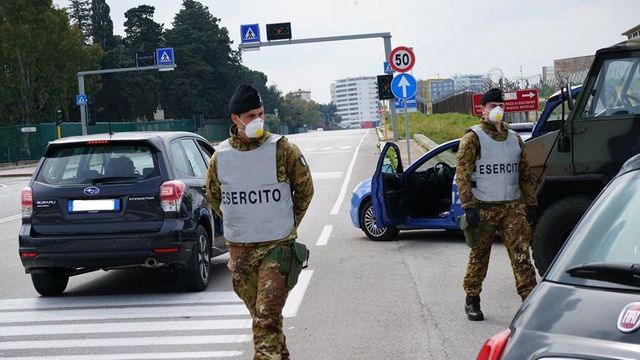
Italian Army soldiers monitoring cars and controlling the streets in Bari: (credit Twitter: Italian Army)
In the UK, the death rate has quadrupled in a week. In just four days since Monday, 1,693 coronavirus deaths have been announced—more than were recorded on all days up to March 29. The Department of Health and Social Care reported a record 569 deaths Thursday, taking the total to almost 3,000 (2,921). This was the second consecutive day Boris Johnson’s Conservative government announced over 500 deaths. Wednesday’s 563 fatalities were a 31 percent increase on the previous day.
With an age range of the latest deaths between 22 and 100 years old, nearly 8 percent (44 people) of yesterday’s victims had no known underlying health conditions.
Britain is now showing the terrible daily toll commonplace in Italy and Spain, with the pandemic taking over 13,000 and 10,000 lives in those countries.
The UK infection rate has also shot up, with 4,324 new cases announced Wednesday and 4,244 Thursday. Total infections in the UK stand at 33,718 but are in reality much higher. Hardly any tests were done when the outbreak began, despite months of warnings. Three weeks ago, Johnson announced—as part of attempting to enforce his “herd immunity” policy aimed at infecting everyone in the country with coronavirus—that no systematic testing would be done and that everyone who showed symptoms should self-isolate.
More than 1.7 million people in the UK have likely caught coronavirus over the past 15 days. Data from the NHS 111 online service revealed that web-based assessments flagged 1,496,651 people as potential carriers; a further 243,543 calls to 111 and the 999 emergency number concluded callers had signs of COVID-19.
It was only after widespread outrage at its social Darwinist policy that the government was forced to pledge that widespread testing would be done. Even now, just 163,194 tests have been completed with yet another promise yesterday of 100,000 a day for the end of April. Only 2,000 of 550,000 National Health Service frontline workers have been tested.
The BBC’s head of statistics, Robert Cuffe, commented Thursday, “if that [UK death rate] keeps up, we’d expect to see in the region of a thousand deaths a day by the weekend.” Sky News economist Ed Conway noted that “For the past week or so,” the UK’s death rate has “been doubling every three days” and “if the growth rate continued like that, in a week’s time there would be 10,000 people dead and the UK would be on a far worse trajectory than Italy.”
An explanation of this steeper curve emerged late yesterday, when NHS England reported that the earliest death in the UK had in fact occurred on February 28, one week earlier than previously reported. In total, six people had died in hospital prior to March 5.
In Italy, 760 died Thursday, taking the total to almost 13,915. Two new studies suggested the true death toll could be significantly higher than reported. The InTwig data analysis firm reveals that while there were 4,500 deaths in the hardest-hit city of Bergamo, the Civil Protection Agency only reported 2,060 deaths. The University of Bergamo, using historical data from the national statistics office compared to current hospital data, showed that deaths in the north of Italy doubled in the first three weeks of March, compared with the average number of deaths during the same period between 2015 and 2019. The uncounted deaths were mostly elderly victims who were not admitted to hospital and never tested for the virus.
The government welfare assistance website remains down, leaving Italy’s most vulnerable unable to receive any COVID-19 scheme for financial support. An estimated 3.3 million Italians work in the black economy and don’t qualify for welfare support schemes. Twenty thousand army soldiers are deployed in southern Campania, Puglia and Sicily to patrol the streets amid rising tensions as citizens run out of food and money.
Germany announced 168 new deaths, taking the total to 1,099. After Berlin approved its “coronavirus aid programme”—a bailout worth €600 billion for the banks, corporations and the super-rich—anger among workers is growing. In the past days, health employees in hospitals, nursing homes and workers in businesses vital to the supply of the population’s needs have criticised catastrophic and unsafe working conditions.
Truck drivers, airport workers, delivery workers and steelworkers are also voicing opposition. A worker at the Outokumpu stainless steel group in Krefeld, speaking anonymously to the WSWS, said, “We’re all angry, feeling betrayed. Even those in risk groups still have to work. An info sheet says they should talk to the company doctor. I did that. He advised me to wash my hands and disinfect myself. But we don’t have any disinfectant, or face masks. I use keyboards, telephones, etc.”
In a dramatic development, France’s death toll shot up by 1,355. Previously, Emmanuel Macron’s government had only released the deaths of those who had died in hospital of coronavirus. Yesterday, it announced that 884 people had also perished in retirement and care homes. On top of the 471 hospital fatalities, this takes total deaths to 5,387. Other countries, including until recently Britain, have also not included those who died outside hospital in their fatality announcements to play down the scale of the catastrophe they are responsible for.
Aware of explosive social anger in workplaces, the Stalinist General Confederation of Labour (CGT) has issued an authorization for public sector workers outside the hospitals to strike in April. The CGT is not calling for strike action or opposition to President Emmanuel Macron, but cynically authorizing isolated action by individual workers while the union bureaucracy keeps working with the government to slash wages and social benefits.
Workers have mounted strikes or walked off the job at Amazon, in supermarkets, in the auto industry and in aeronautics. One worker at an air conditioner manufacturing plant told the press, “This epidemic has woken up a lot of people…now the masks are falling. Usually management manages to calm them down, but today they are seeing that even when it is a matter of life and death, management has no concern for them.”
Lockdowns throughout the continent have led to staggering job losses. The Financial Times reported Wednesday, “Unemployment is growing much faster than in previous recessions because the measures taken to slow the spread of the virus are felt most severely in low-wage, labour-intensive sectors such as retail, hospitality and other consumer-facing services.”
In the UK, more than 1 million people have been forced onto the welfare rolls in just two weeks. Austria reported Wednesday that unemployment now stood at over 12 percent—the highest level since records began in 1946. In Spain, over 900,000 people have been made unemployed since the outbreak began there. In Norway, unemployment has risen from 2.3 percent to 10.4 percent in little over a month. The Financial Times noted the government’s Labour and Welfare Administration statement that a quarter of tourism and transport workers and almost a fifth of retail workers were now claiming unemployment insurance.
The newspaper reported that in Germany, “some 470,000 companies have applied for government wage subsidies through the ‘Kurzarbeit,’ or short-hours, programme—almost five times higher than the 100,000 people who used the scheme during the 2008-2009 recession.”
Another indication of the devastating impact of the coronavirus on the working class is seen in the map produced by the Catalan regional government in Spain, showing that the virus is six or seven times more prevalent in Barcelona’s poorer areas than in wealthier areas.
It’s ‘unthinkable & absurd’ to jail Catalan pro-independence leaders, former UN special rapporteur tells RT
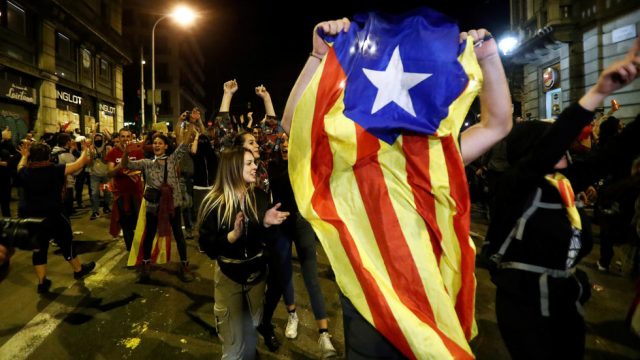
A protest in solidarity with the Catalan pro-independence politicians in Barcelona, Spain, October 20, 2019. © Jon Nazca / Reuters
RT | October 24, 2019
The prosecution of Catalan pro-independence politicians by Spain violates European law and is simply “absurd,” a former high-ranking democracy and human rights expert at the UN has told RT.
“Political prisoners in Spain… It’s absolutely unthinkable!” Alfred-Maurice de Zayas, who served as the UN Independent Expert on the Promotion of a Democratic and Equitable International Order, said in an interview with Rafael Correa on RT Spanish.
He branded the jailing of the leaders of the Catalan independence movement “absurd,” especially since the “Catalans have been protesting for many years in a peaceful, democratic fashion.”
Spain’s northeastern region of Catalonia voted in favor of independence in October 2017. Madrid called the vote illegal and sent in a massive police force to disrupt the referendum.
Chaotic scenes from the ground with officers in full riot gear beating civilians for merely voting, storming polling stations and snatching ballot boxes made the headlines back then, triggering widespread condemnation from international humanitarian organizations.
Following the voting-day crackdown, Spanish authorities detained a group of prominent Catalan politicians who had been involved in staging the referendum. Former Catalan Vice President Oriol Junqueras and eight others were sentenced to between nine and 13 years in prison earlier this month.
Spain is now demanding the extradition of former regional president Carles Puigdemont, who fled to Belgium shortly after the failed independence bid.
“Both Puigdemont and Junqueras were elected with a mandate to carry out this [exact] referendum,” de Zayas stressed.
“So, criminally prosecuting someone for actions that were legitimized through a democratic election is … beyond all reason.”
“It violates Article 2 of the [EU’s] Treaty of Lisbon, which says that such issues must be brought up before the European Commission. Yet, I don’t see any complaints coming from Berlin, Brussels or Copenhagen that declare: ‘Things like that shouldn’t happen in Europe.’”
The lengthy prison sentences for pro-independence politicians sparked peaceful protests in Barcelona, which has been marred by night-time rioting and clashes with police. The mass protests raged for several days in a row, culminating in a general strike last Friday, which attracted at least half a million supporters of independence.
German Government Refuses to Recognise Guaido’s Envoy as Ambassador

Sputnik – March 29, 2019
Although Berlin has sided with the US and recognised self-proclaimed interim president Juan Guaido, it is keeping Otto Gebauer, whom he picked to represent Venezuela in Germany, in limbo and has not granted the representative key diplomatic status. Spain, above all, has reportedly urged fellow EU member states not to recognise him.
Although Otto Gebauer, sent to Germany by self-proclaimed interim president of Venezuela Juan Guaido as his emissary, was received in Berlin, the German government does not plan to accredit him, as the newspaper Neue Osnabrücker Zeitung reports, citing the Foreign Ministry’s response to a request by the left-wing party Die Linke.
According to it, the German government first received Gebauer as “personal representative of Interim President Guaido” on 13 March 2019 to hold talks with him, but “further steps are not planned”. The outlet also reports that, above all, Spain has called on other EU member states not to grant Guaido’s representatives any diplomatic status or corresponding privileges.
Since a political crisis broke out in Venezuela in late January, when parliamentary opposition leader Guaido, backed by the US, declared himself the interim president of Venezuela after disputing President Nicolas Maduro’s re-election last May, Germany recognised him as a transitional head of state. Around 50 states, encouraged by the US, did the same. However, the constitutionally elected head of state Nicolas Maduro, supported by Russia, China, Cuba, Bolivia, Turkey and a number of other countries, continues to hold power and refuses to step down, accusing Washington of trying to orchestrate a coup in order to install Guaido as a puppet leader.
This has led to a paradoxical situation in Germany, leaving it with two Venezuelan emissaries in Berlin but not being able to hold official talks with both of them.
Die Linke praised the decision to restrain from recognising Gebauer as ambassador. Lawmaker from the German parliamentary foreign affairs committee Heike Haensel pointed out that “dispatching of new representatives for Venezuela is based on the recognition of self-appointed President Juan Guaido in violation of international law”, according to the conclusion of the Bundestag’s probe.
“This proves the absurdity of Germany’s Venezuela policy. Recognising Guaido was manoeuvered outside the bounds of international law and this rows it back again”, she said.
Apart from this diplomatic collision, Otto Gebauer has a debatable profile for a diplomat as he was involved in a 2002 coup attempt against President Hugo Chavez, who passed away several years ago. He was a member of the commando unit that held Chavez prisoner and served six years in prison for it.
The legitimacy of interim president Guiado himself is being challenged now as under Venezuelan law his maximum term is limited to a 30-day period. It expired in February while new elections have not yet been announced.
Guaido returns to Venezuela to the welcome of foreign ‘bodyguard’ envoys
RT | March 4, 2019
Self-declared “interim president” of Venezuela, Juan Guaido, returned from his South American tour on Monday, arriving into the loving (and protective) arms of ambassadors from the foreign governments backing him.
Despite Venezuelan authorities making it clear he could face 30 years in prison for attempting to overthrow the government and violating a travel ban, Guaido chose to arrive directly to an airport in Caracas.
The risk of arrest was notably mitigated by the presence of ambassadors from Germany, France, Spain, the Netherlands and several other countries which gathered at the arrival gate to huddle around him like a high-profile human shield. While Guaido was all smiles, his Western-world entourage seemed a bit on edge.
While the media fretted that Maduro might make good on threats to arrest Guaido, the opposition leader passed through customs without incident and headed straight to a rally in central Caracas.
Meanwhile, Vice President Mike Pence warned the Venezuelan government that Washington protects its investments, stressing how important Guaido is to them, and threatening a “swift response” if anyone tries to bully him.
Shortly after moving unhindered through the airport, Guaido arrived at a demonstration he called for on Twitter the week before. Addressing crowds in the country’s capital city, he called on his supporters to take to the streets for continued demonstrations next Saturday.
While Guaido toured South America and met with his most critical support base – foreign governments – the US ramped up pressure on Maduro’s government, imposing intensified sanctions and revoking visas for state actors.
Spanish Supreme Court Sentences Former IMF Chief for Financial Fraud
teleSUR | October 3, 2018
Spain’s Supreme Court sentenced the former International Monetary Fund (IMF) chief Rodrigo Rato to four-and-a-half years imprisonment Wednesday on charges of misusing funds.
In February 2017, Rato was found guilty by Spain’s Supreme Court of paying for personal expenses with company credit cards when he was the chief of Caja Madrid and the state-owned lender Bankia during a time when both the banks faced financial difficulties.
Rato was an economy minister in Spain between 1996 and 2004 and a prominent politician in the ruling People’s Party before becoming the IMF chief. He was free on bail since 2017 pending an appeal, but was found guilty alongside 64 former executives and board members for embezzling a total of US$13.8 million between 2003 and 2012.
Spanish political party Podemos welcomed the court decision, saying Spaniards had long demanded justice, tweeting, “the citizens demanded justice for those who robbed public money, ripped off thousands of families, and burdened us with debt for life.”
The embezzlment — famously known as the “black-cards” scandal — broke in 2014 resulting in public outrage. It was discovered that the cards were used to buy jewelry and clothes, and pay for vacations, according to documents filed with Spain’s high court.
Thousands of small-scale investors lost their money after they were persuaded to convert their savings to shares ahead of the flotation of Bankia in 2011, with Rato at the reins. Less than a year later, he resigned when it became public knowledge that Bankia was in dire straits.
Israel branded ‘illegal state’ by Spain’s Podemos party leader
RT | June 11, 2018
Israel has been branded an “illegal state” by the leader of Spain’s third-largest party, Podemos, for conducting an apartheid-like massacre at the Gaza fence bordering Palestine.
“We need to act more firmly on an illegal country like Israel,” Iglesias Turrion told Spanish RTVE channel. Accusing the country of violating international law and resorting to what he called apartheid-like policies, the leader of the left-wing party questioned the legitimacy of the state of Israel.
“Israel’s actions are illegal. The apartheid policies of the state of Israel are illegal,” the politician said, adding that when it comes to international politics he and his party would continue to “defend international rights.”
Iglesias Turrion’s comments came mere days after a local faction of Podemos on Valencia’s city council “condemned” Israel’s illegal assassinations and declared that the third-largest Spanish city would be an “Israeli apartheid-free zone” from now on.
Valencia’s condemnation of disproportionate violence against Palestinians and the decision to refrain from any contact with Tel Aviv was supported by other Spanish cities, including Madrid, Barcelona and Andalusia, which decided to distance themselves from Israel in an expression of solidarity with the “boycott Israel“ movement.
While the number of casualties on the Israeli-Palestinian border is over 120, Israel has been trying to legitimize its bloodshed by portraying it as a lawful response to the presumed Palestinian violence and Israel’s attempt to protect its borders.
However, Israel’s Prime Minister Benjamin Netanyahu’s insistence that no Palestinian was killed “intentionally” and that “people died accidentally” revealed a disturbing inconsistency with an earlier statement by the Israel Defense [sic] Forces.
Tel Aviv’s oppression of the Palestinians, along with the US’ controversial decision to move its embassy to the disputed [illegally occupied] city of Jerusalem, have been openly condemned by the EU. Seeing no better solution to stop bloodshed at the Gaza border, the European Union, represented by Federica Mogherini, has insisted on a two-state solution with Jerusalem remapped as the capital of “both of the state of Israel and the state of Palestine.”
Western Media Shorthand on Venezuela Conveys and Conceals So Much
By Joe Emersberger | FAIR | April 23, 2018
A Reuters article (4/18/18) reports that the European Union “could impose further sanctions on Venezuela if it believes democracy is being undermined there.”
The line nicely illustrates the kind of journalistic shorthand Western media have developed, over years of repetition, for conveying distortions and whitewashing gross imperial hypocrisy about Venezuela. A passing remark can convey and conceal so much.
The EU’s sincerity in acting on what it “believes” about Venezuelan democracy is unquestioned by the London-based Reuters. Meanwhile Spain, an EU member, is pursuing the democratically elected president of Catalonia, Carles Puigdemont, for the crime of organizing an illegal independence referendum last year. Weeks ago, he was arrested in Germany at Spain’s request, and other elected representatives have been arrested in Catalonia, where Spain’s federal government deposed the elected regional government after the referendum.
In July 2017, a few months before the referendum in Catalonia, Venezuela’s opposition also organized an illegal referendum. One of the questions asked if the military should obey the opposition-controlled National Assembly, which was an extremely provocative question, given the opposition’s various efforts to overthrow the government by force since 2002. The referendum required an extremely high level of political expression, organization and participation. It allegedly involved 7 million voters. The Venezuelan government disregarded the results—as Spain disregarded the Catalan referendum results—but unlike Spain, did not jail people for organizing it, or send police to brutally repress voters. In fact, two weeks later, Venezuelan voters (overwhelmingly government supporters, since the opposition boycotted and did not field candidates) were violently attacked by opposition militants when they elected a constituent assembly. The attacks resulted in several deaths.
Venezuelan President Nicolás Maduro has hardly failed to call attention to the hypocrisy of both the EU and Spain, but the Reuters article made no mention of it.
Reuters also reported that “the country’s two most popular opposition leaders have been banned from competing” from Venezuela’s presidential election on May 20. Reuters didn’t name the two supposedly “most popular opposition leaders,” but in the past (e.g., 4/12/18, 2/28/18, 2/19/18) the wire service has identified them as Leopoldo Lopez and Henrique Capriles. As it happens, according to the opposition-aligned pollster Datanalisis, whose results have been uncritically reported by Western media like Reuters for years, opposition presidential candidate Henri Falcón has been significantly more popular than Capriles in recent months, and barely less so than Lopez.

Mark Weisbrot (in an opinion piece for US News, 3/3/18) broke the news that US government officials had been secretly pressuring Falcón not to run, so that the election could be discredited as including no viable opposition candidate. Two weeks later, Reuters (3/19/18) discreetly reported Weisbrot’s scoop.
However, by far the most important thing Reuters neglects telling readers about the “two most popular opposition leaders” is that had they done in the EU what they’ve done in Venezuela since April 2002, Lopez and Capriles would both be serving long jail terms.
Capriles and Lopez together led the kidnapping of a government minister during a briefly successful US-backed military coup in 2002 that ousted Venezuela’s democratically elected president, the late Hugo Chávez, for two days. Lopez boasted to local TV that the dictator installed by the coup (whom Lopez called “President Carmona”) was “updated” on the kidnapping.
Imagine what Carles Puigdemont’s predicament would be if, rather than organizing a peaceful referendum, he had participated in a foreign-backed, ultimately unsuccessful military coup against the Spanish government. Needless to say, running for public office would not be on the table. That would be the least of his worries.
In Venezuela, Capriles eventually served a few months in prison for participating in the coup, while Lopez avoided doing any time, thanks to a general amnesty granted by Chávez. Lopez was finally arrested in 2014 for leading another violent effort to overthrow the government.
I’ve reviewed before (teleSUR, 1/9/18) violent efforts to overthrow the government that Lopez, Capriles and other prominent opposition leaders have been involved with since the 2002 coup. I also described how Julio Borges and Henry Ramos (two other prominent opposition leaders) have openly sought to starve the Venezuelan government of foreign loans as it struggles with a severe economic crisis.
In August, Trump’s administration imposed sanctions on Venezuela’s entire economy that will cost Maduro’s government billions of dollars this year (FAIR.org, 3/22/18). It has threatened to go even further, brandishing an oil embargo or even a military attack. With sufficiently compliant media (and the collusion of big human rights NGOs like Amnesty International), such depravity becomes possible.
The Reuters article also says that Venezuela’s economic “collapse has driven an estimated 3 million people to flee the country.” No need to tell readers when the economic “collapse” began—2014—much less who made the estimates or if other sources contradict them. In fact, the UN’s 2017 population division numbers estimate Venezuela’s total expat population as of 2017 at about 650,000—only about 300,000 higher than it was when Chávez first took office in 1999. Even a group of fiercely anti-government Venezuelan academics estimated less than 1 million have left since the economic crisis began. (See FAIR.org, 2/18/18.)
Cherry-picked statistics aside, when Western powers want a democratically elected government overthrown, the approach is clear. Complete tolerance for violent foreign-backed subversion—which the powerful states and their allies would never be expected to tolerate—becomes the test for whether or not a state is a democracy. The targeted government fails the test, is depicted as a dictatorship, and all is permitted. Only the tactics required to bring it down need be debated.
Messages to Reuters can be sent here (or via Twitter: @Reuters). Please remember that respectful communication is the most effective.
Spain to Deliver 5 Warships Worth $2.5Bln to Saudi Arabia – Defense Ministry
Sputnik – 13.04.2018
Spanish Defense Minister Maria Dolores Cospedal and Saudi Arabia’s Crown Prince Mohammed bin Salman on Thursday signed an agreement, under which Madrid will deliver five Avante 2200 corvette patrol vessels worth $2.47 billion to the Middle Eastern country, the Spanish Defense Ministry said.
The warships will be built by firm Navantia at its shipyard in San Fernando, Southern Spain, according to the ministry.
Salman arrived to Spain on Wednesday. Earlier on Thursday, the Saudi crown prince held talks with Spain’s King Felipe VI and Prime Minister Mariano Rajoy.
In the period between 2015 and mid-2017, Spain has exported military equipment and weapons worth $901 million to Saudi Arabia, according to data drawn by four non-governmental organizations — Amnesty International, Greenpeace, Oxfam, and FundiPau — from official sources.
In October, four NGOs demanded an independent investigation into the destination of arms acquired by Saudi Arabia, after increasing evidence suggested that Spanish weapons have been used in the conflict in Yemen.
Former Catalan Education Minister Ponsati Going to Surrender to UK Authorities
© REUTERS/ Russell Cheyne
Sputnik – March 28, 2018
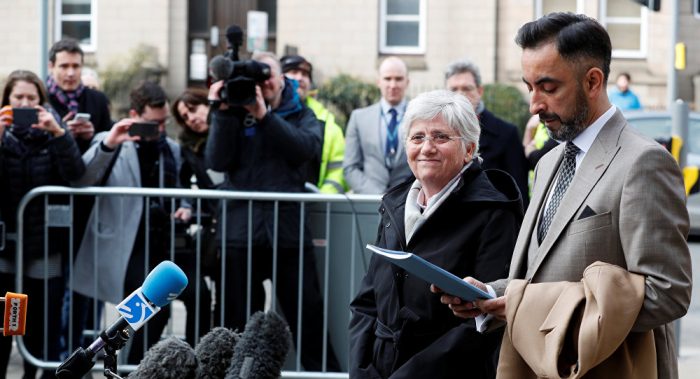
Former Catalan Education Minister Clara Ponsati, who has been hiding from Spanish law enforcement in the United Kingdom, said Wednesday that she was going to surrender to UK authorities.
“Later on this morning I will attend police station with my lawyer @AamerAnwar & will b arrested & taken 2court as Spain tries 2extradite me, I need ur support,” Ponsati wrote on Twitter.
According to Spanish media, a UK judge will decide on the measure of restraint for her later in the day.
On Tuesday, the politician began raising funds online for her legal defense, saying that her goal was to get 40,000 pounds ($56,600). As of now, the campaign managed to raise almost 100,000 pounds.
Charges Against Ponsati
On October 1, Catalonia held an independence referendum, which the central authorities did not recognize. The results showed that the majority of Catalans supported secession, and the regional parliament unilaterally announced independence later in October. In response, Madrid imposed direct rule over the autonomous region, dissolved the Catalan parliament and called a snap election. Several pro-independence leaders were jailed, while others fled to Belgium.
Following the independence vote, Ponsati fled to Belgium with former Catalan leader Carles Puigdemont and three other regional politicians. In March, Ponsati moved back to Scotland and her position as a professor at St. Andrews University.On Friday, the Spanish Supreme Court activated a European arrest warrant for a number of Catalan politicians, including Puigdemont and Ponsati. Shortly after, Puigdemont was detained in Germany after he crossed the border with Denmark on his way from Finland to Belgium.
According to the Spanish Prosecutor’s Office, Ponsati was responsible for allowing polling places to stay open in schools during the referendum. She is charged with organizing an insurrection — which under Spanish law can mean a prison sentence of up to 30 years — as well as embezzlement of state funds.
READ MORE:
Featured Video

Trita Parsi: Massive Houthi Victory Transforms U.S.-Iran War
or go to
Aletho News Archives – Video-Images
New Book
The Vitamin K Injection (2026)
A new paperback on what’s in the shot every newborn is offered in the first hour of life
Lies are Unbekoming | September 12, 2026
Every U.S. newborn is offered a shot in the leg in the first hour of life. Parents are rarely told the shot exists until the moment it is about to be given.
The new paperback is out today. It examines that shot.
Twenty-seven chapters walk through what the vitamin K injection actually is, what it contains, what the manufacturers themselves warn against, what the studies did and didn’t find, and where the current framework came from. … continue
Blog Roll
 Aletho News
- Matt Gaetz’s Brilliant Exposé on Israel Partisans’ Claims of “Antisemitism”
- The Vitamin K Injection (2026)
- Mortality Data Reveal ‘Screaming Safety Signals’ Following COVID Vaccine Rollout
- 13 Things Your Pediatrician Was Trained Not to Tell You
- Trita Parsi: Massive Houthi Victory Transforms U.S.-Iran War
- Britain stands against oppression in Palestine… by supplying F-35s
- Iran has good reason to bar IAEA inspectors from returning amid US aggression: Author
- Invoking 9/11 to justify war against Iran is ‘utterly absurd’: Tehran
- Why the Israelis are so afraid of a liberated Yemen
- BRICS Draws Red Lines on Lebanon, Cuba, and Global Security
- If Americans Knew
- Israeli attack kills Gazan woman and unborn baby – Daily Update
- What was Netanyahu’s first thought on 9/11? – Daily Update
- Digital Strategists: Washington’s Network of “Manipulation and Influence Projects” for Israeli Propaganda
- Israeli Documentary ‘NAZA’ Exposes ‘System of Killing’ in Gaza From Eyes of Secret Intelligence Unit
- Confessions of an Israeli Army Drone Operator
- Maximum Territory, Minimum Population
- Is the Israel Lobby Doomed?
- Israel kills 9, including family of 4, in Gaza – Daily Update
- Secret systems used by Israel in mass killings of Gaza civilians revealed in new film
- Israel Bombs South Lebanon as Report Documents 23 White Phosphorus Attacks
- No Tricks Zone
- Energy Crisis: Germany Enters Heating Season With Historically Low Gas Reserve Fill Levels
- New Study: The Antarctic Ice Sheet Gained Mass From 2020-2024 Due To Staggering Snow And Ice Accumulation
- Study: Ocean Heating Rates From Thousands Of Years Ago ‘Dwarf’ Modern Ocean Heating Rates
- Climate Extremists Target, Attack Large-Scale Power Grid Infrastructure In Germany!
- New Study: Antarctic Ice Melt Has Contributed Less Than 1 Centimeter To Sea Level Rise In The Last 30 Years
- Fear Of Debate: Alarmist German Climate Scientist Calls On Mainstream Media To Discredit Skeptic Voices
- End-Of-August Arctic Sea Ice Extent Hasn’t Fallen In 20 Years, Official Data Show!
- News-Making Nepal Region Has Had As-Warm Or Warmer Periods Than The 2000s In The 1600s, 1700s, 1800s
- 2025 Study: ‘There Exists No Unequivocal Experimental Evidence For The CO2 Greenhouse Effect’
- 2026 Atlantic Cyclone Energy Index Running At 85% Below Normal!
 Aletho News