‘Peacemaker’ Trump beats Biden’s bombing record since return to office: Report
The Cradle | July 23, 2025
US President Donald Trump has ordered hundreds of airstrikes across West Asia and Africa since his return to office, carrying out more attacks in the first five months of his second term than former president Joe Biden did during his entire presidency, according to the Armed Conflict Location & Event Data (ACLED).
“In just five months, Trump has overseen nearly as many US airstrikes (529) as were recorded across the entire four years of the previous administration (555),” said ACLED President Clionadh Raleigh.
Among the countries bombed by Trump are Iran, Iraq, Syria, Somalia, and Yemen. The majority of strikes were carried out against Yemen.
“The US military is moving faster, hitting harder, and doing so with fewer constraints. Syria, Iraq, Afghanistan, Yemen, Somalia, and now Iran are all familiar terrain, but this isn’t about geography – it’s about frequency,” Raleigh added.
The surge in attacks contradicts Trump’s campaign promises, which framed him as “anti-war.”
In March this year, Trump renewed the Biden government’s campaign against Yemen with much greater intensity.
Months of brutal and deadly attacks struck the country in response to the Yemeni Armed Forces’ (YAF) naval operations against Israeli interests and its missile and drone strikes in support of Palestine.
Yemeni forces consistently responded to US attacks by targeting US warships in the Red Sea, during both Biden and Trump’s terms.
A ceasefire between Sanaa and Washington was reached in May, after the US campaign burned through munitions and failed to impact Yemeni military capabilities significantly.
However, the campaign took a heavy toll on civilians and compounded the humanitarian crisis the country has faced due to over a decade of war.
An investigation released by Airwars last month revealed that Trump’s war on Yemen killed almost as many civilians in less than two months as in the last 23 years of Washington’s military action in the country combined.
“In the period between the first recorded US strike in Yemen to the beginning of Trump’s campaign in March, at least 258 civilians were allegedly killed by US actions. In less than two months of Operation Rough Rider … at least 224 civilians in Yemen [were] killed by US airstrikes – nearly doubling the civilian casualty toll in Yemen by US actions since 2002,” it said.
In Iraq, Syria, and Somalia, Trump has also continued to strike what Washington says are ISIS and Al-Shabab targets.
Despite vowing to end “forever wars,” Trump has recently threatened to expand them.
On 22 July, the US president threatened to launch new attacks on Iran, after late June bunker-buster strikes on Iranian nuclear facilities which were carried out on behalf of Israel.
Al-Tanf and the Yinon Plan for Syria: Israel’s Fortress of Fragmentation
21st Century Wire | July 21, 2025
Oded Yinon, author of the 1982 paper “A Strategy for Israel in the 1980s,” is often cited regarding Israel’s aim to divide neighboring Arab and Muslim areas into ethnic mini-states. Yinon was a former advisor to Ariel Sharon, a former senior official with the Israeli Foreign Ministry, and a journalist for The Jerusalem Post. Although Yinon downplays the paper’s direct relevance to current geopolitics, its ideas have arguably become foundational to Zionist policy; balkanization was crucial for Israel’s establishment and continues to be a strategy for its military dominance in the Middle East, especially in Syria. His paper is commonly known as the “Yinon Plan.” Within it, you can read:
“The dissolution of Syria and Iraq later on into ethnically or religiously unqiue areas such as in Lebanon, is Israel’s primary target on the Eastern front in the long run, while the dissolution of the military power of those states serves as the primary short term target. Syria will fall apart, in accordance with its ethnic and religious structure, into several states such as in present day Lebanon, so that there will be a Shi’ite Alawi state along its coast, a Sunni state in the Aleppo area, another Sunni state in Damascus hostile to its northern neighbor, and the Druzes who will set up a state, maybe even in our Golan, and certainly in the Hauran and in northern Jordan. This state of affairs will be the guarantee for peace and security in the area in the long run, and that aim is already within our reach today.”
The fragmentation of Syria was always an integral part of the Yinon plan, with its operational headquarters not in Tel Aviv but at the US Al-Tanf base, located at the tri-border area between Syria, Jordan, and Iraq, and along one of the main highways between Baghdad and Damascus.
Syrian journalist and TV presenter, Haidar Mustafa, wrote for The Cradle on December 2, 2024, about the importance of the Al-Tanf base, one of the most strategic military garrisons for the US occupation in Syria, which acted as a launching platform for countless Israeli overt and covert operations:
“The US coalition’s mission against the Islamic State quickly evolved into a broader strategy of occupying parts of Syria, with the Al-Tanf base crucial to securing its influence and supporting Israeli interests amid growing local resistance.”
In a recent post on X, Lebanese analyst Ibrahim Majed articulated several points about the Al-Tanf base and the immense role the American base has played in advancing Israel’s Yinon Plan, describing it as a “Strategic Outpost for Greater Israel and Israel’s Fortress of Fragmentation.” His post inspired the title of our post today.
Recently, we covered the “David’s Corridor”, a land route in Israel that extends from the occupied Golan Heights through southern Syria to the Euphrates. This route represents Israel’s most crucial foothold in the centre of West Asia, which ultimately benefits from the protection provided by the Al-Tanf base. Should Israel manage to gain control over the southern provinces of Syria, it will be considerably closer to connecting with the territories held by the U.S.-backed Syrian Democratic Forces (SDF) in the east, through the American Al-Tanf base located near the Iraqi border, achieving several goals including the non-negligible control of the corridor, the fragementation of Syria and in time the replacement of the “Shiite Crescent” by an “Israeli Crescent”. Israel aims to establish a secure route that begins in the Golan Heights, traverses through the Suwayda province, continues across the eastern Syrian desert where the US base at Al-Tanf is situated, and extends to the Kurdish-controlled area of Hasakah, ultimately reaching Iraqi Kurdistan along the Iranian border. This explains the continued US military presence in north-east Syria and why last week, on two occasions, a large CIA delegation found itself at the Qasrak base in Al-Hasakah. This is how Israel intends to permanently cut off the Tehran-Beirut road.
Regarding the Druze community in Syria, Israel uses them primarily as a geographic instrument, a human “Maginot Line” of some sort, where the demographic acts as a human shield that, on one hand, hinders Sunnis’ expansion, while simultaneously stopping the Shiites from consolidating on the other. Local groups like Druze, Kurds and Bedouin tribes are all supported directly or indirectly with Western and Israeli logistics and intelligence, and it will remain so, as long as their presence helps Israel fill the vacuum.
The situation in Syria is no longer up for debate—it is laid bare, with each chapter shedding light on the Greater Israel Plan, or the so-called Yinon Plan. This plan provides neither peace nor solutions, nor does it reflect any sense of humanity; instead, it ensures chaos for geopolitical and financial profit, leading to the downfall of a nation we once recognised as Syria. Lebanon is undoubtedly next on Israel’s fragmentation map, and it is with great concern that one must anticipate Israel’s next move…
Darrin Waller writes Fountainbridge Substack…
Understanding the Yinon Plan: Syria is Gone — Is Lebanon Next?
The fall of Syria marks the beginning of a new era of Levantine chaos.
As I wrote when Assad fell, Syria ceased to exist. Fourteen years of sectarian carnage — unleashed by a Salafist proxy terrorist militia, trained by the US, UK, Israel, and Turkey in camps across Jordan and Turkey, and funded by Persian Gulf petrodollar monarchies to the tune of three trillion dollars — extinguished the last secular Levantine nation in December 2024.
As Hassan Nasrallah warned:
“If Syria were to fall into the hands of these groups, its present and future would spiral into chaos… a scene of endless infighting among factions devoid of reason or culture, drowning in extremism, bloodshed, sectarian rivalries…”
It is done. Sold to us as a revolution. A popular uprising.
Another regime change operation — brutally executed over 14 years — culminated in the installation of a mercenary leader: the Saudi-born takfiri Jolani, now styling himself as President Ahmed al-Sharaa.
What we are seeing is the prosecution of the Yinon Plan — a 1982 geopolitical blueprint calling for Israeli regional dominance through the fragmentation of Iraq, Syria, Lebanon, and Egypt along ethnic, sectarian, and tribal lines.
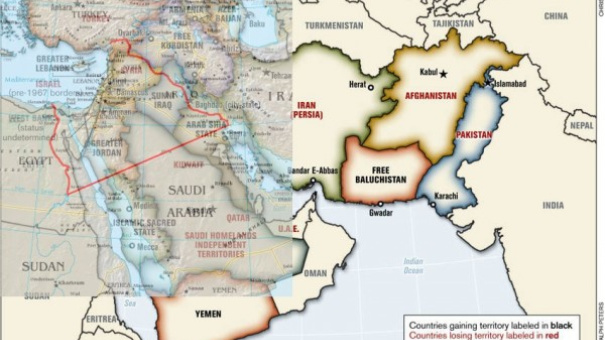
IMAGE: Project Balkanisation: Oded Yinon and an Enduring Plank of Israeli Foreign Policy (Source: Katehon)
It argues that Israel’s long-term survival hinges on one core premise: “The dissolution of all existing Arab states into small units.”
On the surface, the geopolitical win by the US-UK-Israel military-intelligence trifecta — backed by Turkey and the Persian Gulf monarchies — appears seismic. A Shīʿī-led country now falls under Sunni Salafism, severing the contiguous Shīʿī-controlled corridor linking Tehran to Hezbollah in Lebanon.
Another barrier to China’s Silk Road ambitions into the Mediterranean has been firmly set in place. Any revival of the ancient Via Maris — a trade corridor that once ran the Levantine coast, linking Asia to Europe and North Africa — remains a pipe dream.
Severed by the establishment of Israel and now buried beneath the rubble of Syria’s destruction, it ensures that any vision of unity from the Maghreb to the Arabian Peninsula remains just that — a vision.
But perhaps of greater immediate import — Israel’s ethno-supremacists and their vision of a ‘Greater Israel’ have just taken a giant leap forward. Southern Syria — and crucially, Mount Hermon, which overlooks Damascus and the Bekaa Valley in Lebanon, granting strategic military dominance over both — is now firmly under Israeli control. As is the tri-border area between Syria, Jordan, and Iraq — Al Tanf.
Yet there’s more. Israel now moves to establish its self-styled ‘David’s Corridor’ — a contiguous land route stretching from the occupied Golan Heights through southern Syria to the Euphrates. It cuts through the governorates of Deraa, Suwayda, Al-Tanf, and Deir Ezzor, reaching the Iraqi-Syrian border at Albu Kamal — granting Israel a strategic foothold deep in the heart of West Asia.
The corridor was already partially activated during the 12-day war with Iran, enabling standoff air strikes deep into Iranian territory.
With a direct land route to Iraq now viable, expect covert destabilisation efforts within the Shīʿī heartlands of Karbalāʾ and Najaf, alongside renewed backing for Kurdish separatists in both Iraq and Syria. Further vicious sectarian conflict across the region is now being baked in.
Whilst Israel’s bombing of the Defence Ministry and the Presidential Palace in Damascus was supposedly to protect the Druze community from Jolani’s Salafist mercenaries, no such protection was afforded to the Alawites, Armenians, Assyrians, or any of Syria’s other religious or ethnic minorities, who were left to be slaughtered.
The strikes on the Defence Ministry and Presidential Palace were telegraphed well in advance — and were thus performative. A warning to Jolani — Southern Syria is now firmly under Israel’s purview. No Syrian military forces will be allowed.
Meaning: Jolani and his hired guns are expendable, especially now that they’ve completed their task — extinguishing Syria’s sovereignty. As Hadi Nasrallah ruefully put it:
“You mean to tell me the very ones armed by Israel, treated in Israeli hospitals, coordinating with the IOF, shaking Netanyahu’s hand and thanking him for bombing Lebanon — are now being bombed by Israel after serving their purpose? Who would’ve thought?”
And yet, it remains far from clear if Jolani has outlived his usefulness, or if he still has his uses, at least from a US perspective.
Only days ago, whilst Jolani was in Baku, Syrian and Israeli officials were reportedly in talks. Rumours even swirled of a deal wherein Syria would launch attacks against Lebanon’s Shiʿī communities — either independently or in coordination with Israel.
Little wonder, then, that US envoy Tom Barrack warned Lebanon to ‘disarm Hezbollah or risk Syrian occupation’ — signalling that Lebanon, too, is likely slated for division and balkanisation.
The port of Tripoli and the Bekaʿa Valley, Lebanon’s agricultural heartland and a Shīʿī stronghold, are now in play. The only question is whether Ankara or West Jerusalem will seize them first, come to blows over Lebanon’s spoils, or quietly divide them, with Turkey taking the port and Israel the Bekaʿa.
But full control may yet require the chaos of full-on civil war. Syria and Lebanon edge closer — division and balkanisation becoming ever easier to enforce, until little remains but manageable fragments. The Yinon Plan made manifest.
“The attack on Lebanon is going to happen without a doubt… the question is when, and the other question is how. Is Israel going to do a ground invasion at the same time or just attack from the air?” (Ibrahim Majed)
Doubtless, the architects of today’s chaos are already patting themselves on the back, expecting handsome dividends to roll in. More division. More balkanisation. A weaker, fractured Arab world — and a stronger, more dominant Israel.
This is what Netanyahu means when he talks about “redrawing the Middle East”.
Yet the US and Israel are unravelling at an accelerating pace. Their seeming victory over the Levant is no triumph of providence — it courts the abyss and beckons the judgment to come.
US envoy says Hezbollah weapons ‘an internal matter’ during Beirut visit
The Cradle | July 21, 2025
US envoy Tom Barrack said while visiting Lebanon on 21 July that the issue of disarming Hezbollah is an “internal matter,” after months of pressure by Washington on the Lebanese state to secure a surrender of the resistance’s weapons.
“Disarming Hezbollah is an internal matter,” he said, adding that “ideas and assistance” are being offered to the Lebanese state.
“We are not forcing anyone to do anything … we are trying to help,” he added.
He stressed that Hezbollah “is a terrorist organization” in the eyes of the US, and that Washington does not engage in dialogue with it. “We have no skin in the game,” Barrack said.
He claimed Lebanon faces no “consequences” or “threat” if Hezbollah does not disarm, but that it will be “disappointing.”
When asked by a reporter about guarantees that Israel will withdraw its forces from Lebanon and end its attacks on the country, Barrack said, “We cannot compel Israel to do anything, can we?”
Barrack is in Lebanon to discuss with officials Beirut’s response to a US proposal for disarming Hezbollah.
Sources cited by Reuters in early July said that Barrack warned that Hezbollah must be disarmed by November or the end of this year at the latest – in exchange for a withdrawal of Israeli troops from the five points they occupied in south Lebanon after the ceasefire, in violation of the deal. Earlier this month, the US envoy warned that Lebanon risked being occupied by Syria’s extremist-dominated military if Beirut did not move quickly to disarm Hezbollah.
Barrack said during his last trip to Lebanon that he was “satisfied” with Lebanon’s response to the US roadmap, which is expected to be finalized and handed over soon.
Beirut has reportedly demanded that no timeframe for disarmament be set until Israel withdraws and ends attacks.
The resistance group has repeatedly rejected surrendering its weapons. As the government vows to achieve a monopoly over all weapons across Lebanon, Hezbollah says it is ready for internal discussions on the formation of a Lebanese defensive strategy, through which the group’s arms would be incorporated into the state for use in deterring Israel.
The Lebanese resistance group has refused any discussion on the matter until Israeli troops withdraw from Lebanon and end their attacks.
Israeli attacks on Lebanon have continued unabated. Tel Aviv has violated the ceasefire over 3,000 times. More than 200 people have been killed since the deal was signed in November 2024.
Twelve people were killed in an Israeli airstrike in the eastern Bekaa region of Lebanon last week.
Israel has threatened to continue escalating against Lebanon if Hezbollah is not disarmed.
Hezbollah MP Hussein Jachi said on Monday that Hezbollah “will not abandon its weapons for empty US promises.”
“We will not abandon our faith or our strength. We are ready for confrontation. There will be no surrender or submission to Israel, and Israel will not receive our weapons,” Hezbollah chief Naim Qassem said on Friday.
“We know that confrontation is very costly, but surrender leaves us with nothing,” he added, noting that if the “threat is removed, we are ready to discuss the defense strategy and the national security strategy.”
We reject ‘Israeli protection’: Druze spiritual leader
Press TV – July 18, 2025
The spiritual leader of the Druze ethnic minority in Lebanon says the community rejects the Israeli regime’s request to supposedly “protect” the minority.
Sheikh Sami Abi al-Muna made the remarks at a gathering of Druze officials in the Lebanese capital Beirut on Friday.
He was referring to the regime’s repeated deadly and destructive violations of the Syrian territory, which it has undertaken under the supposed pretext of “protecting” the Druze, who also form a minority in Syria.
The request on the part of Tel Aviv “is harmful to our history and identity,” al-Muna added.
Observers rated the remarks as a warning to the regime against its trying to associate itself with the minority in order to advance its expansionist regional goals.
‘Don’t provide Israel with an excuse’
The spiritual leader, meanwhile, addressed the recent clashes in southern Syria between members of the Druze community and Bedouin tribes that had so far claimed the lives of hundreds of people.
He cautioned that the sectarian clashes “give an excuse for Israeli intervention and for blowing up the situation in the region.”
The regime has intensified its assaults on Syria since last year, claiming it seeks to prevent an outpouring of violence from the Arab country into the occupied territories.
On Wednesday, the escalation took a significantly more violent turn, when the regime hit various parts of Syria, including the capital Damascus, with intense airstrikes.
The attacks came amid the deadly fighting between the Druze and the Bedouins, fueling fears that the Israeli involvement under the pretext of supporting the Druze was aimed at intensifying the confrontations and further destabilizing Syria.
Amid the situation, al-Muna called for all parties to rather resort to national dialogue to address the issues among different communities in Syria.
Lebanese Druze leader Walid Joumblatt addressed the same gathering, calling for formation of an investigative committee to probe violations against both Druze and Bedouins in the Arab country.
A day earlier, he had also warned in remarks to France’s RFI radio station that “Israel is using the Druze to tear Syria apart.”
He said “Israel’s intent to divide the country” was visible from the clashes that had erupted between the dual communities in Syria.
Seyed M. Marandi: Israel Attacks Syria – Prelude to Balkanization
Glenn Diesen | July 18, 2025
Seyed Mohammad Marandi is a professor at Tehran University and a former advisor to Iran’s Nuclear Negotiation Team. Prof. Marandi discusses Israel’s efforts to Balkanise Syria. Follow Prof. Glenn Diesen: Substack: https://glenndiesen.substack.com/
X/Twitter: https://x.com/Glenn_DiesenPatreon:  / glenndiesen
Support the channel: PayPal: https://www.paypal.com/paypalme/glenn…
Buy me a Coffee: buymeacoffee.com/gdieseng
Go Fund Me: https://gofund.me/09ea012f
World rallies behind Syria as Israel tears away at it
Press TV – July 18, 2025
International organizations and a whole host of countries have expressed outright condemnation of the Israeli regime’s escalating deadly and destructive attacks against Syria under the pretext of protecting the country’s Druze minority.
A torrent of statements followed the regime’s attack on various areas in the country on Wednesday, including areas lying in its south, in reported support for the Druze.
The attacks came as fighting between members of the minority and Bedouin tribes has killed hundreds of people, with the Israeli involvement being feared to be aimed at intensifying the confrontations and further destabilizing Syria.
UNSC calls for end to Israel’s ‘impunity’
Addressing the situation, Pakistan, which holds the United Nations Security Council (UNSC)’s rotating presidency, denounced the Israeli aggression.
Ambassador Asim Iftikhar Ahmad noted that the attacks resembled Tel Aviv’s atrocities against the Gaza Strip, Lebanon, Iran, and Yemen, all of which violated the international law. The envoy also called for an end to the regime’s impunity.
Mohamed Khaled Khiari, UN assistant secretary-general, denounced the Israeli escalation on the part of the world body’s chief, Antonio Guterres.
He said the attacks amounted toa violation of Syria’s sovereignty and territorial integrity, and further destabilized the country amid the already sensitive situation.
The official also advised that Tel Aviv respect the 1974 agreement that has mandated its refusal to conduct violations against the Arab nation.
China calls for Israeli withdrawal
Geng Shuang, China’s deputy UN ambassador, said Beijing called on “Israel to immediately cease its military strikes on Syria and withdraw from Syrian territory without delay.”
Chinese Foreign Ministry spokesman Lin Jian also said the attacks amounted to a flagrant violation of international law and Syria’s sovereignty, saying the Arab country had to be spared of whatever measure that could lead to further crisis and tension.
Turkey: ‘Terror state’ Israel using Druze as excuse
Turkey’s President Recep Tayyip Erdogan called the Israeli regime a “terror state.”
“Israel, using the Druze as an excuse, has been expanding its banditry into neighboring Syria over the past two days,” he said in a televised speech.
Erdogan said Turkey would not allow Syria’s partition, saying Tel Aviv’s actions showed it was not after peace.
PGCC: Israel after irresponsible escalation
The Persian Gulf Cooperation Council’s Secretary-General, Jasem Mohammed Albudaiw,i also said the Israeli regime’s atrocities indicated its efforts at irresponsible intensification of standing tensions.
The Israeli aggression, he added, also showed the regime’s disregard for the international community’s efforts at realizing stability and ensuring security in Syria.
Hamas: Israeli aggression ‘systematic terrorism’
The Palestinian resistance movements, Hamas and the Islamic Jihad, called the atrocities “organized terrorism.”
The latter also said Tel Aviv was trying to fragment the region through violence, reaffirming solidarity with Syria and supporting its right to resist by all means.
Ansarullah: Israeli attacks part of ‘imperialist scheme’
Yemen’s Ansarullah resistance movement denounced the Israeli strikes as part of a larger “imperialist scheme” to dominate the Arab and Muslim world.
It called for a unified Arab-Islamic response and an end to silence in the face of the aggression.
Muslim states hold intensive talks
Foreign ministers from various regional Muslim countries have, meanwhile, held intensive talks concerning the state of affairs.
The talks were held among top diplomats from Jordan, the United Arab Emirates, Bahrain, Turkey, Saudi Arabia, Iraq, Oman, Qatar, Kuwait, Lebanon, and Egypt.
The discussions that were held with the aim of helping the countries in question adopt a unified stance in the face of the situation saw the officials reiterate support for Syria’s security, unity, stability, and sovereignty.
They called on the UNSC to assume its legal and moral duties towards guaranteeing the withdrawal of the Israeli regime from Syria, and bringing about an end to its aggression by obliging it to abide by the 1974 agreement.
Malaysia: Israel threatening international peace
Malaysia also called for the international community “not to tolerate the continued aggression by the Israeli Zionist regime against other countries, threatening regional and international peace and security.”
Malaysian Prime Minister Anwar Ibrahim said after decades of hardship, the Syrian people deserved peace, not further violence and external interference.
Norway’s foreign minister has also said he was “deeply concerned about recent Israeli airstrikes and rising domestic tensions.”
Turkiye backs extremists in Lebanon as ‘blackmail’ over Cyprus ties
The Cradle | July 14, 2025
Turkiye has expressed “deep concern” over Lebanese President Joseph Aoun’s recent visit to Cyprus and has plans to “blackmail” Beirut if it chooses to counter Ankara’s influence in the Mediterranean, a senior Lebanese source told The Cradle on 14 July.
“Ankara expressed deep concern over Aoun’s visit to the Cypriot capital, Nicosia, and viewed it as a worrying sign of Beirut’s potential openness to Mediterranean and European partnerships that are inconsistent with its agenda in the Eastern Mediterranean,” the source said.
“Northern Lebanon is witnessing a worrying increase in the number of displaced Syrians with complex security backgrounds,” the source added, noting an increase in cross-border [weapons] smuggling operations which are taking place “under the direct sponsorship and cover of Syrian and Turkish security agencies.”
According to the Lebanese source, Aoun’s visit to Cyprus “revealed files of political and security blackmail prepared by Turkiye for use later if Beirut decides to pursue strategic options that conflict with Ankara’s interests in Lebanon and the region.”
The source went on to say that Ankara “considers northern Lebanon as its traditional area of influence and will not tolerate any new official positioning by Beirut that threatens its geopolitical position in the Mediterranean.”
Turkiye invaded Cyprus in 1974 and controls the northern part of the island. Ankara views Greek Cyprus as a main regional and geopolitical rival.
The Cradle’s Malik Khoury wrote that Ankara is unlikely to take kindly to an improvement of Lebanese–Cypriot ties, and has strong ambitions for northern Lebanon.
“Turkiye has long-standing historical ties to northern Lebanon,” he said. Citing Lebanese sources, he noted Ankara’s “interest in the port of Tripoli.” Geographically and maritime-wise, this is the largest port in the Mediterranean in terms of potential. “If rehabilitated, it could rival the Israeli port of Haifa. Ankara also has its eye on the Qlayaat Airport, near the Syrian border, as well as large areas of the Akkar Plain, rich in minerals and natural resources,” he added.
Thousands of extremist Islamist prisoners, including Syrians linked to the groups now affiliated with authorities in Damascus, are held in Lebanon’s Roumieh prison.
Reports from after the fall of former Syrian president Bashar al-Assad’s government said that Syria was planning to request their repatriation.
A day after Aoun’s visit to Cyprus last week, a source quoted by Syria TV threatened to revive the issue of Syrian prisoners in Lebanon, while hinting at the potential closure of the Syrian–Lebanese border. The report said Damascus is unhappy with Beirut’s “handling” of the situation and is planning a political and diplomatic escalation if the issue is not resolved.
“If you want to breathe air via Cyprus, you will suffocate by land from Damascus,” the source said.
The information provided by the Lebanese source to The Cradle comes as there has been growing concern about potential ambitions by Syria’s extremist-dominated military to take over swathes of northern Lebanon.
There have been reports recently that extremist fighters from Syria have been infiltrating Lebanon.
The Lebanese Armed Forces (LAF) denied these reports on Sunday and said they are working to ensure the security of the border.
Ten people, including two foreign nationals, were detained during an LAF operation in the town of Btebyat in Metn in the Mount Lebanon governorate, according to an army statement Sunday evening. The suspects’ nationalities were not specified.
Initial findings indicated that the individuals were not linked to any extremist organizations. The army’s statement did not acknowledge circulating reports of attempts to stockpile weapons across the country in preparation for attacks.
A report by Israel’s i24 in early July claimed Syria is demanding control over the northern Lebanese city of Tripoli during ongoing talks between Damascus and Tel Aviv.
The concern caused by this report and others like it was compounded on Friday, when US envoy Tom Barrack warned that Lebanon is “going to be Bilad al-Sham (historical name for Greater Syria) again” if Hezbollah does not surrender its arms.
“Syrians say Lebanon is our beach resort,” Barrack added.
The threat of extremist factions, which now make up the bulk of the Syrian state, is not new to Lebanon.
The Syrian army is predominantly made up of what used to be known as Hayat Tahrir al-Sham (HTS), an extremist Al-Qaeda-linked organization which was headed by Syria’s new President Ahmad al-Sharaa (known back then as Abu Mohammad al-Julani).
HTS was formerly known as the Nusra Front – Al-Qaeda’s official branch in Syria. The organization, responsible for deadly suicide attacks inside Lebanon, took over large swathes of the Syrian–Lebanese border in the first few years of the war in Syria, including the barrens of Arsal and Ras Baalbek.
The organization was eventually fully repelled by Hezbollah and the Lebanese army in 2017 in what is referred to as “The Second Liberation.”
HTS and the other groups, which have been incorporated into the Syrian Defense Ministry, have long operated under the direct tutelage of Turkish intelligence.
Latakia’s burning coast: Sectarian purge masked as ‘wildfire’ under Syria’s new government
Syria’s new rulers exploit wildfire and war to reshape the coastal region
By Abdullah Suleiman Ali | The Cradle | July 12, 2025
Less than four months into its rule, Syria’s interim government is under mounting pressure, as each crisis—natural or security-related—casts doubt on its ability to govern and maintain control.
The recent wildfires that tore through northern Latakia were no seasonal accident. They broke out as sectarian killings escalated and suspicions of state complicity grew.
The blaze behind the purge
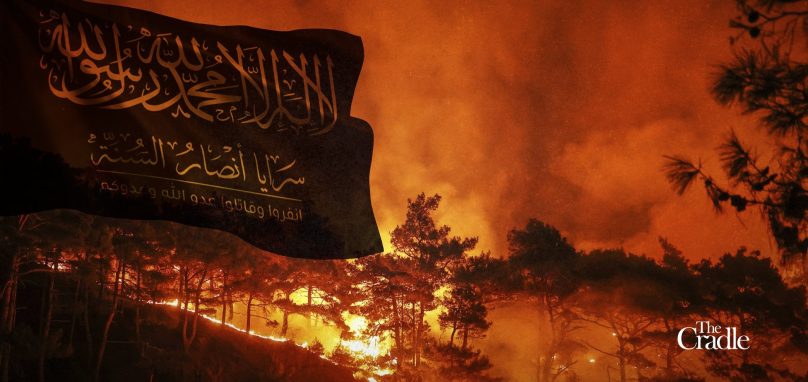
Never before in Syria had an armed group claimed responsibility for a natural disaster. That changed when Saraya Ansar al-Sunna announced it was behind fires that spread through the Qastal Ma’af region, explicitly stating that the arson attack “led to the fires spreading to other areas, forcing the Nusayris [Alawites] to flee their homes, and causing a number of them to suffocate.”
The statement came just three days into the blazes and only weeks after the same group had claimed responsibility for the 22 June bombing of Mar Elias Church in Damascus’ Douweila neighborhood.
That attack had sparked a rare public dispute between the Interior Ministry and Saraya Ansar al-Sunna. While the ministry blamed ISIS and paraded an arrested cell, the group named a different perpetrator, Muhammad Zain al-Abidin Abu Uthman.
Despite vowing to release confessions to back its version, the ministry has remained silent.
Anas Khattab—former Al-Qaeda commander and Nusra Front co-founder, now serving as interior minister—only deepened the contradictions during his visit to the fire zone. He insisted there was “no evidence” of arson, even as his own ministry investigated suspects.
Khattab’s refusal to acknowledge Saraya Ansar al-Sunna suggests that Damascus still considers it a phantom—a position reinforced when ministry spokesman Noureddine al-Baba publicly dismissed it as “imaginary” during a press conference after the church bombing.
At the same time, some Alawites believe that Interior Minister Khattab is using Saraya Ansar al-Sunna to carry out attacks against Alawites, Christians, and other minorities, while maintaining plausible deniability.
Coordinated chaos and forced displacement
In Latakia’s coastal hinterlands, fear was already running high. Many villages had yet to recover from the violence of March, when security raids and sectarian killings devastated entire communities, leaving behind charred homes and mass graves that remain under-reported by official channels.
Only months ago, bloody confrontations claimed 2,000 lives across the region. Locals, mainly from the Alawite community, saw these events as the culmination of a systematic purge under the new regime. A wave of targeted killings, kidnappings, and violence had left communities deeply scarred.
Just days before the fires erupted, the murder of two brothers working as grape leaf pickers, along with the kidnapping of a girl, sparked widespread protests in the Al-Burjan and Beit Yashout areas in the Jableh countryside.
These demonstrations, amplified by diaspora voices, coincided almost to the hour with the first outbreaks of fire, feeding widespread suspicion that the flames were a diversion or smokescreen. On the same day this call was issued, the spread of fires in the Latakia countryside forests began to attract media attention.
The Qastal Ma’af fire—the most intense and destructive—was explicitly claimed by Saraya Ansar al-Sunna. Although the group declared it aimed to displace Alawites, some affected villages housed significant Sunni Turkmen populations. Later, the group issued a cryptic clarification: “The burning of Sunni villages is attributed to Nusayri groups, and this is in the context of the ongoing, raging conflict.”
Local sources tell The Cradle that the fire consumed large swaths of forest and farmland, displacing entire communities. Despite the government’s dismissals, few believe this was a coincidence.
Denial and deception by Damascus
Rather than confront the threat, the Interior Ministry downplayed the human hand in the fires. Observers suggest this was a deliberate choice to avoid validating Saraya Ansar al-Sunna’s claim—and to prevent inflaming sectarian tensions.
But some in the Alawite community accuse Ahmad al-Sharaa’s government of weaponizing fire as a tool of demographic engineering. They point to circulating videos of security forces, Sunni Bedouin groups, and even Turkish-plate vehicles setting fires to Alawite lands.
One Alawite source explains to The Cradle:
“The Alawites rely on their land and employment, while Sharaa seeks to bring about a demographic shift in the coastal region. His aim is to strangle the Alawites and kill them, forcing them either to flee the country or remain amid ongoing cases of murder, abduction, and arson. The objective is clear: displacement and the destruction of every source of livelihood.”
The source adds that on 9 July, in the town of Al-Haffa in Latakia, a small fire broke out.
Thirty young men rushed to extinguish it—all around 21 years old—including nine Alawites. After the fire was put out, the nine Alawite young men were arrested and mysteriously disappeared.
When their families asked the local authorities regarding their whereabouts, the only response they received was: “We transferred them to Latakia.”
Demographic warfare under the cover of fire
Many Alawites believe Turkiye seeks to effectively annex parts of the Syrian coast to seize maritime gas reserves, and that attacks by Turkmen and Uighur militants loyal to Damascus are designed to provoke pleas for Turkish protection.
Historically, arson has not been random in Syria. In 2020, the former government arrested 39 individuals for setting coordinated fires across Latakia, Tartous, Homs, and Hama—allegedly financed by a “foreign party.”
Last year, vast fires scorched Wadi al-Nasara in Homs and later spread to Kasab near the Turkish border. Then-Governor Khaled Abaza admitted, “The multiplicity of fire outbreaks strongly suggests that they were intentional, as between 30 and 40 fires broke out in a single day in various areas of the governorate, especially those rugged areas that are inaccessible to vehicles.”
He continued, “A search was launched for two vehicles believed to belong to the arsonists.”
The pattern of politically timed arson is now impossible to ignore. Every major fire in the past five years has coincided with key political milestones such as regime transitions and outbreaks of sectarian unrest, pointing to a deliberate strategy masked as environmental catastrophe.
While poverty and illegal logging are the usual explanations for Syria’s seasonal fires, deeper motives have taken shape. Intelligence services are reportedly scouring Latakia’s forests for buried weapons stockpiles.
Foreign militaries are surveying the terrain for future base sites. Coastal land developers are eyeing scorched villages for luxury tourism projects. And behind it all, Israel remains a constant agitator, stoking sectarian flames for its own expansionist agenda and to further undermine the Resistance Axis.
If anything, the ministry’s insistence on ruling out human involvement in this year’s fires has further eroded public trust. In a country exposed to endless covert operations, the official version of events cannot withstand scrutiny.
In Latakia, what’s burning isn’t just land—it’s the last hope that post-Assad Syria might survive this transition intact.
US envoy warns Lebanon: ‘Disarm Hezbollah or risk Syrian occupation’

The Cradle | July 12, 2025
Lebanon risks being invaded and occupied by Syria and Israel unless Beirut acts to disarm Hezbollah, US special envoy Thomas Barrack warned on 12 July.
Speaking to The National, Barrack, who is the US special envoy for Syria and ambassador to Turkiye, stressed Lebanon faces an existential threat” from the two US allies on its borders, while urging Beirut to act quickly to disarm Hezbollah.
“You have Israel on one side, you have Iran on the other, and now you have Syria manifesting itself so quickly that if Lebanon doesn’t move, it’s going to be Bilad Al Sham again,” he said, using the historical name for greater Syria, which included Lebanon and Palestine.
“Syrians say Lebanon is our beach resort. So we need to move. And I know how frustrated the Lebanese people are. It frustrates me,” he added.
 In December, the former Al-Qaeda offshoot Hayat Tahrir al-Sham (HTS) conquered Damascus, bringing Syria under US, Israeli, and Turkish influence.
Syria’s new government, led by former ISIS commander Ahmad al-Sharaa, has reportedly demanded it be given the Sunni-majority city of Tripoli in northern Lebanon while relinquishing the Golan Heights as part of a peace deal with Israel.
Last month, Barrack presented Lebanese officials with a proposal that calls for reconstruction aid and an end to Israel’s attacks if Hezbollah gives up its weapons.
The war between Israel and Hezbollah ended in November with a US-brokered ceasefire. But Israel continues to carry out air strikes and assassinations throughout Lebanon. Israeli ground forces also occupy five points in the south of the country.
In response to the proposal, Lebanese authorities submitted a seven-page document calling for a full Israeli withdrawal from occupied Lebanese territory, including the Shebaa Farms, and pledging to dismantle Hezbollah’s arms in south Lebanon, but not nationwide as Israel is demanding.
When The National asked Barrack why Lebanese President Joseph Aoun has not publicly committed to a disarmament timetable, Barrack said: “He doesn’t want to start a civil war.”
“We don’t have the soldiers on the ground for the [Lebanese Armed Forces, LAF] to be able to do that yet because they don’t have the money. They’re using equipment that’s 60 years old,” he said.
“Hezbollah is looking at it saying, ‘We can’t rely on the LAF. We have to rely on ourselves because Israel is bombing us every day, and they’re still occupying our land,’” Barrack added.
On 6 July, Hezbollah chief Naim Qassem said the Lebanese resistance movement will not disarm or back down from confronting Israel until it ends its air strikes and withdraws from southern Lebanon.
“We cannot be asked to soften our stance or lay down arms while [Israeli] aggression continues,” Qassem told thousands of supporters gathered in Beirut’s southern suburbs on Sunday.
He was speaking during religious gatherings for Ashura, which commemorates the martyrdom of the Prophet Muhammad’s grandson, Imam Hussein, in 680 AD in Karbala, Iraq.
Lebanese President Aoun stated on Friday that Lebanon has no intention of normalizing relations with Israel.
US President Donald Trump is pressuring both Syria and Lebanon to sign the Abraham Accords, which saw the UAE, Bahrain, and Morocco normalize relations with Israel in previous years.
‘Global War on Terror’ is Over. Terror Won.
By Daniel McAdams | Ron Paul Institute | July 10, 2025
On Sept. 16, 2001, five days after the attacks on New York and Washington, DC, President George W. Bush declared, “This crusade – this war on terrorism – is going to take a while. And the American people must be patient. I’m going to be patient. But I can assure the American people I am determined.”
Four days after that, President Bush declared the “war on terror” to be primarily against al-Qaeda. “Our war on terror begins with al Qaeda,” he said in an address to Congress and the nation, “but it does not end there. It will not end until every terrorist group of global reach has been found, stopped and defeated.”
He described the enemy thus:
This group and its leader — a person named Osama bin Laden — are linked to many other organizations in different countries, including the Egyptian Islamic Jihad and the Islamic Movement of Uzbekistan. There are thousands of these terrorists in more than 60 countries.
Bush was correct in his assessment of the group.
One of those countries into which al-Qaeda jihadists implanted themselves was Syria, where from 2011 – with the support of the Obama Administration – they attempted to overthrow the secular leader, Bashar al-Assad, using terrorist tactics they had been well-trained in.
They soon changed their name – but not their stripes – and became the Al-Nusra Front, headed up by an experienced jihadist who fought against US troops in Iraq by the name of Abu Mohammad al-Jolani. His group was known for chopping off heads. Perhaps even American heads.
Last December Jolani’s jihadists – with support from the US, Turkey, and Israel – finally brought down the Assad government and quicker than you can say “Washington PR makeover” he clipped his beard, switched out his tactical military watch for a $90,000 Patek Philippe World Time Chronograph, and declared himself president.
The “civilized world” cheered the re-emergence of democracy in Syria!
At their first meeting earlier this year in Saudi Arabia, President Trump praised jihadist Jolani as “a young, attractive fellow” and “a tough guy, a fighter, with a very strong background. He has a lot of potential, he’s a real leader.”
This was a US-designated global terrorist with a $10 million bounty placed on his head by the US authorities. His “wanted” poster STILL remains on the X account of the US Embassy in Syria!
This week, President Trump “removed sanctions on Jolani’s Syria at (Israeli Prime Minister) Netanyahu’s request,” and just yesterday Secretary of State removed Jolani’s old al-Qaeda affiliate (which had gone from al-Nusra to HTS over the years) from the US terrorist list.
As one observer on X quipped:
The history of the GWOT (Global War on Terror) began in 2001 with the US invading Afghanistan to dig out Al Qaeda. It ends twenty-four years later with the US recognizing an AQ affiliate as the new ruler of Syria.
According to Brown University’s Cost of War Project, the “Global War on Terror” cost the American people at least eight trillion dollars. It also took the lives of perhaps a million people.
And what did we get for all this blood and treasure? In Afghanistan, the Taliban were after 20 years of US military action replaced by the Taliban, and in Syria a fierce opponent of al-Qaeda was replaced by…al-Qaeda!
As Jake Sullivan, then right hand to Secretary of State Hillary Clinton, wrote to the Secretary in 2012, “al-Qaeda is on our side in Syria.” He wasn’t joking!
That was the shot…here’s the chaser:
In the same week the United States removed sanctions on al-Qaeda ruled Syria, it placed sanctions on…UN Special Rapporteur on the occupied Palestinian territories Francesca Albanese!
Who is Albanese? She is the fearless defender of human life in a Gaza where it is slowly being extinguished by Israel with the backing (and weapons) of the US government.
In hitting UN human rights defender Albanese with sanctions, US Secretary of State Marco Rubio wrote:
Today I am imposing sanctions on UN Human Rights Council Special Rapporteur Francesca Albanese for her illegitimate and shameful efforts to prompt @IntlCrimCourt action against U.S. and Israeli officials, companies, and executives.
Albanese’s campaign of political and economic warfare against the United States and Israel will no longer be tolerated. We will always stand by our partners in their right to self-defense.
The United States will continue to take whatever actions we deem necessary to respond to lawfare and protect our sovereignty and that of our allies. (emphasis added)
What might those “whatever actions” be? Clearly it is a physical threat against Albanese for speaking out against a mass murder happening in real time, observable for all who wish to do so on our own computer screens.
So that is it. The “Global War on Terror” is over. Terrorists have been elevated by the US government to be heads of state and those who speak out against state terrorism are threatened with “whatever actions we deem necessary” to shut them up.
Tom Barrack’s project to destabilize Lebanon
The Cradle | July 7, 2025
“A century ago, the west imposed maps, mandates, penciled borders, and foreign rule. Sykes-Picot divided Syria and the broader region for imperial gain-not peace. That mistake cost generations. We will not make it again.”
–Tom Barrack, US ambassador to Turkiye and special envoy to Syria
When US Envoy to Turkiye and Syria Tom Barrack made this declaration last month in Ankara, it suggested Washington was repudiating the colonial-era borders imposed on the Levant by Britain and France. But Barrack’s actual meaning was far more insidious: The Sykes-Picot agreement may be dead, but now the US intends to redraw the region’s frontiers to suit one purpose only – Israeli expansionism.
US envoy’s agenda: Redrawing the region by dismantling resistance
Lebanon’s fate remains tightly interwoven with that of Syria and occupied Palestine. Any imposed resolution to the so-called Israeli-Palestinian conflict will inevitably reverberate through both Damascus and Beirut, forcing their governments to make existential choices. Chief among these is the surrender of arms and capabilities, a demand embedded in the US-led effort to transform the region’s balance of power.
Enter Barrack, the Lebanese-American billionaire and close confidant of US President Donald Trump, now repurposed as a roving envoy to Lebanon and Syria. He has since positioned himself as a chief advocate of pulling both Syria and Lebanon into the Abraham Accords, a euphemism for normalizing ties with the occupation state.
Barrack met with top officials in Beirut today, where he was expected to peddle this political reconfiguration under the guise of regional peace.
Maximum pressure and the threat of force
Lebanon is at the sharp end of a US-Israeli campaign to disarm Hezbollah at any cost and within months. The escalation is not a reaction to local dynamics, but rather a consequence of Washington’s regional failures: from the quagmire in Ukraine to its inability to deter Iran or check Israel’s war crimes in Gaza.
With nothing substantive to offer, the US is leaning on coercion to twist arms at the top. Israeli military threats serve as a blunt instrument to corner Lebanese officials into signing off on the resistance’s disarmament – a fantasy the US is now aggressively chasing.
Trump, seeking a legacy boost, is betting on a high-stakes foreign policy gambit: force Lebanon – the last Levantine Arab state still tethered to the Axis of Resistance – into surrender, and break its last defensive stronghold against Israeli expansion.
A new kind of envoy, a new kind of threat
Barrack’s mission departs from the playbook of previous US envoys who, for all their meddling, took Lebanon’s fragility seriously. Not so today. Barrack, who also serves as US ambassador to Turkiye and envoy to Syria, represents a new breed of imperial proxy, unconcerned with sectarian fault lines or civil strife.
Washington now believes Hezbollah is vulnerable. The plan is to crush it politically, and if needed, militarily, even if that means weaponizing the Lebanese army against its own citizens. The Trump administration has made clear it will trade Lebanese stability for US-Israeli hegemony.
According to a Lebanese official cited by Anadolu Agency, Barrack handed Beirut a five-page proposal in June that centered on three main objectives. The first is the monopolization of all weapons under the Lebanese state’s control. The second involves enacting fiscal and economic reforms, including tighter border controls, anti-smuggling efforts, and boosted customs revenues. The third demands a reconfiguration of ties with Syria by demarcating borders and expanding trade.
No timeline is spelled out in the document, but US pressure suggests an expectation for full implementation by year’s end. Lebanon, the official claims, is drafting a unified response based on the ministerial statement and President Joseph Aoun’s inaugural address.
But Beirut has its own demands, including an end to Israeli violations, a full withdrawal from occupied territories, and the launch of reconstruction efforts in the south.
For now, Hezbollah’s official position remains undisclosed. Its response is expected to surface in the coming days, as Barrack returns to Beirut.
After meeting with President Aoun, Prime Minister Nawaf Salam, and Speaker of Parliament Nabih Berri in Beirut today, Barrack announced that he is “satisfied” with the Lebanese authorities’ response to Washington’s request regarding the disarmament of Hezbollah. At the same time, he warned that Lebanon “will be left behind” if it does not move in line with the ongoing regional changes. Barrack also stated that “Hezbollah is a political party, and it also has an armed wing. Hezbollah needs to see that there is a future for them, and that this path is not meant to be only against them, and that there is an intersection between peace and prosperity for them as well.”
Empty promises, no Israeli restraint
During his last visit, Barrack met Lebanon’s three top officials to pitch a phased disarmament plan, divided by time and geography. He hinted at possible US pressure on Tel Aviv to vacate recently occupied points. But when pressed, he admitted there were no guarantees that Israel would halt its aggression.
This is no peace deal. It is an ultimatum.
Barrack’s push marks the culmination of a decades-long campaign to dismantle the region’s anti-imperialist front. With Egypt and Jordan long co-opted, Syria’s Baathist era gutted, and Iraq’s factions fragmented, apart from Yemen’s Ansarallah-aligned army, Hezbollah remains the last major armed deterrent to Israeli expansion.
Washington and Tel Aviv understand this. Disarming Hezbollah clears the path for diplomatic normalization not only with Beirut, but also with Syria’s so-called interim government under de facto President Ahmad al-Sharaa, a former ISIS chief who went by the nom de guerre Abu Mohammad al-Julani, now edging closer to normalization with Tel Aviv.
Capitulation without compensation
The US demands everything and offers nothing. There are no guarantees of Israeli withdrawal. No prisoner releases. No end to airstrikes or assassinations. Not even arms for the Lebanese army or funds for reconstruction.
Instead, Washington continues to throttle the army by blocking weapons transfers and targeting seized stockpiles, cementing its subservience.
Barrack’s so-called solution is a trap. It further strips Lebanon of sovereignty, invites more Israeli strikes across the south, the Bekaa, and even Beirut, and paves the way for sectarian fragmentation under the guise of national reform.
With some domestic factions parroting US-Israeli talking points, the threat is no longer just foreign. Western-backed, right-wing Lebanese elements are gaining narrative traction, openly adopting Tel Aviv’s discourse on resistance weapons. These forces could soon coordinate directly with the occupation state, becoming internal agents of destabilization.
Meanwhile, the proposal ignores the Palestinian refugee question, omits border security mechanisms, and offers no path to deter Israeli incursions. In effect, it sets the stage for a sectarian, security-driven partition of Lebanon.
Divide and conquer: Disarming in stages
Washington’s strategy is clear. It aims to isolate and disarm resistance factions one by one. Last month, the target was Palestinian groups. Now, Hezbollah. The aim is to prevent a unified front by cutting off cross-sectarian solidarity and picking off targets individually.
If these pressures are not absorbed and neutralized, the risks are existential. A major Israeli assault on Lebanon or a manufactured civil conflict is likely. At the same time, extremist groups are resurging in Syria under Sharaa’s watch, a man eager to appease Washington and Tel Aviv at all costs.
Hezbollah and its supporters face a stark choice. They must either surrender to foreign diktats or entrench their defenses and refuse to even entertain a debate on arms as long as threats persist.
This may be the gravest threat to Lebanon’s post-war existence. With the US shedding all pretense of neutrality and openly advocating for a new regional map, the country faces a binary future: resist, or be dismembered.
Lebanon’s salvation hinges on one truth. Only a united front behind the resistance can preserve its sovereignty and shield it from the vultures circling overhead.
Featured Video

Racist Seinfeld Dances for Joy as Bibi Unveils His New Map
or go to
Aletho News Archives – Video-Images
TV Drama Review
Japanese drama projects Japan’s wartime atrocities onto Chinese characters

Global Times | October 25, 2026
By portraying Chinese characters as perpetrators of ruthless violence while casting Japanese Self-Defense Forces (SDF) intelligence operatives as defenders, the season 2 of the Japanese drama Vivant has recently drawn criticism from Chinese netizens, who argue that its depiction turns historical reality on its head while ignoring Japan’s wartime atrocities.
The TBS drama series – a spy suspense story in which an alleged unofficial intelligence unit of the SDF operates across the globe — has attracted a passionate fanbase. Its currently airing season 2 opened with a household rating of 18.8 percent, the highest for a TV drama this year, according toa commentary article by Japanese media Toyo Keizai.
What draws attention is the portrayal of the enemies in the series, the article noted. Scenes in which the Chinese organization subjects kidnapped members of the SDF unit to brutal torture are repeated with unrelenting intensity.
It is rare for Japanese TV dramas to explicitly portray a real-life country as the enemy, the article noted.
Japanese Prime Minister Sanae Takaichi also made a reference to the drama, saying that she has been recording Vivant and hopes to binge-watch it over the year-end and New Year holidays, according to Japanese media outlets.
China’s CCTV News report on Sunday revealed that the drama features scenes in which Chinese personnel cut off the fingers of and stab Japanese intelligence operatives in the abdomen. Such acts bear striking similarities to the torture inflicted on Chinese nationals by invading Japanese troops during the World War II.
The drama distorts the truth by attributing these atrocities to modern Chinese characters. Beneath the surface, it subtly glorifies Japan’s cross-border overseas operations, blurs the functional boundaries of the SDF and implicitly promotes an expansionist narrative, per CCTV News. … continue
Blog Roll
 Aletho News
- EU facing trillion-euro debt hole while seeking more cash for Kiev
- How US, Europe, Persian Gulf states exhausted missile stockpiles, splurged billions to defend Israel
- Up in arms… Koreans reject U.S. empire’s plan to make South Korea the next Ukraine
- Iran, Turkey, Pakistan, Saudi Arabia could advance region-led security framework in Tehran: FM spox
- Netizens condemn Japanese drama for projecting Japan’s wartime atrocities onto Chinese characters
- Racist Seinfeld Dances for Joy as Bibi Unveils His New Map
- A West Bank War for Netanyahu’s Election Campaign, Could It Backfire?
- Yemen denounces European Parliament’s ‘hypocritical’ push to blacklist Ansarullah
- Qalibaf: UAE’s UN bid aims to ‘clear the runway’ for ‘Greater Israel’, whitewash genocide
- Pakistan reopens Iran border after boosting security: Report
- If Americans Knew
- An error has occurred; the feed is probably down. Try again later.
- No Tricks Zone
- Sudden Stratospheric Warming, Powerful El Niño Combination May Lead To Extreme Europe Cold, Energy Crisis!
- Two New Studies Find Thwaites Glacier Melt Cannot Be Driven By Human Activity Or A Warming Ocean
- E-Cars Reduce CO2 Emissions By Only 41% Compared To Internal Combustion Engine Vehicles
- Predictions Made By Renowned Climate Professor Over Past Decades Have Been Proven To Be Poor
- New Study Suggests Large Regions Of The Pacific Ocean Have Been Cooling For The Last 80 Years
- Germany’s Green Energy Debacle: High Energy Costs Force Kahla Porzellan to Close After 182 Years!
- New Study: 50 Years Of The Most Aggressive ‘Net Zero’ Policies Can Only Affect The Global Climate By 0.03°C
- US September “Heat” Was No Record…Many Records Set Decades Ago
- Latest European Green Energy Debacle; Portugal’s Largest Flagship Solar Park Insolvent!
- Green Energy Debacle: German Expert Professor Fritz Vahrenholt Warns Of Severe Economic And Social Consequences

