CNN reporter inhales deadly ‘chemical weapons’ on camera: ‘Yeah that stings’
The global Fake News leader’s Arwa Damon sampled a little sarin in the course of her humanitarian propaganda piece on Syria
By Ricky Twisdale | The Duran | April 20, 2018
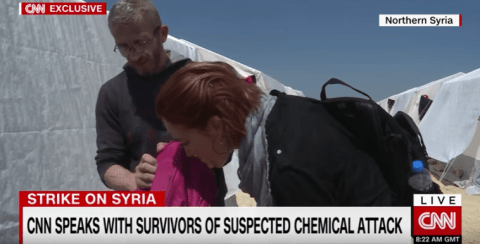
CNN, the world leader in hard hitting, real news (do you sense any irony?), has produced this stupendous report from a refugee camp in Northern Syria, with people it says “survived” the “chemical attack” in Douma earlier this month.
The US, Britain and France alleged Syrian President Bashar al-Assad pointlessly attacked his own people in Douma with sarin nerve agent, prompting the three nations to launch air strikes on Syria on the night of April 13-14th.
CNN correspondent Arwa Damon was at the camp to interview the “survivors” – as well as sample a little sarin herself.
The report (below) shows Damon and others, handling backpacks, clothing and toys allegedly exposed to Syrian government chemical weapons.
Damon plunges her face into one backpack, reacting, “There’s definitely something that stings” after taking her first whiff of sarin.
Neither Damon nor anyone else in the video, uses gloves or any form of protection when handling the articles allegedly contaminated with deadly chemicals.
As a reminder, here are the effects of sarin exposure according to the US government’s Centers for Disease Control (CDC):
- A person’s clothing can release sarin after it has come in contact with sarin vapor, which can lead to exposure of other people.
- Sarin is the most volatile of the nerve agents…People can be exposed to the vapor even if they do not come in contact with the liquid form of sarin.
- Symptoms likely will appear within a few seconds after exposure to the vapor form of sarin
- People may not know that they were exposed because sarin has no odor.
- Even a small drop of sarin on the skin can cause sweating and muscle twitching where sarin touched the skin
- People exposed to a low or moderate dose of sarin by breathing contaminated air…or touching contaminated surfaces may experience some or all of the following symptoms within seconds to hours of exposure:
- Runny nose
- Watery eyes
- Small, pinpoint pupils
- Eye pain
- Blurred vision
- Drooling and excessive sweating
- Cough
- Chest tightness
- Rapid breathing
- Diarrhea
- Nausea, vomiting, and/or abdominal pain
- Increased urination
- Confusion
- Drowsiness
- Weakness
- Headache
- Slow or fast heart rate
- Low or high blood pressure
Those are the symptoms of a low to moderate dose. The CDC webpage goes on to note a large dose immediately leads to convulsions and death.
“There’s definitely something that stings” – yeah that about sums up the symptoms of exposure to the deadly nerve agent.
The CNN fake news report goes on to interview others in the camp, without any proof of where they in fact came from, or more importantly, the political allegiance of the alleged witnesses.
All in a day’s work for the network that now prides itself on promotion of salacious gossip, unverified atrocity claims, and warmongering hysteria.
Out of 26 Major Editorials on Trump’s Syria Strikes, Zero Opposed
By Adam Johnson | FAIR | April 18, 2018
A survey by FAIR of the top 100 papers in the US by circulation found not a single editorial board opposed to Trump’s April 13 airstrikes on Syria. Twenty supported the strikes, while six were ambiguous as to whether or not the bombing was advisable. The remaining 74 issued no opinion about Trump’s latest escalation of the Syrian war.
This is fairly consistent with editorial support for Trump’s April 2017 airstrikes against the Syrian government, which saw only one editorial out of 47 oppose the bombing (FAIR.org, 4/11/17). The single paper of dissent from last year, the Houston Chronicle, didn’t publish an editorial on last week’s bombing.
Seven of the top 10 newspapers by circulation—USA Today, Wall Street Journal, Los Angeles Times, New York Post, Chicago Tribune, Newsday and Washington Post—supported the airstrikes. The New York Daily News and San Jose Mercury News offered no opinion, while the New York Times (4/13/18) was ambiguous—mostly lamenting the lack of congressional approval, but not saying that this meant the strikes were illegal or unwise. “Legislation should…set limits on a president’s ability to wage war against states like Syria,” is the Times’ conclusion. A complete list of editorials on the airstrikes can be viewed here.
Almost every editorial spoke in the same Official, Serious tone that demanded “action” be taken and “international norms” be “enforced.” Some, such as the Wall Street Journal (4/16/18), went further, insisting on a wider war against the Syrian regime, Iran and/or Russia in vague but menacing terms.
“Barack Obama dealt Mr. Trump a bad hand by letting Russia, Iran and China believe they could advance their goals of regional domination without US resistance,” the Journal insisted. “In Syria as elsewhere, Mr. Trump has to decide if he wants to ratify that American retreat or develop a strategy to stop it.”
The mid-market Toledo Blade (4/15/18) punched above its weight class and delivered the most bellicose and jingoistic editorial of them all with “The West Stands Up”:
Make no mistake, this was a warning to Vladimir Putin as well as Bashar al-Assad.
The United States and its two longtime allies redrew the red line that had been obliterated by a failure of nerve by the US and the West generally: There will be cost for your barbarities….
But in the larger sense, the West did what it should have done a long time ago. It stood up for decency and international law. It stood up for those who are defenseless. It stood up for itself, and for simple humanity, and redeemed some self-respect.
If Assad regime officials find themselves catching up on news from the greater Northwest Ohio region, they will surely take heed.
None of the top 100 newspapers questioned the US’s legal or moral right to bomb Syria, and all accepted US government claims to be neutral arbiters of “international law.” Many editorials handwrung about a “lack of strategy” or absence of congressional approval, but none so much that they opposed the bombing. Strategy and legal sanction are add-on features—nice but, by all accounts, not essential.
The total lack of editorial board dissent is consistent with major papers’ tradition of uniform acceptance of US military action. The most influential paper in the country, the New York Times, has not opposed a single US war—from the Persian Gulf to Bosnia, to Kosovo to Iraq to Libya to the forever war on ISIS—in the past 30 years.
The scope of debate among major editorial boards is not if Trump should bomb the Syrian regime, but how much bombing he should undertake—and when, roughly speaking, he should maybe get around to letting Congress know.
Lebanese Journalist Names Washington’s Goal Number One in Syria
Sputnik – April 19, 2018
Sputnik spoke to Lebanese journalist and commentator Sharmine Narwani to find out more about situation in Syria and Washington’s goals and actions there.
It has been revealed that US Secretary of Defence, James Mattis, tried to urge US President Donald Trump to obtain congressional approval before launching airstrikes on targets in Syria last weekend. According to reports, President Trump was however set on the use of military force, and overruled the Pentagon chief’s advice. In other developments, Saudi Arabia is reportedly holding talks with the United States and Egypt about sending an Arab coalition force into Syria.
Sputnik: We’re hearing news that the US is in talks with Saudi Arabia to build an Arab force and send it to Syria. Saudi Arabia’s foreign minister has said that he is in talks with US National Security Advisor John Bolton to plan building this force – what do you make of this, what do you think its purpose is?
Sharmine Narwani: Look Trump wants to clear exit the debacle in Syria and eliminate the need to spend billions of dollars a year in maintaining US forces there and participating in the war. The recent chemical weapons allegations came shortly after Trump vocalised this desire; but the likelihood of an Arab force to physically base themselves in Syria on the Syrian-Iraqi border is virtually nil. We must view this new tactic with some suspicion. The US has always trumpeted ISIS as its main goal in Syria or the elimination of ISIS. If ISIS is gone, then what’s the need to have foreign forces based on that border? It seemed clear all along that containing Iran’s access from Iran to the borders of Palestine has always been the goal. It’s not as though Saudi Arabia and Egypt have stellar or significant nation-building expertise anyway. And they have many differences – the Saudis and the UEA for instance are heavily involved militarily in Yemen and are overextended there. Egypt has shown reluctance to participate in that Arab conflict, let alone another one with a government that it has actually sort of ideologically supported in the Syrian conflict. So it’s not likely to become a reality.
Sputnik: Of course in the lead up to the Western bombing campaign on Syria the US was saying that President Bashar al-Assad had used sarin gas, but we’ve now found out that they did not have sufficient evidence of this at the time. Also, the New York Times has revealed that Defence Secretary Jim Mattis urged Trump to get congressional approval for the strikes, but the president overruled him on that – what does this all tell you about the lead up to the events of last weekend?
Sharmine Narwani: If we look at the recent events leading up to the alleged chemical weapons incident, it took place under cover of two important developments: one was Trump’s declaration of exiting Syria, and removing US troops from there soon. The second would be the Syrian army’s very rapid defeat of terrorists in Eastern Ghouta and the reclamation of that strategically vital territory around Damascus. I think the sort of bringing up Sarin, the nerve gas sarin, it’s always kind of utilised as an emotional trigger, as is the mention of chemical weapons by itself and the general assumption if we’re talking about sarin would be that only states would have access to that particular substance, and not terrorist groups and non-state actors, unlike say with a substance like chlorine that is readily available. So I think it was very deliberately invoked, meaning sarin, to create an emotional response globally.
But Sarin has been used in Iraq by insurgents since at least 2004, in the form of IEDs. Turkey for instance, in May 2013, way later during the Syrian conflict, captured 12 Nusra members, Nusra is the Al-Qaida arm in Syria, they captured 12 Nusra members with significant amounts of Sarin and that was believed to be heading toward Syria. And major US-UK risk analysis firm IHS Conflict Monitor, in 2016, told us in a report that ISIS has used chemical weapons more than 52 times in both Syria and Iraq.
Sputnik: We’ve heard today that US senators are increasingly becoming concerned at the absence of a coherent US strategy in Syria, where do you see things from here?
Sharmine Narwani: Even during Obama’s term, we talked about there being a lack of coherent strategy. I would say that there is maybe a lack of a coherent verbalised strategy, one that was disseminated to the American public and an international one. There was certainly a strategy behind the scenes, one that was not vocalised and actions speak louder than words, so when we look at the arming, training and financing of terrorists when it was clear that there wasn’t enough Syrian support to topple Assad in the way leaders had been toppled in Tunisia and Egypt. We had the arming, training & financing but there was a very clear strategy, and the goal was number one, regime change, and two, to weaken the most important Iranian Arab state ally. So that was the strategy. When people say there wasn’t a coherent one they probably mean there wasn’t a coherent vocalised one. US actions have certainly shown us that regime change and weakening Iran were in fact the strategy in Syria and this is apparent today because the escalation still continues.
BBC presenter declares ‘info war against Russia’ after ex-navy chief questions Syria ‘evidence’
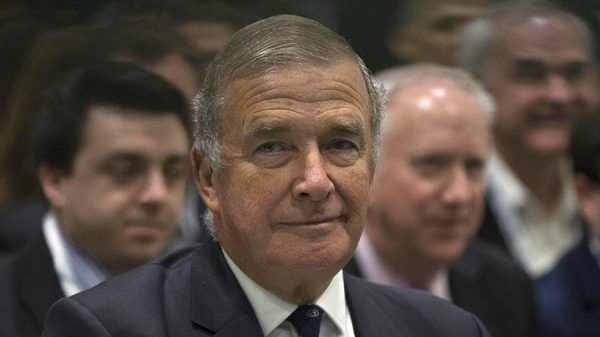
Britain’s Admiral Lord West. © Neil Hall / Reuters
RT | April 18, 2018
During a live interview, a BBC news presenter declared “we’re in an information war with Russia” after a former Royal Navy chief questioned the “extraordinary” claims surrounding an alleged chemical attack in Syria.
Former Navy Admiral Lord West’s questioning of the mainstream narrative surrounding the alleged chemical weapons attack in the town of Douma led the BBC’s Annita McVeigh to suggest that truthfully stating his position and posing questions risked “muddying the waters” in an ongoing “information war with Russia.”
Lord West had described how in his view the claim that Bashar Assad ordered the attack “doesn’t ring true,” asking “what benefit is there for his military?” He went on to say “we know that in the past some of the Islamic groups have used chemicals, and of course there would be huge benefit in them labelling an attack as coming from Assad.”
West went on to question the ‘evidence’ provided by groups like the White Helmets and the World Health Organization, both of which he described as “not neutral.”
The former First Sea Lord then described how in the past he had been put under pressure to support politically motivated narratives: “I had huge pressure put on me politically to try and say that our bombing campaign in Bosnia was achieving all sorts of things which it wasn’t. I was put under huge pressure, so I know the things that can happen.”
At that point the BBC’s McVeigh appeared to question whether he should actually be expressing his opinion truthfully, asking: “Given that we’re in an information war with Russia on so many fronts, do you think perhaps it’s inadvisable to be stating this so publicly given your position and profile, isn’t there a danger that you’re muddying the waters?”
West replied: “I think the answer is, if there’s a real concern, let’s face it, if [Assad] hasn’t done it then that is extremely bad news. If Assad hasn’t carried out the attack, I think it’s just worth making that clear. I think our government’s policy towards Assad has not been clever since 2013.”
Western media cover tracks of Trump, May and Macron’s war crime in Syria
By Finian Cunningham | RT | April 17, 2018
With astounding double-think, the US and Britain accuse Russia of “tampering” with the alleged chemical-weapon attack site in Syria’s Douma – just days after the US, UK and France barraged the county with over 100 missiles.
If anyone is guilty of tampering with the alleged crime scene, it is the NATO trio who rushed to bomb Syria just as inspectors belonging to the Organization for the Prohibition of Chemical Weapons (OPCW) arrived in Syria – invited there by the Syrian and Russian governments.
The frenzied Western media campaign to find Syria and Russia guilty of a war crime involving alleged chemical weapons is further highlighted by the reporting this week by award-winning British journalist Robert Fisk.
Fisk, who has been covering Middle East war zones for nearly 40 years, went to Douma city to file his report for The Independent. Credit goes to The Independent for publishing Fisk’s investigative work.
In the aftermath of the weekend’s airstrikes, what he found from interviewing local people and medics is arresting, if not shocking. From Fisk’s witness-gathering report, there was no gas attack carried out on April 7 – in stark contradiction to what the US, British and French governments have been declaring in hysterical tones for the past two weeks.
Those declarations culminated in the US-led bombing of Syria at the weekend. What’s more, the US, British and French leaders are reserving the right to carry out further strikes on Syria – if “the regime repeats its chemical-weapons attacks on civilians.”
What Robert Fisk reports from inside Douma corroborates what the Syrian government and its Russian ally have been saying consistently since the alleged incident on April 7. The incident, they say, was staged by the so-called “first responder” group known as the White Helmets, who work hand-in-glove with notorious terrorist outfits like Jaysh al-Islam and Al-Nusra Front. The White Helmets are also on the pay roll of the American CIA, as well as British and French intelligence agencies.
Similar to Russian Foreign Minister Sergey Lavrov’s earlier claim, Fisk reports that on April 7, a panic scene was engendered in Douma’s hospital by White Helmets activists who shouted that “chemical weapons” were being deployed. These activists began dousing people with water hoses and conveniently had video cameras on hand to capture the chaotic scenes acted out by unwitting civilians. A doctor in the hospital confirmed this to Fisk.
As for the supposed dozens of dead that Western governments and media blamed on “animal Assad” and Russian complicity, there is no evidence of the alleged victims. Video footage of dead people in a war zone is hardly proof.
This means that US President Trump and his British and French counterparts, Theresa May and Emmanuel Macron, just launched a criminal aggression on Syria in grave violation of international law and the country’s sovereignty. This is exactly what many independent observers were decrying at the time of the missile barrage, warning that the presumed evidence for a chemical attack was far from substantiated.
Indeed, the suspicion is that Trump, May and Macron knew that their evidential ground for attacking Syria was impossibly thin, and that is why they rushed to bomb the country. It was a decision hastened by the arrival of the OPCW inspectors heading to Douma. The inspectors are due to start their investigative work on Wednesday – delayed apparently by security concerns.
In all probability, the Douma incident was a propaganda stunt orchestrated by Western-backed anti-government militants and their White Helmets media agents, precisely in order to provoke an external military attack on Syria by the US, Britain and France.
Several things stand out about Robert Fisk’s latest reporting. This is exactly the kind of critical journalism that other Western media outlets should have been engaged in following the alleged chemical weapon attack on April 7. Credit goes to Fisk and The Independent. But it is a shameful case of “too little, too late.”
Also, it is notable how Fisk’s reportage is being roundly ignored – at least so far – by other mainstream Western media outlets. That’s an impressive feat of self-censorship at a crucial time when the US, British and French governments should be open to accusations of committing a war crime on Syria over their latest blitzkrieg.
This is especially so, given their warnings of more to come, over “further” chemical-weapons use. The urgent concern is that these governments are giving themselves a license to act on more false flags. They should be held rigorously to account for their claims.
This disregard for international law is made possible because of the appalling willingness of Western mainstream media to regurgitate self-serving claims made by terrorist-affiliated groups in Syria and their propaganda outlets.
American, British and French mainstream media have given saturated coverage to the White Helmets and the Syrian American Medical Society, and the dodgy one-man-band operation in Coventry known as the Syrian Observatory for Human Rights. CNN, the BBC and France 24 cite these groups as if they are “authoritative” and impartial, when in fact they are all part of the regime-change campaign in Syria sponsored by the US and its British and French allies.
It is telling, too, how Robert Fisk is being assailed as a “Syrian, Russian stooge” on social media. The one Western mainstream journalist who has had the integrity to delve into Syria’s Douma to uncover a very different critical perspective – one that disproves the claims peddled by the US, British and French leaders and other mainstream media – is being vilified for principled journalism.
Western corporate media are a grotesque mockery of public information and critical, independent accounting of government power.
Apart from Robert Fisk, the few other Western journalists to have ventured into Syria to report on what is really happening are independent, “alternative” sources like Eva Bartlett, Vanessa Beeley and Patrick Henningsen. They have exposed the “Oscar-winning” White Helmets group, which is actually complicit in staging atrocities against civilians living under a reign of terror imposed by their terrorist affiliates. It is understood the White Helmets activists behind the Douma provocation on April 7 have since fled the city along with the terrorist gangs under the cover of an evacuation deal with the liberating Syrian and Russian forces, who are now in control of most of the Eastern Ghouta suburbs near Damascus.
Western media journalists, if they were really committed to principles of accuracy and critical investigation, should be poring over the rubble in Douma, interviewing local people and finding out what really happened. But they are not.
That is why, one suspects, they are not there. That is why the US and Britain are now accusing Russia of “tampering” with the site in Douma – because there is no evidence of a chemical-weapons attack, as Robert Fisk reports.
That means the US, British and French governments just committed a brazen war crime.
This would also explain why Western mainstream media have now quickly moved their focus to allegations of “Russian cyberattacks” on American and British infrastructure. This is a classic case of “keeping ahead of the story.” Western governments and their dutiful media do not have a “story” – at least not the one they claim – in Syria, so the imperative is to change to another subject as quickly as possible.
‘Russia’ Instead of ‘US’: Swedish TV Caught Peddling Fake News on Syria
Sputnik – April 18, 2018
Swedish TV-channel TV4 has sparked outrage by offering its viewers a skewed picture of reality by substituting “the US” with “Russia” in a critical news report on the US-backed attacks against the war-torn middle-Eastern country.
In a news report about the conflict in Syria by TV4, a Syrian woman was speaking about the US, which, oddly enough, was rendered as “Russia, Iran and the regime” in the accompanying subtitles. After a public outcry on social media, TV4 recognized its “mistake” while translating the woman’s outspoken message from Arabic into Swedish.
“The attack did not get enough effect, so we want to see more. We want them to avenge us. Russia, Iran and the regime must back off from here because they have stolen our country and our land,” a woman living in Douma was quoted as saying on TV4.
In reality, however, she didn’t mention “Russia” at all, not even once, which was eagerly pointed out on TV4’s Facebook page by Arab-speaking Swedish viewers.
“Why do you cheat your viewers by means of translating errors? The lady said the United States, you wrote ‘Russia, Iran and the regime,'” Katja Jakoub, an Arabic-speaking woman from Gothenburg pointed out in her post.
This post has been shared by thousands of people, including many people of Arab descent who pointed out that the woman clearly said “Amrika,” Arabic for the United States.
They also pointed out that the Syrian woman actually said that “not everything is dependent on the US” and claimed that she “once again felt hope.” It is not clear from the excerpt whether she was referring to the US-backed missile attack against the Syrian government or something else.
In response to the public uproar, TV4 acknowledged that the translation was “incorrect.”
“During yesterday morning’s broadcast, we sent out a feature from Syria in which the footage unfortunately was accompanied by the wrong text. Thus, the translation did not match what was actually said in the footage regarding this particular broadcast. This was discovered shortly afterwards and we rectified this immediately,” TV4 wrote in its reply, stressing that subsequent broadcasts featured a more consistent translation.
“Was this really a mistake from TV4? One translates the US as ‘Russia, Iran and the regime’ and lets it go on air during peak time to hundreds of thousands of viewers. Then one apologizes on TV4’s Facebook page which is only read by several hundred… Looks more like TV4 owners would like get a world war started,” user Christian Christensen wrote.
On April 14, the US, Britain and France launched 103 cruise and air-to-surface missiles at a number of government facilities in Syria, in response to the alleged April 7 chemical attack in the Damascus suburb of Douma. The airstrikes came even before the results of an ongoing investigation into the case by experts from the Organization for the Prohibition of Chemical Weapons were announced. Most of the missiles were intercepted by Syrian air defenses.
The Stockholm-headquartered TV4 is one of Sweden’s largest channels. It is fully owned by the Bonnier Group, which, in turn, is managed by the powerful media tycoon family the Bonniers [see link below], who run a network of about 170 companies in 15 countries, including Sweden’s foremost dailies such as Dagens Nyheter, Expressen and Sydsvenskan.
READ MORE:
Jewish Media Influence in Scandinavia
Sweden Starts Anti-‘Fake News’ Body for Mental Defense Against ‘Russian Threat’
‘Source Critical’ Swedish Daily Draws Ridicule by Posting Fake PM Tweet
Even western mainstream media is reporting that no chemical attack took place in Douma
Medical personnel on the ground in Syria give testimony that those videos show people suffering from hypoxia – not gas poisoning
By Frank Sellers | The Duran | April 18, 2018
On April 7th, an attack was carried out in the town of Douma, just a few kilometers out of Syria’s capital, Damascus, which was occupied by radical terrorist forces. The attack was peddled as a chemical weapons attack using chlorine gas, and it was additionally reported to have included some unknown nerve agent (which apparently the White Helmet guys who were filming the incident were somehow immune to), which was then said to have killed at least 75 people, and, according to the UK Prime Minister Theresa May, also resulted in the deaths of 500 more, all based on social media postings, based on what is being revealed to the public anyway, by groups that have known links and coincidental interests with the very radical terrorists that Western governments are claiming to be fighting.
Additionally, these media outlets and governments have been quick to thrust blame in the direction of Syrian government forces, particularly on the Syrian President Bashar al-Assad, before any independent organization has conducted an investigation to determine whether the attack was of a chemical nature or who carried out the attack in the first place.
The US, UK, and France are, however, continuing to insist that the attack was chemical in nature, and that Assad conducted the attack, of course, without having any of their own assets on the ground to conduct any observations or investigations in Douma, citing “intelligence”, which, of course, is classified, and will not be released to the public in order to bolster their “confidence” that Assad ordered a chemical attack on his own citizens “including young children” at a time when his forces were retaking the town already anyway.
In fact, the US and France have even insisted that they have “proof” that they are “highly confident that they believe in” that Assad did, in fact, conduct a chemical weapons attack on his own civilian population in Douma, once again, including women and young children. Meanwhile, the Kremlin has been warning for months that provocateurs were preparing to launch a chemical attack in Syria in order to blame their opposition, the Syrian government, and provoke a Western military response to help them in their conflict against Assad’s forces.
On the basis of this alleged chemical attack, that the West says that it is highly confident that Assad ordered, a military “precision strike” was conducted by a coalition of US, British, and French forces on the Syrian capital of Damascus, for the purpose of destroying or significantly disrupting the Syrian government’s capability to manufacture, store and employ chemical weapons, as well as to serve as a deterrent against any future chemical weapons attack, which the US ambassador to the UN Nikki Haley says will actually happen again, and which recurrence will be met with yet another coordinated response by the US and its allies.
The strike took place just hours before the UN’s Organization for the Prohibition of Chemical Weapons expert investigators were due to arrive at the scene of the alleged chemical attack to determine if reports about the suspected attack were, or are, in fact, true.
We are being told that the coordinated missile strike, included over 100 missiles, including American Tomahawks, struck chemical weapons research and manufacturing facilities in Damascus, which apparently didn’t result in any dangerous banned chemicals or nerve agents being released into the surrounding area, which would have been utterly devastating to hundreds of people in the area, if not more.
Now, all of the sudden, after conducting a few interviews with witnesses from the site of the attack, even some mainstream Western invesigative journalists are questioning the narrative that has been published about a chemical gas attack in Douma.
The world’s third largest news agency, Agence France-Presse (AFP), and a major British online newspaper, the Independent, are publishing stories which are casting doubt on the whole chemical gas attack narrative that we have been being fed since the date of the attack, and which Western governments are claiming “proof” for, which, of course, they are “highly confident” in, and which was used as a justification for a military intervention in Syria against the capital city of a government that is fighting the same bad guys that these very Western governments say they have spent, and continue to throw money at, billions on.
The AFP spoke with Marwan Jaber, a medical student who witnessed the aftermath of the alleged chemical attack, who said “Some of [the victims] suffered from asthma and pulmonary inflammation. They received routine treatment and some were even sent home, they showed no symptoms of a chemical attack. But some foreigners entered while we were in a state of chaos and sprinkled people with water, and some of them were even filming it.”:
The Syrian regime on Monday (April 16th) organized a press visit to the city of Duma in Eastern Ghouta, where an alleged chemical attack on April 7 killed at least 40 people, shortly before the regime’s forces took over the city, then held by the rebels. The team of the International Organization for the Prohibition of Chemical Weapons (OPCW) had still not been able to enter the city on Monday.
The Independent’s Robert Fisk travelled to the site in Douma, and spoke with medical personnel on the ground in the Syrian town:
It was a short walk to Dr Rahaibani. From the door of his subterranean clinic – “Point 200”, it is called, in the weird geology of this partly-underground city – is a corridor leading downhill where he showed me his lowly hospital and the few beds where a small girl was crying as nurses treated a cut above her eye.
“I was with my family in the basement of my home three hundred metres from here on the night but all the doctors know what happened. There was a lot of shelling [by government forces] and aircraft were always over Douma at night – but on this night, there was wind and huge dust clouds began to come into the basements and cellars where people lived. People began to arrive here suffering from hypoxia, oxygen loss. Then someone at the door, a “White Helmet”, shouted “Gas!”, and a panic began. People started throwing water over each other. Yes, the video was filmed here, it is genuine, but what you see are people suffering from hypoxia – not gas poisoning.”
But, just like the story with Saddam Hussein went, when these very Western governments wanted so bad to follow the American’s blood lust for war in Iraq, this government, so they say, has weapons of mass destruction, and is lead by not just any old tyrannical dictator, but a “monster” who is using these banned WMDs on his own population (apparently for the sheer sadistic pleasure of it), for no good reason. And, of course, without any verifiable intelligence resulting from any on the ground investigation by anyone trained to look for the stuff.
In fact, here we are seeing reports from journalists, western ones, I might add, that report the opposite of what we have been told for the past ten days. No use of WMDs being used in Douma, or at least, no evidence of it anyway. And, based on the fact that the US led strike on Syria’s alleged chemical weapons labs and storehouses didn’t release any of these agents into the area when the strike should have spread the stuff all over the place, it looks like Syria doesn’t have those WMDs, or, at least the West doesn’t know where they’re at, and just randomly shot off a couple of missiles to make it look like they were doing something about those WMDs.
Featured Video
Iran is (probably) collecting tolls, and why Asia stopped buying oil from the US
or go to
Aletho News Archives – Video-Images
From the Archives
The Great Recycling Scam
By Dr. Vernon Coleman – 21st Century Wire – September 2, 2022
Recycling was introduced, worldwide, as a tool to teach citizens to become compliant.
Forcing citizens to sort their rubbish into up to nine separate bags or boxes every week had absolutely nothing to do with ‘saving the planet’ and everything to do with teaching citizens (through a mixture of fines and shame) to behave ‘responsibly’ i.e. to do as they were told without looking too closely at the rationale of what they were being told to do.
The recycling never had anything to do with protecting the planet, of course. Most of the rubbish sorted, washed and collected in the UK was taken abroad, by lorry or ship or train, and burnt or dumped. It was, quite simply, impractical and not cost effective to recycle the material that had been collected. And, of course, collecting the sorted rubbish involved massive costs in terms of cash and pollution.
Today, the recycling business has reached an apogee of lunacy. Councils introduce ever more complex rules and fees. They refuse to take away much of the waste that is collected. And those wanting to take their rubbish to a ‘recycling’ centre will probably have to make an appointment and answer a host of questions.
It is no surprise that fly-tipping has become a major problem. The biggest causes of plastic in the sea are dumped fishing gear and plastic waste (much of it officially designated as recycled) which has been dumped by ships.
The good news, however, is that in Britain, recycling rates are falling. More and more people have become aware that the whole recycling movement was just another piece of manipulative trickery.
Blog Roll
 Aletho News
- Lithuania plans universal conscription
- Lies, Damn Lies, and Ukraine News
- Financial Times rejects Nordic demands to correct Putin call story – media
- The Case for Less Unity in Europe
- Ukraine expands minority rights under EU pressure – but Russians remain excluded
- Albania takes anti-riot crackdown cue from France
- The interest of the House of Rothschild in Ukraine
- Pentagon fires top military planner
- Three tankers hit mines on unauthorized Hormuz route: IRGC Navy
- Iran is (probably) collecting tolls, and why Asia stopped buying oil from the US
- If Americans Knew
- An error has occurred; the feed is probably down. Try again later.
- No Tricks Zone
- Germany’s Green Energy Transition Becoming Increasingly Expensive…Another 6 Trillion Euros!
- Sudden Stratospheric Warming, Powerful El Niño Combination May Lead To Extreme Europe Cold, Energy Crisis!
- Two New Studies Find Thwaites Glacier Melt Cannot Be Driven By Human Activity Or A Warming Ocean
- E-Cars Reduce CO2 Emissions By Only 41% Compared To Internal Combustion Engine Vehicles
- Predictions Made By Renowned Climate Professor Over Past Decades Have Been Proven To Be Poor
- New Study Suggests Large Regions Of The Pacific Ocean Have Been Cooling For The Last 80 Years
- Germany’s Green Energy Debacle: High Energy Costs Force Kahla Porzellan to Close After 182 Years!
- New Study: 50 Years Of The Most Aggressive ‘Net Zero’ Policies Can Only Affect The Global Climate By 0.03°C
- US September “Heat” Was No Record…Many Records Set Decades Ago
- Latest European Green Energy Debacle; Portugal’s Largest Flagship Solar Park Insolvent!

