Syria: The Horrible End Versus the Endless Horror
By Randy Shields • Unz Review • March 17, 2018
Neocon Max Boot now says it’s better for the Syrian people if Assad stays in power. But we still can’t get the American left to come to its senses about Syria.
Louis Proyect says in Counterpunch that the suffering coming out of East Ghouta is “on a massive scale reminiscent of Leningrad in 1941.”
According to Wiki, a million and a half people died during the Leningrad siege. According to the authoritative-sounding Syrian Observatory for Human Rights — one anti-Assad guy in a Coventry flat, relying mostly on reports from anti-Assad fighters — 1,000 people have been killed in East Ghouta, horrible to be sure but not Leningrad. In Leningrad, people were reduced to cannibalism. There was cannibalism in Syria in 2013: a commander for the left’s beloved Free Syrian Army cut the lungs out of a Syrian Army soldier and ate them on camera. A “moderate” rebel eminently worthy of CIA dollars — and spicy recipes.
While bringing up Lou-dicrous comparisons to 1941 Leningrad, Proyect fails to mention the US-destroyed Raqqa and Mosul from which dead bodies are still being found and dragged out of the rubble. Rest assured that the Great Satan will not rebuild those cities as Assad is doing with Palmyra and Aleppo. To the colonized mind of the American left, the crimes of America’s enemies are always worse and more worth talking about than the crimes of America itself. US airstrikes were responsible for most of the 40,000 dead civilians in Mosul and over 3,000 in Raqqa.
By the way, two thirds of the casualties in Syria have been Syrian soldiers and anti-government fighters. The anti-Assad left and the mockingbird media would have us believe that all 345,000 Syrian deaths have been civilians who Assad and Putin deliberately, personally and exclusively killed. The pressitutes tell us how unpopular the Alawite Assad is while the entire world sees a Sunni majority army fighting to the death for him and the rest of Syria by killing off Wahhabist Sunni fanatics. Huh? (Syria has never been a “civil war” or a “sectarian conflict” — it’s been a pre-planned destruction led by the US, piggy-backing on legitimate grievances of the Syrian working class.)
Interestingly, the anti-Assad left never tells us the names of the armed opposition groups that it supports. Why? Is it because they are al-Qaeda offshoots? Is it because they are so tiny and few in number that they are inconsequential and/or the Syrian working class majority don’t support them? Is it because they collaborated with the most regressive fundamentalist groups and/or got wiped out by them? The anti-Assad left seems to live in an ivory tower that got destroyed somewhere around 2012 — they never say what should be done now.
Then Proyect makes a false equivalency between Israel bombing Gaza in response to Hamas’ largely ineffectual rockets and the Syrian government bombing terrorists in East Ghouta who have been shelling Damascus for years with howitzers, mortars and GRAD rockets, killing and wounding thousands of civilians. Gazans are occupied and have legitimate rights under international law to resist, including violently.
Proyect quotes Counterpunch’s Jeffrey St. Clair that aerial bombing of cities is a war crime. I couldn’t agree more and I’ll raise you an aerial bombing of jungles also. And I think shooting a barrage of GRAD rockets into downtown Damascus is a war crime too. (What parts of war aren’t a crime?) So, where does that put us? It puts “us” safely and snugly in the belly of the beast. It puts the Syrian working class majority wanting its government to protect them from a minority of al-Qaeda metastases, funded and armed by the most reactionary regimes on earth, trying to win violently what they can’t win intellectually, socially or politically. The left just won’t cut its intellectual (“moderate” rebels) or political (Russia-gate) losses. And isn’t it interesting how so much of what the left does is in harmony with what the Pentagon, the CIA and the empire wants.
And since Proyect brought up Gaza and the Palestinians… It was the Palestinian Liwaa al-Quds force who stormed the al-Shaaher roundabout in Aleppo on September 24, 2016 which liberated the Handaraat Camp which turned around the battle for Aleppo which turned around the fight for Syria which is turning the American empire upside down with indispensable help from Russia and Iran. On that memorable September day eastern Aleppo residents were cheering on Liwwa al-Quds, Hezbollah and the Syrian Arab Army as they hunted down and killed the members of the CIA-funded Nour al-Din al-Zenki who beheaded the 12-year-old Palestinian boy on film. The Syrian working class doesn’t actually like the 31 flavors of takfiri terrorists that some western leftists find so sweet.
In fact, during the December 2016 liberation of Aleppo, Syrians who lived for years under the rule of the fanatics were outraged that the Syrian army put the terrorists on buses to Idlib instead of killing them outright. A day later it was discovered that, just before they surrendered, the terrorists had summarily executed over 100 hostages and prisoners in basement prisons, including many Syrian soldiers.
Then Proyect attempts to make a case for the fanatics in East Ghouta by contrasting their poverty-stricken area with wealthier Damascus. A splendid insight. Now, how about you leading the charge of South Central against Beverly Hills? Oh, that’s right — the impotent defeated American left has been on the run for 40 years and can only mind the business of the Assads, Saddams, Gadaffis and the ayatollahs — all Israeli enemies and sitting atop large energy resources [allowing economically viable resistance] — while “our” own government remains the chief engine of destruction in the world. Blessedly, the brown working classes of the world don’t give a flying fuck about what white western leftists think because they know they aren’t going to get any help from us. We’re irrelevant. Ask a Yemeni, ask a Honduran, ask a Congolese.
Christmas and New Years have been celebrated for the last two years in Aleppo and some semblance of normalcy is returning. Right now, in liberated areas of East Ghouta, people are welcoming the return of the Syrian Arab Army and telling the media how they’ve been used as human shields. In non-liberated areas, civilians are demonstrating against the terrorists and negotiating with them to leave. As with Aleppo in 2016, people in East Ghouta have been telling the SAA the locations of terrorist commanders, ammo dumps, jails and headquarters. Also, as with Aleppo, terrorists are sniping and shelling humanitarian corridors so civilians have difficulty leaving. There are also now civilians rallying in Raqqa for the occupying American monster to GTFO.
The future of the world is being fought for in Syria — that’s why the propaganda of the mockingbird media has been unrelenting in its lies, hypocrisy, hysteria and demonization for seven years. Tel Aviv and Riyadh are going crazy and they are making sure Mordor-on-the-Potomac goes crazy with them. Putin is killing off America’s regime-changing terrorist mercenary army although, characteristically, he’s been too slow and cautious and Daesh has now set up shop in Afghanistan to harass, delay and destroy China’s Belt and Road Initiative. Assad and Putin are bringing a horrible end to the carnage in Syria as opposed to the Saudi, Israeli and US-preferred endless horror.
One last thing. People have not been paying proper attention to the written transcript of several lines toward the end of Putin’s March 1st address to the Russian Federal Assembly: “I should note that our military doctrine says Russia reserves the right to use nuclear weapons solely in response to a nuclear attack, or an attack with other weapons of mass destruction against the country or its allies, or an act of aggression against us with the use of conventional weapons that threatens the very existence of the state. This all is very clear and specific. As such, I see it as my duty to announce the following. Any use of nuclear weapons against Russia or its allies, weapons of short, medium or any range at all, will be considered as a nuclear attack on this country. Retaliation will be immediate, with all the attendant consequences.”
An attack with other weapons of mass destruction against Russia or its “allies.” Who does Russia consider allies? China, Iran, Syria, North Korea, Venezuela? Turkey? The Donbass? Did Putin just tell the criminal neocon filth who rule America to never attack Iran and North Korea — or ever attack the Syrian government again? No sane person in the world should test that out. Perhaps the previously mentioned neocon Max Boot is one of the first to “listen.”
The last time no one paid careful attention to Putin was his September 28, 2015 address to the United Nations where he condemned the US use of terrorists to further its regime change operations throughout the world, saying “We can no longer tolerate the current state of affairs in the world.” Two days later Russia began bombing hundreds of ISIS oil tankers in Syria that US satellite surveillance had been contentedly watching grow for years. Wake up, Americans. “Retaliation will be immediate, with all the attendant consequences.” The three horses’ asses of the apocalypse — Trump, Satanyahoo and Saudi Clown Prince Mohammad bin Salman — are leading the world to disaster.
Randy Shields can be reached at music2hi4thehumanear@gmail.com. His writings and art are collected at RandyShields.com.
Syrian Army Intercepts Truck Heading to Terrorists in Eastern Ghouta
Sputnik – March 17, 2018
The Syrian armed forces carried out a successful military operation intercepting a truck containing weapons and ammunition intended for terrorists, a representative of Syrian intelligence told Sputnik.
“We organized an ambush, as a result of which a large truck carrying ammunition and weapons has been intercepted; some of the equipment is made in America. Also there were medicines and equipment for satellite communication there. All this was intended for militants in Ghouta,” the spokesman said.
The operation was carried out after Syrian intelligence received information on the transfer of a large batch of weapons, ammunition and equipment for armed groups in the region.
A video that appeared online shows ammunition and weapons found in the truck, including smoke grenades with the inscription “Salisbury England.”
According to the officer, it is not the first time that the Syrian army manages to intercept a cargo intended for the militants.
A few days earlier, Syrian forces intercepted a car that was carrying ammunition, mortar shells, guns and missiles to the region.
The success of the operation will be a serious blow for the terrorists and will contribute to the weakening of armed groups in Eastern Ghouta, the spokesman concluded.
READ MORE:
Humanitarian Pause in Action: Nearly 13,000 Civilians Flee E Ghouta — MoD
US training Syria militants for false flag chemical attack as basis for airstrikes – Russian MoD
RT | March 17, 2018
Russia’s Defense Ministry says “US instructors” are training militants to stage false flag chemical attacks in south Syria. The incidents are said to be a pretext for airstrikes on Syrian government troops and infrastructure.
“We have reliable information at our disposal that US instructors have trained a number of militant groups in the vicinity of the town of At-Tanf, to stage provocations involving chemical warfare agents in southern Syria,” Russian General Staff spokesman General Sergey Rudskoy said at a news briefing on Saturday.
“Early in March, the saboteur groups were deployed to the southern de-escalation zone to the city of Deraa, where the units of the so-called Free Syrian Army are stationed.”
“They are preparing a series of chemical munitions explosions. This fact will be used to blame the government forces. The components to produce chemical munitions have been already delivered to the southern de-escalation zone under the guise of humanitarian convoys of a number of NGOs.”
The planned provocations will be widely covered in the Western media and will ultimately be used as a pretext by the US-led coalition to launch strikes on Syria, Rudskoy warned.
“The provocations will be used as a pretext by the United States and its allies to launch strikes on military and government infrastructure in Syria,” the official stated.
“We’re registering the signs of the preparations for the possible strikes. Strike groups of the cruise missile carriers have been formed in the east of the Mediterranean Sea, Persian Gulf and Red Sea.”
Another false flag chemical attack is being prepared in the province of Idlib by the “Al-Nusra Front terrorist group, in coordination with the White Helmets,” Rudskoy warned. The militants have already received 20 containers of chlorine to stage the incident, he said.
The War Against Alternative Information
By Rick Sterling | Consortium News | January 1, 2017
The U.S. establishment is not content simply to have domination over the media narratives on critical foreign policy issues, such as Syria, Ukraine and Russia. It wants total domination. Thus we now have the “Countering Foreign Propaganda and Disinformation Act” that President Obama signed into law on Dec. 23 as part of the National Defense Authorization Act for 2017, setting aside $160 million to combat any “propaganda” that challenges Official Washington’s version of reality.
The new law mandates the U.S. Secretary of State to collaborate with the Secretary of Defense, Director of National Intelligence and other federal agencies to create a Global Engagement Center “to lead, synchronize, and coordinate efforts of the Federal Government to recognize, understand, expose, and counter foreign state and non-state propaganda and disinformation efforts aimed at undermining United States national security interests.” The law directs the Center to be formed in 180 days and to share expertise among agencies and to “coordinate with allied nations.”
The legislation was initiated in March 2016, as the demonization of Russian President Vladimir Putin and Russia was already underway and was enacted amid the allegations of “Russian hacking” around the U.S. presidential election and the mainstream media’s furor over supposedly “fake news.” Defeated Democratic presidential nominee Hillary Clinton voiced strong support for the bill: “It’s imperative that leaders in both the private sector and the public sector step up to protect our democracy, and innocent lives.”
The new law is remarkable for a number of reasons, not the least because it merges a new McCarthyism about purported dissemination of Russian “propaganda” on the Internet with a new Orwellianism by creating a kind of Ministry of Truth – or Global Engagement Center – to protect the American people from “foreign propaganda and disinformation.”
As part of the effort to detect and defeat these unwanted narratives, the law authorizes the Center to: “Facilitate the use of a wide range of technologies and techniques by sharing expertise among Federal departments and agencies, seeking expertise from external sources, and implementing best practices.” (This section is an apparent reference to proposals that Google, Facebook and other technology companies find ways to block or brand certain Internet sites as purveyors of “Russian propaganda” or “fake news.”)
Justifying this new bureaucracy, the bill’s sponsors argued that the existing agencies for “strategic communications” and “public diplomacy” were not enough, that the information threat required “a whole-of-government approach leveraging all elements of national power.”
The law also is rife with irony since the U.S. government and related agencies are among the world’s biggest purveyors of propaganda and disinformation – or what you might call evidence-free claims, such as the recent accusations of Russia hacking into Democratic emails to “influence” the U.S. election.
Despite these accusations — leaked by the Obama administration and embraced as true by the mainstream U.S. news media — there is little or no public evidence to support the charges. There is also a contradictory analysis by veteran U.S. intelligence professionals as well as statements by Wikileaks founder Julian Assange and an associate, former British Ambassador Craig Murray, that the Russians were not the source of the leaks. Yet, the mainstream U.S. media has virtually ignored this counter-evidence, appearing eager to collaborate with the new “Global Engagement Center” even before it is officially formed.
Of course, there is a long history of U.S. disinformation and propaganda. Former CIA agents Philip Agee and John Stockwell documented how it was done decades ago, secretly planting “black propaganda” and covertly funding media outlets to influence events around the world, with much of the fake news blowing back into the American media.
In more recent decades, the U.S. government has adopted an Internet-era version of that formula with an emphasis on having the State Department or the U.S.-funded National Endowment for Democracy supply, train and pay “activists” and “citizen journalists” to create and distribute propaganda and false stories via “social media” and via contacts with the mainstream media. The U.S. government’s strategy also seeks to undermine and discredit journalists who challenge this orthodoxy. The new legislation escalates this information war by tossing another $160 million into the pot.
Propaganda and Disinformation on Syria
Syria is a good case study in the modern application of information warfare. In her memoir Hard Choices, former Secretary of State Hillary Clinton wrote that the U.S. provided “support for (Syrian) civilian opposition groups, including satellite-linked computers, telephones, cameras, and training for more than a thousand activists, students and independent journalists.”
Indeed, a huge amount of money has gone to “activists” and “civil society” groups in Syria and other countries that have been targeted for “regime change.” A lot of the money also goes to parent organizations that are based in the United States and Europe, so these efforts do not only support on-the-ground efforts to undermine the targeted countries, but perhaps even more importantly, the money influences and manipulates public opinion in the West.
In North America, representatives from the Syrian “Local Coordination Committees” (LCC) were frequent guests on popular media programs such as “DemocracyNow.” The message was clear: there is a “revolution” in Syria against a “brutal regime” personified in Bashar al-Assad. It was not mentioned that the “Local Coordination Committees” have been primarily funded by the West, specifically the Office for Syrian Opposition Support, which was founded by the U.S. State Department and the U.K. Foreign and Commonwealth Office.
More recently, news and analysis about Syria has been conveyed through the filter of the White Helmets, also known as Syrian Civil Defense. In the Western news media, the White Helmets are described as neutral, non-partisan, civilian volunteers courageously carrying out rescue work in the war zone. In fact, the group is none of the above. It was initiated by the U.S. and U.K. using a British military contractor and Brooklyn-based marketing company.
While they may have performed some genuine rescue operations, the White Helmets are primarily a media organization with a political goal: to promote NATO intervention in Syria. (The manipulation of public opinion using the White Helmets and promoted by the New York Times and Avaaz petition for a “No Fly Zone” in Syria is documented here.)
The White Helmets hoax continues to be widely believed and receives uncritical promotion though it has increasingly been exposed at alternative media outlets as the creation of a “shady PR firm.” During critical times in the conflict in Aleppo, White Helmet individuals have been used as the source for important news stories despite a track record of deception.
Recent Propaganda: Blatant Lies?
As the armed groups in east Aleppo recently lost ground and then collapsed, Western governments and allied media went into a frenzy of accusations against Syria and Russia based on reports from sources connected with the armed opposition. CNN host Wolf Blitzer described Aleppo as “falling” in a “slaughter of these women and children” while CNN host Jake Tapper referred to “genocide by another name.”
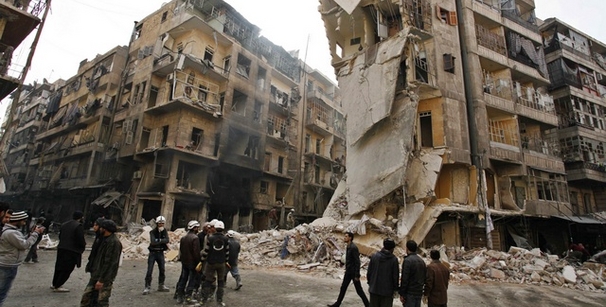
War damage in the once-thriving Syrian city of Aleppo
The Daily Beast published the claims of the Aleppo Siege Media Center under the title “Doomsday is held in Aleppo” and amid accusations that the Syrian army was executing civilians, burning them alive and “20 women committed suicide in order not to be raped.” These sensational claims were widely broadcast without verification. However, this “news” on CNN and throughout Western media came from highly biased sources and many of the claims – lacking anything approaching independent corroboration – could be accurately described as propaganda and disinformation.
Ironically, some of the supposedly “Russian propaganda” sites, such as RT, have provided first-hand on-the-ground reporting from the war zones with verifiable information that contradicts the Western narrative and thus has received almost no attention in the U.S. news media. For instance, some of these non-Western outlets have shown videos of popular celebrations over the “liberation of Aleppo.”
There has been further corroboration of these realities from peace activists, such as Jan Oberg of Transnational Foundation for Peace and Future Research who published a photo essay of his eyewitness observations in Aleppo including the happiness of civilians from east Aleppo reaching the government-controlled areas of west Aleppo, finally freed from areas that had been controlled by Al Qaeda’s Syrian affiliate and its jihadist allies in Ahrar al-Sham.
Dr. Nabil Antaki, a medical doctor from Aleppo, described the liberation of Aleppo in an interview titled “Aleppo is Celebrating, Free from Terrorists, the Western Media Misinformed.” The first Christmas celebrations in Aleppo in four years are shown here, replete with marching band members in Santa Claus outfits. Journalist Vanessa Beeley has published testimonies of civilians from east Aleppo. The happiness of civilians at their liberation is clear.
Whether or not you wish to accept these depictions of the reality in Aleppo, at a minimum, they reflect another side of the story that you have been denied while being persistently force-fed the version favored by the U.S. State Department. The goal of the new Global Engagement Center to counter “foreign propaganda” is to ensure that you never get to hear this alternative narrative to the Western propaganda line.
Even much earlier, contrary to the Western mythology of rebel “liberated zones,” there was strong evidence that the armed groups were never popular in Aleppo. American journalist James Foley described the situation in 2012 like this:
“Aleppo, a city of about 3 million people, was once the financial heart of Syria. As it continues to deteriorate, many civilians here are losing patience with the increasingly violent and unrecognizable opposition — one that is hampered by infighting and a lack of structure, and deeply infiltrated by both foreign fighters and terrorist groups. The rebels in Aleppo are predominantly from the countryside, further alienating them from the urban crowd that once lived here peacefully, in relative economic comfort and with little interference from the authoritarian government of President Bashar al-Assad.”
On Nov. 22, 2012, Foley was kidnapped in northwestern Syria and held by Islamic State terrorists before his beheading in August 2014.
The Overall Narrative on Syria
Analysis of the Syrian conflict boils down to two competing narratives. One narrative is that the conflict is a fight for freedom and democracy against a brutal regime, a storyline promoted in the West and the Gulf states, which have been fueling the conflict from the start. This narrative is also favored by some self-styled “anti-imperialists” who want a “Syrian revolution.”
The other narrative is that the conflict is essentially a war of aggression against a sovereign state, with the aggressors including NATO countries, Gulf monarchies, Israel and Jordan. Domination of the Western media by these powerful interests is so thorough that one almost never gets access to this second narrative, which is essentially banned from not only the mainstream but also much of the liberal and progressive media.
For example, listeners and viewers of the generally progressive TV and radio program “DemocracyNow!” have rarely if ever heard the second narrative described in any detail. Instead, the program frequently broadcasts the statements of Hillary Clinton, U.S. Ambassador to the United Nations Samantha Power and others associated with the U.S. position. Rarely do you hear the viewpoint of the Syrian Ambassador to the United Nations, the Syrian Foreign Minister or analysts inside Syria and around the world who have written about and follow events there closely.
“DemocracyNow!” also has done repeated interviews with proponents of the “Syrian revolution” while ignoring analysts who call the conflict a war of aggression sponsored by the West and the Gulf monarchies. This blackout of the second narrative continues despite the fact that many prominent international figures see it as such. For example, the former Foreign Minister of Nicaragua and former President of the UN General Assembly, Father Miguel D’Escoto, has said, “What the U.S. government is doing in Syria is tantamount to a war of aggression, which, according to the Nuremberg Tribunal, is the worst possible crime a State can commit against another State.”
In many areas of politics, “DemocracyNow!” is excellent and challenges mainstream media. However in this area, coverage of the Syrian conflict, the broadcast is biased, one-sided and echoes the news and analysis of mainstream Western corporate media, showing the extent of control over foreign policy news that already exists in the United States and Europe.
Suppressing and Censoring Challenges
Despite the widespread censorship of alternative analyses on Syria and other foreign hotspots that already exists in the West, the U.S. government’s new “Global Engagement Center” will seek to ensure that the censorship is even more complete with its goal to “counter foreign state and non-state propaganda and disinformation.” We can expect even more aggressive and better-financed assaults on the few voices daring to challenge the West’s “group thinks” – smear campaigns that are already quite extensive.
In an article titled “Controlling the Narrative on Syria”, Louis Allday describes the criticisms and attacks on journalists Rania Khalek and Max Blumenthal for straying from the “approved” Western narrative on Syria. Some of the bullying and abuse has come from precisely those people, such as Robin Yassin-Kassab, who have been frequent guests in liberal Western media.
Reporters who have returned from Syria with accounts that challenge the propaganda themes that have permeated the Western media also have come under attack. For instance, Canadian journalist Eva Bartlett recently returned to North America after being in Syria and Aleppo, conveying a very different image and critical of the West’s biased media coverage. Bartlett appeared at a United Nations press conference and then did numerous interviews across the country during a speaking tour. During the course of her talks and presentation, Bartlett criticized the White Helmets and questioned whether it was true that Al Quds Hospital in opposition-held East Aleppo was attacked and destroyed as claimed.
Bartlett’s recounting of this information made her a target of Snopes, which has been a mostly useful website exposing urban legends and false rumors but has come under criticism itself for some internal challenges and has been inconsistent in its investigations. In one report entitled “White Helmet Hearsay,” Snopes’ writer Bethania Palmer says claims the White Helmets are “linked to terrorists” is “unproven,” but she overlooks numerous videos, photos, and other reports showing White Helmet members celebrating a Nusra/Al Qaeda battle victory, picking up the bodies of civilians executed by a Nusra executioner, and having a member who alternatively appears as a rebel/terrorist fighter with a weapon and later wearing a White Helmet uniform. The “fact check” barely scrapes the surface of public evidence.
The same writer did another shallow “investigation” titled “victim blaming” regarding Bartlett’s critique of White Helmet videos and what happened at the Al Quds Hospital in Aleppo. Bartlett suggests that some White Helmet videos may be fabricated and may feature the same child at different times, i.e., photographs that appear to show the same girl being rescued by White Helmet workers at different places and times. While it is uncertain whether this is the same girl, the similarity is clear.
The Snopes writer goes on to criticize Bartlett for her comments about the reported bombing of Al Quds Hospital in east Aleppo in April 2016. A statement at the website of Doctors Without Borders says the building was “destroyed and reduced to rubble,” but this was clearly false since photos show the building with unclear damage. Five months later, the September 2016 report by Doctors Without Borders says the top two floors of the building were destroyed and the ground floor Emergency Room damaged yet they re-opened in two weeks.
The many inconsistencies and contradictions in the statements of Doctors Without Borders resulted in an open letter to them. In their last report, Doctors Without Borders (known by its French initials, MSF) acknowledges that “MSF staff did not directly witness the attack and has not visited Al Quds Hospital since 2014.”
Bartlett referenced satellite images taken before and after the reported attack on the hospital. The images do not show severe damage and it is unclear whether or not there is any damage to the roof, the basis for Bartlett’s statement. In the past week, independent journalists have visited the scene of Al Quds Hospital and report that that the top floors of the building are still there and damage is unclear.
The Snopes’ investigation criticizing Bartlett was superficial and ignored the broader issues of accuracy and integrity in the Western media’s depiction of the Syrian conflict. Instead the article appeared to be an effort to discredit the eyewitness observations and analysis of a journalist who dared challenge the mainstream narrative.
U.S. propaganda and disinformation on Syria has been extremely effective in misleading much of the American population. Thus, most Americans are unaware how many billions of taxpayer dollars have been spent on yet another “regime change” project. The propaganda campaign – having learned from the successful demonizations of Iraq’s Saddam Hussein, Libya’s Muammar Gaddafi and other targeted leaders – has been so masterful regarding Syria that many liberal and progressive news outlets were pulled in. It has been left to RT and some Internet outlets to challenge the U.S. government and the mainstream media.
But the U.S. government’s near total control of the message doesn’t appear to be enough. Apparently even a few voices of dissent are a few voices too many.
The enactment of HR5181, “Countering Foreign Propaganda and Disinformation,” suggests that the ruling powers seek to escalate suppression of news and analyses that run counter to the official narrative. Backed by a new infusion of $160 million, the plan is to further squelch skeptical voices with operation for “countering” and “refuting” what the U.S. government deems to be propaganda and disinformation.
As part of the $160 million package, funds can be used to hire or reward “civil society groups, media content providers, nongovernmental organizations, federally funded research and development centers, private companies, or academic institutions.”
Among the tasks that these private entities can be hired to perform is to identify and investigate both print and online sources of news that are deemed to be distributing “disinformation, misinformation, and propaganda directed at the United States and its allies and partners.”
In other words, we are about to see an escalation of the information war.
Rick Sterling is an independent investigative journalist. He lives in the San Francisco Bay Area and can be reached at rsterling1@gmail.com
We’ll respond if lives of our military, incl. from strikes on Damascus, are endangered – Russian MoD
RT | March 13, 2018
Moscow is ready to respond if lives of the Russian servicemen are endangered, including by strikes on Damascus, head of Russia’s General Staff Valery Gerasimov said.
“There are many Russian advisers, representatives of the Russian Center for Reconciliation of Opposing Sides and [Russian] servicemen in Damascus and at Syrian defense facilities,” Gerasimov stated.
In case lives of Russian military personnel are put in danger, the Russian Armed Forces will respond with certain measure to both “missiles” and “lauchers” which are delivering these projectiles.
Russian MoD also says it has information that militants in Syria are planning to stage chemical attacks against civilians under the guise of the Syrian government. According to Gerasimov, they have already sent ‘civilians’ in Eastern Ghouta who will ‘play victims’ of chemical attacks. Members of the White Helmets and film crews are already there, he pointed out.
“Following the provocation, the United States are planning to accuse Syrian government forces of using chemical weapons,” according to Gerasimov. In the aftermath it would “present the international community the so-called ‘evidence’ of the apparent mass deaths of civilians at the hands of the Syrian government and “supporting it, the Russian leadership.”
In response, Washington will strike the government quarters of Damascus, the general has alleged.
On Monday, US Ambassador to the UN Nikki Haley warned that Washington will take action in Syria on its own if the UN Security Council fails to do so. When the UNSC “failed to act” after the Khan Sheikhoun chemical incident in 2017, the US “successfully struck the airbase from which Assad had launched his chemical attack,” Haley stated.
The US diplomat once again claimed that Russia and Damascus continue to bomb “innocent civilians” under a pretext of fighting terrorism. However, Russia’s envoy to the UN, Vassily Nebenzia dismissed the allegations, saying that Western countries use the situation in Eastern Ghouta only as a pretext to put pressure on Russia and blindly put the blame on Damascus for any incidents in the country.
Also on Monday, Nebenzia accused militant groups in the city of using chlorine gas. He added that the Syrian operation in the Damascus suburbs does not violate resolution 2401, as it exempts terrorists.
“They [militants] are constantly striking humanitarian corridors and checkpoints, including during the humanitarian pauses,” Nebenzia stated. “They intensified the use of tunnels in order to provoke the Syrian military and the exits of those tunnels are in the areas of public buildings, first and foremost mosques, hospitals and markets.”
Featured Video

Trita Parsi: Middle East Unraveling — Are We on the Path to World War?
or go to
Aletho News Archives – Video-Images
New Book
Trans agenda is ‘normalization of sadism’ – US author

RT | September 23, 2026
The US Democratic Party has embraced a transgender agenda that amounts to “the normalization of sadism,” author A.J. Rice has said, warning that radical trans policies would return if the party is allowed to regain power.
Speaking to RT’s America First host Scotty Nell Hughes about his new book, ‘The Curse of the Bearded Lady: How the Trans Mafia Whacked American Sanity’, Rice argued that activists have gained significant influence in schools, medicine, and corporate America while people who questioned the agenda have faced pressure to stay silent.
The author described the “trans mafia” as the sprawling network of people and institutions that have helped the movement gain influence. He singled out parts of academia, wealthy backers, and corporations, and stated that providers of transition-related treatment also have a financial incentive to keep young people in their care indefinitely.
Rice argued that the consequences of these policies ultimately fall on children who are being drawn toward gender-affirming medical treatments and on girls who are expected to share locker rooms or compete in sports with biological males.
He noted that while voters rejected the Democrats’ approach to gender in 2024, the party, which has been “captured by madness,” has since only doubled down and is seeking what is effectively “the normalization of sadism.” … Full report
Blog Roll
 Aletho News
- NATO chief wants Europeans to fight American wars [for Israel]
- German chemicals giant reveals details of downsizing
- Refaat Al-Areer Was The Canary In The Coal Mine In Israel’s War On The Truth
- Israeli election committee bars candidate from Knesset race over Gaza war opposition
- French-Lebanese man files war crimes complaint over Israeli attacks
- Mahan Air Flight Lands in China Despite US Threat against Iranian Airlines
- US eyes $10bn fund to rebuild war-battered Gulf infrastructure
- Trump meets Rodríguez near Maduro’s prison as Venezuela’s oil flows to US
- Trita Parsi: Middle East Unraveling — Are We on the Path to World War?
- Iran FM meets with US envoy on UN meeting’s sidelines at American side’s insistence: Report
- If Americans Knew
- Caught on Tape: AIPAC CEO Boasted of Controlling Trump’s National Security Officials
- Why Hamas Attacked Israel in October 2023 – Israeli professor Ilan Pappé
- They see them, then kill them: Israeli quadcopters track, deliberately target civilians in Gaza
- Winter could turn Gaza’s treacherous, war-damaged buildings into deathtraps
- Majority of Democratic Voters Want to Prosecute Both Biden and Trump Administration Officials Over Gaza
- As Gaza languishes, world leaders gather at the UN – Daily Update
- Sanctions are collective punishment: immoral and self-defeating
- Phosphorus Munitions Fired by Israel Burn Groves, Orchards in Southern Lebanon
- Israel Carries Out New Ceasefire Violations Across Gaza
- AI – Emphasis on the ‘I’: Israel Is Funding AI Chatbot Propaganda
- No Tricks Zone
- New Study: Earth And Venus Surface Warmth Largely Explained By Convection And Lapse Rate, Not CO2 Or Radiation
- 2025 Nature Paper Claiming Worsening Global Drought Gets RETRACTED …Heavily Flawed
- New Study: ‘Global Drought Shows No Detectable Recent Acceleration Under Climate Warming’
- Economic Masterminds: German Socialists Suggest Taxing Productivity Gains Stemming From Using AI
- The South China Sea Has Not Been Cooperating With The Climate Change Narrative
- Energy Crisis: Germany Enters Heating Season With Historically Low Gas Reserve Fill Levels
- New Study: The Antarctic Ice Sheet Gained Mass From 2020-2024 Due To Staggering Snow And Ice Accumulation
- Study: Ocean Heating Rates From Thousands Of Years Ago ‘Dwarf’ Modern Ocean Heating Rates
- Climate Extremists Target, Attack Large-Scale Power Grid Infrastructure In Germany!
- New Study: Antarctic Ice Melt Has Contributed Less Than 1 Centimeter To Sea Level Rise In The Last 30 Years

