Al-Nusra terrorists used chlorine chemicals in Eastern Ghouta – Russian envoy to UN
RT | March 12, 2018
Russia’s envoy to the UN Vassily Nebenzia has accused militant groups in Eastern Ghouta of using chlorine gas, while stressing that the Syrian government has every right to eradicate the “terrorism hotbed” near its capital.
Nebenzia has defended Syria’s government and the ongoing anti-terrorism operation in Eastern Ghouta, asserting that it has “every right to try and remove the threat to the safety of its citizens.”
“According to information at our disposal, on March 5, Al-Nusra militants used chlorine substance in Eastern Ghouta, which injured 30 civilians. All this is done to prepare the grounds for unilateral military actions against sovereign Syria,” Nebenzia stated.
“The suburbs of Damascus cannot remain a hotbed of terrorism. And it is being used for continued attempts by terrorists to undermine the cessation of hostilities.”
The ongoing operation in the Damascus suburbs does not violate resolution 2401, which allows the continuation of the battle against terrorists, the diplomat stressed. The terrorists, unlike Moscow and Damascus, do, in fact, frequently attack hospitals and other civilian facilities, and the attacks are well-documented, he added.
“Since the resolution was passed, more than 100 people died from this and a considerably higher number were wounded. More than one hospital… was shelled,” Nebenzia said. “These were true hospitals, genuine hospitals, not headquarters of fighters which they very frequently claim to be hospitals.”
The militants also are preventing the civilians from leaving the combat zone, raining mortar and sniper fire on them.
“They [militants] are constantly striking humanitarian corridors and checkpoints, including during the humanitarian pauses,” Nebenzia stated. “They intensified the use of tunnels in order to provoke the Syrian military and the exits of those tunnels are in the areas of public buildings, first and foremost mosques, hospitals and markets.”
US prepared to act on Syria if UN Security Council won’t – Haley
RT | March 12, 2018
US envoy to the UN Nikki Haley has warned that the US will take action in Syria on its own if the UN Security Council fails to do so. The official cited last year’s attack on a Syrian airbase as an example of possible US action.
“It is not the path we prefer, but it is a path we have demonstrated we will take, and we are prepared to take again,” Haley told the UN Security Council meeting on Monday. “When the international community consistently fails to act, there are times when states are compelled to take their own action.”
When the Security Council “failed to act” after the Khan Sheikhoun chemical incident last year, the US “successfully struck the airbase from which Assad had launched his chemical attack,” Haley stated. It should be noted that the US attacked the base only three days after the incident, without any investigation into it, while the blame was promptly pinned on Damascus.
The US diplomat blamed Russia for not observing the 30-day ceasefire in Syria and accused Moscow of deliberately putting an anti-terrorism “loophole” in the February UNSC resolution.
“With that vote, Russia made a commitment to us, to Syrian people and to the world to stop the killing in Syria. Today, we know that Russians did not keep their commitment,” Haley said, claiming that Russia and Damascus continue to bomb “innocent civilians” under a pretext of fighting terrorism.
Haley announced a new US-sponsored draft of a ceasefire resolution for Syria, which will not have any “anti-terrorism loopholes.” The resolution, if adopted, would take effect immediately and call for a complete cessation of hostilities in Syria. It remains unclear exactly how the US plans to enforce the measure on terrorist groups.
Syrian Army Reportedly Finds Cache of French Weapons in Liberated Eastern Ghouta
Sputnik – March 12, 2018
Syrian forces involved in a mopping-up operation in recently-freed areas of Eastern Ghouta have come across a large arms depot including weapons made in France, Fars News Agency has reported, citing field sources.
The French-made weapons and ammunition were found during the military’s operations to sweep the towns of Modira and Mesraba of militants, the sources said.
The discovery of a cache of French-made weapons comes following a report by the Syrian Army Monday that the military had found a clandestine workshop used for the manufacture chemical weapons in the village of Aftris.
Paris has made no secret of its weapons deliveries to Syrian ‘rebels’, with illicit deliveries continuing in 2012 despite a European embargo. In a 2015 interview, then-President Francois Hollande admitted that France had delivered the weapons, saying that he was “certain that they would end up in the right hands.” France provided the militants with small arms, rocket launchers, and anti-tank missiles. In addition to weapons, France has also provided rebel groups with other forms of support, including cash and military advisors. In 2014, Hollande justified the supply of weapons, saying that France “cannot leave the only Syrians who are preparing a democracy… without weapons.”
France has been at the front of the line of Western powers accusing Damascus of using chemical weapons in its struggle against militants in Eastern Ghouta. Last month, French President Emmanuel Macron warned that France “will strike” if reports about the Syrian government’s use of chemical weapons against civilians were confirmed.
“On chemical weapons, I set a red line and I reaffirm that red line,” Macron said, referring to a telephone conversation he had with Russian President Vladimir Putin. The Syrian government has repeatedly denied using chemical weapons, pointing out that their chemical weapons stocks were destroyed in 2014 as part of a deal brokered by Russia and the US.
The Damascus suburb of Eastern Ghouta has been under the control of a motley collection of Islamist militants, including the al-Nusra Front* since 2012, with an estimated 10,000 to 12,000 militants estimated to be holed up in the area. The Syrian Army began a major military operation, code-named ‘Damascus Steel’, last month in a bid to liberate the territory. According to the latest estimates, the Syrian Army has now liberated well over half of the area, dividing the area under terrorist control into three pockets.
See also:
Putin calls for investigation into strikes on civilians in Syria
“As for crimes, go back to Raqqa and at least bury the dead bodies”
RT | March 10, 2018
Russian President Vladimir Putin has said there should be an investigation into the massive airstrikes on residential areas in Syria’s Raqqa. Putin pointed out that the dead are still unburied and corpses are lying in the ruins.
“As for crimes, go back to Raqqa and at least bury the dead bodies, which are still lying amid the ruins after the air strikes on residential neighborhoods – and investigate these attacks,” the Russian leader said as he sat down for an “at times combative” interview with NBC’s Megyn Kelly. Putin also raised the point that the battle for Iraq’s Mosul involving the US-led forces left the city “razed to the ground.”
The interview heated up when the two were speaking about Syria, when the anchor asked about alleged chemical attacks, for which the West blames the Syrian government. Those claims were rebuffed as “fake news” by the Russian leader. Putin stressed that Damascus destroyed its stockpile of chemical weapons long ago, and the militants aimed “to simulate chemical attacks” which were then blamed on the Syrian army.
“All the attempts that have been made repeatedly in the recent past, and all the accusations were used to consolidate the efforts against Assad,” Putin told the journalist. As Kelly continued to ask about alleged chemical attacks that led to civilian deaths, Putin noted that there had been no thorough investigation into what had happened in Syria.
“Russia is for a full-scale investigation. If you do not know this, I am telling you this now. It is not true that we are against an objective investigation. That is a lie.”
Read more:
“We Note Your Concerns” – ABC News Responds to Accusations of Misreporting Syrian Conflict
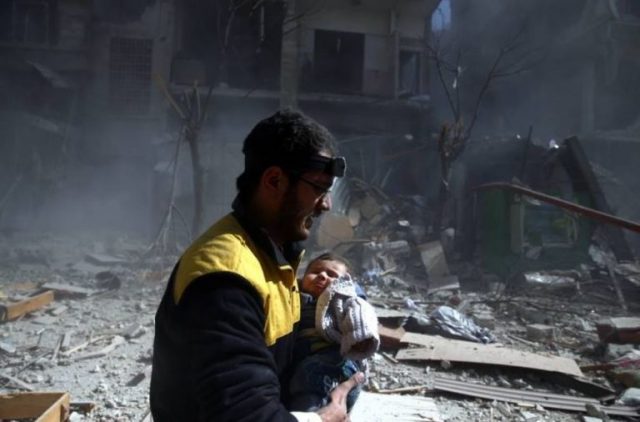
White Helmet images allegedly from Eastern Ghouta invariably depict WH operative carrying baby or child with no mother in attendance. No context, no names, no record of the incident.
21st Century Wire | March 9, 2018
David Macilwain is an Australian journalist and peace activist whose battle against ABC’s misrepresentation of the Syrian Conflict is a long and frustrating one. Macilwain recently wrote, again, to ABC to challenge their Eastern Ghouta narrative. Here is that letter that follows on from a previous correspondence between journalist Jeremy Salt and ABC. Salt received the bland response that began – “We note your concerns”. Translation “ABC will not deviate from support for US Coalition regime change project in Syria”:
“As another writer and critic of the ABC’s unbalanced reporting of the war on Syria, Jeremy Salt has forwarded me your response to his complaint about Sophie McNeill’s recent report on Ghouta.
Jeremy shared his complaint with me at the time, and I endorse the points he made in their entirety, regarding both the true situation in Syria and Ghouta, and on the ABC’s consistent and seven-year long failure to present a balanced picture of the Syrian government’s war with foreign-backed Islamist terrorists.
Consequently I am bemused by the ABC’s response today. Taken at face value, it betrays an almost complete lack of understanding of the ‘geopolitics’ of the conflict, as well as the role that the ABC has played over the last seven years in helping to deceive and misinform the Australian public.
So serious is this failure, and that of all the other “Western mainstream” media organisations, that almost the whole of Western society, including leaders and commentators, NGOs and even the UN, have an idea about the war on Syria which is a total fabrication.
Put simply, – and I need to spell it out – the war ON Syria was started and fomented by the US and NATO governments in coordination with their local Middle Eastern allies – the Gulf Arab theocracies, Israel and Turkey. These countries and their intelligence agencies conspired to ship an arsenal of weapons into Syria, and jihadists from across the region, with the intention to destroy Syria’s secular government and replace it with a Western friendly puppet.
This criminal attack by “proxies” and mercenaries might not have succeeded in Syria, where there was little interest in removing the government, and certainly not by force. So the role played by some media networks, in particular Al Jazeera and Al Arabiya, and the collusion of Western media agencies such as the Guardian and BBC – and by association the ABC – was critical to creating support for this lethal invasion amongst those in the West who had some say in what their governments were doing.
The propaganda from Arabic media, including Al Jazeera before it was kicked out of Syria, was also important in persuading some Syrians that their own government was attacking them. Many Syrians who fled the country continue to believe this, even as support for their government and army by the majority who remained is at record levels.
That is the background to the war on Syria, but there are two particularly important aspects of the subsequent misreporting of the war – as “Civil war” for instance, or as some sort of sectarian war against Sunnis – that need special mention. These two things have recently come together in the incredible propaganda campaign over the Syrian Army’s operation to liberateEastern Ghouta from its terrorist besiegers.
This ugly propaganda partnership is between the White Helmets and their “Chemical Weapons”. And it was perfectly illustrated in the scenes we saw – over and over again – of White Helmets hosing down children they claimed to have been affected by Sarin gas in Khan Shaikoun last year. This supposed attack is now thoroughly debunked, due to a complete lack of credible evidence either of Syrian airforce bombing or of proven Sarin contamination. While the UN made such claims, it refused to send an investigative team to the area – under control of Al Nusra terrorist groups – or respond adequately to Russia’s detailed criticism and protestations at the UN.
In fact, the most cursory viewing of the Khan Shaikoun footage – filmed by the White Helmets’ photographers and transmitted to Western media by unknown and unverified “activists”, would lead an uninformed – or un-misinformed – viewer to ask questions about its credibility. They might ask – and have – how the “White Helmets volunteers” seem unaffected by the Sarin contamination of their victims.
But if they know a little more, or do some simple research on the symptoms of Sarin poisoning, they wouldn’t ask this question; victims of Sarin and other nerve agents do NOT gasp for breath, because they cannot breathe. They also turn blue from lack of oxygen, in contrast to the rosy faces of these poor children, supposedly dying from Sarin exposure.
The well-informed viewer would then conclude – as I have and Jeremy Salt has, and thousands of observers and commentators in “non-Western” and alternative media have done – that both the White Helmets and their Sarin, and “Chlorine” attacks are a FRAUD. A criminal fraud, which has led to the deaths of tens and hundreds of thousands of innocent Syrians and Syrian defence forces by being endlessly repeated and echoed in Western media.
Even though these media organisations may not be intending to mislead, and may – like their audiences – genuinely believe that the White Helmets are a volunteer rescue organisation and that the Syrian government is killing its own people with chemical weapons – these media must hold some responsibility for the atrocious situation we now find ourselves in.
It will be a hard road back to truth and responsibility for the ABC and SBS, and their foreign media partners, but it is not too late to turn around and face reality. The consequences of not doing so are becoming increasingly severe.
Finally I would just like to address several points and claims that you made in your response to Jeremy Salt’s complaint.
You say that:
“As we have noted in our previous correspondence to you, the ABC has presented vast and comprehensive coverage of events in Syria. This coverage has included a broad and diverse range of perspectives over time, as required by the editorial policies.”
This beggars belief. “Vast and comprehensive coverage” that failed to inform your audience about the 10,000 strong “Army of Conquest” that was created by Saudi Arabia and Turkey in March 2015, and invaded Idlib province at a time when the Syrian army and its allies were finally making great progress to liberate the area from the clutch of insurgent groups. Now three years later, and countless thousands of deaths later, the Syrian army has driven the insurgents back to Idlib, with assistance from Russia.
“Comprehensive coverage” that somehow failed to tell your audience about the billion dollar Oil export business being run by Islamic State, in collusion with the US, Israel and Turkey, which was brought to an end by Russian bombs and cruise missiles? And that also failed to note how huge convoys of IS fighters and weapons had crossed the desert to reach and attack Palmyra without being stopped or attacked by US coalition forces?
A “diverse range of perspectives over time” that completely failed, over a very long time, to present the “perspective” of Syria’s legitimately elected government or that of the majority of its people? Their perspective on the foreign backed head-choppers of Al Nusra and Ahrar Al Sham, Jaish al Islam and Islamic State, is quite simple – they are all terrorists killing innocent Syrians, and if Western governments won’t cooperate in the joint operations with Russia, Iran and Hezbollah to drive them out and kill them, then they have no right to level any accusations against the Syrian government and its partners for acting in whatever way they see fit to defend their sovereign territory.
I’m afraid that the ABC’s response to this criticism is quite inadequate, and evidently a parody of truth. Citing two recent reports where there was mention of terrorist attacks on Damascus only highlights the absence of such a perspective from normal coverage. The titles of both reports focused on the usual half-truths about attacks on ‘rebel-held’ Ghouta by the Syrian army, misleading readers away from the reality – that the Syrian Army’s actions are a defensive response to the terrorists indiscriminate shelling of residential areas of Damascus.
It should also be borne in mind that Ms McNeill was not actually in Eastern Ghouta, so her sources are suspect. There is no credible information available on the number of children suffering or killed in Ghouta, and what information does reach us is mostly misinformation, from the White Helmets and their “anti-government” partners. When you have seen one fake “child rescued from the rubble” by these men you have seen them all, and should ask why it is that these bombed suburbs seem to have no inhabitants other than White Helmets “volunteers” and young children?
In consideration of my own criticism, which must also constitute a formal complaint, I would ask that you refer to my recent article posted on John Menadue’s blog “Pearls and Irritations”, which questions our alliance with America over the war on Syria, as well as the role and nature of the White White Helmets.”
AfD MPs in Damascus: Media Coverage of Syrian Conflict is Fundamentally Untrue
Sputnik – March 8, 2108
Despite the German Ministry of Foreign Affairs recommending to withhold the trip to Syria, several members from the AfD took the risk of visiting the war-torn country.
A group of seven politicians from the right-wing party “Alternative for Germany” has visited Syria to find out whether the country is safe, citing a lack of trust in the media’s coverage of the conflict.
“We have set out to Syria in order to receive information about the humanitarian situation in the country on-site. We do not rely exclusively on media coverage, which paints a horrifying picture of the developments, we want to find out what the living conditions are,” Christian Blex, an AfD parliamentarian from the western state of North Rhine-Westphalia (NRW) told Sputnik.
Shell-Holes from Terrorist Mortar Attack in Cathedral
The delegation entered Syria from Lebanon on March 5, with its first destination being the country’s capital, Damascus. Firstly, the politicians met with religious figures.
“What the state media won’t tell: On February 5, “moderate” terrorists from Eastern Ghouta shelled a Syrian Orthodox Church with mortars. The altar and floor were damaged, fortunately, no one was hurt,” Blex wrote on Twitter.
The group held a meeting with Syrian Grand Mufti Ahmad Hassoun, who reportedly called for Syrian refugees to return home. Christian Blex posted a picture from the meeting on his Twitter:
“His excellence Syria’s Grand Mufti has emphasized how important the separation of various religions from the state is for their peaceful coexistence in this country. It is also of particular importance to him that Christians in Syria have equal rights with people of other religions,” Blex explained.
The delegation managed to speak to the representative of the Patriarch of Damascus, who supported the Grand Mufti’s aspirations.
“We have also visited the cathedral. They showed us shell-holes, caused by the terrorists’ mortar attack on February 5,” said Blex.
Desire to Restore Normal Diplomatic Relations
The AfD delegation also plans to hold meetings with senior Syrian officials and politicians. They have spoken to the minister of state for national reconciliation affairs about the Syrian government’s program, aimed at reintegrating the rebels into peaceful life.
“The government grants amnesty to people willing to reintegrate into peaceful life, as long as they have not committed war crimes. There is a whole array of people, and even cities that are ready to reintegrate, seeking negotiations. […] They also told us about the background of terrorist groups in Syria and foreign influence on these groups: some are financed by Turkey; others are funded by Saudi Arabia, Qatar or the United States. We have also found out that the United States maintains its bases in Syria in violation of the norms of international law,” Blex elaborated.
“The meeting with Mr Ali Haidar, the minister for national reconciliation on Tuesday evening. He told us that over 100,000 former militants (fighting against the government) have returned to peaceful life following the amnesty. More than 100 municipalities and towns have been reintegrated into peaceful life.”
Furthermore, it appears that Syria is in dire need of labor and would be glad if those Syrians who left for Germany returned home. Blex has also said that the minister of foreign affairs told the delegation that the officials were aware of Syrians with Islamist background living in Germany.
“He warned us against letting people who may be dangerous into the country. But he also wants to restore normal diplomatic relations with our country,” Blex said, saying that another topic on the agenda was Turkey’s military operation in Afrin, which has spurred outrage among Syrians.
Is Syria a Safe Country of Origin?
The first two days of the trip the group spent in Damascus, with politicians being impressed by the cleanliness of the streets and the peaceful life in the city. However, the AfD members preferred to steer clear of the territories being constantly shelled from Eastern Ghouta.
“I can only say that Damascus is worth visiting. People are polite and the food is very delicious. Nevertheless, keep in mind the old Arab saying: God bless those who pay visits – but short ones,” he wrote on Twitter.
When asked whether Syria was a safe country of origin, Blex said that the first impression was that it was, although said that they could not make a conclusion based on what they had already seen.
“We didn’t see any danger on our way from Lebanese border to Damascus. Certainly, there is some threat closer to the territories, where terrorists are, due to the shelling. But they are limited to several regions in Syria. As soon as we visit Homs and Aleppo, we will have a full picture of the situation. For now, I would share the US’s evaluation and say that Syria is a safe country,” Blex told Sputnik.
“At the fair in Damascus. Usual weekdays. Modern shops. Women in headscarves and without them. It’s hard to believe that tens of thousands of Syrian men are in Germany now, and their families have yet to join them…”
Criticism from German Politicians and Media
While AfD MPs continue their journey through Syria, many colleagues have lashed out at them at home.
“It’s unnatural to meet with the criminal clique, while the dictator Assad uses bombs and poison gas,” said an outraged Michael Brand, human rights representative from the faction CDU/CSU in the Bundestag.
He called the Syrian Grand Mufti “brutal Assad’s Grand Mufti who has called on suicide-bombers to commit terrorist attacks in Europe and has personally approved of thousands of death sentences.”
Rolf Mützenich, expert on foreign policy from the SPD, insisted that the trip would have repercussions in the Bundestag.
“It will be discussed in [parliamentary] committees. The Council of Elders will also check who has financed the trip,” Zeit newspaper cited him as saying.
While other German daily newspapers have also slammed the trip, Christian Blex said that they are distorting the facts, as the Grand Mufti is a very peace-loving and educated person, and the reports about the developments in the country are also one-sided.
“They also report about the government forces’ offensive in Eastern Ghouta all the time. However, they conceal the fact that terrorists from Eastern Ghouta are shelling civilians and hospitals. They do not report it, because such information does not fit well into this black-and-white picture. What a shame, in such a country as Germany, which is a democracy, there is an obvious lack of information flow and honest coverage of events in the area. I believe that German media coverage of Syrian conflict is fundamentally untrue,” he said.
Analysts alarmed over Pentagon’s 60,000-strong Syrian rebel force
‘US aid ends up with extremists’
RT | March 7, 2018
Analysts have warned that US-supported groups in Syria often defect to extremists with their weapons. That’s after it was revealed the Pentagon plans to spend around $300 million to train and equip a 60,000-strong army in Syria.
Commenting on the Pentagon’s plans to build, train and equip a massive ‘Vetted Syrian Opposition’ to fight Islamic State (IS, formerly ISIS) in Syria, a number of US-based experts told RT the move has nothing to do with combatting terrorism. Instead, US weapons and aid could easily land in the hands of Islamist extremists, as has often been seen in the past.
“In the past, some of the groups who were the recipient of US aid ended up either taking over or [being] defeated by some of the radical forces on the ground in Syria. Or some of them ended up joining the extremists and taking some of the weapons with them,” Edmund Ghareeb, a scholar at the American University in Washington, DC, told RT.
Another expert said an armed formation will help Washington tighten its grip over rebel-controlled parts of Syria, while stressing that the US’ “hostile military presence in Syria” has no legal basis. “They want to create… conditions in Syria where the country is still divided. The record of the US and the CIA’s operations in Syria is that the people they have supported all along have been extremists,” said Nicolas J.S. Davies, the author of ‘Blood On Our Hands: the American Invasion and Destruction of Iraq.’
He argued that the State Department and Pentagon “clearly want to push ahead with a plan to basically keep forces under their control in command of all Syrian territory east of the Euphrates river.”
While the US justifies its presence in Syria with claims it is fighting terrorists, the only area IS “has survived is the area that is under American and its allies’ control,” Daoud Khairallah, a professor of international law at Georgetown University, believes.“One would wonder whether they are getting assistance from Americans for their survivability, ” Khairallah told RT.
Pentagon pays monthly allowance to rebels, seeks to establish large force in Syria
Following the virtual defeat of IS terrorists in Syria, the US appears to be trying to restructure its military presence in the war-torn country. In February, a fiscal year 2019 budget document mulled creating a new army out of elements of the so-called Vetted Syrian Opposition (VSO). The forces are “projected to total approximately 60,000 to 65,000” by October 2018, according to a report titled ‘Justification for FY 2019 Overseas Contingency Operations (OCO)’.
The document explains that some 30,000 fighters will conduct “ongoing combat missions” against remaining pockets of IS in the Middle Euphrates River Valley (MERV), while another 35,000-strong contingent will form Internal Security Forces in liberated areas.
Creating the massive new military structure of rather questionable legality, roughly equivalent to the size of the Canadian armed forces, is an expensive endeavor. Besides seeking $250 million for border security requirements for areas outside of Iraq and Syria, the Pentagon is seeking some $300 million from US lawmakers to implement the creation of the new opposition bulwark machine that will be funded through the Syrian Train and Equip Program. Launched under the Obama administration in 2014, the program identified and trained selected Syrian opposition forces to fight IS.
The Pentagon plans to spend the bulk of the new funds on arming the forces. Nearly $50 million is allocated for buying AK-47s, PKM machine guns, as well as RPG-7 anti-tank rocket-propelled grenade launchers. Mortar launchers and sniper rifles are also on the menu next to hand grenades, different types of vehicles and tons of ammunition.
Washington plans to pay a monthly allowance to its force, in addition to providing the new force with uniforms, hygiene kits and medical equipment. “[The Department of Defense] will transition to a stabilization effort that will focus on support to local Internal Security Forces, who will receive stipends for their efforts to secure liberated territory and prevent the re-emergence of ISIS or its affiliates,” the document reads. “Currently, 10,000 established partner force personnel are being paid stipends. The individual stipend payments range from $200 to $400 per month.”
While Washington maintains that its goal is to defeat IS, Moscow has repeatedly questioned US intentions, especially as the American presence in Syria is viewed as a violation of sovereignty.
The Russian military last month asserted that the true US goal is to capture “economic assets” in Syria, warning that America’s presence constitutes a dangerous threat to the political process and territorial integrity of the country.
Russian MoD Urges US Not to Hinder UN Access to Syria’s Raqqa
Sputnik – March 6, 2108
According to the Russian Defense Ministry, the only areas in Syria where the requirements of UN Security Council Resolution 2401 are completely ignored and there is no help for the population remains the destroyed city of Raqqa, as well as the Al-Rukban refugee camp in the US-controlled area of At-Tanf.
Since the entry into force of the resolution, no humanitarian convoy has been delivered there. The residents’ situation is estimated to be a humanitarian disaster.
“We urge the United States to fulfill its obligations under UNSC 2401, not to impede access to controlled areas for representatives of international humanitarian organizations and the UN to assess the severity of the humanitarian situation and take urgent measures to provide the necessary assistance to the civilian population,” the statement said.
The Defense Ministry recalled that in the Eastern Ghouta de-escalation zone, despite the daily imposed humanitarian pauses, militants are preventing people from leaving the areas of combat operations and are firing at the humanitarian convoys.
The ministry stressed that the reconciliation center earlier organized an entry for the UN convoy to Eastern Ghouta loaded with 247 tons of food and basic necessities. Furthermore, it is noted that the convoy was ready to evacuate up to one thousand civilians, but only 13 people, including five children, were able to leave late during the night.The UN Security Council unanimously adopted resolution 2401 which urges all parties to the conflict to immediately halt all clashes and adhere to a long-term humanitarian pause on the entire territory of Syria in order to ensure safe and unhindered humanitarian aid deliveries, as well as medical evacuations for those injured.
Terrorist organizations regularly violate the humanitarian pause. Earlier, Jabhat al-Nusra terrorists fired mortar shells at the humanitarian convoy that was on its way to the Syrian town of Douma in Eastern Ghouta.
Russia rejects ‘unfounded’ reports of Syria using chemicals
Press TV – March 6, 2018
Russia has rejected allegations that the Syrian government is using chemical weapons, stressing that only an international body can rule on the issue based on an “impartial” probe.
“The provocations are continuing that spawn such insinuations and unfounded accusations against the Syrian leadership,” Kremlin spokesman Dmitry Peskov told reporters on Tuesday.
Last week, the so-called Syrian Observatory for Human Rights, which is sympathetic to the militants operating against the Damascus government, claimed a suspected chlorine attack had taken place in the militant-held al-Shifuniyah village of the Eastern Ghouta region on February 25.
Russian Foreign Minister Sergei Lavrov described the alleged chemical attack as “bogus stories in the media.”
Prior to the Observatory’s report, the Russian Defense Ministry had warned that militant groups in Eastern Ghouta were preparing a false flag attack in a bid to blame the Damascus government for using chemical weapons against civilians.
On Monday, The Washington Post quoted US officials as saying that the government was considering new military action against the Syrian government in response to reports of suspected chemical weapons use.
The United Nations Human Rights Council also ordered investigators to examine what it called “the alleged use of chemical weapons in Eastern Ghouta.”
Peskov said, “In Syria the chemical weapons were destroyed. That was verified not only by the Russian side but by the OPCW (Organization for the Prohibition of Chemical Weapons).”
He further noted that for Russia, such accusations against the Syrian government need to be based on “the findings of an international commission, an international working group, only the result of an impartial investigation.”
“In the absence of such an investigation, all accusations are nothing but insinuations,” the Kremlin spokesman added.
Syria turned over its entire chemical stockpile under a deal negotiated by Russia and the United States back in 2013.
On April 7, the US launched a missile attack against Shayrat Airbase in Syria’s Homs Province. Washington claimed that the air field targeted in the missile raid was the origin of the April 4, 2017, purported chemical attack on the town of Khan Shaykhun in Syria’s Idlib Province.
Damascus denied the accusation of being behind the alleged gas attack and described it as a “fabrication” to justify the subsequent US missile strike.
UK, US De Facto Confirmed Support of Syria Terrorists – Russian Diplomat
Sputnik – 05.03.2018
The United Kingdom and the United States de facto confirmed their support of terrorists in Syria by rejecting Russian amendments for the UN Human Rights Council resolution on the situation in Eastern Ghouta, Russian permanent representative to the UN Office in Geneva Gennady Gatilov told Sputnik.
“The amendments which we introduced should have been supported by all states which do not want the conflict to escalate, and those who sincerely want to achieve the resolution of the Syrian crisis and elimination of the terrorist threat. But the conclusion may be drawn that those who initiated this resolution are not interested in the resolution of the Eastern Ghouta crisis, and de facto continue supporting militants turning a blind eye to their crimes,” he said.
In a separate comment, Aleksei Goltiaev, a Senior Counselor at the Russian mission to the UN Office Geneva, said Monday that Moscow considers the UN HRC statement on the situation in Syria’s Eastern Ghouta “disconnected from the situation on the ground.”
The council voted in favor of adopting the UK-proposed draft resolution, rejecting amendments proposed by Russia. As many as 29 members of the council voted in favor of adopting the document, four officials voted against and 14 abstained.
Moscow proposed adding clauses to the resolution that states condemn all terrorist acts in Syria, including those in East Ghouta, and refuse to provide any support for terrorists on the territory of the country. Therefore, the refusal of the HRC members to accept Russia’s amendments shall be regarded by Moscow as an outright demonstration of support for terrorists.
In addition, Moscow had appealed to the states participating in the vote to add to the text of the resolution a paragraph on the crimes of militants against civilians in East Ghouta and to include a clause on humanitarian corridors to ensure the safe evacuation of civilians.
The draft resolution set forth by the UK condemns the massive violation of human rights in Syria. In particular, London proposed condemning attacks on medical facilities and civilian infrastructure, “airstrikes against civilians,” and the “alleged use of chemical weapons in East Ghouta.”
The vote in the HRC on the UK-proposed draft comes after, on February 24, the UN Security Council unanimously adopted resolution 2401 introducing a 30-day truce on the entire territory of Syria to ensure the safety of humanitarian aid and the medical evacuation of those injured. However, the ceasefire regime does not cover military operations against the Daesh, al-Qaeda, and Jabhat Fatah al-Sham (formerly known as al-Nusra Front) terrorist groups.
The humanitarian situation in the suburb east of the Syrian capital has drastically deteriorated since February 18, when Syrian government forces launched an operation codenamed “Damascus Steel,” in a bid to clear the region of militants. According to the Russian military, the terrorist groups in the region are purposely struggling to escalate the situation in East Ghouta, preventing civilians from leaving the area and provoking retaliatory fights against the Syrian government.
READ MORE:
‘US accusations against Russia over E. Ghouta are escalation of information war’
RT | March 5, 2018
The West is trying to prolong the war in Syria and prevent the Syrian government from regaining control of Eastern Ghouta, investigative journalist Rick Sterling told RT.
On Sunday, the White House released a statement condemning the operation against militants in Ghouta and also blaming Russia and Iran for supporting the Syrian government.
“The United States condemns the ongoing military offensive that the Assad regime, backed by Russia and Iran, is perpetrating against the people of Eastern Ghouta,” the White House said.
Meanwhile, the Russian military says only two children have managed to escape the besieged Syrian district of Eastern Ghouta, after Russia established a humanitarian corridor to help civilians find safe passage out of the region on Tuesday.
RT discussed the latest developments with Rick Sterling, investigative journalist and member of the Syria Solidarity Movement.
RT: The White House statement blames Russia and the Syrian government for violating the ceasefire agreement. How reasonable is that charge?
Rick Sterling: The ceasefire agreement explicitly excludes the terror groups that basically dominate the region. In the areas where there are just civilians – that is where the ceasefire applies, in the areas where the terrorists are launching mortars into Damascus and are grouped that was explicitly excluded in point number 2 of the resolution.
RT: The statement also says Russia is killing civilians “under the false auspices of counterterrorism operations.” Do you think the White House seriously believes Russia wants to deliberately kill civilians? Even from a purely military point of view, what would there be to gain from that?
RS: The statement coming out on Sunday, it is a little bit unusual, a press release on Sunday. But it is an escalation of the information war, they make a reference to chemical weapons in there. Interestingly enough, the statement also includes a reference to Aleppo which is actually a very good comparison because the very same claims were being made 14 months ago in December of 2016. And when the armed opposition groups were finally expelled from Aleppo, it was learned that the civilians were really joyful at finally being liberated. And Aleppo today, the civilians are returning, they are rebuilding East Aleppo, the people walk about East and West Aleppo without fear. It is a good comparison because the same claims… are now being made about East Ghouta and it is basically a lot of false information, accusations without evidence and just let’s call it what it is – propaganda.
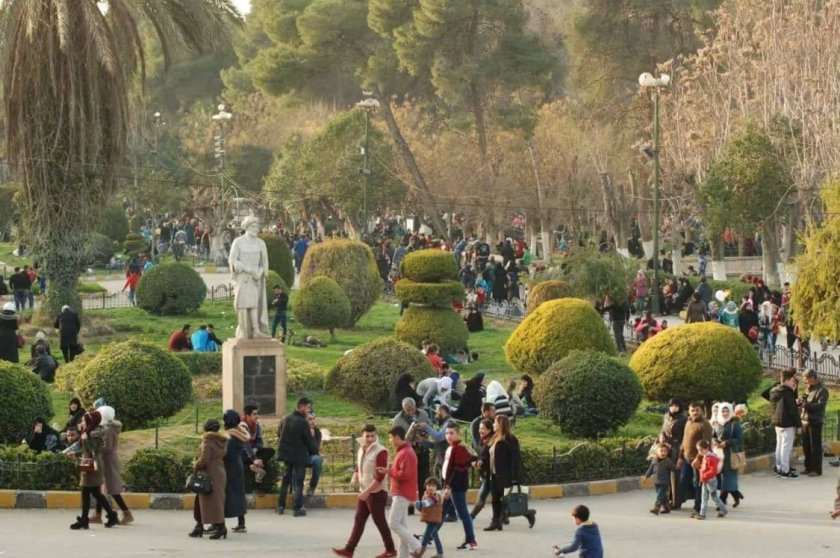
Aleppo central park, March 1, 2018 – Ahmad Al-Issa in Twitter
RT: Earlier, Syrian President Assad pointed out that the West shows concern for innocent life only when the Syrian Army is advancing. Why do you think that is?
RS: The whole point of view is very one-sided, of course. The major funder of the group Jaysh al-Islam and the Al-Nusra faction in East Ghouta is Saudi Arabia, which is, of course, a very sectarian reactionary country and so they are funding the war. Unfortunately, Saudi Arabia is very closely allied with the US, they are very biased on this, they’ve made no bones about it. They’ve been calling for regime change since the summer 2011. Basically, what we have going on here is a violation of international law. It is illegal internationally to fund a proxy army to try to overthrow a government you don’t like. That is coupled with an information war they’ve made a lot of accusations which are untrue.
RT: Damascus remains under periodic shelling by militants in Eastern Ghouta. Can this be brought under control?
RS: Definitely, in fact the Syrians, the elite ground forces of the Syrian Army, the Tiger Forces, are working there. So, the bombing of East Ghouta is really minimal in comparison, for example, to what the US air coalition did to Raqqa in East Syria. What the Syrian and the Russian air forces are doing in East Ghouta is a small fraction of the bombs that were dropped in Raqqa. What the Syrian Army is doing is that it is advancing more on the ground… And we are probably looking at weeks or months before the liberation of East Ghouta. Sadly, what is going on now is that the West is trying to prolong the war and prevent the Syrian government from regaining control of that region…
Read more:
Featured Video

Trita Parsi: Middle East Unraveling — Are We on the Path to World War?
or go to
Aletho News Archives – Video-Images
New Book
Trans agenda is ‘normalization of sadism’ – US author

RT | September 23, 2026
The US Democratic Party has embraced a transgender agenda that amounts to “the normalization of sadism,” author A.J. Rice has said, warning that radical trans policies would return if the party is allowed to regain power.
Speaking to RT’s America First host Scotty Nell Hughes about his new book, ‘The Curse of the Bearded Lady: How the Trans Mafia Whacked American Sanity’, Rice argued that activists have gained significant influence in schools, medicine, and corporate America while people who questioned the agenda have faced pressure to stay silent.
The author described the “trans mafia” as the sprawling network of people and institutions that have helped the movement gain influence. He singled out parts of academia, wealthy backers, and corporations, and stated that providers of transition-related treatment also have a financial incentive to keep young people in their care indefinitely.
Rice argued that the consequences of these policies ultimately fall on children who are being drawn toward gender-affirming medical treatments and on girls who are expected to share locker rooms or compete in sports with biological males.
He noted that while voters rejected the Democrats’ approach to gender in 2024, the party, which has been “captured by madness,” has since only doubled down and is seeking what is effectively “the normalization of sadism.” … Full report
Blog Roll
 Aletho News
- NATO chief wants Europeans to fight American wars [for Israel]
- German chemicals giant reveals details of downsizing
- Refaat Al-Areer Was The Canary In The Coal Mine In Israel’s War On The Truth
- Israeli election committee bars candidate from Knesset race over Gaza war opposition
- French-Lebanese man files war crimes complaint over Israeli attacks
- Mahan Air Flight Lands in China Despite US Threat against Iranian Airlines
- US eyes $10bn fund to rebuild war-battered Gulf infrastructure
- Trump meets Rodríguez near Maduro’s prison as Venezuela’s oil flows to US
- Trita Parsi: Middle East Unraveling — Are We on the Path to World War?
- Iran FM meets with US envoy on UN meeting’s sidelines at American side’s insistence: Report
- If Americans Knew
- Caught on Tape: AIPAC CEO Boasted of Controlling Trump’s National Security Officials
- Why Hamas Attacked Israel in October 2023 – Israeli professor Ilan Pappé
- They see them, then kill them: Israeli quadcopters track, deliberately target civilians in Gaza
- Winter could turn Gaza’s treacherous, war-damaged buildings into deathtraps
- Majority of Democratic Voters Want to Prosecute Both Biden and Trump Administration Officials Over Gaza
- As Gaza languishes, world leaders gather at the UN – Daily Update
- Sanctions are collective punishment: immoral and self-defeating
- Phosphorus Munitions Fired by Israel Burn Groves, Orchards in Southern Lebanon
- Israel Carries Out New Ceasefire Violations Across Gaza
- AI – Emphasis on the ‘I’: Israel Is Funding AI Chatbot Propaganda
- No Tricks Zone
- New Study: Earth And Venus Surface Warmth Largely Explained By Convection And Lapse Rate, Not CO2 Or Radiation
- 2025 Nature Paper Claiming Worsening Global Drought Gets RETRACTED …Heavily Flawed
- New Study: ‘Global Drought Shows No Detectable Recent Acceleration Under Climate Warming’
- Economic Masterminds: German Socialists Suggest Taxing Productivity Gains Stemming From Using AI
- The South China Sea Has Not Been Cooperating With The Climate Change Narrative
- Energy Crisis: Germany Enters Heating Season With Historically Low Gas Reserve Fill Levels
- New Study: The Antarctic Ice Sheet Gained Mass From 2020-2024 Due To Staggering Snow And Ice Accumulation
- Study: Ocean Heating Rates From Thousands Of Years Ago ‘Dwarf’ Modern Ocean Heating Rates
- Climate Extremists Target, Attack Large-Scale Power Grid Infrastructure In Germany!
- New Study: Antarctic Ice Melt Has Contributed Less Than 1 Centimeter To Sea Level Rise In The Last 30 Years

