US Launches Tomahawk Missiles on a Syrian Airbase Used in Fight against ISIL
Al-Manar | April 7, 2017
The United States has launched on Friday morning dozens of Tomahawk cruise missiles at an airbase in Syria in response to this week’s alleged chemical attack that it has blamed on the Syrian government, the pentagon announced.
The US military launched about 60 Tomahawk missiles against several targets on al-Shayrat air base 38 kilometers southeast of the city of Homs. They were reportedly fired from the USS Ross and USS Porter, Navy destroyers in the eastern Mediterranean Sea.
The strikes targeted aircraft and infrastructure, including the runway, but not people, US officials told NBC. But a Syrian military source was quoted by state TV as saying that the US missile strike has “led to losses.”
Syrian military personnel, as well as equipment, were evacuated from the airfield in prior to the late Thursday US missile attack, media report. The missile strike damaged runways, towers and traffic control buildings at the airbase, but personnel had been evacuated and equipment was moved ahead of the strike, ABC said on Friday citing eyewitness reports.
Governor of Homs Province Talal al-Barazi said that the Shayrat Airfield plays a key role in supporting Syrian government forces in their fight against ISIL terrorists.
“The Syrian army and armed forces are fighting terrorism, especially in the east of Homs. And recently significant progress has been reached, gas fields have been liberated as well as the city of Palmyra and its surroundings. This base to the east of Homs plays a key role in supporting military operations against ISIL, particularly in the eastern part of Homs,” al-Barazi said in a phone interview.
“Tonight, I ordered a targeted military strike on the airfield in Syria from where the chemical attack was launched,” US President Donald Trump told reporters at his Mar-a-Lago resort in Florida. “It is in this vital national security interest of the United States to prevent and deter the spread and use of deadly chemical weapons,” Trump said.
“There can be no dispute that Syria used banned chemical weapons,” he stated without providing a shred of evidence to back his claim.
The allegations of chemical arms use are still made against Syria even as the dismantling of the country’s entire stockpile of chemical weapons as well as relevant production facilities was supervised by the UN.
Foreign-backed militants have repeatedly used chemical weapons against Syrian troops, some of which have been verified by UN officials, but the attacks have often been ignored by Western governments.
US Congressman Tulsi Gabbard said that Trump’s decision to conduct the missile strike against a Syrian airfield was a mistake that will escalate tensions with Russia and lead to more civilian casualties. “This escalation is short-sighted and will lead to more dead civilians, more refugees, the strengthening of al-Qaeda and other terrorists, and a direct confrontation between the United States and Russia — which could lead to nuclear war,” Gabbard stressed.
Russia will demand urgent UN Security Council meeting after US missile strike at an airbase in Syria, Victor Ozerov, the chairman of the Russian Federation Council’s Committee on Defense and Security, told Sputnik.
“Russia will first of all demand an urgent meeting of the UN Security Council. This can be regarded as an act of aggression on the part of the US against a UN state,” Ozerov said.
“After this incident the already clouded relations with the US will somewhat worsen,” Ozerov told Sputnik, adding that the missile attack will likely be “a very bad example for the armed opposition in Syria, which could put under question the agreements reached with the opposition, including in Geneva.”
US Secretary of State Rex Tillerson said in a statement after the US attack that there were no discussions or prior contacts between the United States and Moscow ahead of the missile strike on the Syrian base.
British journalist destroys MSM lies on Syria
Syriana Analysis | April 6, 2017
Exclusive interview with British Journalist Tom Duggan in Damascus at the French Hospital tells us about the chemical attacks accusations.
Interview conducted by Hanin Elias
***Follow Syriana Analysis***
YouTube: https://www.youtube.com/c/syrianaanal…
Facebook: https://www.facebook.com/SyrianaAnalysis
Twitter: https://twitter.com/SyrianaAnalysis
‘Take Out His Airfields’: Hillary Clinton Comes Out of Woods to Warmonger
Sputnik – 07.04.2017
Defeated Democratic presidential candidate Hillary Clinton made a rare public appearance on Thursday evening — to come out and push for the US to bomb Syria.
The former secretary of state called for more US international intervention while speaking at the Women of the World Summit in New York, saying that the US should target Syrian airfields.
“That air force is the cause of most of the civilian deaths, as we have seen over the years and as we saw again in the last few days,” Clinton said.
“I really believe that we should have — and still should — take out his airfields and prevent him from being able to use them to bomb innocent people and drop sarin gas on them,” she added, referring to Syrian President Bashar al-Assad, and aligning herself with the likes of Iraq War architect Bill Kristol and neoconservatives such as Republican Senator John McCain.
The chemical attack has raised many eyebrows, however, as it came just days after the Trump administration stated that Syrians should decide who is running their country.
“It makes no sense, even if you were totally separate from this and take no sides of this and you were just an analyst, it doesn’t make sense for Assad under these conditions to all of the sudden use poison gasses. I think it’s zero chance that he would have done this deliberately,” former Texas congressman Ron Paul said on Wednesday.
Kentucky Representative Thomas Massie has also been outspoken about how the attack would not serve Assad’s interests.
“Let me ask you this: Who benefits? Who benefits, if chemical weapons were used and America weighs in on the side of the rebels, or wades into a war against Assad?” Massie said in an interview on CNN. “How does Assad benefit from that?”
Many of Trump’s most prominent supporters on social media have also been urging the president to ignore calls for intervention.
US rep shocks CNN anchor by questioning Syria gas attack narrative
RT | April 6, 2017
CNN anchor Kate Bolduan was flabbergasted after Representative Thomas Massie (R-Kentucky) questioned a recent chemical gas attack in Syria, then said it wouldn’t be in President Bashar Assad’s interest to conduct such a strike on his own people.
Bolduan interviewed Massie, a tea party darling and member of the House Freedom Caucus, about the US response to the reported chlorine gas attack on civilians in Syria that killed more than 80 people, including children. Massie voted against an American intervention in Syria in 2014.
“You see the images coming out of Syria and you think the best policy for the United States right now is to do nothing?” Bolduan asks towards the end of the 7.5-minute interview.
Massie cautions that American intervention might make the situation on the ground worse, then notes that “the first casualty of war is the truth.”
“It’s hard to know exactly what’s happening in Syria right now,” he continued. “I’d like to know specifically how that release of chemical gas, if it did occur ‒ and it looks like it did ‒ how that occurred. Because frankly I don’t think Assad would have done that. It does not serve his interest, it would tend to draw us into that civil war even further.”
Bolduan can’t contain herself from interrupting, her expression shocked, to haltingly ask who Massie thinks is behind the attack.
“Supposedly the airstrike was on an ammo dump, and so I don’t know if it was released because there was gas stored in the ammo dump or not,” he replied. “That’s plausible; I’m not saying that’s what I think happened…”
Baffled, Bolduan interrupts again to tie Massie to Assad and the Syrian president’s Russian backers.
“You’re more inclined to believe the position of what Bashar Al-Assad is saying and what the Russians are saying right now than more inclined to agree with, believe what your even your colleagues here in the United States believe is true, that this is Assad and what human rights observers over there say is Assad?” she asks incredulously.
“I don’t think it would have served Assad’s purposes to do a chemical attack on his people. So, you know, it’s hard for me to understand why he would do that if he did,” Massie replied.
Still stunned, Bolduan ends the interview.
Massie is most known for his repeated attempts to abolish the US Department of Education, as well as his pronouncement in mid-March that he would change his vote on the much-maligned American Health Care Act from “no” to “hell no.”
Why the Syrian Gas Attack Is Probably Fake
By Colin Liddell | Occidental Observer | April 5, 2017
Dirty tricks are like favourite records: play them too much and they get jaded. We haven’t heard about gas attacks in Syria for some time, but now, once again, the media — and, sadly, the Trump administration — is in overdrive about what is claimed to be a gas attack on the Syrian town of Khan Sheikoun by the Assad government.
First of all, the use of gas should not be regarded as particularly “evil” in a war that has also seen bombing and shelling of civilian areas as a matter of course, not to mention all the refinements to cruelty that ISIS and their like have introduced. But it is. We get it. Gas is “evil,” and you’re very, very bad if you use it. OK? So, stop!
But this means that gas attacks are also an extremely useful means of propaganda — but only if your opponents are seen to do them. In fact, this negative propaganda effect totally outweighs gas’s military benefits. And, yes, using gas may have military benefits, although in this case it’s hard to see how any possible benefits could outweigh the costs in terms of increasing the level of Western hostility.
An important precedent is the major gas attack, apparently by sarin rockets, that took place in the Damascus suburb of Ghouta in 2013 in which from between 350 and 1,400 people died.
Now, horrific as the attack was, there was a certain logic in it that made blaming the Syrian government plausible. The Syrian army was fighting street-to-street, house-to-house, trying to recapture urban territory, which any professional soldier can tell you is a nightmare for soldiers and civilian population alike. A way round this would be to use gas to clear out nests of entrenched opposition to make advances and pacification possible. Not ideal, obviously, but a way to break the deadlock and get a result. So, when the Ghouta attacks happened they at least made sense in a basic military tactical sense.
But any gains in this respect — and there weren’t many, as four years later Ghouta is still held by anti-Assad rebels — were soon outweighed by the negative international and diplomatic backlash, with the Obama and Cameron governments using the “propaganda” value of the attacks to push for military intervention.
Only strong countermeasures by the Russians, who claimed the attacks were false flag attacks designed to prepare the way for Western intervention, and a strong Russian commitment to support Assad, prevented this gas attack — false flag or not — becoming the death knell of the Assad government. Indeed, it is at least highly doubtful (see also here) that the attack was carried out by the Assad government.
Obviously gas attacks are an extremely risky and inefficient option for anyone, but especially the Assad government, so it simply doesn’t make sense that they would do this on purpose now. In fact there are a whole list of reasons why this couldn’t be a willful use of poison gas by the Assad government.
First, there’s the fact that Nikki Haley, the U.S. Ambassador to the United Nations, told reporters on March 30 that removing Assad was no longer a priority for the US:
You pick and choose your battles and when we’re looking at this, it’s about changing up priorities and our priority is no longer to sit there and focus on getting Assad out…
Do we think he’s a hindrance? Yes. Are we going to sit there and focus on getting him out? No. What we are going to focus on is putting the pressure in there so that we can start to make a change in Syria…
We can’t necessarily focus on Assad the way that the previous administration did…Our priority is to really look at how do we get things done, who do we need to work with to really make a difference for the people in Syria.
Given this, why would Assad risk the displeasure of the United States by doing something that reinforces the image presented by much of the media that he is a prime candidate for regime change? Why give fuel to Trump’s many critics by putting him in a difficult situation when he has just given you a free pass? On the other hand, if you really want renewed US effort to topple Assad, a false flag gas attack is just the ticket. Trump, under pressure from the media and many Republicans, may decide to change his mind and opt for a military confrontation.
So it’s no surprise that the neocon media immediately concluded that Assad was responsible. Michael Warren, writing in The Weekly Standard, hopes that the attack will change Trump’s policy toward Syria. For Neocon Jonathan Tobin, writing in National Review, it’s certain that Assad did it, and he wants to use this event to go after the neocons’ bête noire, Russia:
The Syrian government dropped a poison-gas bomb on a hospital, taking the lives of dozens, including eleven children. … This is a moment for the president, who is not generally shy about sounding off on his views of the world, to say something that puts the onus on Putin for Assad’s atrocities and makes clear that the U.S. won’t continue to turn a blind eye to the horror there.
Like 9-11, the gas attack is exactly the sort of thing the neocons want in order to panic the US into military intervention by providing a powerful moral rationale. Remember the moral opprobrium attached to Saddam Hussein that was so important in selling the disastrous Iraq war to the American people? Assad’s supposed gas attack on children in a hospital paints him as the epitome of evil.
And of course neocon favorites Senators John McCain and Lindsay Graham condemned the move. McCain‘s reasoning was that Trump, by de-prioritizing toppling the Assad regime, had encouraged Assad.
I’m sure they are encouraged to know the United States is withdrawing and seeking a new arrangement with the Russians. It is another disgraceful chapter in American history and it was predictable.
Sorry, but it seems ridiculous to try to launch a gas attack that kills a few dozen people in a civil war that has already killed between 321,000-400,000 people when it will be condemned by virtually everyone and has been used in the past as a pretext for US involvement. How could such a small-scale attack yield a strategic advantage? How can attacking a hospital and killing children have any military benefit at all?
There’s also the location. Khan Sheikoun is not on the front line. It is well in the rear, at least 10 miles from where the fighting is taking place, and ten miles is an enormous distance in this war where front lines have been moving slowly for years. This is clearly not Assad’s army clearing out an area of entrenched opposition so that they can advance.
So, there is absolutely no clear military rationale behind such an attack. In fact quite the reverse. In terms of negative propaganda for the Syrian government, the location is ideal: an isolated gas attack that harms civilians, but does not significantly endanger or inhibit journalists, allowing the latter to film and highlight the suffering of the former. We are now being inundated with images of dead babies and children writhing in pain—the emotional currency of Fourth Generation Warfare.
So, absolutely zero military benefit and a massive negative propaganda effect for the Syrian government. They would have to be insane to do it.
There are other possibilities. The worst one for the Syrian government would be an unwitting use of a bomb, shell, or rocket containing gas. This is not impossible, as there is always a chance that some gas weapons slipped through the net when the Assad government agreed to clear out its stockpiles of chemical weapons.
Another possibility is that a normal bomb, shell, rocket hit an opposition chemical weapons depot. Again there is no reason why this is impossible. Chemical weapons have been in the hands of various sides in this chaotic war.
Then there is the possibility of a false flag. In its favour is the fact that Syria and gas attacks haven’t been at the top of the news agenda for some time, so the shock effect on the uninformed public will be fresh and strong. If it worked in the 2013 attack in getting the US involved, maybe it will work again. Also arguing in favour of a false flag is the fact that the Assad government has been making gains and has been growing stronger for months. In short, they have been on a roll. The last thing they need is to be blamed for gassing civilians, while this clearly favors their opponents who need all the help from the West that they can get. Indeed, Zerohedge notes:
What was lost in all of today’s conflicting narratives is that it was an almost identical alleged chemical attack by Assad in 2013 that got the Obama administration involved in the Syria proxy war in the first place; the motive behind today’s attack is hardly any different.
It is clear then that the most likely explanation for this tragic event is either an accident or a false flag, and certainly not an intentional action by the Assad government.
Putin rebukes Netanyahu over ‘groundless’ accusations on suspected chemical incident in Syria
RT | April 6, 2017
Russian President Vladimir Putin told Israeli Prime Minister Benjamin Netanyahu in a telephone conversation that it was unacceptable to make “groundless” accusations concerning the alleged chemical weapons incident that took place in Syria earlier this week.
During the phone call initiated by the Israeli side on Thursday, Putin and Netanyahu stressed the importance of boosting international efforts to tackle terrorism, the Kremlin said in a statement.
Both sides “expressed readiness to expand [cooperation] in the interest of assuring stability and security in the Middle East and, first of all, in Syria,” it said.
In particular, Putin “pointed out that it was unacceptable to make groundless accusations against anyone without conducting a detailed and unbiased investigation.”
At least 70 people, including 11 children, were reportedly killed in a suspected chemical incident in the town of Khan Sheikhoun in Iblib province, Syria, on Tuesday. The US and its allies have put the blame on the Syrian government.
Earlier on Thursday, Israeli Defense Minister Avigdor Lieberman told the Yedioth Ahronoth newspaper that he was sure Syrian government forces were behind the “chemical weapons attack” in Idlib.
“The two murderous chemical weapons attacks on civilians in the Idlib region in Syria and on the local hospital were carried out by direct and premeditated order of Syrian President Bashar Assad, with Syrian planes. I say this with 100 percent certainty,” Lieberman said.
The defense minister criticized the ‘international community’ for having “zero” reaction to the incident, stressing that “the world needs to take responsibility and, instead of just talking, needs to do something.”
When asked if Russia was somehow involved in the chemical weapons attack, Liberman replied “we don’t know.”
The Russian Defense Ministry said the Syrian military carried out airstrikes in Khan Sheikhoun on April 4, hitting production facilities where terrorists stored chemicals, which were previously used in Iraq and the Syrian city of Aleppo.
Syrian Foreign Minister Walid Muallem has dismissed any accusations that the Syrian Army deployed chemical weapons in Idlib.
It’s impossible that the army – which has been making significant gains in almost all theaters of the Syrian war – would use banned chemical weapons against its “own people” and even terrorists, the minister said.
As the US and EU disintegrate, is it time for a French renaissance?
By Gearóid Ó Colmáin | April 6, 2017
Things were looking good for days. President Donald Trump had reportedly sent US senator Tulsi Gabbard on a fact-finding mission in Syria and wanted to know if President Assad would cooperate with the US in defeating ISIS. Assad was willing to cooperate with the new American president. US Secretary of State Rex Tillerson’s recent statement in Ankara that the US had renounced its desire to remove Assad seemed to mark a major policy shift in the right direction.
French presidential favourite Marine Le Pen was unequivocal in her desire to work with the Syrian government to defeat Takfiri terrorism. France’s Popular Republican Union party (UPR) recently invited journalist Vanessa Beeley to address their election campaign where she delivered an inspiring speech on Syria. Francois Asselineau, the party’s leader, is the most progressive and anti-imperialist candidate in the French election.
For a few days, it seemed as though the tide was turning in favour of peace and good sense. Then, as peace negotiations with the Syrian government were progressing, the Syrian gas saga returned with a vengeance.
If you are new to the topic of Syria, there are a few matters which need to be cleared up here. The country’s leader, Bashar Al-Assad, is democratically elected. He is neither dictatorial nor brutal. All of the “sources” which the mainstream Western media use to write their stories on Syria come from organisations such as the ubiquitously cited Syrian Observatory for Human Rights (SOHR). SOHR is neither Syrian nor a human rights organisation. It is a one-man show run by Rami Abdel Rahman, an anti-government exile based in Coventry England. He hasn’t been in Syria for more than two decades. Almost all Western media sources come from this man!
So, the intrepid and indefatigable purveyors of “serious” journalism in France’s Le Monde were busy yesterday doing what they do best: war propaganda. Having implanted the belief in the uncritical reader’s brain through headlines accusing the Syrian government of gassing its own people – this time in Khan Cheikoun in the outskirts of Idlib – according to “the sources”, the real story emerges from the rubble of the aforementioned “sources”: the Syrian Army have intensified operations against “rebels” in the area contiguous to Idlib and Hama in recent weeks.
“The Operation” writes Le Monde’s Benjamin Barthes “which enabled the insurgents to come to at least within 10 kilometres of their aim, was led by the Jihadists of the Fatah Al Sham Front, an emanation of Al Qaida”. So there you have it! Le Monde has just told you once again that the “rebels” and “insurgents” are in fact led by an “emanation of Al-Qaida.
Our governments are supposed to be fighting Al-Qaida, supposed to be protecting us from them. The Syrian government – which NATO admitted in 2013 has the support of the majority of the Syrian people – claims to have bombed a chemical weapons depot in Khan Cheikoun. The information has been confirmed by the Russian military.
Even if you believe Bashar Al-Assad is secretly a devil “killing his own people”, surely the man is intelligent? If he wants to stay in power, getting the United States off his back would be a major help, would it not? So, just days after the United States looked like it was going to work with Assad against ISIS, he just couldn’t resist spraying that gas on innocent children and all the war-weary generals of the Syrian Arab Army are cowering in the barracks, abjectly carrying out every whim of the Damascene butcher and now facing a carpet bombing campaign by NATO! How did such a crazy fool manage to stay in power so long!?
Yesterday morning on France Inter radio station, academic dullards were pontificating about “post-truth”, “fake news” and of course, “conspiracy theories”. Russian media in France is increasingly coming under the spotlight. Some pundits have accused Moscow of destabilising European opinion. But critical minds always seek clarity and the French are a most critically-minded people. The war lobby is howling in Washington and Brussels and a silence of cruel complicity was observed in Western capitals following the terrorist attacks in St Petersburg on Monday. We have been taught to hate Russia.
In the French presidential debates on the 4th of April there were only two candidates the establishment fear: François Asselineau and Marine Le Pen. Of the two, Asselineau is unquestionably superior. Unlike Le Pen, Asselineau wants to leave NATO and not just the Military Command Structures. He wants leave the EU and not just have a time-wasting referendum on it. Asselineau wants to reform the Conseil de Resistance Nationale (the National Council of the Resistance) – the post war council formed by patriots and communists to reconstruct France.
Asselineau’s UPR could be the surprise in this election. No genuine communist could vote for that perfidious caitiff, that execrable little Trotskyite trashbag Jean-Luc Mélenchon! The pseudo-leftist defends wars of aggression as long as they have their UN mandates and ‘humanitarian’ cover. Mélenchon is the incarnation of everything that is putrid and pathetic on the “Left.” In fact, he is not left-wing at all. He is a right-wing demagogue who pipes the far-left tune – another Alexis Tsipras, another Sorosite, fake social-democratic class traitor!
Yesterday morning the republican presidential candidate was drilled by France Inter’s war-monger-in-chief Patrick Cohen concerning the French government’s response to the alleged gassing in Syria. Fillon, who has faced an avalanche of dubious allegations due to his connections with pro-Assad Lebanese businessmen and his desire for peace with Russia, said tellingly that the Syrian leader makes “incredible mistakes”. Fillon seemed to suggest that Assad couldn’t be that stupid and demanded “proof”- to the chagrin of Patrick Cohen!
Trump has now excluded Chief Strategist Steve Bannon from the National Security Council. The CIA and Joint-chiefs of Staff are also back in the council. The US Deep State is triumphant and the White House is pushing UN war resolutions against Syria. In France we need a patriotic leader capable of challenging the Empire; we need the National Council of the Resistance. In the aftermath of American populist failure, now is the time to build the European popular front!
Here’s why Donald Trump is unlikely to attack Syria
By Alexander Mercouris | The Duran | April 6, 2017
The debate about the Syrian chemical attack yesterday and President Trump’s comments during a news conference with the King of Jordan have led to speculation that the US might be readying an attack on Syria.
The speculation stems from the fact that Nikki Haley, the US ambassador to the UN, said that if the UN Security Council fails to take action over the chemical attack the US might consider taking “unilateral action”, whilst President Trump himself made comments during the news conference that appeared to have the military option open.
Whilst in any international issue the possibility of unilateral military action by the US can never unfortunately be completely ruled out, on balance neither Nikki Haley’s comment nor President Trump’s comment seem to presage military action.
Nikki Haley’s comment was made during a debate in the UN Security Council about the setting up of an investigation to look into the details of the chemical attack. No one questions that such an investigation should take place. The draft Resolution prepared by the Western powers is – as with every Resolution the Western powers have proposed during the Syrian crisis – absurdly unbalanced, effectively blaming the Syrian government for the chemical attack before the investigation takes place. However even this Resolution concedes that an investigation is needed, especially after the relevant UN bodies have said that they cannot themselves say who was responsible for the chemical attack.
The Russians for their part have prepared their own draft Resolution which – far more neutrally – calls for an investigation.
It is difficult to avoid the impression that Nikki Haley’s comment was part of the game of bluff and counter bluff that nowadays regularly takes place in the UN Security Council. Specifically, she appears to have been trying to scare the Russians into agreeing to the Western draft Resolution and to drop their own.
The Russians are most unlikely to be intimidated by this kind of bluff, and having already ruled the West’s draft Resolution out they will almost certainly persist in rejecting it.
As for Donald Trump’s comments, as the entirety of his words during the press conference show, he did not directly threaten unilateral US military action in Syria but made his comments when pressed to say by a journalist whether or not he was considering military action. He declined to give any concrete answer one way or the other, but the clear impression from his comments is that he is not contemplating it.
Overall the impression President Trump’s news conference gave was that Donald Trump’s focus remains overwhelmingly on fighting ISIS – he said far more about that than about the chemical attack in Syria – and that though he does not want to give more ammunition to his domestic opponents by denying the Syrian government’s responsibility for the chemical attack, he tried to shift ultimate responsibility for the likely lack of a US reaction away from himself onto President Obama.
Ultimately the same factors that deterred a US military attack to lift the Syrian army’s siege of eastern Aleppo last autumn remain in place today. The Russian air defence system which was installed in Syria with its S400 and S300 missiles is still there. The US military in the autumn made absolutely clear their deep reluctance to engage this system, and nothing since has happened to change their views.
President Trump more than any other President in recent years looks to the US military for political support. It is even less credible that he will go against their advice than President Obama did.
In light of all this a unilateral US attack on the Syrian military on anything like the necessary scale to affect the course of the Syrian war is extremely unlikely.
Chemical attack blame game ‘failed’ at Syria conference in Brussels – Russian envoy
RT | April 6, 2017
Attempts by some members of the Brussels conference on Syria to redraw the agenda and focus on allegations of the Syrian government’s complicity in the suspected chemical attack in Idlib have failed, Russia’s deputy foreign minister has said.
“In what concerns this conference, of course, some tried to redirect it in order to focus attention on the incident that has occurred [in Idlib]. I must say that they failed to achieve that,” said Gennady Gatilov, Russia’s representative at the UN-sponsored international donor conference that was held on April 4-5 in Brussels.
Moscow hopes that the incident will not lead to the derailment of intra-Syrian talks as that would play into hands of those who strive to obstruct the peace process.
“Anything can affect the talks. But we would not like for such incidents to be used by opponents of the negotiation process to disrupt it,” the Russian diplomat said, stressing that it is necessary for the negotiations to be inclusive.
Despite the apparent discord at the conference, its participants were largely united in that there is no alternative to political settlement to the protracted military conflict.
“I would like to note that all spoke in favor of political solution, the majority agreed that there is no military solution,” Gatilov said, as cited by TASS. He added that “practically all hailed” the negotiations in Astana made possible by the mediation of Russia, Turkey and Iran and commended them as “great help” for the Geneva process.
No breakthrough has yet been achieved in the talks, Gatilov said, referring to the latest round of intra-Syrian negotiations that took place in Geneva last week.
“Regrettably, so far it has yielded no practical results but it is not the reason to say that the round failed. Obviously, it is going to be a long process and we had been saying this all the time,” Gatilov said.
The slow progress is due to major differences between the take of the Syrian government and rebels on an array of key issues, he said. The major point of disagreement between the sides is what topic should be given a priority in the talks. While opposition argues that the talks should pave way for a transitional government, the Syrian authorities insist on the preeminence of the fight against terrorism.
On Tuesday, a suspected chemical attack on the hospital in the town of Khan Sheikhoun in rebel-held Idlib province claimed the lives of dozens of people, including children. Rebel groups accused the Syrian government of mounting the attack, the claims which the Syrian authorities flatly denied.
Russia has demanded a thorough investigation into the incident, saying it should be led by the Organization for the Prohibition of Chemical Weapons (OPCW), Russian Foreign Ministry spokeswoman Maria Zakharova said. The OPCW will be entrusted with collecting evidence of the attack within the fact-finding mission. The composition of the mission should be subject to approval by the UN Security Council.
In the aftermath of the attack, Russia’s Defense Ministry issued a statement, saying that the Syrian Air Force on Tuesday bombed a warehouse housing chemical weapons bound for Iraq. The storage facility, which was used to produce and store munitions containing toxic gas, was managed by the rebels. Defense Ministry spokesman Major-General Igor Konashenkov noted that the symptoms displayed by the victims of the attack in Khan Sheikhoun are similar to those shown by civilians who suffered in the Aleppo chemical attack, perpetrated by the militants.
The death of civilians has sparked an international outcry, with some of the Western governments, including the US, backing the allegations put forward by the rebels.
Commenting on the attack, US President Donald Trump said that it was “unacceptable” went “beyond the red line” and made him to rethink his stance on the Syrian government and President Bashar Assad.
In his turn, Vice President Mike Pence blamed the attack on a “failure of the past administration to both confront the mindless violence of the Assad regime and also hold Russia and Syria to account for the promises to destroy chemical weapons,” in an interview to Fox News on Wednesday.
Responding to a question, if Washington sees Moscow also responsible for the attack, Pence stated that Russian must ensure the implementation of the pledge by the Syrian government to destroy all chemical stockpiles, saying that “the time come has come for them [Russia] to keep the word that they made, to see the elimination of the chemical weapons so that they no longer threaten the people in that country.”
“We were told that there were an agreement between Russians and Assad to destroy chemical weapons and that the threat to civilians from a chemical attack had been eliminated, it was not,” Pence claimed.
Syria denies & condemns use of chemical weapons – foreign minister
RT | April 6, 2017
Syria’s foreign minister has dismissed allegations that the Syrian Army had deployed chemical weapons in the city of Idlib, saying the military will never use such weapons against its own people or even terrorists.
Syrian Foreign Minister Walid Muallem denied claims that the military used chemical weapons in the western city of Idlib. Speaking at a news conference on Thursday, Muallem said an airstrike by Syrian military had targeted an arms depot where chemical weapons stockpiles were stored by Islamic State (IS, formerly ISIS/ISIL) and Al-Nusra Front militants.
He said it’s impossible that the army – which has been making significant gains in almost all theaters of the Syrian war – would use banned chemical weapons against its “own people” and even terrorists.
Asked if Damascus would allow a fact-finding mission into the Idlib incident, Muallem said past experience of similar investigations was “not encouraging.” He also said that he could not predict “the reality of US intentions” in Syria.
Muallem added that such a mission must not be politicized and must start its operations “from Damascus, not Turkey,” apparently referring to the latest statements by Ankara condemning the incident, as well as the fact that some victims were taken to Turkey for autopsy.
‘Monstrous crime’
Meanwhile, Dmitry Peskov, spokesman for the Russian president, said the Kremlin believes the Syrian military will do its utmost to prevent chemical agents from falling into the hands of terrorists.
“This was indeed a dangerous and monstrous crime, but in our opinion, it would be wrong to point fingers,” Peskov told reporters on Thursday. The Kremlin spokesman said Moscow does not agree with assessments provided by certain Western countries.
“Immediately after the tragedy no one had access to this area, so no one could have hard verifiable data. Consequently, any information which the US side or our colleagues from other countries might have had access to, could not be based on objective facts,” Peskov told reporters.
Though Peskov rejected “hasty assessments” of the alleged use of chemical weapons, he emphasized that there are always disagreements between Moscow and Washington, but mutual discords over the Idlib incident are unlikely to affect “the spirit of our cooperation.”
Earlier in the day, the Russian Foreign Ministry dismissed as “unsubstantiated” statements by US Vice-President Mike Pence that Moscow and Damascus had failed to fulfill their obligations under a landmark 2013 deal to eliminate Syria’s chemical weapons arsenals.
“I wouldn’t use profane language, especially when it comes to the second-most powerful man in the US administration, but I do believe that this is ignorance rather than irresponsibility,” Mikhail Ulyanov, head of the ministry’s Arms Control Department, said.
“The new administration has only recently begun reviewing its policy. Once that’s done, American officials’ statements, I hope, will become more accurate. There is no reason to say the US-Russia agreements [on eliminations Syria’s chemical weapons stockpiles] did not work,” Ulyanov stated.
Idlib chemical attack: A sign no change of policy is on the horizon
By Kit | OffGuardian | April 5, 2017
The alleged chemical attack, reported yesterday, is the latest in a series of atrocities notionally carried out by the Syrian government (“The Regime”, in the partisan parlance of the press). There has not been time, as yet, to fully examine and analyse all the evidence – the claims and counter claims, the photographs and videos – but it would be a massive mistake to view it in a vacuum.
First, the situation on the ground needs to be considered. The Syrian government – with assistance from Iran and the Russian Air Force, have been making steady progress for months. Aleppo has fallen. Palmyra was retaken. The rebels are losing. So cui bono? What good does dropping chemical weapons on children do Assad, at this point? It is both strategically pointless, and a crushing blow to his international image. It would serve no purpose, unless he’s a comic-book style villain intent on being cruel for cruelty’s sake – and they don’t exist outside of cinema or the American press. Conversely, it would make all the sense in the world for cornered zealots and mercs to try to disrupt the upcoming talks (from which they are excluded).
Second, the timing. Much like a previous “chemical attack” (and subsequent BBC Panorama documentary) came on the eve of a commons vote on military intervention in Syria, this attack comes at a key moment. In two days there is a meeting in Brussels on the Syria peace process, and the future of the country. This attack will allow Western leaders – especially the European voices, increasingly separate from the US on this issue – to ride an artificial high-horse into those proceedings. Deals can be scuppered and progress refused in the wake of such “atrocities”.
Third, we have seen this all before. There was the chemical attack in Ghouta, initially pinned on the government (and still unquestioningly attributed to them in the MSM), that was revealed to be carried out by rebels. there was also the aforementioned napalm/chemical attack on a school – thoroughly debunked by Robert Stuart. We have seen the same girl rescued three different times by the White Helmets, and seen people in Egypt arrested for faking footage of bombings. The “last hospital in Aleppo” was knocked down everyday for a month, and the last doctors slaughtered bi-weekly. There is no reason, as yet, to think this is not just more of the same.
This is in fine tradition of media manipulation – from filming people on the outside of a fence and pretending they’re inside, to moving bodies for a better photograph, to deliberately removing an image’s context, and lying about it. Events are ignored, twisted, exaggerated and outright fabricated in order to push an agenda. Accordance with reality is immaterial to the process, and coincidental when it occurs.
Real or not, false flag or not – No one can deny convenience of the timing. Given the conflict the UK/EU find themselves in with the new US administration re: Syria. During the campaign Trump, unlike Clinton, totally refused to countenance the idea of no-fly zones or any kind of American/NATO backed military action against Syria and their Russian/Iranian allies. The last few weeks have seen even a softening of America’s “Assad must go” mantra. Rex Tillerson, speaking in Turkey last week, said:
I think the… longer term status of president Assad will be decided by the Syrian people,”
And the American ambassador to the UN added:
You pick and choose your battles and when we’re looking at this, it’s about changing up priorities and our priority is no longer to sit there and focus on getting Assad out.”
Though she did later clarify these remarks, after being named-and-shamed in the media.
John McCain called Tillerson’s words “one of the more unusual statements I have ever heard”, stating it would be ridiculous to let Syrians decide the fate of Syrian government (probably because they would choose wrong).
The press, of course, have not referenced any of this. They continue to cite the partisan White Helmets and completely discredited “Syrian observatory for Human Rights” as if they are reliable sources. They continue to assert gossip and rumor as if it were fact. They continue to lie, but give themselves just enough room to manoeuvre should their lies be exposed.
The Guardian view on…, one of the Guardian’s anonymous editorials (that definitely don’t come straight from GCHQ, you cynics), is a classic example. The headline reads:
The Guardian view on Syria: Assad knows he acts with impunity
A sharp, hard-edged, statement of absolute certitude… and the only sentence of conviction in the whole piece. The rest is littered with uncertain, selective language. Weasel-words and guesses. I have added the emphasis:
Tuesday’s attack in rebel-held Idlib province has forced a reaction: it is one of the worst suspected chemical attacks in the six-year war
the symptoms suggest the use of a nerve agent, probably sarin
ascertaining the agents used, by whom, is always difficult – particularly given the problems experts will face in accessing the site.
The suspicion is that Tuesday’s strike, like another suspected sarin attack which killed 93 people in eastern Hama in December,
Some have already drawn a link between what seems to be the use of a more deadly agent and the US shift on Syria
That’s an awful lot of “seems” and “suspecteds” to cram into 700 words. It’s a suspected attack, that seems like it might be similar to other suspected attacks, which might have happened. As of right now, it appears, we don’t who attacked, how they attacked, what they attacked with or – indeed – if anyone attacked anything at all.
Nevertheless, the nameless and completely non-partisan and objective author reassures us that:
Nonetheless, the evidence so far points in one direction,
… he just neglects to mention exactly what that evidence is, or tell us where we can find it.
Just hours later we are treated to a longer variation on the exact-same theme, this time the author doesn’t feel ashamed to put his name to it… he probably should be. But years of writing about the Guardian teaches you that Jonathan Freedland is never ashamed of putting his name to anything.
Let’s not even condemn these attacks any more – because our condemnations ring so hollow.
… he says, before condemning the attacks – at interminable length and in trite manipulative language. That these condemnations “ring hollow” might be the only honest words in the article. The level of selective blindness, historical dishonesty, and flat-out hypocrisy is astounding. Even for him,
Assad has himself broken international law, indeed broken a set of precious, century-old conventions and agreements that ban chemical weapons.
… he says, as if a) It was a proven fact and b) It was the only example. No mention of American use of depleted Uranium, Agent Orange or napalm is made. No mention of Israeli White Phosphorus or of the cluster bombs we used in Iraq, and sold to Saudi Arabia to be used on Yemeni civilians. The use of any and all of those substances is illegal under International law. America and Israel cannot be charged with a breach of The Geneva Convention, of course, because they have never ratified protocols I and II, outlawing the targeting of civilians and infrastructure and banning certain weapons.
We are all too aware of the costs of action. But the dead of Khan Sheikhoun force us to make another calculation. They force us to see that inaction too can exact a terrible price.
This could be a straight copy-and-paste job from his many articles on Libya. He made the same arguments back then, and must take partial responsibility for post-apocalyptic wasteland that he (and his colleagues in the media) helped to create. Libya is destroyed, he knows this, and if he could excuse or downplay his role in that destruction… he would do so. To ignore it, and employ the same reasoning to encourage the same fate to yet another Middle-Eastern country, displays a callousness and vanity that belies is saccharine concern for “values”.
However, no amount of faux-moral agonising and dishonesty will ever trump this:
For more than a decade, we have rightly weighed the grave consequences of the 2003 invasion of Iraq, counting the toll in human suffering.
The tone mirrors the same tone ever-taken by members of the Western press when it comes to Iraq. “Our consciences are agony”, they scream at us. As if Iraq was all a tragic accident, fuelled by the fervor of our best intentions and naivety of our governments. They will never address the truth of it – that it was a cynical and brutal war of conquest, cheered on a by braying, controlled media, with more regard for their appearance of virtue, and their bank balances, than any idea of objective truth.
Now, the lame self-flagellation is one thing, but that it should appear alongside this:
Assad’s impunity is, at this very moment, being noted and filed away by the world’s most brutal regimes: the precedent is being set. This is what you can get away with.
… is quite another. The world is VERY aware “what you can get away with” in international law…and it’s not 70 dead in what “seems” like a gas attack. What you can “get away with” is walling up millions of people in a giant ghetto, and cutting off their water and power supply. It’s dropping carcinogens on villages, that give babies tumors 50 years later. It’s illegal sanctions that kill 500,000 children but are “worth it”.
“what you can get away with”, as the author so po-facedly admits, is the invasion of Iraq. An illegal war, a million dead, an ancient seat of civilisation reduced to a glass crater. Was anyone fired? Did anyone resign in disgrace? Has anyone faced charges in the Hague. No, the perpetrators walk free. They collect paychecks from the boards of the most powerful companies in the world, and are given column inches in the Guardian when ever they want them.
In terms of making an actual argument, he hits the exact same talking points as The Guardian view, uses the exact same phrases… and produces the exact same amount of evidence:
… we almost certainly know who did it. Every sign points to the regime of Bashar al-Assad.
He doesn’t say what these “signs” are. Or link to where we can see them.
We know that the poison spread after warplanes dropped bombs
We “know” no such thing. That’s just what the White Helmets said. The White Helmets are paid by the governments of several countries… including the US and UK. They are completely discredited as a source. But this article isn’t about making an evidence-based case, it is about harnessing created public outrage in order to further a specific political agenda.
So, what is the agenda? Well, it won’t be full-blown war in Syria. Number 10 was very quick to – shall we say – shoot-down that idea. It won’t be any kind of overt NATO or American backed intervention… if the PTB had wanted that, they would have pushed harder for a Clinton victory. And Freedland’s reference to Anne-Marie Slaughter’s suggestion is laughable:
Anne-Marie Slaughter, formerly of the Obama administration, suggests a single strike that would crater, say, a runway used by Assad’s warplanes – not an invasion, not a full-scale military operation, but some way of punishing Syria for what it has done.
No, the agenda being pushed here is two-fold, firstly an attack on the UN and its apparent impotence, and secondly a pre-emptive defense of the status quo.
To deal with the first point, the article launches a sidelong attack on the UN Security Council, most specifically the veto power:
In February, the UN security council considered imposing sanctions over the use of chemical weapons. Russia vetoed it, of course: it would never want to stay the hand of its murderous chum. But China vetoed it too.
This is not new material for the Guardian, they have been attacking the UN veto for years now – as have other liberal papers and news outlets. You don’t need to be a genius to understand the drive to undermine the only regulatory body that can put a hold on neo-liberal imperialism. But for the UNSC, Iraq would have been so much easier and Syria would have been levelled by now.
The second point is more subtle. For years the CIA et al have been seeking to remove Assad from government, most openly through supplying arms and money to the “moderate opposition” in order to wage a proxy war. Trump’s election, and his public undermining of the intelligence agencies, poses a threat to this on-going plan.
Now that this chemical attack has happened, of course, Trump’s administration can be condemned for being “soft”. Now, we can call on Trump and his cabinet to “act”… and when they refuse to change their policy, rightfully fearful of a conflict with Russia, they will be further derided and undermined in the press as “Russian agents” who are “easy on tyrants”.
All the while, the covert operations carried out by American and European alphabet agencies all over Syria will continue.
When the State Dept., the CIA and all their co-members of America’s (totally imaginary) “deep state” completely disregard the orders of their Commander-in-Chief, and continue to pursue their own agenda – continue to supply arms and funding to their mercenaries and proxies – they will be applauded in the press for their “bravery” and “resolution”.
We will be encouraged to be “thankful” that the mechanics of democracy and freedom cannot be impeded by the election of an autocratic buffoon. We will be told, with a bright smile, that our choice of leadership means literally nothing as it pertains to foreign policy.
It will be thrown in our faces that our elected officials have no real power, and we will be told to applaud the death of democracy… in the name of freedom.
Featured Video
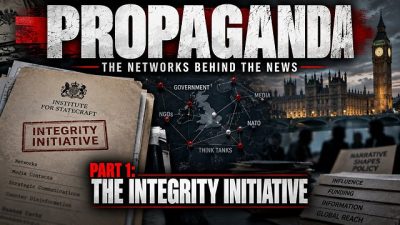
Integrity Initiative: UK-funded network framed dissent as Russian disinformation for years
or go to
Aletho News Archives – Video-Images
From the Archives
Why Saudi Ties to 9/11 Mean U.S. Ties to 9/11
By Kevin Ryan | Dig Within | September 27, 2015
Media interest in Saudi Arabian connections to the crimes of 9/11 has centered on calls for the release of the 28 missing pages from the Joint Congressional Inquiry’s report. However, those calls focus on the question of hijacker financing and omit the most interesting links between the 9/11 attacks and Saudi Arabia—links that implicate powerful people in the United States. Here are twenty examples. … continue
Blog Roll
 Aletho News
- ‘A Big Victory’ – Palestine Chronicle Wins Two-Year Legal Battle
- IAEA inspectors cannot return to Iran amid US threats: Russia
- Senate Rejects Iran War Powers Resolution Passed By House
- ‘We did not attack Pakistan with drones’: Afghan sources
- Iraqi Resistance faction links arms to sovereignty, questions US exit
- Cannon fodder no more… South Korea rejects Trump’s pressure to join his criminal war on Iran
- Neria Leiter Was A Legitimate Military Target
- Integrity Initiative: UK-funded network framed dissent as Russian disinformation for years
- ‘We don’t seek permission to defend our country’: Snippets from President Pezeshkian’s UNGA address
- NATO chief wants Europeans to fight American wars [for Israel]
- If Americans Knew
- In UN Speech, Iran’s President Displays Pictures of Children Killed by US, Brings Attention to Israel’s Nuclear Arsenal
- Israel displaces hundreds of Palestinians amid wave of demolitions in West Bank
- Aid, reconstruction, and Israel’s history of obstruction in Gaza
- Trump administration digs an ever-deeper hole of complicity in genocide – Daily Update
- US-Israel $2.8 Billion Arms Deal, 40,000-Bomb Supply Faces New Gaza Complicity Accusations
- Caught on Tape: AIPAC CEO Boasted of Controlling Trump’s National Security Officials
- Why Hamas Attacked Israel in October 2023 – Israeli professor Ilan Pappé
- They see them, then kill them: Israeli quadcopters track, deliberately target civilians in Gaza
- Winter could turn Gaza’s treacherous, war-damaged buildings into deathtraps
- Majority of Democratic Voters Want to Prosecute Both Biden and Trump Administration Officials Over Gaza
- No Tricks Zone
- New Study: Earth And Venus Surface Warmth Largely Explained By Convection And Lapse Rate, Not CO2 Or Radiation
- 2025 Nature Paper Claiming Worsening Global Drought Gets RETRACTED …Heavily Flawed
- New Study: ‘Global Drought Shows No Detectable Recent Acceleration Under Climate Warming’
- Economic Masterminds: German Socialists Suggest Taxing Productivity Gains Stemming From Using AI
- The South China Sea Has Not Been Cooperating With The Climate Change Narrative
- Energy Crisis: Germany Enters Heating Season With Historically Low Gas Reserve Fill Levels
- New Study: The Antarctic Ice Sheet Gained Mass From 2020-2024 Due To Staggering Snow And Ice Accumulation
- Study: Ocean Heating Rates From Thousands Of Years Ago ‘Dwarf’ Modern Ocean Heating Rates
- Climate Extremists Target, Attack Large-Scale Power Grid Infrastructure In Germany!
- New Study: Antarctic Ice Melt Has Contributed Less Than 1 Centimeter To Sea Level Rise In The Last 30 Years

