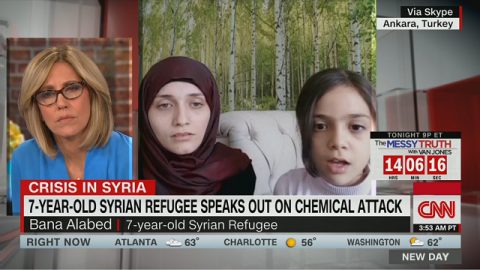
CNN is calling it a “7-year-old Syrian girl’s heartbreaking plea” to stop the war in Syria, in reality it’s a fake news hoax to get the Trump administration to overthrow Assad and turn on Russia.
The top story on CNN’s front page today is a disgusting Iraq-has-WMDs-style fake news story to con America into another war.
Under the title, “7-year-old Syrian girl’s heartbreaking plea: ‘Why can’t you stop the war?’,” CNN anchor Alisyn Camerota is seen interviewing a 7-year-old Syrian girl named Bana Alabed.
Camerota asks her: “Bana, do you [a 7-year-old girl] blame President Assad for this [chemical attack]?”
Bana responds, “Yes.”
“What is your message to President Assad?” Camerota asks the 7-year-old.
“I am very sad,” Bana says, looking down and blatantly reading off a script. “A lot of died,” she says, clearly struggling to read and skipping over the word “people” or “Syrians.”
“And, oh,” she stutters, “no one help them.”
“The world is watching,” she stammers, “the world doesn’t do anything.”
It goes on for another minute with Bana struggling to read her clearly pre-written propaganda lines. Eventually she asks, “why you, why can’t you, stop the war?”
“I don’t know Bana, I don’t know why the world can’t stop the war in Syria someday,” a torn Camerota responds, ignoring how incredibly fake and staged the whole shameless stunt she just took part in is.
This is the epitome of fake news and it’s a thousand times more dangerous to our country than some schmuck in Macedonia writing about fake endorsements from the Pope.
April 5, 2017
Posted by aletho |
Fake News, Mainstream Media, Warmongering | Alisyn Camerota, CNN, Syria, United States |
Leave a comment
The UN Security Council convened on Wednesday to discuss a draft resolution proposed by the US, the UK and France, which would condemn Damascus for the reported use of chemical weapons in the town of Khan Sheikhoun in Idlib province on Tuesday.
Russia criticized the draft resolution for being unbalanced and jumping to conclusions. It said the document would have to include several amendments, such as calling on the rebels controlling the area to provide full access to UN investigators and setting an unbiased and comprehensive probe into the incident as the primary goal of the resolution.
“This draft was penned in haste and adopting it would have been irresponsible,” the Russian deputy acting envoy to the UN, Vladimir Safronkov, said.
He also blamed Western members of the UNSC for unwillingness to investigate previous cases of alleged use of chemical weapons in Syria, where rebel groups were accused of using toxin agents.
Nikki Haley, the US ambassador to the UN, delivered an emotional speech that included images of children to argue in favor of swift action. The pictures were used in reporting of the alleged chemical weapons attack.
She claimed the incident carried “all hallmarks” of an attack by Damascus, adding that the toxin used in the alleged assault was “more deadly” than in previous cases attributed to the Syrian military by Washington.
US envoy to UN also accused Russia of failing to ensure that there were no chemical weapons in the possession of the Syrian government.
“The truth is that Russia, Iran and [Syrian President] Assad have no interest in peace,” Haley claimed.
The US has hinted at taking its own action in Syria unless the UN Security Council moves to prevent the use of chemical weapons in the war-torn country.
“When the United Nations consistently fails in its duty to act collectively, there are times in the life of states that we are compelled to take our own action,” the US ambassador to the UN said.
April 5, 2017
Posted by aletho |
Militarism | France, Nikki Haley, Russia, Syria, UK, United States |
Leave a comment
Islamic State militants have managed to steal chemical weapons from underground storage facilities in Libya that were not properly guarded and the gas has already been used, a cousin of the late Libyan leader Muammar Gaddafi told RT Arabic in an exclusive interview.
“ISIS has managed to find some of the secret underground storage facilities, still holding chemical weapons, hidden in the desert. Unfortunately, they weren’t properly guarded,” said Ahmed Gaddafi Al-Dam, a cousin of Muammar Gaddafi, the Libyan leader who was killed in 2011.
Al-Dam, the stolen gas was then trafficked to the northern part of the country and sold.
“There are two known cases of this chemical agent being stolen. I know this from my sources in Tripoli. In the first case, seven drums of sarin were stolen, and in the second, I think it was five.”
And the destructive chemicals have already been used, said Ahmed Gaddafi Al-Dam, who formerly was one of Gaddafi’s most trusted security chiefs. He recalled that during the recent clashes near the Al-Quds Mosque in Tripoli, security forces discovered a vehicle loaded with sarin.
“Unfortunately, those who had driven this vehicle into the city didn’t understand the dangers of this nerve agent, and how risky it was to bring it into an urban area, let alone ever use it. I don’t want to spread panic, but that’s the reality. And the world knows this very well,” he said.
Islamic State (IS, previously ISIS/ISIL) has already used chemical weapons in Iraq and Syria, according to numerous reports.
Earlier this month, Eren Erdem, a member of Turkey’s main opposition party, the Republican People’s Party (CHP), told RT that IS terrorists in Syria had received all the necessary materials to produce deadly sarin gas via Turkey.
April 5, 2017
Posted by aletho |
War Crimes | ISIS, Libya, Syria |
Leave a comment

ARCHIVE: Russian military inspect suspected chemical weapons workshop in Aleppo © Ruptly
The Syrian Air Force has destroyed a warehouse in Idlib province, where ammunition dump containing chemical weapons was being produced by militants before being delivered to Iraq, the Russian Defense Ministry spokesman has said.
The strike, which was launched midday Tuesday, targeted a major rebel ammunition depot east of the town of Khan Sheikhoun, Russian Defense Ministry spokesman Major-General Igor Konashenkov said in a statement.
The warehouse was used to both produce and store shells containing toxic gas, Konashenkov said. The shells were delivered to Iraq and repeatedly used there, he added, pointing out that both Iraq and international organizations have confirmed the use of such weapons by militants.
The same chemical munitions were used by militants in Aleppo, where Russian military experts took samples in late 2016, Konashenkov said.
The Defense Ministry has confirmed this information as “fully objective and verified,” Konashenkov added.
According to the statement, Khan Sheikhoun civilians, who recently suffered a chemical attack, displayed identical symptoms to those of Aleppo chemical attack victims.
Hasan Haj Ali, commander of the Free Idlib Army rebel group, rejected Russia’s version of the incident, saying the rebels had no military positions in the area.
“Everyone saw the plane while it was bombing with gas,” he told Reuters.
“Likewise, all the civilians in the area know that there are no military positions there, or places for the manufacture [of weapons]. The various factions of the opposition are not capable of producing these substances,” he added.
At least 58 people, including 11 children, reportedly died and scores were injured after a hospital in Khan Sheikhoun was targeted in a suspected gas attack on Tuesday morning, Reuters reported, citing medics and rebel activists. Soon after a missile allegedly hit the facility, people started showing symptoms of chemical poisoning, such as choking and fainting.
The victims were reportedly also seen with foam coming out of their mouths. While the major Syrian opposition group, the Syrian National Coalition, and other pro-rebel groups put the blame on the attack onto President Bashar Assad’s government, the Syrian military dismissed all allegations as propaganda by the rebels.
“We deny completely the use of any chemical or toxic material in Khan Sheikhoun town today and the army has not used nor will use in any place or time, neither in past or in future,” the Syrian army said in a statement.
The Russian military stated it did not carry out any airstrike in the area either.
However, EU foreign affairs chief Federica Mogherini, commenting on the incident, was quick to point to the Syrian government as a culprit, saying that it bears responsibility for the “awful” attack.
US Secretary of State Rex Tillerson echoed Mogherini, accusing the Syrian government of perpetrating the attack calling it “brutal, unabashed barbarism.” He argued, that besides the Syrian authorities, Iran and Russia should also bear “moral responsibility” for it.
The suspected nerve agent attack on a rebel-held area on Tuesday has underlined the regime’s confidence – bolstered by the Trump administration
The Guardian | April 4, 2017
Heartbreaking images of desperate patients and dead children in Syria are, sadly, too familiar. But Tuesday’s attack in rebel-held Idlib province has forced a reaction: it is one of the worst suspected chemical attacks in the six-year war. It claimed at least 67 lives, and the symptoms suggest the use of a nerve agent, probably sarin. It hit an area where thousands had taken shelter from fighting nearby. It was followed by attacks on medical facilities treating victims. It had “all the hallmarks of a regime attack”, said Britain’s ambassador to the United Nations. The White House accused the Syrian government of a “heinous” attack. […]
Some have already drawn a link between what seems to be the use of a more deadly agent and the US shift on Syria. The secretary of state said last week that Mr Assad’s future was a matter for the Syrian people, while the ambassador to the UN said removing him was no longer the priority (though she later tempered that remark).
Those comments dangerously reinforced, rather than created, the regime’s certainty that it can carry out war crimes with impunity. As a candidate, Donald Trump said Mr Assad’s future was “secondary” to defeating Isis. In February, Russia and China vetoed a security council resolution imposing sanctions over chemical weapons use; Wednesday’s meeting on the issue is unlikely to change much. … Full editorial
April 4, 2017
Posted by aletho |
Mainstream Media, Warmongering | Syria, The Guardian |
Leave a comment
DAMASCUS – The command of the Syrian Armed Forces decisively rejected accusations of using chemical weapons in Idlib province and placed responsibility for that on militants and their patrons.
“The army command and the Armed Forces categorically deny the use of any chemical weapons in the town of Khan Shaykhun in the suburb of Idlib today,” according to a Syrian Armed Forces command statement copy obtained by Sputnik.
The document also said the responsibility for the chemical attack in Idlib lies with militants and their patrons.
Earlier in the day, the Syrian National Coalition of Revolution and Opposition Forces claimed that nearly 80 people were killed and some 200 injured in an attack by the use of chemical weapons in Idlib, placing the blame for the reported attack on the Syrian army. However, a source in the Syrian army told Sputnik that the army did not have chemical weapons and the allegations could be part of anti-Damascus propaganda.
“The armed terrorist groups regularly blame the Syrian Army of using chemical weapons against members of this group, as well as against civilians, every time they fail to reach their objectives. And they do everything to justify their defeats on the ground to their financial patrons,” the statement added.
A UN Security Council meeting has been called by the United States to discuss the issue, while the United Nations said it could not verify if the attack took place. The Organisation for the Prohibition of Chemical Weapons (OPCW) has set up a Fact Finding Mission (FFM) to gather information about the alleged incident.
In 2013, Damascus agreed to place its chemical weapons under international control for its destruction. The move was made in order to prevent the weapons from being captured by militants in the course of the civil war in the Middle Eastern state.
So far, there has been a number of reports on use of chemical weapons in Syria, putting responsibility for attacks both on Syrian authorities and Daesh terrorist group.
In October 2016, the UN Joint Investigative Mechanism (JIM) on the chemical weapons use in Syria said that the Syrian authorities used chemical weapons at least three times throughout 2014-2015, while an earlier report said the IS was also responsible for several attacks.
Despite lack of conclusive evidence, a number of countries, in particular the United Kingdom, France, and the United States, blamed the Syrian government for the chemical attacks. Syrian President Bashar Assad though denied all accusations, claiming the reports failed to provide conclusive evidence of its culpability and putting blame on the terrorist groups. The Russian authorities have repeatedly called on necessity to double-check such kind of reports, stressing that conclusions cannot be simply made on interviews of several local residents.
In late October-early November 2016, a number of chemical attacks were conducted in Syria’s city of Aleppo by militants, killing dozens of Syrian servicemen and civilians. The Syrian government urged the Organization for the Prohibition of Chemical Weapons (OPCW) to conduct the investigation, while the Russian Defense Ministry handed the results of the chemical use probe to Syria’s national regulator in charge of implementing the OPCW convention.
Earlier on February, Russia’s Foreign Ministry said it expected more effective work from the OPCW, adding that the organization’s act-finding mission in Syria had conducted its activity over the past years remotely by interviewing witnesses, which raised questions over information’s credibility.
Since 2011, Syria has been engulfed in a civil war, with government forces fighting against numerous opposition and terrorist groups, including al-Nusra Front and Daesh, banned in a range of countries, including Russia.
READ MORE:
Assad: West ‘Demonizes’ Damascus Through Chemical Weapons Use Allegations
Oscar for White Helmets: Hollywood Gave Credibility to ‘Terror-Affiliated’ Group
April 4, 2017
Posted by aletho |
Deception, Fake News, False Flag Terrorism, Mainstream Media, Warmongering, Timeless or most popular | Syria |
Leave a comment
Russia strongly opposes sanctions imposed by the US and EU on Syria, which punish ordinary Syrians and prevent the delivery of aid to a country facing an unprecedented humanitarian crisis.
The sanctions and war have severely destabilized the Syrian economy, transforming a once prosperous country into an aid-dependent nation. They block access to aid, particularly medicines. Medical equipment, fuel, food, building materials, are desperately needed today.
A report by the UN Economic and Social Commission for Western Asia describes the sanctions as some of the most complicated and far-reaching ever imposed. For example, sanctions on Syrian banks have made the transfer of money into the country nearly impossible, preventing, among other things, aid groups from paying local staff and suppliers. Pharmaceutical factories that haven’t been destroyed by the fighting have been forced to shut down because of the sanctions-related restrictions on raw materials and foreign currency. US trade restrictions on Syria prescribe items that contain 10 percent or more of US content, including medical equipment, which is banned from sale to Syria.
According to independent reports, the sanctions became the main reason for the shortage of goods and rampant inflation, plunging over 80 percent of Syrians into poverty.
The work of Syrian charities and humanitarian organizations is severely impeded under the pretext that they have links to the people from the so-called inner circle of President Bashar Assad. One can recall the campaign in the British media criticizing the UN for cooperating with the Syrian Government in the distribution of humanitarian aid.
Unfortunately, on March, 20 the EU imposed a new set of sanctions on Syria, showing disregard for the aspirations of the Syrians for the better future. The statements of our Western partners about the need to alleviate the suffering of the Syrian people contradicts their sanction policy. We hope that common sense and compassion will prevail over political and ideological considerations.
The West has been wrong on Syria from start to finish. Maybe, now is the time to bring its narrative in line with reality on the ground and the real needs of Syrians.
Dr Alexander Yakovenko, Russian Ambassador to the United Kingdom of Great Britain and Northern Ireland, Deputy foreign minister (2005-2011). Follow him on Twitter @Amb_Yakovenko
April 4, 2017
Posted by aletho |
Economics, Subjugation - Torture | European Union, Human rights, Syria, UK, United States |
Leave a comment
A Spanish High Court Judge has made a controversial decision to open a case on charges of ‘state terrorism’ against several Syrian security officials.
Eloy Velasco, a Spanish High Court Judge, decided to review a lawsuit brought forward by Amal Hag-Hamdo Anfalis, a Spanish citizen who accused nine Syrian security officials of kidnapping, torturing and executing her brother, a Syrian national.
Despite the fact that the victim was not a Spanish citizen, Velasco argued that the nature of the case makes it subject to universal jurisdiction.
Professor Julio Jimenes, a Spanish blogger and notable mass media expert, told Sputnik that the judge’s decision to review this case is a mockery.
“First things first, the Spanish courts lack the necessary jurisdiction. And second, here’s what I’d like to ask: why didn’t Madrid take an interest in the killing of a Spanish journalist in Iraq in 2013 who was slain by US soldiers? Not to mention the fact that back then a number of legal measures were enacted to ensure that the Spanish justice system was unable to get involved in that case. All of this looks, shall we say, surprising,” he said.
Professor Jimenez also remarked that this decision looks “especially absurd” considering the fact that the Spanish legal system still remains reluctant to investigate the crimes committed “during the times of dictator Franco”, adding that “there are too many unpunished crimes here in Spain to meddle in the affairs of other countries.”
“Just think about it: a Spanish judge is going to review charges of terrorism against a government which is currently fighting against terrorism. His zeal would’ve been put to better use if he pursued the real extremists who are currently fighting in Syria against the legitimate government; or, even better, those who train and fund said extremists – namely, certain Western countries,” he said.
And finally, Professor Jimenez pointed out, this case may actually be a veiled attempt to derail the ongoing negotiations between Damascus and members of the Syrian opposition who seek to find a political solution to the crisis that is currently tearing apart their country.
“I can’t rule out the possibility that this decision may be an attempt to hamper the talks between the Syrian government and the opposition which began in Geneva,” Jimenez added.
April 3, 2017
Posted by aletho |
Mainstream Media, Warmongering | Spain, Syria |
Leave a comment
As early as 2013, Western powers have been rooting for the balkanization of Syria as the best possible outcome of the war tearing apart the country since 2011.
Since the war against Syria is significant in this period of imperialism, watching how it was led by the US, imperialist proxies and their so-called allies, one can fully understand that the war against the Syrian Arab Republic has been decades in the making.
Throughout history, the imperialist powers have been facilitating and empowering the most intolerant, bigoted ideologies and groups in the region starting from the Balfour Declaration, passing through the infamous Sykes-Picot agreement and ending in the invasions of Iraq and Libya before making their way into Syria. The latest group to gain the full support of the US on the ground in Syria is the Syrian Kurdish YPG forces (People’s Protection Units).
The US threw its lot in with the Kurds in Iraq at first as it supposedly tried to find partners who reportedly pose a credible threat to ISIS. Thus, their pick of the Peshmerga Kurdish group came as a result of mutual interest in the region. The Kurds wanted to establish their own autonomous state in the region and the US wanted to reenter Iraq under the pretext of helping the Kurds fight ISIS.
Kurdish Political Ambitions
The first direct coordination between US forces and Kurdish groups was between October 2014 and January 2015 in the battle of Kobani, inside Syria, where Kurdish forces reached out to the Americans after ISIS forces surrounded them. The US then hit the terrorist group’s targets in the area with airstrikes, while the Kurdish forces on the ground assaulted ISIS positions that ended up inflicting heavy losses on the terrorists and drove them out of the area.
This battle represented an historic opportunity for both political wings of the Kurdish movement, the Iraqi Peshmerga and the Syrian PYD (The Democratic Union Party) to realize their dream of independence. The PYD’s armed forces known as the YPG (People’s Protection Units), which has a fighting force of 50,000 fighters, became determined to take control of the vast majority of Syria’s border with Turkey fully backed by US airpower.
The PYD then stated that its priority focused on uniting traditional Kurdish areas of Syria (known as Rojava), extending from Afrin to the Tigris river into one attached land mass.
That statement took me back to the words of former US Secretary of State Henry Kissinger in 2013 when he commented on the Syrian situation, expressing his preference for a broken-up and balkanized Syria to emerge out of the current so-called “Assad-controlled unity.” The man said he supports the partitioning of a unified state.
Oldest plan in the book: Balkanize Syria
The US’s vision of the future Syrian map was detailed by Kissinger during a presentation at the Ford School Syria with pretty much a distorted history lesson. He stated that Syria was not a historic state “It was created in its present shape in 1920, and it was given that shape to facilitate the control of the country by France, which happened to be after a UN mandate,” he said.
Kissinger then claimed that the current Syria was conceived as a more or less artificial national unity consisting of different tribes and ethnic groups.
This same theory was also presented by the Israeli Oded Yinon plan which is an article published in February 1982 in the Hebrew journal Kivunim (“Directions”) entitled A Strategy for Israel in the 1980s. This plan is an early example of characterizing political projects in the Middle East in terms of a logic of sectarian divisions and the dissolution of all the existing Arab states.
Hence, supporting the partitioning of Syria began with the US and Israel’s full support of the so- called “Rojava Project”.
US helping Kurds put plan into effect
The US’ support for the YPG has gained public sympathy in the West viewing the Kurds as the most forward-thinking “rebel” group in the battle against extremism. The same cannot be said for the countless factions receiving aid from regional backers, many of which have cooperated with Al-Qaeda’s Syrian affiliate, Nusra Front (Ahrar Al Sham).
However, you would have thought that the PYD’s connections to the Kurdistan Workers’ Party (PKK) – a US, EU, and Turkey-designated terror group – are problematic. Despite this fact, the US appears to be committed to maintaining its air support for the Syrian Kurds, both near the Euphrates in the west and the outskirts of Raqqa in the south.
Thus since the US favors the balkanization of Syria, it is now working openly to empower Syrian and Iraqi Kurds. So by choosing sides, the US may be signaling that it is preparing for all contingencies, including the fracturing of Syria and the complete collapse of the state in Raqqa.
During the past couple of weeks, Raqqa, ISIS’s main urban base of operations in Syria, is the focus of an ongoing campaign by the newly formed US-backed Syrian Democratic Forces (SDF). The SDF is a coalition of Kurdish (YPG), Sunni Arab (FSA-Free Syrian Army) and Syriac Christian fighters, but is completely dominated by its Kurdish element (YPG).
The main Syrian Kurdish militia, the YPG, already controls swathes of northern Syria as well, where Kurdish groups and their allies are working to establish a decentralized system of government in areas captured from ISIS. This political project is causing deep alarm in Damascus, which sees the YPG and its political affiliate, the PYD, as a potential threat with their current loud and clear alliance with the US.
According to Reuters, Saleh Muslim, the co-chair of the Syrian Kurdish PYD party, stated that the northern Syrian city of Raqqa is expected to join a decentralized system of government being set up by Syrian Kurdish groups and their allies once it is freed from ISIS.
As per these comments, I spoke with Fares Shehabi, a member of the Syrian Parliament for Aleppo and Chairman of the Syrian Federation of Industry who firmly guaranteed that “the statement of Saleh Muslim is irresponsible since the Syrian government will not recognize any presence in Raqqa or any other province other than the legitimate Syrian state represented by the Syrian Arab Army.”
As I spoke with Mr. Shehabi, a heavy US-backed operation near Raqqa was blocking any advance by the Syrian Arab Army from the west in preparation for the balkanization process. Thus I asked Mr. Shehabi where the Syrian government stands from this process as seemingly the Kurdish forces are fully under the control of the US. The Syrian MP responded resolutely that “no balkanization of Syria will be allowed” stating that “the Kurdish Forces do not have the field power to enter or stay in Raqqa because that would cause an unwanted and unrealistic change in the fabric of the city.” Mr. Shehabi then explained that any sort of a Kurdish uncalculated incursion whether from YPG or SDF on the city of Raqqa would backfire since their move will not be accepted or tolerated in the city.
In March, the SDF announced it had captured the Tabqa air base, 45 kilometers (28 miles) west of Raqqa, with direct US substantial air and ground support provided.
The Telegraph reported on that mission that five helicopters, supported by five fighter jets, dropped dozens of SDF fighters near the northern town of Shurfa without stating whether or not US soldiers accompanied them.
Meanwhile, the Syrian Arab Army’s main ally Russia has always been aware of US plans to pull Raqqa into a “decentralized” government, which would be the first step toward balkanizing Syria. As early as October of 2014, Sputnik reported:
The Pentagon’s reliance on Kurds to liberate Raqqa may indicate that the US is actually ready to support the federalization of Syria, said Alexander Babakov, a member of the Foreign Affairs Committee at the upper house of the Russian parliament.
“It would be hard to imagine that American plans on Raqqa are aimed only to bring peace to Syria. It cannot be ruled out by using Kurds to liberate the city from Daesh the US wants to support the federalization of Syria, including establishing an autonomous Kurdish region,” Babakov told the Russian newspaper Izvestia.
Therefore, since the United States and Israel have never denied their aspiration to see Syria divided up into small, vulnerable and easily manipulated territories, and since the Kurds have provided the US and Israel with the pretext to do so, it remains to be seen how the Syrian government and its allies will respond. Now that a foreign army and its proxies are blocking the Syrian Army from liberating its own country from terrorists, we wait to see if balkanization is next.
Ms. Marwa Osman. PhD Candidate located in Beirut, Lebanon. University Lecturer at the Lebanese International University and Maaref University. Political writer/commentator on Middle East issues with many international and regional media outlets.
April 3, 2017
Posted by aletho |
Ethnic Cleansing, Racism, Zionism, Timeless or most popular, Wars for Israel | Iraq, Israel, Middle East, Syria, Turkiye, United States, YPG, Zionism |
Leave a comment
The NATO Foreign ministers meeting in Brussels on Friday assumed special significance since it happened to be the first appearance by US Secretary of State Rex Tillerson on the alliance’s ‘diplomatic podium’. The alliance, in fact, refixed the date of the ministerial to suit Tillerson’s scheduling convenience. And he, for sure, did not disappoint his audience.
Tillerson’s interventions on Friday were the first structured statements of the Donald Trump administration on two important vectors of the US foreign policies – NATO’s raison d’etre as a military alliance and, secondly, Ukraine – which together inevitably reflect on the overall approach that can be expected from Washington in relations with Russia – at least in the near term. Tillerson is slated to visit Moscow on April 12.
Tillerson unequivocally stressed the Trump administration’s commitment to NATO. He described the alliance as the “bedrock of transatlantic security”. Thereupon, he went on to identify ISIS and Russia as the two “common threats” that the alliance faces. He said NATO as an alliance is “fundamental to countering both non-violent, but at times violent, Russian agitation and Russian aggression.” Tillerson called on NATO to “remain vigilant in strengthening NATO’s eastern defences… from Baltic to the Black Sea.”
No doubt, it was exceptionally strong language for the US’ top diplomat to use. Tillerson cited against this backdrop this weekend deployment to Poland of the US’ “enhanced, forward presence battalion”. He hinted that the Trump administration envisages a lead role for NATO in fighting the ISIS and, importantly, in the stabilization of Iraq.
This effectively rules out any significant level of military cooperation between the US and Russia in the fight against ISIS. (Notably, though, Tillerson made no mention of Syria.) Indeed, it remains to be seen how an enhanced NATO presence in Iraq will be perceived in Tehran.
Tillerson also addressed a meeting of the NATO-Ukraine Commission in Brussels on Friday and his remarks there have been the most detailed statement so far on the Trump administration’s policies towards the Ukraine crisis. Tillerson literally tore into Russia. The following excerpts bring out the flavour of this unequivocal condemnation of Russian policies in Syria through the past 3-year period:
- Three years ago, Russia’s aggression against Ukraine shook the very foundations of security and stability in Europe. Today, Russia’s ongoing hostility and occupation is compromising our shared vision of a Europe that is whole, free, and at peace. American and NATO support for Ukraine remains steadfast. As we have repeated at every Ministerial and Summit since Russia launched its campaign of aggression against Ukraine, NATO Allies stand firm in our support of Ukraine’s sovereignty and territorial integrity. We do not, and will not, accept Russian efforts to change the borders of territory of Ukraine… NATO solidarity is crucial to finding a political solution to this conflict.
Tillerson made it clear that the US squarely holds Russia accountable for the implementation of the Minsk agreements. He warned Moscow:
- The United States sanctions will remain until Moscow reverses the actions that triggered our sanctions. We note with alarm the escalating violence along the line of contact and the repeated targeting of civilian infrastructure by Russia-led separatist forces, which poses an elevated risk of humanitarian disaster. We call on Russia to exercise its influence over the separatists to put a stop to the violence, end the campaign of attacks and intimidation against OSCE monitors, and facilitate the access they need to do their job. The OSCE must be able to fulfill its mandate which included monitoring throughout the conflict zone and to the international border. And Russia must understand there is no basis to move forward on the political aspects of the Minsk agreements until there is visible, verifiable, and irreversible improvement in the security situation.
Simply put, Tillerson has put Russia on notice that the Trump administration policies will be hard as nails when it comes to the Ukraine situation. (Meanwhile, there are growing demands that the US should supply lethal weapons to Ukraine.)
On Crimea, Tillerson was pretty much blunt: “Crimea-related sanctions must remain in place until Russia returns control of the peninsula to Ukraine.”
Most important, Tillerson just stopped short of saying that the US is supportive of Ukraine’s induction as a NATO member country. He urged Kiev to bring the Ukrainian armed forces to continue to reform and modernise so as to come up to the NATO standards by 2020. In a subtle reference to what lies ahead, Tillerson recalled Trump’s assertion that “every country has the right to chart its own future.” To be sure,Ukraine is looming ahead as the inflection point in Russia’s relations with the US.
The overall tenor of Tillerson’s remarks suggests that not only is the Trump administration unable or unwilling to do anything to improve relations with Russia in immediate terms, it might simply continue with the Barack Obama administration’s Russia policies for as long as the civil war conditions prevail in Washington between him on the one hand and the Russophobes in the Congress and the American foreign and security policy community on the other. Read the triumphalist opinion piece by Time magazine – These Five Facts Explain Why Trump’s Russia Reset May Be Over.
April 2, 2017
Posted by aletho |
Aletho News | Iraq, ISIS, NATO, New Cold War, Syria, Ukraine |
Leave a comment
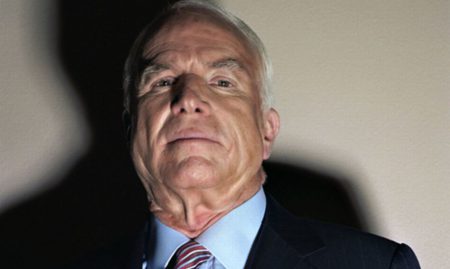
Following the announcement by top US diplomats that Washington will no longer pursue regime change in Syria, Republican senators John McCain and Lindsey Graham condemned the administration’s shift in priorities, saying it would empower ISIS and Al-Qaeda.
On Thursday, US Secretary of State Rex Tillerson said the future of President Bashar Assad “will be decided by the Syrian people.” Earlier in the day, US ambassador to the UN Nikki Haley said Washington’s “priority is no longer to sit there and focus on getting Assad out.”
Chairman of the Senate Armed Services Committee, Senator John McCain (R-Arizona), said he was “deeply disturbed” by Haley and Tillerson’s pronouncement, John McCain adding that their “suggestion that Assad can stay in power appears to be just as devoid of strategy as President Obama’s pronouncements that ‘Assad must go’.”
Syrian people can’t decide the future of their country “when they are being slaughtered by Assad’s barrel bombs, Putin’s aircraft, and Iran’s terrorist proxies,” McCain said in a statement.
He also said a “Faustian bargain with Assad and Putin” would betray US allies and partners and “empower ISIS, al-Qaeda, and other radical Islamist terrorists as the only alternative to the dictator that the Syrian people have fought for six years to remove.”
Fellow committee member Sen. Lindsey Graham (R-South Carolina) joined McCain in denouncing the policy shift, calling it “crushing news to the Syrian opposition and to our allies throughout the Middle East.”
“I fear it is a grave mistake,” Graham said, adding that the Syrian people want Assad gone and that leaving him in power would be “a great reward for Russia and Iran.”
McCain and Graham have been vocal critics of President Donald Trump throughout the 2016 campaign, and have since become two of the most prominently featured Republicans in the mainstream US media. Both have a reputation for being foreign policy hawks, championing US military interventions from the Balkans and Ukraine to the Middle East.
When McCain ran for president in 2008, a recording emerged of him singing “Bomb, bomb Iran” to a tune of a 1960s pop song. Earlier this month, he accused Senator Rand Paul (R-Kentucky) of “working for Vladimir Putin,” for expressing reservations about NATO’s expansion to Montenegro. Most recently, he called North Korean leader Kim Jong-un a “crazy fat kid.”
Read more:
March 31, 2017
Posted by aletho |
Deception, Mainstream Media, Warmongering | Lindsey Graham, Syria, United States |
Leave a comment
Washington’s priorities in Syria have changed with the new administration, and the US will no longer focus on the removal of President Bashar Assad as a condition for ending the six-year civil war, a top official said.
“Our priority is no longer to sit there and focus on getting Assad out,” Ambassador Nikki Haley told a small group of reporters on Thursday.
“Our priority is to really look at how do we get things done, who do we need to work with to really make a difference for the people in Syria.”
Earlier in the day, Secretary of State Rex Tillerson said that the future of President Assad “will be decided by the Syrian people.”
Tillerson was in Ankara meeting with his Turkish colleague Mevlut Cavusoglu. Some of their discussion involved Turkey’s support for the US-led coalition against Islamic State (IS, formerly ISIS/ISIL) in Iraq and Syria.
Since 2011, when the conflict in Syria began, Washington has insisted that “Assad must go” as the only acceptable solution for peace in the country.
The US has provided weapons and training to what it called “moderate rebels” in Syria, ostensibly so they could fight IS rather than the government.
Leaving the State Department in January, now former Secretary of State John Kerry acknowledged that the Obama administration planned to oust Assad’s government by supporting the rebels, but “that whole ball game changed” when Russia intervened in September 2015.
Turkey also intervened in Syria, launching Operation “Euphrates Shield” in August 2016. Ankara officially announced the operation’s end on Wednesday, but did not say if and when the Turkish army will withdraw from the zone it occupied in northern Syria.
March 30, 2017
Posted by aletho |
Illegal Occupation | Obama, Syria, Turkiye, United States |
Leave a comment
At a news conference in the Turkish capital, US Secretary of State Rex Tillerson appeared to suggest the end of Bashar Assad’s presidency was no longer a prerequisite for a way out of the Syrian crisis, in a U-turn from Washington’s long-held policy.
“I think the … longer term status of President Assad will be decided by the Syrian people,” said Tillerson at a joint conference with Turkish Foreign Minister Mevut Cavusoglu on Thursday, AFP reported.
Under President Barack Obama, the United States made Assad’s departure one of its key objectives. The Syrian armed opposition also insisted upon the longtime leader’s resignation as one of the conditions during the Astana peace talks.
Tillerson added that there were no major disagreements between Turkey and the US over the NATO allies campaigns against Islamic State (IS, formerly ISIS/ISIL).
“There’s no space between Turkey and the US and our commitment to defeat Daesh [Arabic acronym for IS], to defeat ISIS,” he said.
However, this was met with disagreement from Cavusoglu, who complained about US support for the Syrian Kurdish YPG militia, considered a terrorist group by Ankara.
“It is not good or realistic to work with a terrorist group while fighting another terrorist group,” Cavusoglu said, adding that Turkey expected “better cooperation” with the US over this issue.
Turkey said it is interested in supporting the operation to take the IS stronghold of Raqqa, but not if the Kurdish militia is involved, AP reports.
The Turkish authorities consider the YPG, or the People’s Protection Units, to be a Syrian faction of the Kurdistan Workers Party (PKK), a banned Kurdish movement that has been fighting for autonomy in southeastern Turkey since the 1980s.
Years of negotiations between the Syrian government and opposition, as well as representatives from Moscow, Washington, Tehran, and other powers, have failed to bring an end to the Syrian crisis. The Astana talks launched in January, which hoped to bring all the key sides to the negotiating table, have stalled since the Syrian opposition pulled out in mid-March.
March 30, 2017
Posted by aletho |
Illegal Occupation | Syria, Turkiye, United States, YPG |
Leave a comment