Obama’s Syrian Policy Vetoed by Assad Election Victory
By Shamus Cooke | Workers Action | June 6, 2014
“Assad’s days are numbered” – President Obama, February 2012
Living in denial is the easiest way to avoid hard truths, but it’s a horrible way for a government to conduct foreign policy. Obama’s Secretary of State John Kerry recently scoffed at the elections in Syria, calling them “meaningless.” The U.S. media obediently agreed, while the rest of the world drew a much more realistic opinion. It’s true that an election during an ongoing conflict isn’t ideal for democracy, but the deeper truths exposed by the election were completely ignored by the U.S. government and media.
Interestingly, few governments or media outlets doubted the Syrian election was fair for those who were able to vote. There were no large-scale allegations of fraud, and the numbers announced by the government were not seriously contested.
The results of the election weren’t a surprise to anyone familiar with Syrian domestic politics. Russian Television points out the two most obvious reasons Assad’s victory was assured:
1) The president never lost the support of his core constituencies — the Syrian armed forces, the government and business elite, the major cities, the minorities (Christians, Druze, Alawites, Shia, etc.) and secular Sunni (most of the 3 million members of the Baath Party are Sunni).
2) The opposition was fundamentally unable to present a cohesive front and a common political platform — this includes both domestic and external opponents — let alone rally behind a single candidate.
While ignoring these clear truths, John Kerry attempted to justify his characterization of the election as “meaningless,” by adding “…you can’t have an election where millions of your people don’t even have an ability to vote.”
Kerry’s point, although true, would hold greater weight if not for the fact that the Syrian Government controls all but one major city in Syria. Most of the Syrian rebel strength is in the less populated rural areas.
Therefore, it’s quite meaningful that 73 percent of eligible voters went to the polls and that 88 percent of them voted for Assad. Eleven out of 15 million apparently voted. And although one could likely poke further holes in the electoral process, the general sentiment in Syria found expression, the meaning of which was accepted by most of the world.
Equally meaningful was the huge voter turnout in neighboring countries, though especially Lebanon and Jordan, where tens of thousands of Syrian refugees voted at the Syrian embassy overwhelmingly in favor of Assad. Of course this fact directly contradicts the longstanding lie that these refugees were all “victims of Assad.”
In fact, Syrian citizens around the world voted at their embassies, overwhelmingly for Assad. This didn’t make the U.S. media think twice about their strict anti-Assad narrative. Ignorance is bliss. The media had a similarly muted attitude when thousands of pro-Assad Syrian protesters across the U.S. attended anti-war protests in response to Obama’s plan to bomb Syria.
Perhaps the deepest truth the Syrian elections exposed is that, were it not for the U.S. and its allies, the war in Syria would have long ago ended, and tens of thousands of lives spared. Millions of refugees would not be homeless.
It’s now very clear that the motor force of war in Syria has long been orchestrated from the outside. The people on the inside want peace. The media has long acknowledged that Obama’s CIA has led regional allies Saudi Arabia, Qatar, Turkey, etc., against the Syrian government, by funneling guns and training foreign fighters. Without this the rebels would have been crushed long ago.
Ultimately the elections proved that the catastrophic war in Syria is not the will of the Syrian people. Many likely voted in favor of Assad simply to show the world that they don’t support the rebels — that they want an immediate end to the insane war that has nearly destroyed an entire nation.
Will Obama listen? Not likely. John Kerry’s blathering about the election was out of sync with most of the world, but in line with the Obama administration’s consistently out of touch perspective about the situation in Syria.
Stunningly, when the official spokeswoman for Obama’s State Department, Jen Pskai was recently asked if the administration still believes that Assad’s “days are numbered,” she responded by saying “yes we do.” Being in denial too long can resemble psychosis.
Obama also recently re-enforced his failed Syria policy in his big speech at the West Point military academy, where he said he would “…ramp up support for those in the Syrian opposition who offer the best alternative to terrorists and brutal dictators.”
To “ramp up” support for the Syrian rebels at this point means only one thing; that much more blood is about to be spilled. And for what?
Obama’s West Point plan to “arm the Syrian moderates” is the same worn-out “strategy” that Obama has used since 2011 to justify his support of cash, arms, and training to the Syrian rebels, which has artificially lengthened the Syrian catastrophe while directly resulting in a the revival of Islamic extremism and terrorism in the region.
Ironically, Obama’s West Point speech also mentioned a plan to create a $5 billion dollar regional anti-terrorism fund, no doubt a way to “legally” funnel more money to further target the Assad government while creating yet more terrorists in the process.
It was also revealed recently that Obama is now supplying rebel groups with sophisticated anti-tank missile launchers, ensuring that blood will flow more freely. By continuing down this policy that the Syrian people have clearly rejected, Obama is proving that he cares nothing for democracy nor for the lives of the people in Syria. Nor does he care about the will of the American people: In a 2013 poll conducted by the Pew Research Center “70% of Americans oppose arming the Syrian rebels.”
The number is likely much higher now.
At home and abroad Obama’s Syrian policy has been condemned as a failure, yet he shows no signs of stopping, even after most Syrians voted for peace. This is the same peace that Americans and the rest of the world demand.
Elections in Syria: The People Say No to Foreign Intervention
By Ajamu Baraka | Black Agenda Report | June 4, 2014
 Defying threats of violence, tens of thousands of ordinary Syrians went to the polls to cast a vote that was more about Syrian dignity and self-determination than any of the candidates on the ballot. After three years of unimaginable atrocities fomented by a demented and dying U.S. empire, with the assistance of the royalist monarchies of the Middle East and the gangster states of NATO, the Syrian people demonstrated, by their participation, that they had not surrendered their national sovereignty to the geo-strategic interests of the U.S. and its colonial allies in Europe and Israel.
The dominant narrative on Syria, carefully cultivated by Western state propagandists and dutifully disseminated by their auxiliaries in the corporate media, is that the conflict in Syria is a courageous fight on the part of the majority of the Syrian people against the brutal dictatorship of Bashar al-Assad. As the story goes, the al-Assad “regime,” (it is never referred to as a government), can only maintain its power through the use of force. By attacking “its own citizens,” the regime, representing the minority Alawite community, can only maintain its dominance over the rest of the country through sheer terror.
However, events in Syria, with the election being a dramatic example, continue to reveal fissures in that story.
First, it became clear that substantial numbers of non-Alawite people and communities support the government. And even those elements of Syrian society that were not enthusiastic supporters of the government grew to understand that the legitimate indigenous opposition had been displaced by powerful non-Syrian forces from the U.S. and the Gulf States who provided material, political and diplomatic support to an opposition that not only had tenuous ties to the country but seemed only committed to waging war. This convinced many that the only politically consistent option was to support the government, as an expression of support for Syria’s sovereignty and its’ national project.
As a result, not only did popular support for the government hold over the last three years of carnage, it expanded to include those in the opposition who were against the destruction of the country and the slimy Syrian ex-pats who traveled from one European capital to another begging for the U.S. and NATO to do what it did in Libya – destroy the infrastructure of the country through the use of NATO air power and flood the country with weapons.
But the most graphic undermining of the dominant Western narrative has been the participation of tens of thousands of ordinary Syrians who have braved threats and violence to participate in the election process.
Western corporate news outlets, especially in the U.S., were unable to explain the huge turnout of Syrian refugees voting in Lebanon preceding the election on Tuesday, so they just decided not to cover it. Images of Syrians displaced by war yet backing al Assad for president did not support the carefully crafted story that the only people fleeting war were those who had been terrorized to do so by the government.
Instead, the U.S. press raised the question of the “legitimacy” of elections taking place in a country involved in a “civil war,” a position consistent with their narrative of the war being one between the Syrian people and the government as opposed to what it has turned out to be – a war largely being fought by foreign forces, with the indigenous opposition forces allied with the feckless Syrian National Coalition; isolated, out-gunned and militarily irrelevant.
And while the U.S. press uncritically propagated the position of the U.S. state, which wrote off the election as illegitimate and a farce, the media seemed not to notice the contradictory position of the U.S. writing off the election in Syria because of conflict but giving enthusiastic support to the election in Ukraine in the midst of a conflict and contested legitimacy. The Western media could explore a few obvious questions if it was really independent, such as: what makes the election in Ukraine legitimate when half of the country boycotts the vote and the national army violently attacks its own citizens in Eastern Ukraine who refused to recognize the legitimacy of the coup-makers in Kiev?
Other questions might be: if they deem it appropriate to support an election in Ukraine, why would the Obama Administration violently oppose elections in Syria, especially if, as it claims, the majority of the people oppose the current government? Wouldn’t the illegitimacy of the government in Syria be confirmed by the low turnout, even in areas where there was a modicum of security? If Syrian authorities organized opportunities for displaced Syrians in various countries around the world to vote and very few participated, wouldn’t that verify the Administration’s position that the al Assad government lacks popular support?
Yet in various European capitals and other countries like Turkey, United Arab Emirates, Jordan and Egypt, efforts were made to block the opportunity for displaced Syrians to vote in their election – why? Were the authorities afraid that the narrative of non-support for al Assad might be challenged if there was a proliferation of images like the ones that came out of Lebanon showing thousands of Syrians marching to the polls holding signs of Bashar al Assad?
It will be interesting to see how the authorities and their spokespeople in the corporate media spin the voting process in Syria.
The U.S. position is a position of continued war in Syria
Secretary of State John Kerry declared that Syria’s presidential election was a “farce,” and that the U.S. and its partners are prepared to quickly redouble efforts to support opposition forces in the county. The meaning of this position is that it does not matter what kind of public display of support is given to al Assad or anyone who might emerge as the head of state in Syria, the U.S. objective is more death, more war and more chaos.
This is the essence of the “new” global strategy unveiled by President Obama during his foreign policy speech at West Point last week. The U.S. declaration that it will “change the dynamics on the ground in Syria” came out of a meeting of the so-called “Friends of Syria,” a motley collection of 11 Western colonial nations and their Arab creations. The Obama Administration intends to work through these kinds of regional formations and alliances to advance its strategic objectives with as minimal a cost to the U.S. as possible. Of course, the interests and desires of the states or peoples involved are of secondary concern. The desire on the part of the majority of the people to end the conflict in Syria is not even considered. As part of the effort to secure public support in the U.S. for destabilizing and then attacking Syria it was posited that by deposing the al Assad government a real democracy can be introduced. That is why policymakers pretended to back so-called moderate elements that support democracy. But over the last year or so, even that proposal has been eliminated. Democracy in Syria is as much a threat to U.S. imperialist interests as it is in Ukraine – and increasingly even in the U.S.
Policymakers in Washington and London have already made the shift to supporting what are being called “moderate” Islamists forces grouped around the Islamic Front (IF) with al Nusrah, al Qaeda’s official Syrian affiliate, operating in the background. The problem for the Syrian people is that these moderates the west is supporting are Salafi-Wahhabi fundamentalists who reject representative democracy and support the imposition of sharia law in Syria. So while the U.S. and their allies characterize the election in Syria a farce, their solution is to back forces who would eliminate even the pretext of democratic participation. This is the progress that is being imposed on the secular, pluralist society of Syria by the Western “liberators.”
It is not about al Assad, it is about the people of Syria and imperialism:
Questions of democratic legitimacy have never determined U.S. relationships with any state where the U.S. had strategic and economic interests. If a commitment to democracy and democratic governance was the determining factor for U.S. support, the Obama Administration would not be in alliance with the dictatorship of the royalists in the Gulf states, it would have condemned the coups in Honduras and Egypt, not given diplomatic or economic support to the coup in Ukraine, and would not be supporting right-wing elements in Venezuela attempting to destabilize the democratically-elected government in that country.
There was a time when this position would have been clear to the peace and anti-war, anti-imperialist progressive and left movements in the U.S. and the West. But over the last two decades, with the ideological infiltration of the left by liberalism, social democracy and the rightist tendencies of “anti-authoritarian” anarchism, the resulting political confusion has seen a consistent alignment of the left with the imperial project of the U.S. – from the attacks on the Federal Republic of Yugoslavia through to attacks on nationalist projects throughout the global South, from Libya to Syria. Since the last gasp of anti-imperialism solidarity represented by the massive marches in opposition to the illegal attack on Iraq in 2003, the peace, anti-war and anti-imperialist movements have been in relative disarray.
This disarray and ineffectiveness is taking place right at the historical moment when in order to maintain its global hegemony, the colonial/capitalist West has decided to revert to what it does best – spread death and destruction. For those of us who understand our responsibility situated, as we are, at the center of this monstrosity called the U.S., we have to strip away the veneer of humanitarianism that hides the ugly inner logic of domination and we have to “struggle” – a term now passé for the hip post-modern nihilist left.
When a people, like the people of Syria, demonstrate their commitment to the integrity of their own national experience in opposition to the efforts of the imperialist states that we reside in, the only principled position we can take is to stand in solidarity with those people, no matter how we see the internal contradictions of that nation/state. The people of Syria have said no to foreign intervention. Those of us in the imperialist West, can we do anything less?
Ajamu Baraka, a long-time human rights activist and organizer, is an editor and contributing columnist for Black Agenda Report. Baraka can be reached at info.abaraka@gmail.com and http://www.AjamuBaraka.com
Media Distortions on the Syrian Elections
By Rick Sterling | CounterPunch | June 3, 2014
US Secretary of State Kerry has pronounced the Syrian election to be a “farce”. As if on cue, National Public Radio, Associated Press, ABC and other western media have presented stories which support that claim. A closer look reveals the media has been exaggerating, distorting and lying about the Syrian elections.
Following are a few examples from the past few days.
Example 1. “Thousands Flee before Syrian Elections” by Bassem Mroue, AP
On Saturday May 31 Associated Press distributed a story claiming that thousands of Syrian civilians have “fled government-held Syrian cities”. In my local newspaper there is an accompanying photo showing youth on a truck, photographed from behind. The impression to the casual viewer will be that these are some of the people fleeing. But the reality is the opposite: the photo shows youth enthusiastically encouraging voting in the election and flashing peace signs. Far from “fleeing”, they are driving around town expressing their enthusiasm for the election.
Where is the evidence to back up the AP claim? It’s all “according to opposition activists”. That’s it, no other evidence.
Contrary to the claim of this AP story, many people are flooding INTO Syria to vote in the election. There are Syrians flying from all over the globe to return home to vote. There are dozens of Syrian Americans from southern California flying there to vote.
Example 2. “How Fair can a Vote be in a War Zone?” , Frederick Pleitgen, CNN
This CNN story reports that opposition and Western countries “say it’s impossible to hold a vote when rebels are holding much of the north and east of the country. And they say the election won’t be free or fair, that it will be rigged and Assad declared the winner.” The CNN story fails to include such relevant information as:
a) Elections have recently been held in Afghanistan, Iraq and Ukraine where there are also conflicts and areas beyond the government control. The response of the US was not to dismiss the election but to congratulate the government and people!
b) The US held its 1864 election in the midst of the US Civil War.
As to the final claim about election rigging, that is simple propaganda without evidence. Perhaps CNN does not refer to polling or surveys because credible polls , including those contracted by Doha Qatar and NATO, have consistently shown Assad having wide support.
Example 3. ”Syria Election: Experts Weigh In” Voice of America , Cecily Hilleary, June 2, 2014
In this VOA report the “experts” have clearly been selected with bias. Only one of the eight is not vehemently anti-Assad. The “experts” proceed to voice all sorts of nonsense. For example Zaher Sahloul says the Syrian government is “targeting the healthcare system”. For a reality check interested readers can view the video of rebels blowing up of the Kindi Hospital in Aleppo. To the cries of Alahu Akhbar we see the truck slowly drive up the road and then blow up the new hospital which was to be a model for Syria. Sahloul continues as follows: “Syrians who are lucky enough to stay alive or be spared from displacement will have no choice but to vote and vote frequently for the ’exceptional’ leader”. This is untrue. There is no requirement to vote, nor is there any way to determine how a person votes if they do. It’s a secret ballot. Sahloul’s claim is part of the stream of false rumors and claims, assertions without evidence.
Example 4. “Five Things to Know about Tuesday’s Election in Syria“, ABC News, by Zeina Karam AP
According to this article “The election is an indication the civil war is likely to last a long time.” On the contrary, if the election confirms that the Syrian government has significant popular support, it will further undermine the credibility of the armed opposition and lead to ENDING the armed conflict. That, of course, is what they are worried about.
Another claim in this article is that “The so-called internal Syrian opposition groups … are also boycotting.” This is not true. The non-violent opposition parties and groups are actively participating in the election.
The article further claims that “About 2.5 million Syrian refugees are scattered across neighboring countries. Most of them have been either excluded or are boycotting the balloting.” This is not true. Those refugees who crossed the border into Lebanon or Jordan with passports stamped had their voting day last Wednesday May 28. The turnout of Syrians in exile was huge, greatly exceeding the expectations.
Those refugees who fled across the border over the past few years and only have their national ID card, were expected to vote at polling stations on the Syrian side of the border on election day June 3.
However in the wake of the massive turnout last Wednesday, the US allied Lebanese “Future Movement” has in the last 48 hours enacted a new law which will PREVENT Syrian refugees from voting on Tuesday! The law will not allow the refugees to return to their camp if they cross over into Syria to vote. It’s the Lebanese government, not the Syrian government, which is excluding the vote of Syrian refugees.
In summary, Syrian citizens abroad are not being allowed to vote in countries like USA and Canada where the Syrian Embassies have been shut down. They are not being allowed to vote in European countries such as Germany, Belgium and France where the host countries have prohibited voting. And now the refugees in Lebanon are not being allowed to cross into Syria to vote. The claims of the article are untrue. It’s the western powers and their allies who are preventing Syrians from voting.
WHAT IS AT STAKE
John Kerry and those seeking regime change in Damascus know the significance of the Syrian elections. That’s why Kerry has been so crude and forceful in his denunciation. The media, as in the past, has fallen into line and failed to report objectively.
The Syrian people, both those in the country and those abroad, also know the meaning of the election. That’s why they went in massive numbers in Beirut. That’s why Syrians have traveled from many countries around the globe, going to vote in their homeland. And that’s why it will be interesting to see how many boycott the election in Syria vs. how many vote. One thing is clear: We won’t find out from the mainstream media or their followers.
Rick Sterling is a founding member of Syria Solidarity Movement. He was in Damascus, Latakia and Homs in April with the International Peace Pilgrimage. He can be emailed at rsterling1@gmail.com
Left Forum Conference Ignores US-NATO Genocide
By Jay Janson | Dissident Voice | June 3, 2014
The Left Forum’s tenth annual conference was held this year at John Jay College of Criminal Justice, part of the City University of New York. Left Forum describes itself as “convening “the largest annual conference of a broad spectrum of left and progressive intellectuals, activists, academics, organizations and the interested public.”
The rather enigmatic theme for Left Forum 2014 was “Reform and/or Revolution: Imagining a World of Transformative Justice,” but one heard no mention of justice for the victims of sixty-nine years of US-NATO genocide presently ongoing in a dozen Muslim nations in the Middle-East and Africa as being a reason for either “reform” or “revolution.” The entire focus of the three day event, save in a a very small number of the three-hundred-and-eighty panel/workshops, was on “reform and/or revolution” to benefit Americans in America.
For this writer, the actual theme of Left Forum 2014 seems to have been: Martin Luther King was Wrong!: Americans CAN make a better America WHILE still continuing to kill the poor overseas in spite of the cost in human and financial resources that SHALL NOT stop Americans from making progress on social and justice issues at home.
Martin Luther King Jr. said:
I knew that America would never invest the necessary funds or energies in rehabilitation of its poor so long as adventures like Vietnam continued to draw men and skills and money like some demonic destructive suction tube. So, I was increasingly compelled to see the war as an enemy of the poor and to attack it as such. “I knew that I could never again raise my voice against the violence of the oppressed in the ghettos without having first spoken clearly … for the sake of the hundreds of thousands trembling under our violence. … Somehow this madness must cease. We must stop now. … I speak for those whose land is being laid waste, whose homes are being destroyed, whose culture is being subverted. I speak … for the poor of America who are paying the double price of smashed hopes at home, and … in sending their sons and their brothers and their husbands to fight and to die in extraordinarily high proportion relative to the rest of the population.
A few years ago there was a shining moment in that struggle. It seemed as if there was a real promise of hope for the poor — both black and white — through the poverty program. There were experiments, hopes, new beginnings. Then … I watched this program broken and eviscerated, as if it were some idle political plaything of a society gone mad on war.
Martin Luther King cried out, “For the sake of the hundreds of thousands trembling under our violence I cannot be silent!”
But Cornel West, now of New York Theological Seminary, the keynote speaker at Left Forum 2014’s Opening Plenary, and Harry Belafonte and Angela Davis, who spoke at its Feature Event, were silent on the sixty-seven years of US-NATO genocide overseas, the ongoing US-NATO slaughter of Muslims in a dozen nations in the Middle East and Africa and the covert violence around the world for “unjust predatory investments” that Rev. King condemned. Amazingly, their cries and exhortations were to fight for justice for Americans at home. Left Forum 2014 was a truly an ‘America First’ proposition.
All three most beloved African American celebrities of the Left railed against the injustices suffered by African Americans, Native Turtle Islanders, Latin Americans, and non-heterosexuals (including one supposes those returning from military duty in one or the more of the nations under military occupation or attack, and from US military bases in more than a hundred and fifty nations.)
The shouting was mainly about getting a better deal for Americans in America, Americans who King had held responsible for atrocity wars and covert genocide on three continents since 1945. Yours truly was uncomfortably aware that he sat in a college gymnasium filled with knowledgeable people, who, by virtue of their anti-government stance and protests, felt themselves innocent of the massive atrocities that King held himself responsible for, along with his fellow Americans.
Perhaps the most galling pill to swallow was the presence on stage of progressive media Democracy Now director Amy Goodman, long committed to false reporting to destroy the government and the population that supports it in Syria, having had a dedication to the destruction of beautiful, democratic and prosperous Libya and third world hero Muammar Gaddafi, and to dutiful backing of the Orange, Green and now Ukrainian “revolutions” sponsored by CNN and arranged by CIA and its many foreign branches.
I was gratified to find that quite a few panel facilitators and speakers at the three day conference were very knowledgeable and outspoken about the perfidy and treachery of Amy Goodman — and just as angry about her role in contributing to the death and maiming of so many innocent citizens by disseminating false propaganda in support of US-NATO bombings and funding of terror.
In fact, the panels I sought out were run and attended by dedicated scholars well aware of the traitorous nature of so many of those who pride themselves in being leftists and progressives critical, or even damning, of their government without realizing that not working firstly to stop the carnage of US-NATO deadly military operations and CIA’s equally deadly covert activities makes Leftists and Progressives more responsible for the genocide continuing than anyone else. For as the segment of society most informed about the horror of American actions overseas, yet refraining from referring to them as prosecutable crimes against humanity, not calling for their prosecution, and not seeking justice for America’s victims, makes such intellectuals, professors, historians and journalists accessories after the fact, even in some cases before the fact, for backhandedly protecting criminals in hindering the arrest and bringing to justice of all fellow Americans responsible. … Full article
Seymour Hersh: liar and pro-fascist propagandist?
Interventions Watch | June 3, 2014
On 19th December 2013, the London Review of Books published an article by Seymour Hersh, entitled ‘The Red Line and the Rat Line’, which challenged the Obama administration’s claims that only the Assad regime could have been responsible for the chemical weapon attacks in Ghouta on August 21st 2013.
The article attracted a lot of criticism and attempted ‘debunkings’, some of which I blogged about here.
The latest attempted ‘debunking’ comes from Muhammad Idrees Ahmad, an author and journalist, and has been published in the L.A. Review of Books.
It’s being widely circulated among those who have long been critical of Hersh’s claims in regards to Ghouta, with – for example – Peter Bouckaert of Human Rights Watch tweeting:
Thank u @im_PULSE 4 revealing Sy Hersh’s lies re Ghouta CW attack–we stand by @hrw findings of Assad resp. http://www.hrw.org/reports/2013/09/10/attacks-ghouta …
I agree: Sy Hersh’s @LRB writing on Ghouta chemical weapons attack = distortions of a propagandist, not journalism. http://lareviewofbooks.org/essay/dangerous-method-syria-sy-hersh-art-mass-crime-revisionism# …
Not only is Hersh being accused of being wrong, then, but he’s being accused of being both a liar and a propagandist – a couple of very serious, and potentially libellous, accusations.
For Bouckaert to justify making such serious allegations against Hersh, Ahmad’s article would have to demonstrate conclusively that Hersh is both a liar and a propagandist. And in my opinion, it fails to do so.
Let’s just deal with some of the claims made against Hersh:
1. Claims of Responsibility
Ahmad writes that:
Hersh claims that the Assad regime was innocent of the August 21 massacre, that indeed the attack was carried out by the Islamist rebel group Jabhat al-Nusra, as part of what Hersh’s source describes as “a covert action planned by [Turkish Prime Minister Recep] Erdoğan’s people to push Obama over the red line.”
This is Ahmad’s first error, and one that is commonly made among those seeking to ‘debunk’ Hersh.
Hersh is not in fact saying that the regime was innocent, and that the rebels were to blame, and has clarified this on a number of occasions.
In an interview with Mint Press News in April 2014, he said that:
No one is saying they know what happened . . . We don’t know.
In an interview with Democracy Now! in December 2013, he said that:
I certainly don’t know who did what, but there’s no question my government does not.
And in an interview with Almayadeen in April 2014, he said that (starts at 21:54):
I am not saying I know that one particular unit . . . we know nothing about who did what. Was there an Al Nusrah wing that did it? Was it done by a rogue unit of the Syrian army? Maybe, who knows? I’m not ruling out . . . I’m just saying what the President was told by the Joint Chiefs: the Sarin that we found was not military grade.
So Ahmad starts off by attributing an opinion to Hersh that he’s never actually held, and that he has openly denied holding on at least three separate occasions. Ahmad continues to repeat the error throughout the rest of the article.
Hersh is instead saying that there are people within the U.S. Intelligence community who suspect rebel culpability; who believe certain rebel groups have the capability to manufacture Sarin; and that this therefore directly contradicts the Obama administration’s initial claims that only Assad and Assad alone could have been responsible.
2. U.N Reports
In his article, Hersh relays claims that Sarin samples collected on the ground in Ghouta by a Russian agent were later tested by British defence scientists at Porton Down. These scientists apparently concluded that ‘the gas used didn’t match the batches known to exist in the Syrian army’s chemical weapons arsenal’, and so a message was relayed to the U.S. Joint Chiefs of Staff ‘that the case against Syria wouldn’t hold up’.
In response, Ahmad quotes a U.N. report from February 2014. Here is what Ahmad says exactly:
Samples were also recovered from the site by the UN. Hersh makes no mention of these. Whatever discoveries Porton Down might have made, they were superseded by what the UN inspectors extracted and studied first hand. The UN’s remit did not include assigning responsibility, but its judgment leaves little room for doubt. The perpetrators, it concludes, “had access to the chemical weapons stockpile of the Syrian military, as well as the expertise and equipment necessary to manipulate safely large amount of chemical agents.”
And here is what that U.N. report says in full:
The evidence available concerning the nature, quality and quantity of the agents used on 21 August indicated that the perpetrators likely had access to the chemical weapons stockpile of the Syrian military, as well as the expertise and equipment necessary to manipulate safely large amount of chemical agents.
http://www.globalr2p.org/media/files/a-hrc-25-65_en.pdf – p.19 (emphasis mine)
As you can see, Ahmad leaves the words ‘indicated’ and ‘likely’ out of the quote, perhaps because they’re qualifiers and do in fact suggest a degree of doubt.
That reading is strengthened by what the report says three paragraphs later. Namely, and in regards to allegations of chemical weapon usage in Syria in general, that:
In no incident was the commission’s evidentiary threshold met with regard to the perpetrator.
Again, if the U.N. are themselves saying that the evidentiary threshold has not been met in regards to the perpetrator, then quite a significant degree of doubt *is* suggested.
Ahmad then moves onto the alleged chemical weapon attack in Khan al-Assal in March 2013. Hersh quotes an anonymous source from the U.N. as saying that:
Investigators interviewed the people who were there, including the doctors who treated the victims. It was clear that the rebels used the gas. It did not come out in public because no one wanted to know
Ahmad again responds by quoting the U.N. report from February, which says:
Concerning the incident in Khan Al-Assal on 19 March, the chemical agents used in that attack bore the same unique hallmarks as those used in Al-Ghouta.
He then accuses Hersh of not having read the report.
But the report doesn’t pin the blame on the regime, does it? It just says the chemical agents allegedly used had the same hallmarks as those used in Ghouta – an attack for which, like all the others, no ‘evidentiary threshold was met with regard to the perpetrator’.
Further to this, a previous and more indepth U.N. report, released in December 2013, had said of the Khan al-Assal attacks that there is:
credible information that corroborates the allegations that chemical weapons were used in Khan Al Asal on 19 March 2013 against soldiers and civilians
https://unoda-web.s3.amazonaws.com/wp-content/uploads/2013/12/report.pdf – p.19 (emphasis mine)
A reasonable question to ask here might be ‘Why would the Syrian regime gas its own soldiers?’.
And for what it’s worth, Hersh’s anonymous U.N. source is not the only person from that organisation who has pointed the finger of suspicion at rebel groups, in regards to chemical weapon attacks carried out in the early part of 2013.
Carla Del Ponte, one of the overseers of the U.N. Commission of Inquiry on Syria, was reported as saying in May 2013 that:
According to their report of last week, which I have seen, there are strong, concrete suspicions but not yet incontrovertible proof of the use of sarin gas, from the way the victims were treated . . . I was a little bit stupefied by the first indications we got . . . they were about the use of nerve gas by the opposition.
http://www.bbc.co.uk/news/world-middle-east-22424188
Ahmad is entitled to his interpretation of the February 2014 report, and I would agree that it does, to an extent, look damning for the regime.
But he has clearly stripped all of the qualifiers out of the report he is quoting, which do indeed leave room for doubt. He then – at least in regards to the Khan al-Assal attack – ignores previous U.N. reports, and quotes from named and senior U.N. officials, which, in turn, look damning for the rebels.
Ahmad then quotes Hersh as saying, in regards to the U.N. team who investigated the Ghouta attack, that:
[Their] access to the attack sites, which came five days after the gassing, had been controlled by rebel forces
This quote actually comes from Hersh’s first LRB article on the chemical weapon attacks in Ghouta, ‘Whose Sarin?’, which was published in December 2013.
In Ahmad’s reading, this is Hersh ‘suggesting that the UN may have been constrained by the presence of the rebels’, while neglecting to mention that, in Ahmad’s words, ‘the visit “came five days after the gassing” because the regime refused access to the sites and instead subjected them to unrelenting artillery fire‘.
Ahmad, on the basis of this, accuses Hersh of employing ‘the distortion of a propagandist’.
Another way of looking at Hersh’s sentence is that it is simply true.
The U.N. investigative teams access to the affected areas had indeed been controlled by rebel forces, as the report itself says. Here is the relevant passage:
A leader of the local opposition forces who was deemed prominent in the area to be visited by the Mission, was identified and requested to take ‘custody’ of the Mission. The point of contact within the opposition was used to ensure the security and movement of the Mission, to facilitate the access to the most critical cases/witnesses to be interviewed and sampled by the Mission and to control patients and crowd in order for the Mission to focus on its main activities’.
Hersh’s article also quoted the part of the U.N. report which says that:
‘During the time spent at these locations, individuals arrived carrying other suspected munitions indicating that such potential evidence is being moved and possibly manipulated’.
The report, then, is clear: the teams access to the affected areas was controlled by the opposition, and the team also had concerns about the potential moving and/or manipulation of evidence.
Hersh doesn’t misrepresent or distort the report in any way.
The most Ahmad can pin on Hersh is that he didn’t outline why there was a five day delay in getting to the affected areas, but frankly, it’s weak tea indeed, and in no way justifies the description of ‘distortion’ and ‘propaganda’.
3. Technical claims
Ahmad takes issue with Hersh’s use, in an interview with Democracy Now!, of the phrase ‘kitchen sarin’, writing that:
one would also have to accept Hersh’s related claim that sarin can be produced in a kitchen. Bashar al-Assad shares this view, but chemical weapons experts understandably disagree. Sarin is a deadly substance; its production is a substantial technical, financial, and logistical undertaking. It is not the kind of thing one can conceal in a house; nor is it something one can load into homemade rockets using kitchen gloves.
But it’s clear from the full quote that Hersh is not saying that he thinks sarin can be ‘produced in a kitchen’. Here is the full quote:
And so, the Brits came to us with samples of sarin, and they were very clear there was a real problem with these samples, because they did not reflect what the Brits know and we know, the Russians knew, everybody knew, is inside the Syrian arsenal. They have—professionals armies have additives to sarin that make it more persistent, easier to use. The amateur stuff, they call it kitchen sarin, sort of a cold phrase.
The phrase ‘kitchen sarin’, then, is being used as a slang term to distinguish professionally manufactured sarin from ‘the amateur stuff’. I very much doubt it was intended to be taken literally, or that Hersh seriously believes sarin can be knocked up on a stove with a few pots and pans.
There is then an overview of the debate regarding the launch points of the rockets used in the Ghouta attacks, and about who is in possession of such rockets.
This basically pits Ted Postol, a well regarded defence technology expert at MIT, and Richard Lloyd, a former UN weapons inspector, against Eliot Higgins, a British blogger renowned as an expert on the munitions used in the Syrian conflict.
Postol and Lloyd are the main sources for Hersh’s technical claims, and Ahmad himself concedes that ‘They have produced valuable analyses on the payloads and ranges of the rockets used on August 21′, and that ‘There is little reason to doubt their expertise in this area’.
I’m not going to attempt to analyse the competing claims and counter-claims in this regard, because i’m not qualified to do so.
But Hersh relying on the expertise of Postol and Lloyd in making some of his claims in regards to the technical aspects of the attack doesn’t strike me as being particularly outrageous. They may be right, they may be wrong, but they are competent and credible sources.
However, Ahmad then accuses Ted Postol of a ‘determination to validate’ Seymour Hersh’s work, and in doing this, ignoring ‘all evidence that undermines them’. He quotes Emile Durkheim as calling this the ‘ideological method’, defined as ‘the use of “notions to govern the collation of facts, rather than deriving notions from them”.
But Postol himself has said that when he first started investigating the attacks, he was sure that no-one but the regime could have been responsible. To quote Postel himself:
My view when I started this process was that it couldn’t be anything but the Syrian government behind the attack. But now I’m not sure of anything.
http://www.mcclatchydc.com/2014/01/15/214656/new-analysis-of-rocket-used-in.html
If anything then, Postol’s trajectory has been the exact opposite of the one Ahmad attributes to him. When he started his investigations, he was sure that the regime was culpable, and that Hersh was wrong. But the facts he uncovered in the course of that investigation lead him to doubt and then discard his initial hunches.
That doesn’t stop Ahmad essentially dismissing some of his work as ideologically motivated.
Ahmad then accuses Hersh of a similar ideological motivation, saying that:
He ignores or obfuscates established facts that contradict his theory: the fact that the delivery system used in the attacks is peculiar to the regime, or that the UN has established that the sarin could only have come from government stockpiles
But you could argue that it is Ahmad who is obfuscating here.
The UN has never categorically reported ‘that the sarin could only have come from government stockpiles’, saying only that the perpetrators ‘likely’ had access to government stockpiles, but that the evidentiary threshold in regards to the perpetrators hasn’t been met.
Postol and Lloyd are both of the opinion that the ‘delivery system used’ could have been manufactured by a rebel group, and needn’t be peculiar to the regime.
Ahmad himself also ignores other evidence – such as Carla Del Ponte’s claims, or that regime soldiers appear to have been targeted in some cases – that points to rebel culpability for at least some of the chemical weapon attacks in Syria.
Ahmad finishes by wondering whether Hersh is just ‘credulous’, or whether ‘something less benign is at play’.
He basically accuses Hersh of wanting to see Assad retain his chemical arsenal, based on this paragraph from ‘Whose Sarin?’:
While the Syrian regime continues the process of eliminating its chemical arsenal, the irony is that, after Assad’s stockpile of precursor agents is destroyed, al-Nusra and its Islamist allies could end up as the only faction inside Syria with access to the ingredients that can create sarin, a strategic weapon that would be unlike any other in the war zone’.
Ahmad calls this ‘a dog-whistle case for Assad keeping his arsenal’, and expresses astonishment that LRB would publish it.
But I don’t see it as anything of the sort. Ahmad’s reading of Hersh here is, at best, tenuous and uncharitable, and at worst an outright smear that is the polar opposite of Hersh’s stated beliefs.
In his December 2013 interview with Democracy Now!, for example, Hersh said in regards to Obama’s acceptance of the Russian brokered disarmament deal:
He (Obama) decides overnight to go to Congress, and then he accepts a very rational deal—and I’m glad he did—that the Russians put forward, with the Syrians, to dispose of the chemical arsenal or the chemicals that are in Syria.
http://www.democracynow.org/2013/12/9/seymour_hersh_obama_cherry_picked_intelligence
So Hersh thinks the deal was ‘very rational’, and he is ‘glad’ Obama accepted it. Some ‘dog whistle’.
In summary, then, these are the most obvious and immediate errors and misrepresentations I found in Ahmad’s article:
1. That Hersh thinks the rebels were to blame for the attacks in Ghouta. This is flatly false, as Hersh’s own words show, and is not the point he’s making at all. Ahmad gets the basic premise of Hersh’s argument – which is that doubt over culpability exists where the Obama administration insists there is none – completely wrong.
2. That Hersh misrepresents, obfuscates or ignores U.N. reports to make his case. Again, this isn’t true, and if anything it’s Ahmad who has selectively quoted some U.N. reports, while totally ignoring others/senior U.N. officials, to make it look like they’re categorically blaming the regime.
3. That Hersh is wrong in regards to the technical claims, and that his sources are ideologically motivated.
All I can say is that it’s clear the technical debate is still raging, and that Hersh has some very credible sources on his side – one of whom, despite Ahmad’s insinuations, actually started his investigations convinced that the regime was to blame, and that Hersh was wrong.
It should also be noted that Ahmad’s own main source, Brown Moses, is far from infallible, and is less qualified and less experienced than both Postol and Lloyd.
4. That Hersh might not just be well meaning if wrong, and instead has another agenda, such as wanting Assad to keep his chemical weapon stockpile. This is based on the most uncharitable reading of Hersh’s work possible, is extremely tenuous, and is directly contradicted by Hersh’s own words.
Ahmad finishes by saying:
By now even the most dogmatic among Hersh’s publishers must have realized that they were hoaxed. Their ideological proclivities and eagerness for clicks made the deception easier. They got played — they relayed what is in effect pro-fascist propaganda.
And while this may ultimately turn out to be true, he doesn’t come anywhere near close to demonstrating it to be the case.
Nor is there any convincing evidence presented of Hersh being a liar or a propagandist, as opposed to just conveying claims from his sources that are potentially dishonest or mistaken.
But for those who are desperate to see Hersh discredited if not destroyed, I suppose it’ll have to do until the next attempt.
Why are They Afraid of the Syrian Elections?
By Rick Sterling | CounterPunch | May 30, 2014
The Presidential Election in Syria takes place next Tuesday, June 3. With a revised 2012 Constitution, Syria is no longer a one party state and there are multiple candidates for office. Running against Bashar al Asad are former communist and legislator Maher al Hajjar and business person Hassan al Nouri.
The election has been vehemently opposed by the so called “Friends of Syria” (NATO members Turkey, Germany, France, UK, Italy, USA, plus the Gulf monarchies UAE, Qatar, Saudi Arabia plus Jordan and Egypt). Since 2011 the “Friends” have met periodically to coordinate funding, arming and training the rebels plus trying to promote and consolidate a credible outside political leadership. According to the pro opposition Syrian Observatory for Human Rights the result of this externally supported uprising has been over 62,000 dead Syrian soldiers and militia, plus another 80,836 dead civilians. Many of the civilians were killed by rebels. Just looking at the number of dead Syrian soldiers and security forces, can you imagine what would happen if 10% of that number (6,000 soldiers and security) were killed in the USA?
Given the extent of the violence, the well publicized fanaticism of the most active rebels and evident difficulty to manage the political operatives who were supposed to be anointed “leaders”, one might wonder why the USA and others persist in trying to force regime change in Syria.
But instead of viewing the multi-candidate election in Syria as a step forward, they are viewing it as a mortal threat. “Assad’s staged elections are a farce,” Kerry said after the so-called Friends of Syria meeting in London on Thursday May 15. “They’re an insult. They are a fraud on democracy, on the Syrian people and on the world,” he added.
France, Germany, Belgium and the Gulf States have all prohibited voting in the Syrian election. Syrian Embassies in the US and Canada have been forced to close, removing the chance for Syrians living in these countries to vote.
Why are Kerry and the “Friends” so upset and fearful of Syrian elections? If they are such a farce, then much of the public will not participate in them. If the vote is seen by the public as meaningless, then voter turnout will be very low such as in Egypt this week.
As to the issue of holding an election during a time of conflict, this was done right here in the USA. The 1864 election which re-elected Abraham Lincoln was held during the midst of the extremely bloody US civil war.
Another group afraid of the Syrian elections is the Syrian American Council (SAC). This well funded lobby group claims to represent Syrian Americans. They have launched a twitter and Facebook campaign decrying the ‘Blood Election’. They have professional marketing and public relations, paid staff and support from neo-con and Zionist interventionists in Congress. Still, their real support across the country seems thin. Last August and September 2013, they were promoting a US attack on Syria. They were not concerned with the massive bloodshed that would have resulted from that. Ironically they are decrying blood now when Syria holds a peaceful election.
In sharp contrast with SAC, alternative organizations such as Arab Americans for Syria (AA4Syria) and Syrian American Forum (SAF) are speaking with growing strength against our US tax dollars being used to destroy their homeland. As a measure of the depth of feelings, over 25 members of AA4Syria are flying to Beirut then traveling by land to Syria to vote in next Tuesday’s election. The same thing is happening in other countries which have prevented Syrians from casting a vote. Syrians who live in the Gulf are traveling all the way to Syria to vote as a sign of their commitment.
The reason is that many Syrians, both inside and outside the country, see voting in this election as a sign of support for their homeland at this difficult time.
Voting by Syrians living abroad has already begun, with voting yesterday, May 28, in Lebanon, Jordan and a few other countries. The turnout in Beirut was massive, with tens of thousands of people marching, chanting and singing through the avenue and along the highway to the Syrian Embassy compound east of the city center. Look at the video and judge for yourself whether these people are being “forced” to vote or cheer for Bashar al Asad.
The voting in Beirut has been extended due to the huge turnout. This is in ironic contrast with Egypt where the government is desperately extending the voting hours and days, trying to boost the voting turnout.
If recent history is a guide, there may be some kind of spectacular media event or atrocity in the coming days. The Syrian opposition and their handlers have executed PR stunts at critical times. If it happens here, the purpose will be to distract from the strong Syrian participation in the election and to attempt to renew the branding of Assad as “brutal dictator”.
But the branding is wearing thin, those who are most affected by the crisis know the truth and even those who have been influenced by the immense propaganda may be starting to wonder: Was it ever a genuine “Syrian revolution”? What kind of “revolution” is financed by corrupt monarchies and former colonial powers? Is the “brutal dictator” really as bad as they say? The scenes of thousands of Syrians waving his poster, chanting his name and youth expressing love for him are not what they wish us to see.
Next week we can look at the videos, photos and stories from Syria. Hopefully there will be some reasonably unbiased reports. John Kerry and other “Friends of Syria” did not want it to happen, and there may still be violence and bumps on the journey, but the election in Syria is going ahead. Let’s see what Kerry and company are afraid of.
Rick Sterling is a founding member of Syrian Solidarity Movement. In April he was in Damascus, Latakia and Homs with the International Peace Pilgrimage.
Historic Syrian Election Brings Multitudes of Voters
By Brenda Heard | Friends of Lebanon | May 29, 2014
On the 28th May 2014, expatriated Syrian nationals in numerous countries flocked to Syrian embassies to begin the voting process in a presidential election. With all its potential flaws, perhaps even inherent flaws, this quintessential element of democracy is still the most effective means of finding consensus. As the saying goes, you can’t please all the people all the time. Thus elections provide an opportunity for peaceful compromise. But to work, democracy requires participation.
President Bashar al Assad is being challenged by Maher Hajjar and Hassan Nouri, even if sneered at by those who label them as merely symbolic candidates. Yet instead of offering strong opponents to al Assad, those aligned with the opposition parties of the Syrian War have boycotted the election, calling it a mockery, a parody, a joke. Likewise, many expats have been unable to vote because their host countries have either closed their Syrian Embassies or have banned the election process. Notable examples are Australia, Belgium, Britain, Egypt, France, Germany, Italy, Jordan, Qatar, Switzerland, Turkey, the United Arab Emirates, and the United States.
As thousands upon thousands of Syrians made their way to embassies around the world to vote, US President Obama addressed the West Point Military Academy and proclaimed that the US would “ramp up support for those in the Syrian opposition” and that the US would “coordinate with our friends and allies in Europe and the Arab World to push for a political resolution of this crisis.” Such a stance is nonsensical. Isn’t an election the essence of a political resolution? Instead, the US has led the Western world in denouncing the election as a farce, and in fomenting division.
The context of Syria’s war is long and complex. The bottom line, however, is that far too many people have suffered. Many Syrians oppose the al Assad government. Many Syrians support the al Assad government. Unless an agreement is reached between the two camps, they will both suffer a dismal war of attrition. This election could have been an opportunity to take a path of compromise and cooperation. Instead, it has been refused and ridiculed.
Typical of Western media coverage, the Washington Post reduces the election to a “forceful affirmation of [al Assad’s] tightening grip on power.” The Post bemoans that “Assad is expected to win easily because there are no serious challengers,” saying that the “constitution has been carefully crafted to exclude political opponents.” Has it? The constitution is here, with the relevant section beginning with Article 83. Perhaps the Post is reading between the lines of what appear to be standard criteria for candidacy, but even the alleged stumbling block of a candidate’s needing approval from 35 of the 250 members of a citizen-elected parliament is surmountable. The National Progressive Front (aligned with al Assad) gained 168 seats in the May 2012 election, which if assuming absolute party-alliance, still leaves 82 non-aligned potential votes for the would-be candidate. That pool might have been more, but the opposition boycotted that election as well, thus forfeiting the chance to gain authority.
Again typical of Western media coverage, the Post attempts to explain away the vast numbers of expat voters in Lebanon by saying:
“The large turnout here was spurred in part by a widespread rumor that those who do not vote will not be allowed to return home, a question of growing concern for those among the 1 million Syrian refugees living in Lebanon who support the opposition but are losing hope that the rebels will prevail. Syrian authorities did not say this would be the case, but with all voters having to submit their identity papers to the embassy for registration, it is feasible that the government will know who voted and who did not.”
Well, yes, that is not only feasible, but quite normal. All governments check off the names of those voting in some fashion against a voter registration. Such an occurrence hardly validates this rumour. Even if a voter did cast his ballot for al Assad simply to ensure his future ability to return home, it would mean he felt that return preferable than the status quo. And even if this were the case with some expats, it does not explain away the obvious enthusiasm that is seen in the faces, statements and actions reported across the ideological spectrum. As the Huffington Post’s World Post reports, support for President al-Assad “was splashed across everything from T-shirts to enormous signs that men carried” as “tens of thousands of Syrians living here [in Lebanon] cast their ballots.”
Of course there are ordinary Syrian citizens—“farmers or dentists,” as President Obama imagined the “ordinary Syrians”—who oppose the al Assad government. But as you can see and hear for yourself in the numerous reports of this election process, there are also many people who genuinely support his leadership, even after three years of bitter conflict. While the election is surely a lost opportunity for working toward a common good, perhaps the passions exhibited act as a much needed reminder: Isn’t it time for compromise?


Reports for additional reading:
Al Jazeera: In Pictures: Syrians in Lebanon head to polls
Al Jazeera: Massive turnout for Syrian vote in Lebanon: Of the tens of thousands of expatriates flocking to their embassy to vote, a majority voiced support for Assad’s rule. (with video)
Guardian/Associated Press: Syrians in Lebanon battle crowds to vote for Bashar al-Assad: Massive turnout for ‘expatriate’ voting in embassies before Syria’s June election though many refugees boycott polls
BBC: Syria election: Refugees vote in Lebanon and Jordan
Washington Post: This is what the Syrian election looks like in Lebanon
International Business Times: Syria: Refugees Go to Polls in Lebanon to Vote for Bashar al-Assad
Huffington Post’s World Post: Syrians Flood Embassy In Lebanon To Cast Ballots In Presidential Election
Reuters: Tens of thousands of Syrians abroad vote in early poll
Lebanon Daily Star: Beirut roads paralyzed by Syrian voters headed to polls
Lebanon Al Akhbar: Syrian Expatriates Head to the Polls in Presidential Vote
Capitalists, Technocrats and Fanatics: The Ascent of a New Power Bloc
By James Petras :: 05.21.2014
Introduction
The sweeping electoral victory of the Bharatiya Janata Party (BJP) in India is the latest expression of the world-wide advance of a new power bloc which promises to impose a New World Order harnessing ethno-religious fanaticism and narrowly trained technocrats to capitalist absolutism.
The far-right is no longer at the margins of western political discourse. It is center-stage. It is no longer dependent on contributions by local militants; it receives financing from the biggest global corporations. It is no longer dismissed by the mass media. It receives feature coverage, highlighting its ‘dynamic and transformative’ leadership.
Today capitalists everywhere confront great uncertainty, as markets crash and endemic corruption at the highest levels erode competitive markets. Throughout the world, large majorities of the labor force question, challenge and resist the massive transfers of public wealth to an ever reduced oligarchy. Electoral politics no longer define the context for political opposition.
Capitalism, neither in theory nor practice, advances through reason and prosperity. It relies on executive fiats, media manipulation and arbitrary police state intrusions. It increasingly relies on death squads dubbed “Special Forces” and a ‘reserve army’ of para-military fanatics.
The new power bloc is the merger of big business, the wealthy professional classes, upwardly mobile, elite trained technocrats and cadres of ethno-religious fanatics who mobilize the masses.
Capitalism and imperialism advances by uprooting millions, destroying local communities and economies, undermining local trade and production, exploiting labor and repressing social solidarity. Everywhere it erodes community and class solidarity.
Ethno-Religious Fanatics and Elite Technocrats
Today capitalism depends on two seemingly disparate forces. The irrational appeal of ethno-religious supremacists and narrowly trained elite technocrats to advance the rule of capital. Ethno-religious fanatics seek to promote bonds between the corporate-warlord elite and the masses, by appealing to their ‘common’ religious ethnic identities.
The technocrats serve the elite by developing the information systems, formulating the images and messages deceiving and manipulating the masses and designing their economic programs.
The political leaders meet with the corporate elite and warlords to set the political-economic agenda, deciding when to rely on the technocrats and when to moderate or unleash the ethno-religious fanatics.
Imperialism operates via the marriage of science and ethno-religious fanaticism- and both are harnessed to capitalist domination and exploitation.
India: Billionaires, Hindu Fascists and IT “Savants”
The election of Narendra Modi, leader of the BJP and long-time member of the Hindu fascist Rashtriya Swayamsevak Sangh (RSS) para-military organization was based on three essential components:
(1) Multi-billion rupee funding from corporate India at home and abroad.
(2) Thousands of upwardly mobile IT technocrats mounting a massive propaganda campaign.
(3) Hundreds of thousands of RSS activists spreading the “Hindutva” racist doctrine among millions of villagers.
The Modi regime promises his capitalist backers that he will “open India”– namely end the land reserves of the tribes, convert farmland to industrial parks, deregulate labor and environmental controls.
To the Brahmin elite he promises to end compensatory quotas for lower castes, the untouchables, the minorities and Muslims. For the Hindu fascists he promises more temples. For foreign capitalists he promises entry into all formerly protected economic sectors. For the US, Modi promises closer working relations against China, Russia and Iran… The BJP’s ethno-religious Hindu fanaticism resonates with Israel’s notion of a “pure”Jewish state. Modi and Netanyahu have longstanding ties and promise close working relations based on similar ethno-racist doctrines.
Turkey: The Transition to Islamic-Capitalist Authoritarianism
Turkey under the rule of Erdogan’s Justice and Development Party has moved decisively toward one-man rule: linking Islam to big capital and police state repression. Erdogan’s ‘triple alliance’ is intent on unleashing mega-capitalist projects, based on the privatization of public spaces and the dispossession of popular neighborhoods. He opened the door to unregulated privatization of mines, communications, banks – leading to exponential growth of profits and the decline of employment security and a rising toll of worker deaths. Erdogan has shed the mask of ‘moderate Islam’ and embraced the jihadist mercenaries invading Syria and legislation expanding religious prerogatives in secular life. Erdogan has launched massive purges of journalists, public officials, civil servants, judges and military officers. He has replaced them with ‘party loyalists’; Erdogan fanatics!
Erdogan has recruited a small army of technocrats who design his mega projects and provide the political infrastructure and programs for his electoral campaigns. Technocrats provide a development agenda that accommodates the foreign and domestic crony corporate elite.
The Anatolian Islamists, small and medium provincial business elite, form the mass base – mobilizing voters, by appealing to chauvinist and ethnocentric beliefs. Erdogan’s repressive, Islamist, capitalist regime’s embrace of the “free market” has been sharply challenged especially in light of the worst mining massacre in Turkish history: the killing of over 300 miners due to corporate negligence and regime complicity. Class polarization threatens the advance of Turkish fascism.
Israel and the “Jewish State”: Billionaires , Ethno-Religious Fanatics and Technocrats
Israel, according to its influential promoters in the US, is a ‘model democracy’. The public pronouncements and the actions of its leaders thoroughly refute that notion. The driving force of Israeli politics is the idea of dispossessing and expelling all Palestinians and converting Israel into a ‘pure’ Jewish state. For decades Israel, funded and colonized by the diaspora, have violently seized Palestinian lands, dispossessed millions and are in the process of Judaizing what remains of the remnant in the “Occupied Territories”.
The Israeli economy is dominated by billionaires. Its “society” is permeated by a highly militarized state. Its highly educated technocrats serve the military-industrial and ethno-religious elite. Big business shares power with both.
High tech Israeli’s apply their knowledge to furthering the high growth, military industrial complex. Medical specialists participate in testing the endurance of Palestinian prisoners undergoing torture (“interrogation”). Highly trained psychologists engage in psych-warfare to gain collaborators among vulnerable Palestinian families. Economists and political scientists, with advanced degrees from prestigious US and British universities (and ‘dual citizenship’) formulate policies furthering the land grabs of neo-fascist settlers. Israel’s best known novelist, Amos Oz condemned the neo-fascist settlers who defecate on the embers of burnt-out mosques.
Billionaire real estate moguls bid up house prices and rents “forcing” many “progressive” Israelies, who occasionally protest, to take the easy road of moving into apartments built on land illegally and violently seized from dispossessed Palestinians. ‘Progressives’ join neo-fascist vigilantes in common colonial settlements. Prestigious urbanologists further the goals of crude ethno-racist political leaders by designing new housing in Occupied Lands. Prominent social scientists trade on their US education to promote Mid-East wars designed by vulgar warlords. Building the Euro American Empire: Riff-Raff of the World Unite!
Empire building is a dirty business. And while the political leaders directing it, feign respectability and are adept at rolling out the moral platitudes and high purposes, the ‘combatants’ they employ are a most unsavory lot of armed thugs, journalistic verbal assassins and highly respected international jurists who prey on victims and exonerate imperial criminals.
In recent years Euro-American warlords have employed “the scum of the slaughterhouse” to destroy political adversaries in Libya, Syria and the Ukraine.
In Libya lacking any semblance of a respectable middle-class democratic proxy, the Euro-American empire builders armed and financed murderous tribal bands, notorious jihadist terrorists, contrabandist groups, arms and drug smugglers. The Euro-Americans counted on a pocketful of educated stooges holed up in London to subdue the thugs, privatize Libya’s oil fields and convert the country into a recruiting ground and launch pad for exporting armed mercenaries for other imperial missions.
The Libyan riff-raff were not satisfied with a paycheck and facile dismissal: they murdered their US paymaster, chased the technocrats back to Europe and set-up rival fiefdoms. Gadhafi was murdered, but so went Libya as a modern viable state. The arranged marriage of Euro-American empire builders, western educated technocrats and the armed riff-raff was never consummated. In the end the entire imperial venture ended up as a petty squabble in the American Congress over who was responsible for the murder of the US Ambassador in Benghazi.
The Euro-American-Saudi proxy war against Syria follows the Libyan script. Thousands of Islamic fundamentalists are financed, armed, trained and transported from bases in Turkey, Jordan, Saudi Arabia, Iraq and Libya to violently overthrow the Bashar Assad government in Syria. The world’s most retrograde fundamentalists travel to the Euro-American training bases in Jordan and Turkey and then proceed to invade Syria, seizing towns, executing thousands of alleged ‘regime loyalists’ and planting car bombs in densely populated city centers.
The fundamentalist influx soon overwhelmed the London based liberals and their armed groups.
The jihadist terrorists fragmented into warring groups fighting over the Syrian oil fields. Hundreds were killed and thousands fled to Government controlled regions. Euro-US strategists, having lost their original liberal mercenaries, turned toward one or another of the fundamentalist groups. No longer in control of the ‘politics’ of the terrorists, Euro-US strategists sought to inflect the maximum destruction on Syrian society. Rejecting a negotiated settlement, the Euro-US strategists turned their backs on the internal political opposition challenging Assad via presidential elections.
In the Ukraine, the Euro-Americans backed a junta of servile neo-liberal technocrats, oligarchical kleptocrats and neo-Nazis, dubbed Svoboda and the Right Sector. The latter were the “shock troops” to overthrow the elected government, massacre the federalist democrats in Odessa and the eastern Ukraine, and back the junta appointed oligarchs serving as “governors”.
The entire western mass media white-washed the savage assaults carried out by the neo-Nazis in propping up the Kiev junta. The powerful presence of the neo-fascists in key ministries, their strategic role as front line fighters attacking eastern cities controlled by pro-democracy militants, establishes them as central actors in converting the Ukraine into a military outpost of NATO.
Euro-America Empire Building and the Role of Riff-Raff
Everywhere the Euro-American imperialists choose to expand – they rely on the ‘scum of the earth’: tribal gangs in Libya, fundamentalist terrorists in Syria, neo-Nazis in the Ukraine.
Is it by choice or necessity? Clearly few consequential democrats would lend themselves to the predatory and destructive assaults on existing regimes which Euro-US strategists design. In the course of imperial wars, the local producers, workers, ordinary citizens would “self-destroy”, whatever the outcome. Hence the empire builders look toward ‘marginal groups’, those with no stake in society or economy. Those alienated from any primary or secondary groups. Footloose fundamentalists fit that bill – provided they are paid, armed and allowed to carry their own ideological baggage. Neo-Nazis hostile to democracy have no qualms about serving empire builders who share their ideological hostility to democrats, socialists, federalists and culturally ‘diverse’ societies and states. So they are targeted for recruitment by the empire builders.
The riff-raff consider themselves ‘strategic allies’ of the Euro-American empire builders. The latter, however, have no strategic allies – only strategic interests. Their tactical alliances with the riff-raff endure until they secure control over the state and eliminate their adversaries. Then the imperialists seek to demote, co-opt, marginalize or eliminate their ‘inconvenient’ riff-raff allies. The falling out comes about when the fundamentalists and neo-Nazis seek to restrict capital, especially foreign capital and impose restrictions on imperial control over resources and territory. At first the empire builders seek ‘opportunists’ among the riff-raff, those willing to sacrifice their ‘ideals’ for money and office. Those who refuse are relegated to secondary positions distant from strategic decision-making or to remote outposts. Those who resist are assassinated or jailed. The disposal of the riff-raff serves the empire on two counts. It provides the client regime with a fig leaf of respectability and disarms western critics targeting the extremist component of the junta.
The riff-raff, however, with arms, fighting experience and financing, in the course of struggle, gains confidence in its own power. They do not easily submit to Euro-US strategies. They also have ‘strategic plans’ of their own, in which they seek political power to further their ideological agenda and enrich their followers.
The riff-raff, want to ‘transition’ from shock troops of empire into rulers in their own right. Hence the assaults on the US embassy in Libya, the assassination of Euro-American proxies in Syria, Right Sector riots against the Kiev junta.
Conclusion
A new power bloc is emerging on a global scale. It is already flexing its muscles. It has come to power in India, Turkey, Ukraine and Israel. It brings together big business, technocrats and ethno-religious fascists. They promote unrestrained capitalist expansion in association with Euro-American imperialism.
Scientists, economists, and IT specialists design the programs and plans to realize the profits of local and foreign capitalists. The ethno-fascists mobilize the ‘masses’ to attack minorities and class organizations threatening high rates of returns.
The Euro-Americans contribute to this ‘new power bloc’ by promoting their own ‘troika’ made up of ‘neo-liberal clients’, fundamentalists and neo-Nazis to overthrow nationalist adversaries. The advance of imperialism and capitalism in the 21st century is based on the harnessing of the most advanced technology and up-to-date media outlets with the most retrograde political and social leaders and ideologies.
Ukraine and Syria: Elections at the Barrels of US-NATO Guns?
By Felicity Arbuthnot | Dissident Voice | May 20, 2014
Hypocrisy, the most protected of vices.
— Moliere, 1672-1673
On Sunday May 11th, Ukraine’s referenda in the country’s eastern Donetsk and Luhansk provinces were met with verbal condemnation from the US – accusations of the electorate voting “at the barrel of a gun”, in reportedly a near 90% turn out, nearly 90% in Donetsk voting for political independence from Kiev and 96.2% in Luhansk in favour of self rule.
Many did indeed vote at the barrels of guns – held by those sent by the US-UK-EU-NATO allies in the $5 Billion US coup in the capitol, Kiev, which replaced the elected government. Their actions “resulted in several deaths.”
The two regions followed Crimea, who on March 16th, voted by near 93% to cede to Russia in an over 80% turnout.
However, as barrels of guns go, they surely don’t get bigger than those focused on the voters in the Ukraine national election on Sunday, May 25th.
The US war ship the Vella Gulf is expected to arrive in the Black Sea “on the eve of Presidential elections”, with American diplomats stressing “that the United States wanted to support the actions of the new Ukrainian authorities through the presence of US warships in the Black Sea.”
In “support” of the elections, “The Vella Gulf is armed with Tomahawk cruise missiles, ACPOK, and antisubmarine and anti-aircraft Standard-2 and Standard-3 missiles. The ship carries the total of 122 missiles on board. The vessel also has two multipurpose helicopters.”
It is also “a guided missile cruiser built for open-ocean warfare and long-range attacks on targets inland …”
That should bring the voters out!
Further: “The American Aegis guided missile cruiser will be in the Black Sea in time for the Ukrainian presidential elections on May 25 …” Additionally: “… the French Navy’s intelligence ship, Dupuy de Lome, (is) currently in the waters off Bulgaria’s port city of Varna. (It is) designed for radar monitoring and capable of intercepting communications, including phone calls and e-mails …”
However, if the people of Ukraine survive US missile driven backing for “democracy”, the people of Syria may face an even bigger challenge as they hold their Presidential election just nine days later.
On the day of the Ukraine elections, Operation “Eager Lion” kicks off in Syria’s neighbour, Jordan, in a “military training drill” involving 24 countries “organized by the Jordan Armed Forces, in co-operation with the US Army.” Read: organized by the US at every level. The “training drill” just happens to run from May 25th to June 10th, thus taking in the day of Syria’s elections on June 3rd. The distance between Jordan’s capitol, Amman and Syria’s capitol Damascus is a mere 109 miles. The Jordan-Syrian border is a mere hop, skip and jump away.
Of the same named exercise last year, Natowatch.org called it: “A NATO exercise in all but name.”
Equipment to be utilized this year seems unavailable, but in last year’s smaller exercise, with 18 nations taking part, just some major equipment included “amphibious assault ships (and numbers of) AV-B Harrier II, C130 Hercules, F18 Hornet, F16 Falcon, Patriot missile system and the V-22 Osprey tilt rotor aircraft … “
This year, though, we do learn (mark carefully) that: “The land component includes a mixture of special operations forces and Marines from the 26th Marine Expeditionary Unit, which played a role in Operation Odyssey Dawn to enforce the no-fly zone over Libya in March 2011.”
We know what happened to Libya.
“Ground, air and naval forces” will be deployed. The US also now has one thousand troops (including special operations?) deployed in Jordan long term.
In April last year in another eighteen country silly named operation in Qatar, operation Eagle Resolve, according to the US Department of Defence, included every country in the region except Syria and Iran. “Everyone else had representation.” Syria and Iran, of course, were on the Pentagon list, after September 11th, 2001 of “Seven countries” to be “taken out in five years.” They are behind, but clearly still working on it under the Nobel Prize winning and more recently the “Ambassador for Humanity” awarded US President.
Search engines explain that the names of US military exercises and operations are long pondered over to make them meaningful, assertive, ringing of authority, control and dominance. “Eager Lion” has all the authority of a bully taunting in a reception class school playground. “Assad” in Arabic translates as “Lion.” To quote Peter Ustinov again: “When we were five, we all wanted to be Generals.” Pathetic.
West Funds Insurgencies
By Felicity Arbuthnot | Dissident Voice | May 19, 2014
Thursday, May 15 marked Nakba Day, Yawm an-Nakba, “Day of Catastrophe”, the onset of the displacement of up to 800,000 Palestinians, at the time 67% of the population, followed by the destruction of over 500 villages since the establishment of the State of Israel in 1948, under the commitment agreed to by the then British Foreign Secretary, Lord Arthur Balfour, in November 1917.
This week: “Figures released by the Ramallah-based Central Bureau of Statistics … put the number of registered Palestinian refugees at 5.3 million. Those refugees live in 58 United Nations-run camps in Syria, Lebanon, Jordan, the West Bank and Gaza Strip.” Tragedy on a scale near unimaginable – ongoing.
Hardly the day to plan another one. However, undaunted, Britain’s current Foreign Secretary, William Hague (“I have been a Conservative Friend of Israel since I was sixteen”) hosted a meeting of the “Friends of Syria” group (Egypt, France, Germany, Italy, Jordan, Qatar, Saudi Arabia, Turkey, the United Arab Emirates, the UK and the US) to continue plotting to further decimate another Middle East country and overthrow yet another sovereign head of State.
As increasingly chilling, verified images appear of “opposition” – read insurgent – atrocities in Syria: beheadings, behandings, crucifixions, summary executions and, of course, cannibalism, Hague announced that: “the Syrian opposition would have its diplomatic status in the UK upgraded”, according to the BBC.
The Foreign Secretary was clearly following in his master’s footsteps since last week the Obama regime granted diplomatic foreign mission status to the “Syrian National Coalition” offices in New York and Washington, with a welcome present of a further promised $27 million increase in “non-lethal assistance to rebels fighting to oust President Bashar al-Assad.” This brings the total US support for the above crimes to $287 million.
Strangely, two days before the London meeting, it was announced that Israel’s Justice Minister Tzipi Livni was awarded “special mission” temporary diplomatic status to visit London, “to protect her against arrest and potential prosecution for alleged breaches of international law, including war crimes” relating to Israel’s attack on Gaza in December 2008-January 2009.
In December 2009 Livni cancelled a visit to Britain after an arrest warrant was issued by a London Court. “The British government subsequently changed the law on universal jurisdiction … in connection with international war crimes … Previously, citizens could apply directly to a Judge for an arrest warrant.”
Currently, London lawyers Hickman Rose working with Gaza’s Palestinian Centre for Human Rights (PCHR) had again been seeking a warrant for Livni’s arrest, Hickman Rose requesting that the Crown Prosecution Service advise the police to apprehend her: “for suspected war crimes and to liaise with the Attorney General to approve criminal charges.”
PCHR Director Raja Sourani commented of the Foreign Office’s stunt: “As lawyers for the victims of widespread suspected Israeli war crimes, PCHR is very concerned that these kind of political acts endorse the ‘rule of the jungle’ rather than the ‘rule of law.’” Indeed.
The Foreign Office is remarkably selective when it comes to alleged war criminals. Livni’s visit met “all the essential elements for a special mission, and for avoidance of any doubt on the matter, the Foreign and Commonwealth Office has confirmed consent to the visit as a special mission”, they commented.
The reason for Livni’s visit was shrouded in secrecy. What is known that the evening of the “Friends of Syria” meeting, she was to address a fund- raising dinner for the Jewish National Fund at London’s luxury Jumeirah Carlton Tower Hotel ($725 a night current lowest available rate, no wonder funds are needed.) But all those Foreign Office diplomatic sleights of hand to enable something she could have done by video-link?
Well, here’s a thought. Two days before Ms Livni’s arrival in London aided by the Foreign Office’s diplomatic goal post displacements, Major General Amos Yadlin, former Deputy Commander of the Israeli Air Force, who headed military intelligence between 2006-2010 said that “ Israel should weigh launching a military strike at Syria if the Assad regime uses chemical weapons against his civilian population …”
Preferable, though, mooted the General, would be a NATO led action led by the US, with Turkey the key country, establishing a no fly zone over Syria “at the very minimum.” Libya revisited. There should also be “standoff strikes” by NATO aircraft at strategic government targets.
“If Israel discovers that Assad is using chemical weapons against his people in mass attacks, it should intervene militarily”, said the representative of a regime who has used chemical weapons – not alone white phosphorous but also depleted uranium, both a chemical and radioactive weapon – against the Palestinians. Ironically, the article is headed: “Israel should punish Assad for killing civilians”, an expertise Israel has honed with impunity over sixty-six years.
Right on cue, on May 13th, in the lead to the London Conference, Human Rights Watch produced a report of “strong evidence” that Syrian government forces were using chlorine bombs.
Coincidentally, the previous day a letter had been sent to Kenneth Roth, Executive Director of Human Rights Watch, querying the organization’s seemingly extraordinarily partisan relationship with the US government.1
A flavour of the content is at paragraph 2:
For example, HRW’s Washington advocacy director, Tom Malinowski, previously served as a special assistant to President Bill Clinton and as a speechwriter to Secretary of State Madeleine Albright. In 2013, he left HRW after being nominated as Assistant Secretary of State for Democracy, Human Rights & Labor under John Kerry.
The letter was also signed by former UN Assistant Secretary General, Hans von Sponeck, current UN Special Rapporteur on Human Rights in the Palestinian Territories, Richard Falk and over one hundred scholars
John Kerry was, of course, also in London for the meeting, two days after he and President Obama had met with alleged former brothel owner Ahmed al-Jabra, who heads the “Syrian National Coalition”, in Washington. Jabra too had hopped on a ‘plane to London to attend the up-market plotting venue. A world away from the prison cell in Syria where he allegedly spent time for drug dealing.
Al-Akhbar has written regarding Ahmed al-Jabra of security records showing him:
“as a fugitive wanted for criminal offenses, including fraud, corruption, and even assassination plots that were not carried out. According to the source, records show that Riyadh handed over ‘the suspect Ahmad al-Jarba’ to Damascus in 2008, on charges of drug trafficking, in accordance with an extradition agreement between Saudi and Syrian security services … Jarba was tried and sentenced to a prison term at the time.”
Moreover:
“ … another entry involving Jarba, which the Qatari security services undoubtedly also have in their records. After the coup staged by the outgoing Emir of Qatar Hamad against his father Khalifa al-Thani, the latter’s Foreign Minister fled to Syria, where he became a vocal supporter for restoring the previous Emir. At the time, according to the records, Emir Hamad’s people asked Ahmad al-Jarba to assassinate the exiled Qatari Foreign Minister … Al-Jarba even received payment after accepting to carry out the mission, the source claimed.”2
Perhaps these most serious allegations regarding the man who now has upgraded diplomatic status in the US and UK have passed the State Department and Whitehall by. Whatever, they certainly seem to play fast and loose with awarding diplomatic credentials. In context, if the real reason for the action over Justice Minister Livni’s status change was not so she could attend the plotting against Syria – just over three weeks before the Syrian Presidential election on 3rd June, which President Assad is widely expected to win – it would be beyond astonishing.
Incidentally, at the Jewish National Fund cash-making bash, Livni told an illuminating tale:
“Recalling her family history, the minister also jokingly confided to the audience that as Justice Minister it was ‘embarrassing that my parents met while they were robbing a British money train to buy weapons to fight against the British army.’
“Ms Livni told her audience: ‘The first thing I want to emphasise is my parents were freedom fighters and not terrorists. I am not willing to accept any comparison with terrorists like Hamas who are looking for civilians to kill.’”
Clearly this was a week of triumph for selective perception.
Meanwhile, double standards at all levels are the order of the days. Obama, Kerry and Hague repeat the same words: “(President) Assad has no place in Syria’s future” (will any one ever ask what business it is of theirs?) Syria’s election has been declared a “farce”, but that of the US imposed fascist Junta in Ukraine on 25th May is regarded by as a “vote crucial to finding a way out of the crisis and preventing the country from tearing apart further …”
“The US and its allies are working ‘to send a unified message to pro-Russian separatists …’” that interference will not be tolerated. Whilst in sovereign Syria they are giving ever escalating $millions and arms to up to 80 groups of foreign terrorists led by an alleged serial criminal to bloodily interfere at mass murderous level.
In all there is only one consistency: illegal interference in nation states and barely believable levels of double standards. Incidentally Mr al-Jarba refers to the coming “new Syria.” For anyone looking at the ruins of the US’ “new Iraq” and “new Libya”, that should be enough to send all banging on government doors, emailing, telephoning, demonstrating: “Never, ever again.”
Why Won’t Kerry Leave Syria Alone?
By Daniel McAdams | Ron Paul Institute | May 16, 2014
US Secretary of State John Kerry seems to be on a personal mission to draw the US into an invasion of Syria. At the least, he remains determined to continue backing the rebellion against the Syrian government until the country is completely destroyed.
Meeting yesterday in London, the self-styled “Friends of Syria,” including, in addition to the US and UK, such model democracies as Qatar, Saudi Arabia, and Turkey, determined to increase assistance to those who for three years have fought to overthrow the Syrian government.
Kerry took the opportunity at the meeting to again accuse the Syrian government of using chemical weapons, apparently not at all chastened by his fraudulent claims to the same effect last year. “Raw data” suggests the Syrian government used chlorine gas recently, Kerry claimed this time. Very raw, no doubt.
Meanwhile, US Defense Secretary Chuck Hagel said on the same day that, “We’ve not seen any evidence” of additional chemical attacks. It seems that the US administration is at war with itself, with Kerry seeming to go rogue at every opportunity.
Recall last summer that Kerry said unambiguously that “we know” that Assad used chemical weapons in Ghouta. Also remember that he was completely wrong, having placed the US on the brink of invading another country on a trumped-up pretext.
But even though an agreement was reached last summer whereby the Syrian government agreed to give up its strategic chemical arsenal — an agreement that was kept — the US only intensified its support for regime change.
In fact, the US recently launched a pilot program to provide deadly TOW missiles to the “moderate” opposition. However, it has already been reported that these missiles almost immediately landed in the hands of radicals in Syria, including fighters from the notorious al-Nusra Front. In short, the US is providing some of the deadliest weapons in its arsenal to affiliates of al-Qaeda.
Were the indefinite detention provisions of the National Defense Authorization Act actually enforced, Secretary Kerry and much of the US Administration would currently be in custody, held incommunicado without charge or access to legal counsel. But such laws do not apply to those in charge of making or executing them.
Tragically, this ramping up of aid to the extremist-dominated rebels in Syria comes amid the first signs of a way out from the three year long nightmare. In Homs, considered the birthplace of the rebellion, government forces and rebels reached an agreement for a peaceful rebel withdrawal from the city. The years-long fight ended and almost immediately the population began returning to their city to begin rebuilding.
Had the US propaganda about the Assad regime been true, we would of course have seen government forces slaughtering the people upon their return. But in fact the opposite was true, as the Syrian flag was raised again in the city and the people set out to return to what is left of their homes.
As even the Los Angeles Times discovered:
“… a group of Christian women headed into the Old City to view the remains of their family home. The Christian minority is generally effusive about the “liberation” of an area central to their ancient identity. “The Army has swept away all of the bad people from our city,” said Hannan Ragap, 45, a mother of two who sported spike heels and jeans as she walked toward the Old City. In the adjacent Zahra district, people were savoring a victory against what many view as an existential threat from a radical Islamist force.
In Aleppo, still rebel-controlled, anti-government fighters are looking wearily but with hope at the peaceful surrender of Homs.
The publication al-Monitor quotes Syrian rebel “Abdel” fighting in Aleppo:
‘Let’s admit it: Time has come for an agreement,’ Abdel says. … The model, he says, is Homs, where cease-fires are now beginning to appeal to weary rebel fighters in Aleppo. ‘We are not surrendering, because we will prevent Assad from staying in power, but through other means. Nobody can prevail with weapons. Do you know what is there, on the western side, in the direction of this mortar? Do you know what I am shooting at? There is my house. I am shooting at my house.’
The absurdity of the struggle laid bare, a “rebel” reduced to shooting at his own house!
It is against this backdrop that the US seeks to actually intensify and prolong the war. It is against this backdrop that John Kerry continues to push for US involvement in Syria, to the point of again making wild claims with zero evidence. Listen to the disoriented but murderous rage in his voice.
The US Secretary of State yesterday condemned the upcoming presidential vote in Syria, saying, “Together, we are unified in saying that Assad’s staged elections are a farce. They’re an insult. They are a fraud on democracy, on the Syrian people and on the world.”
However, as even the United Arab Emirates’ English language The National (recall that UAE, being one of the “Friends of Syria” is far from pro-Assad), concludes:
But the dirty secret in Syria today is that, if the presidential election were free and fair, Bashar Al Assad would still win.
Kerry is again making up his own reality.
Meanwhile not a word from Kerry about a rebel car bombing yesterday that killed dozens of civilians. Not a word about rebels blocking water to civilians in Aleppo, creating a humanitarian disaster of horrific proportions. Some humanitarian disasters are more equal than others.
Has John Kerry gone mad? Can Obama for some reason not fire him? Are there any adults left?
Featured Video
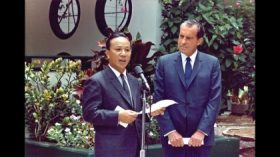
The American Retreat from Vietnam
or go to
Aletho News Archives – Video-Images
From the Archives
Secret document reveals plans for civil war in Lebanon, Israeli false flags, and invasion
By Randi Nord | Geopolitics Alert | April 5, 2019
Beirut – During his visit with US Secretary of State, Mike Pompeo, Lebanese President Michael Aoun reportedly received a US-Israeli document detailing plans for creating a civil war in Lebanon with covert false flag operations and possible Israeli invasion.
Although the source of the document is Israeli and created in partnership with Washington, no one knows who presented it to Aoun. The Lebanese TV station, Al-Jadeed, initially reported the document on Lebanese TV and a video on its website. Geopolitics Alert translated the report for this article. … continue
Blog Roll
 Aletho News
- There Is A Drought in Academia: A Drought in Honest Research on the Subject of Drought and Other Weather Extremes
- Department of War Awards $20.7 Billion Contract to Raytheon for Air-to-Air Missiles
- ‘Distance yourselves from Israel’: IRGC urges US population to question govt policies
- America’s Greenland deal has a radioactive backstory
- The RAF Fairford ‘terror plot’: Unpacking escalation in the UK echo-chamber
- EU Council Advances Chat Control 2.0 Scanning Proposal
- Ex-Greek MEP files complaint against Israeli spyware firm over alleged Pegasus surveillance
- Troubling ideas throughout the Torah, Talmud, Mishneh Torah and Tanya
- ‘Grave, alarming’: Iran mission on Trump’s UNGA ‘annihilation’ threats
- Najaf airport to reopen to Iranian flights within 24 hours: Ambassador
- If Americans Knew
- New Report: “Scholasticide and Genocide in Gaza: Assessment, Testimonies and Legal Analysis”
- Ex-Biden officials are desperate for a Gaza scapegoat
- Israeli “settlers” Invade Al-Aqsa; Pour Boiling Water on 75-Year-Old
- Israel Has Kidnapped Another American Teenager
- US arms sales to Israel worth $21.6 billion in 20 months
- Three Palestinians Killed in Israeli Attacks on Gaza
- Revealed: German “Anti-Semitism Expert” Driving Crackdown on Palestine Solidarity is Former Israeli Spy
- Egypt’s Warning to Israel Before Oct 7
- Israel’s siege signals another cruel winter for 1.8 million Gazans – Daily Update
- Netanyahu Asked UAE Leader to Deny Report on Oct. 7 Warning in Secret Visit, Sources Say
- No Tricks Zone
- New Study: Earth And Venus Surface Warmth Largely Explained By Convection And Lapse Rate, Not CO2 Or Radiation
- 2025 Nature Paper Claiming Worsening Global Drought Gets RETRACTED …Heavily Flawed
- New Study: ‘Global Drought Shows No Detectable Recent Acceleration Under Climate Warming’
- Economic Masterminds: German Socialists Suggest Taxing Productivity Gains Stemming From Using AI
- The South China Sea Has Not Been Cooperating With The Climate Change Narrative
- Energy Crisis: Germany Enters Heating Season With Historically Low Gas Reserve Fill Levels
- New Study: The Antarctic Ice Sheet Gained Mass From 2020-2024 Due To Staggering Snow And Ice Accumulation
- Study: Ocean Heating Rates From Thousands Of Years Ago ‘Dwarf’ Modern Ocean Heating Rates
- Climate Extremists Target, Attack Large-Scale Power Grid Infrastructure In Germany!
- New Study: Antarctic Ice Melt Has Contributed Less Than 1 Centimeter To Sea Level Rise In The Last 30 Years

