How International Financial Elites Change Governments to Implement Austerity
By ISMAEL HOSSEIN-ZADEH | CounterPunch | February 28, 2014
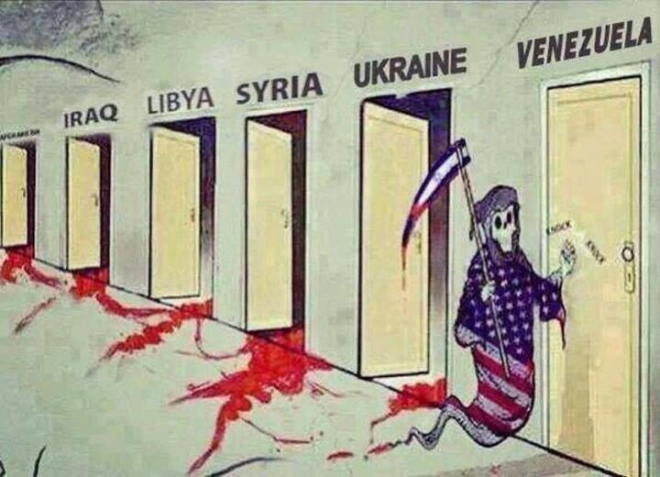
Many countries around the world are plagued by all kinds of armed rebellions, economic sanctions, civil wars, “democratic” coup d’états and/or wars of “regime change.” These include Ukraine, Venezuela, Syria, Thailand, Iran, Afghanistan, Iraq, Egypt, Yemen, Somalia and Lebanon. Even in the core capitalist countries the overwhelming majority of citizens are subjected to brutal wars of economic austerity.
While not new, social convulsions seem to have become more numerous in recent years. They have become especially more frequent since the mysterious 9-11 attacks on the World Trade Center in 2001 and the 2008 financial collapse in the United States, which soon led to similar financial implosions and economic crises in Europe and beyond.
Despite their many differences, these social turbulences share two common features. The first is that they are largely induced, nurtured and orchestrated from outside, that is, by the Unites States and its allies—of course, in collaboration with their class allies from inside. And the second is that, contrary to the long-established historical pattern of social revolutions, where the desperate and disenfranchised masses rebelled against the ruing elites, in most of the recent struggles it is the elites that have instigated insurgencies and civil wars against the masses. The two features are, of course, integrally intertwined: essentially reflecting the shared interests and collaborative schemes of the international plutocracies against the global 99%.
Fighting to Make Austerity Economics Universal
The official rationale (offered by the U.S. and its allies) that the goal of supporting anti-government opposition forces in places such as Syria, Ukraine and Venezuela is to spread democracy no longer holds any validity; it can easily be dismissed as a harebrained pretext to export neoliberalism and spread austerity economics. Abundant and irrefutable evidence shows that in places where the majority of citizens voted for and elected governments that were not to the liking of Western powers, these powers mobilized their local allies and hired all kinds of mercenary forces in order to overthrow the duly elected governments, thereby quashing the majority vote.
Such blatant interventions to overturn the elections that resulted from the majority vote include the promotion of the Orange Revolution in Ukraine (2004 and 2014), Rose Revolution in Georgia (2003), Cedar Revolution in Lebanon (2005), Tulip Revolution in Kyrgyzstan (2005) and the Green Revolution in Iran (2009). They also include the relentless agitation against the duly elected governments of the late Hugo Chavez and now his successor Nicolás Maduro in Venezuela, as well as the rejection (and effective annulment) of the duly elected Hamas government in Palestine.
So, the real driving forces behind wars of regime change need to be sought elsewhere; specifically, in the imperatives of expansion and accumulation of capital on a global level. Socialist, social-democratic, populist or nationalist leaders who do not embrace neoliberal economic policies, and who may be wary of having their markets wide open to unbridled foreign capital, would be targeted for replacement with pliant leaders, or client states. This is, of course, not a new explanation of economic imperialism; it is as old as the internationalization of trade and investment.
What is relatively new, and seems to be the main driving force behind the recent wars of regime change, is that, as the U.S. and other major capitalist powers have lately embarked on austerity economic policies at home they also expect and, indeed, demand that other countries follow suit. In other words, it is no longer enough for a country to open its markets to investment and trade with Western economic powers. It seems equally important to these powers that that country also dismantle its public welfare programs and implement austerity measures of neoliberalism.
For example, after resisting imperialist pressures for years, the late Libyan leader Muammar al-Gaddafi eventually relented in 1993, and granted major oil and other transnational corporations of Western powers lucrative investment and trade deals. Under pressure, he even dismantled his country’s nuclear technology altogether in the hope that this would please them to “leave him” alone, so to speak. None of the concessions he made, however, proved satisfactory to the U.S. and its allies, as his regime was violently overthrown in 2011and he was literally butchered by the thuggish gangs that were trained and armed by Western powers.
Why? Because the U.S. and its allies expected more; they wanted him to follow the economic guidelines of the “experts” of global finance, that is, of the U.S. and European economic “advisors,” of the International Monetary Fund and of the World Trade Organization—in short, to dismantle his country’s rather robust state welfare programs and to restructure its economy after the model of neoliberalism.
The criminal treatment of al-Gaddafi can help explain why imperialist powers have also been scheming to overthrow the populist/socialist regimes of the late Hugo Chavez and his successor in Venezuela, of the Castro brothers in Cuba, of Rafael Correa Delgado in Ecuador, of Bashar Al-assad in Syria and of Evo Morales in Bolivia. It also helps explain why they overthrew the popularly elected nationalist governments of Mohammad Mossadeq in Iran, of Jacobo Arbenz in Guatemala, of Kusno Sukarno in Indonesia, of Salvador Allende in Chile, of Sandinistas in Nicaragua, of Jean-Bertrand Aristide in Haiti and of Manuel Zelaya in Honduras.
The imperialist agenda of overthrowing al-Gaddafi and other “insubordinate” proponents of welfare state programs abroad is essentially part of the same evil agenda of dismantling such programs at home. While the form, the context and the means of destruction may be different, the thrust of the relentless attacks on the living conditions of the Libyan, Iranian, Venezuelan or Cuban peoples are essentially the same as the equally brutal attacks on the living conditions of the poor and working people in the US, UK, France and other degenerate capitalist countries. In a subtle way they are all part of an ongoing unilateral class warfare on a global scale. Whether they are carried out by military means and bombardments or through the apparently “non-violent” processes of judicial or legislative means does not make a substantial difference as far as their impact on people’s lives and livelihoods is concerned.
The powerful plutocratic establishment in the core capitalist countries does not seem to feel comfortable to dismantle New Deal economics, Social Democratic reforms and welfare state programs in these countries while people in smaller, less-developed countries such as (al-Gaddafi’s) Libya, Venezuela or Cuba enjoy strong, state-sponsored social safety net programs. Plutocracy’s intolerance of “regimented” economies stems from a fear that strong state-sponsored economic safely net programs elsewhere may serve as “bad” models that could be demanded by citizens in the core capitalist countries.
In a moment of honesty, former U.S. President Harry Truman is reported as having expressed (in 1947) the unstated mission of the United States to globalize its economic system in the following words: “The whole world should adopt the American system. The American system can survive in America only if it becomes a world system” [1].
In a similar fashion, Lord Cecil Rhodes, who conquered much of Africa for the British Empire, is reported to have suggested during the heydays of the Empire that the simplest way to achieve peace was for England to convert and add the rest of the world (except the United States, Germany and few other Western powers of the time) to its colonies.
The Mafia equivalent of Truman’s or Rhodes’ statements would be something like this: “You do it our way, or we break your leg.”
The mindset behind Truman’s blunt statement that the rest of the world “should adopt the American system” has indeed served as something akin to a sacred mission that has guided the foreign policy of the United States ever since it supplanted the British authority as the major world power.
It explains, for example, the real and the main reason behind the Cold War hostilities between the U.S. and its allies, on the one side, and the Soviet Union and its allies, on the other. While the “threat of communism” has been the official rationale for the start and escalation of those hostilities, there is convincing evidence that not only Joseph Stalin and his successors in the Soviet Union had no plans to wage war against the United States or its allies but that, in fact, they played a restraining role to contain independent revolutionary movements worldwide. “It is often forgotten,” points out Sidney Lens, “that for a few years after the war, he [Stalin] assumed an exceedingly moderate posture. . . . His nation had lost 25 million people in the war, was desperately in need of aid for rebuilding, and continued for a long time to nurture hopes of coexistence. Far from being revolutionary, Stalin in those years put the damper on revolution wherever he could” [2]. To accommodate the United States and other Western powers in the hope of peaceful coexistence, Stalin often advised, and sometimes ordered, the pro-Moscow communist/leftist parties in Europe and elsewhere in the world to refrain from revolutionary policies that might jeopardize the hoped-for chances of coexistence.
The goal or mission of converting other economies to the U.S.-style capitalism also helps explain why the United States has engaged in so many military operations and engineered so many coup d’états and regime changes around the world. The Federation of American Scientists has recorded a list of U.S. foreign military engagements which shows that in the first decade after the collapse of the Berlin Wall (1989-99) the U.S. engaged in 134 such operations, the majority of which are altogether unknown to the American public [3].
Global financial elites change “unaccommodating” regimes not only in the less developed countries but also in the core capitalist countries. They accomplish this not so much by military means as by utilizing two very subtle but powerful means: (a) artificial, money-driven elections, peddled as “democracy in action”; and (b) powerful financial institutions and think tanks such as the International Monetary Fund (IMF), central banks and bond/credit rating agencies like Moody’s, Standard & Poor’s and Fitch Group. An unfavorable rating report by these agencies on the credit status of a country can create havoc on that country’s economic, financial and currency position in world markets, thereby dooming its government to collapse and replacement. This is how during the ongoing financial turbulence of recent years a number of governments have been changed in places like Greece and Italy—no need for the traditional or military style regime change, the “soft-power” financial coup d’état engineered by the IMF and/or rating agencies would serve the purpose even more effectively.
Class War on a Global Scale
As noted, all the schemes and wars of regime change, whether by the traditional military means or by the “soft” power of the global financial juggernaut, essentially represent one thing: a disguised class war on a global level, a relentless worldwide economic war by the one percent financial-economic oligarchy against the rest of the world population.
Class struggle in an economically-tiered society is of course not new. What is relatively new in the recent years’ war of the 1% against the 99% is its escalated pace, its widespread scale and its globally orchestrated character. While neoliberal austerity attacks on the living conditions of the public in the core capitalist countries began (formally) with the supply-side economics of President Ronald Reagan and Prime Minister Margaret Thatcher more than three decades ago, the brutality of such attacks have become much more severe in the context of the current financial/economic crisis, which began with the 2008 financial crash in the United States.
Taking advantage of the crash (as an economic shock therapy, as Naomi Klein put it), the financial oligarchy and their proxies in the governments of the core capitalist countries have been carrying out a systematic economic coup d’état against the people the ravages of which include the following:
• Transfer of tens of trillions of dollars from the public to the financial oligarchy through merciless austerity cuts;
• Extensive privatization of public assets and services, including irreplaceable historical monuments, priceless cultural landmarks, and vital social services such as healthcare, education and water supply;
• Substitution of corporate/banking welfare policies for people’s welfare programs;
• Allocation of the lion’s share of government’s monetary largesse (and of credit creation in general) to speculative investment instead of real investment;
• Systematic undermining of the retirement security of millions of workers (both white and blue collar) and civil servants;
• Ever more blatant control of economic and/or financial policies by the representatives of the financial oligarchy.
Combined, these policies have significantly aggravated the already lopsided income/wealth distribution in these countries. The massive cuts in social spending have resulted in an enormous transfer of economic resources from the bottom up. The transfer has, indeed, more than made up for the 2008 losses of the financial speculators. In the U.S., for example, the wealthiest one percent now own 40 percent of the entire country’s wealth; while the bottom 80 percent own only seven percent. Likewise, the richest one percent now take home 24 percent of the country’s total income, compared to only nine percent four decades ago [4].
This shows that, as pointed out earlier, while neoliberal attacks on the 99% in the core capitalist countries may not seem as violent as those raging, for example, in Venezuela, Syria or Ukraine, the financial impact of such attacks on the living conditions of the 99% is not any less devastating.
Plutocrats of the World Are United
Policies of regime change are usually designed and carried out as collaborative schemes by cross-border plutocracies, that is, by the financial oligarchies of the imperialist countries in partnership with their native counterparts in the less-developed countries.
In addition to constant behind-the-scenes strategizing, representatives of transnational capital and their proxies in capitalist governments also routinely meet at international conferences in order to synchronize their cross-border business and financial policies—a major focus of which in recent years has been to implement global austerity measures and entrench neoliberal policies worldwide. These include the World Economic Forum in Davos, Switzerland, the World Bank and IMF annual meetings, the Periodic G20 meetings, the Aspen Institute’s Ideas Festival, The Bilderberg Group annual geopolitics forum, and the Herb Allen’s Sun Valley gathering of media moguls—to name only a handful of the many such international policy gatherings.
Through its global strategies and operations, transnational capital has broken free from national constraints and commitments at home and successfully shifted the correlation of class forces and social alliances worldwide. Today’s elites of global capitalism “are becoming a trans-global community of peers who have more in common with one another than with their countrymen back home,” writes Chrystia Freeland, Global Editor of Reuters, who travels with the elites to many parts of the world. “Whether they maintain primary residences in New York or Hong Kong, Moscow or Mumbai, today’s super-rich are increasingly a nation unto themselves,” she adds [5].
Implications for Globalization from Below
What conclusions can the 99% draw from this? What can the working people and other grassroots do to protect their jobs, their sources of livelihood, their communities and their environment? What can communities of ordinary people do to undermine the strategies of the global 1% that block life-sustaining progressive social and economic reforms?
In the same fashion that, in their fight against the working people, the elites of the international capitalist class are not bound by territoriality or national boundaries, so does the working class need to coordinate its response internationally.
A logical, first step deterrent to transnational capital’s strategy of blackmailing labor and communities through threats such as destroying or exporting jobs by moving their business elsewhere would be to remove the lures that induce plant relocation, capital flight or outsourcing. Making labor costs of production comparable on an international level would be crucial for this purpose. This would entail taking the necessary steps toward the international establishment of wage and benefits, that is, of labor cost parity within the same company and the same trade, subject to (a) the cost of living, and (b) productivity in each country.
A strategy of this sort would replace the current downward competition between workers in various countries with coordinated bargaining and joint policies for mutual interests and problem-solving on a global level. While this may sound radical, it is not any more radical than what the transnational 1% is doing: coordinating their anti-99% strategies on a global scale. If at an earlier stage of capitalist development “workers of the world unite” seemed an outlandish dream of the leading labor champion Karl Marx, internationalization of capital, the abundance of material resources and developments in technology, which has greatly facilitated cross-border organizing and coordination of actions by the 99%, has now made that dream an urgent necessity.
As capital and labor are the cornerstones of capitalist production, their respective organizations and institutions evolve more or less apace, over time and space. Thus, when production was local, so was labor: carpenters, shoemakers, bricklayers, and other craftsmen organized primarily in their local communities. But as capitalist production became national, so did trade unions. Now that capitalist production has become global, labor organizations too need to become international in order to safeguard their and their communities’ rights against the profit-driven whims of the footloose and fancy-free transnational capital.
Many would argue that these are not propitious times to speak of radical alternatives to capitalism. The present state of the sociopolitical landscape of our societies appears to support such feelings of pessimism. The high levels of unemployment in most countries of the world and the resulting international labor rivalry, combined with the austerity offensive of neoliberalism on a global level, have thrown the working class and other grassroots on the defensive. The steady drift of the European socialist, Social Democratic, and labor parties/governments toward the U.S.–style market economies and the erosion of their traditional ideology, power, and prestige have led to workers’ confusion there. The collapse of the Soviet Union, however much some socialists have always distanced themselves from that system, haunts the specter of socialism, and is likely to do so for some time to come. These developments have understandably led to workers’ and other grassroots’ confusion and disorientation globally.
None of these, however, mean that there is no way out of the status quo. Capitalism is not only “destructive,” it is also “regenerative,” as Karl Marx put. As it captures world markets, universalizes the reign of capital, and disrupts the living conditions for many, it simultaneously sows the seeds of its own transformation. On the one hand, it creates common problems and shared concerns for the majority of the world population; on the other, it creates the material conditions and the technology that facilitate communication and cooperation among this majority of world citizens for joint actions and alternative solutions.
When the majority of world population, the global 99%, will come to the realization and determination to actually appropriate and utilize the existing technology and material resources for a better organization and management of the world economy, no one can tell. But the potential and the long term trajectory of global socioeconomic developments point in that direction. The distance between now and then, between our immediate frustrations and the superior but elusive civilization of our desire, can be traversed only if we take the necessary steps toward that end [6].
Ismael Hossein-zadeh is Professor Emeritus of Economics, Drake University, Des Moines, Iowa. He is the author of The Political Economy of U.S. Militarism (Palgrave – Macmillan 2007), the Soviet Non-capitalist Development: The Case of Nasser’s Egypt (Praeger Publishers 1989), and most recently, Beyond Mainstream Explanations of the Financial Crisis (forthcoming from Routledge, April 29, 2014).

Oppose Force to Save Starving Syrians
By David Swanson | FDL | February 27, 2014
I’ve been asked to debate Danny Postel on the question of Syria, and so have read the op-ed he co-authored with Nader Hashemi, “Use Force to Save Starving Syrians.”
Excellent responses have been published by Coleen Rowley and Rob Prince and probably others. And my basic thinking on Syria has not changed fundamentally since I wrote down my top 10 reasons not to attack Syria and lots and lots of other writing on Syria over the years. But replying to Postel’s op-ed might be helpful to people who’ve read it and found it convincing or at least disturbing. It might also allow Postel to most efficiently find out where I’m coming from prior to our debate.
So, here’s where I’m coming from. Postel’s op-ed proposes the use of force as if force hadn’t been tried yet, as if force were not in fact the very problem waiting to be solved. What he is proposing is increased force. The arming and funding and training of one side in Syria by the CIA, Saudi Arabia, et al, and the other side by Russia, et al, is not enough; more is needed, Postel believes. But “force” is a very non-descriptive term, as are all the other terms Postel uses to refer to what he wants: “air cover,” “coercive measures,” “Mr. Assad … [should] be left behind.”
I find it hard to imagine people on the ground while NATO dropped thousands of bombs on Libya pointing to the sky and remarking “Check out the air cover!”
Or this: “What happened to your children, Ma’am?” “They experienced some coercive measures.”
Or this: “What became of Gaddafi?” “Oh, him? He was left behind.”
When people who experience modern wars that wealthy nations launch against poor ones talk about them, they describe detailed horror, terror, and trauma. They recount what it’s like to try to hold a loved one’s guts into their mutilated body as they gasp their last. Even the accounts of recovering and regretful drone pilots in the US have much more humanity and reality in them than do Postel’s euphemisms.
I’m not questioning the sincerity of Postel’s belief that, despite it’s long record of abysmal failure, humanitarian war would find success in a nation as divided as Syria, of all unlikely places. But Postel should trust his readers to share his conclusion after being presented with the full facts of the case. If Postel believes that the people whose lives would be ended or devastated by “air cover” are out-weighed by the people who he believes would be thereby saved from starvation, he should say so. He should at the very least acknowledge that people would be killed in the process and guesstimate how many they would be.
Postel claims Somalia as a past example of a “humanitarian intervention,” without dwelling on the chaos and violence aggravated and ongoing there. This seems another shortcoming to me. If you are going to make a moral decision, not only should it include the negative side of the ledger, but it should include the likely medium-term and long-term results, good and bad. Looking at Somalia with a broader view hurts Postel’s case, but so does looking at Libya, Afghanistan, or Iraq. Studies by Erica Chenoweth and others have documented that violent solutions to oppression and tyranny are not only less likely to succeed, but if they succeed their success is shorter lived. Violence breeds violence. “Force,” translated into the reality of killing people’s loved ones, breeds resentment, not reconciliation.
So, I think Postel’s case for dropping tons of deadly “coercive measures” on Syria would be a weak one even if it were likely to resemble his outline. Sadly, it isn’t. The war on Libya three years ago was sold as an emergency use of “force” to protect supposedly threatened people in Benghazi. It was immediately, illegally, predictably, cynically, and disastrously turned into a campaign of bombing the nation to overthrow its government — a government that, like Syria’s, had long been on a Pentagon list to be overthrown for anything but humanitarian reasons. Postel presents a quick and antiseptic “leaving behind” operation to provide food to the starving, but surely he knows that is not what it would remain for any longer than it takes to say “R2P.” Why else does Postel refer so vaguely to leaving Assad behind?
It may be worth noting that it’s not aid workers advocating for “coercion” strikes on Syria. I spoke with a US government aid worker in Syria some months back who had this to say:
“Before we contemplate military strikes against the Syrian regime, we would do well to carefully consider what impact such strikes would have on our ongoing humanitarian programs, both those funded by the US and by other countries and international organizations. These programs currently reach hundreds of thousands of vulnerable people throughout Syria, in areas controlled both by the regime and the opposition. We know from past military interventions, such as in Yugoslavia and Iraq that airstrikes launched for humanitarian reasons often result in the unintended deaths of many civilians. The destruction of roads, bridges, and other infrastructure, which such airstrikes may entail, would significantly hamper the delivery of humanitarian aid in Syria.
“The provision of this assistance in regime controlled areas requires the agreement, and in many cases the cooperation, of the Assad government. Were the Assad regime, in response to US military operations, to suspend this cooperation, and prohibit the UN and nongovernmental organizations from operating in territory under its control, hundreds of thousands of Syrian civilians would be denied access to food, shelter, and medical care. In such a scenario, we would be sacrificing programs of proven effectiveness in helping the people of Syria, in favor of ill considered actions that may or may not prevent the future use of chemical weapons, or otherwise contribute to U.S. objectives in any meaningful way.”
Let’s grant that the crisis has continued for months and worsened. It remains the fact that it is advocates of war advocating war, not aid workers advocating war. The option of ceasing to arm both sides, and of pursuing a negotiated settlement, is simply ignored by the war advocates. The option of nonviolent efforts to deliver aid is avoided entirely. The failure to provide adequate aid to refugees who where that can be reached seems far less pressing than the failure to provide aid where that failure can become a justification for an escalated war.
“Humanitarian interventions,” Postel writes, “typically occur when moral principles overlap with political interests.” This seems to be an acknowledgment that political interests are something other than moral. So, there’s no cry for “humanitarian intervention” in Bahrain or Palestine or Egypt because it doesn’t fit “political interests.” That seems like an accurate analysis. And presumably some interventions that do fit political interests are not moral and humanitarian. The question is which are which. Postel believes there have been enough humanitarian interventions to describe something as being typical of them, but he doesn’t list them. In fact, the record of US military and CIA interventions is a unbroken string of anti-humanitarian horrors. And in most cases, if not every case, actual aid would have served humanity better than guns and bombs, and so would have ceasing pre-existing involvement rather than escalating it and calling that an intervention.
But once you’ve accepted that the tool of war should be encouraged in certain cases, even though it’s misused in other cases, then something else has to be added to your moral calculation, namely the propagation of war and preparations for war. Those of us who cannot find a single war worth supporting differ only slightly perhaps from those who find one war in a hundred worth backing. But it’s a difference that shifts opposition to support for an investment that costs the world some $2 trillion a year. The United Nations believes that $30 billion a year could end serious starvation around the world. Imagine what, say, $300 billion could do for food, water, medicine, education, and green energy. Imagine if the United States were to offer that kind of aid to every nation able to peacefully and democratically accept it. Would polls continue to find the US viewed as the greatest threat to peace on earth? Would the title of most beloved nation on earth begin to look plausible?
Members of the nonviolent peace force, Nobel Peace Prize Laureate Mairead Maguire, and other advocates of de-escalation in Syria traveled freely around Syria some months back. How were they able to do that? What might trainers in creative nonviolent action offer Syria that CIA and military trainers aren’t offering? The alternative is never even considered by advocates of war-or-nothing. Postel wants to back “democratically oriented” rebel groups, but is violence clearly democratically oriented? Turning our eyes back on ourselves suggests a rather disturbing answer. In September 2013, President Obama gave us the hard sell. Watch these videos of suffering children, he said, and support striking their nation with missiles or support their ongoing suffering. And a huge majority in the US rejected the idea that those were the only two choices. A majority opposed the strikes. An even larger majority opposed arming the rebels. And a large majority favored humanitarian aid. There is a case to be made that democracy would be better spread by example than by defying the will of the US people in order to bomb yet another nation in democracy’s name.
Postel, to his credit, calls the “Responsibility to Protect” a “principle.” Some have called it a “law.” But it cannot undo the UN Charter. War being illegal, its use damages the rule of law. That result must also be factored into a full moral calculation of how to act. Act we must, as Postel says repeatedly. The question is how. Rob Prince presents a useful plan of action in the article linked above.
Postel’s most persuasive argument is probably, for many readers, his contention that only threatening to act will save the day. He claims that Syria has responded positively to threats of force. But this is not true. Syria was always willing to give up its chemical weapons and had long since proposed a WMD-free Middle East — a proposal that ran up against the lack of “political interest” in eliminating Israel’s illegal weapons. Also false, of course, were claims by the Obama administration to know that Assad had used chemical weapons. See Coleen Rowley’s summary of how that case has collapsed in the article linked above.
Granted, there can be a good honest case for an action for which misguided, false, and fraudulent cases have been offered. But I haven’t seen such a case yet for taking an action in Syria that would, to be sure, dramatically declare that action was being taken, release a lot of pent-up tension, and enrich Raytheon’s owners, but almost certainly leave Syrians, Americans, and the world worse off.
‘Critical juncture’: Battles, attacks on convoys delay Syrian chemical weapons destruction
RT | March 1, 2014
Syrian convoys transporting chemical weapons under the international agreement were attacked twice late last month, according to a UN report, causing a delay in chemical shipments out to sea.
In a monthly report to the UN Security Council, the Organization for the Prohibition of Chemical Weapons (OPCW) said that the Syrian authorities told their team overseeing the destruction of its arsenal that the attempted attacks took place on January 27.
“In addition, Syrian authorities indicated that ongoing military activities rendered two sites inaccessible during most of the reporting period,” the five-page UN report said.
This caused the delay of “in-country destruction of the final quantities of isopropanol [one of two key ingredients for sarin gas production], preventing some activities to consolidate chemical material into a reduced number of locations, and preventing the physical verification of chemical material prior to movement on 27 January 2014.”
“When we talk about transferring those weapons, we talk about hundreds of kilometers that should be passed in safe conditions,” Charles Shoebridge, former British intelligence officer told RT. “They’ve attacked weapons carriers and made transporting the chemicals even more difficult and dangerous.”
The report also said that the elimination of the chemical weapons program in Syria stands at a “critical juncture.” It calls on Syria to “intensify and accelerate” its efforts to eliminate its stockpile, after falling behind on schedule. Syria denies in the very strongest terms that it is deliberately slowing things down.
“A look at the history of Syria since the formation of the United Nations, of which Syria is an establishing member, will recognize that Syria has always been committed to its vows,” Dr. Hassan Hassan, Syrian expert, told RT. “It has never given a promise without fulfilling it.”
The fourth shipment of mustard gas, left Latakia, Syria on Wednesday. Earlier in February the OPCW reported that Syria had shipped out only 11 percent of its stockpile, falling short of the February 5 deadline to have chemical stockpiles removed from the country.
Syria last week submitted a new 100-day plan to remove the remaining chemicals, which would have set a target of late May or early June for completion. The UN is considering the new timetable. Under the OPCW schedule, all Syria’s declared chemical weapons must be destroyed by June 30.
“Measurable progress has been made over the last months in the destruction of critical equipment and special features at a number of chemical weapons production facilities, as well as unfilled chemical munitions,” the report said. “As a result, the production, mixing and filling capabilities of the Syrian Arab Republic have been rendered inoperable.”
Syria has declared around 700 tons of the most-dangerous chemicals, 500 tons of less-dangerous precursor chemicals and 122 tons of isopropanol – an active ingredient in sarin gas production.
Israel, US Mulling Training Syria Terrorists with Saudi Arabia
Al-Manar | April 1, 2014
Top Israeli and US military officials discussed on Monday the possibility of “security cooperation” between the Zionist entity and some Arab states in the Persian Gulf.
The New York Times reported that a meeting took place on Monday between Chief of Staff Benny Gantz and Gen. Martin Dempsey, visiting chairman of the U.S. Joint Chiefs of Staff in al-Quds.
Prior to the meeting, Gantz hinted that even in the current period of instability there could be opportunities, Israeli daily, Haaretz reported.
Those opportunities became clearer when Dempsey said after the meeting that the discussions included “an outreach to other partners who may not have been willing to be partners in the past,” the Israeli daily said according to NYT.
“What I mean is the Gulf States in particular, who heretofore may not have been as open-minded to the potential for cooperation with Israel, in any way.” Dempsey said.
Haaretz noted that while Dempsey did not go into specifics, other American military officials said that possibilities include “intelligence-sharing, joint counterterrorism exercises and perhaps looking for how Israeli and Saudi troops could jointly work on the training of Syrian opposition fighters.”
Remarking that “world jihadists are not fighting only against Israel,” Gantz added that it would be in the interests of both Israel and neighboring states to “look for ways to combat common enemies.”
Syria has been gripped by deadly violence since 2011. Over 140,000 people have been reportedly killed and millions displaced due to the violence fueled by the foreign-backed militants.
Western powers and some of their regional allies – especially Qatar, Saudi Arabia and Turkey – are reportedly supporting the militants operating inside Syria.
Related articles


Art of drills: 10 NATO war games that almost started armed conflicts
RT | February 28, 2014
The world’s largest military alliance seems annoyed about Russia’s “lack of transparency” over military drills at a very “delicate time.” NATO, however, has its own long history of war games all over the globe.
Western politicians have leveled criticism at Russia for planned drills on its own territory, seemingly glossing over the many joint military exercises Western powers, namely the US and NATO forces, have conducted on foreign soil over the years.
South Korea
This week, US and South Korean forces began their annual joint military drills, which will last until mid-April. The Foal Eagle exercise is conducted near Iksan and Damyan, South Korea.
The drills prompted a stern reaction from North Korea, which slammed the exercises as “a serious provocation” that could plunge the region into “a deadlock and unimaginable holocaust.”
Israel
The US joined Greece, Italy, and Israeli forces at Ovda air base in southern Israel for the ‘Blue Flag’ air-training drills in November 2013. The drills were called the “largest international aerial exercise in history,” by Israeli news outlet Haaretz.
According to Israel National News reports the exercises are geared towards “simulating realistic engagements in a variety of scenarios, based on Israel’s experience with air forces of Arab armies in previous engagements.”
Poland and Latvia
NATO’s ‘Steadfast Jazz’ training exercise was held in November 2013, in Latvia and Poland. The drills included air, land, naval, and special forces.
Over 6,000 military personnel from around 20 NATO countries and allies took part in the largest NATO-led drills of their kind since 2006.
Bulgaria
In October, NATO also held anti-aircraft drills in Bulgaria, along with the Greek and Norwegian air forces. The exercises were held to test responses in conditions of radio interference, according to the Bulgarian Ministry of Defense.
Persian Gulf
In May 2013, the US joined 40 other countries in the Persian Gulf for maritime war games. The US Navy said the mass exercises are aimed at “enhancing capability to preserve freedom of navigation in international waterways.”
The drills provoked a sharp response from the Iranian government who voiced concerns at how the maneuvers came in the run-up to the Iranian elections.
Japan
In August 2012, US Marines joined Japanese troops for military drills in the western Pacific. The drills were held in part in Guam, a US holding, just as an old territory dispute reemerged between Japan and China over islands in the East China Sea.
“China will not ignore hostile gestures from other nations and give up on its core interests or change its course of development,” the Chinese Communist Party stated in response to the drills, warning the US and Japan not to “underestimate China’s resolve to defend its sovereignty.”
Jordan
The US joined 16 other nations in May 2012 for military exercises in Jordan near the Syria border. The ‘Eager Lion’ drills included 12,000 soldiers from the participating countries, Turkey, France, and Saudi Arabia among them.
Denying accusations that the violence in Syria had nothing to do with the drills, the US claimed it was “designed to strengthen military-to-military relationships through a joint, entire-government, multinational approach, integrating all instruments of national power to meet current and future complex national security challenges.
Vietnam
In August 2010, the US Navy joined Vietnamese forces for drills in the South China Sea, to the dismay of China. Sovereignty claims in the South China Sea have long been a subject of debate and animosity among Taiwan, the Philippines, Brunei, Vietnam, and Malaysia, though China’s territorial declarations have been the most aggressive.
Ukraine
Ukraine welcomed a fleet of NATO warships for a two-week period of military drills in July 2010. Operation ‘Sea Breeze-2010’ focused on joint anti-terror exercises, despite Kiev’s decision not to enter the NATO alliance. Some 3,000 international military personnel were said to be a part of the drills.
Ukraine began hosting the Sea Breeze exercises in 1997, as part of its commitment to join the alliance. In 2009, the Ukrainian parliament voted against the drills, curtailing then-President Viktor Yuschenko’s efforts to seek NATO membership.
Georgia
In May 2009, 15 NATO countries held a series of controversial military exercises in Georgia less than a year after it launched an offense against its breakaway region of South Ossetia. Russia called the maneuvers “dubious provocation” saying it may encourage the country’s regime to carry out new attacks.
The Case for Humanitarian War- Again
By Ajamu Baraka | Black Agenda Report | February 25, 2014
With the predictable failure of the Syrian peace conference, the call for the Obama administration to wage a humanitarian war to save civilians in Syria is once again being championed by some elements of the mainstream media in the U.S. This shouldn’t be a surprise to anyone, since certain powerful voices in the U.S. corporate media have long been in lock-step with some of the most hawkish elements in the Obama administration regarding the use of force in Syria.
A sober, clear-eyed analysis of the logic of the decisions by the Obama administration suggest that the failure of the peace conference was a programmed outcome. The inescapable conclusion as to why the conference was even held, therefore, is that administration hawks saw the failure of the conference as a valuable public relations weapon to move public opinion in favor of more direct military involvement.
Before I am accused of being overly cynical or even conspiratorial, a review of the decisions made in the days and weeks leading up to the conference provides more than adequate evidence to support this contention.
If the Obama administration had been even remotely committed to brokering some kind of diplomatic solution, would it have insisted that all of the parties to the talks be bound by the terms of the Geneva communiqué that called for “regime change” in the form of a transitional government? Would the administration have excluded Iran or been committed to pretending that the “legitimate opposition” was represented by the Syrian National Coalition, a motley crew of slavish opportunist exiles who everyone knows have no real connection to the political and military situation on the ground?
The propaganda value of the talks seems to be the only plausible explanation for why the administration would engineer the elaborate charade in Geneva. The decision to hold the talks knowing that they were going to lead to failure is where the real cynicism lies.
As I have argued since the beginning of this manufactured conflict, peace and particularly the humanity of the Syrian people are the last things on the minds of U.S. policy-makers. The often-invoked concerns for the starving people of Homs and all of the other innocents in this brutal conflict continue to be no more than a crude subterfuge to allow the administration to pursue its broader regional geostrategic objective – the elimination of the Syrian state.
That is why the Islamic fundamentalist groups that U.S. intelligence services helped to arm, train and deploy with destructive efficiency (without much real concern if they were affiliated with al-Qaeda) have targeted all of the institutions of the Syrian state – schools, hospitals, government agencies, electrical stations, water and sanitation facilities, food distribution networks – as part of their strategy. Generalized mayhem, reducing the population to dependence on their networks and territorial dismemberment have all moved the administration toward realization of its strategic objective. But because of the successes of the Syrian armed forces and the uncertainties generated as a result of internal conflicts breaking out among Islamist forces in the country, Washington decision-makers want to make sure that the Syrian government is not able to retake or re-consolidate its influence in contested zones. This can only be assured as a result of more direct military intervention on the part of the U.S. and its allies.
So the next act in this macabre play is now centering on the very real sufferings of the Syrian people. The administration’s man at the U.N., Lakhor Brahimi, set this direction in motion by skillfully moving the peace talks toward the issue of humanitarian concerns. No longer needing the chemical weapons excuse, the administration along with its coterie of collaborationist human rights organizations and media apologists, are now demanding U.N. access to the areas where the Syrian governmental forces have hemmed in the armed groups.
Taking a page from its Libyan playbook on how to manipulate the public to support war, the Obama administration had a draft U.N. Security Council resolution circulated that placed the full blame on the Syrian government for the humanitarian situation in the country.
The language in the resolution was seen as so one-sided and belligerent by some U.N. members that it had no chance of being supported, which of course was the real objective. Orchestrated by U.S. Ambassador to the U.N. Samantha Power, the resolution appeared aimed at invoking a veto in the Security Council that would set the stage for another illegal NATO-led military assault on the Syrian armed forces. Instead, a resolution was passed over the weekend that some characterized as more balanced because it called on “all sides” to allow humanitarian aid to reach civilians and condemned acts of terror. But all of the delegations understand that this compromise resolution is primarily targeting the Syrian government.
This concern for the humanity of the Syrians is comical if it was not so deadly serious. Sen. John McCain – the same Vietnam-era war criminal who was silent on the uprising of the people in Bahrain, the slaughter of innocent civilians in the various military assaults by Israel in Gaza and who supported the illegal war against Iraq that resulted in the deaths of over a million Iraqi’s – loudly condemned the Obama administration for not doing more for people suffering in Syria.
McCain as well as the hawks in the Obama administration and in the media know that they have a powerful weapon with the imperial and racist notion of the U.S. government’s “responsibility to protect.” The New York Times, Washington Post and a number of other major newspapers are now on record suggesting that the “use of force” by the Obama administration to end the starvation of innocents trapped in besieged cities is morally justified.
No one can deny the reality of tens of thousands of innocents suffering from the savage brutality of war. And who can disagree with relieving the sufferings of innocent civilians trapped in the middle of warring factions? U.S. decision-makers are well aware that most polling data suggest that when issues of humanitarian concerns are introduced, public support for more direct involvement in Syria shifts from a majority that is opposed to a slight majority that would support it.
So the U.S. public has been saturated over the last two weeks with stories about the trapped civilians, the cruel al-Assad government opposing humanitarian access and the innocent American administration that only wants to help the suffering Syrian people. The sad part of all of this is that with the anti-war and anti-imperialist movement in shambles, suffering from a combination of institutional weakness, marginalization and the effects of the “liberal virus” that has confused and disarmed U.S. radicals, the administration may very well be successful in maneuvering the public into supporting more direct military involvement.
The consequence of all of this for the people of Syria will be more violent destruction, brutality and displacement. But I am sure that the pro-imperialist and pro-war Democrats in the Obama administration have concluded that for the Syrian people, freedom – as they define it – is “worth the price” in death and destruction. And they will not see any irony in this.
Ajamu Baraka is a human rights activist and organizer. Baraka is an Associate Fellow at the Institute for Policy Studies (IPS) in Washington, D.C.
USA declares war on democracy
By Dr. Kevin Barrett | Press TV | February 26, 2014
Atlanta, February 26, 2014 – Since the days of President Woodrow Wilson – that is, for roughly 100 years – the USA has been on a self-styled crusade to “make the world safe for democracy.”
Colossal wars, hot and cold, were fought against German kaisers and fuhrers, Russian communists, and Third World nationalists. The American people were told they were “defending democracy.”
Americans slaughtered 3.5 million Vietnamese, and nearly another million Cambodians, to “defend democracy” in Southeast Asia.
They murdered millions of Iraqis through wars and sanctions to “defend democracy” in the Middle East.
According to André Vltchek and Noam Chomsky’s book On Western Terrorism, the US government has murdered between 55 and 60 million people since World War II in wars and interventions all over the world. If we believe the imperial propagandists, this American Holocaust has been one big defense of democracy.
But now, on the eve of the 100th anniversary of World War I, the US has embarked on a new crusade – to make the world UNSAFE for democracy.
In Ukraine, Venezuela, and Thailand, the US is spending billions of dollars to unconstitutionally eject democratically-elected governments. In Palestine, the US has been trying to overthrow the democratically-elected Hamas government ever since it came to power. In Egypt, the US – under Zionist pressure – recently overthrew the only genuinely democratic government in 5,000 years of recorded history. In Syria, the US insists that the people must not be given the opportunity to re-elect Assad, no matter how many international observers and safeguards ensure honest elections. And in Turkey, the US is undermining the democratically-elected Prime Minister Erdogan in favor of CIA puppet Fethullah Gulen.
Taking the long view, the US is working patiently to destroy democracy in Iran, Russia, and Latin America.
Why does the US government hate democracy?
Because the international bankers who own the US government and run the US empire cannot always buy enough votes to impose their will on every country. So democracy is fine – as long as voters elect the New World Order candidate. But if they vote for a candidate who doesn’t suit the oligarchs, get ready for a coup!
The banksters will overthrow any government that stands up to them – even in the USA. The “termination with extreme prejudice” of the presidency of John F. Kennedy sent a message to all future US presidents.
Mayer Rothschild famously said “Give me control of a nation’s money and I care not who makes its laws.” But that was an exaggeration. The New World Order banksters seek to overthrow democratically-elected governments all over the world precisely because they DO care who makes and enforces the laws.
The NWO banksters are destroying Ukraine as a geostrategic move against Russia, where Putin has reined in the Russian-Zionist oligarchs and put a major roadblock in the path of the banksters’ world government project. Yes, Ukrainian President Yanukovich won a free and fair democratic election. But democracy means nothing to the psychopathic pharaohs of finance and their Neocon hired guns.
The banksters (and the Western governments they control) are also trying to overthrow President Nicolas Maduro of Venezuela, who took office after the CIA assassinated Hugo Chavez. President Maduro overcame the banksters’ attempts to defeat him in last year’s elections; he is now the constitutional, democratically-elected President of Venezuela. But that hasn’t stopped the banksters from trying to overthrow him in a pseudo-populist coup.
In Thailand, the banksters and their local kleptocracy are trying to overthrow the democratically-elected government of Prime Minister Shinawatra. Apparently Shinawatra’s attempts to fund education, medical care, and infrastructure, and institute a minimum wage, offended the oligarchs.
In Ukraine, Venezuela, and Thailand, as in Syria and Egypt before them, the banksters are adding violence to their “color revolution” game plan for destroying democracy. This may seem incongruous, since the NWO intellectual hired gun Gene Sharp, the so-called “Machiavelli of non-violence,” designed the original color revolutions as purportedly peaceful and democratic uprisings.
But Sharp’s so-called color revolutions, beginning with Georgia’s Rose Revolution of 2003 and Ukraine’s Orange Revolution of 2004, were never genuine people’s revolutions. They were bankster takeover attempts from the beginning. George Soros would funnel Rothschild money to ambitious, power-hungry apparatchiks, who would inundate their target countries with propaganda and hire rent-a-mobs to dress in a particular color and make a spectacle of themselves in the public square, in hopes of duping naive young people into joining the “revolution” – whose real goal is always to install a NWO puppet leader.
But now the pretense of nonviolence and democracy has evaporated. The New World Order’s smiling Mickey Mouse mask has fallen away, revealing the bloodthirsty grin of satanic banksters bent on establishing an Orwellian one-world dictatorship.
In Syria, the “peaceful uprising” of March 2011 became a pretext for sending in heavily armed thugs and terrorists on a destabilization mission. In Egypt, the bankster-generated “uprising” last summer was a manufactured excuse for a violent coup d’état. In Thailand, Venezuela and Ukraine, the banksters are paying hooligans to stage violent protests, destroy public property, fight police, and incite mayhem – in hopes of violently overthrowing democratically-elected governments.
This is pure fascism.
Fascism is fake populism. Self-styled fascist “revolutionaries” are paid to dress up in colors or uniforms, goose-step around the public square, overthrow democratically-elected governments… and institute a veiled dictatorship of the rich, in which corporate and governmental power merge.
That is what Mussolini did in 1922. It is what Hitler did in 1933. And it is what the neoconservatives, and their bankster sponsors, are doing today… all over the world. The 9/11 Reichstag Fire, which turned the world’s sole superpower decisively toward total fascism, was the gunshot that set off the avalanche.
The end-game: A global fascist dictatorship that would make the Third Reich look like a walk in the park.
There is only one way to defeat these monsters. All great fortunes, beginning with the trillion-dollar treasure hordes of the Rothschilds and their friends, must be confiscated and returned to the public treasury. All of the big banks must be nationalized, and their operations must be made completely transparent. All major financial transactions must be taxed and closely regulated. And all of the biggest corporations, starting with those that own the mainstream media, must be broken into small pieces by anti-trust action.
This revolution – the overthrow of the global oligarchy – is the only revolution that matters.
Assad: Syria Seeks to Build National Dialogue, Coalitions
Al-Manar | February 25, 2014
Syrian President Bashar al-Assad stressed Monday the importance of dialogue among the state’s parties in order to reach a sound political environment.
During his meeting with Baath party figures – Damascus branch, Assad pointed out to the importance of the Syrian capital Damascus, which is featured by preserving the Islamic and Christian inheritance together, thus presenting a model of modern openness.
“Damascus played a major role in Syria’s steadfastness during a three-year crisis,” the Syrian President indicated.
He also stressed the need for dialogue and effective and constructive communication with the new parties in Syria, in order to identify future mechanisms of sound communication.
“We are facing great challenges emerged by the crisis and the first one is to confront the extremist ideology which tries to penetrate the society,” he stated.
“We also have unprecedented serious intellectual vacuum… Our duty is to deal with it,” Assad went on to say, adding that “Without dialogue we cannot develop neither the party (Baath) nor the country.”
President Assad assured that the popular support of terrorism is shrinking while the reconciliation circle is being widened, and it is the most effective way to fight off the project of defeating Syria.”
Israeli army deploys new division in occupied Golan Heights: report
Al-Akhbar | February 24, 2014
The Israeli military deployed a new division to the border with Syria in a move described as “a significant boost to border security and stability,” the Jerusalem Post reported on Sunday.
The 210th Regional Bashan Division replaced the 36th Armor Division and the Har Dov sector, which have been stationed on the occupied Golan Heights for 40 years.
The 36th Armor Division will become “an all-purpose wartime division, designed to be sent to any combat arena, such as Lebanon or Gaza, to support other divisions,” while the 210th Regional Bashan Division, with it’s “enhanced capabilities” backed by air defense systems and intelligence operations, will also have the ability “to carry out a ground maneuver in enemy territory.”
The deployment, dubbed “historic” has been planned months in advance, spurred by the volatile events across the border in Syria particularly in terms of fears that “there is no Syrian state sovereignty in areas bordering the southern Golan Heights, and global jihadi forces are expected to get stronger in such areas,” the Jerusalem Post said, citing Israeli intelligence assessments.
“The military sources said they do not expect Syria to recover from the civil war and go back to being a sovereign state in the foreseeable future, and they described the conflict as a strategic change that will be studied in future textbooks on Middle East history. It is impossible to know how Syria will turn out,” the report said.
“The IDF’s map of territory controlled by the Assad regime and the rebels is changing continuously,” it added.
Furthermore, the Jerusalem Post report noted that the 210th Division will be assisted by “a recently created Combat Intelligence Collection battalion, active along the Syrian border, and by a new security fence complete with electro-optical surveillance means and radars.”
The 210th Division will also have the ability to conduct military operations without seeking higher approval.
Why Does Ukraine Seem So Much Like Syria?
By Daniel McAdams | Ron Paul Institute | February 19, 2014

In Ukraine, US-backed rebels seize weapons from a military depot and begin firing on police — killing at least ten. The rebel groups occupy and torch government buildings, trade union headquarters, the central post office, and political party headquarters. They occupy local government facilities in other cities and physically attack local authorities. Their goal is to overthrow the elected government.
Reports of rebel reinforcements arriving, with “bulky backpacks near the scene of the latest protests,” are suspiciously reminiscent of the “Internet in a Suitcase” project funded by the US government to provide tools for “activists” in regime-change candidate countries. The US has similarly trained and equipped the Syrian rebels.
US-backed rebels are photographed all over Ukraine with weapons, sometimes photographed shooting at police. In Syria, the US covertly provided the weapons and approved Saudi Arabia, Qatar, and other “friends of Syria” to provide even more. A Russian official has accused the US of arming the Ukrainian opposition.
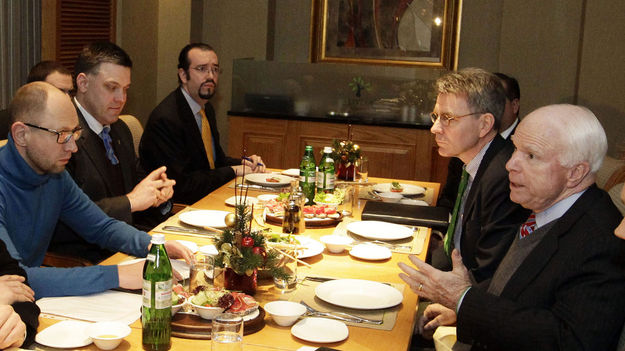
As in Syria, where US Ambassador Robert Ford adopted the rebels from the beginning of the insurrection, US officials have beat a steady path to the Ukrainian rebels to offer their support and assistance. Senator John McCain has even dined with Svoboda Party president Oleh Tyahnybok, shown here in a rather different pose. US Assistant Secretary of State Victoria Nuland was recorded plotting the overthrow and replacement of the Ukrainian government with the US Ambassador to Ukraine, Geoffrey Pyatt.
Pyatt, a man surely devoid of any sense of self-reflection, boldly proclaimed that his recorded plotting to overthrow of the Ukrainian government was merely “helping to build bridges between the government and the opposition.” Of course in a strict sense that is true: he is actively engaged in building a bridge to government power for the Ukrainian opposition.
The Syrian rebels are presented as a moderate group of would-be democrats seeking political reform; Ukrainian rebels are presented as a bunch of pro-Western, pro-EU “peaceful demonstrators.” In both cases the real power on the streets has been radical extremists with whom US officials have had considerable contact.
In Syria, President Assad responded early on to the unrest with offers of compromise, including agreeing to hold a constitutional referendum which put an end to generations of one-party rule. In Ukraine, President Yanukovich granted amnesty to violent protesters, rescinded legislation seen as inhibiting protest, fired his government at the request of the opposition and even offered to name opposition leaders to a new interim government. Each move toward compromise and appeasement of the opposition was met with increased violence and escalating demands on the part of the rebels, most recently in Ukraine after opposition leaders met with US and EU officials at a security conference in Munich.
President Obama sternly warns the Ukrainian government against restoring order: “We expect the Ukrainian government to show restraint, to not resort to violence in dealing with peaceful protesters.” He cryptically hinted at possible US escalation, stating: “We’ll be monitoring very carefully the situation, recognizing that, along with our European partners and the international community, there will be consequences if people step over the line.”
He similarly warned Syrian president Assad against taking action to defend the country against armed rebels fighting for its overthrow.
Another red line drawn? This time on Russia’s doorstep?
Here again is the million dollar question: What would Washington do if rebels intent on overthrowing the Obama regime raided military weapons depots, killed at least ten police officers and wounded dozens of others, set Washington D.C. on fire, occupied key government buildings including the US Capitol complex, and demanded a change in the Constitution favoring their ascendance to power?
Obama warned the Ukraine government to make sure the “Ukrainian military does not step in to resolve issues that could be resolved by civilians.” The US military was called in to quell a far less significant protest in Seattle over the World Trade Organization meeting there in 1999.
The US Capitol area has been on “lockdown” innumerable times over such “threats” as a mentally disturbed woman driving erratically — who was unarmed and shot dead by police.
One need not side with either opposing group in Ukraine to point out the choking hypocrisy of the US position.
But what is truly remarkable are the many similarities between what has been happening in Syria and what is now happening in Ukraine. It almost seems as if the same hand with the same playbook is plotting both regime change operations.
Syria opposition leader praises Benjamin Netanyahu
Press TV | February 22, 2014
A Syrian opposition leader has praised Israeli Prime Minister Benjamin Netanyahu for expressing support for militants wounded during the conflict in Syria.
Muhammad Badie told Israel Radio Friday that the Syrian opposition is grateful to Netanyahu for his February 18 tour to a field hospital in the (occupied) Golan Heights.
Speaking from Istanbul, the Syrian opposition leader added that Netanyahu’s public presence near the wounded militants sent an “important message.”
Badie also said that he and his friends thanked the Israeli premier for publicly voicing support for injured militants, especially after the collapse of the recent talks between the Syrian government and the opposition in Geneva, Switzerland.
Israel Channel 2 News recently aired footage of a secret Israeli field hospital in the occupied Golan Heights that has treated over 700 Syrians including militants over the past months.
Last year, the Israeli military carried out at least three airstrikes against Syria.
Damascus says Tel Aviv and its Western allies are aiding al-Qaeda-linked militant groups operating inside Syria.
Saudi Arabia replaces Bandar bin Sultan as leader of Syrian dossier
MEMO | February 21, 2014
Diplomatic sources told AFP on Thursday that Saudi Arabia has sidelined its intelligence chief, Prince Bandar bin Sultan, by transferring key aspects of the Syrian dossier, which he had previously been overseeing, to Interior Minister Prince Mohammed bin Nayef.
A Western diplomat in the Gulf region told the news agency that Prince Bandar is no longer in charge of the Syrian dossier, leaving Prince Nayef primarily responsible.
According to a source close to the dossier, Prince Nayef participated in a meeting last week in Washington between Western and Arab officials to discuss the situation in Syria.
Diplomatic sources added that Washington has criticised Prince Bandar’s management of the Syrian dossier.
Prince Bandar, the son of the former Crown Prince Sultan bin Abdul Aziz Al-Saud, was appointed in July 2012 as the head of the Saudi Intelligence Service. He had previously served as the Saudi Ambassador to Washington for 22 years and played a key role in encouraging the Bush administration to invade Iraq in 2003.
The Saudi media have not covered any activity of Prince Bandar’s since January.
A diplomatic source told AFP that he was hospitalised recently in the United States and is currently in Morocco.
Media aligned with the Syrian regime have accused him of backing extremists in Syria.
Prince Nayef is the son of the former Crown Prince Nayef bin Abdul Aziz, and is playing a major role in the war being waged by Saudi Arabia against terrorism and Al-Qaeda.
Related articles
Featured Video

The American Retreat from Vietnam
or go to
Aletho News Archives – Video-Images
From the Archives
Secret document reveals plans for civil war in Lebanon, Israeli false flags, and invasion
By Randi Nord | Geopolitics Alert | April 5, 2019
Beirut – During his visit with US Secretary of State, Mike Pompeo, Lebanese President Michael Aoun reportedly received a US-Israeli document detailing plans for creating a civil war in Lebanon with covert false flag operations and possible Israeli invasion.
Although the source of the document is Israeli and created in partnership with Washington, no one knows who presented it to Aoun. The Lebanese TV station, Al-Jadeed, initially reported the document on Lebanese TV and a video on its website. Geopolitics Alert translated the report for this article. … continue
Blog Roll
 Aletho News
- There’s a drought in academia: A drought in honest research on the subject of drought and other weather extremes
- Department of War Awards $20.7 Billion Contract to Raytheon for Air-to-Air Missiles
- ‘Distance yourselves from Israel’: IRGC urges US population to question govt policies
- America’s Greenland deal has a radioactive backstory
- The RAF Fairford ‘terror plot’: Unpacking escalation in the UK echo-chamber
- EU Council Advances Chat Control 2.0 Scanning Proposal
- Ex-Greek MEP files complaint against Israeli spyware firm over alleged Pegasus surveillance
- Troubling ideas throughout the Torah, Talmud, Mishneh Torah and Tanya
- ‘Grave, alarming’: Iran mission on Trump’s UNGA ‘annihilation’ threats
- Najaf airport to reopen to Iranian flights within 24 hours: Ambassador
- If Americans Knew
- New Report: “Scholasticide and Genocide in Gaza: Assessment, Testimonies and Legal Analysis”
- Ex-Biden officials are desperate for a Gaza scapegoat
- Israeli “settlers” Invade Al-Aqsa; Pour Boiling Water on 75-Year-Old
- Israel Has Kidnapped Another American Teenager
- US arms sales to Israel worth $21.6 billion in 20 months
- Three Palestinians Killed in Israeli Attacks on Gaza
- Revealed: German “Anti-Semitism Expert” Driving Crackdown on Palestine Solidarity is Former Israeli Spy
- Egypt’s Warning to Israel Before Oct 7
- Israel’s siege signals another cruel winter for 1.8 million Gazans – Daily Update
- Netanyahu Asked UAE Leader to Deny Report on Oct. 7 Warning in Secret Visit, Sources Say
- No Tricks Zone
- New Study: Earth And Venus Surface Warmth Largely Explained By Convection And Lapse Rate, Not CO2 Or Radiation
- 2025 Nature Paper Claiming Worsening Global Drought Gets RETRACTED …Heavily Flawed
- New Study: ‘Global Drought Shows No Detectable Recent Acceleration Under Climate Warming’
- Economic Masterminds: German Socialists Suggest Taxing Productivity Gains Stemming From Using AI
- The South China Sea Has Not Been Cooperating With The Climate Change Narrative
- Energy Crisis: Germany Enters Heating Season With Historically Low Gas Reserve Fill Levels
- New Study: The Antarctic Ice Sheet Gained Mass From 2020-2024 Due To Staggering Snow And Ice Accumulation
- Study: Ocean Heating Rates From Thousands Of Years Ago ‘Dwarf’ Modern Ocean Heating Rates
- Climate Extremists Target, Attack Large-Scale Power Grid Infrastructure In Germany!
- New Study: Antarctic Ice Melt Has Contributed Less Than 1 Centimeter To Sea Level Rise In The Last 30 Years