Terrorist Groups in Syria Treat over 700 of Their Injured in Israeli Hospital
Al-Manar | February 2, 2014
The Israeli occupation army established a field hospital on the Golan Heights to treat injured militants who belong to the terrorist groups in Syria.
These groups have treated over 700 of their injured militants in that hospital, according to Israeli media outlets.
The Zionist army prevented media outlets from broadcasting the activities of the field hospital yet allowed the Second Channel to prepare a report about it in order to promote the “humane Israeli step towards the Syrians.”
The report mainly focused on Israeli intentions behind treating the militants, clarifying that the Israelis aim at strengthening and deepening their relations with the terrorist groups in Syria in order to keep the calm and stability which now prevails between these groups and Israel at the Palestinian-Syrian borders.
The report also included interviews with a number of the militants who stated that “Zionism is not macabre as it has been portrayed by the Syrian regime.”
“The regime used to force us to believe that our enemy is all the surrounding world, yet after the beginning of the revolution, we recognized our real friends and real enemies.”
US invokes holocaust in Syria aid spat with Russia
Penny for you thoughts | January 28, 2014
How low can you go?
When the hand you hold is a loser. The holocaust card can always be played.
The U.S. ambassador to the United Nations has called on Russia to use its influence with the Syrian regime to help get humanitarian aid to the besieged city of Homs.
Tense negotiations between the Syrian government and opposition entered their fifth day Tuesday, focusing on the transfer of power and helping besieged parts of Homs.
The emphasis on Homs and release of detainees are meant as confidence-building measures. A tentative agreement was reached in Geneva over the weekend for the evacuation of women and children trapped in Homs before aid convoys go in. Central Homs has been under siege for nearly two years.
U.S. Ambassador to the UN, Samantha Power, in a speech during international Holocaust commemoration day on Monday, said that just as Russian soldiers liberated Auschwitz in 1945, “the world again needs Russia to use its influence, this time to ensure that food reaches the desperate and starving people imprisoned in besieged Homs, Yarmouk, the Damascus suburbs and elsewhere.”
“The horrors of the Holocaust have no parallel but the world continues to confront crimes that shock the conscience,” Power said during an event where film director Steven Spielberg gave a keynote address and a survivor of the Nazi genocide also spoke. “In October, the Security Council spoke with a united voice about the need for action to address the humanitarian devastation in Syria. There are people who are imprisoned in their own neighborhoods.” “They need food desperately and yet food cannot reach them because the regime will not allow it.”
Oh, I can think of plenty of parallels, but, let’s pretend the Holocaust (TM) is the only one that counts.
So valued for so many reasons:
Crushing free speech
Playing the victim card
Guilt
And let’s not forget- Used to traumatize young Israeli’s- I saved this one knowing the time would be right to use it!
‘Holocaust journeys’ can cause mental health problems
Think of the value in traumatizing the populace. Fear and trauma allows for mass manipulation and ease of control.
Back to the invocation of the high holy holocaust meme
Russia’s mission to the UN criticized Power for bringing the Holocaust into the Syria issue.
“We regard such analogies as entirely inappropriate,” said Alexei Zaitsev, a spokesman for the mission, in an e-mail.
And these are inappropriate analogies. But, Samantha Power has always shown herself to be willing to stoop to the way down low level.
Sick. Considering the US and Israeli involvement in the ruin of Syria. Absolutely sick!

US Congress secretly approves sending small arms to ‘moderate’ Syrian rebels
RT | January 28, 2014
Congressional lawmakers have quietly authorized sending small arms, an assorted variety of rockets, and financial backing to so-called “moderate” rebels fighting in Syria’s civil war, according to a new report.
American and European security officials told Reuters that the US will provide anti-tank rockets, but nothing as deadly as shoulder-launched surface-to-air missiles (known as MANPADs), which can be used to bring down military or civilian aircraft.
Legislators voted in closed-door meetings to fund the opposition forces through September 30, the end of the US government’s fiscal year. The decision is an about-face from congressional debates last year, in which the same committees were reluctant to supply arms over concerns that American weapons would wind up in the hands of radical Islamists fighting in the region, the Al-Qaeda-backed Al-Nusra being the most well known.
Now, though, those concerns appear to have lessened. Exactly when Congress approved the funding is not known, yet the sources speculated that it was signed in a classified section of a defense appropriations bill that was approved in December.
“The Syrian war is a stalemate,” said Bruce Riedel, a former CIA analyst and current foreign policy advisor to US President Obama with the Brookings Institution. “The rebels lack the organization and weapons to defeat Assad; the regime lacks to loyal manpower to suppress the rebellion. Both sides’ external allies…are ready to supply enough money and arms to fuel the stalemate for the foreseeable future.”
Despite the uncertainty remaining around the conflict, Western officials have asserted in recent weeks that “moderate” rebels have strengthened their positions in the south of Syria and have begun excluding Al-Qaeda sympathizers. Extremists are known to be in control of rebel forces in the north and east, however.
US and British officials temporarily suspended “non-lethal aid” (a category that includes communications equipment and transportation vehicles) in December, although officials now say they hope to resume providing assistance to the Supreme Military Council (SMC), which oversees rebel forces favored by the West.
“We hope to be able to resume assistance to the SMC shortly, pending security and logistics considerations,” one source told Reuters. “But we have no announcement at this time.”
News of the funding comes as the Syrian government and the external opposition in Geneva have reached an agreement that would see humanitarian aid enter the besieged city of Homs, and would allow women and children to leave its war-ravaged areas.
What makes the deal dubious, however, is that it’s not yet clear how it will be implemented on the ground. Currently, the Syrian government is promising – voiced on Sunday by Deputy Foreign Minister Faisal Mekdad – that women and children can leave Homs safely. Another question is how rebels inside the city besieged by the army will react.
“If the armed terrorists in Homs allow women and children to leave the old city of Homs, we will allow them every access. Not only that, we will provide them with shelter, medicines and all that is needed,” he said, as cited by Reuters. “We are ready to allow any humanitarian aid to enter into the city through the arrangements made with the UN.”
US State Department spokesman Edgar Vasquez said that an evacuation is not a legitimate option because of how dire the need for aid is.
“We firmly believe that the Syrian regime must approve the convoys to deliver badly needed humanitarian assistance into the Old City of Homs now,” Vasquez said. “The situation is desperate and the people are starving.”
The results of a meeting in Geneva, Switzerland – where government officials sat across the negotiating table from representatives of the opposition on Monday – is so far unclear. Each side pledged its willingness to continue discussions, though progress so far has been nearly nonexistent.
United Nations envoy Lakhdar Brahimi told reporters after the meeting Monday that even though the talks “haven’t produced much,” another session was scheduled for Tuesday.
“Once again, I tell you we never expected any miracle, there are no miracles here,” he said in a news conference. “My expectation from this conference is that the unjust war will stop. But I know this is not going to happen today or tomorrow or next week.”
A True Holocaust that the World Will Deny: Syrian Foreign Minister Blasts Syria War Lies at Geneva II
SANA | January 23, 2014
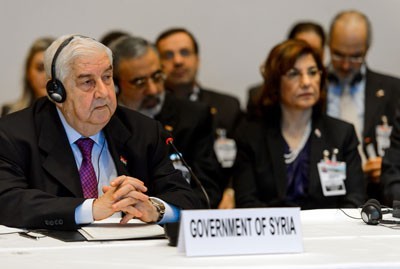
Montruex – The international conference on Syria, Geneva2, kicked off on Wednesday morning with the participation of Syria’s official delegation, headed by Deputy Premier, Foreign and Expatriates Minister, Walid al-Moallem.
Minister al-Moallem said at the opening session of the conference:
Ladies and Gentlemen, On behalf of the Syrian Arab Republic, SYRIAN – steeped in history for seven thousand years. ARAB – proud of its steadfast pan-Arab heritage despite the deliberate acts of aggression of supposed brotherly Arabs. REPUBLIC – a civil state that some, sitting in this room, have tried to return to medieval times. Never have I been in a more difficult position; my delegation and I carry the weight of three years of hardship endured by my fellow countrymen – the blood of our martyrs, the tears of our bereaved, the anguish of families waiting for news of a loved one – kidnapped or missing, the cries of our children whose tender fingers were the targets of mortar shelling into their classrooms, the hopes of an entire generation destroyed before their very eyes, the courage of mothers and fathers who have sent all their sons to defend our country, the heartbreak of families whose homes have been destroyed and are now displaced or refugees.
Al-Moallem: My delegation and I carry the hope of a nation for the years to come
My delegation and I also carry the hope of a nation for the years to come – the right of every child to safely go to school again, the right of women to leave their homes without fear of being kidnapped, killed or raped; the dream of our youth to fulfill their vast potential; the return of security so that every man can leave his family safe in the knowledge that he will return.
Finally, today, the moment of truth; the truth that many have systematically tried to bury in a series of campaigns of misinformation, deception and fabrication leading to killing and terror. A truth that refused to be buried, a truth clear for all to see – the delegation of the Syrian Arab Republic representing the Syrian people, the government, the state, the Army and the President – Bashar al-Assad.
It is regrettable that seated amongst us are representatives of countries that have the blood of Syrians on their hands
It is regrettable, Ladies and Gentlemen, that seated amongst us today in this room, are representatives of countries that have the blood of Syrians on their hands, countries that have exported terrorism along with clemency for the perpetrators, as if it was their God given right to determine who will go to heaven and who will go to hell. Countries that have prevented believers from visiting holy places of worship whilst abetting, financing and supporting terrorists. Countries that gave themselves the authority to grant and deny legitimacy to others as they saw fit, never looking at their own archaic glasshouses before throwing stones at acclaimed fortified towers. Countries that shamelessly lecture us in democracy, in development and in progress whilst drowning in their own ignorance and medieval norms. Countries that have become accustomed to being entirely owned by kings and princes who have the sole right to distribute their national wealth granting their associates whilst denying those who fall out of favour.
They lectured Syria – a distinguished, virtuous, sovereign state, they lectured her on honour whilst they themselves were immersed in the mud of enslavement, infanticide and other medieval practices. After all their efforts and subsequent failures, their masks fell from their quivering faces, to reveal their perverse ambitions. A desire to destabilize and destroy Syria by exporting their national product: terrorism. They used their petrodollars to buy weapons, recruit mercenaries and saturate airtime covering up their mindless brutality with lies under the guise of the so-called “Syrian revolution that will fulfil the aspirations of the Syrian people.”
Ladies and Gentlemen, how is what has happened and continues to plague Syria, meeting these aspirations? How can a Chechen, Afghani, Saudi, Turkish or even French and English terrorists deliver on the aspirations of the Syrian people, and with what? An Islamic state that knows nothing of Islam except perverse Wahhabism? Who declared anyway that the Syrian people aspire to live thousands of years in the past?
In Syria, the wombs of pregnant women are butchered and their foetuses killed
In Syria, Ladies and Gentlemen, the wombs of pregnant women are butchered and their foetuses killed; women are raped, dead or alive, in practices so heinous, so vile and repulsive that they can only be attributed to their perverse doctrine. In Syria, Ladies and Gentlemen, men are slaughtered in front of their children in the name of this revolution; worse still, this is done whilst the children of these foreign perpetrators sing and dance. In Syria, how can so-called revolutionaries cannibalize a man’s heart and claim to promote freedom, democracy and a better life?
Under the pretext of the “Great Syrian Revolution,” civilians, clergymen, women and children are killed, victims are indiscriminately blown up in streets and buildings regardless of their political views or ideologies; books and libraries are burned, graves are dug up and artifacts stolen. In the name of the revolution, children are killed in their schools and students in their universities, women are extorted in the name of jihad al-nikah and other forms, mosques are shelled whilst worshippers kneel at prayer, heads are severed and hung in the streets, people are burned alive in a true holocaust that history and many countries will deny without being accused of anti-Semitism.
In the name of a revolution, “to free the oppressed Syrian people from the regime and to spread democracy,” does a father blow himself up with his wife and children to prevent foreign intruders from entering his home? Most of us in this room are fathers – I ask you then, what would compel a man to kill his own family to protect them from freedom fighting monsters. This is what happened in Adra, a place that most of you have not heard of but where the same alien monsters attacked: killing, looting, beheading, slaughtering, raping and burning people alive. You have heard nothing of this brutality for sure, yet you have heard of other places where the same heinous crimes were committed and where the same blood soaked finger was pointed at the Syrian Army and government. And when these flagrant lies were no longer credible, they stopped spinning their web of deceit.
This is what their masters ordered them to do, these countries that spearheaded the war against Syria, trying to increase their influence in the region with bribes and money, exporting human monsters fully soaked in abhorrent Wahhabi ideology, all at the expense of Syrian blood. From this stage, loud and clear, you know as well as I do that they will not stop in Syria, even if some sitting in this room refuse to acknowledge or consider themselves immune.
Ladies and Gentlemen, everything you have heard would not have been possible, had our border sharing countries been good neighbours during these challenging years. Unfortunately they were far from it; with backstabbers to the North, silent bystanders to the truth in the West, a weak South accustomed to doing the bidding of others, or the tired and exhausted East still reeling from the plots to destroy it along with Syria.
Misery and destruction, which has engulfed Syria, has been made possible by the decision of Erdogan’s government
Indeed, this misery and destruction, which has engulfed Syria, has been made possible by the decision of Erdogan’s government to invite and host these criminal terrorists before they entered into Syria. Clearly, oblivious to the fact that magic eventually turns on the magician, it is now beginning to taste the sour seed it has sown. For terrorism knows no religion, and is loyal only unto itself. Erdogan’s government has recklessly morphed from a zero problems with its neighbours policy to zero foreign policy and international diplomacy altogether, crucially leaving it with zero credibility.
Nevertheless, it continued on the same atrocious path falsely believing that the dream of Sayyid Qutb and Mohammad Abdel Wahab before him was finally being realized. They wreaked havoc from Tunisia, to Libya, to Egypt and then to Syria, determined to achieve an illusion that only exists in their sick minds. Despite the fact that it has proven to be a failure, they nevertheless are still determined to pursue it. Logically speaking, this can only be described as stupidity, because if you don’t learn from history, you will lose sight of the present; and history tells us: if your neighbour’s house is on fire, it is impossible for you to remain safe.
Some neighbours started fires within Syria whilst others recruited terrorists from around the globe – and here we are confronted with shockingly farcical double standards: 83 nationalities are fighting in Syria – nobody denounces this, nobody condemns it, nobody reconsiders their position – and they impertinently continue to call it a glorious SYRIAN Revolution! While when a few scores of young resistant fighters supported the Syrian Army in a few places, all hell broke loose and it suddenly became foreign intervention! Demands were made for the departure of foreign troops and the protection of Syrian sovereignty and for it not to be violated. Here I affirm, Syria – the sovereign and independent state, will continue to do whatever it takes to defend herself with whatever means it deems necessary, without paying the least bit of attention to any uproar, denunciations, statements or positions expressed by others. These have been and always will be Syria’s sovereign decisions.
They imposed sanctions on our food, our bread and our children’s milk
Despite all of this, the Syrian people remained steadfast; and the response was to impose sanctions on our food, our bread and our children’s milk. To starve the population, pushing them into sickness and death under the injustice of these sanctions. At the same time, factories were looted and burned, crippling our food and pharmaceutical industries; hospitals and healthcare centers were destroyed; our railroads and electricity lines sabotaged, and even our places of worship – Christian and Muslim – were not spared their terrorism.
When all of this failed, America threatened to strike Syria, fabricating with her allies, Western and Arab, the story about the use of chemical weapons, which failed to convince even their own public, let alone ours. Countries that celebrate democracy, freedom and human rights regrettably only choose to speak the language of blood, war, colonialism and hegemony. Democracy is imposed with fire, freedom with warplanes and human rights by human killing, because they have become accustomed to the world doing their bidding: if they want something, it will happen; if they don’t, it won’t. They have heedlessly forgotten that the perpetrators who blew themselves up in New York follow the same doctrine and come from the same source as those blowing themselves up in Syria. They have heedlessly forgotten that the terrorist that was in America yesterday is in Syria today, and who knows where he will be tomorrow. What is certain, however, is that he will not stop here. Afghanistan is an ideal lesson for anyone who wants to learn – anyone! Unfortunately, most do not want to learn; neither America nor some of the ‘civilized’ western countries that follow its lead, starting from the city of lights to the kingdom over which “the sun never set,” in the past; despite the fact that they have all felt the bitter taste of terrorism in the past.
And then suddenly they became “Friends of Syria.” Four of these ‘friends’ are autocratic, oppressive monarchies that know nothing of a civil state or democracy, whilst others are the same colonial powers which occupied, pillaged and partitioned Syria less than one hundred years ago. These so called ‘friends’ are now convening conferences to publicly declare their friendship with the Syrian people, whilst covertly facilitating their hardship and destroying their livelihoods. They openly express their outrage over the humanitarian plight of Syrians whilst deceiving the international community of their complicity. If you were truly concerned about the humanitarian situation in Syria, you would remove your strangle hold on her economy by lifting the sanctions and the embargo, and by partnering with her government in tightening security by fighting the influx of weapons and terrorists. Only then can we assure you that we will be well as we once were, without your deep concern for our well-being.
Some of you may be asking yourselves: Are foreigners the sole manufacturers of the happenings in Syria? No Ladies and Gentlemen, Syrians amongst us here, having been legitimized by foreign agendas, have played a contributing role as facilitators and implementers. They did this at the expense of Syrian blood and the people whose aspirations they claim to represent, whilst they themselves were divided hundreds of times and their leaders on the ground were fleeing far and wide. They sold themselves to Israel becoming her eyes on the ground, and her fingers on the trigger for Syria’s destruction; and when they failed, Israel intervened directly to reduce the capabilities of the Syrian Army and thus ensuring the continued implementation of her decades old plan for Syria.
Our people were being slaughtered while opposition figures legitimized by foreign agendas were living in five star hotels
Our people were being slaughtered while they were living in five star hotels; they opposed from abroad, met abroad betraying Syria and selling themselves to the highest foreign bidder. And yet, they still claim to speak in the name of the Syrian people! No, Ladies and Gentlemen, anyone wishing to speak on behalf of the Syrian people cannot be a traitor to their cause and an agent for their enemies. Those wishing to speak on behalf of the people of Syria should do so from within her borders: living in her destroyed houses, sending their children to her schools in the morning not knowing if they will return safe from mortar shelling, tolerating the freezing cold winters because of the shortage in heating oil and queuing for hours to buy bread for their families because sanctions have prevented us from importing wheat when we were once exporters. Anyone wanting to speak in the name of the Syrian people should first endure three years of terrorism, confronting it head on, and then come here and speak on behalf of the Syrian people.
Syrian has welcomed hundreds of international journalists and facilitated their mobility
Ladies and gentlemen, the Syrian Arab Republic – people and state, has fulfilled its duties. It has welcomed hundreds of international journalists and facilitated their mobility, security and access; and they in turn have reflected the stark and horrific realities they witnessed to their audiences, realities that have perplexed many Western media organisations who couldn’t bear their propaganda and narrative being exposed and contradicted. The examples are too many to count. We allowed international aid and relief organizations into the country, but the clandestine agents of certain parties sitting here, obstructed them from reaching those in dire need of aid. They came under terrorist attack several times, whilst we, as a state, did our duty in protecting them and facilitating their work. We issued numerous amnesties and released thousands of prisoners, some even members of armed groups, at the anger and dismay of their victim’s families; these families though, like the rest of us, ultimately accepted that Syria’s interests come before anything else, and hence we must conceal our wounds and rise above hatred and rancour.
What have you done, you who claim to speak on behalf of the Syrian people. Where is your vision for this great country? Where are your ideas or your political manifesto? Who are your agents of change on the ground other than your armed criminal gangs? I am certain that you have nothing and this is only too apparent in the areas that your mercenaries have occupied or to use your words “liberated.”
In these areas, have you freed the population or have you hijacked their moderate culture to enforce your radical and oppressive practices? Have you implemented your development agenda by building schools and health centres? No, you have destroyed them and allowed polio to return after it had previously been eradicated in Syria. Have you protected Syria’s artifacts and museums? No, you have looted our national sites for your personal profit. Have you demonstrated your commitment to justice and human rights? No, you have enforced public executions and beheadings. In short, you have done nothing at all except muster the disgrace and shame of begging America to strike Syria. Even the opposition, over which you are the self-appointed masters and guardians, do not acknowledge you or the methods in which you manage your own affairs, let alone the affairs of a country.
A country they want to homogenize; not in the sectarian, ethnic or religious sense, but rather in a warped ideological sense. Anyone against them, whether Christian or Muslim, is an infidel; they killed Muslims of all sects and targeted Syrian Christians with severity. Even nuns and bishops were targeted, kidnapping them after they attacked Ma’loula, the last community that still speaks the language of Jesus Christ. They did all this to force Syrian Christians to flee their country. But little did they know, that in Syria we are one. When Christianity is attacked all Syrians are Christians, when mosques are targeted all Syrians are Muslims. Every Syrian is from Raqqa, Lattakia, Sweida, Homs or the bleeding Aleppo when any one of these places is targeted. Their abhorrent attempts to sow sectarian and religious sedition will never be embraced by any level-headed Syrian. In short, Ladies and Gentlemen, your “glorious Syrian revolution” has left no mortal sin uncommitted.
There is another side to this dark gloomy picture. A light at the end of the tunnel shinning through the Syrian people’s determination and steadfastness, the Syrian Army’s courage in protecting our citizens and the Syrian state’s resilience and perseverance. During everything that has happened, there are states that have shown us true friendship, honest states that stood on the side of right against wrong, even when the wrong was clear for all to see. On behalf of the Syrian people and state, I would like to thank Russia and China for respecting Syria’s sovereignty and independence. Russia has been a true champion on the international stage strongly defending, not only with words but also with deeds, the founding principles of the United Nations of respecting the sovereignty of states. Similarly China, the BRICS countries, Iran, Iraq and other Arab and Muslim countries, in addition to African and Latin American countries, have also genuinely safeguarded the aspirations of the Syrian people and not the ambitions of other governments for Syria.
The Syrian people, like other people of the region, aspire to more freedom, justice and human rights
Yes, Ladies and Gentlemen, the Syrian people, like other people of the region, aspire to more freedom, justice and human rights; they aspire to more plurality and democracy, to a better Syria, a safe, prosperous and healthy Syria. They aspire to building strong institutions not destroying them, to safeguarding our national artifacts and heritage sites not looting and demolishing them. They aspire to a strong national army, which protects our honour, our people and our national wealth, an army that defends Syria’s borders, her sovereignty and independence. They do not, Ladies and Gentlemen, aspire to a mercenary army ‘Free’ to kidnap civilians for ransom or to use them as human shields, ‘Free’ to steal humanitarian aid, extort the poor and illegally trade in the organs of living women and children, ‘Free’ to cannibalise human hearts and livers, barbequing heads, recruiting child soldiers and raping women. All of this is done with the might of arms; arms provided by countries, represented here, who claim to be championing “moderate groups”. Tell us, for God’s sake, where is the moderation in everything I have described?
Where are these vague moderate groups that you are hiding behind? Are they the same old groups that continue to be supported militarily and publicly by the West, that have undergone an even uglier face-lift in the hope of convincing us that they are fighting terrorism? We all know that no matter how hard their propaganda machine tries to polish their image under the name of moderation, their extremism and terrorism is one and the same. They know, as we all do, that under the pretext of supporting these groups, al-Qaeda and its affiliates are being armed in Syria, Iraq and other countries in the region.
This is the reality, Ladies and Gentlemen, so wake up to the undeniable reality that the West is supporting some Arab countries to supply lethal weapons to al-Qaeda. The West publicly claims to be fighting terrorism, whilst in fact it is covertly nourishing it. Anyone who cannot see this truth is either ignorantly blind or wilfully so in order to finish what they have begun.
Is this the Syria that you want? The loss of thousands of martyrs and our once cherished safety and national security replaced with apocalyptic devastation. Are these the aspirations of the Syrian people that you wanted to fulfill? No, Ladies and Gentlemen, Syria will not remain so, and that is why we are here. Despite all that has been done by some, we have come to save Syria: to stop the beheadings, to stop the cannibalizing and the butchering. We have come to help mothers and children return to the homes they were driven out of by terrorists. We have come to protect the civil and open-minded nature of the state, to stop the march of the Tatars and the Mongols across our region. We have come to prevent the collapse of the entire Middle East, to protect civilization, culture and diversity, and to preserve the dialogue of civilizations in the birthplace of religions. We have come to protect tolerant Islam that has been distorted, and to protect the Christians of the Levant. We are here to tell our Syrian expatriates, to return to their home country because they will always be foreigners anywhere else, and regardless of our differences we are all still brothers and sisters.
We have come to stop terrorism as other countries that have experienced its bitter taste have done, whilst affirming loudly and consistently that a dialogue between Syrians is the only solution; but as with other countries that have been struck by terrorism, we have a constitutional duty to defend our citizens and we shall continue to strike terrorism that attacks Syrians regardless of their political affiliations. We have come to hold those accountable, for as long as particular countries continue to support terrorism, this conference will bear no fruit. Political pluralism and terrorism cannot coexist in the same landscape. Politics can only prosper by fighting terrorism; it cannot grow in its shadow.
Nobody has the authority to grant or withdraw legitimacy from a president, a government, a constitution, a law or anything else in Syria except Syrians themselves
We are here as representatives of the Syrian people and the state; but let it be clear to all, – and experience is the best proof – that nobody has the authority to grant or withdraw legitimacy from a president, a government, a constitution, a law or anything else in Syria except Syrians themselves; this is their constitutional right and duty. Therefore, whatever agreement is reached here will be subject to a national referendum. We are tasked with conveying our people’s desires, not with determining their destiny; those who want to listen to the will of the Syrian people should not appoint themselves as their spokesperson. Syrians alone have the right to choose their government, their parliament and their constitution; everything else is just talk and has no significance.
Finally, to all those here and everyone watching around the world: in Syria we are fighting terrorism, terrorism which has destroyed and continues to destroy; terrorism which since the 1980’s Syria has been calling, on deaf ears, for a unified front to defeat it. Terrorism has struck in America, France, Britain, Russia, Iraq, Afghanistan, Pakistan; the list goes on and it continues to spread. Let us all cooperate to fight it, let’s work hand in hand to stop its black, horrifying and obscurantist ideology. Then, let us as Syrians stand united to focus on Syria and start rebuilding its social fabric and material structures. As I said, dialogue is the foundation to this process, and despite our gratitude to the host country, we affirm that the real dialogue between Syrians should in fact be on Syrian soil and under Syrian skies. Exactly one year ago, the Syrian government put forward its vision for a political solution; think of how much innocent blood we would have saved had some countries resorted to reason instead of terrorism and destruction. For a whole year, we have been calling for dialogue, but terrorism continued to strike at the Syrian state, her people and institutions.
Today, in this gathering of Arab and Western powers, we are presented with a simple choice: we can choose to fight terrorism and extremism together and to start a new political process, or you can continue to support terrorism in Syria. Let us reject and isolate the black hands and the false faces, which publicly smile but covertly feed terrorist ideology, striking Syria today, but ultimately spreading to infect us all. This is the moment of truth and destiny; let us rise to the challenge.
Thank you.
Al-Moallem: We hope that Geneva Conference be a first step to start Syrian-Syrian dialogue in Syria
Later, Minister al-Moallem said, “The orchestra that we have heard from some sides today and the content of some hostile speeches from some states, to the extent that in some minutes we seemed to have heard old rhetoric with no difference except for the place of delivering them, do not deserve to be answered.”
Concluding the second session of the conference, al-Moallem added, “Because we want to stop bloodshed in Syria, to protect the lives of citizens, to build Syria again and because, as a state, we play our constitutional, political, security and social role to save Syria from what is going on, we are here and we hope the Geneva conference will be a first step on the way to start Syrian-Syrian dialogue on the Syrian territories.”
“I thank those who have stood by us from the friendly countries for three years so far and we say to all that we will continue hitting terrorism wherever it was with one hand and we will build Syria democratically, politically and socially with the other,” al-Moallem said.
Minister al-Moallem added, “I say to those who are interfering in the Syrian affairs through any sort of interference: three years and you are still trying; have you not become desperate yet? … Enough! … Put your hands off Syria so that we can indeed achieve the people’s aspirations of a secure and developed life.”
Top Three Media Lies About the Syrian Peace Talks
The Propaganda War Heats Up
By Shamus Cooke | RINF | January 24, 2014
The media spin machine is again kicking into high gear, perfectly timed to accompany the “Geneva II” Syria peace talks. The lies are necessary to give the Obama administration an upper hand in the peace negotiations, which are not being used to pursue peace, but instead, to accomplish the Obama administration peace talks.
1) The removal of Syrian president Bashar al-Assad was an agreed upon “precondition” for the Geneva II peace talks.
This lie has been repeated over and over by government and media alike. It has zero basis. The Obama administration claims that this precondition was expressed in the “Geneva communiqué,” which was a road map agreement meant to guide the Geneva II peace talks, agreed upon by some of the major parties of the negotiations, including Russia.
The communiqué does indeed call for a negotiated political transition, but nowhere does it state that such a transition cannot include President Assad. Such a condition would have been outright rejected by Russia.
In fact, the Geneva communiqué includes this crucial statement:
“[a transition government] could include members of the present [Syrian] government and the opposition and other groups and shall be formed on the basis of mutual consent.”
Nowhere does it specifically mention or imply President Assad.
The Los Angeles Times recently stepped out of line and exposed this lie:
“[John] Kerry regularly cites the “Geneva communiqué,” a kind of peace road map hammered out in June 2012 during a United Nations-organized summit. But the document does not explicitly call for Assad’s ouster.”
The Obama administration’s constant repeating of this lie only causes divisions in the peace process, undermining the chances that the peace process will succeed.
The Obama administration is especially adamant about this “Assad must go” pre-condition because it knows that, if free and fair elections were held tomorrow in Syria — as part of a UN-backed “transitional process”— President Assad would likely win. This is the result of the ethnic and religious minorities in Syria that have rallied behind President Assad, since they’ve witnessed the consistent religious sectarian atrocities committed by the U.S.-backed rebels (which the U.S. media loves to ignore or minimize).
Assad would probably win an election since there is also simply no one else on the government side or the opposition side with his name recognition or popularity. The U.S.-backed rebel war in Syria has vastly strengthened Assad’s political hand, but you wouldn’t know it from the Western, anti-Syrian media.
Demanding Assad’s ouster also does not reflect the situation on the ground. The U.S.-backed rebels have never controlled more than one Syrian city, namely Raqaa, which is dominated by al-Qaeda and is governed under a Taliban-style interpretation of Islamic law, which includes a strict ban on music. Thus, the rebels don’t have the ground power that would even enable them to make the demand that “Assad must go”.
2) The U.S.-backed rebel militias are “moderate” Islamic groups.
The fact that this lie can even be uttered publicly without encountering ridicule is a major success of Western media propaganda. The media narrative paints the U.S.-backed “good” rebels fighting both the Syrian government and the “bad” al-Qaeda linked rebels.
But the “good” rebels in the U.S.-backed Islamic Front share the same vision for Syria’s future as the al-Qaeda rebels: a fundamentalist version of Sharia law, where women live in virtual house arrest and where religious minorities are second class citizens (non-Sunni Muslims would simply be butchered, as they are on a regular basis in Syria, which is again minimized or ignored in the Western media.)
The “moderate rebel” lie was further exposed recently when a top leader in the most powerful militia, Ahrar al Sham, within the Islamic Front declared Ahrar al Sham to be the “real” representative of al-Qaeda in Syria, as opposed to the rival al-Qaeda faction that the Islamic Front had recently begun fighting.
Ahrar al Sham has long been known to be an al-Qaeda type Islamist extremist group; the Western media simply chose to ignore it. But when it was recently made official, the U.S. media chose to continue its ignoring stance, since actually reporting on it would destroy their “moderate rebel” lie. The Western media also continues to ignore the fact that the “moderate” U.S.-backed Islamic Front issued a joint statement that aligned itself to the extremist views of Ahrar al Sham, the “real” al-Qaeda.
3) New Evidence of Syrian government “industrial scale” torture.
The Western media recently blasted the “breaking news” of brand new evidence showing massive “NAZI-like” torture and murder by the Syrian government, released at the beginning of the Syrian peace talks. This may or may not be true, but the lie here is that the Western media promoted the “evidence” as being unquestionably true, when the story doesn’t reach first base when it comes to evidence-based journalism.
All we really know is that there are hundreds of pictures of dead people that a “trusted source” says were killed by the Syrian government. The trusted source was designated as such by pro-Western intellectuals, who have earned professional “credibility” by helping convict war criminals in the International Criminal Court [ICC]. But as author Diane Johnstone pointed out in her excellent book “Fools Crusade,” about the war against Yugoslavia — as well as in other articles — the ICC has long been used by western powers as a tool to create a pretext for war, or a tool to justify a war after the fact.
The evidence of the “NAZI-like” atrocities was written in a study paid for by the government of Qatar, which has long funneled cash, guns, and Jihadis to Syria in aid of the anti-government rebels.
Again, we don’t know if the story is true or not. But such an important investigation should be conducted by the UN or another more objective institution. The same biased dynamic occurred in relation to the infamous chemical weapons attack, where no real evidence was provided, though an unending string of “experts” were quoted in the Western media, testifying to the guilt of the Syrian Government. But when Pulitzer prizewinning journalist Seymour Hirsch reported that the Obama administration lied about the rebels not having the capacity to perform such an attack, the Western media simply ignored the legend of journalism. The wrench in the propaganda machine was simply dislodged.
How do these lies become such permanent fixtures in the Western media? An excellent article in the Guardian newspaper recently discussed in depth the principal sources the Western media has used to understand the Syrian conflict.
The article exposed the incredible bias of some of the most important Western media sources on Syria, which is why they were handpicked in the first place to be “expert” sources: they had political agendas that were aligned with the U.S. government’s foreign policy decisions. The other side of the conflict was completely ignored, except when it was targeted for ridicule. Thus, Americans and Europeans have a completely one-sided, if not fantasy-based perspective of what is happening in Syria. This has been systematic since the beginning of the conflict, as happened with the Yugoslav, Afghan, Iraq, and Libya wars.
The result of this media-led ignorance could result in yet more unnecessary deaths in a country that now has millions of refugees and over a 100,000 dead. Obama seems like he intends to exploit these peace talks with the intention of blaming the Syrian government for their failure. Having failed to defeat Assad on the battlefield in a proxy war, the Obama administration is trying to win the propaganda war. And once peace talks have failed, talk of war will resume, since “all other options have failed.”
Shamus Cooke is a social service worker, trade unionist, and writer for Workers Action (www.workerscompass.org). He can be reached at shamuscooke@gmail.com
Outside Forces Seeking Palestinian-Hezbollah Conflict
By Franklin Lamb | Al-Manar | January 23, 2014
Ain el Helweh camp, Lebanon – It isn’t just the Zionist regime still occupying Palestine six decades after the Nakba; one can sense the carnivorous drooling from Tel Aviv to Amman, from Riyadh and the Gulf Kingdoms all the way to Washington DC and beyond—drooling and salivation over their project to promote tensions between the Palestinian Resistance and what is in some respects its historic offspring—Hezbollah.
The hostile forces gathered against the Tehran-Damascus-Hezbollah-Palestine Resistance alliance are reportedly hard at work on yet another scheme to weaken, and possibly destroy, all four. It won’t be easy, but it is a key game plan among those still seeking regime change in Syria.
Even as some of these governments deceptively play down their central goal of regime change in public, they appear to be fantasizing that by building up the Lebanese army—with a pledged $3 billion from Riyadh—that Lebanese troops can be induced to confront Hezbollah and its allies, this in what seems to be a “beat em or bleed em” strategy.
Patrick Cockburn, writing recently in the UK Independent and Counterpunch, gave a digest of anti-Shia hate propaganda being spread by Sunni religious figures, clerics financially backed by, and in some cases based in, Saudi Arabia and the Gulf monarchies. Cockburn noted accurately that what is being painstaking laid is the groundwork for a sectarian civil war engulfing the entire Muslim world.
Efforts to egg on a confrontation between Palestinians and Hezbollah have increased over the past three months in Lebanon’s camps, stemming principally from some of the local Sunni and Christian power centers. Support is being seen for various “militia of the month” groups, those terrorizing the population of the Syrian Arab Republic.
Moreover, the Takfiri Al-Nusra Front leader Abou Mohammed al-Joulani insists his organization is active on Lebanese soil in order to help the Sunnis, including Palestinians, face the “injustice” of Shiite Hezbollah. “Lebanon’s Sunni are requesting that the mujahideen intervene to lift up the injustice they are suffering from at the hands of Hezbollah and similar militias,” he said recently in an interview on Al-Jazeera.
Shiite-populated areas across Lebanon have been the target of terror attacks even before Hezbollah entered the fighting on the side of the Syrian government in May 2013, but those terror attacks have intensified recently. Four car bombings have targeted southern Beirut in recent months, while a number of IED attacks have occurred in Lebanon’s Beqaa Valley.
The head of the Islamic Jihadist Movement in Ain al-Hilweh camp voiced fears on January 8 of a possible armed sectarian confrontation between Hezbollah and Palestinian refugees in Lebanon if the party did not revise its policies at home and in Syria. Sheikh Jamal Khattab told the Daily Star that should fighting erupt between Palestinians and Hezbollah the conflict could be even worse than the “war of the camps” (read: massacres) of the 1980s, when that conflict was not considered particularly sectarian. Today, says Sheikh Khattab, it would be different. Today it would be a Sunni vs. Shia war, with regional and international consequences, given the poisonous sea-change in sectarian relations since the invasion of Iraq in 2003.
In Ain al-Hilweh and other camps, posters of local men killed while fighting alongside Takfiri groups in Syria, or against U.S. troops in Iraq, are tacked up throughout the camp. Lebanese security sources claim that Palestinian Islamist groups in Ain al-Hilweh have all finalized preparations to for a possible conflict with the Hezbollah’s organized and trained “Resistance Brigades.” These organizations include Usbat al-Ansar, Jund al-Sham, Fatah al-Islam, and other Salafist groups, and supporters of the controversial fugitive Sheikh Ahmad al-Assir, and rumors abound that some of these elements are being financed by certain of the six Gulf Cooperation Council states as well as some Lebanese pro-Western March 14 parties. Apparently the consideration among such groups and their sponsors is that conditions in Lebanon are ripe for an expanded war against “Shia infidels,” and reportedly plans are now in place to bring it here, with several groups that are now fighting in Syria pledging to widen the Sunni-Shia war into Lebanon.
For their part, some pro-Hezbollah groups and many Lebanese citizens are suspicious of possible Palestinian involvement in recent terror attacks in Dahiyeh and the recent bombing of the Iranian Embassy. In point of fact, one of the two suicide bombers who attacked the Iranian Embassy on November 17 was Mouin Abu Dahr, a known pro-Palestinian whose mother is a Shiite and his father a Sunni. Ain al-Hilweh of course has also been in the spotlight with the arrest of Majed al-Majed, the leader of the Al-Qaeda-affiliated Abdullah Azzam Brigades. Majed is believed to have lived in the camp since 2012.
Clearly Israel and its new—as well as its longtime—allies seek a Sunni-Shia war, and the sooner the better. Also favored is a continuation of the Syria crisis for the reason that they consider Hezbollah to be squandering some of its best fighters and commanders and well as its weapons stores. Western Diplomats have spoken about US-Israeli hopes that Syria will be Hezbollah’s Achilles heel and Iran’s Vietnam, and Israeli media have commented on views by some officials that Hezbollah has shifted its attention toward Syria and away from the southern front with occupied Palestine.
Time will tell.
Hezbollah maintains it is using only five percent of its capacity to confront Israel, and according to one source close to the Resistance: Hezbollah has self-sufficiency when it comes to the missiles, strategic and non-strategic weapons. All these weapons are quite abundant. Any additional equipment will constitute a negative factor because there is no need for them. All the weapons that are manufactured by Iran or owned by Syria are also available for Hezbollah. The land forces and the Special Forces fighting in Syria have acquired a lot of practical and intelligence related experience and a force of maneuvering on the land. This experience will be used when the war with Israel begins again.
The Sunni and the Shia, just as with the Palestinians and Hezbollah, need each other for many reasons, including confronting growing Islamophobia, anti-Arab hate propaganda, and the deepening and broadening apartheid occupation of Palestine.
All must work to tamp down their differences publicly and privately while endeavoring to neutralize sectarian provocateurs, Sunni as well as Shia—domestic and regional as well as international—provocateurs that today are seeking internecine and sectarian violence in order to weaken both sects, and even all of Islam.
Related article
President Bashar al-Assad’s interview with Agence France Presse
SANA | January 21, 2014
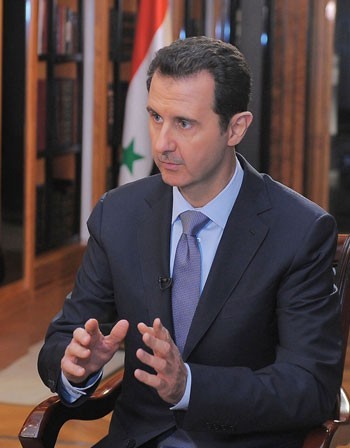 Damascus – President Bashar al-Assad gave an interview to Agence France Presse. Following is the full text of the interview:
Mr. President, what do you expect from the Geneva conference?
President Assad: The most basic element, which we continuously refer to, is that the Geneva Conference should produce clear results with regard to the fight against terrorism in Syria. In particular, it needs to put pressure on countries that are exporting terrorism, – by sending terrorists, money and weapons to terrorist organisations, – especially Saudi Arabia and Turkey, and of course the Western countries that provide political cover for these terrorist organisations. This is the most important decision or result that the Geneva Conference could produce. Any political solution that is reached without fighting terrorism has no value. There can be no political action when there is terrorism everywhere, not only in Syria but in neighbouring countries as well. From the political side, it is possible for Geneva to contribute to a process of dialogue between Syrians. There has to be a Syrian process within Syria and whilst Geneva could support this, it cannot be a substitute for it.
AFP: After nearly three years of devastating war and the big challenge of reconstruction in the country, is it likely that you will not be a candidate for the presidency?
President Assad: This depends on two things: It depends on personal aspirations or a personal decision, on the one hand, and on public opinion in Syria, on the other. As far as I am concerned, I see no reason why I shouldn’t stand; as for Syrian public opinion, there is still around four months before the election date is announced. If in that time, there is public desire and a public opinion in favour of my candidacy, I will not hesitate for a second to run for election. In short, we can say that the chances for my candidacy are significant.
AFP: In these past years, have you thought for a moment about losing the battle, and have you thought of an alternative scenario for you and your family?
President Assad: In any battle, there is always the possibility of winning and losing; but when you’re defending your country, it’s obvious that the only choice is to win. Should Syria lose this battle that would mean the spread of chaos throughout the Middle East. This battle is not confined to Syria and is not, as Western propaganda portrays, a popular uprising against a regime suppressing its people and a revolution calling for democracy and freedom. These lies have now become clear to people. A popular revolution doesn’t last for three years only to fail; moreover, a national revolution cannot have a foreign agenda. As for the scenarios that I have considered, of course these types of battles will have numerous scenarios – 1st, 2nd, 3rd……tenth, but they are all focused on defending the country not on running away from it. Fleeing is not an option in these circumstances. I must be at the forefront of those defending this country and this has been the case from day one.
AFP: Do you think you are winning this war?
President Assad: This war is not mine to win; it’s our war as Syrians. I think this war has, if you will, two phases. The first phase, which took the form of plans drawn up at the beginning, was the overthrow of the Syrian state in a matter of weeks or months. Now, three years on, we can safely say that this has failed, and that the Syrian people have won. There were countries that not only wanted to overthrow the state, but that also wanted to partition the country into several ‘mini-states;’ of course this phase failed, and hence the win for the Syrian people. The other phase of the battle is the fight against terrorism, which we are living on a daily basis. As you know, this phase isn’t over yet, so we can’t talk about having won before we eliminate the terrorists. What we can say is that we are making progress and moving forward. This doesn’t mean that victory is near at hand; these kinds of battles are complicated, difficult and they need a lot of time. However, as I said, and I reiterate, we are making progress, but have not yet achieved a victory.
AFP: Returning to Geneva, do you support a call from the conference for all foreign fighters to leave Syria, including Hezbollah?
President Assad: Clearly the job of defending Syria is responsibility of the Syrian people, the Syrian institutions, and in particular the Syrian Army. So, there would be no reason for any non-Syrian fighters to get involved had there not been foreign fighters from dozens of countries attacking civilians and Hezbollah especially on the Syrian-Lebanese border. When we talk about fighters leaving Syria, this would need to be part of a larger package that would see all the foreign fighters leave, and for all armed men – including Syrians – to hand over their weapons to the Syrian state, which would consequently achieve stability. So naturally, yes, one element of the solution in Syria – I wouldn’t say the objective – is for all non-Syrian fighters to leave Syria.
AFP: In addition to the prisoner exchange and a ceasefire in Aleppo, what initiatives are you ready to present at Geneva II?
President Assad: The Syrian initiative was put forward exactly a year ago, in January of last year. It’s a complete initiative that covers both political and security aspects and other dimensions that would lead to stability. All of these details are part of the initiative that Syria previously put forward. However, any initiative, whether this one or any other, must be the result of a dialogue between Syrians. The essence of anything that is proposed, whether it’s the crisis itself, fighting terrorism, or the future political vision and political system for Syria, requires the approval of Syrians. Our initiative was based on a process to facilitate this dialogue rather than a process to express the government’s point of view. It has always been our view that any initiative must be collective and produced by both the political actors in Syria and the Syrian people in general.
AFP: The opposition that will participate in Geneva is divided and many factions on the ground don’t believe it represents them. If an agreement is reached, how can it be implemented on the ground?
President Assad: This is the same question that we are asking as a government: when I negotiate, who am I negotiating with? There are expected to be many sides at Geneva, we don’t know yet who will come, but there will be various parties, including the Syrian government. It is clear to everyone that some of the groups, which might attend the conference, didn’t exist until very recently; in fact they were created during the crisis by foreign intelligence agencies whether in Qatar, Saudi Arabia, France, the United States or other countries. So when we sit down with these groups, we are in fact negotiating with those countries. So, is it logical that France should be a part of the Syrian solution? Or Qatar, or America, or Saudi Arabia, or Turkey? This doesn’t make any sense. Therefore, when we negotiate with these parties, we’re in fact negotiating with the countries that are behind them and that support terrorism in Syria. There are other opposition forces in Syria that have a national agenda; these are parties that we can negotiate with. On the issue of the vision for Syria’s future, we are open for these parties to participate in governing the Syrian state, in the government and in other institutions. But as I mentioned earlier, anything that is agreed with any party, whether in Geneva or in Syria, must be subject to people’s endorsement, through a referendum put to Syrian citizens.
AFP: In this context, could the ceasefire agreements that have been started in Moadimiya and Barzeh be an alternative to Geneva?
President Assad: The truth is that these initiatives may be more important than Geneva, because the majority of those fighting and carrying out terrorist operations on the ground have no political agenda. Some of them have become professional armed robbers, and others, as you know, are takfiri organisations fighting for an extremist Islamic emirate and things of that kind. Geneva means nothing for these groups. For this reason, the direct action and the models that have been achieved in Moadamiyeh, in Barzeh and other places in Syria has proven to be very effective. But this is separate from the political process, which is about the political future of Syria. These reconciliations have helped stability and have eased the bloodshed in Syria, both of which help pave the way for the political dialogue I mentioned earlier.
AFP: Are you prepared to have a prime minister from the opposition in a future government?
President Assad: That depends on who this opposition represents. When it represents a majority, let’s say in parliament, naturally it should lead the government. But to appoint a prime minister from the opposition without having a majority doesn’t make any political sense in any country in the world. In your country, for example, or in Britain or elsewhere, you can’t have a prime minister from a parliamentary minority. This will all depend on the next elections, which we discussed in the Syrian initiative; they will reveal the real size of support for the various opposition forces. As to participation as a principle, we support it, of course it is a good thing.
AFP: Are you prepared to have, for example, Ahmed Jarba or Moaz Khatib, be your next prime minister?
President Assad: This takes us back to the previous question. Do any of these people represent the Syrian people, or even a portion of the Syrian people? Do they even represent themselves, or are they just representatives of the states that created them? This brings us back to what I mentioned earlier: every one of these groups represents the country that created them. The participation of each of these individuals means the participation of each of those states in the Syrian government! This is the first point. Second, let’s assume that we agreed to the participation of these individuals in the government. Do you think that they would dare to come to Syria to take part in the government? Of course they wouldn’t. Last year, they claimed that they had control of 70% of Syria, yet they didn’t even dare to come to the areas that they had supposed control of. They did come to the border for a 30-minute photo opportunity and then they fled. How can they be ministers in the government? Can a foreigner become a Syrian minister? That’s why these propositions are totally unrealistic, but they do make a good joke!
AFP: Mr. President, you said that it depends on the results of the elections, but how can you hold these kinds of elections if part of Syria’s territory is in the hands of insurgents?
President Assad: During this crisis, and after the unrest started in Syria, we have conducted elections twice: the first was municipal elections and the second was parliamentary elections. Of course, the elections cannot be conducted in the same way they are conducted in normal circumstances, but the roads between Syrian regions are open, and people area able to move freely between different regions. Those who live in difficult areas can go to neighbouring areas and participate in the elections. There will be difficulties, but it is not an impossible process.
AFP: Now that opposition fighters are battling jihadists, do you see any difference between the two?
President Assad: The answer I would have given you at the beginning of the events or during its various phases, is completely different to the answer today. Today, there are no longer two opposition groups. We all know that during the past few months the extremist terrorist groups fighting in Syria have wiped out the last remaining positions that were held by the forces the West portrays as moderates, calling them the moderate or secular forces, or the Free Syrian Army. These forces no longer exist. We are now dealing with one extremist group made up of various factions. As to the fighters that used to belong to what the West calls ‘moderate forces,’ these have mostly joined these extremist factions, either for fear or voluntarily through financial incentives. In short, regardless of the labels you read in the Western media, we are now fighting one extremist terrorist group comprising of various factions.
AFP: Would it be possible for the army and the opposition to fight against the jihadists side by side?
President Assad: We cooperate with any party that wants to join the army in fighting terrorists, and this has happened before. There are many militants who have left these organisations and joined the army to fight with it. So this is possible, but these are individual cases. This is not an alliance between ‘moderate’ forces and the army against terrorists. That depiction is false and is an illusion that is used by the West only to justify its support for terrorism in Syria. It supports terrorism under the pretext that it is backing moderation against extremist terrorism, and that is both illogical and false.
AFP: The state accuses the rebels of using civilians as human shields in areas under their control, but when the army shells these areas, do you not think this kills innocent people?
President Assad: The army does not shell neighbourhoods. The army strikes areas where there are terrorists. In most cases, terrorists enter particular areas and force out the civilians. Why do you think we have so many displaced people? Most of the millions of displaced people in Syria have fled their homes because terrorists forcefully entered their neighbourhoods. If there are civilians among these armed groups, why do we have so many displaced people? The army is fighting armed terrorists, and in some cases, terrorists have used civilians as human shields. Civilian casualties are unfortunately the consequences of any war. There is no such thing as a clean war in which there are no innocent civilian victims. This is the unfortunate nature of war, and that is why the only solution is to put an end to it.
AFP: Mr. President, some international organisations have accused the government and the opposition of committing abuses. After this war ends, would you be ready for there to be an investigation into these abuses?
President Assad: There is no logic to this claim made by these organisations. How can the Syrian state be killing its own people, and yet it is still standing three years on, despite the fact that there are dozens of countries working against it. Had the Syrian state been killing its people, they would have revolted against it long ago. Such a state could not survive for more than a few months; the fact that it has resisted for three years means that it has popular support. Such talk is more than illogical: it is unnatural. What these organizations are saying is either a reflection of their ignorance of the situation in Syria, or, in some cases, it shows they are following the political agenda of particular states. The Syrian state has always defended its civilians; it is well documented, through all the videos and the photos circulating, that it is the terrorists who are committing massacres and killing civilians everywhere. From the beginning of this crisis, up until today, these organizations do not have a single document to prove that the Syrian government has committed a massacre against civilians anywhere.
AFP: Mr. President, we know of foreign journalists who were kidnapped by the terrorist groups. Are there any foreign journalists in state prisons?
President Assad: It would be best for you to ask the relevant, specialised agencies on this issue. They would be able to give you an answer.
AFP: Would a reconciliation be possible, one day, between Syria on the one hand, and Saudi Arabia, Qatar and Turkey on the other?
President Assad: Politics changes constantly, but this change depends on two factors: principles and interests. We share no common principles with the states you mention; these states support terrorism and they have contributed to the bloodshed in Syria. As for interests, we need to ask ourselves: will the Syrian people agree to shared interests with these countries after everything that has happened and all the bloodshed in Syria? I don’t want to answer on behalf of the Syrian people. If the people believe they share interests with these states, and if these states change their policy on supporting terrorism, it is plausible that the Syrian people might agree to restore relations. I can’t individually as President, answer on behalf of all the Syrian people at such a time. This is a decision for the people.
AFP: Mr. President, you were welcomed on the occasion of July 14 (Bastille Day) in the Elysee Palace in Paris. Are you now surprised by France’s position, and do you think France may one day play some kind of role in Syria?
President Assad: No, I am not surprised, because when that reception took place, it was during the period – 2008 to 2011 – where there was an attempt to contain Syria’s role and Syria’s policy. France was charged with this role by the United States when Sarkozy became president. There was an agreement between France and the Bush administration over this, since France is an old friend of the Arabs and of Syria and as such it is better suited to play the role. The requirement at that time was to use Syria against Iran and Hezbollah, and to pull it away from supporting resistance organisations in the region. This French policy failed, because its goal was blatantly obvious. Then the so-called Arab Spring began, and France turned against Syria after it had failed to honour the pledge it had made to the United States. This is the reason behind the French position during that period why it changed in 2011.
As for France’s role in future, let’s talk frankly. Ever since 2001 and the terrorist attacks on New York, there has been no European policy-making to speak of (and that’s if we don’t look back even further to the 1990s). In the West, there is only an American policy, which is implemented by some European countries. This has been the case on all the issues in our region in the past decade.
Today, we see the same thing: either European policy is formulated with American blessing, or American policy is adopted by the Europeans as their own. So, I don’t believe that Europe, and particularly France, which used to lead the European policy in the past, is capable of playing any role in the future of Syria, or in neighbouring countries. There is another reason too, and that is that Western officials have lost their credibility. They no longer have double standards; they have triple and quadruple standards. They have all kinds of standards for every political situation. They have lost their credibility; they have sold their principles in return for interests, and therefore it is impossible to build a consistent policy with them. Tomorrow, they might do the exact opposite of what they are doing today. Because of this, I don’t think that France will play a role in the immediate future, unless it changes its policy completely and from its core and returns to the politically independent state it once was.
AFP: How long do you think Syria needs to rid itself completely of its chemical weapons stockpiles?
President Assad: This depends on the extent to which the Organisation for the Prohibition of Chemical Weapons (OPCW) will provide Syria with the necessary equipment to carry out the process. So far, the process of making this equipment available has been quite slow. On the other hand, as you know dismantling and neutralizing the chemical materials is not taking place inside Syria nor by the Syrian state. A number of countries in different parts of the world have accepted to carry out that process; some have agreed to deal with the less dangerous materials, whilst others have refused completely. Since, the time-frame is dependent on these two factors – the role of the OPCW and the countries that accept to neutralize the materials on their territories – it is not for Syria to determine a time-frame on this issue. Syria has honoured its part by preparing and collecting data and providing access to inspectors who verified this data and inspected the chemical agents. The rest, as I said, is up to the other parties.
AFP: Mr. President, what has changed in your and your family’s daily, personal lives? Do your children understand what has happened? Do you talk to them about this?
President Assad: There are a few things that haven’t changed. I go to work as usual, and we live in the same house as before, and the children go to school; these things haven’t changed. On the other hand, there are things which have affected every Syrian household, including mine: the sadness which lives with us every day – all the time, because of what we see and experience, because of the pain, because of the fallen victims everywhere and the destruction of the infrastructure and the economy. This has affected every family in Syria, including my own. There is no doubt that children are affected more deeply than adults in these circumstances. This generation will probably grow up too early and mature much faster as a result of the crisis. There are questions put to you by children about the causes of what’s happening, that you don’t usually deal with in normal circumstances. Why are there such evil people? Why are there victims? It’s not easy to explain these things to children, but they remain persistent daily questions and a subject of discussion in every family, including my own.
AFP: Through these years, what was the most difficult situation you went through?
President Assad: It’s not necessarily a particular situation but rather group of elements. There are several things that were hard to come to terms with, and they are still difficult. The first, I believe, is terrorism; the degree of savagery and inhumanity that the terrorists have reached reminds us of what happened in the Middle Ages in Europe over 500 years ago. In more recent modern times, it reminds us of the massacres perpetrated by the Ottomans against the Armenians when they killed a million and a half Armenians and half a million Orthodox Syriacs in Syria and in Turkish territory. The other aspect that is difficult to understand is the extent of Western officials’ superficiality in their failure to understand what happened in this region, and their subsequent inability to have a vision for the present or for the future. They are always very late in realizing things, sometimes even after the situation has been overtaken by a new reality that is completely different. The third thing that is difficult to understand is the extent of influence of petrodollars in changing roles on the international arena. For instance, how Qatar was transformed from a marginal state to a powerful one, while France has become a proxy state implementing Qatari policies. This is also what we see happening now between France and Saudi Arabia. How can petrodollars make western officials, particularly in France, sell their principles and sell the principles of the French Revolution in return for a few billion dollars? These are only a few things, among others, which are difficult for one to understand and accept.
AFP: The trial of those accused of the assassination of former Lebanese Prime Minister Rafic Hariri has begun. Do you think it will be a fair trial?
President Assad: Nine years have passed since the beginning of this trial. Has justice been served? Every accusation was made for political reasons. Even in the past few days, we have not seen any tangible proof put forward against the parties involved in the case. The real question should be: why the timing? Why now? This court was set up nine years ago. Have the things produced in the last few days been uncovered only now? I believe that the whole thing is politicized and is intended to put pressure on Hezbollah in Lebanon in the same way that it aimed at putting pressure on Syria in the beginning, immediately after al-Hariri’s assassination.
AFP: You have said the war will end when terrorism is eradicated. But the Syrians and everyone else want to know when this war will end. Within months? After a year? In years to come?
President Assad: We hope that the Geneva conference will be able to provide an answer to part of this by exercising pressure on these countries. This aspect has nothing to do with Syria; otherwise we would have put pressure on these states from the beginning and prevented terrorism from entering Syria. From our side, when this terrorism stops coming in, ending the war will not take more than a few months.
AFP: It appears Western intelligence agencies want to re-open channels of communication with Damascus, in order to ask you for help fighting terrorism. Are you ready for that?
President Assad: There have been meetings with several intelligence agencies from a number of countries. Our response has been that security cooperation cannot be separated from political cooperation, and political cooperation cannot be achieved while these states adopt anti-Syrian policies. This was our answer, brief and clear.
AFP: You have said in the past that the state has made mistakes. In your view, what were the mistakes that could have been avoided?
President Assad: I have said that mistakes can be made in any situation. I did not specify what those mistakes were because this cannot be done objectively until the crisis is behind us and we can assess our experience. Evaluating them whilst we are in the middle of the crisis will only yield limited results.
AFP: Mr. President, without Russia, China and Iran’s help, would you have been able to resist in the face of the wars declared against you?
President Assad: This is a hypothetical question, which I cannot answer, because we haven’t experienced the alternative. Reality has shown that Russian, Chinese and Iranian support has been important and has contributed to Syria’s steadfastness. Without this support, things probably would have been much more difficult. How? It is difficult to draw a hypothetical picture at this stage.
AFP: After all that has happened, can you imagine another president rebuilding Syria?
President Assad: If this is what the Syrian people want, I don’t have a problem with it. I am not the kind of person who clings to power. In any case, should the Syrian people not want me to be president, obviously there will be somebody else. I don’t have a personal problem with this issue.
Thank you very much Mr. President.
Iran, Syria and the Tragicomedy of U.S. Foreign Policy
By Flynt Leverett and Hillary Mann Leverett | Going to Tehran | January 20, 2014
Today is Martin Luther King Day in the United States and we urge our readers to re-read a piece we wrote previously honoring his extraordinary insight. It is also the day on which implementation of the Joint Plan of Action that the P5+1 and Iran announced on November 24 formally commences. And, of course, two days from now, the Geneva II conference on the Syrian conflict is scheduled to take place.
In anticipation of the beginning of implementation of the Joint Plan of Action, negotiations on prospective “final” nuclear deal, and the Geneva II conference, Hillary taped an interview with Scott Horton for Pacifica Radio. It was broadcast/posted yesterday; click here to listen.
Regarding President Obama’s ongoing struggle with the Senate over Iran policy, Hillary cautions against premature claims of “victory” for the Obama administration’s efforts to avert new sanctions legislation while the Joint Plan of Action is being implemented. She points out that “the foes of the Iran nuclear deal, of any kind of peace and conflict resolution in the Middle East writ large, are still very strong and formidable. For example, the annual AIPAC policy conference—a gathering here in Washington of over 10,000 people from all over the country, where they come to lobby congressmen and senators, especially on the Iran issue—that will be taking place in very early March. There’s still a lot that can be pushed and played here.”
To be sure, President Obama and Secretary of State John Kerry “have put a lot of political capital on the line.” No other administration has so openly staked out its opposition to a piece of legislation or policy initiative favored by AIPAC and backed by a bipartisan majority on Capitol Hill since the 1980s, when the Reagan administration successfully defended its decision to sell AWACs planes to Saudi Arabia. But, Hillary notes, if the pro-Israel lobby is able to secure a vote on the new sanctions bill, and to sustain the promised veto of said bill by President Obama, “that would be such a dramatic blow to President Obama, and not just on his foreign policy agenda, but it would be devastating to his domestic agenda.” So Obama “has a tremendous amount to lose, and by no means is the fight anywhere near over.”
Of course, to say that Obama has put a lot of political capital on the line over the sanctions issue begs the question of whether he is really prepared to spend the far larger amounts of capital that will be required to close a final nuclear deal with Tehran. As Hillary points out, if Obama were “really trying to lead this country on a much more constructive, positive trajectory after failed wars and invasions in Iraq and Afghanistan and Libya—Libya entirely on President Obama’s watch—[he] would be doing a lot more, rather than just giving these lukewarm talks, basically trying to continue to kiss up to major pro-Israel constituencies, and then trying to bring in some of political favors” on Capitol Hill.
Compare Obama’s handling of Iran and other Middle East challenges to President Nixon’s orchestration of the American opening to China—including Nixon’s willingness to “break the crockery” of the pro-Taiwan lobby—and the inadequacy of Obama’s approach become glaringly apparent. And that, Hillary underscores, is why we wrote our book, Going to Tehran—because “we think it’s absolutely essential for President Obama to do what Nixon did and go to Tehran, as Nixon went to China,” for “the Middle East is the make-or-break point for the United States, not just in our foreign affairs but in our global economic power and what we’re able to do here at home. If we can’t get what we’re doing in the Middle East on a much better, more positive trajectory, not only will we see the loss of our power, credibility, and prestige in the Middle East, but we will see it globally.”
Getting the nuclear issue right is, arguably, just one piece of the project of realigning U.S.-Iranian relations—but it is a uniquely critical piece. As Hillary notes, in Iran, “they see reaching a nuclear deal with the United States as absolutely essential [to any prospect of broader realignment]—even though they absolutely believe it is a ‘show’ issue. For if they could get the United States to accept the Islamic Republic of Iran with nuclear capability, this is the essential step to getting it to accept Iran as an independent, sovereign power.” Of course, that is something Western governments have been manifestly unwilling to do for decades, going back even decades before the 1979 Iranian Revolution. For the Iranians, “if they can get the United States to recognize their independence and sovereignty through this nuclear deal, recognizing Iran’s right to nuclear capability, that’s [how] you can open the way to go forward.”
But, “if negotiations with the United States fail, the thinking in Iran—and I was just there a couple of months ago—is that this will show both Iranians inside Iran and (this is critically important) countries like China, in other emerging markets…that Iran was the rational actor here. Iran tried its best to work within a framework of international law, the Nuclear Non-Proliferation Treaty, but it was the United States, as it has treated key countries in the Middle East for decades, that was unwilling to work within the parameters of international law and to recognize basic sovereign and treaty rights. That’s their Plan B—if the United States can’t do the deal, they still come out ahead in terms of important actors both at home and abroad.”
On Syria, Hillary suggests that the growing Western focus on al-Qa’ida-like jihadis in opposition ranks obscures a much more important point—even if al-Qa’ida-like elements had not permeated the opposition, why does the United States think it should be supporting armed rebels to overthrow the recognized government of a UN member state? As Hillary recounts, “This didn’t work in Iraq (before al-Qa’ida was there; of course, now al-Qa’ida is there, after we said we had a dog in that fight), it didn’t work in Libya, it didn’t work in Afghanistan. The idea that when we choose to become involved in a fight, it’s going to turn out to help us is just not borne out by history, but we continue to make the mistake.”
As for an appropriate American approach to the Syrian conflict and other Middle Eastern challenges, Hillary says that the United States shouldn’t just “go home and essentially be isolationist. I believe very much in free trade, and I believe very much in diplomacy and conflict resolution. And there does need to be real conflict resolution in Syria.” In this regard,
“We have a real asset in Lakhdar Brahimi, the UN envoy. He has worked on exactly these kinds of problems in Iraq, in Lebanon, in Somalia, in Haiti, and in Afghanistan, where I worked with him personally for about two years. And in each of those situations, he didn’t come up with a fantastic, Pollyanna government for each of these places. But he has a core formula [that] would really help to stop the destabilization and killing that we see in Syria, which is: you work with the sitting government, and you work with forces on the ground to gradually bring them into not a liberal democracy, but into a much more representative and inclusive power-sharing arrangement…You’re not going to get great ‘good governance,’ with no corruption and fantastic human rights treatment—but you will, over time, have a much more stable environment, where far fewer people are killed, and the opportunity for that country to politically reconstitute itself along its own lines, its own values, and its own position in the world.”
Hillary’s interview preceded the tragicomic antics surrounding UN Secretary-General Ban Ki-moon’s invitation to Iran to participate in Geneva II—which Ban spinelessly rescinded less than 24 hours later after tantrum-like outbursts from the Syrian National Council and (more consequentially) strategically witless (and utterly predictable) pressure from the Obama administration. Clearly, the Brahimi formula is not going to be given a chance to work in Syria anytime soon—but something like it will probably prove critical to any eventual political settlement to the conflict there.
In the interview, Hillary also discusses Iran’s internal political dynamics regarding a possible improvement in relations with the United States, the strategic incoherence of Israeli and Saudi opposition to any U.S. opening to the Islamic Republic, continuing Western mythmaking about Iran’s “nuclear weapons” program, and more.
Finally, as the Joint Plan of Action formally goes into effect, we want to call attention to two recent posts on Dan Joyner’s Arms Control Law that do an excellent job criticizing some of the more egregious distortions of the Nuclear Non-Proliferation Treaty (NPT) and international law more generally that various American pundits have advanced in their bloviations about the Joint Plan. One, see here, lambastes Orde Kittrie’s assertion that the implementing agreement for the Joint Plan—not the Joint Plan itself, mind you, but the implementing agreement—is actually a secret treaty; the other, see here, takes on the chronically wrong Ray Takeyh. His latest missive, misrepresenting the Additional Protocol to the NPT, is co-authored by Mitchell Reiss, who appeared in advertisements publicly advocating for the MEK—many of whose advocates acknowledge receiving at least $20,000 per endorsement—while the U.S. government still designated it as a foreign terrorist organization.
Geneva II talks on Syria not aimed at regime change: Russia
PressTV Videos | January 21, 2014
As the Geneva Two conference on Syria is drawing closer, the gap is widening among participants.
Russian Foreign Minister Sergei Lavrov says that based on the Russian-US initiative, the conference is NOT aimed at bringing about regime change in Syria, but it seeks to launch an inter-Syrian dialog. The US, however, is pushing ahead with its own interpretation, saying that the Syrian government should give up power. Meanwhile, tensions are running high among Syrian opposition groups. After the UN excluded the main regional player, Iran, from the talks, the Syrian National Coalition confirmed that it will take part in the conference. But the largest bloc within the coalition has boycotted the negotiations. Meanwhile, Lavrov has described the one-day event as largely ceremonial, raising doubts about any tangible results.
Related article

UN invites Iran to Geneva II
BRICS Post | January 20, 2014
The United Nations formally extended an invitation for Iran to attend the Geneva II Syria Peace Summit to be held later this week, much to the surprise of US officials and the chagrin of opposition forces fighting to remove the Damascus government.
Echoing previous statements from BRICS officials that Iran’s presence at the talks is pivotal, UN Secretary-General Ban Ki-Moon told reporters, “I believe strongly that Iran needs to be part of the solution to the Syrian crisis,” he added.
Last week, Russian Foreign Minister Sergei Lavrov said during a joint press conference with US Secretary of State John Kerry that Iran’s role was important.
“[The] presence of Saudi Arabia, Iran [are] necessary at the Geneva-2 talks on Syria, it’s obvious for Russia… We’ve called for the [opposition] National Coalition to work with other oppositional groups: the delegation should be truly representative,” said Lavrov.
China has also supported Iran’s participation in the Syria peace talks.
“Proper resolution of the Syria issue will be impossible without the participation and support of regional countries, especially countries with leverage over concerned parties in Syria,” Chinese Foreign Ministry Spokeswoman Hua Chunying has previously said.
But according to the US State Department, Iran has to comply with a central condition before it can attend the Syria peace talks.
Spokeswoman Jen Psaki said in a statement that Iran has not yet accepted the tenets of the Geneva I communique in 2012 which call for a “transitional body to govern Syria” by the mutual consent of all the summit participants.
Iranian diplomatic officials have assured the UN that they will play a constructive role in the talks, the Secretary-General said.
Iran’s participation has for nearly a year been a source of contention between Russia and the US and has been a partial reason that the peace talks have been repeatedly delayed.
Late on Sunday, Syria’s largest anti-Assad opposition bloc said it was angered by Ban’s announcement and threatened to withdraw from participating in the Geneva II talks on January 22.
According to Reuters, quoting National Coalition spokesperson Louay Safi on Twitter, “The Syrian Coalition announces that they will withdraw their attendance in Geneva 2 unless Ban Ki-moon retracts Iran’s invitation”.
Syria analyst Camille Otrakji, however, says there is no substitute to Iran’s participation in the Geneva II talks because of the influence it wields in the region.
“Russia and Iran must help in pressuring the regime to accept to maintain control on foreign policy and national security matters, while giving up power to a government that is formed by a coalition of parties that manage to win a majority of monitored and free parliamentary elections,” he writes.
US Ambassador Ford to Syria Opposition: Bandar on Long Vacation, Go to Geneva 2
al-Manar | January 19, 2014
The US Ambassador to Syria Robert Ford has ordered foreign-backed opposition figures to take part in the international peace conference, noting that there are many changes in Saudi policy regarding the Syrian crisis.
Quoting an official in the executive committee in the so-called “Syrian National Coalition”, Nidal Hamade said that Ford had called for an urgent meeting for the SNC figures in Istanbul, noting that the US envoy had threatened to cut funds for anyone who will not attend the meeting.
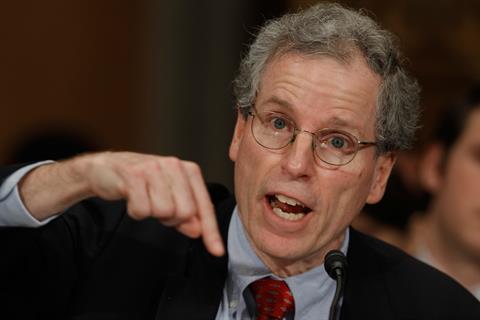 In addition to Ford, all SNC figures who were opposing Geneva 2 participation were at the meeting: Loay Safi, Anass al-Abdeh, Haitham al-Maleh, Burhan Ghalioun, Najeeb al-Ghadban and Maher Noaimi, Hamade wrote in his corner on al-Manar Website.
During the meeting, Ford told the SNC figures that Saudi prince Bandar Bin Sultan is on a long vacation in the United States, “because of sickness and psychological fatigue,” Hamade added, citing the Syrian opposition official who is also close to former Prime Minister, Riyad Hijab.
“We would like to inform you that there are some changes that will take place in Saudi Arabia next March,” Ford said, noting that these changes will reach Bandar Bin Sultan and Saud al-Faissal.
“We also would like to tell you that the US had asked Saad Hariri (head of al-Mustaqbal parliamentary bloc in Lebanon) to participate in a coalition government with Hezbollah.”
The US ambassador added that the Saudi committee for Lebanon and Syria (which comprises Abdulaziz Khoja, Abdulaziz Bin Abdullah Al Saud and Muqren Bin Abdullah Al Saud) is to be activated and will take over the Lebanese and Syrian file from Bandar.
Ford told the Syrian opposition figures: “Bandar’s plan for the Syrian conflict, put [in place during] 2012, had catastrophic repercussions on Syria and the region. It had made of Syria a powerful hub for al-Qaeda that US cannot confront. For that, you have to stop objecting and to go to Geneva 2, this is the US’ interest.”
Related article
Syria hands over plan for Aleppo ceasefire, readies for prisoner exchange
RT | January 17, 2014
The Syrian government is ready to negotiate a ceasefire agreement with opposition forces in the flashpoint city of Aleppo, Foreign Minister Walid Moallem has said. A list of rebel prisoners has also been drawn up in preparation for a proposed exchange.
Damascus has handed Moscow a plan for a ceasefire in the city of Aleppo, Moallem announced at a news conference with his Russian counterpart, Sergey Lavrov, in Moscow on Friday.
“Taking into account the role of the Russian Federation in halting the bloodshed in Syria and our relationship of trust, today I have given Minister Lavrov a ceasefire plan for the city of Aleppo,” he said. Moallem asked Lavrov to coordinate with his contacts in the Syrian opposition in order to ensure the execution of the new plan, adding that if it is successful it could be implemented in other areas of the war-torn country.
“I really hope all sides will keep to the terms of the agreement. If this happens, then we can implement this plan in other cities.”
Moallem asked Lavrov to coordinate with his contacts in the Syria opposition in order to ensure the successful execution of the new plan.
Addressing the issue of the humanitarian crisis in Syria, Moallem said the Syrian government is already working with the UN to deliver aid to “a number of regions.” However, the success of the humanitarian program depends on rebel fighters keeping to their pledge not to open fire on humanitarian convoys, he said.
The UN estimates that over 100,000 people have died since the violence broke out three years ago.
‘Government forces do not target civilians’
Refuting claims the Syrian Army is bombing its own citizens, Moallem said that such allegations “do not reflect the reality of the current situation.” He laid the blame at the feet of terrorist organizations that are being supported by international players.
“According to the constitution, the Syrian government is obligated to protect its citizens and public institutions in Syria. Terrorists and terrorist groups are responsible for these acts of destruction,” said Moallem, adding that “these groups are growing in number because of outside support from known states.”
Lavrov echoed this opinion, calling accusations that Damascus is carrying out strikes on its own citizens “irresponsible.”
“In Syria, civilians are suffering on both sides, but it is totally irresponsible to accuse the government of purposely targeting civilians,” said Lavrov. “To make such accusations, serious proof is required.”
Both foreign ministers said that opposition representation is absolutely essential for the success of the Geneva-2 talks, which are set to kick off next Monday. They believe the conference will pave the way for the creation of a transitional government to bring an end to the three-year conflict.
The Syrian National Coordination Committee, a faction in the domestic Syrian political opposition, decided to boycott this month’s peace conference in Switzerland, UN envoy to Syria Lakhdar Brahimi has said. The Syrian National Coalition – the main political opposition group – is meeting in Istanbul on Friday to decide whether it will attend the Geneva talks.
Featured Video

Dan Dicks with James Corbett on Solutions Watch
or go to
Aletho News Archives – Video-Images
From the Archives
Secret document reveals plans for civil war in Lebanon, Israeli false flags, and invasion
By Randi Nord | Geopolitics Alert | April 5, 2019
Beirut – During his visit with US Secretary of State, Mike Pompeo, Lebanese President Michael Aoun reportedly received a US-Israeli document detailing plans for creating a civil war in Lebanon with covert false flag operations and possible Israeli invasion.
Although the source of the document is Israeli and created in partnership with Washington, no one knows who presented it to Aoun. The Lebanese TV station, Al-Jadeed, initially reported the document on Lebanese TV and a video on its website. Geopolitics Alert translated the report for this article. … continue
Blog Roll
 Aletho News
- How to MAKE THE CONSPIRATORS PAY for their crimes! Dan Dicks with James Corbett on Solutions Watch
- There’s a drought in academia: A drought in honest research on the subject of drought and other weather extremes
- Department of War Awards $20.7 Billion Contract to Raytheon for Air-to-Air Missiles
- ‘Distance yourselves from Israel’: IRGC urges US population to question govt policies
- America’s Greenland deal has a radioactive backstory
- The RAF Fairford ‘terror plot’: Unpacking escalation in the UK echo-chamber
- EU Council Advances Chat Control 2.0 Scanning Proposal
- Ex-Greek MEP files complaint against Israeli spyware firm over alleged Pegasus surveillance
- Troubling ideas throughout the Torah, Talmud, Mishneh Torah and Tanya
- ‘Grave, alarming’: Iran mission on Trump’s UNGA ‘annihilation’ threats
- If Americans Knew
- New Report: “Scholasticide and Genocide in Gaza: Assessment, Testimonies and Legal Analysis”
- Ex-Biden officials are desperate for a Gaza scapegoat
- Israeli “settlers” Invade Al-Aqsa; Pour Boiling Water on 75-Year-Old
- Israel Has Kidnapped Another American Teenager
- US arms sales to Israel worth $21.6 billion in 20 months
- Three Palestinians Killed in Israeli Attacks on Gaza
- Revealed: German “Anti-Semitism Expert” Driving Crackdown on Palestine Solidarity is Former Israeli Spy
- Egypt’s Warning to Israel Before Oct 7
- Israel’s siege signals another cruel winter for 1.8 million Gazans – Daily Update
- Netanyahu Asked UAE Leader to Deny Report on Oct. 7 Warning in Secret Visit, Sources Say
- No Tricks Zone
- New Study: Earth And Venus Surface Warmth Largely Explained By Convection And Lapse Rate, Not CO2 Or Radiation
- 2025 Nature Paper Claiming Worsening Global Drought Gets RETRACTED …Heavily Flawed
- New Study: ‘Global Drought Shows No Detectable Recent Acceleration Under Climate Warming’
- Economic Masterminds: German Socialists Suggest Taxing Productivity Gains Stemming From Using AI
- The South China Sea Has Not Been Cooperating With The Climate Change Narrative
- Energy Crisis: Germany Enters Heating Season With Historically Low Gas Reserve Fill Levels
- New Study: The Antarctic Ice Sheet Gained Mass From 2020-2024 Due To Staggering Snow And Ice Accumulation
- Study: Ocean Heating Rates From Thousands Of Years Ago ‘Dwarf’ Modern Ocean Heating Rates
- Climate Extremists Target, Attack Large-Scale Power Grid Infrastructure In Germany!
- New Study: Antarctic Ice Melt Has Contributed Less Than 1 Centimeter To Sea Level Rise In The Last 30 Years

