MIT study of Ghouta chemical attack challenges US intelligence
RT | January 16, 2014
A new MIT report is challenging the US claim that Assad forces used chemical weapons in an attack last August, highlighting that the range of the improvised rocket was way too short to have been launched from government controlled areas.
In the report titled “Possible Implications of Faulty US Technical Intelligence,” Richard Lloyd, a former UN weapons inspector, and Theodore Postol, a professor at the Massachusetts Institute of Technology (MIT), examined the delivery rocket’s design and calculated possible trajectories based on the payload of the cargo.
The authors concluded that sarin gas “could not possibly have been fired at East Ghouta from the ‘heart’, or from the Eastern edge, of the Syrian government controlled area shown in the intelligence map published by the White House on August 30, 2013.”
Based on mathematical calculations, Lloyd and Postol estimate the rocket with such aerodynamics could not travel more than 2 kilometers. To illustrate their conclusion, the authors included the original White House map that depicted areas under Assad control and those held by the opposition. Based on the firing range and troop locations on August 21, the authors conclude that all possible launching points within the 2 km radius were in rebel-held areas.
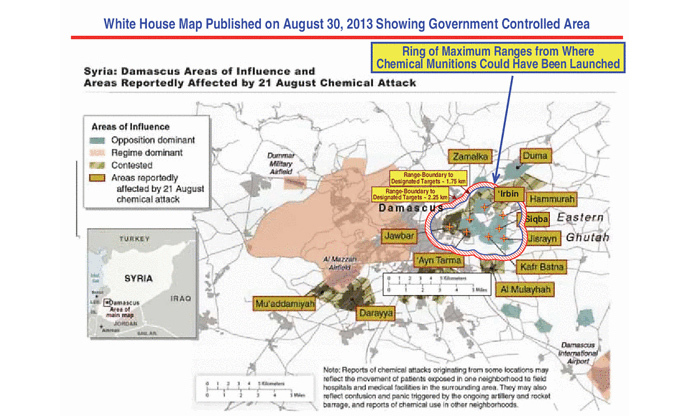
“This mistaken intelligence could have led to an unjustified US military action based on false intelligence. A proper vetting of the fact that the munition was of such short range would have led to a completely different assessment of the situation from the gathered data,” the report states.
The authors emphasize that the UN independent assessment of the range of the chemical munition is in “exact agreement” with their findings.
The report goes on to challenge the US Secretary of State’s key assessments of the chemical attack that he presented to the American people on August 30th and to the Foreign Relations Committee on September 3rd in an effort to muster a military attack on Syria.
“My view when I started this process was that it couldn’t be anything but the Syrian government behind the attack. But now I’m not sure of anything. The administration narrative was not even close to reality. Our intelligence cannot possibly be correct,” Postol told McClatchy news.

“The Syrian rebels most definitely have the ability to make these weapons,” he said. “I think they might have more ability than the Syrian government.”
It also remains a mystery why the particular type of rocket that was used in the attack was not declared by the Syrian government as part of its chemical weapons arsenal when it agreed to destroy its chemical weapons and their delivery methods. OPCW inspectors charged with implementing the agreement also did not discover such a rocket in possession of government forces.
Syria agreed to the destruction of its chemical weapons through a deal brokered by Russia and the US after a sarin gas attack on August 21. Western nations blamed the deadly attack on President Bashar Assad’s forces, while Damascus accused the rebels for the incident. The UN fact-finding mission had no mandate to find out who carried out the attack.
Under the UN-backed plan, all of the country’s declared 1,290 tons of toxic agents should be destroyed by June 30. Initially, the first batch of the most dangerous materials was to be moved out of Syria on December 31.
However, the deadline was missed because of the ongoing war in Syria and technical issues. It was only on January 7 that “priority chemical materials” left the Syrian port of Latakia on a Danish ship for international waters.
Related article


Is Obama Trying to Resolve or Prolong the Conflict in Syria?
By Flynt Leverett and Hillary Mann Leverett | Going to Tehran | January 10, 2014
Suppose a great power declares that it supports a peace process aimed at finding a political solution to a terrible, ongoing conflict. Then suppose that this great power makes such declarations after it has already proclaimed its strong interest in the defeat of one of the main parties to said conflict. And then suppose that this great power insists on preconditions for a peace process—preconditions effectively boiling down to a demand for pre-emptive surrender by the party whose defeat the great power has already identified as its major goal—which render such a process impossible. Is it not reasonable to conclude that the great power in question is (how to put this gently) lying about its purported support for peace?
That, in a nutshell, is the Obama administration’s posture toward the ongoing conflict in Syria.
Earlier this week, United Nations Secretary General Ban Ki-moon began sending out invitations for the Geneva II conference on Syria scheduled for January 22. And, as Ban’s spokesperson acknowledged, the Islamic Republic of Iran was not among the “first round” of nations asked to take part.
According to the spokesperson, invitations to the talks are subject to the approval—or veto—of the two “initiating states,” Russia and the United States. The Islamic Republic has said repeatedly that it is prepared to attend and to contribute constructively to the search for a political settlement. Of course, Russia supports Iran’s participation in Geneva II—as does China, Germany, Turkey, every other state seriously interested in resolving the conflict in Syria, and the United Nations itself. (Ban’s spokesperson publicly stated this week, “The secretary-general is in favor of inviting Iran.”)
It is the United States—whose leader, President Obama has demanded for more than two years that Syrian President Bashar al-Assad relinquish his position—that is blocking Iranian participation in Geneva II. And it is attempting to justify this position by continuing to insist on Assad’s pre-emptive surrender as part of the Geneva II agenda. Moreover, Washington is couching its demand for Assad’s pre-emptive surrender in a shamelessly dishonest reading of the 2012 Geneva I communique, which is supposed to set the terms of reference for Geneva II.
On this last point, Secretary of State John Kerry earlier this week (before Ban started sending out invitations) reiterated the Obama administration’s opposition to Iran’s participation in Geneva II as a “ministerial partner.” In the administration’s view, Iran can’t come to the meeting because it has not signed on to the Geneva I document—in particular, the passage positing that a “transitional governing body” for Syria “shall be formed on the basis of mutual consent” among “the present government and the opposition and other groups.”
Since Iran (at Washington’s insistence) was not invited to Geneva I, it is not clear exactly how or why Tehran should sign up to a communique it had no part in producing. But the most shamelessly dishonest aspect of the Obama administration’s posturing on the matter is its insistence that Iran accept the administration’s warped reading of the passage from Geneva I just cited, which Team Obama (including Kerry) interprets as a requirement that Assad leave office and play no future political role—whether as part of a transitional government or as Syria’s first president elected after a settlement is negotiated.
We suspect that Assad would, in all likelihood, win another national mandate—even in the “free and fair multi-party elections” envisioned in Geneva I. But Washington doesn’t want Syrians to have the chance to make that choice. And so Washington continues to block Iranian participation in Geneva II—save perhaps, as Kerry pompously suggested earlier this week, “from the sidelines” (a proposition that Iran has roundly rejected).
What is so appallingly arrogant about the Obama administration’s position is that it was explicitly rejected at Geneva I. Then-UN envoy Kofi Annan’s draft communique originally contained U.S.-backed language barring figures from the conflict resolution process whose participation would block creation of a national unity government—language that the United States, Britain, and France crafted to exclude Assad. Russia and China insisted that this language be removed from the final communique. But the Obama administration has disingenuously continued asserting that the language in Geneva I bans Assad from any future political role—even though it is as clear as day that Geneva I, as actually adopted, does not do any such thing.
Kerry and Russian Foreign Minister Sergei Lavrov are supposed to discuss the question of Iranian participation in Geneva II on January 13. Let’s see if the Obama administration can actually decide that it wants to resolve the conflict in Syria, rather than prolonging it further.
Saudi Arabia victim of US policies: Larijani
Press TV – January 6, 2014
An Iranian rights official says Saudi Arabia is a victim of US policies, urging Middle East countries not to support terrorists.
Speaking on the sidelines of a Monday conference in Tehran, Secretary-General of Iran’s High Council for Human Rights Mohammad-Javad Larijani said terrorist measures do not stem from the Middle East.
“Regional countries must know that by supporting terrorists they are only jeopardizing their own interests,” he added.
Regarding the recent bombings taking place in the region, Larijani said, “My position regarding these bombings is completely clear and I believe that the most part of their planning took place outside the region.”
He said Saudi Arabia is a victim of US policies and urged regional countries to stay away from American policies.
Larijani’s remarks come following a wave of terrorist bombings across the region, especially in Iraq, Syria and Lebanon, widely attributed to al-Qaeda-linked groups that are believed to be funded and supplied by Saudi Arabia.
Regional reports suggest al-Qaeda-linked terrorist and leader of the Abdullah Azzam Brigades Majed al-Majed, who was arrested in connection with the twin bombings near the Iranian embassy in Beirut on November 19, 2013 and later pronounced dead in a Lebanese military hospital- was a high-ranking official of Saudi Arabia’s intelligence service.
Media reports said Riyadh had put pressure on Lebanon to extradite al-Majed before his death in detention.
The Saudi terrorist had extensive secret information as he had been active in various countries such as Saudi Arabia, Iraq, Syria, Lebanon, Afghanistan and Pakistan and had direct cooperation or contact with mid- and high-ranking al-Qaeda leaders.
Related articles
Iraq: The ‘Liberation’ Neocons Would Rather Forget
By Ron Paul | January 5, 2014
Remember Fallujah? Shortly after the 2003 invasion of Iraq, the US military fired on unarmed protestors, killing as many as 20 and wounding dozens. In retaliation, local Iraqis attacked a convoy of US military contractors, killing four. The US then launched a full attack on Fallujah to regain control, which left perhaps 700 Iraqis dead and the city virtually destroyed.
According to press reports last weekend, Fallujah is now under the control of al-Qaeda affiliates. The Anbar province, where Fallujah is located, is under siege by al-Qaeda. During the 2007 “surge,” more than 1,000 US troops were killed “pacifying” the Anbar province. Although al-Qaeda was not in Iraq before the US invasion, it is now conducting its own surge in Anbar.
For Iraq, the US “liberation” is proving far worse than the authoritarianism of Saddam Hussein, and it keeps getting worse. Last year was Iraq’s deadliest in five years. In 2013, fighting and bomb blasts claimed the lives of 7,818 civilians and 1,050 members of the security forces. In December alone nearly a thousand people were killed.
I remember sitting through many hearings in the House International Relations Committee praising the “surge,” which we were told secured a US victory in Iraq. They also praised the so-called “Awakening,” which was really an agreement by insurgents to stop fighting in exchange for US dollars. I always wondered what would happen when those dollars stopped coming.
Where are the surge and awakening cheerleaders now?
One of them, Richard Perle, was interviewed last year on NPR and asked whether the Iraq invasion that he pushed was worth it. He replied:
I’ve got to say I think that is not a reasonable question. What we did at the time was done in the belief that it was necessary to protect this nation. You can’t a decade later go back and say, well, we shouldn’t have done that.
Many of us were saying all along that we shouldn’t have done that – before we did it. Unfortunately the Bush Administration took the advice of the neocons pushing for war and promising it would be a “cakewalk.” We continue to see the results of that terrible mistake, and it is only getting worse.
Last month the US shipped nearly a hundred air-to-ground missiles to the Iraqi air force to help combat the surging al-Qaeda. Ironically, the same al-Qaeda groups the US is helping the Iraqis combat are benefiting from the US covert and overt war to overthrow Assad next door in Syria. Why can’t the US government learn from its mistakes?
The neocons may be on the run from their earlier positions on Iraq, but that does not mean they have given up. They were the ones pushing for an attack on Syria this summer. Thankfully they were not successful. They are now making every effort to derail President Obama’s efforts to negotiate with the Iranians. Just last week William Kristol urged Israel to attack Iran with the hope we would then get involved. Neoconservative Senators from both parties recently introduced the Nuclear Weapon Free Iran Act of 2013, which would also bring us back on war-footing with Iran.
Next time the neocons tell us we must attack, just think “Iraq.”
Syria as a Bridge
By Robert Thompson | Axis of Logic | March 8, 2009
The good news is that two envoys have been sent by the USA to Damascus, and that they have discussed with the Syrian Foreign Minister what can be done to improve Syria’s relations with the USA, now that a new régime is in place in Washington.
The bad news is that these envoys (and their bosses) seem to have expected Syria, as part of this aim, to give up all its present diplomatic and other links with some of its principal local friends and allies in the region, especially Hezbollah, Hamas, and (above all) Iran. If this is indeed so, it shows a staggering lack of understanding, not only of Syria, but also of the whole Near and Middle East on the part of the US State Department under the direction of Mrs Hillary Clinton [who seems to think that Syria should be yoked to an alliance with U.S. backed Sunni regimes].
The Syrian Ba’ath Party remains (as its founders, Michel Aflaq and Salah-al-Din Bitar always intended) strictly secular, and its links with theocratic bodies and governments are based on practical strategic concerns and on shared interests which are not linked to any religious affinities. Beyond this, the Syrian government has the good sense to wish to remain in close touch with the vast majority of the inhabitants of all the Arab states. This is in stark contrast, very clearly, with the behaviour and policies of the many Arab rulers who, effectively to protect themselves from their own subjects, have decided to shelter under the protection of the USA and the Zionists.
The rulers of the USA must also bear in mind that a significant and strategic area of Syrian territory is still under harsh enemy occupation. We, on the sidelines, can only wonder what the Obama régime, with its ‘diplomacy’ being mismanaged by Mrs Clinton, thinks it can do, if it believes that it can bully Syria into joining the club of Arab states which have been neutered to make them do as the Zionists/Neocons wish.
The very sensible proposal put forward once again by Syria (using much more polite words than I do) is that it should serve as a bridge linking the USA, the Zionist entity and their servile allies on the one hand, and the people of the Near and Middle East on the other. If the Neocons/Zionists really wanted peace in the area, they would not hesitate a second to welcome such a proposition. Any hesitation can only be a sign that they wish merely to make much of pretending to work for peace, while doing all that they can to ensure that justice continues to be denied to the Palestinians, the Syrians, and the Lebanese, all of whom seek liberation from the atrocities inflicted on them by the Zionist war machine.
It would appear that even the Obama régime has finally understood the sheer lunacy of the expression (invented for Mr George W. Bush by Mr David Frum) ‘Axis of Evil’ in grouping Iran and Syria with North Korea. These three states are so dissimilar that it is hard to follow what this expression was intended to mean. The USA has every interest in having the best of relations with both Iran and Syria; and if they wish to get anywhere in solving the multiple problems arising from the chaos of Afghanistan, they could not do better than to cooperate closely with Iran. Both parties have similar concerns relating to that unhappy country.
To revert to the question of relations between the USA and Syria, some humility on the part of the former would not come amiss, since Syria is no threat to any of the USA’s genuine interests. It is fully understandable, though, that Syria would be extremely happy to see its turbulent south-western neighbour converted into a single democratic and secular state, based on justice, in which its citizens of any religion or none would have equal rights and duties. Apart from the benefits that the whole world would enjoy if peace could return to the Near and Middle East, the USA has no vital interests in that part of the world. The sooner they withdraw their occupation forces from the area, the better it would be for the ordinary citizen (and taxpayer) in the US, as well as for the rest of the world.
The basic problem remains, as ever, the greedy desire by the rulers of the USA to dominate the whole world, and I cannot get out of my mind the fact that the command structure based in Diego Garcia is known as CENTCOM (i.e. Central Command). I would still like a satisfactory answer to explain what it is ‘central’ to, for the USA.
My conclusion is that the USA has every interest in taking advantage of any assistance which Syria can give them, and should be grateful for it. However, I cannot see this being welcomed by the Zionist entity based on (and only held together by) its viciously rigid apartheid system!
© Copyright 2009 by AxisofLogic.com
Lines of the Game: Price to Pay for the Shatah Assassination
By Sami Kleib | Al-Akhbar | December 28, 2013
The assassination of former Lebanese Finance Minister Mohammed Shatah will open a dangerous chapter in Lebanon, a bit similar to the one that followed the assassination of late Prime Minister Rafik Hariri. Shatah was no ordinary man in the region, and the attack occurred at a crucial moment in Lebanon and its neighborhood’s history. Here, escalated tensions and sedition will never let such a crime pass by without major repercussions. The killer knew it!
Hariri’s assassination in 2005 was a turning point for Hezbollah’s image in the Arab and Islamic world, and contributed to the Syrian army’s withdrawal from Lebanon. These events weren’t just a result of local demands. Former US President George W. Bush and his French counterpart Jacques Chirac were also involved.
The Sunni-Shia strife that ripped Iraq apart after the American-British invasion was further consolidated when Hezbollah, with its large Shia base, was accused of murdering the new symbol of modern Sunnism in the region: Rafik Hariri. Back then, political accusation preceded all real investigations on the ground.
Now, what to expect after Shatah’s assassination?
Former Lebanese Prime Minister Saad Hariri was brief, while Future bloc leader Fouad Siniora elaborated, hinting that the Syrian regime planned the crime, and its Lebanese allies, mainly Hezbollah, carried it out. In the March 14 statement, Siniora echoed the calls that followed Hariri’s murder, urging to take Shatah’s assassination to the international level, something we expect to hear quite often in the coming weeks amid international pressure on Hezbollah and Lebanon.
Head of the National Struggle Bloc MP Walid Jumblatt was alone in his call for reason and moderation. He knows quite well that some are seeking to exploit the assassination to achieve bigger political gains. He also understands that this assassination is apt to take the country from sectarian sedition to the battlefield.
The Shatah assassination occurred while Lebanon was at a crossroads. The future government and the current presidency are now up for grabs amid political bickering between Hezbollah and March 14. But behind both parties is a larger and deeper conflict taking place in Syria.
The assassination ought to increase pressure on the formation of a Lebanese government and a formula for a presidential agreement. Previously hesitant, the international community is now expected to support these solutions as the death of Shatah and the other martyrs raised the alarm about a bloody year awaiting Lebanon.
Shatah’s murder also paves the way for further assassinations, clashes, and blasts. Obviously there is a plan to transform Lebanon into an arena for a regional and international conflict that has not been settled in Syria.
What if a Hezbollah leader or ally is killed in the coming days? Will we hear that it is a retaliation for the Shatah murder? Who will break this vicious cycle?
Israel may also find an opportunity to conduct a military operation. It is reported that Hezbollah’s incursion in Syria and the widening rift with its former Sunni base offers Israel the right opportunity to strike. In Lebanon, Israel may redeem what it couldn’t achieve in Iran. At least that’s what the Israelis believe.
The assassination put the Syrian regime and Hezbollah in a raging storm of accusations at a critical time. The world is heading toward the Geneva II conference and an historic understanding with Iran. The international tribunal investigating Hariri’s murder will soon begin its sessions.
Martyr Mohammed Shatah was no ordinary man. Neither was martyr Wissam al-Hassan. Shatah, a man with hefty economic and political baggage, was, just like security man Hassan, standing on a pivotal local, regional, and international intersection. With such assassinations, it is easy to point figures, but it is hard to support accusations with evidence as political exploitation comes in smoothly.
A dark period of major transformation is awaiting Lebanon, but unfortunately the fierce battle ahead won’t yield any winners. What if a fait accompli government was imposed on Hezbollah and its allies? How will Hezbollah Secretary General Hassan Nasrallah put his words “don’t mess with us” into action? Those messing with him this time will have an international cover far larger than the one they had before the assassination.
Related article
Beirut murder: Dirty tricks get dirtier
By Finian Cunningham | Press TV | December 28, 2013
The latest deadly attack in Lebanon’s capital Beirut is yet another desperate attempt to destabilize not only that country, but the entire Middle East to precipitate all-out sectarian war.
The murder of senior Lebanese Sunni political figure, Mohamad Shatah, on Friday in a massive bomb blast that hit his motorcade as it drove through downtown Beirut was aimed at implicating the Shia Hezbollah and closely allied Syrian and Iranian governments.
Syria’s government of President Bashar al-Assad, along with Hezbollah and Iran, swiftly condemned the assassination of Shatah, who was formerly Lebanon’s finance minister between 2008 and 2011.
But the condemnations didn’t stop anti-Syria politicians within Lebanon and various Western media outlets from pointing the finger.
“Anti-Assad ex-minister killed in Beirut bomb,” was the headline carried by Reuters and Britain’s Daily Telegraph, among others.
This contrived innuendo betrays who the real perpetrators are.
Mohamad Shatah, a senior political adviser to Lebanese opposition leader Saad Hariri, was indeed a strident critic of Hezbollah and Syria’s Assad, accusing them of fuelling bloodshed in Syria and also sectarian tensions inside Lebanon. His political views were consistent with the narrative of the pro-Zionist Western media, as well as Saudi Arabia.
Shatah could therefore be considered an ally of the West, Saudi Arabia and the Zionist Israeli regime. But that very profile may have been what made him a prime target, not for Hezbollah or Syria, but for his so-called allies.
The day before his killing, Shatah had reiterated criticism of Hezbollah, claiming that the group was using Syria to consolidate its military strength in Lebanon.
Within minutes of Shatah’s murder, the Saudi-backed Lebanese opposition leader Saad Hariri implicated Hezbollah for the attack. “Shatah’s murderers are the same ones who assassinated former premier Rafik Hariri.” This was a reference to the bomb-blast killing of his father, Rafik, also a former prime minister, in 2005.
A United Nations-backed Lebanese tribunal has indicted five members of Hezbollah for that 2005 murder. The trial is set to open in the coming weeks in a Hague court. For the past eight years Hariri’s group have accused Hezbollah as well as Syrian intelligence over that assassination, without the accusations gaining much credibility.
Both Hezbollah and Syria have strenuously denied any involvement, saying that there is no evidence, and that the tribunal is politically driven. Hence, they have refused to cooperate with the forthcoming trial.
That is why Saad Hariri said of the latest killing: “The accused… are the same ones who are running away from international justice.”
Shatah’s assassination this week comes at a sensitive time, which strongly suggests who the real perpetrators might be.
First, the atrocity serves to re-ignite the accusations against Hezbollah, and its regional allies, in the murder of Rafik Hariri just when the case is being re-opened in an international court.
Secondly, there is the forthcoming Geneva II political talks organized to find a peaceful solution to the nearly three-year Syrian crisis. If Hezbollah, and by extension Syria and Iran, can be linked by sensational media claims of involvement in the murder of high-profile Lebanese politicians, then that would have a damaging impact on the Assad government during the Geneva negotiations.
Thirdly, and this is more to the point of who are the likely perpetrators, the murder of Mohamad Shatah comes at a time of mounting sectarian tensions and violence across the region. Lebanon has witnessed a wave of deadly bomb attacks and assassinations in recent months, which have mainly targeted Shia areas of Beirut.
Earlier this month, a senior Hezbollah commander was shot dead. And at the end of last month, a twin suicide bomb attack on the Iranian embassy in Beirut killed 29, including Iran’s cultural attaché, Ebrahim Ansari. Back in August, a bomb outside a Sunni mosque in Sidon reportedly butchered 40 people.
This violence replicates the pattern of sectarian bloodshed unleashed in neighboring Syria and Iraq. There is ample evidence to show that that violence is being systematically fuelled by Saudi Arabia, working in collusion with Israeli and Western intelligence.
Israel in particular has a long track record of sabotaging Lebanon from within, having invaded that country in 1978, 2000 and 2006. There is also evidence that its agents were the real authors of the assassination of Rafik Hariri in 2005.
Lebanon is particularly vulnerable to sectarian strife. The country’s communal wounds are still raw from the 15-year-old civil war between its Sunni, Shia, Christian and Druze communities, which ended in 1990. There have been renewed sectarian clashes between Sunni and Shia/Alawite groups in Sidon, Tripoli and several other towns over the past year. Saudi-backed Sunni clerics have been prominent in agitating sharper tensions in Lebanon.
This pattern of sectarian destabilization within Lebanon and across the Middle East by external forces is consistent with the latest murder of Mohamad Shatah in Beirut. The massive blast is believed to have come from a 50-60 kg bomb wired in a booby-trapped car. Wreckage was scattered 100 meters away and some 40 other cars were damaged, some of them upended. This was a professional hit with a devastating message.
In the grand nefarious scheme of geopolitics it matters little that Shatah was a prominent Sunni figure who was an ardent critic of Hezbollah and Syria. Indeed, from the viewpoint of the agents of subversion and destabilization, Shatah’s political and religious affiliation would have made him a prime target for their purpose of trying to explode sectarian war.
The heinous role played by Saudi, Israeli and Western intelligence in inflicting untold suffering on civilians across the Middle East, whether Shia, Sunni or Christian, means that their capability of using the dirtiest tricks knows no limits. The murder of Mohamad Shatah would be viewed by these dark forces as merely an expendable sacrifice if that means achieving the bigger aim of inciting all-out sectarian war in Lebanon; and engulfing the entire region in internecine flames.
The powers that gain from this atrocity are those that sow division and thrive on conflict in order to shore up their illegitimate hegemony over the region and over the mass of its ordinary, decent people.
Why Doesn’t Israel Eliminate Hezbollah Now?
By Yahya Dbouk | Al-Akhbar | December 16, 2013
Israeli political and military leaders of all levels have been issuing almost daily threats against Hezbollah while claiming that the Israeli army stands fully ready to confront – and even crush – Hezbollah. So, why don’t they destroy Hezbollah now?
Recently, Israel began to step up its verbal threats, “flexing the muscles” of its military. Hardly a day passes without a statement, report, or interview coming from the Jewish state raising alarm about Hezbollah’s military capabilities but affirming at the same time the “might” of the Israeli armed forces and their preparedness for any future conflict involving Hezbollah.
Israeli military commanders have all put their two cents in. The Israeli top brass seem to suffer from a curious case of overconfidence, prompting observers to wonder why Tel Aviv has not already proceeded to wage war and end Hezbollah once and for all, with victory so close at hand given Israel’s allegedly full readiness and unmitigated superiority.
The most recent statement on Hezbollah came from Yuval Steinitz, Israel’s intelligence minister. Steinitz was keen to affirm that Hezbollah does not have chemical weapons, and that it had not obtained any, prior to the deal to dismantle Syria’s arsenal being reached.
Steinitz may have been clarifying remarks made earlier by a senior Israeli officer, who said that it could be neither confirmed nor denied whether Hezbollah had acquired part of Syria’s chemical weapons – an issue that aggravates the concerns Israelis have regarding the losses to be expected in the event of a confrontation with Hezbollah.
In recent days, Tel Aviv resumed its campaign against Hezbollah, raising many questions about its aims with regard to timing. Usually, these Israeli campaigns, often instigated by the Israeli army spokesperson, seek to ramp up the perception of Israel’s deterrence vis-à-vis Hezbollah to dissuade it from carrying out any operations, or to warn it against responding if Tel Aviv decides to launch an attack.
The question is: Does this weeks-long campaign seek to achieve one of these goals, or both?
Colonel Asher Ben-Lulu, commander of the Israeli army’s Kfir infantry brigade, stressed the army was ready to face the worst and most complex scenarios involving Hezbollah, though he acknowledged, “The smartest and most formidable enemy we face is Hezbollah, whether at the level of intelligence, combat techniques, or military doctrine.” In an interview with Maariv, Ben-Lulu said, “Hezbollah is a smart enemy. It possesses a network of underground tunnels and has professional fighters and state-of-the-art combat techniques.”
Regarding scenarios for a future conflict with Hezbollah, Ben-Lulu warned, “The conflict will not involve convoys of armored vehicles or legions of soldiers, but [will involve] guerilla warfare and hostilities originating from civilian areas.” The Israeli colonel then stressed the need for additional troops on the ground, and said that the Kfir brigade would be suitable for the job.
Ben-Lulu continued, “The next war will see forces brought in to control the areas where rockets are launched. We at the Kfir brigade train on combat behind enemy lines to inflict heavy losses on the enemy.”
The commander then remarked that Israel’s enemies, especially Hezbollah, are fully aware of Israel’s air superiority, intelligence capabilities, and precise firepower, and said, “Hezbollah will operate underground, will not rely on communications, and will try to invalidate our superiority as a conventional army.”
In the same vein, Raafat Halabi, commander of the Israeli army’s Herev (Sword) battalion, said that his unit was prepared to move from “zero to one hundred” in a matter of seconds. In an interview with the website Israel Defense, the officer in charge of the Druze battalion specialized in combat in Lebanon revealed that preparations had been stepped up recently, with the build-up focusing on training and increased readiness for contingencies along the northern front. He said, “We must be ready in a matter of seconds.”
“Hezbollah members patrol the border in four-wheel drives or disguised as shepherds, who are sometimes seen carrying scopes,” he added.
Concerning whether Hezbollah’s intervention in Syria serves the interests of the Israeli army, Halabi said, “On the one hand, this hurts Hezbollah. But nevertheless, it allows its fighters to accumulate operational experience on how to carry out attacks.” Halabi reckoned that “offensive combat is new to Hezbollah, which has so far played on the defensive.”
Herev’s commander then pointed out that the members of his unit are frequently posted along different border positions with Lebanon to maintain their readiness, saying that in the next war, they will spend a long time inside Lebanese territory and reach the areas where Hezbollah’s rocket-launching platforms are deployed.
According to Israel Defense, a specialized military affairs website, the Herev battalion has developed new techniques to fight Hezbollah. Israel Defense indicated that the Northern Command in the Israeli army is currently considering transferring Herev’s techniques to other units that must also be ready for war.
The website also stated that the soldiers in the battalion were training to fight inside Lebanon in a third Lebanon war and to defend settlements in the Galilee, as Hezbollah Secretary General Hassan Nasrallah had promised “surprises” in any future conflict, for example, in the form of a Hezbollah incursion into northern Israel.
US to hold talks with Syrian jihadists in Turkey: rebel source
Al-Akhbar | December 14, 2013
Syrian rebel commanders from the Islamic Front which seized control of bases belonging to Western-backed rebels last week are due to hold talks with US officials in Turkey in coming days, rebel and opposition sources said on Saturday.
The expected contacts between Washington and the jihadist fighters reflect the extent to which the Islamic Front alliance has eclipsed the more moderate Free Syrian Army brigades – which Western and Arab powers tried in vain to build into a force able to topple President Bashar al-Assad.
The talks could also decide the future direction of the Islamic Front, which is engaged in a standoff with yet more radical takfiri fighters from the al-Qaeda-linked Islamic State in Iraq and the Levant (ISIL).
A rebel fighter with the Islamic Front said he expected the talks in Turkey to discuss whether the United States would help arm the front and assign to it responsibility for maintaining order in the rebel-held areas of northern Syria.
He declined to be identified because of the sensitivity of the talks, and gave no further details. Diplomatic sources in Turkey said that America’s Syria envoy Robert Ford was expected in Istanbul soon but his schedule was not yet confirmed.
The Islamic Front, formed by the unification of six major Islamist groups last month, seized control a week ago of weapons stores nominally under the control of the Free Syrian Army’s Supreme Military Command (SMC).
It has since said it was asked to take over the base by the SMC to protect it from attack by ISIL fighters. Whether or not the move was requested, it demonstrated how little power the Western-backed SMC wields in rebel-held Syria.
An SMC rebel commander also said he had been told the Islamic Front would hold talks with US officials in Turkey in the coming days.
The infighting and rivalries among the rebels have undermined their fight against Assad in Syria’s 2-1/2 year civil war.
The conflict has also reduced whole city districts across Syria to rubble, causing tens of billions of dollars of damage, driven 2 million refugees to seek safety abroad and made millions more homeless and vulnerable to a winter storm which has covered the region in snow and biting rain.
The Islamic Front rebel told Reuters that rivalry with the ISIL had already led to a spate of hostage-taking between the two sides, and that the Front’s decision to talk to the Americans had further escalated tension.
Although he described the two Islamist forces as ideologically close, he said ISIL appeared set on confrontation, perhaps encouraged by some of their backers in Saudi Arabia.
“The front has to talk to ISIL via messengers because of the tense situation,” he said. “ISIL sees things in black and white. They are very stubborn.”
“So far the Islamic Front has been restraining itself, having some sort of dialogue with ISIL,” the rebel said. But he said that unless the hostages were released soon “there will be more discussions and a different decision will be taken.”
Contacts with the United States will not be undertaken lightly by the Islamic Front, which includes Salafi groups such as Ahrar al-Sham brigades which are mainly hostile to the West and have rejected US-Russian backed UN peace talks for Syria, due to be held in Switzerland next month.
But their leaders have compared engaging with Washington to the Prophet Mohammad’s temporary and tactical truces with enemy tribes as he built up his power.
The US State Department, asked earlier this month whether it was in contact with Islamist rebels in Syria, said it wanted to work with a range of groups to try to persuade them to be part of the peace negotiations.
Rebels control a large region of northern and eastern Syria but have failed to unite in a single military force, allowing Assad’s army to make some inroads around the northern city of Aleppo in recent weeks.
The army, backed by Lebanese Hezbollah fighters, has also recaptured towns and suburbs around Damascus and along the main highway north from the capital towards the central city of Homs.
Last week’s Islamic Front seizure of the SMC weapons bases led the United States and Britain to suspend non-lethal aid into northern Syria. But the opposition Syrian National Coalition said on Friday that more help, not less, was desperately needed.
“We know that we have a problem, we know that we don’t have the organized military institutions that we want. We know of the challenges of the loose organization of the Free Syrian Army,” Coalition chief of staff Monzer Abkik said in London.
Appealing for international support to restructure the rebel forces, he said the alternative to an overhaul of their military operations was “complete chaos.”
“There are many, many groups fighting the regime and fighting each other and fighting al-Qaeda. It is a complete mess on the ground,” he said.
(Reuters, Al-Akhbar)
Saudi Arabia Buys 15,000 U.S. Anti-Tank Missiles for a War It Will Never Fight
Al-Manar | December 13, 2013
No one is expecting a tank invasion of Saudi Arabia anytime soon, but the kingdom just put in a huge order for U.S.-made anti-tank missiles that has Saudi-watchers scratching their heads and wondering whether the deal is related to Riyadh’s support for the Syrian rebels, Foreign Policy reported.
The proposed weapons deal, which the Pentagon notified Congress of in early December, would provide Riyadh with more than 15,000 Raytheon anti-tank missiles at a cost of over $1 billion. According to the International Institute for Strategic Studies’ Military Balance report, Saudi Arabia’s total stockpile this year amounted to slightly more than 4,000 anti-tank missiles. In the past decade, the Pentagon has notified Congress of only one other sale of anti-tank missiles to Saudi Arabia — a 2009 deal that shipped roughly 5,000 missiles to the kingdom.
“It’s a very large number of missiles, including the most advanced version of the TOWs [tube-launched, optically tracked, wire-guided missiles],” said Jeffrey White, a fellow at the Washington Institute for Near East Policy and a former intelligence analyst at the Defense Intelligence Agency. “The problem is: What’s the threat?”
That’s a tough question to answer. A military engagement with Iran, the most immediate potential threat faced by Riyadh, would be largely a naval and air engagement over the Persian Gulf. Saudi Arabia has fought a series of deadly skirmishes with insurgents in northern Yemen over the years, but those groups have no more than a handful of military vehicles. And Iraq, which posed a real threat during Saddam Hussein’s day, is far too consumed by its internal demons and the fallout from the war in Syria to ponder such foreign adventurism.
But one Saudi ally could desperately use anti-tank weapons — the Syrian rebels. In the past, Riyadh has been happy to oblige: It previously purchased anti-tank weapons from Croatia and funneled them to anti-Assad fighters, and it is now training and arming Syrian rebels in Jordan. Charles Lister, a London-based terrorism and insurgency analyst, said that rebels have also received as many as 100 Chinese HJ-8 anti-tank missiles from across the border with Jordan — and indeed, many videos show Syrian rebels using this weapon against Bashar al-Assad’s tanks.
While most of the rebels’ anti-tank weapons were seized from Assad’s armories, Lister also believes that several dozen 9M113 Konkurs missiles, an old Soviet weapon, were provided to Islamist rebels in northern Syria this summer. And when these missiles have found their way to the battlefield, they’ve helped the rebels break through the belts of armor Assad uses to protect strategic areas: “Neutralizing these external defenses has proven key to opening the gates for ground assaults,” Lister said.
The Saudis can’t send U.S. anti-tank missiles directly to the rebels — Washington has strict laws against that. Recipients of U.S. arms are not allowed to transfer weapons to a third party without the explicit approval of the U.S. government, which in the case of Saudi Arabia has not been granted. Given Washington’s heightened concern over radical Islamist forces seizing control over the conflict — which resulted in the suspension of nonlethal aid to Syrian rebels on Dec. 12 — that approval will almost certainly never be given. If Riyadh went ahead and transferred the weapons anyway, it “would be a serious breach of U.S. law,” said Aram Nerguizian, a senior fellow at the Center for Strategic and International Studies, that would “all but certainly lead to a suspension of existing arms sales agreements.” So far, only one American anti-tank missile has been identified in Syria — an older model that Lister speculates may have been sold to Shah-era Iran, transferred to the Assad regime, and then captured by the rebels.
But while the latest American anti-tank weapons might not be showing up in Aleppo anytime soon, that doesn’t mean the deal is totally disconnected from Saudi efforts to arm the Syrian rebels. What may be happening, analysts say, is that the Saudis are sending their stockpiles of anti-tank weapons bought from elsewhere to Syria and are purchasing U.S. missiles to replenish their own stockpiles. “I would speculate that with an order of this size, the Saudis were flushing their current stocks in the direction of the opposition and replacing them with new munitions,” said Charles Freeman, a former U.S. ambassador to Saudi Arabia.
Regardless of how this purchase of anti-tank missiles relates to Syria, it’s undoubtedly part of a larger Saudi arms buildup that has been going on for nearly a decade. From 2004 to 2011, according to a 2012 report by the Congressional Research Service, Riyadh signed $75.7 billion worth of arms transfer agreements — by far the most of any developing nation. The United States was the major benefactor of this Saudi largesse, as the deals bumped up U.S. arms sales to a record $66 billion in 2011 alone.
How the Saudis plan to use many of these weapons is a mystery. And it’s not just the anti-tank missiles whose purpose remains unclear. Riyadh recently bought advanced fighter jets from the United States for a whopping $30 billion — but the Saudis’ lack of pilots and ability to maintain them means that it’s an open question how long they can keep them airborne, said William Hartung, the director of the Arms and Security Project at the Center for International Policy.
But purchasing the weapons, rather than any intent to use them, may be the point for the Saudis. At a time when they are at odds with Washington over the Obama administration’s diplomacy with Iran and nonintervention in Syria, the kingdom’s deep pockets can at least make sure their ties to the Pentagon remain as strong as ever.
“There was a [Washington] lobbyist who used to say, ‘When you buy U.S. weapons, you’re not just buying the weapon — you’re buying a relationship with the United States,'” said Hartung. “I think that’s kind of the concept.”
On Hersh, Higgins, Whitaker and Ghouta
Interventions Watch | December 12, 2013
A few brief thoughts on Seymour Hersh’s article on the chemical weapons attack in Syria in August: Elliot Higgins’ response to it; and Brian Whitaker’s take on things.
Here are the bits from Whitaker’s article that I thought were worth commenting on:
‘On one side of the chemical weapons debate is Seymour Hersh, the veteran investigative journalist, who suggested in an article for the London Review of Books that rebel fighters, rather than the Syrian regime, were to blame for the Damascus attacks’.
That isn’t really the point Hersh was making though, is it? The gist of the story was that the case against the Assad regime wasn’t as strong as the Obama regime made out, and that the Obama regime knew this.
As Hersh told Democracy Now – ‘I certainly don’t know who did what, but there’s no question my government does not’, and that Obama ‘was willing to go to war, wanted to throw missiles at Syria, without really having a case and knowing he didn’t have much of a case‘.
Hersh and his sources saw that as a major scandal: a President deciding to start a war, with all that entails, based on a case that was less than watertight.
They also refused to even entertain the possibility, at least in public, that a rebel faction may have been responsible, despite knowing that at least one rebel faction had ‘mastered the mechanics of creating sarin and was capable of manufacturing it in quantity’.
‘Given that Hersh has spent decades working for mainstream media, that Media Lens disapproves of anonymous sources’.
An apparent ‘Gotcha!’ moment, no? But maybe there’s a difference between people leaking and briefing anonymously to promote Establishment narratives and aims, and people leaking and briefing anonymously to challenge them. Hersh has, throughout his career, promoted the latter with a very good hit rate. Simply put, anonymous leaks designed to whistleblow are not the same as anonymous leaks designed to mislead and confuse.
‘Some of his other exposes have misfired, though’
Some examples might be nice.
‘he has often been criticised for his use of shadowy sources. In the words of one Pentagon spokesman, he has “a solid and well-earned reputation for making dramatic assertions based on thinly sourced, unverifiable anonymous sources”‘.
Hersh has spent decades shining lights into places ‘Pentagon spokesmen’ types don’t want him to look. So it’s not surprising that they’d try and discredit his work. Would Whitaker, for example, quote an Iranian military spokesman to try and rubbish the work of an Iranian dissident journalist? I doubt it. And the fact he does it here perhaps says much about his unexamined assumptions and biases.
‘Higgins, meanwhile, is the antithesis of a “corporate” journalist’.
At this point in his career, it’s not like Higgins is some obscure, insurgent outsider. He has had his work published in The New York Times and Foreign Policy, has had a lengthy profile written about him in The New Yorker, has worked with Human Rights Watch, and has been interviewed more than once on T.V. News. Does this make him wrong? Of course not. But the line between him and ‘old media’ isn’t quite as defined as Whitaker would like to make out.
It is perhaps instructive that in this case, Hersh struggled to get anyone to publish his chemical weapons piece, while Higgins had no problem in getting Foreign Policy, an Establishment journal if ever there was one, to publish his rebuttal pretty much straight away.
‘Hersh’s source on the supposed sarin-manufacturing capabilities is an unnamed “senior intelligence consultant”:
‘Already by late May, the senior intelligence consultant told me, the CIA had briefed the Obama administration on al-Nusra and its work with sarin, and had sent alarming reports that another Sunni fundamentalist group active in Syria, al-Qaida in Iraq (AQI), also understood the science of producing sarin’
. . . Interestingly, though, EAWorldView has an idea who this consultant might be. It notes that Michael Maloof, who formerly worked in the US Defense Department, has made very similar claims in an article for the right-wing World Net Daily, and also on the Russian propaganda channel, RT’.
Pure speculation, of course. Even if the source is Maloof, it doesn’t automatically follow that Maloof is wrong.
Nor is Maloof, or any other source Hersh might have, the only person to have suggested a rebel faction may have access to chemical weapons.
In May 2013 for example, Carla Del Ponte, one of the overseers of the UN commission of Inquiry on Syria, told Swiss T.V. that ‘there are strong, concrete suspicions but not yet incontrovertible proof of the use of sarin gas’ by rebel factions, and that she was ‘a little bit stupefied by the first indications we got . . . they were about the use of nerve gas by the opposition’.
Predictably, her comments quickly disappeared down the Memory Hole, even though she is a very credible and well respected source, and likely wasn’t just making it all up.
She was, incidentally, also smeared and/or discredited by those who simply don’t want to see any kind of challenge to the Establishment narrative on Syria, much like is happening to Hersh now.
Related articles
Featured Video

Dan Dicks with James Corbett on Solutions Watch
or go to
Aletho News Archives – Video-Images
From the Archives
Secret document reveals plans for civil war in Lebanon, Israeli false flags, and invasion
By Randi Nord | Geopolitics Alert | April 5, 2019
Beirut – During his visit with US Secretary of State, Mike Pompeo, Lebanese President Michael Aoun reportedly received a US-Israeli document detailing plans for creating a civil war in Lebanon with covert false flag operations and possible Israeli invasion.
Although the source of the document is Israeli and created in partnership with Washington, no one knows who presented it to Aoun. The Lebanese TV station, Al-Jadeed, initially reported the document on Lebanese TV and a video on its website. Geopolitics Alert translated the report for this article. … continue
Blog Roll
 Aletho News
- Sheikh al-Asadi warns of Iraqi government compliance with US demands
- How to MAKE THE CONSPIRATORS PAY for their crimes! Dan Dicks with James Corbett on Solutions Watch
- There’s a drought in academia: A drought in honest research on the subject of drought and other weather extremes
- Department of War Awards $20.7 Billion Contract to Raytheon for Air-to-Air Missiles
- ‘Distance yourselves from Israel’: IRGC urges US population to question govt policies
- America’s Greenland deal has a radioactive backstory
- The RAF Fairford ‘terror plot’: Unpacking escalation in the UK echo-chamber
- EU Council Advances Chat Control 2.0 Scanning Proposal
- Ex-Greek MEP files complaint against Israeli spyware firm over alleged Pegasus surveillance
- Troubling ideas throughout the Torah, Talmud, Mishneh Torah and Tanya
- If Americans Knew
- New Report: “Scholasticide and Genocide in Gaza: Assessment, Testimonies and Legal Analysis”
- Ex-Biden officials are desperate for a Gaza scapegoat
- Israeli “settlers” Invade Al-Aqsa; Pour Boiling Water on 75-Year-Old
- Israel Has Kidnapped Another American Teenager
- US arms sales to Israel worth $21.6 billion in 20 months
- Three Palestinians Killed in Israeli Attacks on Gaza
- Revealed: German “Anti-Semitism Expert” Driving Crackdown on Palestine Solidarity is Former Israeli Spy
- Egypt’s Warning to Israel Before Oct 7
- Israel’s siege signals another cruel winter for 1.8 million Gazans – Daily Update
- Netanyahu Asked UAE Leader to Deny Report on Oct. 7 Warning in Secret Visit, Sources Say
- No Tricks Zone
- New Study: Earth And Venus Surface Warmth Largely Explained By Convection And Lapse Rate, Not CO2 Or Radiation
- 2025 Nature Paper Claiming Worsening Global Drought Gets RETRACTED …Heavily Flawed
- New Study: ‘Global Drought Shows No Detectable Recent Acceleration Under Climate Warming’
- Economic Masterminds: German Socialists Suggest Taxing Productivity Gains Stemming From Using AI
- The South China Sea Has Not Been Cooperating With The Climate Change Narrative
- Energy Crisis: Germany Enters Heating Season With Historically Low Gas Reserve Fill Levels
- New Study: The Antarctic Ice Sheet Gained Mass From 2020-2024 Due To Staggering Snow And Ice Accumulation
- Study: Ocean Heating Rates From Thousands Of Years Ago ‘Dwarf’ Modern Ocean Heating Rates
- Climate Extremists Target, Attack Large-Scale Power Grid Infrastructure In Germany!
- New Study: Antarctic Ice Melt Has Contributed Less Than 1 Centimeter To Sea Level Rise In The Last 30 Years

