Russia Warns US Again Against Syria Intervention
Al-Manar | August 26, 2013
Russian Foreign Minister Sergei Lavrov has warned US Secretary of State John Kerry over the “extremely dangerous consequences” of launching military action against Syria, the foreign ministry said Monday.
Russia, USLavrov told Kerry in a telephone call Sunday that Moscow was “deeply alarmed” by comments from US officials indicating a readiness to intervene in Syria over alleged use of chemical weapons which the Syrian government had strongly denied, it said in a statement.
“Sergei Lavrov drew attention to the extremely dangerous consequences of a possible new military intervention for the whole Middle East and North Africa region,” it added. Lavrov told Kerry that it appeared certain elements inside the United States wanted to launch military action in Syria outside of the United Nations to undermine joint US-Russia efforts to organize a peace conference.
The Russian minister urged his US counterpart “to refrain from using military pressure against Damascus and not to give in to provocations.” The ministry said Kerry promised to “attentively” study the arguments of the Russian side.
Russia underlined the necessity of an objective UN investigation into the claimed chemical attack and repeated its doubts that the Syrian government of President Bashar al-Assad was to blame. “There is mounting evidence that the incident was a pretence set up by the rebel opposition with the aim of accusing the Damascus government of everything,” the statement said.
Syria gives green light to UN chemical weapons team
Press TV – August 25, 2013
The Syrian government has given the green light to the UN team of chemical weapons inspectors to investigate the site of the recent alleged chemical attack in the country.
The Syrian Foreign Ministry made the announcement on Sunday, after an agreement was reached between the UN team and Syrian Foreign Minister Walid Muallem.
“An agreement was concluded today in Damascus between the Syrian government and the United Nations during the visit of the UN High Representative for Disarmament Angela Kane,” the ministry said in a statement.
The accord would “allow the UN team led by Professor Aake Sellstroem to investigate allegations of chemical weapons use in Damascus Province,” the statement stated, adding that it “is effective immediately.”
The Syrian government and the UN also agreed that the UN team should start its investigation of the sites from Monday.
Damascus also promised to observe ceasefire during the UN team’s visit to the site of the attack.
“Syria is ready to cooperate with the inspection team to prove that the allegations by terrorist groups of the use of chemical weapons by Syrian troops in the Eastern Ghouta region are lies,” Muallem was quoted as telling Kane.
On August 21, the head of the so-called opposition Syrian National Coalition, George Sabra, claimed that 1,300 people were killed in a government chemical attack on militant strongholds in Damascus suburbs of Ain Tarma, Zamalka and Jobar.
The Syrian government, however, has vehemently rejected the allegation, saying the foreign-backed militants had carried out the attack.
On Saturday, the Syrian forces found chemical agents in tunnels dug by the militants in Jobar. A number of soldiers suffocated as they entered the area.
The UN investigators are staying at a hotel just a few kilometers away from the site of the attack. They arrived in Syria on August 18.
The US has reportedly said Syria’s permit for the UN inspection is too late to be credible. A senior American official has said the access should have been granted immediately after the attack.
Related article
- Syria Opposition Preventing Chemical Attack Probe: Russia (syrianfreepress.wordpress.com)
BBC and Democracy Now! Syrian Chemical Weapons Coverage: An exercise in Imperial deception
By William Bowles — August 23, 2013
Over the past three days, since the story first broke, the BBC’s news Website (I use the word news advisedly) has carried twelve stories on the alleged chemical weapons attack that took place in a suburb of Damascus. Today’s offerings include, Hague believes Assad behind attack (23/8/13), without offering a shred of proof that the Assad government is behind the alleged attack or even that it took place, takes foreign secretary Hague’s ‘belief’ as a given. The lead paragraph tells it all:
UK Foreign Secretary William Hague says he believes President Assad was behind a chemical attack in Syria.
What Hague’s belief is based upon is not revealed, instead we get more of the same:
“I know that some people in the world would like to say that this is some kind of conspiracy brought about by the opposition in Syria,” said Mr Hague.
Now why does Hague feel compelled to bring in the issue of a conspiracy? Perhaps because it is a conspiracy? A conspiracy dreamed up to justify the overthrow of the sovereign government of Syria. Hague then makes the most astonishing statement:
“I think the chances of that are vanishingly small [that it was a conspiracy] and so we do believe that this is a chemical attack by the Assad regime.”
‘So we do believe’ intones Hague but the BBC article offers not a shred of actual proof that one, gas was actually used and two, if gas was used who it was used by?
Now you have to ask why the BBC feels it necessary to propagandise on behalf of the UKUS governments? What’s in it for the BBC? Well if it was an independent organisation, there could be no justification for promoting an allegation as fact even when its main UK advocate, Hague himself, can only offer his “belief”. But given as the BBC is the de facto mouthpiece for the UK state, it clearly has to peddle the ‘party line’. The piece continues:
“Pressing for UN weapons inspectors to be given access to the site, the UK foreign secretary said: “It seems the Assad regime has something to hide.
“Why else have they not allowed the UN team to go there?”
But who says the Syrian government have denied access to Ghouta? Given as firstly, the area in question is under the control of the rebels (isn’t that the reason why all we have to go on are the rebels presentations, which judging by the videos I’ve seen, look suspiciously staged?), at the point of writing, there’s nothing the Syrian government can do about it. Second, just a few miles away there’s the newly arrived UN inspection team, who given the chance, I’m sure will want to check out the situation for themselves. In fact, they have, see here.
Even Barack Obama says “the alleged used of chemical weapons” and doesn’t actually name the Assad government. Once burned, twice shy perhaps, considering that the last alleged Syrian government use of chemical weapons turned out to have been used by the rebels. Do I detect a pattern here?
But by the last section of the article we read:
He [Hague] added: “This is what we are focused on and we are working with countries all over the world to try to bring this about and to try to establish the truth to the satisfaction of the world about what is clearly a terrible atrocity.
Well at least now the man is admitting that he doesn’t actually know what really happened, and it makes a nonsense of the BBC’s title. But just how compelling the propaganda assault has been (it reminds me somewhat of the media’s coverage of the Boston Bombing), is that ‘progressive’ media outlet, Democracy Now! has just published a piece that’s pretty much in step with the BBC’s coverage, though it does at least entertain the idea that if the Syrian government had done it it had shot itself in the foot and opened the door to direct (as opposed to indirect) foreign intervention, which is what Hague is proposing we do. Thus proof is is crucial.
“The only possible explanation of what we have been able to see is that it was a chemical attack and clearly many, many hundreds of people have been killed, some of the estimates are well over 1,000.
“There is no other plausible explanation for casualties so intense in such a small area on this scale.” – Hague
There is nothing clear about anything at this point in time, not even that chemical weapons were actually used. We have only the conveniently supplied rebel footage, which when viewed objectively, tells us nothing much at all, except that some appeared to be dead but not how they died and in some of the footage it’s not even clear the people are actually dead. Another part of Democracy Now!’s footage shows people, young an old, walking around rather aimlessly and clearly very aware of the camera’s presence, too aware I think.
The entire event registers as false, as contrived and just too damn convenient and to have happened on the same day as the UN inspection team arrived? That’s a coincidence? At the end of the day, it’s the latest and the most elaborate provocation staged to try and justify direct, foreign intervention by the Imperialist powers, given that the ‘rebels’ appear to be on the run.
Yesterday, the 22nd of August, the BBC put out another propaganda piece titled, Obama’s thick red line on Syria by the BBC’s North American Editor, Mark Mardell. The title tells it all doesn’t it? Obama is indecisive, unsure of what to do (the issue of the chemical weapons is not even mentioned directly, it’s just assumed that it was the Assad government that used them):
President Obama clearly has a problem, and will be accused of inaction and dithering.
Mardell gives the game away when he writes:
The president’s main military adviser has cancelled a planned news conference. Chairman of the Joint Chiefs of Staff General Martin Dempsey was due to answer questions at the foreign press centre.
Perhaps he’s had to call it off because he is busy planning what happens next in Syria. [my emph.]
‘Busy planning what happens next in Syria’ says it all really. Syria is just another place to blow up and decide if it has a future. The BBC speaks with an Imperialist tongue, that’s why the BBC is so gung ho about invading Syria to the point that it’s entire coverage of the events in Ghouta are based on nothing more than supposition and allegation? This outrageous piece of out and out warmongering ends thus:
In either case, Mr Obama is likely to insist on going the full UN route to gather the maximum possible support for any action – and that means waiting for the inspector’s report on earlier incidents at the very least.
I could be very wrong. The bombers could be in the air by this afternoon.
But at the moment all Mr Obama plans for today is a talk about the cost of college education and “a better deal for the middle classes”.
I suspect his red line is very thick indeed.
Obviously too thick for the BBC aka the state.
In another, later Mardell piece, quoting from Obama’s speech on the subject we read (just in case we didn’t get it with the earlier piece):
[Obama] calls the attack “troublesome” and says it touches on core national interests of the US, but quickly adds: “Sometimes what we’ve seen is that folks will call for immediate action, jumping into stuff, that does not turn out well, gets us mired in very difficult situations, can result in us being drawn into very expensive, difficult, costly interventions that actually breed more resentment in the region.”
Damn these dithering imperialists, Mardell seems to be telling us! Get on with it and bomb the crap out of Assad! Mardell continues:
You might think a private punishment is not much of a deterrent and anything that happens now will have to be a lot more public.
/../
It does not sound like a man gung ho for military action. It sounds like the pleading of man being dragged, pushed and pulled by allies and world opinion to do something but who wants to be certain it doesn’t end up in a new war.
Mardell is pissed off because Obama doesn’t want to start bombing another country (yet)! What is going on here when a journalist, paid for out of the public purse and purportedly working for a media outfit that is bound by law to be objective and impartial, can act as point man for the Empire and its fucking wars?!
Erdogan’s policy on Syria counterproductive
By Prof. Rodney Shakespeare | Press TV | August 23, 2013
Turkey’s policy is being smashed apart. It has no depth, no vision, no principle and no morality. It is not just a case of muddle or a failure of cynical opportunism. Rather, it is something which is completely inexplicable without there having been some sort of big bribe (probably of the “We will make you the regional big-wig” variety) for Erdogan, the Prime Minister.
Turkey had a clear, simple policy – be friends with all neighbors. It was a very sensible policy and, as a result, Turkey was able to build its economic and political strength and was increasingly being recognized as a regional leader. (Remember the deal arranged between Turkey, Brazil and Iran over 20% uranium enrichment which made Obama look like a fool, as he is?)
Importantly, Turkey was also seen as a successful example of how Islam and politics can integrate in a modern way.
But now look what has happened! History has many examples of countries, led by incompetent prime ministers, shooting themselves in the foot. However, in the case of Turkey, it’s an instance of shooting itself in both feet.
In Syria, no doubt dreaming of a huge territorial expansion under his benign rule, Erdogan went from friend to not just enemy but to being the worst thing of all – a vicious sectarian out to put the whole of the Middle East at each other’s throats. What a disgraceful turnabout for a man who was being held up as an example to the world!
And look at the consequences! Can anybody guess how many hundreds of thousands, even millions, of refugees will soon be living within Turkey’s borders? What is that going to do for Turkey’s economy?
Can anybody guess what will be the consequences for the unity of Turkey itself (which has a large Kurdish minority) given that the Kurds of Syria have to fight against the Takfiri throat-slitters supported by Turkey?
Will the Kurds in Turkey remain silent? And what about those throat-slitters in Syria (who also like a bit of head-chopping and gas-choking on the side)? Are they going to leave Turkey alone (since they have no intent of leaving anybody else alone)? Turkey is arming them and establishing secret routes for them, in fact, doing everything to ensure that Turkey itself is one day going to be attacked by them. How idiotic can you get?
Moreover, goodness me! What about Turkey’s middle class? They are enraged with Erodogan’s Syria policy and, as history teaches, politicians who upset the middle classes do so at their peril….
Erdogan has been doing some slimy creepy-crawling to the Israelis and Americans (after all, they were the ones promising that he would become the Big Caliph big-wig if he only did a bit of their bidding). But now, Erdogan is being given a nasty dose of reality – the last thing the USA and Israel want is a Big Caliph: rather, all they want is a Greater Israel (from the Mediterranean across to the River Euphrates and down to the Nile).
So, Erdogan is now accusing Israel of being behind Morsi’s ouster in Egypt which is a very reasonable accusation given that Israel (together with the USA and Saudi Arabia) is a member of the Axis of Evil which interferes everywhere in the Middle East. Of course, the USA is angry that anybody should even hint that Israel is behind anything but, then, the USA is another country regularly shooting itself in the foot and, in its case, the feet are very big, clumsy ones.
Thus, Turkey is finding out the hard way that it cannot rely on the USA or Israel as allies (and who, in their right mind, would think otherwise?)
Behind all this, of course, are some big geo-political realities one of which is that China, Russia and Iran are holding firm in backing Assad of Syria. Therefore, the USA is unlikely to intervene in Syria even though it wants to.
So, Turkey’s Syria policy is now down the drain and it’s beginning to look as if Turkey itself is going down the drain (although the country will probably push Erdogan down the drain before it gets near to going down itself….)
Where will Erdogan turn now? He is promoting sectarianism and, by doing so, has betrayed Islam.
The obvious thing to do would be to turn away from the West and Israel and look more to stronger relationships with Muslim countries. But to whom? Saudi Arabia? That would be another strategic mistake (and it is disgraceful that Erdogan has allowed a disgusting Saudi Arabia to become more influential.) Egypt? Unlikely. Iraq? Very unlikely …
Erdogan’s made a ripe mess, hasn’t he? He’s alone. Why should anybody trust him when he has betrayed everybody else? We can expect the Turkish people to be taking action soon.
Related article
The Media Deception About the Bombings in Lebanon
By Mahdi Darius NAZEMROAYA | Strategic Culture Foundation | 21.08.2013
There has been an ongoing information war being fought for hearts and minds inside and outside of the Middle East. The war has mostly been tied to Syria. As the US and its allies begin to focus their attention on Hezbollah in Lebanon, the media war now includes the events in Lebanon. This, however, has not stopped the media attempts to depict the fighting in Syria in sectarian terms as a regional war between Shias and Sunnis or to demonize Syria’s allies…
In regards to Syria, the Israeli media, the Saudi media, and Lebanon’s Hariri-owned media — which belongs to Hezbollah’s US/Saudi-supported rivals — have all carried the same August 2013 AFP story or some derivative of it that deceitfully reports that Iran and Hezbollah are now running Syria. The Jerusalem Post, Arutz Sheva, the Daily Star, Ya Libnan, Al-Arabiya, the Saudi Gazette, Hürriyet, Naharnet, France 24, Fox News, and the Dubai-based Gulf News are examples of the type of media that carried this so-called news. Here is an extract of the text which sums up the entire image that the article is trying to engrain into the minds of its readers: “Assad ‘no longer runs Syria. The real rulers of Syria are the Iranian (elite) Revolutionary Guard… with the participation of Hezbollah fighters,’ Jarba said.” The entire report is built around a quote by Ahmad Al-Jarba, the leader of the foreign-controlled and funded Syrian National Coalition.
How the Mainstream Media Legitimizes Terrorism Against Lebanese Civilians
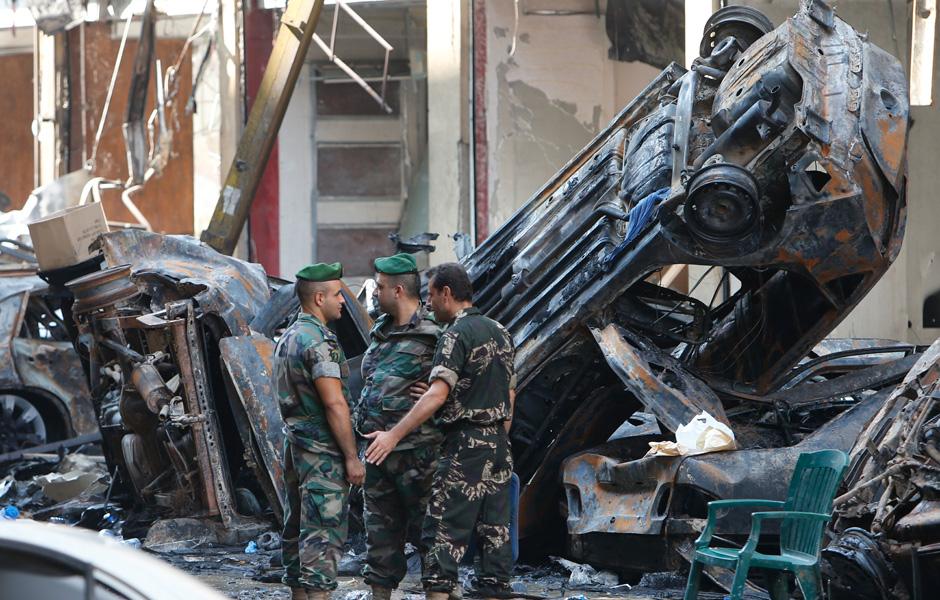 Next the same media outlets finessed the news about the terrorist bombs planted in Beirut’s southern suburb of Dahiyeh. The August 15, 2013 terrorist bombings in the neighbourhood of Al-Rouweiss (Al-Rweiss) were downplayed and, in a manner of speaking, legitimized by the media through their selective use of language. The attack on Al-Rouweiss come about a month after the July 9, 2013 terrorist attack on the neighbourhood of Bir Al-Abed. Both are densely populated neighbourhoods in Dahiyeh. The Institute for Public Accuracy (IPA) in the United States took quick notice of the biased media framing. IPA asked the following, on August 16, 2013, through the title of report: “Why Isn’t Beirut Bombing Called ‘Terrorist’? What’s Behind It?”
The Lebanese newspaper Al-Akbar is worth looking at to get a grasp of the biased media reporting that has been used to reframe the events as legitimate. It commented thus on August 17, 2013: “The Western media have double standards when it comes to ‘terrorism.’ Within hours after two bombs were detonated at the Boston Marathon last April, many in the media had christened it a ‘terrorist attack.’ Meanwhile, the August 15 bombing in Rouweiss that killed at least two dozen is a ‘blast’ that occurred in a ‘Hezbollah stronghold.’” As Al-Akhbar observes, the phrase “Hezbollah stronghold” plays a prominent role in giving the impression that the civilian neighbourhoods bombed in Beirut were armed barracks. Al-Akhbar even nicely sums up some of the biased titles used to describe the terrorist attacks:
Wall Street Journal: «Car Bomb Blasts Hezbollah Stronghold in Lebanon»
BBC: «Deadly Lebanon Blast in Beirut Stronghold of Hezbollah»
LA Times: «Massive Explosion in Beirut Rocks Hezbollah Stronghold»
Washington Post: «Bomb Explodes in Hezbollah Stronghold in Beirut, Injuring Dozens»
Reuters: «Over 50 Hurt as Car Bomb Hits Hezbollah Beirut Stronghold»
Associated Press: «Car Bomb Rocks Hezbollah Stronghold in Lebanon»
France24: «Car Bomb Rocks Hezbollah Stronghold in Beirut»
Mixed with the other narratives that the same media outlets are painting, the terrorist attacks are being tacitly portrayed as some type of legitimate retaliation. Readers are basically led to think that that the terrorist attacks in Dahiyeh were a military act against some type of Hezbollah base.
How the Mainstream Media Lies and Deliberately Places the Blame on Sunni Muslims
Sheikh Hassan Nasrallah, the secretary-general of Hezbollah, responded to the terrorist attack on Al-Rouweiss by categorically saying that the attacks were not the work of Sunni Muslims. He gave a speech saying that there were going to be those groups and individuals that would try to blame the terrorist attacks in Beirut on the Sunnis and said that these groups and individuals should be outright dismissed. In fact, he said that anyone that used this divisive logic was an “Israeli” and a partner in the goal of creating massacres. He made it clear that the individuals who planted the bomb did not represent the Sunni Muslims or the Arabs or the Syrians or the Palestinians. In a message to the US and its allies, he also said clearly stated that Hezbollah was aware that the intelligence services of the US and its allies had infiltrated various terrorist groups and manipulate them as tools.
Despite Nasrallah’s clarity, his words were totally changed by the same media outlets that were legitimizing the terrorist attacks in Beirut. The Israeli media, the state-run British Broadcasting Corporation (BBC), Al Jazeera, and Al Arabiya would blatantly fabricate the news and claim that Nasrallah “blamed the Sunnis” or try to manipulate readers into getting the impression that he did. The New York Times titled an August 16, 2003 article on the terrorist attacks as the following: “Hezbollah Makes Vow to Step Up Sunni Fight”. It never even mentioned that Nasrallah went out of his way to say that the people involved in the terrorist attacks were the tools of the US and Israeli government and not really Sunni Muslims. Instead Ben Hubbard focused on sectarianism in Lebanon and wrote: “In short, Hezbollah has more enemies than it used to have.”
The BBC wrote a similar article on August 16. It also used a grossly misleading title. The title being “Hezbollah blames Sunnis for bomb”. After a large number of people caught it, the BBC changed the title to “Beirut bomb: Hezbollah’s Nasrallah blames Sunni radicals”.
Exposing the Yellow Journalism at Work as a Tool of War
Aside from their direct or indirect links to these media outlets, even the political actors involved show that the way the news is reported is not isolated. Saad Hariri, the leader of the Future Party and a Saudi client, even responded to Hassan Nasrallah’s speech by saying that he had no right to designate what groups are terrorists. Hariri’s overlords in Saudi Arabia, on the other hand, refused to even condemn the terrorist attacks. This again is tied to the attempts to reframe the terrorist attacks in Beirut as a legitimate military act.
This type of yellow journalism that relies on misleading headlines that essentially say everything while the hollow articles carry and have little or no newsworthy material is not politically neutral. It is a weapon of war. All these articles are agitating for bloodletting in the Middle East, specifically between Shias and Sunnis. This type of journalism either directly or indirectly stokes the fires of sectarianism in Lebanon and the Middle East with the intentions of spreading sectarian animosity. This is why it deliberately ignores and refuses to even acknowledge the main points of Nasrallah’s speech that clearly pointed the finger at Israel and the US and said that the terrorist attacks had nothing to do with Sunni Muslims.
Related article
US could easily verify massacre of Kurdish civilians in Syria if they wanted
RT | August 16, 2013
Defending themselves by all means available is the Kurdish Popular Defense Units’ (YPG) last resort in Syria, the group’s spokesperson Redor Khalil told RT.
Amid Western inaction and Russian condemnation of massacres against the Kurds, Redor Khalil said that evidence is readily available to support the injustice perpetrated against the Kurdish people by militants sponsored from abroad – if anybody were to listen.
RT: Tell us about the Popular Defense Units. Is it your objective to protect the Kurds, or to protect all the residents of this territory?
Redor Khalil: The Popular Defense Units were established to protect all the people – Kurds as well as Arabs. We formed the units in 2011 when the war began. You should know that Syria, including Western Kurdistan, has a mixed population of Kurds, Arabs, Armenians, Assyrians, Turkmens, Circassians and so on. Our units were intended to protect all these areas and their residents.
RT: But some are saying that your attacks on enemy positions in Arabic villages are impeding the relations between Kurds and Arabs. Armed clashes in these areas result in losses on both sides.
RK: We don’t believe that our actions will result in social disintegration. Kurds and Arabs have been living side-by-side in these territories for centuries, and they will keep it this way in the future.
We’ve said time and again that we strongly disapprove of ethnic, religious and sectarian wars. However, there are certain powers which have been trying to stir up confusion and to make it look like a fight between Kurds and Arabs for the sake of their own interests.
As you travel through these areas you may ask the local members of minorities and religious groups whether there is a sectarian war taking place here. I can assure you that it’s not the case.
Our traditions, moral values and principles prevent us from starting a war between different religious or ethnic groups. Neither Kurds nor Arabs want this war to happen. But some forces are working on instigating a conflict between us as a part of their plan.
RT: We’ve been around Qamishli, where the clashes take place. The YPG members told us that Jabhat Al-Nusra and the Islamic State of Iraq and the Levant are much better armed. With this in mind, can the YPG really ensure people’s security and extend it to other regions? And what is your opinion on some foreign states supplying weapons to these terrorist groups?
RK: The YPG units are made up of the local population. Our main strategy is defense, not offense. If there are no attacks on our territory, no threats to our towns and cities, we do not take any offensive action. We don’t attack anyone or provoke confrontation. But since our territories are under attack, we have to defend ourselves with all the means available. Our enemy gets support from the outside; they have heavy armaments and plenty of ammunition. I can state openly that the YPG units do not get any support from foreign countries. We employ a defensive strategy in all our operations, using only our own weapons and ammunition.
RT: Recently it was rumored that Kurdish political forces want to create a government of the so-called Western Kurdistan. It’s well-known that there are external Kurdish elements that support the idea. How would you comment on these rumors?
RK: Some parties and movements declare this project their main political objective. On behalf of the YPG members and based on the information we have, I can say that they don’t intend to set up a government for Western Kurdistan. This is just talk meant to drive a wedge between different ethnic groups living in the region. Syria is going through a very difficult and dangerous time right now. There are some places in Syria over which the current regime will never be able to regain control. People living there are in dire need of governing authorities, which the Free Syrian Army has already created in Idlib and Ar-Raqqah. There’s nothing surprising about that, and it’s the same thing the Kurdish people want – self-government over the areas where the Kurds live is an inherent part of our political project. Some political movements claim that it springs from our desire to separate from Syria and create our own state and government. They aim to sow seeds of discord among various ethnic and religious groups living in this area and exacerbate the already complicated state of affairs. They are just pursuing their own selfish goals.
RT: Some opposition groups say that the YPG leaders coordinate their operations with the Syrian government and its army forces. What kind of relations do you maintain with the Syrian government?
RK: We have vehemently denied these allegations before, and we will keep doing so. We don’t maintain any relations with the government. The Popular Protection Units have no connection to the regime. You have seen for yourselves that the government officials stay inside the city. The rest of the territory is under our control. Basically, the YPG is in charge there and responsible for ensuring security.
RT: Speaking of Jabhat al-Nusra’s massacre in Afrin and Qamishli, the Russian Foreign Ministry and several human rights organizations condemned it, but the US State Department said that they have no hard evidence of genocidal intent against the Kurdish people. How would you explain this US stance?
RK: I think that if the US truly wanted to get to the bottom of this, it would be very easy – it’s crystal clear what exactly is happening. The massacre of Kurdish civilians in places like Tal Hasil and Tal Aran is a dark but undeniable fact. There are eyewitnesses of these events, and we at the YPG, as well as several Kurdish civilians, have documentary proof of it. We are ready to give this proof to international organizations and mass media to show them the truth of this horrible war the radical Islamists are fighting on our soil. I think the main reason for this massacre is that the YPG defeated the militants at Ras al-Ayn where they were based, maintaining control over a border checkpoint. After they suffered defeat at Rumeylan the radical groups attacked civilians who are not involved in military action.
Related article
Tel Aviv: “Axis of Evil” Cannot Be Allowed to Win in Syria
By Yahya Dbouk | Al-Akhbar | August 16, 2013
It is perhaps one of those rare times that Israel openly clarifies its position regarding the Syrian crisis, and from the mouths of high-ranking officials: the Resistance cannot be allowed to win.
Tel Aviv is increasingly worried about the developments taking place in Syria. They want the West to be more involved, particularly as Washington seems less certain about how far it should go in supporting the opposition there.
This prompted Israel’s minister of war Moshe Yaalon to make his concerns known to his visitor from Washington, chairman of the Joint Chiefs of Staff Martin Dempsey, for all the media to hear: “The axis of evil, which extends from Tehran to Damascus and Beirut, cannot be allowed to win in the ongoing war in Syria.”
After explaining that the most important thing happening in the region is the change sweeping through many Arab countries, he asked Dempsey to consider Iran’s role and the threat it poses to Israel’s security.
“The lack of stability in the region,” Yaalon insisted, “is due to many reasons, at the top of which is the Iranian regime and its involvement in all the crises taking place in the Middle East.”
According to Israel Defense magazine, the minister said that he believed the Syrian crisis would continue for a long time and would not end even if Bashar al-Assad falls, noting that “there are bloody accounts to be settled between the Alawis and Sunnis, in addition to other minorities engaged in the fighting.”
Yaalon repeated statements he had made after the Syrian opposition’s defeat in Qusayr, that Syria is going through a period in which the state is breaking up, suggesting that the Assad regime, contrary to what recent developments suggest, is weakening.
“I don’t see a change [in the regime’s favor],” the minister maintained, “because in Syria there are many places where the opposition is hitting the regime hard, as in Aleppo and the Latakia area, in addition to the Golan. This suggests that the opposition controls more territory than before.”
In the same vein, a high-ranking Israeli official criticized the US administration’s policy, and the weakness it has shown in handling a number of files in the region. On the occasion of Dempsey’s visit to Israel, the official told Yedioth Ahronot that Washington’s hesitation “will only increase Russia’s influence in the area.”
“Israel is very worried about America’s position regarding the region,” the same source added. “The Russians are taking advantage of America’s weakness, and they are waging their battles like a superpower, therefore proving to the countries of the region and President Assad that they can be relied on, while the Americans abandon their allies and partners.”
Of more concern to the source is that the US’ weak stand extend to its confrontation with Iran, asking Washington not to fall into the trap of the country’s new president, Hassan Rouhani, and “to squeeze Iran until it surrenders.”
The source explained that Israelis are generally comfortable with what is going on around them, despite the upheaval taking place in Egypt: “We can work with the Egyptians, Jordanians and other countries, for we have common interests with many parties in the region, and Israel is the one holding up the tent these days.”
Related articles
- Chair of US Joint Chiefs of Staff arrives in Israel for talks (alethonews.wordpress.com)
- some israeli politicians have a real talent for rhetoric (and this is not one of them) (niqnaq.wordpress.com)
Syria accepts essential terms of chemical weapons probe – UN
RT | August 15, 2013
The Syrian government has accepted the ‘essential modalities’ under which the UN was ready to investigate whether chemical weapons had been used in the country, the body has announced, signalling that experts will shortly be traveling to Syria.
“The departure of the team is now imminent,” UN Secretary-General Ban Ki-moon said in a statement. “As agreed with the Government of Syria, the team will remain in the country to conduct its activities, including on-site visits, for a period of up to 14 days, extendable upon mutual consent.”
The Secretary-General has expressed his appreciation to the Syrian government for accepting “the modalities essential for cooperation to ensure the proper, safe and efficient conduct of the Mission.”
The statement also reminded that the use of chemical weapons “by any side under any circumstances” would constitute an “outrageous crime.”
Two weeks ago the United Nations said that an agreement had been reached with Syrian President Bashar al-Assad’s government as to the three locations that UN inspectors would be investigating, led by Swedish scientist, Ake Sellstrom.
One site to be visited by the UN team is Khan al-Assal in Aleppo, where the country’s government says rebels used chemical weapons in March. The two additional locations have yet to be confirmed.
Both Syria’s government and rebel forces have long been accusing each other of using chemical weapons, and both have denied it.
Russia welcomed the move, saying on its Twitter feed that “Damascus is ready to bring clarity into the situation”, and expressing hope that the move will “provide a springboard for a political solution of the ongoing crisis”.
Last month Russia submitted “a full set of documents” to the UN and its analysis of samples taken west of Aleppo. Russia’s findings indicated that it was rebels behind the Khan al-Assal incident, in which more than 30 people died.
The United States cast doubt on the Russian findings saying its own intelligence services believed Syrian government forces had used chemical weapons. However, Paulo Pinheiro, chairman of the UN commission’s inquiry into rights violations in Syria, said the evidence provided by the US did not meet standards as his commission was “very worried about the chain of custody of the substances.”
Back in March Damascus requested UN investigators to visit Khan al-Assal. The UN formed a mission then, but was reluctant to send it, demanding “unconditional and unfettered” access across the country, according to Ban’s spokesman Martin Nesirky.
Syria’s Foreign Ministry rejected the UN’s effort to broaden the probe claiming that it was “at odds with the Syrian request” and that its “possible hidden intentions” could violate Syrian sovereignty.
In total, the UN received some 13 reports of alleged use of chemical weapons in Syria and the UN inspectors will be investigating the “allegations” of chemical weapons use, rather than determining who was responsible for the attacks.
Featured Video

Dan Dicks with James Corbett on Solutions Watch
or go to
Aletho News Archives – Video-Images
From the Archives
MMR (Measles, Mumps and Rubella) – Vaccine Risk Statement
MMR Vaccine (Measles, Mumps, and Rubella) Is It Safer Than Measles, Mumps and Rubella?
Physicians for Informed Consent | December 2024
… It has not been proven that the MMR vaccine is safer than measles, mumps, and rubella. The vaccine package insert raises questions about safety testing for cancer, genetic mutations, and impaired fertility. Although VAERS tracks some adverse events, it is too inaccurate to measure against the risk of measles, mumps, and rubella. Clinical trials do not have the ability to detect less common adverse reactions, and epidemiological studies are limited by the effects of chance and possible confounders. Safety studies of the MMR vaccine are particularly lacking in statistical power. A review of more than 60 MMR vaccine studies conducted for the Cochrane Library states, “The design and reporting of safety outcomes in MMR vaccine studies, both pre- and post-marketing, are largely inadequate.”19 Because permanent sequelae (aftereffects) from measles, mumps, and rubella are so rare (especially in children with normal levels of vitamin A and infected after birth),6,15-17 the level of accuracy of the research studies available is insufficient to rule out the possibility that the MMR vaccine causes greater death or permanent disability than measles, mumps, and rubella. – Read full article
Blog Roll
 Aletho News
- Sheikh al-Asadi warns of Iraqi government compliance with US demands
- How to MAKE THE CONSPIRATORS PAY for their crimes! Dan Dicks with James Corbett on Solutions Watch
- There’s a drought in academia: A drought in honest research on the subject of drought and other weather extremes
- Department of War Awards $20.7 Billion Contract to Raytheon for Air-to-Air Missiles
- ‘Distance yourselves from Israel’: IRGC urges US population to question govt policies
- America’s Greenland deal has a radioactive backstory
- The RAF Fairford ‘terror plot’: Unpacking escalation in the UK echo-chamber
- EU Council Advances Chat Control 2.0 Scanning Proposal
- Ex-Greek MEP files complaint against Israeli spyware firm over alleged Pegasus surveillance
- Troubling ideas throughout the Torah, Talmud, Mishneh Torah and Tanya
- If Americans Knew
- New Report: “Scholasticide and Genocide in Gaza: Assessment, Testimonies and Legal Analysis”
- Ex-Biden officials are desperate for a Gaza scapegoat
- Israeli “settlers” Invade Al-Aqsa; Pour Boiling Water on 75-Year-Old
- Israel Has Kidnapped Another American Teenager
- US arms sales to Israel worth $21.6 billion in 20 months
- Three Palestinians Killed in Israeli Attacks on Gaza
- Revealed: German “Anti-Semitism Expert” Driving Crackdown on Palestine Solidarity is Former Israeli Spy
- Egypt’s Warning to Israel Before Oct 7
- Israel’s siege signals another cruel winter for 1.8 million Gazans – Daily Update
- Netanyahu Asked UAE Leader to Deny Report on Oct. 7 Warning in Secret Visit, Sources Say
- No Tricks Zone
- Two More Paleo Reconstructions Affirm Meters-Higher Sea Levels Across Ireland, Brazil 7000-6000 Years Ago
- New Study: Earth And Venus Surface Warmth Largely Explained By Convection And Lapse Rate, Not CO2 Or Radiation
- 2025 Nature Paper Claiming Worsening Global Drought Gets RETRACTED …Heavily Flawed
- New Study: ‘Global Drought Shows No Detectable Recent Acceleration Under Climate Warming’
- Economic Masterminds: German Socialists Suggest Taxing Productivity Gains Stemming From Using AI
- The South China Sea Has Not Been Cooperating With The Climate Change Narrative
- Energy Crisis: Germany Enters Heating Season With Historically Low Gas Reserve Fill Levels
- New Study: The Antarctic Ice Sheet Gained Mass From 2020-2024 Due To Staggering Snow And Ice Accumulation
- Study: Ocean Heating Rates From Thousands Of Years Ago ‘Dwarf’ Modern Ocean Heating Rates
- Climate Extremists Target, Attack Large-Scale Power Grid Infrastructure In Germany!

