Obama to Press Putin to Back Assad’s Removal in Syria
RIA Novosti | June 14, 2013
WASHINGTON – US President Barack Obama will attempt to convince Russian President Vladimir Putin in their planned meeting Monday that it is in Moscow’s interest to support the removal of Syrian President Bashar Assad from power, a White House official said Friday in the wake of fresh US claims that Syria has used chemical weapons.
“It’s in Russia’s interest to join us in applying pressure on [Assad] to come to the table in a way that relinquishes his power and his standing in Syria,” Obama’s deputy national security adviser, Ben Rhodes, told reporters Friday.
The United States and Russia remain at loggerheads over the ongoing civil war in Syria as Obama and Putin prepare to meet on the sidelines of the G8 Summit in Northern Ireland on Monday.
The meeting comes a day after Rhodes told reporters Thursday that US intelligence had concluded with “high confidence” that Syrian President Bashar Assad’s forces had used chemical weapons multiple times over the past year – an assessment that has prompted Obama’s decision to boost military aid to the Syrian rebels.
The chemical weapons claim was met with skepticism and derision by Russian officials.
“The Americans have tried to provide us with information on the use by the [Syrian] regime of chemical weapons, but I will be frank: The report does not seem convincing to us,” Kremlin aide Yury Ushakov told reporters in Moscow on Friday.
Alexei Pushkov, the head of Russia’s parliamentary foreign affairs committee, dismissed the US assessment outright Friday, calling its conclusions “fabricated.”
Rhodes told reporters Friday that Obama would offer an “interest-based” argument to Putin on the Syria issue during Monday’s meeting in an effort to persuade “the Russians that they can best protect their interests by being a part of a political settlement that is real and that enables a transition away from Assad’s rule.”
He added that “there are no illusions” that the talks between Obama and Putin about the Syria conflict would be easy.
“What Russia has articulated to us, and publicly, is that they don’t want to see a downward spiral, they don’t want to see a chaotic and unstable situation in the region, they don’t want to see extremist elements gaining a foothold in Syria,” Rhodes said.
Ushakov told reporters in Moscow that the United States and Russia “are not competing on Syria.”
“On the contrary, we are seeking a constructive solution to this issue which is vital for the situation in the region and the world,” he said.
Both the European Union (EU) and the North Atlantic Treaty Alliance (NATO) expressed concern Friday about the US claims of multiple chemical weapons attacks in Syria over the past year, which the White House said have resulted in 100 to 150 deaths.
“These developments can only reinforce the importance of a political solution and should accelerate the efforts of the international community to find a definitive political solution to the conflict,” Catherin Ashton, the EU’s high representative for foreign affairs and security policy, said in a statement.
NATO Secretary-General Anders Fogh Rasmussen on Friday called the US assessment “a matter of great concern,” Reuters reported.
“The international community has made clear that any use of chemical weapons is completely unacceptable and a clear breach of international law,” Rasmussen said in Brussels, Reuters said.
Meanwhile, US Sen. John McCain repeated his call Thursday for the Washington to establish a no-fly zone “to create a safe area” within Syria.
“You can’t do it with half measures. You can’t do it with just supplying weapons,” McCain told CNN.
In a conference call with reporters Thursday, Rhodes said the White House believed boosting assistance to the Syrian rebels is the most effective strategy at this point, saying a no-fly zone “would carry with it great and open-ended costs for the United States and the international community.”
“It’s far more complex to undertake the type of effort, for instance, in Syria than it was in Libya,” Rhodes said.
The Syrian government on Friday called White House claims about the use of chemical weapons in Syria “a statement full of lies based on fabricated information.”
Both sides in the ongoing Syrian civil war have traded allegations of chemical weapons use, with government officials accusing opposition forces of using chemical weapons against Assad’s military in a March attack outside of the northern city of Aleppo.
Some 93,000 people are believed to have died since fighting broke out between Syrian government forces and rebels in March 2011, according to the latest UN figures.
Russia: Syria no-fly zone would be illegal
Al-Akhbar | June 15, 2013
Russian Foreign Minister Sergei Lavrov said on Saturday any attempt to enforce a no-fly zone over Syria using F-16 fighter jets and Patriot missiles from Jordan would violate international law.
Russia, which has vetoed three UN Security Council resolutions aimed at pressing for a no-fly zone in Syria, vehemently opposes any foreign military intervention in the Syrian conflict.
“There have been leaks from Western media regarding the serious consideration to create a no-fly zone over Syria through the deployment of Patriot anti-aircraft missiles and F-16 jets in Jordan,” said Lavrov, speaking at a joint news conference with his Italian counterpart.
“You don’t have to be a great expert to understand that this will violate international law,” he said.
The United States has moved Patriot missiles and fighter jets into Jordan, officially as part of an annual exercise in the past week, but making clear that the military assets could stay on when the war games are over.
The Wall Street Journal reported this week that a US military proposal to arm rebels fighting against Assad also calls for a limited no-fly zone inside Syria that could be enforced by US and allied planes on Jordanian territory.
Lavrov also rejected US claims that Syria has used “small amounts” of sarin on rebels, saying there was no need for that because government forces were making steady advances on the ground.
“The regime, as the opposition is saying out in the open, is enjoying military success on the ground,” he said.
“What sense is there for the regime to use chemical arms, especially in such small amounts?” Lavrov asked.
Russia said on Friday it was unconvinced by US allegations that Assad had used chemical weapons against his own people.
US President Barack Obama’s administration said on Thursday it would boost military support for the opposition as a result.
(Reuters, AFP)
Related article
Why Obama is Declaring War on Syria
By Franklin Lamb | Al-Manar | June 15, 2013
The short answer is Iran and Hezbollah according to Congressional sources. “The Syrian army’s victory at al-Qusayr was more than the administration could accept given the town’s strategic position in the region. Its capture by the Assad forces has essentially added Syria to Iran’s list of victories starting with Afghanistan, Lebanon, Iraq, as well as its growing influence in the Gulf.”
Other sources are asserting that Obama actually did not want to invoke direct military aid. The rebels fighting to topple the Assad government or even to make use of American military power in Syria for several reasons. Among these are the lack of American public support for yet another American war in the Middle East, the fact that there appears to be no acceptable alternative to the Assad government on the horizon, the position of the US intelligence community and the State Department and Pentagon that intervention in Syria would potentially turn out very badly for the US and gut what’s left of its influence in the region. In short, that the US getting involved in Syria could turn out even worse than Iraq, by intensifying a regional sectarian war without any positive outcome in sight.
Obama was apparently serious earlier about a negotiated diplomatic settlement pre-Qusayr, and there were even some positive signs coming from Damascus, Moscow, and even Tehran, John Kerry claimed. But that has changed partly because Russia and the US have both hardened their demands. Consequently, the Obama administration has now essentially thrown in the towel on the diplomatic track. This observer was advised by more than one Congressional staffer that Obama’s team has concluded that the Assad government was not getting their message or taking them seriously and that Assad’s recent military gains and rising popular support meant that a serious Geneva II initiative was not going to happen.
In addition, Obama has been weakened recently by domestic politics and a number of distractions and potential scandals not least of which is the disclosures regarding the massive NSA privacy invasion. In addition, the war lobby led by Senators McClain and Lindsay Graham is still pounding its drums and claiming that Obama would be in violation of his oath of office and by jeopardizing the national security interest of the United States by allowing Iran to essentially own Syria once Assad quells the uprising. Both Senators welcomed the chemical weapons assessment. For months they have been saying that Obama has not been doing enough to help the rebels. “U.S. credibility is on the line,” they said in a joint statement this week. “Now is not the time to merely take the next incremental step. Now is the time for more decisive actions,” they said, such as using long-range missiles to degrade Assad’s air power and missile capabilities. Another neo-con, Sen. Robert P. Casey Jr. (D-Pa.) said the opposition forces risk defeat without heavier weapons, but he also warned that may not be enough. “The U.S. should move swiftly to shift the balance on the ground in Syria by considering grounding the Syrian air force with stand-off weapons and protecting a safe zone in northern Syria with Patriot missiles in Turkey,” Casey said.
Secretary of State Kerry held meetings with more than two dozen military specialists on 5/13/13. The Washington Post is reporting that Kerry believes supplying the rebels with weapons might be too little and too late to actually flip the balance on the Syrian ground and this calls “for a military strike to paralyze Al-Assad’s military capacities.” A Pentagon source reported that the USA, France, and Britain are considering a decisive decision to reverse the current Assad momentum and quickly construct one in favor of the rebels” within a time period not exceeding the end of this summer.
Shortly after the meetings began, King Abdullah of Saudi Arabia quickly returned to Saudi Arabia from his palace at Casa Blanca, Morocco after receiving a call from his intelligence chief, Prince Bandar Bin Sultan. Bandar reportedly had a representative at the White House during the meetings with President Obama’s team. King Abdullah was reportedly advised by Kerry to be prepared for a rapid expansion of the growing regional conflict.
What happens between now and the end of summer is likely to be catastrophic for the Syrian public and perhaps Lebanon. The “chemical weapons-red line” is not taken seriously on Capitol Hill for the reason that the same “inconclusive evidence” of months ago is the same that is suddenly being cited to justify what may become essentially an all-out war against the Syrian government and anyone who gets in the way. Hand wringing over the loss of 125 lives due to chemical weapons, whoever did use them, pales in comparison to the more 50,000 additional lives that will be lost in the coming months, a figure that Pentagon planners and the White House have “budgeted” as the price of toppling the Assad government.
“We are going to see a rapid escalation of the conflict”, a staffer on the US Senate Foreign Relations Committee emailed this observer: “The president has made a decision to give whatever humanitarian aid, as well as political and diplomatic support to the opposition that is necessary. Additionally direct support to the (Supreme Military Council), will be provided and that includes military support.” The staffer quoted the words of Deputy National Security Adviser Ben Rhodes to the media on 5/13/13 to the same effect.
A part of this “humanitarian assistance” the US is going to establish in the coming weeks a “limited, humanitarian no-fly zone, that will begin along several miles of the Jordanian and Turkish borders in certain military areas into Syrian territory, and would be set up and presented as a limited bid to train and equip rebel forces and protect refugees. But in reality, as we saw in Libya a Syrian no fly zone would very likely include all of Syria.
Libya’s no-fly zones made plain that there is no such thing as a “limited zone”. Put briefly, a “no-fly zone” means essentially a declaration of all-out war. Once the US and its allies start a no fly zone they will expand it and intensify it as they take countless other military actions to protect its zones until the Syrian government falls. “It’s breathtaking to contemplate how this in going to end and how Iran and Russia will respond,” one source concluded.
The White House is trying to assuage the few in Congress as well as a majority of the American public that it can be a limited American involved and that the no-fly zone would not require the destruction of Syrian antiaircraft batteries. This is more nonsense. During the no-fly zone I witnessed from Libya in the summer of 2011 the US backed it up with all manner of refueling, electronic jamming, special-ops on the ground and by mid-July a kid peddling his bike was not safe. Over the 192 days of patrolling the Libyan no-fly zones, NATO countries flew 24,682 sorties including 9,204 bomb strike sorties. NATO claimed it never missed its target but that was also not true. Hundreds of civilians were killed in Libya by no-fly zone attack aircraft that either missed their targets or emptied their bomb bays before returning to base while conducting approximately 48 bombing strikes per day using a variety of bombs and missiles, including more than 350 cruise Tomahawks.
At a Congressional hearing in 2011, then US Secretary of Defense Robert Gates got it right when he explained while discussing Libya “a no-fly zone begins with an attack to destroy all the air defenses … and then you can fly planes around the country and not worry about our guys being shot down. But that’s the way it starts.”
According to the accounts published in American media, Obama could alternatively authorize the arming and training of the Syrian opposition in Jordan without a no-fly zone. That appears unlikely because the Pentagon wants to end the Syrian crisis by summer’s end, the observer was advised “rather than working long term with a motley bunch of jihadists who we could never trust or rely on. The administration has come to the conclusion apparently that if they are in for a penny they are in for a pound.”
In response to a question from this observer about how he thought events might unfold in this region over the coming months, a very insightful long-term congressional aid replied: “Well Franklin, maybe someone will pull a rabbit out of the hat to stop the push for war. But frankly I doubt it. From where I sit I’d wager that Syria as we have known it may soon be no more. And perhaps some other countries in the region also.”
Franklin Lamb can be reached c/o fplamb@gmail.com
US claims of Assad’s chemical weapons are lies – Pushkov
RT | June 14, 2013
A senior Russian MP holds that the recent White House statement of chemical weapons use by the Syrian government is as false as the notorious reports about Iraqi WMDs.
“The data about Assad’s use of chemical weapons is fabricated by the same facility that made up the lies about Saddam Hussein’s weapons of mass destruction. Obama is walking George W. Bush’s path,” the head of the Duma’s Foreign Affairs Committee Aleksey Pushkov tweeted.
The Russian MP was referring to the 2003 invasion in Iraq prompted by the US and UK claims that Saddam Hussein possessed weapons of mass destruction that threatened neighboring nations. The UN probe into the matter was underway as the invasion started and no traces of WMD have been discovered on Iraqi territory since the war ended, prompting accusations that the US administration and special services fabricated the data to get an excuse to start the conflict.
In comments to Russian news agencies Pushkov noted that the supplies of arms from the US to the Syrian rebels would hardly lead to the overthrow of President Bashar Assad’s regime. He added that the government in Syria is supported by “a significant, if not the larger, part of the population” and the Syrian military “show a high degree of resistance.”
Pushkov also forecast that the United States would now attempt to further escalate the situation.
“Now they are arming the rebels but then they will come to some form of direct military involvement. We cannot exclude the possibility of cruise missile strikes and if this measure brings no result – of direct military intervention,” he said.
The statement was made shortly after US authorities publicly announced that they had proof that pro-government forces used chemical weapons, like the nerve agent sarin in the Syrian conflict, killing at least 150 people. At the same time, the US side claimed that there was no proof about similar actions from the rebels’ side.
US Deputy National Security Advisor Ben Rhodes has told the press that President Barack Obama has decided to boost the US support to the Syrian opposition forces and that this would now include military support. The detailed orders will be issued within the nearest weeks after Obama consults with the Congress, the official added.
Earlier last week UK and France said that their probes into the alleged use of chemical weapons in Syria showed that the pro-government forces did it at least once causing casualties among rebels and called the international community for immediate action. Many officials, including top Russian politicians, noted that the impartiality of British and French researchers is under question and urged an independent probe.
The UN is currently preparing its own independent investigation, but it might take a long time. Syrian government has said it was ready to accept the UN delegation and help with the investigation.
In late March one of the conflicting parties in Syria allegedly used a sarin-charged missile near the city of Aleppo. The government and rebels now accuse each other of the attack that killed at least 25 people.
While the UK, France and now the United states accuse pro-Assad forces, Turkish media said in early June that the country’s security forces had found sarin gas in the homes of members of the Al-Qaeda-linked Al-Nusra Front – one of the main groups opposing the Syrian government.
Russian officials have repeatedly condemned the use of chemical weapons and urged an all-sided and unbiased research into all incidents connected with the issue.
Syrian rebels open fire on convoy carrying Russian journalists
RT | June 9, 2013
A Russian TV crew came under fire in Syria when a mainly civilian convoy taking the journalists to the Golan Heights was shelled by Syrian rebels.
The convoy shelled on Saturday was led by a Syrian army military vehicle, and consisted of several cars occupied by civilians, including one with Russian TV journalists.
The shelling started when the cars were about 5 kilometers away from their destination – ‘Checkpoint Charlie’ – the only crossing between Syria and the Golan Heights, disputed territory claimed by both Syria and Israel.
“The Syrian troops started to fight the rebels back, but the insurgents targeted the civilian cars,” said Evgeny Poddubny, the head of the Russian TV crew and special correspondent for Rossiya TV channel.
Throughout the fighting, a Russian cameraman kept filming; gunshots can be heard on the video for 15 minutes. The footage also features a Syrian army officer reporting to command that armed militants attacked first, that shelling was coming from both sides of the road.
“The convoy could not make it to the checkpoint, the rebels set an ambush on the road, fighting broke out, the military responded with heavy fire to cover the retreat of our TV crew, and then they retreated themselves. The militants were further confronted by the field artillery, which is deployed in the area,” Poddubny said.
No one was injured in the attack. A similar incident occurred recently in the Golan Heights buffer zone when Checkpoint Charlie was attacked and seized by rebels on Thursday, and quickly recaptured by government troops.
“The militants use the status of the territory; they hide in the buffer zone and are carrying out attacks like the one you’ve just witnessed. Then they retreat. And we cannot carry out special operations here – as that would be a breach of international agreements. Besides, the rebels are getting help from Israel – it supplies them with ammunition and even provides medical aid to terrorists in mobile hospitals,” Syrian army General Nasr Haidar, whose regiment is deployed in the area, told Rossiya.
Provocations by the insurgents are seen as major reason why international peacekeepers have been withdrawing from the area. Austrian troops, which accounted for 40 percent of the UN peacekeepers in the Golan Heights, have announced their withdrawal.
This week, Russia proposed to replace Austrian UN peacekeepers on the Israel-Syria border. However, the mandate of the UN mission would not allow Russia’s participation.
The NYT and Chemical Weapons in Syria
By Michael McGehee | NYTX | June 7, 2013
Last month when UN investigator Carla Del Ponte came out publicly to say, “There are strong, concrete suspicions but not yet incontrovertible proof of the use of sarin gas, from the way the victims were treated,” and, “This was use on the part of the opposition, the rebels, not by the government authorities,” it was quickly met with suspicion and denial, from the UN and the White House.
Jay Carney, the White House press secretary, said as much to reporters.
“We are highly skeptical of the suggestion that the opposition could have or did use chemical weapons,” Mr. Carney said. “We find it highly likely that any chemical weapon use that has taken place in Syria was done by the Assad regime. And that remains our position.” (NYT, 05/07/2013)
In the previous month both the US and Israel came out with the claim that the Syrian government had used chemical weapons.
On Tuesday the UN issued a report on the war-torn country, and The New York Times reported that, “There are reasonable grounds to believe limited quantities of toxic chemicals were used.”
However, the “paper of record” conveniently failed to note that the report immediately goes on to say that “It has not been possible, on the evidence available, to determine the precise chemical agents used, their delivery systems or the perpetrator.”
But there are two very important developments to this story which have been met with total silence.
The first is the hacking of Britam, a British defense company. Four months ago it was reported by Yahoo! that:
The Obama administration gave green signal to a chemical weapons attack plan in Syria that could be blamed on President Bashar al Assad’s regime and in turn, spur international military action in the devastated country, leaked documents have shown.
One of the leaked documents was an email. The email:
Phil
We’ve got a new offer. It’s about Syria again. Qataris propose an attractive deal and swear that the idea is approved by Washington.
We’ll have to deliver a CW to Homs, a Soviet origin g-shell from Libya similar to those that Assad should have.
They want us to deploy our Ukrainian personnel that should speak Russian and make a video record.
Frankly, I don’t think it’s a good idea but the sums proposed are enormous. Your opinion?
Kind regards
David
One of the parties who continues to feed the UN information about the use of chemical weapons in Syria is the United Kingdom. The NYT reported on Wednesday, Britain “repeated an earlier assessment that ‘a growing body of limited but persuasive information’ pointed to the use of the same toxin.”
After the email was leaked, claims of chemical weapons usage were made and then President Obama was hounded to act swiftly. Syria’s President Assad allegedly crossed Washington’s “red line.”
The June 4th UN panel report claims that, “It is possible that anti-Government armed groups may access and use chemical weapons. This includes nerve agents, though there is no compelling evidence that these groups possess such weapons or their requisite delivery systems.”
The Turkish news agency, Zaman, reported on May 28, 2013—that is, a week before the UN report was published—that Syrian rebels were arrested in Turkey and had Sarin gas in their possession.
While Russia Today covered the development, as well as Voice of Russia and Iran’s PressTV, no Western source published the development.
In all the coverage provided on Syria and chemical weapons—in the last year the NYT has provided more than 1,100 news items—we should suppose that a hacked email showing Washington supports a plan to use chemical weapons in Syria and blame it on the regime, and that rebels have been caught with Sarin nerve gas in Turkey, simply is not “all the news fit to print.”
Syria’s Fake Sectarian War
By Shamus Cooke | Worker’s Action | June 7, 2013
The fate of Syria and the broader Middle East balances on a razor’s edge. The western media is giving dire warnings of an impending sectarian war between Sunni and Shia Muslims, a war that could drown the Middle East in a flood of blood.
Such a war would be completely artificial, and is being manufactured for geo-political reasons. When the most influential Sunni figures in Saudi Arabia and Qatar — both U.S. allies — recently called for Jihad against the Syrian government and Hezbollah, their obvious intentions were to boost the foreign policy of Saudi Arabia and its closest ally, the United States, by destroying Iran’s key ally in the region.
Will Sunni Muslims in Syria — who are the majority — suddenly begin attacking their Shia countrymen and the Syrian government? Unlikely. A compilation of data from humanitarian workers in and around Syria compiled by NATO suggests that:
…70 percent of Syrians support the Assad regime. Another 20 percent were deemed neutral and the remaining 10 percent expressed support for the rebels.”
The pro-Assad 70 percent is mostly Sunni. This data flies in the face of the constant barrage of western media distortion about what’s happening in Syria. Previous polling compiled last year by Qatar had similar results, and was likewise ignored by the western media.
The above article quoted a source familiar with the data:
The Sunnis have no love for Assad, but the great majority of the community is withdrawing from the revolt… what is left is the foreign fighters who are sponsored by Qatar and Saudi Arabia. They are seen by the Sunnis as far worse than Assad.
Syrian Sunnis are likely disgusted by the behavior of the foreign extremists, which include a laundry list of war crimes, ethnic cleansing, as well as the terrorist bombing of a Sunni Mosque that killed the top Sunni cleric in Syria — along with 41 worshipers and 84 others injured. The Sunni cleric was killed because he was pro-Assad.
The recent calls for Jihad by the Saudi and Qatari Sunni leaders are likely in response to the Syrian government scoring major victories against the rebels. The rebels are now badly losing the war, in large part because they’ve completely lost their base of community support.
There are other key rebel supporters now taking urgent action to bolster the flagging rebel war effort. The leader of al-Qaeda, for example, made a recent plea for Sunnis to support the rebels against the Syrian government, while U.S. politician John McCain journeyed into Syria to meet with rebels — later identified as terrorists — to further commit the U.S. to the rebel side.
Meanwhile, The New York Times confirmed that the CIA had increased its already-massive arms trafficking program into Syria, while the European union agreed to drop the Syrian arms embargo, so that even more arms could be funneled to the rebels.
And to top it off, France now says it has proof that the Syrian government used chemical weapons against the rebels — a UN representative has suggested that just the opposite is the case — while the rebels are desperately trying to incite war between Syria and Israel by attacking the Syrian government on the border of the Israeli-occupied Golan Heights.
Also relevant is that the pro-Jihad religious leaders of Qatar and Saudi Arabia are taking a giant gamble in their recent anti-Hezbollah proclamations, and risk triggering political instability to these already-shaky regimes, which are hugely dependent on the religious leaders for support.
Hezbollah is still revered throughout the Muslim world for its military defeat of Israel in 2006; and most Muslims will likely be uninterested in waging Jihad in Muslim majority Syria. Also, attacking the Syrian government and Hezbollah would mean allying with Israel and the United States, not an ideal situation for most jihadists.
It’s very possible that the Syrian tinderbox could drag the surrounding Middle Eastern countries into a massive regional war, with Russia and the United States easily within the gravitational pull.
The Syrian conflict could end very quickly if President Obama rejected U.S. support for the rebels and demanded his U.S. allies in the region do the same. Obama should acknowledge the situation in Syria as it exists, and respect the wishes of the Syrian people, who do not want their country destroyed.
Instead, the U.S. is considering arming the rebels even more.
U.S. Senator John McCain revealed the unofficial U.S. government policy for Syria when he said that he would tolerate an extremist takeover of Syria if it weakened Iran.
At this point an extremist takeover of Syria will cost tens of thousands of more lives, millions more refugees, while exploding the region into a multi-country orgy of violence.
The media will blame such genocide on Islamic sectarian violence, and ignore the obvious political motives.
Hopefully, the social movement in Turkey will force the Turkish government out of the western-controlled anti-Syrian alliance, while empowering other Middle Eastern countries to do the same.
UN calls for record $5.2 billion aid package for Syria
Al-Akhbar | June 7, 2013
The United Nations on Friday launched a record $5.2-billion aid appeal to fund operations in Syria and neighboring nations, saying the number of people affected by the country’s brutal conflict was set to spiral.
The call for donations comes as the UN expects that 10.25 million Syrians – half the country’s population – will need humanitarian aid by the end of 2013.
The sum of aid being requested overshadows by far the $2.2 billion the UN sought in 2003 to help cope with the crisis sparked by the war in Iraq.
The $5.2 billion represents money needed across this year to pay for operations that have already been undertaken, are ongoing, or are due to be carried out until the end of December.
“The figure for the new appeal is both an expression of the alarm about the situation facing Syrians and an absence of a political solution,” said Adrian Edwards, spokesman for the UN’s refugee agency, the UNHCR.
It also marked a more than threefold increase on the $1.5 billion which the UN previously had said that it needed to cover operations this year.
The UN has so far received $1.0 billion of that sum, after launching an appeal last December.
In the latest appeal, the world body said that a total of $3.8 billion was needed to help Syrian refugees who have spilled across the country’s borders to escape fighting in their homeland.
The figure for operations inside Syria meanwhile was $1.4 billion.
According to UN estimates, more than 80,000 people have been killed and some 1.6 million Syrians have fled the country since the civil war began in March 2011 after a crackdown on protests against President Bashar al-Assad.
“The numbers represented in this plan are staggering,” said Amir Abdulla, deputy executive director of the UN’s World Food Program (WFP). “They’re not sustainable over the very long term.”
“They represent a tragedy for Syria and a burden on the region,” he told reporters.
The WFP, which has delivered 500 million meals in Syria so far this year, expects its weekly costs to rise from almost $20 million now to $36 million after September. It says it has a funding shortfall of about $725 million.
The WFP’s Syria Regional Emergency Coordinator Muhannad Hadi said: “We have reached a stage in Syria where some of the people, if they don’t get food from the World Food Programme, they simply do not eat.”
The overwhelming majority of the refugees have fled to neighboring Lebanon, Turkey, Iraq and Jordan, which are struggling to cope.
In Jordan, for example, one refugee camp is now the equivalent of the nation’s fifth-largest town.
With the revolt against Assad having morphed into a vicious, drawn-out conflict, the total number of refugees is expected to swell to at least 3.45 million by the end of this year, according to the UN appeal.
Within the country, a total of 6.8 million people are forecast to need aid this year, the majority of them people who have been forced to flee their homes because of the fighting.
“These are huge numbers. They are not sustainable over the very long term, which is why we hope that there will be a solution to the situation inside Syria,” said Abdulla.
“We hope that the world will respond, as millions of Syrians displaced in their home country, and refugees in neighboring countries, basically have little else to rely on at this time,” he added.
Syria’s pre-war population was 20.8 million.
“By the end of the year, half of the population of Syria will be in need of aid,” underlined Edwards.
The nature of the Syrian conflict has affected aid efforts, with convoys often having to clear dozens of checkpoints manned by different militias from both sides.
“In other operations, there’s often a front line when you’re dealing with two opposing forces. In this instance you’ve a very complex situation where there are pockets. There is no clear line. You’re dealing with a fragmented opposition who don’t follow a monolithic command and control structure,” said Abdulla.
(AFP, Reuters, Al-Akhbar)
Russia slams the US for distorting results of trilateral talks on Syria
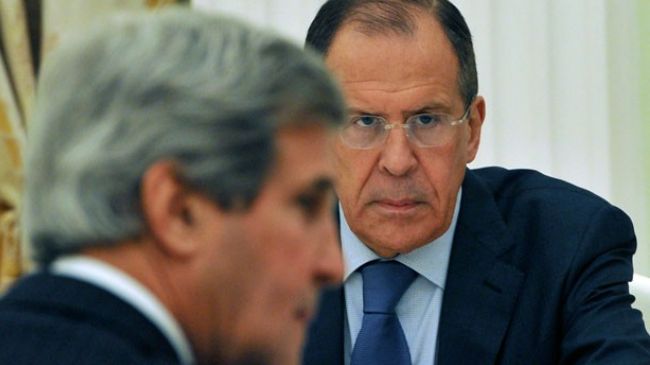
Press TV – June 7, 2013
Russia’s foreign minister has censured the US Department of State officials for their ‘peculiar comment’ on the results of a trilateral meeting over Syria in Geneva.
The trilateral meeting on Wednesday was held with the participation of UN-Arab League Special Representative for Syria Lakhdar Brahimi and representatives from Russia and the United States. It served as a preparatory move to pave the way for the Geneva 2 talks on the issue of Syria.
During a Thursday press conference, Russian Foreign Minister Sergei Lavrov said, “I have heard that officials from the US Department of State have given a very peculiar comment on the results of yesterday’s meeting in Geneva between Russia, US, and UN.”
“In particular, the State Department representative stated that Russia, the United States and the United Nations agree that the goal of the new conference in Geneva must be the forming of a new transitional government in Syria. This really matches with what was written down last year,” he said.
“But, if the reports that I have received are true, the State Department went on to add that this should be a transitional government to which the current authorities in Damascus would hand over all their powers. If this was really said by the State Department, this is a very strong distortion of what the talks were about,” the Russian foreign minister added.
He made the remarks in response to an earlier statement by Jennifer Psaki, a spokesperson for the US Department of State, where she reportedly claimed that participants in the preparatory meeting had agreed that the forthcoming talks on Syria should focus on the formation of a transitional government, to which the current administration should give up all powers.
Lavrov further reiterated that Moscow would continue to push for Iran’s participation in the upcoming Geneva meeting despite opposition from some Western states.
Meanwhile, Brahimi has expressed hope that the Geneva conference would convene in July, as the preparatory meeting failed to set a date.
Featured Video

Dan Dicks with James Corbett on Solutions Watch
or go to
Aletho News Archives – Video-Images
From the Archives
MMR (Measles, Mumps and Rubella) – Vaccine Risk Statement
MMR Vaccine (Measles, Mumps, and Rubella) Is It Safer Than Measles, Mumps and Rubella?
Physicians for Informed Consent | December 2024
… It has not been proven that the MMR vaccine is safer than measles, mumps, and rubella. The vaccine package insert raises questions about safety testing for cancer, genetic mutations, and impaired fertility. Although VAERS tracks some adverse events, it is too inaccurate to measure against the risk of measles, mumps, and rubella. Clinical trials do not have the ability to detect less common adverse reactions, and epidemiological studies are limited by the effects of chance and possible confounders. Safety studies of the MMR vaccine are particularly lacking in statistical power. A review of more than 60 MMR vaccine studies conducted for the Cochrane Library states, “The design and reporting of safety outcomes in MMR vaccine studies, both pre- and post-marketing, are largely inadequate.”19 Because permanent sequelae (aftereffects) from measles, mumps, and rubella are so rare (especially in children with normal levels of vitamin A and infected after birth),6,15-17 the level of accuracy of the research studies available is insufficient to rule out the possibility that the MMR vaccine causes greater death or permanent disability than measles, mumps, and rubella. – Read full article
Blog Roll
 Aletho News
- The fallacy of US delusions about Iran’s economic collapse
- Hezbollah denies Syria cell link, warns of Israeli plan to sow discord
- The legacy of US sanctions, war, and occupation in Iraq
- Iraqi resistance group rejects disarmament, vows to maintain support for Lebanon
- Sheikh al-Asadi warns of Iraqi government compliance with US demands
- How to MAKE THE CONSPIRATORS PAY for their crimes! Dan Dicks with James Corbett on Solutions Watch
- There’s a drought in academia: A drought in honest research on the subject of drought and other weather extremes
- Department of War Awards $20.7 Billion Contract to Raytheon for Air-to-Air Missiles
- ‘Distance yourselves from Israel’: IRGC urges US population to question govt policies
- America’s Greenland deal has a radioactive backstory
- If Americans Knew
- As settlers ravage West Bank, Israeli forces kill 10 in Gaza – Daily Update
- New Report: “Scholasticide and Genocide in Gaza: Assessment, Testimonies and Legal Analysis”
- Ex-Biden officials are desperate for a Gaza scapegoat
- Israeli “settlers” Invade Al-Aqsa; Pour Boiling Water on 75-Year-Old
- Israel Has Kidnapped Another American Teenager
- US arms sales to Israel worth $21.6 billion in 20 months
- Three Palestinians Killed in Israeli Attacks on Gaza
- Revealed: German “Anti-Semitism Expert” Driving Crackdown on Palestine Solidarity is Former Israeli Spy
- Egypt’s Warning to Israel Before Oct 7
- Israel’s siege signals another cruel winter for 1.8 million Gazans – Daily Update
- No Tricks Zone
- Two More Paleo Reconstructions Affirm Meters-Higher Sea Levels Across Ireland, Brazil 7000-6000 Years Ago
- New Study: Earth And Venus Surface Warmth Largely Explained By Convection And Lapse Rate, Not CO2 Or Radiation
- 2025 Nature Paper Claiming Worsening Global Drought Gets RETRACTED …Heavily Flawed
- New Study: ‘Global Drought Shows No Detectable Recent Acceleration Under Climate Warming’
- Economic Masterminds: German Socialists Suggest Taxing Productivity Gains Stemming From Using AI
- The South China Sea Has Not Been Cooperating With The Climate Change Narrative
- Energy Crisis: Germany Enters Heating Season With Historically Low Gas Reserve Fill Levels
- New Study: The Antarctic Ice Sheet Gained Mass From 2020-2024 Due To Staggering Snow And Ice Accumulation
- Study: Ocean Heating Rates From Thousands Of Years Ago ‘Dwarf’ Modern Ocean Heating Rates
- Climate Extremists Target, Attack Large-Scale Power Grid Infrastructure In Germany!

