NATO commander reveals plans for intervention in Syria
Press TV – March 20, 2013
NATO’s supreme commander says the alliance is drawing up contingency plans for a possible military intervention in Syria.
Admiral James Stavridis, commander of US European Command, said at the Senate Armed Services Committee that US military would be ready to take part in the aggression, the Washington Post reported on Tuesday.
Stavridis also serves as NATO’s Supreme Allied Commander Europe (SACEUR).
The United States is “looking at a variety of operations. We are prepared if called upon to be engaged,” he said.
The US commander said the 28-member military alliance is also looking into the option of assisting the foreign-backed militants fighting against the Syrian government.
Stavridis further added that the negotiations within the NATO member states also concentrated on imposing a no-fly zone over Syria and providing lethal support to the militants.
The official confirmed that targeting Syria’s air defenses would also be taken into consideration.
On March 18, US Secretary of State John Kerry said Washington would not ‘stand in the way’ of Europeans if they decide to arm the militants fighting against the Syrian government.
The Los Angeles Times reported on March 16 that the CIA is considering a secret contingency plan to expand the US assassination drone strikes to Syria, according to former and current US officials.
The US publicly claims that its role in Syria is merely limited to providing food and medical supplies to the anti-government militants, but the Croatian daily Jutarnji List revealed on March 7 that the US has coordinated shipments of weapons from Croatia to the militants in Syria.
The report said 3,000 tons of weapons in 75 planeloads have been transferred from Zagreb to the militants in Syria via Jordan and Turkey. The weapons were reportedly paid for by Saudi Arabia at the request of the US.
Use of chemical weapons, “first act” by opposition interim government
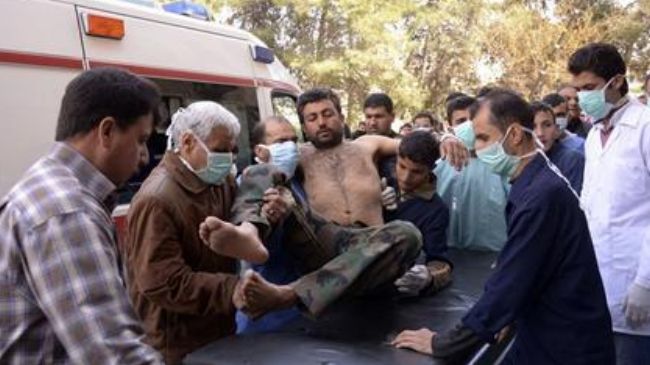
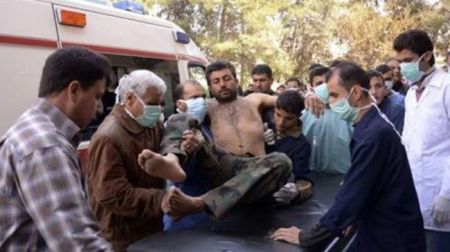 Residents and medics transport a Syrian soldier, wounded in Aleppo chemical attack, to hospital on March 19, 2013.
Press TV – March 19, 2013
Syrian Information Minister Omran al-Zoubi has described militants’ use of chemical weapons as the “first act” by the so-called opposition interim government.
The Syrian minister also said that Turkey and Qatar, which support militants fighting against the government of President Bashar al-Assad, bore “legal, moral and political responsibility” for the chemical attack in the northern city of Aleppo on Tuesday.
At least 25 people were killed and 86 others were injured after militants fired rocks containing “poisonous gases” into Aleppo’s Khan al-Assal village. Women and children are reported to be among the victims.
According to a Reuters photographer in Aleppo, victims of attack were suffering breathing problems.
“I saw mostly women and children. They (witnesses) said that people were suffocating in the streets and the air smelt strongly of chlorine,” he said adding that “people were dying in the streets and in their houses.”
Foreign-backed militants, who had threatened to use chemical weapons against the army government forces and Assad supporters a few months ago, have denied using chemical weapons and have accused government forces of being behind the attack.
The attack comes hours after Syria’s opposition National Coalition elected Ghassan Hitto, a former US-based IT executive, as prime minister for what it called an interim government.
UK Media Morality
By John Andrews | Dissident Voice | March 18th, 2013
The editorial page of last Saturday’s Times led with the following headline: “Arm the Rebels”.
Editorials seldom have the name of the writer attached to them, which is possibly very useful in the case of this particular article. The piece refers to the suggestion that the British government is poised to begin (officially) supplying military hardware to the militants who are at war with the Syrian government. The article insists that the government get on with doing so… and that, my friends, is incitement to break international law. Chapter one of the UN Charter (an international law), article two, paragraph 4 reads:
“All Members shall refrain in their international relations from the threat or use of force against the territorial integrity or political independence of any state, or in any other manner inconsistent with the Purposes of the United Nations.”
No resolution demanding the overthrow of President Assad has been passed by the general assembly of the United Nations – nor even its cynical “security” council. The UK is a founder member of the United Nations and it really ought not to be breaking its own laws: what sort of example is that to be setting to the plebs? Of course lawyers would argue that the law does not specifically forbid the provision of military hardware to militant anti-government extremists. However, such an action could be said to be an “other manner inconsistent with the Purposes of the United Nations” – one of which is clearly stated in article one paragraph one as “to maintain peace and security”.
The Times editorial opens its argument with a subheading that reads:
“It is no longer strategically or morally tenable to stand by while Iran and Russia ship weapons to the Assad regime for use against Syrian rebels and civilians.”
As with so many articles in the Times, the content fails to deliver what is promised in the heading. We see not one word of evidence to justify the use of the word “strategically”. Why is the situation in Syria of any “strategic” importance to the interests of sixty million people in a country 3,000 miles away, with no significant economic or diplomatic links? The Times gives no answer.
As for morality, well… what can you say? Here we are being lectured on morality by someone who is openly calling for our government to break international law; and a quick glance at Britain’s “allies” in its disgraceful adventure in Syria is instructive. The anti-Assad militants are said to be resourced extensively from icons of freedom and democracy such as Bahrain and Saudi Arabia which, by the way, just happened to be carrying out some routine executions of some men convicted of theft (some of whom were just juveniles when the crimes were committed) during a chummy visit by Prince Charles. But the morality of making allies of dictatorial tyrants who routinely murder their own country’s children doesn’t seem overly to trouble the Times. Who said satire was dead?
As for the argument about standing by “while Iran and Russia ship weapons to the Assad regime” … there’s one small flaw in that point. The Assad “regime” happens to be the legitimate government of Syria. It’s perfectly within its rights to buy whatever it likes from whomever it likes – cynical trade sanctions notwithstanding, obviously.
You have to wonder what the Times leader-writer would say if there were armed extremists from foreign lands running wild around Britain, murdering, raping and looting; and some foreign country with a sizable interest in selling military hardware and a known fondness for looting distant lands demanded the right to supply those extremists with their wares on the grounds that the British government, whilst trying to do its job to protect its people, was using some military equipment known to be supplied from the United States. Would The Times also support the right of that country to supply those extremists, I wonder, for the sake of morality.
The Times is no stranger to the courtroom. Its legal experts will know, just as our trusted political leaders who’re supporting the outrageous events in Syria know, that having a law is one thing, enforcing it is something quite different. You can quite literally get away with murder if no one is able to stop you or call you to account; and you can break international laws with just as much impunity, if the world’s only superpower says it’s O.K. But that doesn’t make the thing right, does it. Still, what could I possibly know about morality; I’m sure The Times knows much more about the subject than I do.
~
John Andrews is a writer whose latest book is The People’s Constitution. He can be contacted through his website.
Iraq and Iran’s Oil and Gas Pipeline Politics
By Elie Chalhoub | Al-Akhbar | March 14, 2013
Away from the region’s headlines and wars, plans are being methodically put in place that could redraw the strategic map of the Middle East, erasing one of the region’s key colonial-era features.
Recent moves by Iran and Iraq to press ahead with the construction of a series of new oil and gas export pipelines could be attributed to Iran’s bid to counter international sanctions. The planned pipelines could also reflect Iraq’s economic recovery or perhaps pressure from oil companies for new export routes.
There may be some truth to these explanations. But a closer look makes clear that these schemes are related.
The short-term aims are evident. They include trying to lure Jordan into the region’s “resistance” axis and reducing American influence on Iran’s eastern neighbor Pakistan.
But the long-term objective is more ambitious: to connect the Middle East by way of a web of economic ties that binds them into a regional partnership whose mainstays are Iran and Iraq.
Baghdad is making it increasingly clear where it stands in terms of its regional alignment. In recent months, it has openly supported Syrian President Bashar al-Assad’s regime in Damascus, clashed with Ankara, reached out to Cairo, and been at odds with Riyadh and Doha.
The pipeline schemes also underscore Iraq’s chosen course. The country has opted to assume a role consistent with its historical legacy and its economic and strategic clout.
Iran Lures Pakistan
The latest move in this regard was Monday’s pipeline inauguration by Iranian President Mahmoud Ahmadinejad and Pakistani President Asif Ali Zardari. The pipeline will transport Iranian natural gas to Asian markets via Pakistani territory, providing Pakistan with desperately needed energy supplies.
Negotiations between the two countries began almost a decade ago, but were frequently stalled due to opposition from the US. Washington has long sought to thwart any scheme for transporting oil and gas from or through Iran.
During that period, Iran completed its section of the pipeline from the Pars gas field in the south of the country to the Pakistani border town of Multan. It has a capacity of 750 million cubic meters per day.
Tehran has undertaken to cover a third of the $1.5 billion cost of the 780-km Pakistani section of the pipeline, with the Pakistani government funding the rest.
Wooing Jordan and Egypt
Meanwhile, Iraq and Jordan have begun work on building parallel oil and gas pipelines connecting southern Iraq to the Red Sea port of Aqaba, with the possibility of extending the link to Egypt.
The 1,690-km line, which will take two to three years to complete, is to run from Basra to Haditha west of Baghdad then into Jordanian territory and south to Aqaba. Contracts for the Jordanian portion are to be awarded to companies on a build-operate-transfer basis, with ownership reverting to the Iraqi government after 20 years.
Under the agreement, the oil pipeline will provide Jordan with 150,000 barrels of Iraqi oil per day for domestic use at preferential prices (around $20 dollars per barrel below market). Apart from putting an end to Jordan’s chronic fuel crises, the scheme is expected to benefit the country to the tune of $3 billion per year.
A planned second phase of the project envisions the building of a western spur from Haditha through Syrian territory to pump 1.25 million barrels of oil per day to the Syrian Mediterranean port of Banias.
Sustaining Syria
Meanwhile, plans are being developed for a 5,000-km link to transport Iranian gas to Iraq and Syria and on into Europe, providing Iran with an export route that bypasses the Gulf.
Iran and Iraq are due to sign an agreement on the first phase of the project on 20 March. This would enable Iran to pump 25 million cubic meters of gas a day to Iraq. Proposed extensions to the line envision it supplying Jordan and Lebanon with gas.
Iran shares the Pars field – the world’s largest gas field with an estimated 14 trillion cubic meters of gas, around 8 percent of total proven world reserves – with Qatar. The emirate recently unveiled its own plans for a pipeline to carry gas through Saudi, Jordanian, Syrian and Turkish territory to Europe.
Related articles
- US threatens Pakistan with sanctions over gas pipeline deal with Iran (alethonews.wordpress.com)
- Iran-Iraq-Syria Gas Pipeline Project Agreement Finalized (alethonews.wordpress.com)
- Zardari, Ahmedinijad inaugurate Pak-Iran gas pipeline project (nation.com.pk)
Despite Civilian-Targeting US Sanctions, Damascus University Excels
By Franklin Lamb | Al-Manar | March 11, 2013
Damascus – Students everywhere are special people and this observer has discovered that Syrian students are among the very best.
Meeting and interviewing students again this past week, before and following a frank and enlightening discussion with Prof. Dr. Mohammad Amer Al-Mardini, the indefatigable President of Damascus University, about the situation of the students and current instruction at the University, one cannot, even as a foreigner, fail to feel pride in Syrian students.
Good meeting places, among others on campus, include “outdoor cafes” — a ‘street student union’ of sorts — consisting of a few chairs and portable tables. They are scattered among the dozens of vendor stalls that line “DU Boulevard” outside the main DU campus in central Damascus. Here students can buy everything from school supplies to mobile phones to snacks. It’s a perfect place to meet and chat with students.
One learns from them about the many effects on the education system in Syria of the US-led sanctions. Some argue that the Obama administration actually fuels the current crisis with its sanctions and achieves the opposite result of what the White House and its allies claim they are seeking.
These freewheeling discussions leave a foreigner with a reminder why this student body ranks among the best in the World. How Damascus University has to date reacted to this crisis evidences the same status.
Currently there are more than 200,000 full-time and ‘open-learning’ students at Damascus University, the 6th largest in the World. The core institutes of the University were established in 1901; they were the medicine and law institutes that formed the basis of the Syrian University that was established in 1923. In 1958, it got its current name, Damascus University when Aleppo University was established.
All of the students are feeling the effects of the Obama Administration’s harsh civilian-targeting sanctions and many are increasingly in the cross-hairs of the “humanitarian sanctions which Washington and Brussels claim “exempt food, medicines and medical supplies” and therefore “should be considered humane.”
Among DU Faculties most severely affected by the US-led sanctions are the Science Departments and the Medical and Nursing schools according to administration and student sources. Chemicals used in various science classes, medicines and medical equipment cannot be found as before and if some are brought in from Europe or elsewhere, the University often has to pay four times the normal price.
Utah’s Brigham Young University gained the respect and appreciation of many in Syria for its shipments to DU’s nursing school of medicines and equipment and even “model doll babies” which in Syria use in baby care classes. All are now banned by the US sanctions which claim to exempt medical equipment and medicines.
Damascus University, with its 36 specialized faculties and five higher institutes is no banking-hours institution and its proven commitment is to give the highest possible quality education to as many students as possible. Syria’s largest university is now open for classes 365 days a year minus a few holidays and a few short breaks for her professors and overworked staff, partly due to the increased number of students arriving from across Syria. The DU administration and faculty work with faculties in war zones to guarantee students can continue their studies without missing key exams required for semester advancement. Still, about 20% of college level students are unable to attend due to transportation and displacement problems.
One direct and predictable severe impact of the US-led civilian-targeting sanctions in Syria is that they have essentially stranded approximately 700 Damascus University students in Europe and half a dozen in the US, forcing some to take leaves of absence and find jobs to survive. This is because, as is well known among the US Treasury Department “craftsmen” who devise the sanctions, these students are no longer able to receive funds for Damascus University to pay for their foreign tuition or living expenses because the banking system has been essentially shut down. More than 1500 Syrian students from other institution of higher learning are similarly stranded as a direct result of the US-led sanctions.
Never the less, Damascus University keeps its commitment to pay the students their tuition fees and their living cost as they are on full scholarships. Currently, parents must pick up the funds from the University accountant and find a way to transfer them. Should they decide to send it via Western Union, for example, a new “sanctions surcharge” of 70 euros for every 1,000 euros sent, is demanded by WU and other money transfer agencies, suggesting another form of war profiteering.
To make things even more difficult for the students, foreign universities which might consider lending their stranded Syrian students tuition money or might even consider aiding them with scholarships or a grant have been “chilled” and are backing-off because these institutions do not want to be accused of “sanction-busting” by the US Treasury hound dogs.
Few food or medicine suppliers — given the sanctions’ language, the meanings of which is uncertain even for their own lawyers, some of whom have declared it incomprehensible — want to risk the wrath of the US Treasury Department and be slapped with severe penalties including very expensive fines by dealing with anyone in Syria.
One of the US Treasury hound dogs is David Cohen, Under-Secretary for Terrorism and Financial Intelligence. Late last month, Mr. Cohen made a trip to the region (including Israel) to brief allies and businesses as well as NGO’s “to be sure the sanctions were biting hard” to use a favorite phase of UN Ambassador Susan Rice. The Obama administration, reportedly frustrated by the fact that its multi-tiered sanctions have failed to topple the governments of Syria and Iran, has been attempting to find and plug loopholes in the sanctions and are intensifying warnings to the international community not to mess with the US Office of Terrorism and Financial Intelligence (TFI) or the Office of Financial Assets Control (OFAC) by getting all wobbly-kneed and going soft on full sanction enforcement.
Meanwhile, Syria’s Department of Education is joining the struggle to shield Syria’s education institutions and is being joined by various student associations. To date, the Ministry of Education and Higher Education have not cut their substantial disbursements to schools and faculties. Tuition remains among the lowest in the world (almost free; 5 US $ a year with the current exchange rate) at Damascus University, which also provides housing for 15,000 students. The DU administration is currently under pressure to find more dormitory space for those needing housing.
Still, despite the conflict, even in Deraa near the Jordanian border where the current crisis started, DU’s campus continues to function.
Many DU students are also volunteering with assisting Syrian primary schools which urgently need their help. According to a December 2012 UNICEF education assessment of primary schools in Syria — at least 2,400 schools have been damaged or destroyed, including 772 in Idlib (50 per cent of the total), 300 in Aleppo and another 300 in Deraa. Over 1,500 schools are being used as shelters for displaced persons. The Damascus University community has also taken on the humanitarian challenge of assisting sister educational institutions that have been affected by the current crisis including campuses in Homs, Deir al Zur and Aleppo, among others.
This observer has met several Damascus University students among the 9,000 volunteers, including Palestinian refugees, who are donating their time working with the Syria Red Crescent Society (SARCS). Many DU students are also volunteering by assisting at primary schools.
The grim reality for Syrian families, hospitals, health care facilities and now university students and educational institutions across the country is that the claimed “humanitarian” exemptions for food, medicine and medical equipment is little more than News-Speak.
Rather than target the people who represent Syria’s future leaders, the White House would do better to cancel its sanctions and send Secretary Kerry to Damascus to meet face-to-face with the Syrian people and government and demonstrate a real American interest in stopping the bloodshed. Armored vehicles and assorted “non-lethal aid” to one side in this conflict will only prolong the killing, as any student here will attest.
Franklin Lamb is doing research in Syria and can be reached c/o fplamb@gmail.com
Captive Ukrainian journalist escapes Syrian rebels
RT | March 11, 2013
 After five months of captivity in fear of execution, Ukrainian journalist Anhar Kochneva has safely escaped from Syrian rebels, Kochneva’s ex-husband told RT.
Relatives and friends of the journalist said Kochneva managed to escape the building she was kept in, and hid from the pursuers in the mountains. She then had to walk about 15km before reaching Syrian army forces, and is now travelling to Damascus in safety.
Kochneva ironically wrote she’s “back from the Wonderland” in a short LiveJournal post, promising some further details later.
She also confirmed the details of her escape in two brief media interviews, saying the captors mistreated her, and she decided to run away for the fear that they would kill her and blame government forces for another death. Kochneva said she had to live in a cold room with a broken window, leaving her health in a terrible state.
Despite this, the journalist vowed to remain in Syria and continue to highlight the ongoing conflict.
“The world is just blind… I will definitely do everything for the people to discover, what is really going on here,” Kochneva told Business FM, saying Syria is “a friend in need”.
Anhar Kochneva, who had reported critically about the Syrian rebels for Russian and Ukrainian news outlets, was captured in the beginning of October 2012 near the city of Homs. The city, seen as the cradle of the Syrian revolution, has recently been going through frequent fighting outbursts, which Kochneva was following at the time of her capture.
The kidnappers, members of the Free Syrian Army, had repeatedly threatened to kill the journalist in December, if a US$50 million ransom was not paid. They later lowered the sum to reportedly $300,000, and announced they had “spared” Kochneva for the time being.
Kochneva’s relatives said they had been unaware of her fate since New Year, and accused the Ukrainian Foreign Ministry of being “inactive” and “ignoring the negotiation process.”
Syrian rebels, who had been in contact with the journalist’s former husband, also claimed that Ukrainian authorities were doing nothing. The rebels uploaded several videos of Kochneva last year, in which she admitted to having participated in the fighting, and of working as a military interpreter with Syrian and Russian officers.
International groups like the Committee to Protect Journalists, ARTICLE 19, the International Press Institute and Reporters Without Borders have questioned the objectivity of these videos, saying the journalist appeared to be speaking under pressure.
The groups urged the Free Syrian Army and the Syrian Opposition Coalition to ensure that the journalist is safe and set free, and called for world governments to assist in her release.
The Foreign Ministry of Ukraine has said that it was taking all necessary measures to free the journalist and urged Damascus for “concrete results” in attempts to release her.
The ministry has confirmed on Monday that Kochneva is free, without elaborating on the circumstances of her escape.
Free to go…not! Syrian rebels backpedal over UN hostages
RT | March 8, 2013
The Syrian rebels who captured a group of Filipino UN peacekeepers failed to release them despite earlier promises to hand over the hostages to the Red Cross, the Philippines government said.
The Syrian militant group that had captured 21 blue helmet troops in Golan Heights is sticking to its initial demands, said the spokesman for the Philippines Department of Foreign Affairs, Raul Hernandez. After seizing the peacekeepers on Wednesday, the Syrian rebels demanded that Syrian government forces withdraw from the village of Jamlah in exchange for the release of the captives.
The abrupt change of plans appears a sign of discord among the Syrian rebel group, which is detaining the Filipinos. Earlier on Friday they seemed to have played down their demands, calling the hostages “guests” and stressing that they would not harm them.
It comes after the Syrian Observatory for Human Rights released a video showing some of the 21 peacekeepers, with one man – who identified himself as a captain in the UN Philippines battalion – saying that he and his men are in “a safe place.”
The peacekeepers were taken by Syrian rebels in Golan Heights, a territory that Israel captured from Syria in 1967. The land grab was not recognized as legitimate by either Syria or the international community.
The UN has maintained a peacekeeping force in the area to maintain the ceasefire between Israel and Syria since 1974. As of late January, there were more than 1,000 troops and about 100 civilian personnel deployed there.
A flurry of condemnation followed the ill-fated capture, as the countries and organizations usually seen as supporters of the Syrian armed opposition demanded their freedom. The US called it “absolutely unacceptable,” while the EU called such moves “serious breaches of international law.”
The UN and the Philippines government had condemned the capture of the peacekeepers and urged the insurgents to immediately release them. Russia’s UN envoy Vitaly Churkin said the seizure of the UN observers showed “gross disrespect for the United Nations.”
It’s not clear whether the militant group had changed their intentions about the hostages due to the international pressure or because they thought that holding UN personnel does not give them enough leverage on the Syrian government to force their troops out of Jamlah.
The incident will not make the UN withdraw its peacekeeping force from the Golan Heights, UN spokesman Martin Nesirky said.
Related articles
U.S. Policy Shift on Syria: Edging Closer to Direct Military Intervention
By Ben Schreiner | Aletho News | March 1, 2013
Though President Obama last year rejected a proposal from the State Department, Pentagon, and CIA to directly arm Syrian rebel fighters, his administration is once again edging closer to directly intervening in the Syrian war.
As the Washington Post reported Tuesday, “The Obama administration is moving toward a major policy shift on Syria that could provide the rebels with equipment such as body armor, armored vehicles and possible military training and could send humanitarian assistance directly to Syria’s opposition political coalition.”
White House spokesperson Jay Carney confirmed the Post‘s reporting Wednesday, stating that the U.S. is “constantly reviewing the nature of the assistance we provide to both the Syrian people, in form of humanitarian assistance, and to the Syrian opposition in the form of non-lethal assistance.”
The exact nature of the additional U.S. assistance is expected to be announced Thursday at a meeting of the “Friends of Syria” in Rome. The U.S. has previously sent communications equipment and night-vision goggles to rebels fighting in Syria.
John Kerry the Interventionist
The – perhaps – unlikely driver of the reported shift in U.S. policy on Syria has been none other than new Secretary of State John Kerry. The very man many continue to insist on mislabeling a dove.
Speaking as early as February 13, Secretary of State Kerry proclaimed that there were “additional things that can be done” to force Syrian President Bashar al-Assad aside. And on Monday, Kerry again went on to reiterate that the West was “determined to change the calculation on the ground for President Assad.”
“We are examining and developing ways to accelerate the political transition that the Syrian people want and deserve,” Kerry commented further.
Although a policy change for the Obama administration, advocating for a more direct role for the U.S. in Syria has long been Kerry’s position. As Kerry commented in May of 2012: “The concept of a safe zone is a reality and worth the discussion. The concept of working with the Turks and the Jordanians, if everybody is on the same page, there could be some [military] training [of the opposition forces]. If we can enhance the unity of the opposition, we could consider lethal aid and those kinds of things.”
In the same interview Kerry went on to voice support – under the right conditions – for “U.S.- or NATO-led airstrikes on the Syrian military.”
This should come as no surprise given Kerry’s previous support for U.S. bombing campaigns in Serbia, Afghanistan, Iraq, and Libya. Some dove! Of course, the American foreign policy establishment as a whole has steadily veered toward a greater affinity for missile and bomb diplomacy.
“Once war was considered the business of soldiers, international relations the concern of diplomats,” C. Wright Mills wrote of the U.S. over 50 years ago in The Power Elite. “But now that war has become seemingly total and seemingly permanent… Peace is no longer serious; only war is serious.”
If nothing else, then, Kerry has proven himself once again to be a rather “serious” man.
Intervention by Proxy
While Kerry helps edge Washington closer to direct military intervention into Syria, U.S. proxies continue to ramp up their campaign to topple the Syrian regime.
As the New York Times reported Monday, Saudi Arabia has recently begun to funnel heavy weapons purchased from Croatia to Syrian rebel groups via Jordan. The Saudi shipments, the paper goes on to note, “have been a factor in the rebels’ small tactical gains this winter against the army and militias loyal to Mr. Assad.”
The U.S. role in the Saudi arms flow, the Times reports, “is not clear.” Yet, it is hard to fathom that such shipments were not sanctioned by Washington, given the close military ties the U.S. maintains between those involved. After all, Saudi Arabia remains one of the largest purchasers of U.S. arms. The Pentagon, meanwhile, maintains “a robust military-to-military relationship with Croatia,” providing the Croatian military with “training, equipment, equipment loans, and education in U.S. military schools.” And U.S. military aid to Jordan tops $300 million a year.
Moreover, the U.S. has had upwards of 150 military planners stationed along the Jordanian border with Syria since last summer, where the Croatian arms are reported to have passed into rebel hands. It has long been reported that the CIA is overseeing the arms shipments to Syrian rebels from within Turkey.
The U.S. is thus already well entangled in the Syrian war – albeit if by the use of proxy forces.
Thwarting Dialogue
The push to further enhance the degree of U.S. intervention – from guiding regional proxies to direct military support – comes as the rebel drive to oust Assad appears to be reaching its limits. In fact, Mouaz Mustafa, the political director of the U.S.-based Syrian American Task Forced, recently argued that, “Assad cannot be deposed without the consent of the U.S.”
This realization has even left some in the West to admit that Assad still retains a sizable base of domestic support. As former U.S. diplomat Karen AbuZayd commented in a recent interview with CBC Radio, “there’s quite a number of the population, maybe as many as half, if not more, who stand behind him [Assad].”
Thus, we see the exiled Syrian opposition – long opposed to dialogue – now hinting at a new willingness to engage in negotiations with the Syrian regime. Yet, the U.S. continues to insist that any political dialogue must be preempted by regime change.
As State Department spokesperson Patrick Ventrell commented on Wednesday, “the [political] process has to include Assad leaving, but it’s really up to the Syrian people.” Another example of the limits of America’s democratic ideals, as we see that the choice for the Syrian people begins and ends with supporting Washington’s agenda.
Of course, as long as a sizable segment of Syrians stand behind Assad – or at least refrain from supporting the armed rebels – demanding that Assad leaves only portends a protracted military struggle. As Russian Foreign Minister Sergey Lavrov was left to comment Monday, “It seems extremists, who bet on a military solution to Syria’s problems and block initiatives to start dialogue, have for now come to dominate in the ranks of the Syrian opposition.” And the ranks of Washington, it appears as well.
Yet, even as Washington and its European allies antagonize Russia by preparing to heighten their intervention into Syria, they still desperately seek the legitimacy of a United Nations Security Council resolution endorsing a military intervention. And for this they need Moscow.
Cajoling Russia to Pave the Road to Tehran
Writing in Foreign Policy, Christopher Chivvis of the RAND Corporation and Edward Joseph, a senior fellow at the Johns Hopkins School of Advanced International Studies, argue that the threat of Western military intervention is what is needed to bring Russia around to supporting the “regime change” line.
“Changing the Russian position means changing Moscow’s calculus on Syria,” Chivvis and Joseph write. “And that means presenting the Kremlin with an alternative that it finds more unpalatable than the status quo: a NATO-backed, Turkey-led military coalition invited by the Arab League to intervene in the Syria conflict.”
And here we have the bankruptcy and hubris of the American foreign policy elite. It’s all rather transparent: capitulate to our demands, or face the brunt of military force. Only war is serious.
Of course, Chivvis and Joseph go on to tout the “blow to Iran and a boon to the United States and its regional partners and allies” a toppled Assad would present. “Israel would be a primary beneficiary, with its antagonist, Hezbollah, having been dealt a serious setback,” they continue.
How all this is supposed to entice Moscow is not exactly clear. What is good for American is good for the world, it appears. Indicative, perhaps, of what Chalmers Johnson once wrote to be the self-aggrandizement of imperial rot.
And so with the typical delusions of grandeur, the U.S. edges closer to direct military intervention into Syria – closer, too, to unleashing a dangerous regional conflagration. In fact, the Iran war drums are already beating louder; for regime change in Damascus only paves the road to Tehran.
Ben Schreiner can be reached at: bnschreiner@gmail.com.
Related articles
Report: US and Allies Are Training Rebels in Fight against Assad
Al-Manar | March 1, 2013
The Times published on Friday a report under the headline “US and Allies Are Training Rebels in Fight against Assad”.
The British paper said that “the US and several of its European allies are overseeing training bases for the Syrian rebels in Jordan in an effort to bolster moderate groups fighting to overthrow President (Bashar) Assad.”
The paper indicated that “the move is the most far-reaching US involvement yet in the Syrian crisis and reflects broader Western concerns that Islamic militants such as Jabhat Al-Nusra (Front) are making the running in the battle against the regime.”
It further quoted intelligence officers and diplomats in the region as saying that “rebel fighters are being offered training ranging from the use of light arms to more complicated maneuvers, such as how to secure chemical-weapons facilities.”
Jordan: A Limited Strategic Shift
By Elie Chalhoub | Al-Akhbar | February 27, 2013
Jordanian King Abdullah II’s recent visit to Moscow crowned a series of steps that Amman has been taking over the past few months, signalling a shift away from its traditional allies like Washington and Israel.
Until recently, Jordan was in the warm embrace of oil-rich Gulf Arab countries that, prepared to admit the Hashemite kingdom into their Gulf Cooperation Council (GCC), would then shower it with billions in aid.
This is while Amman offered the services of its security and intelligence forces, coordinating closely with both Washington and Tel Aviv in a variety of areas, not least of which the unfolding crisis in Syria.
According to informed sources, last July 2012, Amman hosted a gathering of security officials from the US, Qatar, and Israel, who recommended setting up training camps for Syrian opposition fighters near the Jordanian city of Irbid.
US Secretary of Defense Leon Panetta admitted as much when he acknowledged in October 2012 that dozens of American soldiers were deployed along the Jordanian-Syrian border, explaining that “these units are tasked with establishing a base in Jordan and to assist the Syrian refugees and Jordanian armed forces to confront the dangers stemming from Syria’s chemical weapons.”
In the last few months Amman has begun to reassess its alliances in light of the Syrian crisis, perhaps embarking on a process of strategic realignment, moving closer to Iraq and Russia, at the expense of its traditional allies.
The prospective threat posed by the powerful Jordanian Muslim Brotherhood and the more radical Islamist currents prompted the army and intelligence to convince the palace not to go along with Washington’s plan.
Amman even went so far as to completely close its border with Syria, preventing fighters and weapons from crossing it.
This came at a high cost for Jordan, as Saudi Arabia and Qatar – who were mobilizing all the forces they could muster against the Bashar al-Assad regime – to halt their support for the kingdom, causing a serious economic crisis in the country.
Iraq quickly moved in to try to fill the void and revive its once close ties with Jordan. An official visit to Amman by Iraqi Prime Minister Nouri al-Maliki at the end of 2012 led to the signing of several lucrative deals that would see cheap Iraqi oil once again flowing to Jordan.
As for Jordan’s relationship with Iran, “that’s a tough one for us,” says a high-level Jordanian security official, pointing out that the realignment underway may go far, “but it has its limits, for there are lines that cannot be crossed, and Iran lies outside these boundaries.”
In light of all this, King Abdullah II’s visit to Moscow on Tuesday, February 19 cannot in any way be seen simply as a routine call.
For its part, Jordan is seeking a counterbalance to US influence, for fear that Washington is preparing to force Amman into accepting a confederation with the Palestinians as a solution to the Arab-Israeli conflict.
Russia, on the other hand, sees this as an opportunity to bring Amman into its orbit, particularly on the Syrian question, where Moscow is in the process of pushing for a settlement.
Jordan’s diplomatic support in the Arab arena and the valuable intelligence it can provide on the Syrian opposition make it a critical resource for the Russians.
Featured Video
No Vote, No Representation, No State: Democracy, Israeli Style
or go to
Aletho News Archives – Video-Images
From the Archives
Sanctions, War and the Policy of Dual Containment
By SASAN FAYAZMANESH | March 17, 2008
It is now nearly three decades since the Unites States adopted the policy of dual containment of Iran and Iraq. While much has been written about the containment of Iraq, there has been very little in-depth analysis of this policy when it comes to Iran. In a book that is going to be released on March 31, 2008, entitled The United States and Iran: Sanctions, Wars and the Policy of Dual Containment (Routledge), I attempt to address this shortcoming by investigating when and why the US policy of containment of Iran came about, how it evolved, and where it stands today.[1] To the extent that Israel has been involved in US policy making, the study will also include the role that Israel has played in the containment of Iran. Also, since the fate of Iran has been inextricably linked to that of Iraq, occasionally the investigation will overlap with the containment of Iraq.
The policy of dual containment of Iran and Iraq originated during the Carter Administration, but it was not until the Clinton Administration that the expression “dual containment” became popular. … continue
Blog Roll
 Aletho News
- Americans are paying the price to preserve Israel’s nuclear hegemony
- Resistance factions are necessary to ensure a permanent US Iraq withdrawal
- How Israel destabilizes the Middle East: Denying sovereignty and the right to exist
- Europe’s Establishment Is Embracing War – and Losing Voters
- NATO chief advocates war of aggression
- No Vote, No Representation, No State: Democracy, Israeli Style
- Zionist Bought Senate Blocks Information About American Citizens Killed By Israel
- While Gaza dominates the UN, these are the people keeping it alive
- New Report: “Scholasticide and Genocide in Gaza: Assessment, Testimonies and Legal Analysis”
- ‘THAAD Delusion’: Iran war exposes US missile shield limits – The Atlantic
- If Americans Knew
- Eight Palestinians Killed in Israeli Attacks on Gaza
- Israeli former leaders and security chiefs threaten legal action over ‘Jewish terrorism’
- Israel map in LA Times ad includes all land from the river to the sea
- Inside Lebanon’s 200-page dossier on Israeli war crimes
- Flydubai, genocide, settler violence, Trump abuse of power to deport – Daily Update
- Counting Antisemitic Incidents: What the ADL Audit Reveals — and Obscures
- Mamdani releases plan to combat antisemitism and hate crimes in New York City
- Iran’s Revolutionary Guards Publish Letter to the American People
- DMFI launches $1 million ad campaign supporting Virginia’s Elaine Luria
- US Senate blocks resolution seeking report on Americans killed by Israel
- No Tricks Zone
- Green Energy Debacle: German Expert Professor Fritz Vahrenholt Warns Of Severe Economic And Social Consequences
- Two More Paleo Reconstructions Affirm Meters-Higher Sea Levels Across Ireland, Brazil 7000-6000 Years Ago
- New Study: Earth And Venus Surface Warmth Largely Explained By Convection And Lapse Rate, Not CO2 Or Radiation
- 2025 Nature Paper Claiming Worsening Global Drought Gets RETRACTED …Heavily Flawed
- New Study: ‘Global Drought Shows No Detectable Recent Acceleration Under Climate Warming’
- Economic Masterminds: German Socialists Suggest Taxing Productivity Gains Stemming From Using AI
- The South China Sea Has Not Been Cooperating With The Climate Change Narrative
- Energy Crisis: Germany Enters Heating Season With Historically Low Gas Reserve Fill Levels
- New Study: The Antarctic Ice Sheet Gained Mass From 2020-2024 Due To Staggering Snow And Ice Accumulation
- Study: Ocean Heating Rates From Thousands Of Years Ago ‘Dwarf’ Modern Ocean Heating Rates

