Turkish journalist acquitted over exposing Ankara’s arms aid to Syria militants

Erdem Gul, Ankara bureau chief of Turkish newspaper Cumhuriyet (Photo: Hurriyet Daily News )
Press TV – July 16, 2018
A court in Turkey has acquitted a journalist of the center-left and opposition daily newspaper Cumhuriyet, who was being tried for espionage in a case about revealing state secrets by publishing footage of a video showing weapons shipment to pockets of Syria held by foreign-backed terrorists.
On Monday, Istanbul’s 14th Heavy Penal Court dropped charges against Erdem Gul, who used to serve as the paper’s Ankara representative.
In May 2016, the 14th High Criminal Court in Istanbul convicted former editor-in-chief of Cumhuriyet daily Can Dundar and Gul following the publication of the video.
The two defendants were arrested and held in prison until Turkey’s Constitutional Court ruled that their rights had been violated and ordered their release.
Earlier this year, Turkey’s Supreme Court of Appeals overturned the Istanbul court’s previous ruling on the case, and ordered Gul’s acquittal over lack of evidence.
Back in May 2015, Cumhuriyet daily posted on its website footage showing Turkish security forces in early 2014 intercepting a convoy of trucks carrying arms for the militants in Syria.
The paper said the trucks were carrying some 1,000 mortar shells, hundreds of grenade launchers and more than 80,000 rounds of ammunition for light and heavy weapons.

A screen grab from a video published on the website of Cumhuriyet daily on May 29, 2015 shows mortar shells in boxes intercepted on a truck destined for Syria.
Ankara denied the allegation and claimed that the trucks had been carrying humanitarian aid to Syria. However, lawmaker from the opposition Republican People’s Party Enis Berberoglu defended the video, saying it was genuine.
Turkey stands accused of supporting militant groups fighting to topple the Damascus government since March 2011.
Syria has been gripped by foreign-backed militancy since March 2011. The Syrian government says the Israeli regime and its Western and regional allies are aiding Takfiri terrorist groups wreaking havoc in the country.
Russia has been helping Syrian forces in an ongoing battle in the province of Dayr al-Zawr as Daesh struggles to keep its last positions in eastern Syria.
The Russian military assistance, which began in September 2015 at the official request of the Syrian government, has proved effective as the Syrians continue to recapture key areas from Daesh and other terrorist groups across the country with the backing of Russia’s air cover.
On May 21, the General Command of the Syrian Army and Armed Forces announced in a statement that complete security was restored to Damascus and its countryside after al-Hajar al-Aswad district and al-Yarmouk camp had been totally purged of Daesh terrorists.
The development was preceded by flushing the Takfiris out of the towns of Yalda, Babbila and Beit Sahem on the southern outskirts of Damascus.
Trump Is Israel’s “Useful Idiot”

By Philip Giraldi | American Herald tribune | July 16, 2018
The claim made by many neoconservatives that Israel and the United States are partners in the Middle East because their strategic interests are identical is belied by the fact that the Israelis are more than willing to ignore Washington when its suits them to do so. The claim of identical interests has always been false, promoted by the Zionist media and an intensively lobbied Congress to make the lopsided relationship with an essentially racist and apartheid regime more palatable to the American public, but, in wake of the slaughter in Gaza and pending legislation in the Knesset empowering Israeli communities to ban non-Jewish residents, it completely lacks any credibility.
It would probably surprise most American friends of Israel to learn that Prime Minister Benjamin Netanyahu has visited Moscow three times so far this year, particularly as Russia has been getting vilified in the U.S. mainstream media on an almost daily basis. There is a reason for the Russophobia beyond what Moscow might or might not have done in the 2016 election. Russia has become a particular target of hostility for the burgeoning number of neoconservative foundations, also closely linked to Israel, whose funding from defense contractors depends on having a powerful enemy. The ability of Israel and its supporters to play both sides regardless of what the accepted perception of what American interests might be should therefore be an issue of some concern.
The United States military is deeply engaged in Syria, in part due to Israeli pressure, seeking to depose the existing government of President Bashar al-Assad and replace it with a Syria composed primarily of fragmented local jurisdictions representing tribal and religious groups rather than a unified state. Israel believes that a shattered Syria would not pose any threat to its continued possession of the occupied Golan Heights and might even offer an opportunity to expand that occupation.
In response to Israeli interests, the U.S. has sought regime change in Syria and has toyed with the creation of mini states within the country controlled by the Kurds and the so-called moderate rebels. It would mean the end of Syria as a nation, which has been an Israeli objective since 1967. Israel has been contributing to the turmoil by attacking targets inside Syria. The targets are generally described as either “Iranian” or “Hezbollah,” but they have also included Syrian Army installations. One such attack took place last week after a drone allegedly entered Israeli territory.
Israel has also collaborated with rebel groups inside Syria, to include al-Qaeda affiliates and ISIS, which puts Washington in an awkward position as it claims to be in Syria primarily to defeat ISIS and other terrorists. In one bizarre episode, ISIS actually apologized to Israel for inadvertently attacking Israeli positions in the Golan Heights. There have also been reports of Israeli hospitals treating wounded terrorists.
The Israeli willingness to play all sides in the Syrian conflict recognizes that Russia rather than the United States has assumed the pivotal role in determining what the ultimate political outcome of the fighting is likely to be. Apart from weakening and fragmenting Syria itself, Israel’s clearly stated objective has been to reduce or, even better, eliminate Iranian presence in the country, which Netanyahu describes hyperbolically as “… very important for the national security of the state of Israel.”
Benjamin Netanyahu’s visits to Russia can be seen as efforts to get Moscow’s backing to push back against Iran, admittedly a Sisyphean task as both Russia and Iran are in Syria by invitation of the legitimate government and both have been critical to the success of Damascus’s successful counter-offensive. There are, however, differences in perception, as Moscow’s role has been limited and largely high-tech while Iran has supplied as many as 80,000 of the foot soldiers in the conflict. Russia would prefer that Syria not become an Iranian satrapy after the fighting is over.
With both Iran and Israel courting Russian favor, President Vladimir Putin hosted last week back-to-back visits by Netanyahu and Iranian senior foreign policy adviser Ali Akbar Velayati. Netanyahu was open about his desire to explain to Putin why a significant Iranian presence in Syria post-war would be undesirable and even dangerous. He pushed for restoration of a United Nations monitored demilitarized zone along the Golan Heights and also for complete withdrawal of Iranian forces from the country. In return, the Russians suggested that they would support an Iranian military presence “tens of kilometers” away from the Israeli border, but Putin also made clear that Syria would be reunited under its government in Damascus and that the Iranians should have a role in the country’s reconstruction and defense. Netanyahu did not get what he wanted but the conversation with a basically friendly Russia will continue. Expect more visits.
The Iranians, for their part, were dealing with the broader issue of impending United States sanctions on the Iranian oil industry. They obtained a commitment from Putin to continue investment in Iranian oil development and also to continue cooperation to stabilize Syria and drive out the last of the so-called rebels. As Russia is an energy exporter, the issue of buying Iranian oil was irrelevant, but Velayati was reportedly on his way to China to press for a commitment from Beijing to continue purchases of oil in spite of the threat of sanctions from Washington after November 4th.
Whatever one believes about the Syrian conflict and Washington’s role in it, the adherence to Israeli points of view in framing policy has made the United States largely irrelevant and has handed control of the situation to enemy du jour Russia. The Israelis have found the new administration in Washington to be what Lenin once described as a “useful idiot,” prepared to support whatever Netanyahu proposes while at the same time so clueless that the Israeli government can freely and openly simultaneously cut deals with Moscow that undermine the U.S. continued presence in the country.
Donald Trump’s recent comment that the United States might move to get out of Syria completely by the end of the year suggests that he might actually be figuring things out and is no longer willing to be the Israeli patsy in developments in that country. It just might also be that the White House has finally realized that continued engagement in Syria is a lose-lose no matter how it turns out.
Kurdish Fighters Selling US-Supplied Weapons on Black Market – Reports
Sputnik – 15.07.2018
Just as Washington has ramped up its support for Kurdish units in Syria, the fighters are selling their US-made weapons on the black market to make up for their expenses, the Arabic-language Daily Sabah reported, citing local sources in Northern Syria.
In keeping with an agreement between the US and Turkey, the Kurdish forces are to withdraw from Manbij and other areas west of the Euphrates River and surrender their weapons to the UN before the end of this year.
According to the sources, the Kurdish fighters fear that once they have handed over their weapons, Turkey might launch a new military operation against them in Northern Syria.
“Hence, they are selling the weapons to other militant groups that operate in the same region,” they added.
The US has delivered light and heavy weapons on a large number of trucks to the Kurdish forces in northern Syria under the pretext of fighting Daesh, Fars News reported.
Earlier this month, the US dispatched a new 200-truck military convoy to the Syrian Democratic Forces (SDF) in Hasaka province in Northern Syria.
The Arabic-language al-Watan daily quoted local sources as saying that the US-led coalition had sent several personnel carriers and armored vehicles from Iraq to the Kurdish units stationed in Northeastern Hasaka.
The US looks upon the Kurdish People’s Protection Units (YPG) as an ally in Syria and a constituent part of the so-called Syrian Democratic Forces (SDF), which has allegedly been trained, equipped and monitored by the Americans.
In December 2017, President Donald Trump approved providing $393 million worth of weapons to what Washington calls partners in Syria, including the YPG. Shortly thereafter, the US announced its intention to set up an all-Kurdish battalion comprising about 30,000 people, which was supposed to be deployed along the Turkish border.
Washington’s move was condemned by Turkey which launched a military operation in January aimed at ousting SDF forces from areas in northern Syria near the Turkish border.
Neocons Panic As Trump-Putin Meeting Could Mark Close Of Syrian Proxy War
By Tyler Durden | Zero Hedge | July 13, 2018
When multiple op-ed pieces appear in the pages of the New York Times, Washington Post, and the CFR-owned Foreign Affairs authored by neocons simultaneously pleading with Trump Don’t Get Out of Syria(!) all within the same week, this is typically an indicator that the president is about to do something good.
Trump is set to meet with Putin one-on-one this coming Monday in Helsinki after a contentious NATO summit and a sufficiently awkward visit with Theresa May, and mainstream pundits’ heads are exploding.
The Post’s Josh Rogin warns, Trump and Putin may be about to make a terrible deal on Syria, and Susan Rice suddenly emerges from obscurity and irrelevance to say in the Times that Trump Must Not Capitulate to Putin while urging the administration not to “prematurely withdraw United States forces [from Syria], thus ceding total victory to Russia, Mr. Assad and Iran.” From North Korea to Afghanistan to Syria to Ukraine, Rice advises the typical regime change script of “harsh additional sanctions” anywhere the dictates of Washington are not strictly adhered to.
Similarly, Eli Lake links together the main regime change wars begun under Obama while lamenting their potential winding down as a result of Putin and Trump meeting as indicative of living in “some alternate universe.” “The price of Russian cooperation in Syria cannot be U.S. capitulation on Crimea,” Lake writes, and further calls such a possibility “the most dangerous possible outcome.”
The Kagan-led neocon think tank ISW, meanwhile, is outraged(!) the administration appears to lack “the will to use” America’s military might to counter Assad, Iran, and Russia, saying “the United States should invest now in building leverage for future decisive action.”
And then there’s Senator Lindsey Graham’s meltdown on Twitter this week in reaction to both the Syrian Army victoriously raising the national flag over Daraa and Israeli Prime Minister Benjamin Netanyahu telling President Vladimir Putin during a summit that Israel has no problem with Assad staying, so long as Israel can preserve “freedom of action” if attacked.
In a significant change of posture toward Damascus, Netanyahu told reporters in Moscow, “We haven’t had a problem with the Assad regime, for 40 years not a single bullet was fired on the Golan Heights.”
This was enough to send Graham’s head spinning: “Radical Sunni groups will say – correctly – that Assad is a proxy of Iran and the Ayatollah. It means the Syrian war never ends and ISIS comes back,” he said in a strange twist of logic that gives credence to the arguments of terror groups.
Israel’s Haaretz newspaper featured Sen. Graham’s reaction:
‘Without Assad’s blessing, the flags of Hezbollah and the Iranian Revolutionary Guard would not be on Israel’s front door,’ Graham tweets in response to Netanyahu claiming Israel has no problem with Assad.
As Trump readies for Putin summit, saying “He’s not my enemy,” interventionistas are raging:
Senator @LindseyGrahamSC continues his Twitter storm against the Netanyahu-Putin meeting https://t.co/MAjs8VA30Y
— Barak Ravid (@BarakRavid) July 12, 2018
#Putin is not our friend nor merely a competitor. Putin is our enemy—not b/c we wish it so, but b/c he has chosen to be. He chose to invade Ukraine & annex Crimea. He chose to help Assad slaughter Syrians. He chose to attack our election & undermine democracies around the world.
— John McCain (@SenJohnMcCain) July 12, 2018
In the past months there’s been widespread reporting on a “secret” deal brokered between Russia, Israel, and Syria, which reportedly involves the Syrian Army agreeing to keep Iranian forces away from the ongoing successful campaign along the Israeli and Jordanian borders, especially the contested Golan Heights.
Netanyahu now says, fresh off his Moscow visit, that Putin agreed to restrain Iran in Syria, but that ultimately Assad will take back all of Syria.
The New York Times reports this hugely significant acknowledgement and surprising change of tune from the Israeli PM:
Israel, he said, did not object to President Bashar al-Assad’s regaining control over all of Syria, a vital Russian objective, and Russia had pushed Iranian and allied Shiite forces “tens of kilometers” away from the Israeli border.
The NYT continues:
But a commitment to keep Iranian forces tens of kilometers from Israel was a far cry from ejecting them completely from Syria, which Mr. Netanyahu has been lobbying Mr. Putin to do. And even that commitment was not confirmed by Russian officials.
… So a willingness to accept Mr. Assad’s resumption of control over all of Syria is no small concession, said Amos Yadlin, a former chief of Israeli military intelligence who now heads the Institute for National Security Studies in Tel Aviv.
“Nobody can these days destabilize the Assad regime,” he said. “The only one who can do it is Israel. And the Russians know that very well. So to get a commitment from Israel not to destabilize Syria is something that Russia will value very much.”
The neocon pundits’ last hope for military intervention in Syria has remained Netanyahu, and to see him fold must feel like a swift unexpected punch in the stomach, but more crucially the Syrian diplomatic cards have fallen in place just days before Monday’s Trump-Putin meeting.
President Assad has long vowed to liberate “every inch” of sovereign Syrian territory, something which but two years ago appeared impossible, yet which now looks increasingly inevitable. Should the Trump-Putin summit result in a green light that ensures Moscow and Damascus remain in the driver’s seat and set the terms for Syria’s stabilization, we could be witnessing the final diplomatic chapter in this dark seven-year long proxy war.
However, Trump continues to be urged from various corners of the beltway foreign policy establishment to salvage and preserve what he can of the open-ended US troop presence in eastern Syria: the US must “preserve its interests in the conflict, namely… constraining Iranian influence in the country” as one Foreign Policy essay argues.
For months now, Trump has talked of US military withdrawal from the country — which the Pentagon in public statements has put at over some 2,000 troops — a proposal which hawks within his administration have pushed back against every time.
And then there’s the clearly observable pattern that seems to repeat whenever the administration announces it is poised to pull out of Syria. Indeed it seems to occur every time the Syrian Army is on a trajectory of overwhelming victory: an ill-timed and strategically nonsensical mass chemical attack on civilians supposedly ordered by Assad — inevitably giving the West an open door for military intervention, new rounds of crippling sanctions, and yet more international media condemnation heaped on Damascus.
Precisely this scenario occurred just days after President Trump declared in the last week of March of this year that he wanted a complete US military pullout from Syria. What then immediately followed was the April 7 “chemical attack” provocation in Douma — just the thing that brought Trump’s planned pullout to a grinding halt, instead resulting tomahawk missiles unleashed on Damascus.
Should Trump and Putin ultimately come to a lasting settlement on the Syria issue which results in US troop withdrawal from Syria, will the international proxy war come to a close?
Or will we witness yet another last minute “mass casualty event” or other other provocation that pulls the US, Israel, and Russia into yet deeper direct military confrontation?
NATO’s Dead?
If so, who killed it: Obama, Putin, Or Trump?
By Andrew Korbyko – InfoRoss – 06.07.2018
NATO, as the world knew it, is dead, and the organization’s demise is attributable to the combination of President Putin’s deft diplomacy in advancing the Russian-Turkish rapprochement and his American counterpart’s revolutionary reconceptualization of the very essence of the alliance, both of which wouldn’t have been possible had it not been for Obama.
NATO, as it was previously conceived of for decades, is dead, and while it might be reborn in a different format sometime in the future, its previous model has exhausted its purpose and is entering into the dustbin of history. The organization still officially exists, but everything about it is changing to the point where it might soon become unrecognizable. The consistently anti-Russian driving force behind the bloc has been decisively neutralized by President Putin’s deft diplomacy in winning over its second-largest military member, Turkey, as Russia’s newest strategic partner, while Trump’s revolutionary reconceptualization of the alliance as an equal collection of states combating the asymmetrical security challenges of terrorism and illegal migration will fundamentally transform what it means to be a NATO member.
The Shadow Of Obama
Before going through the post-mortem in detail, it’s worthwhile to describe how Obama’s shadow hangs heavy in the sense that he orchestrated the three greatest mistakes that inadvertently led to NATO’s demise. The 2011 NATO War on Libya has the chance of being seen in hindsight as the final flash of a fast- fading star, with its “shock-and-awe” destruction of the former Jamahiriya going down in history as perhaps the last real instance of the bloc’s members working in coordination with one another to conventionally wage war against a targeted state. The self-congratulatory pomp that followed this brief military campaign has since been proven to have been premature because of the country’s ongoing civil war and role as a transit state for facilitating the flood of hundreds of thousands of migrants into Europe, which sparked its own crisis that has since led to the rise of EuroRealist populists in the continent.
In addition, the Libyan model of Hybrid War destabilization was also applied to Syria, albeit minus the final conventional warfare form, and this exacerbated the Migrant Crisis to the point of no return in guaranteeing the inevitable rise of right-wing politicians in Europe. Taken together, the Wars on Libya and Syria, waged in different manners but nevertheless following the same neo-imperialist regime change form, generated unprecedented humanitarian blowback to the point of triggering far-reaching political changes in NATO’s EU members, making many of them reconsider the official anti-Russian purpose of the bloc when it could be better put to use in defending the organization’s southern shores from swarms of migrants. For as “constructive” of an idea as this may have been, it led to deep divisions within the EU itself between the pro-migrant Western countries, the anti-migrant Central & Eastern European ones, and the anti-Russian Baltic States, Poland, and Romania.
While these intra-NATO disagreements were percolating, Obama made another massive mistake in giving the greenlight for the failed pro-American coup attempt against Turkish President Erdogan in the summer of 2016, and the blowback from this sloppy operation was almost instantaneous in making the bloc’s second-largest military deeply suspicious of US intentions from then on out. Although Turkey had hitherto been mostly focused on facilitating American strategic objectives in the Mideast (which for the most part were disadvantageous to Russia’s long-term regional vision), its unchanging geopolitical position as an irreplaceable part of NATO’s anti-Russian “containment” policy was thought to have retained a consistent function that had been taken completely for granted up until that point. That was a huge error, as will be seen, because President Putin’s deft diplomacy succeeded in its judo-like maneuver to flip Turkey from an enemy into a partner.
Putin’s Judo
Taking advantage of President Erdogan’s understandable distrust of what he had presumed was his country’s closest ally, President Putin reached out to extend his support for the embattled Turkish leader in demonstrating which of the two Great Powers really had Ankara’s best interests in mind. It shouldn’t be forgotten that unconfirmed reports also alleged that Russian intelligence might have tipped President Erdogan off right before a fighter jet flown by one of the coup conspirators was set to bomb his residence, therefore saving his life and sealing a new bond of friendship between both countries. It might never be known whether that actually happened or not, but in any case, the Russian-Turkish rapprochement that followed soon thereafter was swift and even saw Moscow passively accepting Ankara’s limited “Euphrates Shield” incursion into northern Syria later that summer, something that would have been utterly unthinkable just a few months prior.
The revival of the Turkish Stream pipeline project and a related agreement on nuclear energy cooperation served as physical testimonies to the strength of the Russian-Turkish Strategic Partnership, which went one dramatic step much further in officially including a military dimension per Ankara’s desire to buy Moscow’s state-of-the-art S-400 air & missile defense system despite Washington’s threats to sanction it if the deal goes through. In the course of less than two years, President Putin’s deft diplomacy flipped the tables on the previous US-Turkish Strategic Partnership by replacing America with Russia and totally changing the overall dynamics of Mideast geopolitics. The de-facto removal of NATO’s second-largest military force from the organization, which is essentially the true state of affairs at the moment given Ankara’s planned S-400 military cooperation with Moscow and Washington’s CAATSA sanction threats, dealt a heavy blow to the bloc from which it has yet to recover.
Decades’ worth of strategic planning that went into using Turkey as a bulwark against the spread of Russian influence towards the Mediterranean are now worthless after Ankara has for all intents and purposes turned its back on the bloc out of protest of the US’ role in the failed summer 2016 coup attempt. The organization can no longer count on the cornerstone of its Mideast, Black Sea, and Eastern Mediterranean policies, and this has inevitably led to the alliance having to reinvent itself. As it happened, this took place concurrent with the rapid politicization of the Migrant Crisis and its resultant intra-NATO/-EU disputes about how best to respond to this civilizational challenge, further exacerbating divisions within the West and making Turkey’s “defection” (brought about through President Putin’s masterful diplomacy) all the more impactful of a destabilizing move for the already confused alliance.
Trump’s Turnaround
The last and most powerful factor that contributed to the death of NATO was Trump himself, who decided to turn everything around and reorient the bloc from its official anti-Russian purpose by transforming it into something entirely different. It’s true that some of the anti-Russian functions will still remain because of the Baltic States, Poland, and Romania’s membership as “frontline states”, but Trump’s vision is to use NATO as a platform for responding more to asymmetrical security threats such as terrorism and illegal immigration instead of conventional ones like Russia was portrayed as being since the organization’s inception. Words are one thing, but transforming them through action is another, and it’s here where Trump is “walking the walk” much more than “talking the talk” like his predecessors did in visibly pressuring his “allies” to contribute their required 2% of GDP towards defense like they were always supposed to do to begin with.
Trump, being the successful businessman that he is, can’t fathom why the US should subsidize the EU’s “socialist welfare states” especially given that the “foreboding challenge” of a “Soviet invasion” no longer makes that necessary like it may have once. Seeing world affairs from an economic perspective and therefore perceiving the EU to be America’s rival in this respect, Trump knows that the best way to “level the playing field” and “get a better deal” is to put pressure on America’s military underlings by compelling them to pay more for defense in order to advance their interests in a reconceptualized NATO, with this being coordinated alongside the US’ campaign to get the EU to lift its anti-American tariffs. The knock-on effect of this “double whammy” could hit the Europeans’ economic growth and possibly compel them into “cutting a deal’ of some sort for relief, one which can only be speculated upon at this time but which would undoubtedly strengthen American influence.
Far from representing the “united” West that NATO did during the Old Cold War and the brief period of unipolarity that followed, the New Cold War has seen the bloc weakened from within because of the blowback caused by Obama’s disastrous Wars on Libya & Syria as well as the failed pro-American coup attempt against President Erdogan in summer 2016.
President Putin skillfully exploited the latter in rapidly turning Turkey into a close partner and convincing it that its future interests are best served by keeping the bloc at arm’s length, while Trump dealt the deathblow against the alliance for his own reasons mainly having to do with a different view on contemporary security challenges and his economically driven vision of foreign affairs. While the shell of NATO still exists, its functional capacities are now divided into different regional blocs mostly constituting the new anti-migrant European Intervention Force in Western Europe and the remaining anti-Russian forces in the East, though Turkey’s de-facto “defection” means that the organization will never be the same as before.
As Many as 20% of Refugees Return Home in Syria’s Province of Hama – Governor
Sputnik – 08.07.2018
About 20 percent of refugees have returned from temporary housing to their homes in the province of Hama after the liberation of the region from militants, Hama governor Mohammad Abdullah Hazzouri told reporters.
“Across the province of Hama about 20 percent of residents have returned to their homes from temporary accommodation facilities. We can assist many of them ourselves. But there are settlements where the scope of destruction is really large and we will need the government’s support,” the governor said.
Thus, in Mardes, one of the province’s cities, the rehabilitation of infrastructure is well under way, with local people returning to their homes.
As soon as Mardes was liberated from militants, local authorities have rebuilt the city’s school and a medical center, which was opened a week ago and has already received hundreds of patients.
In late June, the Russian center for Syrian reconciliation stated that the situation in the Syrian provinces of Hama and Homs was improving.
Damascus continues to restore populated areas and infrastructure destroyed during years of war. Particularly, the Syrian government with the assistance of Russia makes every effort to ensure the return of the Syrian refugees to their homes.
Ceasefire agreement reached with leaders of armed groups in Syria’s Deraa province – Russian MoD
RT | July 7, 2018
A ceasefire agreement has been reached with leaders of armed groups in Syria’s Deraa province, Russia’s Defense Ministry has said. The leaders also agreed to surrender weaponry, according to the ministerial statement.
“Following negotiations mediated by the Russian Center for Reconciliation of Opposing Sides in Syria in the province of Deraa, agreements on [the] following issues have been reached: ceasefire, the start of heavy and medium weapons’ handover in all the settlements controlled by the armed groups,” the statement read.
The parties have also agreed on a number of other issues, including the settlement of the militants’ status. In cases where militants do not wish to settle their status, procedures have been agreed for their evacuation to Idlib province along with their families.
It has also been agreed to resume the work of Syrian government bodies on the territories controlled by armed groups, and on the return of Syrian refugees to their homes from the Jordanian border.
The talks in the southwestern province of Deraa, bordering with Jordan, started several days ago following a successful two-week offensive by the Syrian army, which was backed by Russia.
The Reconciliation Center for Syria was established by Russia in 2016. Its purpose is to facilitate talks between warring parties.
No Trump, No Clinton, No NATO
By Craig Murray | July 7, 2018
Marina Hyde’s vicious and spiteful attack on Susan Sarandon and the Green Party points to the real danger of anti-Trump protest next week being hijacked by the neo-con warmonger franchise. The idea that those of us who do not want arch warmonger Clinton in power are therefore supporters of Trump is intellectually risible and politically dishonest.
Yesterday the OPCW reported that, contrary to US and UK assertions in the UN security council, there was no nerve agent attack on jihadist-held Douma by the Syrian government, precisely as Robert Fisk was execrated by the entire media establishment for pointing out. The OPCW did find some traces of chlorine compounds, but chlorine is a very commonly used element and you have traces of it all over your house. The US wants your chicken chlorinated. The OPCW said it was “Not clear” if the chlorine was weaponised, and it is plain to me from a career in diplomacy that the almost incidental mention is a diplomatic sop to the UK, US and France, which are important members of the OPCW.
Trump’s reaction to yet more lying claims by the UK government funded White Helmets and Syrian Observatory, a reaction of missile strikes on alleged Syrian facilities producing the non-existent nerve agent, was foolish. May’s leap for British participation was unwise, and the usual queue of Blairites who stood up as always in Parliament to support any bombing action, stand yet again exposed as evil tools of the military industrial complex.
Hillary Clinton, true to form, wanted more aggressive military action than was undertaken by Trump. Hillary has been itching to destroy Syria as she destroyed Libya. Libya was very much Hillary’s war and – almost unreported by the mainstream media – NATO bombers carried out almost 14,000 bombing sorties on Libya and devastated entire cities.
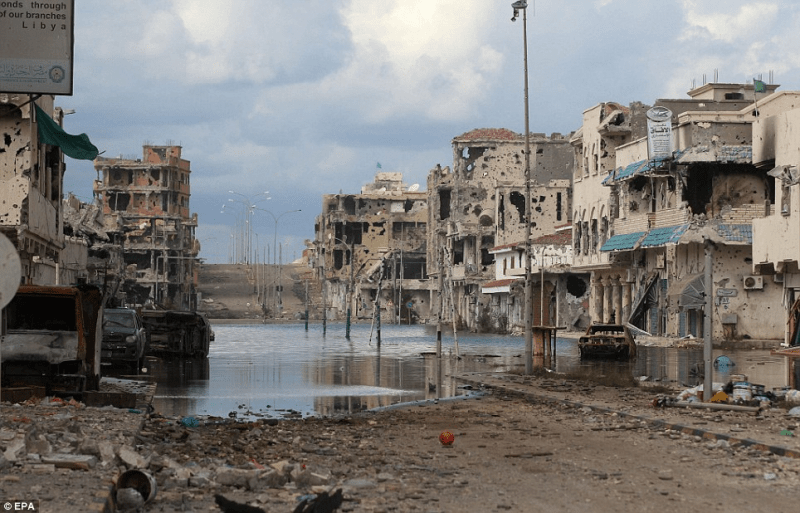
Sirte, Libya, after NATO bombing
The destruction of Libya’s government and infrastructure directly caused the Mediterranean boat migrant crisis, which has poisoned the politics of much of the European Union.
Donald Trump has not started any major war. He has been more restrained in military action than any US President since Jimmy Carter. My own view is (and of course it is impossible to know for sure) that, had Hillary been in power, Syria would already have been totally destroyed, the Cold War with Russia would be at mankind threatening levels, and nuclear tension with North Korea would be escalating.
“He hasn’t destroyed mankind yet” is faint praise for anyone. Being less of an existential danger to mankind than Hillary Clinton is a level achieved by virtually the entire population of the planet. I am not supporting Trump. I am condemning Clinton. I too, like Susan Sarandon, would have voted for Jill Stein were I an American.
So do protest against Trump. But do so under the banner No Trump! No Clinton! No NATO! And if any Clintonite or Blairite gets up to address you, tell them very loudly where to get off. I remember the hijacking of the Make Poverty History campaign by Brown, Darling and Campbell on behalf of their banker friends. Don’t let that happen again.
Or here is an even better idea.
Escape the Trump visit completely. Rather than stand penned in and shouting slogans at a police van parked right in front of you, turn your back on all of that and come join me at the Doune the Rabbit Hole Festival from 13 to 15 July. As our regulars know, this blog has been intimately connected with running the Festival from the start. This year is much bigger, with the Levellers, Akala, Atari Teenage Riot, Peatbog Faeries, and literally scores of other bands, and a great array of other festival activities too, including for kids, who come free and get free drinks.
DTRH has no sponsorship, no advertising, no government money and no rip-offs – beer and cider from £3.50 a pint at the bars. It is very much an alternative lifestyle gathering, and I find spiritual renewal there in the glorious Stirlingshire countryside. (I know that sounds corny, but I do). Tickets are £90 for full weekend including camping, which I think makes it the cheapest festival on this level around. Or you can buy a cheaper day ticket and drop in just for the day. If tickets are too expensive or you fancy a different kind of fun, you can volunteer, including to come and work with me in the bar, though there are a whole range of other tasks to be done if you don’t fancy that. Volunteers get in free and get fed in return for one six hour shift a day.
I really do hope I will see some of you there – it looks set to be a glorious weekend. Forget stress, forget Trump and hang out with nice people!
Israel to attack Syrian forces if they move into border zone: Israeli minister
Press TV – July 5, 2018
An Israeli minister has warned Syria that Israel could strike Syrian government troops if they are stationed in a border zone subjected to a UN demilitarization agreement, a few days after Tel Aviv announced that it had beefed up its military presence in the occupied Golan Heights near the Syrian border.
“We must verify and do everything to clarify vis-a-vis the Russians and [Syrian President Bashar al-] Assad’s government, that we will not accept any armed presence by the Assad regime in the areas which are meant to be demilitarized,” said Gilad Erdan, the regime’s public security minister, in an interview with the Israeli news website Ynet on Thursday.
In 1967, the Israeli regime waged a full-scale war against Arab territories, including those of Syria, occupied a large swathe of Syria’s Golan Heights and annexed it four years later, a move never recognized by the international community.
In 1973, another war, known as the Arab-Israeli War or the Yom Kippur War, broke out between the Israeli regime and a coalition of Arab states led by Egypt and Syria. A year later, a United Nations-brokered ceasefire came into force, according to which the Israeli regime and the Syrian government agreed to separate their troops, and create a buffer zone patrolled by the UN Disengagement and Observer Force (UNDOF).
Erdan’s comments came as Syrian government troops have managed to liberate a string of towns and villages in the southern and southwestern regions of the country from the clutches of militant outfits in recent weeks.
Syria, which has been gripped by foreign-backed militancy since March 2011, has said that the Israeli regime and its Western and regional allies have been aiding Takfiri terrorist groups.
The Daesh Takfiri terrorist group, which once held large swathes of land in Syria, is no longer in control of any urban center. Following its crushing defeat against Syrian government forces late last year, the terror outfit is only active through its remnants, sparsely based in some rural areas. Other Takfiri groups are either significantly weakened or increasingly losing ground to advancing government troops.
The Syrian government also strongly seeks to take back its share of the mountainous plateau of the Golan Heights from the Israeli regime.
When asked if the Israeli regime was prepared to take military action against the Syrian army, Erdan said: “Unequivocally, yes,” citing Israeli air strikes conducted in recent months against positions held by the Syrian troops.
Back on May 10, Israel conducted what it called its most intensive airstrikes on Syria in decades. According to Russia’s Defense Ministry, Israel had used 28 warplanes in its airstrikes on Syria and fired 70 missiles. Both Damascus and Moscow said that the Syrian army managed to shoot down over half of the missiles.
The Tel Aviv regime, at the time, claimed that its assault was in response to a barrage of 20 rockets fired from Syria at Israeli military outposts in Golan.
Over the past few years, Israel has frequently attacked military targets in Syria in what is considered an attempt to prop up terrorist groups that have been suffering heavy defeats against Syrian government forces. It has also been providing weapons to anti-Damascus militants as well as medical treatment to Takfiri elements wounded in Syria.
“Here, too, if there is a violation, and certainly in the southern Syrian region which is close to” the Israeli settlements, “and a bringing of weaponry that should not be there, Israel will take action,” Erdan added.
Late last week, Israeli Prime Minister Benjamin Netanyahu, alluding to the so-called truce, told the Israeli cabinet that “we will demand strict adherence to the 1974 disengagement deals with the Syrian army.” He also said that he was in constant contact with Washington and Moscow on the matter.
In a Sunday statement, the Israeli military said that it had deployed artillery and armored reinforcements to the occupied mountainous plateau, saying the move was the result of a situation assessment “in light of developments on the Syrian Golan Heights.”
Germany’s AfD Party Passes Resolution to Lift EU Sanctions Against Syria
By Suliman Mulhem – Sputnik – July 4, 2018
 The Alternative for Germany (AfD) Party is continuing its efforts to repatriate Syrian refugees, formally urging the German federal government and the EU to lift their debilitating economic sanctions against the Arab Republic.
Earlier this month at a party convention in Augsburg, AfD politicians passed a resolution calling for the lifting of EU economic sanctions against Syria in a bid to aid Damascus’ ongoing efforts to stabilize the entirety of the country and provide adequate public services, according to a party press release sent to Sputnik reporter Suliman Mulhem.
The resolution was submitted by Dr. Christian Blex and a number of other party officials who visited Syria in March to assess the situation on the ground for themselves.
Presenting the resolution at a party conference, Bundestag member Dr. Blex warned of the detrimental effects of the sanctions on the availability of healthcare for Syrians who decided to remain in their home country, especially those on low incomes and with limited resources to seek treatment abroad.
“They [the sanctions] target human beings who the European states allegedly want to protect. The EU sanctions against Syria are a cause of flight; its removal would even benefit Germany’s economy,” Dr. Blex said.
“We demand Germany be no longer complicit in the sanctions, which are an instrument of power against the current government. A prolongation of the suffering of the Syrian people to overthrow President Bashar al-Assad is incompatible with AfD-principles and not in the German national interest,” the resolution reads.
Moreover, the resolution called on the German government and the EU itself to reinstate diplomatic relations with Damascus to “find a solution which secures the country’s peaceful rebuilding process,” highlighting that rebuilding Syria and reviving its national economy is firmly in Germany’s interests, as it’s necessary for the repatriation of Syrian migrants.
AfD members also passed a resolution on July 1 condemning the tripartite aggression by the UK, US and France against Syria earlier this year as a “violation of international law.”
The coordinated strikes were carried in retaliation to an alleged chemical attack which was blamed on the Syrian government, despite Damascus staunchly denying any involvement and having no motive to carry out such an attack.
READ MORE:
EU Sanctions Have ‘Disastrous’ Effects on Syria’s Civilian Population – AfD MP
Syrian Army Uncovers Massive Haul of Western-Made Weapons for Rebels
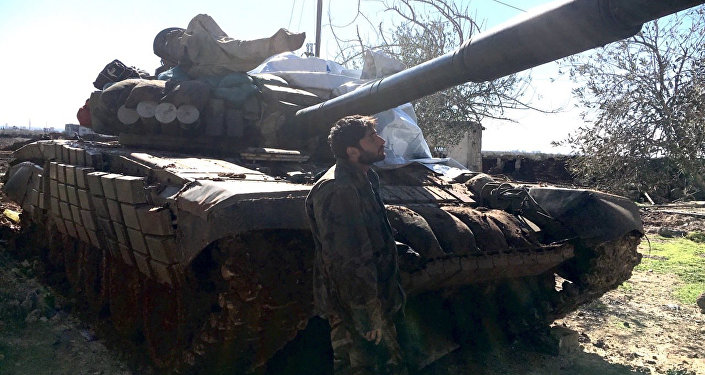
© Sputnik / Michael Alaeddin
Sputnik | July 4, 2018
The Syrian Army has gotten its hands on another huge cache of weapons and ammunition, including US-made TOW anti-tank missile systems, chemical warfare, minesweeping and communications equipment and even armored vehicles. Some of the supplies appear to be brand new, as if militants did not get the chance to use them against government forces.
The weapons and equipment were surrendered to Syrian troops by militants in Daraa, southwest Syria, who handed over the haul in accordance with a recently signed reconciliation agreement.
The Syrian Arab News Agency posted a video report of the find, with footage showing everything from tanks and armored personnel carriers to RPG launchers, shells, gasmasks, minesweepers, mortars, heavy machinegun emplacements and TOW launchers, along with boxes which appear to be supplies for Free Syrian Army militants from the United States.
Over two dozen towns and villages in southwestern Syria accepted a surrender deal with Damascus following days of negotiations brokered by the Russian military. The deal saw militants from the Free Syrian Army giving up their fight against the government and siding with the army in their operation to mop up the remnants of Nusra Front and Daesh forces in the region. The Syrian military launched an offensive in southern Syria in recent weeks amid constant militant shelling of the cities of Daraa and As-Suwayda.
The Israeli military reportedly drew “red lines” on Sunday amid the fighting, demanding that Damascus stick to a 1974 disengagement agreement which provides for a buffer zone between the two countries. Israel has beefed up its presence near the Golan Heights with tanks and artillery, but promised to stick to a policy of non-intervention in the Syrian conflict.
Featured Video

HE SAVED LIVES. NOW HE FACES PRISON.
or go to
Aletho News Archives – Video-Images
From the Archives
NATO Sanctions and the Coming Global Diesel Fuel Disaster
By F. William Engdahl – New Eastern Outlook – 11.04.2022
Amid the ongoing global inflation crisis, NATO heads of state and mainstream media repeat a mantra that high energy prices are a direct result of Putin’s actions in Ukraine since end of February. The reality is that it is the western sanctions that are responsible. Those sanctions including cutting SWIFT interbank access for key Russian banks and some of the most severe sanctions ever imposed, are hardly having an impact on the military actions in Ukraine. What many overlook is the fact that they are increasingly impacting the economies of the West, especially the EU and USA. A closer look at the state of the global supply of diesel fuel is alarming. But Western sanctions planners at the US Treasury and the EU know fully well what they are doing. And it bodes ill for the world economy.
While most of us rarely think about diesel fuel as anything other than a pollutant, in fact it is essential to the entire world economy in a way few energy sources are. The director general of Fuels Europe, part of the European Petroleum Refiners Association, stated recently, “… there is a clear link between diesel and GDP, because almost everything that goes into and out of a factory goes using diesel.” … continue
Blog Roll
 Aletho News
- Trita Parsi: Middle East Unraveling — Are We on the Path to World War?
- Iran FM meets with US envoy on UN meeting’s sidelines at American side’s insistence: Report
- Qatar PM calls for Gulf security framework with Iran, says war must be ‘wake-up call’
- China condemns US extortion of Iranian airlines, rejects Washington’s ‘illegal’ sanctions threats
- Italy to move military personnel from Taif base after missile strike
- Finland’s Stubb tells European leaders to calm down
- Defeating Russia on battlefield impossible – Fico
- Finland’s Gender Clinic Reversal
- Massachusetts Wants Mental Health Visits, Why Does Government Use ‘Health’ to Enter Our Homes & Families?
- US lawmaker admits American people footing bill for Trump’s failed aggression against Iran
- If Americans Knew
- Sanctions are collective punishment: immoral and self-defeating
- Phosphorus Munitions Fired by Israel Burn Groves, Orchards in Southern Lebanon
- Israel Carries Out New Ceasefire Violations Across Gaza
- AI – Emphasis on the ‘I’: Israel Is Funding AI Chatbot Propaganda
- Israel Blocking Hundreds of Wheelchairs for Injured Children From Entering Gaza
- Israel Is Expanding and Upgrading Compounds for Palestinian Militias in Gaza
- The Palestinian-American Residents of This West Bank Town Are Wondering: Where Is Trump?
- Gaza desperately needs tents, wheelchairs, fuel… and everything else (Israel blocks it all) – Daily Update
- Israeli Attacks in Gaza Kill at Least Seven Palestinians Over Three Days, including Woman and Child
- Trump’s militarization of Washington DC as he pursues Israel’s war against Iran
- No Tricks Zone
- New Study: Earth And Venus Surface Warmth Largely Explained By Convection And Lapse Rate, Not CO2 Or Radiation
- 2025 Nature Paper Claiming Worsening Global Drought Gets RETRACTED …Heavily Flawed
- New Study: ‘Global Drought Shows No Detectable Recent Acceleration Under Climate Warming’
- Economic Masterminds: German Socialists Suggest Taxing Productivity Gains Stemming From Using AI
- The South China Sea Has Not Been Cooperating With The Climate Change Narrative
- Energy Crisis: Germany Enters Heating Season With Historically Low Gas Reserve Fill Levels
- New Study: The Antarctic Ice Sheet Gained Mass From 2020-2024 Due To Staggering Snow And Ice Accumulation
- Study: Ocean Heating Rates From Thousands Of Years Ago ‘Dwarf’ Modern Ocean Heating Rates
- Climate Extremists Target, Attack Large-Scale Power Grid Infrastructure In Germany!
- New Study: Antarctic Ice Melt Has Contributed Less Than 1 Centimeter To Sea Level Rise In The Last 30 Years

