Sanctions catch up to Russian energy project
Samizdat | July 7, 2022
Oil production at Russia’s far-eastern Sakhalin-1 oil and gas project has decreased significantly due to sanctions imposed by the West, according to Russian Deputy Prime Minister Yuri Trutnev.
“As for the Sakhalin-1 project, due to the restrictions imposed … oil production at the project has decreased by 22 times – from 220,000 barrels per day to 10,000 barrels per day,” Trutnev said.
The Sakhalin-1 project produces Sokol grade crude oil off the coast of Sakhalin Island in Russia’s Far East, exporting about 273,000 barrels per day, mainly to South Korea, but also to other destinations including Japan, Australia, Thailand, and the US.
In May, US oil giant ExxonMobil’s Russian unit Exxon Neftegas declared force majeure for its Sakhalin-1 operations due to sanctions. It had become increasingly difficult to ship crude to customers, the company explained.
Project stakeholders, which also include Japan’s Sakhalin Oil and Gas Development consortium and Indian explorer ONGC Videsh, were reportedly having difficulty chartering tankers to ship oil out of the region.
Exxon had earlier announced it would exit about $4 billion in assets and discontinue all of its Russia operations, including the Sakhalin-1 project.
On Thursday, Reuters reported the head of the energy committee in Russia’s lower house of parliament, Pavel Zavalny, as saying that the Sakhalin-1 oil and gas project would be put under Moscow’s jurisdiction, just as the neighboring Sakhalin-2 has.
Last week, President Vladimir Putin ordered the re-organization of the Sakhalin-2 LNG project, transferring ownership to a new, domestic, company.
Thailand Paid $45 Million in COVID Vaccine Injury Claims, While U.S. Has Paid $0
By Michael Nevradakis, Ph.D. | The Defender | March 15, 2022
Thailand’s National Health Security Office (NHSO) as of March 8 has paid 1.509 billion baht (the equivalent of $45.65 million) to settle COVID-19 vaccine injury compensation claims.
The payouts were made to 12,714 people, including family members of some people who died as a result of the vaccine.
An additional 891 claims are pending. A total of 15,933 claims have been filed since the start of the compensation program on May 19, 2021. Of the 2,328 complaints that were rejected, 875 are being appealed.
The figures released on March 9 represent a continued increase in claims approved by Thailand’s NHSO. As of Dec. 26, 2021, only 8,470 claims had been approved for compensation.
The vaccines being administered in Thailand are primarily the British-Swedish AstraZeneca vaccine, and the Chinese-made Sinovac vaccine.
Thailand’s vaccine injury compensation program is an example of a “no-fault compensation program.”
As reported by The Defender in December 2021, “no-fault” refers to a measure put in place by public health authorities, private insurance companies, manufacturers and/or other stakeholders to compensate individuals harmed by vaccines.
Such programs allow a person who has sustained a vaccine injury to be compensated financially, without having to attribute fault or error to a specific manufacturer or individual.
No-fault compensation schemes are one of three options used by various countries to handle vaccine injury claims.
The other two options include allowing vaccine-injured people to sue private-sector actors, such as vaccine manufacturers or their insurers, or to place the full financial burden on the patient.
In the case of Thailand, the compensation scheme sets forth the following payout categories:
- For cases of death or permanent disability, each family receives 400,000 baht ($11,928).
- Those who sustained a disability that affects their livelihood or who lost a limb receive 240,000 baht ($7,157).
- For other injuries or illnesses sustained as a result of COVID vaccination, a maximum of 100,000 baht ($2,982) is paid out.
For the third category of claims, the specific amount awarded is contingent on the level of damages found to have been caused by the vaccine, as well as the financial state of the patient.
When the compensation fund was set up in 2021, Dr. Jadej Thammatacharee, the NHSO’s secretary-general, stated the available funds would total 100 million baht ($2.98 million), but that initial budget already has been exceeded many times over.
Thailand’s “no-fault” system makes it easy to secure compensation, at least when compared to similar schemes in the U.S. and other western countries.
Claims can be submitted by the individuals in question, or their families, at the hospital where they were vaccinated, at provincial health offices, or at NHSO regional offices. Moreover, claims can be entered up to two years after the adverse effects first occur.
Any individual claiming injury or side effects can file a claim for initial financial aid to provide an unspecified amount to claimants prior to confirmation that the injuries resulted from the vaccine.
If it is later determined the adverse effects were not a result of the vaccine, the claimants are entitled to keep this initial financial payout.
The turnaround time on claims also appears to be quick, when compared to the U.S. and several other countries.
The Bangkok Post reported that 13 panels across Thailand meet on a weekly basis to consider compensation claims. Those that are approved are paid within five days. Rejected claims can be appealed directly to the NHSO secretary-general within 30 days.
Available figures from the Thai authorities do not break down the number awarded claims for deaths, serious injuries and disabilities, or other injuries and adverse effects.
However, according to information provided by Thailand’s Department of Disease Control (DDC), as of Oct. 24, 2021, three deaths were linked to COVID vaccination.
According to Chawetsan Namwat, the DDC’s director for emergency health hazard and disease control, two of these deaths were a result of thrombosis. The other death came after the onset of a severe allergic reaction and shock following the administration of the vaccine.
Of the 842 deaths that were investigated up until that date, 541 were found to be “coincidental events,” including cardiovascular disease, stroke, pulmonary embolism, blood infections, lung inflammation, lung cancer and breast cancer.
For an additional 66 deaths, it was inconclusive whether the vaccine led to the fatalities — with 47 of these individuals also having been diagnosed with cardiovascular disease.
A further 41 deaths were categorized as “unclassified,” as there was not enough information available to make a determination regarding whether the deaths were linked to the vaccines.
According to a Feb. 18 briefing from healthdata.org, COVID-19 was the 13th most common cause of death in the country for the preceding week, behind such causes as chronic kidney disease, liver cancer, Alzheimer’s disease, diabetes mellitus and road injuries.
Ischemic heart disease and stroke were recorded as the top two causes of death in Thailand during the same period.
U.S. remains ‘stuck’ at one approved vaccine injury claim since November 2021
As previously reported by The Defender, as of Nov. 1, 2021, only one COVID vaccine injury claim had been approved for compensation by the Countermeasures Injury Compensation Program (CICP).
As of today, the figure remains at one — a claim which has not yet been paid. No new claims were compensated in the interim.
As reported by the CICP:
“As of March 1, 2022, the CICP has not compensated any COVID-19 countermeasures claims.
“Six COVID-19 countermeasure claims have been denied compensation because the standard of proof for causation was not met and/or a covered injury was not sustained.
“One COVID-19 countermeasure claim, a COVID-19 vaccine claim due to an anaphylactic reaction, has been determined eligible for compensation and is pending a review of eligible expenses.”
Last week, U.S. Sen. Ron Johnson (R-Wis.) introduced the Countermeasure Injury Compensation Amendment Act to help expedite claims by those injured by COVID vaccines.
The bill would amend the CICP to improve responsiveness, create a commission to examine the injuries directly caused as a result of COVID countermeasures and allow those whose claims have been previously rejected to resubmit claims for new consideration.
With only one claim approved for compensation and six claims denied, the CICP has a backlog of approximately 7,050 claims, with 4,097 claims alleging injuries or death from COVID vaccines, and an additional 2,959 claims alleging injuries or death from other COVID countermeasures.
Since 2010, a total of 7,547 compensation claims have been filed with the CICP. Only 41 were deemed eligible for compensation; still fewer (30) were actually compensated.
Notably, as of the March 4 release of Vaccine Adverse Event Reporting System (VAERS) data, a total of 1,168,894 adverse effects following COVID vaccination have been reported, including 25,158 deaths and 46,515 cases of permanent disability.
Historically, VAERS has been shown to report only 1% of actual vaccine adverse events.
CICP was established under the aegis of the Public Readiness and Emergency Preparedness (PREP) Act of 2005. The PREP act was developed to coordinate the response to a “public health emergency.”
The law is scheduled to remain in place until 2024.
CICP differs from another U.S. federal vaccine compensation program, the National Vaccine Injury Compensation Program (VICP), which was established after the passage of the National Childhood Vaccine Injury Act of 1986.
VICP, however, covers only those vaccines routinely administered to children and to pregnant women. To help fund the program, those vaccines are subject to a federal 75-cent excise tax.
To date, more than 8,400 VICP claims have been settled, out of more than 24,000 petitions, with a total of $4.6 billion issued in settlements.
The small number of approved compensation claims and the slow review process has recently led to calls for the modernization of vaccine compensation programs in the U.S.
Other western countries appear to have developed similarly cumbersome compensation procedures.
For instance, Australia’s newly established no-fault vaccine compensation system was described as “intentionally complex and narrowly targeted.”
Canada, which also only recently established a no-fault compensation program, as of Dec. 16, 2021, had approved fewer than five of 400 claims filed. More recent data from Canada’s Vaccine Injury Support Program is unavailable as of this writing.
Michael Nevradakis, Ph.D., is an independent journalist and researcher based in Athens, Greece.
© 2022 Children’s Health Defense, Inc. This work is reproduced and distributed with the permission of Children’s Health Defense, Inc. Want to learn more from Children’s Health Defense? Sign up for free news and updates from Robert F. Kennedy, Jr. and the Children’s Health Defense. Your donation will help to support us in our efforts.
Manufacturing Dissent: US NGO’s Build Opposition in Thailand
By Joseph Thomas | New Eastern Outlook | June 9, 2018
Should decidedly anti-British government organisations be found across the United Kingdom to be funded and directed by Russians, we could only imagine the reaction. Even whispers of hints of Russian influence have resulted in legislation, sanctions and quite literally years of punditry warning of the Kremlin’s insidious reach.
When the tables are turned, it is clear London, Washington and Brussels understand the inappropriateness of one nation interfering in the internal affairs of another.
Yet this acute awareness has not informed US or European foreign policy, including components of what could be called “soft power,” or influence operations. While soft power implies non-coercion, in practice it is always used in conjunction with coercive means toward exacting concessions from targeted nations.
Hiding US Funding
In the Southeast Asian Kingdom of Thailand, a growing army of such influence operations has formed the foundation of an opposition to the current government. It is an opposition that without its current funding and support from abroad otherwise would not exist.
Just as was done for years against nations like Syria, Libya, Ukraine and Egypt (nations to have recently suffered or nearly suffered the impact of Western-sponsored regime change), Thailand faces long-term interference in its internal affairs as a direct result of these influence operations.
The opposition in Thailand itself is minute and unpopular. However the organisations supporting them enjoy a veneer of credibility owed primarily to their efforts to obfuscate from audiences their foreign funding and their actual role in organising and leading the opposition.
One example can be seen in the local English-language newspaper, the Bangkok Post. Its article, “The fight for basic rights,” interviews the American founders of a supposed nongovernmental organisation called, “Fortify Rights.” Fortify Rights has consistently used its platform to support anti-government protests under the pretext of defending human rights.

Nowhere in the interview are Matthew and Amy Smith asked where their money comes from and how, as Americans, it is their moral imperative to involve themselves in critical issues faced by Asia.
Throughout the interview, the Smiths repeatedly admit to reporting back to the United States government, including testifying before US Congress and lobbying in Washington for issues related to Myanmar’s ongoing refugee crisis. The interference in Asia by a nation residing on the other side of the planet seems almost taken for granted by both the Smiths and the interviewer, as if the United States is imbued with the authority to arbitrate universally.
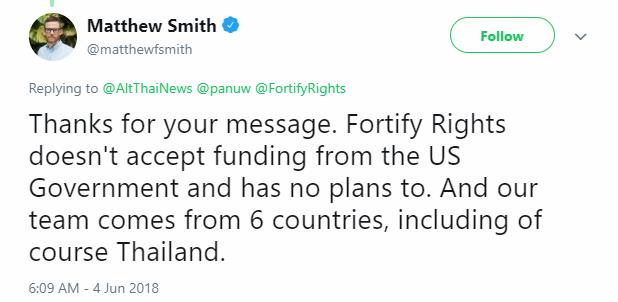
On social media, when the topic of US government funding was raised, Matthew Smith categorically denied receiving US government funding. He would refer to additional questions regarding his organisation’s funding as “trollish.”
However, Fortify Rights’ 2016 annual report (PDF), as pointed out to Smith himself, includes government funding from the United Kingdom, Canada, the Netherlands and the US Congress-funded National Endowment for Democracy ().
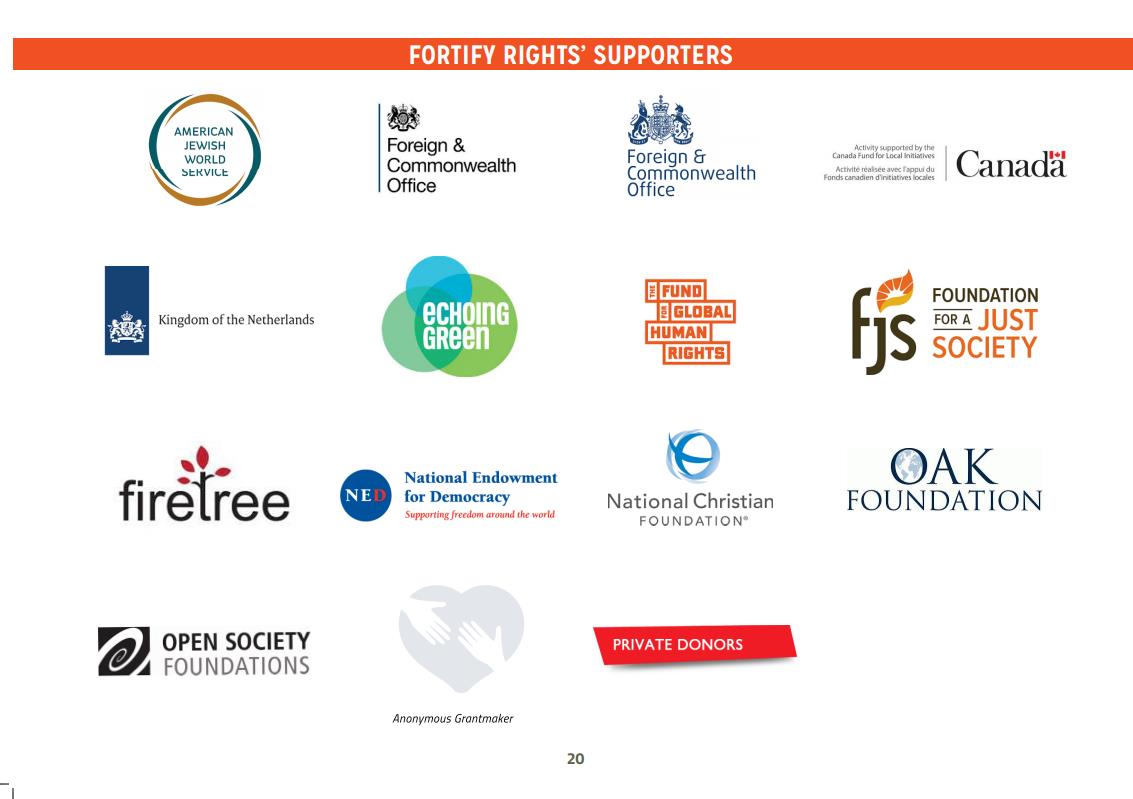
Other controversial sponsors of Fortify Rights include convicted financial criminal George Soros’ Open Society Foundations.
Matthew Smith not only knows that NED is funded by and serves as an intermediary for the US government, (thus making Fortify Rights a recipient of US government funding), he is undoubtedly aware of how controversial such funding is across Asia, a region sensitive to outside interference after centuries of European and more recently, American colonisation.
Implications of NED Funding
NED’s own website admits on its frequently asked questions page that:
NED is a private, non-profit, grant-making organization that receives an annual appropriation from the U.S. Congress through the Department of State. Although NED’s continued funding is dependent on the continued support of the White House and Congress, it is NED’s independent BOARD OF DIRECTORS that controls how the appropriation is spent.
NED itself admits that it is funded through the US State Department. It claims that its board of directors, not the US government itself, then determine how those US tax dollars are spent.
A look at NED’s board of directors only further implicates organisations like Matthew Smith’s Fortify Rights in deep impropriety merely hiding behind “rights” advocacy.
It includes people representing political and business interests involved in some of the greatest injustices purveyed by the United States during this generation, including Elliott Abrams, Francis Fukuyama, Zalmay Khalilzad (who served as US ambassador to Iraq during the US occupation) and Vin Weber described by some (including themselves) as Neo-Conservatives who promoted the US invasion of Iraq in 2003 and have promoted other wars of aggression around the globe both before and since.
Victoria Nuland, who played a central role in ousting the elected government of Ukraine in 2014 through a violent coup spearheaded by Neo-Nazi political parties and their militant wings, also serves on NED’s board of directors, along with Anne Applebaum of the Washington Post who clearly finds herself in a conflict of interest between reporting the truth and promoting organisations and agendas underwritten by the NED she chairs.
Another commonality is shared among NED’s board of directors; their use of “human rights” and “democracy” as pretexts for the wars of aggression and regime change they have promoted and helped execute, which reveals the true purpose, whether Matthew Smith of Fortify Rights knows or admits it or not, of both NED’s existence and the desired outcome of the work it funds around the globe.
NED in Thailand
Fortify Rights is by far not the only front operating in Thailand under the sponsorship of US government-funded NED.
It coordinates with other fronts as well, including media outlets like Prachatai based in Bangkok (whose director also serves as an NED Fellow), Isaan Record based in Thailand’s northeast, and BenarNews covering Thailand’s deep south. All three disingenuously portray themselves as independent local media. They have intentionally taken steps to obfuscate their US government funding from their Thai readers. Prachatai has only disclosed its foreign funding once in 2011, and only on its English-language website.
Each media front specialises in seizing upon and exploiting social and economic tensions to bolster opposition to the current government. Before the 2014 coup ousted the previous, US-backed government of Yingluck Shinawatra, these same media organisations used their platforms to smooth over injustices and emerging tensions threatening that government’s stability.
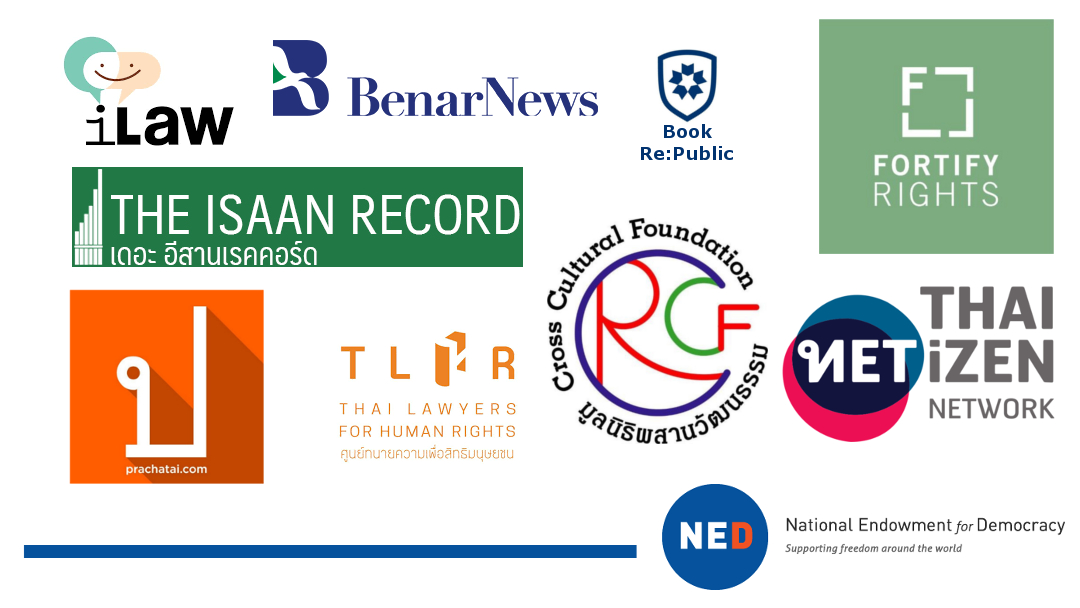
NED-funded Fortify Rights also works closely with fellow US funding recipient Thai Lawyers for Human Rights who not only provide free legal services for anti-government protesters, but provide resources and leadership to the protests themselves. The protesters portraying themselves as “pro-democracy” activists, fail to disclose their foreign funding to potential followers. They also avoid questions regarding how their foreign funding violates democracy’s prerequisite of self-determination independent of foreign interference.
Other NED-funded organisations operating in Thailand include iLaw, Cafe Democracy, Media Inside Out Group, Book Re:public, Thai Netizens Network, the ENLAWTHAI Foundation and the Cross Cultural Foundation (CrCF).
Many of these US government-funded organisations play a direct role in demanding policy changes. Currently in Thailand, protests demanding regime change are also led by US government-funded organisations.
The implications of foreign funded organisations attempting to influence Thailand’s policy or its political future are troubling. Many of the individuals working for these US government-funded organisations on their social media accounts frequently comment on their opposition to “Russian influence” in their US sponsors’ internal affairs, apparently failing to appreciate the irony of what their own work represents.
They also fail to appreciate the irony of portraying themselves as “independent” and working for “nongovernmental organisations,” despite being both dependent on wealthy and influential foreign sponsors as well as working on behalf of foreign governments.
Through their connections with equally compromised organisations and individuals in Thailand’s media, they have written promotional pieces about their supposed work, like in the Bangkok Post, without disclosing their foreign funding to readers.
At other times, complicit individuals within the Thai media have attempted to write pieces defending or dismissing US government-funding when public outcry begins to rise.
Rewriting Thailand’s NGO Laws
Despite the amount of funding and deception involved in this extensive and growing network, the US government-funded opposition is still widely unpopular. It would not be necessary for the Thai government to restrict their activities, let alone uproot and expel them as neighbouring Cambodia has (understandably) done.
Should Thailand simply rewrite its NGO laws to demand the same degree of scrutiny and transparency of these organisations as they themselves demand of targets of US government pressure, their already unpopular message would lose even more credibility and support across Thai society.
Prachatai, for example, being forced to disclose its US government funding at the header or footer (or both) of every article it writes would mean Prachatai finally practising the integrity and transparency it demands of targets of its daily propaganda. Likewise, those like writers at the Bangkok Post writing promotional pieces about Fortify Rights, should be obligated to disclose the organisation’s foreign funding somewhere within the body of the article.
Were these organisations as dedicated to the principles of transparency, freedom, democracy and human rights as they claimed, all of this information would already be freely and repeatedly provided to readers. If these organisations truly believed US, UK and Canadian government funding was benign or beneficial, they would not have gone through such extensive efforts to obfuscate and spin it to begin with. If anything, they would use such funding as a selling point.
Matthew Smith of Fortify Rights would not deceive people on social media by playing off of a technicality in which his US government money is essentially laundered through the NED before reaching him.
As the US continues accusing Russia of interfering in its internal political affairs, measures and consequences it attempts to level against Moscow could easily be cited and adopted by other nations across the globe to deal with the very real interference the US is engaged in within their respective borders.
The double game the US is playing regarding its own interference around the globe and accusations of interference it has levelled against Moscow, prove there is nothing benign at all about its agenda and activities. In turn, this calls into question all those organisations whose existence depends on annual contributions from this malignant political order.
Those truly dedicated to helping people will seek to independently fund their work by finding support from the local communities they claim to represent. If people are unwilling to fund Matthew Smith and Fortify Rights at the local level, it is likely Smith and his organisation are not truly working in the benefit of these communities, and instead, for interests diametrically opposed to them.
US Wages Cyberwar Abroad Under Cover of “Activism”
By Joseph Thomas – New Eastern Outlook – 20.08.2017
The threat of cyberterrorism has competed for centre stage in American politics with fears of “Russian hackers” disrupting everything from elections to electrical grids. And yet as US policymakers wield threats of cyberterrorism to promote a long and growing list of countermeasures and pretexts for expanding its conflict with Moscow, it is simultaneously promoting very real cyberterrorism globally.
Worst of all, it does so under the guise of “activism.”
The Carnegie Endowment for International Peace recently published a paper titled, “Growing Cyber Activism in Thailand.”
In it, readers may have expected a detailed description of how independent local activists were using information technology to inform the public, communicate with policymakers and organise themselves more efficiently.
Instead, readers would find a list of US-funded fronts posing as “nongovernmental organisations” (NGOs) engaged in subversion, including attacks carried out against Thai government websites aimed at crippling them, the dumping of private information of ordinary citizens online and coercing policymakers into adopting their foreign-funded and directed agenda.
US-Backed Cyberterrorism
The paper cites petitions created by the US-funded Thai Netizen Network on the US-based petition site, Change.org as well as distributed denial of service attacks (DDoS) aimed at crippling essential government websites, a campaign defended by US-funded Thai Netizen as being “virtual civil disobedience.”
The paper would claim (our emphasis):
The most innovative countermeasure was a series of Distributed Denial of Service (DDoS) attacks: an anonymous group, Thailand F5 Cyber Army, declared a cyberwar on the Thai government by encouraging netizens to visit listed official websites and continuously press F5 on their keyboards to refresh the pages. The goal was to overwhelm web servers and cause a temporary collapse of the websites of the Ministry of Defense, Ministry of Information and Communication Technology, Government House of Thailand, National Legislative Assembly, and Internal Security Operations Command. The group disseminated detailed instructions on the operation to its anonymous activists. It then demanded that the junta cancel its Single Gateway proposal.
Most of the attacks were successful. Activists wanted to demonstrate the government’s technological ineptitude and its lack of capacity to manage the Single Gateway. Arthit Suriyawongkul, coordinator of the Thai Netizen Network, described the campaign as virtual civil disobedience—an online version of the nonviolent resistance practiced by civil rights groups in the United States.
In another case, an activist group called Anonymous launched a #BoycottThailand campaign on Twitter and reportedly hacked government websites, snatched confidential information from official databases, and shared it online.
The Thai Netizen Network is funded by the US State Department via the National Endowment for Democracy (NED) subsidiary, Freedom House, as well as convicted financial criminal George Soros’ Open Society and a number of other foreign governments and corporate-funded foundations.
The role of a foreign-funded front coordinating efforts to undermine Thailand’s national security, including promoting cyberterrorism as “civil disobedience,” carries with it many implications. That the US is the foreign state promoting these activities in Thailand, undermines its own efforts to define and combat cyberterrorism back home.
What is Cyberterrorism?
Cyberterrorism is described on the United States Federal Bureau of Investigation’s (FBI) website as:
… the use of computer network tools to shut down critical national infrastructures (e.g., energy, transportation, government operations) or to coerce or intimidate a government or civilian population.
Attacking government websites millions of people across Thailand depend on for information and services while pilfering the personal information of thousands of ordinary citizens clearly fits the definition of not only cyberterrorism because of the political motivations involved, but also malicious criminality in general.
Unlike alleged Russian hacks which divulged emails detailing impropriety among American politicians, the information pilfered by US-backed hackers in Thailand included the personal information of millions of ordinary citizens using government services as part of their daily lives.
Bangkok Post would fill in the missing information intentionally omitted from the Carnegie Endowment paper, reporting that:
Files posted by Anonymous and examined by the Bangkok Post appear to be from the court system, as the Anonymous posters claimed.
An SQL database file of 1.1 gigabytes contains thousands of names, ID card numbers, photos, email addresses, personal phone numbers and more — all in clear text.
By dumping this information online, US-backed hackers targeted ordinary citizens, jeopardising their privacy and exposing them to criminal elements the world over involved in identity theft.
US Cyberterrorism is not “Activism”
The Carnegie Endowment paper itself was drafted by Janjira Sombatpoonsiri, assistant professor of political science at Thammasat University, Thailand. She is also cited as a member of the Carnegie Endowment’s Civic Activism Network. Not only is she an active, contributing member of Thailand’s foreign-backed opposition, she is admittedly involved in a foreign think-tank funded by foreign corporate interests.
The Carnegie Endowment includes among its sponsors in its 2016 annual report; the US government, pharmaceutical giants including Gilead, petrochemical monopolies including Chevron, British Petroleum and Shell, defence contractors including Lockheed Martin and several automakers including Ford.
Like many other episodes of extraterritorial political interference up to and including military intervention, America’s meddling in Thailand is done on behalf of corporate interests seeking to expand their respective and collective hegemony both regionally in Asia vis-a-vis Beijing, and globally. This interference is done under the cover of rights advocacy, both by the think tanks and foundations funding it and those in Thailand receiving foreign cash.
The US use of cyberterrorism in Thailand and beyond should come as no surprise. It augments already ongoing efforts by US-backed opposition in Thailand to destabilise and upend Thailand’s political order which has included armed terrorism.
Most recently, a string of bombings plagued Bangkok, including one targeting a hospital. At various junctures during Thailand’s political conflict, foreign-backed opposition has brought militants into the streets. In 2010, nearly 100 would die over the course of several weeks, culminating in citywide arson leaving areas of Thailand’s capital, Bangkok, resembling a war zone.
To see US-sponsored authors attempting to promote cyberterrorism as “activism” in Thailand also comes as no surprise. When Thailand’s opposition carries out armed terrorism, US-sponsored media and policy think tanks often attempt to spin it as well. Other forms of more traditional subversion are also regularly defended by the US and its myriad fronts posing as rights advocates as “activism.”
Understanding that it is not “activism,” but by America’s own very definition, cyberterrorism, helps disarm this malicious campaign posing as “civil disobedience” and “activism,” and allows nations like Thailand to defend themselves through enhanced technological security measure as well as legislation.
US Still Seeks Regime Change Across Asia
By Ulson Gunnar – New Eastern Outlook – 26.11.2016
While the US could accurately be described as a global power in decline, the ambitions of prominent special interests at the center of its economic and political power still pose a potent threat to global stability and national sovereignty worldwide. In Asia particularly, despite a clear shift in a regional balance of power that has persisted for nearly a century, the US is still actively involved in attempting to dictate which governments come to power in respective nation-states and how they rule and all in an attempt to create a balance of power in Asia that serves US interests.
From Myanmar to Vietnam, US Ambitions Still a Clear and Present Danger
US ambition to transform Asia manifests itself in a number of ways. In Malaysia, it has been fueling for years the so-called Bersih movement and its campaign for “clean and fair elections.” While the movement attempted to appear spontaneous and independent of any political party, it was quickly revealed that its core leadership was funded by the US State Department via the US National Endowment for Democracy (NED) and Open Society. It was also revealed that Bersih was in fact an auxiliary front of a political coalition headed by US-backed opposition leader Anwar Ibrahim who quite literally led the protests in the streets himself.
Extensive US support has been provided to the now ruling government of Aung San Suu Kyi in Myanmar, including the creation of Suu Kyi and her National League for Democracy’s (NLD) entire media capabilities. Pro-NLD media platforms created and funded annually by the US government include the New Era Journal, the Irrawaddy, and the Democratic Voice of Burma (DVB). It was also revealed that Suu Kyi’s Minister of Information, Pe Myint, was quite literally trained in Bangkok by the US government-funded Indochina Media Memorial Foundation, which now co-occupies the Western media’s Foreign Correspondents Club (FCCT) office in Bangkok.
In Thailand, in addition to the substantial lobbying support the above mentioned FCCT provides the ousted US-backed regime of Thaksin Shinawatra and his also-ousted sister, Yingluck Shinawatra, the US government funds a large number of supposed “nongovernmental organizations” (NGOs) in a bid to create the illusion of a legitimate, pro-democracy opposition. The Shinawatra family also enjoys continued lobbying support from Washington, with influential firms having registered on their behalf every year since at least as early as 2006.
Currently, US lobbyists are still active in supporting the Shinawatra regime and their political supporters within Thailand. The Shinawatra’s themselves are still positioning themselves to retake power, and the US media is still turning out a large amount of content aimed at setting the stage for continued political conflict within the country.
In Cambodia, opposition leader Sam Rainsy has received years of support from the US government and America’s European allies, including regular political and media support from the US State Department’s Voice of America (VOA) network.
Indonesia strains under pressure put on the government and society by US and Saudi-backed groups capable of mobilizing large numbers of protesters both to augment their own political power and to put pressure on the current ruling government in a bid to roll back growing ties between Jakarta and Beijing.
And while Vietnam lacks any clearly visible, central opposition figure, the US has steadfastly built up an opposition movement with which to pressure the Vietnamese government.
Cultural Colonization via YSEALI
Collectively, across the entire Southeast Asian region, the US is engaged in what some analysts have called “cultural colonization,” particularly with a program it calls Young Southeast Asian Leaders Initiative (YSEALI) in which the US State Department actively recruits, indoctrinates and directs young Asian students and professionals toward building a pro-Western opposition front. This includes a program called “Generation: Go NGO!” in which the US creates and directs a growing network of US government funded fronts posing as “nongovernmental organizations.”
Mirroring a modern day version of the very sort of imperial networks constructed by the British Empire across Asia, America’s reach into Asia seeks to reinvent and reassert Western domination across Asia Pacific. Not only does it seek to dominate the respective people, resources, economies and politics of nations in Southeast Asia, but it also seeks the creation of a united front with which to encircle, contain and eventually displace Beijing’s growing influence in the region.
Asserting Economic Hegemony via the TPP
The Trans-Pacific Partnership (TPP), a decidedly US dominated project, sought to string Asian states together in an economic alliance opposed to China’s rising regional and global influence. The deal’s details were introduced and brokered in secret, contravening any sense of self-determination for those nations and people subjected to it. Ultimately, the inequitable conditions of the deal required coercion and bribery to move forward, and despite great efforts, it appears that it will not likely succeed.
Nations like Thailand have categorically refused to sign the deal thus far, and nations like Vietnam who had initially promised to sign it, have wavered. The US’ desperation in moving through deals like the TPP may also explain the expansive networks it has constructed and continues to construct to apply pressure on both Asia as a region, and each nation individually.
Combating US Primacy
Such aspirations are more than mere speculation, and are instead derived from the writings of prominent US policymakers, including Robert Blackwill who in 2015 penned an entire paper about reasserting US “primacy” over Asia. Blackwill, it should be noted, served as a lobbyist for the above mentioned US proxy Thaksin Shinawatra of Thailand.
For Asia collectively, and for each nation respectively, the need for an international voice as Russia’s RT or China’s CCTV has granted Moscow and Beijing , is essential for challenging and overcoming divisive and destructive narratives perpetuated by the Western media. It is also an important factor in exposing and diminishing the influence of US-backed political opposition parties and the army of US-funded fronts posing as “NGOs.”
And while instinctively, building closer ties with China may seem to be a viable formula to balancing a US that seeks to reassert itself, such ties must be done within a larger regional framework to build a sustainable balance of power. Simply trading US hegemony in for Chinese hegemony, would fail to serve the rest of Asia’s interests well. For each respective Asian state, strong domestic institutions, economies, education systems and military institutions ensures not only America’s inability of asserting its interests over those of each nation’s, but also heads off China from filling in and exploiting the void left by a retreating United States.
Why is a Hong Kong “Activist” in Bangkok?
The New Atlas – October 5, 2016
Joshua Wong’s alleged arrest at a Bangkok airport is portrayed as a slight against “democracy,” yet the US-funded and backed agitator undermines his own principles of “self-determination” by meddling in another nation’s politics.
Thai PBS in its article, “HK democracy activist Joshua Wong detained in Bangkok,” would claim:
Wong, 19, famed for his galvanising role in the city’s 2014 pro-democracy “umbrella movement”, was held as he landed at the airport late Tuesday, his party Demosisto said in a statement, citing a Thai student activist, Netiwit Chotipatpaisal, who was due to meet him.
Wong was invited by Thai student activists to take part at an event marking the anniversary of a military crackdown in October 1976.
Demosisto “strongly condemns the Thai government for unreasonably limiting Wong’s freedom and right to entry, and requests the immediate release of Wong,” the statement said.
What Thai PBS fails to mention is that Joshua Wong and his party, “Demosisto,” are US-funded and directed, and represent Western interests attempting to subvert Chinese control over its own territory of Hong Kong, as well as undermine national sovereignty across the entire Asian region.
Indeed, the entire “Occupy Central” movement, also referred to as the “Umbrella Revolution,” was led by US-backed opposition figures, including Joshua Wong, Benny Tai and Martin Lee, the latter of which was literally in Washington D.C. lobbying for backing just months before the 2014 protest began.
While the US State Department’s National Endowment for Democracy (NED) initially denied it provided any assistance to the movement and denied specifically that Martin Lee served any role in leading the protests despite his Washington visit, NED through its subsidiary Freedom House, would eventually invite Wong, Tai and Lee back to Washington afterwards to award them for role in leading the protests.
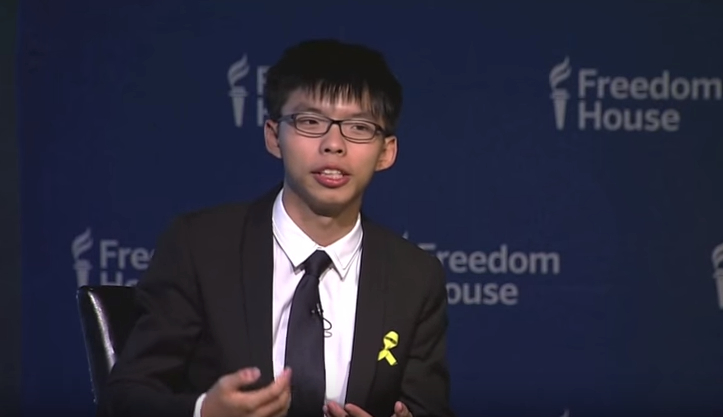 |
Joshua Wong in Washington D.C. attending a US State Department award ceremony held in his and other US-backed agitators’ honor |
At the award ceremony titled, “Three Hong Kong Heroes,” Lee would shuffle onto stage with an umbrella prop in hand, a virtual admission to his leadership role in the protests and confirmation that NED’s previous statement was intentionally false.
Wong’s political party, Demosisto, headed by Nathan Lee, is also tied directly to the US State Department’s NED.
 |
Nathan Law (left) with Carl Gershman of the US State Department’s National Endowment for Democracy (NED) |
Nathan Law in particular was featured on the US State Department’s National Endowment for Democracy (NED) website “World Movement for Democracy” in a post titled, “Democracy Courage Tribute Award Presentation.” In it, NED would write in regards to the award presented to Nathan Lee:
The Umbrella Movement’s bold call in the fall of 2014 for a free and fair election process to select the city’s leaders brought thousands into the streets to demonstrate peacefully. The images from these protests have motivated Chinese democracy activists on the mainland and resulted in solidarity between longtime champions of democracy in Hong Kong and a new generation of Hong Kong youth seeking to improve their city. The Hong Kong democracy movement will face further obstacles in the years to come, and their idealism and bravery will need to be supported as they work for democratic representation in Hong Kong.
The ceremony was yet another in a long line of post-Occupy Central award ceremonies the US State Department conducted, rewarding its proxies for their efforts in the streets of Hong Kong in 2014.
Joshua Wong Was Barred Entry into Malaysia for Similarly Inappropriate Political Pandering
In 2015, Malaysia too would confront Wong and his attempts to spread US-backed subversion across Asia.
That PBS would also report in an article titled, “HK student activist Joshua Wong denied entry to Malaysia,” that:
Immigration officials on Tuesday barred Hong Kong student activist Joshua Wong from entering Malaysia at the Penang International Airport in Bayan Lepas, The Star Online reported.
Wong was scheduled to attend a forum titled “The Uprising of Youth and New Social Activism in Singapore and Hong Kong” at Auditorium A in Komta on Tuesday night.
It is also worth noting that after Wong was denied entry, US-funded organisations posing as nongovernmental organisations (NGOs) immediately took to social media in an attempt to criticise the Malaysian government’s decision.
Malaysian online news service, The Star, in an article titled, “Hong Kong student activist Joshua Wong denied entry to Malaysia,” would further elaborate:
“Malaysia… explain why he is sent back to Hong Kong? Afraid of more street protests,” tweeted Bersih 2.0 chairman Maria Chin Abdullah.
Bersih, like Joshua Wong’s Demosisto, is openly funded by the US State Department and represents Washington’s, not the people of Malaysia’s interests. Bersih would be revealed in 2011 to have received funding and training from the US State Department via the National Democratic Institute (NDI), another NED subsidiary.
Democracy Means Self-Determination, Not Dictates from Washington & its Proxies
It is perhaps ironic that Wong himself and his supporters portray him as a “democracy activist,” considering that one of the central principles of democracy is the concept of self-determination. Self-determination means that a nation’s people themselves determine what course of action is in their best interests, free from the influence of foreign interests.
The concept of self-determination underpins the national identity of many nations across Southeast Asia, having had their respective national destinies dictated to them at various points throughout their history by European colonialism. Independence and self-determination across the region represent hard-fought achievements threatened by US-backed political fronts wielding “soft power” in place of the overt “gunboat diplomacy” practised by the British Empire in days past.
Worse than mere foreign backing, Wong and his Demosisto political party work ceaselessly to promote the parting demands made by British colonial administrators as Hong Kong was returned to China in 1997. These demands, including upholding the “one country, two systems” and “Basic Law” drafted just ahead of the British handover of Hong Kong, are echoed by the current governments of both the United States and the United Kingdom.
Thus, Wong and his political party, Demosisto, work contra to Hong Kong’s self-determination, promoting the parting policy of the British Empire imposed on a still emerging China in 1997.
By Wong meddling in the internal affairs of neighbouring Asian states, attempting to bolster US State Department efforts elsewhere to create proxy political fronts to serve Washington rather than local interests, he is also trampling the concept of regional self-determination, and thus of democracy itself.
In Thailand specifically, Wong sought to support anti-government agitators likewise seeking to subvert Thai sovereignty and return to power political parties loyal to Washington.
Wong’s admirers find among themselves a common denominator of affinity toward the United States and American politics. They believe themselves to be enlightened supporters of freedom, democracy and human rights, despite the reality of US foreign and domestic policy standing firmly against all three of these basic and essential principles.
From the invasion and occupation of foreign nations around the globe, to the detainment and torturing of people worldwide, to the violence and brutality American police deploy against the American population at home, to the invasive abuse of the American people’s right to privacy, American politics in reality exist separately from the ideals cadres of indoctrinated foreigners have been led into believing the US stands for.
Wong and his Demosisto political party and other US-backed political fronts like them, represent a danger to freedom, democracy and human rights, serving as a facade behind which US special interests hide their true, self-serving agenda and all of the abuse that surrounds it. By serving as a facade for foreign interests, merely posing as a proponent of democracy and self-determination, it is Wong and those like him that truly endanger democracy’s future in Asia, not those awaiting him at airports, turning him and his US-backed agitation away.
Follow The New Atlas on Facebook and Twitter.
Obama’s Ungraceful Exit from Air Force One, America’s Ungraceful Exit from Asia

By Joseph Thomas – New Eastern Outlook – 13.09.2016
When US President Barack Obama attempted to leave Air Force One upon arriving at Hangzhou, China, just southwest of Shanghai, he found that no staircase or red carpet awaited him. Instead, he and his staff were forced to use an alternative exit from the aircraft, only to find additional restrictions placed upon them on the tarmac.
The New York Times in its article, “Bumpy Beginning for Obama in China, Starting on the Tarmac,” would note:
There was no staircase for Obama to exit the plane and descend on the red carpet. Obama used an alternative exit.
On the tarmac, a quarrel broke out between a presidential aide and a Chinese official who demanded the journalists traveling with Obama be prohibited from getting anywhere near him. It was a breach of the tradition observed whenever the American president arrives in a foreign place.
When the White House official insisted the U.S. would set the rules for its own leader, her Chinese counterpart shot back.
“This is our country! This is our airport!” the Chinese official yelled.
Rather than accept and adapt to the conditions set forth by their Chinese hosts, the President’s staff quarrelled with them, marking yet another ungraceful bout of American exceptionalism where even in another’s country, America’s will is expected to be fulfilled.
Reflecting on the event, President Obama made cryptic comments seemingly both attempting to downplay the event as a mere oversight, but alluding to the fact that it was more than a mere oversight by their Chinese hosts.
And in fact, it was no oversight. It was a clear message to America that the age of American exceptionalism, particularly in Asia, is over.
America’s Ungraceful Exit from Asia
In and of itself, President Obama’s ungraceful exit from Air Force One may seem like an insignificant event. When added together with a general decline of American influence and regarding the respect it had once commanded across Asia, it is highly symbolic of a global hegemon being pushed from an entire corner of the globe.
It was just recently that the US concluded a lengthy and costly public relations campaign, dressed up as an “international tribunal” conducted at The Hague in the Netherlands that predictably concluded that China held no legitimate claims in the South China Sea.
The “ruling” was allegedly made in favour of the Philippines, despite the legal team being headed by an American, Paul S. Reichler of Foley Hoag. Despite what Washington believed would be a crushing rhetorical blow to Beijing, not only did Beijing dismiss the entire proceeding out of hand, the Philippines itself refused to capitalise on the transparently politically-motivated and provocative ruling.
US pressure on the Philippines, until recently considered a stalwart ally, even a subordinate functionary of Washington, eventually resulted in Philippine President Rodrigo Duterte directly mocking America’s ambassador to the nation, denouncing him as an effeminate meddler.
The previous year, the US had been pressuring Thailand to allow Chinese terror suspects to travel onward to Turkey despite an extradition request from China. Thailand ignored US demands and returned the suspects to face justice in China.
In both cases terrorism struck shortly after, with a bomb striking in the centre of Bangkok killing 20 and maiming many more, and just recently a bomb exploding in the Philippine city of Davao, where President Duterte had previously served as mayor.
In Cambodia, the nation’s Prime Minister Hun Sen has openly accused the US of attempting to subvert political stability around the globe. This was in reference to opposition groups the US State Department is now using to pressure the Cambodian government after its decisive shift away from US interests toward Beijing.
In essence, while the US announced its “pivot” toward Asia, Asia itself appears to be pivoting away from the US. Thus, the incident on the tarmac in Hangzhou is a microcosm of what is taking place across Asia, an unwillingness of locals to further capitulate to American exceptionalism, and an ungraceful America unable to recognise or adapt to this shifting geopolitical reality.
In the end, America with its hegemonic hubris will ensure that it is fully pushed out of Asia, missing what is perhaps a final opportunity to readjust its relationship with the region away from adversarial domination toward something more equitable, proportional and constructive.
Joseph Thomas is chief editor of Thailand-based geopolitical journal, The New Atlas .
Exposing US-Funded “NGOs”
From Moscow to Myanmar, US-European funded organisations undermine the essential work of genuine NGOs
The New Atlas | August 9, 2016
A nongovernmental organisation (NGO) is described as a not-for-profit organisation independent from states and international governments. They are funded by donations and facilitated by volunteers drawn from the communities they serve.
Genuine NGOs fitting this description fulfil a vital role within the nations they work regarding issues including education, healthcare, the media, the environment, technology, and economic development.

They often perform their work in parallel with government organisations and may even cooperate with their national government. At other times, they provide a necessary but constructive check and balance to deficiencies present within a state.
However, NGOs can be abused. Foreign governments and financially motivated special interests can use the structure and appeal of NGOs as vectors to project unwarranted, coercive power and influence.
Funded not by the communities they claim to serve, but by these foreign interests, they often operate under the pretext of upholding the legitimate roles and responsibilities of genuine NGOs while in reality undermining a targeted nation’s government, its people, its institutions, and national peace and stability. Ironically, such organisations also undermine the perceived legitimacy and effectiveness of real NGOs.
Foreign interests seek to do this for a number of reasons including pressuring a targeted government to make concessions regarding bilateral relations, competing with and eventually overrunning state institutions, and even replacing a nation’s entire government.
How the US State Department Took Over Myanmar’s Ministry of Information
An extreme example of this can be seen in Southeast Asia’s Myanmar, where the Ministry of Information is now firmly under the control of Pe Myint, trained in “journalism” by a US government-funded organisation posing as an NGO, called the Indochina Media Memorial Foundation.
Pe Myint is also a member of a political party supported by a large collection of US and British funded organisations (National Endowment for Democracy (NED), Open Society, USAID, etc.), which in turn was propelled into power during recent elections also influenced heavily by organisations posing as NGOs funded by these same foreign interests.
Previously an independent institution of Myanmar, the Ministry of Information is now firmly under the influence of the US State Department. This may explain uncharacteristic comments regarding “substandard democracy” published by a national newspaper it controls directed at neighbouring Thailand ahead of the August 7, 2016 Thai referendum.
Henceforth, the Ministry has been made to serve the best interests of the United States, not Myanmar, indicated by the fact that its recent comments only risk jeopardising what would otherwise be constructive and beneficial bilateral relations with Thailand.
In this example, foreign-funded organisations not only pressured the government of Myanmar to accept the conditions in which a foreign-backed opposition came to power, but these foreign-funded organisations also helped create an entirely parallel government that are now overwriting Myanmar’s sovereignty.
Recognise the Threat
These foreign-funded organisations masquerading as NGOs are more than just foreign-funded “charities,” “rights advocates,” or “media platforms.” This can be discerned simply by examining the intermediary organisations providing these groups money and examining the special interests and agendas they in turn serve.
The United State National Endowment for Democracy (NED) for example, lists among its 2013 sponsors (.pdf) petrochemical giant Chevron, Wall Street’s Goldman Sachs, US State Department-connected and privacy usurping tech-giant Google and the US Chamber of Commerce which itself represents corporations ranging from defence contractors to oil companies to banks, as well as agricultural and pharmaceutical giants. Individual donors include pro-war Republican politicians including Frank Carlucci, Paula Dobriansky, Condoleezza Rice and Robert Zoellick.
 |
| (It would be exponentially more difficult for foreign funded organisatons posing as NGOs to attract volunteers and local support if the true nature of their funding was transparently and repeatedly disclosed to the communities they allegedly serve.) |
NED’s board of directors represents a similar and troubling convergence of special interests who directly contradict the alleged purpose of both NED itself, and the many organisations it funds around the world.
Unfortunately, many people who work for foreign-funded organisations posing as NGOs are unaware of such facts. Senior leadership of these organisations often go through great lengths to conceal their foreign funding to avoid scrutiny and even in some cases, to avoid properly paying people who are led to believe no funds are available and thus are asked to “volunteer” to help. Those few who are aware of this funding, are usually unaware of who and what NED and other organisations like them truly represent.
To put it simply, any organisation or institution serves only the interests of those who support it. An NGO supported by local donations and volunteers serves its local community. A foreign-funded organisation posing as an NGO serves foreign interests.
And simpler still, an organisation funded by a foreign government cannot possibly be characterised as “nongovernmental.” Even at face value, this notion strains credibility.
Case Study: Prachatai, Thailand
After being caught concealing foreign funding, Bangkok-based media platform Prachatai disclosed several million baht in US State Department funding, Open Society grants and funds from several European governments.
Remarkably, Prachatai was (and still is) soliciting donations on their website. They also have categorically failed to update their foreign funding in English (since their first and only disclosure in 2011) and have never disclosed their foreign funding to their Thai readers.
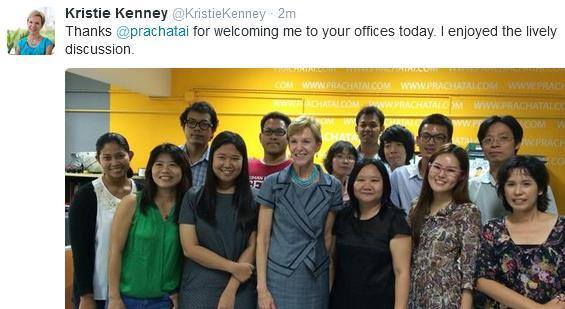 |
| (US Ambassor Kristie Kenney in US State Department-funded Prachatai’s office in Bangkok, Thailand.) |
Independent journalists attempting to ascertain the true depth of Prachatai’s connections to the US State Department were told that Prachatai had none, and that the money was provided to them unconditionally.
In reality, as revealed by Wikileaks, Prachatai’s staff remains in constant contact with the US Embassy in Bangkok, with US ambassadors and political counsellors making regular visits to their office off of Ratchada Road, and with Prachatai’s director Chiranuch Premchaiporn making regular, lengthy and detailed reports about Thailand’s internal political affairs to US Embassy staff.
In the infamous Cablegate leak, the US Embassy in Bangkok sent off as many as 7 cables regarding or referencing Prachatai and its activities within the country and in particular its defence of agitators attempting to undermine the nation’s institutions and political stability.
For the US State Department, Prachatai exists as a state-funded asset — a constant pressure point to extort concessions from the Thai government with and to coerce from them the settings in which US-backed political forces might take power.
Under the guise of defending “free speech” and “human rights,” Prachatai networks deeply with US-backed political party Pheu Thai, its street front the United Front for Democracy Against Dictatorship (UDD or “red shirts”) and a large number of other US-funded organisations posing as NGOs and academic associations — many of which share the office building Prachatai is currently based in.
Additionally, Prachatai communicates and coordinates regularly with foreign media staff based in Thailand, particularly those who gravitate around the swank Foreign Correspondents’ Club of Thailand clubhouse and bar in downtown Bangkok.
Together they stage public relations events aimed at portraying the current Thai government as overbearing, dictatorial and losing popularity and control. In reality, the events include the same handful of stand-ins and utilise intentionally deceptive methods to conflate the size and impact of each staged event.
By participating in such events, the foreign media betrays the principles it allegedly represent, creating the news rather than objectively covering it. For Prachatai, posing as an NGO but clearly functioning as an extension of US interests in Thailand, it too represents a betrayal of true, community-supported activism.
Ending the Charade
In all honesty Prachatai’s activities could easily be tolerated by the Thai government, if only for one concession — that Prachatai and other organisations like it fully and repeatedly disclosed in English and in Thai, their existence as foreign-funded government organisations rather than pose as a genuine NGO.
Since it has operated for years and failed to fulfil its own responsibilities toward transparency to the society it claims to serve, it may be time for Thailand to pass legislation to force foreign-funded organisations like Prachatai to come clean.
Other nations have adopted comprehensive legislation to help protect real NGOs from those with foreign funding merely posing as such.
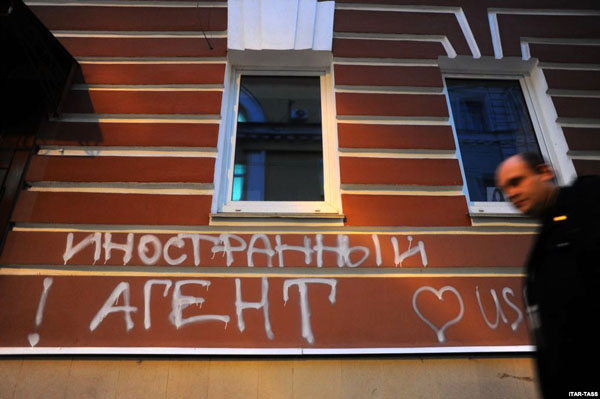
(The graffiti reads, “foreign agent,” written in Russian..)
In Russia, legislation now requires foreign-funded organisations to declare on all written material and verbally declare before all audio statements, their relationship with foreign interests. Those that fail to register as foreign-funded organisations or fail to disclose all of their funding, face liquidation.
While the US and the myriad organisations it was running in Moscow predictably decried the legislation as “oppressive,” some might appreciate the irony of “pro-democracy activists” resisting calls for greater transparency, a fundamental prerequisite for a democratic society.
Foreign-funded organisations posing as NGOs are more than a mere nuisance, or even simply a means by foreign governments and special interests to apply coercive pressure on a nation’s government and institutions. They represent a patient, concerted effort to compete with and eventually fully replace a nation’s existing sovereign institutions. This threat should not be underestimated nor should it be tolerated.
And beyond a threat to national security, these foreign-funded organisations attract and squander a nation’s human resources, while undermining the very legitimate and essential work performed by honest, locally-supported NGOs.
Syria wants to join Russia-led Eurasian Economic Union – prime minister
RT | July 21, 2015
Syrian Prime Minister Wael Halqi has said joining the Eurasian Economic Union (EEU) will allow Damascus easier economic and trade cooperation with friendly nations. Russia and Belarus are also discussing a new loan to Syria.
“Negotiations with Russia on joining the Eurasian Union and customs-free zone are being held. We see this as a benefit and strengthening the relations with friendly states, which will facilitate economic and trade cooperation with them,” said Halqi in an interview with RIA Novosti Tuesday.
According to the prime minister, Russia and Syria have signed a number of contracts for the construction of gas processing plants, irrigation facilities and power stations. In 2013, an agreement was signed for Russian companies to develop oil fields on the Syrian coast. The first phase is worth $88 million and will last for five years.
The countries are also discussing the expansion of loans to Damascus.
“Negotiations with Russia and Belarus on the provision of new lines of credit continue. It will help to meet the needs of production, create new opportunities for the development of the internal market and economic process,” said the prime minister.
He expressed the hope that Russia would help the Syrian government “to cope with the brutal attacks, including the unjust economic sanctions imposed by the West.”
Halqi said that credits between Iran and Syria have already been implemented. The two countries have signed and implemented two lines of credit, of which $3.6 billion Tehran has allocated for projects related to oil and $1 billion for the delivery of humanitarian aid, including food, medicines, hospital equipment and components for power plants.
The prime minister said that Syria appreciates all the efforts made by the Russian leadership to maintain the policy and economy of Syria during the years of crisis, and specifically thanked Moscow for donating 100,000 tons of wheat as humanitarian aid to the Syrian people.
READ MORE: Thailand to apply for free trade zone with EEU by 2016 – minister
Ways to watch Press TV
Press TV – January 12, 2014
Following a move by the European satellite provider Eutelsat SA to take Press TV off the air in a flagrant violation of freedom of speech, Press TV viewers can continue to watch the news channel via the following satellites or by visiting the following websites:
You can watch Press TV by visiting the following websites:
Press TV watch live services (Worldwide)
OHTV Box (internet Set-top box) (Worldwide)
Livestation (internet platform. Supports PC MAC, Linux and all tablet PCs and smartphones)
You could also view our broadcast in Europe through the following satellites:
Optus D2 (152E)
12581
22500
3/4
H
DVB-S,QPSK,MPEG-2
ST 2 (88E)
11051
30000
1/2
V
DVB-S2,8PSK,MPEG-4
Paksat 1R (38E)
4060
23000
5/6
H
DVB-S,QPSK,MPEG-2
Badr 5 (26E)
11881
27500
5/6
H
DVB-S2,8PSK,MPEG-4
Badr 5 (26E)
12303
27500
3/4
H
DVB-S,QPSK,MPEG-2
Badr 4 (26E)
12054
27500
3/4
V
DVB-S,QPSK,MPEG-2
Nilesat 201 A (7W)
11823
27500
5/6
V
DVB-S,QPSK,MPEG-2
Arabsat 5C (20E)
3964
30000
2/3
V
DVB-S2,8PSK,MPEG-4
Arabsat 5C (20E) (HD)
3913
12911
5/6
V
DVB-S2,8PSK,MPEG-4
Express AM44 (11W)
11109
9479
3/4
H
DVB-S2,QPSK,MPEG-2
Thaicom 5 (78.5 E)
3575
6500
3/4
H
DVB-S2,QPSK,MPEG-2
Related Interviews:


Featured Video

Liberty Cannot Exist Inside a Panopticon
or go to
Aletho News Archives – Video-Images
From the Archives
Left-leaning despisers of 9/11 Truth movement: Do you really believe in miracles?
David Ray Griffin | Global Research | 06 Jul 2010
An Open Letter to Terry Allen, Noam Chomsky, Alexander Cockburn, David Corn, Chris Hayes, George Monbiot, Matthew Rothschild, and Matt Taibbi.
[1]According to several left-leaning critics of the 9/11 Truth Movement, some of its central claims, especially about the destruction of the World Trade Center, show its members to be scientifically challenged. In the opinion of some of these critics, moreover, claims made by members of this movement are sometimes unscientific in the strongest possible sense, implying an acceptance of magic and miracles. … Full article
Blog Roll
 Aletho News
- White House envoy declares kinetic action against Yemen ‘fruitless’
- Ukraine deployed thousands of microdrones in Iraqi Kurdistan: Tasnim
- Iran calls for emergency UNSC meeting over Trump’s ‘brazen’ bomb talk, Israeli threats
- Iranian sources reveal details of Russia-China Hormuz proposal
- Plan for more US-Israel integration puts our military tech at risk
- Another Round Against Iran Will Break What Is Left of the Gulf
- SVR Report on Ukraine’s Mexican Drug Gang Links Could Pressure Zelensky, Won’t Change US Policy
- British Government Employees Were Fact-Checking the News at the BBC. Nobody Told You.
- Albania on fire: who’s behind the riots?
- Egypt’s Civil Democratic Movement rejects involvement in regional war
- If Americans Knew
- Mysterious bot accounts reportedly spread fake ‘man on the street’ videos for Michigan Senate candidate
- Israeli Defense Minister Katz Says Over 60 Lebanon Villages Have Been Destroyed
- Why Is Israel Running TV Ads in Iowa Ahead of the Midterms?
- Hind Rajab’s Alleged Killer Is in the United States. HRF Demands His Arrest.
- US Officials Face Fresh Pressure After Another American ‘Brutalized’ by Israeli Settlers in West Bank
- Israel-Backed Palestinian Militias Terrorize Displaced Families in Gaza
- FBI subpoenas pro-Palestine activists over Israeli weapons plant disruption
- Fourth winter arrives in wartorn Gaza, too early – Daily Update
- More on how Bari Weiss is using CBS on behalf of Israel
- What the UK Is Doing to Pro-Palestine Novelist Sally Rooney Is an Act of Orwellian Villainy
- No Tricks Zone
- Predictions Made By Renowned Climate Proifessor Over Past Decades Have Been Proven To Be Poor
- New Study Suggests Large Regions Of The Pacific Ocean Have Been Cooling For The Last 80 Years
- Germany’s Green Energy Debacle: High Energy Costs Force Kahla Porzellan to Close After 182 Years!
- New Study: 50 Years Of The Most Aggressive ‘Net Zero’ Policies Can Only Affect The Global Climate By 0.03°C
- US September “Heat” Was No Record…Many Records Set Decades Ago
- Latest European Green Energy Debacle; Portugal’s Largest Flagship Solar Park Insolvent!
- Green Energy Debacle: German Expert Professor Fritz Vahrenholt Warns Of Severe Economic And Social Consequences
- Two More Paleo Reconstructions Affirm Meters-Higher Sea Levels Across Ireland, Brazil 7000-6000 Years Ago
- New Study: Earth And Venus Surface Warmth Largely Explained By Convection And Lapse Rate, Not CO2 Or Radiation
- 2025 Nature Paper Claiming Worsening Global Drought Gets RETRACTED …Heavily Flawed

