Wild Exaggeration and Egregious Lies
By Kip Hansen | Watts Up With That? | May 6, 2021
The Covering Climate Now propaganda effort was “co-founded by the Columbia Journalism Review and The Nation in association with The Guardian and WNYC in 2019, CCNow’s 460-plus partners include some of the biggest names in news” with the stated purpose “to produce more informed and urgent climate stories, to make climate a part of every beat in the newsroom”. Their basic document, the CCNow Climate Emergency Statement, claims, in part, “… to preserve a livable planet, humanity must take action immediately. Failure to slash the amount of carbon dioxide in the atmosphere will make the extraordinary heat, storms, wildfires, and ice melt of 2020 routine and could “render a significant portion of the Earth uninhabitable…”. To accomplish their goals, CCNow provides its partners with republishable stories from other partners (.pdf), editorial guidance, story writing ideas, a list of talking points labelled Climate Science 101 provided by Katharine Hayhoe.
Important Notice: Call 911 immediately if you are choking or experiencing chest pains as a result of reading that last sentence – in Europe, dial 112 – in the UK, dial 112 or 999 – in Australia, 000 or 112.
CCNow also supplies NPR’s Climate Guide of mis- and dis-information on climate and their own “fact sheet“ [ sic ] “Who says it’s a climate emergency?” in addition to their list of ten “Best Practices” for climate propagandists.
If this is your first time hearing about CCNow, please read my previous essays posted here at WUWT, most recently The Climate Propaganda Cabal and Turning Opinion into Science Fact. There are some earlier essays as well – here and here.
Last week, on April 27 2021, CCNow web site posted a list of Nine Pieces We Loved. One of those featured was:
How Warming Oceans Are Accelerating the Climate Crisis — Humans have locked in at least 20 feet of sea level rise—can we still fix it?” by Harold R. Wanless
On the upside, the article in The Nation is clearly and prominently marked:

Adapted from an article for the Florida Climate Reporting Network’s project “The Invading Sea,” this article is published as part of Covering Climate Now, a global journalism collaboration strengthening coverage of the climate story.
My quick check of web search results show this article, one week old now, being re-posted or linked 16 times, before I stopped counting.
This article represents the “Big Lie” aspect of professional propaganda. Big Lies sell better, persuade people better than little nit-picky lies.
Here’s the bottom line Big Lie from this CCNow propaganda piece:
The climate emergency is bigger than many experts, elected officials, and activists realize. Humanity’s greenhouse gas emissions have overheated Earth’s atmosphere, unleashing punishing heat waves, hurricanes, and other extreme weather—that much is widely understood. The larger problem is that the overheated atmosphere has in turn overheated the oceans, assuring a catastrophic amount of future sea level rise.
As oceans heat up, the water rises—in part because warm water expands, but also because the warmer waters have initiated a major melt of polar ice sheets. As a result, average sea levels around the world are now all but certain to rise by at least 20 to 30 feet. That’s enough to put large parts of many coastal cities, home to hundreds of millions of people, under water.
Let me point out, unnecessarily for many readers, that not a single phrase or sentence in the first paragraph is true. The second paragraph fares little better. But only because “warm water does rise” — just not in the odd way Wanless says. [Technically, warming the water in the ocean causes expansion of the ocean’s water — the fact the ‘warmer water rises’ is not involved in this – it is the expansion that can lead to rising sea levels.] Nothing else in the second paragraph is true.
I am loathe to exaggerate, as this is what I am accusing CCNow and Wanless of doing, so let’s take a close look:
“The climate emergency is bigger than many experts, elected officials, and activists realize.” There is no real physical climate emergency – there is only a shared opinion that there is a climate emergency. At best, the sentence is an unsupported opinion (being presented here as fact). It would be hard for the real climate situation to be bigger (worse) than some of the more bizarre activists and politicians (“we have nine years left” – John Kerry).
“Humanity’s greenhouse gas emissions have overheated Earth’s atmosphere, unleashing punishing heat waves, hurricanes, and other extreme weather—that much is widely understood.” There is no scientific consensus that the Earth’s atmosphere has been “overheated”. Increasing CO2 concentrations in the atmosphere are believed to have caused a small amount of warming – but only that since the mid-1900s. Many think that that small warming and the CO2 that may have caused it are beneficial, including some of the smartest people in America. The real data on global heat waves, hurricanes, and extreme weather do not support the claim that the small warming experienced has “unleash[ed] punishing heat waves, hurricanes, and other extreme weather” – that is the climate activist’s preferred meme, not fact. More on the facts are available from the specialized pages on this web site and here. [Readers: Please supply links in comments to reliable graphs showing that the CCNow/Wanless claims are false.] Since this point is broadly contested by experts in wildfires, heat waves, hurricanes and extreme weather, it cannot be said to be “widely understood”.
“The larger problem is that the overheated atmosphere has in turn overheated the oceans, assuring a catastrophic amount of future sea level rise.” The oceans have not overheated – that is simply not true in any sense – it is difficult to even scientifically support that the oceans have warmed in any substantial, climatically important way. Measuring ocean water temperature is an ongoing project and we have a very short time series of even moderately reliable data. It is madness to claim that the tiny amount (if any) of ocean water warming has “assur[ed] a catastrophic amount of future sea level rise.”
I will leave parsing the rest of second paragraph to readers. But let’s take a further look at the idea that sea levels are assured to rise “20 to 30 feet”.
Wanless states: “But if seas rise 20 feet or more over the next 100 to 200 years—which is our current trajectory—the outlook is grim. In that scenario, there could be two feet of sea level rise by 2040, three feet by 2050, and much more to come.”
That link in there leads to “NOAA Technical Report NOS CO-OPS 083 — GLOBAL AND REGIONAL SEA LEVEL RISE SCENARIOS FOR THE UNITED STATES” [ .pdf ] which you will not be surprised says no such thing. The NOAA document does not say that the most extreme (RCP8.5) scenario is our current trajectory at all. And it does not, under any of the scenarios, predict 2 feet of sea level rise by 2040 or three feet by 2050, not even under RCP8.5 (a scenario which is now widely considered highly improbable to impossible).

Even under impossible RCP8.5 conditions, NOAA predicts only 16 inches (2040) and 25 inches (2050) [yellow highlight] – but in the real world, we saw only the 0.03m (30 mm) predicted for 2010 to 2020 for the very lowest scenario [blue highlight]. Wanless apparently gets his claimed our current trajectory to 20-30 feet from the lower right corner, highlighted in red, RCP8.5 at 2200.
Adding insult to injury, Wanless goes on to claim in his article that “Today, oceans are rising six mm a year (over two inches a decade), and this pace will continue to dramatically accelerate.” The only thing correct in this sentence is that 60mm is over two inches. Wanless’s link to a CSIRO page is broken but current sea level rise, according to NOAA:

Not 6 mm/yr, but 3.3 mm/yr, and level for the last two or three years. [source: https://climate.nasa.gov/ to see this graph select Sea Level from right hand bottom section of the graphic at the top of the page.]
You may ask, “How can any article with so many obvious, egregious errors – wild exaggerations, inaccuracies and falsehoods — get published in The Nation?” That might be the wrong question. Better to ask, “How did it get published by the AGU in EOS in its science news section?”
The answer is: The Nation, AGU and EOS are all partners of CCNow.
# # # # #
Author’s Comment:
The American Geophysical Union (AGU) and its associated online magazine, EOS, have abandoned even the pretext of science and opted to join forces with the acknowledged propaganda effort, Covering Climate Now, with its anything-goes push to convince the world that there is a Climate Emergency so they will willingly give up fossil fuels. This example today shows that that effort extends to publishing wild exaggeration and egregious lies to forward The Message – propaganda’s Big Lie in play.
I honestly don’t know how it has come to this and am simultaneously saddened and outraged.
This has now gone far, far beyond the go-along-to-get-along mutual back-patting of climate alarmists at AGU meetings of the 1990’s. Where are the real scientists who are members of the AGU? How can they remain silent when EOS publishes such articles without even a disclaimer. Shame.
HOW TO WRITE A BAD ARTICLE ABOUT RUSSIA
By Paul Robinson | IRRUSSIANALITY | April 26, 2021
Several press articles I’ve seen in the past few days have annoyed me rather, but I think that they are useful as examples of how reporting on Russia is distorted. For they demonstrate the methods used by journalists to paint a picture of the world that is far from accurate.
The articles in question come from those bastions of balanced reporting, The New York Times and The Guardian. The first is from Sunday’s edition of the NYT, with the title ‘The Arms Dealer in the Crosshairs of Russia’s Elite Assassination Squad’. This discusses Bulgarian arms dealer Emilian Gebrev, whose weapons were destroyed in an explosion in the Czech Republic in 2014, allegedly by Russian secret agents.
The second article is also from the NYT. This one has the title ‘After Testing the World’s Limits, Putin Steps Back From the Brink,’ and analyzes what author Anton Troianovski calls Russia’s ‘escalatory approach to foreign policy’, as seen by the Russian military build up near the Ukrainian border.
The third and final piece is from The Guardian, and is about last week’s protests in support of jailed oppositionist Alexei Navalny. This is somewhat schizophrenic, on the one hand saying that the pro-Navalny movement is in trouble, but on the other hand portraying the protests as a relative success and ending on a confident note that however grim things look for the opposition now, this can change at any moment.
Anyway, as one reads these articles one notices certain techniques that are used to paint a distorted picture of reality. So if you want to be a journalist, here’s what the articles teach that you should do:
1. Make stuff up. In the Guardian article, authors Andrew Roth and Luke Harding (yes, he!) begin by telling readers that ‘The future looked unspeakably grim for Alexey Navalny’s supporters before this week’s protests’. But it then lifts our spirits with the following:
What followed was surprisingly normal: a core of tens of thousands of Navalny supporters rallied near the Kremlin, waving mobile phone torches and chanting “Putin is a thief!” The police stood back in Moscow (there was a violent crackdown in St Petersburg). For an evening, the crowd roved the streets of the capital at will.
“This feeling of enthusiasm, of overcoming fear, the protest ended on a positive note … It left me with the feeling that nothing is lost, it’s still not the final battle, and that street protests in Russia are not over forever,” said Ivan Zhdanov, the head of Navalny’s Anti-Corruption Foundation, in an interview from Europe.
Ah yes, the protests were a huge success, euphoric. There were ‘tens of thousands of Navalny supporters rallied near the Kremlin.’
Except that most reporters said that there was nothing of the sort, and that the turnout was far below expectations.
Estimates of the size of the protest crowd vary, but the Russian Interior Ministry reckoned the numbers as 14,000 across the entire country and only 6,000 in Moscow. Interior Ministry counts tend to be on the low size, so you can treat them with a pinch of salt, but Russian media outlets were claiming a crowd in Moscow of 10,000 to 15,000, , while Western journalists’ estimates were in the same ballpark. Max Seddon of the Financial Times, for instance, reckoned the number at about 10,000 and commented that it was much lower than in the last protests in January. So ‘tens of thousands’ as The Guardian claims? Apparently not.
The Guardian isn’t alone in providing misleading data. In its article about the Bulgarian arms dealer, The New York Times has the following to say:
After pro-democracy protestors toppled the Kremlin’s puppet government there [i.e. Ukraine], Russia special forces units wearing unmarked uniforms seized and annexed the Crimean peninsula and also instigated a separatist uprising that is still going on in the east.
Let’s unravel this a bit: Were the demonstrators in Kiev really ‘pro-democracy’? Debatable, though not provably 100% false. But definitely untrue is the idea that the Ukrainian government that was toppled in February 2014 was a ‘Russian puppet’. That’s simply false. As for Russian special forces ‘annexing’ Crimea, it’s true in a way, although not the whole story of what happened. But the claim that Russian special forces ‘instigated a separatist uprising’ in Donbass is without foundation. I know of no evidence of ‘Russian special forces’ having been present in Donbass in the early weeks of the uprising there. (Strelkov and his goons were not ‘Russian special forces’, and most analyses of the uprising show how it was overwhelmingly spontaneous and local in origin.)
So, again, making stuff up.
2. Mention that others have ‘reported’, ‘claimed’, or ‘alleged’ something without pointing out that the claim in question is dubious at best, or false at worst.
For example. The NYT piece about Mr Gebrev talks about the alleged Russian spy unit, Unit 29155, and tell us that:
Last year, the Times revealed a CIA assessment that officers from the unit may have carried out a secret operation to pay bounties to a network of criminal militants in Afghanistan in exchange for attacks on US and coalition troops.
This is superficially true in that the Times did reveal this assessment. But what it doesn’t tell you is that the US government only has low to medium confidence that the claim is true. That’s kind of important, don’t you think? Shouldn’t it be mentioned? By failing to do so, the Times makes out that something is true that probably isn’t.
It’s not the only example. Talking of Ukraine a little later, the same article tells us that after war broke out in Donbass,
Russian assassins fanned out across the country, killing senior Ukrainian military and intelligence officials who were central to the war effort, according to Ukrainian officials.
They did, did they? Well, maybe ‘according to Ukrainian officials’ they did. But I have to say that it’s the first I’ve ever heard of it, and if it were true wouldn’t there have been news of lots of dead Ukrainian military and intelligence officers? Given that there wasn’t any such news, why repeat the claim? Shouldn’t the Times at least check it first.
3. Cite only sources that back up the narrative you are trying to tell. Ignore alternative viewpoints.
This kind of follows on from the last. If you are writing about Ukraine, cite ‘Ukrainian officials’. But don’t cite rebel spokesmen. If you’re talking about Russia, cite oppositionists. Ignore pro-government analysts.
We can see this in the Guardian piece. This quotes a couple of members of Navalny’s team, a British professor, a pro-Navalny Russia high schooler, and then to finish off some completely random former advisor to one-time British foreign minister Robin Cook, whose connection to, and knowledge of, Russia is completely unexplained. The only reason for giving him the final word seems to be that he came up with some nice lines about how opposition movements can suddenly triumph even when they seem to be losing. Needless to say, dissenting viewpoints are nowhere to be heard in the article.
The NYT piece about Russia stepping ‘back from the brink’ is similarly loaded with carefully chosen sources. First up is the ever-present Gleb Pavlovsky, a one-time advisor to Vladimir Putin turned oppositionist, who seems to be the eternal go-to person for anti-Putin quotes. After him, the article gives us a quote from Navalny’s assistant Leonid Volkov, a statement from Ukrainian National Security Advisor Oleksiy Danilov, and a few words from the generally pretty anti-Putin Estonian analyst Kadri Liik. For a pretence of balance we also get a statement by Kremlin spokesman Dmitry Peskov and the opinion of Konstantin Remchukov, editor of Nezavisimaia Gazeta, a newspaper whose political stance isn’t 100% clear to me but strikes me as sort-of oppositional, sort of not (given that Remchukov ran the re-election campaign of Moscow mayor Sergei Sobyanin). All in all, the anti-government voices get the bulk of the space.
So there you have it. Make some stuff up. Reference ‘claims’ and ‘allegations’ without pointing out that they are unsubstantiated or even false. And throw in lots of quotes from pundits who support the chosen narrative. Easy as pie. A career as a journalist awaits you. Just don’t bother trying to be accurate. Understood?
Vaccine: twenty countries suspend injections; does that make you “hesitant?”
By Jon Rappoport | No Mre Fake News | March 19, 2021
The Guardian : “Several European countries have halted using the Oxford/AstraZeneca Covid vaccine…”
The Guardian has a brand new definition of “several.” Their own article lists the following nations: Austria, Estonia, Latvia, Luxembourg, Lithuania, Romania, Denmark, Norway, Iceland, The Netherlands, Ireland, Germany, France, Italy, Spain, Slovenia, Cyprus, Sweden.
Bulgaria and Thailand have also stopped the jab.
The reason for the “pause?” A “small” number of people have developed blood clots.
And now, as I write this, the Wall St. Journal is reporting that European Union medical regulators have decided everything is OK—“the benefits of the shots outweigh the risks.” Standard boilerplate language for: “we don’t have to explain the vaccine injuries or deaths.”
If you believe just a few people with blood clots caused 20 countries to stop giving the jabs, I have condos on Mars for sale.
Hidden behind the firewall of the vaccine establishment, MANY people are keeling over.
And why wouldn’t they? Governments and pharma companies have rushed a new experimental RNA technology into use, for the first time in history. Prior to the COVID injection, all attempts to force approval of RNA tech had failed; dangerous and deadly over-reaction of the immune system was the reason.
Since I seem to be one of the only people saying this, I’ll say it again: Bill Gates, Fauci, and other rabid vaccinators are in love with RNA tech. It allows vaccines to be produced far more quickly, easily, and cheaply.
For any purported virus, at the drop of a hat, companies can come up with a vaccine. It doesn’t take four years. It takes three months.
“We just discovered a virus that crossed over from geese. And here’s a new one from Easter bunnies. And another new one just drifted in from Jupiter. We’ll have vaccines ready by Christmas. The seventh mutation of SARS-CoV-2 has its own vaccine as of yesterday. If you want to take the kiddies to Disneyland, find one of those pretty pink vans parked in your town, take the shot and receive your updated Immunity Certificate…”
Then there is this: the COVID vaccines manufactured by AstraZeneca, Pfizer, and Moderna are completely ineffective at preventing serious illness. BY DESIGN.
Months ago, a NY Times piece, by Peter Doshi and Eric Topol, spelled it out.
September 22, 2020: “These Coronavirus Trials Don’t Answer the One Question We Need to Know” :
“If you were to approve a coronavirus vaccine, would you approve one that you only knew protected people only from the most mild form of Covid-19, or one that would prevent its serious complications?” [Clue: “most mild” means cough, or chills and fever, which cure themselves without the need for a vaccine.]
“The answer is obvious. You would want to protect against the worst cases.”
“But that’s not how the companies testing three of the leading coronavirus vaccine candidates, Moderna, Pfizer and AstraZeneca, whose U.S. trial is on hold, are approaching the problem.”
“According to the protocols for their studies, which they released late last week, a vaccine could meet the companies’ benchmark for success if it lowered the risk of mild Covid-19, but was never shown to reduce moderate or severe forms of the disease, or the risk of hospitalization, admissions to the intensive care unit or death.”
“To say a vaccine works should mean that most people no longer run the risk of getting seriously sick. That’s not what these trials will determine.”
The COVID shot: dangerous AND ineffective.
Trump’s coronavirus task force knew the truth. Biden’s task force knows the truth. But they don’t care.
The CDC and the WHO know. They don’t care, either.
But these authorities are very nervous, because droves of people are avoiding the vaccine. It’s not “hesitancy.”
It’s utter rejection.
Sensible rejection.
It began soon after the initial rollout of the Pfizer vaccine. NBC News, December 31, 2020:
“A large percentage of front-line workers in hospitals and nursing homes have refused to take the Covid-19 vaccine…”
“About 50 percent of front-line workers in California’s Riverside County have refused to take the vaccine…”
“Anecdotally, an estimated 60 percent of Ohio nursing home employees have refused the vaccine already…”
“A survey of 2,053 New York City firefighters found that more than half said they would refuse the Covid-19 vaccine when it became available to them…”
And all that was long before 20 countries suspended the injection.
I’ll close, for now, with two statements about the role vaccines have played in eliminating deaths from diseases—because true history matters:
“The combined death rate from scarlet fever, diphtheria, whooping cough and measles among children up to fifteen shows that nearly 90 percent of the total decline in mortality between 1860 and 1965 had occurred before the introduction of antibiotics and widespread immunization. In part, this recession may be attributed to improved housing and to a decrease in the virulence of micro-organisms, but by far the most important factor was a higher host-resistance due to better nutrition.” Ivan Illich, Medical Nemesis, Bantam Books, 1977
Robert F Kennedy, Jr.:
“After extensively studying a century of recorded data, the Centers for Disease Control and Prevention and Johns Hopkins researchers concluded: ‘Thus vaccinations do not account for the impressive declines in mortality from infectious diseases seen in the first half of the twentieth century’.”
“Similarly, in 1977, Boston University epidemiologists (and husband and wife) John and Sonja McKinlay published their seminal work in the Millbank Memorial Fund Quarterly on the role that vaccines (and other medical interventions) played in the massive 74% decline in mortality seen in the twentieth century: ‘The Questionable Contribution of Medical Measures to the Decline of Mortality in the United States in the Twentieth Century’.”
“In this article, which was formerly required reading in U.S. medical schools, the McKinlays pointed out that 92.3% of the mortality rate decline happened between 1900 and 1950, before most vaccines existed, and that all medical measures, including antibiotics and surgeries, ‘appear to have contributed little to the overall decline in mortality in the United States since about 1900 — having in many instances been introduced several decades after a marked decline had already set in and having no detectable influence in most instances’.”
Jon Rappoport is the author of three explosive collections, THE MATRIX REVEALED, EXIT FROM THE MATRIX, and POWER OUTSIDE THE MATRIX.
Guardian ‘accidentally’ suggests Covid-like shutdowns every 2 years to meet Paris climate goals
Lockdowns or the planet gets it?
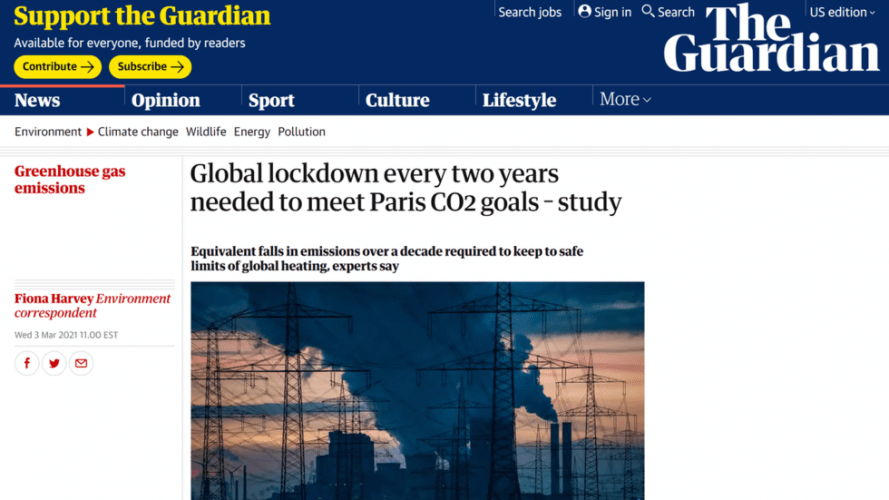
© web.archive.org / The Guardian
By Helen Buyniski | RT | March 4, 2021
The Guardian accidentally confirmed the suspicions of a whole lot of conspiracy theorists with an article suggesting a “global lockdown every two years” was needed to meet Paris climate goals. The title was quickly changed.
If carbon dioxide emissions don’t drop by the equivalent of a worldwide lockdown “roughly every two years” for the next decade, the earth will heat to apocalyptic levels, a team of researchers at the University of East Anglia warned in a Nature article published Wednesday.
This apparently so excited a certain strain of climate fanatic on the Guardian staff, that they originally posted the piece under the title “Global lockdown every two years needed to meet Paris CO2 goals – study.” After being dragged mercilessly for such fear porn, the headline was changed to “Equivalent of Covid emissions drop needed every two years – study” with an explainer that “experts say” that “equivalent falls in emissions over a decade” would be “required to keep safe limits of global heating.”
Despite calling for “completely different methods” to achieve and lock in the emissions drop from the pandemic, lead researcher Corinne Le Quéré nevertheless insisted that climate change couldn’t be a “side issue. It can’t be about one law or policy, it has to be put at the heart of all policy.”
“Every strategy and every plan from every government must be consistent with tackling climate change.”
While Le Quéré didn’t come out and suggest people be arbitrarily deprived of their liberties every two years in order to please a climate model, the other “strategic actions” she mentioned to keep some of the gains of the pandemic were already being implemented – and in many cases had been implemented for years. From city planning to incentivize “active transport” (walking and cycling) and growing public transportation, to promoting remote work where possible, her suggestions were not exactly new – and unlikely to convince anyone they were sufficient enough.
“There is a real contradiction between what governments are saying they are going to do [to generate a green recovery], and what they are doing,” Le Quéré told the Guardian, calling the phenomenon “very worrisome.”
Her co-researcher Glen Peters was more explicit in what latitude countries should have to move away from fossil fuels on their own time, calling for “structural changes” to move economies toward renewable energy.
Some on social media, seeing the “quiet part” said out loud on the first edition of the Guardian article, had an “I told you so” moment. The threat of ‘climate lockdowns’ has been alternately presented and “debunked” by mainstream media for months.
… others at first assumed it had to be satire, because no one would post something that on-the-nose –
… except maybe for the World Economic Forum, which actually posted in praise of what lockdowns had done to cities – presumably turned them into uninhabitable hives of snitches where one can’t even take in a Broadway show anymore – earlier this week, before removing its tweet under public pressure.
The WEF had posted a video praising the “silence” and clearer air – and lack of humans, though they didn’t say that part out loud.
Guardian writer insists cancel culture doesn’t exist, gets whacked by Big Israel
By Helen Buyniski | RT | February 11, 2021
The meaning of ‘free speech’ is devolving rapidly, with an ever-widening swathe of journalistic content deemed deplatform-worthy, but one writer’s run-in with the Israeli lobby should remind us where “cancel culture” began.
Current Affairs editor Nathan Robinson, a columnist for the Guardian, tripped over Tel Aviv’s time-honored third rail back in December. He was incensed – as any sane American might be – by the truly preposterous piles of money that were being bundled off to Israel as part of what was supposed to be an omnibus spending bill combined with Covid-19 stimulus passed by Congress as a life-raft for a desperately needy American populace. So he sent out a tweet.
Robinson’s tweet – which wryly suggested “it’s the law” that “the US Congress is not actually allowed to authorize any new spending unless a portion of it is directed toward buying weapons for Israel” – was a joke that took a moment to recognize as a joke, given its resemblance to reality, as the best satire often is. But, at some point, he seemed to get cold feet, following up the tweet with a qualifier noting while it wasn’t really the law, it was “at least so customary as to be functionally identical” to it.
Apparently smelling weakness (and finding satire a wholly inappropriate pastime for a Guardian columnist), the Guardian’s US editor ordered him to delete the tweets, declaring they were not “helpful to public discourse.” One might ask how 95 percent of what’s printed in the Guardian is helpful to public discourse, but one would probably not receive a reply. The email also included what seemed to be a forwarded message from some humorless individual who denounced the tweets as “clearly anti-Semitic,” arguing they were “saying that the only Jewish state controls the most powerful country in the world” and were liable to “inform murderous hatred.”
“Delete this and apologise,” the nameless critic demanded.
Robinson at this point was going to get fired no matter what. He could have stood his ground, explaining to his editor that only the unsigned letter-writer had claimed “the only Jewish state controls the most powerful country in the world,” a conclusion which was nowhere to be found in Robinson’s tweets. He could have pointed out that deeming criticism of Israel “anti-Semitic” was itself anti-Semitic, because plenty of Jews disapprove of the sociopathic actions of the Israeli government and don’t appreciate being used as human shields for those actions. Or he could have just said “no.”
Instead, he went the route traveled by so many journalists desperate to save their jobs, deleting the tweets, groveling at the feet of his editor, and even asking for guidance from the Guardian on what was off-limits – only to be told there was no such code, just an “unwritten one.” Thus was Robinson sucked into the apology vortex that has destroyed so many upwardly-mobile political and media figures – including UK Labour leader Jeremy Corbyn – who’ve dared to oppose the “war crimes” of a foreign country.
After weeks of emails going unreturned, Robinson was informed his services would no longer be needed.
His fate certainly had a ring of poetic justice – his last column published by the Guardian denied the existence of “cancel culture,” gloating that “bigots like Jordan Peterson” aren’t owed a platform after some employees at the publisher who’d already inked a deal with Peterson complained.
However, the Israeli lobby has been bullying journalists since long before “cancel culture” had a name, as Robinson himself documented in a typically long-winded piece posted to his website after he discovered his groveling had been for naught. Indeed, today’s “cancel culture” practitioners most likely learned their craft from observing the craven sneak-attacks practiced by the Lobby that dare not speak its name.
Like the Israeli lobby’s defenders, cancel culture practitioners pile on their targets without regard for logic, fact, or common sense. They hammer away at not only their victim, but their victim’s employer until it becomes easier to just give them what they want, even if the “offensive” statement that started the controversy was utterly unimpeachable.
Robinson’s criticism of the US dumping billions of taxpayer dollars at the feet of Israel while millions of Americans struggled to make ends meet was accurate, as most job-killing jabs at Israel are. Because there is no way of justifying the expenditure of $3.8 billion per year on a country that deliberately antagonizes its neighbors in order to justify the purchase of more American weaponry, Israel’s defenders merely lob the same “anti-Semitism accusation” grenade, again and again. As former Israeli minister Shulamit Aloni has freely admitted, “it’s a trick, we always use it.”
“The ties between Israel and the American Jewish establishment are very strong.”
It doesn’t matter if the critic of Israel is himself or herself Jewish, either: The list of Jewish critics of the Israeli government’s heinous crimes, all dismissed as “self-hating Jews,” could fill a book (whose publication would no doubt be censored). The Israeli government does not represent the Jewish people, no matter how hard it pretends to, and to suggest it does is itself anti-Semitic.
Unfortunately, the American establishment is utterly unwilling to stand up to these bullies for fear of being smeared as anti-Semitic itself, leading to the spectacle satirized so well in a New York Times cartoon from two years ago – one which also got its creator fired.
It’s a trick they will keep using until someone in the media establishment grows a backbone. As more and more self-styled aggrieved groups pick up on how ‘cancel culture’ works, eventually journalists will be unable to speak at all.
Helen Buyniski is an American journalist and political commentator at RT. Follow her on Twitter @velocirapture23
Blowing in the wind
Climate Discussion Nexus | January 6, 2021
Supposedly the very active Atlantic hurricane season in 2020 was more proof that global warming is upon us. As you will recall, when there was a long hiatus in major hurricanes making landfall in the United States the theory was fine-tuned to say warming decreases hurricanes. But then a string of hurricanes hit and the theory switched back. Except for one small thing: last year was actually a quiet one for… um… hurricanes.
As Paul Homewood writes on his Not A Lot of People Know That blog, or mostly shows in pictures worth thousands of words, the total number of hurricanes recorded by early September 2020 with wind speed over 64 knots was 42 and the number with wind speed over 96 was 18. And while neither number is unprecedented, they are certainly toward the low end of the range from 1980 on. Just as the U.S. saw fewer tornadoes than usual last year. (And for that matter wildfires are down not up over the past few decades; stand by for news that warming reduces wildfires and it’s bad.)
At least 11 years since 1980 saw 60 or more hurricanes recorded globally with wind speed over 64 knots, and at least that many saw 30 or more with wind speed over 96 knots. The period from 1990 to 1998 seems to have been especially bad, if one regards hurricanes as in some way “bad”. (Yes, we realize you don’t want one hitting your home town. But ecosystems are complicated things and it may well be that a healthy planet is one that sees periodic destructive wind storms. Again beware the alarmist trope that all effects of warming are bad and all bad things are effects of warming.)
The overall pattern is, you will not be surprised to hear, complicated. There seems to be a downward trend from the mid-1980s at least until 2014, with a bit of a bump in 2016 and another in 2019.
Some alarmists solved that problem the old-fashioned way, namely by ignoring it. Thus in his lyrical pro-lockdown piece in the Guardian (see below) their global environment editor Jonathan Watts raved about how “2020 saw record smoke plumes from bushfires in Australia, a freakishly protracted heatwave in Siberia, the most tropical storms ever registered in the Atlantic, devastating blazes in Brazil’s Pantanal wetlands, the highest flood levels recorded in east Africa, unusually devastating cyclones and typhoons in India, Indonesia and the Philippines, the hottest northern hemisphere summer in history, and temperature records in the Antarctic and the Arctic, where winter ice formation was delayed for longer than in any season in the satellite era.” But we predict a more subtle approach.
The consensus view will be that warming decreases hurricanes except when it increases them. And which way the switch is thrown at any given point will depend not on trends, careful measurement or rigorous analysis of causation but basically on whatever seems to be happening right now.
The Guardian can try rewriting the history of White Helmets’ James Le Mesurier, but the truth is there for all to see
By Kit Klarenberg | RT | October 30, 2020
A fetishistic Guardian article seeks to rehabilitate the life and death of the former British soldier turned ‘humanitarian’, but cannot explain away his lavish lifestyle, missing money, and all the other financial irregularities.
On the morning of November 11, 2019, James Le Mesurier, founder of Syria’s controversial White Helmets, was found dead in Istanbul. Since then, the Western establishment has struggled to get its story straight on the man, his professional history, the group he founded, and how he died.
The latest example of mainstream media narrative management in the ever-mysterious case came in the Guardian on October 27, in the form of a 6,000-word hagiography of Le Mesurier, authored by its veteran Middle East reporter Martin Chulov.
Many at this point will be familiar with the idolatrous portait it paints of its subject – a heroic humanitarian committed to benevolent causes who saved untold lives, tragically driven to suicide by a “disinformation campaign led by Russian and Syrian officials and peddled by pro-Assad bloggers, alt-right media figures and self-described anti-imperialists.” Nonetheless, it marks the first time the significant controversy surrounding his financial dealings has ever been explored, let alone mentioned, by a British news outlet.
In July this year, the Dutch newspaper De Volkskrant published a long-read of its own, explosively revealing how, three days prior to his death, Le Mesurier ‘confessed’ via email to the White Helmets’ many international donors, who’d funded the group to the tune of hundreds of millions over the years, that he’d committed fraud.
The disclosure was prompted by an internal audit by a Dutch accountant of the finances of Mayday, the foundation started by Le Mesurier to find, train, and support the White Helmets. The audit found, among other things, that he had been paying himself and his wife, long-time UK Foreign & Commonwealth Office (FCO) operative Emma Winberg, “excessive” salaries and supplementing the totals with unjustifiably vast cash bonuses; that his employment of his wife represented a potential conflict of interest; and that he might be guilty of tax evasion.
While claiming this malfeasance wasn’t intentional, Le Mesurier took full and sole responsibility, and expressed fears that further investigation could expose yet more “mistakes and internal failures.”
Monetary misconduct
Damning stuff indeed, but De Volkskrant’s seismic disclosures have been curiously ignored by all other Western media outlets until now. The Guardian’s article deals with the damning revelations, both directly and indirectly – Le Mesurier, whom Chulov knew personally, and with whom he clearly maintained an intense affinity, is acquitted on all charges. Indeed, the White Helmets founder is said to have simply “unravelled under the weight of claims that would later prove to be false.”
The author is at pains throughout to frame “disinformation” as fundamental to Le Mesurier’s untimely demise, in terms of causing him immense “stress,” which led to him “disintegrating” mentally, damaging his reputation and that of the White Helmets in the eyes of world opinion, and, in turn, stoking erroneous suspicions in donor countries that he and his company were engaged in various improper activities.
The question of how a battle-hardened military veteran could be so deleteriously impacted mentally and emotionally by “attacks on Russian television and social media,” particularly if they were entirely without substance, is unasked and unanswered.
There’s little doubt Le Mesurier wasn’t in a good state during his final weeks. It’s been widely reported he was taking sleeping pills and psychiatric medication. Less well amplified were Turkish news reports alleging he and his wife had “fought violently” while dining out together the day before his death.
Chulov alleges “a distressed Le Mesurier” told friends just before he died that claims of Mayday’s monetary misconduct “seemed to come from nowhere.” In fact, questions about what purpose the vast sums donated to the company were put to, and where they all ultimately ended up, had long circulated.
While his article states that donor countries maintained their support for the White Helmets “despite the disinformation surrounding the group’s work,” this isn’t true. In September 2018, the Dutch government ended its backing, after a damning Ministry of Foreign Affairs report outlined serious concerns about Mayday’s financial practices, including an almost total lack of oversight over, and even awareness of, how its money entered Syria, and precisely whose pockets it eventually lined.
However, Chulov feels confident dismissing any and all suggestions of embezzlement, for he’s in possession of a report by forensic auditors Grant Thornton, conducted at the request of Mayday’s donors, which concluded there was “no evidence of misappropriation of funds” by Le Mesurier and Winberg.
Except that he isn’t, because it hasn’t been made public, at donors’ express request. Instead, he relies on the claims of a nameless “source familiar” with the report – which could conceivably, of course, be Winberg herself.
Excessive salaries plus bonuses
It’s clear Grant Thornton’s report isn’t an unalloyed clean bill of health, either – the auditors found “significant gaps in the administrative organization and internal control environment of Mayday” and “identified significant cash transactions that have not been (fully) recorded in the cash books and/or general ledger.”
Moreover, due to Mayday’s “informal” working environment, many key discussions took place “orally and over WhatsApp,” meaning auditors “had to reconstruct a number of financial events and are unable to provide certainty in those cases.”
Chulov is quick to dismiss the significance of these failings as nothing more than “shoddy” bookkeeping, contending “auditors found nothing to support the far more serious allegations made” against Le Mesurier – despite apparently not having actually read the report himself.
Likewise, he concedes Mayday’s executive salaries had been “higher than industry standards”, although his anonymous source familiar with the report is on hand to reassure him, and readers, “they were not off-the-scale high.” In 2017, Le Mesurier informed the Netherlands’ Ministry of Foreign Affairs he was paying himself a salary of €24,000 per month, before bonuses – several orders of magnitude higher than the designated salary ceiling at other Dutch government-funded enterprises. And considerably more than the $150 a day the White Helmet rescuers on the ground received.
References to Le Mesurier founding three separate companies named ‘Mayday Rescue’ – Mayday Rescue FZ-LLC in Dubai, Mayday Search and Rescue Training and Consultancy Services Ltd in Turkey, and Stichting Mayday Rescue Foundation in the Netherlands – are predictably absent from the Guardian’s article.
Accounts aren’t publicly available for any of them – the Dutch entity, while not registered as a charitable organisation, is characterised as being ‘without commercial enterprise’, so doesn’t have to file accounts at all. Dutch ‘stichtings’, or foundations, are openly advertised by Dutch law firms as ideal ways for wealthy individuals and corporations to minimize tax liabilities and distribute funds internationally.
The company nonetheless complied with governance and transparency requirements, appointing a Secretary and Treasurer. As such, the UK government could plausibly claim that Mayday Rescue, to which London funneled £43 million between 2015 and 2018, was, to the best of its knowledge, fully above board.
Tax havens and tangled webs
Except the £43 million actually went to Mayday Rescue FZ-LLC in Dubai – something only begrudgingly admitted by the FCO in March 2019, in response to a Freedom of Information request, after much heel-dragging and obfuscation.
Dubai is a notorious tax haven, and FZ-LLCs – Free Zone Limited Liability Companies – aren’t subject to any taxes on dividends, so they can be used to easily and opaquely repatriate profits. The entities are required to maintain accounting records, which can be inspected by authorities, but aren’t required to file accounts of any kind.
It may be significant that one of Stichting Mayday Rescue Foundation’s three directors, alongside Le Mesurier and Winberg, was a British Army veteran, Rupert Davis, who, in April 2016, founded the company Chameleon Global. Dissolved in October 2020, it was categorised as dormant – that is, non-operational – for the duration of its existence. Le Mesurier also founded other companies, with indeterminate connections to his assorted Mayday entities. For instance, in April 2017 he established Sisu Global BV in the Netherlands. It has never filed accounts, in breach of Dutch law. Le Mesurier resigned in November 2018, but Winberg apparently remains a director.
In January 2019, Le Mesurier registered My Zahara Limited as a dormant company in northern England, at an address belonging to a company formation agent specializing in, among other things, compliance with money laundering regulations, suggesting he intended to use the firm to repatriate money from his overseas firms.
Davis was also, until April 2019, connected to Sisu Global BV, a company in the Netherlands founded by Le Mesurier in April 2017. It has never filed accounts, in breach of Dutch law. Le Mesurier himself resigned from it in November 2018. Winberg apparently remains a director.
Chulov also, again predictably, dismisses as “disinformation” allegations that the White Helmets were “created by governments determined to remove Assad from power”; that Le Mesurier was “an agent of western intelligence, using a rescue organisation as a Trojan horse for regime change”; and that the organization was in any way affiliated to violent extremist groups.
What are matters of public record, however, is that the White Helmets were funded by the very governments avowedly committed to ‘regime change’ in Syria via covert and overt means; that Le Mesurier’s professional history included spells as a military intelligence operative; and that the group has openly collaborated with the Al-Nusra Front, among other jihadist elements, and engaged in violent activity.
In a June 2015 speech discussing his founding of the White Helmets, Le Mesurier cited a market research agency study which found that, in fragile environments, security forces garner low levels of public trust while first responders have the highest as a key motivating factor in his decision to establish a “humanitarian aid group.”
Untold millions for propaganda
That the White Helmets’ benevolent image was very carefully constructed and promoted by a government attempting to achieve ‘regime change’ is amply underlined by FCO documents leaked by hacktivist collective Anonymous.
The documents reveal that ARK, a firm founded by FCO veteran Alistair Harris where Le Mesurier worked between 2011 and 2014, played a pivotal role in promoting the White Helmets, developing“an internationally focused communications campaign to raise global awareness” of the group to “keep Syria in the news.”
Along the way, ARK, among many other endeavors, produced a documentary on the White Helmets, and ran its various social media accounts, among them the Facebook page for Idlib City Council, at one time mooted as a potential interim government to replace Bashar Assad. When Al-Nusra took the city, the White Helmets were filmed celebrating the ‘victory’ with the group’s fighters in its main square.
ARK profited to the tune of untold millions of pounds from these and other information-warfare efforts. The same illicit file tranche also reveals InCoStrat, founded by none other than Emma Winberg, also reaped large bounties for manipulating public perceptions about Syria, within and without the country. In one file, the firm boasted of surreptitiously “initiating events to create media effect” and of “using media to create events.”
One example of the former strategy saw InCoStrat produce mock Syrian currency, in three denominations, imploring Syrians to “be on the right side of history.” It was intended to ensure that international opinion remained arrayed against Assad, at a time “media attention has shifted almost exclusively towards ISIS and some influential voices are calling for co-operation with the Syrian regime to combat ISIS.”
The file states: “The notes are due to be smuggled into regime-held parts of Syria once formal clearance has been authorized by HMG officials … We will engage the international media to create a story around the event … The message to the regime [is] covert but active resistance continues.”
Another document indicates that Winberg’s InCoStrat also established Basma – “a media platform providing human interest stories and campaigns that support [UK government] policy objectives” – and engaged in propaganda operations in the wake of the 2003 invasion of Iraq, training and maintaining a network of journalists who were “instrumental in reporting on events in Basra.”
On the subject of propaganda, establishment efforts to rehabilitate Le Mesurier are scheduled to continue apace in future.
Starting on November 9, the BBC will transmit a 15-part radio documentary on Mayday Rescue. Over the summer, Chloe Hadjimatheou, a reporter on the project, approached a number of journalists and researchers who’d publicly raised questions about the White Helmets, asking if they wished to contribute to the program.
Several of the individuals targeted subsequently published their correspondence with Hadjimatheou, showing that the program’s preordained agenda and objectives couldn’t be more blatant.
What is clear is that any suggestion Le Mesurier was a British intelligence operative surreptitiously attempting to foster regime change in Syria, or that the White Helmets weren’t an entirely benevolent, independent humanitarian organization will be rubbished, and all voices critical of the group will be smeared as witting or unwitting agents of the Russian and Syrian governments.
By Kit Klarenberg, an investigative journalist exploring the role of intelligence services in shaping politics and perceptions. Follow Kit on Twitter @KitKlarenberg
Election reporting
IRRUSIANALITY | September 14, 2020
Leaders of Russia’s ruling United Russia party were in a good mood on Sunday night as the results of the country’s local elections streamed in. ‘You have received the votes of the people, who trust you’, party chairman (and former Prime Minister and President) Dmitry Medvedev told candidates. ‘All our [gubernatorial] candidates … will win in the first round … and likewise in the regional and municipal parliaments United Russia will form a majority in every region without exception’, added party general secretary Andrei Turchak.
Turchak wasn’t exactly right about the results, but not far off. United Russia has reason to be happy. Its candidates for governor were elected with thumping majorities, even in Irkutsk, where it had been predicted it might lose. And in city and regional elections, the party was consistently top, generally getting around 45% of the vote, some 30% or so above its nearest competitors, the Communists and LDPR.
And yet, that’s not what you’d think if you went by the stories in the Western media today, which focused almost entirely on miniscule gains by supporters of opposition activist Alexei Navalny. ‘Russia opposition makes gains in local elections,’ ran the headline on the BBC website. ‘Navalny allies win council seats as Putin’s party claims victory’, said that in the Guardian. ‘Alexei Navalny’s allies claim council wins in Russia local elections’, shouts Deutsche Welle. And so on. You’d imagine that the elections were indicators of some significant shift in the political tide.
So what were these great gains? Navalny-backed candidates won 2 seats in the city of Tomsk, and 5 in Novosibirsk. That’s it. A grand total of 7 council seats. To be fair, it’s 7 more than they’ve ever had before, and so in that respect, it’s progress. But it’s hardly a significant result in the grander scheme of things. Across the country, United Russia governors were being elected with shares of the vote of 70 or so percent. Is ‘Opposition makes gains’ really the appropriate way of reporting the results? Methinks not, but it’s an interesting insight into the mentality of the Western press corps.
Featured Video

Iran’s Next Strike May Not Explode. It Could Shut You Down
or go to
Aletho News Archives – Video-Images
From the Archive
Zionism’s Violent Legacy
By Donald Neff | Washington Report On Middle East Affairs | January 1996
On January 4, 1948, Jewish terrorists drove a truck loaded with explosives into the center of the all Arab city of Jaffa and detonated it, killing 26 and wounding around 100 Palestinian men, women and children.[1] The attack was the work of the Irgun Zvai Leumi – the “National Military Organization,” also known by the Hebrew letters Etzel – the largest Jewish terrorist group in Palestine. The Irgun was headed by Revisionist Zionist Menachem Begin and had been killing and maiming Arabs, Britons and even Jews for the previous ten years in its efforts to establish a Jewish state.
This terror campaign meant that at the core of Revisionist Zionism there existed a philosophical embrace of violence. … continue
Blog Roll
 Aletho News
- Trump’s Iran war is on an Israeli leash
- Saudi oil boss issues global supply warning
- Riyadh Says Its Oil System Is Intact. The Numbers Say Otherwise.
- Trump and Netanyahu Want to “Finish the Job” on Iran
- US ‘one-sided dictation’ not Iran’s beliefs makes rational talks impossible: Baghaei
- Iran’s Next Strike May Not Explode. It Could Shut You Down /Col Doug Macgregor
- Iran: US political targets legitimate if assassinations return
- Iraq shuts key border crossing with Iran under US pressure: Report
- Undersea Internet cables could be targeted in retaliation for attacks on Iran: IRGC deputy chief
- EU sending ‘biased’ observers to interfere in Serbian election – president
- If Americans Knew
- The Israel Lobby’s Changing Fortunes
- AIPAC has become such a political liability that it’s shifting to a more “nimble” approach to buying politicians
- At least 160 Israeli settler attacks in 2 weeks
- Will Gaza’s Ancient Christian Community Disappear Forever?
- Israel’s vision of regional security rests on keeping Arab states weak
- Heidi Levine recounts how Palestinian youths helped save her in settler attack
- DAILY UPDATE: Latest essential news on Palestine, Israel, & region
- Trump’s Intensifying Sabotage of the ICC, for Israel’s Sake
- Israeli military detain US and UK volunteers in West Bank including Democratic NY politician Brad Lander
- Americans at National Conservatism Conference held in Israel this year criticize Israel
- No Tricks Zone
- E-Cars Reduce CO2 Emissions By Only 41% Compared To Internal Combustion Engine Vehicles
- Predictions Made By Renowned Climate Professor Over Past Decades Have Been Proven To Be Poor
- New Study Suggests Large Regions Of The Pacific Ocean Have Been Cooling For The Last 80 Years
- Germany’s Green Energy Debacle: High Energy Costs Force Kahla Porzellan to Close After 182 Years!
- New Study: 50 Years Of The Most Aggressive ‘Net Zero’ Policies Can Only Affect The Global Climate By 0.03°C
- US September “Heat” Was No Record…Many Records Set Decades Ago
- Latest European Green Energy Debacle; Portugal’s Largest Flagship Solar Park Insolvent!
- Green Energy Debacle: German Expert Professor Fritz Vahrenholt Warns Of Severe Economic And Social Consequences
- Two More Paleo Reconstructions Affirm Meters-Higher Sea Levels Across Ireland, Brazil 7000-6000 Years Ago
- New Study: Earth And Venus Surface Warmth Largely Explained By Convection And Lapse Rate, Not CO2 Or Radiation

