The downing of flight MH17 in Eastern Ukraine, on July 17, 2014, led to a tectonic shift in relations between the EU and Russia. The American Secretary of State, John Kerry, paved the way by spreading misinformation and agitprop.
On July 17, 2014, a Malaysian passenger plane that had departed from Amsterdam and was en route to Kuala Lumpur crashed in Donbass, eastern Ukraine, where at that time a battle was raging between Ukrainian government troops and pro-Russian insurgents. All 298 occupants of flight MH17, most of them Dutch, were killed. The Dutch Safety Board (DSB) investigated the technical cause of the crash. In 2015 it concluded that the plane was downed by a Buk missile. The criminal investigation was led by a team of Dutch, Belgian, Australian, Ukrainian and Malaysian police officers and prosecutors – the Joint Investigation Team (JIT). In 2019, it announced that the Dutch Public Prosecution Service would prosecute one Ukrainian, Leonid Kharchenko, and three Russians, Igor Girkin, Sergey Dubinsky and Oleg Pulatov. They were tried in The Netherlands, by the Hague District Court. In 2022, Pulatov was acquitted. The court sentenced the other defendees to life imprisonment for complicity in murder and the downing of an aircraft. The concrete involvement of the three convicts is alleged to have included: expressing the need for and requesting an air defense system with crew; indicating a suitable firing location for that system; transporting, escorting, guarding and concealing it. Those who were directly involved in the downing of the plane are still at large. The JIT assumes they are hiding in circles of the 53rd anti-aircraft brigade in Kursk, Russia. A Buk Telar air defense system from that brigade allegedly crossed the border into Ukraine with crew and all on July 17, 2014, where it fired the fatal missile the same day. However, the JIT has no idea who pushed the button, who gave the order to shoot, and for what reason. In 2023, the JIT anounced that it had halted the investigation.
The impact of the MH17 crash on relations between Russia and Europe cannot be overestimated. Although American and European sanctions were already in force against Russia before July 17, 2014, due to the seizure of Crimea, relations between Russia and most countries of the European Union were still friendly. The European economy benefitted from trade relations with Russia and the import of cheap natural gas. The Obama Administration tried to change this. It urged Brussels to impose additional, tougher sanctions on Russia, The Washington Post reported on June 25. At that time, there were divisions within the E.U. Some countries feared sanctions would hurt their relations with Russia. This changed overnight on July 17. “We hope it is a wake-up call for some countries in Europe that have been reluctant to move,” US Secretary of State John Kerry said in a televised interview three days after the MH17 crash. “We think frankly that the sanctions may need to be tougher. It may well be that the Dutch and others help lead that effort.” Kerry referred to the sanctions package that the US had already imposed on July 16. It was an example for Europe to follow. That package included sanctions against numerous Russian companies in the energy sector, banking and arms industries. Americans were prohibited by law from doing business with individuals who had interests in these companies.
On July 21, the day after Kerry’s TV address, American UN Ambassador Samantha Power and Dutch Minister of Foreign Affairs Frans Timmermans gave emotional speeches at the UN Security Council in New York. They accused the separatists of denying investigators access to the crash site, suppressing evidence, engaging in looting, disrespecting the victims’ bodies and hindering their recovery. “To my dying day I will not understand that it took so much time for the rescue workers to be allowed to do their difficult job, and that human remains should be used in a political game,” Timmermans stated, before flying to Brussels to give a reprise of his speech. Several EU ministers reportedly had tears in their eyes when Timmermans said he had known personally some of the 194 Dutch passengers among the 298 people who died on the plane. Reuters characterized the meeting in Brussels as “a turning point in Europe’s approach towards Russia”. Countries that were previously on the brakes, such as Germany and Italy, now suddenly agreed to the measures desired by the US. “Within days of Timmermans’ address, senior EU diplomats had agreed the broad outlines of potential sanctions on Russian access to EU capital markets, defence and energy technology,” Reuters wrote. “Timmermans’ impassioned speech, several diplomats said, made it difficult for others to hold a firm line against sanctions at Tuesday’s meeting. […] But like a supportive family, EU partners rallied around the bereaved Dutch, putting national economic interests aside and for the first time going beyond asset freezes and visa bans on individuals to envisage curbs on entire sectors of the Russian economy that could turn the screw on President Vladimir Putin.” On July 31, the significantly stricter EU sanctions against Russia became a reality.
The MH17 disaster not only led to economic damage for Russia. The country’s reputation also suffered a serious blow. Various Western media and politicians immediately pointed the finger at the Kremlin. President Vladimir Putin had a 298-fold murder on his conscience. While Russia could previously count on some understanding among many in the West for sending “green men” to Crimea, it was now a rogue state in the eyes of the masses. The separatists in Donetsk and Luhansk also experienced nothing but misery from the disaster.
The repercussions for Russia and the separatists stand in stark contrast to the outcome for the anti-Russian coup government in Kiev. It has benefited greatly from the MH17 crash. Until July 17, fear of a large-scale Russian invasion prevailed and there was concern about the poorly run ‘anti-terrorist operation’ along the border with Russia in the Donetsk and Luhansk oblasts. The MH17 disaster changed this overnight. On July 21, 2014, Ukrainian President Petro Poroshenko appeared on CNN. He qualified the MH17 as a terrorist attack. “I don’t see any difference between the tragedy of 9/11 and the tragedy in Grabovo in Ukraine,” he said. “So now we have to demonstrate the same reaction. This is a danger to the whole world, to global security.” It sounded like a call for the West to take military action, as had happened in response to the alleged terrorist attacks in the U.S. on September 11, 2001. The Americans then successively invaded Afghanistan and Iraq.
Poroshenko almost got his way. An advanced plan by The Netherlands and Australia to take the crash area by force of arms from the insurgents was called off at the last minute. Nevertheless, the MH17 disaster brought the Kiev government much of what it wanted from the US and Europe: political and military support for Ukraine and tough punitive measures against Russia. On December 18, 2014, US President Barack Obama signed the so-called Ukraine Freedom Support Act, which paved the way for $350 million in military aid to Kiev. According to statements from the US Department of Defense, Washington donated one and a half billion dollars worth of military goods and training to Kiev from 2014 to 2019. NATO ‘intensified’ – in its own words – its cooperation with Ukraine. The tougher attitude of Brussels towards Moscow, so fervently desired by Kiev, also took shape.
Was MH17 really downed by a Russian Buk-crew? According to the The Hague District Court, the Dutch Prosecution Service, the JIT and the western legacy media the answer is in the affirmative. According to the author of this article, who attended all 69 court sessions of the criminal trial, no convincing — let alone conclusive evidence — was presented for the Russian Buk scenario. There are reasons to believe that something completely different may have happened. (I will discuss this in extenso in a book that I will publish this year.)
The fact is that in the public mind, Russia was convicted even before the official criminal investigation had started. Secretary of State John Kerry played a major role in this campaign by spreading misinformation and agitation propaganda that was subsequently echoed by others among whom were President Barack Obama, US Ambassador to the UN Samantha Power, and Dutch Minister of Foreign Affairs Frans Timmermans. Let’s take a look at the five tv interviews Kerry gave on Sunday, July 20, 2014. On this day he appeared on CNN, Fox, ABC, NBC and CBS.
Claim 1: “We know for certain that in the last month there’s been a major flow of arms and weapons. There was a convoy about several weeks ago, about 150 vehicles with armed personnel carrier, multiple rocket launchers, tanks, artillery, all of which crossed over from Russia into the eastern part of Ukraine and was turned over to the separatists.”
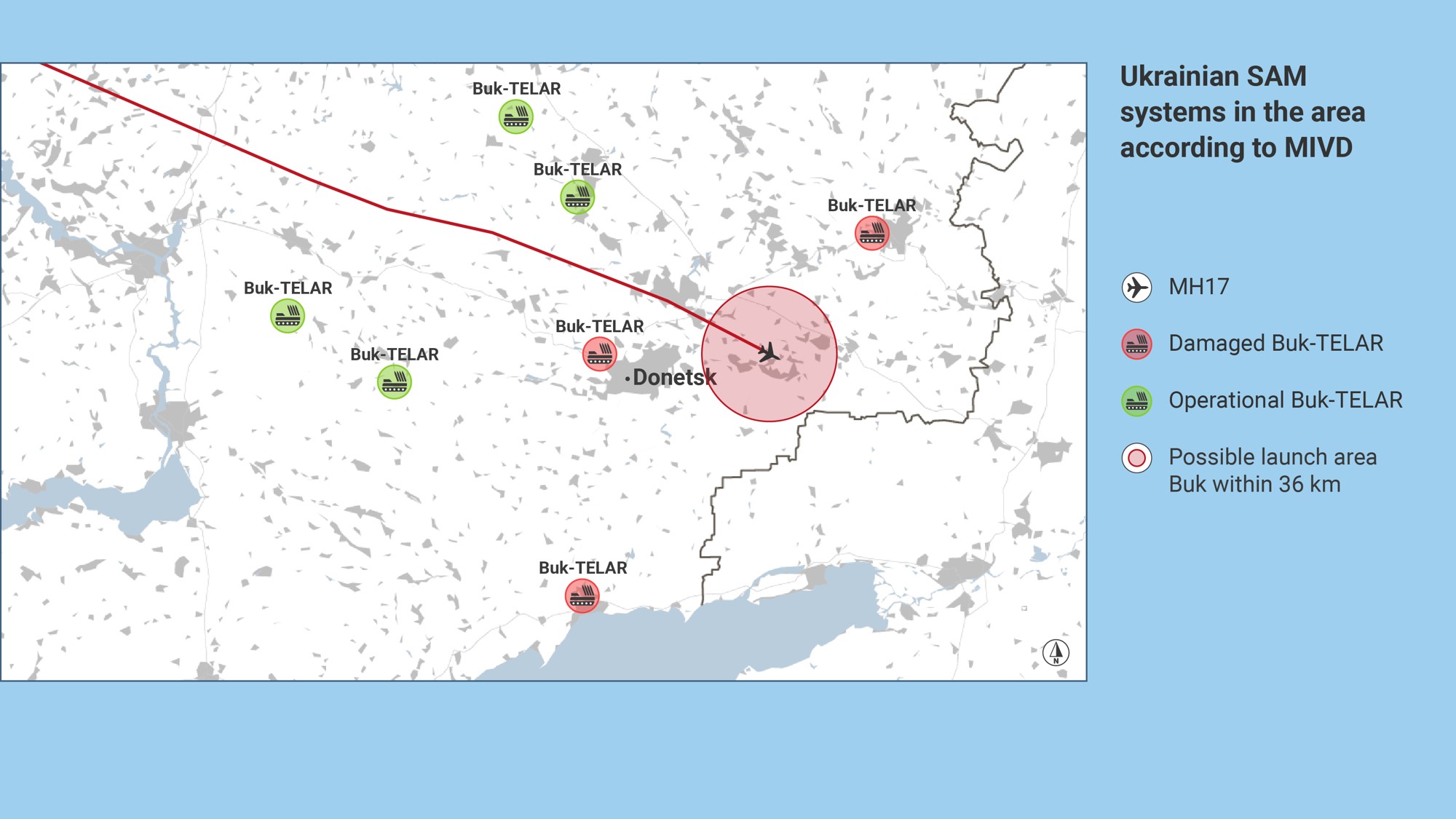
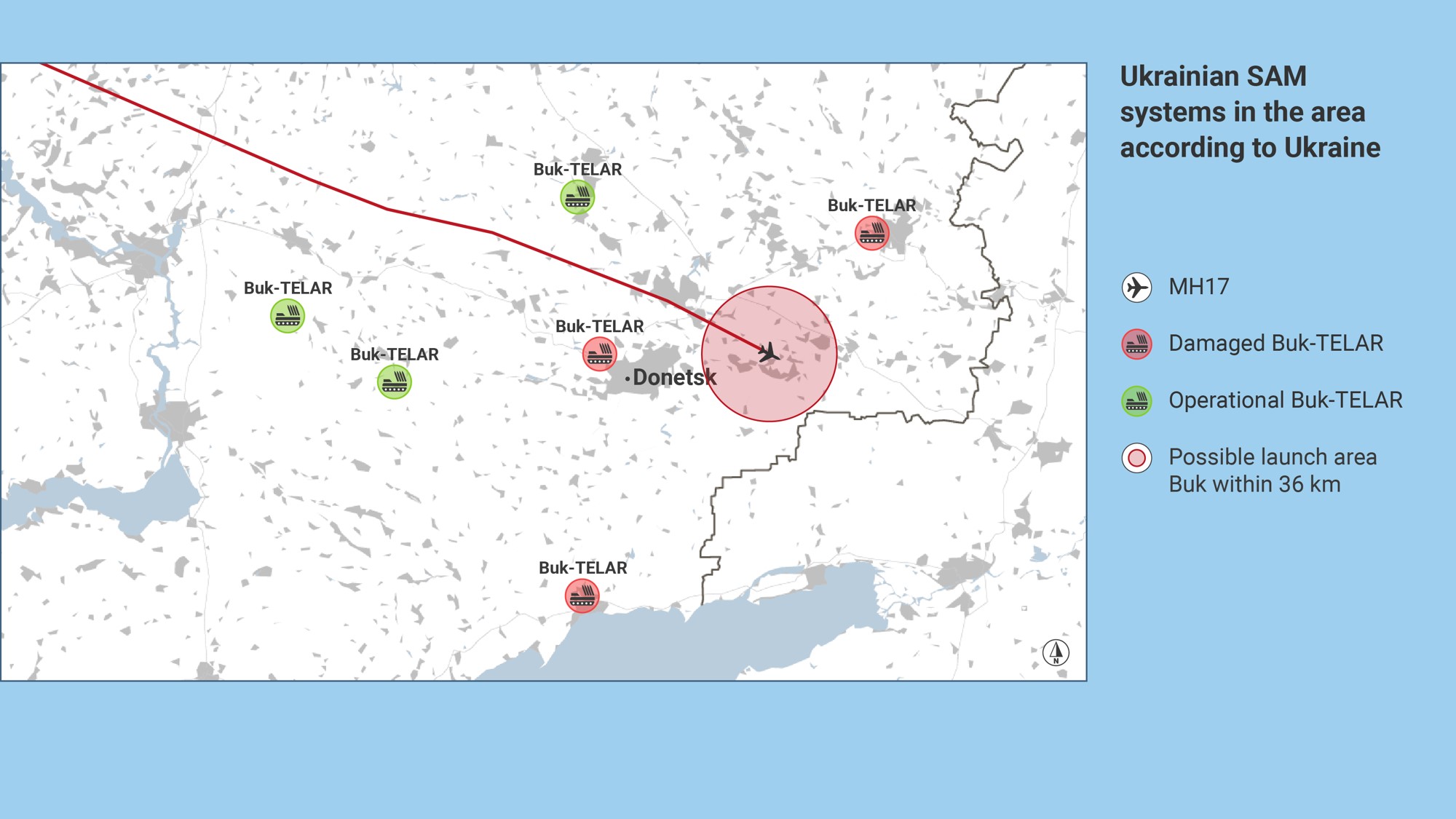
This may be true. I did not study this subject. I concentrated on the Buk allegations. I’ve seen imagery of a military transport in rebel territory, filmed on July 15, 2014. The vehicles in the transport were either provided by Russia or captured by the separatists from the Ukrainian army. In any case, U.S. intelligence has not detected a Buk Telar crossing the Russian-Ukrainian border. No western intelligence agency has identified any Russian Buk system in Ukraine; only Ukrainian Buk systems. This has been acknowledged by the Dutch Public Prosecution Service during the MH17 criminal trial in the Netherlands. In court it showed a map of all known positions of Ukrainian Buk systems in eastern Ukraine in June and July 2014, based on a memo of the Dutch Military Intelligence Service MIVD.
Claim 2: “We know for certain that the separatists have a proficiency that they’ve gained by training from Russians as to how to use these sophisticated SA-11 systems.” (SA-11 is the American designation for the Buk system.)
The Americans have never substantiated this claim. It cannot be true either. A Ukrainian Buk expert who was consulted by the JIT has said that a Buk system is more complex to operate than the most advanced fighter jet. At the time MH17 was shot down, the conflict in eastern Ukraine had been going on for only three months. In such a short period it is impossible to learn how to operate a Buk system. According to Ukrainian ex-Buk commander Tarankov, who was interviewed by the JIT, this takes years. The commander of a Buk Telar has undergone five years of training; his subordinates spend a year or more before they are allowed to deploy, Pulatov’s lawyers revealed in court. According to the ex-commander of a Finnish Buk battalion, Esa Kelloniemi, who was consulted by the author of this article, it is out of the question for an untrained crew to receive permission from higher-ups to go out with a Buk. Moreover, without specialist knowledge, it would be impossible to fire a Buk missile. That would require much more than turning the ignition key and pressing the launch button. “The firing mechanism blocks the launch of a missile if a target has not first been detected, locked-on to and tracked, and if this target is still outside the calculated firing range,” Kelloniemi says.
Kerry’s suggestion that MH17 was brought down by separatists runs counter to the view of the JIT and the Dutch Public Prosecution Service. They propagated the hasty suggestion that MH17 was downed by a Russian crew.
Claim 3. “We know that they had this system to a certainty on Monday the 14th beforehand because the social media was reporting it and tracking it.”
According to the JIT and the prosecution the Buk that downed MH17 entered Ukrainian territory on July 17. This therefore cannot be the Buk that Kerry talked about.
On July 14 a Ukrainian military transport plane, an An-26, was downed. According to Kiev, this had happened at a high altitude and with a system more powerful than anything the insurgents had fired with up to that time. It probably came from Russia, they said. On social media there was talk that it was downed by a Buk missile, but this wasn’t substantiated in any way.
It seems the seperatists were in posession of Buk Telars. In Donetsk and Luhansk they captured air bases where Buk systems were deployed. The Ukrainians had already withdrawn from there, taking their equipment with them, but they may have left some behind. According to the prosecution the separatists found at least one Buk-Telar in an air base near Donetsk. It showed photos of this Telar in court. It looked non-functional. The electronics section was clearly damaged. In Luhansk the Ukrainians also seem to have left at least one Telar behind. On 20 July 2014 a video appeared of Valery Bolotov, the political leader of the Luhansk People’s Republic (LPR). In it Bolotov expressed his condolences to the relatives and reported in the same breath that he had a non-functional Telar. He did not say how he got it. He invited the JIT to come and inspect the Telar and called on technical experts to repair it so that it could be used for the air defense of the LPR. The investigators of JIT never accepted Bolotov’s invitation. They never set a foot in Luhansk.
Claim 4. “On Thursday of the event, we know that within hours of this event, this particular system passed through two towns right in the vicinity of the shoot down. We know because we observed it by imagery.”
“We know they had an SA-11 right in the vicinity, hours before this shoot. The social media has documented this.”
“We know that they had an SA-11 system in the vicinity literally hours before the shootdown took place. There are social media records of that. The social media showed them with this system moving through the very area where we believe the shoot down took place hours before it took place.”
There are six videos and three photos of the transport of a Buk Telar across territory that was controlled by the separatists. Eight of them were posted on social media after the crash. Only one video, filmed in the city of Torez, and one photo, made in Donetsk, came into the hands of JIT before they were presented to the public. The identity of most photographers and filmmakers is unknown. Only two were identified. Of these two, only one was interviewed by the JIT. With his dash cam, he had filmed the transport of a Buk Telar in Makeevka. The metadata of his video indicated that it was shot in 2012. He said he didn’t remember the day of his encounter with the transport. One video was made by “a secret surveillance unit” of the Ukrainians in Luhansk. It was put on a YouTube channel of Ukraine’s secret service SBU the day after the crash. (See claim 9).
According to the Americans, the JIT and the prosecution the fatal missile was launched south of the city of Snizhne, from an agricultural field near the village of Pervomaiskyi. There’s one photo of a Buk driving under its own power in Snizhne and one video of a Buk leaving Snizhne, driving south. It is unknown who produced this imagery and the JIT wasn’t able to obtain the original files. The photo and video are of deplorable quality. Not a single detail can be seen on them. Zooming in creates a pixel salade.
Claim 5: “At the moment of the shoot down, we detected a launch from that area and our trajectory shows that it went to the aircraft.”
“We know to a certainty that we saw the launch from this area of what we deem to be an SA-11 because of the altitude, 33,000 feet, and because of the trajectory. We have the trajectory recorded. We know that it occurred at the very moment that this aircraft disappeared from the radar screen.”
“We picked up the imagery of this launch. We know the trajectory. We know where it came from. We know the timing. And it was exactly at the time that this aircraft disappeared from the radar.”
The Hague District Court has not received any satellite data from the Americans, despite repeated requests by the prosecution service and the Dutch next of kin. Some, among whom former CIA officer Ray McGovern, say this indicates that no missile had been launched from rebels’ held territory at all.
A memorandum the prosecution received from the U.S. Director of National Intelligence (DNI) states: “At the time that flight MH17 dropped out of contact, the U.S. intelligence community detected an SA-11 surface-to-air missile launch from approximately six kilometers south of the town of Snizhne in eastern Ukraine.” The DNI did not comment on the exact time of the launch, but Pulatov’s lawyers concluded from the memorandum that the observed launch could not possibly have been from the missile that brought down MH17. After all, a missile cannot be launched and simultaneously knock a target off the radar. A missile takes some time to reach a specified target. According to the investigators of the Dutch National Aerospace Laboratory NLR the Buk missile that hit MH17 must have travelled for about 32 seconds, if the missile was launched from the agricultural field south of Snizhne. So the launch the Americans allegedly observed must have been from a different missile than the one that hit MH17. (More about this in my upcoming book The MH17 trial.)
Both the Russians and the Ukrainians provided the JIT with primary radar data. On these, no missile or any other object can be seen near MH17. According to experts who were consulted by the JIT this can be explained by technical factors like the high speed of the missile (mach 3).
Claim 6: “We also know to a certainty that the social media immediately afterwards saw reports of separatists bragging about knocking down a plane. And then the so-called defense minister, self-appointed of the People’s Republic of Donetsk, Igor Strelkov, posted a social media report bragging about the shoot down of a transport plane, at which point when it became clear it was civilian, they pulled down that particular report.”
“We know that the so-called defense minister of the People’s Republic of Donetsk, Mr. Igor Strelkov, actually posted a bragging social media posting of having shot down a military transport. And then when it became apparent that it was civilian, they pulled it down from the social media.”
“The defense minister, so-called self-appointed of the People’s Republic of Donetsk, Mr. Igor Strelkov, actually posted a bragging statement on the social media about having shot down a transport. And then when it became apparent it was civilian, they quickly removed that particular posting.”
Kerry suggested that MH17 was shot down by mistake by referring in particular to two messages that appeared on July 17 at 16:37 and 16:50 on the news account “strelkov_info” of the social media site VKontakte. According to these reports, an Antonov transport plane of the Ukrainian Air Force, an Antonov An-26, had been downed. Kerry attributed it to Girkin, whose battle name was “Strelkov”, and who at the time was commander-in-chief of the Donetsk People’s Army. In posting the message, he allegedly “bragged” about shooting it down and then deleted it when he noticed that a passenger plane had crashed. But none of that was true. The account strelkov_info was a fan account, by and for admirers of Girkin. Statements by Girkin were sometimes published on strelkov_info, but they were always accompanied by a banner saying, “Girkin reports”. That banner was not with the first and also not with the second message about the downed An-26. The prosecution acknowledged that the two social media posts did not come from Girkin or subordinates of his. It therefore did not put forward the posts as evidence in its closing speech.
The person who first reported that an An-26 had been downed was, nota bene, the pro-Kiev Twitter account @ua_ridna_vilna. The unknown person behind the account sent out a tweet with this announcement at 4:30 p.m., only to delete the tweet and replace it at 4:32 p.m. with a tweet saying it was “probably” an An-26. The prosecution completely ignored the utterances on this account.
A plane came down. It makes sense that those who had heard about it or watched it from a distance assumed that a military aircraft had been hit. After all, that had happened sixteen times before. In four cases, it involved a military transport aircraft, including an An-26 on July 14. It was to be expected. Social media went wild. Thus the rumor got out that the crashed plane was an An-26.
Claim 7: “We know from intercepts, voices, which have been correlated to intercepts that we have, that those are, in fact, the voices of separatists talking about the shoot down of the plane.”
“We have voices that we have overheard of separatists in Russia bragging about the shoot down.”
“We have intercepted voices that have been documented by our people through intelligence as being separatists who are talking to each other about the shoot down.”
“Social media, which is an extraordinary tool, obviously, in all of this, has posted recordings of separatists bragging about the shoot down of a plane at the time right after it took place.”
Within a few hours after the crash the SBU posted on its YouTube channel an intercept of a phone conversation of a commander of the separatists, Igor Bezler. In it, he reports that a plane had been downed. A week after the crash the SBU posted another intercept, this time with someone reporting to Bezler that a ‘birdie” was coming his way. The JIT interviewed Bezler. At the start of the trial the prosecution stated that none of Bezler’s phone conversations were related to the downing of MH17. According to Bezler the conversations were about the downing of a Ukrainian Sukhoi jet a day before the MH17 crash. Indeed, on July 16, two Sukhois had been downed. It later turned out that the SBU had omitted part of Bezler’s conversation about shooting down a plane. In the omitted part, Bezler says it was a ‘Sushka’, meaning a Sukhoi jet. This was revealed by a Ukrainian blogger, Anatoly Shariy, who got his hands on the original wiretap.
Claim 8: “They have shot down some twelve planes, aircraft in the last months or so, two of which were major transport planes.”
In fact sixteen Ukrainian military aircraft were downed before the MH17 crash, among which four were military transport planes.
Claim 9: “And now we have a video showing a launcher moving back through a particular area there, out into Russia with at least one missing missile on it. So we have enormous sort of input about this, which points fingers.”
“We know that we have a video now of a transporter removing an SA-11 system back into Russia and it shows a missing missile or so.”
On the day after the crash, the Ukrainian secret service SBU posted a video on their YouTube channel of the transport of Buk Telar carrying three missiles in stead of four, which it normally carries if a Buk is being deployed. According to the Ukrainians, the transport was filmed in the early morning of July 18. The prosecution confirmed this and concluded that the video was shot on the outskirts of the city of Luhansk where at that time a battle was going on between the separatists and the Ukrainian army. So, the video was not shot in the border region as Kerry said. According to the prosecution, investigators of the JIT studied the original video file. The metadata indicated the video was shot in the early morning of July 18. The lawyers, however, revealed that the Luhansk video was missing from the SD card on which “a secret surveillance unit” allegedly recorded the event. A Dutch police officer who received the camera and the card from the hands of the SBU determined that the video file had been erased. The lawyers, therefore, said they didn’t understand how the investigators had managed to examine the original file.
It is possible that the Luhansk video is from before July 18. Indeed, at a press conference that was held in the afternoon of July 17, a spokesman for the Ukrainian government, Andrey Lysenko, reported that a video had been shot of a Buk Telar in Luhansk. Lysenko did not present this video, nor was it ever presented thereafter. Why not? Was this perhaps to conceal that the Ukrainians used the video to falsely claim it was made on July 18? Could it be that the Buk on the Luhansk video, that had one missile missing, had been involved with the downing of the Antonov An-26, on July 14?
Claim 10: “We know with confidence that the Ukrainians did not have such a system anywhere near the vicinity at that point in time. So it obviously points a very clear finger at the separatists.”
Dutch military intelligence service MIVD reported that there were several Ukrainian Buk systems present in Eastern Ukraine at the time of the crash. Western intelligence had not detected a single Russian Buk system in Ukraine. According to the prosecution the Buk that shot down MH17 was brought in on July 17 and hastily removed on the night of July 17-18. This would therefore be the reason Western intelligence services overlooked the Buk. The services would only have spotted Buks that had been in the same place for an extended period of time.
There is no evidence of an Ukrainian Buk that was within firing range of MH17. But, as MH17 police investigation chief Wilbert Paulissen correctly noted during the September 2016 press conference of the JIT: “Absence of evidence is not evidence of absence.” Just because there is no evidence of such a Buk does not mean it was not there and did not fire. A Ukrainian Buk Telar may have been put in position without anyone noticing.
The Ukrainian Defense Ministry provided the JIT with a list of all the locations in the east of the country where it had Buk systems. Missing from that was a Buk system on a military base in Dovhenke in the Kharkiv Oblast, just on the border of the rebel-held Donetsk Oblast. The MIVD determined that a Buk system had been located there. Why had Kiev concealed its presence?
Claim 11: “Pro-Russian separatists have reportedly removed almost 200 bodies from the crash site and are continuing to refuse to allow investigators full access to the site.”
“We want the facts and the fact that the separatists are controlling this in a way that is preventing people from getting there, even as the site is tampered with, makes its own statement about culpability and responsibility.”
“There are reports of drunken separatist soldiers unceremoniously piling bodies into trucks.”
“They are interfering with the evidence in the location. They have removed, we understand, some airplane parts.”
The authorities of the Donbass Peoples Republic (DPR) have not refused any investigators access to the crash site. A team of Dutch air-crash investigators was kept in Kiev by the Ukrainian and Dutch authorities, as has been extensively documented in the book MH17: Onderzoek, feiten en verhalen, commissioned by the Dutch Safety Board (DSB) and in a report by the University of Twente, Evaluatie nationale crisisbeheersingsorganisatie vlucht MH17. In a July 20 press conference, DPR Prime Minister Alexander Borodai complained that the investigators were nowhere to be seen. “It will soon be the 4th day after the event. Where are the experts? We are not in the middle of nowhere, the North Pole or Antartica, in a place where you can cannot travel easily. If you look at the map, you see we are in the middle of Europe. The road from Kiev to here takes four of five hours.” The DSB air crash investigators never went to Donetsk. In August they went back home.
However, three Dutch forensic investigators of the LTFO, specialized in victim identification, managed to reach the site. They were welcomed by Borodai, on July 21, the day after Kerry had accused the DPR authorities of refusing investigators access. To their surprise, they found themselves surrounded by journalists from all over the world. “There was press from Australia to the US, there must have been fifty camera teams,” one of them, Peter van Vliet, recalled. “I don’t know how they got there. But it took us three days, without sleeping and with all the dangers that entailed.” On July 21, also a Malaysian delegation arrived. To them Bordodai handed over the black boxes of the plane just after midnight. According to the Malaysians, they had secretly left Kiev. The Ukrainian government had tried to keep them there.
Contrary to what Kerry claimed, no separatist soldiers were involved in the recovery of the victims. The recovery was performed by a specialized team. The local Ukrainian State Emergency Service (SES) recovered human remains between 17 July and 21 July 2014. The SES is a federal organisation which has local teams that, among other things, are responsible for the protection of the population in case of disasters. When a disaster occurs, the SES is given authority over other services. In the case of flight MH17, the SES was assisted in the recovery by local fire brigades, police, farmers and miners.
On July 21, the Dutch forensic investigators of LTFO, observed that there were no more human remains visible at the locations accessible to them. In a statement to the international press, Van Vliet praised the SES: “They did a hell of a job in a hell of a place.” On July 22, a train, carrying the human remains that were recovered by the SES, left Donetsk heading for territory controlled by the Ukrainian authorities in Kiev. In a letter sent in August 2014 the Dutch embassy in Kiev conveyed its gratitude to the SES. “The experts in The Netherlands, who currently work on the identification of the human remains, have been deeply impressed by the professional handling of the bodies by the emergency services in Donetsk.”
Kerry and other American officials never substantiated their claim that the separatists covered up evidence by removing airplane parts. It later turned out that an Australian-Ukrainian journalist, who was covertly working for the Ukrainian government, had collected pieces of evidence from the crash site for “safekeeping and out of reach of the forces of the Russian Federation” and had handed them over to the Ukrainian authorities.
Also, Dutch air crash investigators didn’t seem to be in a hurry to recover the wreckage. The Dutch started a recovery mission only four months after the crash. The lawyers revealed that only 30 percent of the wreckage was transported to The Netherlands. The plane was partly reconstructed. The lawyers found that parts that were not used for the reconstruction had ended up in eighteen containers. The prosecution did not grant them access to these containers. The court did not overrule this decision.
Eric van de Beek is an investigative journalist. He studied journalism at Windesheim University and philosophy at the University of Amsterdam. For years he worked as a journalist for Dutch leading weekly Elsevier. In recent years he contributed to Diplomat Magazine, Novini, Sputnik, and Uitpers. He currently writes for Dutch weekly De Andere Krant. In 2024 a book of Van de Beek’s was published about the MH17 plane crash in Ukraine. On Substack you can read his English language blog about the subject. In 2024 he was awarded the Dutch Julian Assange Prize ‘for public service’.
June 1, 2025
Posted by aletho |
Book Review, Deception, Mainstream Media, Warmongering, Timeless or most popular | European Union, Russia, The Netherlands, Ukraine, United States |
Leave a comment
The Telegram channels of multiple major Russian news outlets were rendered inaccessible across the EU on Sunday. The affected channels now display a plaque stating that access to them has been restricted over alleged “violation of local laws,” with all the content unavailable.
According to media reports, the affected channels include such Russian majors as RIA Novosti, Izvestia, Rossiya 1, Channel One, NTV and Rossiyskaya Gazeta. While it was not immediately clear whether the bans are EU-wide, the restrictions have been reportedly rolled out in Poland, Belgium, France, the Netherlands, Greece, Italy and the Czech Republic.
The EU has taken multiple hostile steps against Russian media amid the ongoing conflict between Moscow and Kiev – and even before it. Some of the media affected in the apparent Telegram ban, namely Rossiyskaya Gazeta, Izvestia and RIA Novosti, were slapped with a broadcasting ban in the bloc in May. At the time, the EU Council claimed the outlets were under the “permanent direct or indirect control” of the Russian leadership, and played an “essential and instrumental” role in the hostilities.
No official statements have so far been made on the matter, either by Telegram, the EU as a whole or by individual members of the bloc.
December 28, 2024
Posted by aletho |
Civil Liberties, Full Spectrum Dominance | Belgium, Czech Republic, European Union, France, Greece, Human rights, Italy, Poland, The Netherlands |
Leave a comment
Humanity has arrived at a rare, explosive moment where several avenues of information are converging to shatter a major paradigm much of society and medicine has accepted as their reality. Which direction will we go?
It was last month that Englands health service announced it would stop prescribing puberty blockers to transgender kids. A move that aligned the UK with several other Nordic countries.
Now, the public received the full data dump that drove England’s decision in the form of The Cass Review commissioned by the NHS and lead by former President of the Royal College of Pediatrics and Child Health Dr. Hillary Cass. Its findings:
- Clinicians should be “extreme cautious” giving powerful hormone drugs to kids 16 and under
- Most of the 23 clinical guidelines and recommendations for managing gender dysphoria in children and young people reviewed were not independent or evidence based
- Of the 50 studies on puberty blockers reviewed, only one was of high quality
- Of the 53 studies on the use of hormone treatment, only one was of sufficiently high quality
Perhaps most interestingly, the Cass Review speaks on the medical profession stating doctors can be cautious in implementing new findings yet “quite the reverse happened in the field of gender care for children,” writes the report.
“Based on a single Dutch study, which suggested that puberty blockers may improve psychological wellbeing for a narrowly defined group of children with gender incongruence, the practice spread at pace to other countries.”
The medically-run gender transiting of children has been a controversial subject for years. Its theory and medical practice began to see a major surge in 2014 to which the momentum has continued ever since. The reason, two Dutch studies, with small sample sizes, lack of a control group, and only short-term follow-up.
Despite the ‘robust’ science mainstream medicine purports to operate from, and demand detractors of their orthodoxy produce to argue against what they are doing, the medical transitioning of children using risky drugs and surgical procedures is not supported by ’science’ or even good evidence.
A reanalysis of the two studies that that gave rise to the “gender-affirmative” care for youth worldwide stated, “… the Dutch research suffers from profound, previously unrecognized problems.” From erroneously concluding that gender dysphoria disappeared as a result of “gender-affirmative treatment,” to reporting only the best-case scenario outcomes and failing to properly examine the risks, despite the fact that a significant proportion of the treated sample experienced adverse effects.
A phenomenon coined “runaway diffusion” has seen the medical community mistake a small experiment on children as a proven practice that rapidly spread to general practice settings.
It was also announced today that puberty blockers halted for children in Scotland after Cass review. The dominos appear to be falling.
The Cass Review has also kicked off investigations by the NHS into its seven major adult gender dysphoria clinics based on evidence from several whistleblowers.
The mainstream medical community is often hypocritical. When faced with irrefutable evidence of side effects and harm from products, drugs, procedures or even vaccines, those protecting the dominant narrative will claim the science isn’t robust to support such evidence or drive change. They will falsely claim the science is settled.
Often it takes a tremendous external public effort to reach into the medical system’s operating orthodoxy and force change for the better. Such change accomplished is often late and can be underwhelming compared to what needs to be done in realty.
It appears that society and an overzealous medical community can benefit from this early inflection point being granted by the evidence presented in the Cass Review, other simultaneous data points currently merging and the rapidly shifting public sentiment towards medically transitioning children.
April 20, 2024
Posted by aletho |
Science and Pseudo-Science, Timeless or most popular | The Netherlands, UK, United States |
Leave a comment
US and UK warships and fighter jets bombed Yemen on 4 February, in a wave of missile strikes US officials claim hit 36 targets.
The US said in a CENTCOM statement that it hit “36 targets at 13 locations,” striking “underground storage facilities, command and control, missile systems, UAV storage and operations sites, radars, and helicopters.”
According to the statement, the US, UK, Australia, Bahrain, Canada, Denmark, the Netherlands, and New Zealand took part in the attacks.
The strikes were in response to Yemeni efforts to target Israeli-linked commercial ships passing through the narrow Bab al-Mandab Strait in the Red Sea. The Yemeni attacks are in response to Israel’s genocidal bombing campaign in Gaza.
Rather than press its ally Israel to stop its military campaign, which has killed over 27,000 Palestinians, the majority women and children, the US has joined forces with the UK to bomb Yemen.
Saturday’s strikes were launched by US F/A-18 fighter jets from the USS Dwight D. Eisenhower aircraft carrier, British Typhoon FGR4 fighter aircraft, and the Navy destroyers USS Gravely and the USS Carney firing Tomahawk missiles from the Red Sea, according to US officials and the UK Defense Ministry.
The Yemen Armed Forces issued a statement detailing where the attacks took place, reporting 13 raids on Sanaa, 9 on Hodeidah, 11 on Taiz, 7 on Al-Bayda, 7 on Hajjah, and one on Saada.
“These attacks will not deter us from our moral, religious, and humanitarian stance in support of the steadfast Palestinian people in the Gaza Strip, and will not go unanswered and punished,” read the statement.
The strikes come one day after the US sent B-1 bombers to target 85 locations affiliated with the Islamic Resistance of Iraq in eastern Syria and western Iraq, killing at least 16. This was in response to an operation by the Islamic Resistance in Iraq that targeted US military outpost Tower 22 in Jordan last week, killing three US soldiers.
US officials reportedly told Al-Jazeera that the strikes on Yemen are “considered a next round of retaliation for the killing of the [US] soldiers in Jordan.”
Like Ansarallah, the Islamic Resistance in Iraq coalition, formed after 7 October, has also targeted Israel, as well as US bases in Syria and Iraq. The groups say their attacks are in response to Israel’s genocide in Gaza, which the US has supported militarily and diplomatically.
Ansarallah leaders in Yemen say they have no intention of scaling back their campaign despite pressure from the US and UK bombing.
Mohammed al-Bukhaiti, an Ansarallah official, said, “military operations against Israel will continue until the crimes of genocide in Gaza are stopped and the siege on its residents is lifted, no matter the sacrifices it costs us.” He wrote on social media that the “American-British aggression against Yemen will not go unanswered, and we will meet escalation with escalation.”
February 4, 2024
Posted by aletho |
Ethnic Cleansing, Racism, Zionism, Militarism, Wars for Israel | Australia, Bahrain, Canada, Denmark, Gaza, Israel, New Zealand, Palestine, The Netherlands, UK, United States, Yemen, Zionism |
Leave a comment
France is planning to extend its vaccine passport scheme obliging travellers to present proof of vaccination, proof of recovery or negative test results upon arrival at the borders of France until at least the end of March 2023. Schengen Visa News has more.
A leaked draft law published by the French media Atlantico, the authenticity of which has later been confirmed by the French Ministry of Health, shows that the country is planning to set up a border scheme through which travellers over the age of 12 reaching the territory of France, Corsica and overseas territories would have to show proof they are immune [sic] to COVID-19.
The same document also foresees the extension of the SI-DEP computer files results of screening tests and Contact Covid (infected people and contact cases) until March 31st, next year.
According to the Ministry of Health, the preliminary draft bill “will be the subject of discussions, before its presentation to the Council of Ministers, with the political forces”.
The bill comes at a time when the country is experiencing an increase in the number of cases, with a total of 342,504 new cases registered in the last seven days alone and 270 deaths within the same period, data from the World Health Organisation (WHO) show.
The spike in the number of cases has occurred in spite of the vaccination rates in the country. According to the European Centre for Disease Prevention and Control (ECDC), 80.4% of the French population are vaccinated with at least the first dose, 78.1% with the second dose, and 59.2% with a booster or additional COVID-19 vaccination dose.
The bill comes following a vote in the European Parliament last week to approve an EU Commission proposal to renew the EU Digital Covid Certificate for another year.
The EU countries which, like France, still have COVID-19 travel restrictions are Spain, Malta, the Netherlands, Portugal and Slovakia.
Have none of them noticed that vaccination does not prevent infection or transmission? Why are they hobbling their economy and undermining freedom by restricting visitor entry for a policy which has not been shown to achieve any benefit at all?
June 29, 2022
Posted by aletho |
Civil Liberties, Science and Pseudo-Science | COVID-19 Vaccine, European Union, France, Human rights, Malta, Portugal, Slovakia, Spain, The Netherlands |
Leave a comment
Dozens of firefighters have been deployed to tackle a blaze at a disused nuclear facility in Dodewaard in the Netherlands. Police have asked the public to stay away and lock all doors and windows to avoid exposure to the fumes.
The fire broke out shortly before noon local time on Thursday in Dodewaard, which is roughly 100 km from Amsterdam. Eyewitness video from the scene shows fire crews battling the blaze on the roof.
The cause of the fire is as yet unknown, but it may have started after work was carried out on the roof recently, according to a spokesperson for the Gelderland-Zuid Safety Region, who added that there may be gas bottles up there. Nearby residents have been told to remain indoors and lock all doors and windows and cut off any ventilation systems.
Police have established a security cordon, while asking cyclists, motorists and other passers-by eager for a look at the incident to leave the area immediately.
The plant has been out of service since 1997 but is not expected to be dismantled until 2045, when radiation at the site drops to safe levels. All fuel rods were removed from the site in 2003, so there is no immediate danger of radioactive fallout.
The main operational areas of the plant were bricked up and contained within a so-called ‘safe zone’, to prevent areas that previously housed radioactive material from being exposed to the outside world.
The power company conglomerate behind the facility is embroiled in a legal battle with the government over who should cover the estimated €80 million cost of decommissioning.
May 21, 2020
Posted by aletho |
Environmentalism, Nuclear Power, Timeless or most popular | European Union, The Netherlands |
Leave a comment
Should decidedly anti-British government organisations be found across the United Kingdom to be funded and directed by Russians, we could only imagine the reaction. Even whispers of hints of Russian influence have resulted in legislation, sanctions and quite literally years of punditry warning of the Kremlin’s insidious reach.
When the tables are turned, it is clear London, Washington and Brussels understand the inappropriateness of one nation interfering in the internal affairs of another.
Yet this acute awareness has not informed US or European foreign policy, including components of what could be called “soft power,” or influence operations. While soft power implies non-coercion, in practice it is always used in conjunction with coercive means toward exacting concessions from targeted nations.
Hiding US Funding
In the Southeast Asian Kingdom of Thailand, a growing army of such influence operations has formed the foundation of an opposition to the current government. It is an opposition that without its current funding and support from abroad otherwise would not exist.
Just as was done for years against nations like Syria, Libya, Ukraine and Egypt (nations to have recently suffered or nearly suffered the impact of Western-sponsored regime change), Thailand faces long-term interference in its internal affairs as a direct result of these influence operations.
The opposition in Thailand itself is minute and unpopular. However the organisations supporting them enjoy a veneer of credibility owed primarily to their efforts to obfuscate from audiences their foreign funding and their actual role in organising and leading the opposition.
One example can be seen in the local English-language newspaper, the Bangkok Post. Its article, “The fight for basic rights,” interviews the American founders of a supposed nongovernmental organisation called, “Fortify Rights.” Fortify Rights has consistently used its platform to support anti-government protests under the pretext of defending human rights.
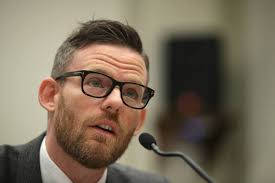
Nowhere in the interview are Matthew and Amy Smith asked where their money comes from and how, as Americans, it is their moral imperative to involve themselves in critical issues faced by Asia.
Throughout the interview, the Smiths repeatedly admit to reporting back to the United States government, including testifying before US Congress and lobbying in Washington for issues related to Myanmar’s ongoing refugee crisis. The interference in Asia by a nation residing on the other side of the planet seems almost taken for granted by both the Smiths and the interviewer, as if the United States is imbued with the authority to arbitrate universally.
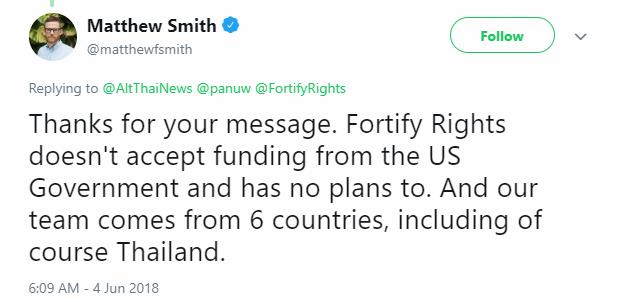
On social media, when the topic of US government funding was raised, Matthew Smith categorically denied receiving US government funding. He would refer to additional questions regarding his organisation’s funding as “trollish.”
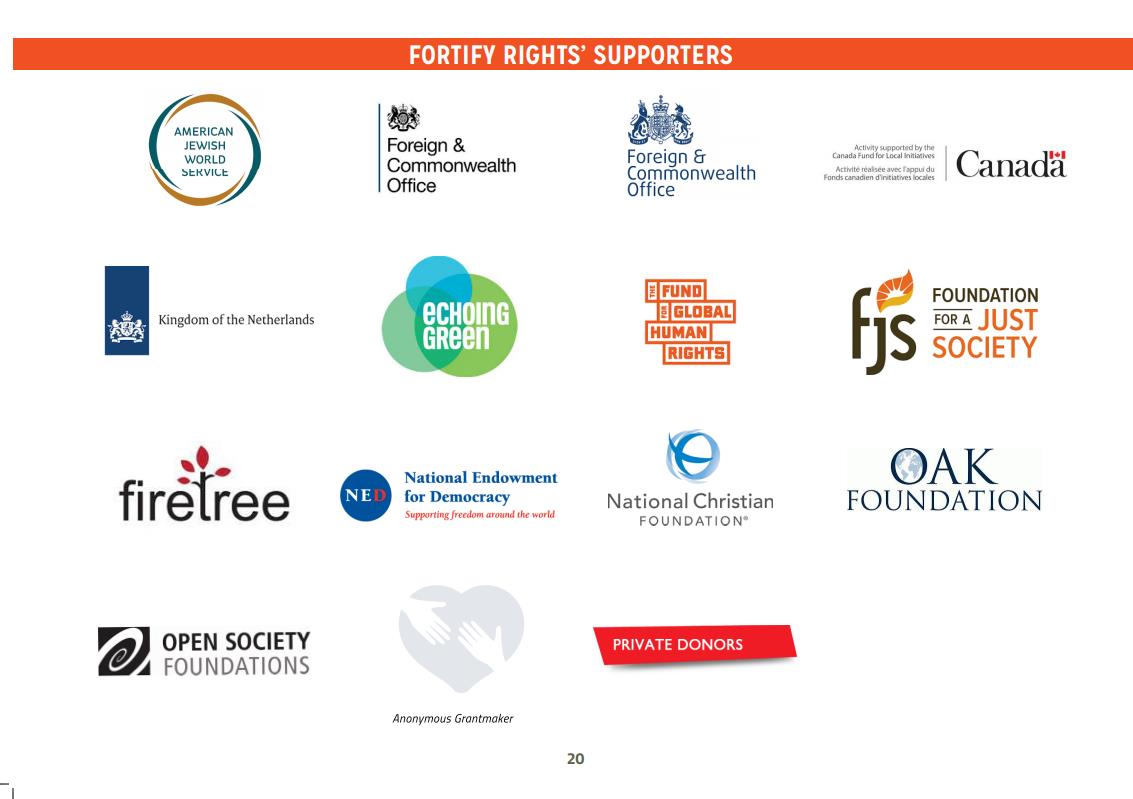
However, Fortify Rights’ 2016 annual report (PDF), as pointed out to Smith himself, includes government funding from the United Kingdom, Canada, the Netherlands and the US Congress-funded National Endowment for Democracy ().
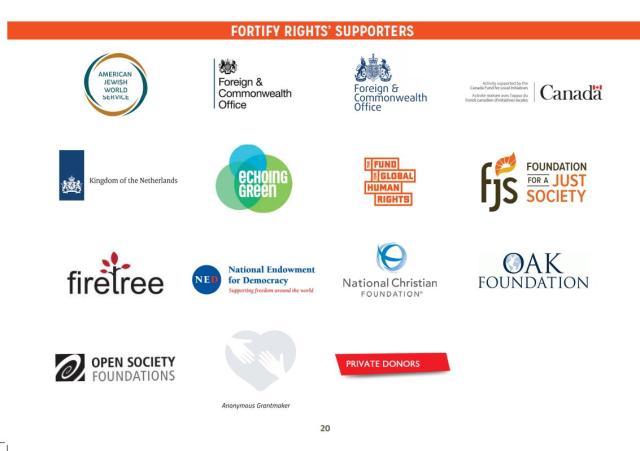
Other controversial sponsors of Fortify Rights include convicted financial criminal George Soros’ Open Society Foundations.
Matthew Smith not only knows that NED is funded by and serves as an intermediary for the US government, (thus making Fortify Rights a recipient of US government funding), he is undoubtedly aware of how controversial such funding is across Asia, a region sensitive to outside interference after centuries of European and more recently, American colonisation.
Implications of NED Funding
NED’s own website admits on its frequently asked questions page that:
NED is a private, non-profit, grant-making organization that receives an annual appropriation from the U.S. Congress through the Department of State. Although NED’s continued funding is dependent on the continued support of the White House and Congress, it is NED’s independent BOARD OF DIRECTORS that controls how the appropriation is spent.
NED itself admits that it is funded through the US State Department. It claims that its board of directors, not the US government itself, then determine how those US tax dollars are spent.
A look at NED’s board of directors only further implicates organisations like Matthew Smith’s Fortify Rights in deep impropriety merely hiding behind “rights” advocacy.
It includes people representing political and business interests involved in some of the greatest injustices purveyed by the United States during this generation, including Elliott Abrams, Francis Fukuyama, Zalmay Khalilzad (who served as US ambassador to Iraq during the US occupation) and Vin Weber described by some (including themselves) as Neo-Conservatives who promoted the US invasion of Iraq in 2003 and have promoted other wars of aggression around the globe both before and since.
Victoria Nuland, who played a central role in ousting the elected government of Ukraine in 2014 through a violent coup spearheaded by Neo-Nazi political parties and their militant wings, also serves on NED’s board of directors, along with Anne Applebaum of the Washington Post who clearly finds herself in a conflict of interest between reporting the truth and promoting organisations and agendas underwritten by the NED she chairs.
Another commonality is shared among NED’s board of directors; their use of “human rights” and “democracy” as pretexts for the wars of aggression and regime change they have promoted and helped execute, which reveals the true purpose, whether Matthew Smith of Fortify Rights knows or admits it or not, of both NED’s existence and the desired outcome of the work it funds around the globe.
NED in Thailand
Fortify Rights is by far not the only front operating in Thailand under the sponsorship of US government-funded NED.
It coordinates with other fronts as well, including media outlets like Prachatai based in Bangkok (whose director also serves as an NED Fellow), Isaan Record based in Thailand’s northeast, and BenarNews covering Thailand’s deep south. All three disingenuously portray themselves as independent local media. They have intentionally taken steps to obfuscate their US government funding from their Thai readers. Prachatai has only disclosed its foreign funding once in 2011, and only on its English-language website.
Each media front specialises in seizing upon and exploiting social and economic tensions to bolster opposition to the current government. Before the 2014 coup ousted the previous, US-backed government of Yingluck Shinawatra, these same media organisations used their platforms to smooth over injustices and emerging tensions threatening that government’s stability.

NED-funded Fortify Rights also works closely with fellow US funding recipient Thai Lawyers for Human Rights who not only provide free legal services for anti-government protesters, but provide resources and leadership to the protests themselves. The protesters portraying themselves as “pro-democracy” activists, fail to disclose their foreign funding to potential followers. They also avoid questions regarding how their foreign funding violates democracy’s prerequisite of self-determination independent of foreign interference.
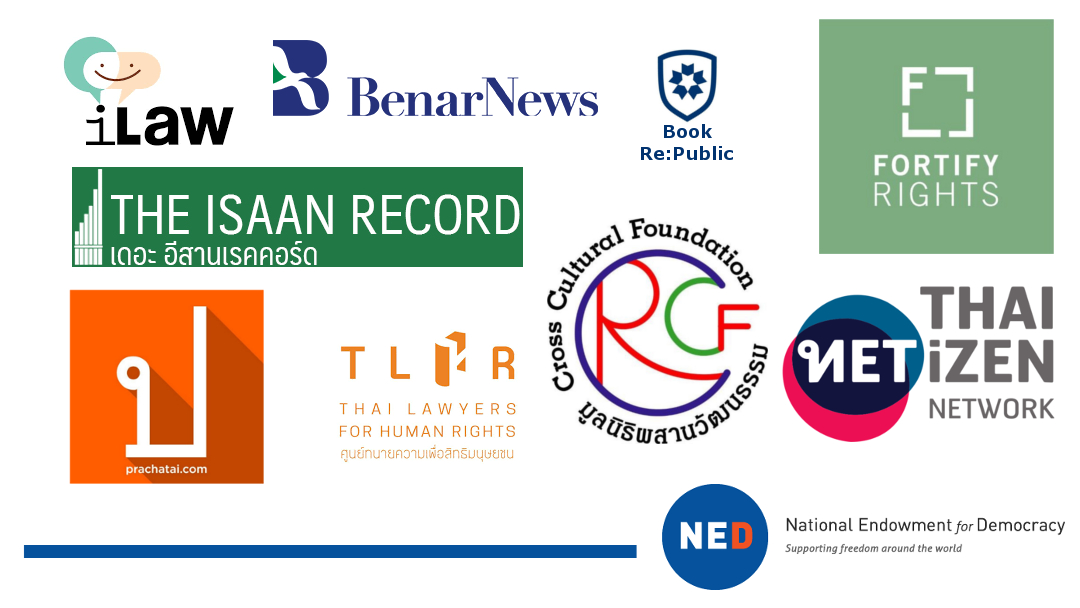
Other NED-funded organisations operating in Thailand include iLaw, Cafe Democracy, Media Inside Out Group, Book Re:public, Thai Netizens Network, the ENLAWTHAI Foundation and the Cross Cultural Foundation (CrCF).
Many of these US government-funded organisations play a direct role in demanding policy changes. Currently in Thailand, protests demanding regime change are also led by US government-funded organisations.
The implications of foreign funded organisations attempting to influence Thailand’s policy or its political future are troubling. Many of the individuals working for these US government-funded organisations on their social media accounts frequently comment on their opposition to “Russian influence” in their US sponsors’ internal affairs, apparently failing to appreciate the irony of what their own work represents.
They also fail to appreciate the irony of portraying themselves as “independent” and working for “nongovernmental organisations,” despite being both dependent on wealthy and influential foreign sponsors as well as working on behalf of foreign governments.
Through their connections with equally compromised organisations and individuals in Thailand’s media, they have written promotional pieces about their supposed work, like in the Bangkok Post, without disclosing their foreign funding to readers.
At other times, complicit individuals within the Thai media have attempted to write pieces defending or dismissing US government-funding when public outcry begins to rise.
Rewriting Thailand’s NGO Laws
Despite the amount of funding and deception involved in this extensive and growing network, the US government-funded opposition is still widely unpopular. It would not be necessary for the Thai government to restrict their activities, let alone uproot and expel them as neighbouring Cambodia has (understandably) done.
Should Thailand simply rewrite its NGO laws to demand the same degree of scrutiny and transparency of these organisations as they themselves demand of targets of US government pressure, their already unpopular message would lose even more credibility and support across Thai society.
Prachatai, for example, being forced to disclose its US government funding at the header or footer (or both) of every article it writes would mean Prachatai finally practising the integrity and transparency it demands of targets of its daily propaganda. Likewise, those like writers at the Bangkok Post writing promotional pieces about Fortify Rights, should be obligated to disclose the organisation’s foreign funding somewhere within the body of the article.
Were these organisations as dedicated to the principles of transparency, freedom, democracy and human rights as they claimed, all of this information would already be freely and repeatedly provided to readers. If these organisations truly believed US, UK and Canadian government funding was benign or beneficial, they would not have gone through such extensive efforts to obfuscate and spin it to begin with. If anything, they would use such funding as a selling point.
Matthew Smith of Fortify Rights would not deceive people on social media by playing off of a technicality in which his US government money is essentially laundered through the NED before reaching him.
As the US continues accusing Russia of interfering in its internal political affairs, measures and consequences it attempts to level against Moscow could easily be cited and adopted by other nations across the globe to deal with the very real interference the US is engaged in within their respective borders.
The double game the US is playing regarding its own interference around the globe and accusations of interference it has levelled against Moscow, prove there is nothing benign at all about its agenda and activities. In turn, this calls into question all those organisations whose existence depends on annual contributions from this malignant political order.
Those truly dedicated to helping people will seek to independently fund their work by finding support from the local communities they claim to represent. If people are unwilling to fund Matthew Smith and Fortify Rights at the local level, it is likely Smith and his organisation are not truly working in the benefit of these communities, and instead, for interests diametrically opposed to them.
June 9, 2018
Posted by aletho |
Corruption, Deception, Timeless or most popular | Cambodia, Canada, NED, Thailand, The Netherlands, UK, United States |
Leave a comment
On this overcast Thursday morning in Brussels, the political capital of Europe, rays of bright sunshine are breaking through from the east as the latest results of vote counting in neighboring Netherlands suggest that Wednesday’s referendum against the European Union’s Association Agreement with Ukraine won two out of every three votes and passed the 30 percent participation requirement of all eligible voters to be considered valid.
If those results are confirmed by the official results – to be released on April 12 – this referendum marks a resounding defeat for the Brussels-led conspiracy to pursue Russia-bashing policies of sanctions and information warfare without consulting public opinion at home.
To change metaphors and speak in terms of Dutch folklore, it is the first crack in the dam that many of us have been waiting for, the opportunity for common sense to prevail over the illogic, hubris and plain pigheadedness of those who control the E.U. institutions in Brussels, and afar from Berlin and Washington.
While the referendum was formally just “advisory,” both the public statements of parliamentarians and the acknowledgements of the Dutch government ahead of the voting indicated that it will force a new vote in parliament on ratification and likely send Prime Minister Mark Rutte to Brussels hat in hand, requesting a renegotiation of the Association Agreement.
As such, it may bring the E.U. foreign policy machinery to a shuddering halt and open the illogic of all its policies towards its eastern borderlands over the past several years to public scrutiny and, possibly, to revision.
However, whether this was the decisive moment when the E.U. is brought to its senses or just the first of a series of knock-out blows directed at the political correctness and group think that have been driving policy ever since the coup d’etat in Ukraine on Feb. 22, 2014, its importance cannot be overstated.
We have been hearing for more than a year that the Russia-bashing policies – the sanctions in particular – were opposed by a growing minority of E.U. member states. Among the dissenters named at one point or other have been Italy, Hungary and Slovakia. Then came Bavaria, within Germany, whose minister-president Horst Seehofer just months ago flouted the policies of Chancellor Merkel and paid court to Russian President Vladimir Putin in Moscow. On Wednesday, the president of Austria did the same.
And yet, despite all the fine words to reporters about how the sanctions violate the basic economic interests of their countries and of Europe as a whole, none of these statesmen broke ranks when the sanctions repeatedly came up for renewal. The significance of Wednesday’s vote in The Netherlands was that this time the people spoke, not their elected or appointed officials. This was a consultation to remember.
In effect, the referendum played out at two levels. At the domestic level, it was a power struggle between the mainstream centrist parties in The Netherlands who stand for a “go with the flow” approach on E.U. decisions and decision-making, versus the Euroskeptic extremes on the left and especially on the right.
On the right, Geerd Wilders and his Freedom Party want to put a stick in the gears of the E.U. machinery and halt the slow-motion, seemingly unstoppable move towards greater union, indeed towards federalism that have gained momentum ever since the onset of the financial crisis in 2008. In that sense, the vote foreshadows the campaign fight of the parliamentary elections that will take place in The Netherlands in 2017.
At the same time, the referendum had a geopolitical dimension going way beyond the spoils of office, as a proxy battle in The Netherlands between those who favor a pro-U.S./pro-NATO approach versus those seeking improved relations with Moscow.
In both dimensions, the particulars of the E.U.’s Association Agreement with Ukraine that runs several thousand pages were not the real issue on the ballot. All of which begs the question of what exactly Prime Minister Rutte will eventually be asking the E.U. Commission to renegotiate.
The signs are multiplying that the E.U. consensus on foreign policy driven by German Chancellor Angela Merkel is nearing collapse. Within Germany itself, her detractors are becoming ever bolder. Earlier this week, the German newspapers were carrying on their front pages news of former Chancellor Helmut Kohl’s invitation to Hungarian Prime Minister Viktor Orban to visit him at his home next week.
This move is seen as a direct rebuke to Merkel and her policy of open-arms to refugees from Syria and the Middle East, a policy that Orban led a number of new Member States in opposing.
The next big test for the European Union, and the next opportunity to deal a severe blow to its complacent leadership in Brussels will be the Brexit referendum in the U.K. at the end of June.
NB: the issues in the referendum were the featured topic in RT’s Cross Talk show released on 6 April during which I expanded on these points and on the criminal folly of EU policy on Ukraine:
For a video discussion about the Dutch referendum, see https://www.youtube.com/watch?v=PCAsC_dw8wY
Gilbert Doctorow is the European Coordinator, American Committee for East West Accord, Ltd. His latest book Does Russia Have a Future? (August 2015) is available in paperback and e-book from Amazon.com and affiliated websites. For donations to support the European activities of ACEWA, write to eastwestaccord@gmail.com. © Gilbert Doctorow, 2016
April 7, 2016
Posted by aletho |
Economics | European Union, NATO, Russia, The Netherlands, Ukraine |
Leave a comment
The United States is perhaps the principle nuclear weapons proliferator in the world today, openly flouting binding provisions of the Treaty on the Non-Proliferation of Nuclear Weapons (NPT). Article I of the treaty forbids signers from transferring nuclear weapons to other states, and Article II prohibits signers from receiving nuclear weapons from other states.
As the UN Review Conference of the NPT was finishing its month-long deliberations in New York last week, the US delegation distracted attention from its own violations using its standard Red Herring warnings about Iran and North Korea — the former without a single nuclear weapon, and the latter with 8-to-10 (according to those reliable weapons spotters at the CIA) but with no means of delivering them.
The NPT’s prohibitions and obligations were re-affirmed and clarified by the world’s highest judicial body in its July 1996 Advisory Opinion on the legal status of the threat or use of nuclear weapons. The International Court of Justice said in this famous decision that the NPT’s binding promises not to transfer or receive nuclear weapons are unqualified, unequivocal, unambiguous and absolute. For these reasons, US violations are easy to illustrate.
Nuclear Missiles “Leased” to British Navy
The US “leases” submarine-launched intercontinental ballistic missiles (SLBMs) to Britain for use on its four giant Trident submarines. We’ve done this for two decades. The British subs travel across the Atlantic to pick up the US-made missiles at Kings Bay Naval base in Georgia.
Helping to ensure that US proliferation involves only of the most verifiably terrible nuclear weapons, a senior staff engineer at Lockheed Martin in California is currently responsible for planning, coordinating and carrying out development and production of the “UK Trident Mk4A [warhead] Reentry Systems as part of the UK Trident Weapons System ‘Life Extension program.’” This, according to John Ainslie of the Scottish Campaign for Nuclear Disarmament, which closely watchdogs the British Tridents — all of which are based in Scotland, much to the chagrin of the Scots.
Even the W76 warheads that arm the US-owned missiles leased to England have parts made in United States. The warheads use a Gas Transfer System (GTS) which stores tritium — the radioactive form of hydrogen that puts the “H” in H-bomb — and the GTS injects tritium into the plutonium warhead or “pit.” All the GTS devices used in Britain’s Trident warheads are manufactured in the United States. They are then either sold to the Royals or given away in exchange for an undisclosed quid pro quo.
David Webb, the current Chair of the British Campaign for Nuclear Disarmament reported during the NPT Review Conference, and later confirmed in an email to Nukewatch, that the Sandia National Laboratory in New Mexico announced, in March 2011, that it had conducted “the first W76 United Kingdom trials test” at its Weapons Evaluation and Test Laboratory (WETL) in New Mexico, and that this had “provided qualification data critical to the UK [United Kingdom] implementation of the W76-1.” The W76 is a 100 kiloton H-bomb designed for the so-called D-4 and D-5 Trident missiles. One of the centrifuges at Sandia’s WETL simulates the ballistic trajectory of the W76 “reentry-vehicle” or warhead. This deep and complex collusion between the US and the UK could be called Proliferation Plus.
The majority of the Royal Navy’s Trident warheads are manufactured at England’s Aldermaston nuclear weapons complex, allowing both the Washington and London to claim they are in compliance with the NPT.
US H-bombs Deployed in Five NATO Countries
An even clearer violation of the NPT is the US deployment of between 184 and 200 thermonuclear gravity bombs, called B61, in five European countries — Belgium, The Netherlands, Italy, Turkey and Germany. “Nuclear sharing agreements” with these equal partners in the NPT — all of whom declare that they are “non-nuclear states” — openly defy both Article I and Article II of the treaty.
The US is the only country in the world that deploys nuclear weapons to other countries, and in the case of the five nuclear sharing partners, the US Air Force even trains Italian, German, Belgian, Turkish and Dutch pilots in the use of the B61s in their own warplanes — should the President ever order such a thing. Still, the US government regularly lectures other states about their international law violations, boundary pushing and destabilizing actions.
With so much a stake, it is intriguing that diplomats at the UN are too polite to confront US defiance of the NPT, even when the extension and enforcement of it is on the table. As Henry Thoreau said, “The broadest and most prevalent error requires the most disinterested virtue to sustain it.”
May 27, 2015
Posted by aletho |
Militarism | Belgium, Germany, Italy, NATO, NPT, The Netherlands, Trident, Turkey, UK, United States |
Leave a comment


 Aletho News
 Aletho News