Wildfires in Syria used as a weapon of war
By Steven Sahiounie | Mideast Discourse | July 30, 2023
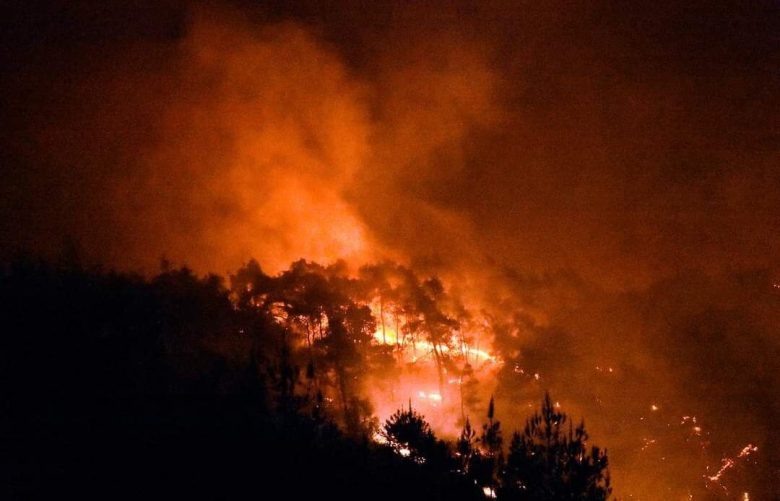
Wildfires broke out on July 25 in Latakia province in northwest Syria and are still burning amid new fires being started. The fires spread quickly by a sudden unusual wind which whipped up. The whole country, and the adjacent Mediterranean region, is in a heat-wave which sets the stage for such a devastating fire burning crops, forests and homes. However, this was not a chance wildfire, but was an act of terrorism.
General Jalal Dawoud, Head of the Fire Department in Latakia, says the fire was man-made. This was determined because the origin of the fire was not in one place, but was started in scattered areas all at the same time in daylight hours.
After the security forces began their investigation, it was found that the fires were started by drones originating from Idlib, under the occupation of Hayat Tahrir al-Sham, formerly Jibhat al-Nusra, the Al Qaeda affiliate in Syria.
Turkey is illegally occupying Idlib as they protect the terrorists under the command of Mohammed Jolani, formerly allied with Abu Baker Al Baghdadi, the head of ISIS who was killed in Idlib by President Trump.
The terrorists have been attacking the fire fighters and vehicles. Bassem Bakar, a water tanker driver, was killed when the terrorists targeted his vehicle near Deir Hanna and Rabiah. Two other men with him were injured.
Turkey is well known for the manufacture of drones, and has been selling drones to Ukraine recently.
On July 25, a fire department vehicle drove over a previously planted mine on Zgharo Mountain, near the town of Maskita, but without injuries. This area was occupied by the terrorists now in Idlib during the 2015 period before they were driven east to Idlib.
The Mayor of Latakia, Amer Hallal, said fire depratments from many areas came to fight the fires, and a Russian water tanker airplane came to battle the fires. Civilians were evacuated from homes and farms and taken to a safe area where they were given humanitarian aid.
The fire raged in Rabiah which sits on a road that connects directly to Idlib. Other areas burning are Ghamam, Sarsekiah, Ein Zarkha, Deir Hanna, Jib Alahmar, Sed Bradoon, and Jebal al Zahra.
A young soldier who volunteered to fight the fires, Mounif Sebry Hassoun, died while fighting the fire due to suffocation in Meshkita. He is from village of Wadi Khelah, in the suburb of Jeblah
The Syrian government, Syrian Red Crescent are coordinating efforts to put out the fires and assisting the humanitarian needs of the affected civilians. Local restaurants have been donating meals to the fire fighters. The Syrian Arab Army (SAA) and the Syrian Red Crescent are putting out fires in Rabiah, which is the front line against the terrorists in Idlib.
The foreign policy of the US and EU have kept the status quo in Idlib. 3 million civilians there are kept as human shields by Hayat Tahrir al-Sham. Turkey prevents the SAA and the Russian military from freeing the civilians kept as hostages to an international game of chess played by America.
International aid organizations, such as the UN, Doctors Without Borders, Save the Children and others deliver all the humanitarian aid to the civilians, while Jolani and his terrorists receive all the aid and distribute it to their cronies first, and sell whatever they horde in a huge shopping mall Jolani and partners built.
Idlib is an agricultural province with farmers and terrorists selling olives and olive oil to Turkish businesses.
The US, EU and UN are enablers of Jolani and the terrorists under his command. Recently, Jolani hung people in Idlib that he perceived were enemies. He and his men oppress women by not allowing social programs directed at women’s issues. The terrorists rule under Islamic Law and in the case of a rape, a woman must present the court with three men who are witnesses to the rape in order to get a conviction. In this situation, rapes go unreported as there is no chance for justice.
Drones can be used for humanitarian purposes, for example: delivering medicines to a remote village. However, drones can also deliver a deadly payload in a war, or attack, and now in Syria they are being used to start wildfires in the heat of summer amid dry winds which spread the deadly fires.
The world responded to the massive 7.8 earthquake on February 6 in Syria and Turkey. Humanitarian aid poured in from Arab countries mainly, with the US boycotting all aid to Syria, with the sole exception of Idlib and the occupying terrorists there.
The earthquake aid has long ago stopped, and although many friends of Syria have asked the US and EU to lift the sanctions which prevent all rebuilding and recovery in Syria from years of war and the earthquake, still there has been no move to lift any sanctions.
Recently, a list of the world’s poorest nations was unveiled with Syria tying for the worse place along with Yemen and Afghanistan. 12 years of armed conflict, the COVID-19 pandemic, the 7.8 earthquake of the century, and now wildfires being delivered by terrorists supported by the US and NATO.
Jolani and his US supported terrorists have no red lines they cannot cross. They are heartless criminals holding the northwest of Syria in fear of their next move.
US mulling multi-front offensive in Syria in collaboration with Takfiri terrorists
By Robert Inlakesh | Press TV | July 29, 2023
The US military is readying approximately 2,500 service members for deployment in the West Asian region, as its proxy forces in Syria’s northeast and al-Tanf areas seek potential alliances with Takfiri terrorists in the northwestern Idlib province.
With tensions boiling between the Syrian government-aligned forces and the US occupation troops in the war-ravaged Arab country, it might be a sign of more violence on the way, observers believe.
According to a report published in New York local media in mid-July, some 2,500 10th Mountain Division soldiers were being sent “off to combat” in Iraq and Syria.
It is not exactly clear how many soldiers from the light-infantry division will be dispatched for operations in the two West Asian countries.
However, the number of forces being sent rings true with a report from the Turkish newspaper, Yeni Safak, that claimed Washington was preparing to send 2,500 troops to northeast Syria.
The US currently maintains, at least publicly, that it has around 900 active-duty service members deployed to Syria, a number which is speculated to be much higher.
If the US is indeed sending additional forces to the region, it could indicate that its objectives have slightly changed in the northeast of the country.
At this time, the Americans occupy roughly a third of Syrian territory and do so without any congressional approval, through its occupation – which it uses the Kurdish Syrian Democratic Forces (SDF) to maintain – it holds hostage the most fertile agricultural lands and roughly 90 percent of Syria’s natural gas from the Damascus government.
Over the past years, the Syrian Arab Army (SAA) and its allies based in the Deir Ezzor province, have grown tired of continued US troop presence inside their territory.
On March 23, the US Department of Defense (DoD) announced “retaliatory strikes” against targets in Deir Ezzor, following a UAV strike against its forces in al-Hasakah.
“Earlier today, a US contractor was killed and five US service members and one additional US contractor were wounded after a one-way unmanned aerial vehicle struck a maintenance facility on a coalition base near Hasakah in northeast Syria at approximately 1:38 p.m. local time,” stated the announcement.
The US coalition airstrikes triggered an unusually extensive response from the SAA and its allies, which fired back and inflicted six traumatic brain injuries, according to the US reports.
At the time, back in March, a Syrian political source told me that the recent move by Syria and its allies was a “direct response” to a wave of Israeli escalation against the country that began last year.
“If you remember in August of 2022, there was a similar stand-off between the Americans and resistance forces in northeastern Syria,” he said, pleading anonymity.
I was also informed by a second source that an order had been given at the time to directly target Americans and not just fire warning shots. However, no further details were divulged.
In mid-July, the US began fortifying its occupation bases surrounding the Conoco and al-Omar oil and gas fields, with forces belonging to their SDF proxies.
According to an Al-Mayadeen source at the time, Washington informed the SDF and its affiliated militias “to prepare for any attack on the region from the Western banks of the Euphrates River” and the US “tasked the Free Syrian Army to mobilize, to face any attack on the 55-kilometer area in Al-Tanf”.
Reports that surfaced on pro-opposition ‘Syria TV’ indicated that the Idlib province-based terrorist group, Hayat Tahrir al-Sham, had hosted several SDF delegations from northeast Syria over the span of months.
The two parties had allegedly concluded agreements on the transport of fuel from Syria’s north-east to Idlib, which appears to have come after Hayat Tahrir al-Sham began facing mounting pressure from Turkiye in northern Aleppo.
The talks between the dominant Idlib Takfiri terrorist group and the SDF apparently explored the possibility of a joint Hayat Tahrir al-Sham-SDF civilian administration with the SDF reportedly claiming that the US supports the idea of unifying the two militant strongholds.
A source who has intimate knowledge of the current security situation in Syria, and who chose to remain anonymous, told the Press TV website that “these moves are complicating, even if this does not amount to an offensive, the only thing that will change the current scenario is a Turkiye-Syria normalization and a possible anti-SDF operation”.
What is also of interest to these developments is that US-Russia relations inside Syria are also deteriorating, with Washington accusing a Russian fighter jet of damaging a US drone on July 23; allegedly using flares to cause the damage.
The terrorist stronghold of Idlib and the US proxies in both northeastern Syria and al-Tanf are seemingly coming together, at a time when American troops are being deployed to the area amid tensions between their occupying forces and the Syrian government’s military.
A possible way forward, in the event that the US carries out a new offensive strategy against the SAA and its allies in Syria, is through the possible normalization of ties between Ankara and Damascus, according to observers.
Despite there being no breakthrough between Turkiye and Syria, the two states are engaged in a dialogue that is aimed at a restoration of ties between them.
Experts say the reason why this is so crucial to combating any potential American plots against the Syrian government and its allies is that Ankara’s cooperation with Damascus could bring an end to many of the various territorial issues in the country.
Turkiye currently occupies two small pockets in the north of Syria, while it actively threatens an offensive against the Kurdish SDF, which it accuses of being run by the YPG and hence a terrorist threat on its border.
If Turkiye forces an incursion into northeastern Syria, dealing another significant blow to the Kurdish armed groups there, it will also force the US to again abandon its SDF proxies, as happened in 2018 and 2019.
If the US withdraws temporarily, this would provide the perfect opportunity for the SAA and its allies to cross the Euphrates River and liberate their oil fields, which the SDF would not likely be capable of holding by themselves.
This is why, in the event that Washington is implementing a new strategy to further punish Syria and its people, a Turkish military offensive may be the simplest way to quickly put an end to it.
What is behind the current tension in Turkish-Iranian relations?
By Alexandr Svaranc – New Eastern Outlook – 16.07.2023
Turkey and Iran continue to be important Middle Eastern nations. Due to their geographical proximity, imperial past, violent rivalry, theological tensions (between Sunnism and Shiism), and, of course, the continuous divergence of geopolitical interests, both nations have a rich history of relations.
There were multiple Turkish-Persian clashes and wars, with various interruptions and varying degrees of success, during the Ottoman and Persian empires. Regarding the significance of the harem in the Ottoman Empire, historians have observed that, unlike the Turkish-Persian conflicts, which occasionally came to an end during periods of truce, the harem wars continued unabatedly. The reasons for these wars were varied, with religion often becoming a justification for the ambitions of Istanbul or Tehran. As a rule, it was a struggle for the right to own border territories from the Caucasus to Asia Minor, for the right to control strategic trade and military communications (for example, the area between Tigris and Euphrates, Eastern or Western Armenia and Syria).
In fact, such a confrontation lasted from the Middle Ages until World War I. The long military and political conflict between the Persians and Turks in such important regions, where the interests of the leading powers of Europe and Russia were represented, led to the establishment of a special international border commission with the participation of Britain and Russia at the turn of the twentieth century to facilitate the delimitation of Persia and the Ottoman Empire. But because London and St. Petersburg had their own distinct interests in the Near and Middle East, this commission never accomplished its mission.
There were also more stable times between Iran and Turkey in the new era. After World War II, from 1955 to 1979, Tehran and Ankara became even politico-military allies in the CENTO (Central Treaty Organization or Baghdad Pact) regional bloc, which emerged thanks to the Middle East diplomacy of Britain and the United States. While the Shah’s regime in Iran remained an ally of the West and Iranian oil and gas were exploited in the interests of London and Washington, Tehran was a regional partner of NATO member Turkey.
The situation changed after the February 1979 revolution in Iran, as the overthrow of the pro-American Shah’s regime and the ascension to power of the Shiite mullocracy brought about a major change in the disposition of forces in the Middle East. Since then, there have been renewed notes of mistrust and tension in Iranian-Turkish relations across the Middle East and global agenda, some of which remain relevant to this day.
It cannot be said that pragmatism in the approaches of Turkey and Iran has lost importance after the overthrow of Shah Reza Pahlavi. Despite harsh anti-Iranian sanctions, Ankara was forced to retain trading with Iran and keeps shipping gas in varying volumes due to its limited own energy supplies.
With the change of political regime in Iran after the 1979 revolution in Kemalist Turkey, where the secular regime suppressed the sprouts of Islamic revival, the politicization of Islam (albeit of Shiite origin) in the 1980s and 1990s still influenced the public consciousness of the Turkish masses in favor of the growing role of religion in the state.
The Kurdish issue remains a common concern between Turkey and Iran. Ankara and Tehran oppose all forms of Kurdish statehood and threats of ethnic separatism. However, in the situation of the Kurds after the 1979 Islamic Revolution in Iran there have been some changes. Some experts believe, not unreasonably, that the phenomenon of the Shiite revolution in February 1979 has both external and internal justifications.
The external reason was to prevent the leading Anglo-Saxon countries (the US and Britain) from monopolizing and plundering Iran’s strategic resources (oil and gas), as well as to prevent the corrosive influence of Western pop culture on the minds of Iranian youth and the general population. The internal reason, however, was related to the idea of preventing the weakening and collapse of Persian statehood under the threat of ethnic separatism with different colors (Kurds, Azeris, Baluchis). At the same time, Islam, namely political Shiism, assumed the religious consolidation of Iranian society regardless of ethnic origin.
Following the revolution’s victory, Iranian leader Ayatollah Khomeini summoned Mustafa Barzani, the leader of Iraq’s Kurdistan Region, then in exile, to Tehran for a final settlement of the Kurdish crisis on an Islamic basis. According to some reports, such an agreement was accepted by a Kurdish politician, but he never made it to Tehran. CIA handlers then announced an emergency surgery on Mustafa Barzani, but the surgery ended in his death.
The main contradictions between Tehran and Ankara include Turkey’s continued membership in NATO and Shiite-Sunni religious differences between different madhhabs. At the same time, as key countries in the Middle East region, it is natural that Turkey and Iran have different approaches on a number of regional topics (including the Syrian crisis, the situation in Libya and Iraq, and the relationship with Pakistan). The adjacent territories of the South Caucasus and Central Asia occupy a distinctive place in this package of contradictions following the breakup of the Soviet Union and the parade of sovereignties of post-Soviet states.
First, Iran is concerned about the renaissance of Turkey’s pan-Turkic and pan-Turanist ambitions toward the Turkic countries of the CIS, which could seriously weaken Iran’s position if the Turan project succeeds.
Second, Tehran watches with great caution the geo-economic projects in the Caspian energy region, which with the collapse of the Soviet Union and the weakening of Russia got a start and developed thanks to the joint initiatives of Turkey and its NATO allies (primarily, the UK and the US). At the same time, this concern of the Persian state is determined not only, or rather, not so much by the considerations of the new direction of oil and gas exports to Turkey as by Ankara’s plans to create alternative energy transit routes bypassing Russia and Iran to bring exporters from Turkic countries to world markets (especially to Europe) and turn the Turkish territory into a major hub. In other words, Iran, as an oil and gas-rich country, is concerned about the geopolitical consequences of transformations in the South Caucasus and Central Asia in favor of the strengthening of Turkey, the United States and Britain.
Third, taking into account the Turkish-Azerbaijani tandem that has formed on Iran’s northern borders, Tehran is anxiously observing the trend of Israel showing up along the Iranian-Azerbaijani border line on the Arax River, the increased intelligence presence of the Mossad and Aman in the same Azerbaijan with the approval of NATO member Turkey.
Fourth, there is now a certain geopolitical rivalry between Turkey and Iran, with a religious connotation in as yet predominantly Shiite Azerbaijan. Given that the Azerbaijani authorities have based their relations with Turkey on the pan-Turkic slogan and the principle of “one nation, two states,” Iran notes the active political persecution of Azerbaijani Shiites (including often with accusations of spying for IRI) by Baku. Moreover, IRGC sources in Azerbaijan note an increasing number of cases of religious interference by Turkey in the Sunnization of Azerbaijani Shiites. Tehran sees all these actions as an attempt by Ankara to weaken the influence of Shiite Iran in this Transcaucasian republic.
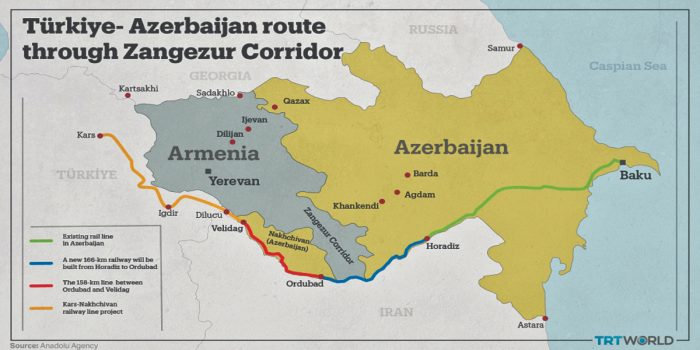
After Recep Tayyip Erdoğan’s victory in the elections and his visit to Baku, assessing the situation with the Zangezur corridor in Armenia, the Turkish leader, not by chance, stressed that the main reason for blocking this corridor was not Yerevan, but Tehran. Iran indeed publicly through the mouths of Ayatollah Ali Khomenei, President Ibrahim Raisi and Foreign Minister Hossein Amir Abdollahian has repeatedly noted that for it the Zangezur corridor remains a “red line,” it is unacceptable to change the borders of neighboring republics of the South Caucasus (in particular, Armenia) and it is important to maintain the direct multi-millenial border of Iran with Armenia.
Tehran does not want NATO to strengthen in the region on the shoulders of its member Turkey, nor does it want to see the Turan project implemented with pan-Turkic content. Otherwise, Iran will be blocked by unfriendly forces on its northern borders, including the emergence of a bridgehead of Zionist Israel on the banks of the Arax River.
With his statement, Erdoğan not only expresses his dissatisfaction with the regional policy of Iran that three Muslim states (Turkey, Azerbaijan, and Iran) through the fault of Persians can’t solve the road question peacefully and get economic dividends but actually says that Iran is not allowing the Turkish-Azerbaijani tandem to start a war with Armenia again and take by force the Meghri segment of the Zangezur corridor (if not all of Zangezur – Syunik Province) from the latter.
Given that Russia is now forced to engage in the western flank of the geopolitical confrontation with the West in Ukraine and is therefore interested in maintaining a partnership with Turkey for the same transit and out into the world, it cannot strain relations with Ankara in Armenia (Transcaucasus). Iran becomes the main opponent of Turkey in this theater.
In the second half of June 2023, Turkey and Azerbaijan announced the formation of a unified system of control and management of airspace from the Aegean Sea to the Caspian Sea according to NATO standards (the Turkish HAKİM Air Command Control System). The latter is practically capable of establishing airspace control in the South Caucasus region and threatening not only Armenia but also Iran. Given the existence of a common air defense system between Armenia and Russia within the CSTO, such a move by the tandem of Ankara and Baku is in some ways a challenge for Russia’s regional interests as well.
Since the beginning of 2023, trade turnover between Iran and Turkey has decreased by 20%, where the main export commodity for the Turkish side remains gas. Apparently, such a decline in economic relations between these countries was the result of a number of objective and subjective reasons (such as the crisis in the energy market due to anti-Russian sanctions and rising prices, the earthquake and rising inflation in Turkey, the devaluation of the Turkish lira, and Ankara’s pressure on the issue of the Zangezur corridor). In response to Moscow’s proposal to create a gas hub in Turkey, Iran came up with an equally ambitious similar project in the Persian Gulf. All these processes testify to the growing Iranian-Turkish contradictions.
Moreover, the information about the ongoing closed-door talks between Iran and the USA on the subject of the deblocking of Iranian assets in exchange for American prisoners and, most importantly, about the end of the “tanker war” between Tehran and Washington in the waters of the Strait of Hormuz and the Gulf of Oman and the export of Iranian oil to world markets (as we know, in the USA itself there is a rise in gasoline prices and an increasing need for oil) creates additional tension in Turkish politics as well.
The US is not yet interested in the implementation of alternative communications from China to Europe through the territory of Turkey (under the One Belt, One Road Initiative). Perhaps Washington is proposing an Indian project through Iran to Europe as an alternative to Chinese transit. And in this geographic preference of the states, a new confrontation between Iran and Turkey is created.
Accordingly, if Iran develops strategic partnerships with countries such as China and India, and can establish certain relationships with the US administration on the nuclear program and oil exports, Turkey will find it difficult to count on success in a battle with Tehran. Moreover, today’s Iranian authorities are interested in strengthening President Erdoğan’s policy independent of the United States, which makes it possible to weaken Washington’s pressure on the region. These are the complicated patterns of the contemporary geopolitical mosaic in the Greater Middle East.
Aleksandr SVARANTS, PhD in political science, professor.
Sweden’s NATO membership not a done deal – Erdogan aide
RT | July 14, 2023
Türkiye has opened the door to the process of Sweden joining NATO but has not yet given its approval, Omer Celik, spokesman for President Recep Tayyip Erdogan’s ruling AK Party, said on Friday.
In a live broadcast on Haberturk TV, Celik said there was a tripartite memorandum between Türkiye, Sweden and NATO about the preconditions for membership, in which Stockholm pledged to undertake certain steps.
If the Turkish parliament is told that Sweden has produced “a strong satisfactory result” by complying with its obligations, AKP deputies will vote to ratify its membership of the US-led military bloc, Celik told Haberturk.
Asked when this might happen, Celik said “at the next session” of the parliament, meaning not before October or November.
Earlier this week, NATO Secretary General Jens Stoltenberg said Türkiye had agreed to support Sweden’s application after a months-long delay.
Erdogan had reportedly attempted to tie his approval of Sweden’s membership bid to Türkiye being admitted to the European Union. In return, the US has signaled willingness to unblock a sale of F-16 fighters to Ankara.
Commenting on Türkiye’s relations with the US, Celik said the meeting between Erdogan and US President Joe Biden promised “a new page,” but that remained to be seen. Relations could improve much faster if the US would change its mind about supporting Kurdish-led militants in Syria, Celik noted.
NATO had hoped to admit Sweden and Finland together before the bloc’s summit in Vilnius, Lithuania this week. Finland eventually joined on its own, after Türkiye held up Sweden’s application over concerns that Stockholm was protecting Kurdish organizations that Ankara has labeled as terrorists. The US-dominated bloc technically requires the consensus of all 31 members before admitting new ones.
Erdogan still firmly in NATO bloc despite blackmailing EU
By Ahmed Adel | July 11, 2023
Turkish President Recep Tayyip Erdogan urged the European Union on July 9 to open the doors for his country to join the bloc if they want to secure support for Sweden’s accession to NATO. His blackmailing of the EU, which ultimately produced results, comes only days after he controversially broke an agreement with Moscow by releasing neo-Nazi Azov Battalion members under Turkey’s custody to Ukraine.
“Turkey has been waiting at the door of the European Union for over 50 years now, and almost all of the NATO member countries are now members of the European Union. I am making this call to these countries that have kept Turkey waiting at the gates of the European Union for more than 50 years,” Erdogan said. “First, open the way to Turkey’s membership of the European Union, and then we will open it for Sweden, just as we had opened it for Finland.”
Turkey has been an EU member candidate since 1999. Since 2016, negotiations on a visa-free regime between Turkey and the EU have been on hold. The country’s bid for EU membership has been stalled due to democratic backsliding and an unrelenting occupation of the northern portion of EU-member Cyprus since 1974.
Ultimately, Erdogan backflipped just mere hours after issuing his blackmail.
“I’m glad to announce … that President Erdogan has agreed to forward the accession protocol for Sweden to the grand national assembly as soon as possible, and work closely with the assembly to ensure ratification,” said NATO secretary general Jens Stoltenberg on the eve of the alliance summit in Vilnius, which will be held on July 11-12.
Finland and Sweden applied to join the bloc in May 2022. Finland gained its membership on April 4, 2023, while the Swedes await approval from Hungary and Turkey. As Turkey will never surrender its occupation of northern Cyprus, its EU membership will be forever stalled, making Erdogan’s ultimatum either a desperate action or a calculated manoeuvre to advance other interests.
Swedish Foreign Minister Tobias Billström told public broadcaster SVT that he expects Turkey will eventually signal that it will let Sweden join the alliance, though he could not say whether that would happen at the NATO summit in the Lithuanian capital. Sweden’s top diplomat said he expects Hungary, which also has not ratified Sweden’s accession, to do so before Turkey.
Turkey and Hungary remain the only NATO members still standing in the way of Sweden becoming the 32nd member of the US-led bloc, with Hungarian Prime Minister Viktor Orban strongly signalling he will follow Erdogan’s lead and approve Sweden’s membership only if Turkey does the same.
Now that Erdogan has reportedly unblocked Sweden’s path, the question is what was offered to appease the Turkish leader. Presumably, Erdogan would have only unblocked the accession process with the promise of receiving F-16 fighter jets, advancing EU membership talks without altering domestic oppression and ethnic cleansing abroad, or securing Western funding as the Turkish economy continues to tank with Gulf money all dried up.
The NATO summit will be dominated by how the alliance will see its future relationship with Kiev amid endless efforts by President Volodymyr Zelensky for Ukraine to become a member and a signatory to the mutual defence pact. Evidently, though, Sweden’s situation will also be discussed since Turkey is the main hindrance to their accession.
German Chancellor Olaf Scholz, for his part, joined a chorus of other European leaders and officials who said Sweden’s NATO membership should not be tied to Ankara’s stalled EU membership bid.
“Sweden meets all the requirements for NATO membership. The other question is one that is not connected with it. And that is why I do not think it should be seen as a connected issue,” the German chancellor said.
Stoltenberg also expressed before announcing Erdogan’s unblocking that the two issues have nothing to do with one another, reminding that while he supports Ankara’s bid for EU membership, it was not one of the conditions in the agreement signed by Turkey, Sweden, and Finland in 2022 at the NATO summit in Madrid.
Despite Erdogan initially adding another condition to Sweden’s accession, it is not a sign that Turkey has gone rogue within NATO, but rather it is the Turkish president blackmailing the alliance and EU to gain advantages for his country – what they are specifically since EU membership is not realistic, remains to be seen.
Erdogan broke a deal he had with Moscow by releasing on July 8, only days before the NATO summit, five Ukrainian Azov Battalion officers, who returned to Ukraine on a presidential plane. The Azov Battalion militants had been prisoners since the battle of Azovstal following the Russian liberation of the port city of Mariupol. Erdogan had no obvious reason for breaking the deal, meaning that he will now want something at the NATO summit for doing this.
Although it may appear that Erdogan has gone rogue by attaching an impossible condition for Sweden to become a NATO member, he is just leveraging to gain some advantage for Turkey. The release of the Azov Battalion members for seemingly no good reason demonstrates that Turkey is still firmly within the NATO bloc.
Ahmed Adel is a Cairo-based geopolitics and political economy researcher.
US, Turkish-backed militias in Syria boost number of child soldiers in their ranks: UN
The Cradle | June 30, 2023
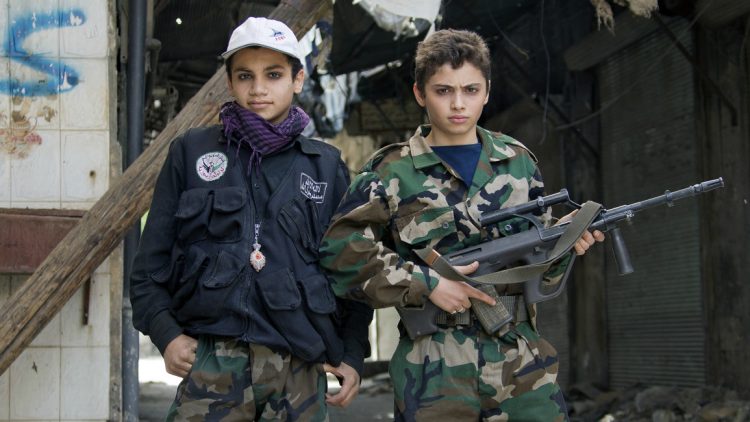
According to a UN report released on 28 June, the US and Turkish-backed armed groups in Syria have been increasingly recruiting minors into their ranks.
The report claims that the number of children recruited by militant groups in the country has risen from around 800 to over 1,200 since 2020.
It adds that among those recruiting children are the US-backed Kurdish militia, the Syrian Democratic Forces (SDF), which oversee control of Syrian oilfields in collaboration with Washington’s occupation forces.
The UN claims that more than 600 of child recruitment cases in Syria are attributed to the SDF and associated Kurdish groups in the country. This is despite the fact that the SDF signed an agreement with the UN in 2019 to end minors’ enlistment.
Over 600 child recruitment cases have also been attributed to the Turkish-backed Syrian National Army (SNA) coalition of militant groups, which has incorporated fighters from several extremist groups, including ISIS, over the years.
Additionally, the UN says that Hayat Tahrir al-Sham (HTS), formerly known as the Al-Qaeda-linked Nusra Front, has recruited over 380 minors into their ranks.
Twenty-five cases among Syrian government forces and allied militias have allegedly been recorded as well.
Bassam al-Ahmad, executive director of Syrians for Truth and Justice, said that in some cases, children are forcibly conscripted into the ranks of armed groups. He added that some join for religious or ideological beliefs, while others join for the salaries much needed by them or their families.
Ahmad claimed that some children are even sent out of the country to participate as mercenaries in foreign wars.
The enlistment of child soldiers has been an issue for much of the Syrian conflict.
During the recruitment efforts of the Nusra Front between 2013 and 2016, led mainly by Saudi cleric Abdullah al-Muhaysni, scores of teenagers were among the thousands enlisted to fight against the Syrian army. Many of these teenagers were sent on suicide missions.
In 2016, members of a US-backed armed group, the Nour al-Din al-Zinki Movement, were filmed beheading a 12-year-old boy named Abdullah Issa, who they claimed was a fighter in the pro-government Liwa al-Quds militia.
Liwa al-Quds released a statement at the time categorically denying that the boy was a fighter, claiming that he had been residing in an area of Aleppo under the control of armed groups.
In 2019, the Nour al-Din al-Zinki Movement was absorbed by the SNA after being defeated by HTS.
DC Scholars: Ukraine Conflict Shows World Has Grown Weary of US Hegemony
By Ekaterina Blinova – Sputnik – 24.06.2023
Despite having the largest military budget in the world and being the largest operator of military bases abroad, the US is far from being a global hegemon, argues a DC-based think tank Quincy Institute for Responsible Statecraft.
Over the past decades Washington has demonstrated a capacity for mass destruction – in Korea, Vietnam, Afghanistan, Iraq, Libya and elsewhere – but “it has won no more than Pyrrhic victories” which led to the erosion of trust in Pax Americana both at home and abroad, according to Responsible Statecraft scholars.
The US military spending reached $876.9 billion in 2022, while the nation also operates a whopping 750 foreign military bases. Still, Washington is incapable of persuading the Global South to join anti-Russia sanctions over the latter’s special military operation in Ukraine, the think tank remarks. “If hegemony means the capacity to get other countries to comply with one’s demands, the United States is far from being a global hegemon,” the report notes.
Judging from the so-called Pentagon leak, even some US allies and partners demonstrated hesitance and unwillingness to provide the Kiev regime with shells, jets and armored vehicles. Meanwhile, most nations of the Global South shrugged off the US calls for slapping sanctions on Moscow as contradicting their national interests.
US political observers emphasize that six nations in the Global South – namely, India, Brazil, Turkey, Indonesia, Saudi Arabia, and South Africa – are set to decide the future of geopolitics and insist that the Biden administration needs to win their hearts and minds. At the same time, European commentators argue that developing nations have the right to remain neutral and non-aligned.
For instance, in June 2022, India’s External Affairs Minister Dr S Jaishankar shredded the West’s claim that New Delhi was “sitting on the fence.” According to the minister, India is entitled to its opinion when it comes to the Russo-Ukrainian conflict.
Likewise, the Association of Southeast Asian Nations (ASEAN) has chosen to collaborate with both the US and China, instead of taking sides. Moreover, ASEAN nations are active participants of Beijing’s Belt and Road Initiative (BRI) regardless of Washington’s attempts to maintain its dominance in the region and curb China’s influence in the Asia Pacific.
Per DC scholars, the emerging trend was articulated by Brookings Institution fellow Fiona Hill, former Deputy Assistant to the President of the United States, in May 2023:
“The war in Ukraine is perhaps the event that makes the passing of Pax Americana apparent to everyone. … [Other countries] want to decide, not be told what’s in their interest. In short, in 2023, we hear a resounding no to US domination and see a marked appetite for a world without a hegemon,” she said at a conference in Tallinn, Estonia
According to Hill, the Global South’s resistance to the US and the EU’s demands to slap sanctions on Moscow is nothing short of “an open rebellion.” She noted that “this is a mutiny against what they see as the collective West dominating the international discourse and foisting its problems on everyone else, while brushing aside their priorities on climate change compensation, economic development, and debt relief.”
Western observers also acknowledge that the world’s center of gravity is steadily shifting east, adding that the Biden administration has so far sought to avert this trend by trying to establish “a lasting technological lead over China” and beefing up the US military in Western Pacific.
However, “most developing countries, including emerging powers in the Global South, are no longer willing to make zero-sum choices” between Washington and its geopolitical rivals, DC scholars underscore, urging American policymakers to accept the reality that the US is no longer “the indispensable nation.”
Extremists who left Syria to fight in Ukraine realize journey ‘futile’: Expert
The Cradle | June 21, 2023
Egyptian researcher and political analyst Ahmad Sultan was quoted as saying on 21 June that many of the extremist militants who left Syria for the Ukrainian battlefield last year have realized that the fight against Russia is futile.
“The jihadists have realized that the situation in Ukraine is difficult for them, and that the arena there is not suitable for them, and that their fight against Russia is a lost battle,” Sultan said.
“Among the jihadists who returned [to Syria] recently is the leader Abdel Hakim al-Shishani … he is one of the most prominent leaders who left with their fighters from Idlib to Ukraine,” he added.
“Dozens of foreign jihadists, especially Chechens, led by Abdel Hakim al-Shishani, the leader of the Soldiers of the Caucasus group, left Idlib in northern Syria and relocated to the fronts against Russian forces in Ukraine,” Sultan went on to explain, adding that Shishani made his way back to Syria “recently.”
Shishani is a Chechen militant leader who was in charge of the Idlib-based group of foreign fighters, Soldiers of the Caucasus.
At the start of the year, Lebanese daily Al-Akhbar reported that after several months of disappearance, the well-known Chechen extremist appeared in Ukraine as part of Kiev’s ‘international legion.’ The Chechen commander appeared in a video posted by the official Twitter account of Ukraine’s defense intelligence.
According to Sultan, Shishani and his Soldiers of the Caucasus were stationed on the fronts near Bakhmut, the eastern Ukrainian city which just last month fell to Russian forces.
“The available data confirms that there are countries that facilitated the process of these fighters’ exit from Syria to Ukraine and that the process of transferring foreign fighters was planned by intelligence services affiliated with countries involved in the conflict inside Ukraine,” the Egyptian researcher continued.
According to Al-Akhbar’s January report, Turkish intelligence played a leading role in facilitating the transfer of militants from Syria to Ukraine.
Sultan adds that these cross-country transfers of militants were ignored by the US coalition operating in Syria, which he said “raises questions.”
Since the start of the war in Ukraine, hundreds of Syria-based militants belonging to ISIS, Hayat Tahrir al-Sham (HTS), and other groups, have made their way to the eastern European country.
“The transfer of foreign fighters suggests that there is an attempt to recreate the scenario of the Afghan-Soviet war in Ukraine. There are fundamental differences between the two cases, but this did not prevent some countries from using the same tactics,” he concluded.
During the war against the Soviets in Afghanistan, foreign militants joined the Afghan side under heavy backing from the US and Saudi Arabia.
US-backing for the ‘Mujahideen’ in Afghanistan throughout the 1980s resulted in the formation of what is today known as Al-Qaeda. This was admitted by Hilary Clinton in 2009.
US involvement prevents Ukraine peace – Hungary
RT | June 14, 2023
Near-term prospects for ending the Ukraine conflict are not looking good, Hungarian Foreign Minister Peter Szijjarto told the Turkish Anadolu agency on Wednesday.
“Unfortunately, all developments are showing a totally different direction. The weapons deliveries, the very open reference to nuclear capacities, the offensives against each other from the two sides, the Ukrainian soldiers being trained in European countries, the very deep involvement of the Americans. So these are not heading toward peace for sure,” he said, during an interview in New York.
Szijjarto also pointed out that Ukraine is only able to fight Russia because of weapons supplied by the US, and that a long-term peace deal would depend on an agreement between Moscow and Washington.
Hungary has repeatedly called for a ceasefire in Ukraine and urged a peaceful resolution of the conflict. Budapest has also refused to allow the transit of Ukraine-bound NATO weapons across its territory, or training of Ukrainian soldiers on its soil.
Late on Tuesday, US Senator Jim Risch of Idaho blocked the sale of HIMARS rocket artillery to Hungary, citing Budapest’s delay in approving Sweden’s membership in the US-led military bloc. As the top Republican on the Senate Foreign Relations Committee, Risch is able to hold up the weapons deal, worth an estimated $735 million and involving 24 HIMARS launchers and the ammunition for them.
Hungary is not opposed to Stockholm’s membership in principle, Szijjarto told Anadolu, but the parliament in Budapest is taking into consideration the “insults” and interference into the country’s internal affairs coming from Stockholm.
Multiple Swedish officials have accused Hungary of “backsliding” on democracy and the rule of law and accused PM Viktor Orban of acting like a “dictator,” as part of an EU campaign to compel obedience from Budapest.
“We never interfere in the domestic issues of other countries,” Szijjarto said. “Such accusations give a reason to put this issue on hold for a while.”
NATO is hoping to finalize Sweden’s membership ahead of next month’s summit in Vilnius, but even if Hungary succumbs to US pressure, that would still leave Türkiye as a holdout. Ankara has repeatedly said that Stockholm needs to do more to implement the agreement reached last year, involving the extradition of Kurdish activists accused of terrorism.
Turkiye’s Proposal For A Kakhovka Dam Investigation Committee Is A Genius Soft Power Move
BY ANDREW KORYBKO | JUNE 7, 2023
Turkish President Erdogan proposed the creation of a multilateral committee for investigating the Kakhovka Dam explosion during a call with President Putin on Wednesday. He suggested that it could comprise the two conflicting parties, the UN, and members of the international community such as his country, which has experience mediating between Moscow and Kiev during their grain deal talks. This was a genius soft power move that’ll powerfully shape global perceptions about this incident.
Russia and Ukraine blame one another for this terrorist attack, and while many might have predicted that the US would take its proxy’s side, National Security Council spokesman John Kirby said on Tuesday that “we cannot say conclusively what happened at this point.” This stance is almost certainly attributable to the fact that Ukrainian Major General Andrey Kovalchuk boasted to the Washington Post in December about how Kiev tested blowing up the dam with US-supplied HIMARS missiles late last year.
Russian Foreign Ministry spokeswoman Maria Zakharova made sure that the entire world knew about this too by bringing it up during a press briefing the day after.
She rhetorically asked US officials “Were you aware of how American weapons, the weapons that are being supplied to Ukraine, are used? That trial tests of a terrorist attack against civilian infrastructure in third countries are being made? These are the questions that we directly pose in the public space before the White House; you must answer them.”
Considering that the US officially regards the dam’s destruction as a war crime, which its Alternative Representative to the UN for Special Political Affairs Robert Wood emphasized during Tuesday’s Security Council meeting about this, it has every reason to support the investigation that Turkiye just proposed. As for Kiev, it insists that Russia was to blame, so refusing to participate in a truly neutral multilateral investigation would come off as incredibly suspicious by suggesting that it has something to hide.
The US and Ukraine, which are the principal antagonists in the NATO-Russian proxy war, are therefore pressured to go along with this initiative from their mutual Turkish partner lest they risk stoking speculation that they’re afraid of a dark truth emerging. Neither can credibly imply that Ankara has any ulterior motives in proposing this investigation either since it’s a NATO ally that’s consistently voted against Russia at the UNGA and has even armed Kiev with drones for use against Moscow’s troops.
Therein lies the reason why President Erdogan’s proposal was such a genius soft power move since it puts those two in a dilemma. Going along with the investigation risks revealing incontrovertible evidence that Kiev blew up the Kakhovka Dam while declining to participate makes them look guilty in the court of public opinion. Regardless of whatever they choose to do, Turkiye comes off as responsible member of the international community, which boosts its global prestige and especially that of its multipolar leader.
What Are Anti-Drone Systems and How Do They Work?
By Ilya Tsukanov – Sputnik – 29.05.2023
The NATO-Russia proxy conflict in Ukraine has demonstrated the significance of drones in modern warfare, with unmanned aerial vehicles (UAVs) used by both sides for reconnaissance, targeting, and kamikaze attacks. What are the four main kinds of anti-drone defenses? What are the advantages and disadvantages of each? Sputnik explores.
“The wars of the future will not be fought on a battlefield or at sea. They will be fought in space, or possibly on top of a very tall mountain. In either case, most of the actual fighting will be done by small robots and as you go forth today remember always – your duty is clear: to build and maintain those robots.”
That was the humorous but eerie prediction by the military school commandant in the 1997 The Simpsons episode “The Secret War of Lisa Simpson.” A quarter of a century later, the idea of using drones in warfare has become ubiquitous, and The Simpsons’ comedic flourish has been forever tainted by real-life conflict.
Although small propeller and rocket-propelled reconnaissance drones fitted with film cameras have been around since the Cold War, modern drone warfare, including camera-mounted, remote-operated GPS-equipped spy and strike drones, is a product of the early 21st century, with the United States kicking off the world’s first campaign of targeted killings using UAVs in 2002.
As small, inexpensive, off-the-shelf drones began entering the commercial market in the 2010s, they started to be used by non-state actors to attack armies and governments – with US-backed terrorists using them in the Syrian dirty war against Syrian and Russian forces, and Yemen’s Houthi militants deploying them against the Saudi-led coalition.
Large, military-grade drones were used to effect in the 2020 war between Azerbaijan and Armenian volunteers in Nagorno-Karabakh, and, starting in 2022, have been deployed extensively by NATO-backed Ukrainian forces in Donbass and throughout Ukraine against Russian forces. Russia has countered them using a series of domestically-developed drone defense systems. But more on that below.
Drone Defenses: What Types Are There?
In the second half of the 20th century, the USSR and the USA focused their air and missile defense research on targeting big, expensive manned fighters, bombers, transport planes, and ballistic and cruise missiles. Although this included research into fantastical concepts including the use of powerful lasers in space under Ronald Reagan’s Star Wars missile defense program, its main focus remained missiles – rocket-powered projectiles designed to intercept and destroy enemy aircraft and missiles.
Can Missiles Be Used to Down Drones?
For drones that are large enough – including unmanned combat aerial vehicles (UCAV) like the Bayraktar TB2, the General Atomics MQ-9 Reaper, or the Northrop Grumman RQ-4A Global Hawk, which have wingspans of 12, 20, or even 40 meters, respectively, the most effective defenses are still good old-fashioned missiles designed to target jet aircraft.
Last month, Russian Air Defense Force Commander Andrey Demin reported that over 100 Bayraktar drones had been destroyed in fighting in Ukraine.
“There are practically no fundamental distinctions between fighting against strategic drones like the US Global Hawk (RQ-4) or Reaper (MQ-9) or Turkiye’s operational-tactical Bayraktar-TB and counteraction to crewed aircraft. The elimination of more than 100 Bayraktars, delivered to Ukraine throughout the period of the special military operation, is clear evidence of this,” Demin said, speaking with Russia’s official army newspaper Krasnaya Zvezda.
For the battle against large drones, including their detection and destruction, the same monitoring and strike systems as those used against traditional aircraft can be used. This has been demonstrated not only in Ukraine, but with the June 2019 shootdown over Iranian airspace in the Strait of Hormuz of a $220 million Global Hawk operated by the US Navy by an Iranian road-mobile air defense system known as the 3rd Khordad.
How Can Electronic Countermeasures Be Used to Destroy Drones?
Smaller drones, including so-called mini and micro UAVs, are more difficult to detect, Demin admitted, pointing to these weapons’ “small effective reflective surface” for radar detection, and saying that tracking such systems and revealing their trajectory using standard radar equipment is “rather problematic.”
For this purpose, the Russian military has developed an air defense system of a different sort – the RLK-MTs Valdai, a special-purpose radar designed specifically to detect, suppress, and neutralize small drones with extremely low radar cross sections.
Developed by Almaz-Antey, manufacturer of the Buk and S-300/S-400/S-500 series of air and missile defense systems, the RLK-MTs is a vehicle-mounted radar complex designed to detect enemy drones at distances of up to 15 km, and to take them down using electronic countermeasures (using a control and navigation signal suppression module) at close-in ranges of 2 km or less. The complex’s detection systems include an X-band radar module, thermal imagers and cameras, a radio signal source-finder module. The vehicles can be operated remotely.
Demin confirmed that the RLK-MTs is “already performing combat missions to cover critical military and state facilities, including those in the special military operation zone,” and said he expects production of the systems to ramp up dramatically in the coming years.
Large, vehicle-based systems stuffed with detection systems and powerful electronic countermeasures are arguably the most capable defenses against small drones, but certainly aren’t the only ones. Smaller systems, ranging from commercial and industrial anti-drone monitoring and suppression hardware, to military-grade man-portable anti-drone rifles have been created by several Russian manufacturers. These weapons include the PARS-S Stepashka – a 9.6 kg anti-drone gun with the capability to hijack enemy drones and force them to land or return to their launch sites. The system is effective at ranges between 500 meters and 1.5 km.
Other, similar portable anti-drone systems have been spotted in footage from the battlefield, including the Stupor electromagnetic rifle – which uses electromagnetic pulses to suppress drones’ control channels and force them down.
How Can Lasers Fight Drones?
Advances in laser pulse weaponry have enhanced prospects for their use in modern warfare. Last year, Yuri Borisov – the former Russian deputy prime minister responsible for defense and the space industry since appointed boss of Roscosmos, revealed that the Russian military has tested a mystery combat laser system known as the Zadira that’s capable of incinerating drones in seconds at distances of up to 5 km in Ukraine. Its development began in 2016 under the auspices of the Russian Federal Nuclear Center, a subsidiary of Rosatom.
The Zadira is not to be confused with the Peresvet – a strategic laser weapon designed to target an enemy up to 1,500 km in orbit over the planet. That system entered combat duty on a test basis in December 2018, but has not been used in Ukraine.
Russia is not the only country tinkering with the use of laser weapons for anti-drone warfare, with the United States and Israel also working on such weapons.
Lasers have several clear advantages over conventional air defense missiles – including their low cost (Israeli officials have boasted, for example, that the new Iron Beam laser-based air defense system uses just $2-worth of electricity – 10,000-50,000 times less than conventional Iron Dome missiles). But lasers also have a number of drawbacks, including the need to secure large amounts of electricity (limiting their mobility), plus problems operating in certain weather conditions, including fog and cloud cover).
Can Drones Be Used to Counter Other Drones?
Last but not least in the list of portable anti-drone defenses are other UAVs. Systems like the ZALA Lancet multipurpose loitering munition/kamikaze drone are capable of targeting enemy UAVs, with its developers creating a concept which they’ve dubbed “air mining” involving the deployment of large numbers of Lancets in an area of the front to protect against incursions by heavy attack drones. As an enemy drones approach, the Lancet locks on to the enemy target and dives onto it at high speeds to force it from the skies.
How Successful Has Russia’s Anti-Drone War Been?
Since Russia entered the Ukraine crisis, it has made many of the difficult but necessary changes to supply the Army with the equipment it needs for effective drone warfare.
Last week, an unclassified intelligence assessment by Britain’s Ministry of Defense concluded that Russia’s military had successfully integrated drone reconnaissance into operations involving long-range missile strikes in the Ukrainian hinterland. Also last week, a separate report by Britain’s Royal United Services Institute calculated that Russia has been using electronic warfare capabilities to destroy upwards of 10,000 Ukrainian drones per month. According to the assessment, Russia maintains “a major electronic warfare system roughly every 6 miles (9.6 km)” along the entire 1,200 km front line.
These assessments echo complaints by an insider at Ukraine’s Defense Ministry, who told one Western outlet in March that Russian forces had obtained “black magic” capabilities against Ukraine’s vast arsenal of NATO-supplied drones, including the ability to “jam frequencies, spoof GPS, [and] send a drone to the wrong altitude so that it simply drops out of the sky.”
Iraq unveils $17bn infrastructure project linking West Asia to Europe
The Cradle | May 27, 2023
Iraqi Prime Minister Mohamed Shia al-Sudani on 27 May unveiled a $17 billion infrastructure project to link West Asia and Europe and make Iraq a regional transportation hub.
Once finished, the “Route of Development” project would run the length of the nation, reaching 1,200 kilometers from Turkiye’s northern border to the Persian Gulf in the south.
The project was announced by Sudani during a meeting with transport ministry representatives from Iran, Jordan, Kuwait, Oman, Qatar, Saudi Arabia, Syria, Turkiye, and the UAE.
“We see this project as a pillar of a sustainable non-oil economy, a link that serves Iraq’s neighbors and the region, and a contribution to economic integration efforts,” he said.
While more negotiations are needed, the Iraqi parliament’s transport committee stated that any country that desires “will be able to carry out part of the project,” adding that the project may be finished in “three to five years.”
“The Route of Development will boost interdependence between the countries of the region,” Turkiye’s ambassador to Baghdad, Ali Riza Guney, said, without specifying what role his country will play in the initiative.
Sudani has prioritized the repair of the country’s road network as well as the upgrade of its aging energy infrastructure.
On 25 May, Iraq’s Oil Minister Hayan Abdel-Ghani announced that Saudi Aramco is seeking to invest in Iraq’s Crutch gas field and expand its capacity to 400 million cubic feet.
Additionally, in February, the Iraqi government signed an agreement with the UAE firm Crescent Petroleum to develop two gas fields in northeastern Diyala governorate to supply local power plants.
The UAE’s private upstream oil and gas company disclosed that the Gilabat-Qumar and Khashim gas fields are expected to produce seven million cubic meters within an 18-month span.
In recent months, Baghdad has bolstered its efforts to increase its relations with Gulf states. On 19 February, Iraq and Saudi Arabia signed a Memorandum of Understanding (MoU) to share sensitive intelligence and deepen security cooperation, marking the first time the two nations have signed a security pact since 1983.
Featured Video

Iran spent $1 million to wipe out $30 billion in data center plans, and take down Amazon in the ME
or go to
Aletho News Archives – Video-Images
From the Archives
A short history of British torture
ICC | December 2005
When the House of Commons was debating how much to increase the time limit for detention without trial the question of torture came up. Officially this was limited to the nice considerations of whether it was all right to send people to places where torture is used and whether Britain can use information collected by the use of torture in other countries. This discussion gave an impression of democratic Britain as the home of civilised behaviour where the very idea of torture is repugnant to our legislators – unlike, say, the US with its secret CIA jails… In reality, the British state has a long history of using and developing a whole range of torture techniques. … continue
Blog Roll
 Aletho News
- Iran spent $1 million to wipe out $30 billion in data center plans, and take down Amazon in the ME
- Zionist billionaire pressure to silence Macklemore sparks exodus from Ed Sheeran tour
- House Votes to End Iran War for Third Time
- North Korea Slams US Plan for ‘AUKUS 2.0’ with South Korea and Japan
- Prolonging US-Iran Conflict Not Meeting Interests of Int’l Community – China’s Wang Yi
- EU bans former Zelensky aide from parliament
- NATO-backed Kosovo separatist ‘responsible for war crimes’
- US destroying international space law
- SCO Calls for Binding Global Deal to Prevent Arms Race in Space
- Iran & Its Allies Are Threatening Every Route for Saudi Oil
- If Americans Knew
- Groups urge Americans to support Van Hollen legislation on Israel’s killing of Americans & Palestinians
- Trump administration plans to send 40,000 tons of bombs to Israel: report
- Sanctions Target Iran’s Government, But Kill Hospitalized 23-Year-Old Woman
- An alternative view on the book “Israel’s Lobby: America in the Grip of a Foreign Power”
- Ed Sheeran’s band Beoga, other opening acts quit tour after Macklemore was dropped over his pro-Palestinian comments
- The assassination attempt on President Trump in Butler and the various Israeli connections to it
- “We Want That the Whole Land Be Jewish”
- BREAKING: Building collapse in Gaza kills at least 20 as they sleep – Daily Update
- ‘School is Life’: 1.5 Million Palestinian Children Face Fourth Year of Shattered Education
- Pentagon admits Iran war caused ammunition shortages, cost US $33.4bn
- No Tricks Zone
- Economic Masterminds: German Socialists Suggest Taxing Productivity Gains Stemming From Using AI
- The South China Sea Has Not Been Cooperating With The Climate Change Narrative
- Energy Crisis: Germany Enters Heating Season With Historically Low Gas Reserve Fill Levels
- New Study: The Antarctic Ice Sheet Gained Mass From 2020-2024 Due To Staggering Snow And Ice Accumulation
- Study: Ocean Heating Rates From Thousands Of Years Ago ‘Dwarf’ Modern Ocean Heating Rates
- Climate Extremists Target, Attack Large-Scale Power Grid Infrastructure In Germany!
- New Study: Antarctic Ice Melt Has Contributed Less Than 1 Centimeter To Sea Level Rise In The Last 30 Years
- Fear Of Debate: Alarmist German Climate Scientist Calls On Mainstream Media To Discredit Skeptic Voices
- End-Of-August Arctic Sea Ice Extent Hasn’t Fallen In 20 Years, Official Data Show!
- News-Making Nepal Region Has Had As-Warm Or Warmer Periods Than The 2000s In The 1600s, 1700s, 1800s
 Aletho News