US sees Turkey’s S-400 deal as fait accompli
By M. K. BHADRAKUMAR | Indian Punchline | June 8, 2019
Three developments in quick succession in the weekend bring closer to a flashpoint the brewing discord between the US and Turkey on account of the latter’s purchase of the S-400 air defence system.
First, Russia disclosed on Friday that the delivery of the S-400 missile defense system will begin within two months. Turkey has made the advance payments and the Turkish military personnel have completed their training in Russia to operate the system. It appears that the die is cast.
Second, Washington has reacted instantaneously, as if anticipating that Turkey is sticking to its decision despite immense American pressure.
The US Acting Defence Secretary Patrick Shanahan has addressed a letter to his Turkish counterpart Hulusi Akar — and simultaneously leaked it to the media — intimating that “Turkey will not receive the F-35 if Turkey takes delivery of the S-400. You still have the option to change course on the S-400.”
Shanahan added that “Turkish F-35 students currently in training” in the US will be sent back by July 31 and no new training programme for Turkish personnel is being scheduled “as we anticipate they would be recalled in the near future.” Meanwhile, in immediate terms, “To facilitate an orderly cessation of Turkish participation in the programmatic management activities of the F-35 program, we will not plan for Turkish participation in the annual F-35 Chief Executive Officer Roundtable on June 12, 2019 and planned updates to the program’s governing programs will proceed without Turkey’s participation.”
Shanahan referred to the Russia-related Countering America’s Adversaries Through Sanctions Act (CAATSA), but concluded that the two countries should endeavour to “manage this matter in a respectful way, to preserve other aspects of our deep security cooperation.”
Third, an innocuous-sounding US State Department readout on June 6 said: “Deputy Secretary of State John J. Sullivan met today with Greek Defense Minister Evangelos Apostolakis to reaffirm the U.S. and Greek commitment to cooperation that strengthens bilateral defense and security and NATO, and to continue discussions started at the December 2018 U.S.-Greece Strategic Dialogue. Deputy Secretary Sullivan underscored the strategic importance of the Eastern Mediterranean and Balkans and highlighted Greece’s role as a pillar of stability and key partner in the region.”
Considering that Turkey’s hostile relations with Greece are even more ancient than India-Pakistan enmity, it is at once apparent that Washington is hitting back at Turkey on the geopolitical plane. Turkey’s principal motivation to procure the S-400 missile defence system is its unmatched capability to threaten aircraft up to 200 miles away—giving it so-called anti-access/area-denial (A2AD) (A2AD) potential.
The Turkish motivation is comparable to India’s (except that India has problematic relationships with two countries.) In layman’s terms, Turkey’s interest in the S-400 needs to be understood in terms of its ongoing rivalry with fellow NATO member Greece, with which it has nearly fought a war over the island of Cyprus. The S-400’s anti-access capabilities strengthen Turkey’s hand in its security competition with Greece.
Quite simply, S-400 system is peerless. The Patriot system that the US has offered Turkey as an alternative is optimised for relatively short-range (less than 40 kms) ballistic missile defence, lacking in A2AD potential.
Like any divorce, this is going to be a messy affair. Out of all the issues complicating the Turkish-American relationship — starting with the US-backed failed coup d’état attempt in July 2016 to kill President Recep Erdogan and overthrow his nationalist government — the S-400 issue has surged as the coup de grâce.
To be sure, if the US cancels the collaboration with Turkey on the development and production of F-35 fighter jets, the latter will look for alternate sources of stealth technology. The fact of the matter is that Turkey seems unperturbed that it is parting ways with the US’ program to develop the F35 fighter and buy 100 planes. But Turkey would like the US to initiate the break-up so that it is free to develop options. In the Turkish assessment, F-35 has serious deficiencies.
Equally, Turkey (like India) has already stated its ambitions to develop a domestic stealth fighter and knows that the US will never transfer such cutting edge technology. In all probability, Turkey may approach Russia. Speculation is rife.
Quite obviously, all this has very serious implications for India, which merit a separate analysis.
Cyprus signs $9bn contract with Israel to extract gas
MEMO | June 7, 2019
Cyprus will earn $ 9.3 billion over 18 years thanks to the exploitation of the Aphrodite gas field under a renegotiated contract with Dutch-British Shell, US-based Noble, and Israeli company Delek, the Energy Minister for Cyprus, announced.
George Lakkotrypis told reporters that the reworking of the production contract guaranteed Cyprus an average annual income of $ 520 million over the life of the gas field.
“We believe it is a good contract under the current circumstances as it will allow the Republic of Cyprus to earn significant commercial revenues estimated at more than $ 9 billion throughout 18 years of the well’s production.”
Under the new deal, companies will commit to a short period for gas reserves exploitation. “Based on the development and production plan we discussed, we expect the first gas quantities to be extracted by 2024-2025,” he said.
Lakkotrypis explained that “the consortium was not previously bound to a deadline.”
Aphrodite gas field is the most significant development project on the island with about $ 7.9 billion invested in related infrastructure.
In 2011, Texas-based Noble Energy made its first discovery off the southern coast of Cyprus in the Aphrodite block, which is estimated to contain about 4.5 trillion cubic feet (127 billion cubic meters) of gas that have not been marketed yet.
The discovery of a vast offshore field in nearby Egyptian waters in 2015 raised more interest in exploring similar resources in Cypriot waters.
Cyprus aims to start pumping natural gas through a pipeline to an Egyptian gas liquefaction facility.
Cyprus has continued to explore marine energy resources despite the collapse of talks between the Turkish and Cypriot sides, in 2017, to end the division that lasted for decades in the island which north is occupied by Turkey.
The new agreement has angered Turkey, which seized the northern part of the island in 1974 following a coup sponsored by Greece’s military junta.
Accordingly, Turkey sent drilling vessels into Cyprus exclusive economic zone, last month, after it announced it would begin its energy exploration work.
In February, Exxon Mobil and Qatar Petroleum discovered a vast reserve of natural gas off the coast of Cyprus, estimated at five to eight trillion cubic feet.
Italian ENI and French Total are likewise involved in oil and gas exploration activities off Cyprus.
US condemns Turkey for drilling in Cyprus, foiling Israel pipeline deal

US Ambassador to Cyprus, Judith Garber
MEMO | June 7, 2019
The US Ambassador to Cyprus, Judith Garber, has expressed her deep concerns over Turkey’s continued drilling off the coast of Cyprus, and urged Turkey to halt the operations exploring energy reserves in the surrounding waters.
Garber made the remarks yesterday evening at the Independence Day reception held at the US Embassy in Nicosia, while in the presence of the President of southern Cyprus, Nicos Anastasiades. She reiterated her support for the Republic and reassured them that the US recognises its right to develop and exploit resources within its “exclusive economic zone” (EEZ).
The resources in question are the vast gas and energy reserves discovered first in Egyptian waters and then in Cypriot waters in recent years, particularly the untouched and un-marketed 4.5 trillion cubic feet (127 billion cubic metres) of gas discovered off the southern coast of Cyprus in 2011. Then in February this year, the companies Exxon Mobil and Qatar Petroleum discovered an estimated five to eight trillion cubic feet of natural gas off the coast of the island.
In her remarks, Garber also touched on the concept of a possible agreement between the Greek and Turkish sides of the island, stating that “resources should be equitably shared between both communities in the context of an overall settlement,” Garber added. “It is our earnest hope that such resources will soon benefit a united Cyprus.”
This, however, does not seem likely, as such vast reserves have prompted a recently-signed deal between Greece, Cyprus and Israel to build the newly planned Eastern Mediterranean (EastMed) pipeline, which would supply gas to European countries and subsequently allow them to decrease their reliance on gas from other sources such as Russia. The deal will mean Cyprus will earn $9.3 billion over 18 years of the reserve’s production.
This new tripartite deal, backed by the US, has angered Turkey, causing it to send drilling vessels into Cyprus’s EEZ last month, announcing that it will begin the work of exploring more energy reserves.
Erdogan must honor his promise to return occupied Syrian territory
Turkish army pullout will bring peace to Northern Syria
By Firas Samuri | Aletho News | May 22, 2019
In mid-January 2018, the Turkish General Staff announced the beginning of Olive Branch Operation. The goal was to oust the Kurds from the outskirts of Afrin, as well as to create a buffer zone along the Syrian-Turkish border.
These steps were sharply criticized by the world community, but Ankara hastened to declare that the presence of its troops in Syria was temporary. Erdogan promised to return these territories to Syrians. Indeed, the fighting stopped on March 20 2018, after capturing Afrin when several hundred Kurds were killed and wounded. However, now it looks like Turkey is not going to leave the occupied territory.
Kurdistan 24 TV channel recently published information that Ankara is building a concrete wall around the city of Afrin to isolate it from its surroundings. “Sources on the ground in Afrin see this as another step of Turkey’s annexation of Afrin into its borders,” said Mutlu Çiviroğlu, a Syria and Kurdish affairs analyst. Though several locals support Turkish activity, it doesn’t bring peace and stability to the region. Just remember the events of the last year.
First of all, let’s notice the terrorist attacks in Afrin that have been carried out against the Turkish Forces and Free Syrian Army (FSA) units. Among the biggest attacks, the car bomb explosion in front of Ahrar al-Sharqiya headquarters is often mentioned. An investigation was initiated, but the responsible parties were never found. That demonstrates the support of the residents for the Kurdistan Workers’ Party.
Moreover, since the beginning of the Turkish occupation, the humanitarian situation in northern Syria has deteriorated significantly. The main reason is the closure of medical and educational facilities whose activities, for some reason, didn’t suit the local pro-Turkish administration. On demand of the Turks, some of them were converted to the military headquarters.
Return of the northern regions under the control of the Syrian government undoubtedly will lead to the reopening of the health centers, hospitals, and schools. Consequently, more Syrian children will be able to obtain an education, and older people will receive appropriate medical treatment.
The districts of Damascus that have been completely liberated from Hayat Tahrir al-Sham militants and now are being speedily reconstructed by the Syrian government serve as a good example. Thus, in February 2019, the provincial departments of education reported on the restoration of 57 schools, another eight are still being reconstructed. The same situation takes place in other parts of Syria.
The reopening of the Police stations and reactivation of other security services will help reduce arms and drug trafficking, as well as limit the supply of weapons to terrorists in the neighbouring province of Idlib. Such actions will lead to a de-escalation of tensions in the region.
Currently, the key reason for hostilities in the region is the ongoing extremist provocations. Ankara ignores such incidents as these radicals are fighting against Kurds. The militants are opposed to President Assad, but after the withdrawal of the Turkish troops, Damascus will be able to establish a dialogue with FSA, as has happened in southern Syria. There the Syrian government managed to persuade the militants to lay down weapons and then amnestied them.
At the same time, we should not forget about the fate of Kurds. If the north of Syria remains under Turkish control, thousands of locals will become refugees and won’t get back to their homes, fearing constant repression by the Turkish authorities. According to the United Nations High Commissioner for Refugees, more than 100,000 people have already left the region before the Turkish invasion.
Therefore, the return of the areas occupied by the Turkish Army to the control of the Syrian government is an essential step towards restoring sovereignty and territorial integrity of Syria. It contributes a lot to the strengthening of peace and stability, both in the north of the country and in the region as a whole.
The West Is in No Position to Lecture Turkey on Democracy or Human Rights
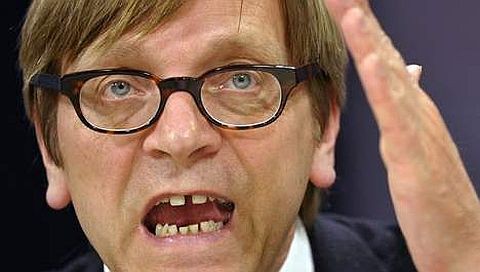
Euro-elitist Guy Verhofstadt
By Martin Jay | Strategic Culture Foundation | May 10, 2019
April fool’s day passed a few weeks ago but when we see news from Turkey that President Erdogan is going to do a re-run of elections in Istanbul, some of us are left doing a double take. But then the jaw dropping moment which follows is not what’s going on in Turkey, a country that certainly has human rights issues, no question – but how the West lines up to chastise the country. The hypocrisy is quite amazing.
And which particular moron should stand first in line with the hilarious opprobrium other than the European Union’s own clown MEP, Guy Verhofstadt a euro-elite type who is hard ignore but well worth the effort. This former Belgian PM recently ejaculated in the European parliament his important thoughts on Turkey and Erdogan, in line with former MEPs who jump on this bandwagon when it suits their federalist interests – before retreating and allowing the circus of EU accession to rumble on in Brussels when it also suits. Right now, with only days before EU elections and record gains expected for populist parties, it was hardly surprising the odious Belgian liberal would take the stage and dutifully pour scorn on Turkey.
But there are times in the EU bubble when reality seems to have been taken over by The Truman Show. Is this for real?
The European Union, probably the most corrupt, anti-democratic, white supremacist, freemason, autocratic organization which has practically invented the handbook on fake news, corruption cover ups and how to bribe journalists and fund despots around the world, is actually holding Turkey to account on its democracy score?
“This outrageous decision highlights how Erdogan’s #Turkey is drifting towards a dictatorship” gushed the Belgian MEP in a tweet. “Under such leadership, accession talks are impossible. Full support to the Turkish people protesting for their democratic rights and for a free and open Turkey!”.
But wait. Is this the same European Union which, when questioned about Romania and Bulgaria’s colossal corruption problem in 2004 (whose judiciaries are run by mafia mobs) said “we’ll let them in and then reform them” only for journalists to be later gunned down in Bulgaria and for Romania to have so many anti-corruption organizations that hacks there joke about getting an EU grant to export it? Or, for that matter, the same EU which repeatedly calls for second elections itself when it doesn’t get the result that it requires, like in Ireland and more recently in the UK with Brexit?
This is the same European Union which signed the arrest warrant of German journalist Hans Martin-Tillack in 2003 – and handed it to Belgian police – so that the journalist’s house could be raided and his computer seized, only for him to be thrown into the back of a police van where a cop tells him “well, it’s not Burmah”?
Or the same EU, which, in the same period where it started a reform process actually just rounded up all its whistleblowers and hung them up on a meat hook as an example to deter others in the EU institutions?
The European Union has a shocking history of human rights abuses not only on its own turf but more poignantly around the world with the regimes it supports with aid. Most central African despots are supported by EU cash, which, in turn, leads to intensified human rights abuses on a grand scale – which then leads to an exodus of migrants who end up in Libya sold as slaves, raped and abused. In many country’s its own environmental programs are bogus so as to funnel slush funds to dictatorships it supports, like in Lebanon for example where its recycling and composting schemes are actually so bad that they are poisoning the country’s water and linked to increased numbers of cancer.
This is the reality of the EU’s human rights record and its own check on democracy. The list just goes on and on and befittingly it is curious that the EU’s own ‘third word country’ (Belgium) which has a shocking deficit on press freedom and is a country infamous for industrial scale pedophilia which historically was the financial basis (blackmail) to fund political parties, is the very country which produced Verhofstadt and accommodates his pathetic ramblings in the European parliament, the only assembly in the world which is so useless that MEPs can’t even initiate legislation in it.
Verhofstadt is a signed up member of the Wet Dream Society, or as it is formerly know the ‘Spinelli Group’ – a sort of freemason’s talk shop of those who believe the EU could one day be a super power and have a real foreign policy. And so it is normal for him to take the floor and deliver such stupendously boring and utterly ludicrous speeches which are delusional at best and simply an old man’s fantasy at worse. Rather like Verhofstadt’s dream in 2004 of being European Commission president – a bid blocked by Tony Blair.
But here’s the real cherry on top if you like your irony in triple doses. The European parliament operates a scheme where it subsidizes all media in their production expenses, running into hundreds of millions of euros. If it didn’t do that, most broadcasters wouldn’t report on the mind numbingly boring events there. Some might call this bribing the press as there is obviously a ‘pay back’ there in helping the EU promote itself. But Euronews, which reported in Verhofstadt’s speech and gave it great prominence, not only profits from the scheme but actually gets a massive subsidy from the Brussels annual budget itself to report on MEPs – a double whammy, so in fact, the Verhofstadt ramble is actually fake news itself. This is an institution – the European Parliament – which voted just recently to actually finance media operations to write propaganda about the EU.
You can’t actually make this stuff up.
But meanwhile, there is news from the other side of the Atlantic, a real super power, which suggests that CNN in Atlanta might send journalists to CNN Turk to train them in the art of journalism. Given that nearly all of its big named foreign reporters make up their stories when they travel the globe – Anderson Cooper, Christiana Ammanpour and Parisa Khosravi – as I was informed by Elise Labott, a ex CNN ‘reporter’ not handicapped herself by journalistic skills, then this could also be a parody, or fake news. CNN Turk is attacked by the West for being pro Erdogan, without any acknowledgement that CNN Atlanta is entirely partisan itself and regularly rigs the news in favour of Clinton or whoever will slip into her peep toes.
At least CNN will not send Labott to Istanbul, a reporter who made a career out of making stories up to such an extent that Atlanta finally had to let her go earlier in the year after at least three investigations into her fabulous lack of journalist ethics, broke all records.
The Same Guy Verhofstadt Who Wants a New Brexit Vote Decries a New Vote For Istanbul’s Mayoral Election
By Adam Garrie | Eurasia Future | 2019-05-07
The leader of the Liberal faction in the European Parliament, Guy Verhofstadt has just decried a decision by Turkish officials to conduct a re-vote in the contentious Istanbul Mayoral race. During the initial vote on 31 March, it was proclaimed that CH Party candidate Ekrem İmamoğlu beat AK Party candidate Binali Yıldırım by a razor thin margin.
Since the initial tally, AK representatives have challenged the result alleging serious irregularities that could have influenced the vote in favour of İmamoğlu. Today, the Turkish Supreme Election Council (YSK) annulled the result of the 31 March election for the Mayoralty in Istanbul and have scheduled a new election to take place on 23 June.
Although such re-run elections are never ideal, in circumstance when a preponderance of evidence indicates that there were enough irregularities present that could have changed the result, re-run elections become the least bad of no good options. This is what the YSK has decided upon in a manner consistent with the principles of mainstream 21st century democracy.
But while the re-run election will be conducted according to normal democratic principles, this has failed to satisfy the notoriously vocal Guy Verhofstadt. The EU Liberal big wig has taken to Twitter to say the following:
“This outrageous decision highlights how Erdogan’s Turkey is drifting towards a dictatorship. Under such leadership, accession talks are impossible. Full support to the Turkish people protesting for their democratic rights and for a free and open Turkey!”
First of all, it was not President Erdoğan who made the decision to hold a new election. It was the YSK’s decision, a body made up of members from multiple parties who then vote on a majoritarian basis in order to enact a decision. In this case, the democratic decision to hold a new election passed by a margin of seven against four.
Secondly, if Turkey’s long stalled quest to join the EU would portend future anti-democratic interference from the likes of Guy Verhofstadt, perhaps many in Turkey ought to be thankful that Brussels has recently leaned against full Turkish membership of the EU. Finally, it is not the “Turkish people” protesting. Those protesting are CH Party workers and supporters who are naturally upset by the electoral re-run. Likewise, supporters of the AK Party had peacefully protested in favour of a re-run. There is nothing unusual about this and of course the protests are occurring freely and without violence.
But the greatest absurdity of Guy Verhofstadt’s meddlesome comments is that while he decries a second vote in a local Turkish election, he has consistently agitated for Britain to hold a re-run vote in order to overturn the Brexit decision made by voters in 2016.
Unlike in the Istanbul election, the British government and opposition parties all accept that the 2016 election was without any worrisome irregularities. In other words, the Brexit referendum was a free and fair vote whilst Turkish authorities have decided that there were too many irregularities in the Istanbul vote for the initial result to be accepted as legitimate.
And yet, Verhofstadt is allying himself with forces that want to overturn a universally acknowledged legitimate vote whilst complaining that a vote in Turkey found to be illegitimate must be set in stone. Once again, double standards rule the day in Brussels.
Different when we do it: Why re-voting is ‘dictatorship’ in Turkey & ‘unity’ in EU

EU Brexit negotiator Guy Verhofstadt © Reuters / Eric Vidal
RT | May 7, 2019
The decision to rerun a local mayoral election in Istanbul has sparked scathing criticism in Brussels — ironically, from none other than the EU’s Brexit negotiator Guy Verhofstadt.
Tweeting about the move, which was branded a “coup” by a Turkish opposition newspaper, Verhofstadt said it highlighted that Turkey was “drifting towards a dictatorship” and offered “full support to the Turkish people protesting for their democratic rights.” Along with the verbal slap on the wrist, he said that under President Recep Tayyip Erdogan’s leadership, talks on Turkey joining the EU are “impossible.”
The irony in Verhofstadt’s outrage, is that the EU itself has a long history of either totally ignoring referendum votes — or just making people vote again until the ‘correct’ result is achieved. But that, of course, does not make the EU a dictatorship. It’s still a “bastion of hope, freedom, prosperity & stability” (as per another recent Verhofstadt tweet). Twitter users wasted no time in pointing out the “irony” and “hypocrisy.”
“How dare [Erdogan] use EU tactics,” one irritated Verhofstadt follower responded, with another saying that the UK itself was currently “battling for its democracy” — a reference to EU officials (including Verhofstadt) who have frequently voiced their personal opposition to Brexit and the ‘Remain’ factions in Britain who have been calling for a re-run of the 2016 referendum.
While there may be at least some merit to the idea of Brexit referendum re-run after two years of failed negotiations and with more accurate information now available to British voters, the idea of simply re-doing EU-related votes is hardly a one-off.
Maybe Verhofstadt should take a trip down memory lane.
France voted ‘no’ to accepting a proposed ‘EU Constitution’ by 54.9 percent in 2005, but the outcome was ignored. The same thing happened in the Netherlands, which rejected it by 61.5 percent. The ‘EU Constitution’ was later repackaged into the Lisbon Treaty and presented to the French parliament where it was adopted, without being put to the people this time (much easier!).
This new Lisbon Treaty was then rejected by Irish voters in 2008, once again sending Brussels into meltdown mode, as the pact needed to be ratified by all member states before taking effect. So, of course, they made some tweaks and asked people to vote again — and got the ‘right’ result the next time. It wasn’t the first time Ireland was asked to re-vote after giving the wrong answer, either. The country also rejected the Nice Treaty in 2001 and accepted it in a second vote a year later.
Greece voted overwhelmingly to reject severe austerity measures desired by the EU in 2015 in exchange for a multi-billion euro bailout. Not long after, under pressure from Brussels, the country’s government agreed to implement even harsher methods — totally ignoring the will of the Greek people.
But way before all that in 1992, Danes, displeased with plans for a single currency, common European defense policies and for joint rules on crime and immigration, rejected the Maastricht Treaty — and were asked to vote again.
Ironically, many European voters voted ‘no’ to these treaties because they were worried that the EU would be turned into some kind of undemocratic superstate where the wills of individual countries and people would be ignored. Being forced to vote until you give the ‘right’ answer doesn’t exactly put those worries to bed. It’s part of the reason why the British voted for Brexit in the first place.
Then there’s Catalonia, where pro-independence leaders were thrown in jail for their role in holding an independence referendum in 2017. One tweeter scolded Verhofstadt and other EU leaders for believing that they have some “moral authority” over Turkey while abuse of pro-independence forces in Catalonia is ignored. “Our leaders are still in prison because they let citizens vote,” they wrote.
With a history like that, maybe it’s a bit rich for Verhofstadt to be going around lamenting the lack of democracy in other countries.
US, Israel to supply anti-aircraft missiles to Kurdish militants in Syria: Report
Press TV – May 1, 2019
The United States and Israel are reportedly set to supply anti-aircraft missiles to Kurdish militants in northern Syria amid tensions between Ankara and Washington over the latter’s support for the militants, which the Turkish government views as terrorists.
Citing local sources, Turkey’s Yeni Safak daily reported that the US is set to deliver shipments of Stinger Man Portable Air Defense System (MANPADS) to militants of the Kurdistan Workers’ Party (PKK).
The PKK, it added, has designated the towns of Rmelan and Shaddadah in Syria’s Hasakah Province as well as the Jalabiyah and al-Omar regions as launching points for its American-supplied missiles.
Ankara is unhappy with Washington’s support for Kurdish militants of the People’s Protection Units (YPG), which it views as an extension of the PKK, and has repeatedly called on the US administration to stop providing them with arms.
The PKK has been fighting for autonomy inside Turkey for decades and runs bases in neighboring Syria and Iraq as well.
The report further said the regime in Israel has also vowed to supply the Kurds with Spike anti-aircraft missiles in the Syrian provinces of Dayr al-Zawr and Raqqah following high-level meetings between the militants and Tel Aviv.
Israel has long been backing the militants operating against the Syrian government. The regime has, on several occasions, criticized Turkey for its operations against the Kurdish militants.
The US-Kurdish alliance is closely coordinating the missiles’ deployment to Syria as part of a “special joint strategy,” according to the report.
It further said that a group of 30 PKK militants have already received training to handle the advanced anti-aircraft missiles.
Turkey has since 2016 launched two military operations inside Syria against the US-backed Kurdish militants and has threatened a third if they fail to leave the east of the Euphrates.
Like Turkey, the US has listed the PKK as a terrorist group, but views the YPG as an ally in its so-called fight against the Takfiri Daesh terror group.
Turkey has repeatedly questioned Washington’s deployment of heavy weapons in Syria despite the defeat of Daesh.
Last December, US officials said the Pentagon was considering recommending that Kurdish militants be allowed to keep American-supplied weapons after the withdrawal of troops from Syria.
In February, President Recep Tayyip Erdogan slammed Turkey’s NATO allies for supplying huge loads of weapons to Kurdish militants in northern Syria, while ignoring Ankara’s arms purchase requests.
Trump, Erdogan seek reset of US-Turkey ties
By M. K. BHADRAKUMAR | Indian Punchline | April 21, 2019
Even as the countdown has begun before the first batch of Russian-made S-400 missiles will arrive in Turkey — expected in coming ten weeks from now — a crisis situation envelops the Turkish-American relationship. No doubt, this crisis, unless resolved in the coming days or weeks, could have profound consequences for the future of the western alliance system as a whole and the geopolitics of Eurasia and the Middle East.
What distinguishes the crisis from the run-of-the-mill spats that keep frequenting the Turkey-US relationship every now and then is that at issue here is Turkey’s vulnerability, if it proceeds with the S-400 deal, to US retribution under the 2017 law known as the Countering America’s Adversaries Through Sanctions Act, or CAATSA, which is directed against Russian arms industry but becomes applicable to third parties that enter into arms deals with Moscow.
If CAATSA sanctions click in, Turkey, which is mired in recession due to the US pressure tactic on its economy, may descend into a free fall of its currency. Incipient signs are already available. Even minor US sanctions could trigger another sharp sell-off in the Turkish lira that deepens the recession. Last year, Turkish lira shed 30 percent of its value, and the currency is down another 10 percent recently, and markets remain on edge.
Simply put, Turkey is so much integrated into the western economies and banking system that any US sanctions would inevitably have a crippling effect. And if there is one message out of Turkey’s recent local elections, it is that the state of the domestic economy could directly impact President Recep Erdogan’s political standing. The point is, despite all the brave chatter about dethroning the dollar, the hard reality is that the US is in a position to “weaponise” the dollar for the foreseeable future and all the King’s men and all the King’s horses — in Moscow and Beijing or Tehran and Caracas or wherever — have to live with that reality.
Besides, in Turkey’s case, a life outside the Western system is simply unthinkable. The Turkish elite are acutely conscious of Ataturk’s legacy that the modernisation of the country demands integration with the West. True, Turkey under President Recep Erdogan is redefining its identity but reclaiming Ottoman legacies in the Muslim Middle East does not and will not mean turning the back on Europe. Paradoxically, Turkey’s strategic autonomy is best preserved by being part of the western alliance system, considering the country’s tough neighbourhood.
No doubt, the stakes are high for Turkey. Unsurprisingly, soon after the visit to Moscow on April 8, Erdogan decided to depute a high-powered team of officials to Washington. The indications are that Erdogan came away from Moscow not quite convinced of the Kremlin’s assiduous wooing of him with an alternative non-western road map for Turkey’s future. At any rate, a team of senior Turkish ministers visited Washington last week for talks aimed at easing the crisis, which included the powerful Finance Minister Berat Albayrak, son-in-law of Erdogan.
The hugely consequential mission of Turkish ministers (which also included Defence Minister Hulusi Akar and Erdogan’s key advisor Ibrahim Kalin) culminated in an unexpected Oval Office meeting for Albayrak with President Donald Trump, with only son-in-law and top aide Jared Kushner and US Treasury Secretary Steven Mnuchin present.
Turkish officials have since exuded optimism that Trump has a “more positive attitude” to Turkey’s pleas than the US Congress where Turkey has almost no cheerleaders.
The catch, however, is that CAATSA, which was legislated in the backdrop of Trump’s alleged “Russia collusion”, has been written precisely with the idea that Trump will have no loopholes to bypass it or dilute the sanctions legislation against Russian arms industry. In fact, for granting a waiver to Turkey in the present case, Trump by law would have to show that the S-400 purchase was not a “significant transaction”, and that it would not endanger the integrity of NATO or adversely affect US military operations.
Again, Trump would also need to show in a letter to congressional committees that the S-400 missile deal would not lead to a “significant negative impact” on US-Turkish cooperation, and that Turkey is taking, or will take, steps over a specific period to reduce its Russian-made defence equipment and weapons. It is a difficult proposition, but doable — provided there is political will.
Trump’s decision to receive Albayrak — it is absolutely unprecedented for POTUS to hold talks with a visiting finance minister — signals that the great dealmaker is on the prowl and would have some formula under his sleeve. Significantly, Trump has not weighed in on Turkey in recent weeks. A senior Turkish official told Reuters that the talks in Washington were “more positive than expected” and the Americans expressed “a softer tone” than they take in public. Another Turkish official added, “There might certainly be some steps to be taken but the search for common ground will continue.”
The Acting US Defense Secretary Patrick Shanahan told reporters on Thursday: “We’re closer” to a final decision on the S-400s after a meeting with his Turkish counterpart. “It’s like: ‘OK, where are we stuck? How do we get unstuck?” he said of the talks, adding he was optimistic and hopeful of visiting Turkey for the formal transfer of F-35 stealth aircraft, which Turkey plans to buy and Washington is threatening to block if Turkey pressed ahead with the S-400 deal with Russia.
Of course, the Turkish-American relationship is littered with several other disputes too — military strategy in the Syrian conflict, Iran sanctions, Turkey’s extradition request to Washington in regard of the Muslim cleric Fetullah Gulen (whom Ankara blames for a failed 2016 military coup) and so on. But the crisis over the S-400 missile deal is the mother of all disputes, since it is directly linked to the viability of the 7-decades old Turkish-American alliance, the Russian strategies in the Black Sea and Eastern Mediterranean, US-Russia tensions and the US’ capacity to influence the Middle East politics as a whole.
What is happening is that after a brinkmanship played out through months at different levels, the crisis over the S-400 affair is reaching a nail-biting finish, with Turkey and the US having reached the edge of the precipice, peering into the abyss and not liking what they see in the darkness and groping for a way to pull back somehow. If they succeed, it will have to be on a “win-win” basis. Read a commentary in the pro-government Turkish daily Sabah entitled This picture gives us hope.
Understanding Saudi Arabia’s Role in Post-Coup Sudan
By Adam Garrie | EurasiaFuture | April 18, 2019
In previous times, when Saudi Arabia sought to intervene in the affairs of foreign nations, it did so overtly. Whether funding foreign masjids to advance Saudi Arabia’s Wahhabi school of Sunni Islam or sponsoring militant groups with unambiguous links to Riyadh, it used to be that when Saudi Arabia wanted change in a foreign nation, there was no real attempt to hide such developments.
Under the de facto leadership of Crown Prince Muhammad bin Salman, this has partly changed. While western media has struggled to form a cohesive narrative through which to portray military strongman and US citizen Khalifa Haftar’s ongoing attempt to take Tripoli, Haftar’s own movements make it clear just how much Saudi Arabia is backing the renegade military man who once fled Libya as a traitor in the late 1980s.
Haftar was in Riyadh where he met the Saudi monarch just days before he began his assault on Tripoli. It has further been reported that Haftar has received millions of dollars from Riyadh. Thus, it is clear that in spite of Riyadh’s US partner’s support of the fledgling and endlessly corrupt Tripoli regime, Saudi Arabia along with its Egyptian and Emirati allies are firmly behind Haftar.
Recent events in Sudan have served as a reminder to the world that whilst long serving and recently ousted President Omar al-Bashir came to power in 1989 with the backing of the Muslim Brotherhood, since then, Bashir had become something of a post-ideological/poly-ideological political survivor. At various times Bashir has been friendly with and had disputes with countries as diverse as Iran, the United States, Saudi Arabia, Gaddafi’s Libya, Assad’s Syria, Egypt, Qatar and Turkey. In many ways, the only two nations with whom Bashir has had consistently good relations were China and Russia. In respect of just about every other country that seeks strategic relations with Khartoum, Bashir’s career was something of a geopolitical game of ping-pong.
Recent years however had seen Bashir’s Sudan greatly improve relations with Turkey and also Turkey’s closest Arab ally Qatar. To this end, Turkey has signed an agreement with Khartoum to construct a modern port at the location of a once prominent Ottoman Port at Suakin. Yet whilst this apparently win-win project did not immediately radiate political overtones, there were in fact many to be found. Suakin was a traditional Ottoman port of call for those on the Hajj to the Holy City of Mecca. From Suakin, pilgrims would take a short maritime journey to Jeddah before moving on to Mecca. For Saudi Arabia, this was seen as a Turkish attempt to influence what could once again become a major route for those on the Hajj. As Turkey and Saudi Arabia continue to compete for influence among the region’s millions of Sunni Muslims, Riyadh certainly took notice of the Turkey-Sudan port deal.
Although Sudan continues to provide mercenaries to the Saudi coalition in nearby Yemen, Bashir’s juggling act between Saudi Arabia on the one hand and the Turkey-Qatari partnership on the other, proved to be one that has self-evidently been a source of consternation in Riyadh.
To be sure, issues of poverty, corruption, genuine human rights concerns and a general political fatigue in the face of Bashir’s lengthy rule were in fact sources of the protests which led to the former President’s ouster. That being said, the rapidity with which Sudan’s new military rulers have moved against Bashir suggests that there is more to the situation than meets the eye.
Reports have now emerged that Bashir is under arrest whilst the country’s new self-proclaimed rulers issue frequent statements of extreme disapprobation against their former boss. This combined with the fact that Turkeys’ calls for calm and moderation are becoming increasingly vocal whilst Saudi state media is celebrating the fact that Sudan’s new regime has refused to receive Qatar’s foreign minister, makes it clear that the new forces in Khartoum are acting in a manner that leans heavily towards Riyadh and away from the Turkey-Qatar partnership that Bashir had been drawing ever closer to in his final years in power.
Although the situation in Khartoum remains fluid to the point of being chaotic, it is already becoming clear that while the origins of the coup where in many ways organic, the management of events since the ouster of Omar al-Bashir has been one that is incredibly favourable towards Saudi Arabia whilst being notably less so to Turkey and Qatar.
This likewise proves that in the age of Muhammad bin Salman, direct intervention into foreign nations via religious groups and militants has been replaced by using Riyadh’s economic influence to force rulers of poorer nations to do as Saudi Arabia wishes.
Turkey Confirms Interest in Russian Su-35, Su-57 If US Denies It the F-35
By Andrei Martyanov | Reminiscence of the Future | April 10, 2019
It is really fascinating to observe the whole process but Turks seem to be in full reactive armor mode and refuse to yield to US pressure on the issue of F-35, which is, by default, the issue of S-400.
Turkey warned on Wednesday that it could buy jets and additional air defense systems from Russia if it cannot get Patriot missile shields and F-35 jets from Washington, raising the prospect of ever deeper defense ties between Moscow and a NATO member.
President Tayyip Erdogan’s existing plans to buy Russian S-400 missile defenses have already alarmed the United States, which says they are not compatible with NATO systems and would compromise the security of F-35 jets Turkey is due to receive.
Washington has offered Ankara both carrot and stick in response, proposing to sell it the Raytheon Co. Patriot systems instead of the S-400s, while at the same time warning of sanctions and a halt in the F-35 fighter jet sales if the Russian deal goes ahead.
Turkey has shown no sign of giving ground and Erdogan, who held talks with President Vladimir Putin in Moscow this week, was quoted on Wednesday as saying the July date for delivery of the first S-400s could even be brought forward.
Foreign Minister Mevlut Cavusoglu also reiterated Turkey’s stance that the S-400 purchase was a done deal and that it would meet its defense needs from elsewhere if necessary.
“If the United States is willing to sell, then we’ll buy Patriots. However, if the United States doesn’t want to sell, we may buy more S-400s or other systems,” Cavusoglu told Turkish broadcaster NTV.
“If the F-35s don’t work out, I will again have to procure the jets I need from elsewhere … There are (Russian) SU-34, SU-57 and others. I will absolutely meet my needs from somewhere until I can produce it myself,” he said.
My main question here is if Turkey knows that F-35 is a…. turkey? I am pretty sure Turks do. Of course, behind all this back-and-forth on S-400 are things much more substantial than even top-notch air defense for Turkey—namely massive economic developments in Eurasia.
It is also obvious that Turks are now in the bargain mode with Russia across the whole spectrum of issues — gas, nuclear power, military, tourism, agriculture, to name a few — and that could be indicative of a tectonic shift in Turkey’s geopolitical orientation but we cannot be sure 100% yet.
On F-35 issue, however, one should not discount the possibility of Turks getting off at the last opportunity from this program in order for a bigger, better thing. This thing are Su-35 of latest modifications and Su-57 which is hitting serial production in 2020 and China expressing interest in this aircraft while already operating full Russian versions of Su-35.
And so the drama is being played out in a front of our very own eyes (and ears). Turkey is getting S-400 (for warm-up), now what will Greece do? Who knows, but implications are enormous for Turkey, NATO and, of course, the United States.
The US knows that this could be bad, very bad but with Trump being surrounded with neocons and Israel having very serious issues with Turkey, who said that the White House will not continue with self-defeating policies in general, and towards Turkey in particular because of Israel— you may see it for yourself.
Most likely Trump and his “court” of Israeli-firsters, aided by US Congress fully corrupted and bought by Israeli lobby, will continue to self-destruct to make Israeli masters feel better, and situation with Turkey is one such example.
So, here is the news of today and for now, at least, it seems the contract will go ahead but, again, knowing that in this region words mean very little we just have to wait to see how it will play out to the very end. Fascinating!
Featured Video
Iran spent $1 million to wipe out $30 billion in data center plans, and take down Amazon in the ME
or go to
Aletho News Archives – Video-Images
From the Archives
Clash of Civilization, Iran Part II
By Jamal Kanj – Intifada-Palestine.com – January 14, 2011
Israel’s survival kit is: perpetuate conflict, insecurity to rationalize collective hate and finally playing victim.
Devoid of conflict, Israel implodes internally; without hate, Zionism loses its justification; and playing eternal victim to continue blackmailing the West. Absence of this holy trinity, Israel ceases to exist. … continue
Blog Roll
 Aletho News
- China Rejects Outside Pressure on Trade Ties After New US Russia Sanctions Bill
- Houthis Keep Advancing as the Red Sea Crisis Deepens
- Iran spent $1 million to wipe out $30 billion in data center plans, and take down Amazon in the ME
- Zionist billionaire pressure to silence Macklemore sparks exodus from Ed Sheeran tour
- House Votes to End Iran War for Third Time
- North Korea Slams US Plan for ‘AUKUS 2.0’ with South Korea and Japan
- Prolonging US-Iran Conflict Not Meeting Interests of Int’l Community – China’s Wang Yi
- EU bans former Zelensky aide from parliament
- NATO-backed Kosovo separatist ‘responsible for war crimes’
- US destroying international space law
- If Americans Knew
- As Gaza crumbles, Israel preps new ground invasion – Daily Update
- ‘We are not like everyone else’ laws that bind other nations do not apply to Israel, says Likud lawmaker
- Trump’s govt makes ‘treasonous’ claim of weapons shortages
- Palestinian-American Journalist Naqaa Hamed Imprisoned by Israeli Forces After Settlers Targeted Her
- U.S. Makes, Israel Takes: The Real Story of U.S.-Israeli Military Cooperation
- Night raids rise in Palestine
- Tucker Carlson interviews Norman Finkelstein about Gaza
- Groups urge Americans to support Van Hollen legislation on Israel’s killing of Americans & Palestinians
- Trump administration plans to send 40,000 tons of bombs to Israel: report
- Sanctions Target Iran’s Government, But Kill Hospitalized 23-Year-Old Woman
- No Tricks Zone
- New Study: ‘Global Drought Shows No Detectable Recent Acceleration Under Climate Warming’
- Economic Masterminds: German Socialists Suggest Taxing Productivity Gains Stemming From Using AI
- The South China Sea Has Not Been Cooperating With The Climate Change Narrative
- Energy Crisis: Germany Enters Heating Season With Historically Low Gas Reserve Fill Levels
- New Study: The Antarctic Ice Sheet Gained Mass From 2020-2024 Due To Staggering Snow And Ice Accumulation
- Study: Ocean Heating Rates From Thousands Of Years Ago ‘Dwarf’ Modern Ocean Heating Rates
- Climate Extremists Target, Attack Large-Scale Power Grid Infrastructure In Germany!
- New Study: Antarctic Ice Melt Has Contributed Less Than 1 Centimeter To Sea Level Rise In The Last 30 Years
- Fear Of Debate: Alarmist German Climate Scientist Calls On Mainstream Media To Discredit Skeptic Voices
- End-Of-August Arctic Sea Ice Extent Hasn’t Fallen In 20 Years, Official Data Show!
 Aletho News