Syria: Has Anyone Stepped Back from the Brink?
By Michael Jabara CARLEY | Strategic Culture Foundation | 26.12.2015
John Kerry, the US Secretary of State, recently visited Moscow to discuss the Syrian crisis with his colleague Sergei Lavrov and President Vladimir Putin. Journalists observed handshakes, smiles, even hearty laughter, between Kerry and his Russian counterparts. Syrian President Bashar al Assad does not have to resign immediately, Kerry declared, and the United States is not trying to isolate Russia. What good news, and what a surprise for the Russians. The Moscow show seemed a great success. Kerry strolled along Stariy Arbat Street, met smiling Russian pedestrians and bought souvenirs to take home. A few days later the UN Security Council passed a resolution, calling for a ceasefire and negotiations. Russian and western journalists alike now say there is some hope to avoid the worst in Syria. And as you may already know, if the United States wants a ceasefire, it’s because their «moderate» Jihadist allies are getting beaten up now by the Syrian Arab Army backed by Russian air support.
Is cautious optimism warranted about a Syrian peace? It is hard to see how. Kerry may say whatever he wants in Moscow, but when he gets back to Washington, he sings a different song, or his colleagues do. His boss, President Obama, said «Assad has to go» only a few days after Kerry returned home. And then there is the new phantasmagorical story published by Seymour B Hersh, the muckraking US journalist, who has revealed that not everyone inside the US government is brain dead. It’s a remarkable discovery when you think about US foreign policy. Some military officials, and no less than the former Chief of Staff, General Martin Dempsey, were actually indirectly, and very secretly, passing military intelligence to the Syrian government to help it fight Daesh, Al-Qaeda and allied Jihadist forces operating in Syria. At the same time, the CIA, with Obama’s support, was sending arms hither and thither in Syria to help the Jihadists overthrow the Assad government.
General Dempsey left office in September 2015 and was replaced by General Joseph Dunford, a true blue Russophobe, who says Russia is an «existential threat» to the United States. It is a classic Washington response: the US aggressor accuses its intended victim of aggression. Just the other day (22 December), the United States slapped on gratuitous new sanctions against Russia. It’s the same old pretext: Russian «aggression» in the Ukraine.
Yet another US provocation, you might think, as Russia searches for a peaceful settlement of the Syrian war. The Russian government is taking a sensible position, but in the present circumstances, is a negotiated peace a real possibility? If the war in Syria were simply a civil war, as is often repeated in the media, you could encourage the belligerents to put on suits and ties and sit down at a table to negotiate a settlement. Unfortunately, the war in Syria is not a civil war: it is rather a proxy war of aggression led by the United States, Britain, and France (until the Paris massacre in November), and pursued vigorously in the region by Turkey, Saudi Arabia, Qatar, Jordan, and Apartheid Israel.
Turkey is playing a dirty, evil role. It provides arms and supplies across its borders for Daesh in Syria. Oil taken from Syrian wells by Daesh travels in the opposite direction, sold at cut rate prices, to provide revenue to the Jihadists for their war against Assad. It is estimated that Daesh was obtaining $40 millions a month from exported oil (before Russian intervention), but this is a bagatelle in terms of the money necessary for the Jihadists to wage war against Syria. Hundreds of millions are required. Saudi Arabia and Qatar are important suppliers and financiers of the Salafi Jihadist movement. Jordan permits training of Jihadists on its territory and allows passage across its frontiers into Syria. Israel also provides support from the occupied Golan territory, even providing medical care to wounded Jihadists. A coalition of states, four of which are NATO members, is waging a war of aggression against Syria. Against this array of deadly enemies, the Syrian government and the Syrian Arab Army, in a remarkable feat of arms, has been able to hold out for more than four years. President Assad has proven his courage and tenacity as a leader by refusing US summons to resign and by staying in Damascus to share the personal danger which all Syrians must endure simply to live in their country. No wonder Obama wants to get rid of Assad before talk about Syrian elections for he would almost certainly win them.
Sputnik in Moscow has estimated that there are as many as 70,000 foreign Jihadists fighting in Syria.

These forces appear for the most part are well motivated, supplied largely with US weapons and deeply entrenched in various parts of Syria. Since the Russian intervention on the side of the Syrian government, progress has been made in rooting out Jihadist forces, but as long as supply routes remain open across Turkey, Iraq, Jordan, Israel, even Lebanon, the war in Syria is not going to end.
Turkey’s role is particularly dangerous. It is a NATO member and it uses this privileged position to commit acts of aggression against Iraq and Syria. It shot down a Russian warplane in a well-planned ambush, likely with US connivance, and then ran to hide in NATO’s skirts. Apparently, the Turkish government hoped to sabotage budding European cooperation with Russia against Daesh, or to provoke a NATO-Russian war, as insane as that might seem. Other NATO members, the United States, France, and Britain, have also been deeply involved in the proxy war against Syria. Indeed, after the destruction of Libya, it has been reported that NATO planes were secretly used to transport Jihadists and Libyan arms to other Middle Eastern fronts. NATO members are effectively allied with Daesh and its Al-Qaeda derivatives against the Syrian government.
To be sure, the United States and its European vassals have attempted to cover up their links to the Jihadist war in Syria by launching make-believe air attacks on Daesh targets, occasionally bombing a caterpillar tractor here or there and blowing up a lot of sand in people’s eyes. Russian intervention exposed the double game of the United States and changed the balance of military forces in Syria.
Even now however, the US air force sends warning messages to Jihadist truck drivers to get away from their vehicles before it attacks them. Or it refuses altogether to attack trucks carrying Daesh oil, claiming it’s private civilian property. How preposterous! Since World War II, when has the United States hesitated to attack civilian targets? It is understandable that Obama and the CIA, having been caught red-handed in Syria, are furious with Putin for exposing them. Nevertheless, the Russian government has offered the United States, a porte de sortie, pushing for an anti-Jihadist alliance and peace talks to settle the war.
Peace is a marvelous idea and the US escape route, a practical gesture, but how is Foreign Minister Lavrov going to get Saudi Arabia, Turkey, Qatar, Jordan, and Israel, not to mention the United States and Britain, to stop supporting the Jihadist movement in Syria and Iraq? Talk about an impossible alliance: it’s like taking a writhing nest of asps to your breast and hoping they won’t bite you. Are such hopes realistic? «Maybe not but that’s diplomacy,» Lavrov might respond: «we have to try nevertheless». These days it takes infinite patience and great theatrical skills to be a Russian diplomat. Russia is trying to finesse the United States into dropping its support of «moderate» Jihadists. In fact, such moderates do not exist.

Neither does the so-called Free Syrian Army (FSA). The Jihadists decapitate a few hapless victims, and FSA volunteers run away in horror leaving their arms for Daesh. Or, they laugh at the infidels’ stupidity and go over, arms in hand, to the Jihadist side.
Even if Russia could get real commitments from the United States, which is as yet quite uncertain, what is to be done about Turkey, Saudi Arabia and the Gulf states? And what is to be done with all the foreign Jihadists in Syria? Are these terrorists and war criminals going to be encouraged to return to the 40+ different countries whence they came to stir up violence there? And what is to be done about the Syrian Jihadists, though there is no open source information about their numbers? Will they be allowed to remain at large, or worse, will they be recognised as a legitimate Syrian opposition?
Even an anti-Jihadist coalition of willing members will have hard work rooting out Daesh and its allies. But the coalition of asps which Russia is trying to organise is composed of Daesh supporters. How is that going to work? One fears not at all well since the would-be alliance members, with the possible exception of France, have not abandoned their backing of Daesh, whatever one hears to the contrary notwithstanding. The United States remains the chief culprit continuing to pursue its two-faced, dangerous policies.

«The four core elements of Obama’s Syria policy remain intact today», Seymour Hersh says: «an insistence that Assad must go; that no anti-IS (Islamic State) coalition with Russia is possible; that Turkey is a steadfast ally in the war against terrorism; and that there really are significant moderate opposition forces for the US to support».
Policy based on false premises invariably leads to failure. Obama’s policy is no exception. Assad is a courageous leader of Syrian resistance against the Jihadist invasion. The only possible successful coalition against Daesh, Al-Qaeda and their affiliates is with Assad and with Russia. Turkey is a dangerous provocateur, playing with matches amongst open kegs of gunpowder, trying to drag NATO into a deeper de facto alliance with Daesh or even war with Russia. Finally, there are no «moderate» Jihadist forces in Syria. The Free Syrian Army barely exists at all, and the so-called moderates are no less murderous than their Daesh allies.
One cannot fault the Russians for trying to organise an anti-Jihadist alliance in Syria, but their potential allies, apart perhaps from the apparently repentant French, are all snakes in the grass. And Obama, the Nobel Peace Prize winner, is the biggest snake of all. «Do you realise what you have done?» Putin asked at the UN in September. Not yet apparently, reports to the contrary notwithstanding. But then, as we know, there are none so blind as those who will not see.
Turkey sheltering Daesh militants: Iraqi cmdr.
Press TV – December 25, 2015
A high-ranking Iraqi military commander has accused Turkey of providing members of the Takfiri Daesh terrorist group, who are wreaking havoc in neighboring Iraq, with shelter.
Spokesman for Badr Organization Karim al-Nouri said on Thursday, “Turks are clearly helping Daesh,” adding that the process is “obvious” and “does not require additional evidence.”
“The problem of Daesh has not appeared out of nothing. It did not arise from the ground or fell from the sky. Someone lets them (Daesh militants) travel through different countries. They use the airports, hospitals. Where are the leaders of Daesh treated? They are treated in the hospitals of Turkey,” Nouri said.
He added that Deash extremists from Uzbekistan, Chechnya and other regions sneak into Iraq and Syria via Turkey.
“Turkey recruits and sends them to Iraq and Syria. It is clear as daylight and needs no proof. It is always hard to explain the obvious things.
“We have a lot of documents that prove that the greatest logistical support and supply routes are provided by Turks. The militants even return to their countries through Turkey,” Nouri said.
The senior Iraqi military figure said Daesh militants, who murdered between 560 and 770 captured Iraqi soldiers at Camp Speicher near the oil-rich northern city of Tikrit back in June, went to Turkey after the massacre.
“I have documents proving the connection of one person to the events in the Speicher. He was arrested because he participated in events in the Speicher. After the Speicher carnage, he went to Turkey and then came back again. This problem is obvious. It is known to everyone and does not require additional evidence,” Nouri said.
This is not the first time Ankara is being implicated in support for Daesh, whose militants have been committing vicious crimes against all ethnic and religious communities, including Shias, Sunnis, Kurds, Christians and others, in Iraq and Syria.
Apart from Turkey, Saudi Arabia, and Qatar also stand accused of contributing to the violence that has gripped the neighboring Arab states for the past two years.
Confessions of a Daesh Fighter: Target Practice in Turkey
Sputnik – 24.12.2015
A former Daesh militant now held captive by Kurdish forces has told of his experiences fighting for the terrorist organization, including the training he underwent in Turkey before returning to Syria.
A former member of Daesh has told Sputnik Turkey about his experiences as part of the terror group, including the time he spent with the organization in Turkey.
“In August 2014 I trained in Adana under a Daesh commander,” said 20-year-old Abdurrahman Adulhadi. He was captured by the Kurdish People’s Protection Units (YPG) earlier this month in the al-Hol region of eastern al-Hasakah Governorate, northeastern Syria.
“There were 60 of us, and we trained in a village not far from the airport. We got up in the morning and played sport. Once a week we had target practice, they taught us how to use Kalashnikovs, machine guns and other kinds of weaponry.”
“We were trained by Ahmet from Urfa (a city in the South Eastern Anatolia region of Turkey, close to the Syrian border), and a group member called Ibrahim was our interpreter.”
“The training took place in Turkey because the Daesh command thought that it was safer there than in Syria. It wasn’t possible to carry out training in Syria because of airstrikes.”
Adulhadi said that Daesh presented its training facility in Adana to local media as a camp of the Free Syrian Army (FSA), one of many opposition groups the Turkish government allows to have a base in Turkey; the FSA’s base is in the city of Hatay on the Turkish-Syrian border.
“In the media they wrote that we were training in an FSA military camp, but in fact, all 60 of us were members of Daesh. We were Syrian nationals, many of whom in the beginning moved to Turkey to earn some money, and then joined Daesh.”
Having undergone training, Adulhadi said his main responsibility was to persuade more Syrians to join the organization’s preparations in Turkey.
“I made contacts with Syrians on the internet, helped them to get to Turkey and begin training. After I undertook the training, for five months I lived together with a relative who was a Daesh commander in Adana. My task was to meet the new recruits arriving from Syria. After training we sent them to Urfa, and from there – to Raqqa. From Raqqa they distributed themselves across different regions of Syria.”
Daesh in Turkey was provided with arms from Iraq, which were transported across the border in ordinary cars under the pretense of carrying food and other humanitarian supplies.
“Heavy weapons were delivered from Ash-Shaddadi (a town in southern Al-Hasakah Governorate),” said Adulhadi. He explained that he had been sent by a Daesh commander to work for the group’s intelligence service in the town when he was captured by the YPG.
“I spent one night there, and the next night December 11 2015 YPG forces attacked our positions, and took both of us captive. In al-Hol the commander was a Frenchman called Abu Yahya.”
Adulhadi, whose brother is still fighting for the terrorist organization, added that he was left disillusioned by his time with the terrorist organization.
“What I read about Daesh, and what I was faced with in reality were absolutely different things,” he said.
Some 100,000 People Flee Homes Amid Clashes Between Ankara, PKK
Sputnik — 24.12.2015
ANKARA – Some 100,000 people have been displaced due to armed clashes between Turkish security forces and militants from the Kurdistan Workers Party (PKK) in the country’s majority-Kurdish southeastern regions, Turkey’s Interior Ministry said on Thursday.
Severe clashes between Ankara forces and PKK militants have been arising sporadically since a July terror attack in the city of Suruc, which killed over 30 people, most of them Kurds. As Kurds killed two Turkish policemen soon after the attack, Ankara launched a military campaign against PKK. The clashes intensified earlier this week in the southeastern city of Diyarbakir.
The Turkish forces’ operations are being carried out in the southeastern districts of Diyarbakir, Silopi, Silvan, Sur and Cizre, where the PKK has a strong presence.
The authorities also declared a police curfew in area most affected by the armed clashes, with a population of 1.3 million civilians.
Over 100,000 of them have been forced to flee their homes due to the ongoing violence and domestic hardships, according to an Interior Ministry report that was cited by the Hurriyet newspaper.
According to the ministry, the security forces have taken control of eight of the 13 high-risk areas where the PKK militants were trying to establish autonomous areas, not controlled by the central government.
The Kurds, Turkey’s largest ethnic minority, are striving to create their own independent state and gain independence from Turkey. The PKK was founded in the late 1970s to promote the self-determination for the Kurdish community. The PKK is designated as a terrorist group by Turkey.
The Kurdish struggle for independence gave rise to a conflict between Ankara and various Kurdish militant groups that has been ongoing since 1984.
Turkish forces barely regrouped, far from announced partial withdrawal – Iraqi defense spokesman
RT | December 24, 2015
Despite the announcement of a “partial withdrawal” of Turkish forces from a training camp near the ISIS-controlled northern Iraqi city of Mosul, Ankara has done nothing to follow up on its empty statements, the Iraqi defense ministry says.
“In fact there is no Turkish troop withdrawal. There are just statements from Anakara,” said Iraqi defense ministry spokesman Nasir Nouri Mohammed, TASS reported. According to the spokesman, Ankara’s forces “only slightly relocated near the same positions.”
This cannot even be called a “partial withdrawal,” Nouri Mohammed said, let alone a full withdrawal of the Turkish contingent.
Tensions between the two countries have increased dramatically since Turkey reinforced its military deployment in Iraq with about 150 soldiers backed by artillery and around 25 tanks in a base near the Islamic State (IS, formerly ISIS/ISIL)-controlled northern Iraqi city of Mosul on December 4.
The Iraqi government considered this action as an hostile act in violation of its sovereignty and demanded the immediate withdrawal of Turkish troops.
Nouri Mohammed expressed hope that Turkey would follow up on its promises and will proceed to the “actual withdrawal” of its contingent. Yet, the spokesman reiterated, “no concrete steps” have been taken by Ankara so far.
On Sunday, the president of Turkey, Recep Tayyip Erdogan, announced the withdrawal of military troops from Iraq to reduce tensions following international criticism. The decision to pull out troops also came after Iraq brought the issue to the United Nations Security Council.
Yet despite the announcement made by Erdogan on December 20, Turkish Prime Minister, Ahmet Davutoglu said Tuesday that the troops will remain in Iraq to fight IS militants. According to the PM, Turkish training and equipment mission for Iraq will continue until IS-held Mosul is liberated.
“Within this framework and in line with Iraqi authorities’ demands, we have been providing training and equipment to both the Peshmerga and the local Mosul volunteers. Our support will continue until Mosul is liberated,” Davutoglu said, Hurriyet Daily News reported.
Addressing national assembly members on Tuesday, Turkish defense minister Ismet Yilmaz said that IS is a direct security threat for Turkey.
“Ensuring Iraq’s stability passes from neutralizing Daesh [the Arabic name for IS]. This can only be possible through the recapture of Mosul, which has, in the first place, strategic importance,” he said.
IS captured Iraq’s second-largest city in 2014. The United States and its allies have been carrying out air strikes against Islamist militants in Iraq since August 2014, but are yet to produce any tangible results.
The Syrian opposition circus comes to town
By Sharmine Narwani | RT | December 22, 2015
In January, the Syrian government will – ostensibly – sit across the negotiating table from ‘the Syrian opposition’ to decide on the structure and make-up of a transitional government that promises to end the 5-year Syrian conflict.
The ‘Syrian opposition,’ we are told by US Secretary of State John Kerry, will be selected by ‘Syrians’ and will therefore be ‘representative.’
“This is not about imposing anything on anyone,” Kerry remarked about the Vienna process, convened to broker a Syrian peace – which was negotiated by 20 countries, but without the involvement of Syrians.
“I want to be clear: the Syrian people will be the validators of this whole effort,” says Kerry again – lest we forget. This is just before he instructs us that Syrian President Bashar al-Assad cannot hold any long-term position in Syria: “Asking the opposition to trust Assad or to accept Assad’s leadership is simply not a reasonable request, and it is literally therefore a non-starter,” explains Kerry from his non-Syrian perspective.
Incidentally, Kerry now also calls any Syrian demand for Assad to leave before the political transition “a non-starting position.” It appears that to be part of this ‘Syrian solution,’ you must first agree with Kerry’s many nuanced positions on Syria.
But back to the ‘Syrian opposition’ – those able negotiators who will represent the ‘Syrian people’ come January.
This is where it gets really confusing. The 20 non-Syrian countries participating in the Vienna process will ultimately decide 1. which Syrians will speak for the opposition at future talks, and 2. which Syrians will instead be labelled ‘terrorists’ to be slaughtered on the battlefield.
To whittle down the ‘Syrian opposition’ to a few dozen individuals that are ‘representative’ of Syrians, several meetings were held to fight it out – mostly in foreign countries.
The Saudis shrewdly tried to grab front-runner advantage for their favorite Syrians by hosting a highly-publicized meeting in Riyadh that cobbled together a 34-member opposition ‘turnkey solution.’
But several countries balked at some of the Riyadh-cooked opposition, which consists of groups or individuals they think should be on the ‘terrorist’ list instead of the negotiating table.
Others on the Saudi shortlist don’t appear to be ‘representative’ of anybody, let alone the ‘Syrian people.’ They include several former heads of the now widely-discredited Syrian National Coalition (SNC), once viewed by Syria’s foes as the country’s ‘legitimate’ government-in-exile.
These Riyadh-backed luminaries include ex-SNC President George Sabra, who gained his Syrian ‘legitimacy’ in 2012 from a whopping 28 votes cast by 41 Syrians – in Qatar.
They also include Khaled Khoja, who squeaked through as president of the now-rebranded ‘National Coalition for Syrian Revolutionary and Opposition Forces’ with 56 votes out of 109 cast – in Turkey.
They also include the likes of Saudi-based Ahmad Jarba, who won his second term at the helm of the National Council in 2014 with 65 votes – also cast in Turkey. Jarba beat his only rival Riad Hijab by 13 whole votes. Hijab turned the tables on Jarba in Riyadh last week, however, when 34 Syrians chose him instead to represent them at peace talks in Vienna.
Hijab, of course, is best known as the highest-ranking official to defect from the Syrian government during this crisis. He was prime minister of the country at the time – and I was in Damascus sitting in a roadside café when the news of his defection first broke. It created quite a stir in the café: Half of the Syrian customers were asking “who is the prime minister?” while the other half were asking “who is Riad Hijab?”
Representative of the Syrian people? Not so much.
The ‘Terrorists’
There are two lists being drawn up per the agreement reached in Vienna: the first list is to decide the ‘Syrian opposition’ negotiators. Since 22 million Syrians will not be voting for their own representatives, this list will basically be ‘manufactured’ by a handful of influential foreign states via some frenzied horse-trading.
The second list created by the Vienna-20 will determine which Syrian opposition militias are to be designated as ‘terrorist’ organizations. It is understood that those who make this list will not be participating in any ceasefires. It is also understood that the groups on this list will be mowed down by the Syrian army, its allies and foreign coalition airstrikes – unless they flee back across the Turkish border, of course.
For years, Washington has insisted there are armed ‘moderate’ groups in Syria, but have gone to great lengths to avoid naming these ‘moderates.’ Why? Because if moderates were named and identified, the US would have to be very, very certain that no past, present or future ‘atrocity video’ would surface to prove otherwise. And the US could not guarantee this with any of the groups they have armed, trained or financed in Syria over the past five years.
The twenty countries involved in Vienna talks have already agreed that ISIS and Jabhat al-Nusra (Al Qaeda’s Syrian franchise) are on this list. The big question now is who else makes the cut. And in everyone’s sights first and foremost is Ahrar al Sham, a Turkish, Qatari and Saudi-funded extremist group whose backbone is a mix of the Syrian Muslim Brotherhood and Al Qaeda.
Earlier last summer, when I queried the US State Department about how they viewed Ahrar, I was told: “The US has neither worked with nor provided any assistance to Ahrar al-Sham. The US supports moderate Syrian opposition groups.”
Put it this way, if Ahrar were ‘moderates,’ they would have already received direct US assistance, so desperate has Washington been to find Syrian fighters to do their bidding. And influential Americans have worked overtime to whitewash Ahrar – to distance it from Al Qaeda and other extremists, even though Ahrar’s closest primary ground force ally is none other than Jabhat al Nusra.
This strange western-Turkish-GCC determination to mainstream radical Salafist militants was seen again in Riyadh in December, when Ahrar reps were invited to join the opposition deliberations. The group is reported to have signed on to the final Riyadh declaration, but this was later hotly disputed by its leadership inside Syria. Either way, Ahrar is never going to be comfortable with Vienna’s terms today – to do so will be to turn its guns on its comrades in Nusra tomorrow, and to renounce many of its core beliefs.
The Ahrar challenge is mirrored by many of the hundreds of militias fighting inside Syria right now. These are mostly Sunni Islamist fighters, who over the course of this conflict have become overtly sectarian, violent and intolerant. Are they terrorists? The Syrian state says yes, and so do its allies Iran and Russia.
And this leads us to why they are right.
Armed and foreign-backed
Whatever this Syrian crisis has been, a ‘revolution’ it is not. No revolution, borne from the heart of a genuinely popular insurrection, is financed, armed and trained by the enemies of a state. What has transpired in Syria for the past five years is a long-planned foreign conspiracy – in coordination with a small sliver of its nationals – to create regime-change on the back of the narratives of the ‘Arab Spring.’
The US military’s ‘unconventional warfare’ manual contains the blueprint for exactly this kind of regime-change operation:

But this is not the first time this trick has been tried in Syria. In the late 1970s and early 1980s, the Syrian branch of the Muslim Brotherhood launched a similar operation from inside Hama and tried to replicate it nationwide. They failed and were wiped out by Bashar al Assad’s father, Hafez, who was not constrained by the threat of today’s foreign “humanitarian intervention” and “Responsibility To Protect” (R2P) doctrines.
The US Defense Intelligence Agency (DIA) in their now-declassified 1982 report on Hama called the Muslim Brotherhood’s actions “terrorism,” and rightly so.
You cannot pick up arms against a central government, impose your will with weapons on population centers, blow up police stations, public transportation, bread factories, pipelines, waterworks, target your national army, human-shield yourself in mosques and schools, assassinate public and private figures – and imagine yourself anything but a terrorist. You are not fighting an occupation, where your right to self-defense is enshrined in law. You are fighting your state, and your state has an internationally-mandated legal duty to protect its nationals – from you.
Furthermore, no state would shelter you from lawful consequence if you were doing all these things at the behest of, and with material support from, an enemy state.
Syria’s largest militant opposition groups are – one and all – financed, armed, trained, supported by the United States, Great Britain, Saudi Arabia, Turkey, Qatar, France and a smattering of other states and nationals.
None of these groups belong at a negotiating table across from the Syrian government – for one, they do not represent ‘Syrians,’ they represent foreign interests.
Can Washington name a single of its own anti-government, US-based, armed militias that it would term “moderate?” If an enemy state was financing and arming a group of American citizens, what would the consequence be if this group burned vehicles, killed police officers, set banks ablaze?
Moderate or extremist, secular or Islamist, why should Syria’s foreign-backed armed groups sit at the table in Vienna? And, for that matter, why should Syria’s foreign-backed unarmed politicos represent ‘Syrians’ at talks either?
Foreign states that spent five years ignoring the many non-violent Syrian dissidents based in Syria who have spent decades in opposition – in order to manufacture a thoroughly unrepresentative, subservient, malleable and repressive ‘Syrian opposition’ that will serve their interests – should not be rewarded for their deeds in Vienna.
None of their hand-picked ‘Syrian opposition’ will do – these mini-tyrants, warlords and militants will just prolong Syria’s tragedy indefinitely.
Think of Vienna as a stage. Right now, several western powers are seeking a political solution in Vienna as an exit from the Syrian theater – because it has become too costly. The extremism of ISIS, terror threats on the home front, a flood of migrants and refugees, and the promise of indefinite chaos in the Middle East has created a new-found bargaining spirit in the west. For the west, Assad, the Russians and Iranians suddenly look like worthy partners today – able, potentially, to help negotiate a face-saving exit from the Syrian quagmire. It is no coincidence that the US pushed through a nuclear deal with Iran this year – or that Kerry and Russian Foreign Minister Sergei Lavrov are co-chairing the Vienna talks.
But in the east – in Saudi Arabia, Turkey and Qatar – Vienna represents potential defeat unless Assad goes. These states either believe they are facing down existential threats, or at best, political humiliations from which they are unlikely to recover.
This brings another level of complexity to the Vienna stage. Allies in east and west find themselves with vastly diverging interests. All are still looking to stack their hands with cards which can improve their fortunes at the table, but their militants in the Syrian field have been losing ground since Russian jets took to Syria’s skies. Their own anti-terror Coalition is being outed and shamed for its complicity with the very terrorists it purports to fight. And they still, five years on, cannot construct a cohesive ‘Syrian opposition.’
Vienna is unlikely to ever see a genuine Syrian political solution. But it could still act as a springboard for some new thinking. Think ‘terror’ first. Disarm militants, halt weapons transfers, shut down borders, besiege them in their strongholds, cut off their financing, sanction their supporters.
Many of these components were in last week’s UN Security Council Resolution 2254, co-sponsored by Syria, in a new twist. An important start.
Cooperate with the Syrian state; coordinate airstrikes, ground battles; share intelligence. This stage may yet arrive.
Finally, acknowledge the reforms that the state tried to implement in the first few months of the Syrian crisis – Syria shut down its military court at the same time that Jordan was establishing a new security court. Why was one derided and the other lauded? Provide the time and space – reconciliation takes time – for Syrians to gear up for new elections under international observation.
If a ‘Syrian opposition’ is the desired outcome, this can only come organically from inside Syria, when Syrians are no longer under the threat of violent conflict.
The alternative, of course, is this Syrian opposition circus that is gearing up for a fall in Vienna. You can pay these clowns through the nose, but you will never get a performance out of them.
Sharmine Narwani is a commentator and analyst of Middle East geopolitics. She is a former senior associate at St. Antony’s College, Oxford University and has a master’s degree in International Relations from Columbia University. Sharmine has written commentary for a wide array of publications, including Al Akhbar English, the New York Times, the Guardian, Asia Times Online, Salon.com, USA Today, the Huffington Post, Al Jazeera English, BRICS Post and others. You can follow her on Twitter at @snarwani
A Call for Proof on Syria-Sarin Attack
Consortium News | December 22, 2015
One reason why Official Washington continues to insist that Syrian President Bashar al-Assad “must go” is that he supposedly “gassed his own people” with sarin on Aug. 21, 2013, but the truth of that allegation has never been established and is in growing doubt, U.S. intelligence veterans point out.
MEMORANDUM FOR: U.S. Secretary of State John Kerry, and Foreign Minister of Russia Sergey Lavrov
FROM: Veteran Intelligence Professionals for Sanity (VIPS)
SUBJECT: Sarin Attack at Ghouta on Aug. 21, 2013
In a Memorandum of Oct. 1, 2013, we asked each of you to make public the intelligence upon which you based your differing conclusions on who was responsible for the sarin chemical attack at Ghouta, outside Damascus on Aug. 21, 2013. On Dec. 10, 2015, Eren Erdem, a member of parliament in Turkey, citing official documents, blamed Turkey for facilitating the delivery of sarin to rebels in Syria.
Mr. Kerry, you had blamed the Syrian government. Mr. Lavrov, you had described the sarin as “homemade” and suggested anti-government rebels were responsible. Each of you claimed to have persuasive evidence to support your conclusion.
Neither of you responded directly to our appeal to make such evidence available to the public, although, Mr. Lavrov, you came close to doing so. In a speechat the UN on Sept. 26, 2013, you made reference to the views we presented in our VIPS Memorandum, Is Syria a Trap?, sent to President Obama three weeks earlier.
Pointing to strong doubt among chemical weapons experts regarding the evidence adduced to blame the government of Syria for the sarin attack, you also referred to the “open letter sent to President Obama by former operatives of the CIA and the Pentagon,” in which we expressed similar doubt.
Mr. Kerry, on Aug. 30, 2013, you blamed the Syrian government, publicly and repeatedly, for the sarin attack. But you failed to produce the kind of “Intelligence Assessment” customarily used to back up such claims.
We believe that this odd lack of a formal “Intelligence Assessment” is explained by the fact that our former colleagues did not believe the evidence justified your charges and that, accordingly, they resisted pressure to “fix the intelligence around the policy,” as was done to “justify” the attack on Iraq.
Intelligence analysts were telling us privately (and we told the President in our Memorandum of Sept. 6, 2013) that, contrary to what you claimed, “the most reliable intelligence shows that Bashar al-Assad was not responsible for the chemical incident that killed and injured Syrian civilians on August 21.”
This principled dissent from these analysts apparently led the White House to create a new art form, a “Government Assessment,” to convey claims that the government in Damascus was behind the sarin attack. It was equally odd that the newly minted genre of report offered not one item of verifiable evidence.
(We note that you used this new art form “Government (not Intelligence) Assessment” a second time – again apparently to circumvent intelligence analysts’ objections. On July 22, 2014, just five days after the shoot-down of Malaysia Airlines Flight 17, after the media asked you to come up with evidence supporting the charges you leveled against “pro-Russian separatists” on the July 20 Sunday talk shows, you came up with the second, of only two, “Government Assessment.” Like the one on the chemical attack in Syria, the assessment provided meager fare when it comes to verifiable evidence.)
Claims and Counterclaims
Speaking to the United Nations General Assembly on Sept. 24, 2013, President Obama asserted: “It’s an insult to human reason and to the legitimacy of this institution to suggest that anyone other than the [Syrian] regime carried out this attack [at Ghouta].”
Mr. Lavrov, that same day you publicly complained that U.S. officials kept claiming “’the Syrian regime,’ as they call it, is guilty of the use of chemical weapons, without providing comprehensive proof.” Two days later you told the U.N. General Assembly you had given Mr. Kerry “the latest compilation of evidence, which was an analysis of publicly available information.” You also told the Washington Post, “This evidence is not something revolutionary. It’s available on the Internet.”
On the Internet? Mr. Kerry, if your staff avoided calling your attention to Internet reports about Turkish complicity in the sarin attack of Aug. 21, 2013, because they lacked confirmation, we believe you can now consider them largely confirmed.
Documentary Evidence
Addressing fellow members of parliament on Dec. 10, 2015, Turkish MP Eren Erdem from the Republican People’s Party (a reasonably responsible opposition group) confronted the Turkish government on this key issue. Waving a copy of “Criminal Case Number 2013/120,” Erdem referred to official reports and electronic evidence documenting a smuggling operation with Turkish government complicity.
In an interview with RT four days later, Erdem said Turkish authorities had acquired evidence of sarin gas shipments to anti-government rebels in Syria, and did nothing to stop them.
The General Prosecutor in the Turkish city of Adana opened a criminal case, and an indictment stated “chemical weapons components” from Europe “were to be seamlessly shipped via a designated route through Turkey to militant labs in Syria.” Erdem cited evidence implicating the Turkish Minister of Justice and the Turkish Mechanical and Chemical Industry Corporation in the smuggling of sarin.
The Operation
According to Erdem, the 13 suspects arrested in raids carried out against the plotters were released just a week after they were indicted, and the case was closed — shut down by higher authority. Erdem told RT that the sarin attack at Ghouta took place shortly after the criminal case was closed and that the attack probably was carried out by jihadists with sarin gas smuggled through Turkey.
Small wonder President Erdogan has accused Erdem of “treason.” It was not Erdem’s first “offense.” Earlier, he exposed corruption by Erdogan family members, for which a government newspaper branded him an “American puppet, Israeli agent, a supporter of the terrorist PKK and the instigator of a coup.”
In our Sept. 6, 2013 Memorandum for the President, we reported that coordination meetings had taken place just weeks before the sarin attack at a Turkish military garrison in Antakya – just 15 miles from the Syrian border with Syria and 55 miles from its largest city, Aleppo.
In Antakya, senior Turkish, Qatari and U.S. intelligence officials were said to be coordinating plans with Western-sponsored rebels, who were told to expect an imminent escalation in the fighting due to “a war-changing development.” This, in turn, would lead to a U.S.-led bombing of Syria, and rebel commanders were ordered to prepare their forces quickly to exploit the bombing, march into Damascus, and remove the Assad government.
A year before, the New York Times reported that the Antakya area had become a “magnet for foreign jihadis, who are flocking into Turkey to fight holy war in Syria.” The Times quoted a Syrian opposition member based in Antakya, saying the Turkish police were patrolling this border area “with their eyes closed.”
And, Mr. Lavrov, while the account given by Eren Erdem before the Turkish Parliament puts his charges on the official record, a simple Google search including “Antakya” shows that you were correct in stating the Internet contains a wealth of contemporaneous detail supporting Erdem’s disclosures.
Mr. Kerry, while in Moscow on Dec. 15, you said to a Russian interviewer that Syrian President Assad “has gassed his people – I mean, gas hasn’t been used in warfare formally for years – for – and gas is outlawed, but Assad used it.”
Three days later The Washington Post dutifully repeated the charge about Assad’s supposed killing “his own people with chemical weapons.” U.S. media have made this the conventional wisdom. The American people are not fully informed. There has been no mainstream media reporting on Turkish MP Erdem’s disclosures.
Renewed Appeal
We ask you again, Secretary Kerry and Foreign Minister Lavrov, to set the record straight on this important issue. The two of you have demonstrated an ability to work together on important matters – the Iran nuclear deal, for example – and have acknowledged a shared interest in defeating ISIS, which clearly is not Turkish President Erdogan’s highest priority. Indeed, his aims are at cross-purposes to those wishing to tamp down the violence in Syria.
After the shoot-down of Russia’s bomber on Nov. 24, President Vladimir Putin put Russian forces in position to retaliate the next time, and told top defense officials, “Any targets threatening our [military] group or land infrastructure must be immediately destroyed.” We believe that warning should be taken seriously. What matters, though, is what Erdogan believes.
There is a good chance Erdogan will be dismissive of Putin’s warning, as long as the Turkish president believes he can depend on NATO always to react in the supportive way it did after the shoot-down.
One concrete way to disabuse him of the notion that he has carte blanche to create incidents that could put not only Turkey, but also the U.S., on the verge of armed conflict with Russia, would be for the U.S. Secretary of State and the Russian Foreign Minister to coordinate a statement on what we believe was a classic false-flag chemical attack on Aug. 21, 2013, facilitated by the Turks and aimed at mousetrapping President Obama into a major attack on Syria.
One of our colleagues, a seasoned analyst of Turkish affairs, put it this way: “Erdogan is even more dangerous if he thinks that he now has NATO license to bait Russia — as he did with the shoot-down. I don’t think NATO is willing to give him that broader license, but he is a loose cannon.”
FOR THE STEERING GROUP, VETERAN INTELLIGENCE PROFESSIONALS FOR SANITY
Philip Giraldi, CIA, Operations Officer (ret.)
Larry Johnson, CIA & State Department (ret.)
John Kiriakou, Former CIA Counterterrorism Officer
Edward Loomis, NSA, Cryptologic Computer Scientist (ret.)
David MacMichael, National Intelligence Council (ret.)
Ray McGovern, former US Army infantry/intelligence officer & CIA analyst (ret.)
Todd E. Pierce, MAJ, US Army Judge Advocate (Ret.)
Scott Ritter, former Maj., USMC, former UN Weapon Inspector, Iraq
Coleen Rowley, FBI Special Agent and former Minneapolis Division Legal Counsel (ret.)
Robert David Steele, former CIA Operations Officer
Peter Van Buren, U.S. Department of State, Foreign Service Officer (ret.) (associate VIPS)
Kirk Wiebe, former Senior Analyst, SIGINT Automation Research Center, NSA
Ann Wright, Col., US Army (ret.); Foreign Service Officer (resigned)
Europe, Turkey Close Airspace to Russian Warplanes Fighting Daesh
Sputnik — December 19, 2015
Europe and Turkey closed airspace for Russian Long-Range Aviation planes carrying out airstrikes on Daesh positions in Syria, forcing Russian pilots to reroute, Deputy Commander Maj. Gen. Anatoly Konovalov said Saturday.
According to Konovalov, Russian pilots had to leave for Syria from Russia’s northernmost Olenegorsk military airport in order to bypass Europe and then cross the Mediterranean Sea toward Syria.
“There were certain issues that excluded the possibility of performing the tasks by other means. Europe would not allow us, Turkey would not allow us,” Konovalov said.
He added that even in such conditions, Russia’s Long-Range Aviation proved its capability to perform the assigned tasks.
Russia has been conducting airstrikes on positions of IS, a group outlawed in many countries including Russia, in Syria since late September at the request of Syrian President Bashar Assad.
Italy’s Lega Nord Party Urges Sanctions on Ankara, Riyadh for Funding Daesh
By Svetlana Alexandrova – Sputnik – 18.12.2015
The European Union should impose sanctions on Turkey and Saudi Arabia for financing the Islamic State (IS or Daesh in Arabic) jihadist group, instead of extending its anti-Russia sanctions, the leader of Italy’s Eurosceptic Lega Nord party, Matteo Salvini, told Sputnik Wednesday.
A UN Security Council Resolution to counter the financing of terrorism, targeting in particular Daesh, an organization outlawed in a number of states including Russia, was adopted Thursday. The resolution specifies that Daesh derives its main source of income from smuggled oil and obliges all states to oppose this illicit oil trade in the strongest terms. Russian Ambassador to the United Nations Vitaly Churkin said that Turkish companies found to be involved in this illicit oil trade might be sanctioned by the UN Security Council.
“Europe needs to impose sanctions against Turkey and Saudi Arabia instead of extending sanctions against Russia,” Salvini said.
Salvini added that his party does not believe that the Islamic coalition against extremists that was announced by Saudi Arabia earlier this week “will serve its alleged goals because it is the state that supports terrorism.”
Daesh controls large swathes of land in oil-rich Syria, Iraq and Libya. Earlier this month, the Russian Defense Ministry presented evidence showing that Daesh has been smuggling oil across the porous Syria-Turkey border in large volumes.
Salvini is currently in Moscow and is set to meet on Friday with the head of Russia’s upper house of parliament’s International Committee, Alexei Pushkov, Deputy Chairman of the Federation Council Committee on International Affairs Andrey Klimov, as well as with the representatives of the United Russia Party.
Featured Video
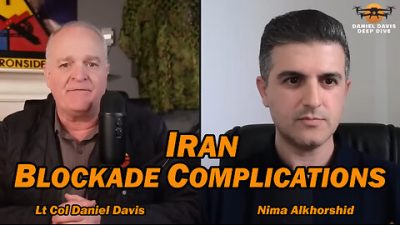
Iran Blockade Complications
or go to
Aletho News Archives – Video-Images
Book Review
Alarmist climate science as a textbook example of groupthink
By Paul MacRae | May 1, 2012
… Groupthink was extensively studied by Yale psychologist Irving L. Janis and described in his 1982 book Groupthink: Psychological Studies of Policy Decisions and Fiascoes.
Janis was curious about how teams of highly intelligent and motivated people—the “best and the brightest” as David Halberstam called them in his 1972 book of the same name—could have come up with political policy disasters like the Vietnam War, Watergate, Pearl Harbor and the Bay of Pigs. Similarly, in 2008 and 2009, we saw the best and brightest in the world’s financial sphere crash thanks to some incredibly stupid decisions, such as allowing sub-prime mortgages to people on the verge of bankruptcy.
In other words, Janis studied why and how groups of highly intelligent professional bureaucrats and, yes, even scientists, screw up, sometimes disastrously and almost always unnecessarily. The reason, Janis believed, was “groupthink.” He quotes Nietzsche’s observation that “madness is the exception in individuals but the rule in groups,” and notes that groupthink occurs when “subtle constraints … prevent a [group] member from fully exercising his critical powers and from openly expressing doubts when most others in the group appear to have reached a consensus.”[2]
Janis found that even if the group leader expresses an openness to new ideas, group members value consensus more than critical thinking; groups are thus led astray by excessive “concurrence-seeking behavior.”[3] Therefore, Janis wrote, groupthink is “a model of thinking that people engage in when they are deeply involved in a cohesive in-group, when the members’ strivings for unanimity override their motivation to realistically appraise alternative courses of action.”[4]
The groupthink syndrome
The result is what Janis calls “the groupthink syndrome.” This consists of three main categories of symptoms:
1. Overestimate of the group’s power and morality, including “an unquestioned belief in the group’s inherent morality, inclining the members to ignore the ethical or moral consequences of their actions.” [emphasis added]
2. Closed-mindedness, including a refusal to consider alternative explanations and stereotyped negative views of those who aren’t part of the group’s consensus. The group takes on a “win-lose fighting stance” toward alternative views.[5]
3. Pressure toward uniformity, including “a shared illusion of unanimity concerning judgments conforming to the majority view”; “direct pressure on any member who expresses strong arguments against any of the group’s stereotypes”; and “the emergence of self-appointed mind-guards … who protect the group from adverse information that might shatter their shared complacency about the effectiveness and morality of their decisions.”[6]
It’s obvious that alarmist climate science—as explicitly and extensively revealed in the Climatic Research Unit’s “Climategate” emails—shares all of these defects of groupthink, including a huge emphasis on maintaining consensus, a sense that because they are saving the world, alarmist climate scientists are beyond the normal moral constraints of scientific honesty (“overestimation of the group’s power and morality”), and vilification of those (“deniers”) who don’t share the consensus. … Read full article
Blog Roll
 Aletho News
- Geopolitics and Geoeconomics of the Strait of Hormuz
- Mali: a new front in the Western war on multipolarism
- CHD Scientist: CDC, FDA COVID Vaccine Safety Monitoring ‘Insulting, and Many People Are Injured’
- COVID Conniving Receives First Federal Indictment
- Iran Blockade Complications /Lt Col Daniel Davis & Nima Alkhorshid
- Pirates of Mediterranean: Israel does as it pleases in the Sea of Three Continents
- Minab children massacre not ‘unfortunate situation’ but ‘heinous war crime’: Tehran
- OPCW Forced To Pay Damages To Whistleblower Who Found Evidence Of False Flag In Syria
- Iran can thrive under blockade, the US and its allies cannot
- Iran slams US leadership, debunking fabrications, false war costs
- If Americans Knew
- US set to sell $1B “Advanced Precision Kill Weapon System” to Israel – Daily Update
- Israeli Strikes Kill at Least 32 Across S Lebanon, Including Children – Amid “Ceasefire”
- Israel to pour $730m into propaganda arm amid reputational crisis
- Real Cost of Iran War Likely Double the $25 Billion Figure the Pentagon Gave to Congress
- Israel conducts farthest-ever strike in long history of attacks on Gaza humanitarian aid flotillas
- In Gaza, Israel commits 10+ ceasefire violations a day – Daily Update
- US ships 6,500 tons of munitions, equipment to Israel in 24 hours
- A New Library in Gaza Rises From the Ashes of Destruction
- Israel’s top Jewish religious body ‘refuses to condemn’ smashing of Jesus statue
- Nun assaulted in Jerusalem amid ‘pattern’ of anti-Christian attacks by Israelis
- No Tricks Zone
- Oversupply Of Volatile Solar Energy Leads To Record NEGATIVE Prices!
- New Study: Extreme Heat Records, Heatwaves, Extreme Cold Records Declining Across US Since 1899
- It’s The Cold, Stupid! Cold 20 Times More Lethal Than Heat, Multiple Studies Show
- European Institute For Climate And Energy: “Climate Debate is Seldom About Science”
- New Study: The Climate May Be 5 Times More Sensitive To Solar Forcing Than Commonly Assumed
- EV Industry Reached $70 Billion In Losses In 2024 Due To Delusional Green Ideologies
- Reality Check: Maldives Have Actually Grown In Size Or Remained Stable Over Recent Decades
- Abrupt Climate Change Also Occurred NATURALLY In The Past …25 Times During Last Ice Age
- Cave Discovery Reveals Today’s Desert Climates Were Recently Far Warmer, Wetter, Teeming With Life
- German Expert: Heat Dome Led To Record Temps In Western USA…Warmer In 1934, 1936
 Aletho News