Aletho News

ΑΛΗΘΩΣ

Putin’s best Q&A quotes from ‘Ankara sucking up to US’ to ‘Trump being absolute frontrunner’

RT | December 17, 2015

Never at loss for words, Putin was as straight-forward as ever at his annual Q&A session. Russian relations with Turkey, the Syrian and Ukrainian crises, as well as the US presidential race were the highlights of the 3-hour long marathon attended by 1,400 journalists.

When asked about third party interests contributing to the deterioration of Russia-Turkey relations, Putin wondered if Washington might have something to do with it.

“We don’t know that for sure, but if someone in the Turkish leadership wanted to suck up to the Americans, I’m not sure whether they did the right thing or not,” he said.

“First of all I don’t know whether the Americans need it or not, it’s possible there was a certain agreement on some level: ‘we down a Russian plane and you turn a blind eye,’ ‘we deploy our troops to Iraq and occupy a part of Iraq’.”

Russia won’t cease its military campaign in Syria because of the Su-24 downing, even if Ankara expected that, said Putin.

“[Ankara] thought we would flee [Syria]! No, Russia is not a country to act like that. We increased our presence in Syria; we increased the strength of our air forces. There were no anti-aircraft weapon systems there before – now there is the S-400,” he said.

Operating a full-fledged base in Syria is not on Russia’s agenda, Putin said.

“Why would we need a base over there? We can get them [if we have to],” Putin said, stressing that the temporary units of the Russian task force currently operating in Syria could be withdrawn within a couple of days.

Putin reiterated that, despite constant accusations, no regular Russian troops have been stationed in Ukraine.

“We never said there were no people fulfilling certain tasks there (in Donbass region of Ukraine), including in the military sphere. But that does not mean there are regular Russian troops. Feel the difference?” Putin said.

After the main part of the Q&A session was over, Putin was asked about his attitude towards Donald Trump.

“It’s not our business to define his accomplishments,” Putin said. “But he is the absolute leader of the presidential race [in the US]”.

“He is a bright, talented person, no doubt about that,” Putin added. Trump recently stated he would like to see the US strengthen ties with Russia. “We welcome that of course,” said Putin.

Earlier in the same Q&A session, Putin had said he was prepared to work with whoever turns out to be victorious in the 2016 US presidential election.

December 17, 2015 Posted by | Aletho News | , , , , | Leave a comment

Turkish troops ‘raiding civilian houses’ in Kurdish city of Silopi
56729df4c36188f61f8b45f3

© farukencu / Instagram
RT | December 17, 2015

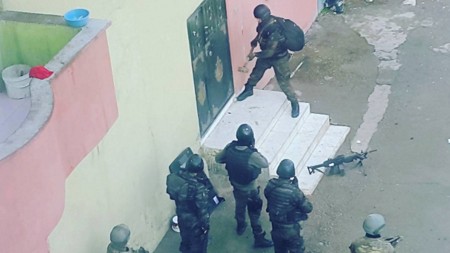
The Turkish Army has reportedly sent military vehicles, including tanks, into civilian areas in its predominantly-Kurdish southeast. While mainstream Western media remains silent, local activists posted frightening photos on social media.

The People’s Democracy Party (HDP) published a series of photos of the Thursday raid by the Turkish Army. According to HDP, soldiers in the Yenisehir district of Silopi “broke into a building and pointed guns at people.”

Ferhat Encu, an MP for the People’s Democratic Party, was taken into custody in Silopi.

“The world and those justifying this cruelty know well, this isn’t an ‘anti-terror’ act. This is an ethnic cleansing and genocide operation,” the party tweeted.

Ankara has been busy conducting military operations in the southeast since summer. Tensions have been mounting for months as security forces have been battling Kurdistan Workers’ Party (PKK) militants after a ceasefire collapsed in July. The PKK has been fighting for an autonomous Kurdish region inside Turkey for over three decades.

Earlier this week, Turkish Prime Minister Ahmet Davutoglu promised that anti-PKK operations would continue in Silopi and Cizre in order to, as he put it, prevent the militants from “spreading the fire” from Syria and Iraq into Turkey.

“The terrorists will be wiped out from these districts. Neighborhood by neighborhood, house by house, street by street,” he pledged.

Nurcan Baysal, founder of the Diyarbakir Political and Social Research Institute, has described Davutoglu’s language as “very dangerous.”

“If the Turkish state wants peace with its Kurdish citizens, it should change its dangerous language into the language of peace,” Baysal told the Middle East Eye news outlet. “Unfortunately, the Turkish state has decided to wage war against the Kurdish people again.”

“People are without water, electricity, food, medical care, and many civilians have died – and state officials say that they will continue this.”

Figen Yuksekdag, the co-chair of the pro-Kurdish Peoples’ Democratic Party (HDP), has publicly accused Davutoglu of “ordering a massacre” in Cizre and Silopi.

“Who are these operations against, Mr. Prime Minister?” Yuksekdag wondered at a press conference in Diyarbakir. “There are people living in these houses, Davutoglu,” she said.

Thousands took to the streets of Diyarbakir in late November after Tahir Elci, a lawyer and campaigner for Kurdish rights, was shot dead in while giving a speech on November 28. This became the last straw.

Seven Kurds were killed following clashes with Turkish security forces earlier this week. Two died in the city of Diyarbakir as protesters fought with police, while five lost their lives in the Mardin province.

Around 5,000 people gathered for a march in Diyarbakir on Monday, according to AP, which was called by the Peoples’ Democratic Party (HDP). Local residents gathered to voice their concerns about round-the-clock curfews being implemented in the region.

According to the Human Rights Foundation of Turkey, there have been a total of 52 curfews imposed since mid-August across seven provinces in the region, affecting areas where some 1.3 million people live.

Residents from the pro-Kurdish town of Silvan (some 80km north east of Diyarbakir) said they had been shelled by Turkish forces in mid-November, while the never-ending curfew had driven them to the brink of starvation.

December 17, 2015 Posted by | Civil Liberties, Ethnic Cleansing, Racism, Zionism, Subjugation - Torture | , | Leave a comment

A Blind Eye Toward Turkey’s Crimes

By Robert Parry | Consortium News | December 16, 2015

Theoretically, it would be a great story for the American press: an autocrat so obsessed with overthrowing the leader of a neighboring country that he authorizes his intelligence services to collaborate with terrorists in staging a lethal sarin attack to be blamed on his enemy and thus trick major powers to launch punishing bombing raids against the enemy’s military.

And, after that scheme failed to achieve the desired intervention, the autocrat continues to have his intelligence services aid terrorists inside the neighboring country by providing weapons and safe transit for truck convoys carrying the terrorists’ oil to market. The story gets juicier because the autocrat’s son allegedly shares in the oil profits.

To make the story even more compelling, an opposition leader braves the wrath of the autocrat by seeking to expose these intelligence schemes, including the cover-up of key evidence. The autocrat’s government then seeks to prosecute the critic for “treason.”

But the problem with this story, as far as the American government and press are concerned, is that the autocratic leader, President Recep Tayyip Erdogan, is in charge of Turkey, a NATO ally and his hated neighbor is the much demonized Syrian President Bashar al-Assad. Major U.S. news outlets and political leaders also bought into the sarin deception and simply can’t afford to admit that they once again misled the American people on a matter of war.

The Official Story of the sarin attack – as presented by Secretary of State John Kerry, Human Rights Watch and other “respectable” sources – firmly laid the blame for the Aug. 21, 2013 atrocity killing hundreds of civilians outside Damascus on Assad. That became a powerful “group think” across Official Washington.

Though a few independent media outlets, including Consortium News, challenged the rush to judgment and noted the lack of evidence regarding Assad’s guilt, those doubts were brushed aside. (In an article on Aug. 30, 2013, I described the administration’s “Government Assessment” blaming Assad as a “dodgy dossier,” which offered not a single piece of verifiable proof.)

However, as with the “certainty” about Iraq’s WMD a decade earlier, Every Important Person shared the Assad-did-it “group think.” That meant — as far as Official Washington was concerned — that Assad had crossed President Barack Obama’s “red line” against using chemical weapons. A massive U.S. retaliatory bombing strike was considered just days away.

But Obama – at the last minute – veered away from launching those military attacks, with Official Washington concluding that Obama had shown “weakness” by not following through. What was virtually unreported was that U.S. intelligence analysts had doubts about Assad’s guilt and suspected a trap being laid by extremists.

Despite those internal questions, the U.S. government and the compliant mainstream media publicly continued to push the Assad-did-it propaganda line. In a formal address to the United Nations General Assembly on Sept. 24, 2013, Obama declared, “It’s an insult to human reason and to the legitimacy of this institution to suggest that anyone other than the regime carried out this attack.”

Later, a senior State Department official tried to steer me toward the Assad-is-guilty assessment of a British blogger then known as Moses Brown, a pseudonym for Eliot Higgins, who now runs an outfit called Bellingcat which follows an effective business model by reinforcing whatever the U.S. propaganda machine is churning out on a topic, except having greater credibility by posing as a “citizen blogger.” [For more on Higgins, see Consortiumnews.com’s‘MH-17 Case: ‘Old Journalism’ vs. ‘New’.”]

The supposedly conclusive proof against Assad came in a “vector analysis” developed by Human Rights Watch and The New York Times – tracing the flight paths of two rockets back to a Syrian military base northwest of Damascus. But that analysis collapsed when it became clear that only one of the rockets carried sarin and its range was less than one-third the distance between the army base and the point of impact. That meant the rocket carrying the sarin appeared to have originated in rebel territory.

But the “group think” was resistant to all empirical evidence. It was so powerful that even when the Turkish plot was uncovered by legendary investigative reporter Seymour M. Hersh, his usual publication, The New Yorker, refused to print it. Rebuffed in the United States – the land of freedom of the press – Hersh had to take the story to the London Review of Books to get it out in April 2014. [See Consortiumnews.com’sWas Turkey Behind Syria Sarin Attack?”]

The Easier Route

It remained easier for The New York Times, The Washington Post and other premier news outlets to simply ignore the compelling tale of possible Turkish complicity in a serious war crime. After all, what would the American people think if – after the mainstream media had failed to protect the country against the lies that led to the disastrous Iraq War – the same star news sources had done something similar on Syria by failing to ask tough questions?

It’s also now obvious that if Obama had ordered a retaliatory bombing campaign against Assad in 2013, the likely winners would have been the Islamic State and Al Qaeda’s Nusra Front, which would have had the path cleared for their conquest of Damascus, creating a humanitarian catastrophe even worse than the current one.

To confess to such incompetence or dishonesty clearly had a big down-side. So, the “smart” play was to simply let the old Assad-did-it narrative sit there as something that could still be cited obliquely from time to time under the phrase “Assad gassed his own people” and thus continue to justify the slogan: “Assad must go!”

But that imperative – not to admit another major mistake – means that the major U.S. news media also must ignore the courageous statements from Eren Erdem, a deputy of Turkey’s main opposition Republican People’s Party (CHP), who has publicly accused the Erdogan government of blocking an investigation into Turkey’s role in procuring the sarin allegedly delivered to Al Qaeda-connected terrorists for use inside Syria.

In statements before parliament and to journalists, Erdem cited a derailed indictment that was begun by the General Prosecutor’s Office in the southern Turkish city of Adana, with the criminal case number 2013/120.

Erdem said the prosecutor’s office, using technical surveillance, discovered that an Al Qaeda jihadist named Hayyam Kasap acquired the sarin.

At the press conference, Erdem said, “Wiretapped phone conversations reveal the process of procuring the gas at specific addresses as well as the process of procuring the rockets that would fire the capsules containing the toxic gas. However, despite such solid evidence there has been no arrest in the case. Thirteen individuals were arrested during the first stage of the investigation but were later released, refuting government claims that it is fighting terrorism.”

Erdem said the released operatives were allowed to cross the border into Syria and the criminal investigation was halted.

Another CHP deputy, Ali Şeker, added that the Turkish government misled the public by claiming Russia provided the sarin and that “Assad killed his people with sarin and that requires a U.S. military intervention in Syria.”

Erdem’s disclosures, which he repeated in a recent interview with RT, the Russian network, prompted the Ankara Prosecutor’s Office to open an investigation into Erdem for treason. Erdem defended himself, saying the government’s actions regarding the sarin case besmirched Turkey’s international reputation. He added that he also has been receiving death threats.

“The paramilitary organization Ottoman Hearths is sharing my address [on Twitter] and plans a raid [on my house]. I am being targeted with death threats because I am patriotically opposed to something that tramples on my country’s prestige,” Erdem said.

ISIS Oil Smuggling

Meanwhile, President Erdogan faces growing allegations that he tolerated the Islamic State’s lucrative smuggling of oil from wells in Syria through border crossings in Turkey. Those oil convoys were bombed only last month when Russian President Vladimir Putin essentially shamed President Obama into taking action against this important source of Islamic State revenues.

Though Obama began his bombing campaign against Islamic State targets in Iraq and Syria in summer 2014, the illicit oil smuggling was spared interdiction for over a year as the U.S. government sought cooperation from Erdogan, who recently acknowledged that the Islamic State and other jihadist groups are using nearly 100 kilometers of Turkey’s border to bring in recruits and supplies.

Earlier this month, Obama said he has had “repeated conversations with President Erdogan about the need to close the border between Turkey and Syria,” adding that “there’s about 98 kilometers that are still used as a transit point for foreign fighters, ISIL [Islamic State] shipping out fuel for sale that helps finance their terrorist activities.”

Russian officials expressed shock that the Islamic State was allowed to continue operating an industrial-style delivery system involving hundreds of trucks carrying oil into Turkey. Moscow also accused Erdogan’s 34-year-old son, Bilal Erdogan, of profiting off the Islamic State’s oil trade, an allegation that he denied.

The Russians say Bilal Erdogan is one of three partners in the BMZ Group, a Turkish oil and shipping company that has purchased oil from the Islamic State. The Malta Independent reported that BMZ purchased two oil tanker ships from the Malta-based Oil Transportation & Shipping Services Co Ltd, which is owned by Azerbaijani billionaire Mubariz Mansimov.

Another three oil tankers purchased by BMZ were acquired from Palmali Shipping and Transportation Agency, which is also owned by Mansimov and which shares the same Istanbul address with Oil Transportation & Shipping Services, which is owned by Mansimov’s Palmali Group, along with dozens of other companies set up in Malta.

The Russians further assert that Turkey’s shoot-down of a Russian Su-24 bomber along the Syrian-Turkish border on Nov. 24 – which led to the murder of the pilot, by Turkish-backed rebels, as he parachuted to the ground and to the death of a Russian marine on a rescue operation – was motivated by Erdogan’s fury over the destruction of his son’s Islamic State oil operation.

Erdogan has denied that charge, claiming the shoot-down was simply a case of defending Turkish territory, although, according to the Turkish account, the Russian plane strayed over a slice of Turkish territory for only 17 seconds. The Russians dispute even that, calling the attack a premeditated ambush.

President Obama and the mainstream U.S. press sided with Turkey, displaying almost relish at the deaths of Russians in Syria and also showing no sympathy for the Russian victims of an earlier terrorist bombing of a tourist flight over Sinai in Egypt. [See Consortiumnews.com’sObama Ignores Russian Terror Victims.”]

New York Times columnist Thomas L. Friedman expressed the prevailing attitude of Official Washington by ridiculing anyone who had praised Putin’s military intervention in Syria or who thought the Russian president was “crazy like a fox,” Friedman wrote: “Some of us thought he was just crazy.

“Well, two months later, let’s do the math: So far, Putin’s Syrian adventure has resulted in a Russian civilian airliner carrying 224 people being blown up, apparently by pro-ISIS militants in Sinai. Turkey shot down a Russian bomber after it strayed into Turkish territory. And then Syrian rebels killed one of the pilots as he parachuted to earth and one of the Russian marines sent to rescue him.”

Taking Sides

The smug contempt that the mainstream U.S. media routinely shows toward anything involving Russia or Putin may help explain the cavalier disinterest in NATO member Turkey’s reckless behavior. Though Turkey’s willful shoot-down of a Russian plane that was not threatening Turkey could have precipitated a nuclear showdown between Russia and NATO, criticism of Erdogan was muted at most.

Similarly, neither the Obama administration nor the mainstream media wants to address the overwhelming evidence that Turkey – along with other U.S. “allies” such as Saudi Arabia and Qatar – have been aiding and abetting Sunni jihadist groups, including Al Qaeda and Islamic State, for years. Instead, Official Washington plays along with the fiction that Saudi Arabia, Turkey and others are getting serious about combating terrorism.

The contrary reality is occasionally blurted out by a U.S. official or revealed when a U.S. intelligence report gets leaked or declassified. For instance, in 2009, then-Secretary of State Hillary Clinton noted in a confidential diplomatic memo, disclosed by Wikileaks, that “donors in Saudi Arabia constitute the most significant source of funding to Sunni terrorist groups worldwide.”

According to a Defense Intelligence Agency report from August 2012, “AQI [Al Qaeda in Iraq, which later morphed into the Islamic State] supported the Syrian opposition from the beginning, both ideologically and through the media. … AQI declared its opposition of Assad’s government because it considered it a sectarian regime targeting Sunnis.”

The DIA report added, “The salafist, the Muslim Brotherhood, and AQI are the major forces driving the insurgency in Syria. … The West, Gulf countries, and Turkey support the opposition.”

The DIA analysts already understood the risks that AQI presented both to Syria and Iraq. The report included a stark warning about the expansion of AQI, which was changing into the Islamic State. The brutal armed movement was seeing its ranks swelled by the arrival of global jihadists rallying to the black banner of Sunni militancy, intolerant of both Westerners and “heretics” from Shiite and other non-Sunni branches of Islam.

The goal was to establish a “Salafist principality in eastern Syria” where Islamic State’s caliphate is now located, and that this is “exactly what the supporting powers to the opposition” – i.e. the West, Gulf states, and Turkey – “want in order to isolate the Syrian regime,” the DIA report said.

In October 2014, Vice President Joe Biden told students at Harvard’s Kennedy School that “the Saudis, the emirates, etc. … were so determined to take down Assad and essentially have a proxy Sunni-Shia war … [that] they poured hundreds of millions of dollars and tens of thousands of tons of military weapons into anyone who would fight against Assad except the people who were being supplied were Al Nusra and Al Qaeda.”

Despite these occasional bursts of honesty, the U.S. government and the mainstream media have put their goal of having another “regime change” – this time in Syria – and their contempt for Putin ahead of any meaningful cooperation toward defeating the Islamic State and Al Qaeda.

This ordering of priorities further means there is no practical reason to revisit who was responsible for the Aug. 21, 2013 sarin gas attack. If Assad’s government was innocent and Ergogan’s government shared in the guilt, that would present a problem for NATO, which would have to decide if Turkey had crossed a “red line” and deserved being expelled from the military alliance.

But perhaps even more so, an admission that the U.S. government and the U.S. news media had rushed to another incorrect judgment in the Middle East – and that another war policy was driven by propaganda rather than facts – could destroy what trust the American people have left in those institutions. On a personal level, it might mean that the pundits and the politicians who were wrong about Iraq’s WMD would have to acknowledge that they had learned nothing from that disaster.

It might even renew calls for some of them – the likes of The New York Times’ Friedman and The Washington Post’s editorial page editor Fred Hiatt – to finally be held accountable for consistently misinforming and misleading the American people.

So, at least for now — from a perspective of self-interest — it makes more sense for the Obama administration and major news outlets to ignore the developing story of a NATO ally’s ties to terrorism, including an alleged connection to a grave war crime, the sarin attack outside Damascus.


Investigative reporter Robert Parry broke many of the Iran-Contra stories for The Associated Press and Newsweek in the 1980s. You can buy his latest book, America’s Stolen Narrative, either in print here or as an e-book (from Amazon and barnesandnoble.com).

December 16, 2015 Posted by | Corruption, False Flag Terrorism, Mainstream Media, Warmongering, Timeless or most popular, War Crimes | , , , , , , , , , , , , , | Leave a comment

Recep Tayyip Erdogan: Portrait of a Backstabbing Pasha

By James Petras :: 12.15.2015

What Makes Recep Run? The Making of a Modern Pasha

Erdogan began his ascent to power as a social reformer in opposition to the power elite; he was a rabble-rouser for popular Islam and social welfare. Once he takes political power he enriches his family and the business elite and purges adversaries and rivals.

With political power and economic connections, he amasses personal wealth through illicit business transactions.

With political power and personal wealth, he seeks prestige and status among the Western elites by serving imperial interests: He shoots down a Russian military jet over Syrian territory and thereby threatens hundreds of Turkish businesses and loses a major source of personal enrichment. When the Russians threaten to cut off energy exports to Turkey, Erdogan’s opponents suggest he heat his own palace and villas with cow dung this winter.

The Two Faces of Erdogan

Turkish President Recep Tayyip Erdogan has a long and ignoble history of betraying political associates, trading partners and military allies; of pledging friendship and then bombing his ‘friends’ and murdering citizens; of negotiating ‘in good faith’ and then killing rivals; of playing democrat then behaving like an ordinary demagogic dictator.

Erdogan appeals to the plebian and austere values of the Anatolian provincial petty bourgeoisie, while building the largest luxurious presidential palace in the world – fit for a 21st century Pasha. He repeatedly pronounces his fealty to the ‘Turkish Nation’, while he robs the Turkish treasury by repeatedly accepting bribes and pay-offs from building contractors who then double charge for publically-funded projects.

More recently, Erdogan claims to oppose terrorism and fight ISIS, while the major Turkish and regional newspapers, journalists and most domestic observers document the massive flow of illegal arms across the Turkish-Syrian border to ISIS terrorists.

Erdogan’s ‘Carnal Relation’ with ISIS

Erdogan supports ISIS by bombing the Syrian Kurdish fighters who resist the jihadi mercenaries; by shooting down a Russian military jet defending the Damascus government against the terrorists; by smuggling and selling oil which ISIS had stolen from Iraq and Syria; by providing medical assistance to wounded ISIS fighters; and by training and arming ISIS terrorists in Turkish bases.

There is a reciprocal relationship: Erdogan uses ISIS operatives to terrorize his own domestic opposition, including terror bombing a gathering of Kurdish ‘socialist youth’ in the town of Suruç on July 20, 2015, which killed 33 and the massive bombing in Ankara on October 10 of a ‘peace and justice’ march, which killed over 100, targeting trade unionists, leaders of professional associations, community activists and members of a democratic Kurdish electoral party and wounded many hundreds.

During the legislative election of 2015 ISIS terrorists and thugs from Erdogan’s Justice and Development Party (AKP) attacked the offices, meetings and candidates of the opposition parties, especially of the Kurdish People’s Democratic Party (HDP), to ensure that Erdogan secured a super-majority.

In other words, Erdogan has three uses for ISIS serving his external and internal interests:

(1) To attack and destroy secular Kurdish forces resisting ISIS in Syria and Iraq, thus preventing the formation of an independent Kurdish state on the Turkish border.

(2) To attack and destroy Syria’s independent Baathist government under Bashar Al-Assad, dismantle the multicultural secular state apparatus and install a Sunni Islamist client in Damascus subordinate to Erdogan’s AKP.

(3) To attack and terrorize the Turkish domestic opposition, including the broad-based Kurdish HDP, and the leftist trade union confederation (DISK).

Erdogan has a decade-long strategic alliance with the militant Wahhabi terrorists who now make up ISIS. He intends to ‘remake’ the map of the Middle East to serve his own expansionist ambitions. In part this explains why Erdogan has provided large-scale arms and material to the terrorists, trained thousands of mercenaries and provided medical aid to wounded ISIS fighters. It also explains why Erdogan took the unprecedented and extremely provocative step of shooting down a Russian military jet over Syrian territory, which had been bombing Erdogan’s ISIS allies. Russian and Syrian Army successes against ISIS have threatened his ambitions.

Erdogan’s transformation from ‘Muslim democrat’ to bloody authoritarian Islamist ruler with pretensions of becoming the dominant Middle Eastern Pasha has to be seen in light of his rise to power over the past 40 years.

What Makes Recep Run?

Erdogan, early on, showed his affinity for extremist Islamist politics. In the 1970’s he was head of the youth branch of the Islamist Salvation Party (MSP), a virulent anti-communist, anti-secular party committed to converting Turkey, a huge multi-ethnic secular state, into a theocratic regime (along the lines of contemporary ISIS).

After the military coup of 1980 the MSP was dissolved and reappeared as the Welfare Party. Erdogan became a leader of the new (re-named) Islamist party.

Erdogan and the Welfare Party exploited Turkish mass discontent with the corrupt and authoritarian military. The Welfare Party embraced a populist social welfare program with Islamist religious undertones in order to build a formidable grassroots organization in the working class neighborhoods in Istanbul. Erdogan was elected mayor of Turkey’s largest city in 1994.

As Mayor, Erdogan over-reached his power by preaching militant Islamism and was convicted in 1998 of sedition against the secular state. He served 4 months of a 10-month sentence.

Henceforth he changed tactics: His Islamist fanaticism was disguised. He changed the party name from Welfare to the modern sounding Justice and Development Party (AKP). Erdogan then launched a series of political maneuvers, in which he cleverly manipulated adversaries to gain power and then… stabbed each of them in the back.

Erdogan: Embrace and Back-Stab

Despite his earlier conviction for sedition against the secular state, the ‘reformed’ Erdogan allied with the Kemalist, secular Republican Peoples Party (CHP) to overturn the military’s ban on his participation in politics in 2002. He was elected Prime Minister in 2003. After the AKP won the general election it cut its ties with the CHP. Erdogan was re-elected Prime Minister in 2007 and 2011.

Erdogan allied with the pro-US Islamist leader Fethullah Gülen’s Hizmet or Cemaat Movement, which was influential within the judicial system, police and army. Together they launched a purge against secular military and judicial officials, journalists and media critics.

The Erdogan – Gülenist state apparatus arrested and jailed 300 secular military officers, judges and journalists and replaced them with Erdogan and Gülen loyalists – all Islamists.

Dubbed “Operation Sledgehammer” the entire purge was based on fabricated charges of treason and conspiracy. Yet it was described by the Western media in terms that flattered Erdogan’s democratic credentials, calling it an ‘effort to consolidate democracy’ against the military.

It had nothing to do with democracy: The purge consolidated Erdogan’s personal power and allowed him to pursue policies that were more overtly neo-liberal and Islamist. The purge of the judiciary further allowed Erdogan to enrich crony capitalists and family members.

Erdogan: The Birth of a Neoliberal Pasha

Erdogan then embraced an IMF-designed ‘stabilization and recovery’ program, which reduced wages, salaries and pensions while privatizing public sector enterprises and activities. This attracted a large inflow of capital as foreign investors and cronies snapped up the goodies at bargain prices. Most emblematic of this ‘free-for-all cronies’ approach to the economy was the Soma coal mine disaster in May 2014 when over 300 miners were killed in a previously state-owned mine, which had suffered a breakdown of worker safety conditions after it had been privatized to an Erdogan-crony. Despite local and international outrage, Recep ignored the scandal and unleashed police on the demonstrating miners.

Erdogan’s combination of Islam with brutal neo-liberalism attracted support from Brussels, Wall Street and the City of London. Large inflows of speculative foreign capital temporarily inflated Turkey’s GNP and Erdogan’s wealth and ego!

In the beginning of his rule Erdogan’s concessions, tax incentives, government contracts to big capital were broadly distributed to most sectors, but especially to his crony capitalists within the construction and real estate sectors.

As the capitalist boom continued and his power increased, Erdogan became more obsessed with his role as the savior of Turkey. By 2010, a serious difference developed between Erdogan and his Gülenist partners over the division of power. Erdogan moved rapidly and brutally. He launched another massive purge of suspected ‘Gülenist officials’. He arrested, fired, jailed and relocated Gülen sympathizers among judges, police and civil servants despite the fact that these were officials who had served him well during the earlier purge of the secular military.

Erdogan is not willing to share power with any other party, movement or group. Pasha Recep wanted to monopolize power. He has attacked critical newspapers, businesses and conglomerates claiming these were ‘Gülen controlled’. Erdogan ensured that only capitalists completely loyal to him would receive regime patronage. In other words, he strengthened the size, strength and importance of crony capitalists: especially in the real estate and construction sector.

Pasha Recep’s Assault on Civil Society

Turkey, under Erdogan’s absolute power, has seen a geometric increase in corruption and mindless ‘development projects’, leading to the degradation and usurpation of public spaces. His arbitrary and destructive policies have provoked sustained civil society protests, especially in the center of Istanbul – during the Gezi Park demonstrations, which began in May 2013.

In response to civil society demonstrations, Erdogan shed all pretensions, ripping off his ‘modern democratic’ mask and brutally repressing the peaceful protestors in the heart of Istanbul– resulting in 22 deaths, hundreds wounded and more arrested and sentenced to long jail term. Erdogan subsequently targeted liberal critics and business leaders, who had criticized his brutal use of force.

2013, the year of the Gezi Park Movement, was a turning point – Erdogan and family members were implicated in a $100 million-dollar corruption scandal while liberal critics of the regime were purged.

Facing opposition from sectors of the elite as well as popular classes, Erdogan became more rabidly ‘Islamist’, chauvinistic and megalomaniacal – ‘Neo-Ottoman’.

In short order, he re-launched his attack on the Turkish Kurds and increased his support to the Islamist terrorists in Syria, including what would become ISIS. These policies were designed to complement his ongoing war against the secular Kurds in Iraq and Syria.

Erdogan: Backstabbing Secular Syria and “Best Friend” Russia

From the beginning of his rule, Erdogan cultivated the ‘best of relations’ with Syria’s Bashar Al-Assad and Russian President Vladimir Putin. He signed dozens of trade agreements with Damascus and Moscow. Putin was welcomed to Ankara and Erdogan to Moscow where they signed billion-dollar energy deals and mutual co-operative agreements.

Up to 3 million Russian tourists visited Turkish resorts each year, a bonanza for one of Turkey’s major industries.

Erdogan’s regime was ebullient, effusive, embracing Moscow and Damascus while systematically preparing the ground for more backstabbing!

By 2011, Erdogan had been deeply involved in preparing the ground for what would become the bloody Islamist uprising in Syria. Early on, hundreds of armed foreign Islamist terrorists crossed the Turkish border into Syria. Their presence overwhelmed local Syrian dissidents. Armed Islamists seized villages and towns brutally purging them of Christians, Kurds, Alawites and secular Syrians. They took over the oil fields. From one day to the next, Erdogan was transformed from loving friend to deadly foe of neighboring Syria demanding ‘regime change’ through terrorist sectarian violence.

Erdogan embraced the most extreme, sectarian Wahhabi Islamist groups because they were committed to undermining the nationalist aspirations of the Syrian Kurds as well as overthrowing the secular Al-Assad government. Erdogan’s covert alliance with ISIS and other Islamist terrorist groups was motivated by several strategic considerations, which are outlined below:

1) The alliance serves to prevent the establishment of an autonomous Kurdish enclave on the Syrian-Turkish border in the event of a Damascus defeat, which Erdogan fears would then link armed Syrian Kurds with the huge disaffected Kurdish population in southeastern Turkey and lead to the formation of an autonomous secular Kurdish state.

2) Erdogan’s alliance with jihadis in Syria has served Ankara’s ambition to impose a puppet Sunni-Islamist regime in Damascus.

3) The ISIS regime controlling the Syrian and Iraqi oil fields provides Turkey with a source of cheap fuel and lucrative profits for the regime. Recep’s son, Necmettin Bilal Erdogan owns and operates the BMZ Group which buys the contraband Syrian and Iraqi oil in Turkey and sells it overseas (especially to Israel) earning nearly a billion dollars a year for ‘the family’.

It is not a surprise that the Erdogan family directly financed ISIS, which uses the cash from contraband oil, pillaged antiquities and ‘tribute’ taxes, to purchase heavy and light arms, military and transport vehicles and communications equipment in Turkey and elsewhere to support its terror campaign in Syria and Iraq. Well-informed Turkish observers believe that Erdogan’s intelligence officials are directly involved in recruiting ISIS terrorists to operate within Turkey and attack Erdogan’s internal opposition, especially the Kurdish electoral party HDP and the broad-based Turkish left and trade union movements. Observers claim Turkish intelligence operations had a direct role in the ‘ISIS’ bomb attacks in Suruç and Ankara this year, which killed and maimed hundreds of Erdogan opponents and civil society activists.

Erdogan and ISIS developed a co-dependent relation, one of mutual manipulation. Each has publicly declared their tactical enmity to the other, while busily pursuing joint strategic aims.

Ankara uses the pretext of fighting ISIS in order to bomb the Kurds in Syria who are resisting the jihadis. ISIS uses the pretext of opposing the NATO member Turkey in order to cover its massive oil and weapons trade deals with Erdogan’s family and crony business enterprises.

The Pasha Stabs the Bear and the Bear Bites Back – One Stab Too Many

Russia’s highly effective aerial bombing campaign against the jihadi and ISIS terrorist networks in Syria was in response to a formal request for military intervention by the legitimate government of President Bashar Al-Assad. Russia has long-standing ties to the Baathist regime in Damascus. The intervention has threatened to undermine Erdogan’s regional power ambitions and illicit business operations in Syria. First and foremost, it ended Erdogan’s plan to annex a large swathe of Northern Syria and call it a ‘no fly zone’. The Turkish-controlled ‘no fly zone’ in Syria would expand Turkish military training bases for ISIS and other jihadi terrorists and secure the transport routes for ISIS oil shipments smuggled out of Iraq and Syria.

Unlike the US, which had rarely bombed the strategic Erdogan-ISIS oil smuggling operations, the Russians destroyed over a thousand oil trucks and numerous ISIS oil depots and logistical centers in the first month of its air campaign. By reducing the flow of smuggled oil, Russia cut off the main source of massive profit for Bilal Erdogan’s BMZ Company as well as for Turkish arms dealers.

Like gangsters, Erdogan, his family and cronies have been immersed in massive corrupt business activities at home and abroad; he can no longer operate within the context of the larger interests of the Turkish capitalist class with its $40 billion dollar annual trade and investment relations with Russia. Erdogan’s decision to shoot down a Russian jet in Syrian territory, on November 24, 2015, was largely motivated by his fury at Russia’s successful interruption of the ISIS oil convoys. By protecting his own family interests, Erdogan stabbed more allies in the back: The Russians, as well as large sections of the Turkish capitalist class!

Up until Erdogan’s act of war against Russia, he had publicly embraced Putin as an ally, friend and partner. The two leaders had cordial relations for over a decade. The Turkish military was fully informed about Russian military operations in Syria, including its flight paths. Then suddenly in November 2015 he risked a total rupture in relations and invited retaliation against Turkey from Russia by shooting down a Russian jet.

Russia immediately responded by upgrading its most advanced weapons systems to defend its operations and bases in Northern Syria and intensified its bombing of the ISIS – Turkish oil operations.

Russia retaliated by imposing visa restrictions and economic sanctions on Turkey, adversely affecting the multi-billion dollar tourist business. Strategic energy deals were terminated. Large-scale Turkish construction contracts were ended. Turkish agricultural exports to Russian markets virtually stopped.

The Pasha Bites His own Tail

Erdogan’s unilateral actions were clearly against the broad interests of Turkey’s large export sector. From Gezi to Gülen, from one purge to another, Erdogan, the former ‘poster boy’ of neo-liberal Turkish capital, has become a self-centered despot, acting on behalf of a narrowing circle of corrupt family and crony capitalists. Erdogan set himself up as a modern day pasha more in the image of the self-indulgent Ibrahim I (the Madman) than the far-seeing Suleyman I (the Wise).

Once Erdogan realized the damage that his fit of egomaniac fury against the Russians had provoked abroad and his growing isolation within Turkey, he rushed to NATO on bended knee to beg for support. True to his authoritarian personality, Recep Erdogan crawls on his knees before his ‘superiors’ (NATO-US) while grabbing the throats of his ‘inferiors’ (the Turkish people)!

Conclusion

Erdogan’s road to absolutist power is strewn with indiscriminate purges, terror and deceit; violence against environmental and liberal protesters in Gezi Park and moderate Gülen Islamists; jail sentences and firing of journalists and publishers, military officials and judges; repression of workers and capitalists; terror bombing against activists and democrats; and war against Kurds and Syrians.

Erdogan’s paranoid and greed-driven vision of politics precludes any trust and stable relations. He thinks he is very clever with his combination of charm and broken promises, but he fools nobody. He reignites the war against the Kurds in Turkey and Syria but they retaliate!

He attacks Russia and provokes a very costly retaliation so far limited to the Turkish economy.

He increases his personal power, but undermines the interests of the Turkish nation and its people. Erdogan believes he is the rising regional hegemon, indispensable to the West. He blackmails the EU for billions of Euros to control the flood of refugees fleeing violence in Syria and Iraq with his promises to warehouse desperate refugees in Turkish concentration camps. But Europeans must know that their money can never buy trust and loyalty from the Pasha.

His oil deals with ISIS are in tatters. Russian bombs ensure that Erdogan will have to find other sources of illicit profit. Worst of all, Erdogan’s furious actions have lost markets, allies and domestic support. He faces enemies from all sides – liberal professors, students, big business owners and organized workers in Istanbul; small business people in the tourist trade; construction and oil companies in Ankara; farmers in Anatolia, and, above all, the coal miners in Soma Manis.

Who knows under what circumstances Pasha Recep (the ‘Megalomaniac’) will be replaced?

December 16, 2015 Posted by | Civil Liberties, Corruption, Deception, False Flag Terrorism, Timeless or most popular | , , , , , , | Leave a comment

Turkish MP faces treason charges after telling RT ISIS used Turkey for transiting sarin

RT | December 16, 2015

An investigation on treason charges has been opened against a Turkish MP who alleged in an exclusive interview with RT that Islamic State jihadists used Turkish territory as a transit route to deliver deadly sarin gas to Syria.

Ankara’s Chief Prosecutor’s Office opened the case against Istanbul MP Eren Erdem of Republican People’s Party (CHP) after his interview about sarin was aired on RT on Monday.

“Chemical weapon materials were brought to Turkey and put together in ISIS camps in Syria, which was known as the Iraqi Al-Qaeda at that time.”

Erdem noted that the chemicals used for the production of weapons did not originate from Turkey. “All basic materials are purchased from Europe. Western institutions should question themselves about these relations. Western sources know very well who carried out the sarin gas attack in Syria,” Erdem told RT.

As Turkish media reported Wednesday, the prosecutor’s office is planning to send a summary of proceedings to the Ministry of Justice on Thursday. Following that, the summary could be forwarded to the Turkish parliament, which could vote to strip Erdem of his parliamentary immunity.

Once Turkish mass-media reported the criminal investigation had been opened against Erdem, the hashtags #ErenErdemYalnızDeğildir – #ErenErdemYouAreNotAlone began to circulate in Turkish social networks.

On Tuesday, MP Erdem issued a written statement in his defense, saying he had become the target of a smear campaign because of his statements made in parliament.

As for his accusations about Turkish businessmen being involved in supplying Islamic State (IS, formerly ISIS/ISIL) with the poisonous gas sarin and other reactants needed for chemical warfare, Erdem maintained this statement was made based on the results of a Turkish court investigation in 2013.

Erdem revealed that five Turkish citizens had been arrested by the Adana Chief Prosecutor’s Office as a result of an investigation coded 2013/139. A Syrian national was prosecuted in Turkey for procuring chemical agents for Islamist groups in Syria. At the same time, Erdem noted all the persons arrested within the framework of the 2013/139 investigation were released a week later.

In his statement Eren Erdem claimed he had received death threats over social media following the publication of his interview to RT.

Eren Erdem said that the Turkish paramilitary organization Ottoman Hearths has published his home address on Twitter in an effort to enable at an attack on his house.

“I am being targeted with death threats because I am patriotically opposed to something that tramples on my country’s prestige,” MP Erdem said.

In an interview to Turkey’s Kanal 24 on Tuesday, Cem Küçük, a columnist at the pro-government Star daily, said that Erdem’s claims about sarin gas should be regarded as treason. Erdem should be stripped of his parliamentary immunity to “pay for his deeds,” Today’s Zaman cited Küçük as saying.

The Turkish public is “very much polarized” and those supporting the government and followers of the ruling Justice and Development Party (AKP) make up “about half of the country,” Hisyar Ozsoy, Turkish MP for leftist HDP party, told RT.

“They really do not care about what is happening in terms of freedom of expression,” Ozsoy said, adding that “anybody who is critical of the government is facing incredible pressure: indictments, court cases, even imprisonments.”

The Turkish government – and the president in particular – use polarization of the Turkish community as a mode of carrying out politics that very much worries the other half of the citizenry.

The most widely-reported chemical attack in Syria took place in the early hours of August 21, 2013, in Ghouta, on the outer fringes of Damascus. Rockets containing sarin gas were reportedly fired, killing more than 1,400 people, including no fewer than 426 children. It was on the very day a UN team of inspectors arrived in the city to investigate the alleged March 19 chemical attack in Khan al-Assal, northern Syria.

December 16, 2015 Posted by | Civil Liberties, Deception, False Flag Terrorism, Full Spectrum Dominance, War Crimes | , , , , | Leave a comment

Turkey: Everyone Needs A Way Out

By Henry Kamens – New Eastern Outlook – 15.12.2015

President Recep Tayyip Erdogan, the well-known fan of air defence systems, is facing impeachment for an endless list of crimes. We have only got to this point because he is probably guilty of most of them.

The Speaker of Parliament, accountable to parliament and not government, has the authority to unveil official documents concerning his actions which have been hidden until now. If that happens, it is very likely that Erdogan’s rule will come to an abrupt end, simply because the list of charges is so long that even if only 10% can be proven that will be enough to sink him.

Many unofficial sources are claiming that Erdogan is going mad at hearing that the nation is no longer following him. Even former supporters who stood by him when he was accused of corruption are now leaving him. Erdogan is blaming all this on his former American aide, the Islamist Sai Baba Fethullah Gulen, the leader of a worldwide movement which is halfway between a faith organization and bunch of jack-of-all-trade agents active from China to the US. But it is not Gulen but Erdogan himself who is the object of criticism, and it would come as no surprise if documents released by his own comrades brought about his downfall.

Big statements

One of the issues these documents might talk about is the bomb massacre at a rally in Ankara which made world news. Prime Minister Davutoglu has claimed that two suicide bombers committed this attack on behalf of both ISIL and the PKK, the Kurdish separatist movement, working together.

This claim smears all the Turkish public’s bogeymen at once, but is highly unlikely to be true. Many of the people taking part in the rally were Kurds, it having been organised by the democratic Kurdish party, the HDP. The Turkish government is keen to draw a distinction between ordinary Kurds, and their democratic representatives, and PKK terrorists. This is the basis of the accusation that the PKK must have planned the attack.

But the PKK knows it does not have the strength to destroy the HDP, or take full control of the Kurdish independence movement. It also knows that when a longstanding grievance is resolved by political means the more radical elements gain more public support if they then join the political process. In Northern Ireland, for example, the moderate Republican and Unionist parties dominated their communities until peace was achieved, but then the more extreme parties displaced them as soon as they renounced violence, being seen as stronger voices for their people.

The PKK is also fighting ISIL in the hottest combat regions and is fundamentally opposed to it ideologically. It has more to gain by helping Turkey and the US defeat ISIL, in exchange for a Kurdish state at the end of it, than trying to overthrow a Turkish government which retains international support due to the country’s strategic location. A Kurdish state would be an appropriate thank you for the “moderate Kurdish” contribution to the war on terrorism, granted willingly and with public support, providing a get-out for all sides in that conflict.

Word on the street in Ankara is that the terrorist bombing was the work of the local special services, not ISIL, and probably acting with foreign support. In this view, its purpose was to rally the nation round Erdogan, the face of law and order. However, his refusal to make an official statement about the Ankara bombing for days suggests he has spurned the opportunity allegedly provided him.

Erdogan was elected on a platform of reviving the Golden Age, whenever that was, and making Turkey great again. But he is now putting at risk the economic strength and regional political clout which have become effective levers for doing just that. This is causing many to question his conduct over a number of other matters, which the general thrust of his policy and success enabled him to get away with before. With the idea of being imprisoned keeping him awake at night, Erdogan may well be tempted to resort to measures such as murdering his own citizens to maintain his hold on power, like many another isolated ruler before him.

Ivory towers

The embattled leader has tried to shore up his position by using another well-worn tactic of leaders under pressure – engaging in foreign diplomacy, which opposition groups can’t do, to show his superiority. But when Angela Merkel – who despises him, and doesn’t try to hide the fact – visited Turkey for multilateral talks on immigration and stopping the flood of migrants to Europe, this was seen as nothing more than a political stunt, on her part as well as his, as she has no intention of pulling out of the wars which are creating these migrants.

Erdogan also piled more pressure on himself by his approach to the talks. He complained that the 3 billion EUR the EU has offered to help Turkey take tougher measures against immigration is much less than Turkey is spending on caring for refugees at present. However, it is widely known that Turkey is encouraging, not stopping, the flow of migrants to Europe so that they can be used as a political weapon whenever suitable. This demonstrates that, having failed to get into the EU by fair, diplomatic means, Erdogan is happy to resort to foul ones. It is this which forms the substance of the documents the Turkish parliament, and his colleagues, might now release.

Paper castles

As in Kazakhstan, governments can get away with a lot if their economies are booming. Its previous economic strength had encouraged Turkey to bid for regional leadership, which every country which has had an empire believes is theirs as of right. But now the Turkish currency is in deep crisis. Last May the official exchange rate was 3.5 Turkish Lira to the British Pound, but this August it was 4.7. This steep decline has made the TL the worst-performing currency in the emerging global economies, and is making entrepreneurs’ lives impossible.

Turkey has few primary resources and suffers from a deep technological gap. Consequently, it cannot produce most of the components industry needs. These have to be imported, processed and then exported to pay for their importation, and with the local currency so weak it is very expensive and not competitive to do this. The new Russian sanctions will cause even more problems.

The high rate of inflation, apparently the product of heavy printing by the central bank, will soon make several businesses go bankrupt. Public debt is also rising, and is calculated in dollars, making Turkey very vulnerable to interest rate decisions made across the Atlantic. Far from being a regional leader, Turkey has become the modern financial world’s equivalent of a banana republic. Its current political position has been given it as a sop, to keep it onside until the time comes to pull the rug from under it.

Emperor’s new clothes

All this is laying bare the fact that it is time to “Talk Turkey” about Turkey. It has always been a US ally because of where it is, not for any other reason. The US doesn’t want it as a trusted ally, or really care about it.

Turkey is traditionally a foe of what is now the political West, which fought wars to liberate Europe from the Ottoman yoke and to keep modern Turkey from allying with Hitler in World War Two. It was made part of the West to stop the Communists, who had encircled it, getting their hands on its strategic ports.

But the West has never liked Turkey or what it does, despite its consistent praise of “improvements” in its continually vicious internal politics or its “support” of US ambitions. It’s not seen as a Western country but a military base in hostile territory, which the West has no choice but to indulge as far as possible.

This grudging indulgence has always been part of broader US calculations in the region. Several years ago Georgia was made the US forward operating base in the region partly because it wanted a way out of Turkey. Georgia isn’t big enough to play this role all the time, but its previous government was nasty enough to let the US do whatever it wanted, including murder, torture, training terrorists and manufacturing and exporting biological weapons, so that some of the reasons it needed Turkey no longer applied.

Now the US operation has moved to Ukraine, and a lot of the nasty Georgians with it. Ukraine does have the size, military capacity and strategic location to replace Turkey to a large degree. At this stage there are still too many vested interests for the US to just walk away from Turkey. But with everybody else also wanting out, how long will Erdogan be able to bank on this remaining truth?

Former Georgian President Saakashvili, who always said he would be back without the need for elections, was recently caught on tape plotting a coup which would be conducted from Turkey. Saakashvili is arrogant enough to think that he can say what he wants without being called to account, but not so stupid as to be caught in such a way by routine methods. These tapes were made somehow, most probably by “protectors” for whom he, like Turkey, has become a deep embarrassment.

Crashing and burning

Those tapes give the West a convenient way out of both Saakashvili’s gang and Turkey, which have now outlived their usefulness. They were one of the reasons Turkey shot down the Russian plane. But this action has provided another reason for Erdogan to be removed, as it was politically inexpedient, a violation of international law and presents Turkey as a supporter of a terrorist organisation, giving the West ample reason to interfere in its affairs yet again.

If Russia responds to the attack militarily NATO is obliged to defend Turkey. However NATO is now trying like hell to avoid expanding to its east, despite the number of countries knocking on its door, precisely because it doesn’t want to find itself obliged to send its forces to these countries. NATO cannot get sucked into war with Russia, or reconstitute the Turkish state, which is not homogeneous to begin with?

The French are fond of talking about their “Fifth Republic”, meaning the state established in 1958, when its current constitution was adopted. France existed before then of course, but under different constitutions and political arrangements. On each occasion, the old France collapsed and was thrown into the dustbin and replaced by a new one, even though it was physically the same country. Erdogan might well achieve his longed-for place in history by being the last president of THIS Turkish Republic, even though it will mean “crashing and burning” with it.

December 15, 2015 Posted by | Deception, Economics, False Flag Terrorism | , , , , , | Leave a comment

The Illusion of Western News

By Finian Cunningham – Sputnik – 14.12.2015

Multi-million-dollar advertising money has long been suspected as an unspoken filter for Western news media coverage. If the news conflicts with advertising interests then it is simply dropped.

Western complicity in Yemen’s conflict is a case study. Add to that the celebrity sheen of Hollywood stars Jennifer Aniston and Nicole Kidman. What we then have is an illustration of how ugly realities of killing and war crimes are cosmetically air brushed from public awareness.

Let’s take three major Western media outlets — BBC, CNN, France 24. All are notable for their dearth of news coverage on the bloody conflict in Yemen. On any given day over the past nine months, these channels have rarely given any reports on the daily violence in the Arabian Peninsula country.

Yemen is heading into peace talks in Geneva this week, so there might follow some desultory reports on the said channels. But over the past nine months when the country was being pummeled in an appalling onslaught by foreign powers, the same channels gave negligible reportage.

It also turns out — not coincidentally — that major advertisers on these same news channels include Qatar Airways, Emirates Airlines and Etihad. The latter two advertisers feature screen celebrities Jennifer Aniston and Nicole Kidman, posing as satisfied customers of these Gulf state-owned companies.

Other prominent advertisers on BBC, CNN and France 24 are Turkish Airlines and Business Friendly Bahrain.

This advertising complex has, undoubtedly, a direct bearing on why the three mentioned Western news channels do not give any meaningful coverage of the disturbing events in Yemen.

Notwithstanding there is much that deserves telling about Yemen — if your purpose was journalism and public information.

The poorest country in the Arab region is being bombed by a coalition of states that include the US, Britain and Saudi Arabia, as well as a handful of other Persian Gulf oil-rich kingdoms. The latter include Qatar, the United Arab Emirates and Bahrain.

Thousands of Yemeni civilians — women and children — have been killed in air strikes by warplanes from this foreign military coalition, which claims to have intervened in Yemen to reinstall a regime headed up by a discredited president who was forced into exile in March this year by a popular uprising. The uprising was led by the Yemeni national army allied with guerrilla known as the Houthis.

Out of Yemen’s 24 million population, nearly half are in dire humanitarian conditions from lack of food, water and medicine, according to the United Nations. The suffering is aggravated by a sea and air blockade of Yemen by the Western-Arab military coalition.

Due to Western involvement in a humanitarian disaster unfolding in Yemen, one might think that Western media would be at least giving some coverage. Well, not if you watch BBC, CNN or France 24.

Moreover, there are reliable reports that ground forces fighting against the Houthi rebels and the Yemeni national army are comprised of Western mercenaries — in addition to troops from Saudi Arabia, Bahrain and the UAE.

According to Lebanon’s Al Manar news outlet, foreign mercenaries killed so far in Yemen include French, British and Australian, as well as Colombian and others from Latin America. They have been enlisted by the notorious US-based private security firm, Blackwater, also known as Academi.

The mercenaries are first sent to the United Arab Emirates for training before dispatch to Yemen, reported the New York Times.

What’s more — and this is explosive from a journalistic point of view — the mercenaries being sent to Yemen also comprise Islamist brigades aligned with the self-styled Islamic State (IS) terror network out of Syria. This has been confirmed by senior Yemeni army sources and several Arab region news outlets, such as Yemen’s Masirah TV and Lebanon’s Al Akhbar newspaper.

In Syria, the IS terror group and other jihadist brigades are suspected of being deployed covertly by a US-led coalition for the purpose of regime change against the government of President Bashar al-Assad. The US-led coalition includes Britain, France, Turkey, Saudi Arabia, Qatar and the UAE. Illicit oil smuggling is one stream of income to fund the terror brigades, as Russian intelligence has uncovered.

Washington and its allies claim to be bombing Syria to “degrade and defeat” IS, in the words of President Barack Obama. But, according to the Syrian and Russian militaries, the Western-led coalition is not serious in its stated aims. Indeed, on the contrary, evidence points to the US-led bombing of Syria as being inordinately ineffectual compared with the parallel Russian aerial campaign against the terror groups.

The conclusion is that the West’s “ineffectiveness” in defeating IS is a deliberate policy because IS is actually a covert regime-change asset in Syria.

That conclusion is consistent with how IS and other jihadist mercenaries are being relocated out of Syria to take up military assignment in Yemen in a configuration that sees Washington and London provide air power, along with warplanes from Saudi Arabia and other Arab states; and the same Arab states providing on-the-ground US-trained mercenaries in addition to their own regular armies.

The IS terror brigades are thus integrated with the Western-Arab coalition fighting in Yemen.

According to Brigadier General Ali Mayhoub, of the Syrian Arab Army, hundreds of jihadist mercenaries have been secretly flown out of Syria to Yemen on board civilian airliners belonging to Turkish Airlines, Emirates Airlines and Qatar Airways.

The IS-affiliated mercenaries were flown into Yemen’s southern port city of Aden at the end of October, about three weeks after Russian President Vladimir Putin ordered Russian fighter jets to begin their blistering anti-terror operations in Syria.

It seems more than a coincidence that major commercial companies belonging to Turkey, Qatar, the United Arab Emirates and Bahrain are lucrative sources of advertising revenue for the three Western news channels, BBC, CNN and France 24. Actresses Jennifer Aniston and Nicole Kidman leverage the advertising budget stakes by multiple millions of dollars.

The companies belong to countries — all or partially state-owned — that are involved in sponsoring military campaigns in Yemen and Syria. The more overt military intervention in Yemen has seen a catalogue of war crimes, including the bombing of civilian centres with cluster bombs, such as hospitals and schools.

Amnesty International last week documented “war crimes” carried out by the aerial bombing coalition attacking Yemen, comprising the US, Britain, Saudi Arabia and other Gulf Arab states.

Yet, scarcely any of these gross violations committed in Yemen by the Western-Arab coalition and their connections to terrorist groups in Syria are covered by the three major Western news channels, BBC, CNN and France 24.

Patently, the censorship is correlated with specific sources of commercial advertising income, which is over-riding the Western public interest in knowing what is really going on in Yemen and how their governments are involved in violations of international law, including state-sponsored terrorism.

Ironically, the same Western channels never stop blowing trumpets to their “consumers” of how courageous and ethical they are in “bringing you the stories”. Evidently, as far as Yemen is concerned, the “journalistic commitment” is determined not by truth and much more by advertising money flowing from states complicit in war crimes.

Western news media’s self-declarations of “independence” and “integrity” are like the celebrity adverts that sponsor them. Cosmetic and illusory.

December 14, 2015 Posted by | Deception, Mainstream Media, Warmongering | , , , , , , , , , | Leave a comment

US failed to prevent Turkey from downing Russian jet despite air safety deal – Moscow

RT | December 14, 2015

As the leader of the international coalition against Islamic State, the US failed to ensure the implementation by its Turkish allies of the Syria air safety agreement, which was signed between Moscow and Washington, the Russian Foreign Ministry says.

“Despite the fact, that the defense ministries of the two countries (the US and Russia) signed a memorandum on ensuring the safety of military aviation flights in Syrian airspace, Washington – which took the responsibility for the actions of the entire coalition it leads – hasn’t ensured compliance with the relevant provisions of the document by its ally Turkey,” the Foreign Ministry said in a statement on Monday.

Russia and the US signed an agreement regulating the operations of the two countries’ air forces over Syria on October 20.

The memorandum established 24/7 communication channels between Russian and American military commanders, in order to prevent incidents and provide for the smooth operation of the two nations’ aircraft, and for mutual aid in critical situations.

As part of the deal, the American side pledged to convey the details of the deal to their anti-Islamic State coalition partners, to follow the rules it sets.

The Foreign Ministry said it was surprised by the “ridiculous” claim of Russia’s international isolation, which Washington is voicing ahead of John Kerry’s visit to Moscow on December 15.

“Given the fact that the US Secretary of State is coming to our country for the second time in the past seven months – and just as in May, the visit is organized upon the urgent request of the American side – such propagandist approaches are ridiculous,” it stressed.

The ministry stressed that Russia is ready for constructive cooperation with Washington, but “it’s only possible on the principles of equality and mutual respect.”

“In determining the areas for joint work with the US, we – as previously – are guided by our own interests, including the objective of strengthening home and international security,” it added.

Read more: Turkey, US failed to notify UN Security Council of ISIS oil smuggling – Russian UN envoy Churkin

December 14, 2015 Posted by | Deception | , , , | Leave a comment

Turkey, US failed to notify UN Security Council of ISIS oil smuggling – Russian UN envoy Churkin

RT | December 14, 2015

Ankara and Washington contravened the UN resolution on financing terrorism by failing to inform the Security Council about Islamic State illegally trafficking stolen oil, Russia’s UN envoy has said.

“We’ve got serious complaints about the implementation of [UN] resolution (#2199, banning financing of the terrorist organization),” Vitaly Churkin told RIA Novosti news agency.

“Under Resolution 2199, adopted on our initiative in February, countries are obliged to provide information (about financing terrorists) to the Security Council – if they have such information. That means the Americans had to provide such information, and of course Turkey, which should have reported any illegal [oil] trade going on there. They didn’t do it,” Churkin said.

“We’ve just been to the Pentagon and two several star generals were telling us about (US-led) coalition actions. I asked them a very simple question: you’ve been flying there for a year, we’ve been there for two months and already provided many photos showing that oil is smuggled through the Turkish border. Didn’t you know about it? They must have known, and if they did, they should have reported it to the Security Council,” the Russian UN envoy told RIA Novosti in an interview.

Vitaly Churkin has revealed that a new UN resolution on illegal oil trade is currently being prepared. “Together with the Americans, we’re drafting a new resolution tightening regulations on that kind of reporting. Possibly we could oblige the Secretary General to deliver regular reports on the issue, or it would be some sort of counter-terrorist agencies. We hope to adopt this resolution on December 17,” Churkin said.

Last week, the Russian Defense Ministry presented evidence of oil being transported by Islamic State (IS, formerly ISIS/ISIL) to Turkey. Washington said according to their intelligence, the quantity of oil being delivered to Turkey is insignificant, yet acknowledged that certain parts of the Turkish-Syrian border remain unsecured.

Vitaly Churkin also believes the US-led coalition airstrikes on the Syrian Army more than a week ago may not have been an accident and could be repeated. Last week, the Syrian Army confirmed the strike on government troop positions by a Western coalition aircraft in the Deir ez-Zor area killed four and wounded 12 servicemen.

“Naturally, there is the suspicion that it was not accidental, that despite all assurances given to the Syrian government that these strikes would not target the Syrian government’s forces, the strikes could target government troops from time to time,” Churkin told RIA Novosti.

READ MORE: ‘Turkey acts like ISIS ally, should not be EU member’– Czech president

December 14, 2015 Posted by | Corruption, Deception | , , , , | Leave a comment

Sarin materials brought via Turkey & mixed in Syrian ISIS camps – Turkish MP to RT

RT | December 14, 2015

Islamic State terrorists in Syria received all necessary materials to produce deadly sarin gas via Turkey, Turkish MP Eren Erdem has told RT, insisting there are grounds to believe a cover up has taken place.

The main opposition Republican People’s Party (CHP) member, Erdem, brought up the issue for public discussion in parliament last week, citing evidence from an abruptly-closed criminal case. He accused Ankara of failing to investigate Turkish supply routes used to provide terrorists with toxic sarin gas ingredients.

“There is data in this indictment. Chemical weapon materials are being brought to Turkey and being put together in Syria in camps of ISIS which was known as Iraqi Al Qaeda during that time,” Erdem told RT.

Sarin gas is a military-grade chemical that was used in a notorious attack on Ghouta and several other neighborhoods near the Syrian capital of Damascus in 2013. The attacks were pinned on the Syrian leadership, who in turn agreed to get rid of all chemical weapons stockpiles under a UN-brokered deal amid an imminent threat of US intervention.

Addressing parliamentarians on Thursday, Erdem showed a copy of the criminal case number 2013/120 that was opened by the General Prosecutor’s Office in the city of Adana in southern Turkey.

The investigation revealed that a number of Turkish citizens took part in negotiations with Islamic State (IS, formerly ISIS/ISIL) representatives on the supply of sarin gas. Pointing to evidence cited in the criminal case, he said that wiretapped phone conversations proved that an Al-Qaeda militant, Hayyam Kasap, acquired sarin.

“These are all detected. There are phone recordings of this shipment like ‘don’t worry about the border, we’ll take care of it’ and we also see the bureaucracy is being used,” continued Erdem.

Based on the gathered evidence Adana authorities conducted raids and arrested 13 suspects in the case. But a week later, inexplicably, the case was closed and all the suspects immediately crossed the Turkish-Syrian border, Erdem said.

“About the shipment, Republic prosecutor of Adana, Mehmet Arıkan, made an operation and the related people were detained. But as far as I understand he was not an influential person in bureaucracy. A week after, another public prosecutor was assigned, took over the indictment and all the detainees were released. And they left Turkey crossing the Syrian border,” he said.

“The phone recordings in the indictment showed all the details from how the shipment was going to be made to how it was prepared, from the content of the labs to the source of the materials. Which trucks were going to be used, all dates etc. From A to Z, everything was discussed and recorded. Despite all of this evidence, the suspects were released,” he said.

“And the shipment happened,” Erdem added. “Because no one stopped them. That’s why maybe the sarin gas used in Syria is a result of this.”

Speaking to RT, Erdem said that according to some evidence Turkish Mechanical and Chemical Industry Corporation was also involved, with some unconfirmed reports pointing in the direction of a government cover up, with Minister of Justice Bekir Bozdag’s involvement.

Certain evidence suggests Bozdag wanted to know beforehand from the sarin gas producer when and if the Islamists will use the chemical weapon.

“When I read the indictment, I saw clearly that these people have relationships with The Machinery and Chemical Industry Institution of Turkey and they don’t have any worries about crossing the border. For example in Hayyam Kasap’s phone records, you hear him saying sarin gas many times, saying that the ateliers are ready for production, materials are waiting in trucks which were supposedly carrying club soda,” he told RT.

The parliamentarian said that now he feels like there is a witch hunt against him, after he confronted the justice minister. Bozdag, according to Erdem denied only the part that he wanted to get notified about the operations beforehand.

Furthermore, Erdem argues that the West purposely blamed the regime of Bashar Assad for the August 2013 attacks and used it as part of the pretext to make US military intervention in Syria possible. The MP said that evidence in Adana’s case, according to his judgment, proves that IS was responsible.

“For example the chemical attack in Ghouta. Remember. It was claimed that the regime forces were behind it. This attack was conducted just days before the sarin operation in Turkey. It’s a high probability that this attack was carried out with those basic materials shipped through Turkey. It is said the regime forces are responsible but the indictment says it’s ISIS. UN inspectors went to the site but they couldn’t find any evidence. But in this indictment, we’ve found the evidence. We know who used the sarin gas, and our government knows it too,” he said.

At the same time, Erdem also accused the West and Europe in particular for providing “basic materials” to create such a powerful chemical weapon.

“All basic materials are purchased from Europe. Western institutions should question themselves about these relations. Western sources know very well who carried out the sarin gas attack in Syria. They know these people, they know who these people are working with, they know that these people are working for Al-Qaeda. I think is Westerns are hypocrites about the situation,” he concluded.

Read more:

Reports of massive chemical attack near Damascus as UN observers arrive in Syria

‘Abandoned’ barrels containing deadly sarin seized in rebel-held Syria

Homemade sarin was used in attack near Damascus – Lavrov

December 14, 2015 Posted by | Deception, False Flag Terrorism, Timeless or most popular, Video, War Crimes | , , , , , | Leave a comment

Bulgaria closes busy border crossing with Turkey

Press TV – December 13, 2015

Bulgaria has shut its busy border crossing with Turkey, which is known for notorious activities of human trafficking and smuggling.

The busy Bulgaria-Turkey border crossing at Kapitan Andreevo, which is an important point of entrance to the European Union, would remain closed until further notice.

The closure came after Bulgaria detained some 14 customs officials in an anti-corruption raid on Sunday.

“All customs officers from the morning shift, who control the entries into Bulgaria at the Kapitan Andreevo (border checkpoint) were detained within a probe against contraband,” Bulgarian National Radio (BNR) quoted Bulgaria’s chief prosecutor Sotir Tsatsarov as saying.

“We apologize to travelers” over the closure, the prosecutor added.

Media reports indicated that a queue of a dozen kilometers long of trucks, waiting to enter Bulgaria, had formed on the Turkish side.

According to Tsatsarov, State Agency for National Security (SANS) conducted about 100 raids in five towns close to the border.

Kapitan Andreevo is the largest and busiest border checkpoint in the Balkans. The crossing is also considered a major crossing point on the route between Europe and the Middle East.

In recent years, Bulgaria has deported hundreds of refugees at its border with Turkey as the poorest country of the European Union grapples with a sharp rise in the number of refugees from non-EU states.

The developments also come as European countries reportedly remain divided over how to deal with refugees, most of whom are fleeing conflict-hit zones in the Middle East and Africa.

The influx of asylum seekers into Europe has sparked pro- and anti-refugee sentiments across the continent.

Leader of several Balkan countries have repeatedly threatened to shut their borders if their northern European Union neighbors refuse to accept refugees.

Bulgarian Prime Minister Boyko Borisov recently announced that Balkan nations desired a Europe-wide solution to the crisis, but would not become a “buffer zone” for the tens of thousands of newly-arriving refugees.

Sofia has already started mobilizing hundreds of forces to its border with Turkey to stop trespassing refugees amid ongoing measures elsewhere across Europe to counter the influx.

According to the recent figures released by the International Organization for Migration (IOM), over 924,140 refugees have reached Europe’s shores so far this year while more than 3,670 people have either died or gone missing in their perilous journey to the continent.

December 13, 2015 Posted by | Corruption, Economics | , , | Leave a comment

Israel’s Syrian blues

By M K Bhadrakumar | India Punchline | December 11, 2015

At the Brookings Institution in Washington last Friday, Israeli Defence Minister Moshe Ya’alon gave an expose of his country’s perspectives on the conflict in Syria. Ya’alon is a former chief of staff of Israeli armed forces. His extensive remarks betrayed Israel’s acute dilemma on the policy front following the traumatic defeat its diplomacy suffered in attempting to forestall the Iran nuclear deal. Israel is finding it hard to turn a new leaf, while other protagonists in the region and indeed the Obama administration are moving on. Ya’alon made the following points:

  • Russia is playing a “more significant role” than the US in the Syrian conflict at present. This is not to Israel’s liking, because Russia supports the ‘Shia axis’, which includes Iran, Syria (Assad regime), Hezbollah, Houthis in Yemen and other Shia elements in Bahrain and Saudi Arabia, etc.
  • Israel disfavors the Syrian peace process devolving upon the UN-sponsored International Syria Support Group and the Vienna talks because it recognizes Iran’s key role in reaching any settlement, which can only lead to the consolidation of Iran’s ‘hegemony’ in Syria.
  • The geopolitics of the Middle East in general and in Syria are centred around three groupings: a) The “very solid” Shia axis which at present enjoys the support of Russia, is anathema to Israel; b) The Muslim Brotherhood axis which comprises Turkey, Qatar, and Gaza (Hamas), which is “not on the same page” as with the US or Israel; and, c) The Sunni Arab camp, “the most significant camp” in the region, which lacks leadership, but brings together Israel with Saudi Arabia and other GCC states, Egypt, Jordan, and Morocco.
  • The US should “orchestrate” and lead the Sunni Arab camp; in Syria, this means defeating Daesh with the foot soldiers provided by Sunni Arabs and Kurds, whom, therefore, Washington should ‘empower, support, finance and arm’. The US should have done this from the very beginning, but it is not yet “a lost cause. There is still a chance to do it”.
  • One of the dangerous implications of the Iran deal is that Tehran is increasingly perceived as “a part of the solution” in Middle East’s hot spots, whereas, a resurgent Iran is a more confident Iran which is all set on the path to become a big military power. The S-300 missiles supplied by Russia recently “are going to be operational within a couple of weeks.”
  • The Russian military operations in Syria have been a failure insofar as Moscow had estimated that a 3-month offensive would gain more territory for the Syrian regime, whereas, this hasn’t happened, and, therefore, pressure has built on Moscow to explore a political settlement.
  • A settlement is hard to reach in Syria and the country will remain unstable for a very long time to come.

Interestingly, Ya’alon conceded that the “apocalyptic, messianic” regime in Iran is firmly ensconced in power in Tehran and “with more money now, without political isolation, without external pressure”, it has more room to maneuver. Thus, no change can be expected in the Iranian policies. As he put it, “I don’t see the chance to have McDonald branches in Tehran as the new future”.

The remarks by Ya’alon underscore the stark isolation of Israel in the politics of the Middle East. Evidently, Israel’s preferred option is that the US resumes its containment strategy against Iran, and, as part of the policy, should lead its regional allies to militarily push for regime change in Syria. On the other hand, the Obama administration has had enough of confrontation with Iran, has no stomach for getting involved in a prolonged war in Syria or anywhere in the Middle East. Besides, Israel is overlooking that the West’s attitude toward the Assad regime has mellowed significantly and there is overall acceptance that Assad has a role in the transition.

On the other hand, the S-300 missiles supplied by Russia recently are becoming operational within the coming week or so and they will considerably strengthen Iran’s air defence system. In sum, an Israeli military option against Iran is inconceivable from now onward. Both Iran and Israel are acutely conscious that the power balance in the region has shifted. Put differently, the spectre that is haunting Israel is the inexorable rise of Iran as a regional ‘superpower’. At one point Ya’alon put it as follows:

  • We believe in the end Daesh (Islamic State) is going to be defeated. Iran is very different. It’s actually an original superpower… That is why we worry about this regime, and if they are perceived as a key for the solution because they are ready to fight Daesh, then they are going to gain more hegemony in the region… to be more dangerous, to be situated on our border, as part of the political settlement in Syria. This is very dangerous.

The implications of a Syrian settlement, reached on the basis of a consensus involving Iran, are very serious indeed for Israel. Iran put its cards on the table recently by stressing that the fate of President Assad is a ‘red line’ for Tehran – non-negotiable. And Iran openly regards Assad as an anchor sheet of ‘resistance’. Significantly, one of the most influential figures in the Iranian establishment, Ali Akbar Velayati, the advisor on foreign affairs to the Supreme Leader and a distinguished former foreign minister himself, made a stunning statement last week that Tehran expects Russia to join the resistance soon — and China too in a conceivable future. Velayati’s statement cannot be without any basis.

Israel has adopted a tactful line so far by engaging Russia and avoiding any skirmishes with the Russian forces operating in Syria. But it thoroughly dislikes the Russian-Iranian-Hezbollah axis in Syria, which is only going from strength to strength. Israel watches with unease that the Russian-Iranian military ties are poised for a phenomenal makeover. (Iranian and Hezbollah forces apparently helped in the rescue of the Russian pilot recently on the Syrian-Turkish border.) The Russian operations go hand in hand with the ground attacks by the Syrian government forces, who are assisted by the Hezbollah and are operating under the guidance of Iranian military advisors.

The crunch time comes if and when the military operations intensify in the southern regions of Syria bordering the Golan Heights. The instability in Syria is useful for Israel to disrupt the supply lines for Hezbollah. But the new reality could be a strong Iranian-Hezbollah presence in southern Syria in the approaches to the Golan Heights enjoying Russian air cover. If that happens, Israel’s illegal annexation of the Golan Heights could become a theatre for the forces of the ‘resistance’. Read Ya’alon’s extensive remarks here.

December 13, 2015 Posted by | Timeless or most popular, Wars for Israel | , , , , , , , , , , , , , , , , , | Leave a comment