A new phase in the global war on Syria
Partitioning Syria at the Doha Summit (Excerpt)
By Ibrahim al-Amin | Al-Akhbar | March 25, 2013
The US-European-Gulf axis has succeeded in dragging the world into a new round of violence and anarchy, all in the name of taking Syria away from Bashar al-Assad.
Those behind this phase no longer care about their public face; they have revealed the true state of the Syrian opposition groups they sponsor. They have brought them totally under their control. So Moaz al-Khatib can protest and resign, Free Syrian Army fighters and officers can object, and opposition figures can complain as much as they like in the press or on TV. What matters is that in conjunction with this decision, the following must be done:
– Sponsorship of opposition forces from Turkey to be escalated. This seeks to impose new military and intelligence chiefs on the armed groups, providing them with new kinds of weapons, and bringing them more firmly under the control of the foreign capitals concerned. A central military objective has been defined: to fully occupy Aleppo as a prelude to proclaiming the new Syrian state in the north.
– The world presented with a fait accompli in the form of an “interim government.” This reflects the total submission of the Islamist opposition, be it Muslim Brotherhood or Salafi, to Gulf leadership, and the collusion of military commanders on the ground. The idea is for this body to be able to request foreign assistance in various forms.
– The Syrian government’s allies, whether in Iraq, Iran or Lebanon, are to be threatened by means of additional funding for civil conflicts that are liable to preoccupy them.
The conspiracy against Syria being hatched at the Doha summit is a massive gamble, as well as a historic crime. The Gulf sheikhs, in conjunction with Western and Arab capital, are launching a step-by-step process of partitioning Syria. – Full article
Related article
Turkey and Israel Reconcile Amid PKK Peace Promise
Al-Akhbar | March 25, 2013
What will a Turkish-Israeli reconciliation mean for Syria? As Israel concedes wrongdoing on the Mavi Marmara, does this signal further alignment on Syria aims? Throw PKK head Abdullah Öcalan’s recent announcement to halt armed activities against Turkey in the mix and the ramifications for Syria are tremendous.
Last week was full of dramatic events, which will continue to impact the situation in Syria and the region. Two days following the election of Ghassan Hitto, a Kurd with a US passport, to head the “interim Syrian government,” the leader of the Kurdistan Workers’ Party (PKK) Abdullah Öcalan announced the cessation of armed activities against Turkey. His move is further indication of the strategic and tactical link between the events.
It seems that PKK fighters, whom Öcalan asked to leave Turkey under formal guarantees from Turkish PM Recep Tayyip Erdogan, will be heading to Syria to support the Kurdish militias.
Erdogan was quick to reconcile and ally himself with Öcalan to achieve more of his regional aims. These actions prompted confusion on behalf of Turkish nationalists who could not find a logical reason for the reconciliation between Erdogan and Öcalan.
Erdogan and his foreign minister Ahmet Davutoglu wanted to leave behind all these complex calculations by strengthening their alliance with the US. This meant a reconciliation with Tel Aviv, according to the conditions set during US Secretary of State John Kerry’s latest visit to Ankara.
This could be the reason behind last week’s backtracking by Erdogan on his former statements on Zionism, announcing that he had not meant what he said and that he is neither against Judaism nor Zionism, but opposed to the policies of Israel concerning the rights of Palestinians.
This new position was enough for US President Barack Obama to convince Israeli PM Benjamin Netanyahu to call Erdogan and apologize for the Israeli army’s actions against the Mavi Marmara ship in May 2010. But Netanyahu only gave verbal promises about lifting the siege on Gaza, which was the third fundamental condition set by Turkey for reconciliation with Israel.
However, these indicators are not the only reason for Israel’s apology to Turkey. Ankara does not hide its dire need for the support of the Jewish Lobby in the US, which had threatened to sabotage Erdogan’s visit to Washington at the end of this month unless he reconciles with Tel Aviv.
It is expected that the reconciliation will be reinforced with a surprise visit to Ankara by Netanyahu very soon and before Erdogan’s visit to the US.
It has now become clear that, in the next few days, the Syrian regime will be facing more political and military pressures on the Arab, regional, and international levels, as a result of the Turkish-Israeli-US alliance and its Qatari and Saudi extensions. Erdogan will attempt to include Syrian Kurds in the mix, based on his deal with Öcalan, whose terms of agreement are still unknown.
Turkish media, meanwhile, are discussing some dramatic scenarios, including an agreement between Ankara and Washington to redraw the map of the region, like the British-French 1916 Sykes-Picot Agreement. This will give the Kurds a regionally independent entity through a federation of Kurdish regions in Iraq, Syria, Turkey, and Iran. It might even be under the protection of the Islamic Ottoman Erdogan, as mentioned by Öcalan in his statements commemorating Nowruz, when he spoke about the Ottoman Islamic brotherhood.
Use of chemical weapons, “first act” by opposition interim government
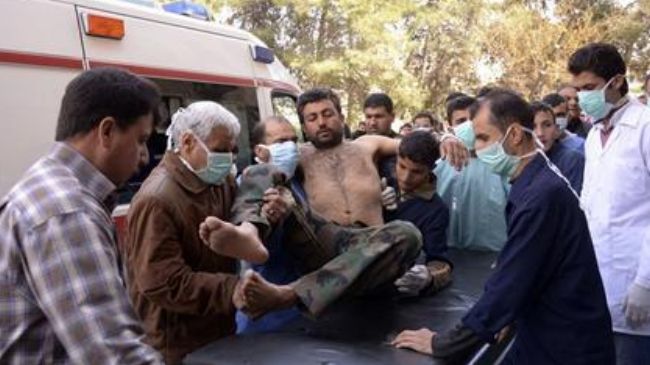
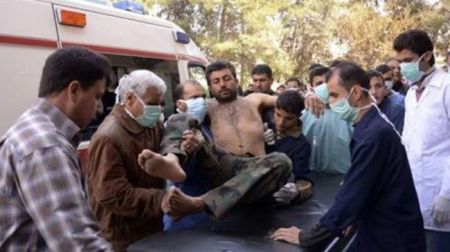 Residents and medics transport a Syrian soldier, wounded in Aleppo chemical attack, to hospital on March 19, 2013.
Press TV – March 19, 2013
Syrian Information Minister Omran al-Zoubi has described militants’ use of chemical weapons as the “first act” by the so-called opposition interim government.
The Syrian minister also said that Turkey and Qatar, which support militants fighting against the government of President Bashar al-Assad, bore “legal, moral and political responsibility” for the chemical attack in the northern city of Aleppo on Tuesday.
At least 25 people were killed and 86 others were injured after militants fired rocks containing “poisonous gases” into Aleppo’s Khan al-Assal village. Women and children are reported to be among the victims.
According to a Reuters photographer in Aleppo, victims of attack were suffering breathing problems.
“I saw mostly women and children. They (witnesses) said that people were suffocating in the streets and the air smelt strongly of chlorine,” he said adding that “people were dying in the streets and in their houses.”
Foreign-backed militants, who had threatened to use chemical weapons against the army government forces and Assad supporters a few months ago, have denied using chemical weapons and have accused government forces of being behind the attack.
The attack comes hours after Syria’s opposition National Coalition elected Ghassan Hitto, a former US-based IT executive, as prime minister for what it called an interim government.
Turkey to consider gas deal with Iraqi Kurds
US claims to oppose deal
Press TV – February 19, 2013
Turkey has reportedly struck a massive oil and gas agreement with Iraq’s Kurdistan Regional Government, a move that would strain Ankara’s ties with the US and the central government in Baghdad.
According to a Monday report by The New York Times the Kurds in Iraq have agreed to supply Turkey with at least 10 billion cubic meters of gas every year through a natural gas pipeline whose construction is part of the deal.
Turkey has not officially confirmed the deal, which represents a fifth of the country’s current gas consumption.
The agreement is a major bone of contention between Turkey and the US, which believes such a measure would put Iraq’s integration in jeopardy by pushing the Kurds in the oil-rich country into the hands of Turks, the report says.
“Economic success can help pull Iraq together,” US Ambassador to Turkey Francis Ricciardone said earlier this month.
But “if Turkey and Iraq fail to optimize their economic relations … there could be more violent conflict in Iraq and the forces of disintegration within Iraq could be emboldened,” he warned.
The US envoy added that at the end of the day, the measure would harm the interests of Turkey, the US and the regional countries.
Turkey had previously shied away from engagement with Iraqi Kurds fearing their probable efforts for independence on Iraqi soil would embolden the Kurds in Turkey to intensify their three-decade battle for autonomy. But Ankara’s recent attempts at ironing out issues with Kurds to put an end to the long hostility may have convinced them to build up courage and get closer to Iraqi Kurds.
The recent deal is also a thorn in the side of Iraq’s central government which tries to block Turkey’s efforts at boosting leverage by planning to become an energy hub in the region.
In November, Baghdad prevented Turkish national energy firm TPAO from bidding for an oil exploration contract.
And in December, Baghdad barred a plane carrying Turkish Energy Minister Taner Yildiz from landing in Arbil as he was reportedly on his way to seal the much-speculated energy deal.
Turkish protesters, angry at NATO missiles, attack German troops
Press TV – January 23, 2013
Turkish protesters have attacked German troops stationed in the Mediterranean port of Iskenderun to operate NATO’s Patriot missiles.
Members of the Turkish Youth Union (TGB), affiliated to the Turkey Workers’ Party, attacked the soldiers in the center of the city on Tuesday and tried to put sacks on their heads.
Turkish media quoted Iskendurun Prosecutors Office as saying that 14 activists have been arrested and 28 others charged with intentionally attempting to cause harm.
Also on Tuesday, Turkish protesters staged a rally in the capital Ankara to voice opposition to the deployment of NATO’s missile system and the presence of foreign troops in the country.
Over the past days, similar protests have been held in front of the German and US embassies.
German and Dutch missile batteries, as part of NATO’s mission, arrived in Turkey on Monday. The surface-to-air missiles will be deployed near the border with Syria.
The United States, another contributor to the NATO mission, has also begun deployment of two Patriot missile batteries at Incirlik Air Base in Turkey’s southeast.
Russia has frequently expressed opposition to the deployment of the missiles in Turkey, which Ankara claims is aimed to deterring any threat emanating from its southern neighbor, Syria.
Moscow says the threats facing Ankara have been exaggerated in order to justify NATO’s deployment of the advanced missiles along the Syrian border, adding that the measure would increase the “risk that these arms will be used.”
Related articles
- Turkish police arrest anti-Patriot missile protesters (alethonews.wordpress.com)
- Anti-Patriot protesters gather in front of German Embassy in Ankara (presstv.ir)
Turkish police arrest anti-Patriot missile protesters
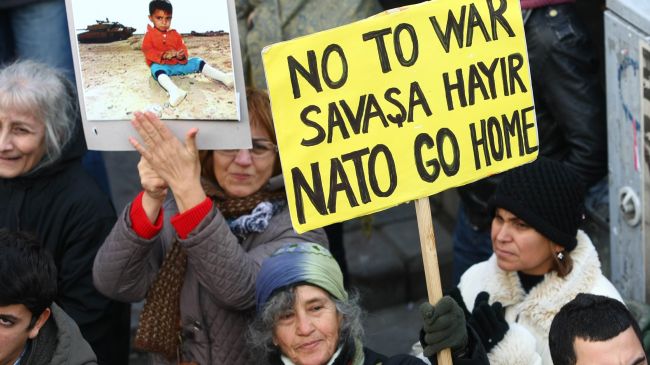
Turkish people protest the arrival of NATO’s Patriot missiles in the country. (File photo)
Press TV – January 21, 2013
Turkish police have arrested dozens of protesters who condemned the arrival of NATO’s Patriot surface-to-air missiles to be deployed near the border with Syria.
Police arrested 25 protesters on Monday after they tried to get through the barricades at Incirlik Air Force Base in the city of Adana, where US troops are assembling two Patriot missile batteries to be later deployed in Gaziantep near Syria’s border.
Protests were also held in Turkey’s capital city of Ankara outside the US embassy, where angry protesters condemned what they called Ankara’s interventionist policies towards Syria.
Earlier, two ships carrying two Patriot batteries each from Germany and the Netherlands anchored at the southwestern port of Iskenderun in Turkey, as part of a NATO-authorized operation to deploy the advanced armament along the border region.
The six batteries of the US-made missiles, effective against aircraft and short-range missiles, will be deployed in the southern city of Adana and the southeastern cities of Kahramanmaras and Gaziantep, along with 350 troops from each contributing country.
In December 2012, NATO approved Turkey’s request for the deployment of the Patriots in its territory. Germany’s Bundestag parliament approved the deployment – limited to one year – on December 14, 2012.
Each Patriot battery has an average of 12 missile launchers. NATO says the missile systems will be operational by early February.
Syria has censured the Turkish plan to deploy the Patriots along its border, calling it another act of provocation by the government of Turkish Prime Minister Recep Tayyip Erdogan.
Turkey Mulls Future Kurdish Scenarios
By Hüsnü Mahalli | Al Akhbar | January 18, 2013
Istanbul – In what may be described as a very odd move by Prime Minister Recep Tayyip Erdogan and the Turkish authorities, tens of thousands of Kurds in the southeastern city of Diyarbakir were allowed to participate in the funeral of three Kurdish activists – including a founding member of the Kurdistan Workers’ Party (PKK) – who were assassinated in Paris on 9 January 2013.
To be sure, Turkish warplanes had carried out airstrikes against PKK positions and encampments in northern Iraq prior to the funeral. Perhaps this was a government message to the Turkish population that the war on Kurdish “terror” would continue, even if the government allowed the slain leaders of the Kurdish “terrorist” group to be buried in a massive funeral procession in Turkey.
Kurdish leaders in Turkey appealed to the participants in the ceremony not to raise PKK flags or portraits of PKK leader Abdullah Öcalan, who has been imprisoned by the Turkish authorities since 1999. These directives are possibly a first for a Kurdish demonstration.
And indeed, tens of thousands gathered yesterday at a square in Diyarbakir, the largest Kurdish city in Turkey, many wearing white scarves, a symbol of peace. The mourners refrained from chanting any “radical” slogans that may have provoked Turkish nationalist factions.
In the meantime, a delegation from the European Committee for the Prevention of Torture (CPT) met with Öcalan to inquire about his conditions in prison. According to the Turkish media, secret talks between the government and the PKK leader continue, with a view to reach a secret deal that serves both sides’ interests. To many, this is seen as a starting point for the final settlement to the Kurdish question in Turkey.
One key demand by Öcalan is to be released under a comprehensive general amnesty issued by the government for all leaders, members, and followers of the PKK. Only then would he instruct the party’s armed fighters to cease their attacks against Turkey once and for all.
After that, political demands such as recognizing the Kurdish national identity in the constitution would be discussed between the PKK and the Turkish government.
Through its media, the Turkish government has been able to persuade a majority of the Turkish people that a political solution to the Kurdish question is both necessary and urgent, and that reaching one would serve the national interests of the state. Yet independent opinion polls show that most Turks would not readily accept Öcalan’s release or amnesty for PKK followers.
For one thing, this would mean that in the future, Öcalan could become an important figure in Kurdish, and even Turkish, political life, especially if the Turkish government were to give autonomy to the Kurds in southeast Turkey.
In this vein, press reports have often alluded to a Turkish plan for a quick resolution to the Kurdish question, which seeks to counter any undesirable scenarios in Syria, which also has a sizable Kurdish population. Particularly so when the Syria-based Kurdish Democratic Union Party (PYD), which is allied with the Turkish chapter of the PKK, controls the Kurdish regions in Syria adjacent to the Kurdish regions in Turkey and northern Iraq.
This may help explain the strategic alliance between Ankara and Iraqi Kurdish leaders Massoud Barzani and Jalal Talabani. The alliance seeks to influence Kurdish public opinion in Syria, and to convince Syrian Kurds of the need for cooperation and rapprochement with Turkey.
Turkey has provided all kinds of support for the Kurdistan Regional Government (KRG) of Iraq as it makes profits to the tune of billions of dollars in trade and oil deals.
This has allowed Ankara to become a key player in internal Iraqi affairs, owing to its alliance with Barzani and Talabani, as well as Iraq’s Sunni Deputy Prime Minister Tariq al-Hashemi.
On a related note, it has become an open secret that Erdogan’s moves concerned with the Kurdish question have a lot to do with its most important ally: Washington DC. Next month, Erdogan will travel to the US to hold talks over future scenarios.
Meanwhile, there are reports that the situation may soon heat up in Iran’s Kurdish regions with the approach of Iran’s presidential election. This may prompt Ankara to move faster towards containing Kurdish populations in the region under an umbrella of pan-Islamic sentiment.
Just like the Turkish political and ideological model was endorsed by the Muslim Brotherhood in the countries of the Arab Spring, this Turkish umbrella may take a form that is acceptable for Arab and the Muslim nations. Most probably, it will involve a model of moderate and democratic Islam, that is to say, one that is consistent with US interests.
See also; prominent Zionist suggests rapprochement:
48 Iranians Kidnapped in Syria Released
Al-Manar | January 9, 2013
Forty-eight Iranians held hostage by armed groups in Syria since August, were released on Wednesday.48 Iranian abductees
State television reported on Wednesday that the Iranians, who were threatened with execution, were released, but without saying further details.
Iran has appealed to Turkey and Qatar, both with close relations with Syria militants, for help in securing the release of the pilgrims who were visiting the Sayyida Zeinab shrine, a holy site in the southeastern suburbs of Damascus.
Related articles
- 48 Iranians released in first prisoner swap by Syrian rebels (thehimalayantimes.com)
Turkey Okays approval of Israel’s status in NATO: Report
Press TV – December 23, 2012
NATO has reportedly agreed to increase Israel’s participation in its activities in 2013 after Ankara eased its opposition to the move following the alliance’s approval of the deployment of Patriot missiles to Turkey.
Citing Israeli officials, the Jerusalem Post reported on Sunday that “the approval had come as Turkey’s request that NATO station Patriot missile batteries along its border with Syria was granted, leading them to assess that NATO was using the deployment as leverage to induce Ankara to thaw its relations with Israel.”
Israel, a NATO partner participating in seminars, exercises and training courses, has been requesting to increase its role in the military alliance but it was met with an objection from Turkey, a full NATO member.
“At the last minute – and I think it was dependent on the Patriots – it was approved,” said one Israeli official on condition of anonymity.
The Israeli official also said that Israel’s approval for participation in the 2013 work plan and other traditional NATO activities “is not a total solution” to tensions between Israel and Turkey.
The report added that Israel is seeking to improve its status in NATO, but Tel Aviv’s fears about the opposition of Turkey which enjoys veto power over decision-making in the alliance which is conducted by consensus.
NATO officials have been pushing to improve the Israel-Turkey ties that were soured after the Mavi Marmara flotilla incident in 2010, according to Post.
“We would like the issue to be resolved sooner rather than later,” a NATO official said on condition of anonymity. “For the time being we’re trying to find ways to keep the conversation going with Israel.”
NATO has approved of Turkey’s request for the deployment of Patriot surface-to-air missiles in its territory.
The agreement emerged from a meeting of NATO foreign ministers in Brussels on December 4th despite strong opposition from Russia, Syria and Iran.
On December 14th, US Defense Secretary Leon Panetta signed orders to authorize the plan to deploy Patriot missile batteries and about 400 troops to Turkey following the announcement of a similar move by Germany.
Related articles
- this is just a confused way of saying that turkey’s anti-zionism is all fake (niqnaq.wordpress.com)
- Turkish students say no to NATO Patriot missiles on Syria border (realisticbird.wordpress.com)
Obama’s War on Syria and its Implications
By SHAMUS COOKE | December 17, 2012
The Obama administration has already declared war on Syria, even if it isn’t “official” yet. Consider the facts, all of them acts of war: The U.S. now recognizes a group of Syrian exiles to be the official government of Syria; the U.S. is providing direct support for rebels attacking the government; the U.S. has coordinated with NATO to place advanced missile systems — and 400 U.S. troops — on Syria’s border with Turkey; Obama has drawn a “red line” that, if Syria crosses, would result in U.S. direct military intervention. If any other country made similar moves toward the U.S., there would be no question that war had been declared.
All the strategic steps that led to the Iraq war are being repeated. Obama has assembled a Bush-style international “coalition of the willing” of nations to topple the Syrian government; 130 countries have put their names on paper in support of toppling the Assad government.
In reality, however, the core of the group is the U.S./Europe NATO alliance and the Gulf monarchies. The rest of the “coalition” are economic and political satellites of these main groups, who would sign onto to any military adventure that the rich nations demanded of them, since otherwise the poorer nations would have their military, financial, or political aid frozen.
Europe’s increased lust for blood is a relatively new phenomenon; the European divisions that erupted during the Iraq war and then the Libyan invasion seem to have been smoothed over. Now even Germany aims to directly join the war efforts, intending to send missiles and troops to the Turkish border as well.
But NATO is still a U.S.-dominated military alliance. Any NATO military action is in reality a U.S. led effort, since the European armies are miniscule in comparison, and lack much of the technological sophistication of U.S. weaponry. The advanced Russian missile systems that Syria is equipped with demand a direct U.S. military role to neutralize.
Like Bush, Obama is using his coalition of the willing to distract from the fact that he is circumventing the UN, and thus bringing the post WWII system of international conflict resolution — already on life support — closer to death.
Also like Bush, Obama strategically exploited the UN to weaken Syria with sanctions, and when further UN action was not possible — because of the objections of China and Russia —Obama threw aside the UN and opted for NATO, a U.S./European military alliance built specifically as a deterrent to the now-defunct Soviet Union.
Again like Bush, Obama has crafted a false motive for war. Obama has stolen Bush’s “weapons of mass destruction” but substituted “the use of chemical weapons” as a bogeyman worthy of military intervention. Obama’s bogeyman is as false as Bush’s was. The New York Times reports:
“…the effect of that statement [that Syria was planning to use chemical weapons] was somewhat undercut when France’s foreign minister, Laurent Fabius, asserted during a news conference that such reports were unconfirmed.”
This lack of confirmation hasn’t bothered the U.S. media, who remain content repeating as truth any report issued by U.S. intelligence, no matter the past lies that have cost countless deaths in Iraq and elsewhere.
Of course the U.S. government has zero legitimacy to hand pick a “replacement” government for Syria, since the U.S. is universally hated in the region after the destruction of Iraq, Afghanistan, Libya, and the ongoing drone wars against Pakistan and Yemen. No sane Syrian would invite the U.S. government to “liberate” their country. In fact, a coalition of Syrian opposition groups inside of Syria, the National Coordination Committee (NCC) — virtually ignored by the U.S. media — opposes military intervention, demanding the conflict be addressed through political means. A leader of the NCC is Hassan Abdul Azim, who correctly states: “We refuse on principle any type of military foreign intervention because it threatens the freedom of our country.”
Another prominent ongoing lie repeated by U.S. politicians and media is that the Syrian government is on the verge of collapse. This lie is effective in that it creates an urgency to “take action.” It also paints a picture of the conflict coming to an end that resonates well with Americans. The reality is that the Syrian western-backed rebels have staged daring high-profile attacks that have been largely repulsed by government counter-attacks. But in each instance the U.S. government has used these attacks as an excuse to ratchet up their support to the rebels and now to place U.S. missiles and troops on Syria’s border. Of course if the Syrian government does fall, Obama has absolutely no plan on how to “stabilize” the country, since the most effective rebel fighting force — the Al-Nusra Front — has been labeled a terrorist organization by the U.S. government. Obama and his NATO and Gulf monarchy allies have created an extremely unstable situation in Syria. They have already torn the Syrian social fabric to shreds with their support of the rebels, but in so doing they’ve pushed many Syrians closer to supporting their government, who they see as a protector against the rebels that have used large scale ethnic-religious cleansing and other war crimes to subdue the population.
Thus, the Syrian government still retains a popular base, ensuring that the already bloody catastrophe will continue with no end in sight, especially since Obama has “regime change” as his goal and is encircling the country with missiles and U.S. and European troops. Iran and Russia will continue to bolster the Syrian government. Under these tense conditions a broader war can break out any moment. The U.S. can claim that the Syrian government is about to employ chemical weapons as an excuse to directly intervene. Or perhaps Turkey — a NATO member — will claim that Syria fired missiles into its territory, and thus Obama will act to “defend” its ally. When war “officially” breaks out, Iran might then increase its direct support for the Syrian government with troops —funneled through Iraq — giving the U.S. another excuse to “defend” itself, and pushing the conflict into Iran. Hezbollah in Lebanon or Israel may intervene too, since both have a direct interest in the outcome of the Syrian conflict. Any number of scenarios could play out that drag other nations into the war, including Russia, who is already supporting the Syrian government. Many of these scenarios have already begun on the proxy level and need only a shove to ensure they explode into a full-scale regional war.A nation under attack creates a feeding frenzy logic from those countries looking to opportunistically exploit the situation. This proxy war in Syria is on the brink of a much larger disaster, with the potential to annihilate the Middle East through a new round of war and barbarism.
Shamus Cooke can be reached at shamuscooke@gmail.com
Featured Video

Fat Fiction
or go to
Aletho News Archives – Video-Images
From the Archives
Anti-science
The infinite list
The Naked Emperor’s Newsletter | October 12, 2022
Almost three years ago science entered a new dark age.
Jay Bhattacharya, a professor of medicine at Stanford University and co-author of the Great Barrington Declaration, seems to agree. He has been compiling a list of the examples of anti-science we have unfortunately become used to.
I have listed his thoughts so far but the list is continually expanding... continue
Blog Roll
 Aletho News
- Melkite bishops concerned over Israeli demolitions in South Lebanon
- Israel’s Obliteration Ecocide from Gaza to Lebanon and Beyond
- UAE deports tens of thousands of Pakistanis, seizes their savings amid war on Iran: Report
- Wheels Down in Tbilisi: Was a Routine U.S. Military Stopover a Deliberate Signal to Iran?
- Trump’s second strike on Iran would be suicidal. But that’s not the reason why he won’t go ahead with it
- Palantir touts record expansion and ‘battlefield’ AI value
- Israeli telecom networks used for mass surveillance across countries
- US claim of sinking Iranian boats ‘a lie’, senior military official tells IRIB
- New KC-46 Supertankers Promise Israel Conventional Samson Option Strike Сapability
- No, New York Times, We Don’t Need to Dam the Bering Strait
- If Americans Knew
- 1 in 5 amputees in Gaza is a child, UN warns amid prosthetic care crisis
- 6,000 Gazans lack prosthetic and/or rehabilitation care – Daily Update
- As in Gaza, Israel is targeting rescue workers in South Lebanon, killing more than 100 since March
- Israel’s Obliteration Ecocide from Gaza to Lebanon and Beyond
- Israel Said It’s Applying the Gaza Model in Lebanon. This Is What the Devastation Looks Like.
- New Member of Trump’s Iran Negotiating Team Comes From Notoriously Pro-Israel Think Tank
- Israeli army demolishes Christian monastery, nuns’ school in southern Lebanon
- Tokenizing Christians In Israel
- One Gaza is not enough: Israel is turning southern Lebanon into another Gaza – Daily Update
- As Palestinians die, Ben-Gvir celebrates birthday with golden noose cake – Daily Update
- No Tricks Zone
- 46 IPCC Scientists Break Rank, Publicly Challenge Long-Standing Dogmatic Climate Claims
- Another Study Links Warming To Cloud Forcing, Shortwave Radiation, Natural Atmospheric Circulation
- Wind Energy Is Toxic, Hazardous To Human Health, Scientific Review Shows
- Oversupply Of Volatile Solar Energy Leads To Record NEGATIVE Prices!
- New Study: Extreme Heat Records, Heatwaves, Extreme Cold Records Declining Across US Since 1899
- It’s The Cold, Stupid! Cold 20 Times More Lethal Than Heat, Multiple Studies Show
- European Institute For Climate And Energy: “Climate Debate is Seldom About Science”
- New Study: The Climate May Be 5 Times More Sensitive To Solar Forcing Than Commonly Assumed
- EV Industry Reached $70 Billion In Losses In 2024 Due To Delusional Green Ideologies
- Reality Check: Maldives Have Actually Grown In Size Or Remained Stable Over Recent Decades
 Aletho News