Twitter Says It Will Consider Censoring “Emerging Narratives” About Ukraine War
By Paul Joseph Watson | Summit News | February 25, 2022
Twitter announced that it was monitoring “emerging narratives” about the Ukraine war that will be censored if they represent a violation of the company’s policies.
The announcement was made in response to Twitter deleting tweets and suspending accounts that had posted videos of Russian tank divisions and helicopters heading to Ukraine.
After users complained, Twitter acknowledged that it had targeted the accounts in “error” and they were later restored.
However, a statement by a Twitter spokesperson is likely to cause alarm amongst free speech advocates.
“We took enforcement action on a number of accounts in error,” the statement said, adding, “We’ve been proactively monitoring for emerging narratives that are violative of our policies.”
The use of the term “emerging narratives” suggests that Twitter will begin censoring certain perspectives on the conflict in the context of their policy on “misinformation.”
These problematic “narratives” are almost certainly likely to be ones that question narratives being put out by the Biden White House and NATO sources.
Similar rules were applied to skepticism expressed towards COVID vaccines as well as the lab leak theory, which was once deemed to be ‘harmful misinformation’ but is now widely accepted as the most likely explanation for the pandemic.
The potential for the Russian attack on Ukraine to be exploited to push for further censorship and blacklisting of free speech in the west is a clear danger.
For weeks, leftists have been trying to smear Tucker Carlson as being guilty of “treason” over him accusing the Biden administration of exploiting tensions between Russia and Ukraine to distract from the president’s dreadful handling of domestic issues.
The word “traitor” also trended on Twitter yesterday in response to Nigel Farage suggesting that NATO should share some blame for Putin’s actions.
In a related story, the official Twitter Ukrainian government also lobbied Twitter to ban the official Russian government Twitter account.
Social Media Skewed Lockdown Debate According To Data Expert

By Richie Allen | February 16, 2022
Experts who spoke out against lockdowns were labelled as pseudo-scientists who possessed fringe ideas, because pro-lockdown scientists had more followers on social media, particularly Twitter.
Data Science expert Professor John Ioannidis of Stanford University, has compared the expertise of the experts who signed The Great Barrington Declaration (GBD) with those who signed The John Snow Memorandum.
The GBD argued that vulnerable people should be shielded and that everyone else be allowed to get on with their lives in order to build natural immunity against the virus. They warned lockdowns would be devastating for public health and the economy.
The signatories of the Snow Memorandum argued that it would be unethical to let the virus rip, therefore lockdown was essential.
According to The Telegraph :
In an article published in BMJ Open Research, he (Professor Ioannidis) found that both letters were authored by very influential experts, but that the John Snow Memorandum authors had a far greater reach on social media, which made it appear that their view had more support.
By November 2021, just four key signatories of the GBD had more than 50,000 Twitter followers, compared with 13 of the key authors of the JSM.
Prof Ioannidis concluded: “Both the Great Barrington Declaration and John Snow Memorandum include many stellar scientists, but JSM has far more powerful social media presence and this may have shaped the impression that it is the dominant narrative.
“GBD is clearly not a fringe minority report compared with JSM, as many social media and media allude.
“If knowledgeable scientists can have a strong social media presence, massively communicating accurate information to followers, the effect may be highly beneficial.
“Conversely, if scientists themselves are affected by the same problems (misinformation, animosity, loss of decorum and disinhibition, among others) when they communicate in social media, the consequences may be negative.”
Prof Ioannidis also said signatories of the JSM had contributed to the vilification of authors of the GBD through their tweets and op-eds.
John Ioannidis is right on when he says that social media skewed the debate in favour of the lockdown evangelicals, but he has missed one very important point. He seems to have overlooked shadow banning.
It shouldn’t have really mattered that pro-lockdown scientists had more followers on Twitter than their Great Barrington Declaration counterparts.
Twitter and Facebook worked in tandem from the outset of the scamdemic to amplify the posts of academics who supported lockdowns while at the same time limiting the reach of experts who opposed the tyrannical measures.
This meant that users were many times more likely to read pro-lockdown propaganda than they were to read the opinions of sceptics. The social media firms use not very sophisticated algorithms to ensure that their users read what they want them to read.
It’s happening today. The Welsh government has announced plans to give covid jabs to children over five years-old. England will announce later this week.
There are tens of thousands of doctors and scientists who are horrified at the prospect of jabbing young children with an unproven medicine that they do not need.
You and I know who they are, but the majority of people do not. This is because they will never see these experts in their news feeds. Free speech has no greater enemy than social media.
Twitter bans Project Veritas Chief of Staff Eric Spracklen
By Tom Parker | Reclaim The Net | January 11, 2022
Twitter has permanently banned Eric Spracklen, the Chief of Staff for investigative reporting outlet Project Veritas, from its platform for violating its rules on “ban evasion,” less than 24 hours after Project Veritas released a bombshell report on Director of the National Institute of Allergy and Infectious Diseases (NIAID) Dr. Anthony Fauci.
Before his ban, Spracklen had been promoting the Project Veritas report which focuses on documents that appear to contradict testimony that Fauci gave under oath on gain of function research.
The report quickly gained traction on Twitter and an associated “#exposefauci” hashtag became the number one trend for several hours.
Spracklen’s final tweets before being banned revealed that the video of this Project Veritas report had racked up 2.8 million views.
The timing is also notable because Fauci was testifying at a Senate hearing on COVID variants as this Project Veritas report was going viral on Twitter.
Spracklen had over 200,000 followers at the time he was banned and was Project Veritas’ last remaining large account on the platform. Its main account (which had more than 735,000 followers) and the account of its founder James O’Keefe (which had over 926,000 followers) were booted earlier this year.
As with the banning of Spracklen, O’Keefe was banned on the same day that one of Project Veritas’ explosive reports was trending on Twitter.
“Twitter has PERMANENTLY SUSPENDED my account for journalism,” Spracklen said. “Twitter knows Veritas is over the target.”
Spracklen is the latest of several high-profile accounts to be banned by Twitter recently. In the last two weeks alone, the tech giant has booted Congresswoman Marjorie Taylor Greene, American immunologist and virologist Dr. Robert Malone, and @Unity4J, a popular support account for journalist Julian Assange.
In addition to the bans, Twitter has locked several users out of their accounts and introduced new censorship rules during the last 30 days.
The growing levels of censorship on Twitter and other Big Tech platforms have inspired an exodus to alternative platforms that vow to not censor their users. Free speech social network Gab, Twitter alternative GETTR, and video sharing platform Rumble have all attracted big names this year.
Twitter Suspends mRNA Inventor Dr. Robert Malone
By Tyler Durden | Zero Hedge | December 29, 2021
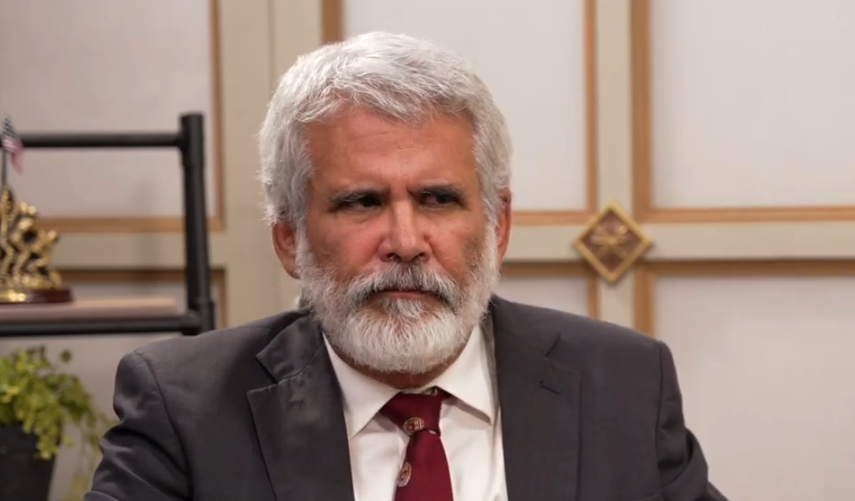
After months of providing valuable Covid-19 information that runs counter to the official narrative, Twitter has finally banned Dr. Robert Malone, inventor of mRNA technology.
Malone, who will appear on the Joe Rogan show Thursday according to associate Ed Dowd (one of four contributors to the Malone doctrine), had more than 520,000 followers. He has been an outspoken critic of both mRNA vaccines, as well as the abysmal failures of policymakers worldwide in responding to the pandemic.
He was not warned or provided an opportunity to delete any offending tweets – instead he was “just suspended,” Dowd continued.
Here’s Malone’s last tweet – sharing an article which claims that the Pfizer Covid-19 vaccine does ‘more harm than good.’
Malone can still be followed via his substack page.
Twitter bans popular account highlighting Nancy Pelosi stock trades, @NancyTracker
Twitter purges another account that scrutinizes powerful figures
By Tom Parker | Reclaim The Net | December 8, 2021
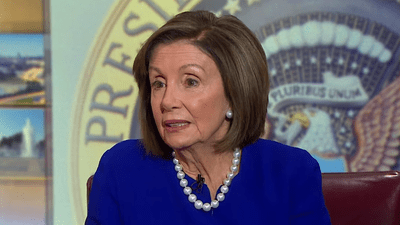
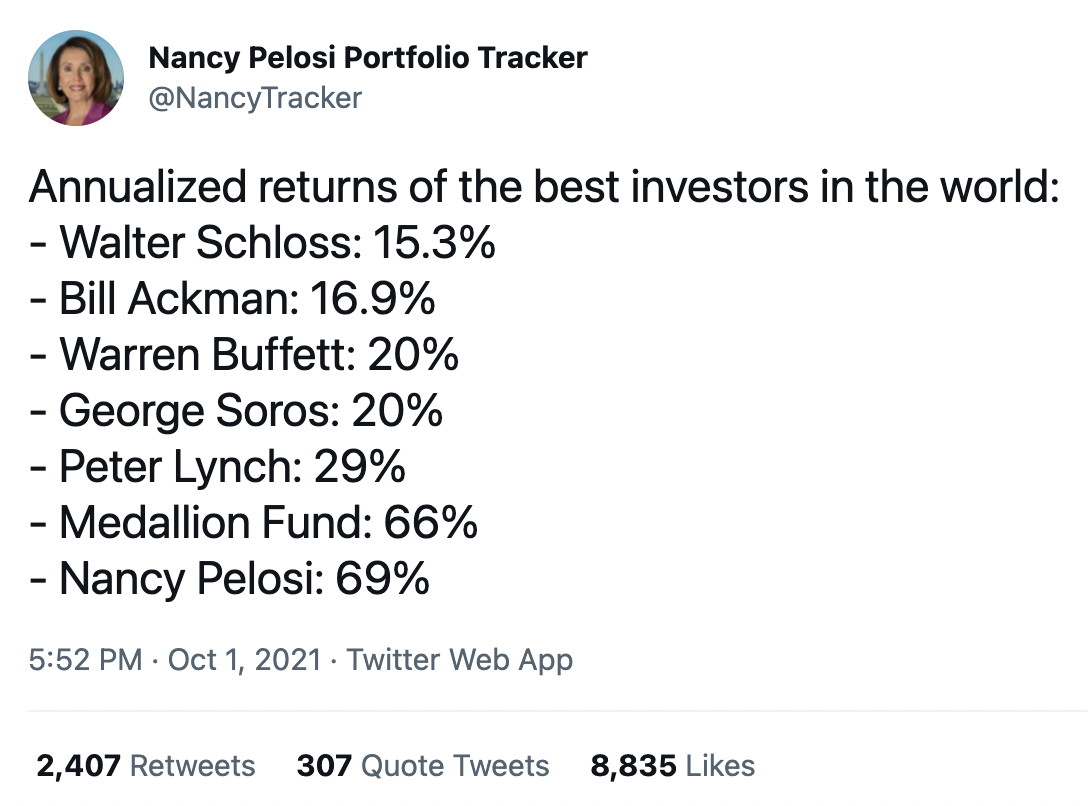
Twitter has booted @NancyTracker, a popular account that documented Speaker of the House Nancy Pelosi’s stock trades and drew attention to the millions of dollars she and her husband have generated through trading.
The account had over 200,000 followers when it was banned. Some of its most popular tweets highlighted that Pelosi’s role as a government official gives her access to “insider information” and noted that Pelosi’s returns have significantly outpaced both the market and some of the world’s best investors.


@NancyTracker was created by The Free Press Report which also created the largest Ghislaine Maxwell trial tracker account, @TrackerTrial.
Twitter suspended both accounts earlier today and claimed that The Free Press Foundation had broken its rules against “platform manipulation and spam.” It also referenced rules that prohibit artificially amplifying or suppressing information.
However, The Free Press Foundation pushed back against Twitter by saying that all of the @TrackerTrial’s engagement was “organic” and that “there was not outside amplification.”
In October, less than two months before the accounts were suspended, @NancyTracker said it had received “a cease and desist order from a lawyer representing someone high up in the [Political] office.”

“I will not name names. And I will also not cease or desist,” @NancyTracker added at the time.
The Free Press Report is urging fans of the @NancyTracker account to follow it on free speech social network Gab and has already built an audience of tens of thousands of followers on the platform.
Filmmaker Daniel Bostic described the censorship of the @NancyTracker account as a “full on authoritarian crackdown just days after Dorsey leaves.”
Former Twitter CEO Jack Dorsey stepped down on November 29 and was replaced by Parag Agrawal. Since being appointed CEO, Agrawal has faced scrutiny for his past comments that Twitter’s role is “not to be bound by the First Amendment” and that he wished Twitter had censored some content sooner.
Investor and Bitcoin commentator Anthony Pompliano also suggested that the censorship was linked to Agrawal by highlighting that the accounts had been suspended and tweeting: “New Twitter CEO seems to be having a busy week.”
The censorship of these popular accounts is the latest in a wave of Twitter censorship that has occurred since Agrawal took the reigns. A link to the American Heart Association website was recently flagged as “unsafe” and numerous accounts have been suspended after Twitter announced new rules that ban the sharing of photos or videos of people without their permission.
Twitter bans largest Ghislaine Maxwell trial tracker account, @TrackerTrial
By Tom Parker | Reclaim The Net | December 8, 2021
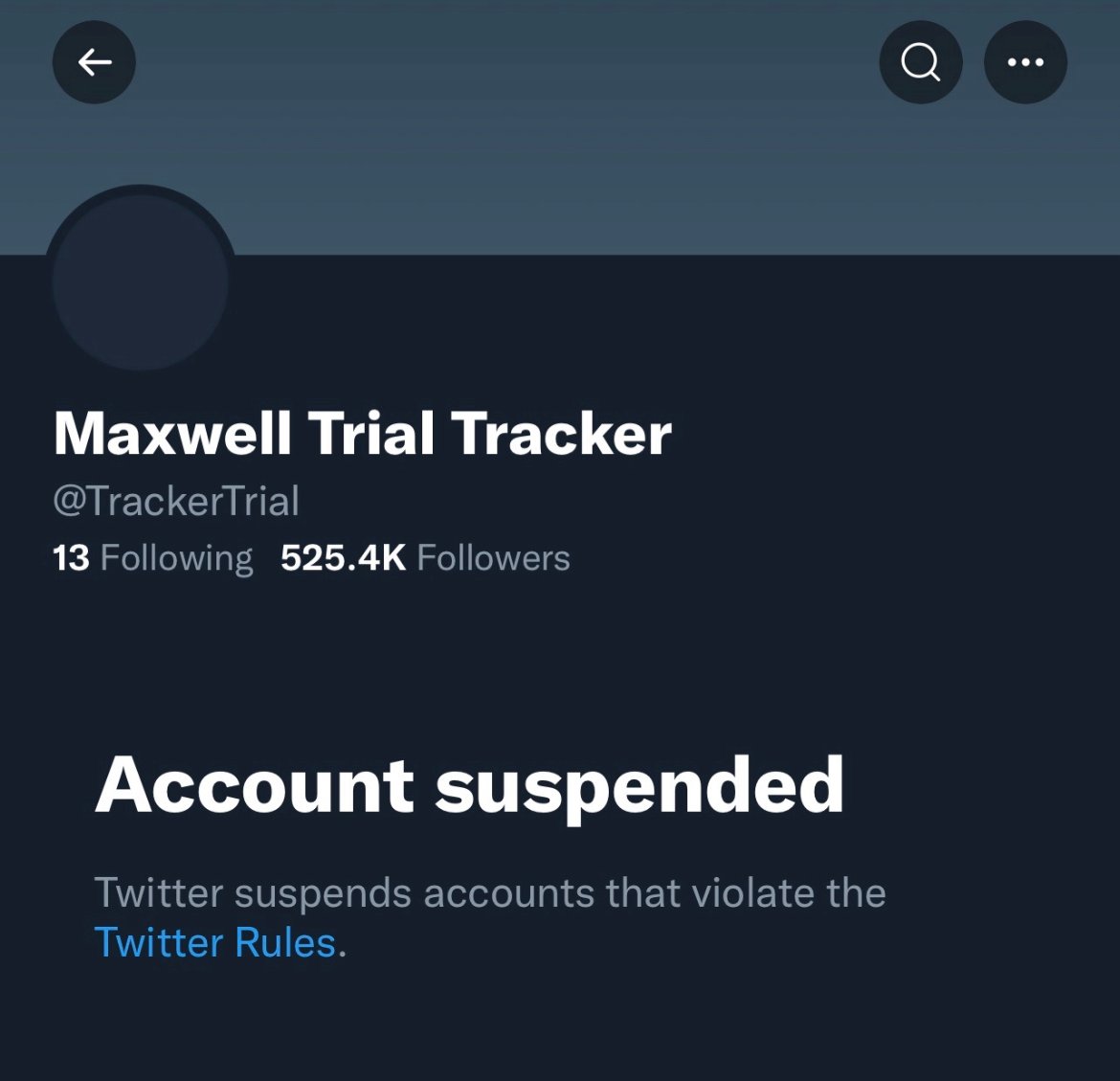
@TrackerTrial, an account with over 525,000 followers that provided regular updates on the Ghislaine Maxwell sex trafficking trial, has been banned from Twitter, just 10 days after the trial began.
The high-profile trial of Maxwell, who is accused of facilitating the sexual exploitation of girls for convicted sex offender Jeffrey Epstein, isn’t being broadcast so people have turned to social media to get updates on the trial. Twitter’s focus on real-time updates and breaking news has resulted in it being the preferred platform for many independent accounts that are covering the trial.
Twitter claimed that the @TrackerTrial account had violated its rules against “platform manipulation and spam” and cited its rules around artificially amplifying or suppressing information when banning the account.
“This is the first censorship that the account has experienced,” The Free Press Report told Reclaim The Net. “No warnings or anything. I woke up this morning and my account was gone.”
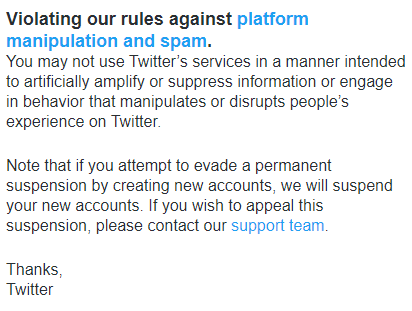
However, the account’s creator, pushed back against Twitter’s claims and said: “The account got insane engagement, which by the way, was all organic. There was not outside amplification.”
“The people wanted to hear the truth about the Ghislaine Maxwell, and Jeffrey Epstein trial and the engagement numbers showed that,” The Free Press Report added. “There were hundreds of millions in impressions and an account that went from zero to over 525,000 followers in a couple of weeks. All we did was report information from the trial that the mainstream media was failing to do.”
The Free Press Report has appealed the suspension and has vowed to continue reporting on the trial via its Substack. It has also encouraged people to follow its Gab account for “a more informal route of communication.”
Additionally, The Free Press Report warned about the power of Big Tech and how it can use its stranglehold over news distribution to determine which news stories are promoted and which news stories are suppressed.
“Big tech has gotten too powerful, and they can silence us anytime they want,” The Free Press Report wrote. “Local blogs and websites are suppressed by big tech algorithms. If you write one thing out of line Google can institute a site-wide ban, making sure you never show up in search algorithms again. Facebook restricts what is posted on their website. Twitter suppresses any outside links, to keep users on their own site. The year is 2021 and big brother is watching.”
This isn’t the first time Big Tech has censored content related to Maxwell and Epstein with Facebook and YouTube censoring and “fact-checking” commentary and memes on Epstein’s 2019 suicide. A roast of Epstein and Maxwell was also removed from Facebook for violating the platform’s rules around “harassment and bullying.”
Twitter has been approached for comment.
Twitter announces more censorship for sake of ‘public interest’
RT | November 30, 2021
Twitter has updated its policy on personal information to cover videos and photos of private individuals shared without their consent, unless that is done by legacy media, in “public interest,” or other context they approve of.
“Sharing personal media, such as images or videos, can potentially violate a person’s privacy, and may lead to emotional or physical harm. The misuse of private media can affect everyone, but can have a disproportionate effect on women, activists, dissidents, and members of minority communities,” Twitter’s Safety division said on Tuesday.
The company has thus decided to add “media of private individuals without the permission of the person(s) depicted” to the category of “personal information” not allowed on the platform. Addresses, identity documents, phone numbers, emails, and bank information of private individuals have already been banned under Twitter’s doxing policy.
This policy update “will allow us to take action on media that is shared without any explicit abusive content, provided it’s posted without the consent of the person depicted,” Twitter said.
It does not apply to media featuring public figures, or when media are shared “in the public interest or add value to public discourse,” however. A specific carve-out seems to be sharing images or videos of private individuals “in an effort to help someone involved in a crisis situation, such as in the aftermath of a violent event, or as part of a newsworthy event due to public interest value,” which “might outweigh the safety risks to a person.”
Twitter “will always try to assess the context in which the content is shared,” including whether it is being “covered by mainstream/traditional media” or “adds value to the public discourse, is being shared in public interest, or is relevant to the community.”
Reactions to the policy update have been mainly negative. “Twitter Implements New Rule So It Can Selectively Ban Memes, Mockery Of Democrats” is how the conservative-leaning Federalist reported the policy change.
Conservative pundit Dana Loesch said this will allow Twitter to “muzzle” independent journalists, let “corporate press” set narratives, and silence undercover reporting from the likes of Project Veritas. Independent journalist Tim Pool tweeted that “journalism is largely banned on twitter basically.”
The new rule seems “poorly thought out,” tweeted digital rights advocate Evan Greer, asking “how long before cops try to abuse this to get videos of brutality taken down?”
As written, the update is “not only vague, but literally unenforceable,” argued BBC’s ‘disinformation’ reporter Shayan Sardarizadeh. “How do you define a private individual across different jurisdictions? What exactly is a public setting and what is in the public interest? What is traditional media? This is a minefield.”
The policy update comes less than a day after co-founder Jack Dorsey stepped down as Twitter CEO, appointing Parag Agrawal as his successor. Agrawal is best known for a November 2020 interview in which he said Twitter’s role is “not to be bound by the First Amendment.”
“So, we focused way less on what’s true and what’s false. We focus way more on potential for harm as a result of certain content being amplified on the platform without appropriate context,” Agrawal also said at the time.
Democrats and Media Do Not Want to Weaken Facebook, Just Commandeer its Power to Censor
By Glenn Greenwald | October 5, 2021
Much is revealed by who is bestowed hero status by the corporate media. This week’s anointed avatar of stunning courage is Frances Haugen, a former Facebook product manager being widely hailed as a “whistleblower” for providing internal corporate documents to the Wall Street Journal relating to the various harms which Facebook and its other platforms (Instagram and WhatsApp) are allegedly causing.
The social media giant hurts America and the world, this narrative maintains, by permitting misinformation to spread (presumably more so than cable outlets and mainstream newspapers do virtually every week); fostering body image neurosis in young girls through Instagram (presumably more so than fashion magazines, Hollywood and the music industry do with their glorification of young and perfectly-sculpted bodies); promoting polarizing political content in order to keep the citizenry enraged, balkanized and resentful and therefore more eager to stay engaged (presumably in contrast to corporate media outlets, which would never do such a thing); and, worst of all, by failing to sufficiently censor political content that contradicts liberal orthodoxies and diverges from decreed liberal Truth. On Tuesday, Haugen’s star turn took her to Washington, where she spent the day testifying before the Senate about Facebook’s dangerous refusal to censor even more content and ban even more users than they already do.
There is no doubt, at least to me, that Facebook and Google are both grave menaces. Through consolidation, mergers and purchases of any potential competitors, their power far exceeds what is compatible with a healthy democracy. A bipartisan consensus has emerged on the House Antitrust Committee that these two corporate giants — along with Amazon and Apple — are all classic monopolies in violation of long-standing but rarely enforced antitrust laws. Their control over multiple huge platforms that they purchased enables them to punish and even destroy competitors, as we saw when Apple, Google and Amazon united to remove Parler from the internet forty-eight hours after leading Democrats demanded that action, right as Parler became the most-downloaded app in the country, or as Google suppresses Rumble videos in its dominant search feature as punishment for competing with Google’s YouTube platform. Facebook and Twitter both suppressed reporting on the authentic documents about Joe Biden’s business activities reported by The New York Post just weeks before the 2020 election. These social media giants also united to effectively remove the sitting elected President of the United States from the internet, prompting grave warnings from leaders across the democratic world about how anti-democratic their consolidated censorship power has become.
But none of the swooning over this new Facebook heroine nor any of the other media assaults on Facebook have anything remotely to do with a concern over those genuine dangers. Congress has taken no steps to curb the influence of these Silicon Valley giants because Facebook and Google drown the establishment wings of both parties with enormous amounts of cash and pay well-connected lobbyists who are friends and former colleagues of key lawmakers to use their D.C. influence to block reform. With the exception of a few stalwarts, neither party’s ruling wing really has any objection to this monopolistic power as long as it is exercised to advance their own interests.
And that is Facebook’s only real political problem: not that they are too powerful but that they are not using that power to censor enough content from the internet that offends the sensibilities and beliefs of Democratic Party leaders and their liberal followers, who now control the White House, the entire executive branch and both houses of Congress. Haugen herself, now guided by long-time Obama operative Bill Burton, has made explicitly clear that her grievance with her former employer is its refusal to censor more of what she regards as “hate, violence and misinformation.” In a 60 Minutes interview on Sunday night, Haugen summarized her complaint about CEO Mark Zuckerberg this way: he “has allowed choices to be made where the side effects of those choices are that hateful and polarizing content gets more distribution and more reach.” Haugen, gushed The New York Times’ censorship-desperate tech unit as she testified on Tuesday, is “calling for regulation of the technology and business model that amplifies hate and she’s not shy about comparing Facebook to tobacco.”
Agitating for more online censorship has been a leading priority for the Democratic Party ever since they blamed social media platforms (along with WikiLeaks, Russia, Jill Stein, James Comey, The New York Times, and Bernie Bros) for the 2016 defeat of the rightful heir to the White House throne, Hillary Clinton. And this craving for censorship has been elevated into an even more urgent priority for their corporate media allies, due to the same belief that Facebook helped elect Trump but also because free speech on social media prevents them from maintaining a stranglehold on the flow of information by allowing ordinary, uncredentialed serfs to challenge, question and dispute their decrees or build a large audience that they cannot control. Destroying alternatives to their failing platforms is thus a means of self-preservation: realizing that they cannot convince audiences to trust their work or pay attention to it, they seek instead to create captive audiences by destroying or at least controlling any competitors to their pieties.
As I have been reporting for more than a year, Democrats do not make any secret of their intent to co-opt Silicon Valley power to police political discourse and silence their enemies. Congressional Democrats have summoned the CEO’s of Google, Facebook and Twitter four times in the last year to demand they censor more political speech. At the last Congressional inquisition in March, one Democrat after the next explicitly threatened the companies with legal and regulatory reprisals if they did not immediately start censoring more.
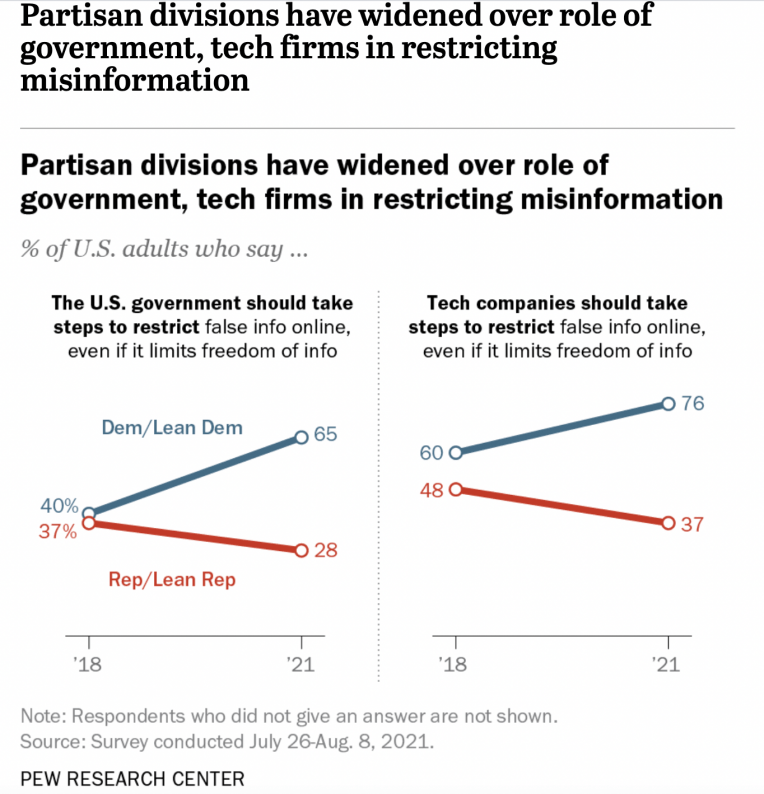
A Pew survey from August shows that Democrats now overwhelmingly support internet censorship not only by tech giants but also by the government which their party now controls. In the name of “restricting misinformation,” more than 3/4 of Democrats want tech companies “to restrict false info online, even if it limits freedom of information,” and just under 2/3 of Democrats want the U.S. Government to control that flow of information over the internet:
The prevailing pro-censorship mindset of the Democratic Party is reflected not only by that definitive polling data but also by the increasingly brash and explicit statements of their leaders. At the end of 2020, Sen. Ed Markey (D-MA), newly elected after young leftist activists worked tirelessly on his behalf to fend off a primary challenge from the more centrist Rep. Joseph Kennedy III (D-MA), told Facebook’s Zuckerberg exactly what the Democratic Party wanted. In sum, they demand more censorship:
This, and this alone, is the sole reason why there is so much adoration being constructed around the cult of this new disgruntled Facebook employee. What she provides, above all else, is a telegenic and seemingly informed “insider” face to tell Americans that Facebook is destroying their country and their world by allowing too much content to go uncensored, by permitting too many conversations among ordinary people that are, in the immortal worlds of the NYT‘s tech reporter Taylor Lorenz, “unfettered.”
When Facebook, Google, Twitter and other Silicon Valley social media companies were created, they did not set out to become the nation’s discourse police. Indeed, they affirmatively wanted not to do that. Their desire to avoid that role was due in part to the prevailing libertarian ideology of a free internet in that sub-culture. But it was also due to self-interest: the last thing social media companies wanted to be doing is looking for ways to remove and block people from using their product and, worse, inserting themselves into the middle of inflammatory political controversies. Corporations seek to avoid angering potential customers and users over political stances, not courting that anger.
This censorship role was not one they so much sought as one that was foisted on them. It was not really until the 2016 election, when Democrats were obsessed with blaming social media giants (and pretty much everyone else except themselves) for their humiliating defeat, that pressure began escalating on these executives to start deleting content liberals deemed dangerous or false and banning their adversaries from using the platforms at all. As it always does, the censorship began by targeting widely disliked figures — Milo Yiannopoulos, Alex Jones and others deemed “dangerous” — so that few complained (and those who did could be vilified as sympathizers of the early offenders). Once entrenched, the censorship net then predictably and rapidly spread inward (as it invariably does) to encompass all sorts of anti-establishment dissidents on the right, the left, and everything in between. And no matter how much it widens, the complaints that it is not enough intensify. For those with the mentality of a censor, there can never be enough repression of dissent. And this plot to escalate censorship pressures found the perfect vessel in this stunningly brave and noble Facebook heretic who emerged this week from the shadows into the glaring spotlight. She became a cudgel that Washington politicians and their media allies could use to beat Facebook into submission to their censorship demands.
In this dynamic we find what the tech and culture writer Curtis Yarvin calls “power leak.” This is a crucial concept for understanding how power is exercised in American oligarchy, and Yarvin’s brilliant essay illuminates this reality as well as it can be described. Hyperbolically arguing that “Mark Zuckerberg has no power at all,” Yarvin points out that it may appear that the billionaire Facebook CEO is powerful because he can decide what will and will not be heard on the largest information distribution platform in the world. But in reality, Zuckerberg is no more powerful than the low-paid content moderators whom Facebook employs to hit the “delete” or “ban” button, since it is neither the Facebook moderators nor Zuckerberg himself who is truly making these decisions. They are just censoring as they are told, in obedience to rules handed down from on high. It is the corporate press and powerful Washington elites who are coercing Facebook and Google to censor in accordance with their wishes and ideology upon pain of punishment in the form of shame, stigma and even official legal and regulatory retaliation. Yarvin puts it this way:
However, if Zuck is subject to some kind of oligarchic power, he is in exactly the same position as his own moderators. He exercises power, but it is not his power, because it is not his will. The power does not flow from him; it flows through him. This is why we can say honestly and seriously that he has no power. It is not his, but someone else’s. . . .
Zuck doesn’t want to do any of this. Nor do his users particularly want it. Rather, he is doing it because he is under pressure from the press. Duh. He cannot even admit that he is under duress—or his Vietcong guards might just snap, and shoot him like the Western running-dog capitalist he is….
And what grants the press this terrifying power? The pure and beautiful power of the logos? What distinguishes a well-written post, like this one, from an equally well-written Times op-ed? Nothing at all but prestige. In normal times, every sane CEO will comply unhesitatingly with the slightest whim of the legitimate press, just as they will comply unhesitatingly with a court order. That’s just how it is. To not call this power government is—just playing with words.
As I have written before, this problem — whereby the government coerces private actors to censor for them — is not one that Yarvin was the first to recognize. The U.S. Supreme Court has held, since at least 1963, that the First Amendment’s “free speech” clause is violated when state officials issue enough threats and other forms of pressure that essentially leave the private actor with no real choice but to censor in accordance with the demands of state officials. Whether we are legally at the point where that constitutional line has been crossed by the increasingly blunt bullying tactics of Democratic lawmakers and executive branch officials is a question likely to be resolved in the courts. But whatever else is true, this pressure is very real and stark and reveals that the real goal of Democrats is not to weaken Facebook but to capture its vast power for their own nefarious ends.
There is another issue raised by this week’s events that requires ample caution as well. The canonized Facebook whistleblower and her journalist supporters are claiming that what Facebook fears most is repeal or reform of Section 230, the legislative provision that provides immunity to social media companies for defamatory or other harmful material published by their users. That section means that if a Facebook user or YouTube host publishes legally actionable content, the social media companies themselves cannot be held liable. There may be ways to reform Section 230 that can reduce the incentive to impose censorship, such as denying that valuable protection to any platform that censors, instead making it available only to those who truly allow an unmoderated platform to thrive. But such a proposal has little support in Washington. What is far more likely is that Section 230 will be “modified” to impose greater content moderation obligations on all social media companies.
Far from threatening Facebook and Google, such a legal change could be the greatest gift one can give them, which is why their executives are often seen calling on Congress to regulate the social media industry. Any legal scheme that requires every post and comment to be moderated would demand enormous resources — gigantic teams of paid experts and consultants to assess “misinformation” and “hate speech” and veritable armies of employees to carry out their decrees. Only the established giants such as Facebook and Google would be able to comply with such a regimen, while other competitors — including large but still-smaller ones such as Twitter — would drown in those requirements. And still-smaller challengers to the hegemony of Facebook and Google, such as Substack and Rumble, could never survive. In other words, any attempt by Congress to impose greater content moderation obligations — which is exactly what they are threatening — would destroy whatever possibility remains for competitors to arise and would, in particular, destroy any platforms seeking to protect free discourse. That would be the consequence by design, which is why one should be very wary of any attempt to pretend that Facebook and Google fear such legislative adjustments.
There are real dangers posed by allowing companies such as Facebook and Google to amass the power they have now consolidated. But very little of the activism and anger from the media and Washington toward these companies is designed to fracture or limit that power. It is designed, instead, to transfer that power to other authorities who can then wield it for their own interests. The only thing more alarming than Facebook and Google controlling and policing our political discourse is allowing elites from one of the political parties in Washington and their corporate media outlets to assume the role of overseer, as they are absolutely committed to doing. Far from being some noble whistleblower, Frances Haugen is just their latest tool to exploit for their scheme to use the power of social media giants to control political discourse in accordance with their own views and interests.
FEC rules Twitter shadowbanning Congressman Matt Gaetz wasn’t election interference
By Cindy Harper | Reclaim The Net | September 18, 2021
The Federal Election Commission (FEC) unanimously rejected a complaint by Republican Rep. Matt Gaetz against Twitter, alleging the social media company shadowbanned him in 2018. The complaint accused Twitter of election interference.
In 2018, Vice reported that Twitter subjected Republican legislators, including Gaetz, to shadowbans, which limited the visibility of their accounts in search results. Following the report, Gaetz filed a complaint against Twitter with the FEC in July 2018.
We obtained a copy of the complaint for you here.
The FEC also recently ruled that Twitter’s suppression of the Hunter Biden corruption story was not election interference.
Last month, all six FEC commissioners agreed that Twitter’s shadowban did not break election interference laws.
Twitter explained that Gaetz’s account was shadowbanned because of being “associated with other accounts that already had high indicia of misuse or abuse.”
In the original complaint, Gaetz said that Twitter’s shadowban amounted to “making an in-kind contribution to [Gaetz’s] political opponents.”
He used a “free billboards” analogy to make his point: “Imagine the following: a billboard company in Florida wants to get involved in the political process, so it offers all candidates running for office… free billboards to promote their campaigns.”
“If the company did not randomly assign locations, but rather, offered large billboards in premium locations within the district to Democratic candidates, but only offered billboards stuck behind dumpsters, outside the district, to Republican candidates, it could not credibly argue that it was not giving an “in-kind” donation to the Democratic candidates.”
The complaint also argued that Twitter was a debate platform, and, therefore, it is supposed to follow FEC’s regulations on political debates.
“Twitter, as a self-identified news organization, and as a recognized debate platform, is a staging organization for candidate debates,” the complaint said.
The FEC rejected the argument, Business Insider reported, referring to a 2019 legal analysis by its general counsel that found out that Twitter could legally limit an account’s activity if it is concerned about “divisive content.” The analysis also concluded that Twitter messages are not “debate within the meaning of the Commission’s regulation,” as its definition of debate means “face-to-face appearances or confrontations.”
Featured Video

Rewriting the risk? Inside the government’s vaccine safety messaging
or go to
Aletho News Archives – Video-Images
Book Review
“Davos Can Really Replace the UN”
Inside the book that maps the architecture behind global governance — from the Epstein files to the Pact for the Future
Lies are Unbekoming | April 1, 2026
On June 13, 2019, the United Nations and the World Economic Forum signed a partnership deal to “accelerate the implementation of the 2030 Agenda for Sustainable Development.” That same evening, WEF president Börge Brende — Norway’s former Foreign Minister — had dinner with Jeffrey Epstein at Epstein’s Manhattan townhouse. The Epstein files, released January 2026, contain an exchange between the two from the previous year. Epstein to Brende: “Davos can really replace the UN. C21, cyber, crypto . genetics… intl coordination.” Brende back to Epstein: “Exactly — we need a new global architecture. World Economic Forum (Davos) is uniquely positioned — public private.”
The next day, the UN General Assembly adopted the framework for restructuring global governance.
That sequence — the partnership signing, the Epstein dinner, the candid admission about replacing the UN with a public-private architecture, and then the formal adoption — opens Jacob Nordangård’s The Digital World Brain. Pages two and three. Footnoted to the UN resolution number, the Epstein files, and the General Assembly record.
I keep coming back to it because it captures what this book does that almost nothing else in the independent research space manages. I’ve followed Jacob’s work for years now and interviewed him about his research. Each book peels back another layer of the same institutional architecture, and each time I think he’s reached the limit of what can be documented, the next one goes further. Nordangård doesn’t speculate. He doesn’t editorialize much. He lays institutional actions next to each other in chronological order and lets the pattern announce itself. … continue
Blog Roll
 Aletho News
- What’s Behind U.S./Israeli Strikes On Iranian Pistachio Factories?
- Seyed M. Marandi: U.S. Military DIVIDED? Iran’s Secret Defense EXPOSED
- How I fell foul of the BBC thought police
- The End of NATO
- 37 days of war on Iran cost US staggering $42bln, tracker shows
- Baghdad tells Asian refiners, traders to begin loading Iraqi crude amid Iranian exemption
- Under fire, Moscow and Tehran close ranks
- Iran, US receive Pakistan-mediated plan for ceasefire then final deal
- Iran submits demands for end to war as mediators scramble ahead of Trump deadline
- Iran Threatens Retaliatory Strike on Stargate AI Project in UAE
- If Americans Knew
- U.N. experts demand Israel release prominent Gaza doctor after reports of ‘severe torture’
- Israel’s Latest Genocide Is Against the Shias of Lebanon. Why Is the World Silent?
- How Eliot Cohen’s influence over U.S. war-making paved the way for Trump’s war crimes in Iran
- Israelis don’t pay for the weapons we ‘sell’ to them — US taxpayers do
- While Distancing from AIPAC, Most 2028 Democratic Hopefuls Are Still Embracing Israel
- A brief history of the Israeli nuclear program, the open secret at the heart of the Iran war
- Israeli Settlers Killed a Palestinian Farmer on His Own Land, in Front of His Father. Yes, Again
- The US-Israeli War on Science is an Assault on our Future
- 100+ International Law Experts Say US Strikes on Iran Violate UN Charter, Could Be War Crimes
- ‘Vile, Horrifying, Evil’: Trump Threatens to Bomb Nation of 90 Million People ‘Back to the Stone Ages’
- No Tricks Zone
- An Inconvenient Tree: Uncovered In Alps… Europe Much Warmer Than Today 6000 Years Ago
- New Study Reports A 60% Slowdown In Greenland’s Ice Loss Rate In The Last Decade
- Low Intensity Tornado Wrecks Major Solar Farm, Creating A Potential Toxic Dump
- New Study Finds Warming Saves Lives…Cold Temperatures 12 Times More Deadly Than Excess Heat
- German Science Blog Accuses PIK Climate Institute Of Hallucinating Climate Tipping Points
- Devastating Assessment Of Comirnaty Vaccine By Former Senior Pfizer Europe Toxicologist
- New Study: CO2 Is ‘Effectively Negligible’ As An Explanatory Climate Change Factor Since 2000
- Former Pfizer Toxicologist Dr. Helmut Sterz Tells Bundestag Hearing Pfizer Vaccine Should Have Never Been Approved
- Energy Expert: Germany’s Nuclear Phaseout Was A “500 Billion Euro Mistake”
- New Research: South Australia’s Mid-Holocene Sea Surface Temperatures Were 4°C Warmer Than Today
 Aletho News