Documents reveal US pressure on ex-Yemeni regime to agree on normalizing ties with Israel
Press TV – July 12, 2021
The interior ministry of Yemen’s National Salvation Government has released a series of confidential documents detailing the United States pressure on the administration of former Yemeni dictator, Ali Abdullah Saleh, to normalize relations with Israel and lift the blockade on products made in the Israeli occupied territories.
According to the documents, the US embassy in Sana’a had asked then-Yemeni authorities to end the economic embargo on Israeli goods, and not to participate in any activities deemed harmful to the Tel Aviv regime, the official Yemeni news agency Saba reported.
The papers expose the level of Washington’s and Tel Aviv’s discontent and frustration with the blockade, and how US officials left no stone unturned to force former Yemeni officials into opening the Arab country’s market to Israeli businesses and their products.
The former US ambassador to Yemen, Thomas C. Krajeski, called on Saleh’s regime to lift sanctions on companies with first-, second- or third-degree ties to Israel, which was not turned down by the Yemeni side.
Then-Yemeni foreign minister, Abu Bakr al-Qirbi, later told the US ambassador that the so-called embargo on US and Israeli goods was not actually being enforced.
The documents go on to reveal that the US embassy urged the Yemeni foreign ministry not to dispatch representatives to an anti-Israel event at the University of Damascus in Syria.
Moreover, the American diplomat described Yemen’s removal of boycott of Israeli products as the fundamental prerequisite for the Arab state’s membership in the World Trade Organization, and its access to free trade and international investment.
Last month, Spokesman for Yemen’s Armed Forces Brigadier General Yahya Saree announced that Yemeni security forces had arrested a man involved in espionage activities on behalf of Israel’s Mossad intelligence agency.
Saree said in a tweet at the time that more details on the matter will be provided in a documentary entitled “The Spy of Mossad in Yemen.”
The documentary will shed light on part of Israel’s intervention in the country and “the plan to target Yemen militarily, and other secrets revealed for the first time,” the senior Yemeni military figure pointed out.
The developments come as earlier reports said that Israel and the United Arab Emirates have been working to establish a spy base on Yemen’s strategically-located island of Socotra.
The UAE has also been accused of constructing an air base on the Mayyun Island, situated off the Yemeni coast in the Bab el-Mandeb.
Both activities have drawn strong condemnation from the Yemeni government, which has described them as violation of Yemen’s sovereignty and international law, especially following the illegally-run tours to Socotra from Abu Dhabi, some of which included Israeli tourists.
“The transfer of tourists to the Socotra Island reveals the plans and programs of the occupying UAE, which are in line with the Zionist schemes to dominate Yemeni islands as well as the steps towards normalization with the regime,” a statement read back then.
Yemen’s popular Ansaullah resistance movement has previously threatened to attack Israel if it was “involved in any action against Yemeni people.”
The Israeli regime took the threats seriously, and deployed its Iron Dome and Patriot missile systems around the southern city of Eilat early this year.
Where the Abraham Accords are (and aren’t) going
Israel has improved its relationship with the UAE, but what about other Gulf countries?
By Giorgio Cafiero and Kristian Coates Ulrichsen | Responsible Statecraft | July 7, 2021
On June 29, Israel’s Foreign Minister Yair Lapid arrived in the United Arab Emirates, marking the first official trip by any chief Israeli diplomat to the Gulf country. Former Prime Minister Benjamin Netanyahu had wanted to visit Abu Dhabi while in office, so the timing of the visit so soon after the new Netanyahu-less government was sworn in was notable.
While Lapid was in the UAE, Israel inaugurated an embassy in Abu Dhabi and a consulate in Dubai, representing an important milestone in Emirati-Israeli relations nine months after the Abraham Accords were signed in Washington last September.
Lapid’s trip highlighted how the bilateral relationship has overcome challenges posed by the recent 11-day Gaza-Israel war. Although Emirati officialdom publicly condemned Israel’s conduct in East Jerusalem and the West Bank, and called on both Hamas and Israel to halt attacks (which notably did not single out Israel) in May, the UAE is not cooling its relations with Israel. To the contrary, Abu Dhabi is keen to find ways to build on the Abraham Accords and enhance its ties with the Israelis notwithstanding the unresolved question of Palestine.
While with Sheikh Abdullah bin Zayed Al Nahyan, the UAE’s Minister of Foreign Affairs and International Cooperation, Lapid signed an economic and commercial cooperation agreement. The two also co-authored a highly optimistic article in Abu Dhabi’s The National newspaper where they outlined their outlook for the Emirati-Israeli relationship as well as for “peace” across the greater region: “Peace isn’t an agreement you sign – it’s a way of life. The ceremonies we held this week aren’t the end of the road. They are just the beginning.” (Technically, the UAE-Israel accord is not a “peace” agreement because the UAE, which gained its independence in 1971, has never been at war with Israel.)
Beyond the rhetoric and the symbolism, what are this relationship’s substantive elements and what does this partnership truly mean in practice nine months after the accord’s signing?
Bilateral trade since September 2020 has reached around $675 million. The two countries have signed a long list of trade and cooperation agreements. Media, education, and tourism are all promising sectors that are starting to take off. It is significant that amid the global pandemic, which greatly harmed the UAE and all other Gulf Cooperation Council states’ tourism sectors, 200,000 Israeli tourists visited the UAE with most flying to Dubai.
Technology may be the area where the Emiratis have the highest hopes for this relationship. The potential benefits of formalized ties with the region’s most technologically innovative and advanced country are clear to the UAE. This is particularly true with respect to cybersecurity and to the potential acquisition of offensive cyber-capabilities by the UAE. As Sheikh Abdullah stated, the Emiratis are pleased that the Israelis will participate in Expo2020, an event to be held later this year in Dubai that will bring 192 countries together through technology, innovation, science, and art.
Nonetheless, the Emirati-Israeli trade relationship has thus far not lived up to its expectations. There has also been a degree of disappointment among those who were expecting the partnership to take off much faster following then-President Donald Trump’s announcement of the Abraham Accords.
Some anticipated deals have not taken place. For example, there was the suspension of the 50 percent sale of Beitar Jerusalem (a Jerusalem-based professional football club with an anti-Arab image) to a member of Abu Dhabi’s royal family in Abu Dhabi, Sheikh Hamad bin Khalifa Al Nahyan. In addition, an Israeli energy firm that planned to sell its share of a gas field to Mubadala Petroleum (a subsidiary of the UAE’s sovereign wealth fund, Mubadala Investment Company) missed a deadline for completing the agreement, although, according to the UAE’s side, the deal remains set to proceed. Time will tell how many and how soon major government-to-government and private sector transactions will indeed take place.
Abraham Accords, the Gulf, and Africa
Despite the political risks for any Arab state that normalizes relations with Israel, the UAE has vocally stood by the Abraham Accords, which, in the words of its ambassador to Washington, Yousef al-Otaiba, “move the region beyond a troubled legacy of hostility and strife to a more hopeful destiny of peace and prosperity.” But Abu Dhabi at this point does not appear to be leading any trend within the Gulf region toward the formalization of relations with Israel.
In Kuwait, Oman, Qatar, and Saudi Arabia, the 2002 Arab Peace Initiative remains popular and the only viable means of reaching a fair and lasting settlement between Israel and the Palestinians. This is true at the highest levels of government and among these countries’ general publics. But Tel Aviv almost certainly will not under any foreseeable circumstances agree to the API’s terms, which require Israel to return to the 1949-1967 borders and permit the Palestinians to have an independent state with East Jerusalem as its capital in exchange for opening diplomatic relations. Therefore, among GCC states, the UAE, along with Bahrain, will probably stand alone on the normalization question for some time.
As the GCC state with the most pro-Palestinian stance, Kuwait is most strongly opposed to normalization and unlikely to change its position. Oman maintains pragmatic, albeit unofficial, relations with Israel as highlighted by Lapid’s phone call with Oman’s foreign minister Badr al Busaidi on June 24, plus Netanyahu and other Israeli prime ministers’ visits to Muscat since the 1990s. But Oman remains committed to the API, as affirmed by Muscat’s chief diplomat at an Atlantic Council event held on February 11.
Qatar has a special role to play in Gaza that would be jeopardized by “abandoning” the Palestinians in exchange for normalization with Israel. Through Al Jazeera, which focuses heavily on the plight of Palestinians, and the tendency of Qatari diplomats to advocate on behalf of Palestinians in international forums, Doha’s regional and global image has much to do with its ability to take firm positions on certain international issues that contribute to the image of a pro-human rights foreign policy.
Finally, Saudi Arabia, due to its special role across the wider Islamic world, its authorship of the API, and its own internal dynamics that are fundamentally different than the smaller GCC states, will likely continue seeing normalization of relations with Israel as too risky, at least so long as King Salman remains on the throne.
Within this context, Israel will likely have its next diplomatic openings in the Islamic world not in the Persian Gulf, but instead in impoverished parts of sub-Saharan Africa where countries such as Niger, Mali, and Mauritania could have their economic interests advanced by joining the Abraham Accords. It will be important to see what actions Abu Dhabi might take to incentivize these African countries, many of which are major recipients of Emirati aid, to formalize ties with Israel. Enhanced Emirati assistance in exchange for normalization with Israel was already evident in Sudan’s decision to normalize ties with Israel, and the UAE may take a similar approach with these and other predominantly Muslim and poor African states.
Arab regimes seek to field Israeli-backed Dahlan for Palestinian elections
Press TV – February 7, 2021
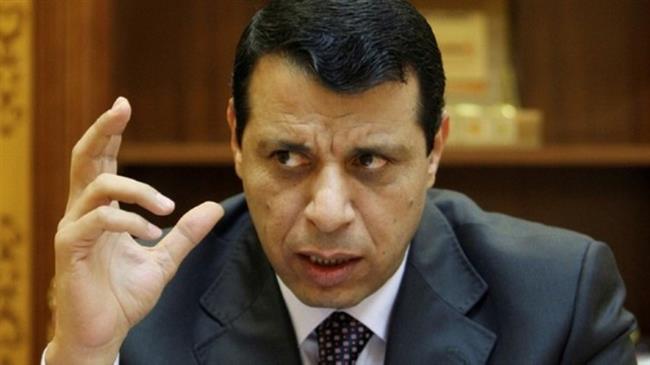
Several Arab states are reportedly putting pressure on Palestinian political factions to reinstate exiled former Fatah strongman Mohammed Dahlan and field him against Hamas in the upcoming elections.
Sources told Arabic Post news website on Saturday that the UAE, Egypt and Jordan are trying to compel Fatah, Palestine Liberation Organization (PLO) and Palestinian Authority (PA) President Mahmoud Abbas to reinstate the Israeli-backed Dahlan and his supporters.
Abbas dismissed Dahlan from the movement in 2011 and stripped the 58-year-old of all his merits, after which he fled to the United Arab Emirates.
Last September, US Ambassador to Israel David Friedman set off an uproar after suggesting Washington was considering supporting Dahlan to overthrow Abbas as the next Palestinian Authority chief.
Dahlan was sentenced in absentia to three years in prison in 2016 by a Palestinian court for corruption, and ordered to repay $16 million, according to his lawyers.
Dahlan once led a coup against the elected Hamas government in Gaza in 2007. The plan was a massive failure which saw Hamas rout out Dahlan’s forces in a matter of days in the summer of 2007.
President Abbas announced in a decree last month that the 2021 general elections will include legislative elections being held on May 22, presidential elections on July 31 and the Palestinian National Council elections on August 31.
Leaders of 14 Palestinian political factions, including Hamas and Fatah, are scheduled to start a comprehensive national dialog in the Egyptian capital of Cairo on February 8, aiming to reach an agreement on the mechanism for holding the general elections in Palestine.
Sharjah: Emir’s wife criticises UAE-Israel education cooperation

MEMO | January 29, 2021
The wife of the Emir of Sharjah has criticised the UAE’s cooperation with Israel in the education field. Sheikha Jawaher Bint Mohammed Al-Qasimi made her comment about an online meeting between the ministries of education in the UAE and Israel to discuss cooperation, student exchanges, and joint academic studies.
“Their [the Israelis’] curriculum encourages the killing of Arabs and stealing Arab lands,” she said on Twitter. The Sheikha also retweeted a post by “Ahmed”, a tour guide, about Andalusia in which he recalled the background of Israeli Minister of Education Yoav Galant.
“Who is the Israeli Education Minister Yoav Galant?” wrote the tour guide. “He is one of the bloodiest generals in the history of Israel. He participated in the killing of Hassan Salameh in Beirut in 1979. He is the leader of the operation to storm the Jenin [refugee] camp, which led to the killing of dozens of defenceless Palestinians, and operation Grapes of Wrath against Lebanon (Lebanese Qana massacre) in 1996.”
Sheikha Jawaher’s tweet is the most prominent and explicit objection to have emerged from the ruling circles in UAE against cooperation with Israel. Hundreds of Twitter users have praised her courage in expressing her opinion.
In 2013, the UN-appointed Sheikha Jawaher as the first prominent advocate for the UN High Commissioner for Refugees in the UAE. This, said the international organisation, was because of her “proven track record in the field of humanitarian work, community support, and women’s empowerment.”
The UAE and Israel signed an agreement last September to normalise their relations under US auspices, despite Palestinian and Arab objections.
READ ALSO:
Kuwait school book shows Israel on map in place of Palestine
Pakistanis hold massive rally against ties with Israel
Press TV – January 23, 2021
Tens of thousands of Pakistanis have held an anti-Israel march in the country’s major city of Karachi, rejecting the possibility of normalizing ties with the occupying Israeli regime.
The “million-man march” organized by opposition Jamiat Ulema-i-Islam-Fazl (JUI-F) was held with participants donning the colors of the JUI-F and raising tall black and white striped flags.
“Israel is involved in the genocide of Muslims in Palestine and we would never allow the federal government to establish diplomatic relations with it,” JUI-F leader Maulana Saleemullah Alwazi told Pakistani daily The News International.
In recent months, the news of deals signed by a few Arab dictatorships to normalize diplomatic relations with Israel under intense US pressure has sparked widespread anger among Pakistani people, who hold strong feelings for the Palestinian cause.
In December, top Pakistani officials fiercely denied rumors publicized by Israeli news outlets that Islamabad was moving towards a similar deal.
Pakistani Prime Minister Imran Khan rejected as “baseless” reports of his government officials visiting Israel, insisting why would any of his ministers visit Tel Aviv when Islamabad does not even recognize Israel.
Pakistan’s Foreign Minister Shah Mahmood Qureshi said later in December that he had informed the UAE — one of the US-backed kingdoms that recently normalized ties with Israel — of Islamabad’s “steadfast” policy towards Tel Aviv, insisting that the country will refuse to recognize it until the issue of Palestine is resolved.
The top Pakistani diplomat said he had explained to his Emirati counterpart Sheikh Abdullah bin Zayed Al Nahyan the “depth of emotions and feelings Pakistanis have about Palestine and Kashmir.”
The normalization trend has drawn widespread condemnation from Palestinians, who seek an independent state in the occupied West Bank and Gaza Strip, with East Jerusalem al-Quds as its capital. They say the deals are “a stab in the back” of the Palestinians.
Top Israeli Rabbi Visits UAE, Inaugurates Jewish School

Israeli rabbi Yitzhak Yosef
Al-Manar | December 19, 2020
The Zionist entity’s Chief Sephardic rabbi visited the United Arab Emirates (UAE) on Thursday, marking the first trip by an Israeli senior religious leader to an Arab state.
Rabbi Yitzhak Yosef’s itinerary included inaugurating a Jewish day school in Dubai and naming a local chief rabbi, Israeli media outlets reported on Friday.
The rabbi joined over 50,000 Israelis who have already traveled to the Gulf kingdom since commercial flights connected the two sides. The Zionist entity and the UAE also reached an agreement on visa waivers.
Dubai’s Jewish community center has reportedly increased its staff sixfold, from five to some 30 employees, and about 150 restaurants have started serving kosher dishes.
Israel and the UAE normalized ties earlier this year as part of a US-brokered deal that also included Bahrain. The so-called Abraham Accords have paved the way for subsequent Israeli normalization agreements with Sudan and Morocco.
UAE to Import Israeli Fruit and Vegetables
Palestine Chronicle | November 2, 2020
The UAE is expected to begin importing Israeli fruit and vegetables this month, Israel’s Agriculture and Rural Development Ministry has announced.
Official authorization is said to have been granted last Thursday following a series of meetings and coordination between Minister Alon Schuster, ministry employees and the UAE’s Ministry for Climate Change and the Environment.
“This is wonderful news for Israel’s farmers,” Schuster is reported as saying by the Jerusalem Post. “The agreement that we signed with the UAE is moving us forward and into a joint future in the field of agriculture.”
With UAE agricultural imports valued at around $10 billion a year, this latest agreement — which is a result of the normalisation deal signed in August — is highly lucrative for the occupation state.
At the moment, the UAE does not appear to be taking any measures to ensure that fruit and vegetables imported from Israel are not produced in the illegal settlements across the occupied Palestinian territories.
Last week it was reported that Israeli wine produced in the occupied Syrian Golan Heights is to be sold in the Emirates.
War-Weary Yemenis See Threat in Israel’s Increasingly Public Role in Their Country
By Ahmed Abdulkareem | MintPress News | October 30, 3030
Israeli battleships now sit side by side with Emirati corvettes ominously docked in Hodeida’s territorial waters in a blatant sign of Israel’s increasingly visibly role in the Saudi-led Coalition’s half a decade long war in Yemen. The ships also represent something else to residents in Western Yemen, where a Houthi-led commemoration of Prophet Muhammad’s birthday on Thursday turned into a demonstration against what many see as an imminent threat to the very identity and soul of Islam, their autonomy, security, and to their brethren in Palestine.
Despite an ongoing fuel crisis, the threat of COVID-19, and one of the bloodiest wars currently raging anywhere on the planet, massive rallies took place across most of Yemen’s provinces. Protesters shouted slogans against French President Emmanuel Macron, whose public defense of cartoons mocking Islam’s holiest figure, Prophet Muhammad, under the guise of free speech is seen as hypocritical coming from a country where questioning details of the Holocaust can land someone in jail. Demonstrators, and indeed many Muslims across the region, see the events in France as hiding a more nefarious goal of dehumanizing Muslims and gutting the identity of its adherents from within.
Demonstrators carried green flags, a symbol of the Prophet Muhammad, and banners emblazoned with slogans against Macron, the Saudi coalition, and its new Israeli partners. In Yemen’s capital city of Sana’a, where the largest demonstrations took place, hundreds of thousands gathered in the southern district of Al-Sabaean. Expats from 20 countries, including Sudan, Syria, Palestine, Egypt, and Bangladesh took part in the protest. A delegation from the southern Saudi province of Najran even joined.
The events were organized primarily by the Houthis and Houthi leader Abdulmalik Al-Houthi took to the podium to give a televised address to a massive audience in which he warned that western intelligence agencies in both the United States and France were involved in supporting the same extremist Salafi interpretation of Islam that is the widely practiced in Saudi Arabia, in part to tarnish the image of the religion and to justify wars in Muslim countries.
Al-Houthi also warned that distortion and misinterpretation of Islamic teachings had created a deep rift among Muslims. “Western [countries] have used such deviation to insult the Holy Qur’an and Islam. There is no mercy or sympathy whatsoever in Western civilization. They trample on human societies, deprive people of their freedom, plunder their wealth and occupy their lands, and then lecture others on human rights,” he said.
The massive demonstrations came despite threats of violence from the very same elements that Al-Houthi warned of. In the weeks leading up to Thursday’s rallies, police implemented special measures to ensure security during proceedings, including the banning of large trucks from central Sana’a and the establishment of additional checkpoints in the Yemeni capital and other provinces.
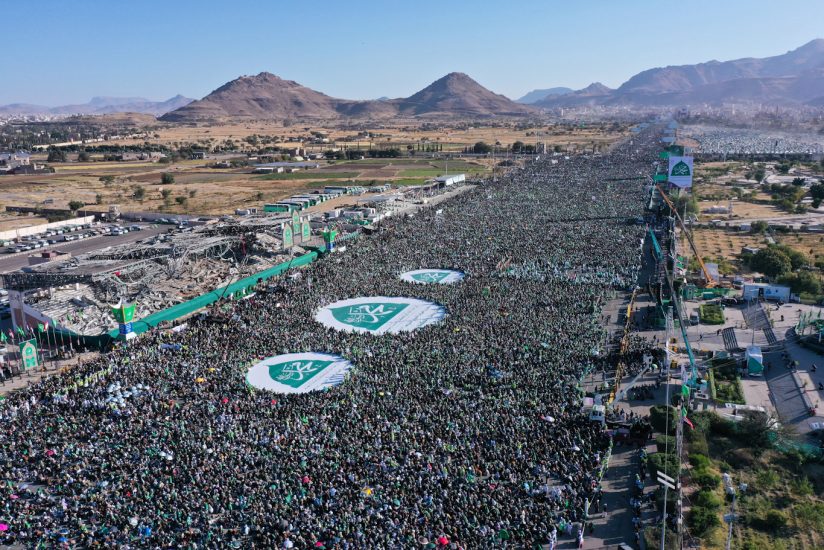
An aerial shot shows massive crowds at Thursday’s rally in Sana’a, Oct. 29, 2020. Hani Mohammed | AP
Despite the additional security measures, Hassan Zaid, the Houthi Minister for Youth and Sports, was assassinated on Tuesday as he drove his car through Sana’a. His 11-year-old daughter was seriously injured in the attack. Zaid was one of the most influential political opponents to Saudi Arabia and was wanted by the Kingdom, which offered a $10 million bounty for information leading to his capture. Houthi security forces said that they had also thwarted dozens of other planned attacks on Thursday’s demonstration.
Israeli settlements in Yemen?
The sheer scale of this week’s demonstrations dwarfed similar rallies that have taken place in previous years, not only due to Macron’s comments in France but because of fierce opposition to Israel’s new partnership with the UAE and other wealthy Gulf states, and its increasingly active presence in Yemen.
Yemenis fear that Israel not only seeks control of the strategic Bab-el-Mandeb strait, efforts that MintPress has covered in previous months, but also that it seeks a permanent footprint inside of Yemen and hopes to replace the original inhabitants of the islands and other coastal cities with Israeli settlers in a move reminiscent of the land grabs that led to the eventual annexation of land in what is now Israel.
In October, Houthi spokesman Yahya Saree warned that Israel was planning to naturalize tens of thousands of Yemeni-born Jews, emphasizing that such a scenario posed a grave threat to Yemen’s national security. Saree presented a number of National Security Agency documents that were seized when the Houthis took control from the government of former President Ali Abdullah Saleh, who ruled Yemen for 33 years.
Those documents detailed visits by Israeli officials to Yemen, facilitated by the UAE, in which a number of economic, cultural, and agricultural agreements were brokered alongside an agreement to open Yemeni airspace to Israeli aircraft. The most dangerous documents, according to Saree, relate to “the modernization of the Yemeni military forces.”
According to the documents, Israeli diplomat Bruce Kashdan arrived in Sana’a on an unannounced visit on July 14 of 2007, which lasted 48 hours. During that trip, Kashdan met with Yemeni military and security top brass who are relatives of Saleh. The Israeli official left Sana’a International Airport on July 16, 2007. The visit had been arranged by Yemeni officials in collaboration with the United Arab Emirates. Kashdan, who was also serving as a coordinator of relations between Tel Aviv and Dubai at that time, had also visited Yemen on February 2, 2005.
A delegation from the Israeli Knesset also visited Sana’a in March 1996 and received remarkable hospitality given the Yemeni government’s official stance towards Israel at the time. Knesset members met with several senior security and civilian officials headed by former president Saleh. Many Israeli delegations visited Yemen between 1995 and 2000 under the cover of tourism, commerce, and investment, according to the National Security Agency documents.
Saree accused the UAE and Israel of reviving a project that granted Israeli citizenship to more than 60,000 Yemenis. According to a memorandum to the UAE’s foreign minister in 2004 by Hamad Saeed Al-Zaabi, the Emirati ambassador in Sana’a, an Israeli delegation visited the Yemeni capital as part of normalization efforts and presented demands to build a museum celebrating Yemeni Jews in Sana’a among other moves that included naturalizing 45,000 Yemeni Jews as Israeli citizens. The Emirati ambassador described the move as part of a broader effort being pushed by the United States.
Ahmed AbdulKareem is a Yemeni journalist. He covers the war in Yemen for MintPress News as well as local Yemeni media
UAE, Bahrain, Israel ‘Abraham Accords’ should be renamed ‘Benjamin Accords’
By Robert Inlakesh – Press TV – October 22, 2020
The first UAE delegation, since the signing of its infamous normalization deal, traveled to Ben-Gurion airport yesterday, in order to secure trade deals with Israel. Amongst deals regarding travel between the two sides and a pipeline deal, Israel, the US and the UAE also agreed to set up a 3 billion dollar investment fund, headquartered in Jerusalem (al-Quds).
Dubbed by media pundits throughout the Western media as a “peace deal”, the so-called “Abraham Accords” have proven to bear the fruits of economic prosperity, instead of sowing the seeds for peace. It is obvious at this point that the official reasons, according to the United Arab Emirates, the US and Israel, for having signed the deal were a farce, it was not about peace but rather about the Benjamins (slang for currency).
Upon the announcement from the UAE that it was to normalize ties with Israel, the narrative was spun from their side that Israeli Prime Minister, Benjamin Netanyahu, would halt going forward on his campaign promise to annex the West Bank, in return for “peace” with the UAE.
However, Netanyahu instantly positioned himself in front of all available cameras and stated that to the contrary Israel will continue with its annexation. Despite this, it seems that Netanyahu was never truly interested in a de jure annexation of the West Bank and had failed to deliver by the promised date he had set forth to begin accomplishing the task.
Benjamin Netanyahu had won an election, campaigning on the promise of annexation, but had failed and was hesitant to enforce the policy, likely due to a fear of European backlash. Netanyahu needed a distraction, so instead of annexation, he delivered a so-called “historic” peace deal with the UAE and Bahrain, nailing in the hundredth nail into the cothin [coffin] of the “two-state solution”.
Although annexation seems to have been put on the back burner, Israel has since the signing approved for over four thousand new settler units to be constructed, in violation of international law, in the occupied West Bank. This is how Israel truly annexes land in the West Bank, through physical expansion onto that land, which is much more cement than a declaration or signing something on paper. So ultimately, annexation has only escalated, on the ground, since the “peace deal” was signed.
Also, on top of this, Israel, the UAE and the US have agreed to set up a three billion dollar trust fund, which will reportedly allow for the creation of further investment, based in Jerusalem (al-Quds).
In a bid to inject investment into the UAE regime owned airline ‘Emirates’, Israeli citizens will be allowed to travel to the UAE without any visa.
But perhaps the most significant of all in this new series of business deals is the announcement that Emirati Crude is set to be sent from the Red Sea to the Mediterranean, this being transported via a pipeline seized by Israel from Iran.
The pipeline was originally built for joint Israeli-Iranian trade, however this no longer became an option after Iran’s Islamic Revolution in 1979.
A Swiss court ruled in 2016 that Israel was liable for its seizure of this pipeline and was required to pay Iran at least 1 billion dollars in compensation, which Israel continues to refuse to pay.
If oil is transported between the UAE and Israel, it is likely to further inflame tensions between the UAE and Iran. One of the aims of the so-called ‘Abraham Accords’ having been to combat Iran’s influence in the Middle-East.
With major trade deals being secured, via illegally seized pipelines, a joint mission having been set up to exacerbate tensions which could lead to all-out war in the region and with Israel’s ongoing bombardment of Gaza, expansion of settlements and ethnic cleansing of the Palestinians, it is clear the deal is not about peace.
The UAE has not been forced to end its involvement in the genocidal war waged against the people of Yemen, with Israel now being able to openly cooperate with them on that front.
The “peace deal” is nothing more than corrupt dictators, coming together with opportunistic Western politicians, in a bid to secure greedy business deals and a policy of joint aggression against their enemies in the region, all whilst saving face to their blind and clueless populations who clap along as they fail to recognize that the “peace deal” is in fact a distraction from how they have been lied to.
Robert Inlakesh is a journalist, writer and political analyst, who has lived in and reported from the occupied Palestinian West Bank. He has written for publications such as Mint Press, Mondoweiss, MEMO, and various other outlets. He specializes in analysis of the Middle East, in particular Palestine-Israel. He also works for Press TV as a European correspondent.
We have lived to see Arabs enter Al-Aqsa under Israeli protection
By Abdullah Al-Majali | MEMO | October 19, 2020
We have lived to see Arabs enter Al-Aqsa Mosque under Israeli protection. It is shameful.
Is there any real difference between an Arab delegation visiting Al-Aqsa Mosque under Israeli protection and hordes of extremist Israeli settlers whose incursions and practice of Talmudic rituals there take place under the protection of the same security forces? The crime of these Arabs is arguably greater.
The storming by Israeli extremists under the guns of the Israeli occupation does not whitewash the image of the occupation in the eyes of the world, nor does it give it legitimate sovereignty over the Noble Sanctuary of Al-Aqsa. The Arabs’ visit does, however, whitewash the image of the military occupation and is “evidence” that all Muslims can go to Al-Aqsa Mosque. It also shows the world the false image of Israel providing protection for religious sites and allowing religious freedom.
A delegation from normalising Arab countries entered Al-Aqsa last week under the protection of the Israeli police and intelligence agencies, despite the occupation authorities’ closure of the mosque to Palestinian residents of Jerusalem. More dangerous than that, the normalisation delegation entered Al-Aqsa without informing the Religious Endowment Department there, and this ignored the authority of the Hashemite Kingdom of Jordan over the holy sites in Jerusalem. According to Jerusalemite activist and member of the Silwan Defence Committee, Fakhry Abu Diab, this also withdraws any recognition by these Arab countries of Jordan’s guardianship; instead, these states demonstrated their acceptance of Israeli sovereignty over the holy sites, especially Al-Aqsa.
This exploratory delegation was a faithful implementation of the deal of the century, which speaks with admiration of the Zionist occupation’s management of the Noble Sanctuary. This is a deliberate and blatant falsehood belied by the facts on the ground. “The State of Israel has been a good custodian of Jerusalem,” claims the Trump deal. “During Israel’s stewardship, it has kept Jerusalem open and secure.” This is a lie.
“Unlike many previous powers that had ruled Jerusalem, and had destroyed the holy sites of other faiths, the State of Israel is to be commended for safeguarding the religious sites of all and maintaining a religious status quo,” the text continues. “Given this commendable record for more than half a century, as well as the extreme sensitivity regarding some of Jerusalem’s holy sites, we believe that this practice should remain and that all of Jerusalem’s holy sites should be subject to the same governance regimes that exist today. In particular, the status quo at the Temple Mount/Haram Al-Sharif should continue uninterrupted.”
Unfortunately, the normalising delegation was loyal to its masters by implementing this deal, which was rejected by all the Arab and Muslim peoples who were able to express their opinion freely. It is a deal that buries the right of the Muslims to the third holiest site in Islam, after the Two Holy Mosques in Makkah and Madinah, and hands it over to the Israeli occupation on a silver platter. Sadly, it also demonstrated the urgently-issued religious and political opinions urging Muslims to visit Al-Aqsa Mosque with permission from Israeli embassies.
Continuing this naivety and even foolishness, even more Arab delegations are likely to enter Al-Aqsa in collaboration with the Israeli occupation forces and intelligence agencies. They will provide implicit recognition of the occupation’s sovereignty over Al-Aqsa Mosque giving Israel the right to determine who enters the mosque and who is turned away. Everyone already knows the serious restrictions imposed by the Israelis on Jerusalemites and other Palestinians regarding prayers at Al-Aqsa.
READ: Israel exploits normalisation deals to escalate violations against Al-Aqsa Mosque
The new situation places a great responsibility on Jordan, which is the guardian of the holy sites, and its diplomats must act quickly in those Arab countries and explain the threats to the Noble Sanctuary that these delegations pose. If Jordan does not get a response in this regard, then it must tell the Arab and Muslim people explicitly, beginning with the Jordanians and Palestinians, of the dangerous situation that threatens its sovereignty over the sanctities. This is not to absolve itself of responsibility, but to stand together against the danger that is being hatched against Islamic sanctities in Jerusalem in the name of the odious deal of the century.
Translated from Arabi21, 18 October 2020
Israel’s occupation is the main problem, not Iran, says Arab MK
MEMO | October 19, 2020
The head of the Arab Joint List in the Israeli parliament has said that Israel’s occupation of Palestine is a greater problem than Iran in the region.
Knesset member Ayman Odeh made his remark in an interview with a Lebanese television station in which he also slammed the UAE’s normalisation with the Zionist state.
The interview followed last week’s vote by the Arab bloc in parliament against UAE-Israel normalisation. When asked to explain the decision of the bloc to criticise the so-called Abraham Accords, Odeh said that they are based on a flawed assumption.
“The fundamental issue is the Iranian question, not the Palestinian question,” he insisted. “Practically, the Israeli occupation is the fundamental problem. We cannot accept the twisted logic of ‘combating Iran’, either morally or nationally.”
In its statement against the normalisation agreement signed between Israel and the UAE, the Joint List said that, “Replacing the principle of land for peace with Netanyahu’s deceptive vision of ‘peace for peace’ will bring disaster to the country and all its people.”
Eighty members of the Knesset voted in favour of the agreement, with 13 voted against, all of them from the Joint List.
Featured Video

Racist Seinfeld Dances for Joy as Bibi Unveils His New Map
or go to
Aletho News Archives – Video-Images
TV Drama Review
Japanese drama projects Japan’s wartime atrocities onto Chinese characters

Global Times | October 25, 2026
By portraying Chinese characters as perpetrators of ruthless violence while casting Japanese Self-Defense Forces (SDF) intelligence operatives as defenders, the season 2 of the Japanese drama Vivant has recently drawn criticism from Chinese netizens, who argue that its depiction turns historical reality on its head while ignoring Japan’s wartime atrocities.
The TBS drama series – a spy suspense story in which an alleged unofficial intelligence unit of the SDF operates across the globe — has attracted a passionate fanbase. Its currently airing season 2 opened with a household rating of 18.8 percent, the highest for a TV drama this year, according toa commentary article by Japanese media Toyo Keizai.
What draws attention is the portrayal of the enemies in the series, the article noted. Scenes in which the Chinese organization subjects kidnapped members of the SDF unit to brutal torture are repeated with unrelenting intensity.
It is rare for Japanese TV dramas to explicitly portray a real-life country as the enemy, the article noted.
Japanese Prime Minister Sanae Takaichi also made a reference to the drama, saying that she has been recording Vivant and hopes to binge-watch it over the year-end and New Year holidays, according to Japanese media outlets.
China’s CCTV News report on Sunday revealed that the drama features scenes in which Chinese personnel cut off the fingers of and stab Japanese intelligence operatives in the abdomen. Such acts bear striking similarities to the torture inflicted on Chinese nationals by invading Japanese troops during the World War II.
The drama distorts the truth by attributing these atrocities to modern Chinese characters. Beneath the surface, it subtly glorifies Japan’s cross-border overseas operations, blurs the functional boundaries of the SDF and implicitly promotes an expansionist narrative, per CCTV News. … continue
Blog Roll
 Aletho News
- EU facing trillion-euro debt hole while seeking more cash for Kiev
- How US, Europe, Persian Gulf states exhausted missile stockpiles, splurged billions to defend Israel
- Up in arms… Koreans reject U.S. empire’s plan to make South Korea the next Ukraine
- Iran, Turkey, Pakistan, Saudi Arabia could advance region-led security framework in Tehran: FM spox
- Netizens condemn Japanese drama for projecting Japan’s wartime atrocities onto Chinese characters
- Racist Seinfeld Dances for Joy as Bibi Unveils His New Map
- A West Bank War for Netanyahu’s Election Campaign, Could It Backfire?
- Yemen denounces European Parliament’s ‘hypocritical’ push to blacklist Ansarullah
- Qalibaf: UAE’s UN bid aims to ‘clear the runway’ for ‘Greater Israel’, whitewash genocide
- Pakistan reopens Iran border after boosting security: Report
- If Americans Knew
- An error has occurred; the feed is probably down. Try again later.
- No Tricks Zone
- Sudden Stratospheric Warming, Powerful El Niño Combination May Lead To Extreme Europe Cold, Energy Crisis!
- Two New Studies Find Thwaites Glacier Melt Cannot Be Driven By Human Activity Or A Warming Ocean
- E-Cars Reduce CO2 Emissions By Only 41% Compared To Internal Combustion Engine Vehicles
- Predictions Made By Renowned Climate Professor Over Past Decades Have Been Proven To Be Poor
- New Study Suggests Large Regions Of The Pacific Ocean Have Been Cooling For The Last 80 Years
- Germany’s Green Energy Debacle: High Energy Costs Force Kahla Porzellan to Close After 182 Years!
- New Study: 50 Years Of The Most Aggressive ‘Net Zero’ Policies Can Only Affect The Global Climate By 0.03°C
- US September “Heat” Was No Record…Many Records Set Decades Ago
- Latest European Green Energy Debacle; Portugal’s Largest Flagship Solar Park Insolvent!
- Green Energy Debacle: German Expert Professor Fritz Vahrenholt Warns Of Severe Economic And Social Consequences

