Spokesman for Yemen’s revolutionary Ansarullah movement Mohammad Abdulsalam, who heads a delegation in the ongoing peace talks in Sweden, said the presence of foreign forces in the Arabian Peninsula country cannot be justified.
Speaking to the Arabic-language al-Masirah TV on Tuesday night, Abdulsalam said the foreign troops’ presence in Yemen is contrary to the country’s constitution and UN Security Council resolutions.
“The presence of foreign forces in Yemen is not justified as long as our approach is political settlement (of the crisis),” he said.
Yemen’s occupied areas are now controlled by foreigners such as British, Saudi and Emirati forces, not a group that calls itself “legitimate”, he added, referring to the Yemeni exiled government which claims legitimacy.
The Ansarullah spokesman went on to say that no party could demand the presence of foreign forces in Yemen.
Abdulsalam further said that in the UN-brokered peace talks in Stockholm, Sweden, the two sides have reached some agreements on ceasefire in some areas.
The talks opened Thursday on an upbeat note, with the warring sides agreeing to a broad prisoner swap, boosting hopes that the talks would not deteriorate into further violence as in the past.
Yemen has been since March 2015 under brutal aggression by Saudi-led Coalition, in a bid to restore control to fugitive president Abd Rabbu Mansour Hadi who is Riyadh’s ally.
Tens of thousands of people have been killed and injured in the strikes launched by the coalition, with the vast majority of them are civilians.
The coalition, which includes in addition to Saudi Arabia and UAE: Bahrain, Egypt, Morocco, Jordan, Sudan and Kuwait, has been also imposing a harsh blockade against Yemenis.
Some 8.4 million Yemenis are facing starvation as a result of the Saudi-led aggression, although the United Nations has warned that will probably rise to 14 million.
Three-quarters of impoverished Yemen’s population, or 22 million people, require aid.
December 12, 2018
Posted by aletho |
Illegal Occupation | Saudi Arabia, UAE, Yemen |
1 Comment
The annual summit meeting of the Gulf Cooperation Council (GCC) in Riyadh on Sunday was particularly important for Saudi Arabia as a display of its regional leadership. But the short meeting of the GCC leaders behind closed doors, lasting for less than an hour, ended highlighting the huge erosion of Saudi prestige lately.
The litmus test was the participation by Qatari Emir Sheikh Tamim bin Hamad al-Thani. King Salman’s letter of invitation to the emir was perceived as some sort of an olive branch for reconciliation. But Qatar’s Minister of State for Foreign Affairs Sultan bin Saad Al Muraikhi represented the country at the summit.
The calculation by the hot headed crown princes of Saudi Arabia and the UAE that Qatar would pack up is turning out to be a historic blunder. Qatar had some trying times but it has successfully weathered the harsh embargo by Saudi Arabia and the UAE, and the boycott is now hurting its enforcers. Qatar “celebrated” the anniversary of the boycott in June by banning the import of goods from the UAE, Saudi Arabia, Bahrain and Egypt (which had cut diplomatic and transport ties on June 5, 2017.) Ironically, Iran has been a beneficiary as Qatar established diplomatic relations with Tehran and began importing Iranian products.
Qatar also strengthened its alliance with Turkey, which stepped in as provider of security for Doha. And Turkey checkmated any plans that Saudis and Emiratis might have had to use force to bring the Qatari emir down on his knees.
The emir’s absence from the summit in Riyadh yesterday underscores that he is not in a mood to forget and forgive. Equally, Kuwait and Oman also have issues to settle with Saudi Arabia and the UAE. There is tension between Kuwait and Saudi Arabia over two oil fields – Khafji and Wafra – that are jointly owned by the two states, which have a capacity to produce more than half a million barrels per day, but have been closed since 2014 and 2015, respectively. The dispute is over the sovereignty over the so-called Neutral Zone on their border, which has been undefined for almost a century.
The Saudis are not relenting. “We’re trying to convince the Kuwaitis to talk about the sovereignty issues, while continuing to produce until we solve that issue,” Saudi Crown Prince Mohammed bin Salman told Bloomberg in an interview in October. Similarly, Saudis and Emiratis have stationed troops in Yemen’s southern province of al-Mahra that borders Oman although the region has no presence of Houthi rebels. Oman considers the move an infringement on its national security. Interestingly, instead of the Sultan of Oman, Deputy Prime Minister for the Council of Ministers Sayyid Fahd bin Mahmood Al Said represented the country at the GCC summit.
To be sure, like Banquo’s ghost at Macbeth’s banquet in Shakespeare’s play, the killing of Jamal Khashoggi provided the backdrop to the GCC summit. The GCC states (including Qatar) have not criticized the Saudi Crown Prince Mohammed bin Salman (MBS) but they would know this is a developing story and it has dented Saudi prestige irreparably, especially with the US Senate is at loggerheads with the Trump administration. The big question for the Gulf region would be as to where Saudi Arabia is heading. (See the blog by Thomas Lippman What Now For U.S. Policy And The Crown Prince?)
Of course, if the GCC disintegrates due to these contradictions, Saudi Arabia will be the big loser, because it will be a reflection on its regional leadership. But do the Saudis understand it? The remarks by the Saudi Foreign Minister Adel Al-Jubeir at the end of the GCC summit showed no sign of remorse.
He said, “The members of the Gulf Cooperation Council are keen that the crisis with Qatar will have no impact on the Council (GCC). But this does not mean relinquishing the conditions imposed on Qatar.” Doha should stop supporting terrorism and extremism and avoid interfering in other countries’ affairs and needed to fulfill the Arab countries’ conditions to open the way for its return to the full-fledged work in the GCC. “The stance towards Qatar came to push it to change its policies,” he added.
The leading Saudi establishment writer Abdulrehman al-Rashed fired away at Qatar on the day of the GCC summit. In a column entitled Is it Time to end the GCC? in the Saudi daily Asharq Al-Awsat (owned by royal family members) he wrote:
“Qatar… has been putting obstacles in the GCC path and it has succeeded where Saddam and Iran have failed: It managed to destroy and rip it [GCC] apart… It organized an internal and external opposition against the United Arab Emirates. It is now the primary financier of the greatest attack against Saudi Arabia and it stands behind the politicization of Khashoggi’s murder… Today’s [GCC] summit could not conceal the dark political cloud hanging over its head. It also strongly poses a question over the future of the GCC as doubts rise over the value of this union… A wedge has been driven in the GCC.”
The disarray within the GCC undoubtedly calls attention to the decline of US influence in the Middle East region. At the end of the day, the Gulf states have not paid heed to repeated US entreaties for GCC unity. Ideally, GCC should have provided today for the US strategy a strong platform for launching the regime change project against Iran. On the contrary, GCC is split down the middle, with Qatar, Oman and Kuwait getting along just fine with Tehran. While addressing the summit in Riyadh on Sunday, the Emir of Kuwait, Sheikh Sabah Al Ahmad hit the nail on the head when he said, “The most dangerous obstacle we face is the struggle within the GCC.”
December 11, 2018
Posted by aletho |
Aletho News | Bahrain, Egypt, GCC, Iran, Kuwait, Middle East, Oman, Qatar, Saudi Arabia, Turkey, UAE |
1 Comment
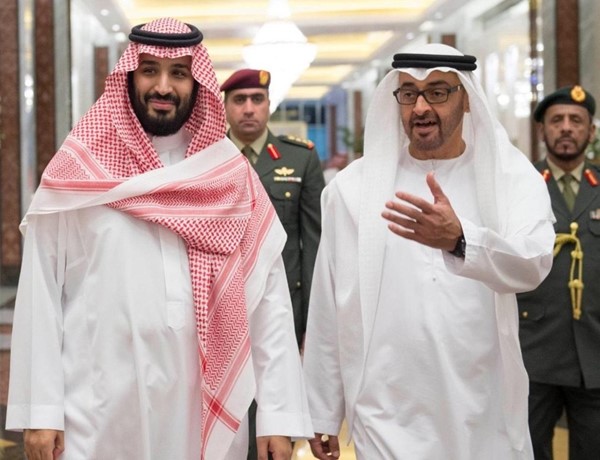
The media in Tel Aviv have reported that the UAE has invested as much as $100 million in an ambitious Israeli project to pipe natural gas to Europe.
The investment would be made by a company based in Abu Dhabi for a pipeline project which is internationally known to be unique given its record length as well as the extreme depths it would be laid toward Europe, Lebanon’s al-Mayadeen quoted Israeli media as reporting.
The agreement has been described as “historic” by Israeli media, al-Mayadeen added.
Israel has signed a multilateral deal over the scheme – called the East Med Pipeline Project – with Greece, Italy and Cyprus. The European Union also supports the project.
The East Med Pipeline Project is to start about 170 kilometers (105 miles) off Cyprus’s southern coast and stretch for 2,200 kilometers (1,350 miles) to reach Otranto, Italy, via Crete and the Greek mainland, according to a report by The Times of Israel news website.
The pipeline will have the capacity to carry up to 20 billion cubic meters (706 billion cubic feet) of gas from Israeli fields each year. Europe’s gas import needs are projected to increase by 100 billion cubic meters (3.5 billion cubic feet) annually by 2030.
Work on the project is expected to begin within a few months, and to conclude within five years.
UAE’s investment in the project could trigger protests in the Muslim world. The Emirates has already taken moves to approach Tel Aviv with speculations recently emerging that it has even involved itself in certain military operations by Israel on Gaza.
Last December, Israel’s Energy Minister Yuval Steinitz said a study on the project showed that the project is feasible, even though it presents technical challenges due to the depths involved and has an estimated cost of 6.2 billion euro ($7.36 billion).
Israel has already engaged in disputes with Lebanon over tapping into Mediterranean energy resources.
Last February, Israel described as “very provocative” a Lebanese tender for projects in two of its 10 offshore blocks in the Mediterranean Sea.
Israel itself has long been developing a number of offshore gas deposits in the Mediterranean Sea, with the Tamar gas field, with proven reserves of 200 billion cubic meters, already producing gas, while the larger Leviathan field is expected to go online in the coming months.
A source close to Israeli Prime Minister Benjamin Netanyahu said in 2012 that Israel’s natural gas reserves were worth around $130 billion. A Business Week estimate later that year put the reserves’ value at $240 billion.
November 25, 2018
Posted by aletho |
Economics | Cyprus, Greece, Israel, Italy, Middle East, UAE |
1 Comment
The reported plan by the United Arab Emirates to reopen its embassy in Damascus shortly leads to a startlingly new alignment on the map of the Middle East.
At the most obvious level, it signals the realization among the Gulf States that the brutal war to overthrow the Syrian government has ended. But the pragmatism is stunning. There isn’t even going to be any ‘cooling-off’ period!
What explains the urgency? Analysts may say it is to counter Iran’s influence. After all, the Saudis with UAE backing tried a similar approach in Iraq through the past year – to counter Iran’s multi-vectored influence in Iraq.
But the UAE cannot but be unaware of the exceptionally strong bonding between Damascus and Tehran. Syria may have uses for ‘green money’ to advance its reconstruction agenda but Iran’s backing has existential dimensions.
The western analysts tend to view the Iran factor as the leitmotif of Middle Eastern developments. However, in this cacophony over Iran, we are largely overlooking that simmering differences among the major Sunni states have also surged to the centre stage lately.
Through the past 2-3 year period, a Turkish-Qatari alignment has crystallized. For Qatar, Turkey’s support is invaluable for resisting the pressures on its strategic autonomy from the regimes in Saudi Arabia and the UAE. The establishment of a Turkish military base in Qatar underscores this new axis. Lately, Qatar has become a pillar of financial support for the Turkish economy.
Neither Qatar nor Turkey is flustered by Iran’s rise. Neither is seeking Iran’s isolation, either. Washington recently ‘granted’ a waiver to Turkey to continue to buy oil from Iran, but Ankara shot back saying it opposed US sanctions anyway, calling them ‘imperialistic’.
For Turkey too, Saudi Arabia and the UAE are the principal regional adversaries today. Turkey viewed with disquiet the UAE’s support of terrorist groups in Libya, Yemen and Syria. In next-door Syria, the Saudi and Emirati openly supported ISIS groups and al-Qaeda affiliates. Circles close to Turkey’s ruling elite have alleged that UAE is targeting Erdogan in a concerted way.
However, the ‘red line’ was crossed when the two Gulf oligarchies lent support to the failed coup in 2016 in Turkey to assassinate President Recep Erdogan. (After the coup failed, it took 16 hours for Riyadh to even issue a statement!) Turkey estimated that the UAE provided a staging post for the coup plotters.
As Turkey sees it, the UAE is implementing a western project to weaken it. Meanwhile, reports also appeared that the two Gulf oligarchies have been funding the Kurdish militant groups (who are the US’ allies in Syria.)
No doubt, it is a combustible mix. But what makes it really explosive is the perception in Abu Dhabi and Riyadh that Turkey and Qatar are patronizing the Muslim Brotherhood as a potent vehicle for the democratic transformation of the Muslim Middle East.
Both regimes (Saudi Arabia and the UAE) regard the Brotherhood as existential threat. Their visceral hatred of Brothers is such that they bankrolled the coup d’état against elected Egyptian President Mohamed Morsi in 2013 in a multi-billion dollar project.
Enter Syria. Given the above backdrop, the UAE and Saudi Arabia are inclined to sense a convergence with the Syrian regime on pushing back at Erdogan’s perceived aspirations of ‘neo-Ottomanism’ in general and his support of the Brotherhood as a vehicle of change in particular.
A tantalizing question will be: Where does the US stand apropos the Brotherhood? The Barack Obama administration with a sense of history saw in the Brotherhood much potential to finesse the Arab Spring toward establishment of ‘Islamic democracy’ in the Middle East. The US had dealings with the Brotherhood in Egypt based on estimation that it could do business with them and even influence them to democratize the Muslim Middle East. Of course, the premature end to the transition in Egypt in 2013 changed everything.

The Muslim Brotherhood lobbying US Congress, May 2017
Erdogan always hoped that the US (and the West as a whole) would appreciate that Turkey is uniquely placed to play the leadership role in the transition to a New Middle East. The Khashoggi affair has noticeably rekindled those hopes. (Interestingly, the spokesmen of the US intelligence establishment who have been very vocal about the Kahshoggi affair have also suddenly mellowed toward Erdogan.)
Now, this subtle shift on the part of the ‘Deep State’ in America toward Erdogan couldn’t have gone unnoticed in Riyadh and Abu Dhabi. It has probably prompted them to open a line to Damascus as early as possible.
How this delicate tango will play out remains to be seen, since there are far too many variables. With the US midterm elections over, President Trump may come under pressure to ‘do something’ on the Khashoggi affair.
Meanwhile, the Saudi and Emirati presence in Syria will be a matter of concern for Turkey in the ‘post-truth’ politics after Khashoggi’s murder.
November 8, 2018
Posted by aletho |
Economics | Middle East, Saudi Arabia, Syria, Turkey, UAE |
Leave a comment
The Houthi Ansarullah movement has opposed a US proposal for mediation in efforts to resolve the conflict in Yemen, holding Washington responsible for the Saudi-led aggression against Yemen.
Mohammed al-Bakhiiti, a member of Ansarullah’s Political Council, told Iran’s Arabic-language Al-Alam news network on Wednesday that peace would be restored to Yemen if the US ended its war on the impoverished country.
He also expressed his objection to any solution to the Yemen crisis that ignores the country’s independence and sovereignty.
On Tuesday, American officials called for a ceasefire in Yemen and demanded that the sides to the conflict come to the negotiating table within a month.
US Defense Secretary Jim Mattis said the US had been watching the conflict “for long enough,” and that he believed Saudi Arabia and the UAE were ready for talks.
“We have got to move toward a peace effort here, and we can’t say we are going to do it sometime in the future,” he said. “We need to be doing this in the next 30 days.”
Mattis’ call was later echoed by US Secretary of State Mike Pompeo, who urged the coalition to stop airstrikes in Yemen’s populated areas, saying the “time is now for the cessation of hostilities.”
Bakhiti further stressed that Washington’s proposed solution for the Yemen conflict included dividing the country.
Mattis’ plan, supported by Saudi Arabia and the UAE, is meant to achieve goals that have not been attained during the war on Yemen, he added.
The only solution to the crisis is intra-Yemeni talks and non-interference by foreign parties, the Houthi official said.
In March 2015, Saudi Arabia and its allies launched a brutal war against Yemen in an attempt to reinstall the country’s former Riyadh-allied regime and crush the Houthis.
The Western-backed war, however, has so far failed to achieve its stated goals, thanks to stiff resistance from Yemeni troops and allied Houthi fighters.
The offensive, coupled with a naval blockade, has destroyed Yemen’s infrastructure and led to famine as well as a cholera outbreak in the import-dependent state. Tens of thousands of people have also lost their lives in the conflict.
October 31, 2018
Posted by aletho |
Illegal Occupation | Saudi Arabia, UAE, United States, Yemen |
Leave a comment
Oman says it will not act as a “mediator” between Israelis and Palestinians, playing down an earlier visit by Israeli Prime Minister Benjamin Netanyahu.
The sultanate was only offering ideas to help Israel and Palestinians to come together, Omani Foreign Minister Yousuf bin Alawi bin Abdullah told a security summit in Bahrain’s capital Manama on Saturday.
The remarks came a day after Netanyahu visited Oman in a rare visit, while accompanied by other senior Israeli officials, including the head of the Israeli spy agency Mossad.
“We are not saying road is now easy and paved with flowers, but our priority is to put an end to the conflict and move to a new world,” Reuters cited Abdullah as saying.
Despite apparently trying to sound impartial, Abdullah said Oman relied on the United States and efforts by US President Donald Trump in working towards the “deal of the century.”
The Trump administration has targeted the plan at the situation in the Palestinian territories.
Details are yet to emerge, but reports say it envisages a Palestinian state with limited sovereignty across about half of Israel-occupied West Bank and all the Gaza Strip. The deal also reportedly foresees potential disarming of the Palestinian resistance movement Hamas, and does not find Palestinians entitled to the eastern part of Jerusalem al-Quds as their capital.
This is while Abbas, who visited Oman before Netanyahu for three days, has renounced the plan, saying it has been devised without consulting the Palestinians. He also spurned any intermediary role by the US late last year after Washington recognized Jerusalem al-Quds as Israel’s “capital.”
In June, however, Saudi Arabia, the United Arab Emirates, Egypt, and Jordan assured the US of their support for the plan during visits to those countries by Trump’s senior adviser and son-in-law Jared Kushner, and Jason Greenblatt, the US envoy to the region.
Saudi Arabia’s Foreign Minister Adel al-Jubeir told the Manama gathering on Saturday that the kingdom believed the key to “normalizing” relations with Israel was the “peace process.”
The Omani minister also claimed Israel was “present in the region, and we all understand this, the world is also aware of this fact and maybe it is time for Israel to be treated the same and also bear the same obligations.”
Observers say Muscat has come to accommodate the US plan under pressure from Washington and Riyadh, the strongest US ally in the Persian Gulf region, which has been inching towards Tel Aviv over the past years.
Palestinian groups, however, condemned the Israeli prime minister’s visit to Oman, urging Arab countries to support the oppressed people of Palestine, instead.
Hamas warned about the dangerous consequences of Netanyahu’s visit for the people of Palestine. The Islamic Jihad movement also censured the visit, saying Oman acquitted Netanyahu of the crimes committed against innocent Palestinians by welcoming him to the country.
Commenting on Netanyahu’s visit, Paul Larudee, with the Free Palestine Movement, told PressTV, “What in the world would Netanyahu know about peace and stability, when his objectives and objectives of Israel have always been war and instability?”
“The importance is what their objectives are not. They are not about Arab unity, not about solidarity with Arabs who are suffering namely the Palestinians,” he said.
“These other countries realize that sooner or later they are potential targets of Israel… that they can be in the same place that the Palestinians are now,” Larudee said.
October 27, 2018
Posted by aletho |
Corruption, Ethnic Cleansing, Racism, Zionism | Egypt, Hamas, Jordan, Middle East, Oman, Palestine, Saudi Arabia, UAE, Zionism |
2 Comments
In first, Israel’s Culture and Sports Minister Miri Regev today arrived in the United Arab Emirates (UAE) to attend the Abu Dhabi Grand Slam Judo tournament.
Regev was invited to attend the event earlier this month to accompany Israel’s national judo team as they compete in the Emirati capital. President of the International Judo Federation (IJF), Marius Vizer, wrote to Regev on 2 October to invite her to the tournament and promised to “make all the necessary arrangements for [her] visit”.
The invitation came after the IJF demanded that the UAE allow the Israeli team to play its national anthem and fly its flag during the tournament. The event had previously been threatened with cancellation after the IJF stripped the UAE of the right to host the tournament due to its failure to guarantee “equal treatment” for Israeli athletes. In September, the UAE accepted the IJF’s conditions and allowed the Israeli judoists to sport their national insignia.
Regev’s attendance at the event – which is taking place from 25-27 October – will be seen as controversial in light of the lack of official relations between Israel and the UAE. In addition, Israeli passports are not valid for travel to the UAE.
However, the UAE has recently been pursuing a policy of normalisation with Israel. In September, it hosted secret backchannel talks between Israel and Turkey in an attempt to mend strained Israeli-Turkish relations. Envoys from the two countries flew into Abu Dhabi via Amman, Jordan, though neither government would confirm the purpose of the talks.
In August, an Israeli journalist claimed that an Emirati pilot participated in the bombing of Palestinian targets in the Gaza Strip during his training on Israeli Air Force F-35 fighters. Cohen, the journalist who made the claims, also accused Dubai’s Deputy Chairman of Police and Public Security, General Dhahi Khalfan, of being complicit in assassinating Hamas leader Mahmoud Mabhouh in Dubai in 2010.
In June, an exposé by the New Yorker revealed that Israel and the UAE have been engaged in secret normalisation talks since the 1990s. The report disclosed that “the secret relationship between Israel and the UAE can be traced back to a series of meetings in a nondescript office in Washington D.C. after the signing of the Oslo Accords”. These meetings discussed the possibility of the UAE purchasing F-16 fighter jets from the US which are known to be comprised of Israeli technology. The Crown Prince of Abu Dhabi, Mohammed Bin Zayed, also gave his blessing for delegations of influential American Jews to be brought to Abu Dhabi to meet with Emirati officials and establish an intelligence-sharing relationship.
READ: Israel, UAE envoys share dinner date
October 26, 2018
Posted by aletho |
Corruption, Ethnic Cleansing, Racism, Zionism | Israel, Middle East, Palestine, UAE, Zionism |
Leave a comment
Those in the Western media too busy to be bothered trying to understand the complexities, intricacies and nuances of the Middle East often resort to concluding nearly all conflicts there are some kind of “proxy war” between Saudi Arabia and Iran.
This is usually out of ignorance, reducing disputes to the lowest common dominator of Sunnis versus Shiites or to that between their two most prominent patron states. Often though there is deliberate obfuscation; there must be justification for a US ally to cause regional mayhem on the pretext of containing an enemy. The easiest and most convenient scapegoat has been Iran and efforts to contain its alleged expansionism by Saudi Arabia, the United Arab Emirates and of course, Israel, go unchecked.
One of the most devastating and tragic episodes occurring in the Middle East today is in Yemen. But this is not a de facto proxy war its bankrollers hope we have all grown too weary of hearing to investigate further.
Despite the constant disclaimers by a lazy media, there is no proxy war in Yemen.
The war which has ravaged the Arab world’s poorest country since March 2015 is a Saudi-led, unilateral onslaught which has so devasted the nation, its economy, infrastructure and social services that malnutrition has become widespread and cholera epidemic.
Ostensibly, the Saudi-UAE military campaign was to oust Houthi-led rebels who unseated the deeply unpopular Saudi-backed puppet-president Abdu Rabbu Mansour Hadi in January 2015 (elected on a ballot in which he was the only candidate and who remained in power even after the expiration of a one-year mandate that had extended his term). The Houthis, a politico-religious group officially known as Ansarullah and named after their founder, Hussein Badreddin al-Houthi, initially formed in opposition to late Yemeni president Ali Abdullah Saleh.
The Houthis generally belong to the Zaidi school in Islam, a branch of the larger Shiite sect. Branding the Houthis as “Iranian-backed Shiite rebels” as is now routine, makes for easy and convenient categorization of who the “bad guys” are in Western and Gulf media. But this is disingenuous. The inconvenient fact is Zaidis are generally closer to Sunni Islam than Shiite (and the longtime military, Saudi-backed dictator Saleh was Zaidi). More significantly, other than voicing solidarity with the Houthis, there has been no substantive evidence of Iranian military intervention or that of affiliated parties in Yemen. On the contrary, and starkly so, it has been the Saudi and Emirati governments’ inhumane bombing campaign which has been the most glaring example of foreign interference in the internal affairs of another country.
When a school-bus was struck during an air raid that killed 40 children, it was initially justified as a “legitimate military target” by the Saudi coalition before international outrage finally led to the conclusion it was otherwise. On the other hand, intermittent Houthi missiles launched at Saudi military installations and considered evidence of foreign military supply belie the Houthis as a legitimate, capable, battle-hardened fighting force. Apparently, the regime cannot fathom that despite daily attack, they have had the muster to retaliate and demonstrate offensive, rather than strictly defensive, capabilities.
Yemen is not a sectarian conflict or one of proxies, but a war stemming from the fallout of removing yet another Saudi-backed ruler from power.
Since 2015, at least 10,000 Yemenis have been killed, 22 million are now in need some form of relief (out of a total population of approximately 29 million) and eight million are malnourished. These numbers can only be expected to climb after evidence has shown Saudi Arabia is targeting food supplies.
The war waged in Yemen by Saudi Arabia and its allies and their wanton use of US and UK-supplied arms is everything short of a formal invasion. It is a one-sided, vicious military adventure which has rendered millions destitute and to date, has proven completely unsuccessful in fulfilling its stated objectives. The only proxies in this struggle are the victims of its war crimes; innocent men, women and children starved or killed, stand-ins for an apparition of a foreign power waiting to be found.
October 20, 2018
Posted by aletho |
Deception, Illegal Occupation, Mainstream Media, Warmongering | Saudi Arabia, UAE, UK, United States, Yemen |
Leave a comment
A Hungarian-Israeli security contractor based in the US, Abraham Golan, has claimed he ran a targeted assassination program in Yemen as part of the Saudi-led coalition currently waging a proxy war against Iran-backed Houthis.
The US is supplying weapons, intelligence, and other support to the coalition, but Golan’s account, as told to BuzzFeed, reads like something out of a spy thriller.
Golan claims the United Arab Emirates (UAE), part of the coalition, hired his mercenary company, Spear Operations Group, to kill specific enemies, including Anssaf Ali Mayo, leader of the Yemeni political party Al-Islah, which the UAE considers a terrorist group. The Mayo assassination was ultimately unsuccessful – Mayo disappeared from Yemeni politics for a while, and the Spear crew even thought he was dead, but he is currently serving in the Yemeni government, alive and well.
The botched assassination of December 29, 2015 is seen by observers from both sides as the opening salvo in a “targeted campaign,” which former UN investigator Gregory Johnsen says eventually took out 25 to 30 members of Al-Islah and other clerics.
Golan claims responsibility for several of the high-profile assassinations in Yemen, though he refuses to share which ones. Not because of remorse – he’s a mercenary, after all – but because his business inhabits a legal gray area, and perhaps because he doesn’t want his professional secrets getting out. Golan is trying to sell his business model to the US military.
Experts have cast doubt on the idea that the US, which essentially armed and trained the UAE’s military from the ground up, didn’t know the UAE had hired Americans to conduct assassinations in a war in which the US is deeply involved. The CIA claimed ignorance of the matter, but one agency official – after categorically denying the government would allow such a thing – confirmed the story, himself shocked that American mercenaries had been allowed to operate “almost like a murder squad.”
The US does enjoy a privileged place within UAE military circles, having sold the Arab nation $27 billion in arms and defense services since 2009. While the US theoretically bars mercenaries from participating in combat, it hires them to do everything else in the military, and one man’s security detail is another man’s firefight.
Private contractors are supposed to be regulated by the State Department, which claims it has never permitted mercenaries to work for another government, and US law forbids any who would “conspire to kill, kidnap, [or] maim” a foreign citizen. But the publication cites multiple sources who claim Spear mercenaries were given military rank by the UAE, providing them legal cover for their actions (US citizens are allowed to serve in foreign militaries, with some exceptions).
BuzzFeed was admittedly unable to verify much of Golan’s biography, which allegedly includes a stint in the French Foreign Legion and friendships with notorious figures like former Mossad head Danny Yatom and Serbian militant Arkan. A CIA acquaintance calls him “prone to exaggeration.” The details of his story – “target cards” handed out with names, photographs, even phone numbers; a Jolly-Roger-esque company flag – are Hollywoodesque.
Golan supposedly offered the UAE his company’s services as targeted assassins, explicitly tasked to “disrupt and destruct” Al-Islah. On top of $1.5 million a month, they would receive kill bonuses and train UAE soldiers. He claims to have declined missions targeting individuals outside the party, but those claims are unverified, and his partner admits that some targets may have simply been enemies of the UAE’s ruling family.
However much truth there may be to Golan’s tale, it illuminates the consequences of War on Terror mission creep – an overabundance of highly-trained special forces, lax oversight regarding war crimes and international law, an increasingly privatized fighting force, and the notion that enemy combatants are anyone a government deems them to be mean Spear’s business model could strike US commanders’ fancy after all.
October 17, 2018
Posted by aletho |
Mainstream Media, Warmongering, War Crimes | UAE, United States, Yemen |
1 Comment
The United Arab Emirates (UAE), Saudi Arabia’s key partner in the ongoing Riyadh-led invasion of Yemen, has reportedly been recruiting tribesmen from northern and central parts of Africa to fight in the war.
The campaign features Emirati envoys “seducing” the tribesmen across a vast area spanning southern Libya as well as entire Chad and Niger, who earn a living by herding as well as human and material smuggling, the Middle East Monitor (MEMO) press monitoring organization reported on Wednesday.
“This campaign is supervised by Emirati officials who gained material profits in collaboration with human traffickers,” the report added.
An awareness campaign has been launched by Chadian activists, led by campaigner Mohamed Zain Ibrahim, to warn the tribesmen against joining the Saudi-led war.
“The Arabs of the [Persian] Gulf region, especially the UAE and Saudi Arabia, have never bothered to get to know the Arabs of the desert, and today they are asking for their support and seducing them to fight by their side in Yemen!” MEMO cited Ibrahim as telling pan-Arab Arabi21 electronic newspaper.
The envoys offer potential mercenaries such incentives as sums ranging from $900 to $3,000, in addition to acquiring UAE citizenship in return for their applying for jobs in Emirati security companies.
Ibrahim said the job opportunities were “an actual military recruitment campaign to gather mercenaries for the Yemeni war and use them to fight the people of Yemen, who are Arabs and Muslims as well, and all that for a bunch of dollars.”
“A delegation of Emirati people in business visited Niger in January 2018, where they met Arab tribal leaders and recruited 10,000 tribesmen living between Libya, Chad, and Niger,” MEMO said.
The Emirates has been contributing heavily to the 2015-present war, which seeks to reinstall Yemen’s former Saudi-allied officials.
In addition to their own forces, both Riyadh and Abu Dhabi have deployed thousands of militants across the violence-scarred country to intensify the invasion.
The Emirati side began beefing up its contribution in June, when the coalition launched a much-criticized offensive against al-Hudaydah, Yemen’s key port city, which receives the bulk of its imports.
October 3, 2018
Posted by aletho |
Militarism, War Crimes | Africa, Chad, Libya, Niger, Saudi Arabia, UAE, Yemen |
1 Comment
An investigation has found that the US-backed, Saudi-led intervention in Yemen has cut secret deals with jihadists from al-Qaeda in the Arabian Peninsula (AQAP), paying them to leave cities rather than dislodging them by force.
The startling revelations come in stark contrast to the long-running US policy of trying to eliminate the jihadist organization with the help of allies from the Arabian peninsula, however, the more pressing aim of defeating Iranian-backed Houthi rebels in Yemen has seen AQAP effectively be on the same side as the Saudi-led coalition — and, by extension, the US, according to Associated Press (AP).
AP based their findings on reporting from the war-torn nation and interviews with two dozen officials, including Yemeni security officers, militia commanders, tribal mediators and four members of al-Qaeda’s branch. All but a few of those sources spoke on condition of anonymity, fearing reprisals. Emirati-backed factions, like most armed groups in Yemen, have been accused of abducting or killing their critics.
The US and their allies have maintained that the last two years has seen them dislodge AQAP from their strongholds in Yemen and limiting their capability to launch attacks on the West.
What the investigation reveals, however, is that this was often done without firing a shot, with key participants saying the US was aware of the arrangements and held off on any drone strikes.
Due to the lack of reliant and effective partners on the ground, coalition partners have also reportedly hired al-Qaeda militants, or at the very least recent members, to fight in militias due to their reputation as “exceptional fighters,” AP said. They added that AQAP members have intertwined with the “dizzying mix of militias, factions, tribal warlords and tribes with very local interests.”
While there is no evidence to suggest that the US itself has given money to AQAP militants, partners involved in the Saudi-led coalition have. The aide of one militia commander recently added to Washington’s terrorism watch list for al-Qaeda ties told AP that the UAE continues to fund his operation.
Another militia commander who has an al-Qaeda figure as his closest aide was recently given $12 million by Yemen’s President Abdrabbuh Mansour Hadi.
While the US does not fund the Saudi-led coalition, it along with the UK, have sold billions of dollars in weapons to Arab partners, as well as providing logistical and targeting support.
While there is awareness and “angst” by “elements of the US military” that its activities in Yemen is strengthening AQAP, “supporting the UAE and the Kingdom of Saudi Arabia against what the US views as Iranian expansionism takes priority,” Michael Horton, a fellow at the analysis group Jamestown Foundation, told AP.
In an email to AP about their investigation, a Pentagon spokesperson denied any US support for AQAP or that they have been soft on drone strikes, and backed up its Arab allies’ commitment to tackling extremism.
“Since the beginning of 2017, we have conducted more than 140 strikes to remove key AQAP leaders and disrupt its ability to use ungoverned spaces to recruit, train and plan operations against the US and our partners across the region,” spokesman Navy Cmdr. Sean Robertson wrote.
“Our regional partners have a proven track record of aggressively pursuing terrorist organizations and denying them safe haven in Yemen and DOD does not have any reason to doubt their resolve,” he added.
Saudi Arabia meanwhile says it has continued its commitment to combating extremism and terrorism. The UAE did not respond to AP’s request for comment.
August 6, 2018
Posted by aletho |
Deception | al-Qaeda, Saudi Arabia, UAE, United States, Yemen |
Leave a comment
Speech by Hezbollah Secretary General, Sayed Hassan Nasrallah, on June 29, 2018
[…] Regarding the situation in the Middle East, I also have some issues to address, in a quick and synthetical way as well.
The first point is the Palestinian issue. It is clear that the developments, as we say in the Lebanese political language, the advances (meant to prepare the success) of the ‘Deal of the century’ began to be implemented with force. [Jared] Kushner has roamed the region for a long time, as well as Trump’s special envoy (in order) to (prepare) the peace initiative, what is known as the peace initiative. It is clear that serious US and Israeli efforts to ensure the success of the ‘Deal of the century’ are actively deployed. It is no longer empty words, mere expectations of journalists or such. We may be very close to the official US announcement on this agreement and on this really infamous step.
This is why at the stage where we are, all political leaders and all people who care about the Palestinian cause must of course follow these movements and developments to see what can be done (to neutralize them), and this, according to me, on several fronts.
Today, it is through this prism that we must consider what is happening in Palestine, as well as what is happening in the region, what has happened and is happening in Jordan, and also, as regards Lebanon, the disputes about the border, discussions on the Shebaa Farms (occupied Lebanese territory), on land and sea borders (with Israel): sometimes, these issues are not related to the ‘Deal of the century’, but sometimes they fit into what is known as the ‘Deal of the century’, and we must then be more careful and precise about it, of course with the strong commitment of all Lebanese to recover all their territories and get all their rights over our territorial waters.
Similarly, what is happening in Syria, when we will discuss it in the next step, we must consider it partly in this context, along with the US withdrawal from the nuclear deal and the continued pressure on Iran, whether political pressure, psychological warfare, economic pressure, threats of sanctions, the fact that Iran and Iranian oil (are embargoed) worldwide… All this, we must interpret it within one frame, the frame of the major US project in our region today, to which they will give (absolute) priority, ie the ‘Deal of the century’ which means the liquidation of the Palestinian cause.
This project should be followed closely and with vigilance, and that’s why everyone concerned must think about what to do, how they will fight, face and resist, and we already talked about it in detail (it is important that no Palestinian sign this agreement).
Also on the Palestinian issue, we must pay tribute, especially now, during these hours (of Friday afternoon), to all the men, women, young and elderly who gather (massively) on Friday afternoon on the border strip which separates Gaza from the remainder of Palestine occupied in 1948. These demonstrations of the March of Return prove the determination and perseverance of the Palestinians, and the continuity of this determination and of this (Resistance) movement. Because during all the past weeks, as should know those who follow these events, Israel has made every possible effort in psychological warfare, security pressure, mobilizing all its military and security capabilities towards the Gaza Strip, up to striking the young throwing kites, in addition to various regional pressures on the Palestinians to get them to despair and make them give up the March of Return. The March of Return represents a great challenge which is one of the few remaining opportunities for the Palestinian people.
And the third point is that we must pay tribute to the courage and boldness of the leadership of the Resistance in Gaza, the leaders of the (different) factions of the Resistance, and to the audacity and courage of the Resistants who demonstrated, during these last days and in recent weeks, that the equation of retaliation against any aggression was well in place.
This Israel who thinks he can bomb and kill (with impunity), and in return, he will not suffer any retaliation whatsoever, the Palestinian Resistance, during the past few days, has passed that stage and demonstrated the reality of this equation. We can truly say that they have demonstrated it, and this is the result of their boldness, their courage and their wise and just planning.
Anyway, whether it be the confirmation of this equation, the support to the Palestinian people, especially in Gaza, for the March of Return to continue, or a firm stand alongside the Palestinian people to deal with concrete measures being implemented today for the ‘Deal of the century’, everyone must assume his responsibility for everything that was said during the last weeks and months.
My second point about the regional situation is Syria. I have two points about it.
First point, the developments in southern Syria in recent days and today. I was in contact with the brothers (from Hezbollah) present there just a few moments ago, and (I can confirm that) the data that you hear in the media (on the dazzling success of the Syrian Arab Army) are true, and what is not public yet is even more important.
All data indicate a total collapse of the armed groups, which are completely abandoned by their (popular) base, in case they ever had one, with a strong impetus of the people to return to the State and to the bosom of the State, as has been expressed by a large number of towns and villages. And it may even be that data confirms that it is not only the western part of the Deraa region (whose liberation) must end today or tomorrow, but the entire southern region, whether in Deraa or Quneitra: all armed groups are in a state of collapse and defeat, and there are no prospects for more fighting (from them).
And anyway, the data also indicate that many of these (armed) groups have begun to review their calculations and to head towards the search for agreement and reconciliation. And in this region, only the darkest and the most obscurantist part controlled by ISIS will remain, whose fate (defeat) will in any way be clear and inescapable during the next step.
In a nutshell, in the south of Syria, we are facing a significant development and a great victory against all the armed organizations that were led and protected by the United States, and assisted and supported by Israel, those organizations who received all possible forms of support from some regional countries.
And what is happening in southern Syria, and happened in recent weeks in Manbij with the Kurdish-Turkish-American question, has many major and eloquent evidences of which we will talk (in detail) another time, because I do not have time today. And I believe it is in our interest that the battle in southern Syria comes to an end first before we talk about this evidence and these lessons of which we must all benefit in the light of this great decisive battle that is being waged in Syria for over 7 years.
The second point about Syria is that at the Syrian-Iraqi border, just a few days ago, enemy aircraft struck positions of factions of the Iraqi Resistance that operated there. The faction that was targeted is the Hezbollah Brigades in Iraq, which suffered many martyrs and wounded. Of course, this is an important and dangerous event, even if some may think (wrongly) that it is (already) in the past and that there will be no consequences.
First, I would like to extend to the families of those noble and dignified martyrs my congratulations (for the blessings and honor conferred by) this martyrdom and my condolences for the loss of loved and beloved ones, as well as to my brothers, dear and beloved leaders of the Hezbollah Brigades in Iraq and all their mujahedeen (fighters). And we also have to extend our congratulations and condolences to all the factions of the Resistance in Iraq to honor their martyrs, because martyrs of each faction are the martyrs of all.
And I would also like to take this opportunity to thank them for all their assistance and support in Syria (to fight terrorists). In Iraq, there is no doubt that all these factions, gathered behind the Hachd al-Cha’bi (popular mobilization), have had a real and important role of auxiliary force in defeating ISIS, the obscurantism of ISIS, the darkness and barbarism of ISIS, and the international and regional powers that stand behind ISIS. But ultimately, in Iraq, they were defending themselves, their holy places, their people and their nation. We must remember the jihad (struggle) of these Iraqi brothers, their sacrifices, their martyrs, their wounded, their perseverance, determination and presence in Syria, which continue until today, especially those who are present at the border between Syria and Iraq, to eradicate the last throes of life in this monstrous body shaped by the United States and Israel in the region and called ISIS. And we thank them for the extent of their support, their help and their presence, because as we have said during these 7 years, the battle in Syria is not only the battle of Syria, but it is the battle of Lebanon, Iraq, Palestine, Syria, the Middle East and the future of this region.
Also, our brothers in the Hezbollah Brigades and in the rest of the factions of the Iraqi Resistance announced that they are investigating to ascertain which part (USA? Israel?…) hit these positions and caused so many martyrs and wounded, and that when the identity of this part shall be established with certainty, the attackers will be punished. This is a wise and natural position, and we pledge our support for any decision that these Resistant factions of Mujahideen (fighters) will make.
Yes, dear and noble brothers, yes, I declare to all peoples of the region: to our brothers in Palestine, in Syria, in Iraq, in Lebanon, in Yemen, across the whole region. Wherever the Resistance is struck and its blood is shed unjustly in acts of aggression, this aggression must not remain unanswered, without retaliation and without punishment. Because our enemies only understand this logic. This is what experience teaches us.
We can not count on either international law or on any moral principle, whether in Yemen, Palestine and in all that is happening in the region, and even in the United States. The image of immigrant children separated from their fathers and their mothers, their isolation clearly shows the monstrous reality of President Trump and his administration. Then they backed off because of pressure, but it does not change the truth of his being. If people could see the true face — in religious terms, we speak about the appearance of the (Divine) Kingdom (the reality of our soul, to be unveiled in the afterlife) —, the true appearance of Trump, they would see a ferocious beast (instead of a human being). Who can do such things?
Anyway, we are in a region and in a world where if we do not defend our people, if we do not avenge our martyrs, if we do not chastise our enemies, their aggression will never cease. If we remain inactive in front of this aggression, it will happen again and again, and we will suffer more attacks and lose many more martyrs and wounded.
I hope that by the grace of God, our brothers from the Hezbollah Brigades and other factions of the Iraqi Resistance will quickly manage to establish the identity of the aggressors and to take the (retaliation) measures they deem necessary. It is their decision that no one can impose on them.
Hezbollah is ready to fight Saudi-US coalition in Yemen
I will address my final point about the regional situation, (Yemen), through (what was reported by) the media in recent days.
A few days ago, what we used to refer to as the Arab alliance, and is now referred to as the Saudi-Emirati alliance, but for our part we refer to it as the Saudi-American aggression against Yemen, the forces of the Saudi-American aggression against Yemen… These forces announced two news items, broadcasted by (official Saudi) channel Al-Arabiya, some Arab satellite channels, [Western news agencies & mainstream media] and also some Lebanese media have followed suit, considering these news sources as very reliable.
The first is that because of the bombing in a specific region of Saada, Hezbollah would have lost 8 martyrs, including commanders of Hezbollah. At the same time, they announced another piece of information – do consider these two pieces of information (together) – according to which 8 Hezbollah members were captured. That is to say that the liar who disseminates these news items claimed at one point that 8 members of Hezbollah were killed, and at another time said they were taken prisoner.
Anyway, after a few hours, they backtracked on the announcement of 8 prisoners, to which they preferred the announcement of 8 martyrs, because if there were prisoners, they should show them on television. And with certainty if there were prisoners, now or in the past…
You know that in recent years, in recent months, they have repeatedly claimed that they had captured a Hezbollah or Iran members (in Yemen), etc., good for them. Some time ago, they considered that they had got hold of a gem and made a fuss claiming they captured an Iranian in a region of Yemen. But it was later revealed that it was simply a Pakistani worker who had come to work in Yemen to earn his livelihood, and they got confused, being unable to distinguish Urdu from Persian.
Anyway, the information concerning prisoners died out of itself, and they stopped talking about it, but during 48 hours, they have not stopped talking about the martyrdom of eight Hezbollah members, including several commanders. I want to comment this information (to draw lessons) for both the past and the future, and I will also say a few words about the situation in Yemen.
First, throughout the past period, and until today, for various reasons and interests, we have not disclosed if we had a presence in Yemen or not. We have not addressed this issue. It is true that one day, I clearly said that we did not send fighters to Yemen, because our brothers in Yemen do not need fighters. Is there something else (counselors, military aid…)? We do not confirm it nor deny it, due to a number of interests. That’s the first point.
Second, whether we are present or not (in Yemen), I categorically deny this information that there would be martyrs of Hezbollah in Yemen, not during these last days nor during the past years.
Third, this is not the first time that the Saudi media evoke (falsely and without any evidence) Hezbollah martyrs or prisoners in Yemen.
Fourth, if we assume that one day this happens, and that members of Hezbollah are martyred in Yemen, I tell you frankly that we would not hide it, we would not be ashamed of it: on the contrary, we would be very proud and honored, and we would raise our head high because of these martyrs, if this was to happen one day. And on the contrary, we consider that we do not have to be ashamed if Hezbollah members fall martyrs in Yemen. We should rather be ashamed if we do not bring them the necessary assistance, if we do not provide what we hope or even dream of offering to the Yemeni mujahideen (fighters) and to the oppressed people of Yemen.
Therefore, let no one imagine that in Yemen or elsewhere (we hide our martyrs). If we have a martyr in Iraq, we acknowledge it. If we have a martyr in Syria, we acknowledge it. If a brother is arrested anywhere in Egypt or elsewhere, as has happened in the past, we are never ashamed of our actions, and we do not abandon our martyrs nor our prisoners. We are proud of them, proud of what they do, and we always declare it publicly. (I say this) as a basis for the future.
And so this question does not require that whenever news are spread about Hezbollah alleged martyrs or prisoners, the media contact us to get our denial. As long as we have not published a press release, that we have not talked ourselves of our martyrs to take pride in them, it means that there was nothing of the sort, and any such (propaganda) is fundamentally false and does not even need to be denied (as far as we are concerned). Let it be an established base for the future.
Fifth, about the situation in Yemen, anyway, they may have needed (false) information of this type that could go along the press campaign of Saudi media and of all those who are with them, whether the American media, the Gulf, etc, through recent weeks. Because what we have seen during the Battle of Hodeida, at the airport, around the town and in adjacent villages, and on the west coast of Yemen, is two scandals (humiliations). We witnessed two disgraces. A military disgrace in the field, and a media disgrace following military disgrace on the battlefield.
Regarding the military disgrace on the battlefield, for months, the United States and even, unfortunately, some European countries participating in this aggression – information evoke British, French and other Western countries’ participation – alongside the forces and states of the (Saudi) coalition, Saudi Arabia, the UAE, the group of Abd Rabbo Mansour, mercenaries from all around the world, aviation, a huge number of military vehicles, tanks and armored vehicles (were preparing for an attack). Military vehicles seem even more numerous than the soldiers themselves, from what we see on television. The preparations took place for months, and a fierce psychological warfare, pressures, bribery, intimidation, terror…
And despite all that, when they went down to the battlefield, they suffered a humiliating defeat. A defeat in every sense. And what happened on the western coast of Yemen in recent weeks and so far is actually, even by military standards, truly miraculous. Because the fighting there takes place between on the one hand the most powerful aviation, extremely powerful intelligence agencies, leading-edge technical and technological equipment, experienced commanders, mercenaries, armies, forces, against a fighting people with modest abilities, but with enormous faith and considerable confidence in God the Almighty and Exalted.
These Resistants are, truly, from what we saw in this fight, an incarnation of (the recommendations of Imam Ali to his son before the Battle of the Camel): “Plant your feet firmly on the ground. Lend your head to God (be ready for the ultimate sacrifice). Mountains may move from their position (because of the multitude of enemies), but you should not move from yours.” They are a model (of courage and victorious Resistance).
And that is why I am one of those who can talk about this in full knowledge because me and my brothers have a similar experience. We know what war is, we know what it is to fight against a powerful aviation, violent, ferocious, having unlimited direct capabilities, we know what Resistance, endurance and perseverance are.
And that’s why when considering the war in Yemen, and especially this last experience on the west coast, in Hodeida Airport and everything around this region, me, all my brothers and any Resistant in the world and anyone who knows the military equations and has military experience, we must bow our heads with respect and humility before these fighters, these Resistants, these heroes and their wise, courageous, firm and steadfast leaders. This is the truth, this is not an exaggeration, I do not aim to cheer, no.
And I say to these fighters: myself, with others, I am embarrassed not to be at your side. In my heart, when I see videos (of the fighting) on TV, these heroic acts, this legendary endurance, I keep telling myself: “If only I could be with you.” And I know that all my (Hezbollah) brothers feel exactly the same. And any dignified man in this world thinks the same thing: “If only we could fight alongside you. If only we could be with you. If only I could be one of your fighters, under the banner of your noble and courageous leader.” This is the truth. This faith and determination have inflicted this defeat (to the Saudi-US alliance).
And this is a great lesson that adds itself to the lessons of the Islamic Resistance in Lebanon, Palestine, Syria and Iraq. This is a lesson to all Arab and Muslim peoples: through faith, perseverance and determination, relying on the people and the brave, faithful and noble youth, we can face the most powerful tyrants, the most powerful armies and the most powerful arrogant bullies of this world, armies and security forces.
And there is also the media scandal: how many times have they said they took and occupied Hodeida Airport? But they could not provide any pictures, while we could see every day videos showing the presence of leaders of AnsarAllah (Houthis attacked by Saudi Arabia) in the airport. How many times have they said that they had arrived inside the city, inside the harbor before it was revealed that they did nothing of the sort?
Weeks of lies to the peoples of the region, the Saudi people, the people of the Gulf countries, the peoples of the world, before it was revealed that these victories had no reality outside the Al-Arabiya channel, nothing more, nothing less. And this is the yardstick with which we must measure the credibility of these media [Western press agencies & mainstream media included] that are completely detached from reality, both for Yemen and for everything else. [Such an AFP report was deleted but still appears in cache]
Along these lines, we must also add our voice and our thanks to the new Malaysian government, the new head of the Malaysian government, Mahathir Mohamad, and to the government and to the Malaysian Defense Minister who announced yesterday the withdrawal of Malaysia from this infamous alliance. And we hope that the rest of the Muslim and Arab countries, at least, will follow suit.
And I particularly call on the Sudanese President, the government of Sudan, the Parliament of Sudan and the people of Sudan. It is sad, really sad that the forces of the Sudanese army fight alongside those tyrants. It is truly appalling that the forces of the Sudanese army are engaged in a battle alongside the US, the West, the takfiris, Israel, allied to Saudi Arabia and others. It’s really disgraceful. Sudan, which had a significant presence and a strong commitment to the causes of the region, the Palestinian cause, many causes of the (Muslim) Community. I also insist on Sudan because of the spectacle of young Sudanese who are abandoned in the deserts, valleys and mountains of Yemen, without protection, without defense and without any support or assistance. Why are they killed? For what cause are they dying?
Anyway, we call for this and we hope that all (the countries of the Saudi coalition) will reconsider things (and withdraw). And we hope that the experience of the last battle on the western coast and all these open frontlines will allow Saudi Arabia, the UAE and those who stand by their side to learn the lesson, and understand that they face a people who will never surrender, who has a very high capacity of Resisting and shaping victories, that your battle has no horizon, and that you must answer all Yemeni, Arab, Muslim and international calls to end the war and aggression, to declare a cease-fire and direct you towards dialogue and national reconciliation, and to save Yemen and the Yemeni people, all the people of Yemen, all the tribes of Yemen and all Yemeni political forces of the consequences of this devastating and destructive war.
I’ll stop there, and as for the rest, if necessary, I will speak shortly.
May the peace of God be upon you, and His mercy and His blessings.
Translation: unz.com/sayedhasan (RSS)
Please support this work and subscribe to Sayed Hasan to get around censorship.
July 10, 2018
Posted by aletho |
Ethnic Cleansing, Racism, Zionism, Wars for Israel | Hezbollah, Israel, Middle East, Palestine, Saudi Arabia, UAE, Yemen, Zionism |
Leave a comment



 Aletho News