UK schools push Ukraine propaganda, gag Palestine solidarity
By Robert Carter | Press TV | July 30, 2022
London – A new study has revealed a shocking disparity by British schools which have gone to great lengths to promote Ukraine solidarity among their students, in stark contrast to how Palestinian solidarity is suppressed in the classroom.
Human rights group CAGE carried out the survey, which received 532 responses from parents, students and teachers. The group said the survey revealed a ‘cavalier attitude to due diligence’, including collaboration with organizations with far-right links and the soft penetration of security think tanks and those linked to the UK’s so-called prevent counter-extremism program.
Some of the survey’s findings include 96% of respondents confirmed proactive engagement on the Ukraine issue by their school, including holding non-uniform days, activities or donation appeals. 62% indicated their schools had fundraised or hosted donation drives for Ukraine.
While 17% also mentioned schools promoted the Ukraine flag, such as encouraging children to wear blue and yellow for non-uniform days, or hoisting the Ukrainian flag on school grounds. And perhaps most shockingly, alleged funding from some schools was intended to provide military gear for the war.
In 2021, Israel’s bombing of Gaza drew huge international backlash as millions took to the streets worldwide.
British students also joined the outpouring of support for Palestine. However, British schools responded negatively. With students being punished for waving a Palestinian flag or branded “racist” for expressing solidarity.
In early July, London’s High Court dismissed a legal challenge by CAGE against the Department for Education for issuing “discriminatory” guidance that led to the censure of dozens of schoolchildren showing support for Palestine during the Israeli bombing last year. The whole saga appears to have proven beyond reasonable doubt that the UK is indeed biased when it takes a stand on Human Rights.
The All-American Lie Factory
Government and the media work together to promote war on Russia
BY PHILIP GIRALDI • UNZ REVIEW • JULY 26, 2022
This article is derived from a speech I made at the July 23rd Peace and Freedom Rally in Kingston New York
There are some things that I believe to be true about the anarchy that purports to be US foreign policy. First, and most important, I do not believe that any voter cast a ballot for Joe Biden because he or she wanted him to relentlessly pursue a needless conflict with Russia that could easily escalate into a nuclear war with unimaginable consequences for all parties. Biden has recently declared that the US will support Ukraine “until we win” and, as there are already tens of billions of dollars of weapons going to Ukraine plus American “advisers” on the ground, it constitutes a scenario in which American and Russian soldiers will soon likely be shooting at each other. The President of Serbia and columnists like Pat Buchanan and Tulsi Gabbard believe that we are already de facto in World War 3 and one has to wonder how the White House is getting away with ignoring the War Powers mandates in the US Constitution.
Second, I believe that the Russians approached the United States and its allies with some quite reasonable requests regarding their own national security given that a hostile military alliance was about to land on its doorsteps. The issues at stake were fully negotiable but the US refused to budge on anything and Russia felt compelled to take military action. Nevertheless, there is no such thing as a good war. I categorically reject anyone invading anyone else unless there is a dire and immediate threat, but the onus on how the Ukraine situation developed the way it did is on Washington.
Third, I believe that the US and British governments in particularly have been relentlessly lying to the people and that the media in most of west is party to the dissemination of the lies to sustain the war effort against Russia in Ukraine. The lies include both the genesis and progress of the war and there has also been a sustained effort to demonize President Vladimir Putin and anything Russian, including food, drinks, the Russian language and culture and even professional athletes. The latest victim is a Tchaikovsky symphony banned in Canada. Putin is being personally blamed for inflation, food shortages and energy problems which more properly are the fault of the Washington-led ill-thought-out reaction to him. There is considerable irony in the fact that Biden is giving Ukraine $1.7 billion for healthcare, while healthcare in the US is generally considered among the poorest in the developed world.
I believe that Russia is winning the war comfortably and Ukraine will be forced to give up territory while the American taxpayer gets the bill for the reckless spending policies, currently totaling more than $60 billion, while also looking forward to runaway inflation, energy shortages, and, in a worst-case scenario, a possible collapse of the dollar.
All of the above and the politics behind it has led me to believe that the United States, assisted by some of its allies, has become addicted to war as an excuse for domestic failures as well as a replacement for diplomacy to settle international disputes. The White House hypocritically describes its role as “global leadership” or maintaining a “rules based international order” or even defending “democracy against authoritarianism.” But at the same time the Biden Administration has just completed a fiasco evacuation that ended a twenty-year occupation of Afghanistan. Not having learned anything from Afghanistan, there are now US troops illegally present in Syria and Iraq and Washington is conniving to attack Iran over false claims made by Israel that the Iranians are developing a nuclear weapon. Neither Syria nor Iraq nor Iran in any way threaten the United States, just as the Russians did not threaten Americans prior to a regime change intervention in Ukraine starting in 2014, when the US arranged the overthrow of a government that was friendly to Moscow. The US has also begun to energize NATO to start looking at steps to take to confront the alleged Chinese threat.
The toll coming from constant warfare and fearmongering has also enabled a steady erosion of the liberties that Americans once enjoyed, including free speech and freedom to associate. I would like to discuss what the ordinary concerned citizen can do to cut through all the lies surrounding what is currently taking place, which might well be described as the most aggressive propaganda campaign the world has ever seen, far more extensive than the lying and dissimulation by the White House and Pentagon officials that preceded the disastrous Iraq war. It is an information plus propaganda war that sustains the actual fighting on the ground, and it is in some senses far more dangerous as it seeks to involve more countries in the carnage while also creating a global threat perception that will be used to justify further military interventions.
Part of the problem is that the US government is awash with bad information that it does not know how to manage so it makes it hard to identify anything that might actually be true. Back in my time as an intelligence officer operating overseas, there were a number of short cuts that were used to categorize and evaluate information. For example, if one were hanging out in a local bar and overheard two apparent government officials discussing something of interest that might be happening in the next week, one might report it to Washington with a source description FNU/LNU, which stood for “first name unknown” and “last name unknown.” In other words, it was unverifiable hearsay coming from two individuals who could not be identified. As such it was pretty much worthless, but it clogged up the system and invited speculation.
My personal favorite, however, was the more precise source descriptions developed by military intelligence using an alphabet letter followed by a number in a sequence running from A-1 to F-6. At the top of an intelligence report there would be an assessment of the source, or agent. A-1 meant a piece of information that was both credible and had been confirmed by other sources and that was also produced by an agent that had actual access to the information in question. At the other end of the scale, an F-6 was information that was dubious produced by a source that appeared to have no actual access to the information.
By that standard, we Americans have been fed a lot of largely fabricated F-6 “fake information” coming from both the government and the media to justify the Ukraine disaster. Here is how you can spot it. If it is a newspaper or magazine article skim all the way down the text until you reach a point towards the end where the sourcing of the information is generally hidden. If it is attributed to a named individual who indeed indisputably had direct access to the information it would at least suggest that the reporting contains a kernel of truth. But that is almost never the case, and one normally sees the source described as an “anonymous source” or a “government official” or even, in many cases, there is no source attribution at all. That generally means that the information conveyed in the reporting is completely unreliable and should be considered the product of a fabricator or a government and media propaganda mill. When a story is written by a journalist who claims to be on the scene it is also important to check out whether he or she is actually on site or working from a pool operating safely in Poland to produce the reporting. Yahoo News takes the prize in spreading propaganda as it currently reproduces press releases originating with the Ukrainian government and posts them as if they are unbiased reporting on what is taking place on the ground.
Another trick to making fake news look real is to route it through a third country. When I was in Turkey we in CIA never placed a story in the media there directly. Instead, a journalist on our payroll in France would do the story and the Turkish media would pick it up, believing that because it had appeared in Paris it must be true even though it was not. Currently, I have noted that a lot of apparently MI-6 produced fake stories on Ukraine have been appearing in the British media, most notably the Telegraph and Guardian. They are then replayed in the US media and elsewhere to validate stories that are essentially fabricated.
Television and radio media is even worse than print media as it almost never identifies the sources for the stories that it carries. So my advice is to be skeptical of what you read or hear regarding wars and rumors of wars. The war party is bipartisan in the United States and it is just itching to seize the opportunity to get a new venture going, and they are oblivious to the fact that they might in the process be about to destroy the world as we know it. We must expose their lies and unite and fight to make sure that they can’t get away with it!
Philip M. Giraldi, Ph.D., is Executive Director of the Council for the National Interest, a 501(c)3 tax deductible educational foundation (Federal ID Number #52-1739023) that seeks a more interests-based U.S. foreign policy in the Middle East. Website is councilforthenationalinterest.org, address is P.O. Box 2157, Purcellville VA 20134 and its email is inform@cnionline.org.
Net Zero Policies Will Turn Europe Into a “Trivial and Incapable” Backwater
BY CHRIS MORRISON | THE DAILY SCEPTIC | JULY 24, 2022
The social and economic destructive power of the political Net Zero agenda across the European Union, and by extension the U.K., is laid bare in a damning new report from the Global Warming Policy Foundation. In a long and detailed presentation, energy writer John Constable warns that the European Green Deal seems all but certain to break Europe’s economic and socio-political power – “rendering it a trivial and incapable backwater, reliant on – and subservient to – superior powers”.
It is easy to read into the report that “superior powers” include countries that supply Europe with vital oil and gas and make the industrial goods required to enjoy current lifestyles. If they wish, European consumers and politicians can continue to indulge in monumental green virtue signalling, print money until kingdom come and even consider resurrecting old economic and social disasters like pointless Covid restrictions. The TalkTV host Julia Hartley-Brewer often notes that Net Zero is “borderline insanity”. The use of the word “borderline” seems superfluous.
The collapse in competitive manufacturing capacity is nowhere more evident than in the renewable sector itself, says Constable.
It is clear that renewable energy equipment manufacturing has no future in the EU, and indeed manufacturing of any kind exposed to international competition will struggle to survive, except in niche areas.
The all but total collapse of the Spanish solar industry within eight years is highlighted. Constable describes it as “extraordinary” and in large part explained by the curtailment of subsidies. Overall, he says, “subsidised deployment in Europe has failed to give European industries a secure position in the world markets for renewable energy equipment. The field is now dominated by China”.
Again, it might be noted that if you can’t even pay companies to produce hardware under local economic conditions, Boris Johnson’s promise – backed it seems by almost all politicians – to bring plentiful green jobs in the U.K. across the ‘Red Wall’ is just windy rhetoric.
News of an impending Net Zero calamity is rarely far from the headlines. Tata Steel has been trying to obtain subsidies approaching £1.5bn from the U.K. Government to pay decarbonising costs and keep Port Talbot steelworks operational. “The new Prime Minister is unlikely to be willing to hand over subsidies on this scale, not least because every other industry hit by demands for decarbonisation would insist on handouts too,” said Dr. Benny Peiser, Director of Net Zero Watch. “It is becoming more evident by the day that the Climate Change Committee misled Parliament over the true cost of Net Zero,” he added.
The lack of Net Zero discussion in the current Tory leadership battle is interesting. Savvy politicians are starting to become aware of the disaster that is hurtling towards society as it seeks to quickly remove the cheapest and most efficient fuel it has from the energy mix and replace it with intermittent sources – described by Constable as “thermodynamically incompetent”. On the other hand, large swathes of the population have become convinced that the climate is breaking down, as evidenced by the hysteria that surrounded the recent brief heatwave. The science is ‘settled’, although a more realistic interpretation is that green activists and financiers have pursued a ruthless 30-year campaign to outlaw the scientific method from atmospheric climate science.
Constable argues that a change of course is inevitable to undo the “deeply embedded” harm of nearly 30 years. Moving towards “fundamentally cheaper energy” will require substantial reductions in European living standards. “Explaining this to the European people will form the greatest political challenge of the next 50 years,” he says.
In his wider report, Constable attempts to demonstrate that the enthusiastic adoption of the green agenda in the 1990s and early 2000s “has effectively produced gradual industrial and economic disarmament”. The ‘”resultant enfeeblement” compared to Europe’s competitors will make arresting the decline difficult: “Recovering the situation entirely may be impossible.” The author lists numerous body blows to overall competitiveness. Electricity prices to industry in the EU between 2008-2018 have been about 30% above those in the G20, an organisation that includes China, India and Russia. Gas price were 20-30% higher. Electricity prices were 80% and 30% higher respectively for industry and households, and this would have hit competitiveness hard and placed heavy energy costs on some of those least able to afford them. Petrol prices were approximately 30-50% higher, and diesel 10-40%, figures again that were guaranteed to destroy competitiveness outside the EU’s protective internal single market.
Meanwhile, energy consumption in the EU has been falling and is now said to be at levels last seen in the early 1990s. Such a deep and sustained decline is said to be unprecedented in the modern era. In the U.K., electricity consumption is reported to have fallen back to levels not seen since 1970. Energy efficiency, of course, plays a part, but Constable notes the effect of “price rationing and demand destruction”. The report labels Europe’s “green experiment” as a “costly failure”, noting that “carbon dioxide abatement costs in the EU are on average several times greater than even high-end estimates of the social cost of carbon”. This is said to indicate that the economic harm of the EU’s mitigation policies “is greater than the climate change it aims to prevent”.
Politicians – and green activist commentators – often blame inflation, high energy prices and food shortages on recent events such as Russia’s war in Ukraine. But Constable argues that the Ukrainian war, while bringing the failures of climate policies into sharper focus, does not mean that the harm is of recent origin. “On the contrary,” he argues, “the environmental policies have been damaging to the EU’s interests, and advantageous to those of its rivals, from the very beginning.”
Wrong, Legacy Media, Climate Change Is Not Causing Summer Heatwaves in the U.S. and Europe
By Anthony Watts | ClimateRealism | July 22, 2022
This past week, both the U.S. and Europe have had significant localized heatwaves. The one in Europe is particularly bothersome for the media, since the area is not prepared for temperatures that exceed 100°F like areas in the in the United States in places like California, Texas, and Oklahoma, where air conditioners are the norm, regularly experience. The mainstream media has uniformly blamed the heatwaves on human caused climate change. This attribution is wrong.
The headlines have been truly apoplectic, and absolutely wrong. For example:
With Record-Breaking Heat, Europe Glimpses Its Climate Future [Scientific American]
Climate change is killing people’: Europe’s extreme heatwave continues [EuroNews]
‘Climate change affects everyone’: Europe battles wildfires in intense heat [Reuters]
And in the United States, the media hype is just as wild and just as false:
Record-breaking heat waves in US and Europe prove climate change is already here, experts say [Yahoo News]
The climate crisis is driving heat waves and wildfires. Here’s how [CNN]
How the heat dome in Texas is related to climate change [Yahoo News]
Every summer in the Northern Hemisphere, it gets hot; that’s what summers do. Also, every year, a localized heatwave occurs somewhere in the world.
The error that is common to all of these news articles is the fact that weather is not climate.
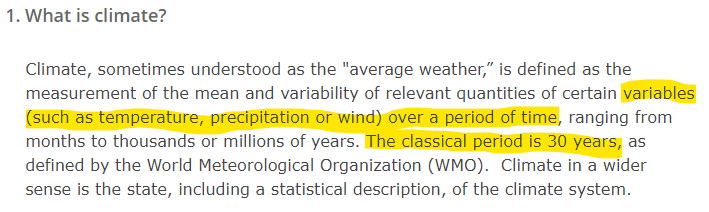
Weather is an event that might last for minutes to a few days. A heatwave is a weather event that is typically linked to large scale weather patterns, such as a high-pressure cell which can create heat-domes in the summer. Climate is an average of weather over a thirty-year period as defined by the World Meteorological Organization. Note my highlights:
Each of these stories trying to link climate change to the heat wave does so without any proof whatsoever. They are nothing more than speculative fearmongering.
And, it isn’t limited to print and Internet media, the TV stations are overhyping it as well to make it seem like a crisis with the use of color. Figure 1 is a comparison of TV graphics on the British Broadcasting Corporation (BBC) in Summer 2012, versus Summer 2022.
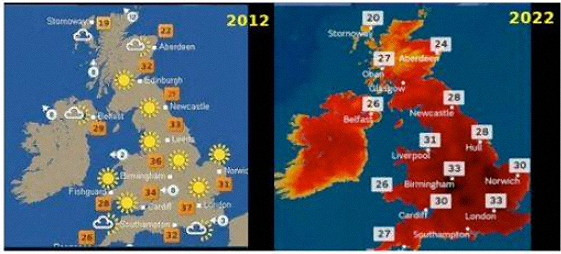
Figure 1: Comparison of TV weather Maps from the BBC in summer 2012, left, and summer 2022 right. Source: BBC
Note that in 2012, some of the temperatures were actually higher, and they didn’t need to fill in areas with red to make it look worse than it actually is.
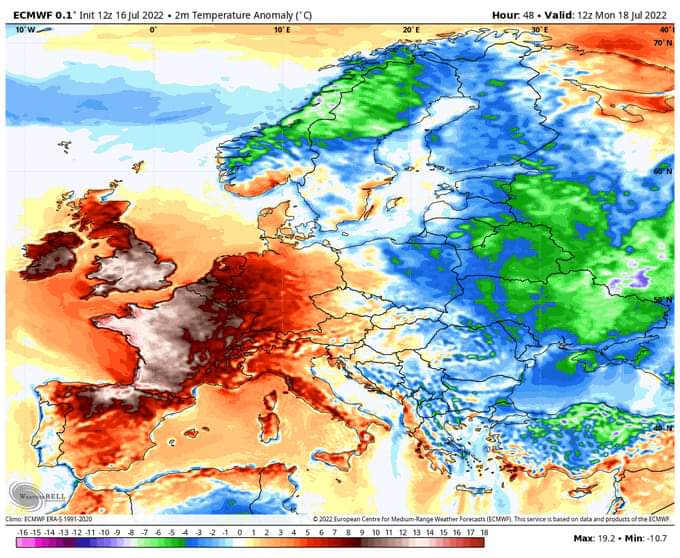
Another thing that you won’t find reported in the BBC on in the newspapers/Internet media is the fact that while record heat was going on in Western Europe, Eastern Europe was experiencing well below average temperatures. Figure 2 below shows the juxtaposition of heat in the UK and Europe compared to the below normal temperatures in Eastern Europe, which the press has ignored.
Figure 2: Surface Temperature map for UK and Europe on July 19, 2022. Image from ECMWF output via WeatherBell Inc.
That dramatic regional temperature difference seen in Figure 2 is a sure sign of this being a weather pattern, and not global scale climate change aka global warming as the media would have you believe. The same applies to the heat wave in the U.S. as seen in Figure 3. It is regional in its scope, not global.
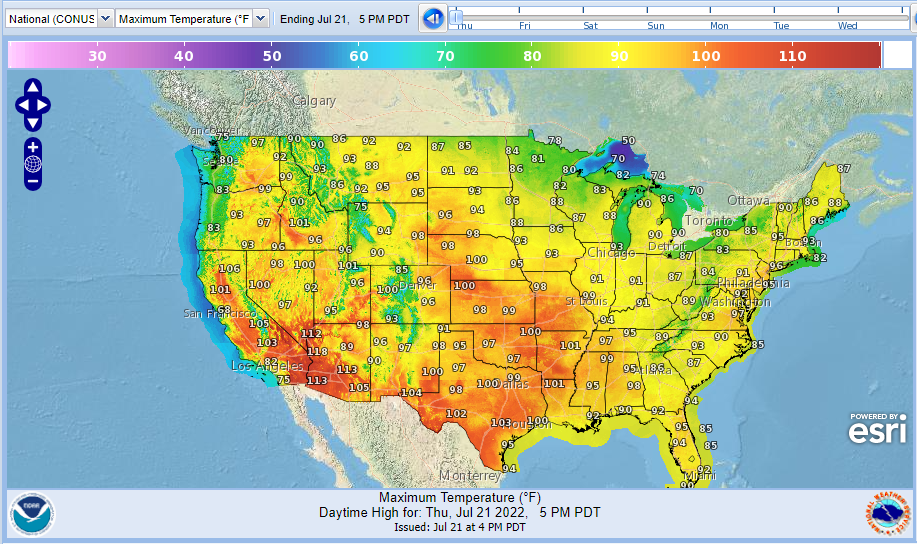
Figure 3: Maximum Temperature for the Contiguous United States July 21, 2022. Source NOAA
As reported in Climate at a Glance: U.S. Heatwaves,
… in recent decades in the United States, heat waves have been far less frequent and severe than they were in the 1930s.
The all-time high temperature records set in most states occurred in the first half of the twentieth century.
The heat wave of 1936 was far deadlier. To their credit, The Washington Post got it right in this report:
The killer U.S. heat wave of 1936 spread as far north as Canada, led to the heat-related deaths of an estimated 5,000 people, sent thermometers to a record 121 degrees Fahrenheit in Steele, N.D., and made that July the warmest month ever recorded in the United States.
But the real issue is that extended high temperatures like the U.S. and Europe have experienced this month have happened before climate change became the universal go-to for blame. It only takes a small amount of research to discover these facts.
A search of the term heatwaves, on Wikipedia, for instance, finds that a heatwave and drought in 1540 in Europe lasted for 11 months, and that a heatwave in 1757 was the hottest in the past 500 years until 2003. Also, Netweather Community TV, called the 1906 heatwave in the U.K during August and September, “one of the most exceptional heatwaves to ever occurred in the UK.” A 1911 heatwave in France contributed to more than 41,000 premature deaths. More recently, in Europe, there was a massive months-long heat wave in 1976. This came at a time when the Earth was experiencing a 30 year cooling trend, that led many scientists to warn the next ice age was looming. Wikipedia’s entry on the 1976 event reports:
The summer of 1976 was considered to be the hottest summer in Europe, and especially the United Kingdom, during the 20th century. A large high-pressure area dominated most of Europe for all of the summer months. The pressure system moved into place in late May 1976 and remained until the first traces of rain were recorded on 27 August.
. . .
For the entire period much of Europe was bathed in continual sunshine with the United Kingdom seeing an average of more than 14 hours of sunshine per day. 1976 was dubbed “the year of the ladybird” in that country due to the rise in the mass numbers of the insect brought on by the long hot period. In the United Kingdom, the summer coincided with a 16-week dry spell, the longest recorded over England and Wales since 1727.
That high pressure pattern is almost identical to what has been seen in UK and Europe today. The difference is that the media today immediately goes to blame climate change rather than weather patterns, and in the case of this article in The New York Times, they even try to convince you that comparisons between the hot summers of 1976 and 2022 are somehow “misleading.”
“Yet the comparison to 1976 is misleading. The highest recorded temperature then was 35.9 degrees Celsius, whereas on Tuesday it surpassed 40 degrees.”
The BBC reported:
“Thermometers hit 40.3C at Coningsby in Lincolnshire, while 33 other locations went past the UK’s previous highest temperature of 38.7C, set in 2019.”
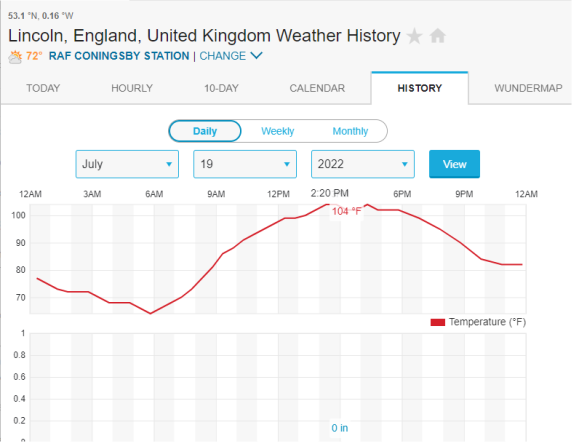
Figure 4. Graph of Temperature at RAF Base Coningsby for July 19th, 2022 showing a max temp of 104°F, Source: WeatherUndergroud.com
What the BBC and the NYT don’t tell you is that the 40 degree Celsius (104 Fahrenheit) was set at a Royal Air Force (RAF) base next to the heat absorbing sea of runway asphalt and tarmac. Figure 4 shows the temperature hour-by-hour that day and where it was recorded.
By contrast, the BBC reports “… the [previous] highest temperature ever recorded in the United Kingdom was 101.7 degrees, observed in Cambridge [at Cambridge University Botanic Garden] in July 2019.“
A botanical garden is an entirely different environment than an RAF air base. The latter would be expected to be much warmer due to the lack of shade, the heat absorbing materials present, and the hot air expelled from jet engines. So, the “misleading” claim of the NYT is really about the lack of solid journalism in reporting the environment under which these temperatures were recorded.
It is well-known that the Urban Heat Island (UHI) effect can contribute to warmer high temperatures, and given the UK went from 56 million people in 1976 to 67 million in 2020, it isn’t the least bit surprising that the UHI increased as infrastructure to support that 11 million extra people was added to that island nation.
The final word comes from meteorologist Cliff Mass, PhD, who did a thorough analysis of the short-lived heatwave event and writes (emphasis his):
The truth and overwhelming scientific evidence provide a different story: the recent European heatwave is mainly the result of natural processes but was enhanced modestly by human-caused global warming.
The situation is very much like the [Pacific] Northwest heatwave of last summer; with many of the same elements.
…
The bottom line is that the recent European heat wave was caused by an amplification of the northern hemisphere wave pattern, with global warming contributing perhaps 5-10% of the warmth. Natural variability of the atmosphere was the proximate cause of the warmth and does not represent an existential threat to the population of Europe.
Clearly, there’s no cause for alarm, no matter what the media says. But the media won’t tell you any of that, because it ruins their narrative of being able to blame the heatwave on climate change, while hoping you don’t notice their distortion of the truth about ordinary weather events we see every summer.
New Prime Minister will have to pause Net Zero or face the demise of UK’s steel industry
Net Zero Watch | July 22, 2022
London – With the exorbitant costs of Net Zero plans threatening Port Talbot steelworks with closure, the next Prime Minister will be faced with a stark choice: pause Net Zero plans for energy-intensive industries or preside over the end of the UK steel manufacturing.
The warning comes from the director of Net Zero Watch, Dr Benny Peiser.
Tata Group, the owner of the UK’s largest steel manufacturer, has threatened to shut down operations if the government does not agree to provide £1.5bn of subsidies to help it reduce CO2 emissions.
The crisis for UK steel demonstrates that the cost of Net Zero is an existential threat to British industries and manufacturing.
As an energy-intensive manufacturer of internationally traded commodities, the steel sector is particularly sensitive to the astronomical cost of decarbonisation. It is the first to acknowledge that the industry simply can’t survive Net Zero without multi-billion handouts – but it won’t be the last.
Tata Steel and the energy-intensive sector more broadly can be regarded as a canary in the coalmine, giving early warning of a more general economic and industrial disaster, as the rising costs of Net Zero trickle down to the rest of the economy.
Dr Peiser said:
“The new Prime Minister is unlikely to be willing to hand over subsidies on the scale demanded by Tata, not least because every other industry hit by demands for decarbonisation would insist on handouts too.
“It is becoming more evident by the day that the Climate Change Committee misled Parliament over the true cost of Net Zero. Most energy-intensive businesses in the UK won’t be able to survive the looming Net Zero cost crisis unless the new Prime Minister takes swift action.”
UK police told to back off “offensive” tweets and get back to real crimes
By Christina Maas | Reclaim The Net | July 23, 2022
New interim guidance by the UK’s College of Policing says police should focus on catching criminals rather than social media “offensive” speech. The guidance reminds police that they have to respect freedom of speech and avoid getting involved in lawful debate on social media simply because an individual has been offended.
Last year, former police officer Harry Miller successfully challenged the recording of non-crime hate incidents after he got a visit from an officer from the Humberside Police over a tweet that was considered transphobic.
The Court of Appeal ruled that the recording of non-crime hate incidents was “plainly an interference with free speech.”
While records of no-crime hate incidents do not appear on the basic Disclosure and Barring Service checks, they could appear on the thorough searches conducted on those applying for jobs as carers and teachers.
CEO of the College of Policing Andy March said that police should not interfere with “lawful debate.”
“The public rightly expect the police to focus on cutting crime and bringing criminals to justice,” he said.
“While we work to protect the most vulnerable in society, we also have a responsibility to protect freedom of speech.
“This updated guidance puts in place new safeguards to ensure people are able to engage in lawful debate without police interference.”
The new guidance tells officers not to record non-crime incidents that are “trivial or irrational” and when there is “no basis to conclude it was motivated by hostility.”
“Individuals who are commenting in legitimate debate, for example, on political or social issues, should not be stigmatized simply because someone is offended,” the guidance states.
It also says that if an officer must record a non-crime hate incident, they should do so in the “least intrusive way possible,” and should avoid specifying locations and using names.
“The police regularly deal with complex incidents on social media. Our guidance is there to support officers responding to these incidents in accordance with the law, and not get involved in debates on Twitter,” Marsh added.
Patronising, selective, abusive – the vaccine propaganda machine at its worst
By Laura Perrins | TCW Defending Freedom | July 22, 2022
ONE thing I will say about Wednesday night’s BBC programme Unvaccinated is that it had to be seen to believed. It managed to be patronising, ignorant, selective and abusive all at the same time. I doubt if even my extraordinary talents can quite convey the level of vaccine propaganda that the national broadcaster engaged in.
If you did not see it, Unvaccinated (available on iPlayer) was a programme whereby the BBC picked a group of people who have exercised their right to medical choice and bodily autonomy and decided not to be injected with an mNRA ‘vaccine’, and got them together, Big Brother-style, in an attempt to change their minds. They were subject to a regime of gaslighting, ‘heated debate’ and an odd jelly-bean experiment. Along the way to help these poor ignoramuses see the error of their ways were a presenter, The Scientists and some bloke from Full Fact, ‘the UK’s independent fact checking organisation’.
The low point was when a young participant explained how a friend started having seizures days after her first jab. This has devastated her life. Unsurprisingly this made the attendee ‘hesitant’ about receiving the Covid vaccine. The response from the presenter was, How can you be sure it was the vaccine that caused the seizures? Maybe it was something else? Just how is a young girl supposed to prove that a serious side-effect such as a seizure was not caused by the vaccine taken only days earlier? As she rightly pointed out, given the age of the victim, it is highly unlikely that this would have occurred naturally. But it’s not impossible, replied the presenter. Sure, it is not impossible, just like pigs might indeed sprout wings and fly.
This gaslighting came after a lengthy session on how mild side-effects are often imagined. Placebo side-effects were real – namely if you thought you would get a side-effect then you were more likely to experience this side-effect. So, you just imagined that blood clot.
Then there was a discussion on myocarditis – this was when the jelly-beans came out to demonstrate how unlikely it is one would suffer such a side-effect after the vaccine. You are more likely to suffer myocarditis from Covid, we were told. The jelly-bean experiment didn’t seem to convince anyone, and positively enraged one attendee.
Then the Unvaccinated met The Scientists, who explained how they were able to develop the mNRA vaccine in an ‘unprecedented’ time scale: ‘The vaccines that we are using in this country at the moment are quite different from vaccines that we have used in the past.’ (They certainly are.)
They were developed at such breakneck, too-good-to-be-true, never-before-done-in-the-history-of-mankind speed because they got critical information from China. The Scientist explains, ‘We were able to get the code for the spike protein on the virus within a matter of weeks from China, and that code was enough to make the spike protein.’ (I am sure you are fully reassured now, dear reader. The code for the spike protein came from China. So you’re all good.) That didn’t really fill me with confidence, I have to say. (For some very real worries about this rushed vaccine, turn to Paula Jardine’s disturbing report for TCW here.)
The other reason for the high-speed development and rollout was, according to the presenter, who heard it from an academic, good old ‘bureaucracy’, or at least the lack of it. Allegedly, all The Scientists were able to clear their diaries so they could make meetings immediately instead of three months down the line and, ta-dah – the vaccine appears! ‘They got rid of everything else in their diary and this was the priority.’ Praise be.
The gang at Full Fact got a slot to explain all about the trouble with ‘disinformation’ and ‘misinformation’ and all the rest of it.
The biggest elephant in the room was the fact that the virus presents little if any threat to the attendees, who were all young. If the risk of the virus to the attendees isn’t analysed then there is no point in talking about how likely mild or serious the side-effects of the vaccine are.
Much of the programme came down to emotion v The Science and the manipulation of statistics, in particular confusing causation with correlation. It is right we should always be careful of statistics. Ultimately, however, I believe the attendees’ gut instinct is against this vaccine but these days, emotion or instinct is routinely dismissed. Nothing can come above The Science, and The Charts and The Technocrats and The Experts. Sir Roger Scruton defended instinct as an entirely appropriate way upon which to make a decision. It is another word for wisdom and common sense built up over a lifetime of experience. One can apply common sense and wisdom when considering the advice given by an expert, but that advice should not trump the commonsense decision which has to be made by the ordinary person.
Experience tells me that in the face of a virus which presents a tiny risk to me, or indeed anyone, it is best not to be injected with a vaccine developed in record time using an entirely new method and relying on information from communist-run China.
My life experience tells me I have an immune system and I trust that more that the government, Big Pharma, China or indeed the BBC. In fact, when a jury consider a verdict in a criminal trial they are directed to apply their common sense and life experience when considering the evidence and coming to a verdict. If common sense is good enough to convict someone of a criminal offence, it should be good enough when considering whether to have a vaccine.
One of the attendees observed that you have only one life and one body, so you have to be careful what you put into it. That really sums it up. Despite the BBC’s best efforts, I doubt that they will have changed any minds with this programme.
Brits could lose passports for using drugs
Samizdat | July 19, 2022
Recreational drug users in the UK could soon be stripped of their passports or driving licenses under a series of new laws proposed by the Home Office on Monday.
In the document titled ‘SWIFT, CERTAIN, TOUGH New consequences for drug possession,’ the Home Office proposes introducing three tiers of punishments for possession of illegal drugs such as cocaine and cannabis.
The penalties vary from being forced to pay for a drug awareness course to being issued with a hefty fine, and could even result in the loss of an offender’s passport and driving license.
“Tier 1: A person should be issued with a fixed penalty notice as an alternative to prosecution, which requires them to attend and pay for a drugs awareness course,” the white paper suggests, adding that if the individual does not attend the course, they will be forced to pay an increased fine.
The second tier suggests that persons caught with illegal drugs could be offered a caution which could include “a period of mandatory drug testing alongside attendance at a further stage drugs awareness course.”
Under the third tier, the person would “likely” be charged for their offense, and, on conviction, could be faced with an exclusion order, drug tagging, passport confiscation, and driving license disqualification.
Home Secretary Priti Patel explained the need for harsher punishments for drug-related offenses by insisting that “illicit drugs are at the root of untold harm and misery across our society.”
She added that more people die every year as a result of drug misuse than from “all knife crime and traffic accidents combined.”
“Drugs also cause enormous harm to children and young people, impacting on their health and their ability to work and learn. The total cost to society and taxpayers is huge too, running close to £22 billion ($26.4 billion) a year in England alone,” she wrote in the document.
Patel stated that the purpose of this newly proposed legislation is to ensure that drug users are “more likely to be caught” and face “tougher and more meaningful consequences.”
“We want to see swift and certain interventions delivered which can deter drug use and, alongside other measures, reduce demand for drugs,” she concluded.
The document sets out a goal of clamping down on the “cohorts of so-called recreational users” and driving down demand for illicit substances. However, it does not seek to address illicit drug use among children or adults with drug addiction.
It also notes the dangers of the drug trade, stating that “too often, individuals who choose to use drugs casually are sheltered from or wilfully ignore the human cost of the drugs trade which is immediately around them. They are putting money into the pockets of dangerous drug gangs and fueling violence, both in the UK and across the globe. We want this to change.“
According to the document, in 2019/20, over three million people in England and Wales reported using drugs in the last year. The Home Office argues that these people were putting themselves at risk, making communities less safe and handing lucrative profits to criminals driving a violent and exploitative supply chain.
Watershed Moment for Sceptics as PM Candidate Rishi Sunak Makes Election Pitch Saying “I Stopped Lockdown”
BY WILL JONES | THE DAILY SCEPTIC | JULY 21, 2022
In a watershed moment for lockdown sceptics, Prime Minister candidate Rishi Sunak has said his opposition to lockdown is a reason that Conservative members should vote for him to lead the country.
In an interview with Andrew Marr on LBC, the former Chancellor said that last December he cut short an overseas trip and flew back to London to intervene and “stop us sleepwalking into a national lockdown”.
“We were hours away from a press conference that was going to lock this country down again because of Omicron,” he said. “And I came back and fought very hard against the system, because I believe that would be the wrong thing for this country, with all the damage it would have done to businesses, to children’s education, to people’s lives.”
It is the first time a leading politician, whether from the Government or opposition, has suggested that being opposed to lockdown is a reason to vote for him or favour him for office. It is indicative of a significant shift in public opinion about Covid restrictions, particularly that Sunak felt able to be so bold in trumpeting his opposition to lockdown and his role in defeating it without a need to couch it in careful language about taking the virus seriously and being cautious. That his interviewer, Andrew Marr, didn’t challenge him on it is further indication of how opinion has changed. This is despite a number of recent high profile calls for restrictions to be reintroduced, most recently by the editors of the BMJ and HSJ.
It offers hope that the future lies with politicians willing to turn their back on the ruinous and illiberal restrictions of 2020 and 2021.
Here is what Rishi said in full.
I’ll tell you what I was doing in December, though, because I still remember it quite vividly. You know what I did in December was fly back from a Government trip I was on overseas and I flew back to this country to stop us sleepwalking into a national lockdown. Because we were hours away from a press conference that was going to lock this country down again because of Omicron. And I came back and fought very hard against the system, because I believe that would be the wrong thing for this country, with all the damage it would have done to businesses, to children’s education, to people’s lives.
That’s really important in December Andrew because we were hours away, we were hours away from a national lockdown, but I came back and challenged the system, and said this is not right and we don’t need to do this and I’m glad I won the argument. But it should give people some confidence that in the same way I stood up for Brexit, in the same way I did that, I am prepared to push hard and fight for the things that I believe in even when that’s difficult.
Watch it here (from 28:45).
Featured Video

The Truth About the Trump Shootings with Ken Silva
or go to
Aletho News Archives – Video-Images
From the Archives
Trans ‘milk’ as good as the real thing – NHS
RT | February 18, 2024
The drug-induced nipple secretions of trans women are as good as mothers’ breast milk for babies, the University of Sussex Hospitals NHS Trust claimed in a letter to campaigners made public in a report by British think tank the Policy Exchange on Sunday.
The healthcare trust’s medical director, Rachel James, argued that the off-label prescription drug cocktail men transitioning to female take in order to produce milk was “similar to the natural hormones which encourage lactation to develop when the baby is newly born.”
“The evidence which is available demonstrates that the milk is comparable to that produced following the birth of a baby,” James wrote in the letter, sent to Children of Transitioners last August.
Biological men who wish to lactate must first take hormones to grow milk glands and then take high doses of either domperidone or metoclopramide to stimulate milk production. Neither drug is approved for this use, though they are occasionally prescribed off-label to biological women who have trouble lactating.
However, domperidone’s own manufacturer, Janssen, warns patients the drug “may cause unwanted side effects affecting the heart in a breastfed baby” and “should be used during breastfeeding only if your physician considers this clearly necessary.” … continue
Blog Roll
 Aletho News
- Leaked: Britain’s Sham Conviction Of Hashim Thaci
- Seyed M. Marandi: U.S. Strike Imminent – Toward Total War in the Middle East
- Russia Voted Under Fire. Washington Is Loading the Tankers.
- 12 Things Your Oncologist Was Trained Not to Tell You
- Anthrax Attacks Paved Way for COVID-Era ‘Junk Drugs and Vaccines’
- How Real Is the Impact of Western Sanctions on Israel?
- France, You Are Guilty: How Paris Turned Western Sahara into the Maghreb’s Powder Keg
- 2025 Nature Paper Claiming Worsening Global Drought Gets RETRACTED …Heavily Flawed
- Your Milk Is Not the Problem
- The Truth About the Trump Shootings with Ken Silva
- If Americans Knew
- Salah Sarsour’s Legal Team Says DHS Has Not Met Its Burden to Prove He Is Deportable
- An analysis of tax forms by The Intercept show Kraft’s charity and LLC have donated to Friends of the IDF and AIPAC’s super PAC.
- Israeli attacks kill four Palestinians in Gaza – Daily Update
- Inside Gaza’s death trap of collapsing, bombed-out buildings
- The everyday items Israel bans from Gaza every day
- Inside the siege, the ruined buildings of Gaza – Daily Update
- Debunking The Claim That Macklemore Has A “History Of Antisemitism”
- CPJ demands release of arrested Palestinian-US journalist near Bethlehem
- Robert Kraft: The Billionaire Friend of Netanyahu Pulling The Strings Behind the Macklemore/Ed Sheeran Blow Up
- Columbia Administered Fund Gives Big Money to Pro-Israel Groups
- No Tricks Zone
- 2025 Nature Paper Claiming Worsening Global Drought Gets RETRACTED …Heavily Flawed
- New Study: ‘Global Drought Shows No Detectable Recent Acceleration Under Climate Warming’
- Economic Masterminds: German Socialists Suggest Taxing Productivity Gains Stemming From Using AI
- The South China Sea Has Not Been Cooperating With The Climate Change Narrative
- Energy Crisis: Germany Enters Heating Season With Historically Low Gas Reserve Fill Levels
- New Study: The Antarctic Ice Sheet Gained Mass From 2020-2024 Due To Staggering Snow And Ice Accumulation
- Study: Ocean Heating Rates From Thousands Of Years Ago ‘Dwarf’ Modern Ocean Heating Rates
- Climate Extremists Target, Attack Large-Scale Power Grid Infrastructure In Germany!
- New Study: Antarctic Ice Melt Has Contributed Less Than 1 Centimeter To Sea Level Rise In The Last 30 Years
- Fear Of Debate: Alarmist German Climate Scientist Calls On Mainstream Media To Discredit Skeptic Voices
 Aletho News