New data reveals British sea level records stretching back 200 years

Credit: University of Liverpool / National Oceanography Centre (Liverpool branch)
Tallbloke’s Talkshop | March 2, 2021
The graph looks consistent with mild warming following the Little Ice Age. About 30 cms. or 1 foot of sea level rise in 130 years since 1890 is nothing remarkable. The average duration of solar cycles was longer in the 19th century than in the 20th but that trend is reversing now, with a lot more sunspot-free days per cycle. Climatic effects may follow.
– – –
A study published by University of Liverpool scientists, alongside colleagues from the Liverpool branch of the National Oceanography Centre, has uncovered and analyzed new sea level records from the nineteenth century which show that the increased rate of the rise of British sea level took place from 1890 onwards, says Phys.org.
Nowadays, sea level measurements around the British Isles are made by tide gauges which record digitally and transmit the data automatically.
The best of these records are fed into the Permanent Service for Mean Sea Level (PSMSL) which brings together the long, reliable tide gauge records from around the world.
However, in the nineteenth century the only long tide gauge records for Britain which stretched back beyond 1895 were from Aberdeen, Liverpool and Sheerness, and of these only Sheerness has records from before 1858.
None of these records is continuous, and it is not clear whether they represent the sea level of Britain as a whole, but they suggest that there was little in the way of British sea level rise prior to 1890.
Now in a paper published in the journal Progress in Oceanography, Liverpool researchers have for the first time produced a continuous sea level rise record for Britain dating back to 1820 by piecing together new sources of information from more than 100 new sites.
The new sources include old manuscripts, maps, admiralty dockyard data and tidal ledgers and provide a huge amount of detailed sea level data for different times and different locations around Britain.
Continued here.
Jab Kids ‘As Fast As We Can,’ Says SAGE Professor On BBC News
By debess | Principia Scientific | March 1, 2021
Professor John Edmunds, a UK scientists acting as a shill for Bill Gates appears on BBC news to promote the disgusting practice of jabbing children with a ‘vaccine’ that is more likely to harm them than help them.
This is the currently reality of the eugenicists’ culling agenda – kill the old and the young (they don’t produce, only consume) If we can’t get them all, sterilize the rest.
From HugoTalks https://hugotalks.com/
Via tangentopolis (world orders review) with many excellent links!
https://www.bitchute.com/video/GoIJbmt6aA5U/
Also See:
Vaccines “Unlikely to COMPLETELY STERILIZE a Population” – Sir John Bell
https://www.bitchute.com/video/94NyKw1b6B2Q/
HOW TO REFUSE MANDATED VACCINATIONS – GETTING READY TO SAY NO!
https://www.bitchute.com/video/VagDtXsF3mQb/
The Eugenics Vaxtrap – Dr Sherri Tenpenny
https://www.bitchute.com/video/9tI9SxZ4pLht/
More at www.bitchute.com
Covid-19: Murder by Misinformation
By Janet Menage, GP retired | Wales, UK
Dear Editor
History is littered with examples of the atrocities which ensue when doctors abandon their traditional principles and judgement in favour of unquestioning subservience to government diktat – medical involvement in torture, human experimentation and psychiatric punishment of political dissidents being familiar examples.
Abbasi takes as axiomatic that there was no prior immunity in the population, that lockdowns are effective, that computer modelling is realistic, that statistics have been accurate and that WHO statements are reliable. All of these parameters have been widely challenged by knowledgeable and conscientious researchers whose findings were often disregarded, censored or vilified.
From a medical perspective, it was clear early on in the crisis that disregarding clinical acumen in favour of blind obedience to abnormal ventilation measures, reliance on an unsuitable laboratory test for diagnosis and management, and abandoning the duty of care to elderly hospitalised patients and those awaiting diagnosis and treatment of serious diseases, would create severe problems down the line.
Doctors who had empirically found effective pharmaceutical remedies and preventative treatments were ignored, or worse, denigrated or silenced. Information regarding helpful dietary supplements was suppressed.
This was further compounded by rule-changes to death certification, coroners’ instructions, autopsy guidelines, DNR notices and the cruel social isolation policy enforcement regarding family visits to the sick and dying.
When medical professionals allow themselves to be manipulated by corrupt politicians and influenced by media propaganda instead of being guided by their own ethical principles and common sense based on decades of clinical experience, the outlook becomes very bleak indeed.
Historically, public respect for and trust in doctors has exceeded that awarded to politicians. The unquestioning capitulation of medicine to an authoritarian executive and predatory corporate power may have undermined the doctor-patient relationship for a generation.
Competing interests: No competing interests
Important editorial notice for readers: This is a rapid response (online comment by a third party) and not an article in The British Medical Journal. It is attributed in a misleading way on certain websites and social media. The Editor, 10/02/2021.
‘Slow’ Atlantic Ocean may cause climate chaos–Or There Again Maybe Not!
By Paul Homewood | Not A Lot Of People Know That | February 27, 2021

The Atlantic current system which maintains mild weather in Europe is at its weakest in over a millennium, most likely because of climate change, scientists have found.
The Atlantic Meridional Overturning Circulation is part of a system of ocean currents which acts as a conveyor belt to move water around the Earth, redistributing heat and acting as a key link in maintaining the world’s climate.
It began a serious slowdown around 1850 and is now at its lowest point in 1,000 years, according to a new study in the journal Nature Geoscience.
It is not certain what the impact of further weakening will be on weather patterns, but scientists believe it could bring more heatwaves in Europe, and sea level rise on the east coast of the US.
The impact of changing water temperatures is also potentially devastating for some marine life, with the slowdown already linked to lower cod numbers off Maine.
Some evidence suggests there could be a ‘tipping point’ sometime after 2100 when the system collapses, which could cause intense winter storms in Europe and a significant cooling effect across the northern hemisphere that would not be offset by global
Co-author Dr David Thornalley, from University College London said: “This study shows the increasing evidence in support of the modern Atlantic Ocean undergoing unprecedented changes in comparison to the last millennium, and in some cases longer.”
Scientists from Ireland, Britain and Germany looked at 11 different sources of data, including tree rings, ocean sediment and corals.
The AMOC has only been directly measured since 2004, leaving scientists to rely on indirect measurements such as these to monitor historic change, which produce imprecise results.
Dr Laura Jackson, a Met Office scientist specialising in AMOC who was not involved in the study, said there were “still uncertainties associated with using these indirect observations.”
But the paper adds to previous research that found a weakening of the AMOC, with one study suggesting there has been a 15 per cent decrease since the mid-century. – Telegraph
In other words they only have data since 2004, and are relying highly unreliable proxies further back Translation – Junk Science!
Meanwhile, another finds exactly the opposite:


Looking into Palantir: Activists want NHS to come clean about secretive deal with data-mining company
RT | February 26, 2021
Under a deal negotiated in secret with the British government, shady data firm Palantir will continue to manage NHS data for two years. Activists calling for transparency have now brought the NHS to court.
When the British government unveiled its ‘Covid-19 data store’ last March, controversial “spy tech” firm Palantir was given control of the data collected from the public, which included sensitive data such as patients’ ages, addresses, health conditions, treatments, and whether they smoke or drink, among other private information. Awarded the contract for a nominal fee of £1 ($1.40), Palantir was only supposed to hold this data until the end of the coronavirus pandemic, but was awarded a second £23 million contract in December, ensuring the data-gathering project will continue until at least December 2022.
The government’s data store – used to inform its pandemic response – was criticized last March for its reliance on US tech firms, like Microsoft, Amazon, and the aforementioned Palantir, to handle Britons’ data. According to an NHS impact assessment, Palantir processes data that includes details on patients’ sex lives, political views, and religious beliefs.
The government inked the deal behind closed doors, and large sections of the contract are redacted – including sections laying out who has access to patient data, how it will be used, and with which third parties it will be shared. Readable in the contract is a line stating that after the coronavirus pandemic subsides, the database may be repurposed for “general business-as-usual monitoring.”
Activists with OpenDemocracy and lawyers with Foxglove Legal this week sued the NHS, claiming that the renewed deal with Palantir warranted a fresh impact assessment and demanding public consultation over the deal, which was awarded without the usual tender process.
As news of the lawsuit broke on Wednesday, the Bureau of Investigative Journalism also revealed that Palantir executives had been lobbying the NHS for access to patient data since summer 2019, six months before the coronavirus first cropped up in China. According to emails seen by the bureau, Palantir’s UK boss, Louis Mosley, hosted a meal attended by Lord David Prior, chair of NHS England, in July. In the days afterwards, Prior thanked Mosley for supplying him with “watermelon cocktails,” and asked him to get in touch with ideas to help the NHS “structure and curate our data.”
In the months afterwards, Palantir offered demonstrations of its services to Prior and his colleagues at its San Francisco offices, and at the World Economic Forum in Davos, Switzerland.
In October 2019, NHS bosses reportedly met with representatives of Microsoft, Amazon, and vaccine manufacturer AstraZeneca to discuss the creation of a “single, national, standardised, event-based longitudinal record for 65 million citizens,” which would be built in the following two years and contain medical and genetic records of every single UK resident. Palantir was said not to be present at the meeting, but Mosley reportedly told Prior shortly afterwards that he had a “very positive meeting” with a top NHS official in private.
Like the mythical seeing-stone it’s named after, Palantir is a company shrouded in secrecy. Launched by billionaire Peter Thiel, Palantir received start-up funding from the CIA and counts multiple US government agencies, law enforcement departments, and military branches among its clients. Its true number of employees is unknown, and former workers are reportedly often forbidden from talking to the media.
Its software has been used by police departments to profile likely offenders and predict future crime, by the military to predict roadside bombings in Middle Eastern war zones, and by immigration authorities to help track, apprehend, and deport illegal immigrants – a partnership it has tried to keep under wraps before.
With both Palantir and the NHS seemingly keen on continuing their partnership, Foxglove director Cori Crider told the BBC that her aim is to prevent the government using “the pandemic as an excuse to embed major tech firms like Palantir in the NHS without consulting the public.”
“The datastore is the largest pool of patient data in UK history. It’s one thing to set it up on an emergency basis, it’s a different kettle of fish to give a tech firm like Palantir a permanent role in NHS infrastructure,” she added.
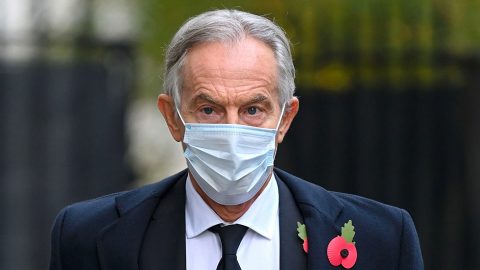
Tony Blair’s anti-freedom project continues, but ‘War on Terror’ is replaced by ‘War on Covid’
By Neil Clark | RT | February 25, 2021
The ‘War on Terror’ seems to have morphed into a ‘War on Covid’. And guess what? Serial warmonger Tony Blair is a key figure in both, seeking to curtail our civil liberties with the excuse that it’s all for the “greater good.”
The date: Monday November 6, 2006. The place: Downing Street news conference. UK Prime Minister Tony Blair dismisses the civil rights argument against ID cards, which his government is keen to introduce. He says it is an issue of “modernity” and “modern life.”
“We are building a new part of our infrastructure here. And like other such projects the gains to citizens will be much larger and more extensive than anyone could say at the time.”
Sound familiar?
Fast forward fourteen years, and the same Tony Blair is saying much the same thing about Covid vaccine passports. There’s been no more zealous British advocate of vaccine passports than the man the anti-lockdown journalist Peter Hitchens calls ‘The Blair Creature’.
“Prepare for a health passport now,” he said in December. “I know all the objections, but it will happen. It’s the only way the world will function and for lockdowns to no longer be the sole course of action.”
Last week it was reported that ´The Blair Creature’ had been lobbying hard for vaccine passports to be included in Boris Johnson’s so-called ‘road map’ out of lockdown. And they were. The government has announced a review. Michael Gove, a man who once wrote a piece entitled ‘I can’t fight my feelings any more; I love Tony (Blair)’, is heading it.
Tony must be delighted.
Back in 2006, ID cards were promoted as a way of tackling the ‘terrorism’ threat and keeping us all ‘safe’. Vaccine passports are presented today in the same reassuring manner. The War on Terror and the War on Covid have so much in common. They both have five level ‘alert’ systems. ´The Blair Creature’ is the key linking figure.
Both wars (Terror and Covid), have been used as smokescreens to pursue elite, globalist and extremely illiberal agendas. Under the guise of ‘fighting terrorism‘, the US, UK and their allies embarked on a series of regime change wars.
First up was Afghanistan, on the grounds that the Taliban-ruled country had been sheltering Bin Laden. But while you could make a case for linking this to a ’war on terror’ there could be no such excuses for the illegal invasion of Iraq.
Ba’athist Iraq – whose long serving Deputy Prime Minister Tariq Aziz was a practising Christian – was actually a bulwark against extremist groups like Al-Qaeda. The assault on Iraq proved to us that the ‘war on terror’ was a sham. Far from making us safer, the invasion actually greatly boosted global terrorism by spawning ISIS.
In short ‘the war on terror’ made the global terrorism situation much worse, and that’s before we get on to the reduction in civil liberties at home. Air travel has never been the same. Restrictions that were imposed – such as prohibitions on bringing liquids on board flights – and which were billed as ’temporary measures’ are still with us. ‘Anti-terrorism’ legislation has been regularly strengthened while at the same time there’s been covert British action in Libya and Syria on the side of the terrorists, which has led to domestic blowback.
We know for instance that the Manchester Arena suicide bomber Salman Abedi, responsible for the horrific attack in 2017 which killed 22 people, more than half of them children, and his father Ramadan, had links with the anti-Gaddafy Libyan Islamic Fighting Group, allegedly used by the UK authorities as part of their regime change operation. As I noted in a previous op-ed, Abedi Jnr was even rescued from Libya by the Royal Navy.
The ‘War on Terror’ was based on a fundamental deceit. It was a deep state/neocon con trick. Not only was it a war that could never be won, it was never meant to be won. It was meant to be permanent. But in 2020 it was superseded by a new war – the ‘War on Covid’.
Again, we see much the same Manichean rhetoric. George W. Bush famously stated “You’re either with us or against us in the fight against terror.” And so it is today, with ‘virus control’ and not ‘terrorism control’ the focus.
If you oppose oppressive lockdowns, restrictions on free movement, and the introduction of vaccine passports, then you are on the side of the virus. You want to ‘let it rip’. You have ‘blood on your hands’ just like the millions who marched against the Iraq War. Support a more nuanced, proportionate approach with people allowed to make their own risk assessments? No, that’s not allowed. You’re either with the ‘War on Covid’ or against it.
The ‘War on Covid’ gives the Western elites the opportunity to strip away our freedoms and complete the building of the digital ‘infrastructure’ that began under the ‘War on Terror’ and which Blair referred to in 2006.
‘Health passports’ are a key part of that infrastructure, as I noted last summer. The WEF’s ‘Great Reset’ is heavily dependent on their introduction.
Of course, it won’t just be your ‘Covid’ status that’ll be on them; they will be extended into full, digitalised bio-ID cards. Vaccine passports are the gateway to a Chinese-style social credit restricted access control system being rolled out in the West.
Blair, the great authoritarian, hopes to get in 2021 or 2022 what he couldn’t get fifteen years ago. “I think you’re going to the stage where it’s going to be very hard for people to do a lot of normal life unless they can prove their vaccination status… Vaccination in the end is going to be your route to liberty,” he said in a recent interview. And of course he is working hard to make sure we do get to that stage.
Will he succeed? His plan for ID cards fifteen years ago failed because of the strength of opposition. When Labour lost power in 2010, the scheme was ditched. But the Tony Blair Institute (which has received considerable funding for its work from the Bill and Melinda Gates Foundation) boasted on Twitter last May that its ‘teams’ were “embedded in governments around the world, helping them to keep their people safe”.
We know that Blair has been ‘advising’ Health Secretary Matt Hancock and that the secret talks reportedly covered vaccines and mass testing. What is scary today is that the parliamentary opposition – now led by the uber-Blairite Sir Keir Starmer – seems to be even more pro-health passports than the government.
But we shouldn’t give up hope just yet. A petition against Covid-19 vaccine passports has raised almost 200,000 signatures. The campaign against health passports needs the support of the anti-war, anti-imperialist left and hopefully the fact that it’s Tony Blair who is pushing them will cause people to wake up and see the bigger picture. War on Terror, War on Covid. ‘Only connect!’, as the great novelist E.M. Forster might say.
Teacher: I Won’t Force Kids To Wear Masks & I Won’t Wear One Either
By Richie Allen | February 24, 2021
The Telegraph newspaper, to its credit, has published an opinion piece by a secondary school teacher who is based in Essex. The teacher believes that forcing kids to wear masks in the classroom is “Dystopian and abhorrent.”
The teacher has been reading “The Handmaid’s Tale with Year 11’s and described a class full of masked children as “like something out of Gilead.” Expressing concern that masks would make it seem to youngsters that schools are not safe when they desperately need some normality the teacher wrote:
They are already being flooded with messages in the media and the outside world which fill them with fear on a daily basis. The government’s whole campaign is built on fear and children have absorbed that. They have also faced a year of disruption to their learning and been kept apart from their friends. What sort of message does it send to them if we then make them wear a mask in the classroom too?
As well as being physically uncomfortable, it’s going to be almost impossible for them to communicate with me as their teacher. It will have a detrimental impact on their confidence, make them even more reluctant to put their hand up in class to ask questions and engage in the lesson. Many of them, especially those who were already struggling, have fallen massively behind during lockdown and will find it difficult or even impossible to catch up.
I’ve also seen very little evidence to suggest that masks are effective anyway. I am cynical about this idea of asymptomatic transmission. Schools aren’t necessarily the cleanest places in the world but children are meant to be exposed to a few germs to build up their immune systems.
The teacher is absolutely right. It’s dystopian and disturbing in the extreme. Of course it will unsettle children but it will also do them serious harm. Wearing masks for eight hours a day may have a seriously detrimental effect on their physical health. Dozens of studies have found that masks make breathing more difficult, especially for children.
The National Institutes of Health (NIH) found that:
… inhaling high levels of carbon dioxide (CO2) may be life-threatening. Hypercapnia (carbon dioxide toxicity) can also cause headache, vertigo, double vision, inability to concentrate, tinnitus (hearing a noise, like a ringing or buzzing, that’s not caused by an outside source), seizures, or suffocation due to displacement of air.
Parents wise up and wise up fast. You must not allow your children be forced to wear a face covering when they return to the classroom.
Leak shows UK attempt to “derussify” former Soviet bloc
By Johanna Ross | February 24, 2021
Back in 2018, the Anonymous hacker group unveiled documents detailing the UK’s global anti-Russian propaganda campaign, otherwise known as the Integrity Initiative. A covert operation, funded by the Foreign Office and Ministry of Defence, it involved academics like Mark Galeotti, security analysts such as Ben Nimmo and journalists like Deborah Haynes of Sky News, who were all paid to provide negative coverage of Russia in various media settings. In true James Bond fashion, they were all part of a giant global syndicate, instructed to counter the Russian government narrative wherever possible, whether it be in articles, or on social media.
It was a shocking revelation for a country constantly accusing Russia of pushing propaganda and spreading disinformation; it turned out that the UK’s Integrity Initiative was doing exactly that. (Some of the claims made in the documents were nothing less than Russophobic. For example: “The Russian Federation is not a normal country in any sense of the word” (!)) After pressure from independent journalists, such as myself, who covered the scheme, the organization shut down its website. It did not disappear altogether however, and instead quietly rebranded itself with a different name – the Open Information Partnership, and with partners including Bellingcat and Zinc Network, it seems the unit has carried on from where the Integrity Initiative left off.
In the latest twist to the story, a new batch of documents were published last week which appear to show that the UK has now set its sights on manipulating Russian speakers in the former Soviet republics. One project, using the British Council is to promote English language in various Russian satellite states – Armenia, Azerbaijan, Belarus, Georgia, Moldova and Ukraine. The cost of this project alone is £1.5million. It describes how through English language lessons, debating competitions and community events it will challenge the “one-sided, unbalanced information” citizens of these countries get from Russian media.
In another scheme, which it describes as “Independent Media Interventions in the Baltic States Aimed at Promoting Plurality and Balance in the Russian Language Media” it is said how BBC Media Action will work together with three public service broadcasters – ETV+ in Estonia, LSM in Latvia and LRT in Lithuania and their digital and social media platforms in all three countries, to produce Russian language content. It also mentions working with the biggest Russian language portal “Delfi” in the region, to target the Russian-speaking youth. It states that Russian speakers in the Baltic States will be targeted differently according to age: the over 40s through traditional media and the under 40s primarily through social media.
The agenda of working with local media in Baltic States is described as being to promote ‘the values of objectivity, impartiality and trust’. But given the fact that this is a UK Foreign Office project, promoting the English-language world view, how can it possibly be described as ‘objective and impartial’? If any of the authors had ever studied cognitive linguistics, then they would understand that every language speaker has his/her own world view, intrinsically associated with the language he/she speaks. English speakers have their own view of the world which is not “objective” or “impartial” but a product of their own historical and cultural experience.
Therefore it is clear that this is a British soft-power propaganda campaign under the guise of aiding independent media in Eastern Europe. It is reminiscent of the Christian missionaries of the 19th century, who set out to “change the ways” of people they thought as uncouth and “savage” in parts of Africa and Asia. Although this time, it’s not Christianity but liberal or “western” values. It’s Britain projecting its imperial power, just as it did in the past.
Let’s not beat about the bush here. This is a Foreign Office project; it is about information warfare and soft power manipulation to achieve geopolitical goals. It’s essentially about de-russifying the Baltic States and Eastern Europe, to ensure that these populations will fall under the spell of the western liberalism, and reduce any Russian influence lingering from the Soviet era. Fundamentally, it’s to ensure that Russia’s sphere of influence is reduced and the West’s/Nato’s is increased – important if at a future date one needs these populations on side if war was to break out.
In another document it is detailed how the organisation helped Russian Youtubers (unnamed) “creating content promoting media integrity and democratic values” – otherwise known as anti-government bloggers – to hide any foreign funding they were receiving, to manage their online profiles, connect them with legal advice if required and to support “them to develop editorial strategies to deliver key messages”. It has already been suggested on one site that opposition blogger Alexei Navalny could have been helped in this way, as his aide Vladimir Ashurkov was not only mentioned in previous Integrity Initiative leaks, but was recently exposed as having met up with a British diplomat whom he asked for financial assistance for Navalny’s campaign.
If all this doesn’t constitute meddling in Russia’s affairs, I don’t know what does. It would be interesting to know what the British taxpayer would think of all these millions of pounds being spent on interference in an entirely different part of the world, which is Russia’s sphere of influence. Such imperialist behaviour belongs in the 19th century, and doesn’t accept the reality of the multipolar world which is emerging. It shows complete disregard for the ethnic Russians living in the post-Soviet bloc, who should be allowed to live freely as they wish, and not be persecuted for their language and cultural values. Quite frankly, the UK has no business involving weighing in on Eastern Europe; its imperialist ambitions belong in the past.
Johanna Ross is a journalist based in Edinburgh, Scotland.
The Arab Spring – A Personal Story
By Finian Cunningham | Strategic Culture Foundation | February 21, 2021
This week marks the 10th anniversary of the Arab Spring uprisings. Two previous commentaries this week have dealt with the geopolitics of those momentous events. This third part below is a personal reflection by the author who found himself unexpectedly embroiled in the maelstrom. It was life-changing…
I had been living in Bahrain for two years before the tumultuous events of the Arab Spring exploded in early 2011. Before that turmoil ignited, I was working as an editor on a glossy business magazine covering the Gulf region and its oil-rich Arab monarchies. But in many ways, I hadn’t a clue about the real social and political nature of Bahrain, a tiny island state nestled between Saudi Arabia and the other big Gulf oil and gas sheikhdoms of Kuwait, Qatar, United Arab Emirates and Oman.
During my corporate media employment I enjoyed a charmed life: a hefty tax-free salary, and a swanky apartment with rooftop swimming pool, jacuzzi and gym, which overlooked the sparkling Gulf sea and other glittering buildings that seemed to sprout up from reclaimed spits of land off the coast.
It was all weirdly artificial, if not hedonistically enjoyable. The luxury and glamor, the opulence. Unlike the other Gulf states, Bahrain had a distinctly more liberal social scene – at least for the wealthy expats. There were endless restaurants offering cuisine from all over the world. There were bars that freely sold alcohol which is “haram” in the other strictly-run Gulf Islamic monarchies. There were loads of nightclubs and loads of pretty hookers, most of them from Thailand and the Philippines. It all had the atmosphere of Sin City and forbidden fruit for the picking.
I later realized that Bahrain was not “cosmopolitan” as the business magazines and advertisements would gush about. That was just a euphemism for a vast system of human trafficking. All the service businesses were worked with menial people from Asia and Africa who were cheap and indentured labor. Where were the ordinary Bahrainis? What did they do for a living? In the cocooned expat life, the ordinary Bahrainis didn’t exist. Rich expats were there to enjoy tax-free salaries, glamorous glass towers, loads of booze and, if desired, loads of cheap sex.
My wake-up call came when my so-called professional contract was terminated after two years. That was in June 2010. Like a lot of other expats, my job came a cropper because of the global economic downturn that hit after the Wall Street crash during 2008. Advertising revenue failed to materialize for the magazine I was employed on. The British owners of the publishing house – Bahrain is a former British colony – told me, “Sorry old chap, but we can employ two Indians on half your salary.”
So that was it. I was out on the street. Going back to Ireland was not a realistic option. The economy was crap there too and job prospects dim. So I decided to hang in there in the Gulf and apply for jobs across the region. I downsized to a more modest apartment and lived off some savings. The job hunting was the usual wearying, self-debasing grind. “There’s nothing more that I would desire than to work as editor on your prestigious oil and gas trade magazine in Dubai.” Copy and paste as required for countless emailed job applications.
Then came the Arab Spring. The entire region of North Africa and Middle East erupted at the end of 2010, first in Tunisia then in the new year spilling over to Egypt and beyond. Watching TV news was like watching a satellite map of a cyclone sweeping across countries. It was an unstoppable force of nature. There were protests flaring up in Saudi Arabia, Yemen, Oman, the Emirates, and they soon arrived in Bahrain. The rallying call among the masses was for more democratic governance, for free and fair elections, for economic equity.
Little did I know during my earlier charmed expat existence, but Bahrain was a particularly explosive powder-keg. Later, however, I was an unemployed journalist who suddenly found himself in the middle of a storm. It was only then that I began to really understand what Bahrain was all about. I mean the ugly, brutish nature of this “kingdom”.
To be honest, I wasn’t looking for work as a freelance reporter. I had done that in a previous life in Ireland. I was still a journalist, but reporting on political news wasn’t appealing anymore.
During my fruitless job-hunting period for a “dream number” in Dubai, I filled in my time and tried to earn a bit extra by hawking around bars in Bahrain with a guitar and microphone. I had done a bit of that in my previous life in Ireland, not very successfully mind you. But I thought I’d give it a go in Bahrain. On February 14, 2011, I was doing a gig at Mansouri Mansions hotel in the Adliya district of Manama, the capital. It was Valentine’s night. There’s me singing cheesy love songs – Elvis’ ‘I Can’t Help Falling in Love With You’ – and there were hardly any customers. The place was dead.
Then the word came around. “We’re closing early. There’s trouble on the streets.” The whole city was eerily quiet. The Bahrain uprising had begun, not in the capital, but in the outlying towns and villages. On February 14, a young Bahraini man Ali Mushaima was shot dead by state security forces during protests. I was still oblivious to the extent of what was happening.
Overnight the atmosphere in Bahrain was changing to a much more menacing, volcanic one. There was immense popular anger over the young man’s killing.
I was in a taxi in the Juffair area of Manama going to enquire about doing a music gig at another bar. My petty concerns were shattered by the young taxi man who was animated about the protests and the death of Ali Mushaima the night before. The taxi man – Yousef, who I got to know – explained to me about Bahrain’s history. About how the majority of the people are Shia muslims who have lived for centuries under a despotic Sunni monarchy. The Al Khalifa royals were originally from the Arabian Peninsula, a clan of raiders and bandits. They invaded Bahrain as pirates in the 18th century and were made the rulers over the island by the British who wanted a strong-arm regime to look after their colonial possession and sea routes to India, the so-called jewel in the British imperial crown. The Khalifa clan would later become obscenely wealthy after oil was discovered in Bahrain in the 1930s, the first such discovery of oil in the Gulf, predating that of Saudi Arabia. Over the decades, the Bahraini majority would be marginalized and impoverished by their British-backed rulers.
I asked Yousef, the young taxi man, “So what do you make of all these wealthy high-rise buildings and the glamor of Bahrain?” He replied, “It means nothing to us – the Shia people of Bahrain. We are strangers in our own land.”
Yousef appealed to me to attend a protest that night. It was at the Pearl Roundabout, a major intersection and landmark sculpture in Manama. The protesters were taking their grievances right to the very capital, not confining themselves to the outlying squalid towns and villages where the Shia majority were forced to live in ghettoes by the Khalifa regime.
What I encountered was a revelation. Suddenly I felt I was finally meeting the people of Bahrain. Tens of thousands were chanting for the regime to fall. The atmosphere was electric but not at all intimidating for me. People were eager to explain to this foreigner what life was really like in Bahrain, as opposed to the artificial images that plaster business magazines and Western media advertisements for rich investors.
Then I knew right there that there was a story to be told. And there I was ready and willing to tell it.
The protests were quickly met with more violence from the Bahraini so-called Defense Forces. “Defense Forces”, that is, for the royal family and their despotic entourage. The protesters were unarmed and non-violent, albeit passionate in their demands for democracy.
The Pearl Roundabout became a permanent encampment for the protesters. Tents were set up for families to rest in. Food stalls were teeming. A media center was operated by young Bahraini men and women. There was an exhilarating sense of freedom and of people standing up for their historic rights.
For the next three weeks, the Khalifa regime was on the ropes. The police and army were overwhelmed by the sheer number of protesters. At rallies there were easily 200,000-300,000 people at a time. For an island of only one million, there was a palpable sense that the long-oppressed majority had awakened to demand their historic rights against the imposter Khalifa regime. People were openly declaring, “the Republic of Bahrain”. This was a revolution.
In a lucky break, I was filing reports for the Irish Times and other Western media. The money was much appreciated, but more importantly there was an edifying, inspirational story to be told. A story about people overcoming tyranny and injustice.
All that would change horribly on March 14 when the Saudi and Emirati troops invaded Bahrain. The invasion had the support of the United States and Britain. What followed in the next few days was brutal repression and killing of peaceful protesters. The Pearl Roundabout was routed by indiscriminate state violence. Its sculpted monument was demolished to erase the “vile” memory of uprising. Men, women, medics, opposition thinkers and clerics were rounded up in mass detention centers. People were tortured and framed up in royal courts, sentenced to draconian prison terms. To this day, 10 years on, many of the Bahraini protest leaders – many of whom like Hassan Mushaimi and Abduljalil al-Singace I interviewed – remain languishing in jail.
However, a strange thing happened. Just when the story was becoming even more interesting – if not heinous – I found the Western media outlets were no longer open for reports. Some of my reports to the Irish Times on the repression were being heavily censored or even spiked. The editors back in Dublin were telling me that the news agenda was shifting to “bigger events” in Libya and Syria.
The corporate news media were shifting their focus to places where Western governments had a geopolitical agenda. Genuine journalistic principles and public interest didn’t matter. It was government agendas that mattered. The Irish Times and myriad other derivative media outlets were following the agenda set by the “majors” like the New York Times, CNN, the Guardian, the BBC and so on, who were in turn following the agendas set by their governments.
For Washington and London and other Western governments, the Arab Spring became an opportunity to foment regime change in Libya and Syria. The protests in those countries were orchestrated vehicles to oust leaders whom Western imperial states wanted rid off. Muammar Gaddafi in Libya was murdered in October 2011 by NATO-backed jihadists. Syrian President Bashar Al Assad nearly succumbed but in the end managed to defeat the Western covert war in his country thanks to the allied intervention of Russia and Iran.
All the while, the Western media were telling their consumers that Libya and Syria were witnessing pro-democracy movements, rather than the reality of NATO-sponsored covert aggression for regime change.
A person might be skeptical of claims that Western media are so pliable and propagandist. I know it for a fact because when I was reporting on the seismic events in Bahrain – which were truly about people bravely and peacefully fighting for democracy – the Western media closed their doors. They weren’t interested because there were “bigger events elsewhere”. Bahrain, like Yemen, would be ignored by the Western media because those countries didn’t serve the Western geopolitical objectives. Whereas Libya and Syria would receive saturation coverage, saturated that is with Western imperial propaganda.
Bahrain was and continues to be ignored by Western media because it is an integral part of the Saudi-led Gulf monarchial system which serves Washington and London’s imperial objectives of profiteering from oil, propping up the petrodollar and sustaining massive weapons sales. Democracy in Bahrain or in any other of the Gulf regimes would simply not be tolerated, not just by the despotic rulers therein but by their ultimate patrons in Washington and London.
I continued to report on the regime’s atrocities in Bahrain. My reports would be taken by alternative media sites like Global Research in Canada and indie radio talk shows in the United States. The money wasn’t great, but at least I could try to get the story out. In June 2011, four months after the Arab Spring began in Bahrain, the regime copped my critical reporting. I was summoned over a “visa irregularity” to the immigration department but instead was met by surly military police officers who told me I was “no longer welcome in the kingdom of Bahrain”. I was given 24 hours to leave “for my own safety”.
I returned to Ireland where after a few months I would relocate to Ethiopia in September 2011 to work as a freelance journalist for Global Research, initially. Later I began to work for Iran’s Press TV and Russian media. I first started working for this online journal, Strategic Culture Foundation, in late 2012. And my best move? I married an Ethiopian woman whom I had met in Bahrain during the Arab Spring.
Witnessing the struggle for democracy and justice in Bahrain was a privilege, one that I hardly expected or even wanted initially. But it fell to me. I witnessed such bravery and kindness among long-suffering Bahraini people who shared their grievances with generosity and graciousness despite the horror and oppression around them. Their struggle continues in spite of the lying, conniving Western governments and their media lackeys.
UK Police Forced to Respond After Ad Claimed “Being Offensive is an Offence”

By Paul Joseph Watson | InfoWars | February 22nd 2021
Merseyside Police were forced to respond after officers took part in an electronic ad campaign outside a supermarket which claimed “being offensive is an offence,” with authorities later clarifying that it is in fact not an offence.
Over the weekend, the mobile electronic billboard was parked outside an Asda supermarket for a PR campaign.
“Being offensive is an offence” states the ad, which features a police badge superimposed over an LGBT rainbow flag.
“Merseyside Police stand with and support the LGBTQI+ community, we will not tolerate hate crime on any level. Come and speak to #TeamBeb,” states the text on the ad.
The billboard received a huge backlash, with many people pointing out that it is in fact not a criminal offence to be offensive.
Merseyside Police were forced to later clarify in a statement that “being an offensive is not in itself an offence.”
Maybe they should have realized that before putting it in big letters on the side of a van.
The force said that the ad was intended to “encourage people to report hate crime” and “although well intentioned was incorrect and we apologise for any confusion this may have caused.”
Although being “offensive” isn’t illegal in the UK, there is a crime of being “grossly offensive,” but that carries with it a high bar to reach court and is very hard to prove.
As a result of underfunding, police forces in the UK are struggling to keep up with rising crime rates. Back in 2015, the head of the National Police Chiefs’ Council said that officers would be unable to attend some burglaries.
This has led to widespread criticism that authorities are too fixated on policing thought crimes while actual crimes are being ignored.
“Are there no problems with gun or knife crime in Merseyside then?” asked Nigel Farage.
Featured Video
HE SAVED LIVES. NOW HE FACES PRISON.
or go to
Aletho News Archives – Video-Images
From the Archives
NATO Sanctions and the Coming Global Diesel Fuel Disaster
By F. William Engdahl – New Eastern Outlook – 11.04.2022
Amid the ongoing global inflation crisis, NATO heads of state and mainstream media repeat a mantra that high energy prices are a direct result of Putin’s actions in Ukraine since end of February. The reality is that it is the western sanctions that are responsible. Those sanctions including cutting SWIFT interbank access for key Russian banks and some of the most severe sanctions ever imposed, are hardly having an impact on the military actions in Ukraine. What many overlook is the fact that they are increasingly impacting the economies of the West, especially the EU and USA. A closer look at the state of the global supply of diesel fuel is alarming. But Western sanctions planners at the US Treasury and the EU know fully well what they are doing. And it bodes ill for the world economy.
While most of us rarely think about diesel fuel as anything other than a pollutant, in fact it is essential to the entire world economy in a way few energy sources are. The director general of Fuels Europe, part of the European Petroleum Refiners Association, stated recently, “… there is a clear link between diesel and GDP, because almost everything that goes into and out of a factory goes using diesel.” … continue
Blog Roll
 Aletho News
- Trita Parsi: Middle East Unraveling — Are We on the Path to World War?
- Iran FM meets with US envoy on UN meeting’s sidelines at American side’s insistence: Report
- Qatar PM calls for Gulf security framework with Iran, says war must be ‘wake-up call’
- China condemns US extortion of Iranian airlines, rejects Washington’s ‘illegal’ sanctions threats
- Italy to move military personnel from Taif base after missile strike
- Finland’s Stubb tells European leaders to calm down
- Defeating Russia on battlefield impossible – Fico
- Finland’s Gender Clinic Reversal
- Massachusetts Wants Mental Health Visits, Why Does Government Use ‘Health’ to Enter Our Homes & Families?
- US lawmaker admits American people footing bill for Trump’s failed aggression against Iran
- If Americans Knew
- Sanctions are collective punishment: immoral and self-defeating
- Phosphorus Munitions Fired by Israel Burn Groves, Orchards in Southern Lebanon
- Israel Carries Out New Ceasefire Violations Across Gaza
- AI – Emphasis on the ‘I’: Israel Is Funding AI Chatbot Propaganda
- Israel Blocking Hundreds of Wheelchairs for Injured Children From Entering Gaza
- Israel Is Expanding and Upgrading Compounds for Palestinian Militias in Gaza
- The Palestinian-American Residents of This West Bank Town Are Wondering: Where Is Trump?
- Gaza desperately needs tents, wheelchairs, fuel… and everything else (Israel blocks it all) – Daily Update
- Israeli Attacks in Gaza Kill at Least Seven Palestinians Over Three Days, including Woman and Child
- Trump’s militarization of Washington DC as he pursues Israel’s war against Iran
- No Tricks Zone
- New Study: Earth And Venus Surface Warmth Largely Explained By Convection And Lapse Rate, Not CO2 Or Radiation
- 2025 Nature Paper Claiming Worsening Global Drought Gets RETRACTED …Heavily Flawed
- New Study: ‘Global Drought Shows No Detectable Recent Acceleration Under Climate Warming’
- Economic Masterminds: German Socialists Suggest Taxing Productivity Gains Stemming From Using AI
- The South China Sea Has Not Been Cooperating With The Climate Change Narrative
- Energy Crisis: Germany Enters Heating Season With Historically Low Gas Reserve Fill Levels
- New Study: The Antarctic Ice Sheet Gained Mass From 2020-2024 Due To Staggering Snow And Ice Accumulation
- Study: Ocean Heating Rates From Thousands Of Years Ago ‘Dwarf’ Modern Ocean Heating Rates
- Climate Extremists Target, Attack Large-Scale Power Grid Infrastructure In Germany!
- New Study: Antarctic Ice Melt Has Contributed Less Than 1 Centimeter To Sea Level Rise In The Last 30 Years

