“I do everything my TV tells me to do” – That’s why we’re hurtling towards the Great Reset
THE DAILY EXPOSE • JANUARY 18, 2021
If the current pandemic of dictatorial tyranny sweeping across the world has taught us anything, it is that the majority of humanity has been so well trained to obey authority that it is now incapable of free thought and afraid to ask questions. Never before have we seen such docile conformance to words echoing from the speakers of a television screen as when the Prime Minister of the UK announced in March 2020 that he had “one simple instruction” for the British people… ”You must stay at home”. But Mr Johnson spoke through the ‘telescreen’, and the nation listened.
Within an instant the UK economy came to a halt, without question, all because a man, in a suit, on the TV said it should. Hundreds of thousands of businesses closed their doors to customers and staff. Schools and nurseries closed their doors to children, which in turn lead to parents being unable to work because they could not find care for their children. Unless of course the man, in a suit on the TV told them that there job was deemed essential, in which case it was fine to send their children to school and go out to work.
“Three weeks” was what the man, in a suit, on the TV said the country needed “to flatten the curve,”. But three weeks turned into five weeks, which turned into eight weeks, which turned into fourteen weeks. I wonder how many would have complied for so long with an instruction given to them by a man, in a suit, on the TV if it had not been for another man, in a suit, on the TV promising to subsidize up to eighty percent of their wages for sitting at home and not working?
Sounds great doesn’t it, sitting at home and still being paid. The people so eager to accept this scheme most likely didn’t realise that A) it was not the man, in a suit, on the TV paying these wages, it was in fact the British taxpayer. B) They would have to pay this money back in the future via higher taxes, and C) that’s only if they still had a job to pay those taxes as the only purpose of this scheme was to delay everyone’s unemployment to ensure that they complied. It was never about making sure you were going to be okay and have a job to go back to, it was about making sure you were complicit in the destruction of the job market as we know it, in order to bring in the new age of AI.
We bet the authorities could not believe their luck at how easy it was to get the vast majority of every man and woman in the land to obey an instruction that was emitted via the telescreen, and boy have they made the most of it ever since.
On the 3rd April 2020, Professor Jonathan Van Tam, deputy chief medical officer for England, told the British public via the ‘telescreen’ that he had spoke with a colleague in Hong Kong who had carried out an evidence review for the World Health Organisation and stated they “were of the same mind that there is no evidence that the general wearing of face masks by the public affects the spread of a disease in our society, what matters right now is social distancing. In terms of the hard evidence, we do not recommend face masks for general wearing by the public.”
Yet fast forward four months and the Government enforced the wearing of face coverings in all indoor public settings. However we did not instantly see a swarm of face nappy clad folk outdoors for over a week, and why was that? Because the man, in a suit, on the TV said this would not come into force for another week. That week came and went and on the day of enforcement there was not a smile to be seen. But what does that say about the majority of the British public and their acquiescence to authority. Not wearing a face covering because they genuinely thought it would work in the “fight against the virus”, but wearing it because a man, in a suit, on the TV said they would be subject to a £200 fine if they refused to do so. We know this to be true because they would have worn the face covering from the moment it was announced they were required otherwise.
Fast forward another few months and we were told by Professor Jonathan Van Tam, again via the ‘telescreen’ that he did not think there would “come a moment when we can have a big party and throw our masks and hand sanitiser and say ‘that’s it, it’s behind us’ like the end of the war? No I don’t.” Insisting that the wearing of face masks “may persist for many years and that may be a good thing”.
The contractions on the wearing of face masks alone should have been enough for the British public to wake up and question why they were partaking in the destruction of the world as they knew it, unknowingly bringing in a “new normal” and a chance for the globalists to fast forward their “great reset” agenda. But disappointingly it has yet to be the case.
Instead we are now stuck in a cycle of stay at home, protect the NHS, save lives, repeat. Whenever a man, in a suit, on the TV appears on the British public’s ‘telescreen’s’ they stand to attention and hang on every word that echoes from the speaker. We don’t hold much hope that this will change anytime soon, instead we are stuck firmly on the road to the ‘Great Reset’ and we’re hurtling towards it at a few hundred miles per hour.
They do everything their TV tells them to do…but do you?
UK Labour’s recent hire shows ‘complete submission to Zionist lobby’, rights group says
MEMO | January 25, 2021
The UK Labour Party’s decision to appoint a former Israel spy to work in his social media team demonstrates its leaders “complete submission to the Zionist lobby”, a UK-based human rights group has said.
The Arab Organisation for Human Rights in the UK (AOHR UK) criticised the appointment of Assaf Kaplan, who worked as an analyst and officer in Unit 8200 of the Israeli Military Intelligence between 2009-2013, where he monitored, collected, and analysed information on all Palestinians, regardless of their status.
“Unit 8200 constantly breaches international laws and conventions, as it dates back to the period before the establishment of Israel when it was known as Shin Mem 2, which worked on collecting information for Zionist gangs that committed massacres against the Palestinians,” AOHR UK said.
“In September 2014, 43 officers published a letter revealing the filthy role of this unit and how the information it gathered led to the killing of thousands of innocent Palestinians, especially during the wars on the Gaza Strip.”
AOHR UK confirmed that Kaplan’s CV, as well as the past and present of this unit, are known to officials in the British Labour Party, thus raising many questions about the reasons behind his employment given the risks he poses to the security of the party
AOHR UK explained that as a result of his work, Kaplan should be in “prison, not the British Labour Party.”
The rights group went on to call on the leaders of the Labour Party and its supporters to reject this appointment.
Infectious Diseases Expert Says UK Lockdown is Not Working
By Paul Joseph Watson | Summit News | January 21, 2021
Infectious diseases expert Professor Steven Riley says current data shows that the national lockdown in the United Kingdom is not working.
Riley, who is professor of infectious disease dynamics at Imperial College London, cited a React study which shows “the prevalence of infection increased between 6 and 15 January,” after the national lockdown was announced on January 4.
“It’s long enough that, were the lockdown working effectively, we would certainly have hoped to have seen a decline,” said Riley.
The professor added that current research “certainly doesn’t support the conclusion that lockdown is working.”
As we highlighted last week, a peer reviewed study by Stanford researchers found that mandatory lockdowns do not provide more benefits to stopping the spread of COVID-19 than voluntary measures such as social distancing.
The researchers found “no clear, significant beneficial effect of [more restrictive measures] on case growth in any country.”
While numerous studies show that lockdowns have no impact on reducing the spread of viruses, an avalanche of data shows that they cost lives.
Academics from Duke, Harvard, and Johns Hopkins have warned that there could be around a million excess deaths over the next two decades as a result of lockdowns.
Thousands of doctors and scientists are on record as opposing lockdown measures, warning that they will cause more death than the coronavirus itself.
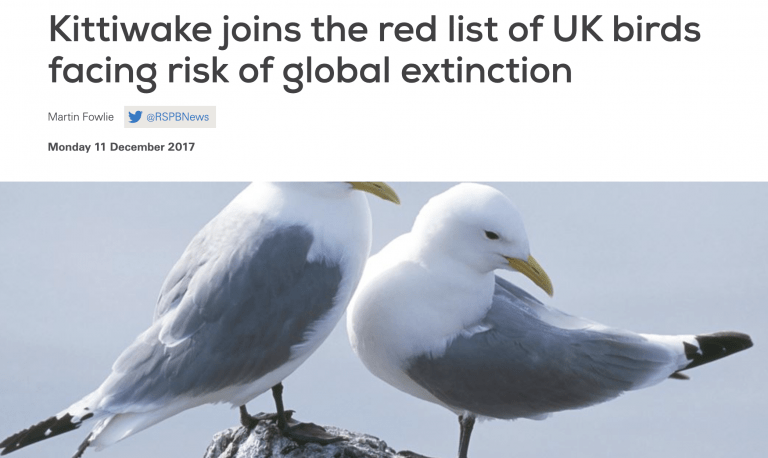
Will Sir David Attenborough attempt to save Red-listed Kittiwakes from giant wind turbine project?
Global Warming Policy Forum – 19/01/21
On the 31st of December last year Alok Sharma, then Secretary of State for Business, Energy and Industrial Strategy, gave planning consent for the giant Hornsea 3 offshore wind farm. He decided to over-ride planning inspectors who had advised refusal on the grounds of unacceptable environmental impacts on the Red-listed Kittiwake populations of the East Coast, whose resting and nesting sites are protected by Natura 2000 legislation, some of the strongest environmental protection in Europe.
In giving consent Mr Sharma said that that contribution of the Hornsea 3 scheme to reaching Net Zero was more important than the affect on the local environment and its bird populations, and justified ignoring Natura 2000 protection.
This sets a precedent that the renewables industry has already identified as “opening the floodgates” for any major industrial development that can make a claim, however tenuous, to low carbon credentials.
The GWPF has written to Sir David Attenborough, asking him to intervene personally to reverse this decision and request a moratorium of the mega-project before it is too late.
Is This Fraud Ever Going to End?
By Dr Vernon Coleman
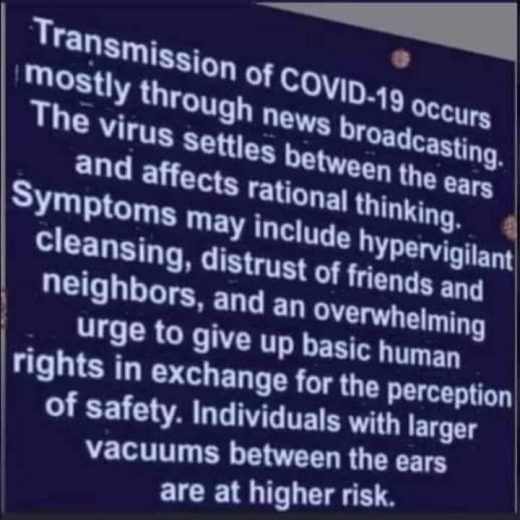
I sometimes envy the zombies who believe that the only problem is an infection which causes a disease called covid-19.
They get up in the morning, check in the mirror to make sure they haven’t died in the night, munch their chocolate flavoured bran flakes, choose a mask that goes best with their chosen outfit for the day and venture out into the world a little nervous but confident that their government is doing its best to protect them in these tricky times.
As they go about their business they disinfect their hands at every possible opportunity, carefully obey the social distancing rules and wait impatiently for the vaccine.
In a way I occasionally envy them their ignorance. They are like not very bright goldfish swimming round and round in one of those glass bowls.
People sometimes refer to the ignorant as sheep but this isn’t fair.
I have kept sheep and they are far more intelligent than most people imagine. Hardly anyone has bothered to do any research because, like cows and pigs, sheep are just farm animals and farmers and vets don’t have much interest in studying animals whose destiny is to be slaughtered, chopped up and eaten.
For example, the books will tell you that sheep are colour blind. They aren’t.
I used to have a four wheel drive vehicle which was the same model as the vet’s. My car was blue and his was green. When the sheep saw my car coming they ran towards me because I always gave them biscuits. When they saw the vet coming they ran away because he always wanted to check their feet and they didn’t like that. I later tested with different coloured feed buckets and I can promise you that sheep are not colour blind. They are actually very bright animals – far more intelligent than Gates, Fauci or Whitty and invariably a darned site better conversationalists. And they are brave too. My sheep once frightened a dog so much that the dog’s owner begged me to call my sheep off his dog.
So, to me, the ignorant thickos who still believe the coronavirus is the new plague are zombies or collaborators.
The vigilance of the collaborators means that every trip to the shops has become something of an ordeal.
The staff in the supermarket are always fine and actually a few seem genuinely sympathetic. But there is invariably one customer who worships Bill Gates, probably has his picture above his bed, and who feels it is his duty to confront any intelligent people he sees with naked faces.
This morning I hadn’t got more than three feet into the supermarket when a pompous, sanctimonious mask-finder general, one of Commander Dick’s shame police, rushed up to my wife and rudely and aggressively demanded that she put on a mask. That’s Commander Dick of the Metropolitan police.
My wife was startled and upset and politely told him that she was exempt. He still scowled, and I thought he deserved more. And with my wife’s permission, I explained that it wasn’t really any of his business but that she’d had surgery for breast cancer and a month’s radiotherapy which has caused damage which makes breathing difficult. Thanks to the absurd coronavirus hoax, the hospital physiotherapy department is still closed so she is in pain most of the day. I wish someone would explain that to me, incidentally. My wife can have a tattoo, were she so inclined, or her hair done, but she cannot have physiotherapy because the physiotherapy department is still closed. I pointed out to the mask-wearing prefect that nurses at the hospital told her to remove her mask after she almost collapsed with palpitations caused by her condition.
You might have thought a human being would have been embarrassed. Not a bit of it. The Dick police specials are shameless. The cretin, utterly indifferent and uncaring, just shrugged and demanded to know why I wasn’t wearing a mask.
I always explain to the thickos that the mask they are wearing does absolutely no good, that mask wearing is dangerous, that they didn’t wear a mask last year so why are they wearing one this year and that covid-19 has killed fewer people than the flu.
I do this because I think these zombies need to be educated before they accost an elderly or frail person and cause serious upset.
Sadly, however, in my now generous experience the mask promoting lunatics always run away when you reply to their muttered, `where’s your mask?’ mantra. The collaborators compound their selfishness and their ignorance with good old-fashioned cowardice: without exception, they run away. Say something, anything, in reply and they scoot away back to the hole in the skirting board.
And that’s what happened with this coward. He ran off. All mouth but no guts.
`You are an idiot!’ I shouted at the retreating mask wearer.
Not witty, I admit, but adequate.
The collaborators will destroy our lives as well as their own unless they are brought to heel.
I had trouble in the bank, too. There was, inevitably, a lengthy queue outside which was fine because Bill Gates’s cloud of calcium carbonate hanging in the sky was keeping the sun at bay though I wonder how many people will freeze to death when the weather becomes a little chillier. All part of the Agenda 21 plan to get rid of the elderly and the frail.
Eventually, when I got a foot in the door, a girl whom I could identify as a staff member only because of her uniform, asked me where my mask was and wanted to know if I was exempt. I smiled and nodded and she offered to get me a lanyard with a label to hang around my neck to show that I was exempt. Since I don’t want a lanyard with a label any more than I want a mask I just smiled and said no thank you and explained that masks are entirely useless because viruses go straight through the material.
`I know,’ she said. `But wearing a mask gives people confidence.’
What madness. She knows that masks are useless but she thinks they give people confidence. Does she think all their customers are half-witted five-year-olds? The answer is obviously yes.
And talking of five-year-olds, when is someone going to start arresting parents who force small children to wear masks? In England, children under 11 are exempt from mask wearing. (Look at the Government website for the latest information because the rules change almost daily.) There is much talk of authorities taking children away from parents who disapprove of vaccination. I think they’ve got it the wrong way round. They should be taking children away from parents who force children to wear masks or let them get vaccinated.
Just before we left town, we saw a maskless man come out of the supermarket. Like conspirators we chatted for a few moments. He was quite awake and aware of the fraud being perpetrated upon us. He told us that he watched UK Column and the old man in a chair. He didn’t have the faintest idea the old man, without his chair, was standing just two feet away from him. We didn’t mention it.
You and I are involved in a war where we are not quite sure whom we are fighting or precisely what their final aims might be – other than the fact that we are destined to be drones, slaves, proles in a world run by a new self-appointed aristocracy.
The minute we think we have worked it out and know what the rules are they change the rules. It is a world which appears to have been designed by Lewis Carroll to make Franz Kafka feel comfortable.
The only stable currency is the lie.
It is no exaggeration to say that it is fair to assume that everything anyone in authority says will be a lie. They do it so naturally that I sometimes wonder if any of the politicians and their advisors realise just how much they are lying. Maybe it’s just like breathing. They do it without thinking.
I think we perhaps all misunderstand how vile politicians are. Auberon Waugh once said that the only thing that any of them is really interested in is the chance to make decisions and see them put into effect – to press a button and watch us all jump.
He was right, but the politicians have recently been joined by an army of advisors, hangers on and confidants who are also in it for the power, and who have very real views on how the world should be but who cannot be bothered to stand for election. The Rothschilds, the Rockefellers, Gates, Soros and so on are all too arrogant to expose themselves to the ballot box and I suspect they all hold us in contempt.
It is often said that the truth will set us free but the one certainty these days is that long before we get there we will be disappointed, frustrated and not a little angry.
They say we must be prepared for a second wave.
A second wave of what?
Did we actually have a first wave? Covid-19 killed less people than the flu. What sort of wave is that? More of a ripple really.
How can there be a second wave without a first wave?
We could, I suppose, have a second ripple.
Take out the hundreds of thousands of old people who were murdered in care homes around the world, and the hundreds of thousands who were put down as dying of covid-19 but actually died of something else and the total number who have allegedly died of the coronavirus can hardly be called a wave. It certainly wasn’t much of a pandemic.
In England and Wales, the excess number of deaths has fallen below the five year average for the fifth week in a row. Moreover, the figures now show that more than 90% of covid-19 deaths occurred in people over 60, and 90% of those who died in hospital had existing health conditions before they got infected. In due course the real figures will be available and they will, I suspect, show that over 90% were in their 80s or older, and had two or three co-morbidities.
There are regions of England where I suspect that more people are dying from falling off horses than are dying from the coronavirus. Does that mean that we’ve having an epidemic of deaths caused by people falling off horses? In many parts of the world anything that actually kills people is a bigger threat than the coronavirus. Is rabies now a global pandemic? How about falling off mountains? I would bet that there have been more suicides, caused by fear and despair for the future than covid-19 deaths in some places in the last month.
Nothing much makes any sense any more, does it?
And yet, as hypnotherapist and author Colin Barron points out, many of the so-called experts on covid-19 don’t have any medical qualifications. Neil Ferguson is a mathematician and yet his predictions were used as the basis for the global lockdowns.
Everyone with a certificate in basic woodwork has suddenly become a medical expert.
The other day the Scottish Daily Mail printed a letter from someone called Professor Greg Philo of Glasgow University who warns `the fear is real and we need a strategy to eliminate the virus’.
So, what is Professor Philo’s medical speciality? Medicine? Surgery? Epidemiology? General Practice?
None of the above.
The only Professor Philo I could find is a professor of communications and social change.
And if you’ve got any idea what that means then you have my commiserations.
Why do such people assume the right to pontificate about whether or not a virus infection is a threat?
As Dr Barron says, there was a time when only taxi drivers were experts on everything. These days even professors of communications and social change want to share their conclusions about a complex piece of global manipulation.
We have reached the strange position where paranoia is no longer a medical condition. It is a rational state of mind. Governments have lied about lockdowns, they have lied about the number of deaths, they have lied about the need for masks and they have lied about social distancing. Trying to dismantle the lies and find the kernel of truth is like playing three dimensional chess and if that isn’t the most mixed up metaphor in history then I’ll try again another day.
I can’t remember the last time a politician said anything that bore even a faint relationship to the truth. You’d be mad not to assume that everything the dishonest, deceitful cynical politicians and the advisors say is a barefaced lie. We’re being ruled by crazed psychopaths who have somehow succeeded in encouraging the collaborators to believe that it is possible to remove all risk from human life.
Politicians and their advisors should be forced to wear logos on their suits to list their sponsors, allegiances and connections. They’d have so many advertising logos they would look like race car drivers. All BBC staff should have EU and the Bill and Melinda Gates Foundation logos on their clothing at all times. The Guardian too. Anyone with links to a drug company should be banned from any sort of public role. As I have shown in previous videos, the world’s drug companies are more dishonest and dishonourable than tobacco companies. We would be better off if the world were run by a cabal of Colombian drug barons than the pirate crew currently striving for global control.
Telling lies is the new normal in our world.
They say that wearing masks will provide protection. This isn’t true. What evidence there is shows that masks are entirely pointless and potentially dangerous. Only the clinically insane and people with IQs in single figures think masks are of any value whatsoever. Why don’t footballers have to wear masks when they’re playing? Because masks impede their breathing. Why do even politicians and government advisors agree that those with respiratory problems don’t have to wear masks? The answer is obvious – because masks impede breathing.
They say that it will be necessary to introduce more lockdowns to prevent more deaths. But even governments now admit that lockdowns cause more deaths than they prevent. So the only possible reason for having more lockdowns is to kill more people.
They say they need to introduce new laws to avoid a second wave of infections and deaths. The truth is that it was the last lot of laws – the social distancing, the lockdowns and the masks – which have caused the deaths. More laws will result in more deaths.
They say we have to close our borders to keep out the virus. This is bollocks. In March I suggested closing airports to control the infection rate. But airports were left open. Now that the death rate has collapsed they want to stop people travelling. They are desperate to stop anyone travelling or having a good time. They are deliberately creating fear to sustain their corrupt, satanic ideology.
They say that testing is showing up more cases. This is so deceitful it’s worthy of Bernie Madoff. The tests which are being used throw up so many false positives that they are about as much use as a castrated ram in a field full of sheep. And even the politicians and their advisors must realise that if you test ten times as many people then the chances are that you will find more people who have or have had the infection. Tracking and tracing is simply an infringement of our civil liberties. It is of no value whatsoever.
They say the only way we will ever get back to normal will be with a vaccine. This is the biggest lie of all. Worst of all, they say that the new vaccine will be safe. They cannot possibly know this. The dimmest, most stupid person you know can judge whether their new vaccine will be safe as well as they can.
Politicians, advisors, commentators and professors of golf course management claim that the world will not get back to normal until there is a vaccine available. There is of course, another unspoken option: that the majority will realise that the coronavirus scare is a hoax; a massive fraud deliberately arranged by people with malignant intentions.
And that’s what is going to happen.
I will leave you with a quote from the Robert Donat film version of the Count of Monte Cristo: `They call me mad because I tell the truth.’
What more can I say?
Vernon Coleman’s bestselling book about the coronavirus is called `Coming Apocalypse’. It is available on Amazon as a paperback and an eBook.
Copyright Vernon Coleman August 2020
Revealed: UK Sets Up Media Influencing Project in Venezuela
By Matt Kennard and John McEvoy | Declassified UK | January 6, 2021
The UK government has established a journalism project to ‘influence’ Venezuela’s ‘media agenda’ while a Foreign Office-funded foundation is spending £750,000 on a secretive ‘democracy-promotion’ programme in the country, as Britain appears to deepen efforts to remove the Maduro government.
- UK government has allocated £250,000 from its aid budget to ‘influence’ local and national ‘media agendas’
- British funding for journalism should not be ‘referred or linked to’, government says
- Westminster Foundation for Democracy has spent over £750,000 in Venezuela since 2016
- It refuses to tell Declassified details about its partners in Venezuela
- Foundation’s country representative sympathised with armed coup attempt in the country
As Venezuela’s political crisis continues, the UK government has initiated a new project promoting investigative journalism in Latin America which furtively covers Venezuela.
The project, launched last summer and intended to “influence” the media agenda in the country, follows a long history of the British government using journalism as an influencing tool. It raises suspicions that it aims to help remove the leftist government of Venezuela president Nicolás Maduro.
In a separate programme, the Westminster Foundation for Democracy (WFD), a majority UK-government funded organisation, has spent over £750,000 to “strengthen democracy” in Venezuela since 2016, according to documents obtained by Declassified.
The WFD’s programmes in the country are shrouded in secrecy due to apparent concerns about the security of its staff, although its country representative advertises his affiliation to the organisation online.
The British government controversially recognises Venezuelan opposition figure Juan Guaidó as president and is running a number of anti-government programmes in the country using the Conflict, Stability and Security Fund (CSSF) which supports projects designed “to tackle instability and to prevent conflicts that threaten UK interests”.
The aim of the fund’s new journalism project is stated to be the creation of a “new platform that strengthens media organisation [sic] throughout the region and provides journalists with a platform in which they can collaborate and build regional stories”.
Programme literature notes that successful applicants should display “a capacity to link into – and ultimately influence – local and national media agendas”.
But they are warned that “the British government — and its resourcing of the project — should not be expressly referred or linked to the individual outputs of the project (i.e. individual articles, events etc).”
Run by the British embassy in Bogotá, Colombia, the call for applications noted that successful bids would start in August 2020. There has been no public update since, although the Foreign Office told Declassified there had been delays due to the coronavirus pandemic.
On the public advert, applicants are advised to budget up to £250,000 for their projects, but the Foreign Office told Declassified : “it is not currently possible to confirm what budget will be available for this project.”
Declassified’s repeated questions about the project to its two coordinators in Bogotá went unanswered. However, a Foreign Office spokesperson told Declassified: “It is inaccurate to conflate this call for bids with the UK position on Venezuela, which has not changed. We want to see a democratic transition with free and fair elections take place in Venezuela.”
The CSSF put out a public call in June last year for applications from journalists seeking to cover crime and corruption in Colombia, Peru and Panama, adding there was the “potential to cover linked events in other neighbouring countries”. The word Venezuela did not appear.
However, CSSF documentation published three days before the advert outlined the same programme with the addition of Venezuela in its title. The furtive inclusion of the country appears to reflect Foreign Office reticence to publicise its increased involvement in Venezuela.
The summary of another CSSF programme, again in Colombia for the year ending March 2020, includes the recommendation to “engage” Foreign Office officials “about options to develop CSSF programmes in Venezuela”.
A September 2019 job advert for a CSSF programme manager in Lima, Peru, notes that the successful applicant will work “with colleagues in Colombia, Panama and, potentially, Venezuela”.
Declassified recently revealed that the CSSF has spent £450,000 setting up an anti-government coalition in Venezuela, again by furtively adding the project to an existing programme focused on Colombia and beginning in 2019.
Journalism as information war
The UK government has long used the media to undermine foreign leaders and political movements it perceives as a threat to British business interests.
Declassified recently revealed that a secretive Cold War propaganda unit, named the Information Research Department (IRD), tried to prevent Chilean socialist Salvador Allende from winning presidential elections in 1964 and 1970.
Declassified files also reveal that during the Brazilian dictatorship of 1964-1985, the IRD “assiduously cultivated” one of Brazil’s leading left-wing publishers, Samuel Wainer.
Though the unit was shut down in 1977, Britain has continued to sponsor journalistic ventures in Latin America. In response to a freedom of information request, the Foreign Office revealed that, between January 2016 and September 2018, it funded Venezuelan news outlet Fundación Efecto Cocuyo, as well as the Instituto Radiofónico Fe y Alegría and Sindicato Nacional de Trabajadores de la Prensa.
While receiving funds from the British government, Efecto Cocuyo teamed up with two British organisations — Bellingcat and Forensic Architecture — to “call for more evidence” regarding the killing of Óscar Pérez at the hands of Venezuelan police. Pérez, a police officer, had hijacked a police helicopter and, on 27 June 2017, used it to attack a number of government buildings in central Caracas.
In July 2019, Efecto Cocuyo’s editor, Luz Mely Reyes, spoke at the UK government’s “Global Conference for Media Freedom” event in London. Then foreign secretary Jeremy Hunt, addressing the conference, said Reyes “has defied the Maduro regime by co-founding an independent news website, Efecto Cocuyo”, without mentioning the website’s links to the British government.
London’s support for media projects in Venezuela appears to mirror that of the US National Endowment for Democracy (NED). According to its accounts, the NED has funded “freedom of information” projects in Venezuela aimed at fostering a “greater understanding of the spillover effects of Venezuelan corruption and criminal activity” by working with “investigative journalists and partner organisations”.
A 2017 NED project, with a budget of over $60,000, aims to “increase transparency and accountability in the Venezuelan government procurement processes. And to foster collaboration with journalists across the region”.
Media freedom group, Reporters Without Borders, which is also funded by the NED, notes: “Venezuela’s president since 2013, Nicolás Maduro persists in trying to silence independent media outlets and keep news coverage under constant control.”
It adds: “The climate for journalists has been extremely tense since the onset of a political and economic crisis in 2016, and is exacerbated by Maduro’s frequent references to ‘media warfare’ in an attempt to discredit national and international media criticism of his administration.”
The embassy in Bogotá
One of the two Foreign Office points of contact for the project at the British embassy in Bogotá is Claudia Castilla, a Colombian national who was a UK government-funded Chevening Scholar in London from 2017-18.
Castilla appears to be a strong supporter of the Venezuelan opposition, writing in February 2014 “I think I fell in love with Leopoldo López”, referring to a leading opposition figure. At the time US-educated López was promoting street protests in a strategy known as “The Exit”, after Maduro won presidential elections in April 2013.
From 2014-15, Castilla worked as a research assistant for the Colombian chapter of Transparency International, where she “formulated public policy recommendations”. Declassified recently revealed the UK government funded Transparency International’s Venezuelan chapter to set up an “anti-corruption” coalition in the country.
From 2012 to 2013, Castilla worked for the Cerrejón Foundation, the charitable arm of the controversial Cerrejón coal mine in Colombia which is run by three London-listed mining multinationals. For the latter period of her employment, Castilla was the foundation’s “social control advisor”.
‘Democracy promotion’
Documents obtained by Declassified also show that the Westminster Foundation for Democracy — Britain’s “democracy promotion” arm — has been running expensive programmes in Venezuela.
The WFD claims to be “the most effective organisation sharing the UK democratic experience”, but its operations are shrouded in secrecy.
Venezuela hosts the WFD’s only full-scale programme and permanent office in Latin America as part of a project which began in 2016. Since then the WFD has spent £760,680, according to figures obtained by Declassified.
The largest outlay was £248,725 in 2017-2018, as the EU announced a sanctions regime against Venezuela and British officials intensified calls for “different people at the helm” of the Venezuelan government.
Alan Duncan, then minister of state for the Americas, said in 2018: “Maduro’s double crime is that his destruction of the economy has been followed by the systemic undermining of democracy.” He added: “The revival of the oil industry [in Venezuela] will be an essential element in any recovery, and I can imagine that British companies like Shell and BP, will want to be part of it.”
Last year, the WFD spent £113,193 on its Venezuela operations, while Declassified understands a bid for funding of just over £27,500 for next year is awaiting approval. The WFD has two full-time staff in Venezuela.
In December, UN human rights experts found that “since November 2020 Venezuela has systematically stigmatised and persecuted civil society organisations, dissenting voices and human rights defenders”.
The WFD has no similar programmes in UK government-allied dictatorships such as Saudi Arabia, Oman, Bahrain, or the United Arab Emirates.
The Foundation told Declassified: “WFD works to strengthen democracy around the world. We are funded by the UK as well as other governments (including Canada, Germany, Norway and Switzerland) and international organisations (such as the United Nations Development Programme) and are operationally independent.”
But the vast majority of the WFD’s funding comes from the British government. In the year to March 2020, it provided £11.4-million to the Foundation, while all other sources of income added up to £1.5-million.
The WFD said that in Venezuela it works “with a range of MPs, National Assembly staff, civil society, and academics” but it refused to disclose to Declassified information about who those partners are. It said this was “to avoid endangering the physical health or safety of those partners”.
However, the WFD’s country representative in Venezuela advertises his position on his public Linkedin page, and his email and phone number are available through WFD job adverts.
As its Venezuela programme began in 2016, the WFD published an article on the independent news site openDemocracy in association with Daniel Fermín, a Venezuelan researcher.
The article asked: “Can Venezuela’s president [Nicolás Maduro] be unseated peacefully?”. In the following two years, openDemocracy was awarded $99,661 (£74,131) by the US analogue of the WFD, the National Endowment for Democracy.
According to a 2018 WFD posting for a job in Venezuela’s capital, Caracas, its country representative is expected to work with the British embassy and must “contribute to development of future business opportunities in Venezuela”.
When asked why it focused on Venezuela, the foundation told Declassified: “WFD programmes have been active in other countries across Latin America. We stand ready to launch new programmes and country offices when the opportunity arises.”
Neutrality
The WFD says that it “works on a cross-party basis” in Venezuela, “seeking to engage all sides of the political divide while supporting democratic institutions in the country”.
In January 2019, shortly after Guaidó proclaimed himself president, the WFD’s country representative wrote that “last years elections [sic] were a sham and therefore Maduro is an usurper”.
The next month — after trucks of the United States Agency for International Development (USAID) attempted to enter Venezuelan territory — he said: “Non-intervention cannot be an absolute principle that doesn’t consider other factors”.
On 30 April, when Guaidó launched an armed coup attempt in Caracas, the WFD’s representative announced that Guaidó’s actions were “not an assault on democracy but the other way round”. Elsewhere, he has described Chavismo — referring to former president Hugo Chávez — as a “plague”.
UK parliamentarians overseeing WFD’s operations have also disparaged the Venezuelan government. Conservative MP Richard Graham, the chair of WFD’s board of governors for the duration of its Venezuela project, said in December 2019 that “Islington Corbynsistas [sic] don’t get that extreme left ideas never work, whether in 2019 Venezuela or 80s Liverpool”.
The WFD’s board is appointed by the UK foreign secretary and is modelled on the NED, which has been described by the Washington Post as the “sugar daddy of overt [US] operations”. Since Chávez’s election in 1998, the NED has been the guiding hand behind a number of efforts to overthrow the government in Venezuela.
While the NED’s operations abroad have received some independent scrutiny, the WFD – has largely operated under media silence.
Matt Kennard is head of investigations at Declassified UK. John McEvoy is an independent journalist who has written for International History Review, The Canary, Tribune Magazine, Jacobin, Revista Forum, and Brasil Wire.
Declassified UK is an investigative journalism organisation that covers the UK’s role in the world. Follow Declassified on Twitter, Facebook and YouTube. Sign up to receive Declassified’s monthly newsletter here.
CONFIRMED: Britain Will Issue VACCINE PASSPORTS
By Steve Watson | Summit News | January 12, 2021
Despite previous government denials that there are any plans to roll out COVID vaccine passports, reports have confirmed that every person vaccinated in two select areas of Britain will be offered exactly that as a ‘trial’ being rolled out with immediate effect.
The London Telegraph reports that biometrics firm iProov and cybersecurity firm Mvine have developed the vaccine passports, which will be optionally provided as an app on phones of those vaccinated.
The government will conduct the rollout in two local authorities, and monitor its application until March.
The report notes that the government has ploughed £75,000 into the trial already, which is claimed to be a way of monitoring who has had the vaccine.
Frank Joshi, director and founder of Mvine noted that while the project started as just a way of keeping a record of COVID tests, extra funding was pumped into it in order to turn it into a vaccine passport scheme.
“Originally we started off with this need to prove whether you’ve had an antibody test, but it can be equally used to demonstrate whether you’ve been vaccinated,” Joshi said, according to the report.
Andrew Bud, chief executive of the other company involved, iProov, said that the system will be integrated with the National Health Service, and could easily be rolled out to everyone in the country.
“We’re talking about a piece of remarkable technology that can be brought to bear and can be readily integrated with the NHS,” he said.
The development appears to be separate from the government contracts given to two other firms to develop COIVD ‘freedom passports’, which we reported on several weeks ago.
Last month, Britain’s vaccines minister Nadhim Zahawi announced that the government had no plans to introduce immunity passports en mass, or place restrictions on those who do not take the jab.
This latest revelation puts Zahawi’s already dubious claim into serious doubt.
We also previously reported, back in November, on the UK government’s active plans to develop a QR code system to use as an ‘immunity passport’.
The report, stemming from sources close to the government, noted that “Those who refuse to get the Covid-19 jab would likely be refused entry to venues, as part of the same proposals.”
Other reports have suggested that an app already used prominently in the UK by people to book doctor and hospital appointments could implement a vaccination status section that will show whether a person has taken the coronavirus jab or not, and that businesses may use it to refuse entry to those who have not.
The spectre of so called ‘immunity passports’ is looming globally.
Yesterday it was revealed that Denmark is the latest country to announce that it is rolling out a ‘Covid passport’, to allow those who have taken the vaccine to engage in society without any restrictions.
Recently, the government in Ontario, Canada admitted that it is exploring ‘immunity passports’ in conjunction with restrictions on travel and access to social venues for the unvaccinated.
Last month, Israel announced that citizens who get the COVID-19 vaccine will be given ‘green passports’ that will enable them to attend venues and eat at restaurants.
A litany of other government and travel industry figures in both the US, Britain and beyond have suggested that ‘COVID passports’ are coming in order for ‘life to get back to normal’.
Sam Grant, campaign manager at the civili liberties advocacy group Liberty has warned that “any form of immunity passport risks creating a two-tier system in which some of us have access to freedoms and support while others are shut out.”
“These systems could result in people who don’t have immunity potentially being blocked from essential public services, work or housing – with the most marginalised among us hardest hit,” Grant further warned.
“This has wider implications too because any form of immunity passport could pave the way for a full ID system – an idea which has repeatedly been rejected as incompatible with building a rights-respecting society,” Grant further urged.
UK Government Hires Men to Stand in Public with TV on Head for Pandemic Propaganda
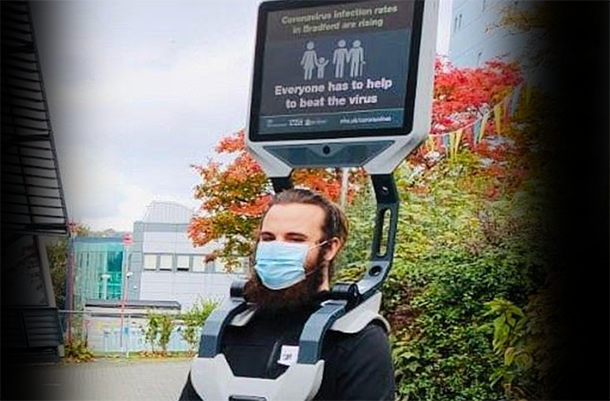
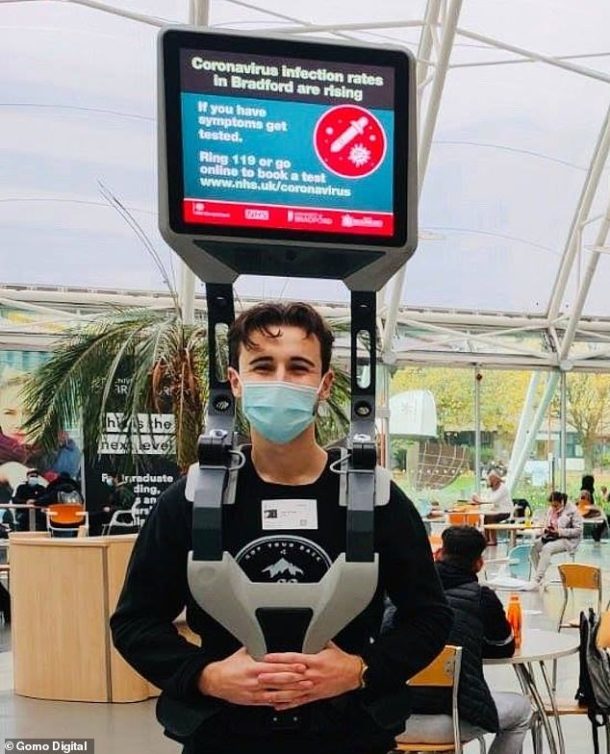
Britain’s bizarre ‘Robocop-like’ walking propaganda digital billboards (Image Credit: Gomo Digital)
21st Century News Wire | January 12, 2021
In one of the most desperate and bizarre moves yet, a local government in the UK has begun recruiting men to walking the streets with TVs strapped over their heads, supposedly to help police during a highly unpopular lockdown.
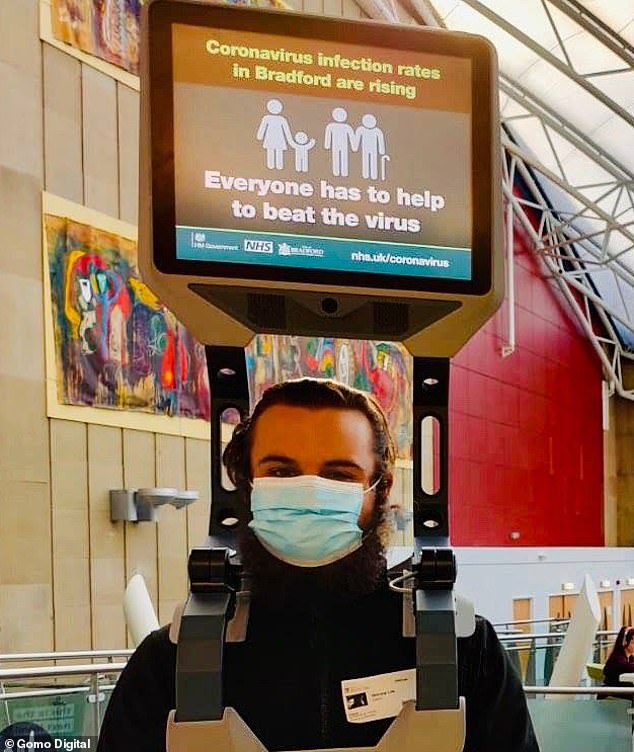
Bradford Council in Yorkshire announced their new ‘iWalkers’ scheme, where local council staff and volunteers are deployed onto the streets with a 19 inch screen weighing 18 lbs, mounted on their shoulders.
According to reports, the program ran for two days before it began to go horribly wrong. The government scheme was so ridiculous, residents thought it might have been satire at first, or a prank, not believing that the local government had lost the plot to such a degree. When they realized the plan was actually a real government initiative, the public backlash was severe, and so embarrassed council officials panicked and removed their Facebook post detailing their ‘exciting new program.’
A number of outrageous comments, both in person and online, were hurled at the walking Robocop-like human propaganda digital billboards
These real-life Teletubies were supposed to be walking the city and town streets, wearing masks, while their TV’s would be pushing out government propaganda on COVID, designed by a government behavioural insights team and applied behavioural psychologists – to nudge residents into tighter lockdown compliance, and to keep the public abreast of minute-to-minute ever-changing “coronavirus rules and restrictions.”
According to reports, the cost of Bradford’s COVID Teletubies is being paid for through Government funding of “Covid-19 communications.”
Local government officials denied they had deleted their new initiative because of public embarrassment, and instead claimed that it was suddenly taken down because of public comments that supposedly “crossed the line into abuse of people who are working hard to help residents and workers in Bradford District stay safe and stop the spread of the virus.”
The incident comes at a bad time for local councils who have recently decreed that they will be squeezing the working class even more by raising their council taxes (aka poll tax) – all of this amid a steep economic depression instigated by the reactionary COVID lockdown policies of the UK government.
Government officials tried to justify the expensive theme park-style stunt by saying that, “There are still many key workers in the city who may wish to get some information on testing where testing sites are close by and it’s really important that we have people out on the streets who can provide this.”
The Orwellian saga continues…
“Careless Talk Costs Lives” – Fresh Calls To Silence Pandemic Skepticism
OffGuardian | January 6, 2021
Throughout 2020, there has regularly been claimed to be a Left-biased pandemic zealotry in operation. We see Wales’ strict corona measures. Victoria. New Zealand. Most recently, two examples chill the blood.
Keir Starmer, appearing on the ITV’s Good Morning Britain, said…
we have to deal with the antivaxx campaigns because they will cost lives and if we need to pass emergency legislation to deal with them I would be prepared to work with the government on that.
George Monbiot said, today, we need to…
criminalise the spreading of blatant disinformation about the pandemic. As in wartime, careless talk costs lives.
No doubt the output of Off-Guardian over the last 12 months would fall into the brackets these gentlemen are referring to.
As if to underpin this apparent slant of the Left toward authoriranianism, Talkradio, oft touted as a Right Wing platform, was today deplatformed from Youtube. It was subsequently ‘replatformed’ after a UK minister from the Department for Digital, Culture, Media and Sportminister ‘inquired’ as to why.
Apart from raising the question of how much at the beck and call of government these supposedly ‘private’ and independent Silicone Valley tech companies are, it is an unsettling sign of potential things to come.
Featured Video
HE SAVED LIVES. NOW HE FACES PRISON.
or go to
Aletho News Archives – Video-Images
From the Archives
NATO Sanctions and the Coming Global Diesel Fuel Disaster
By F. William Engdahl – New Eastern Outlook – 11.04.2022
Amid the ongoing global inflation crisis, NATO heads of state and mainstream media repeat a mantra that high energy prices are a direct result of Putin’s actions in Ukraine since end of February. The reality is that it is the western sanctions that are responsible. Those sanctions including cutting SWIFT interbank access for key Russian banks and some of the most severe sanctions ever imposed, are hardly having an impact on the military actions in Ukraine. What many overlook is the fact that they are increasingly impacting the economies of the West, especially the EU and USA. A closer look at the state of the global supply of diesel fuel is alarming. But Western sanctions planners at the US Treasury and the EU know fully well what they are doing. And it bodes ill for the world economy.
While most of us rarely think about diesel fuel as anything other than a pollutant, in fact it is essential to the entire world economy in a way few energy sources are. The director general of Fuels Europe, part of the European Petroleum Refiners Association, stated recently, “… there is a clear link between diesel and GDP, because almost everything that goes into and out of a factory goes using diesel.” … continue
Blog Roll
 Aletho News
- Trita Parsi: Middle East Unraveling — Are We on the Path to World War?
- Iran FM meets with US envoy on UN meeting’s sidelines at American side’s insistence: Report
- Qatar PM calls for Gulf security framework with Iran, says war must be ‘wake-up call’
- China condemns US extortion of Iranian airlines, rejects Washington’s ‘illegal’ sanctions threats
- Italy to move military personnel from Taif base after missile strike
- Finland’s Stubb tells European leaders to calm down
- Defeating Russia on battlefield impossible – Fico
- Finland’s Gender Clinic Reversal
- Massachusetts Wants Mental Health Visits, Why Does Government Use ‘Health’ to Enter Our Homes & Families?
- US lawmaker admits American people footing bill for Trump’s failed aggression against Iran
- If Americans Knew
- Sanctions are collective punishment: immoral and self-defeating
- Phosphorus Munitions Fired by Israel Burn Groves, Orchards in Southern Lebanon
- Israel Carries Out New Ceasefire Violations Across Gaza
- AI – Emphasis on the ‘I’: Israel Is Funding AI Chatbot Propaganda
- Israel Blocking Hundreds of Wheelchairs for Injured Children From Entering Gaza
- Israel Is Expanding and Upgrading Compounds for Palestinian Militias in Gaza
- The Palestinian-American Residents of This West Bank Town Are Wondering: Where Is Trump?
- Gaza desperately needs tents, wheelchairs, fuel… and everything else (Israel blocks it all) – Daily Update
- Israeli Attacks in Gaza Kill at Least Seven Palestinians Over Three Days, including Woman and Child
- Trump’s militarization of Washington DC as he pursues Israel’s war against Iran
- No Tricks Zone
- New Study: Earth And Venus Surface Warmth Largely Explained By Convection And Lapse Rate, Not CO2 Or Radiation
- 2025 Nature Paper Claiming Worsening Global Drought Gets RETRACTED …Heavily Flawed
- New Study: ‘Global Drought Shows No Detectable Recent Acceleration Under Climate Warming’
- Economic Masterminds: German Socialists Suggest Taxing Productivity Gains Stemming From Using AI
- The South China Sea Has Not Been Cooperating With The Climate Change Narrative
- Energy Crisis: Germany Enters Heating Season With Historically Low Gas Reserve Fill Levels
- New Study: The Antarctic Ice Sheet Gained Mass From 2020-2024 Due To Staggering Snow And Ice Accumulation
- Study: Ocean Heating Rates From Thousands Of Years Ago ‘Dwarf’ Modern Ocean Heating Rates
- Climate Extremists Target, Attack Large-Scale Power Grid Infrastructure In Germany!
- New Study: Antarctic Ice Melt Has Contributed Less Than 1 Centimeter To Sea Level Rise In The Last 30 Years

