Another Syrian Victory – and West’s Telling Silence
Strategic Culture Foundation | August 30, 2019
The liberation of Khan Sheikhoun in Idlib Province by the Syrian army and its Russian ally marks another important victory towards ending the eight-year war in Syria.
Last week saw the return to relative normalcy in the northwestern town which had been held under siege by al Qaeda-affiliated militants for over five years. Situated south of Aleppo on the road to the capital Damascus, Khan Sheikhoun was officially declared under the control of Syrian state forces on August 21 after a hard-fought battle against militants.
International journalists from Italy, Bulgaria, Greece and Russia witnessed the return of residents and efforts to resume electricity services and reopening of schools. Khan Sheikhoun was ransacked by the routed jihadi terror groups, with the typical depravity that had been seen in other liberated areas. But despite the devastation, residents were relieved to begin the task of restoration of what was previously a town renowned for its culture and beauty before the war erupted in March 2011.
The remnants left behind by the defeated militants as well as the identity of dead fighters testified to their terrorist affiliation. Many of them were foreign mercenaries. Khan Sheikhoun was a stronghold for the Hayat Tahrir al-Sham group which was formerly known as Al Nusra Front. Notwithstanding the chameleonic name, they are part of the jihadi Al Qaeda terror network which is internationally proscribed and which Western governments are officially opposed to.
The capture of the town again demonstrates the vile nature of the Syrian war as being one of foreign-sponsored aggression for regime change. In particular, the United States government and its NATO allies, Britain, France, Turkey, and others, are now known to be fully complicit in covert sponsorship of these terrorists.
Khan Sheikhoun is of particular significance because on April 4, 2017, it was dramatically reported by Western news media as being the site of a Sarin chemical weapon attack, allegedly carried out by the Syrian state forces. Three days later, on April 7, the US, Britain and France launched over 100 airstrikes on Syria in what was claimed to be “revenge” against the “Syrian regime” for allegedly committing an atrocity with chemical weapons. Syrian authorities and Russia asserted the alleged Sarin attack at Khan Sheikhoun was a false-flag provocation, fabricated by the militants with the aim of eliciting a military strike on Syria by the US and its NATO allies.
Clearly, after the liberation of the town this month, it is evident that it was a den of terrorist groups which held residents under a reign of terror. Yet for years, the Western news media had proclaimed that these fighters were “rebels” who deserved support from Western intervention. Even as Syrian forces were launching their assault on Idlib Province in recent months, the Western media were animated by shrill reports of “rebels” and civilians being killed by indiscriminate “regime” air strikes.
Tellingly, the momentous victory at Khan Sheikhoun was met with an astonishing silence among Western governments and news media.
The same duplicitous pattern has been seen before when the Syrian army and its Russian ally liberated Douma, Ghouta, Daraa, Aleppo, Maaloula and many other areas besieged by the so-called “rebels” so lionized in Western media. Syrian residents have been invariably relieved and overjoyed to have their freedom and dignity restored by the Syrian army and Russian forces. Their stories of the horror they endured under captivity are shocking from the depravity and cruelty meted out by Western-backed “rebels”.
That is why the liberation of Khan Sheikhoun, as with other locations in Syria, has had to be studiously ignored by the Western news media. Because if they really performed normal journalistic duty what the Western public would learn is that their governments and media have been complicit in huge war crimes against the Syrian nation.
It is all the more despicable therefore that the US is shifting its efforts to block the reconstruction of war-torn Syria. This week, the country is to hold the annual Damascus International Trade Fair. Delegates from some 40 nations are attending and exploring ways to regenerate the Syrian economy and to meet the challenge of reconstruction. Some estimates put minimal repair of infrastructure at a cost of $388 billion. The true figure could be in trillions of dollars.
That bill should be assigned to Washington, London, Paris, Ankara, Riyadh, Doha and Tel Aviv for the criminal aggression they collectively and stealthily inflicted on Syria.
Ahead of the Damascus trade fair, the US was warning prospective foreign investors that they could face sanctions if they did business with Syria. Russia’s foreign ministry condemned the American effort to sabotage Syria’s reconstruction.
As Russian lawmaker Valery Rashkin, who was in Syria this week, put it, the US is trying to destroy Syria through economic warfare after losing its dirty-war military agenda.
The European Union also stands condemned for continuing to impose economic sanctions on Syria. The war is over and it has been exposed as Western-backed criminal aggression. All past accusations against the Syrian state are null and void as malign propaganda. Thus, sanctions on Syria are a contemptible attack on the country by nations whose criminal complicity should actually be a matter of prosecution.
We can only wish the people of Syria well. With international solidarity from Russia, China, Iran and others, Syria will recover its former strength and pride. Syria has won a tremendous victory. The losers are the Western governments and media who have been exposed for the corrupt charlatans they are.
Film ‘Official Secrets’ is the Tip of a Mammoth Iceberg
By Sam Husseini • Consortium News • August 29, 2019
Two-time Oscar nominee Keira Knightley is known for being in “period pieces” such as “Pride and Prejudice,” so her playing the lead in the new film “Official Secrets,” scheduled to be released in the U.S. on Friday, may seem odd at first. That is until one considers that the time span being depicted — the early 2003 run-up to the invasion of Iraq — is one of the most dramatic and consequential periods of modern human history.
It is also one of the most poorly understood, in part because the story of Katharine Gun, played by Knightley, is so little known. Having followed this story from the start, I find this film to be, by Hollywood standards, a remarkably accurate account of what has happened to date–“to date” because the wider story still isn’t over.
Katharine Gun worked as an analyst for Government Communications Headquarters (GCHQ), the British equivalent of the secretive U.S. National Security Agency. She tried to stop the impending invasion of Iraq in early 2003 by exposing the deceit of George W. Bush and Tony Blair in their claims about that country. For doing that she was prosecuted under the Official Secrets Act — a juiced up version of the U.S. Espionage Act, which in recent years has been used repeatedly by the Obama administration against whistleblowers and now by the Trump administration against WikiLeaks publisher Julian Assange.
Gun was charged for exposing— around the time of Colin Powell’s infamous testimony to the UN about Iraq’s alleged WMDs – a top secret U.S. government memo showing it was mounting an illegal spying “surge” against other U.N. Security Council delegations in an effort to manipulate them into voting for an Iraq invasion resolution. The U.S. and Britain had successfully forced through a trumped up resolution, 1441 in November 2002. In early 2003, they were poised to threaten, bribe or blackmail their way to get formal United Nations authorization for the invasion. [See recent interview with Gun.]

Katherine Gun
The leaked memo, published by the British Observer, was big news in parts of the world, especially the targeted countries on the Security Council, and helped prevent Bush and Blair from getting the second UN Security Council resolution they said they wanted. Veto powers Russia, China and France were opposed as well as U.S. ally Germany.
Washington invaded anyway of course — without Security Council authorization — by telling the UN weapons inspectors to leave Iraq and issuing a unilateral demand that Saddam Hussein leave Iraq in 48 hours— and then saying the invasion would commence regardless.
‘Most Courageous Leak’
It was the executive director of the Institute for Public Accuracy, where I work (accuracy.org), Norman Solomon, as well as Pentagon Papers whistleblower Daniel Ellsberg who in the U.S. most immediately saw the importance of what Gun had done. Ellsberg would later comment: “No one else — including myself — has ever done what Katharine Gun did: Tell secret truths at personal risk, before an imminent war, in time, possibly, to avert it. Hers was the most important — and courageous — leak I’ve ever seen, more timely and potentially more effective than the Pentagon Papers.”
Of course, no one knew her name at the time. After the Observer broke the story on March 1, 2003, accuracy.org put out a series of news releases on it and organized a sadly, sparsely attended news conference with Ellsberg on March 11, 2003 at the National Press Club, focusing on Gun’s revelations. Ellsberg called for more such truth telling to stop the impending invasion, just nine days away.
Though I’ve followed this case for years, I didn’t realize until recently that accuray.org’s work helped compel Gun to expose the document. At a recent D.C. showing of “Official Secrets” that Gun attended, she revealed that she had read a book co-authored by Solomon, published in January 2003 that included material from accuracy.org as well as the media watch group FAIR debunking many of the falsehoods for war.
Gun said: “I went to the local bookshop, and I went into the political section. I found two books, which had apparently been rushed into publication, one was by Norman Solomon and Reese Erlich, and it was called Target Iraq. And the other one was by Milan Rai. It was called War Plan Iraq. And I bought both of them. And I read them cover to cover that weekend, and it basically convinced me that there was no real evidence for this war. So I think from that point onward, I was very critical and scrutinizing everything that was being said in the media.”
Thus, we see Gun in “Official Secrets” shouting at the TV to Tony Blair that he’s not entitled to make up facts. The film may be jarring to some consumers of major media who might think that Donald Trump invented lying in 2017.
Gun’s immediate action after reading critiques of U.S. policy and media coverage makes a strong case for trying to reach government workers by handing out fliers and books and putting up billboards outside government offices to encourage them to be more critically minded.
Solomon and Ellsberg had debunked Bush administration propaganda in real time. But Gun’s revelation showed that the U.S. and British governments were not only lying to invade Iraq, they were violating international law to blackmail whole nations to get in line.
Mainstream reviews of “Official Secrets” still seem to not fully grasp the importance of what they just saw. The trendy AV Club review leads: “Virtually everyone now agrees that the 2003 invasion of Iraq was a colossal mistake based on faulty (at best) or fabricated (at worst) intelligence.” “Mistake” is a serious understatement even with “colossal” attached to it when the movie details the diabolical, illegal lengths to which the U.S. and British governments went to get other governments to go along with it.
Gun’s revelations showed before the invasion that people on the inside, whose livelihood depends on following the party line, were willing to risk jail time to out the lies and threats.
Portrayal of The Observer
Other than Gun herself, the film focuses on a dramatization of what happened at her work; as well as her relationship with her husband, a Kurd from Turkey who the British government attempted to have deported to get at Gun. The film also portrays the work of her lawyers who helped get the Official Secrets charge against her dropped, as well as the drama at The Observer, which published the NSA document after much internal debate.
Observer reporter Martin Bright, whose strong work on the original Gun story was strangely followed by an ill-fated stint at the Tony Blair Faith Foundation, has recently noted that very little additional work has been done on Gun’s case. We know virtually nothing about the apparent author of the NSA document that she leaked — one “Frank Koza.” Other questions persist, such as how prevalent is this sort of U.S. blackmail of foreign governments to get UN votes or for other purposes? How is it leveraged? Does it fit in with allegations made by former NSA analyst Russ Tice about the NSA having massive files on political people?
Observer reporter Ed Vulliamy is energetically depicted getting tips from former CIA man Mel Goodman. There do seem to be subtle but potentially serious deviations from reality in the film. Vulliamy is depicted as actually speaking with “Frank Koza,” but that’s not what he originally reported:
“The NSA main switchboard put The Observer through to extension 6727 at the agency which was answered by an assistant, who confirmed it was Koza’s office. However, when The Observer asked to talk to Koza about the surveillance of diplomatic missions at the United Nations, it was then told ‘You have reached the wrong number’. On protesting that the assistant had just said this was Koza’s extension, the assistant repeated that it was an erroneous extension, and hung up.”
There must doubtlessly be many aspects of the film that have been simplified or altered regarding Gun’s personal experience. A compelling part of the film — apparently fictitious or exaggerated — is a GCHQ apparatchik questioning Gun to see if she was the source.
Little is known about the reaction inside the governments of Security Council members that the U.S. spied on. After the invasion, Mexican Ambassador Adolfo Aguilar Zinser spoke in blunt terms about U.S. bullying — saying it viewed Mexico as its patio trasero, or back yard — and Zinser was compelled to resign by President Vicente Fox. He then, in 2004, gave details about some aspects of U.S. surveillance sabotaging the efforts of the other members of the Security Council to hammer out a compromise to avert the invasion of Iraq, saying the U.S. was “violating the U.N. headquarters covenant.” In 2005, he tragically died in a car crash.
“Official Secrets” director Gavin Hood is perhaps more right than he realizes when he says that his depiction of the Gun case is like the “tip of an iceberg,” pointing to other deceits surrounding the Iraq war. His record with political films has been uneven until now. Peace activist David Swanson, for instance, derided his film on drones, “Eye in the Sky.” At a D.C. showing of “Official Secrets,” Hood depicted those who backed the Iraq war as being discredited. But that’s simply untrue.
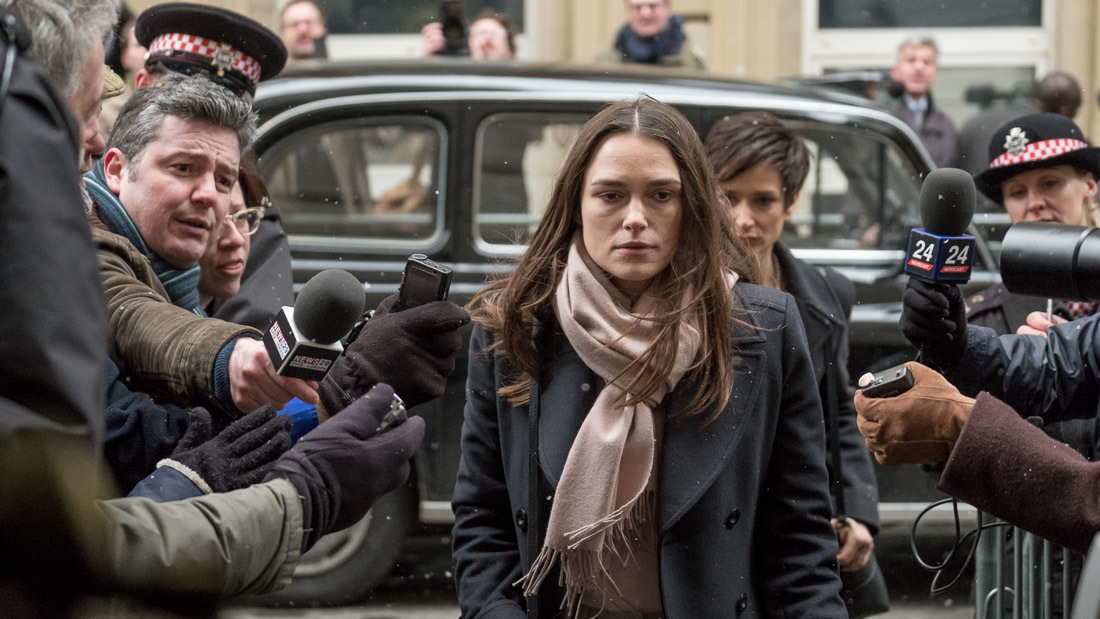
Keira Knightley appears as Katherine Gun in Official Secrets (Courtesy of Sundance Institute.)
Leading presidential candidate Joe Biden — who not only voted for the Iraq invasion, but presided over rigged hearings on in 2002 – has recently falsified his record repeatedly on Iraq at presidential debates with hardly a murmur. Nor is he alone. Those refusing to be held accountable for their Iraq war lies include not just Bush and Cheney, but John Kerry and Nancy Pelosi.
Biden has actually faulted Bush for not doing enough to get United Nations approval for the Iraq invasion. But as the Gun case helps show, there was no legitimate case for invasion and the Bush administration had done virtually everything, both legal and illegal, to get UN authorization.
Many who supported the invasion try to distance themselves from it. But the repercussions of that illegal act are enormous: It led directly or indirectly to the rise of ISIS, the civil war in Iraq and the war in Syria. Journalists who pushed for the Iraq invasion are prosperous and atop major news organizations, such as Washington Post editorial page editor Fred Hiatt. The editor who argued most strongly against publication of the NSA document at The Observer, Kamal Ahmed, is now editorial director of BBC News.
The British government — unlike the U.S.– did ultimately produce a study ostensibly around the decision-making leading to the invasion of Iraq, the Chilcot Report of 2016. But that report — called “devastating” by the The New York Times – made no mention of the Gun case. [See accuracy.org release from 2016: “Chilcot Report Avoids Smoking Gun.”]
After Gun’s identity became known, the Institute for Public Accuracy brought on Jeff Cohen, the founder of FAIR, to work with Hollie Ainbinder to get prominent individuals to support Gun. The film — quite plausibly — depicts the charges being dropped against Gun for the simple reason that the British government feared that a high profile proceeding would effectively put the war on trial, which to them would be have been a nightmare.
Sam Husseini is an independent journalist, senior analyst at the Institute for Public Accuracy and founder of VotePact.org. Follow him on twitter: @samhusseini.
YouTube ‘borderline content’ crackdown hits UK shores, creators demand justice
RT | August 28, 2019
YouTube is cracking down on “borderline content” that doesn’t quite break its rules, expanding an algorithm-tweak that prevents controversial material from gaining a US audience to the rest of the English-speaking world.
A recommendations tweak that cut the referral views of content that “brushes right up against our policy line” in half in the US over the past six months is being rolled out across the UK, Ireland, South Africa, and “other English-language markets,” YouTube CEO Susan Wojcicki said in a quarterly letter to creators on Tuesday, patting herself on the back for what she claimed was the company’s tolerance for non-mainstream views.
“A commitment to openness is not easy,” Wojcicki wrote, likely provoking a few spit-takes from readers. “It sometimes means leaving up content that is outside the mainstream, controversial or even offensive.” But diversity of opinion “makes us a stronger and more informed society, even if we disagree with some of those views,” she continued – begging the question of why YouTube feels compelled to de-platform so many outside-the-mainstream commentators even as its CEO has admitted in the past that “news or news commentary [is] a very small percentage of the number of views we have.”
“Reducing the spread of borderline content” was one of “four Rs” Wojcicki claimed formed the company’s framework for dealing with creators, accompanied by “remove content that violates our policy,” “raise up authoritative voices,” and “reward trusted, eligible creators.”
Creators were up in arms about the rising tide of censorship, which took out a number of popular channels without warning. Many speculated about the platform’s future, even calling for Wojcicki’s resignation.
“Youtube’s final form will be mainstream TV,” one user lamented. “YouTube was primarily built by edgy content. That’s what made it great,” another agreed. “We prefer diversity and free speech on YouTube, not racism and censorship,” said another.
Many insisted the crackdown was part of the company’s admitted efforts to control the 2020 US election (even, apparently, in the UK).
Even some who disagreed with the “borderline” content creators opposed banning them. “These people will become martyrs,” one user warned, suggesting those who disagree with “extremists” should “debate them, make them look stupid,” but not censor.
Others breathed a sigh of relief. “It’s about time society starts to protect itself against the (far) right. The slide into violence and extremism is having rl consequences,” one person tweeted.
The truth about YouTube’s intent does occasionally flash though the corporate jargon. “We keep tightening and tightening the policies,” Wojcicki told the Guardian in an interview earlier this month, noting that “with every policy we make, there is content that will become borderline, or will find ways to skirt around those policies.” That content becomes the target of new policies, and the cycle begins anew.
And “borderline content” – like “sowing discord,” the excuse used to de-platform hundreds of channels earlier this month for their opposition to the Hong Kong protests – has no official definition, allowing moderators to delete any channel they want without having to produce proof any rule has been violated.
Scottish nationalist leader awarded more than £512,000 after winning court case
Press TV – August 24, 2019
Alex Salmond’s legal victory against the government has been widely seen as yet another victory by Scottish nationalists against an establishment hell-bent on stopping them.
Scotland’s former First Minister had been accused of “inappropriate conduct” during the time he led the Scottish government.
The Scottish government has reportedly paid Salmond more than £512,000 to cover his legal costs after he successfully contested charges of sexual misconduct in court.
Although the case against him effectively collapsed in January, the government has now formally admitted defeat by awarding Salmond the large sum on an “agent and client” basis.
This is a punitive award used by the courts to recognize the fact that the losing party to litigation has caused the other party “unnecessary expenses”.
The Scottish parliament (Holyrood) has reportedly set up an enquiry to look into the huge expenses incurred investigating Salmond and the subsequent pay out after he won his court case.
The official enquiry was set up in the wake of reports that the Scottish government had spent nearly £750,000 (excluding internal costs) trying to defend its flawed legal case against Salmond.
This massive sum, combined with the substantial payment to Salmond, has raised questions about the nature of the enquiry into Salmond’s alleged “misconduct” and whether the case was politically motivated.
The former British diplomat, and supporter of Scottish independence, Craig Murray, alludes to this possibility in his latest post on his popular and respected blog.
For their part, the Scottish Conservative Party has seen fit to go on the political offensive, possibly with a view to deflect potential revelations that they had had a hand in forcing through a botched legal case against Salmond.
Donald Cameron, a Scottish Conservative member of Holyrood, has said it is “outrageous” that so much money had been spent on the case.
Salmond, who was the leader of the pro-independence Scottish National Party (SNP) for over 20 years, still faces a separate trial centred on 14 alleged offences, including two of attempted rape, nine of sexual assault, two of indecent assault and one of breach of the peace.
But in view of the former First Minister’s latest legal victory, it is fair to ask whether the separate charges against him could also be “flawed” and possibly politically motivated.
The legal and criminal cases against Salmond have raised suspicions in the Scottish nationalist community that the British establishment is trying to arrest the momentum toward Scottish independence, by any means necessary, including “flawed” legal procedures.
Salmond is widely seen as the most effective proponent of Scottish independence, as demonstrated by his two highly successful stints as leader of the SNP, first from 1990 to 2000 and then from 2004 to 2014.
Long Before Epstein: Sex Traffickers & Spy Agencies
By Elizabeth Vos | Consortium News | August 23, 2019
The alleged use of sexual blackmail by spy agencies is hardly unique to the case of Jeffrey Epstein. Although the agencies involved as well as their alleged motivations and methods differ with each case, the crime of child trafficking with ties to intelligence agencies or those protected by them has been around for decades.
Some cases include the 1950s -1970s Kincora scandal and the 1981 Peter Hayman affair, both in the U.K.; and the Finders’ cult and the Franklin scandal in the U.S. in the late 1980s. Just as these cases did not end in convictions, the pedophile and accused child-trafficker Jeffrey Epstein remained at arms’ length for years.
“For almost two decades, for some nebulous reason, whether to do with ties to foreign intelligence, his billions of dollars, or his social connections, Epstein, whose alleged sexual sickness and horrific assaults on women without means or ability to protect themselves… remained untouchable,” journalist Vicky Ward wrote in The Daily Beast in July.
The protection of sex traffickers by intelligence agencies is especially interesting in the wake of Epstein’s death. Like others, Epstein had long been purported to have links with spy agencies. Such allegations documented by Whitney Webb in her multi-part series were recently published in Mintpress News.
Webb states that Epstein was the current face of an extensive system of abuse with ties to both organized crime and intelligence interests. She told CNLive! that: “According to Nigel Rosser, a British journalist who wrote in the Evening Standard in 2001, Epstein apparently for much of the 1990s claimed that he used to work for the CIA.”
Vicky Ward, who wrote on Epstein for Vanity Fair before his first arrest, and claimed the magazine killed one of her pieces after Epstein intervened with editor Graydon Carter, said in a Tweet that one of Epstein’s clients was Adnan Khashoggi, an arms dealer who was pivotal in the Iran Contra scandal and was on the Mossad (the Israeli intelligence agency) payroll. This was also noted in a book “By Way of Deception” by former Mossad agent Victor Ostrovsky.
A former Epstein friend reported in @Salon last week that Epstein claimed “he worked for governments to recover money looted by African dictators. Other times those dictators hired him to help them hide their stolen money.” https://t.co/pYkOlFGoyY
— Vicky Ward (@VickyPJWard) July 16, 2019
The Times of Israel reported that Epstein was an “active business partner with former prime minister Ehud Barak” until 2015, adding: “Barak formed a limited partnership company in Israel in 2015, called Sum (E.B.) to invest in a high-tech startup…. A large part of the money used by Sum to buy the start-up stock was supplied by Epstein.”
Webb wrote he “was a long-time friend of Barak, who has long-standing and deep ties to Israel’s intelligence community.” On the board of their company sat Pinchas Bukhris, a former commander of the IDF cyber unit 8200.
Epstein’s allegedly protected status was revealed by Alexander Acosta, the former U.S. attorney in Miami who gave Epstein an infamously lenient plea deal in 2007. Acosta, who was forced to resign as President Donald Trump’s labor secretary because of that deal, reportedly said of the case: “I was told Epstein ‘belonged to intelligence’ and to leave it alone.”
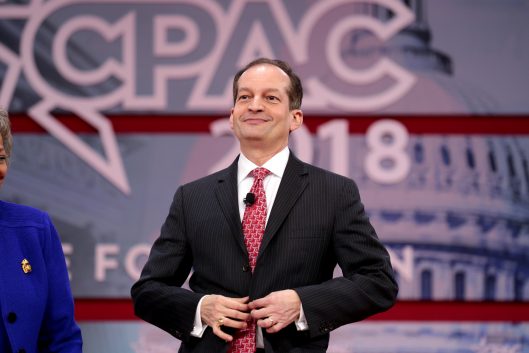
Alexander Acosta: “Told to leave it alone.” (Flickr/Gage Skidmore)
Kincora Boy’s Home
Several cases in the unsavory history linking intelligence agencies and sex scandals put the allegations against Epstein in context. Among these was the U.K. Kincora Boy’s Home, where at least 29 boys were reported to have been targeted at the Belfast, Northern Ireland, facility from the mid-1950s until the late 1970s, until it was shut in 1980. It also involved the alleged protection of child sexual abusers at the home and among their clients.
The Irish Times wrote that “destitute boys were systematically sodomised by members of Kincora staff and were supplied for abuse to prominent figures in unionist politics. The abusers – among them MPs, councillors, leading Orangemen and other influential individuals – became potentially important intelligence assets.”
The Belfast Telegraph also quoted former Labour Party MP Ken Livingstone, who said: “MI5 weren’t just aware of child abuse at Kincora Boys’ Home – they were monitoring it. They were getting pictures of a judge in one case, politicians, a lot of the establishment of Northern Ireland going in and abusing these boys.”
Three staff were eventually convicted of sexually abusing minors, which included the housemaster William McGrath, a loyalist “Orangeman” and allegedly an MI5 agent, according to the Belfast Telegraph in July 2014.
Although the U.K.’s Historical Institutional Abuse inquiry ultimately found “no credible evidence” to support the allegations, two former U.K. intelligence officers maintained their claim of MI5’s involvement: Brian Gemmell says he alerted MI5 to the abuse at Kincora and was told to stop his investigation; and a former army intelligence officer, Colin Wallace, “consistently claimed that MI5, RUC special branch and military intelligence knew about the abuse at Kincora and used it to blackmail the pedophile ring to spy on hardline loyalists,” according to The Guardian.
The Irish outlet, An Phoblacht, wrote: “The systematic abuse of young boys in the Home and the part played by the British intelligence organisations to keep the scandal under wraps ensured that one side of the murky world of Unionist paramilitarism and its links to the crown forces was kept out of the public domain for years.”
In the U.S., the New York State Select Committee On Crime in 1982 investigated nationwide networks of trafficking underage sex workers and producing child pornography. Dale Smith, a committee investigator, noted that call services using minors also profited from “sidelines,” besides the income from peddling prostitution. Smith said they sold information “on the sexual proclivities of the clients to agents of foreign intelligence.” Presumably, this information could be used to blackmail those in positions of power. Smith added that one call service sold information to “British and Israeli intelligence.”
The Hayman Affair
Another U.K. scandal included allegations that Sir Peter Hayman, a British diplomat and deputy director of MI6, was a member of the Pedophile Information Exchange (PIE).
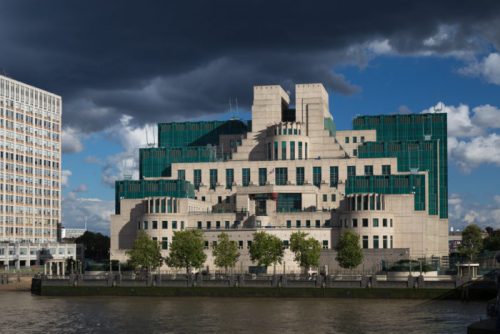
London headquarters of British Secret Intelligence Service.
(Laurie Nevay, CC BY-SA 2.0, Wikimedia Commons)
Police discovered that two of the roughly dozen pedophiles in his circle had been writing to each other about their interest in “the extreme sexual torture and murder of children,” according to the The Daily Mail.
In 2015, The Guardian reported that former Prime Minister Margaret Thatcher had been “adamant that officials should not publicly name” Hayman, “even after she had been fully briefed on his activities…. formerly secret papers released to the National Archives shows.”
Still, Hayman was unmasked as a subscriber to PIE in 1981 by M.P. Geoffrey Dickens, who also reportedly raised the national security risk of Hayman’s proclivities, implying they were a potential source of blackmail sought by intelligence agencies.
The British tabloid The Mirror reported that intelligence agencies, including the KGB and CIA, kept their own dossiers on U.K. establishment figures involved with PIE and the abuse of minors, to blackmail the targets in exchange for information.
Hayman was never charged for his association with PIE: The U.K. attorney general at the time, Sir Michael Havers, defended the decision and denied claims that Heyman was given special treatment.
Labour Party MP Barbara Castle allegedly gave a dossier she compiled on pedophiles in positions of power to U.K. journalist Don Hale in 1984 when he was editor of the Brury Messenger. Hale alleged that soon afterward, police from the “Special Branch, the division responsible for matters of national security,” raided his office and removed the Castle dossier. They then threatened him with a “D-notice,” which prevented him from publishing the story on the threat of up to 10 years in prison.
The Finders Cult
Another group accused of trafficking children, which had links to intelligence agencies, was the “Finders” cult. In 1987, The Washington Post reported that two members were arrested in connection with the alleged abuse of six children. Investigators found materials in Madison County, Virginia, which they said linked to a “commune called the Finders.”
Besides nude photographs of children, a Customs Service memo written by special agent Ramon Martinez refers to files “relating to the activities of the organization in different parts of the world, including “London, Germany, the Bahamas, Japan, Hong Kong, Malaysia, Africa, Costa Rica, and Europe.”
Martinez’s memo notes that a Finders’ telex ordered the purchase of two children in Hong Kong. Another expressed interest in “bank secrecy situations.” The memo also documents high-tech transfers to the U.K., numerous properties under the Finders’ control, the group’s interest in terrorism, explosives, and the evasion of law enforcement.
Martinez describes the swift end to his investigation. He wrote that on April 12, 1987, he arrived at the Metropolitan Police Department and was told that all the data was turned over to the State Department which, in turn, advised MPD that “all travel and use of passports by the holders was within the law and no action would be taken. Then he was told that the investigation into the Finders had become a CIA internal matter. The MPD report was classified, not available for review” and “No further action will be taken.”
Martinez was not the only person with unanswered questions. The U.S.News & World Report wrote that N. Carolina Rep. Charlie Rose (Dem.), chair of the House Administration Committee, and Florida’s Rep. Tom Lewis (Rep.) asked “Could our own government have something to do with this Finders organization and turned their backs on these children? That’s what the evidence points to,” says Lewis, adding that “I can tell you that we’ve got a lot of people scrambling, and that wouldn’t be happening if there was nothing here.”
The leniency shown by the State Department and the fact that the CIA would designate the investigation of the Finders group as “an internal matter” raises serious questions. What motive might have driven the CIA to associate with or protect a child abuse ring?
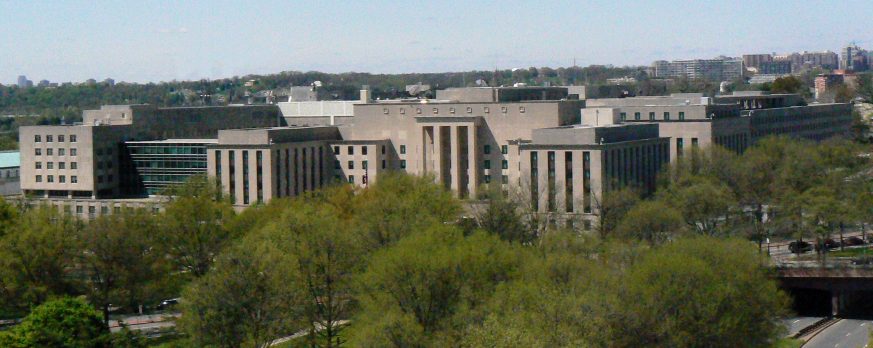
Harry S. Truman State Department building. (Paco8191, CC BY 3.0, Wikimedia Commons)
The Franklin Scandal
The Franklin Scandal erupted in 1988, centering on a child-trafficking ring operating in Omaha, Nebraska, by Lawrence E. King Jr., a former vice chairman of the National Black Republican Council: It was alleged that children were provided to politicians in Washington, D.C., and elsewhere, among other illegal activities.
The late former state Sen. John Decamp alleged in his book “The Franklin Coverup” that a special committee of the Nebraska Legislature launched a probe to investigate the affair, which involved King being indicted for embezzling money from the Franklin Credit Union. The committee hired former Lincoln, Nebraska, police officer Jerry Lowe, whose reports suggested that King was involved in “guns and money transfers to Nicaragua,” and was linked with the CIA.
James Flanery, an investigative reporter at The World Herald who reported on the scandal, told associates that King was “running guns and money into Nicaragua,” and that the CIA was heavily involved.”
Like many scandals before and since, the Franklin case ended with no prosecution of the perpetrators. However, Paul Bonacci, one of the alleged victims, was indicted for perjury. He had alleged that he was sexually abused as a minor in Nebraska and around the country where he was flown by Lawrence King.
In 1999, the Omaha World Herald reported Bonacci was awarded $1 million in damages due to his lawsuit against King and other alleged perpetrators. Decamp, who was Bonacci’s attorney, told the newspaper “Obviously, you don’t award $1 million if you don’t think he (Bonacci) was telling the truth.”
Given the history of child trafficking rings that were allegedly connected with or enjoyed the protection of intelligence services, it is possible that similar claims about Jeffrey Epstein are something the authorities, though unlikely given these other instances, should investigate.
Elizabeth Vos is a freelance reporter and regular contributor to Consortium News.
Epstein: The Maxwell Connection
By George Galloway | RT | August 21, 2019
As Jeffrey Epstein’s accomplice Ghislaine Maxwell appears to have fallen off the face of the Earth, it’s little remembered in the media how I fought a long war against her father Robert and the part I played in his downfall.
It would be scarcely worth recalling at this distance if it did not shed light, or rather a cloud of suspicion, over Maxwell’s favourite child Ghislaine, now at the centre of a dark and fascinating story as bizarre as any which enveloped her late father.
I first met Robert Maxwell when he was an enormously powerful and fiercely intimidating media mogul in the early 1980s. It was in the green room of the BBC’s then flagship program Question Time, hosted by Sir Robin Day – then the doyen of BBC grandees.
“Ah, Mr Galway (sic),” boomed Mr Maxwell, “the PLO man.” At which point he punched me so hard in the solar plexus I doubled over, tears in my eyes. As was the wont of the British establishment at the time, my fellow participants and Sir Robin himself averted their eyes and pretended not to see.
At the time and for nearly a decade, I was closely associated with the then-British satirical magazine Private Eye, writing regularly and providing stories and leads for others, regularly attending the legendary Private Eye lunches at the Soho waterie The Coach and Horses, presided over by the founder and editor of the magazine, Richard Ingrams.
About a year after Maxwell striking his first blow, I submitted a story to Private Eye which, embellished by others, was published and upon which he sued and fought an epic court battle with us. He won.
Although the editor Richard Ingrams spent a night in the cells for refusing to name me as the source, it was soon obvious to Maxwell that it was me and we began a war of attrition which lasted until his death.
In October of 1991, the Pulitzer Prize-winning author and celebrity journalist Seymour Hersh caused to be delivered to my home late one Saturday night a file of papers, a synopsis of a book he had written in which he made serious allegations against Maxwell. So fearsome was Maxwell’s power at the time, he had obtained pre-publication injunctions against anyone publishing any word of it, against anyone printing it, against anyone distributing it, against anyone selling it. In Britain, the Hersh book did not exist.
But I – as a member of the British Parliament – enjoyed the ancient right of legal privilege on anything I said in the Parliament or published on the Order Paper. Moreover, so could anyone else reporting fairly anything I said or wrote there. And so I did.
Inter-alia I accused Maxwell of being a thief, of stealing his own employee’s pension funds, of being an agent of the Israeli intelligence service Mossad, and of betraying the whereabouts in London of the brave Israeli Jewish whistleblower Mordechai Vanunu, causing him to be kidnapped, drugged, and delivered, his jaws wired like Hannibal Lector to ensure his silence, to Israel where he eventually served decades in solitary confinement and even now is not free to talk or travel.
My allegations exploded like a nuclear bomb in the life of Robert Maxwell.
He ordered his journalistic minions (whose pensions he had stolen) to “Piss all over Galloway” and micturate they promptly did.
On the front page of all SIX of his national newspapers, they called me “a jackal” of “scavenging in the dung-heap” a “friend of Arab terrorists” (“Ah, Mr Galway (sic) the PLO man”) and above all of having lied and lied about their proprietor.
Within weeks, the missing pensions were exposed, Maxwell was dead, having fallen, jumped, or been pushed off the back of his yacht – the Lady Ghislaine – off the Canary islands, and Maxwell was given a full Israeli-state funeral on the Mount of Olives presided over by the Israeli president, prime minister and no less than seven former and serving heads of the Mossad. In the eulogy, tribute was paid to the “extraordinary service” Mr Maxwell had given to Israel. The full story of which exact “services” he had provided were buried with him in Jerusalem.
The fateful yacht was called the Lady Ghislaine because his daughter was his favourite child (other daughters were available) and she was his favourite child for a reason. Of all her siblings, Ghislaine Maxwell was the one who was most like him.
Ghislaine Maxwell’s father’s body was lost to the deep and murky waters of international intrigue. Where she will turn up is as yet unknown. What “extraordinary service” she performed and for whom equally remains to be seen.
Australia joins US-led anti-Iran flotilla… in the name of national security & economic interests
RT | August 21, 2019
Australia will send a frigate and a spy plane in support of Washington’s dubious initiative to boost security in the Straits of Hormuz by filling it with foreign warships, increasing the risk of miscalculations and provocations.
“The government has decided that it is in Australia’s national interest to work with our international partners to contribute,” Prime Minister Scott Morrison said on Wednesday morning. “Our contribution will be limited in scope and it will be time-bound.”
Following the US and UK lead, the former British colony will reinforce the sparse coalition with a P-8A Poseidon maritime surveillance plane this year and will dispatch a frigate next January for at least six months’ patrol, foreign affairs minister Marise Payne and defense minister Linda Reynolds said in a statement.
Besides this ‘limited’ contribution, Canberra also agreed to provide intelligence and other assistance, as the US faces an uphill battle trying to muster support for its “maritime policing” initiative. Previously, only the UK and Israel had volunteered to battle the much-hyped Iranian threat, following a series of mysterious attacks on oil tankers that were pinned on Tehran and reciprocal vessel seizures by Iran and the UK.
The Islamic Republic, meanwhile, believes the US is simply trying to enforce its unilateral oil sanctions through military pressure after failing to do it via political extortion.
Why the World Is Watching the Fate of an Iranian Tanker in the Mediterranean
Will the Greeks seize it on a US warrant?
By Vijay Prashad – Monthly Review – August 19, 2019
At 11:30 p.m. on August 18, the Iranian tanker Adrian Darya 1 left the shores of Gibraltar at the mouth of the Mediterranean Sea. This ship had been detained 46 days ago by British Royal Marines and Gibraltar’s officials. The British claimed that the ship—then named Grace 1—was taking its cargo of 2.1 million barrels of oil to Syria. There are European Union sanctions against trade with the Syrian government. It is based on these sanctions that the British seized the Iranian vessel.
Last Thursday, on August 15, Gibraltar’s Chief Minister Fabian Picardo ordered the release of the ship after the Iranian authorities said it would not be going to Syria. The immediate destination for Adrian Darya 1 is the Greek port of Kalamata.
Sanctions on Iran
The British, it is clear, seized the Iranian tanker at the urging of the United States. There was no previous British warning that it might enter in such a muscular way into the U.S. attempt to suffocate Iran. Even the location of the seizure unnecessarily raised tensions for the United Kingdom. The waters around Gibraltar are contested between Britain and Spain, with the latter making noises about a formal complaint about the British action.
Gibraltar’s government has been trying to find a middle course between the claims of Britain and Spain. It seeks some form of independence, although with close ties with both its large neighbor and its formal occupant. When the UK asked Gibraltar’s authorities to get involved in the seizure of the Iranian tanker, Gibraltar’s government complied because the request was in line with European Union sanctions against trade with the Syrian government.
In Gibraltar’s courts, the British were largely silent. The case against the Iranian vessel was made by the United States, which changed the basis for the seizure. The U.S. argued that the vessel had to remain impounded as part of its new and harsh sanctions regime against Iran. When Gibraltar was preparing to release the ship, the U.S. District Court in Washington, D.C., issued a warrant for the ship. This emergency warrant alleged that the ship was owned by the Iranian Revolutionary Guards and therefore must not be allowed to sail.
Gibraltar did not agree. The U.S. tried to use its 1977 International Emergency Economic Powers Act, and the new sanctions regime by the Trump administration. None of this appealed to the judiciary in Gibraltar. The government of Gibraltar said that it did not accept the new U.S. sanctions regime on Iran. It had held the vessel based on the European Union sanctions on Syria, not on any EU sanctions on Iran. Therefore, it has allowed Adrian Darya 1 to sail.
Iran’s Reaction
New statistics show that Iran’s economy has been decelerating at a rapid pace. The numbers from the Statistical Center of Iran show that Iran’s GDP shrank by 4.9 percent in 2018-19. Economic growth is slipping backwards, as the sectors of oil, industry, and agriculture post negative numbers. Inflation continues, with the inflation rate now at the highest it has been in a quarter of a century. Iranian traders have been moving their goods to Iraq, which results in the rise of prices within Iran. Most stunningly, the prices of non-trade goods and services—such as health and housing—are rising. All this has put enormous pressure on the government of Hassan Rouhani, although his spokesman Ali Rabiei said on Monday that Iran’s economy is experiencing “positive signs.”
Confidence from the Iranian government is remarkable. Officials in Tehran refuse to be cowed by the pressure from Washington, D.C. When the Adrian Darya 1 left Gibraltar, senior Iranian parliamentarian Alaeddin Boroujerdi said that its release was a result of “the revolutionary diplomacy of resistance.” He pointed to the seizure by Iran of the British ship Stena Impero, which continues to be detained in Iran. The British ship, Boroujerdi said, was being held for its violation of basic maritime rules in the Strait of Hormuz. The seizure of the Iranian ship—he pointed out—“was an act of piracy by England.”
Based on this assessment that the UK had indulged in piracy at the urging of the United States, Iran’s chief judge Ebrahim Raeisi said that the release of Adrian Darya 1 is not sufficient. Compensation must be paid to Iran. What compensation will be demanded from the UK is not clear, and it is further unclear where Iran will formally raise the issue of compensation. Iranian diplomats say that they might approach the United Nations based on the 1982 UN Convention on the Law of the Sea.
Will Greece Hold the Tanker?
Within the Trump administration there is appetite to further block the passage of Adrian Darya 1, and make it a flashpoint toward war. That is what Trump’s adviser John Bolton indicated when Gibraltar held the ship. Make your move, he seemed to suggest to Tehran. Iran told the U.S.—through the Swiss authorities—that it must allow the ship free passage. If the Adrian Darya 1 is blocked, it would set a terrible precedent for international shipping.
When the tanker enters Kalamata, it will likely take on a new crew and then set its next destination. There is no indication as to what the ship will do with its 2.1 million barrels of crude oil. It is likely that it will unload its cargo onto another ship in international waters.
Last week, the U.S. government asked Greece to contribute to its naval force in the Persian Gulf. Greece, with its new conservative prime minister, declined—as did France and Germany—to this new U.S. initiative. The Greek government, led by Kyriakos Mitsotakis, is eager for a close relationship with Washington, but it is not willing to enter a frontal clash with Iran. Greece is already in a heated situation with Turkey. To rattle Iran would only further complicate Greece’s fragile dance in the eastern Mediterranean. *
Greece, unlike the U.S., has taken the position that Iran has “the right to develop nuclear technology for peaceful purposes alone.” This is Iran’s position. The United States, as Professor Seyed Mohammad Marandi told Tricontinental: Institute for Social Research, opposes even a peaceful nuclear project for Iran. This is why Trump walked out of the 2015 nuclear deal. This is precisely why the U.S. has been putting immense pressure on Iranian shipping. And this is what led us to the story of the Adrian Darya 1.
*[Actually it is because of its “heated situation with Turkey” that Greece has sought US support at a high cost.]
Iran official calls for compensation for tanker seizure
Press TV – August 20, 2019
Judiciary chief Ebrahim Raisi says Iran should be compensated for the seizure of an oil supertanker off the coast of Gibraltar after it was released on Thursday.
Britain’s naval forces seized the Grace 1 and its cargo of 2.1 million barrels of oil in the Strait of Gibraltar on July 4 under the pretext that the vessel might be carrying crude oil to Syria in violation of EU sanctions on Damascus.
Iran says the UK’s reason for confiscation is not valid because Tehran is not a member of the EU and therefore its sanctions do not apply to the country. Moreover, the tanker was never headed to Syria, according to Iranian officials.
The tanker, renamed the Adrian Darya 1, left anchorage off Gibraltar on Sunday after being released.
Raisi, however, said the release is not enough and Iran has to be compensated by those behind the seizure which Iranian officials have described as “state piracy”.
“The amount of time that it was seized will not be compensated just by it being freed,” the judiciary chief was quoted as saying Monday. “Damages must be paid so that it becomes a lesson for all those who act contrary to international regulations,” he added.
Reports said the vessel was heading to Greece after the release which Washington called unfortunate and warned Mediterranean ports against receiving it.
Iran has warned the US against trying to seize the vessel again. Since Gibraltar released the tanker on Thursday, Washington had launched a flurry of efforts to keep the tanker from leaving.
The US Justice Department even issued a warrant on Friday to seize the tanker, claiming that it had links to Iran’s Islamic Revolution Guards Corps (IRGC), which the US has designated a terrorist organization.
The Gibraltar government ignored the warrant, noting that the IRGC is not blacklisted in Gibraltar, the UK or in most of the EU generally.
“It’s unfortunate that that happened,” US Secretary of State Mike Pompeo told Fox News Channel about the ship’s release.
The US State Department said Washington had conveyed its “strong position” to the Greek government, as well as to all ports in the Mediterranean about facilitating the tanker.
Iran’s Navy commander Rear Admiral Hossein Khanzadi said on Sunday his force is ready to send a flotilla to escort the tanker.
Iranian Foreign Ministry spokesman Abbas Mousavi also warned of “heavy consequences” if the United States renewed its seizure request.
“Such an action, and even the talk of it would endanger shipping safety in open seas,” he said.
“Iran has issued the necessary warnings through official channels, especially the Swiss embassy, to American officials not to commit such an error because it would have heavy consequences,” Mousavi added.
The Swiss embassy in Tehran represents US interests in the Islamic Republic in the absence of diplomatic relations between Iran and the United States after the 1979 Islamic Revolution.
Tensions have escalated since US President Donald Trump pulled out of a 2015 nuclear deal with Iran in May last year. Washington wants to reduce Iran’s oil exports to zero under unilateral sanctions which it imposed on Tehran.
The tanker’s seizure is seen in line with Washington’s “maximum pressure” campaign to bend Iran. When the ship was originally seized, Spanish and even Gibraltar officials admitted that it had come on the US request.
Iran’s Foreign Minister Mohammad Javad Zarif said on Monday because of US sanctions, Iran could not disclose where the oil would go.
Iranian MP Heshmatollah Falahatpisheh called on Britain to help the tanker reach its destination.
Iran still holds in its custody a British-flagged tanker which the IRGC impounded on July 19 for “violating international maritime law” in the Persian Gulf.
“The crisis with Britain is not over. Britain has the primary responsibility for ending the oil tanker crisis,” said Falahatpisheh who is the head of the Iranian parliament’s national security and foreign affairs committee.
“Until the Iranian oil tanker arrives at its destination the British must help end the crisis,” he said.
FCO Speeds Up Planning to Move UK Embassy to Jerusalem
By Craig Murray | August 18, 2019
Following US National Security Adviser John Bolton’s talks with Boris Johnson and his ministers in London last week, FCO officials have been asked to speed up contingency planning for the UK to move its Embassy in Israel from Tel Aviv to Jerusalem, with an eye to an “early announcement” post Brexit.
The UK is currently bound by an EU common foreign policy position not to follow the United States in moving its Embassy to Jerusalem. As things stand, that prohibition will fall on 1 November. FCO officials had previously been asked to produce a contingency plan, but this involved the construction of a £14 million new Embassy and a four year timescale. They have now been asked to go back and look at a quick fix involving moving the Ambassador and immediate staff to Jerusalem and renaming the Consulate already there as the Embassy. This could be speedily announced, and then implemented in about a year.
Johnson heads the most radically pro-Israel cabinet in UK history and the symbolic gesture of rejection of Palestinian rights is naturally appealing to his major ministers Patel, Javid and Raab. They also see three other political benefits. Firstly, they anticipate that Labour opposition to the move can be used to yet again raise accusations of “anti-semitism” against Jeremy Corbyn. Secondly, it provides good “red meat” to Brexiteer support in marking a clear and, they believe, popular break from EU foreign policy, at no economic cost. Thirdly, it seals the special link between the Trump and Johnson administrations and sets the UK apart from other NATO allies.
Bolton also discussed the possibility of UK support for Israeli annexation of areas of the West Bank to “solve” the illegality of Israeli settlements on occupied territory. My FCO sources believe this is going to be much more difficult politically for the Cabinet to agree than simply moving the Embassy, due to lack of support on their own backbenches.
This is an insight into the future of British foreign policy if the Johnson government, and the UK, both survive. In the massive defeat of the UK at the UN General Assembly two months ago over the illegal occupation of the Chagos Islands, the UK was in a voting block with only the USA, Israel, Australia, Hungary and the Maldives, against the rest of the world. The Maldives had a particular maritime interest there, but the leadership of the others – Donald Trump, Viktor Orban, Scott Morrison, Benjamin Netanyahu and now Boris Johnson – constitute a distinct and extreme right wing bloc. These are very worrying times indeed.
Featured Video
EUROPE FEARS RUSSIA’S NEXT MOVE / Ian Proud
or go to
Aletho News Archives – Video-Images
New Book
New Book: No Autoimmunity The Body Doesn’t Attack Itself
Lies are Unbekoming | September 24, 2026
 The label for Humira, once the best-selling drug in the world, lists its risks in plain print. One of them, in the label’s own words, is new “autoimmune” disease.
A drug prescribed for a condition labelled autoimmune carries a warning that it can cause a condition labelled autoimmune. That contradiction sits in every box, on a folded paper almost nobody reads.
My new book starts there.
No Autoimmunity: The Body Doesn’t Attack Itself
For seventy years, “your body is attacking itself, and we don’t know why” has ended the conversation for people diagnosed with multiple sclerosis, lupus, rheumatoid arthritis, Hashimoto’s, Type 1 diabetes, Crohn’s and psoriasis. More than eighty conditions now carry the autoimmune label. The diagnosis comes with a prescription for life. It almost never comes with a question about cause.
This book asks the question and answers it from the framework’s own records: its drug labels, its journals, its regulatory filings, and its own experiments. … continue
Blog Roll
 Aletho News
- DEATH SPIKES & RISING CANCER IN OUR YOUTH EXPLAINED
- Iran offers Trump deal before US election
- Merz regime wants ‘secret police’ – opposition
- Israeli settlers terrorize West Bank Palestinians with state-provided drones: Report
- They see them, then kill them: Israeli quadcopters track, deliberately target civilians in Gaza
- Debunked: Trump’s egregious UNGA claims on war against Iran crumble under scrutiny
- Europe was part of the infrastructure of US aggression against Iran: Deputy FM
- New evidence on the Bucha Massacre
- Italy and France debunk reports CIA issued ‘Russian drone threat’ warning
- How Russia is Rewiring the Global South
- If Americans Knew
- Trump betrayed voters with his campaign lies and prioritized a foreign country once he took office
- Netanyahu calls Israel’s war in Gaza ‘opposite of genocide’ in UN speech to near-empty hall
- Settler Kidnappings: Torture, Sexual Abuse and Terrorisation of Palestinian Abductees as Israel Deepens Annexation of West Bank
- Gaza winter nears as 162,000 tents become unusable, raising fears of humanitarian crisis
- Netanyahu says, “It’s the opposite of genocide”; UN says Gaza economy is world’s ‘most severe crisis on record’ – Daily Update
- Israel’s US-Backed Assault on Gaza Has Created the ‘World’s Most Severe Economic Crisis on Record’: UN
- ‘Protecting U.S. Citizens’… From Israel
- ‘This is where I live now, the back of a truck’: a day in the life of a grandmother in Gaza
- In UN Speech, Iran’s President Displays Pictures of Children Killed by US, Brings Attention to Israel’s Nuclear Arsenal
- Israel displaces hundreds of Palestinians amid wave of demolitions in West Bank
- No Tricks Zone
- New Study: Earth And Venus Surface Warmth Largely Explained By Convection And Lapse Rate, Not CO2 Or Radiation
- 2025 Nature Paper Claiming Worsening Global Drought Gets RETRACTED …Heavily Flawed
- New Study: ‘Global Drought Shows No Detectable Recent Acceleration Under Climate Warming’
- Economic Masterminds: German Socialists Suggest Taxing Productivity Gains Stemming From Using AI
- The South China Sea Has Not Been Cooperating With The Climate Change Narrative
- Energy Crisis: Germany Enters Heating Season With Historically Low Gas Reserve Fill Levels
- New Study: The Antarctic Ice Sheet Gained Mass From 2020-2024 Due To Staggering Snow And Ice Accumulation
- Study: Ocean Heating Rates From Thousands Of Years Ago ‘Dwarf’ Modern Ocean Heating Rates
- Climate Extremists Target, Attack Large-Scale Power Grid Infrastructure In Germany!
- New Study: Antarctic Ice Melt Has Contributed Less Than 1 Centimeter To Sea Level Rise In The Last 30 Years


