Regenerating Islamic Terrorism

Usman Khan – Credit: Khabarhub
By David Macilwain – American Herald Tribune – December 2, 2019
On almost every occasion when the Western powers make claims of a terrorist attack or other event whose outcome seems to further their interests, there are inconsistencies or coincidences that suggest malign state interference. The identity documents found in the attacker’s vehicle, or the later revelation the person was already known to police. But for any single incident, it is rarely the case that such “give-aways” prove malign influence or covert action by the state, even though cumulatively the “conspiracy” by these organizations appears beyond dispute, and unsurprising to those of us on this side of the divide.
As has been observed before however, the agencies who appear to be responsible for staging and coordinating such “provocations” or “false flags” have discovered that they can now get away with almost anything – presented appropriately in the mainstream media. The public has been trained to respond to diversionary and emotive material much as Pavlov’s dog, bypassing any intellectual curiosity that would see them ask even basic questions – such as “why would he do that?”
But as they say – you can’t fool all of the people all of the time – and sooner or later there will be enough people who are not fooled to stand up and derail this juggernaut of lies and fabrications that has become the modus operandi of the Imperial Establishment. On the basis of what we have already seen and heard about the latest London Bridge “terrorist attack”, that time should be now, based on a couple of critical pointers; the unnecessary assassination of the knife-wielder, and the timing and location of the attack.
While we might ask of the – now deceased – Usman Khan “why would he do that?”, it seems to be a question many are already asking, as the story of his alleged rehabilitation from would-be terrorist emerges. They might also be asking “how was he able to do that?” – given his electronic monitoring and known attendance at a conference on Prisoner Rehabilitation before his unexpected knife rampage. But such questions are asked every time an attack happens, without satisfactory answers being provided.
The answers – from the chosen experts and from the authorities – are provided, but are never satisfactory; the terrorist was “radicalized”, influenced by an extremist Imam, pledged allegiance to Islamic State, went to fight in Syria. In this bizarre case those questions were asked nine years ago, when Khan was jailed for planning a London terrorist attack; now the question being asked is how he became “re-radicalized”, though without showing any indication of it since his early release a year ago.
But it’s the wrong question, again. Instead it should be asked who gave Usman the idea that running amok with a couple of kitchen knives in a London tourist spot would help the cause of Islamist fundamentalism in the Middle East? Would this not be the very thing that the UK government is looking for to justify its continued illegitimate intervention and occupation of Iraq, just at a critical time when the other dodgy pretexts are falling apart?
Consider for instance how the whole narrative of the “fight against Islamic State” could have been maintained had the series of terrorist attacks in the UK not happened – the Manchester bombing and the Borough Market attacks most recently. It hardly needs pointing out that the perpetrators of those attacks were also well-known to counter-terrorism authorities, and even cooperated with them.
We might even ask, if we were more cynical about the motives and actions of the UK state in its “War on Terror”, why a supporter of “the Islamic State” would be biting the hand that feeds it – with weapons and supportive propaganda – and which has benefited from the use of ISIS as a pretext for invasion and occupation of Syria’s oil and gas fields. As the basis for the whole illegitimate NATO coalition campaign in the Middle East – justified as preventing terrorist attacks in the West – this question is unlikely to be answered! But ask a Syrian soldier this question as he and his comrades face multiple missile attacks and foreign-backed Al Qaeda extremists with real suicide vests and car bombs and you might be told the truth. Just don’t expect much sympathy for your loss from “blowback”.
But back to the two critical points mentioned earlier and our question, now posed to the policeman who shot Usman Khan dead – “why would he do that?” Why, when Khan was already overpowered and disarmed on the ground, was it necessary to shoot him dead? Why was it so necessary that one of the men holding him down had to be pulled off him and out of the way so Khan could be shot? This video, which shows the minutes before Khan was apparently shot dead, is particularly revealing. Once Khan was pinned down by his civilian pursuers there is no drama, but all hell breaks out as soon as police arrive.
This question has been asked, including by those brave men who chased the attacker following his knife attacks in the conference hall. It was answered with the claim that Khan was wearing a – fake – suicide vest, which is worse than unconvincing; if the police thought it was fake – like the ones worn by the Borough Market attackers – then their answer is disingenuous, but they could hardly have thought otherwise; the idea that attendees at a conference on Prisoner Rehabilitation which included convicted murderers and terrorists could bring along suicide vests is preposterous! And we only have the word of one alleged witness and police that Khan actually was wearing such a vest, fake or otherwise, without any visual evidence – such as Khan shouting that he would detonate his vest if police shot at him.
Instead we are forced to conclude that police were determined to shoot Khan and to shoot him dead, not because he was a danger to the public – who had already overcome him – but because he was a danger to them. Dead men tell no tales, and this man clearly had one to tell. Considered on its own and in isolation from the circumstances prevailing in the UK at this time, which to say the least are “extenuating”, this could be thought a case of “rough justice”. It wouldn’t be the first time that police have sought to avoid a lengthy trial where a murderer might escape justice on some technicality.
So if “the police” – who surely knew exactly who they were dealing with long before he ran out onto the bridge – didn’t want the public to hear what Khan had to say, what exactly might that have been? That he had links to Islamic State, despite being closely monitored since his early release from Belmarsh prison a year ago? That he had fooled them into thinking he was reformed? None of this is likely, given that within 48 hours we have already Usman Khan’s whole life story and history of his previous trial and conviction.
What else can we conclude but that Khan was the means to an end which suited the UK establishment and its agencies, and that he was somehow manipulated and set up to perform in this provocation? It’s not as though this hasn’t happened before, and involved the very same organizations and individuals who are now prognosticating about the resurrection of the terrorism threat, along with their obedient media. In another Daily Mail article on the event it says:
“It has been speculated that the attack may have been revenge for the death of ISIS leader Abu Bakr al Baghdadi”
Speculation presumably by someone who believed the false story about the US bombing of a house in Syria, and didn’t realize Baghdadi was long past his use-by date; like Dr Who, he needed to regenerate, so he needed to die first, and soon!
Once again one has the feeling that events are being “orchestrated” by the Imperial powers to suit the agenda of NATO and the Five Eyes, as well as the political agendas of their governments. It’s a paranoid idea, but the paranoia is no fantasy; what more might we fear from leaders and governments who we now know have conspired through the OPCW to fabricate evidence that has facilitated terrorist attacks in Syria and lethal disinformation around the globe?
Global Giants: American Empire and Transnational Capital
Maximilian C. Forte review of Giants: The Global Power Elite by Peter Phillips (Introduction by William I. Robinson). New York: Seven Stories Press, 2018. LCCN 2018017493; ISBN 9781609808716 (pbk.); ISBN 9781609808723 (ebook); 353 pps.
Giants: The Global Power Elite, by Peter M. Phillips, Professor of Political Sociology at Sonoma State University, opens with a stated intention of following in the tradition C. Wright Mills’ The Power Elite. This book is clearly meant to be a contemporary update and expansion of Mills’ work, such that the “power elite” now becomes the global power elite (GPE) in Phillips’ volume—and central to the idea of a global power elite is the transnational capitalist class that was at the core of the theorization of Leslie Sklair. One of the most important features of this book, in my view, is that it overcomes the unproductive dichotomy that continues to silently inform many academic and political debates on this question: is the contemporary world order one dominated by US imperialism or transnational capital? Phillips’ answer is productive (even if I do not entirely agree): transnational capital has acquired US power and uses the power of the US state to further its aims, protect its interests, and enforce its agenda. Where I differ, the difference is a relatively slight matter of emphasis: Phillips’ model is largely correct, but it is also important to remember that the wealthiest, most numerous, and most powerful membership of the “transnational” capitalist class is in fact American.
Aside from this, Phillips reveals how even now mere mention of the “transnational capitalist class” is obscured in mainstream corporate media coverage. As he points out: “the concept of a global transnational capitalist class is essentially completely absent from corporate news coverage in the United States and Europe” (p. 62).
The centrepiece of this work is its detailed exposition of the 389 individuals who constitute the core of “the policy planning nongovernmental networks that manage, facilitate, and protect the continued concentration of global capital” (p. 10).
I am thankful to the author for providing me with a free copy of this text, so that this review could be written. I have also assigned one of the chapters as required reading in one of my recent courses (DeGlobalization & the Nation), and thus I also have the benefit of feedback from students on some of the book’s key contents.
Chapters—Contents
The Preface to the volume effectively summarizes the key contents of the book and outlines its principal arguments. It was not prepared as a mere formality, and is worth reading on its own.
The Introduction, “Who Rules the World?” was written by William I. Robinson, one of the leading scholars today on the topic of the transnational capitalist class.
Chapter 1, “Transnational Capitalist Class Power Elite: A Seventy-Year History,” aims at explaining the “transition from the nation state power elites described by Mills to a transnational power elite centralized on the control of global capital around the world”. In this chapter Phillips traces the development of the concept of global power elites from the work of C. Wright Mills, through to Leslie Sklair, William Robinson, William Carroll and even David Rothkopf. While the author also invokes “shadow elites,” he does not mention the work of Janine Wedel in this regard. Phillips also provides a detailed outline of the nature of global wealth inequality, ranging from the control of wealth by a few, to over-accumulation, and starvation. In addition to the preface, this is the chapter that makes the central arguments of the book.
Chapter 2, “The Global Financial Giants: The Central Core of Global Capitalism,” identifies the 17 global financial giants—money management firms that control more than one trillion dollars in capital. As these firms invest in each other, and many smaller firms, the interlocked capital that they manage surpasses $41 trillion (which amounts to about 16% of the world’s total wealth). The 17 global financial giants are led by 199 directors. This chapter details how these financial giants have pushed for global privatization of virtually everything, in order to stimulate growth to absorb excess capital. The financial giants are supported by a wide array of institutions: “governments, intelligence services, policymakers, universities, police forces, militaries, and corporate media all work in support of their vital interests” (p. 60).
Chapter 3, “Managers: The Global Power Elite of the Financial Giants,” largely consists of the detailed profiles of the 199 financial managers just mentioned.
Chapter 4, “Facilitators: The Power Elite Policy Planning Center of the Transnational Capitalist Class,” examines the membership of two non-governmental Global Elite policy-planning organizations: the Group of Thirty and the Trilateral Commission. The chapter also goes into some depth in related organizations, such as the Bilderberg Group and the Council on Foreign Relations. Detailed profiles of the directors of the G30 are included in this chapter, as well as profiles of the members of the Trilateral Commission Executive Group.
Chapter 5, “Protectors: The Power Elite and the US Military NATO Empire, Intelligence Agencies, and Private Military Companies,” focuses on the power of “the US/NATO military empire”. As Phillips explains, the US/NATO functions as a “transnational military police state” that operates in nearly every country in the world, and, “threatens nations that do not fully cooperate with global capital with covert activities, regime change, and heavy negative propaganda” (p. 12). Phillips also examines how the global Giants, “invest in war making as a method of using surplus capital for a guaranteed return, with an increasing use of private military/security companies for protection of Global Power Elites and their wealth” (p. 12). Detailed profiles of the 35 members of the Atlantic Council Executive Committee form part of this chapter. This chapter also examines “Private Military Contractors,” focusing on Blackwater and G4S.
Chapter 6, “Ideologists: Corporate Media and Public Relations Propaganda Firms,” concentrates on the extensive investment by the Giants in corporate media and their expanding “use of public relations propaganda companies in the news systems of the world” (p. 13). The six major global media organizations The chapter this focuses on the six leading global media organizations, and how they offer ideological justification for corporate capitalism while censoring contrary perspectives. As Phillips explains early in his book:
“We have a media system that seeks to control all aspects of human thinking and promotes continued consumption and compliance. The dominant ideological message from corporate media today is that the continued growth of the economy will offer trickle-down benefits to all humans and save the planet”. (p.13)
One outstanding fact that is presented at the start of this chapter is that, “corporate media receive anywhere from two thirds to 80 percent of their broadcast and print news content from public relations and propaganda (PRP) firms” (p. 263). Since only a handful of media companies monopolize the world market of information distribution, this fact reveals a monumental bullhorn in the hands of the transnational capitalist class (p. 265). This chapter also informs us that, in the US, the number of media companies has declined from 50 in the early 1980s to just six today, and that 98% of all US cities are served by only one daily newspaper (p. 264).
This chapter also provides detailed profiles of the major media and public relations firms in the US, along with discussion of some of their noteworthy international interventions. In addition, the chapter discusses propaganda and the “engineering of consent”.
Chapter 7, “Facing the Juggernaut: Democracy Movements and Resistance,” offers “a summary and what-needs-to-be-done statement” (p. 13), that emphasizes what needs to be done to reform the system, in very broad terms, with a return to the principles outlined in the UN’s Universal Declaration of Human Rights.
The books ends with a postscript which amounts to a letter to the Global Power Elites “asking them to consider future generations when making decisions regarding global capital, and urging them to take corrective action before more serious and inevitable unrest and environmental devastation take effect” (p. 13).
“Global Power Elites”: the Transnational Capitalist Class
Phillips describes the Global Power Elite as follows:
“The Global Power Elite function as a nongovernmental network of similarly educated wealthy people with common interests of managing, facilitating, and protecting concentrated global wealth and insuring the continued growth of capital. Global Power Elites influence and use international institutions controlled by governmental authorities—namely, the World Bank, International Monetary Fund (IMF), NATO, World Trade Organization (WTO), G7, G20, and many others”. (p. 9)
Therefore what Phillips indirectly points to here is the growing recognition of the fact that, far from the promised obsolescence of the state, globalization has not only been enacted by states, the power of certain states has in fact increased. On the other hand, he apparently endorses Robinson’s claim that nation-states have become, “little more than population containment zones,” while “the real power lies with the decision makers who control global capital” (p. 26). Both propositions are unconvincing: first, populations are clearly not being contained; second, if states matter so little, and the real decision-makers are global capitalists, then why do the latter need states?
Indeed, Phillips appears to be of two minds on this question. He does note, for example: “The World Bank, IMF, G7, G20, WTO, Financial Stability Board, and Bank for International Settlements are institutions controlled by nation-state representatives and central bankers with proportional power/control exercised by dominant financial supporters, primarily the United States and European Union countries” (p. 161). Critical institutions of the global capitalist system are themselves state institutions. Clearly then, states are a lot more than just population containers. The shaky narrative of this book is a product of an underlying theoretical lack of clarity.
Global Power Elites, as Phillips explains, “are the activist core of the Transnational Capitalist Class—1 percent of the world’s wealthy people—who serve the uniting function of providing ideological justifications for their shared interests and establishing the parameters of needed actions for implementation by transnational governmental organizations” (p. 10). They should therefore not be confused with all elites, nor apparently with elite technocrats who serve in government but who are not among the world’s wealthiest people. The GPEs also apparently exclude the lobbyists, academics, media and think tank members who constitute a large part of what Janine R. Wedel describes as flexible “influence elites,” in her own updating of Mills’ work on elites (see “From Power Elites to Influence Elites: Resetting Elite Studies for the 21st Century” in the special issue of Theory, Culture & Society on Elites and Power after Financialization).
What unites the members of the GPEs are common interests and backgrounds. They tend to interact with each other regularly, and a wide range of mutually reinforcing organizations. It can come down to sharing the same university affiliations and membership in social clubs—“It is certainly safe to conclude they all know each other personally or know of each other in the shared context of their positions of power” (p. 11). Elsewhere in the book, these transnational elites are described as effectively forming a club: “interacting families of high social standing with similar lifestyles, corporate affiliations, and memberships in elite social clubs and private schools” (p. 22). “The power elite policy groups inside the Transnational Capitalist Class,” Phillips observes, “are made up of persons with shared educational experiences, similar lifestyles, and common ideologies” (p. 214). The degree of commonality among the elites studied in this book is striking:
“One hundred thirty-six of the 199 power elite managers (70 percent) are male. Eighty-four percent are whites of European descent. The 199 power elite managers hold 147 graduate degrees, including 59 MBAs, 22 JDs, 23 PhDs, and 35 MA/MS degrees. Almost all have attended elite private colleges, with 28 attending Harvard or Stanford”. (p. 62)
Of those same 199 individuals, 59% are from the US; many of the 199 are dual citizens; and, “they live in or interact regularly in a number of the world’s great cities: New York City, Chicago, London, Paris, Munich, Tokyo, and Singapore” (p. 63). Of the same 199 global financial directors, 69 have attended the World Economic Forum (p. 147).
Less convincing was William Robinson’s assertion, in the Introduction to the book, that suggests that national capitalists have effectively vanished. Presumably they metamorphosed into a transnational capitalist class, and for that reason Mills’ work needs to be updated (p. 17). What was missing here then was a golden opportunity to reflect on the fractious breakup of the dominant elites into a diminished and angered national capitalist faction in opposition to the transnationalist faction. That alone could have done more to explain the rise of Trump, as a champion of national capital, than resorting to facile ideological truisms about “populism”. Unfortunately, Robinson is destined to continue missing this, as elsewhere he quickly rushed to assert that Trump himself was a leading representative of the transnational capitalist class—and it was as unconvincing as it was misleading. Even worse, Robinson risks reducing “transnational capitalist class” to something like “fascist”: a term of abuse, with limited explanatory power. Unlike Robinson’s comments in this book, Phillips seems much more attuned to the reality of factions that exist even among the global power elites (p. 23).
Phillips describes the world’s top billionaires as “similar to colonial plantation owners” (p. 21), which can be a useful way for conceptualizing Western power structures as they have developed over the past five centuries. Phillips thus points to the UK’s Barclays Bank as an example of the colonial heritage at work today: “Barclays Bank [is] the number-one most connected firm. Barclays is a 300-year-old banking company founded in 1690 in London. Barclays grew with the expansion of the British Empire and now offers services in more than 50 countries and territories, serving some 49 million clients” (p. 79)
Transnational capitalists work through an array of institutions such as, “the World Bank, World Trade Organization, International Monetary Fund, the G20, G7, World Economic Forum, Trilateral Commission, Bilderberg Group, Bank for International Settlements,” among others (p. 25). This book also cites the The Handbook of Transnational Governance (2011) which “lists 52 trans-governmental networks, arbitration bodies, multi-stakeholder initiatives (with internet cooperation), and voluntary regulation groups (fair labor/trade associations)” as key bodies of the transnational capitalist class. It’s not clear why, if their interests and agendas are shared in common, they would need so many multilateral international organizations—at the very least it would seem to be an inefficient diffusion of effort.
The other question is, if the global power elites discussed in this book control/manage a total of about $41 trillion, and the world’s total wealth is estimated at $255 trillion, then that would mean the global power elites in fact control a minority share of global wealth (roughly 16%). Then who owns or controls the other 84%? Elsewhere in the book it is revealed that “147 companies controlled some 40 percent of the world’s wealth” (p. 36). Then the question becomes: who controls the remaining 60%? Also, is control the same thing as ownership? Later the book informs us that, “in excess of $74 trillion of inter-invested centralized capital” is controlled by 69 cross-invested firms (p. 49). This would mean that they control just over 29% of the world’s wealth. One wishes that some overall profile of global wealth ownership and distribution had been provided in this book, so as to better contextualize what the “giants” really own.
American Power Elites (APEs)?
One of the ironies in this text is what Phillips reveals in Chapter 1:
“The top six billionaires in 2017, with their country of citizenship and estimated net worth, were Bill Gates (US, $88.8 billion), Amancio Ortega (Spain, $84.6 billion), Jeff Bezos (US, $82.2 billion), Warren Buffett (US, $76.2 billion), Mark Zuckerberg (US, $56 billion), and Carlos Slim Helú (Mexico, $54.5 billion). Forbes’s billionaire list contained 2,047 names in 2017”. (p. 21)
Thus of the top six billionaires, four are American. As for the Forbes list, in 2019, seven of the top 10 billionaires listed are American. In fact, the list has become increasingly American since circa 2012, according to this compilation of annual rankings, returning to the situation that was observed from before 2005. In total, 14 of the world’s richest 20 persons are American. Overall, 607 of the world’s 2,153 billionaires in 2019 are American—or just over 28%, which still reflects a disproportionately large American presence. As mentioned above, the American proportion has been steadily increasing:
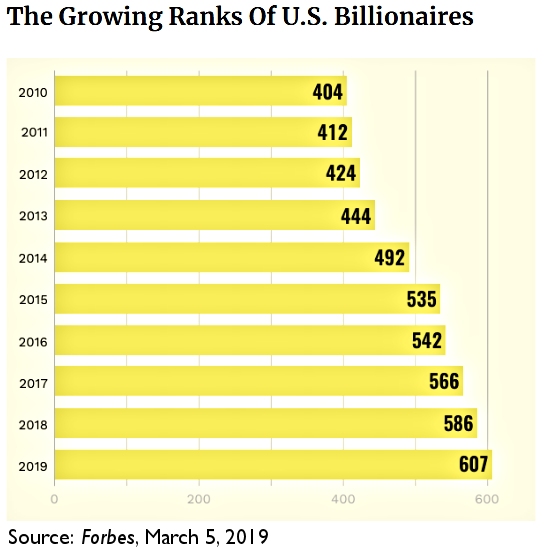
So what does one conclude from this picture? Is it in fact transnational capital of a global power elite that has dominated globalization, that we are seeing here? Or would it be more accurately reflective of reality to speak of an American Power Elite that dominates the world’s circuits of wealth creation and concentration? The answer has enormous import for how we think about globalization vs. American imperialism as the best mode of describing contemporary reality.
As we saw in the last section, the inability to explain why transnational capitalists need states is one of the most serious flaws in explanations that claim states have been diminished while transnational capitalists have real power. If they had real power, they would not need states. Thus one of the problems of this book is that it under-theorizes critical areas that really needed attention, if we were really to update Mills’ work.
US Imperialism and Transnational Capitalism
One of the key strengths of this book is that it goes against fashionable theorizing on the political left, prevalent among academics and activists, that minimizes or even refuses to name US imperialism. As Phillips shows in this book, the US is the foundation of transnational policing that works to enforce the interests of global capital. In particular, the global financial giants invest heavily in war-making as a means of profitably deploying excess capital.
Thus Phillips notes that, “the policy elites in the United States have been mostly united in support of an American empire of military power that maintains a repressive war against resisting groups…around the world” (p. 23). He also points out: “uncooperative regimes are undermined and overthrown in support of the free flow of global capital for investments anywhere that returns are possible” (p. 64).
“Humanitarian intervention” is also critically addressed by Phillips. He argues that the transnational capitalist class promotes “military interventions [that] are ideologically justified as peacekeeping or humanitarian missions,” primarily in cases where governments are “viewed as unfavorable to the TCC’s capital interests”—in such cases then, “resistance forces will be supported and encouraged toward regime change, as in…Libya, Syria, Iraq, Yemen, Somalia, Ukraine, Venezuela, and Yugoslavia” (p. 30). It is refreshing to read a North American academic who recognizes this reality. As indicated in the list of contents, Phillips dedicated an entire chapter to the subject of US empire (chapter 5).
The protection of transnational capital, Phillips argues, is what lies behind the production of “failed states, manufactured civil wars, regime changes, and direct invasions/occupations”. Each of these is a manifestation of “the new world order requirements for protecting transnational capital” (p. 215).
NATO is a key part of Phillips’ discussion, and he notes that NATO members collectively account for 85% of the world’s military spending (p. 223). Phillips’ argument is that NATO is the leading military defender of the interests of global capital: “NATO is quickly becoming a US military empire supplemental police force for the Global Power Elite and the Transnational Capitalist Class” (p. 224). In conjunction with this, he discusses the role of the Atlantic Council as the chief purveyor of NATO propaganda.
Yet, despite Phillips’ own arguments about manufactured civil wars, “resistance” groups funded if not created by Western powers, and regime change war—he still manages to produce an unquestioning endorsement of “Arab Spring protests” in North Africa as examples of resistance against neoliberal austerity politics (p. 304).
Global Inequality
Global inequality has become extreme under the dominance of the Global Power Elites. As William Robinson writes in the Introduction,
“the richest 1 percent of humanity in 2017 controlled more than half of the world’s wealth; the top 30 percent of the population controlled more than 95 percent of global wealth, while the remaining 70 percent of the population had to make do with less than 5 percent of the world’s resources”. (p. 15)
Phillips recounts a recent finding that only eight individuals now own half the world’s wealth (p. 21).
While not always clear about whether “the richest 1 percent” are the top 1% in the US or the top 1% of the world as a whole, the book informs us that the top fraction “increased their total wealth by 42.5 percent in 2008, and 50.1 percent in 2017,” and in the latter year, “2.3 million new millionaires were created, bringing the total number of millionaires around the globe to more than 36 million”; these millionaires represent “0.7 percent of the world’s population controlling more than 47 percent of global wealth’; the world’s bottom 70% only control 2.7% of total wealth (pp. 301–302).
This book also relays the following overview of global wealth inequality:
“The world’s total wealth is estimated to be close to $255 trillion, with the United States and Europe holding approximately two thirds of that total; meanwhile, 80 percent of the world’s people live on less than $10 per day, the poorest half of the global population lives on less than $2.50 per day, and more than 1.3 billion people live on only $1.25 per day”. (p. 30)
Robinson offers a partial/partisan view of the political results of increasing inequality, asserting that it has fueled “populist insurgencies” (thus unfortunately reinforcing elitist terminology), and that these are dominated by racist, xenophobic, and nativist concerns. What Robinson does not do is offer an explanation as to why those on the losing end of globalization in North America and Europe have turned to the right, and not the left.
What Robinson predicts is that the global concentration of wealth is, in effect, suicidal: it will lead to a global contraction of demand, and thus the global market will be unable to absorb the output of the global economy, and at that point the system will seize up. Is this something to be celebrated or criticized?
Phillips makes a similar point about the over-accumulation of capital: “there are only three mechanisms of investing excess capital: risky financial speculation, wars and war preparation, and the privatization of public institutions” (p. 30). What needs to be explained to readers is why, if capital over-accumulation is really a problem, would the holders of such capital invest in areas that generate even more capital.
Land and hunger also stand out as one of the strong points of this book’s explanations. First, some important statistics are provided, such as: the UN’s World Food Program estimates that 1 in 9 people go to bed hungry each night, which amounts to 795 million people suffering from chronic hunger; nine million die each year from starvation; one-third of the planet suffers from malnutrition; two billion more people will be lacking food by 2050, according to UN forecasts; and yet, “chronic hunger is mostly a problem of distribution, as one third of all food produced in the world is wasted and lost” (p. 31). Phillips clearly pins the blame of this mal-distribution on global speculation invested in agricultural lands, and global speculation in food, which have both raised the costs of land and food, and displaced populations (pp. 31, 63). As Phillips explains:
“In the last ten years, more than $90 billion has been invested in 78 countries for buying up more than 74 million acres of farmland. The result is mass corporate farming, usually for export, and the removal of these lands as a local food source”. (p. 32)
While the book tends to endorse much of the emergency talk around “climate change,” it’s important to note that Phillips is aware of some of the glaring opportunism that motivates some of the crisis-making:
“Amazingly, TCC/Global Power Elite money managers study the transforming environment for new investment opportunities. Climate change investing can be profitable, according to Forbes, and getting in on low-carbon investments, and sectors that will benefit should climate stress increase—such as defense, health care, and property insurances—can prove lucrative. Increasing interest in new mining opportunities available due to global warming is an important issue in Greenland. Private investment in the control of water sources is seen as an increasingly attractive opportunity for power elite speculation”. (p. 32)
Criticisms of the Book
Unfortunately, much of the book is written for an audience that is already prepared to believe and accept its main arguments and their assumptions. The question then is why such an audience would need this book. The echo-chambering of public discourse is itself echoed louder than ever in academic production. This book is not written for, say, skeptical students who are unconvinced and like to raise questions. On the other hand, it can be useful precisely for generating questions.
What in my view is one of the least attractive features of the book is the tendency to reduce discussion to moral principles. In that respect it is a very American book, which follows the very American tradition of displacing politics into morality. The result is a moralistic appeal for reform. Thus the book is directed at precisely those elites who are least likely to read or care about this book. However, matters become even murkier when the book’s idea of reform means that activists should volunteer to work with billionaires: “An honest, open look at real human options is vitally needed, and social movement activists seeking to end the crisis of humanity may find allies at the top willing to make radical readjustments needed to prevent wars, mass poverty, and environmental degradation” (p. 159). In an open letter to the Global Power Elite at the end of the book, we read this: “We absolutely believe that continued capital concentration and neoliberal austerity policies only bring greater human misery to the vast majority of people on earth” (p. 320, emphasis added). Why reduce what the book shows to be factually true, a matter of objective knowledge, to a matter of belief? Why should anyone care what the author and his colleagues “believe”? Sometimes the book has an unfortunate tendency of diminishing itself.
Theory remains relatively under-developed in this book, which tends to leave major questions unspoken (some of which were discussed in the sections above). The result is that books like C. Wright Mills’ The Power Elite remain as outstanding contributions, and the updating of his work is something that still needs to be done. Neither this book, nor other attempts at updating Mills, are yet ready to be read as “Mills Part 2”.
Related to the latter point, we seem to be generating an ever expanding vocabulary for describing essentially the same phenomenon. Thus, added to the base that is the transnational capitalist class (which is sufficient), we have shadow elites, influence elites, flexible networks, and now global power elites. Pretty soon, rather than having work that takes our understanding further, we will instead have works that lose time and energy in just clearing up the mystifying mass of new labels.
Though I intensely dislike facile comments like, “some of the book’s strengths are also its weakness,” I find myself here needing to make the same comment about the immense catalogue of empirical detail that appears in the profiles of the 389 individuals and the dozens of organizations named in this book. In that respect, the book begins to resemble more of a database, that makes for tedious reading. Seen from another angle, the book serves as a reference resource. However, what really stands out is the limited theorization of the material, that really does not expand on or elaborate on either the works of Mills, Sklair, or William Robinson.
Restrictions on access to the power elites means that the profiles that are provided in the book are based almost exclusively on open source documentation. The profiles thus result as flat, and almost lifeless—useful perhaps for statistical analysis, but almost devoid of oral history and cultural content.
Sometimes this book mirrors a website more than a printed volume, meaning that there can be excessive interleaving with contents that are already widely available. Thus the book unnecessarily reproduces, in full, the UN’s Universal Declaration of Human Rights. The tendency to copy and insert so much that is open source tends to produce excessive length.
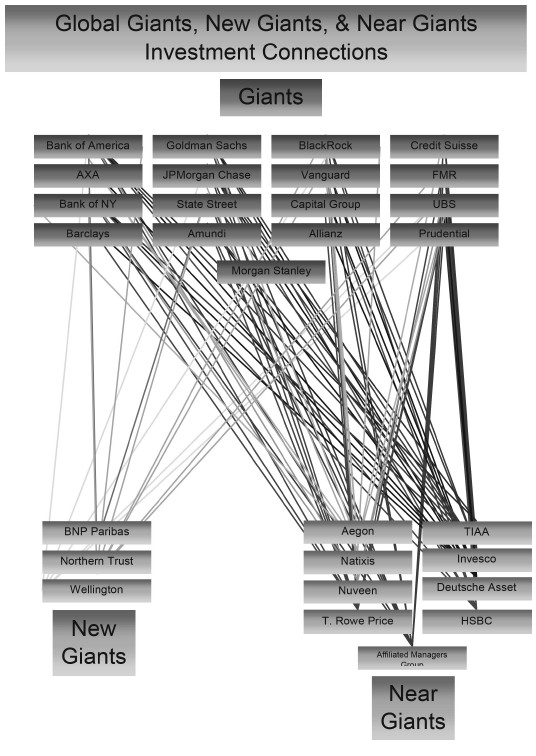
Diagrams in the book are often useless spaghetti illustrations of many dozens of crisscrossing lines linking inter-locked firms. The point is to show that each one is connected to every other—and it is far more economical to express that fact with words.
The Introduction by William Robinson was, surprisingly, one of the disappointing elements of this book. Robinson exploited the opportunity to sound off on a range of issues that personally anger and frustrate him—everything from Trump to climate change. I gather that this a popular Californian academic narrative. The chapter on the whole has a certain apocalyptic, doomsday quality to it, which is arguably more of a reflection of how culturally unprepared Americans are when it comes to absorbing the reality of their imperial decline: “If we do not annihilate ourselves in a nuclear holocaust or descend into the barbarism of a global police state, we will have to confront the threat of a human-induced sixth mass extinction that scientists say has already begun” (pp. 15–16).
At times, the book appears to pander to the fixations of the liberal-left, especially where climate emergency alarmism and identity politics are concerned. We are thus told at various points that this or that board of directors is exclusively male, or exclusively white, or white and male—as if the aesthetic veneer of dominance is what should occupy our attention.
Sometimes the book paints an excessively bleak and hopeless picture of inevitable collapse and war. The power of elites is sometimes overstated. Assumptions that poverty leads to rebellion (p. 303) are part of the book’s baggage of truisms, even if there is painfully little evidence to validate such assumptions. The point is that if it is all so bleak, then that defeats the chances of reform, the same reform that the book advocates. Phillips argues that unless something is done soon, movements like Occupy Wall Street will continue to emerge (p. 305)—to which the answer has to be a big “so what?”
Lastly, the index contains some notable errors and omissions, and is actually not very useful for using this book.
Conclusion
Reminding me of the some of the great books written by Susan George in the 1980s on debt crises and hunger, this is one of the more original and important contributions to early 21st-century debates about the decline of the 20th-century phenomenon known as “globalization”. It will serve as a valuable reference to many students of globalization, both within and outside of academia. Thus, despite my criticisms above, I would still recommend this book as required reading for any students in the fields of Political Science and International Relations, Global Sociology, and International Political Economy, as well as perhaps students in Economic Anthropology. What is especially valuable about this book is more than just its detail, but its reconciling of transnational capitalism with US empire. Even where the book falls short, it does so in a manner that provokes many productive and constructive questions.
For me personally, what emerged from studying this text is recognition of the degree to which states still matter immensely in the so-called globalized world (produced by states themselves), and the extent to which the US stands on top of globalization. It is no surprise then that we see the decline of US empire at the same time as the rise of de-globalization. Not discussed in this volume—and hardly mentioned on this site either—is the rise of an embryonic new order dominated by China, as evidenced by its extremely ambitious and widely spread Belt and Road Initiative.
Source: https://zeroanthropology.net/2019/11/27/global-giants-american-empire-and-transnational-capital/
Will the ICC Prosecute Perpetrators of the ‘War on Terror’?
By Ramona Wadi | MEMO | November 30, 2019
On May 13 2014, the International Criminal Court’s (ICC) Chief Prosecutor announced it would reopen the investigations into alleged war crimes committed by British soldiers in Iraq and Afghanistan, following additional submitted information pertaining to the investigation which had been concluded in 2006.
A recent BBC Panorama investigation, in collaboration with the Sunday Times, ascertained a cover-up by the UK government of British soldiers torturing and murdering Iraqi and Afghan civilians, including children since 2003, when the UK participated alongside the US in invading Iraq under the pretext of the so-called “war on terror”.
In 2010, the Iraq Historic Allegations Team (IHAT) was tasked with investigating allegations of abuse in Iraq, with the possibility of prosecuting the perpetrators. However, mismanagement and corruption within the body, including claims that solicitor Phil Shiner had paid people to find clients for IHAT, failed to open a single case from its investigations. For the UK’s Ministry of Defence, the allegations against IHAT were an opportune moment to discredit the claims of human rights violations committed by British troops. Rather than prioritise the allegations of human rights violations, IHAT was deemed harmful and “making soldiers on the battlefield anxious about later legal repercussions.”
In a 2018 report issued by the ICC, UK soldiers are alleged to have committed war crimes against 61 Iraqis in custody, including killings, torture, rape and sexual violence. Seven deaths occurred in custody and 54 victims died of “mistreatment”. The ICC report specifies: “At this stance, these incidents should not be considered as either complete or exhaustive, but rather illustrative of the alleged criminal conduct.”
In July 2019, the European Centre for Constitutional and Human Rights (ECCHR) submitted a follow-up to the ICC Prosecutor, informing the office about the UK’s failure to investigate or prosecute those responsible for war crimes, “despite significant and growing evidence indicating that liability extends up the chain of command to senior military and civilian officials.” The ECCHR also described the closing down of IHAT as a politically motivated decision to avoid ICC prosecution.
The UK’s intention was clearly to preserve its impunity. During the course of the BBC investigation, it was revealed that “The Ministry of Defence (MoD) had no intention of prosecuting any soldier of whatever rank he was unless it was absolutely necessary, and they couldn’t wriggle their way out of it.” Among the concealed crimes, a soldier from an SAS unit shot 4 Afghan civilians, three of them children, in the head, while they were in their own home, drinking tea. “When I entered the room, the bones, teeth, blood and brain were all over the place,” a witness to the aftermath stated. The UK government dismissed the war crime allegation by stating the four Afghans were Taliban suspects and commanders.
Other war crimes were concealed through fabricated evidence in order to evade such classification. Evidence of sexual abuse was also revealed to have occurred at Camp Stephen in Basra, Iraq, which was under the command of the Black Watch.
If the ICC does investigate the UK government for these violations of the Geneva Convention, it would have set a precedent, given that the Court has, so far, focused on investigating the leaders of African nations as opposed to the crimes of Western governments and foreign intervention. The “war on terror” is characterised by two main factors – perpetual aggression and extended impunity for the perpetrators. Justice for the Iraqi and Afghan people, by now, is worse than a macabre farce. Yet the ICC must fulfil its duty to lay bare the dynamics that have so far shielded the UK military and governmental collaboration from judicial scrutiny.
Prince Andrew – The Right Royal Lizard Tale
The furore around a disposable parasite’s conduct distracts from a REAL investigation into the Epstein case

By Kit Knightly | OffGuardian | December 1, 2019
The Queen is cancelling Prince Andrews birthday party. It’s big news. Oh, and some charities are declining to work with him.
This is all off the back of his (allegedly) voluntary, stilted and frankly bizarre Newsnight interview with Emily Maitlis. The collection of jarring statements, fairly obvious evasions and upper-class waffle has been autopsied to death. We don’t need to go over it again.
In fact, mocking Prince Andrew has become the pastime du jour. Everyone’s doing it. Isn’t it fun to partake? Make a little dig, really throw something back in the face of the establishment?
Really though, shouldn’t we know better?
The voice of the mainstream can NOT be trusted. It is never more important to remember this than when it is telling you what you want to hear.
Everybody should have learned by now, the media – and most especially the BBC – don’t have ANY duty to the truth. They can’t be forced to report something just because it’s true. They actively and willfully ignore true things all the time.
A few years ago 50,000 people marched past television centre, and the BBC simply ignored them all.
When the powers who control mainstream media don’t want to talk about something, it. Doesn’t. Get. Talked. About.
The corollary of this is that when the mainstream media is talking about something it’s for one reason and one reason only – they want to talk about it, because somewhere, somehow an agenda is being served.
What’s the agenda being served here? It’s impossible to know for sure at this stage, but it’s certainly true that while we’re talking about Prince Andrew having sex with a 17-year-old, we’re not talking about REAL paedolphilia.
We’re not talking about orphanages on Jersey or trafficking in Belgium, or Jimmy Savile. And we’re not talking about any of the names in Epstein’s “little black book”.
I’m not minimising or apologising for Prince Andrew’s alleged conduct, but let us recall the age of consent in the UK (and many American States) is 16. Significantly, he’s not being accused of doing anything actually illegal.
Do we really think that this is all the Epstein case boils down to? Is this as dark as the underbelly of the political elite gets?
It is sleazy, it is unseemly, and it is highly unpleasant. But it’s NOT a crime, and it’s certainly not a source of powerful political leverage. Nobody is being blackmailed into line based on this.
You don’t need to fly people to private Islands in the Caribbean to have sex with 17-year-olds. You don’t need to “traffic” legal teenagers in order to find girls willing to have sex with billionaires or royalty.
Clearly there must be something more to Epstein, his goals and his agenda, but none of that is being talked about.
While Andrew is being pilloried, and the BBC is getting plaudits for “hard-hitting” journalism, there are proven cases of institutional paedophilia that are far deeper and darker than anything being discussed by the BBC.
While we’re all laughing at Andrew, we’re forgetting that Prince Charles never gave, and was never asked to give, an interview explaining his “friendship” with Jimmy Savile.
While we’re huffing and puffing over “Royal conduct” and sex with girls of legal age, we’re not talking about the fact there are sitting MPs who were once “affiliated” with groups that campaigned to have the age of consent lowered to 10. We’re forgetting that accusations of REAL paedophilia circulate around many high-profile MPs (usually only after they die).
And, of course, lost in all the fuss about Andrew is the fact Jeffrey Epstein is dead.
It may have been memed into a meaningless catchphrase, but it’s still true – Epstein didn’t kill himself. Not alone, anyway.
Broadly speaking one of only three things can have happened:
He called in some favours and faked his death.
He was allowed/encouraged to commit suicide.
He was outright murdered.
Which of these took place we may never know, but it doesn’t really matter. He’s gone. And wherever or however he’s gone, he didn’t do it alone.
Someone – or a collection of someone’s – helped him on his way, either literally or euphemistically.
Why?
Why is always the most important question, you can tell that because it’s always the one media ignore. We’re never encouraged to wonder why anything happens, to think through motive, risk-reward calculations or basic strategy.
These are the big questions, going unanswered while we all partake of Prince Andrew free-for-all.
The fool of the family used to go into the Army or the Church, but now he’s dressed in motley and thrust in front of the TV cameras to gamble and pratfall to the laughs and jeers of the common man. The individual is sacrificed, but the institution is preserved.
I’ve used the autotomy of lizard tails as a metaphor before, and while it may display a lack of imagination to revisit that particular well, there’s no denying it fits well enough.
Of course there’s a temptation to go after Prince Andrew, he likely deserves it, but if we throw everything behind that, we’re in danger of losing the bigger picture. Like a dog being distracted with a string of sausages.
There’s something much bigger than Prince Andrew at the heart of all this, but we won’t find it if we content ourselves with feasting on the morsels the press are happy to feed us.
BBC under increasing criticism for biased reporting
By Johanna Ross | November 27, 2019
It’s almost as British as fish and chips and a pint, but what used to be embraced by the masses as a reliable source of information, the BBC, is now under increasing scrutiny for its overt political bias. With the growing popularity of social and alternative media, Brits are no longer taking as gospel what is pumped out by, this publicly funded service which is increasingly coming under fire for being nothing more than a propaganda machine for the sitting government. The hashtag #BBCbias has been trending for some time now on Twitter, and with more and more commentators questioning the integrity of this public service, it’s clear that the organisation needs to take a long hard look at itself.
Let’s take the issue of Scottish Independence for example. Coverage of this, and of the Scottish National Party has been demonstrated to be biased for years. A 2014 report by Dr John Robertson concluded that BBC reports in the run up to the Yes campaign consisted of “typically a Westminster scare story, on the Yes campaign, mostly left unanswered and unchallenged” and that coverage had “not been fair or balanced”. More worrying however, the research had illustrated that this biased reporting could well have had a negative impact on the independence movement: “we have evidence of coverage which seems likely to have damaged the Yes campaign”. The revelations earlier this year by a senior BBC journalist, Allan Little, that his colleagues viewed it as their responsibility to demonstrate how ‘foolish’ independence was, only adds to the case that coverage was far from impartial.
But despite the public outcry, it’s clear that few lessons have been learned. Much of the current criticism of the BBC is to do with its stance towards the Labour party led by Jeremy Corbyn. It couldn’t be more obvious from interviews by some of its top journalists – Andrew Marr for one – that there is an anti-Corbyn position, and in fact Corbyn has himself accused Marr in the past of ‘establishment bias’. A report from 2016 only looked into coverage of the Labour leader by the mainstream media in general and concluded that there was a “marked and persistent imbalance” in favour of sources critical to him. Furthermore, it singled out the BBC for using more ‘pejorative language’ when referring to Corbyn and his party colleagues and it gave almost double the unchallenged airtime to people criticising the Labour leader than to his supporters.
In recent months however, since Prime Minister Boris Johnson took office, the preferential treatment given to the government has been more stark than ever, mainly down to the nature of his ‘style’. For more than any other Prime Minister before him, Johnson has been accused of being economical with the truth. Therefore the BBC is under increased pressure to either promote the government position, as it has traditionally done, however extraordinary it may be, or rethink its approach altogether. One of the first to bring this issue to the public eye was acclaimed journalist Peter Oborne. Writing in Open Democracy, he stated that ‘British journalists have become part of Johnson’s fake news machine’. He accuses the Prime Minister of having “debauched Downing Street by using the power of his office to spread propaganda and fake news” and mentions the BBC Political Editor Laura Kuenssberg, saying she was ‘manipulated by Downing Street’ when she reported ‘insider information’ without questioning it. But with the lies of Boris Johnson being exposed more and more, how long can the BBC protect him?
Peter Oborne does go some way to explaining the problem: “I have talked to senior BBC executives, and they tell me they personally think it’s wrong to expose lies told by a British prime minister because it undermines trust in British politics.” But in actual fact this does not convey fully what is happening. For the reality is, despite its mission statement boasting of its aim “to act in the public interest, serving all audiences through the provision of impartial, high-quality and distinctive output and services which inform, educate and entertain”, the BBC is, and always has been, a mouthpiece for the British government of the day. Its journalists, up until the 1990s were vetted by the British security services. It’s always had an agenda to promote the establishment narrative and to oppose any individuals or movements which threaten that. Scottish independence is a threat. Jeremy Corbyn is another. The former will break up the Union; the latter is deemed a security risk because of his pacifist tendencies and non-interventionist stance when it comes to foreign policy.
But with both these movements gaining ground, and British politics and society in a state of flux, we are now in uncertain territory. The period of post-war stability is now coming to an end, and so is it the reign of the mainstream media. For the BBC to survive in this new media landscape it will have to inject a heavy dose of honesty and transparency into its broadcasting, or face being obsolete. As populism gathers strength, and people access a wider range of media sources than ever before, they will no longer be accepting things at face value.
Johanna Ross is a journalist based in Edinburgh, Scotland.
Where Comedy ends and Hasbara Begins
By Gilad Atzmon | November 26, 2019
Two days ago at the ADL conference Jewish Zionist comedian Sacha Baron Cohen criticised the internet and social media companies for allowing freedom of speech. This grotesque character who has made a career of marginalising oppressed minorities by depicting stereotypical characters and then ridiculing them is now calling on social media to adopt gag orders and to move us further into an Orwellian realm.
Galvanized by the support it received from the Jewish comedian, the ADL is now demanding that 10 social media accounts “should be removed immediately.”
For one reason or another I am included on the list. I need not mention that I have never been charged with any crime let alone a hate crime. I’ve never once been questioned by a single law enforcement body anywhere in the world. This does not stop the ADL from writing of me: “Gilad Atzmon is an anti-Semitic author and musician who describes himself as an ‘ex-Israeli’ and an ‘ex-Jew.”
I am indeed an ex Israeli and ex Jew and I am also a musician. However, I deny the accusation of anti-Semitism, I have never criticized Jews, or anyone else for the matter, as ‘a people,’ as ‘a race,’ as ‘a biology’ or as ‘an ethnicity.’ In fact, for my entire life I have opposed all forms of racism and this includes Jewish racism. I do criticise Jewish identitarian politics and some aspects of Jewish culture and ideology. I grew up in Israel and as far as I can remember, in the Jewish state, criticism of culture, ideology and politics is considered a perfectly kosher activity.
The ADL says of me that I am an “outspoken promoter of classic anti-Semitic conspiracy theories.” This is an absurd lie as I have repeatedly argued that there are no Jewish conspiracies since it is all done in the open: from Epstein’s Lolita Express, to Israeli war crimes, to advocacy of Zioncon global conflicts and plans for an ‘New American Century.’ The UK chief rabbi’s call for Brits to turn their backs on their opposition party is not exactly a conspiratorial clandestine move, it is actually mainstream news in Britain this morning. There are no Jewish conspiracies, what happens takes place in front of our eyes but we cannot discuss it because Jewish power, as I define it, is the power to suppress criticism of Jewish power.
From then on, what the ADL says about me is somewhat accurate. He is “a fierce critic of Jewish identity.” I am.
“He has written that ‘Jewish ideological, political, and cultural discourse is… foreign to universalism and ideas of true equality.’ My exact words can be found here. What I say is “We must find a way to admit to ourselves that the Jewish ideological, political and cultural discourse is a tribal discourse: it is foreign to universalism and ideas of true equality.” Here the ADL is engaged in a rather obvious attempt to deceive. In my original text, being ‘foreign to universalism and true equality’ elucidates the notion of tribal discourse. You may wonder why the ADL acts in a duplicitous manner.
The ADL complains that “although Atzmon frequently attacks Zionism, he has also argued that Zionism itself was originally a ‘universalist and humanist’ movement which was ‘hijacked by Judaism.’ In fact, this is exactly what I argue and I wonder, where exactly is the ‘crime?’ The battle between ‘the Israeli’ and ‘the Jew’ was at the centre of the Israeli political debate in the last election. Am I guilty of identifying the core of Israel’s identity crisis a decade before anyone else?
Finally the ADL complains that I say of Israel that it is a “tyranny inspired by a deep Talmudic intolerance.” I am afraid that the Israeli National Bill is the materialisation of the above. I think I remember that the ADL’s Abe Foxman also wasn’t pleased with Israel’s National Bill for pretty much the same reasons. Is the ADL going to ask to delete his twitter account?
Sooner or later we will have to examine the question whether the relentless attack by Jewish institutions on freedom of speech, 1st amendments and the core Western ethos has been ‘good for the Jews.’
WikiLeaks Proved the OPCW Cannot Be Trusted In Syria
By Paul Antonopoulos | November 26, 2019
The “Syrian regime” and chemical weapons has become a constant mantra in the Western World and has become synonymous with the Syrian War since it began in 2011. One of the most famous cases was the April 2018 chemical weapon attack in the Damascene satellite city of Douma that led to the U.S., UK and France conducting airstrikes against Syrian Army positions, despite the lack of evidence that the Syrian government was responsible for the incident.
The April 7, 2018 chemical incident killed between 40 and 50 people and was followed up by the Western Powers attack against Syria exactly a week later. Strangely though, the attack took place just mere hours before the Organization for the Prohibition of Chemical Weapons (OPCW) inspectors arrived in Syria to investigate the attack. The U.S., UK and France knew that the eventual OPCW report would not match their claims and allegations against the Syrian government, and were quick to act in wasting their people’s tax dollars by dropping bombs on the Arab country.
The final OPCW report would not match the first report made by the Fact-Finding mission that were actually on the ground in Syria. An email released by whistleblowing Wikileaks on the weekend found that the final OPCW report on the Douma incident had been manipulated and changed by the Office of the Director-General of the OPCW, then held by Turkish diplomat Ahmet Üzümcü. This is an extremely disturbing discovery as the OPCW claims to have a “neutral role” by not assigning blame for chemical weapon use, but to find out the details of how the attack was conducted. This however was reversed last year with the OPCW being given permission to investigate perpetrators – but they still kept the mythology that they are “neutral.”
Although the report did not assign blame, the e-mail claims that the report “morphed into something quite different to what was originally drafted” and that “a bias has been introduced into the report, undermining its credibility” and that it “is disingenuous.” This was of course to bring the illusion that Syria was responsible for the attack, despite no tangible evidence.
In March, the OPCW report claimed that chlorine was the likely agent used in last year’s attack, but the newly released email explains that this claim “is highly misleading and not supported by the facts.”
“Omitting this section of the report has a serious negative impact on the report as this section is inextricably linked to the chemical agent identified… In this case, the confidence in the identity of chlorine or any other choking agent is drawn into question precisely because of the inconsistency with the reported and observed symptoms. The inconsistency was not only noted by the fact-finding mission team, but strongly supported by three toxicologists with expertise in exposure to chemical warfare agents”, the e-mail revealed.
The email then makes a final request that the original report be released in “its entirety” as the author fears that the manipulated report does not “reflect the work of the team” and “would negatively impact on the perceived credibility of the report, and by extension that of the Organisation.”
It must be remembered that when the OPCW report was released in March 2019, nearly a whole year after the incident. The released report ignored evidence provided by the Russian Foreign Ministry that the Al-Qaeda affiliated White Helmets were responsible for the attack, and that rather the report was attempting to justify the U.S.-led attack against Syria.
However, the release by WikiLeaks was only the final nail in the coffin confirming that the OPCW is not “neutral” and rather highly politicized. It was revealed only last week by the Grayzone that a second whistleblower from the OPCW came forward to accuse the top leadership of the organisation of suppressing critical evidence because of pressure from the U.S.
This demonstrates that there is a major rift between the actual inspectors on the ground and the higher-level officials of the organization who are willingly submitting to U.S. pressures despite trying to maintain their credibility of being neutral. The very appointment of Üzümcü, a former Turkish ambassador to Israel and a former Permanent Representative of Turkey to NATO, demonstrates that his very appointment had political motivations knowing Ankara’s aggressive foreign policy towards Syria since the beginning of the war.
There can be little doubt now that the claim of neutrality is far from reality and rather the top leadership of the OPCW are willing to omit, manipulate and change facts that were on the ground and discovered by their own Mission at the behest of the U.S. so it could pressure Syria and legitimize the illegal U.S.-led attack. This can only bring into question now the legitimacy of all the other chemical weapon attacks blamed on the Syrian government over the course of many years.
In addition, the OPCW should be the center of wide condemnation from the international community and the United Nations, who once shared a Joint Mission with the OPCW to remove Syria’s chemical weapons from October 2013 to September 2014. The OPCW has now lost all credibility and should be replaced by a new organization that does not appoint controversial Director-Generals or submit to pressure from external forces, like the U.S., and perhaps even Turkey.
However, the most telling of the politicization of the OPCW occurred at yesterday’s annual OPCW forum in the Hague, where the organization vehemently defended themselves against the well-timed Wikileaks expose. Fernando Arias, the current OPCW Director-General, defended the manipulated report, saying: “the nature of any thorough inquiry for individuals in a team is to express subjective views. While some of these diverse views continue to circulate in some public discussion forums, I would like to reiterate that I stand by the independent, professional conclusion [of the investigation].”
Simply put, WikiLeaks has helped prove that the OPCW can no longer be trusted and certainly is not neutral. Britain and France unsurprisingly at yesterday’s OPCW forum also defended the initial report and rejected the allegations of doctoring. But this of course was always to be expected.
Paul Antonopoulos is a Research Fellow at the Center for Syncretic Studies.
Anti-Russian sanctions based on fraudster’s tales? Spiegel finds Magnitsky narrative fed to West by Browder is riddled with lies
RT | November 24, 2019
British investor Bill Browder has made a name for himself in the West through blaming Moscow for the death of his auditor, Sergey Magnitsky. Der Spiegel has picked apart his story and uncovers it has major credibility problems.
For years Browder – Russian President Vladimir Putin’s self-proclaimed “enemy number one” and head of the Hermitage Capital Management fund – has been waging what can only be described as his personal anti-Russian campaign.
The passionate Kremlin critic relentlessly lobbied for sanctions against Russian officials everywhere from the US to Europe – all under the premise of seeking justice for his deceased employee, who died in Russia, while in pre-trial detention, where he’d been placed while accused of complicity in a major tax evasion scheme.
Browder, who was himself sentenced in absentia by a Russian court to nine years in prison for tax evasion, and was later found guilty of embezzlement as well, presented Magnitsky as a fearless whistleblower who exposed a grand corruption scheme within the Russian law enforcement system, and who was then mercilessly killed out of revenge.
The investor has succeeded in feeding this narrative to the Western governments and the mainstream media alike, prompting the US to adopt the Magnitsky Act in 2012, which allowed the US to sanction numerous Russian officials and businessmen over alleged human rights violations. Some American allies, including Canada and the UK, later followed suit and passed similar motions, which either allowed the sanctioning of Russian officials or called on their governments to do it.
Yet, the businessman, who has over the years donned the mantle of a human rights campaigner, does not plan to stop at that and is now lobbying for an EU-wide equivalent of the Magnitsky Act, which would allow the banning of Russian officials from the bloc’s countries and the freezing of their accounts.
On the tenth anniversary of the auditor’s death, the German weekly Der Spiegel has decided to take a closer look at Browder’s story about Magnitsky. And the paper found out that the narrative doesn’t quite flow as smoothly as Western politicians and the MSM would like it to.
No hero
The whistleblower image Browder has built for Magnitsky starts splitting at the seams from the very beginning, as Browder appears to be dishonest, even in minor details like his claim that Magnitsky was his lawyer, Der Spiegel’s Benjamin Bidder reveals in his investigative bombshell.
The problem is that he was not. The man was an auditor, who was hired by Browder’s company as a tax specialist and then worked in this capacity for years with the US-born British investor. Browder himself had to admit this fact when he was questioned in a US court while seeking to make the US impose sanctions on yet another group of Russian entrepreneurs.
Magnitsky’s role as a whistleblower also comes into question as the deceased auditor’s former lawyer confirmed to Der Spiegel’s Bidder that his client had, in fact, been summoned by Russian investigators to provide testimony in a tax evasion case that opened at least months before he came up with his corruption allegations.
Other documents obtained by Der Spiegel, including Magnitsky’s unpublished emails, also suggest that Magnitksy acted not of his own volition but on the instructions of Browder’s senior lawyer, at a time when the Russian authorities had already been investigating dubious letterbox companies Browder supposedly had used in his tax evasion scheme for years.
Finally, the records of Magnitsky’s interrogation, released by Browder’s own people on the internet and seen by Der Spiegel, show that he’d never explicitly accused Russian police officers Artyom Kuznetsov and Pavel Karpov, whom Browder declared to be the masterminds behind the supposed corruption affair, and ultimately behind the auditor’s murder.
This fact was also implicitly confirmed by a UK court, which issued a ruling on a libel lawsuit filed by Karpov against Browder in 2012. Although the court ruled that Karpov simply had no prior reputation to defend in the UK and rejected his claim, it still called Browder a “storyteller,” arguing that he could not even come “close to substantiating his allegations with facts.” The British media, however, presented the verdict as a resounding victory for Browder.
No murder
The German weekly also found similar inconsistencies in the story of the auditor’s supposed murder, as told by Browder. In his claims, the businessman constantly refers to a report by the Moscow Public Monitoring Commissions (PMC) – an independent, non-governmental body consisting of rights advocates that conducted its own thorough investigation into Magnitsky’s death.
Browder maintains that Magnitsky was deliberately murdered. Yet, the commission’s report, which is still freely available on its website, contains no claim of this sort. The commission does decry the harsh jail conditions which the auditor was kept in, and accuses the Russian authorities of failing to fulfil its duty to protect his life. However, it says nothing of murder.
It is not just the text of this report that Browder has apparently distorted, though. In August, the European Court of Human Rights (ECHR) issued a ruling on Magnitsky’s case, ordering Russia to pay his widow and mother €34,000 ($38,000) in damages.
Browder was quick to hail this decision as “destroying the Russian government’s narrative” and proving that “the Russian government murdered Magnitsky.” However, it would seem Browder’s own narrative was dealt a blow instead.
The ECHR never even mentioned the word “murder” in its ruling. Instead it said that Russia basically failed “to protect Mr Magnitsky’s right to life” by providing inadequate medical care and failed “to ensure an effective investigation into the circumstances of his death.”
It even concluded that Magnitsky’s arrest “was not arbitrary, and that it was based on reasonable suspicion of his having committed a criminal offence” – though it did also say there was no “justification” for his lengthy pre-trial detention.
Buying into convenient narrative
In his investigative report, Der Spiegel’s Benjamin Bidder eventually concludes that, although Magnitsky might have fallen victim to some “gruesome injustice,” his image is still far from that painted by Browder in his efforts to pit Russia and the West against each other.
“A question arises whether there has ever been a perfidious political murder plot or the West simply was made to buy into the lie of a fraudster.”
The journalist says that Browder’s “justice for Magnitsky” campaign might have, in fact, been part of his own “personal revenge” on Russia, one that uses the auditor’s fate as fuel for an “argumentative perpetual motion” that helps the businessman himself stay afloat in the sea of Western politics.
Yet, there is another question that needs to be asked: Why did Western politicians and the media support Browder’s narrative so eagerly, without even fact-checking it first? The answer is simple.
According to Bidder, Browder is “so successful because his narrative seems to fit perfectly with the devastating image” that Russia has in the West, making it much more convenient for the media to just toe the line instead of questioning it.
Also on rt.com:
Tycoon who pushed Magnitsky Act warns EU minister that opposing Russia-bashing is ‘career ruining’
UK Blasted as ‘Illegal Colonial Occupier’ After Skipping UN Deadline Over Chagos Islands
Sputnik – November 22, 2019
Mauritian Prime Minister Pravind Jugnauth has branded Britain an illegal colonial occupier after the country failed to meet a UN deadline to hand over an overseas territory to Mauritius, a former British colony in the Indian Ocean, BBC reported.
The country claims it was forced to trade the Chagos Islands in exchange for sovereignty, with the UK purchasing them for £3 million in 1965, when Mauritius was still under British rule.
Earlier this year, the UN general assembly voted by an overwhelming majority of 116-6 in favour of the motion demanding that the islands, Britain’s last remaining African territory, be reunited with Mauritius. However, the UK refused to regard the UN motion as binding.
“We have no doubt about our sovereignty over the British Indian Ocean Territory, which has been under continuous British sovereignty since 1814″, a Foreign Office spokesperson said adding the African country has “never held sovereignty over the archipelago”.
According to the press service, the territory will remain under British control until “it is no longer needed for defence purposes”.
White Helmets involved in organ trafficking in Syria: Study
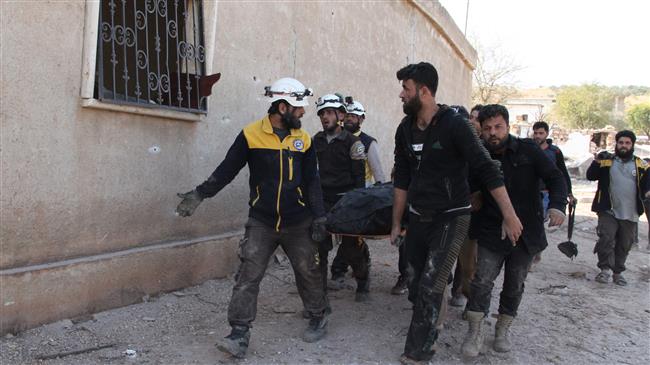
White Helmets members with the body of a person in al-Malajah village, south of Syria’s Idlib Province, November 17, 2019. (Photo by AFP)
Press TV – November 21, 2019
A survey by a Russian institution reveals that the White Helmets, which operates under the guise of an aid group in Syria, has been involved in the forcible removal of organs from civilians living in areas controlled by militants.
The survey, dubbed “White Helmets: terrorist abettors and sources of disinformation,” was conducted by the Foundation for the Study of Democracy.
Presenting the study’s findings on Thursday, Maxim Grigoryev, director of the organization, said the White Helmets evacuated people with the promise of medical assistance, but later handed their bodies — with some vital organs missing — to their relatives.
He added that the organ removals came to light after the bodies were examined.
“They [White Helmets] were a key element in this illegal scheme of organ removal. We learned about those incidents from the people whom we interviewed. This information came as an unpleasant surprise to us,” Grigoryev said.
He further noted that the survey was based on interviews with White Helmets members, former militants and residents of Syrian areas where White Helmets were most active, including Aleppo, Damascus, Douma, Dayr al-Zawr and Saqba.
Grigoryev also pointed out that the illegal extraction and trade of human organs was practiced in late 1990s, when White Helmets co-founder James Le Mesurier was in Yugoslavia. Le Mesurier, a former British army officer, was found dead in Istanbul earlier this month.
“The scheme of illegal extraction of organs from residents of Serbia was carried out on the territory where he [Le Mesurier] was staying, and exactly the same system was recreated in Syria. This is exactly what White Helmets are doing,” he said.
The White Helmets claims to be a humanitarian NGO, but it has been accused of working with anti-Damascus terrorists and staging false-flag chemical weapons attacks in Syria.
Syria views the White Helmets as “a branch of al-Qaeda and al-Nusra” militant outfits and a “PR stunt” by the US, the UK and France.
“The Palace… Threatened Us a Million Different Ways”
By Craig Murray | November 16, 2019
This leaked off-air recording of ABC News anchor Amy Robach is much more revealing than anything the BBC is going to air about Andrew Saxe Coburg Gotha.
Buckingham Palace has been “threatening” journalists to bury the story for years – which is all very reminiscent of Jimmy Savile, who was of course, ahem, popular at the Palace. Robach also states they were scared of losing interview access to folically challenged William Saxe Coburg Gotha and his underweight wife. She does not explicitly state that was one of the “threats” Buckingham Palace employed, but it does follow directly as her next observation.
Amy Robach very probably realised this “unguarded” moment would get out to the public, and we should be grateful to her for lifting the lid on how the protection of the crimes of the powerful operates, on a global level. Alan Dershowitz, whom Robach mentions, was not only a Lolita Express passenger, he is the celebrity lawyer who defended the CIA‘s use of torture as legally and morally justified. One might speculate on the psychological parallels of torturing the defenceless and inflicting sex on the young.
There is overwhelming evidence that Virginia Roberts Giuffre was trafficked into the UK by Epstein for sex with Prince Andrew. There are flight logs. There is that compromising photo in Ghislaine Maxwell’s flat. Both are entirely consistent with, and strongly corroborate, Virginia’s own testimony. This instance occurred in the UK.
It ought to be a matter of deep national disgrace that neither Ghislaine Maxwell nor “Prince” Andrew has been questioned over by the Metropolitan Police over this sex trafficking. That Virginia was over 16 is not the issue. She was sex trafficked into the UK and not legally adult. Why is there not a massive media clamour for Scotland Yard to investigate?
Amy Robach has the answer to that question.
Hat Tip to projectveritas
Featured Video

John Mearsheimer: New World Order Arrived & Europe Is Left Behind
or go to
Aletho News Archives – Video-Images
Book Review
Sunset on Net Zero: A Heretic’s Guide to the Futile CO2 Target
By Ronald Paul Barmby (Author) – October 3, 2025
SUNSET ON NET ZERO describes in detail why Net Zero CO2 is pointless and unachievable. It explains in understandable terms the up-to- date thoughts of the greatest minds of today in physics, meteorology, economics, engineering, and the geosciences.
Net Zero CO2 is pointless because we have now confirmed by satellites that 90% of CO2 warming has already happened. CO2 is not an existential threat but clouds, El-Niño, and human habitation are significant drivers of global warming that are often ignored.
Net Zero CO2 is unachievable because the green technology alternatives are unreliable and unaffordable. Wind and solar power triple electricity costs, building fully electric vehicles produces at least one-half of CO2 emissions they are meant to avoid, and heat pumps will leave you dangerously cold in the winter. Green hydrogen, air capture CO2, and carbon capture and storage are prescriptions for national bankruptcy. The supply of key metals and minerals required to achieve Net Zero need to be at least doubled—some much more—and are often controlled by a very few. Net Zero comes with huge environmental and agricultural costs.
We have been through similar climatic temperature changes before, more recently than you think. Our efforts to control it are futile.
Blog Roll
 Aletho News
- FDA Ordered to Pay Over $570,000 in Fight Over Pfizer COVID Vaccine Records
- USAID turned to Facebook to drive demand for Covid vaccines in Global South – files
- Britain’s shadow security network expands into south Lebanon
- The ADL Has a Foreign Policy, and You Are Not Supposed to See It
- Former Qatari PM says ‘Israel’ has security ties with all Gulf states
- The Sound of Silence in the Strait of Hormuz
- Poland’s call for a no-fly zone in Ukraine means NATO direct war with Russia
- John Mearsheimer: New World Order Arrived & Europe Is Left Behind
- Naqab demolition notices top 1,000; settlers demolish Jaloud homes
- Israel is Using the ‘Gaza Ceasefire’ to Commit Ethnic Cleansing
- If Americans Knew
- An error has occurred; the feed is probably down. Try again later.
- No Tricks Zone
- Physicists: Doubling CO2 Has A Smaller Impact On Ocean ‘Acidification’ Than Existing Internal Variability
- Alarmist Climatologists In Shock! 2026 Atlantic Hurricane Season Sees Lowest Count In 101 Years
- New Study: Modern Temps Are Among The Coldest Of The Last 10,000 Years In East Central Europe
- Germany’s Renewable Energies Lead to 1.4 Billion Euro Electric Power Trade Deficit
- Argentina’s Perito Moreno Glacier Joins Antarctica and Arctic In Defying Doomsday Melt Claims
- New Study: Barents Sea Temperatures Were Warmer And Sea Ice Less Extensive In The 1700s Than Today
- German Authorities Start Initiative To Evaluate Public Register For Climate “Disinformation” Spreaders!
- Zonal Asymmetry of Temperature Change in the Antarctic Circumpolar Current
- New Study: The Net Fossil Fuel Contribution To Rising Atmospheric CO2 Has Been Zero For 500 Years
- Germany’s Green Energy Transition Becoming Increasingly Expensive…Another 6 Trillion Euros!

