Tehran slams Bahrain for hosting ‘provocative’ conference on Gulf maritime security
RT | August 8, 2019
Tehran has hit out at Bahrain for hosting a “provocative” conference on Gulf maritime security and for its rhetoric accusing Iran of attacking tankers. Manama said the July 31 meeting was held to discuss the “current regional situation,” Lebanon’s Daily Star reported.
It was not announced who’d attended the event in Bahrain, but the Guardian reported the UK had called for the meeting with other European countries and Washington. The tiny Gulf monarchy hosts the US Fifth Fleet.
“Bahrain’s government should not become the facilitator of common enemies’ wishes and schemes in the region,” Iran’s foreign ministry spokesperson Abbas Mousavi said on Thursday, in a statement published on his Telegram channel.
“The security of regional countries is inseparable and it is not possible for some to be secure at the cost of others’ insecurity.” he said. “It is expected that regional countries prevent foreigners’ escalatory interventions by exercising prudence and foresight.”
Sky News laments erosion of ‘rules-based international order’ but does such a thing really exist?
By Danielle Ryan | RT | August 7, 2019
The “rules-based international system” is under increasing threat, with laws flouted and “norms” violated at every turn by disobedient members of the world community, warns a preachy Sky News op-ed.
The dire warning, authored by Sky’s foreign affairs editor Deborah Haynes, defines this rules-based order as the “network of accords and institutions” which make up the“framework that helps to ensure security, rights, freedoms and justice” around the world.
Haynes hails the United Nations, the NATO alliance and various international treaties as examples within that framework, but, curiously, the central bogeymen of the piece allegedly eroding this so-called system are all Western adversaries.
Any truly honest assessment of the world today would acknowledge that this “rules-based international system” of which Haynes speaks is a myth; if it ever did exist, it has been battered ceaselessly by Western powers. The rules-based order is less a functioning system offering “rights, freedoms and justice” and more a tired catchphrase used by Western officials and their media partners to scold countries that refuse to obey their commands. In other words, it exists only in theory, rarely in practice.
Russia is accused by Haynes of having repeatedly attacked “the global rulebook of normal behaviour,” but what is normal behaviour? If we are to believe that Western actions are “normal,” then normal has taken an increasingly macabre turn.
Was the 2001 US invasion of Afghanistan — a country still occupied 18 years later — a win for the rules-based system? If there were any lingering notions about a functioning international order after that, the 2003 invasion of Iraq should surely have put an end to them; oddly, it gets no mention in the article.
Britain’s misdeeds — including its enthusiastic support for that war — are also conspicuously absent from the opus. Speaking of Britain, one wonders do Yemenis, slaughtered and starved by Saudi Arabia, with generous help from London in the form of billions of pounds worth of arms, feel they are the lucky beneficiaries of this rules-based order?
Maybe Libyans, having had their once stable and prosperous country ravaged by NATO’s 2011 “humanitarian intervention” feel the same? The military bloc’s infamous “humanitarianism” was also on display during its earlier bombardment of Yugoslavia in 1999.
Are the “rights, freedom and justice” touted by Haynes as by-products of this so-called system being offered to Palestinians? When Israel demolishes their homes and schools, tramples over their rights, and uses overwhelming military force to stamp out resistance — while the West turns a blind eye — is it adhering to this normal rules-based behaviour?
This phrase “normal behavior” is nothing more than a Washington talking point. US Secretary of State Mike Pompeo warned Iran last year to “act like a normal country, or see its economy crumble.”
Unfortunately, it has indeed become ‘normal’ for the US to crush under its boot any country which dares to object to its rule, through the use of deadly sanctions and often brute military force.
The same warnings were recently issued to Venezuela, which is now under a total economic blockade and where experts have assessed that deadly sanctions have led directly to the premature deaths of 40,000 people.
The other thing about the “global rulebook” is that the rules are constantly changing to suit the whims of Western powers. When asked why Washington’s recognition of Israel’s sovereignty over Syria’s Golan Heights was good, but Crimea’s decision to rejoin Russia was bad, Pompeo referred senators to a particular “international law doctrine” which does not exist.
Haynes also deplores China’s erosion of freedoms for the people of Hong Kong and mentions ongoing pro-democracy protests in the region as another “symptom” of the unraveling of the rules-based system. Meanwhile, in her own country, one of, if not the most consequential journalist of modern times sits behind bars for the crime of doing real journalism and upsetting the global elites’ applecart.
Ultimately, the screed adds little of value to any discussion about international affairs. Yet, it is still valuable in the sense that it is a great demonstration of the delusion, hypocrisy, and total lack of self-awareness displayed by many Western journalists when attempting to make sense of the world around them.
London council cancels pro-Palestine event over anti-Semitism claims
MEMO | August 5, 2019
London Borough of Tower Hamlets refused to host the closing rally of the annual bike ride raising money for Palestinian children in the besieged Gaza over claims it would breach the IHRA’s anti-Semitism criteria, the Guardian reported on Saturday.
The council told the Big Ride for Palestine, which was established on the first anniversary of Israel’s 2014 offensive on Gaza and which has raised nearly £150,000 for sports equipment for children in the enclave, that the event could not go ahead in the borough “without problems”.
However, the Palestine Solidarity Campaign won a Freedom of Information battle in an effort to discover the reasons behind the council’s refusal to host the event. Internal emails revealed that council staff agreed not to make public “anti-Semitism concerns”.
While the council officials, according to the Guardian, told the organisers that there was a risk speakers might express views which contradicted the council’s policies on community cohesion and equality, behind the scenes the council attributed the reasons to “real risk” of violating IHRA’s definition of anti-Semitism.
The council’s concerns were linked to the Big Ride’s website describing Israel’s illegal occupation and siege of the Gaza Strip as “apartheid” and “ethnic cleansing”.
When considering how to explain the decision, the Guardian said, one council official said it would be wise to “avoid the anti-Semitism aspect… as this could open a can of worms and come back to bite us”.
The Guardian reported a council spokesman saying: “The council gave the application careful consideration and decided not to host the event, because we do not host rallies with political connotations, albeit without direct links to political parties.”
However a spokesperson for the charity said its work was focused on helping the 300,000 children in Gaza showing signs of severe psychological distress.
The spokesperson added: “It’s a dreadful thing when an over-scrupulous interpretation of the IHRA definition of anti-Semitism is used behind closed doors to prevent awareness raising of the situation in Palestine and the need for humanitarian support.”
It’s not too late to donate, follow this link and give what you can.
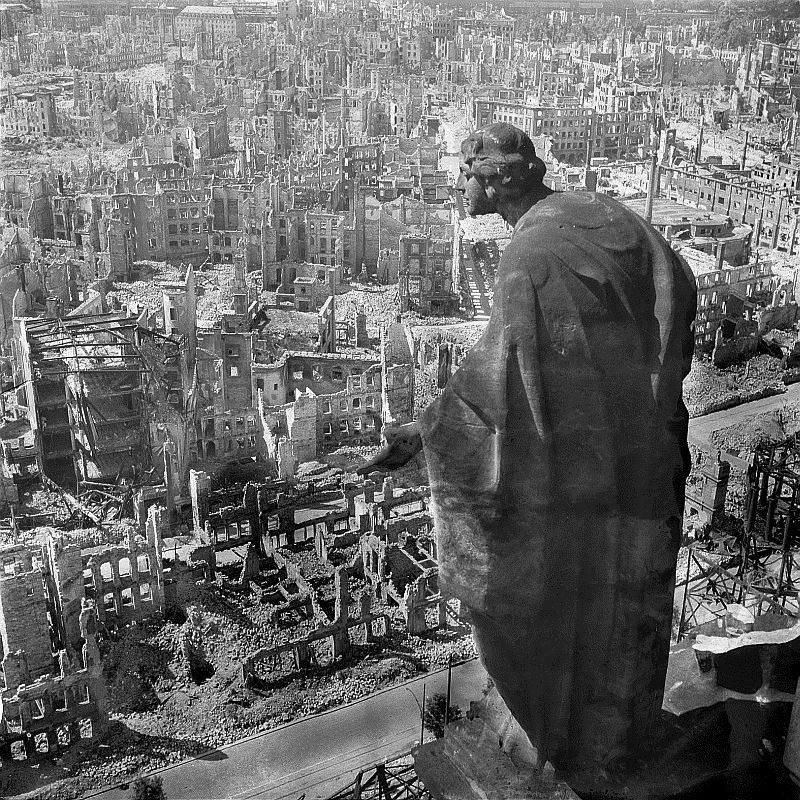
How Many Germans Died under RAF Bombs at Dresden in 1945?
By John Wear | Inconvenient History, Vol. 11, No. 1 (3-25-2019)
Introduction
The bombing of Dresden remains one of the deadliest and morally most-problematic raids of World War II. Three factors make the bombing of Dresden unique: 1) a huge firestorm developed that engulfed much of the city; 2) the firestorm engulfed a population swollen by refugees; and 3) defenses and shelters even for the original Dresden population were minimal.[1] The result was a high death toll and the destruction of one of Europe’s most beautiful and cultural cities.
Many conflicting estimates have been made concerning the number of deaths during the raids of Dresden on February 13-14, 1945. Historian Richard J. Evans estimates that approximately 25,000 people died during these bombings.[2] Frederick Taylor estimates that from 25,000 to 40,000 people died as a result of the Dresden bombings.[3] A distinguished commission of German historians titled “Dresden Commission of Historians for the Ascertainment of the Number of Victims of the Air Raids on the City of Dresden on 13/14 February 1945” estimates the likely death toll in Dresden at around 18,000 and definitely not more than 25,000.[4] This later estimate is considered authoritative by many sources.
While exact figures of deaths in the Dresden bombings can never be obtained, some Revisionist historians estimate a death toll at Dresden as high as 250,000 people. Most establishment historians state that a death toll at Dresden of 250,000 is an absolute impossibility. For example, Richard Evans states:
Even allowing for the unique circumstances of Dresden, a figure of 250,000 dead would have meant that 20% to 30% of the population was killed, a figure so grossly out of proportion to other comparable attacks as to have raised the eyebrows of anyone familiar with the statistics of bombing raids…even if the population had been inflated by an influx of refugees fleeing the advance of the Red Army.[5]
Population of Dresden
Historians generally agree that a large number of German refugees were in Dresden during the night of February 13-14, 1945. However, the estimate of refugees in Dresden that night varies widely. This is a major reason for the discrepancies in the death toll estimates in the Dresden bombings.
Marshall De Bruhl states in his book Firestorm: Allied Airpower and the Destruction of Dresden:
Nearly every apartment and house [in Dresden] was crammed with relatives or friends from the east; many other residents had been ordered to take in strangers. There were makeshift campsites everywhere. Some 200,000 Silesians and East Prussians were living in tents or shacks in the Grosser Garten. The city’s population was more than double its prewar size. Some estimates have put the number as high as 1.4 million.
Unlike other major German cities, Dresden had an exceptionally low population density, due to the large proportion of single houses surrounded by gardens. Even the built-up areas did not have the congestion of Berlin and Munich. However, in February 1945, the open spaces, gardens, and parks were filled with people.
The Reich provided rail transport from the east for hundreds of thousands of the fleeing easterners, but the last train out of the city had run on February 12. Transport further west was scheduled to resume in a few days; until then, the refugees were stranded in the Saxon capital.[6]
David Irving states in The Destruction of Dresden:
Silesians represented probably 80% of the displaced people crowding into Dresden on the night of the triple blow; the city which in peacetime had a population of 630,000 citizens was by the eve of the air attack so crowded with Silesians, East Prussians and Pomeranians from the Eastern Front, with Berliners and Rhinelanders from the west, with Allied and Russian prisoners of war, with evacuated children’s settlement, with forced laborers of many nationalities, that the increased population was now between 1,200,000 and 1,400,000 citizens, of whom, not surprisingly, several hundred thousand had no proper home and of whom none could seek the protection of an air-raid shelter.[7]
A woman living on the outskirts of Dresden at the time of the bombings stated: “At the time my mother and I had train-station duty here in the city. The refugees! They all came from everywhere! The city was stuffed full!”[8]
Frederick Taylor states in his book Dresden: Tuesday, February 13, 1945 that Dresden had been accepting refugees from the devastated cities of the Ruhr, and from Hamburg and Berlin, ever since the British bombing campaign began in earnest. By late 1943 Dresden was already overstretched and finding it hard to accept more outsiders. By the winter of 1944-1945, hundreds of thousands of German refugees were traveling from the east in an attempt to escape the Russian army.[9]
The German government regarded the acceptance of Germans from the east as an essential duty. Der Freiheitskampf, the official German organ for Saxony, urged citizens to offer temporary accommodation:
There is still room everywhere. No family should remain without guests! Whether or not your habits of life are compatible, whether the coziness of your domestic situation is disturbed, none of these things should matter! At our doors stand people who for the moment have no home—not even to mention the loss of their possessions.[10]
However, Taylor states that it was general policy in Dresden to have refugees on their way to the west to continue onwards within 24 hours. Fleeing the Russians was not a valid justification for seeking and maintaining residence in Dresden. Taylor states that the best estimate by Götz Bergander, who spent time on fire-watching duties and on refugee-relief work in Dresden, was that approximately 200,000 nonresidents were in Dresden on the night of February 13-14, 1945. Many of these refugees would have been living in quarters away from the targeted center of Dresden.[11]
The Dresden historian Friedrich Reichert estimates that only 567,000 residents and 100,000 refugees were in Dresden on the night of the bombings. Reichert quotes witnesses who state that no refugees were billeted in Dresden houses and that no billeting took place in Dresden’s parks or squares. Thus, Reichert estimates that the number of people in Dresden on the night of the bombings was not much greater than the official figure of Dresden’s population before the war.[12]
Reichert’s estimate of Dresden’s population during the bombings is almost certainly too low. As a RAF memo analyzed it before the attack:
Dresden, the seventh largest city in Germany and not much smaller than Manchester is also [by] far the largest unbombed built-up area the enemy has got. In the midst of winter with refugees pouring westwards and troops to be rested, roofs are at a premium, not only to give shelter to workers, refugees and troops alike, but also to house the administrative services displaced from other areas…[13]
Alexander McKee states in regard to Dresden:
Every household had its large quota of refugees, and many more had arrived in Dresden that day, so that the pavements were blocked by them, as they struggled onwards or simply sat exhausted on their suitcases and rucksacks. For these reasons, no one has been able to put a positive figure to the numbers of the dead, and no doubt no one ever will.[14]
The report prepared by the USAF Historical Division Research Studies Institute Air University states that “there may probably have been about 1,000,000 people in Dresden on the night of the 13/14 February RAF attack.”[15] I think the 1 million population figure cited in this report constitutes a realistic and conservative minimum estimate of Dresden’s population during the Allied bombings of February 13-14, 1945.
Did Only 25,000 People Die?
If the 25,000 death-toll estimate in Dresden is accurate, we are left with the odd result that Allied air power, employed for textbook purposes to its full measure and with no restrictions, over an especially vulnerable large city near the end of the war, when Allied air superiority was absolute and German defenses nearly nonexistent, was less effective than Allied air power had been in previous more-difficult operations such as Hamburg or Berlin. I think the extensive ruins left in Dresden suggest a degree of complete destruction not seen before in Germany.
The Dresden bombings created a massive firestorm of epic proportions, and were in no way a failed mission with only a fraction of the intended results. The fires from the first raid alone had been visible more than 100 miles from Dresden.[16] The Dresden raid was the perfect execution of the Bomber Command theory of the double blow: two waves of bombers, three hours apart, followed the next day by a massive daylight raid by more bombers and escort fighters. Only a handful of raids ever actually conformed to this double-strike theory, and those that did were cataclysmic.[17]
Dresden also lacked an effective network of air-raid shelters to protect its inhabitants. Hitler had ordered that over 3,000 air-raid bunkers be built in 80 German towns and cities. However, not one was built in Dresden because the city was not regarded as being in danger of air attack. Instead, the civil air defense in Dresden devoted most of its efforts to creating tunnels between the cellars of the housing blocks so that people could escape from one building to another. These tunnels exacerbated the effects of the Dresden firestorm by channeling smoke and fumes from one basement to the next and sucking out the oxygen from a network of interconnected cellars.[18]
The vast majority of the population of Dresden did not have access to proper air-raid shelters. When the British RAF attacked Dresden that night, all the residents and refugees in Dresden could do was take refuge in their cellars. These cellars proved to be death traps in many cases. People who managed to escape from their cellars were often sucked into the firestorm as they struggled to flee the city.[19]
Dresden was all but defenseless against air attack, and the people on the ground in Dresden suffered the consequences. The bombers in the Dresden raids were able to conduct their attacks relatively free from fear of harassment by German defenses. The master bombers ordered the bombers to descend to lower altitudes, and the crews felt confident in doing so and in maintaining a steady altitude and heading during the bombing runs. This ensured that the Dresden raids were particularly concentrated and thus particularly effective.[20] The RAF conducted a technically perfect fire-raising attack on Dresden.[21]
The British were fully aware that mass death and destruction could result from the bombing of Germany’s cities. The Directorate of Bombing Operations predicted the following consequences from Operation Thunderclap:
If we assume that the daytime population of the area attacked is 300,000, we may expect 220,000 casualties. Fifty per cent of these or 110,000 may expect to be killed. It is suggested that such an attack resulting in so many deaths, the great proportion of which will be key personnel, cannot help but have a shattering effect on political and civilian morale all over Germany.”[22]
The destruction of Dresden was so complete that major companies were reporting fewer than 50% of their workforce present two weeks after the raids.[23] By the end of February 1945, only 369,000 inhabitants remained in the city. Dresden was subject to further American attacks by 406 B-17s on March 2 and 580 B-17s on April 17, leaving an additional 453 dead.[24]
Comparison to Pforzheim Bombing
A raid that closely resembles that on Dresden was carried out 10 days later on February 23, 1945 at Pforzheim. Since neither Dresden nor Pforzheim had suffered much damage earlier in the war, the flammability of both cities had been preserved.[25] A perfect firestorm was created in both of these defenseless cities. These cities also lacked sufficient air-raid shelters for their citizens.
The area of destruction at Pforzheim comprised approximately 83% of the city, and 20,277 out of 65,000 people died according to official estimates.[26] Sönke Neitzel also estimates that approximately 20,000 out of a total population of 65,000 died in the raid at Pforzheim.[27] This means that over 30% of the residents of Pforzheim died in one bombing attack.
The question is: If more than 30% of the residents of Pforzheim died in one bombing attack, why would only approximately 2.5% of Dresdeners die in similar raids 10 days earlier? The second wave of bombers in the Dresden raid appeared over Dresden at the very time that the maximum number of fire brigades and rescue teams were in the streets of the burning city. This second wave of bombers compounded the earlier destruction many times, and by design killed the firemen and rescue workers so that the destruction in Dresden could rage on unchecked.[28] The raid on Pforzheim, by contrast, consisted of only one bombing attack. Also, Pforzheim was a much smaller target, so that it would have been easier for the people on the ground to escape from the blaze.
The only reason why the death-rate percentage would be higher at Pforzheim versus Dresden is that a higher percentage of Pforzheim was destroyed in the bombings. Alan Russell estimates that 83% of Pforzheim’s city center was destroyed versus only 59% of Dresden’s.[29] This would, however, account for only a portion of the percentage difference in the death tolls. Based on the death toll in the Pforzheim raid, it is reasonable to assume that a minimum of 20% of Dresdeners died in the British and American attacks on the city. The 2.5% death rate figure of Dresdeners estimated by establishment historians is an unrealistically low figure.
If a 20% death rate figure times an estimated population in Dresden of 1 million is used, the death-toll figure in Dresden would be 200,000. If a 25% death-rate figure times an estimated population of 1.2 million is used, the death toll figure in Dresden would be 300,000. Thus, death-toll estimates in Dresden of 250,000 people are quite plausible when compared to the Pforzheim bombing.
How Were the Dead Disposed Of?
Historian Richard Evans asks:
And how was it imaginable that 200,000 bodies could have been recovered from out of the ruins in less than a month? It would have required a veritable army of people to undertake such work, and hundreds of sorely needed vehicles to transport the bodies. The effort actually undertaken to recover bodies was considerable, but there was no evidence that it reached the levels required to remove this number.[30]
Richard Evans does not recognize that the incineration of corpses on the Dresden market square, the Altmarkt, was not the only means of disposing of bodies at Dresden. A British sergeant reported on the disposal of bodies at Dresden:
They had to pitchfork shriveled bodies onto trucks and wagons and cart them to shallow graves on the outskirts of the city. But after two weeks of work the job became too much to cope with and they found other means to gather up the dead. They burned bodies in a great heap in the center of the city, but the most effective way, for sanitary reasons, was to take flamethrowers and burn the dead as they lay in the ruins. They would just turn the flamethrowers into the houses, burn the dead and then close off the entire area. The whole city is flattened. They were unable to clean up the dead lying beside roads for several weeks.[31]
Historians also differ on whether or not large numbers of bodies in Dresden were so incinerated in the bombing that they could no longer be recognized as bodies. Frederick Taylor mentions Walter Weidauer, the high burgomaster of Dresden in the postwar period, as stating
[T]here is no substance to the reports that tens of thousands of victims were so thoroughly incinerated that no individual traces could be found. Not all were identified, but—especially as most victims died of asphyxiation or physical injuries—the overwhelming majority of individuals’ bodies could at least be distinguished as such.”[32]
Other historians cite evidence that bodies were incinerated beyond recognition. Alexander McKee quotes Hildegarde Prasse on what she saw at the Altmarkt after the Dresden bombings:
What I saw at the Altmarkt was cruel. I could not believe my eyes. A few of the men who had been left over [from the Front] were busy shoveling corpse after corpse on top of the other. Some were completely carbonized and buried in this pyre, but nevertheless they were all burnt here because of the danger of an epidemic. In any case, what was left of them was hardly recognizable. They were buried later in a mass grave on the Dresdner Heide.[33]
Marshall De Bruhl cites a report found in an urn by a gravedigger in 1975 written on March 12, 1945, by a young soldier identified only as Gottfried. This report states:
I saw the most painful scene ever…. Several persons were near the entrance, others at the flight of steps and many others further back in the cellar. The shapes suggested human corpses. The body structure was recognizable and the shape of the skulls, but they had no clothes. Eyes and hair carbonized but not shrunk. When touched, they disintegrated into ashes, totally, no skeleton or separate bones.
I recognized a male corpse as that of my father. His arm had been jammed between two stones, where shreds of his grey suit remained. What sat not far from him was no doubt mother. The slim build and shape of the head left no doubt. I found a tin and put their ashes in it. Never had I been so sad, so alone and full of despair. Carrying my treasure and crying I left the gruesome scene. I was trembling all over and my heart threatened to burst. My helpers stood there, mute under the impact.[34]
The incineration of large numbers of people in Dresden is also indicated by estimates of the extreme temperature reached in Dresden during the firestorm. While no survivor has ever reported the actual temperature reached during the Dresden firestorm, many historians estimate that temperatures reached 1,500° Centigrade (2,732° Fahrenheit).[35] Since temperatures in a cremation chamber normally reach only 1,400 degrees to 1,800 degrees Fahrenheit[36], large numbers of people in Dresden would have been incinerated from the extreme heat generated in the firestorm.
Historians also differ on whether or not bodies are still being recovered in Dresden. For example, Frederick Taylor states: “Since 1989—even with the extensive excavation and rebuilding that followed the fall of communism in Dresden—no bodies have been recovered at all, even though careful archaeological investigations have accompanied the redevelopment.”[37]
Marshall De Bruhl does not agree with Taylor’s statement. De Bruhl notes that numerous other skeletons of victims were discovered in the ruins of Dresden as rubble was removed or foundations for new buildings were dug. De Bruhl states:
One particularly poignant discovery was made when the ruins adjacent to the Altmarkt were being excavated in the 1990s. The workmen found the skeletons of a dozen young women who had been recruited from the countryside to come into Dresden and help run the trams during the war. They had taken shelter from the rain of bombs in an ancient vaulted subbasement, where their remains lay undisturbed for almost 50 years.[38]
Conclusion
The destruction from the Dresden bombings was so massive that exact figures of deaths will never be obtainable. However, the statement from the Dresden Commission of Historians that “definitely no more than 25,000” died in the Dresden bombings is probably inaccurate. An objective analysis of the evidence indicates that almost certainly far more than 25,000 people died from the bombings of Dresden. Based on a comparison to the Pforzheim bombing and the other similar bombing attacks, a death toll in Dresden of 250,000 people is easily possible.
ENDNOTES
[1] McKee, Alexander, Dresden 1945: The Devil’s Tinderbox, New York: E.P. Dutton, Inc., 1984, p. 275.
[2] Evans, Richard J., Lying about Hitler: History, Holocaust, and the David Irving Trial, New York: Basic Books, 2001, p. 177.
[3] Taylor, Frederick, Dresden: Tuesday, February 13, 1945, New York: HarperCollins, 2004, p. 354.
[5] Evans, Richard J., Lying about Hitler: History, Holocaust, and the David Irving Trial, New York: Basic Books, 2001, p. 158.
[6] DeBruhl, Marshall, Firestorm: Allied Airpower and the Destruction of Dresden, New York: Random House, Inc., 2006, p. 200.
[7] Irving, David, The Destruction of Dresden, New York: Holt, Rinehart and Winston, 1964, p. 98.
[8] Ten Dyke, Elizabeth A., Dresden: Paradoxes of Memory in History, London and New York: Routledge, 2001, p. 82.
[9] Taylor, Frederick, Dresden: Tuesday, February 13, 1945, New York: HarperCollins, 2004, pp. 134, 227-228.
[10] Ibid., p. 227.
[11] Ibid., pp. 229, 232.
[12] Evans, Richard J., Lying about Hitler: History, Holocaust, and the David Irving Trial, New York: Basic Books, 2001, p. 174.
[13] Taylor, Frederick, Dresden: Tuesday, February 13, 1945, New York: HarperCollins, 2004, pp. 3, 406. See also River, Charles Editors, The Firebombing of Dresden: The History and Legacy of the Allies’ Most Controversial Attack on Germany, Introduction, p. 2.
[14] McKee, Alexander, Dresden 1945: The Devil’s Tinderbox, New York: E.P. Dutton, Inc., 1984, p. 177.
[16] Cox, Sebastian, “The Dresden Raids: Why and How,” in Addison, Paul and Crang, Jeremy A., (eds.), Firestorm: The Bombing of Dresden, 1945, Chicago: Ivan R. Dee, 2006, pp. 44, 46.
[17] DeBruhl, Marshall, Firestorm: Allied Airpower and the Destruction of Dresden, New York: Random House, Inc., 2006, pp. 204-205.
[18] Neitzel, Sönke, “The City under Attack,” in Addison, Paul and Crang, Jeremy A., (eds.), Firestorm: The Bombing of Dresden, 1945, Chicago: Ivan R. Dee, 2006, pp. 68-69.
[19] Ibid., pp. 69, 72, 76.
[20] Cox, Sebastian, “The Dresden Raids: Why and How,” in Addison, Paul and Crang, Jeremy A., (eds.), Firestorm: The Bombing of Dresden, 1945, Chicago: Ivan R. Dee, 2006, pp. 52-53.
[21] Davis, Richard G., Carl A. Spaatz and the Air War in Europe, Washington, D.C.: Center for Air Force History, 1993, p. 557.
[22] Hastings, Max, Bomber Command, New York: The Dial Press, 1979, pp. 347-348.
[23] Cox, Sebastian, “The Dresden Raids: Why and How,” in Addison, Paul and Crang, Jeremy A., (eds.), Firestorm: The Bombing of Dresden, 1945, Chicago: Ivan R. Dee, 2006, p. 57.
[24] Overy, Richard, The Bombers and the Bombed: Allied Air War over Europe, 1940-1945, New York: Viking Penguin, 2014, p. 314.
[25] Friedrich, Jörg, The Fire: The Bombing of Germany, New York, Columbia University Press, 2006, p. 94.
[26] Ibid., p. 91. See also DeBruhl, Marshall, Firestorm: Allied Airpower and the Destruction of Dresden, New York: Random House, Inc., 2006, p. 255.
[27] Neitzel, Sönke, “The City under Attack,” in Addison, Paul and Crang, Jeremy A., (eds.), Firestorm: The Bombing of Dresden, 1945, Chicago: Ivan R. Dee, 2006, p. 77.
[28] DeBruhl, Marshall, Firestorm: Allied Airpower and the Destruction of Dresden, New York: Random House, Inc., 2006, p. 210. See also McKee, Alexander, Dresden 1945: The Devil’s Tinderbox, New York: E.P. Dutton, Inc., 1984, p. 112.
[29] Russell, Alan, “Why Dresden Matters,” in Addison, Paul and Crang, Jeremy A., (eds.), Firestorm: The Bombing of Dresden, 1945, Chicago: Ivan R. Dee, 2006, p. 162.
[30] Evans, Richard J., Lying About Hitler: History, Holocaust, and the David Irving Trial, New York: Basic Books, 2001, p. 158.
[31] Regan, Dan, Stars and Stripes London edition, Saturday, May 5, 1945, Vol. 5, No. 156.
[32] Taylor, Frederick, Dresden: Tuesday, February 13, 1945, New York: HarperCollins, 2004, p. 448.
[33] McKee, Alexander, Dresden 1945: The Devil’s Tinderbox, New York: E.P. Dutton, Inc., 1984, p. 248.
[34] DeBruhl, Marshall, Firestorm: Allied Airpower and the Destruction of Dresden, New York: Random House, Inc., 2006, pp. 253-254.
[35] Alexander McKee cites estimates of 3,000 degrees Fahrenheit (McKee, Alexander, Dresden 1945: The Devil’s Tinderbox, New York: E.P. Dutton, Inc., 1984, p. 176).
[37] Taylor, Frederick, Dresden: Tuesday, February 13, 1945, New York: HarperCollins, 2004, p. 448.
[38] DeBruhl, Marshall, Firestorm: Allied Airpower and the Destruction of Dresden, New York: Random House, Inc., 2006, p. 254.
Another ‘Arab Revolt’? History never repeats.
By M. K. BHADRAKUMAR | Indian Punchline | August 2, 2019
The Arab sheikhs who instigated the US-Iran standoff have heard the African proverb, ‘When elephants fight, it is the grass that suffers’. But they chose to ignore it. The assumption in Riyadh and Abu Dhabi was that President Trump’s ‘maximum pressure’ strategy would frighten Tehran and life would be back to normal very soon with a weakened Iran bludgeoned into submission.
On the contrary, the gyre of the US-Iran standoff is only widening by the day. What was thought to be a localised affair is acquiring international dimensions. America’s Arab allies no longer have a say in the mutation of the US-Iran standoff.
The Saudi and Emirati role narrows down to bankrolling the Anglo-American project on Iran and to allow the western bases on their territories to be used as launching pads for belligerent acts aimed at provoking the leadership in Tehran into retaliatory moves. In sum, there is growing danger that they might get sucked into a conflict situation in a near future.
The Gulf states lack “strategic depth” vis-a-vis Iran and are sure to find themselves on the frontline of any military conflagration. Conceivably, neither Saudi Arabia nor the UAE bargained for such an eventuality.
It is possible to discern amidst the welter of interpretations given to the “partial” pullout of the UAE forces from Yemen, Abu Dhabi’s calculation that safeguarding homeland security comes first, way above any imperial agenda. That sobering thought may also have prompted the UAE to make some overtures most recently toward Tehran.
The UAE has taken a nuanced stance that no country could be held responsible for the attacks on oil tankers in the Gulf in June. Foreign Minister Abdullah bin Zayed Al-Nahyan said “clear and convincing evidence” is needed regarding the attacks that targeted four vessels off the UAE coast, including two Saudi oil tankers. In essence he distanced the UAE from the US National Security Adviser John Bolton’s finding that the attacks on oil tankers were the work of “naval mines almost certainly from Iran”.
Significantly, Al-Nahyan made the remark at a joint press conference with Russian Foreign Minister Sergey Lavrov during a visit to Moscow in late June, which from all indications focused on the efforts to bring the war in Yemen to an end and on a possible Russian initiative to moderate UAE’s tensions with Iran. (Interestingly, within the week after Al-Nahyan’s visit in late June, Moscow also hosted the Secretary-General of the Organisation of Islamic Conference and the UN special envoy on Yemen.)
It is entirely conceivable that Russia is doing what it can behind the scenes to lower the tensions between Iran and the UAE and in the Persian Gulf region as a whole. Moscow has lately rebooted its proposal for a collective security system for the Persian Gulf. In fact, on July 29, the Russian concept of collective security in the Persian Gulf has been distributed as an official document approved by the UN.
The Russian document envisages an initiative group to prepare an international conference on security and cooperation in the Persian Gulf, which would later lead to establishing an organisation on security and cooperation in this region. China has welcomed the Russian initiative and offered to contribute to its success — “We would also like to boost cooperation, coordination and communication with all the corresponding parties.”
Clearly, the Russian proposal flies in the face of the Anglo-American project to create a western naval armada led by the US to take control of the 19000 nautical miles in and around the Strait of Hormuz that will put the West effectively as the moderator of the world oil market — with all the implications that go with it for international politics — and literally reduce the oil-rich Persian Gulf countries to de facto pumping stations. For that reason, the Russian initiative will not fly. Simply put, the US and Britain will resent Russia butting in.
However, there are other straws in the wind. The Iran-UAE joint meeting to address littoral security cooperation in Tehran on July 30 is a tell-tale sign that the Persian Gulf states may have begun to realise that the endemic insecurities of the region ultimately require a regional solution. Iran has welcomed the Emirati overture and sees in it a “slight shift” in policy.
The big question is how far the UAE can get away with an independent foreign policy toward Iran. The West traditionally dictates the bottom line and that cannot change fundamentally unless the Arab regimes in the region give way to representative rule.
This is where the real tragedy lies. The big powers — be it the US or Russia — are largely guided by their own mercantilist interests and are stakeholders in the autocratic regimes in the region, which they find easily amenable to manipulation. A century ago, when an Arab Revolt appeared in the region, Britain had engineered it to roll back the Ottoman Empire. Today, there is no such possibility. The dismal ending of the Arab Spring in Egypt was to the advantage and utter delight of both the US and Russia.
Having said that, the situation is not altogether bleak. The western powers and Russia fiercely competing to secure lucrative arms sales running into tens of billions of dollars annually. This can be turned into opportunity.
The Russia-Saudi axis calibrating the world oil market shows the potential to incrementally shift the locus of Middle East politics.
Similarly, China’s appearance on the scene opens seamless possibilities for the Gulf states. The recent visit by the UAE Crown Prince to China underscores the Arab ingenuity to test the frontiers of strategic autonomy even in such difficult conditions. The fact of the matter is that the UAE has openly defied American pressure and is positioning itself as a hub of China’s Belt and Road Initiative and, furthermore, has become the first country in the Persian Gulf to introduce the 5G technology from China. (See my blog Belt and Road takes a leap forward to the Gulf.)
UK Army Cyberwarfare Operations on Social Media
‘War of Tweets?’
Sputnik – August 1, 2019
London, along with the US and other western states, has repeatedly accused Moscow of using social media platforms to sow discord and division in the West, while presenting no proof to substantiate the claims. Russia has denied these accusations on multiple occasions.
The British Army has decided to assemble experts in cyberwarfare and intelligence to form a 14,500-strong 6th Division that will focus on countering Russia’s alleged “malign activity” online, as well as cyber threats coming from groups like Daesh, The Telegraph reported.
According to Commander of the Field Army Lieutenant General Ivan Jones, cited by the newspaper, the new force will be engaging in “information warfare” in a bid to influence not only British adversaries, but also public opinion. Jones brought up recent scandals involving a UK contingent in Croatia as a justification for the move. According to Croatian media reports some British servicemen had unsuccessfully attempted to abduct a minor and were confronted by local residents.
“What happened was that a handful of incidents that happened after the exercise, regrettable stories of soldiers accused of vandalism or urinating in public, were exaggerated online locally and began to appear in local media. We need people on the ground from the new 6th Div who can quickly counter that”, Jones said.
The 6th Division will not just be reacting to “attacks” against the UK on social media, but conducting its own “proactive” offensives, The Telegraph noted. The media outlet cited unnamed army sources, who claimed that deliberate disinformation campaigns, which were organised on Daesh-controlled territories in the past, yielded “great effect” in damaging the terrorist organisation’s positions, but failed to give any specifics.
Jones stated that the new army formation would operate “above and below the threshold of conventional conflict”, as, according to him, the boundaries between conventional and unconventional warfare have become barely distinguishable.
UK Allegations Against Russian Media
The UK, along with many other western states, have repeatedly accused Russia of organising disinformation campaigns on social and regular media platforms, although Moscow has repeatedly denied doing so, pointing out that no credible proof was presented to substantiate such claims. London, in particular, claimed that Moscow had used internet trolls to affect the outcome of the Brexit referendum.
The investigation of these claims, however, yielded no proof with then Foreign Secretary Boris Johnson saying that no signs were found that Russia meddled in the 2016 vote. Furthermore, internal probes by both Facebook and Twitter also didn’t reveal any organised campaign to affect the Brexit referendum’s outcome.
The latest move against the Russian media involved the UK Foreign Office denying accreditation to Sputnik and RT for the Global Conference for Media Freedom over allegedly “spreading disinformation”. Moscow slammed the decision arguing that it’s impossible to conduct a conference on media freedom, while banning journalists from it at the same time.
In a separate incident, British broadcast regulator Ofcom imposed a fine on Russia-based RT for allegedly breaking the rules by “failing to preserve due impartiality” in its news programmes.
Prince Harry in Overpopulation ‘Doomsday Cult’
Sputnik – August 1, 2019
Prince Harry, who became a father this year, prompted a Twitter storm after he professed a desire to only have two children in order to help save the planet. After mouthy UK journalist Piers Morgan mocked him over the statement, his colleague Julia Hartley-Brewer also weighed in with a critical remark.
“TalkRADIO” host Julia Hartley-Brewer has insisted that there is no evidence of looming overpopulation when she discussed Prince Harry’s pledge to father only two children for the planet’s sake with Green Party peer Baroness Jenny Jones.
“In what way do we think there is any evidence to claim that this planet can’t sustain the population we’ve got right now? Or indeed a bigger population with predictions of it hitting nine or ten billion before it plateaus out in the next, say, 50 years?” the journalist asked.
She also showed some bewilderment over the overpopulation alarmists, apparently including the prince, who, with his wife Meghan, became a parent of a baby boy only recently. The journalist said that she cannot perceive how it might feel “to go through life basically as part of a doomsday cult, thinking the world is in such a terrible position”.
“I understand being concerned about renewable energy and replacing fossil fuels and clean the air and polluting the sea and all that. Absolutely that all makes sense to me but I find this idea that this view that human beings are effectively parasites on the planet, I find it such a depressing thought… I am really glad that I have a much more positive view of life”, she noted.
Co-host of Good Morning Britain Piers Morgan earlier also mocked the Duke and Duchess of Sussex, referring to rumours about the then-pregnant Meghan Markle flying back home to Prince Harry on board a private jet after a baby shower in a plush New York hotel.
“Is this the same Harry who uses helicopters to go from London to Birmingham & whose wife uses celebrity mates’ private jets to cross the Atlantic?” Morgan tweeted, while some commenters supported his stance, branding the prince’s remarks “hypocrisy at its finest”.
The Yemen Tragedy Further Fueled by the West and Its Allies

By Viktor Mikhin – New Eastern Outlook – 31.07.2019
A most sophisticated demagogy, blatant falsifying of facts, impudent interpretation of events with everything going upside down, these are the thoughts that come to one’s mind when one reads another forgery concocted in the West. We mean the statement addressed to Iran calling for the termination of the actions which are allegedly destabilizing the situation in the Persian Gulf. The statement was made by the governments of the US, the UK and their satellites: the United Arab Emirates (UAE) and Saudi Arabia, on June 24, as reported by the US Department of State press service. In this manifesto, contrary to the obvious facts, the signatories held Iran responsible for the escalation of the situation in Yemen and the attacks on the oil tankers on May 12 and June 13, urging the Islamic Republic to start searching for a diplomatic solution. The intensity of this demagogy, as the saying goes, is beyond the scale.
Let us however, in a quiet fashion and on the basis of the obvious facts, consider the situation in the Persian Gulf area and ask several questions. Did Iran or the poor Yemen suffering a score of internal problems, indeed attack Saudi Arabia? Did the Houthis indeed create a so-called Arab coalition which has consistently bombed the Saudi cities and villages killing the civilians? By no means. It was the Saudis, namely the Crown Prince Mohammad bin Salman bin Abdulaziz Al Saud who took up the foreign policy responsibilities due to the old age and numerous diseases of his father, the King, and who gave the order sanctioning the rough intervention of Riyadh in internal affairs of the neighboring state of Yemen and the total bombing of the Yemen cities.
The leader of the Houthis and the President of the Supreme Revolutionary Committee (SRC) Mohammed Ali al-Houthi demanded the UN Secretary General to condemn the war crimes committed in Yemen. Among the crimes perpetrated by the coalition of the Arab countries (led by Saudi Arabia and supported by the countries of the West), the Houthi leader named the ruthless blockade of the Yemen people, the famine in the country, the ongoing air embargo, the blockade of the Red Sea ports, the mass murders (including those of children), the destruction of civil facilities targeted during the military attacks.
The UN strongly condemned the following Saudi air raid on the Yemen capital city of Sanaa which resulted in the death of many civilians, including five children; dozens of people were wounded. The head of the United Nations Children’s Fund (UNICEF) Henrietta Holsman Fore, speaking at the UN Security Council session, urged the international community to save the lives of the millions of Yemenite children. She emphasized that, since the beginning of the conflict in the country, according to official figures only, up to 10,000 children had been killed or wounded. According to the UN, the Saudi Air Force “aimed at the civilians systematically,” dropping bombs on hospitals, schools, weddings, funeral processions and even on the camps for the displaced persons escaping from bombing.
Representatives of the United Nations High Commissioner for Refugees (UNHCR) emphasized that the belligerents, Saudi Arabia in the first place, must respect the principles of international humanitarian law, which includes protecting the civilians during the hostilities. Millions of people in Yemen are currently on the verge of starvation, and the humanitarian organizations often have no opportunity to deliver the aid: food, medicines and fuel, to those in need. A major part of humanitarian cargo comes to Yemen through the ports of Al Hudaydah, As-Salif and Ras Issa, where the Houthis, following the Stockholm agreement, withdrew their troops from. However, representatives of the international organizations, whose activities have suffered consistent pressure exerted by the United States, for some reason or other, are not in a hurry to fulfill their obligations.
The international community’s condemnation of the Saudi crimes reached such a degree that the Deputy Minister of Defense of Saudi Arabia Khalid bin Salman bin Abdulaziz Al Saud had to hold a meeting with the special envoy of the UN Secretary General on Yemen Martin Griffiths. However, his stance was only limited to demagogical statements “about Riyadh‘s commitment to a political solution of the conflict in Yemen.”
And, probably, in order to ensure “the wellbeing of the Yemen people,” the Riyadh-led coalition declared the launch of a new attack on the positions of the Houthi insurgents in the province of Sanaa, in western Yemen. This information was made public by the Al Arabiya TV channel, referring to the military. The main targets for the new airstrikes include air defense facilities and missile warehouses belonging to the rebels. It is known that this province is densely inhabited; numerous cities and settlements are located there, and, therefore, the number of victims among the civilians will only increase. Such is the “commitment” of Saudi Arabia to the “wellbeing” of its neighbor and the “support” of a political solution of the ongoing conflict. Many politicians claim (for a good reason) that had there been no intervention of the Saudis in the internal affairs of Yemen, then this conflict would not have existed at all, nor would there have been all the numerous victims.
The international community does not pay due attention to the humanitarian crisis in Yemen, no sufficient financing is allocated for it, said the President of the International Federation of Red Cross and Red Crescent Societies (IFRC) Francesco Rocca: “The problem is not in providing more (help), but in receiving financing (to have an opportunity) to provide more (help). It is a vicious circle, the Yemen crisis lacks financing. It is forgotten, it is being ignored.”
More fuel to the long-lasting Yemen conflict fire was added by D. Trump who extended the sanctions against Yemen for another year. The White House website comments as follows: “The actions and policy of several former members of the Yemen government and other persons continue to threaten the peace, safety and stability of Yemen. Among other things, they interfere with the political process and the implementation of the peace treaty of November 23, 2011 between the government of Yemen and the opposition.” Let us remind the reader that the state of emergency concerning Yemen envisaging a number of restrictions was imposed in May 2012.
A faithful ally of the US, the UK has been actively partaking in this murderous war as well by delivering to the Saudis aviation bombs (for good money, too) which are used to kill the civilians of Yemen. On March 27, 2015 the day after the first British bombs fell on Yemen, the then Foreign and Commonwealth Secretary Philip Hammond told the reporters that the UK “will support the Saudis in every practical operation, by involvement in the fighting.” Since then, the British bombs which have been actively used by the Saudi pilots during the raids on the Yemen territory have been regularly manufactured in three British cities: Glenrothes in Scotland, and Harlow and Stevenage in Southeast England. The bombs which leave the production line for the Saudis on a daily basis belong to the Raytheon UK and ВАЕ Systems.
As soon as this weapon was bought by Saudi Arabia, the UK began to participate in the Yemen slaughter even more actively. The Saudi military lack experience to use this modern and lethal weapon. Therefore, for this air war to go on and for the British government to do good business on the blood of Yemenites, under another contract, London provides what is known as the “on-site military services.” In practical terms, it means that some 6,300 British experts have been deployed on the advanced operational bases in Saudi Arabia. It is them, not the Saudi pilots and technicians, who perform necessary repairs of the planes day and night so that they could fly across the Arabian Desert to their targets in Yemen again. They also control the Saudis loading bombs onto the planes and installing fuses on the bombs.
Thus, the West, which has been doing good business on the Yemen blood, will go on with its impudent demagogical statements that Iran, not Saudi Arabia, is responsible for the Yemen tragedy. Even more so, since Riyadh is buying arms amounting to hundreds of billions of dollars from the US alone, thus supporting the American military and industrial complex and giving Donald Trump a chance to create new jobs in the US. However, no one in the West seems to care at whose expense and on whose blood the US prospers.
During his recent trip to Yemen, the British conservative Member of Parliament Andrew Mitchell visited a school in the capital where he was “welcomed” by children who chanted slogans. The politician asked the accompanying Yemenite to interpret and learnt that they meant “death to the Saudis,” “death to the Americans,” and the third slogan remained untranslated, but it is easy to guess that it meant: “death to the British.”
Viktor Mikhin is a corresponding member of the Russian Academy of Natural Sciences.
Germany won’t take part in US Strait of Hormuz initiative – FM
RT | July 31, 2019
Germany will refuse to take part in a US-led maritime mission in the Strait of Hormuz, Foreign Minister Heiko Maas announced. Maas said that there “cannot be a military solution” to the current crisis in the Persian Gulf.
Speaking in Warsaw, Poland on Wednesday, Maas said that Germany will turn down Washington’s request, which was revealed by the US Embassy in Berlin on Tuesday. The joint US, British, and French operation is aimed at protecting sea traffic in the Strait of Hormuz, and combating so-called “Iranian aggression.”
The mission was conceived following Iran’s seizure of the British-flagged Stena Impero oil tanker earlier this month, itself widely considered a tit-for-tat response to Britain’s seizure of an Iranian tanker off the coast of Gibraltar several weeks earlier.
That Germany would refuse to assist the American-led mission is no surprise. Washington’s request was the subject of intense debate in Berlin, with opposition parties on the left and right pressuring Chancellor Angela Merkel’s coalition government into saying no.
“We have to avoid further escalation in the Strait of Hormuz,” Maas said on Wednesday. “That has always been our position.” Compared to the United States and some of its allies, Germany has enjoyed relatively cordial relations with Tehran since the 1970s.
Germany remains party to the 2015 Joint Comprehensive Plan of Action (JCPOA, or Iran nuclear deal), a landmark agreement that granted Iran sanctions relief in exchange for a curb on its nuclear weapons program. The United States unilaterally withdrew from the deal last year, precipitating the current standoff with Tehran.
Despite Germany’s refusal to join the US-led mission, some politicians in Berlin remain open to another kind of deployment. “The alternative is a European mission, if necessary without the British, if they decide for the US,” Norbert Roettgen, a member of Merkel’s CDU party, told German media on Tuesday.
Texts Between British, US Intel Officials Reveal UK Link in Whipping Up Russiagate Hysteria – Report
Sputnik – July 31, 2019
UK and US claims about ‘Russian meddling’ in the Brexit referendum and the 2016 US presidential election are nothing new, with recently appointed UK Prime Minister Boris Johnson saying he has “no evidence of Russian interference” in Brexit, and President Trump repeatedly accusing opponents of using Russiagate to try to stage a ‘coup’ against him.
An unnamed ‘informed source’ has told The Guardian that in 2016, now retired FBI deputy director Andrew McCabe and his British counterpart Jeremy Fleming, then serving as deputy director general of the UK’s Government Communications Headquarters (GCHQ), exchanged a series of texts about possible Russian interference in the Brexit vote, and alleged collusion between the Trump presidential campaign and the Kremlin.
Butting In on Brexit
According to the newspaper’s source, McCabe and Fleming were surprised by the results of June 2016 EU referendum, and indicated this sentiment in their back and forth texts, with US officials said to have called the referendum results a “wake-up call” about the success of alleged Russian efforts to meddle in UK politics.
The claims run contrary to statements made by Boris Johnson, who, during his tenure as foreign secretary, said that he saw “no evidence’” of any successful Russian meddling in Britain’s democratic process, or the Brexit referendum. Moscow similarly dismissed the meddling claims, saying those who made them have offered zero substantiated evidence.
Following the referendum, UK lawmakers asked authorities to investigate the scale of alleged Russian meddling, with media reporting on massive troll farm operations on Facebook and Twitter reportedly trying to influence the vote by posting pro-leave messages from fake users. However, last month, Facebook said that there was “absolutely no evidence” that Russia swayed the 2016 vote in any way, reiterating statements the company has been making since 2017. In 2018, Twitter also challenged claims of a Russian troll influence campaign, reporting that just some 49 accounts thought to originate in Russia posted tweets about Brexit ahead of the vote, making up just 0.005 percent of accounts tweeting about the referendum.
Trump Collusion Claims
According to The Guardian’s source, after the Brexit vote, the McCabe-Fleming texts turned to talk of Russian meddling in the US election, with one text from August 2016 referring to a meeting between members of the FBI and MI5 to discuss “our strange situation,” in reference to the alleged collusion situation.
The off-again-on-again messages, most of them cryptic and avoiding reference to any specific details, are “new insights into the start of the FBI’s Russia investigation, and how British intelligence appears to have played a key role in the early stages,” the newspaper suggested.
The FBI opened a secretive counterintelligence operation codenamed ‘Crossfire Hurricane’ into possible links between the Trump campaign and Russia in July 2016, at the same time that the senior FBI and GCHQ officials were supposedly exchanging their texts, with that investigation soon rolling over into the Mueller probe.
Claims about possible Trump-Russia collusion finally collapsed in April 2019, after special counsel Robert Mueller released a 448-page report following a two year investigation, showing that he could find no evidence that anyone from the Trump campaign knowingly colluded with any Russians. As with the Brexit case two years earlier, the ‘evidence of Russian meddling’ presented in the report again boiled down to alleged Russian troll farms; however, these claims by Mueller were themselves debunked for being misattributed, and grossly ineffective, given, for example, that the so-called trolls posted over half of the messages supposedly aimed at influencing the US election in Russian.
The Democrats’ collusion claims took another hit last week during Mueller’s testimony to Congress, and his failure to provide any grounds to revive the Russiagate claims.
McCabe’s Conflict With Trump, UK’s Role in Russiagate
A spokesman for McCabe declined to comment on The Guardian’s piece. The official temporarily served as Trump’s acting director of the FBI for several months in 2017, after James Comey’s dismissal. McCabe was fired in 2018 by then Attorney General Jeff Sessions after being charged with making unauthorised releases of information to the media, and of misleading agents who questioned him about it. McCabe has since proposed that Trump’s cabinet suspend the president from office over his alleged obstruction of justice and work “on behalf of Russia against American interests.” Trump and his allies have blasted such proposals as a call for a “coup” against the elected president.
Since his reported communications with McCabe in 2016, Fleming has been promoted, and now serves as director of the GCHQ.
The UK’s activity in the early stages of the Trump-Russiagate investigation has been put under the spotlight in recent months after it was reported that the so-called Steele dossier, created by former British intelligence officer Christopher Steele, was vetted by MI5 and MI6 ahead of its release. Steele made a variety of bizarre claims about Trump’s suspected ties with Russia, including allegations that Russian intelligence had compromising information on him, forcing him to do their bidding. That report was thoroughly discredited by US media shortly after its release.
FCO Fails to Condemn Bahrain Embassy Incident
Press TV – July 30, 2019
Four days after Bahraini embassy staff in London allegedly tried to throw a protester off the embassy roof, the Foreign and Commonwealth Office (FCO) has yet to comment on the incident.
There were angry protests outside the Bahraini embassy in London on July 26, prompted by the imminent execution of two activists.
The event climaxed after a protester, one Moosa Abd-Ali, climbed onto the roof of the embassy and was intercepted there by embassy staff who allegedly tried to throw him off the roof.
The event was live streamed and prominently tweeted by British-Iranian journalist, Nargess Moballeghi.
Wider media coverage, notably by the online Independent, identified the protester as “Moosa Mohamed”, and reported that he had unfurled a banner reading: “I am risking my life to save two men about to be executed in the next few hours. Boris Johnson act now!”
Whilst the police eventually stormed the building to save Abd-Ali’s life, however instead of taking action against embassy staff they ended up arresting Abd-Ali for alleged trespass.
Abd-Ali’s dramatic protest proved fruitless as the two activists, Ali al-Arab and Ahmed al-Malali, were executed by the Bahraini authorities the following morning.
Hitherto, the dramatic events at the Bahraini embassy and the alleged attempted murder by embassy staff, has not elicited any reaction from the British government, let alone a condemnation.
This is not the first time that Bahraini embassy staff in London have tried to harm protesters and got away with it. In 2017, Bahraini embassy employees were accused of throwing hot water on demonstrators from a balcony.
The FCO’s failure to admonish Bahrain for this potentially criminal behavior on British soil is entirely in keeping with the British government’s policy of supporting the ruling Al-Khalifa dynasty.
The British government admits to training Bahraini security forces on “command and control” techniques designed to suppress demonstrations.
A 2017 report by the human rights organization “Reprieve” revealed that the FCO had paid for six Bahraini police officers to visit Belfast in August 2015 for “public order” training.
The Guardian reported in August 2016 that the UK’s College of Policing had a contract with Bahrain’s Ministry of Interior to train Bahrain’s police forces.

 The label for Humira, once the best-selling drug in the world, lists its risks in plain print. One of them, in the label’s own words, is new “autoimmune” disease.

