Are Academics Cowards?
The Grip of Grievance Studies and the Sunk Costs of Academic Pursuit
By James A. Lindsay | Areo Magazine | December 4, 2018
There is much that should be said about the ways in which the dominant Social Justice ideology has negative impacts upon the university, free expression, academic freedom and, especially, the sciences. Like all rigid ideologies, Social Justice is inimical to science—not because of what it claims or concludes but because of how it goes about reaching its conclusions. Social Justice, like all rigid ideologies, is only interested in science that supports its predetermined theoretical conclusions and holds all other science suspect.
Of course, the accusation that the sciences are susceptible to the forces of Social Justice and its endless politicking may come as some surprise to those in the sciences, because they are duly confident in their own rigor. They are right to realize that, even if the Social Justice educational reformers go too far or have a frightening amount of institutional control, they cannot really influence science directly because they don’t do science. The assumption held by many, which is plausible, is that scientists will keep doing science according to rigorous scientific methodologies and needn’t worry much about the influence of politics from the more ideological sectors of the academy—including the administration.
This attitude is both laudable and quaintly naive. It is likely to underestimate the degree to which the sciences, like all disciplines, are susceptible to the influences and whims of a dominant orthodoxy. We should note that this exact concern is also what we hear from proponents of Social Justice when they attempt to encroach upon science—it’s perhaps the chorus of the siren song of feminist studies of science and technology to insist that the sciences are already biased and that their activism is a necessary corrective. These criticisms of science insist that science is already prejudiced towards the ideological assumptions of white, Western men and therefore needs to be made more inclusive. This argument, however, goes against the core and essential nature of science, which is universality. Whatever is true about the world should be discoverable by the same methods, regardless of who or what does the experiment.
Another core part of the scientific process is skepticism. This means that science, as a process, is already geared to minimize and correct for potential biases and errors, be they ideological or otherwise. Input into ways to do this more efficiently are always welcome, but Social Justice approaches do not seek to further improve the objectivity of science. Instead, they aim to introduce opposing biases, which they see as effectively counteracting existing ones. Far from being a novel or useful insight, however, concerns about the lack of objectivity on the part of any given observer or theoretician aren’t lost on any serious scientist or philosopher of science and haven’t been in decades (and appropriating Thomas Kuhn’s work here doesn’t work on the Social Justice side).
For these reasons, scientists should be deeply concerned with the possibility that people with strongly ideological and political motives, many of which are ambivalent at best and hostile at worst to the core values of scientific inquiry, might establish themselves as the body of working scientists and arbiters of what science can and should be done and for what reasons. Rigorous epistemology and a certain willingness to let the cards fall where they may and to have one’s ideas proven wrong will suffice.
The thing is, it is extremely likely that a majority of working scientists, at least outside of the social sciences, are keenly aware of the ways in which Social Justice can corrupt science, its conflict with the core values of science and science education, and its potential costs and implications. Nevertheless, it appears that they are letting it happen. Why would they do this?
There’s no real mystery in this question. Most of the scientists who see the writing on the wall and wish they could do something about it will eagerly tell you precisely why they don’t speak and act against the creeping woke hegemony they know will eventually corrupt their disciplines, possibly for generations. They’re afraid. They’re afraid they’ll be fired. They’re afraid they’ll be blacklisted from jobs, tenure and research funding opportunities. They’re afraid they’ll become thorns in the sides of the administration, especially the Grand Wizards of their institutions’ Offices of Diversity and Inclusion, and targets of the newly minted campus inquisition Bias Response Teams, and never have another peaceful day to get real work done. They’re afraid they’ll be done like Tim Hunt was done.
Outside of the academy, this attitude often gets them branded cowards. In fact, the insistence that academics are cowardly, and that’s how we got into this mess in the first place, is one that seems to have a worrying level of support lately. It’s probably true that significant numbers of academics are cowards. In the main, however, it is only true in the sense in which a person is a coward for knowing that the first few to speak out in a revolt against any hegemonic regime are going to be its first martyrs. Speaking game theoretically, she who speaks out first should always be somebody else.
On those grounds, it’s probably not correct to say that academics are cowards. We hear exhortations that they should have the courage to risk their positions by speaking out because they have options. They have PhDs for God’s sake—surely they can get another job somewhere. This is a popular myth, but the opposite is nearer to the truth. Getting a PhD often locks a person into very few options other than to toe whatever line is needed to stay in academia. If we’re going to solve many of the institutional problems facing the academic working environment, not least the creep of Social Justice ideology into these institutions, the reality of the PhD job market is going to have to be taken into account.
To understand and find a workable path forward, we need to empathize.
Imagine yourself as a relatively new PhD. Chances are that you have spent anywhere between the last three and twelve years dedicated to higher education, and you have been following a path of increasing difficulty, paired with increasingly specific and narrow focus. By definition, supposing your committee and institution were up to the task and you’re not a rather extreme outlier, you should be for about eighteen months the world’s foremost authority on some exceptionally narrow topic within a subfield of whatever field you tell people that you got your doctorate in. You’re going to be competent in other aspects of that field, of course, but it’s important to remember that you’ve spent at least the last two or three years of your program (or the entire program, depending on the country where you studied) going right to the bottom of some fairly deep rabbit hole.
Why did you do this? Passion. Love. Interest. Enthusiasm. To pursue the simple dream of doing something you genuinely love doing.
It’s virtually impossible to push yourself through a PhD program unless you truly love the subject you’re studying and want to devote your working life to researching it and teaching it—which means getting an academic job. And earning a PhD isn’t exactly a picnic. (When I did my master’s degree, my reaction was that it was a bit surprising how easy it was to earn compared to my expectations going into the program. When I finished my Ph.D., the only thing I could say was, “they don’t give those away!”) In nearly every case, it takes a great deal of dedication, interest and passion to earn a PhD, to say nothing of luck and talent.
The phrase grad student is misleading. It seems to many kind of like Easy Street. But many PhD students and postdocs work obscene hours—often in excess of eighty hours a week—to keep up with their educational, research and job duties, especially if they want to do well enough to score a tenure-track job later. They usually get summers off from coursework so that they can work even harder on their research, so there’s no real break there. They also usually do this out of passion and grit because there’s hardly any money in graduate assistantship stipends in the wide majority of fields.
And don’t get this wrong. This isn’t a poor PhD candidate story: it’s a tale of investment. A PhD program isn’t just school (or college); it is just another kind of apprenticeship like that any master tradesperson has to go through, except that it takes about a decade of insanely hard work to get through the first stage of it. To earn a PhD requires an enormous investment of time, energy, talent and resources. And what do you get in return (besides your degree and a set of wizard’s robes, complete with a hooded cape and a goofy hat)? (Note: You have to buy the robes and hat, and they’re expensive. Further, you’ll never wear them again unless you go into academia professionally.)
Pause to consider this. Chances are, if you’re looking for academic jobs, especially in the sciences, you’re coming off a postdoc or two, so you’ve literally spent the last decade or more in training for the job you hope to get. You’ve made incredible sacrifices for it. You’ve invested more into getting past the first hurdle of a future career than almost anyone else. Just imagine training at double full time, paid less than minimum wage, for a decade for a job and then being able to think it’s worth risking the career you’re working for to make a political point, even a really important or necessary one.
It’s not easy to call that cowardice when you see what it’s really about.
But you got a PhD at the end of it, so you’ve got little to worry about now, right? Wrong. By the time you earn your PhD, you will have achieved a few things, all of which contribute to why your job prospects outside of the academy border upon the mythological.
One: you’ll be hyper-competent in something pretty narrow and specific, while being generally knowledgeable about the raft of information that supports that specific set of skills. This isn’t particularly great for you, unless you get to apply that specific focus or fall into something closely related. This isn’t really a problem within the academy because it’s where your passion for researching and teaching led you—and it’s the job you trained yourself for—but if you abandon academia, it is a big problem.
Two: you will become overqualified for the vast majority of positions in the working world. For a long time, I wasn’t able to understand how overqualification is a problem, but I do now. If you are overqualified, you aren’t just worth more than many employers might want to pay; you’re worth more for a specific and important reason that matters far more than your education. Employers know that overqualified employees aren’t likely to last a long time in their jobs. It’s altogether too likely that an overqualified employee will become bored with their current job or find one more fitting to their qualifications and leave. This is a real risk for an employer, especially one who may (or may not!) already be paying you a lot more for your time than they’d pay someone rightly qualified for the work. This limits your employment options to something for which you are genuinely qualified (mostly in academia), jobs that don’t care about high turnover rates or jobs obtained through nepotism.
Three: despite having proved your capacity to learn new things and get very, very good at them, you’re likely to be essentially useless at everything else. I know this is a tough pill to swallow for a lot of PhDs, but it’s exactly how they’re seen from the outside. Even making the jump from a coding-heavy science specialty to something like commercial data mining—which you probably have the skills to adjust to quickly—isn’t an easy sell.
The result of this is the following employability portfolio. Unless something pretty fortunate happens to you (or nepotism), you can either (a) get a job in your field, which will almost certainly be in academia for most PhDs; (b) attempt to build something on your own; or (c) work somewhere that has high enough employee turnover not to care about your overqualification, for example, as a stocker in a grocery store or a barista in a coffee shop. The myth here is that (b) is easy because you have a PhD. It is, in fact, by far the most difficult of the three options. And (c) is about two notches above throwing the hardest decade of your life in a dumpster and setting it on fire.
Essentially, shooting for that job in academia—which is probably your main ambition anyway—takes a ton of work but is worth competing for because building something successful on your own takes a lot of auxiliary skills, work, time and luck, and it’s still extremely high risk. Most people who try this path fail, and there’s nothing in staying in formal educational spheres until you’re almost thirty that increases your odds at making it in the real world.
Worse, you haven’t probably had the time or resources to lay any of the tracks to pull this off if you’ve been working in academia up until this point because those jobs are usually insanely busy, especially now. That also implies that you can’t really safety net yourself in an academic job while you start building something because working in academia (especially sub-tenure) will leave you with absolutely no time to build a goddamn thing.
Because there are so many people with PhDs now and so many more in the educational pipeline, the academic jobs you’re after (both for practical reasons and because, remember, it’s probably your dream) are insanely competitive—often against people who literally cannot understand why anyone wouldn’t want to work as hard as they can for every waking moment of their lives. Therefore, these extremely demanding jobs don’t come easily, and thus there’s a lot of justifiable fear of losing one. (The applications process for academic jobs is, itself, a fairly brutal full-time job—except it doesn’t pay a cent.) This is even without factoring in the insane investment that went into being qualified for them in the first place.
It’s grimmer than that, though. Because your skill set is likely to be highly specific in your research and limited to education outside of it, there’s pretty much nothing left for you in the overqualification gulf between these options and working the back room of a big box store. And you can’t safety net there, either.
The same forces also make for another type of hypercompetitive pressure on academic jobs—you go obsolete fast. Your skills are hyper-specific, and there’s an army of people coming up behind you, with similar hyper-specific skills, which are just that little bit more fresh. Remember how I mentioned that you’ll be the world’s expert in your dissertation topic for about eighteen months? Yeah, well, take that much time off, and you’re obsolete. There’s no bridge back, at least not to a tenure-track position at a research university. After that much time has passed out of active work in your field, it will be virtually impossible for you to convince anyone that you’re marketable against the glut of hungry candidates who haven’t stepped away for a minute.
So, if you’re going to go for that academic job, you’re going to have to chain yourself to it. Your alternatives are to abandon it entirely (along with your dreams and most of the point of your hard work up to that point) and either take the great risk of building something new, completely changing course in life (probably by taking up a trade), or working in the lowest sectors of the economy, just as you could have done without ever chasing your dreams first.
So take a minute to imagine working a double-full-time apprenticeship in something you’re passionate about and want to do more than anything else in your life, doing it for a decade, and then having to give that up to serve someone coffee because you had political opinions that bucked the institutional orthodoxy. Worse, tenure is (perceived to be) little protection against the considerable inroads made by the Social Justice ideology into the academic institution’s administrative ranks, so that the further one goes in an academic career, the more one has to lose by challenging it. To lose tenure is, in a best case scenario, to have to earn it again, and if PhDs don’t come easy, tenure is far worse. It’s a grim picture.
This set of options sucks so much ass that it’s perfectly reasonable—not cowardly in the least—for so many academics to choose chaining themselves to their careers to be able to keep doing the thing they loved enough to go to college for a decade to be able to do and teach. I mean, you could go back to teaching as an adjunct, but you’re quite literally better off bartending.
In short, we don’t see most academics risking their careers to speak out against the creep of Social Justice ideology or other institutional and administrative nightmares because the risks just aren’t worth the potential rewards in most cases. This isn’t cowardice. It’s a legitimate problem to be overcome.
The thing is, there won’t be change if a few faculty members speak up. On the contrary, by putting themselves in the firing line and being summarily executed, other academics are likely to be further deterred from speaking out. To make a difference will require a critical mass action. It will require honest communication between academics for them to realize how many of them there are who see the same problem and become emboldened enough to feel safe speaking up about the institutionalization of a Social Justice orthodoxy throughout the academy and beyond. What we need now is a way for academics to connect with each other, share their concerns, discuss ways in which they can support each other and then all speak out at once.
The question comes down to what working scientists and other academics who are concerned about Social Justice ideology can do about any of this. Here are a few suggestions. Do as much as you can feel safe doing. That may mean making anonymous posts on message boards, social media or elsewhere. It may mean signing your name to the same, if you think you can. It is probably helpful to feel out the situation with your colleagues and find out whom you can talk to or to seek out similar people online. The purpose of this is to realize that many other people are concerned that the educational reformers and Social Justice busybodies have gone too far. Recognize that what these groups are after is far more than the pleasant sounding diversity, inclusion and equity and look into what those terms really mean. You may find that a great deal of what they’re after is at direct odds with your core values, and this might rouse you to want to do more about it. Most importantly, realize that you’re not alone in this, and you probably have far more colleagues who agree with you than who do not.
The War Against Globalism
By Philip M. GIRALDI | Strategic Culture Foundation | 13.12.2018
We are the Little Folk—we!
Too little to love or to hate.
Leave us alone and you’ll see
How we can drag down the State!A Pict Song, Rudyard Kipling
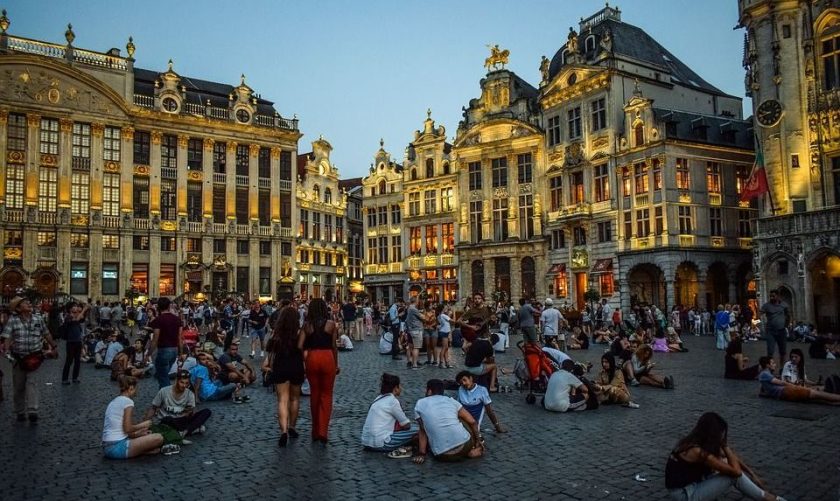
Belgium has joined the list of countries that are rebelling against their elected leadership. Over the weekend the Belgian government fell over Prime Minister Charles Michel’s trip to Morocco to sign the United Nations Migration Agreement. The agreement made no distinction between legal and illegal migrants and regarded immigration as a positive phenomenon. The Belgian people apparently did not agree. Facebook registered 1,200 Belgians agreeing that the Prime Minister was a traitor. Some users expressed concern for their children’s futures, noting that Belgian democracy is dead. Others said they would get yellow vests and join the protests.
The unrest witnessed in a number of places is focused on some specific demands but it represents much broader anger. The French yellow vests initially protested against proposed increases in fuel taxes that would have affected working people dependent on transportation disproportionately. But when that demand was met by the government of President Emmanuel Macron, the demonstrations continued and even grew, suggesting that the grievances with the government were far more extensive than the issue of a single new tax. Perhaps not surprisingly, the French government is seeking for a scapegoat and is investigating “Russian interference.” The US State Department inevitably agrees, claiming that Kremlin directed websites and social media are “amplifying the conflict.”
Some commentators looking somewhat more deeply at the riots in France have even suggested that the real issue just might be regime change, that the Macron government had become so disconnected with many of the voters through both its policies and the rhetoric justifying them that it had lost its legitimacy and there was no possibility of redemption. Any change would have to be an improvement, particularly as a new regime would be particularly sensitive to the sentiments of those being governed, at least initially. One might suggest that the prevailing sentiment that a radical change in government is needed, come what may, to shake up the system might well be called the “Trump phenomenon” as that is more-or-less what happened in the United States.
The idea that republican or democratic government will eventually deteriorate into some form of tyranny is not exactly new. Thomas Jefferson advocated a new revolution every generation to keep the spirit of government accountable to the people alive.
Call it what you will – neoliberalism, neoconservatism or globalism – the new world order, as recently deceased President George H.W. Bush once labeled it, characteristically embraces a world community in which there is free trade, free movement of workers and democracy. They all sound like good things but they are authoritarian in nature, destructive of existing communities and social systems while at the same time enriching those who promote the changes. They have also been the root cause of most of the wars fought since the Second World War, wars to “liberate” people who never asked to be invaded or bombed as part of the process.
And there are, of course, major differences between neoliberals and neoconservatives in terms of how one brings about the universal nirvana, with the liberals embracing some kind of process whereby the transformation takes place because it represents what they see, perhaps cynically, as the moral high ground and is recognized as being the right thing to do. The neocons, however, seek to enforce what they define as international standards because the United States has the power to do so in a process that makes it and its allies impossible to challenge. The latter view is promoted under the phony slogan that “Democracies do not fight other democracies.”
The fact that globalists of every type consider nationalism a threat to their broader ambitions has meant that parochial or domestic interests are often disregarded or even rejected. With that in mind, and focusing on two issues – wholesale unwelcome immigration and corrupt government run by oligarchs – one might reasonably argue that large numbers of ordinary citizens now believe themselves to be both effectively disenfranchised and demonstrably poorer as rewarding work becomes harder to find and communities are destroyed through waves of both legal and illegal immigration.
In the United States, for example, most citizens now believe that the political system does not work at all while almost none think that even when it does work it operates for the well-being of all the citizens. For the first time since the Great Depression, Americans no longer think of upward mobility. Projections by sociologists and economists suggest that the current generation growing up in the United States will likely be materially poorer than their parents. That angst and the desire to “do something” to make government more responsive to voters’ interests is why Donald Trump was elected president.
What has been occurring in Belgium, France, with Brexit in Britain, in the recent election in Italy, and also in the warnings coming from Eastern Europe about immigration and European Union community economic policies are driven by the same concerns that operated in America. Government itself is becoming the enemy. And let us not forget the countries that have already felt the lash and been subjected to the social engineering of Angela Merkel – Ireland, Spain, Portugal and Greece. All are weaker economies crushed by the one size fits all of the EURO, which eliminated the ability of some governments to manage their own economies. They and all their citizens are poorer for it.
There have been windows in history when the people have had enough abuse and so rise up in revolt. The American and French revolutions come to mind as does 1848. Perhaps we are experiencing something like that at the present time, a revolt against the pressure to conform to globalist values that have been embraced to their benefit by the elites and the establishment in much of the world. It could well become a hard fought and sometimes bloody conflict but its outcome will shape the next century. Will the people really have power in the increasingly globalized world or will it be the 1% with its government and media backing that emerges triumphant?
Labour furious over report that anti-Russia charity targeted Corbyn, receives govt cash
RT | December 9, 2018
Labour politicians are outraged and calling for a probe after a report that a McCarthy style charity has received £2 million in government money and targeted Jeremy Corbyn, straying from tackling so-called Russian disinformation.
The Institute for Statecraft, based in Scotland, initially seems to be a small organization which claims to counter alleged Russian propaganda by forming communities of journalists and influencers who use social media to push back on any so-called disinformation.
However, leaked documents provided to the Daily Record show that the organization’s Integrity Initiative isn’t as grassroots as it appears on the surface. In fact, it’s apparently funded with £2 million of Foreign Office cash and run by British military intelligence specialists.
What’s more is that the newspaper has reported that it launched its own investigation which found “worrying evidence” that the organization’s official Twitter account has been used to attack Jeremy Corbyn, his Labour Party, and other officials within the party.
And of course, there were some anti-Russia comments thrown in for good measure – such as one tweet which quoted a newspaper article calling Corbyn a “useful idiot” with “open visceral anti-Westernism [that] helped the Kremlin cause, as surely as if he had been secretly peddling Westminster tittle-tattle for money.”
“What he has done, wittingly or unwittingly, is work with the Kremlin agenda,” a newspaper report retweeted by the Integrity Initiative tweet states.
Although the Integrity Initiative’s apparent mission was first revealed last month, the Daily Record’s Sunday report about its targeting of Corbyn and the Labour party has left the party’s members more than a little angry.
“It is simply outrageous that the clearly mis-named ‘Integrity Initiative’ – funded by the Foreign Office to the tune of £2.25 million over the past two years – has routinely been using its Twitter feed to disseminate personal attacks and smears against the Leader of the Opposition, the Labour Party and Labour officials,” Emily Thornberry MP, Labour’s Shadow Foreign Secretary said in her statement.
Labour MP Chris Williamson also chimed in, calling any such activity “unacceptable in any democracy.”
The question of whether MSM will eventually pick up the story remains unknown, especially since it has a tendency to turn a blind eye to anyone claiming to fight the good fight against “aggressive” Russia.
The Integrity Initiative’s spokesman Stephen Dalziel has said he is “not aware” of any Corbyn attacks on the official social media account. “I’m not the one who controls the Twitter account. If it was criticism of one of our politicians, then that shouldn’t be on there.”
Mainstream Media Assaults on Freedom of Speech. “The Truth” is No Longer “Important”
Alternative news sources have come under sustained attacks
By Shane Quinn – Global Research – December 7, 2018
The New York Times unveiled a new slogan early in 2017 titled, “The truth is more important now than ever.” It has acquired a seemingly noble motto but a perhaps contentious one if we examine the Times’ recent history. Two international law specialists, Howard Friel and Richard Falk, published a book after the 2003 Invasion of Iraq called The Record of the Paper, which has scarcely been reviewed.
Friel and Falk focused on the Times due to the newspaper’s importance. The authors point out that in 70 Times editorials on Iraq – from September 11, 2001 to March 20, 2003 – the words “international law” and “UN Charter” were never mentioned. The “truth” did not seem terribly “important” as the Times stood idly by in the destruction of Iraq.
Such was the barrage of propaganda directed at the American public that 69% believed Saddam Hussein was “personally involved” in the September 11 attacks. That is a significant achievement in manipulation. The poll results must have been news to the Iraqi dictator himself, a forgotten one-time American ally.
Why Hussein would take it upon himself to orchestrate a surprise attack on the United States, of all nations, is anyone’s guess. Perhaps if he had a death wish but as later events proved he was not the suicidal type.
The Times was not alone in its position of selling the Iraq war to the American people, as television networks from Fox News to CBS and CNN were overwhelmingly pro-war. Fox News, owned by Rupert Murdoch – who strongly backed the illegal conflict – placed a permanent US flag in the corner of the screen. Fox employees were compelled to describe the invasion as “Operation Iraqi Freedom”, with hundreds of thousands of Iraqis later being killed.
The pattern continues into other illegitimate interventions as the liberal Guardian newspaper championed the demolition of Libya in 2011, with editorials imploring, “The quicker Muammar Gaddafi falls, the better.” The Guardian encouraged NATO “to tip the military balance further against Gaddafi”, while later that year summarising that “it has turned out, so far, reasonably well” – by that point thousands had been killed.
In 2015 Ian Birrell, then deputy editor of the Independent, still assured his readers, “I would argue that Britain and France were right to step in [in Libya]. The failures came later on.” Apparently it was fine for two old imperial powers to “step in” to shatter a sovereign nation, then afterwards absolve the invaders of blame with “the failures” only coming “later on”.

Sceengrab from The Independent
It’s a rare thing indeed to hear a prominent commentator question the balance of Western mainstream coverage. The same voices can be heard piping up when alternative news sources take a different line not so palatable to their tastes.
Nick Cohen, writing in the Guardian, accused the network Russia Today (RT) of being a “propaganda channel” and that Russia was “prostituting journalism”. In the following sentence, Cohen describes the BBC and New York Times as being “reputable news organisations”.
Cohen firmly supported the Iraq war, writing at the time that “the Left betrays the Iraqi people by opposing war”, and “an American invasion offers the possibility of salvation”. He was deemed not to be “prostituting journalism” in backing this violation of international law, nor when later supporting other interventions in Libya and Syria.
The BBC’s reputation, which Cohen previously claimed to be “reputable”, was dealt a blow when it was revealed by Cardiff University that the network “displayed the most ‘pro-war’ agenda of any broadcaster” with its coverage on the Iraq invasion.
Steven Erlanger of the New York Times described RT as “an agent of Kremlin policy” used to “undermine Western democracies” and to “destabilise the West” – failing to back up the claims with any evidence. To gain perspective on these attacks, it may be worth pointing out a key excerpt from the First Amendment of the US Constitution: “Congress shall make no law… abridging [curtailing] the freedom of speech, or of the press.”
This law does not exist in Western democracies but attempts at limiting freedom of expression continue apace, while attacks on alternative media outlets by institutions of power grow. It has reached a point whereby the French president Emmanuel Macron, shortly after assuming office, publicly attacked legitimate news sources of “behaving like deceitful propaganda”.
Perhaps the hidden concern about RT, for example, is its continued increase in both popularity and scope – with the channel enjoying a total weekly viewership of 70 million people and rising. RT is available to viewers in Western heartlands such as Britain and the US, with eight million Americans watching the station each week. It represents quite an achievement that a channel with the word “Russia”, featured in its title, can attract viewers in their millions, despite the growing anti-Russian sentiment espoused by the powers-that-be.
It is revealing that elite figures like Hillary Clinton have lamented in the past, “We are in an information war and we are losing that war.” For the first time in history, populations have broad access to alternative news angles – points of view that they likely find of a more balanced nature. Gone is the unchallenged monopoly on the public mind.
Mattis Tells All Without Any Evidence
By Philip M. GIRALDI | Strategic Culture Foundation | 06.12.2018
The insanity runs deep in Washington but it has also briefly surfaced at Simi Valley in California at the Reagan National Defense Forum, which ran through last weekend. United States Secretary of Defense James “Mad Dog” Mattis was the keynote speaker on Saturday. He had a few interesting things to say, the most remarkable of which was the assertion that Russia had again sought to interfere in the 2018 midterm elections, which were completed last month.
Mattis, a Marine general who is sometimes considered to be the only adult in the room when the White House national security team meets, claimed that the bilateral relationship between Washington and Moscow had “no doubt” deteriorated still further due to the Russian activity, which he described as the Kremlin “try[ing] again to muck around around in our elections last month, and we are seeing a continued effort along those lines” with Russian President Vladimir Putin making “continued efforts to try to subvert democratic processes that must be defended. We’ll do whatever is necessary to defend them.”
Mattis did not address President Donald Trump’s cancellation of a meeting with Putin at the G20 summit in Buenos Aires, Argentina, a move which he reportedly supported. The cancellation was reportedly based on what has been described as an act of aggression committed by the Russian military against three Ukrainian naval vessels seeking to transit the Kerch Strait, which since the annexation of Crimea has been completely controlled by Moscow. The Ukrainians were aware of the Russian protocols for transiting through the area and chose to ignore them to create an incident, possibly as part of a plan to disrupt the Trump-Putin discussions. If that is so, they were successful.
Mattis was somewhat taciturn relating to his accusation regarding Moscow’s meddling. He provided absolutely no evidence that Russia had been interfering in the latest election and there have been no suggestions from either federal or state authorities that there were any irregularities involving foreigners. There was, however, considerable concern over possible ballot and voting manipulation at state levels carried out by the major political parties themselves, suggesting that if Mattis is looking for subversion of democratic processes he might start looking a lot closer to home.
The U.S. government has issued a general warning that “Americans should be aware that foreign actors — and Russia in particular — continue to try to influence public sentiment and voter perceptions through actions intended to sow discord.” Law enforcement and intelligence agencies have reportedly been working with private sector internet social networking companies, to include Twitter and Facebook, to shut down Russian and Iranian accounts in attempt to forestall any interference in either the campaigning or voting processes. Some Russians have even been indicted in absentia based on flimsy evidence but as they are in Russia they cannot be tried. One Russian student, Maria Butina, is still in jail in Virginia based on conflicting and flimsy evidence and it is not clear when she will be able to defend herself in court.
Beyond the general anti-Russia hysteria being encouraged by the media and congress, there are a number of problems with the Mattis assertion. First of all, beyond the fact that no actual evidence has been presented, it is irrational to assume that Russian intelligence services would waste their effort and burn their resources to attempt to accomplish absolutely nothing. Russia was not on the ballot last month and no candidates were running on any platform that would benefit Moscow in the slightest. To get caught “mucking around” would invite more sanctions and justify an increasingly hostile response from Washington, hardly a price that Putin would be willing to pay for little or nothing tangible.
Second, the intense investigations being carried out by the Robert Mueller Special Counsel’s office have to this point developed no information suggesting that Russia did anything in 2016 beyond the low-level probing and manipulating that every major intelligence agency does routinely to get a window into what an adversary is up to. To be sure, several Team Trump associates will likely be going to jail, but their crimes so far have consisted of perjury or tax fraud. Some, like former Trump lawyer Michael Cohen are seeking desperately to find a way to implicate the president in some grander scheme, but if there is anything actually there it has yet to be identified to the public.
Third, based on the evidence produced so far, the only two countries that may have cooperated with either Trump or the Deep State to influence the results of the 2016 election are Israel, which sought Trump intercession at the United Nations, and Britain, which may have engaged in a plot by the British intelligence and security services to conspire with CIA Director John Brennan to elect Hillary Clinton.
So, there we go again. Another vague accusation against Russia to convince the American public that there is a powerful enemy out to get us. And lest there be any shortage of enemies Mattis also mentioned always dangerous Iran, saying “… we cannot deny the threat that Iran poses to all civilized nations.” And, by the way, Mattis in his speech strongly supported an increased “defense” budget to deal with all the threats, saying somewhat obscurely that “Fiscal solvency and strategic solvency can co-exist.” Sure. In the wonderful world of Washington, more money can fix anything.
What Foreign Threats?
The biggest threats to America come from its “friends”
By Philip Giraldi • Unz Review • December 4, 2018
One of the local Washington television stations was doing a typical early morning honoring our soldiers schtick just before Thanksgiving. In it soldiers stationed far from home were treated to videolinks so they could talk to their families and everyone could nod happily and wish themselves a wonderful holiday. Not really listening, I became interested when I half heard that the soldier being interviewed was spending his Thanksgiving in Ukraine.
It occurred to me that the soldier just might have committed a security faux pas by revealing where he was, but I also recalled that there have been joint military maneuvers as well as some kind of training mission going on in the country, teaching the Ukrainian Army how to use the shiny new sophisticated weapons that the United States was providing it with to defend against “Russian aggression.”
Ukraine is only one part of the world where the Trump Administration has expanded the mission of democracy promotion, only in Kiev the reality is more like faux democracy promotion since Ukrainian President Petro Poroshenko is clearly exploiting a situation that he himself provoked. He envisions setting himself up as a victim of Moscow to aid in his attempts to establish his own power through a security relationship with Washington. That in turn will help his bid for reelection in March 2019 elections, in which his poll numbers are currently running embarrassingly low largely due to the widescale corruption in his government. Poroshenko has already done much to silence the press in his county while the developing crisis with Russia has enabled him to declare martial law in the eastern parts of the country where he is most poorly regarded. If it all works out, he hopes to win the election and subsequently, it is widely believed, he will move to expand his own executive authority.
There also has to be some consideration the encounter with the Russians on the Kerch Strait was contrived by Poroshenko with the assistance of a gaggle of American neoconservative and Israeli advisers who have been actively engaged with the Ukrainian government for the past several years. The timing was good for Poroshenko for his own domestic political reasons but it was also an opportunity for the neocon warmongers that surround Trump and proliferate inside the Beltway to scuttle any possible meeting between a vulnerable Donald Trump and Vladimir Putin at the G20 gathering in Argentina.
The defection of Trump’s lawyer Michael Cohen, together with the assumption that a lot of anti-Trump dirt will be spilled soon, means that the American president had to be even more cautious than ever in any dealings with Moscow and all he needed was a nod of approval from National Security Adviser John Bolton and Secretary of State Mike Pompeo to cancel the encounter. A heads-of-state meeting might not have solved anything but it certainly would be better than the current drift towards a new cold war. If the United States has only one vitally important relationship anywhere it is with Russia as the two countries are ready, able and apparently willing to destroy the world under the aegis of self-defense.
Given the anti-Russian hysteria prevailing in the U.S. and the ability of the neocons to switch on the media, it should come as no surprise that the Russian-Ukrainian incident immediately generated calls from the press and politicians for the White House to get tough with the Kremlin. It is important to note that the United States has no actual national interest in getting involved in a war between Russia and Ukraine if that should come about. The two Eastern European countries are neighbors and have a long history of both friendship and hostility but the only thing clear about the conflict is that it is up to them to sort things out and no amount of sanctions and jawing by concerned congressmen will change that fact.
Other Eastern European nations that similarly have problems with Russia should also be considered provocateurs as they seek to create tension to bind the United States more closely to them through the NATO alliance. The reality is that today’s Russian Federation is not the Soviet Union and it neither aspires to nor can afford hegemony over its former allies. What it has made very clear that it does want is a modus vivendi where Russia itself is not being threatened by the West.
Recent military maneuvers in Poland and Lithuania and the stationing of new missiles in Eastern Europe do indeed pose a genuine threat to Moscow as it places NATO forces on top of Russia’s border. When Russia reacts to incursions by NATO warships and planes right along its borders, it is accused of acting aggressively. One wonders how the U.S. government would respond if a Russian aircraft carrier were to take up position off the eastern seaboard and were to begin staging reconnaissance flights. Or if the Russian army were to begin military exercises with the Cubans? Does anyone today remember the Bay of Pigs?
When it comes to international conflicts context is everything. Seeing the incident between Russia and Ukraine in Manichean terms as an example of Moscow’s aggressive instincts is satisfying in some circles, but it does not in any way reflect the reality on the ground. Internal politics of the two countries combined with deliberate fabrications that are expected to generate a certain response operate together to create a largely false narrative for both international and domestic consumption. Unfortunately, narratives have consequences: in this case, the sacrifice of the possibly beneficial meeting between Trump and Putin.
The same dynamic works vis-à-vis Washington’s other enemy du jour Iran. In the case of Russia, useless “friend” Ukraine is pulling the strings while regarding Iran it is conniving Israel and Saudi Arabia. Iran has been accused of being the world’s leading sponsor of terror, of destabilizing the Middle East, and of having a secret nuclear weapon program that will be used to attack Israel and Europe. None of those assertions are true. The terrorism tag comes from the country’s relationship with Hezbollah, which is only a terrorist group insofar as it is hostile to Israel and pledged to resist any future Israeli invasion of Lebanon. Washington and Israel have pushed the terrorism label for Hezbollah, but most Europeans have begun to disregard the designation since the group has become a part of the Lebanese government.
And regarding destabilizing the Middle East, that has largely been the end result of actions undertaken by the United States, Israel and the Saudis, while the alleged Persian nuclear weapons program is a fantasy. If someone in the U.S. national security apparatus had any brains the United States would work to improve relations with Iran real soon as the Iranians would in the long run quite likely prove to be better friends than those rascals who are currently running around using that label.
And there are other friends in unlikely places. Beleaguered British Prime Minister Theresa May is wailing loudly against a Trump threat to reveal classified documents relating to Russiagate. The real problem is that the documents apparently don’t expose anything done by the Russians. Rather, they seem to appear to reveal a plot by the British intelligence and security services working in collusion with then CIA Director John Brennan to subvert the course of the 2016 election in favor of the Deep State and Establishment favorite Hillary Clinton. How did that one work out?
So how about it? Teenagers who get in trouble often have to ditch their bad friends to turn their lives around. There is still a chance for the United States if we keep our distance from the bad friends we have been nurturing all around the world, friends who have been convincing us to make poor choices. Get rid of the ties the bind to the Saudis, Israelis, Ukrainians, Poles, and yes, even the British. Deal fairly with all nations and treat everyone the same, but bear in mind that there are only two relationships that really matter – Russia and China. Make a serious effort to avoid a war by learning how to get along with those two nations and America might actually survive to celebrate a tricentennial in 2076.
Ex-Canadian Diplomat: UK’s Anti-Russia Info Ops Mark Decline in Western Values
Sputnik – 04.12.2018
United Kingdom’s anti-Russian propaganda operations are a sign that Western values related to freedom of expression are on the decline, former Canadian diplomat Patrick Armstrong told Sputnik.
On Monday, the international hacktivist group Anonymous released a new package of documents of the anti-Russian UK Integrity Initiative project. In particular, the documents include fake proof of Russian interference in the 2017 Catalan independence referendum disseminated among Spanish politicians and media.
The revelations undermined the credibility of the United Kingdom’s and Western media, Armstrong pointed out. “Only a couple of decades ago we were boasting about Western values of freedom of speech and thought,” Armstrong said. “Not today.”
These United Kingdom operations marked another step in “the decline of the West,” Armstrong added, as its rulers try to counter any discussion they disagree with by portraying it as fake news.
“Our rulers are determined that their stories must not be challenged and thus they try to shut down all discussion. Accept, Believe, Repeat. Anything else is ‘fake news,’” Armstrong said.
According to the first document leaked by Anonymous last month, the project was in fact a “large-scale information secret service” sponsored and created by London.
However, the latest leak suggests that “the British government goes far beyond and exploits the Integrity Initiative to solve its domestic problems inside the United Kingdom by defaming the opposition.”
Until his retirement, Armstrong was a Canadian diplomat who was a specialist on the Soviet Union and Russia. He previously served as political counselor in the Canadian Embassy in Moscow.
Moscow Comments on Media Reports About UK Psychological Warfare Units in Ukraine
Sputnik – 03.12.2018
MOSCOW – The United Kingdom seems to be seeking to expand its military presence in Ukraine in the run-up to the March presidential election in the country, the Russian Embassy in London said, commenting on media reports about the UK psychological warfare units allegedly stationed in Ukraine.
On Sunday, BBC News Russian reported that 1,200 servicemen of the British Army’s 77th Brigade, a top-secret unit that deals with electronic and psychological warfare, are currently stationed in Ukraine. According to the broadcaster, the UK servicemen in Ukraine have three main areas of activities: carry out military tasks on the Internet, as well as psychological and information operations.
“Earlier, we had information about the [United Kingdom] dispatching its military experts to train the Ukrainian military to conduct special operations against civilians of Donetsk and Lugansk. Now it turns out that the UK presence has expanded through, as BBC reports, conducting psychological and information operations in this country. As we see, it all happens in the run-up to the presidential election in Ukraine,” the embassy said in a statement on Sunday.
If the information is correct, the new units represent a “new element of a large-scale UK military presence in Ukraine,” the embassy noted.
“Once, the United Kingdom supported the coup in Kiev and the coming to power of the so-called ‘government of the winners’ in violation of the country’s constitution. Now we are witnessing a special operation, whose scale and consequences are yet to be assessed,” the embassy added.
The British army’s 77th Brigade is a combined regular and army reserve unit responsible for using “legitimate non-military levers” as a means “to adapt behaviors of the opposing forces.”
Featured Video

Death Spikes & Rising Cancer In Our Youth Explained
or go to
Aletho News Archives – Video-Images
From the Archives
Politicians lie
By Mazin Qumsiyeh | Popular Resistance | August 18, 2013
There is no way to say this truth nicely: Politicians lie. That includes Japanese, American, Egyptian, Israeli, and Palestinian politicians! Is there something more common sense than that? Yet, so many citizens around the world believe their own politicians or wistfully acknowledge lies but think it is part of the job needed to run things. They believe even when politicians contradict themselves blatantly. This phenomenon is rather remarkable. It is a dissonance and disconnect from reality that many seem oblivious to. It is very dangerous because it can lead to accepting rationales for going to war. These can be deadly wars that lead to millions of lives lost as happened in what was called World War 1 and WW2. Even when incredible and declassified evidence abound, politicians continue to lie and old mythologies refuse to die. Here are just a few of the countless lies told to us over the past few decades… continue
Blog Roll
 Aletho News
- RSF military group defects, joins Sudanese army: State media
- Ireland goalkeeper refuses to play ‘Israel’ as squad weighs boycott
- China pushes back against US on Cuba, Iran
- Ukrainian Soldiers, Potential Mercenaries: Have Gun, Will Travel!
- Burnham’s UN debut… A masterclass in British disinformation
- Iran flights continue despite US aviation sanctions
- Global Tipping Points Lead the World Into a State of Entropy
- The day-after at the White House: USA and Xi Jinping
- The Geopolitical Balance in the Red Sea: The UAE Being Displaced by New Players
- Iraqi resistance group vows to stage airport sit-ins over Iran aerial blockade
- If Americans Knew
- Deconstructing Netanyahu’s pants-on-fire UN rant – Daily Update
- Trump betrayed voters with his campaign lies and prioritized a foreign country once he took office
- Netanyahu calls Israel’s war in Gaza ‘opposite of genocide’ in UN speech to near-empty hall
- Settler Kidnappings: Torture, Sexual Abuse and Terrorisation of Palestinian Abductees as Israel Deepens Annexation of West Bank
- Gaza winter nears as 162,000 tents become unusable, raising fears of humanitarian crisis
- Netanyahu says, “It’s the opposite of genocide”; UN says Gaza economy is world’s ‘most severe crisis on record’ – Daily Update
- Israel’s US-Backed Assault on Gaza Has Created the ‘World’s Most Severe Economic Crisis on Record’: UN
- ‘Protecting U.S. Citizens’… From Israel
- ‘This is where I live now, the back of a truck’: a day in the life of a grandmother in Gaza
- In UN Speech, Iran’s President Displays Pictures of Children Killed by US, Brings Attention to Israel’s Nuclear Arsenal
- No Tricks Zone
- New Study: Earth And Venus Surface Warmth Largely Explained By Convection And Lapse Rate, Not CO2 Or Radiation
- 2025 Nature Paper Claiming Worsening Global Drought Gets RETRACTED …Heavily Flawed
- New Study: ‘Global Drought Shows No Detectable Recent Acceleration Under Climate Warming’
- Economic Masterminds: German Socialists Suggest Taxing Productivity Gains Stemming From Using AI
- The South China Sea Has Not Been Cooperating With The Climate Change Narrative
- Energy Crisis: Germany Enters Heating Season With Historically Low Gas Reserve Fill Levels
- New Study: The Antarctic Ice Sheet Gained Mass From 2020-2024 Due To Staggering Snow And Ice Accumulation
- Study: Ocean Heating Rates From Thousands Of Years Ago ‘Dwarf’ Modern Ocean Heating Rates
- Climate Extremists Target, Attack Large-Scale Power Grid Infrastructure In Germany!
- New Study: Antarctic Ice Melt Has Contributed Less Than 1 Centimeter To Sea Level Rise In The Last 30 Years

