Fiasco In Islington, Part 2
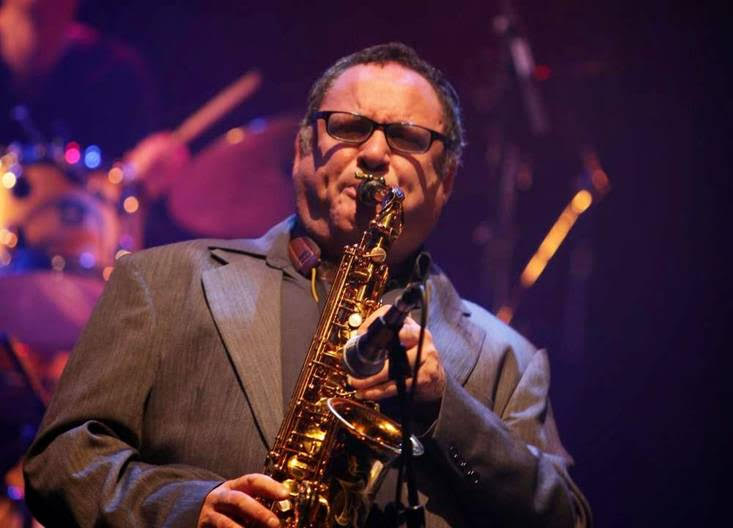
Gilad Atzmon
By Richard Hugus | December 26, 2018
More facts have come to light in the case of Gilad Atzmon and his banning by the Islington Town Council from performing at a jazz concert on December 21, 2018. The original scenario was that one e-mail from one person calling Atzmon an antisemite somehow persuaded the Islington council to take the drastic step of removing Atzmon from a town-owned venue. Many who heard the story felt this was a rash decision which would surely be reversed when the facts were brought to light. But the Council voted to uphold its decision and Atzmon was indeed not allowed to play.
Now it appears that the single complainant – Martin Rankoff – was not just an anonymous fan of Israel but the UK director of Likud-Herut. Herut (or ‘freedom’) was Israel’s founding nationalist party from 1948 until it later merged with Likud. It is a militant and extreme Zionist organization whose roots go in a straight line from Ze’ev Jabotinsky and Menachem Begin up to Benjamin Netanyahu today. Jabotinsky and Begin helped form the Irgun terrorists in 1937. Irgun committed notorious massacres in Palestine leading up to and during the Nakba (or ‘catastrophe’) of 1947-1948. These include the bombing of the King David Hotel in Jerusalem in 1946, killing 91 people, and the massacre at Deir Yassin in 1948 in which 254 unarmed Palestinian villagers were brutally murdered as an incentive for other Palestinians to leave. On its web site Likud-Herut UK lists Jabotinsky and Begin as “visionaries.” Likud-Herut is a member of the World Zionist Organization and the Zionist Federation of the UK who believe in “the inalienable right of all Jews to live and settle in all parts of the Land of Israel.”
In a letter to the New York Times in 1948 Albert Einstein, Hannah Arendt, and others compared Herut to the Nazis and Fascists who had just been defeated in World War II. Referring to this letter, Ramzy Baroud recently wrote, “the ‘Nazi and Fascist’ mentality that defined Herut in 1948 now defines the most powerful ruling class in Israel. Israel’s leaders speak openly of genocide and murder, yet they celebrate and promote Israel as if an icon of civilization, democracy and human rights.”
–
The history of Herut and Likud tells us a great deal about who the people are who complained about Atzmon to Islington Town Council. When Atzmon moved to appeal his being banned, formidable opponents again appeared in the form of the Simkins Law firm, one of the most expensive law practices in Britain, with not one but two partners at Simkins being put on the case. These are Gideon Benaim and Tom Iverson. Benaim recently became well known in Britain for winning an invasion of privacy suit against the BBC on behalf of pop singer Cliff Richard, who said he spent £3.4m ($4.3 million) on the case. Clearly, representation by Simkins doesn’t come cheap. Also listed in Benaim’s resumé as a client is the Las Vegas Sands Corporation which likely has no problem with Simkins’ fees either. The Sands casino is owned by billionaire Sheldon Adelson, who, as it happens, is a primary sponsor of the Likud Party in Israel, led by Benjamin Netanyahu. Adelson owns the newspaper Israel Hayom, a mouthpiece for Netanyahu and Likud.
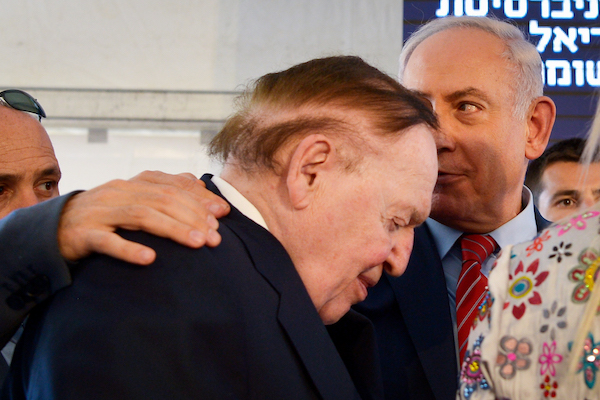
American businessman and investor Sheldon Adelson with Prime Minister Benjamin Netanyahu at the ceremony of a laying of a cornerstone for new Medicine Faculty buildings at the Ariel University in the West Bank, on June 28, 2017. Photo by Ben Dori/Flash90
It now appears that Atzmon’s banning was not the result of a casual complaint; it was an intentional attack on a well-respected supporter of Palestinian human rights by the Likud organization, directly represented by Martin Rankoff. The attack was followed up by the hiring of a lawyer who has worked for Likud godfather Sheldon Adelson. The connection to these powerful forces may explain why Islington Town Council leader Richard Watts, without any delay or attempt at negotiation, took the step of going straight to a decision to hire an expensive law firm. This is while Islington is facing serious austerity and shortage of funds in its own operating budget. Islington has a population of about 206,000 people. This very month, 43 of those people were counted in one survey as homeless and sleeping on the streets.
Regarding the financial problems of his borough and others around London, Richard Watts, told The Independent in October 2018 :
“unprecedented” funding pressures and demand for adult and children’s social care and homelessness services was “pushing councils to the limit”.
“As a result less money is being spent on the other services that keep our communities running such as libraries, local roads, early intervention and local welfare support,” he added.
Yet, to Watts and his fellow councilors in Islington, backing partisans for a foreign country -Israel- took precedence over the pressing needs of the people whom they are supposed to represent. Either Watts was inexcusably careless with scarce town funds or a deal was made and he knew that he could depend on Likud-Herut to back him. Or, like politicians all across Europe and the US facing the power of the Israel lobby, he knew he couldn’t afford to say no.
According to Simkin’s web site, Gideon Benaim “has extensive expertise in the areas of defamation, privacy, harassment and copyright.” Perhaps it is not a coincidence that immediately after Islington brought in Simkins, identical statements from an unnamed Labour spokesman describing Atzmon as “a vile antisemite” appeared in both the BBC and The Guardian. Perhaps a lawyer experienced in defending people against defamation and harassment would also know how to perpetrate these things. Perhaps this was Benaim’s opening move. Character assassination is a common tactic in cases that have a weak legal foundation, such as this one, as it goes a long way to convicting the accused before their case ever reaches a courtroom.
The involvement of Likud-Herut in the attack on Gilad Atzmon, and Islington’s official backing of that attack, constitutes a monumental scandal. This wasn’t just a stupid mistake; it was a hit. It is an affront to reason that an an arch-racist organization like Likud, who from the beginning have stood for the removal of the people of Palestine from their own land by means of terror, murder, and forced expulsion, could possibly claim they they were defamed by someone pointing out these very crimes. There is a case of defamation here for sure – the defamation of Gilad Atzmon. For Zionists, defamation is nothing more than a tool to destroy opponents who can’t be dealt with by other means. We are long since tired of truth tellers being accused of antisemitism. We’re tired of national and local resources being used to prop up the criminal state of Israel. Coercion by advocates for Israel is at the center of this issue in Islington, as it is in many other towns and many other countries. For the sake of Palestine and our own sovereignty, it has to be called out and stopped.
To sign a petition in support of Gilad click here
Lodge a formal complaint with Islington Council: https://www.islington.gov.uk/contact-us/comments-and-complaints?status=inprogress
Email: assemblyhall@islington.gov.uk
Contact the Council: +4420 7527 2000
To support Gilad’s legal battles: https://donorbox.org/gilad-needs-additional-support
Fiasco In Islington
By Richard Hugus | December 21, 2018
Jazz saxophonist and writer Gilad Atzmon was recently banned from playing at an assembly hall in Islington, a borough of London, by order of the Islington Town Council. This came about as a result of an e-mail from one person — Martin Rankoff — saying nothing more than that if Atzmon was going to be at the venue on December 21 he would give a ticket that was given to him to someone else. Rankoff wrote, “Mr Atzmon’s news and beliefs I personally find repulsive and do not wish to be in the same place as him, let alone listen to his music.” Rankoff included links to ADL and Israeli news outlets accusing Atzmon of antisemitism. Incredibly, on the basis of this letter alone, the Islington Council went way out of its way and contacted the show’s promoter to get Atzmon banned — something Rankoff didn’t even ask for.
Imagine the situation in reverse: Gilad Atzmon writes a letter to the Council saying he is uncomfortable with Martin Rankoff appearing in the audience at Islington assembly hall. He refers to Mr. Rankoff’s pro-Israel Twitter page where Rankoff calls Jeremy Corbyn “A F***ing Antisemite and Racist” and where Corbyn is pictured on a bike with a comment suggesting Corbyn should be rammed by a car. Atzmon says that he doesn’t feel safe with Rankoff in the audience. He finds Mr. Rankoff’s support for Israel repulsive because Israel was founded on genocide against the people of Palestine. As proof he provides links to news reports on the slaughter of unarmed protestors in Gaza since March 30, 2018, and a story on the Deir Yassin massacre of 1948.
This imaginary second complaint would have been scorned as an abridgement of Rankoff’s rights. Indeed, since the Islington Council has adopted the International Holocaust Remembrance Alliance definition of antisemitism, in which criticism of Israel is deemed antisemitic, the Council would probably feel obliged to forward the letter to the authorities as evidence of hate speech.
The Council provided a statement on the banning in which it says: “under the Equality Act 2010, the Council must, in the exercise of its functions, have due regard to the need to foster good relations between different races and religions within the borough. The Council took account of the fact that Mr Atzmon’s presence at the Hall, and knowledge of his presence among residents of the borough, might harm such relationships, as well as the Council’s duty to tackle prejudice and promote understanding within the borough.”
This begs the question — in what way would either the “presence” of Gilad Atzmon or “knowledge of his presence among residents” harm the relationship between different races and religions in the borough? Atzmon was to appear at the venue as a saxophone player in a jazz group. It’s hard to imagine a more severe inversion of the concept of discrimination. On the basis of the feelings of one complainant, the right of a musician to work or even be present in Islington is taken away.
What lies behind this is a familiar tactic. Zionists have no argument to counter critics of Israel, so they try to shut them up by attacking their character and robbing them of their livelihood. Now AIPAC and other lobbies are working to make it illegal to criticize Israel, as we see in the recent case of a Texas speech therapist whose yearly contract was denied because she refused to sign a pledge not to support a boycott of Israel. One might ask, what does a teaching position in Pflugerville, Texas have to do with one’s opinions about a country seven thousand miles away? And why does that country have the right to compel anyone in the US to sign a loyalty oath?
If the BDS movement doesn’t do it, zealotry and fanatacism will be the undoing of the Zionist project. People don’t like being told what they are allowed to think and say. When our words and thoughts are policed, it makes us question all the more. What were once decent leftist positions against racism and discrimination have been twisted into a new kind of totalitarianism, one in which it is racist to question the racist, and discriminatory to question discrimination; one in which we are told to think something doesn’t exist when we can see with our own eyes that it does. The self-righteous members of the Islington Town Council have set a very dangerous precedent, and have been used as fools on top of it.
British Government Covert Anti-Russian Propaganda and the Skripal Case
By Craig Murray | December 21, 2018
It is worth starting by noting that a high percentage of the Integrity Initiative archive has been authenticated. The scheme has been admitted by the FCO and defended as legitimate government activity. Individual items like the minutes of the meeting with David Leask are authenticated. Not one of the documents has so far been disproven, or even denied.
Which tends to obscure some of the difficulties with the material. There is no metadata showing when each document was created, as opposed to when Anonymous made it into a PDF. Anonymous have released it in tranches and made plain there is more to come. The reason for this methodology is left obscure.
Most frustratingly, Anonymous’ comments on the releases indicate that they have vital information which is not, so far, revealed. The most important document of all appears to be a simple contact list, of a particular group within the hundreds of contacts revealed in the papers overall. This is it in full:
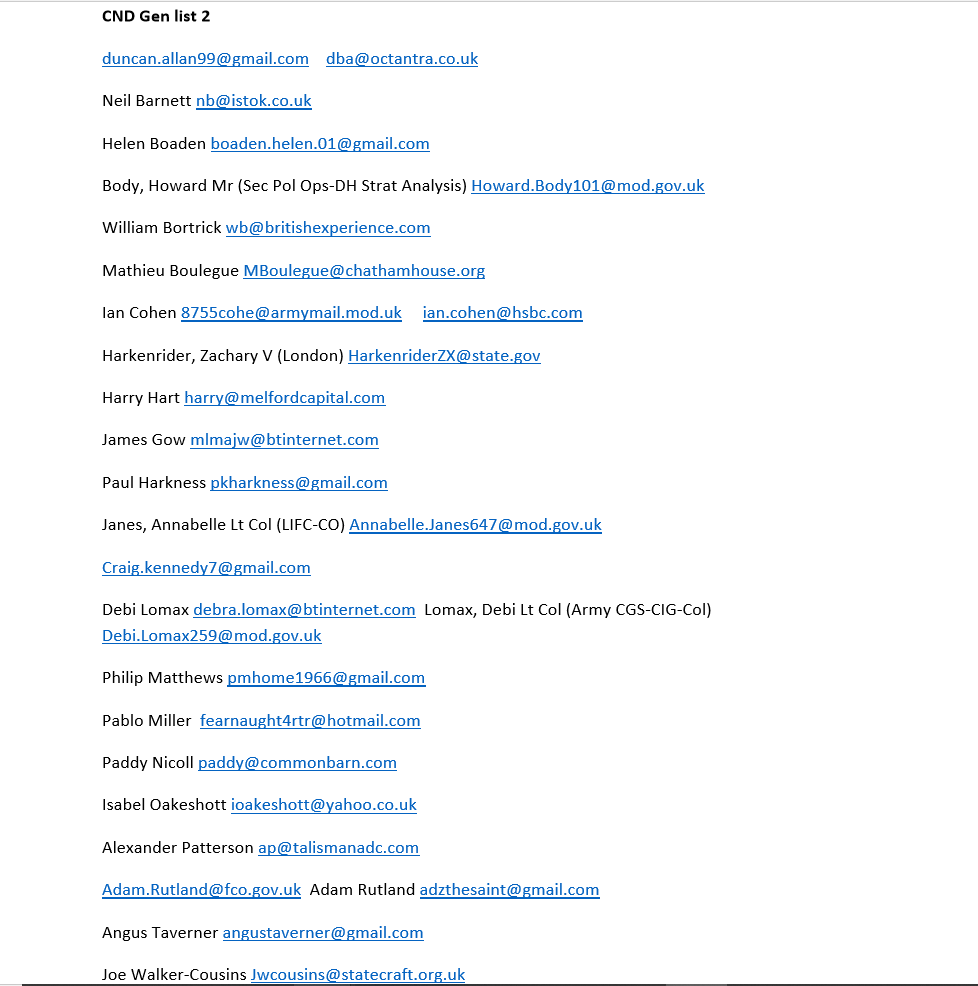
Tantalisingly, Anonymous describe this as a list of people who attended a meeting with the White Helmets. But there is no evidence of that in the document itself, nor does any other document released so far refer to this meeting. There is very little in the documents released so far about the White Helmets at all. But there is a huge amount about the Skripal case. With the greatest of respect to Anonymous and pending any release of further evidence, I want you to consider whether this might be a document related to the Skripal incident.
The list is headed CND gen list 2. CND is Christopher Nigel Donnelly, Director of the Institute for Statecraft and the Integrity Initiative and a very senior career Military Intelligence Officer.
The first name on the list caught my eye. Duncan Allan was the young FCO Research Analyst who, as detailed in Murder in Samarkand, appears in my Ambassadorial office in Tashkent, telling me of the FCO staff who had been left in tears by the pressure put on them to sign up to Blair’s dodgy dossier on Iraqi WMD. During the process of clearing the manuscript with the FCO, I was told (though not by him) that he denied having ever said it. It was one of a very few instances where I refused to make the changes requested to the text, because I had no doubt whatsoever of what had been said.
If Duncan did lie about having told me, it did his career no harm as he is now Deputy Head of FCO Research Analysts and, most importantly, the FCO’s lead analyst on Russia and the Former Soviet Union.
Now let us tie that in with the notorious name further down the list; Pablo Miller, the long-term MI6 handler of Sergei Skripal, who lived in Salisbury with Skripal. Miller is the man who was, within 24 hours of the Skripal attack, protected by a D(SMA) notice banning the media from mentioning him. Here Pablo Miller is actively involved, alongside serving FCO and MOD staff, in a government funded organisation whose avowed intention is to spread disinformation about Russia. The story that Miller is in an inactive retirement is immediately and spectacularly exploded.
Now look at another name on this list. Howard Body. Assistant Head of Science Support at Porton Down chemical weapon research laboratory, just six miles away from Salisbury and the Skripal attack, a role he took up in December 2017. He combines this role with Assistant Head of Strategic Analysis at MOD London. “Science Support” at Porton Down is a euphemism for political direction to the scientists – Body has no scientific qualifications.
Another element brought into this group is the state broadcaster, through Helen Boaden, the former Head of BBC News and Current Affairs.
In all there are six serving MOD staff on the list, all either in Intelligence or in PR. Intriguingly one of them, Ian Cohen, has email addresses both at the MOD and at the notoriously corrupt HSBC bank. The other FCO name besides Duncan Allan, Adam Rutland, is also on the PR side.
Zachary Harkenrider is the Political Counsellor at the US Embassy in London. There are normally at least two Political Counsellors at an Embassy this size, one of whom will normally be the CIA Head of Station. I do not know if Harkenrider is CIA but it seems highly likely.
So what do we have here? We have a programme, the Integrity Initiative, whose entire purpose is to pump out covert disinformation against Russia, through social media and news stories secretly paid for by the British government. And we have the Skripals’ MI6 handler, the BBC, Porton Down, the FCO, the MOD and the US Embassy, working together in a group under the auspices of the Integrity Initiative. The Skripal Case happened to occur shortly after a massive increase in the Integrity Initiative’s budget and activity, which itself was a small part of a British Government decision to ramp up a major information war against Russia.
I find that very interesting indeed.
With a hat-tip to members of the Working Group on Syria, Media, and the Propaganda, who are preparing a major and important publication which is imminent. UPDATE Their extremely important briefing note on the Integrity Initiative is now online, prepared to the highest standards of academic discipline. I shall be drawing on and extrapolating from it further next week.
Influencing Foreigners Is What Intelligence Agencies Do
By Philip M. GIRALDI | Strategic Culture Foundation | 20.12.2018
The Rand Corporation defines America’s influence operations as… “the coordinated, integrated, and synchronized application of national diplomatic, informational, military, economic, and other capabilities in peacetime, crisis, conflict, and post-conflict to foster attitudes, behaviors, or decisions by foreign target audiences that further US interests and objectives. In this view, influence operations accent communications to affect attitudes and behaviors but also can include the employment of military capabilities, economic development, and other real-world capabilities that also can play a role in reinforcing these communications.”
In a world where communications and social networks are global and accessible to many ordinary people, influence operations are the bread-and-butter of many intelligence agencies as a means of waging low intensity warfare against adversaries. During the past week there have been two accounts of how influencing foreign audiences has worked in practice, one relating to Russia and one to Great Britain.
The Russian story is part of the continuing saga of Russiagate. On Monday, the Senate Intelligence Committee released two reports on Russian operations before during and after the 2016 election to influence targeted groups, to include African-Americans, evangelical Christians and Second Amendment supporters to confuse voters about what the candidates stood for. Russia Internet Research Agency, headed by Yevgeny V. Prigozhin, alleged to be a friend of President Vladimir Putin, reportedly coordinated the effort.
The New York Times, slanted its coverage of the story, claiming that Moscow was “weaponizing” social media and that it was intended to support the candidacy of Donald Trump who “had a Russian blind spot and an army of supporters willing to believe convenient lies and half-truths.” They also dubbed it “a singular act of aggression that ushered in an era of extended conflict.” Of course, one might note that in 2016 the Times itself had a blind spot regarding Hillary Clinton compounded by a bias against Trump and his “deplorable” supporters, while one must also point out that Russian intentions are unknowable unless one were a fly on the wall inside the Kremlin when the US election was under discussion, so one might conclude that the newspaper is itself spreading something like disinformation.
It is undoubtedly true that Russia had a vital national interest in opposing Clinton, whose malevolent intentions towards Moscow were well known. It is also undoubtedly true that there was a campaign of manipulation of social networks by the Kremlin and its proxies to influence readers and also to assess the development of the two major party campaigns. But it also should be observed that the claim that it was seeking to suppress Democratic voters is not really borne out given the other much more conservative demographics that were also targeted. Indeed, involvement by Russia did not alter the outcome of the election and may have had virtually no impact whatsoever, so the claims by the Times that the world is seeing a new form of warfare is clearly exaggerated to reflect that paper’s editorial stance.
The fact that the Times is trying to make the news rather than reporting it is clearly indicted by its sheer speculation that “The Internet Research Agency appears to have largely sat out the 2018 midterm elections, but it is likely already trying to influence the 2020 presidential election, in ways social media companies may not yet understand or be prepared for. And Russia is just the beginning. Other countries, including Iran and China, have already demonstrated advanced capabilities for cyberwarfare, including influence operations waged over social media platforms.” It is certainly convenient to have all one’s enemies collectivized in two sentences, but the Times manages that quite neatly.
The second story, much less reported in the US media, relates to how the British intelligence services have been running their own disinformation operations against Russia, also using social networks and the internet. The British government has been financing a program that was given the name Integrity Initiative. It has been tasked with creating and disseminating disinformation relating to Russia in order to influence the people, armed forces and governments of a number of countries that Moscow constitutes a major threat to the west and its institutions.
Former British intelligence officer and established Russo-phobe Christopher Nigel Donnelly (CND) is the co-director of The Institute for Statecraft and founder of its offshoot Integrity Initiative. The Initiative ironically claims to “Defend Democracy Against Disinformation.” According to leaked documents, the Initiative plants disinformation that includes allegations about the “Russian threat” to world peace using what are referred to as journalists ‘clusters’ in place both in Europe and the United States.
Even though the Institute and Initiative pretend to be independent Non-Government Organizations (NGOs), they are both actually supported financially by the British government, NATO and what are reported to be other state donors, possibly including the United States.
The Integrity Initiative aside, the United States has also long been involved in influence operations, sometimes also referred to as perception management. Even before 9/11 and after the breakup of the Soviet Union the State Department, Pentagon and National Security Agency were all active on the internet in opposing various adversaries, to include terrorist groups. The CIA has been spreading disinformation using paid journalists and arranging foreign elections since 1947. Sometimes US federal government agencies are operating openly, but more often they are using covert mechanisms and cover stories to conceal their identities. America’s internet warriors are adept at spreading misinformation aimed at target audiences worldwide.
The fact is that spreading disinformation and confusion are what governments and intelligence services do to protect what they consider to be vital interests. It is naïve for the US Senate and America’s leading newspapers to maintain that intelligence probing and other forms of interference from Russia or China or Iran or even “friend” Israel occur in a vacuum. Everyone intrudes and spreads lies and everyone will continue to do it because it is easy to understand and cheap to run. In the end, however, its effectiveness is limited. In 2016 the election result was determined by a lack of trust on the part of the American people for what the establishment politicians have been offering, not because of interference from Moscow.
‘Striking images to help public relate’: UK Integrity Initiative’s post-Skripal psyop leaked
RT | December 19, 2018
The UK government-funded ‘Integrity Initiative’ (II) actively monitored social media and suggested influencing foreign journalists with “pro-UK messaging” in the aftermath of the poisoning of Sergei Skripal, latest leaks claim.
The shady II – a project of the Institute for Statecraft (IfS) – bills itself as a non-partisan, disinformation-busting charity. Yet, according to leaked documents by a group calling itself Anonymous, it ran a smear campaign at home and also meddled in the internal affairs of EU countries.
The latest – third – batch of leaks says that IfS also sprung into action after the poisoning of ex-double agent Sergei Skripal and his daughter earlier this year. London blamed the attack on Moscow, while Kremlin said the accusations lacked evidence and were part of smear campaign against Russia.
In the aftermath of the case, IfS suggested a “live monitoring” project to determine which “key influencers” and journalists were “friendly” toward the UK and which were not, in order to be able to provide an “early warning” of any “threat to HMG” (Her Majesty’s Government).
A proposal document for the Skripal project said that the social media monitoring service known as ‘SENTINEL’ and an investigative platform called ‘SEEKER’ would be used to identify accounts that were deemed “part of a Russian government media strategy.”
The latest leak also includes a number of short country reports on the Skripal monitoring project from across Europe including from Bosnia Herzegovina, Montenegro and the Baltic states. A more lengthy report was produced for Italy, where the Integrity Initiative claimed that “the risk of Russian influence” remains “high.”
The reason was that that doubts had been raised about the UK government’s narrative on the Skripal story, even in “high quality” Italian newspapers. This was blamed on the fact that not enough Italians consider Russia a threat and therefore, people there reacted to the news with “emotions” rather than rational analysis, it is claimed. According to the docs, the way to remedy this, was to direct “an effective, discrete and articulated information campaign” toward Italian influencers in politics and media.
A document on “ramping up” IfS’s work suggests that posting “striking images” of Skripal in hospital might “help the public relate” more to the story. Notably, while the IfS denigrated the “emotional” reaction from Italians that did not go in their favor, they were not so reserved with the British public.
The same document argues that the IfS could potentially be“anonymous funders” of Patreon projects where users are creating high-quality anti-Russian content — and could even “commission” such content itself. IfS should “use public figures in our networks to approach celebrities” and other “social influencers” to spread the message, it says, giving former footballer Gary Lineker as an example.
The IfS could also help expand “recent efforts to develop media literacy in rural USA” by using the Skripal affair as a “vivid and timely case-study,” the document says, without elaborating on its US efforts. Another stated goal would be to “find ways” to remove content from RT and Ruptly news agency from anywhere it was found within mainstream media.
Earlier leaks claim that the group has already led a successful social media campaign to prevent the appointment of Colonel Pedro Banos as director of Spain’s Department of Homeland Security due to his so-called “pro-Russian” views. The government-funded group also launched a domestic smear campaign against Labour leader Jeremy Corbyn in an effort to brand him as a tool of the Kremlin.
Read more:
UK and US PSYOP Collusion
By Margaret Kimberly | Black Agenda Report | December 19, 2018
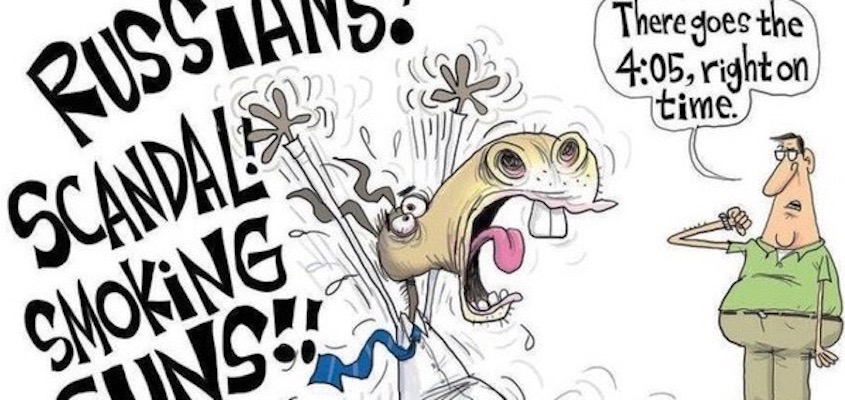
Russiagate hysteria is an international conspiracy, with British spooks spreading lies on three continents. Now Black Americans are slandered as “dupes” of Moscow.
For more than two years the corporate media, elite think tanks, NATO leaders, and most Democratic Party politicians have insisted that Russia interferes in American and European elections. The charge doesn’t withstand scrutiny but the lies are repeated. There is proof that surveillance state meddling in the affairs of democratic nations is real, but Russia isn’t the culprit. It is the United Kingdom and the United States who lead in skullduggery and meddling with the rights they claim to uphold.
Thanks to the Anonymous hacker community the work of the Integrity Initiative has been exposed to the public. The Integrity Initiative is a British “charity” founded in 2015. Its mission is to “bring to the attention of politicians, policy-makers, opinion leaders and other interested parties the threat posed by Russia to democratic institutions in the United Kingdom, across Europe and North America.” That mission is suspect in and of itself, a phony trope meant to cover up its own imperialist wrong doing. The Integrity Initiative is an arm of the British government and has received more than $2 million in funding from the British Foreign Office and Defense department. It has also raised money from NATO, Facebook and rightwing foundations.
The Integrity Initiative is a means of undermining the sovereignty of the British people by manipulating them with lies. It engaged in numerous efforts to libel Labour Party leader Jeremy Corbyn and prevent him from ever being elected prime minister. Corbyn has been accused of Soviet era espionage, anti-Semitism and anything else his enemies choose to use against him. Academics and writers who spoke out against UK involvement in attacks on Syria were likewise targeted by The Timesand other influential British media. The reporters involved were part of this Integrity Initiative campaign. The attacks are consistent and are obviously coordinated at a very high level.
Integrity Initiative director Christopher Donnelly is a former member of the British Army Intelligence Corps. He also helped to create the U.S. Army’s Foreign Military Studies Office at Fort Leavenworth, and served as an advisor to several Secretaries General at NATO. After the NATO instigated coup against the elected Ukrainian government Donnelly recommended placing mines in the Sevastopol harbor, an obvious provocation.
When Integrity Initiative isn’t planning to start wars it plots to interfere in the affairs of other countries through orchestrated “clusters” of journalists and academics. The Spanish cluster quashed the appointment of a new defense secretary through the use of a coordinated social media campaign. They were also involved in subverting the Catalan independence vote.
Clusters are operating not just in the UK and Spain but in France, Germany, Greece, Italy, Montenegro, Netherlands, Norway and Lithuania. After Julian Assange revealed the extent of interference in Spain the cluster targeted the Ecuadorean government to end his asylum.
There is evidence that the Integrity Initiative sent an operative into the Bernie Sanders 2016 campaign for the Democratic Party presidential nomination. An Englishman named Simon Bracey-Lane got much media attention for volunteering in the Sanders Iowa caucus campaign. Bracey-Lane is now a research fellow at the Institute for Statecraft, the Integrity Initiative’s parent company. There was foreign meddling in the 2016 election but it came from British spooks like Christopher Steele and undercover operatives, not Russian agents.
The only Americans aware of the Integrity Initiative are those who use social media to gather information outside of the corporate media bubble. The New York Times, Washington Post, CNN and MSNBC haven’t covered this story. They repeat what Robert Mueller says about crooked and amateurish Trump allies who cheat on taxes or pay off porn stars. They repeat flimsy evidence of Russian collusion while America’s allies in the UK cheat their own citizens of their rights. It is miraculous when the people are able to find out anything they need to know.
These miracles occur when Wikileaks or Anonymous steal secrets the powerful want to keep hidden. Americans wouldn’t know about the existence of the FBI Counter Intelligence Program if a group of activists hadn’t stolen the documentary evidence. That is why the leakers and the hackers deserve support from anyone who wants to live in a truly democratic society.
While British spies operate covertly, their American counterparts work in the open as they make a profit off of their disinformation campaigns. The story of a Russian troll farm swaying Americans to vote for Donald Trump was relegated to old news but it was resurrected by a Silicon Valley surveillance state operation.
New Knowledge is a tech firm created with venture capital cash and founders who are former operatives from the National Security Agency, U.S. military, and State Department. New Knowledge was hired by the Senate Intelligence Committee and tasked with finding out the extent of supposed Russian influence on social media.
As expected, they produced a report claiming not only that the Russians meddled in the election but that African Americans were the most targeted group . This is a rehash of the discredited story that click bait ad selling schemes amounted to espionage. It also confuses with claims of millions of online interactions that are a drop in the bucket in comparison with American political sites.
Of course phony concern for black people is the last refuge of many scoundrels. Now that there has been no evidence presented of Russian government collusion with Donald Trump, the rehashing will be more frequent. The Democratic Party and the corporate media cannot let this story die. They depend upon it and they must keep covering up their own lies. Russiagate is the gift that keeps on giving.
Hillary Clinton, the Democratic National Committee and their establishment supporters are responsible for the Donald Trump presidency. They were more concerned with covering up her scandals, attracting Republican voters and raising corporate money than they were about getting out the black vote that they always rely upon for victory. Despite raising more than $1 billion they presided over one of the worst debacles in American political history. Any outrage about the Trump presidency must be pointed in their direction.
No one should fear terms like conspiracy theory when there are proven conspiracies operating at the highest levels of government and media. There are no coincidences when certain people suddenly come under attack. There is every reason to be paranoid because collusion is quite real. But the stories we’re told about it are the most fake news of all.
UK Report Falsely Claims Russia Went All-Out Trying to Help Elect Trump
By Stephen Lendman | December 18, 2018
The claim is the Big Lie that won’t die – no matter how often accusations and allegations are debunked. Imagine the following:
If endless political, media, think tank, fake reports, and other efforts spent trying to prove nonexistent Russian US 2016 presidential election meddling went for promoting world peace, social justice, and other positive actions, imagine how much better the state of America and world might be today.
Oxford University’s Computational Propaganda Research Project (COMPROP) claims to investigate “how tools like social media bots are used to manipulate public opinion by amplifying or repressing political content, disinformation, hate speech, and junk news.”
A report it prepared for the Senate Intelligence Committee yet to be released, perhaps in cahoots with the Theresa May regime and anti-Trump undemocratic Dems, falsely claims the Kremlin used social media platforms to help Trump triumph over Hillary.
Exhaustive House and Senate investigations since January 2017 found no evidence linking Trump or his team with Russia – nor anything suggesting Kremlin election meddling.
Special council Mueller’s probe since May 2017 fared no better – nor the US intelligence community might of the DNI, FBI, CIA, NSA, and other US agencies.
US sophisticated investigatory powers, including countless millions of dollars spent, failed to find credible evidence of Russian US election meddling, nor an improper or illegal Trump team connection to Moscow – because none of the above exists no matter how long probes continue.
Did Oxford University’s COMPROP find a way to uncover information that eluded America’s best and brightest, or is its report the latest example of Russia bashing based on nothing but invented rubbish?
It reportedly analyzed material provided to the Senate Intelligence Committee, its report to be released in days.
The neocon/CIA-connected Washington Post said it saw a draft of the report, leaked so the broadsheet could bash Russia more than already, other US-led Western media to follow suit on their own.
According to WaPo, COMPROP’s data “were provided by Facebook, Twitter and Google and covered several years up to mid-2017, when the social media companies cracked down on the known Russian accounts,” adding:
“The report, which also analyzed data separately provided to House Intelligence Committee members, contains no information” beyond the mid-2017 period.
COMPROP claims “all of the messaging (information it analyzed) sought to benefit the Republican party,” adding:
“Trump is mentioned most in campaigns targeting conservatives and right-wing voters, where the messaging encouraged these groups to support his campaign.”
“The main groups that could challenge Trump were then provided messaging that sought to confuse, distract and ultimately discourage members from voting.”
According to WaPo, “(t)he report offers the latest evidence that Russian agents sought to help Trump win the White House” – despite no credible evidence proving it, an indisputable fact.
It’s unclear what information Facebook, Twitter and Google provided to COMPROP. Last week, Google CEO Sundar Pichai revealed what he called the “full extent” of possible (not proved) Russian meddling in the run-up to the 2016 presidential election.
In House Judiciary Committee testimony, he said “we undertook a very thorough investigation, and, in 2016, we now know that there were two main ad accounts linked to Russia which advertised on Google for about $4,700 in advertising.”
According to the Center for Responsive Politics, the total amount spent by candidates for all offices in US 2016 elections was around $6.5 billion (with a “B”), including for primary races.
The amount spent by 2016 presidential aspirants was $2.4 billion, including for primaries. In all races, Republicans and Dems each spent around 48% of the total amount (96% combined).
Trump spent $398 million compared to Hillary’s $768 million, nearly double DLT’s amount.
What possible impact could $4,700 have – even 10x over on all social media platforms – compared to billions of dollars spent by candidates?
Facebook explained that 56% of ads linked to Russia on its platform appeared after the US 2016 presidential election.
Alleged Internet Research Agency Russian hackers spent $100,000 from mid-2015 to mid-2017 on 3,000 ads. One-fourth of them were never shown to anyone.
Only around 1,000 ads appeared during the presidential campaign. Many ads expressed no preference for any candidate.
Facebook said US presidential candidates spent hundreds of millions of dollars in online political advertising – “1000x more than any problematic ads we’ve found” – admitting virtually no evidence of Russian use of the platform for improper meddling.
Asked to examine 450 accounts Facebook flagged as fake, no evidence connecting them to Russia was found, just groundless suspicions.
Twitter’s vice president Colin Crowell explained “(w)e have not found accounts associated with this activity to have obvious Russian origin but some of the accounts appear to have been automated.”
Twitter found and suspended 22 suspicious accounts – once again, nothing connecting them to Russia.
Another 179 were suspended for terms of service violations – none of the 201 accounts registered as advertisers.
Twitter found over 3.2 million automated accounts, providing no evidence of any connected to the Kremlin.
RT, RT America and RT en Espanol spent $274,100 for 1,823 US ads – none supporting one US presidential aspirant over another.
The bottom line conclusion is indisputable. No Russia US meddling occurred online or in any other way. No evidence suggests it. Claims otherwise are spurious.
Yet they persist endlessly, the latest from the dubious COMPROP report – rubbish masquerading as credible analysis.
A previous article said Russiagate should be called Hillarygate. With considerable media help, she, her campaign, and the DNC cooked the books for her to be Dem standard bearer.
She and the DNC hired former MI6 spy Christopher Steele to produce a dodgy dossier on Trump – filled with unverified accusations and allegations, an effort with no credibility.
No Russiagate witch hunt investigation was warranted. No special counsel should have been appointed. The whole ugly business should be terminated straightaway.
All the allegations and accusations about Russian election meddling were and continue to be bald-faced Big Lies.
Not a shred of credible evidence indicates otherwise.
Stephen Lendman’s newest book as editor and contributor is titled Flashpoint in Ukraine: How the US Drive for Hegemony Risks WW III.
Christopher Steele Admits He Was Hired To Help Hillary Challenge 2016 Election
By Tyler Durden – Zero Hedge – 12/17/2018
Former UK spy Christopher Steele admitted in a London court that he was hired to help Hillary Clinton contest the results of the 2016 election in case Trump won, according to the Washington Times.
Steele assembled an anti-Trump “dossier” of opposition research investigative firm Fusion GPS, which was in turn hired by DNC law firm Perkins Coie LLP. The document used “a senior Russian Foreign Ministry figure,” and “a former top level intelligence officer still active in the Kremlin,” according to Vanity Fair. In other words, Hillary Clinton – through Steele and other intermediaries – was working with Russians against Donald Trump.
He said the law firm Perkins Coie wanted to be in a position to contest the results based on evidence he unearthed on the Trump campaign conspiring with Moscow on election interference.
His scenario is contained in a sealed Aug. 2 declaration in a defamation law suit brought by three Russian bankers in London. The trio’s American attorneys filed his answers Tuesday in a libel lawsuit in Washington against the investigative firm Fusion GPS, which handled the former British intelligence officer.
In an answer to interrogatories, Mr. Steele wrote: “Fusion’s immediate client was law firm Perkins Coie. It engaged Fusion to obtain information necessary for Perkins Coie LLP to provide legal advice on the potential impact of Russian involvement on the legal validity of the outcome of the 2016 US Presidential election.
“Based on that advice, parties such as the Democratic National Committee and HFACC Inc. (also known as ‘Hillary for America’) could consider steps they would be legally entitled to take to challenge the validity of the outcome of that election.” – Washington Times
During the election, Clinton told voters that Donald Trump would “threaten democracy” if he didn’t promise to accept the results of the 2016 election – after Trump suggested he might not accept the results of a “rigged” contest.
😂Hillary Says:”Not Accepting the results of the Election is a direct assault on our Democracy,Dont b a Sore Loser”😂pic.twitter.com/l0pGRuYcoG
— Sandi-The Ice cube that Kav threw!😂 (@sandiv11) November 15, 2016
Now listen to Hillary when she thought she was going to win the election:
Meanwhile Clinton was open to challenging the election more than ten months after her historic loss – if only there were a way. “There are scholars, academics, who have arguments that it would be, but I don’t think they’re on strong ground. But people are making those arguments. I just don’t think we have a mechanism,” Clinton told NPR in September 2017.
The dossier Steele produced was used as the basis for an FBI FISA surveillance warrant application to spy on members of the Trump campaign. Notably, the agency never told the FISA court that the dossier their application hinged on was paid for by the DNC and Clinton’s campaign, although it did indicate that it was opposition research.
The mainstream media used still-unverified key claims within the dossier to fuel a conspiracy theory that President Trump conspired with the Russian government to win the 2016 US election.
Meanwhile, as we reported earlier Monday, FBI and CIA sources told a Pulitzer Prize-winning Washington Post reporter that they didn’t believe a key claim contained in the “Steele Dossier,” the document the Obama FBI relied on to obtain a surveillance warrant on a member of the Trump campaign.
The Post‘s Greg Miller told an audience at an October event that the FBI and CIA did not believe that former longtime Trump attorney Michael Cohen visited Prague during the 2016 election to pay off Russia-linked hackers who stole emails from key Democrats, reports the Daily Caller’s Chuck Ross.
“We’ve talked to sources at the FBI and the CIA and elsewhere — they don’t believe that ever happened,” said Miller during the October event which aired Saturday on C-SPAN.
We literally spent weeks and months trying to run down… there’s an assertion in there that Michael Cohen went to Prague to settle payments that were needed at the end of the campaign. We sent reporters to every hotel in Prague, to all over the place trying to – just to try to figure out if he was ever there, and came away empty. -Greg Miller
Meanwhile, Trump is still living under the spectre of Russian collusion, while Hillary Clinton actually colluded Russians in her plan to challenge the 2016 election.
Don’t Laugh – It’s Giving Putin What He Wants
By Caitlin JOHNSTONE | Medium | December 15, 2018
The BBC has published an article titled “How Putin’s Russia turned humour into a weapon” about the Kremlin’s latest addition to its horrifying deadly hybrid warfare arsenal: comedy.
The article is authored by Olga Robinson, whom the BBC, unhindered by any trace of self-awareness, has titled “Senior Journalist (Disinformation)”. Robinson demonstrates the qualifications and acumen which earned her that title by warning the BBC’s audience that the Kremlin has been using humor to dismiss and ridicule accusations that have been leveled against it by western governments, a “form of trolling” that she reports is designed to “deliberately lower the level of discussion”.

“Russia’s move towards using humour to influence its campaigns is a relatively recent phenomenon,” Robinson explains, without speculating as to why Russians might have suddenly begun laughing at their western accusers. She gives no consideration to the possibility that the tightly knit alliance of western nations who suddenly began hysterically shrieking about Russia two years ago have simply gotten much more ridiculous and easier to make fun of during that time.
Couldn’t possibly have anything to do with the emergence of a demented media environment wherein everything around the world from French protests to American culture wars to British discontent with the European Union gets blamed on Russia without any facts or evidence. Wherein BBC reporters now correct guests and caution them against voicing skepticism of anti-Russia narratives because the UK is in “an information war” with that nation. Wherein the same cable news Russiagate pundit can claim that both Rex Tillerson’s hiring and his later firing were the result of a Russian conspiracy to benefit the Kremlin. Wherein mainstream outlets can circulate blatantly false information about Julian Assange and unnamed “Russians” and then blame the falseness of that reporting on Russian disinformation. Wherein Pokemon Go, cutesy Facebook memes and $4,700 in Google ads are sincerely cited as methods by which Hillary Clinton’s $1.2 billion presidential campaign was outdone. Wherein conspiracy theories that Putin has infiltrated the highest levels of the US government have been blaring on mainstream headline news for two years with absolutely nothing to show for it to this day.
Nope, the only possibility is that the Kremlin suddenly figured out that humor is a thing.
The fact of the matter is that humorous lampooning of western establishment Russia narratives writes itself. The hypocrisy is so cartoonish, the emotions are so breathlessly over-the-top, the stories so riddled with plot holes and the agendas underlying them so glaringly obvious that they translate very easily into laughs. I myself recently authored a satire piece that a lot of people loved and which got picked up by numerous alternative media outlets, and all I did was write down all the various escalations this administration has made against Russia as though they were commands being given to Trump by Putin. It was extremely easy to write, and it was pretty damn funny if I do say so myself. And it didn’t take any Kremlin rubles or dezinformatsiya from St Petersburg to figure out how to write it.
“Ben Nimmo, an Atlantic Council researcher on Russian disinformation, told the BBC that attempts to create funny memes were part of the strategy as ‘disinformation for the information age’,” the article warns. Nimmo, ironically, is himself intimately involved with the British domestic disinformation firm Integrity Initiative, whose shady government-sponsored psyops against the Labour Party have sparked a national scandal that is likely far from reaching peak intensity.
“Most comedy programmes on Russian state television these days are anodyne affairs which either do not touch on political topics, or direct humour at the Kremlin’s perceived enemies abroad,” Robinson writes, which I found funny since I’d just recently read an excellent essay by Michael Tracey titled “Why has late night swapped laughs for lusting after Mueller?”
“If the late night ‘comedy’ of the Trump era has something resembling a ‘message,’ it’s that large segments of the nation’s liberal TV viewership are nervously tracking every Russia development with a passion that cannot be conducive to mental health — or for that matter, political efficacy,” Tracey writes, documenting numerous examples of the ways late night comedy now has audiences cheering for a US intelligence insider and Bush appointee instead of challenging power-serving media orthodoxies as programs like The Daily Show once did.
If you wanted the opposite of “anodyne affairs”, it would be comedians ridiculing the way all the establishment talking heads are manipulating their audiences into supporting the US intelligence community and FBI insiders. It would be excoriating the media environment in which unfathomably powerful world-dominating government agencies are subject to less scrutiny and criticism than a man trapped in an embassy who published inconvenient facts about those agencies. It certainly wouldn’t be the cast of Saturday Night Live singing “All I Want for Christmas Is You” to a framed portrait of Robert Mueller wearing a Santa hat. It doesn’t get much more anodyne than that.

Russia makes fun of western establishment narratives about it because those narratives are so incredibly easy to make fun of that they are essentially asking for it, and the nerdy way empire loyalists are suddenly crying victim about it is itself more comedy. When Guardian writer Carole Cadwalladr began insinuating that RT covering standard newsworthy people like Julian Assange and Nigel Farage was a conspiracy to “boost” those people for the advancement of Russian agendas instead of a news outlet doing the thing that news reporting is, RT rightly made fun of her for it. Cadwalladr reacted to RT’s mockery with a claim that she was a victim of “attacks”, instead of the recipient of perfectly justified ridicule for circulating an intensely moronic conspiracy theory.
Ah well. People are nuts and we’re hurtling toward a direct confrontation with a nuclear superpower. Sometimes there’s nothing else to do but laugh. As Wavy Gravy said, “Keep your sense of humor, my friend; if you don’t have a sense of humor it just isn’t funny anymore.”
UK psyops bigwig pushed plan to ‘mine Sevastopol Bay’ during 2014 Crimea crisis – leaked documents
RT | December 17, 2018
In the midst of the Crimean crisis, a special adviser to the UK House of Commons Defence Committee had a suggestion for Kiev – to lay mines in Sevastopol Bay, leaked documents have revealed.
“I am trying to get this message across” to Kiev, reads a leaked document purporting to show the strategy that Christopher Donnelly, who was a Special Adviser to the UK House of Commons Defence Committee, recommends.
The documents, leaked by a group which claims to be associated with the Anonymous hackers, purport to indicate that Donnelly had drafted “military measures” that he would implement if he, personally was “in charge.” The documents are allegedly dated March 01, 2014, when the Crimean crisis was in full swing.
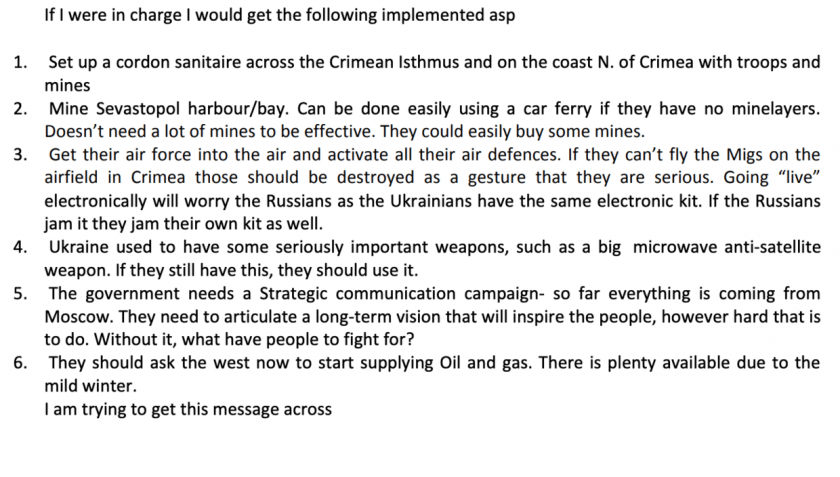
A print screen of the leaked document with alleged “military measures” which Christopher Donnelly wanted to communicate to Kiev. © cyberguerrilla.org
Donnelly noted that “at the moment the new ‘Government’ in Kyiv is unable to think in terms of military reality,” since it was not sure if its “orders will be obeyed or not.”
“They are like a rabbit in the car’s headlights,” he said, according to the documents.
The measures which the official would supposedly implement, include “mining of Sevastopol harbor,” setting up a “cordon sanitaire” across the Crimean Isthmus with “troops and mines,” and trying to “inspire” their own troops, endeavoring to explain to them what exactly they had to fight for.
Donnelly allegedly writes that he would have used “some seriously important weapons” Ukraine “used to have,” namely some sort of “big microwave anti-satellite weapon.”
Apart from that, the text says all the air forces in the region should have been scrambled and anti-aircraft defenses activated. If the aviation in Crimea proved to be not airworthy, it should have been destroyed “as a gesture that they are serious.”
While all the “measures” appear to be designed to incite an open armed conflict, the last one was also about making profit by the West: “They should ask the west now to start supplying oil and gas. There is plenty available due to the mild winter.”
Donnelly has a rich background that ties him to top military officials. Between 1989 and 2003, as special adviser to four NATO Secretaries General, he was closely involved with NATO. From 2003 to 2010 he ran the UK Defence Academy’s Advanced Research and Assessment Group. He has been a specialist adviser to three UK Defence Secretaries (both Labour and Conservative) and was a member of Prime Minister Margaret Thatcher’s Soviet advisory team. Since 2010 he has been the Co-director of The Institute for Statecraft – a shady think tank that provides “decision takers & policy makers with reliable, alternative solutions.”
This is the third of a number of leaks, which began on November 5. The leaks claim that the UK government-funded group “Integrity Initiative” (II), which was founded by the Institute of Statecraft, has a network of journalists, analysts and former politicians who make up a Europe-wide chain of “clusters” that help London meddle in other state’s affairs.
Commenting on the previous leak, the II neither confirmed nor denied that the documents were genuine, saying that it didn’t have time to validate them.
However, II did confirm that the organization has, indeed, been receiving funding from the British Foreign and Commonwealth Office (FCO) for the past two years, but insisted that private donors were its primary source of money. Meanwhile, in response to a question by Labour MP Chris Williamson last week, Minister for Defence, People and Veterans Tobias Ellwood admitted that the Institute for Statecraft had also received funding from the British Army and the Ministry of Defence. The FCO money came from the department’s ‘Conflict Fund’ which investigative journalist Mark Curtis exposed last year as a “secretive slush fund” which had backed “some of the world’s worst security forces.”
RT has reached out to Mr. Donnelly for comment over the contents of the “military measures” list, as well as over allegations that his organization targeted Jeremy Corbyn in an anti-smear campaign which are now being investigated by the Foreign Office. He declined to comment.
“Thank you very much for your enquiry but as RT is a state-sponsored propaganda organization and not a legitimate news channel, we have no comment to make,” Donnelly said in a mailed statement.
British minister ‘misled Parliament’ over state-funded NGO ‘smearing’ Corbyn, Labour MP says
RT | December 17, 2018
A Labour MP has said that Foreign Office minister Alan Duncan chose to ‘bury his head in the sand’ as he denied allegations that state funds granted to a shadowy ‘disinformation-fighting charity’ were used to attack Jeremy Corbyn.
“There is a real concern” that Duncan “was misleading Parliament whether that was wittingly or unwittingly,” Chris Williamson said on Sunday.
He was commenting on the official’s response to a question posed earlier by another Labour MP, Emily Thornberry, about government funding for the controversial Scotland-based ‘charitable body,’ the Institute for Statecraft (IfS).
Labour politicians demanded an official probe into the organization, insisting it participated in a campaign to “smear” the party and its leader Jeremy Corbyn.
Speaking in the House of Commons on Wednesday, Duncan, who serves as Minister of State for Europe and the Americas, said he had “established the facts” concerning the NGO and was “satisfied that our money does not go towards funding any kind of UK domestic activity.”
The Institute for Statecraft came under fire when Sunday Mail reported that the think tank used its ‘Integrity Initiative’ project to promote newspaper articles denouncing Labour chief Jeremy Corbyn as a “useful idiot” whose views “helped the Kremlin cause.” The project styles its mission as “revealing and combating propaganda and disinformation.”
In practice, nearly all materials published on its website are focused on fighting so-called ‘Russian propaganda.’
Citing the organization’s leaked documents, the Sunday Mail said that IfS received £2 million from the Foreign Office. The paper also reported that the charity itself is, in fact, registered at a derelict rural mill.
Faced with the Labour backlash, Duncan admitted that the government funded IfS’ Integrity Initiative with £296,500 in financial year 2017-2018 and is giving it £1,961,000 for the year 2018-2019. He refused, however, to publish the government’s correspondence on grant agreements with the project, saying that such information could be used by Moscow “to actively attempt to disrupt and undermine” its effectiveness.
Duncan’s claim that no state funds were used for an alleged campaign against Corbyn did little to quell the anger coming from Labour MPs. Williamson suggested that the minister “needs to realize that this isn’t going to go away and he must come up with some real answers rather than burying his head in the sand.”
His colleague Emily Thornberry told the Sunday Mail that Duncan’s words “just didn’t make sense.”
I found it genuinely confusing. I have never heard a minister say with such confidence that he is telling the truth.
Thornberry suggested that Duncan was simply reading the answers prepared by other government officials and “they just don’t stack up.”
Leaked Memo Touts UK-Funded Firm’s Ability To Create “Untraceable” News Sites For “Infowar Campaign”
By Tyler Durden – Zero Hedge – 12/15/2018
The hacking collective known as “Anonymous” has published more explosive documents detailing a UK-based psyop to create a “large-scale information secret service” in Europe in order to combat “Russian propaganda” — which has been blamed for everything from Brexit to Trump winning the 2016 US election to this month’s anti-Macron “Yellow Vest” protests.
We previously detailed the first trove of documents which were dumped online November 5th to the site Cyberguerilla, revealing the private UK organization with deep government ties, the Integrity Initiative, to be engaged in an aggressive campaign to organize “clusters” of journalists across the West engaged in “counter-propaganda” efforts on social media networks and in media. And now a new trove of leaked Integrity Initiative documents has been dumped online Friday.

“Combatting Russian Disinformation” – Screenshot from a bombshell newly leaked document published Friday and hosted on the Cyberguerilla site.
This week the Integrity Initiative and its founding parent organization, the Institute for Statecraft — which is known for its close relationship with the UK military and defense officials — is at the center of debate in the House of Commons over its anti-Corbyn and anti-Labour smears involving labeling party leader Jeremy Corbyn a “useful idiot” for Moscow, even while the company is a recipient of official Foreign and Commonwealth Office (FCO) funding.
The early November online leaks of confidential Integrity Initiative documents were the first to reveal the UK government’s relationship to the private project devoted to “fighting Russian disinformation”. According to The Guardian :
FCO funding of the Integrity Initiative was revealed by a set of stolen documents posted online last month by hackers under the banner of the Anonymous hacktivist collective. The organisation has not disputed their authenticity, but in a statement suggested that Russia was responsible for the hack and that Moscow had used its media channels to amplify its impact.
We noted previously that the work done by the Initiative — which claims it is not affiliated with government bodies, is done under “absolute secrecy via concealed contacts embedded throughout British embassies,” according to memos in the November leak. It does, however, admit to working with unnamed British “government agencies.”
In the Commons earlier, I asked Alan Duncan why taxpayers money had been used by the so-called ‘Integrity Initiative’ to disseminate political attacks from its Twitter site (1/2). pic.twitter.com/zQNOPeQOMn
— Emily Thornberry (@EmilyThornberry) December 12, 2018
Friday’s document dump via “Anonymous” is the third such release, and already some bombshell information has come to light.
The geopolitical blog, Moon of Alabama, was the first to unearth and analyze one of the more interesting among the document trove:
A “strictly confidential” proposal by the French company Lexfo to spread the Integrity Initiative’s state-sponsored propaganda through an offensive online influence campaigns for a monthly pay per language of €20-40.000. The proposal also includes an offer for “counter activism” through “negative PR, legal actions, ethical hack back, etc.” for €50,000 per month.
The document is marked “Strictly confidential” and lays out a “comprehensive action proposal” which repeatedly invokes Russian state funded media outlets RT and Sputnik as enemy disinformation to be defeated.

The proposal touts the ability of an Integrity Initiative partner — the French cybersecurity firm Lexfo — to create “indirect” and “untraceable” news content, including its ability to conduct “naming and shaming” campaigns targeting “allies” of “Russian disinformation”.
Presumably “allies” means any person or entity that happens to align with the Russian viewpoint on any given issue. The shaming campaigns and counter-information operations will be conducted “across hundreds of credible media outlets”.


Alarmingly, the document notes that:
“where we lack platforms to publish our content… we will create news media sites serving our objectives…”
Again, both the contracting cybersecurity firm and the Integrity Initiative’s role in literally creating media sites out of thin air for the purpose of “serving our objectives” will remain “untraceable”.

As part of the “infowar campaign” teams of media operatives across Europe and the U.S. will “monitor” and edit social media pages as well as Wikipedia entries, according to the leaked document.
“Hot topics” which especially need to be monitored include the Ukraine conflict and any situation wherein “pro-Western local politicians” could be swayed by “Russian-backed trolls”
The teams will engage in “special operations” which are listed as:
- negative PR
- legal actions
- ethical hack back

And which populations are to be targeted? The document specifically mentions seeking out a Russian audience alongside Western countries: “This plan should be implemented in every targeted country and language, including Russia.”

These “influence operations” come at a price, according to the document. One figure which is floated is a monthly pay per language fee of €20-40.000, making it classic government subsidized mass propaganda (again, the company has been confirmed as receiving FCO funding).
Given that this looks like merely the tip of the iceberg in terms of similar such UK and US funded “combating disinformation” projects conducted in partnership with private entities out there, these initiatives have most likely already been active for years.
Featured Video

Death Spikes & Rising Cancer In Our Youth Explained
or go to
Aletho News Archives – Video-Images
From the Archives
Politicians lie
By Mazin Qumsiyeh | Popular Resistance | August 18, 2013
There is no way to say this truth nicely: Politicians lie. That includes Japanese, American, Egyptian, Israeli, and Palestinian politicians! Is there something more common sense than that? Yet, so many citizens around the world believe their own politicians or wistfully acknowledge lies but think it is part of the job needed to run things. They believe even when politicians contradict themselves blatantly. This phenomenon is rather remarkable. It is a dissonance and disconnect from reality that many seem oblivious to. It is very dangerous because it can lead to accepting rationales for going to war. These can be deadly wars that lead to millions of lives lost as happened in what was called World War 1 and WW2. Even when incredible and declassified evidence abound, politicians continue to lie and old mythologies refuse to die. Here are just a few of the countless lies told to us over the past few decades… continue
Blog Roll
 Aletho News
- RSF military group defects, joins Sudanese army: State media
- Ireland goalkeeper refuses to play ‘Israel’ as squad weighs boycott
- China pushes back against US on Cuba, Iran
- Ukrainian Soldiers, Potential Mercenaries: Have Gun, Will Travel!
- Burnham’s UN debut… A masterclass in British disinformation
- Iran flights continue despite US aviation sanctions
- Global Tipping Points Lead the World Into a State of Entropy
- The day-after at the White House: USA and Xi Jinping
- The Geopolitical Balance in the Red Sea: The UAE Being Displaced by New Players
- Iraqi resistance group vows to stage airport sit-ins over Iran aerial blockade
- If Americans Knew
- Deconstructing Netanyahu’s pants-on-fire UN rant – Daily Update
- Trump betrayed voters with his campaign lies and prioritized a foreign country once he took office
- Netanyahu calls Israel’s war in Gaza ‘opposite of genocide’ in UN speech to near-empty hall
- Settler Kidnappings: Torture, Sexual Abuse and Terrorisation of Palestinian Abductees as Israel Deepens Annexation of West Bank
- Gaza winter nears as 162,000 tents become unusable, raising fears of humanitarian crisis
- Netanyahu says, “It’s the opposite of genocide”; UN says Gaza economy is world’s ‘most severe crisis on record’ – Daily Update
- Israel’s US-Backed Assault on Gaza Has Created the ‘World’s Most Severe Economic Crisis on Record’: UN
- ‘Protecting U.S. Citizens’… From Israel
- ‘This is where I live now, the back of a truck’: a day in the life of a grandmother in Gaza
- In UN Speech, Iran’s President Displays Pictures of Children Killed by US, Brings Attention to Israel’s Nuclear Arsenal
- No Tricks Zone
- New Study: Earth And Venus Surface Warmth Largely Explained By Convection And Lapse Rate, Not CO2 Or Radiation
- 2025 Nature Paper Claiming Worsening Global Drought Gets RETRACTED …Heavily Flawed
- New Study: ‘Global Drought Shows No Detectable Recent Acceleration Under Climate Warming’
- Economic Masterminds: German Socialists Suggest Taxing Productivity Gains Stemming From Using AI
- The South China Sea Has Not Been Cooperating With The Climate Change Narrative
- Energy Crisis: Germany Enters Heating Season With Historically Low Gas Reserve Fill Levels
- New Study: The Antarctic Ice Sheet Gained Mass From 2020-2024 Due To Staggering Snow And Ice Accumulation
- Study: Ocean Heating Rates From Thousands Of Years Ago ‘Dwarf’ Modern Ocean Heating Rates
- Climate Extremists Target, Attack Large-Scale Power Grid Infrastructure In Germany!
- New Study: Antarctic Ice Melt Has Contributed Less Than 1 Centimeter To Sea Level Rise In The Last 30 Years

