Real ‘obscene masquerade’: How BBC depicted staged hospital scenes as proof of Douma chemical attack
By Vanessa Beeley | RT | February 16, 2019
In an extraordinary turn of events, corporate media appears to have been exposed again as an extension of state foreign policy, by a member of the establishment media cabal, manufacturing consent for regime change in Syria.
Riam Dalati is on the BBC production team based in Beirut and describes himself, on his Twitter page, as an “esteemed colleague” of Quentin Sommerville, the BBC’s Middle East correspondent. Dalati broke ranks with his UK Government-aligned media, on Twitter, to announce that “after almost 6 months of investigation, I can prove, without a doubt, that the Douma hospital scene was staged.”
The scenes in question are those manufactured by the White Helmet pseudo-humanitarian group and activists affiliated to Jaish al-Islam, the extremist armed group in charge of Douma at the time of the alleged chemical weapon attack on April 7, 2018. The scenes of children being hosed down, following a “chemical attack” were immediately accepted as credible and appeared alongside sensationalist headlines in most Western media outlets, including the BBC, CNN and Channel 4. Simon Tisdall of the Guardian wrote an opinion piece, with the headline ‘After Douma the West’s response to Syria regime must be military’ – only two days after Douma, effectively calling for all out war.
While Dalati’s tweets have clearly distressed some notables in the establishment camp, Dalati is no stranger to such controversy. Almost immediately after the alleged incident in Douma, he tweeted out his frustration that “activists and rebels” had used “corpses of dead children to stage emotive scenes for Western consumption.” The emotive wording of Dalati’s tweet, he was “sick and tired” of such manipulation of events, suggested that this was not the first time children had been used as props in a macabre war theatre designed to elicit public sympathy for escalated military intervention in Syria disguised as a necessary “humanitarian” crack down on “Assad’s gassing of his own people.”
Dalati had been referring to the arranging of two children’s corpses into a “last hug” still life composition, a photo that went viral, rocketed into the social media sphere by activists who had collaborated with the brutal Jaish al-Islam regime while it tortured and abused the Syrian civilians under its control.
Perhaps Dalati’s apparent outburst could be explained by his participation in the production of the controversial September 2013 BBC Panorama documentary, ‘Saving Syria’s Children’. An independent researcher, Robert Stuart, has made it his life’s work to present a compelling argument that “sequences filmed by BBC personnel and others at Atareb Hospital, Aleppo on August 26, 2013 purporting to show the aftermath of an incendiary bomb attack on a nearby school are largely, if not entirely, staged.” Perhaps Dalati had witnessed one too many stagings of events that would precipitate the potential for war in Syria between the US and Russia.
Whatever the reason for Dalati’s exasperation, the tweet was deleted before a watered down version appeared. Dalati claimed that a “breach of editorial policy” and lack of context was behind this alteration. Apparently BBC employees are not allowed to be “sick and tired” of the exploitation of children to promote a war that will inevitably kill more children. Simultaneously, Dalati’s account was protected, making tweets visible only to approved followers.
On two significant occasions to date, Dalati appears to deviate from the BBC narrative road map in Syria. However, Dalati had participated in the corporate media lynching of journalists and academics who had dared to question the dominant “chemical attack” narrative, at the time of the alleged incident in Douma, dismissing them as conspiracy theorists. These “conspiracy theorists” included acclaimed journalist, Robert Fisk and Uli Gack, an experienced war correspondent with ZDF, a German public media outlet. Independent journalist, Eva Bartlett, and Pearson Sharpe of One American News Network also reported evidence of staging and mainstream media distortion of events in Douma.
I visited Douma shortly after the alleged attack. I interviewed medical staff and civilians who were adamant that a chemical attack had not taken place. Doctors and nurses, some of whom were on duty on the night in question, told me that adults and children were suffering the effects of smoke inhalation. They described the panic generated by the activists and White Helmet operatives who arrived crying “chemical attack” before they hosed down the traumatised patients.
20-year-old Suleiman Saour told me: “At 7pm we had been receiving wounded people all day long. At 7pm someone came in carrying a little boy, he laid him on a bed and said he had been hit with chemical weapons. Basically I checked the boy […] he was suffering from smoke inhalation […] we washed his face, used a spray and Ventolin. Later on we found out the child had asthma and it got worse because of the smoke.”
Academics, Professors Piers Robinson and Tim Hayward, came under concerted attack as did other members of the Working Group on Syria, Propaganda and Media when they analysed the events and questioned the veracity of it being a chemical attack. In the UK, the Times published no less than four articles labeling myself and the “rogue” academics as “Assad’s useful idiots,” timed to perfection on the day that the UK, US and France launched their unlawful bombing campaign against Syria. A bombing campaign that was fully enabled by the ignominious rush to judgement by corporate media in the West.
It has taken Dalati six months to arrive at the same conclusion as those he condemned as compromised “conspiracy theorists,” therefore we must question his motives for suddenly releasing these conclusions. Peter Ford, former UK Ambassador to Syria, gave me his opinion on Dalati’s revelations.
“The UK joined Trump and Macron in illegally bombing Syria largely on the basis of a video clip shown ad nauseam on the BBC, which a BBC Syria producer has now said he has evidence was staged. The BBC in their statement are not denying the claim. The implications are shattering: firstly that the state broadcaster effectively connived at a manipulation of public opinion, and secondly that the British government launched its attack on Syria on a false and fabricated premise. This demands a public enquiry.”
Ford’s statement highlights the seriousness of Dalati’s statement which must surely raise questions about the possibility of previous “chemical attack” narratives also being manipulated, staged or fabricated. Swedish Doctors for Human Rights investigated the alleged chlorine gas attack in Sarmin, March 2015 and found the medical procedures conducted by doctors at the scene to be extremely questionable.
Dr Leif Elinder, a Swedish medical doctor and paediatric specialist, found that “after examination of the video material, I found that the measures inflicted upon those children, some of them lifeless, are bizarre, non-medical, non-lifesaving, and even counterproductive in terms of life-saving purposes of children.” This video, produced and presented by the White Helmets and their colleagues at the Syrian American Medical Society (SAMS), was shown during a UN Security Council “closed door” session to promote a no-fly zone which translates to protection for the US coalition-backed terrorist forces on the ground in Syria.
As BBC producer has stated publicly that the hospital scenes during the Douma “attack” are staged, the BBC has distanced itself by stating that these are the personal claims of an employee which do not mean an attack did not take place. The July 2018 OPCW interim report has already discredited the early sensationalism of western media reporting. “No organophosphorus nerve agents or their degradation products were detected, either in the environmental samples or in plasma samples from the alleged casualties,” it stated. No Sarin.
The OPCW Fact Finding Mission (FFM) has not yet reached a conclusion that a chemical attack of any kind took place in Douma. The environmental samples were reported to contain chlorinated organic molecules such as trichloroacetic acid and chloral hydrate, which could be attributed to something as basic as chlorinated drinking water. Despite this ambiguity, the BBC initially ran with the headline that ‘Chlorine was used’ in the Douma attack before altering to ‘Possible Chlorine at Douma Attack Site’. Another mistake? Or another deliberate attempt to mislead and shore up the UK FCO regime change storyline in Syria?
Dalati’s revelations must also be viewed in context. They follow similar conclusions arrived at by corporate media colleague and journalist, James Harkin, a Guardian contributor who published a long-winded Douma investigation in the Intercept. Harkin also conceded that the Douma hospital scenes were likely staged and that the Sarin canard was a non-starter.
It is very unlikely, despite the BBC protestation, that Dalati would risk publishing his claims without approval from BBC hierarchy. Timing is always crucial when examining events that have the potential to expose colonial media, particularly the BBC, as the refined state PR agencies they are in reality.
Based on an informed and intelligent interpretation of events with historical context, we could speculate that the OPCW is about to release its final findings on the Douma attack. A report which has the potential to lay bare the full extent of the BBC’s deception and falsification of facts in Douma. A report which could raise unpleasant questions about corporate media reporting, particularly on alleged chemical weapon use by the Syrian government, throughout the 8 year conflict in Syria. Was Dalati’s shock information release nothing more than a damage limitation tactic by the BBC or is Dalati genuinely a rogue truth-teller? Only time will tell.
What Dalati has done is highlight the hypocrisy and bias of Western media and government officials. The BBC report on the Russian “production” of Douma-chemical-attack-denying witnesses at the HQ of the OPCW in the Hague emphasises the dismissal of the event as a “despicable stunt” by the UK, US and France who boycotted the proceedings. French ambassador to the Netherlands described the Syrian civilian testimonies as an “obscene masquerade.” The Guardian ran with this statement as its headline, reducing Russia’s attempt to bring some clarity to the Douma attack to the unveiling of “supposed witnesses” in order to discredit such attempts to derail their preferred narrative.
Now, it appears that the real obscene masquerade took place in the Medical Point in Douma, was constructed by the UK FCO-financed White Helmets, and was adopted by the BBC and other state stenographers as gospel in order to further criminalise the Syrian Arab Army just as the final liberation of Douma from Jaish al-Islam brutal rule was fast approaching. This obscene masquerade resulted in the unlawful bombing of Syria by the US, France and the UK. As Peter Ford stated, “this demands a public enquiry.”
‘Western Media Haven’t Covered Syria the Way They Should’ – Prof
Sputnik – February 14, 2019
The video of people being treated after an alleged chemical weapons attack in the Syrian city of Douma was fabricated. This is what BBC Syria producer Riam Dalati wrote on his Twitter account on Wednesday.
Sputnik has discussed the development with Piers Robinson, co-director of the Organisation for Propaganda Studies and professor at the University of Sheffield.
Sputnik: What is your reaction to Mr Dalati’s tweets?
Piers Robinson: It’s obviously very interesting that somebody in his position is now declaring that it’s his opinion that there was some element of manipulation or fabrication occurring in the events surrounding Douma. In some ways, of course, as you see in the recent Intercept article by [James] Harkin, the message of his idea is that there was an attack of some kind and Riam Dalati is saying that there was an attack.
But what kind of attack is unclear. So we really need to hear more from him. But at the very least, if it is the case that it is established that there were staging and manipulation going on, then it really just starts to raise a whole series of further questions about staging and manipulation in the case of Douma, running all the way through to the obvious question which is whether it was some kind of a false flag event.
That it was something that was carried out by opposition groups, Jaish al-Islam, in order to try to enable a military intervention, which obviously did occur six or seven days later with the bombing against Damascus. All of that is on the table now, undoubtedly.
And in some ways what Riam is saying does confirm what myself and many other academics, independent researchers and journalists have been saying for some time that there are serious questions about the official claims being brought forward by Western governments about what happened in Douma.
Sputnik: Moscow is now waiting for an official response from BBC to this tweet. What’re your thoughts? Will the BBC respond and what we can expect from them in the way of some kind of response based on, perhaps, past incidents?
Piers Robinson: I’m really not quite sure if I can guess how the BBC might respond. I think we need to wait and see what more comes out. I mean, it’s not very clear if Riam Dalati is referring to an article he has coming out, if that’s an article which is going to go to the BBC or independently, we just don’t know.
I guess most media organisations in general when they’ve got it wrong in the past tend to be fairly mealy-mouthed in their ability to either correct the record or to apologise for what has happened. We saw that in the case of the 2003 Iraq War, with some very limited apologies about their failure to scrutinise Western governments over WMD claims in Iraq.
So, I would suspect nothing more than a very cautious response from the BBC and they will probably want to wait and see what more Riam Dalati comes out and says over the coming days and weeks.
Sputnik: It’s interesting that there aren’t really [any] mainstream media reports about this at all. Do you think it’s just too early, or do you think there are some other reasons for that nobody has really picked up on this?
Piers Robinson: I think the reasons are well-known. We know that when it comes to, especially foreign policy, war and conflict, media in Western democracies, as is the case in pretty much every other country in the world, tend to toe the line of what governments are doing and saying. This is well established across the critical political communication literature; it’s for a whole number of reasons that this occurs.
Mainstream media, in the case of Syria, haven’t been covering it in the way they should have been because they have been beholden and co-opted by the government position and so on in relation to this conflict. We see it in every war time and time again; and it’s no different in the conflict in Syria than it was on the case of Iraq or going all the way back to Vietnam in the 1960s.
You see a real timidity and lack of confidence amongst journalists and editors to really ask difficult questions of their governments when their countries are involved in some kind of war.
READ MORE:
BBC Says Its Producer Expressed ‘Personal Opinions’ on Douma Incident
BBC Producer Says Footage of Alleged Gas Attack Victims in Syria’s Douma Staged<
BBC “Trying to Limit Damage” After Fake News of Syrian Chemical Attack – Journo
Sputnik – February 14, 2019
BBC Syria producer Riam Dalati tweeted on Wednesday that the video of people treated after an alleged chemical weapons attack in the Syrian city of Douma had been fabricated. Sputnik has discussed the development with Vanessa Beeley, an independent investigative journalist who specialises in the Middle East and Syria in particular.
Sputnik: This doesn’t really look good though, does it, for Mr. Dalati. Why do you think he decided to speak up now? He is now contradicting himself basically.
Vanessa Beeley: Well, yeah, and effectively this is a damage limitation operation. One of their own, so to speak, James Harkin, who is a mainstream journalist, he writes in the Internet and he also writes for the Guardian, and the Guardian’s Simon Tisdall I believe it was, almost immediately after the alleged attack in Douma, which has, of course, been largely discredited by the OPCW report that has told us that no organic phosphates were used, there is still an element of doubt over whether chlorine was used. But the OPCW report itself has already negated the use of sarin in this attack.
But when Harkin himself is saying that this event was staged, then, of course, the BBC and Louisa Loveluck of Washington Post are immediately, in my opinion, trying to limit damage.
Sputnik: What do you think the BBC is going to do next? Do you think that they are going to have an official statement out on this? What can we expect?
Vanessa Beeley: I guess we should be waiting for Riam Dalati’s full investigation. He’s told us on Twitter that he’s been looking into this for six months and he’ll be providing further details soon. So we should be waiting to see whether the BBC will retract its previous statements; I mean it put out a very misleading report even on the use of chlorine after the release of the OPCW interim report. It basically stated on its leading report that chlorine had been used, it later changed that but it didn’t retract its storyline.
And I’ve just checked, for example, the Telegraph, on its timeline of chemical weapon attacks or alleged chemical weapon attacks inside Syria, it’s still stating that it is alleged that sarin was used in Douma. So, that is still standing on the Telegraph website.
So, fundamentally what these mainstream outlets do is put out a narrative which, as I’ve pointed out, effectively manufactured consent for the unlawful bombing of a sovereign nation, Syria, by the US, France and the UK post- the Douma alleged attack. But these storylines and these narratives are never retracted; so it remains to be seen whether the BBC will apologise to Syria for having manufactured the consent for the bombing, and whether Riam Dalati and the BBC will apologise to academics and to independent journalists that they smeared at the time for arriving at the same conclusion they’ve now arrived at.
Sputnik: If Mr. Dalati’s tweet is proven, what will it say about the White Helmets and their trustworthiness, not to mention their, perhaps, role in the whole event?
Vanessa Beeley: Of course, this raises huge questions. I mean, I’ve proven and I’ve written an open investigation based on testimony from civilians in Eastern Ghouta of the White Helmets staging at least one chemical weapon attack one month before Douma… which was actually derailed by the civilians themselves who exposed it on social media etc. The White Helmets have been proven time and time again to be staging events in order to serve the NATO member states’ regime change narrative inside Syria. This might start to raise questions over the veracity of the White Helmets reports, bearing in mind that the UK government document has publicly stated that Amnesty International and Human Rights Watch, for example, rely extensively on the evidence of the White Helmets to produce their reports that, again, largely criminalise the Syrian government.
Sputnik: This alleged attack was actually used to justify a response, the bombing of the area by the US, UK and France; it was quite a significant military strike that was perpetrated after that attack. What would this mean for evaluating the legality or the justification of that attack?
Vanessa Beeley: The very fact that France, the UK and the US went ahead and bombed Syria, and as you said it was an extensive bombing operation that targeted alleged chemical weapons manufacturing facilities that were proven afterwards and also reported by OPCW to not be chemical weapons manufacturing facilities, brings into question the legality of that attack. It brings into question the legality of the entire regime change war that has been waged against Syria since 2011, of course instigated by those same nations that bombed after Douma.
But the fact that that the bombing went ahead without any OPCW investigation having been able to take place and based entirely on what is now proven or thought to be spurious information from groups like the White Helmets, that are being funded by the nations that carried out the bombing attack, I mean, this is an extraordinary event; this basically means that the US, the UK and France have completely violated international law time and time again inside Syria and this must be brought into the light, it must be investigated. And the media’s role in enabling this unlawful act must also be investigated.
READ MORE:
Assad Calls Douma Chemical Attack ‘British PR Stunt’ Straight to UK Media’s Face
BBC Producer Says Footage of Alleged Gas Attack Victims in Syria’s Douma Staged
Militants Engaged in Chemical Attacks Are Under Western Patronage – Sec. Council
BBC-staged footage on Syria’s Douma Western media’s ‘theater of absurd’: Russia
Press TV – February 14, 2019
Russia says the latest revelations by BBC that the footage of an April chemical attack near the Syrian capital was fabricated proves the “theater of absurd” in Western media’s coverage of events in the Arab country.
“Over the past few years, and not just in Syria, we have been witness to a travesty being staged by the West and its media agencies, which on [the one] hand brags about brilliant democratic goals and support for civilians of a sovereign state, but on the other does not … give a damn about … international law, various forms of freedom and rights of a nation or a certain minority,” the spokeswoman for the Russian Foreign Ministry, Maria Zakharova, told reporters in Moscow on Thursday.
The footage broadcast by BBC showed people being treated after a chemical attack in Douma.
BBC Syria producer Riam Dalati wrote on Twitter on Wednesday that the issue had been investigated for six months.
Zakharova added, “The culmination of this theater of absurd may be a statement by a BBC producer, who confirmed based on his own research that the footage [in Douma] had been staged with direct participation of [the so-called civil defense group] White Helmets.
She further pointed out that Russia wanted to listen to BBC’s explanation because it actively covered the events in favor of the US-led coalition purportedly fighting the Daesh Takfiri terrorist group.
The Western-backed White Helmets group, which has been repeatedly accused of cooperating with Takfiri terrorists and staging fictional chemical attacks, published a video in April 2018, alleging that Syrian government forces had launched a chemical assault in the city of Douma, located about 10 kilometers northeast of Damascus.
The US has warned it would respond to any possible chemical weapons attack by Syrian government forces with retaliatory strikes, stressing that the attacks would be stronger than those conducted by American, British and French forces last year.
On April 14, 2018, the US, Britain and France carried out a string of airstrikes against Syria over a suspected chemical weapons attack on the city of Douma.
Washington and its allies blamed Damascus for the Douma attack, an allegation rejected by the Syrian government.
On September 11 last year, Russian Deputy Foreign Minister Sergei Ryabkov censured the US threats to use military force against Syria as part of Washington’s blackmail policy.
“Unlike the United States, Britain and their allies, Russia provides particular facts on a daily basis through its Defense Ministry, the Foreign Ministry as well missions in New York, The Hague and Geneva. We particularly name geographical points, where preparations are underway for certain terrorist groups backed by the US and its allies to carry out provocations,” Ryabkov said.
BBC Says Its Producer Expressed ‘Personal Opinions’ on Douma Incident
Sputnik – February 14, 2019
BBC Syria producer Riam Dalati, who wrote on Twitter that he could prove the video of the victims of the alleged chemical attack in Douma being treated in hospital was staged, was expressing his own opinion and did not deny the fact of the attack itself, the broadcaster’s spokesperson told Sputnik on Thursday.
“The producer was expressing his personal opinions about some of the video footage that emerged after the attack but has not claimed that the attack did not happen”, the BBC spokesperson said.
On Wednesday, the journalist tweeted that he could “prove without a doubt” that the Douma hospital footage had been staged and no fatalities had occurred in the hospital. He said the attack did take place but without the use of sarin gas and that the nature of any chemical used would have to be verified by the Organisation for the Prohibition of Chemical Weapons.
Previously, the RT broadcaster reported that Dalati had already expressed his scepticism about the Douma hospital video in a Twitter post. However, the journalist subsequently deleted his tweet, citing a breach of editorial policy.
The same month, Hassan Diab, 11, who was featured in the White Helmets video, in an interview with a Russian media outlet alongside his father, gave a detailed description of how the footage of people treated in the hospital was filmed. Diab said, among other things, that children were given food for participating in the video.
Moreover, Douma residents, interviewed by Sputnik, were unable to confirm that the attack had taken place there. They said they knew nothing about it and were not aware of anybody having been affected by toxic chemicals.
The reports about the attack and the publication of the footage by the White Helmets were followed by missile strikes carried out by France, the United Kingdom and the United States targeting alleged chemical weapons production facilities in Damascus.
Western states have repeatedly accused the Syrian authorities of having carried out the Douma attack, while Damascus denied any involvement in the incident. The Russian Foreign Ministry has said that the claims about the alleged use of toxic chemicals by the Syrian government were aimed at justifying external military action.
READ MORE: German Journalist Federation Calls on Regulators to Deny Broadcast License to RT
15 Years in Prison for Clicking on Terrorist Propaganda Even Once – New UK Law
Sputnik – February 13, 2019
Upon the adoption of a new legislation, Home Secretary Sajid Javid said that the Counter-Terrorism and Border Security Act “gives the police the powers they need to disrupt plots and punish those who seek to do us harm.”
The Counter-Terrorism and Border Security Act 2019 has received Royal Assent on 12 February, making the bill an Act of Parliament.
The act makes provision in relation to terrorism, enabling persons at ports and borders to be questioned for national security and updating the offence of obtaining information likely to be useful to a terrorist to cover material that is only viewed or streamed, rather than downloaded to form a permanent record.
The act sees to an increase to the maximum penalty for certain preparatory terrorism offences to 15 years’ imprisonment.
The UK government has been criticized by the UN Special Rapporteur on the right to privacy, Joe Cannataci, back in 2018. The inspector argued following his visit in the UK, that it was concerning that accessing propaganda “on three or more different ccasions” was viewed as an offence. Cannataci called the approach straying towards “thought crime.”
The three-click benchmark has been removed in the new bill and now even a single tap on ‘terrorist material’ could lead to years in prison. Exemption is provided for journalists, academic researchers or people who had “no reason to believe” they were accessing terrorist propaganda.
The Bill has also provided for a launch of an independent review of Prevent, the much criticized government’s strategy that aims to support persons vulnerable to radicalisation.
British intelligence services were condemned in 2018 for failing to properly monitor individuals of interest — later to be involved in terrorist activity — not under active investigation at the moment but in the peripheries of more than one investigation.
In 2017, the United Kingdom suffered five terrorist attacks in Westminster, the Manchester Arena, London Bridge, Finsbury Park and Parsons Green, with 36 people losing their lives and dozens injured.
German Campaigners Defame Russian Media as Opinions Differ – Envoy to Berlin
Sputnik – 12.02.2019
MOSCOW – Russian media in Germany are being “persecuted” because their opponents do not have arguments to challenge their positions, Russian Ambassador to Berlin Sergei Nechayev told Sputnik, adding that proponents of such an approach were revealing who they really were.
“All those involved in this, to put it mildly, ugly media campaign against Russian and Russian-language media, are exposing themselves. After all, the course for defamation is adopted when arguments finish. One can only regret that opinions that differ from those expressed by local mainstream media do not give rise to a professional debate, but become a target for dishonest attacks. It is much easier to accuse your opponent of propaganda and deny him the opportunity to freely deliver his opinion to the local public rather than to hold a professional, fact-based discussion on controversial issues,” Nechayev said.
The ambassador added that Russian authorities did not target German media working in Russia, despite the fact that Moscow did not always like their content, which, he said, was often far from being objective.
“All we are striving for is providing our journalists with the opportunity to freely fulfill their professional duty in Germany, exactly the same way as many more numerous media representatives of Germany do in our country,” Nechayev stressed.
The comments come after on January 11, the German Federation of Journalists issued a statement calling on German regulators supervising media activities to not issue a broadcasting license for RT Deutsch, claiming that it was a “tool for Kremlin propaganda.” The Russian Foreign Ministry has said that Russia is not ruling out the possibility of taking retaliatory measures against countries where Russian media have their rights violated.
The situation with Russian media in the West has become increasingly difficult in recent years. A number of Western politicians, including those in the United Kingdom, the United States and France, have accused RT and Sputnik of interfering in elections and spreading propaganda, albeit without providing any evidence.
Russian officials have repeatedly stressed that Moscow does not meddle in other countries’ affairs. They, in particular, emphasize that the Western states’ policy toward Russian media reflected the fear of alternative coverage of global events and deterioration of the freedom of speech there.
Arms purchases by Middle Eastern countries have doubled: Annual security report
Press TV – February 12, 2019
An annual international security report shows that arms sales to the Middle East doubled during the period between 2013 and 2017 compared to the previous five years.
The Munich Security Report 2019, released on Monday, also said the outsize concentration of weapons in the Middle East increased the risk of confrontation in the region.
“Between 2013 and 2017, the value of Middle Eastern countries’ arms purchases doubled compared to the previous five years, thus bearing the risk of an arms race and military confrontation,” it said.
The report did not name the top purchasers of arms, but they are believed to be the Arab countries in the Persian Gulf region, which traditionally allege that they face a “threat” from Iran and use that pretense to buy advanced weapons from eager suppliers mainly in the West.
The report did reveal the exporters, though. It said 53 percent of the total volume of the arms exports to the Middle East originated in the United States. The US was followed by France (11 percent), the United Kingdom (10 percent), and Canada (seven percent).
Italy, Germany, and Turkey were also among the leading exporters, with their share in the total volume of arms sales to the region equaling six percent, three percent, and two percent, respectively.
‘Countries reevaluating relations with Saudi Arabia following Khashoggi murder’
The report also said that “numerous US politicians and governments of other countries are reevaluating their partnership with Saudi Arabia,” following the state murder of dissident journalist Jamal Khashoggi in the Saudi consulate in Istanbul last October and Riyadh’s deadly military campaign in Yemen.
While the US administration has backed the Riyadh regime in both of those cases, other US politicians, including some of the administration’s allies in Congress, have been concerned by Saudi Arabia’s destabilizing role.
“The US Senate even passed a resolution urging the cessation of any military support to countries involved in the [Yemen] war, thus contradicting White House positions,” the report said.
The US administration on Monday threatened to veto any resolution passed in Congress against Saudi Arabia.
Saudi Arabia and a number of its allies launched a devastating military campaign against Yemen in March 2015, claiming that a popular uprising there was backed by Iran, an allegation denied both by the revolutionaries and Tehran.
According to a new report by the Armed Conflict Location and Event Data Project, a nonprofit conflict-research organization, the Saudi-led war has so far claimed the lives of around 56,000 Yemenis.
The United Nations has said that a record 22.2 million Yemenis are in dire need of food, including 8.4 million threatened by severe hunger. According to the world body, Yemen is suffering from the most severe famine in more than 100 years.
The Munich Security Report 2019 also warned of a possible “risk of an accidental clash” between Saudi Arabia, the US, Israel, and Iran in the region, stressing that the confrontation “cannot be discounted.”
The report comes days ahead of the 55th edition of the Munich Security Conference, which is scheduled to take place in the German city of Munich on February 15-17. Heads of state and defense ministers of more than 80 countries from across the globe attend the event every year.
UK’s Anti-War Group Slams Defence Secretary for Ramping Up War Rhetoric
Sputnik – 11.02.2019
Lindsey German, the convener of London-based Stop the War Coalition, a group campaigning against what it believes are unjust wars, criticized UK Defence Secretary Gavin Williamson on Monday for deliberately increasing warmongering rhetoric that could further escalate tensions internationally.
“Gavin Williamson’s latest Churchill tribute act would be laughable were it not so dangerous. His speech today is a deliberate ramping up of warmongering rhetoric which belies the reality of Britain’s military record and which can only increase tensions in an already dangerous world,” Lindsey German said in a statement, which described Williamson as “divorced from reality.”
She criticized the minister’s argument that the West should be ready to “use hard power” to support its interests and that the United Kingdom should increase the “mass and lethality” of its armed forces.
“It is quite incredible that he fails to address the consequences of past ‘mass and lethality’ of British hard power. The last decade has seen catastrophic and unpopular invasions and occupation in Afghanistan and Iraq, a bombing campaign in Libya which only exacerbated the conditions there, the continued bombing of Syria and Iraq,” German pointed out.
Describing the United Kingdom’s military role as “a hangover from its imperial past,” German stressed that the country needed a foreign policy that would promote peace and that “tells the truth about Britain’s recent interventions.”
The statement comes after Williamson made a speech at a defence think tank earlier in the day, in which he said that the United Kingdom should redefine itself after Brexit as a global power ready to intervene against “adversaries” that undermine the rules-based international order.
Williamson said in his address that the United Kingdom would soon have nine new Poseidon P-8 maritime patrol aircraft that would enable it to “patrol thousands of miles of ocean and greatly enhancing our anti-submarine and maritime capability.”
We must be ready to use ‘hard power’ against Moscow and Beijing – UK defense chief
RT | February 11, 2019
The UK must be ready to use ‘hard power’ against Russia and China, defense chief Gavin Williamson has said. The remark has raised eyebrows in Moscow, which calls it “irrelevant” to reality and aimed at securing a larger budget.
The UK needs to strengthen its “lethality” and must be ready to “use hard power” to uphold it interests against nations like Russia and China, Secretary of State for Defense Gavin Williamson said on Monday.
Delivering a speech at the Royal United Services Institute in London, he accused “resurgent” Moscow of boosting its “military arsenal” to bring former Soviet states like Georgia and Ukraine “back into its orbit.”
The UK defense chief lashed out at Beijing as well, warning the audience that China is “developing its modern capability and commercial power.”
“We have to be ready to show the high price of aggressive behavior, ready to strengthen our resilience.”
The politician made the remarks as London prepares to send its largest warship, the aircraft carrier HMS Queen Elizabeth, to the South China Sea on a mission to enforce freedom of navigation rights.
Williamson’s statement was met with a mixed reaction in Russia, with the nation’s embassy in the UK calling it “completely irrelevant” to reality, yet “worrying” in its militaristic spirit.
“Certainly, it’s convenient to threaten society with the so-called ‘Russian threat’, distracting it from the relevant internal and external problems that Great Britain faces today,” the embassy said in a statement.
“Apart from that, the British minister is pursuing a very particular goal with such statements: painting our country as an ‘aggressor’, he is trying to steadily expand the state funding of the UK’s military-industrial complex.”
Williamson, 42, is known for pushing Britain to reassert its role as an influential military power. He also often makes headline-grabbing bombastic statements. In September, commenting on plans to send British troops to the Arctic, he called the region the nation’s “backyard.”
At the end of last year, he unveiled plans to build military bases in the Far East and the Caribbean, suggesting that it will help the UK to become a “true global player” after leaving the EU.
During the tensions over the Skripal poisoning case, Williamson went on a fiery tirade against Moscow, saying that Russia should “go away and shut up.”
How Integrity Initiative’s ‘Counterfeit Expert’ Perpetuated Novichok Narrative
By Kit Klarenberg | Sputnik | 07.02.2019
In the days following the apparent poisoning of Sergei and Yulia Skripal on 4 March 2018, speculation abounded. What substance had rendered the double agent and his daughter comatose? How? Who was responsible? Why?
By 7 March, it’d been established the pair were struck by a nerve agent, confirmation merely triggering yet further frenzied theorizing — much of it unscientific — on what precise variety had struck the pair. Could it have been VX for instance, first synthesized in the 1950s at Porton Down, the UK’s secretive and controversial chemical and biological weapons testing centre situated a mere eight kilometres from Salisbury?
A day later, security consultant Dan Kaszeta offered an alternative explanation — writing for controversial website Bellingcat, he suggested the agent may have been ‘novichok’.
“The Soviet Union developed a new series of nerve agents in the 1970s and 1980s. The exact nature of these so-called novichok agents is still debated and the information on them varies a bit depending on what source you are looking at… some Novichok agents of interest include A230 and A232,” Kaszeta said.
It was seemingly the first time anyone anywhere had connected the substance with the Salisbury incident — but it would soon become a crucial feature in the UK government’s official narrative, helping lay blame for the attack squarely on the Russian state, before a motive had been established, any perpetrators identified, or other basic facts ascertained.
Own Initiative?
Due to Kaszeta’s amazingly fortuitous insight, he would become a central figure in media reporting on the Skripals, a go-to ‘independent chemical weapons expert’ quoted in a great many articles and reports.
At no point however did Kaszeta disclose his intimate relationship with the Integrity Initiative, a shadowy military intelligence outfit funded by the British state and NATO — and moreover, an organization that specifically sought to systematically shape media reporting on, and Whitehall’s response to, the Salisbury incident from day one.
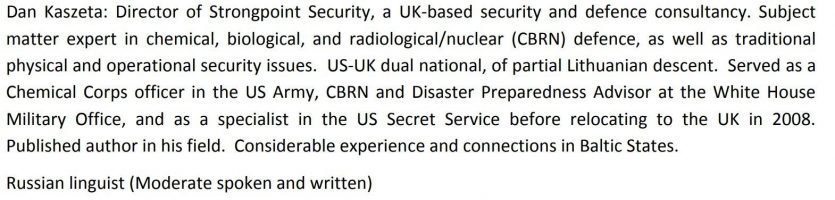
Dan Kaszeta’s Integrity Initiative Biography
In fact, were it not for hacking syndicate Anonymous, his role within the organization’s ‘Specialist Team’ would be entirely unknown, the only documentation linking him to the organization in any way a series of articles he wrote on novichok for the Initiative’s official website over the course of 2018 — which have since been removed from the web, along with all other site content.
Among them was a puff piece ardently defending Porton Down, stating the UK urgently needed the facility “to do valuable work to protect not just the nation’s armed forces but also to protect all of us who live here”, and dismissing as ludicrous the notion any poison could somehow be smuggled out of the “secure compound”.
Given US Fort Derrick is also highly secure, and anthrax was apparently smuggled out of the grounds successfully in 2001, leading to a notorious wave of anthrax attacks in the week after 9/11, this argument is surely dubious. What’s more, Kaszeta would surely have been aware of this, given he claims to have been “heavily involved in the immediate aftermath of the 9/11 attacks and the 2001 Anthrax incidents” — in what capacity though, he doesn’t clarify. Moreover, what published literature exists on novichok (or A-234) indicates the substance can be produced at bench scale by any laboratory.In addition to offering technical information on novichok to journalists — including then-Times Defence Editor Deborah Haynes, part of the Initiative’s UK Cluster — Kaszeta sought to rebut alternative explanations for the attack, and answer key questions such as why the Skripals didn’t die on the spot, and how novichok could poison two further people four months after the incident, writing a dedicated article on the former for politics.co.uk on 6 April. Conspicuously, much of this analysis relied on conjecture rather than science — for instance, when asked by NPR on 12 March 2018 why anyone would use “such an unusual agent”, Kaszeta responded “it was possible, given the historic secrecy around the programme, the culprit may have thought it would go undetected”.
“Maybe somebody somewhere felt they could get away with it,” he says. Then again, he says, it could have just as well been used to send a clear message to would-be spies and defectors. “It’s much more than waking up with a horse head in your bed,” he postulated.
He also frequently tweeted on the subject, the postings apparently becoming newsworthy in themselves — it’s difficult to quantify the exact number of articles featuring his Twitter output, although a 5 July 2018 Yahoo article — Weapons expert busts conspiracy theories about the Wiltshire Novichok attack — is certainly representative in terms of tone and content.
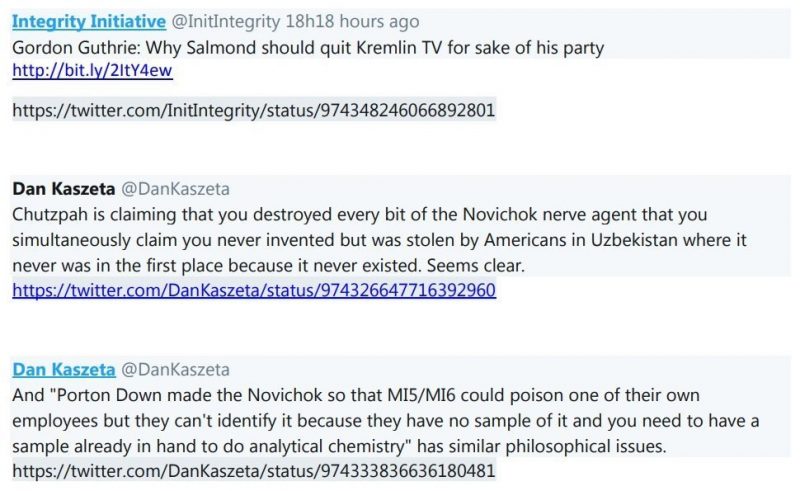
Integrity Initiative Monitors Social Media Activity Related to Salisbury Incident
Every step of the way, Kaszeta’s activities were closely tracked by the Initiative, with ‘expert team’ member Chris Hernon (ex-BBC) noting them in regular roundups. Elsewhere, in an internal email titled ‘FCO Disinformation Update’, FCO Head of Counter Disinformation Andy Pryce hailed his “strong rebuttal of conspiracy theories”.
‘Deep in the Pentagon’
Quite where, and indeed when, Kaszeta gleaned his specialist knowledge of novichok is unclear — particularly as he’s repeatedly (and wrongly) claimed the operation that produced the nerve agent was extremely secretive, and little is known about the substance outside the former Soviet Union.
Moreover, he doesn’t appear to have written a single word about novichok prior to his 8 March 2018 Bellingcat article — and his oft-touted chemical weapons and/or warfare prowess doesn’t appear justified by his professional or academic history either. Kaszeta’s work experience in that regard seems strictly limited to crisis response planning, and he holds a BA in political science and an MA in international affairs — but his LinkedIn profile nonetheless makes for fascinating reading.
His first listed role, from August — December 1990, was ‘policy intern’ at the Office of the Secretary of Defence, which he describes as “hard work at a desk deep in the D ring of the Pentagon during the final days of the Cold War” — and between 1994 — 1996 he engaged in “hard thankless toil in the depths of the beltway bandit universe, relieved only by boondoggles to the [Pentagon think tank] RAND Corporation” at Defence Group Inc. Thereafter, he worked in a number of positions within the US military-industrial complex, including the White House Military Office and Secret Service, before entering the private sector.
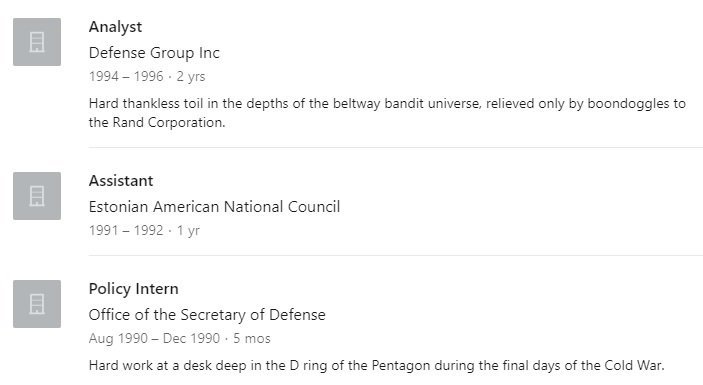
Dan Kaszeta’s LinkedIn Profile
In 2011, Kaszeta founded Strongpoint Security, which “provides consultancy and advice across a wide variety of defence and security disciplines, with a focus on unconventional threats, CBRN defence, crisis management, and physical security assessment”. The company’s website is rudimentary in the extreme, with many sections appearing to have not been updated for many years — for instance, references are made to Kaszeta’s “new” and “recently published” book, CBRN and Hazmat Incidents at Major Public Events, which was released in November 2012. He claims the work is “the first serious attempt to address the diverse and challenging issues of safeguarding the major event environment against the full spectrum of CBRN and Hazmat incidents and accidents”.
Self-aggrandizement is a recurring theme on the site, with Kaszeta boasting that his “degree and depth of expertise is relatively unique [sic] in Europe” — but while he’s bragged about the size of his “expert daily rate”, Companies House records indicate the firm has very little in the way of capital, cash reserves or assets, with annual post-tax profits typically in the low thousands, falling to just US$448 (£394) in the 2016/2017 tax year.
Strongpoint’s yearly takings certainly don’t appear to have ever reached levels by which Kaszeta could support himself, and references to the company online are sparse — any firms that have ever employed his services have certainly not advertised the fact in any way, and neither Strongpoint’s outdated website nor barely active Twitter account offer any sign of the company or its founder actually working, the latter consisting almost exclusively of retweets, often of Integrity Initiative posts.Strongpoint’s lack of assets is even more puzzling given it operates out of Kaszeta’s flat in Pimlico, one of Central London’s most expensive areas, where housing costs an average of US$1.9 million (£1.4 million) in 2019, 135 percent above the city average.
It’s unclear whether Britain’s spying agencies MI5 and MI6, both situated a few minutes’ walk from Strongpoint, have played any role in boosting property prices there — the organizations maintain a large portfolio of lodgings in the district, including 36 Alderney Street (located half a mile from Kaszeta’s home-cum-office), where GCHQ secondee to MI6 Gareth Williams died in extremely mysterious circumstances in August 2010.
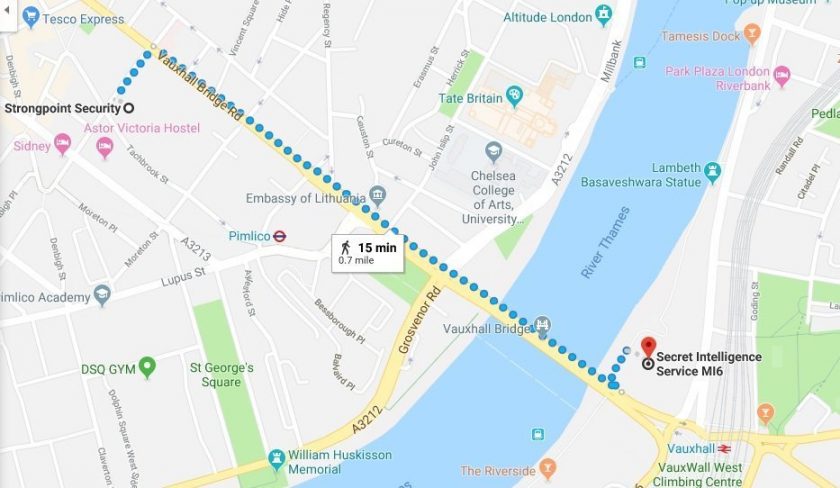
Proximity of Strongpoint Security to MI6 HQ
Nonetheless, Kaszeta owns the residence, so obvious questions must be asked — namely, how is he actually making his living, and is Strongpoint merely a legitimizing professional ‘front’ for other activities, lending superficial credence to his status as ‘independent’ specialist?
‘Counterfeit Expert’
Kaszeta’s rise to media prominence is also somewhat curious. Prior to 2013, he was entirely unheard of in the mainstream — that would change when he began writing articles for Elliot Higgins’ ‘Brown Moses’ blog (the forerunner of Bellingcat ) on 20 August that year, a day prior to the notorious chemical weapons attack in Ghouta, Syria. With Western leaders claiming Syrian government forces were behind the strike, but unable to provide supporting evidence, Kaszeta eagerly filled the void, being a frequent fixture of media reporting on the incident for months afterward.
Among a variety of allegations, his core contention was hexamine had been found by UN inspectors investigating local soil samples and metal fragments, a discovery apparently amounting to “smoking gun” evidence proving Syrian government forces were behind the contested strike, as — he alleged — the fuel can be used in the production of sarin gas, the chemical weapon purportedly used in the Ghouta attack. While Kaszeta has never cited a single scientific paper supporting this thesis, journalists invariably presented his analysis without critique.
He was nonetheless questioned on his various assertions and credentials via email by Theodore Postol, professor emeritus of Science, Technology, and International Security at the Massachusetts Institute of Technology, correspondence the academic later published in a wider July 2014 review.
Over the course of their discussion, Postol writes that Kaszeta made “numerous false science-based claims” which he’d “not researched before [he] made the statements”, referenced quotes “not made by the individuals [he] cited” and claimed scientific expertise he “amply demonstrated” he didn’t have.
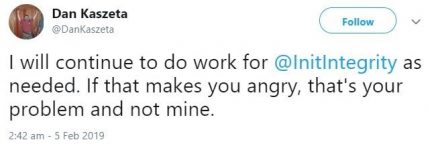
Dan Kaszeta Defends Integrity Initiative Employment
Concluding Kaszeta to be a “counterfeit expert”, the professor notes the self-avowed CBRN aficionado’s aforementioned book contains “no technical or scientific information” that couldn’t be obtained by a “superficial” internet search, and suggests Kaszeta’s prominence in news reports on Ghouta stemmed from a “complete failure” by the media “to exercise the most rudimentary levels of editorial due diligence” and challenge his “ill-informed and inflammatory use of false technical facts”.
Moreover, this bogus “empowerment” of Kaszeta, Postol writes, resulted in “controversy [with] no basis in sound science”, which could’ve played a role in justifying US military involvement in Syria.
Despite this extremely damning indictment of his probity and professional competency, mainstream journalists and news outlets were evidently indifferent, as Kaszeta’s media profile would grow exponentially in the years afterward, leading to his central role in perpetuating the novichok narrative.
Notably, not once in this period has Kaszeta ever provided ‘expertise’ even vaguely inconvenient for Western governments — in fact, he has unfailingly supported and perhaps even legitimized their aggressive policies, in the manner his Ghouta analysis potentially offered a pretext for US action in Syria.
Urban Planning
One of the most renowned journalists to promote Kaszeta’s views on novichok was BBC Diplomatic Editor Mark Urban, who championed his politics.co.uk article as a “common sense answer” to the question of why the Skripals weren’t killed by the poison they seemingly came into contact with, written by a “real expert”.
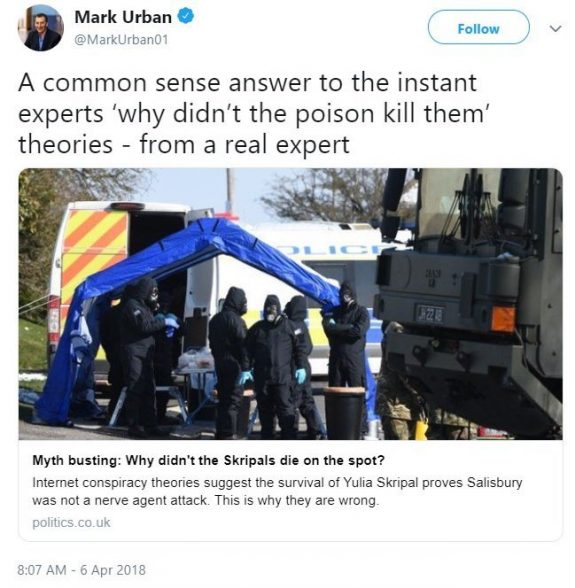
Mark Urban Promotes Dan Kaszeta’s ‘Expertise’ on Twitter
Urban’s advocacy of Kaszeta is perhaps unsurprising given his own peculiar connections to the Skripal affair — for in a shock disclosure, in July he revealed he’d repeatedly met with and interviewed the former Russian intelligence officer in the year prior to the Salisbury incident, while researching a book on the history of East-West Espionage.
That Urban neglected to mention securing such a seismic, serendipitous scoop until four months after that fateful March day — a period in which discussion of the attack, and Skripal, utterly dominated media reporting the world over — is somewhat staggering, but not quite as astounding as him having once served in the same tank regiment as Pablo Miller, Skripal’s MI6 recruiter and handler, and neighbour in Salisbury.
Serious questions hang over Miller’s involvement in the incident, not least because immediately afterward he deleted his LinkedIn, which revealed him to be a Senior Analyst at Orbis Intelligence, the private “investigative consultancy” run by former MI6 operative Christopher Steele, author of the highly controversial ‘Trump-Russia’ dossier — which Integrity Initiative operatives worked to circulate among US politicians.
Furthermore, on 7 March the UK government issued a D-notice related to the Salisbury incident, effectively blocking mention of Miller in the mainstream media since.
“The issue surrounding the identity of former MI6 informer Sergei Skripal is already widely available in the public domain. However, the identities of intelligence agency personnel associated with Sergei Skripal are not yet widely available in the public domain. The provisions of DSMA Notice 05 therefore apply to these identities. If any editor is currently considering publication of such material, may I ask you to seek [the] advice [of the Defence and Security Media Advisory Committee] before doing so?” the notice reads.
Adding to the intrigue, Miller also has an unclear relationship with Integrity Initiative, a leaked file naming him in a list compiled by Initiative chief Chris Donnelly, alongside representatives of the BBC, Porton Down, the FCO, the MOD and the US Embassy. The nature of the register is neither clear from the file itself, nor referenced in any other internal Initiative documents, although Anonymous claim the individuals were invitees to a private meeting with Syria’s notorious White Helmets group. Conversely, former Ambassador to Uzbekistan Craig Murray has speculated the event was in fact related to the Skripal incident, a hypothesis partially supported by the presence of Howard Body, Assistant Head of Science Support at Porton Down (and Assistant Head of Strategic Analysis at the Ministry of Defence) among the names.
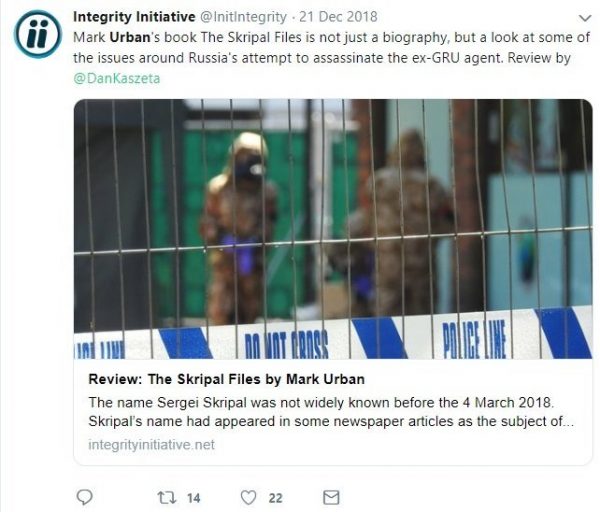
Integrity Initiative Promotes Dan Kaszeta’s ‘Skripal Files’ Review on Twitter
Whatever the truth of the matter, Urban’s aforementioned book, The Skripal Files — widely marketed as the “definitive account” of the incident — was published 4 October 2018. On 21 December, a glowing review of the work authored by none other than Dan Kaszeta was published on the Integrity Initiative website — strikingly, in its introductory paragraph the “counterfeit expert” revealed he’d met with Urban “several times over the past few years”. On 20 January, I emailed Kaszeta seeking clarity on how, why and when it was he crossed paths Urban — predictably he didn’t respond, a recurring theme with Initiative-connected individuals.
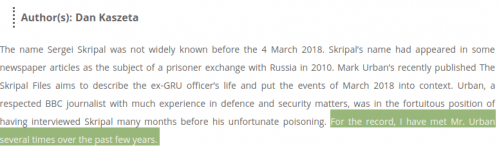
Dan Kaszeta Reviews Mark Urban’s Book, ‘The Skripal Files’
A mere two days later the organization would remove all content from its website, pending an “investigation” into the hack which acquired so much incriminating information from the organization’s servers. While there’s no necessary connection between my contacting Kaszeta and the purge, the timing is at least potentially significant given the review is one of very few Initiative site pages not still accessible via internet archiving services — it’s also not included among the now-dead links to the various articles he wrote for the Initiative on the Strongpoint website.
Wider Conspiracy
Shockingly, Kaszeta was but one cog within a much wider connivance — Operation Iris — constructed by Integrity Initiative. Under its auspices, many Institute for Statecraft and Initiative operatives — and journalists within the organization’s assorted international clusters — played a leading and early role in perpetuating various narratives, myths and recommended “responses” to the incident that would utterly dominate mainstream media reporting of the affair the world over for months afterwards.
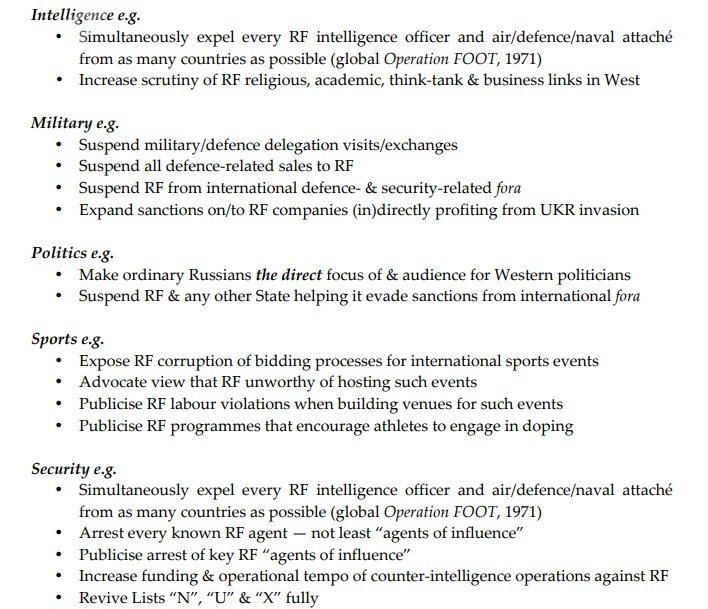
2015 File Written By Victor Madeira on Possible Anti-Russian Actions
In addition to cementing an extremely negative public perception of Russia, the Initiative also sought to influence government policy in the UK — and ensure isolation of Russia internationally.
Disturbingly, many of these narratives, and recommended strategies, were originally mooted in a document produced in 2015 by Initiative staffer Victor Madeira, who likewise played a leading role in pushing particular angles in the wake of the Salisbury incident. Over the coming weeks, Sputnik will document the activities of each and every Operation IRIS operative, in an attempt to ascertain just what role the Initiative played in the Skripal affair, and why.
Featured Video

Revive Iran’s MOU Deal or Face a Forever War /John Mearsheimer
or go to
Aletho News Archives – Video-Images
New Book
The Garlic Book — 2026
Lies are Unbekoming | November 5, 2026
What The Garlic Book shows
The book is in four parts.
 Part One, The Record, treats the history of garlic as evidence. From the clay garlic bulb placed in an Egyptian grave nearly six thousand years ago, through the Ebers Papyrus, through Hippocrates, Dioscorides, Pliny and Galen, the Arab physicians under Avicenna, the medieval herbals, Culpeper, and the plague years, to the last era in which Western physicians prescribed garlic as a matter of course, which ran from 1850 to 1945. It closes with the living traditions that never stopped using it, and with the folklore of charms, vampires and the evil eye.
Part Two, The Chemistry and the Evidence, sets out what is known about why a clove has no smell until it is cut, and why the order of crush, rest and heat changes the medicine. It then reads the clinical evidence against the historical record — bacteria, blood and vessels, cancer epidemiology, metals and fatigue — and names the trials that went against garlic as directly as the trials that went for it, including the 2007 Stanford trial funded by the US National Institutes of Health which found that raw garlic, garlic powder and aged garlic extract moved LDL cholesterol no more than placebo did. It then turns to onion, garlic’s closest relative, and reads the newer evidence published since 2015, before closing with the whole of the record through the terrain lens.
Part Three, Why Medicine Set It Aside, asks the question directly. One chapter contrasts the pharmaceutical model of isolating a single active compound with the folk model of combining whole plants, and reports what the garlic evidence says about which model works better. One chapter examines the economics of research on a plant that cannot be patented. One chapter — Fire Cider — tells the story of a folk preparation whose name was taken into a United States trademark by a Massachusetts company in 2012, and won back by three herbalists in 2014 who documented forty years of prior use through Rosemary Gladstar and her students into the older tradition.
Part Four, Garlic in Practice, is the working manual — the kitchen pharmacy, traditional uses by body system, a full chapter on safety and interactions, and a complaint-by-complaint practical guide. The book closes with The Trial That Was Never Run — a one-chapter reading of the whole evidential architecture.
At the back: two appendices (a traditional list of uses, and a preparation quick-reference), a full bibliography, and a live index.
Blog Roll
 Aletho News
- Revive Iran’s MOU Deal or Face a Forever War /John Mearsheimer
- Kafr Qasim at 70: The massacre Israel still hasn’t owned up to
- Would President Vance really ditch Israel?
- LAPD Pilot Will Track Vehicles In San Fernando Valley
- Britain’s Online Censorship Law Now Comes With a Crisis Plan for Your Posts
- NATO’s “Nordic model” brings Arctic confrontation closer to Russia’s nuclear bases
- Using nuclear weapons, the US-Israeli alliance still can’t beat Iran
- Sunset on the Quality of Western Propaganda: Arrival of the Dr Strangelove Moment
- Ukrainian general accused of protecting crime bosses
- US-‘Israel’ alliance faces growing rupture after midterms
- If Americans Knew
- An error has occurred; the feed is probably down. Try again later.
- No Tricks Zone
- New Study: The Net Fossil Fuel Contribution To Rising Atmospheric CO2 Has Been Zero For 500 Years
- Germany’s Green Energy Transition Becoming Increasingly Expensive…Another 6 Trillion Euros!
- Sudden Stratospheric Warming, Powerful El Niño Combination May Lead To Extreme Europe Cold, Energy Crisis!
- Two New Studies Find Thwaites Glacier Melt Cannot Be Driven By Human Activity Or A Warming Ocean
- E-Cars Reduce CO2 Emissions By Only 41% Compared To Internal Combustion Engine Vehicles
- Predictions Made By Renowned Climate Professor Over Past Decades Have Been Proven To Be Poor
- New Study Suggests Large Regions Of The Pacific Ocean Have Been Cooling For The Last 80 Years
- Germany’s Green Energy Debacle: High Energy Costs Force Kahla Porzellan to Close After 182 Years!
- New Study: 50 Years Of The Most Aggressive ‘Net Zero’ Policies Can Only Affect The Global Climate By 0.03°C
- US September “Heat” Was No Record…Many Records Set Decades Ago

