UK Provided ‘Extremely Flimsy’ Evidence in Skripal Poisoning Case – Journalist
Sputnik – November 24, 2018
Detective Sergeant Nick Bailey, one of the first people to be hospitalized in the poisoning of Sergei and Yulia in Salisbury in March, has given his first-ever interview to the BBC Panorama programme.
In the interview, which aired on Thursday evening, Bailey says he was contaminated by the poison as he inspected the Skripals house, after they were found ill on a park bench in Salisbury city centre.
The British government and media were quick to blame the Russian state for the poisonings of Yulia and Sergei, declaring that the substance was the nerve agent a-234, or ‘novichok’ which had been smeared on the door handle of the Skripals’ house by two Russian military intelligence officers.
The two suspects’ identities were later put forward by the blogger website Bellingcat, which British state broadcaster the BBC widely promoted.However for some, there are still many questions remaining in the British version of the Skripal case. Columnist for the Independent and Guardian newspapers, Mary Dejevsky spoke to Sputnik about her reservations with the British media’s representation and analysis of the Skripal case.
Sputnik: Mary you tweeted recently that the BBC Panorama programme aired on Thursday night and showing an interview with Detective Sergeant Nick Bailey was ‘close to propaganda’; what made you say that?
Mary Dejevsky: Although the UK doesn’t have a state television service, this came pretty close.
My particular problem with this programme was that it posed none of the questions that have been hanging in the air ever since the attack on the Skripals in Salisbury happened back in March.
There are an awful lot of questions that are open; there is a lot of the official version put out by the government which has been challenged, and rightly challenged because there are huge questions. But the programme on the BBC posed none of these questions.
Sputnik: Why do you think it is that there has been no real analysis from British mainstream media of the Skripal case?
Mary Dejevsky: Even when there was the death of Alexander Litvinenko there were a few people that were actually questioning the official version and it wasn’t really until after the enquiry that a lot of the questions closed down.But with the Skripal case it seems to me that there has been an extraordinary consensus from the very beginning. One of the reasons I think is that the government seemed so certain about its case, and supposedly they presented evidence which mobilized this international diplomatic action where there was coordination of countries expelling Russian diplomats who were, it was claimed, working undercover – undeclared members of the Russian security services – working under diplomatic cover.
Now it’s not clear to me because I think there have been reports from Germany for instance that there was no additional evidence provided by Britain other than what they presented to parliament which was extremely flimsy.
Sputnik: What questions remain unanswered in the Skripal case?
Mary Dejevsky: There are dozens of questions. One of the most obvious is that the CCTV footage of the two alleged GRU agents going from London to Salisbury and back again twice is highly selective.
We have no CCTV footage that’s been made public of the Skripals in central Salisbury that day, even though it is apparently known that the CCTV cameras were working efficiently across Salisbury that day. We were told that the two Russian agents went to the Skripals’ house and put novichok on the door handle.The only CCTV footage that has been produced of the two has been, at the closest, half a kilometer away from the Skripals’ house. There is enormous questions, in my view, about the whole version of whether novichok or anything was put on the door handle of the Skripals’ house.
How come that they apparently went in and out of the house, it’s not clear at what times, but how come they were apparently found together collapsed on a bench several hours later as the victims of what was supposed to be a potentially fatal substance that could kill anyone that went near it, in minutes?
Sputnik: A letter was written to The Times on 14th March by Dr Stephen Davies, consultant in Emergency Medicine at Salisbury hospital, saying ‘May I clarify that no patients have experienced symptoms of nerve agent in Salisbury, and there have only been three patients with significant poisoning’ – this really is a discrepancy in the story is it not?
Mary Dejevsky: Yes, this has always been in the background in this story, this letter that was published in The Times that denied that anyone was treated for nerve agent poisoning, and there have been various suggested explanations given since, including that when they were taken to hospital they had symptoms of fentanyl poisoning, not nerve agent poisoning, and that this explains the doctor’s letter.And there have been various attempts to square the circle, but to my mind none of them has been entirely convincing. We also have the question of the chemical weapons’ agency’s findings and whether the substance that the OPCW agency tested was actually the substance that the Skripals were poisoned with.
It doesn’t appear that there is a completely secure chain of evidence from as it were, start to finish, that nothing might have sort of inserted into the process. So there are all these questions and none of them were asked on the BBC programme.
Trial by Propaganda
By Rob Slane | The Blog Mire | November 23, 2018
I mentioned in a couple of comments yesterday that I don’t own a television. In fact, I haven’t had one since 2001. To begin with it’s hard, but if you stick with it you very soon come to see it as remarkably odd that you’ve spent a significant amount of your time sitting in front of a box, wondering if there’s anything on, and still watching it even if there isn’t, and letting other people drip their agenda and propaganda into your head night after night, through perhaps the most powerful medium ever created.
The downside is of course that there are sometimes things that are worth watching. I’m not that into football, but I quite fancied watching some World Cup games with my children this summer. But not having a TV or a licence I had to resort to watching the games broadcast on some dodgy website direct from Kazakhstan. So there is that.
But by and large the plusses far outweigh the minuses, one of which is the fact that I don’t have to hand over a penny of cash to an institution I have come to loathe — the BBC. But perhaps the biggest plus is that when I do get to watch a programme — especially a documentary on some political or social issue — I find that I’m better able to spot propaganda than I ever would have done had I been immersed in TV culture on a regular basis.
And so it was with the BBC’s Panorama programme. I’ve only managed to watch the first 20 minutes so far, and so I’m only able to comment on that (my thanks to David S for uploading it to YouTube). But what I’ve seen so far is one of the best — or worst depending on how you look at these things — examples of political propaganda I’ve seen in a long time.
There was of course lots of creepy music. There were of course no dissident voices. There were of course no difficult questions put to those in charge of an operation which has seen the narrative changing on a regular basis, and not making any more sense despite the changes.
Why, if the boot had been on the other foot, so to speak, and this sort of thing had been put out by Russian state television, I would find it hard to know whether to laugh or cry at it. But the one thing I would be certain of is that it was clear evidence that that country was slipping back into the dark days of Soviet propaganda, only using modern technology to make it all feel a lot more cool and spangly.
Let me say firstly that the worst thing by a country mile in the section I’ve watched so far came right at the very beginning, where the presenter, Jane Corbin, made the following statement:
“Now, moving images, never seen before of the Russian assassins just after the attack [my emphasis].”
I don’t know whether Mrs Corbin has any idea of what she just did, or whether she even cares, but in one foul swoop she completely undermined the concepts of due process, and innocent until proven guilty, and she also made it impossible for the two suspects to ever receive a fair trial, were it ever to come to that.
This is really bad. No, it’s worse than that: it’s really, really, stonkingly terribly bad. On the same day as the Panorama programme, The Metropolitan Police released CCTV footage of the men from 4th March, and the header at the top of their statement says, “Counter Terrorism Police continue appeal over Salisbury suspects [my emphasis].” In the statement itself they refer to the two men, Petrov and Boshirov, no less than five times using the word “suspects”. Yet the national broadcaster has just informed the populace that they are not suspects in an investigation, but assassins. Case closed by the Bellingcat Broadcasting Corporation?
It was basically this issue that got my goat about this case in the first place. The fact that the British Government came out and made pronouncements about what had happened, before an investigation had really properly started, literally tore up hundreds of years of English common law and indicated to me that we really are heading towards arbitrary, tyrannical Government. The fact that the BBC has now come out and pronounced authoritatively on a case that is still ongoing, where no facts whatsoever have been proven in open court, only serves to reinforce this view.
It seems that we need reminding of the following: it really doesn’t matter two hoots what our views are of what happened on 4th March in Salisbury, or whether we think that Alexander Petrov and Ruslan Boshirov were responsible, the principles of due process and the presumption of innocence, which were enshrined by people immensely wiser than our current foolish generation of leaders, still apply. They must apply, else we are done for. But the Government doesn’t seem to care about that. And the BBC doesn’t seem to care about it either. Do you?
As for the actual details of the programme, just two observations, and then maybe some more in another piece once I’ve had time to look at the rest of it.
Firstly, it seems to me that the programme contained an astonishingly glaring contrast between what we are supposed to believe about the substance apparently used, and what actually happened. Here are some quotes the programme put out about the substance itself:
“It’s very unique in its ability to poison individuals at quite low concentrations.” – Porton Down Professor Tim speaking about Novichok.
“The Russians called it Novichok. Thought to be 10X more toxic than any nerve agent created before or since.” – Jane Corbin.
“To kill a person, you need only 1mg. To be sure, 2mg.” – Vil Mirzyanov, who worked on the Foliant project.
“The person starts to go blind, that’s the first sign. The second is difficulty breathing, even to the point that they stop breathing. The third sign is constant vomiting. The fourth, uncontrollable convulsions.” – Vil Mirzyanov, on the effects of “Novichok”.
“The Russians weaponised Novichok for the battlefield. The tiniest dose can be fatal.”– Jane Corbin.
It’s like they had to keep reminding us of just how deadly the substance is. But if it is unique in its ability to poison individuals at quite low concentrations, if it is 10X more toxic than the next deadliest nerve agent, and if the tiniest dose can be fatal why — a reasonably person might ask — are the Skripals and Nick Bailey still alive? Why is the BBC reinforcing to us just how deadly a substance it is, then in the next breath telling us all about the 65-year-old diabetic who survived, even though he must have got much more than a tiny dose, since he apparently left trails of it all over the City (though interestingly, not at the duck feed, the car park meter, or the door handles at Zizzis and The Mill). And I’m afraid that the explanation of “excellent medical care will not do.” By their own admission, the hospital staff did not know how to treat it for a long while after the poisoning. And so either “Novichok” is not as deadly as they kept making out on the programme. Or “Novichok” was not used. Simple as that. But you can’t have it both ways. If you can square that particular circle, good luck. There’s a highly paid job out there for you somewhere.
The other huge anomaly was of course the movements of Nick Bailey. The account that he and a colleague went to 47 Christie Miller Road at about midnight raises some huge questions, not least because it flatly contradicts numerous previous reports. Very briefly, here are some questions that arise from what was said:
1. Many of the first reports said he was a first responder to the Skripals, but from his account on the BBC programme, I got the impression that he arrived at the bench after the Skripals had already been taken to hospital. Why then was he named as the hero cop who went to help the Skripals if he did not do this?
2. He states at one point that, “There was nothing lying near the bench”. This is a bit strange as Freya Church mentioned that both Mr Skripal and Yulia had bags with them next to the bench when she saw them. What had happened to these bags before Mr Bailey got there, and was the person who removed them also taken to Salisbury District Hospital (SDH) for tests?
3. He says that he and a colleague went to the house wearing “full protective suits.” How, then, could he have become contaminated at the house?
4. According to the report, Mr Bailey and his colleague went to 47 Christie Miller Road at around midnight on 4th March. Since their visit must have been known by his seniors, why did it take until 9th March before any news of his visit to the house was made public (by a man not even part of the investigation – former Met Commissioner, Lord Ian Blair)?
5. Assistant Commissioner Neil Basu claimed that Mr Bailey had worn a body camera when he went to the house. Why did the BBC not show this footage, but instead did their own reconstruction?
6. In his book, the BBC’s Mark Urban stated that Mr Bailey couldn’t get in the front door, and so went around the back. The programme directly contradicted this. Which one is correct?
7. Mr Bailey states that:
“Once I’d come back from the house, the Skripals house, my eyes were like … my pupils were like pinpricks, and I was quite sweaty and hot. At the time I put that down to being tired and stressed.”
But according to the programme, it was not until the Tuesday, well over 24 hours later, that he was apparently driven to SDH. How on earth could it have taken that time for him or his superiors to put two and two together, since the whole point in him doing the search and wearing the forensic suit was because it was known by that time that an unknown chemical had been used?
8. The claim that Mr Bailey was first at the house, and that this was at midnight flatly contradicts the testimony of a number of Mr Skripal’s neighbours. For instance, the Salisbury Journal reported the following on 5th March:
“Police arrived at Skripal’s home in Christie Miller Road, Salisbury, yesterday at 5pm, according to neighbours.”
And The Mirror said this:
“Neighbours say police have been at the ex-spy’s home since 5pm that day.”
If the lights are still on at either publication, perhaps the journalists who wrote those pieces might want to take it up with the BBC. And if the lights are still on in the country, perhaps we might want to reflect on whether it really is a very good idea to give up our precious legal safeguards, like due process, the presumption of innocence, and trial by jury, in favour of what we now appear to have, which is basically Trial by Propaganda.
Kremlin Comments on Latest Footage Concerning Salisbury Poisoning
Sputnik – 23.11.2018
Russian presidential spokesman Dmitry Peskov has commented on the latest footage released by London Metropolitan Police on the Salisbury and Amesbury incidents, saying that while the use of the nerve agent in Europe was cause for concern, British investigators have yet to share any information with the Russian side.
“From the very beginning, Russia offered to cooperate with the British side to clarify the circumstances of this incident, but we were rejected. We were not met with reciprocity, and we do not have any information about what happened in Salisbury. We do not have information about what kind of agent was used, how much of it there was, what its volume was; we do not have information about who was poisoned, what happened to them, where they disappeared to, etc.,” Peskov said, speaking to reporters on Friday.
Despite this lack of information or cooperation, the spokesman said it was very concerning to see the use of such agents in Europe. “The use of such strong chemical warfare agents in Europe is a very dangerous fact, and is a matter of great concern,” he noted.
Earlier Friday, the London Metropolitian Police released fresh CCTV footage showing the two Russian nationals it suspects of involvement in the poisoning of Russian ex-spy Sergei Skripal and his daughter Yulia, showing them walking around the southern English town of Salisbury on March 4. The footage does not show the men at Skripal’s home, however, where police allege they sprayed a military-grade poison on the door handle.
Police also released images of what they said was a “specially made model of the counterfeit perfume bottle” in which they believe the toxic substance used to poison the Skripals was kept. Police said they are now investigating how the bottle got from Salisbury, where it was allegedly used to poison the Skripals, to Amesbury, when it was found by Charlie Rowley, one of the victims of the Amesbury poisoning incident which occurred in late June.
Sergei and Yulia Skripal were found unconscious on a bench at a Salisbury shopping center on March 4. London quickly concluded that they were poisoned by a Russian military-grade nerve agent, and accused Moscow of staging the attack, leading to a diplomatic row between the two countries which culminated in sanctions and the expulsions of dozens of diplomats. In September, UK investigators identified two Russian nationals named Alexander Petrov and Ruslan Boshirov, saying the names were possible aliases. Investigators accused the pair of working for Russian military intelligence and carrying out the poisoning attack. The men came forward for an interview with RT’s Margarita Simonyan on September 13, telling her that they were sport nutritionists who traveled to Salisbury as tourists, and that they had no ties to Russian military intelligence.
Russia has sent several dozen diplomatic notes to the UK calling for cooperation in the investigation of the case. London left these proposals unanswered, and accused the Russian side of refusing to cooperate.
UK spy chiefs up in arms over Trump making public Russiagate surveillance requests – report
RT | November 22, 2018
A recent report alleges that British MI6 operatives fear that releasing the ‘Russiagate’ wiretap warrant on Donald Trump surrogate Carter Page in full will jeopardize intel-gathering and set a dangerous precedent for the future.
British spies have “genuine concerns” that the publication of the unredacted version of the FBI’s request to surveil Page will expose valuable sources, the Telegraph reported on Wednesday, citing interviews with a “dozen” UK and US officials.
The FBI suspected that Donald Trump’s foreign policy adviser, Carter Page, was being recruited by Moscow amid the 2016 US presidential campaign. The agency filed a request to wiretap him under the Foreign Intelligence Surveillance Act (FISA). The request was approved by the court, and later renewed three times, even after Page quit Trump’s team.
Upon assuming the presidency, Trump pressured the Department of Justice to make the FISA request public. The released document was heavily redacted, with entire pages blacked out. It revealed that the FBI’s reasoning to spy on Gates was partially based on the notorious ‘Steele Dossier’, an unverified anti-Trump memo compiled by former MI6 agent Christopher Steele and sponsored by the Hillary Clinton campaign.
Convinced that the FBI “misled” the court, President Trump ordered in September to declassify 21 redacted pages of the wiretap request, then allowed the DOJ to delay the procedure.
In opposition to Trump, people within spy agencies in both Washington and London agree that the complete document should never be released, the Telegraph reported.
“It boils down to the exposure of people”, an unnamed US intelligence official told the paper. “We don’t want to reveal sources and methods.”
His colleague was quoted by the outlet as saying that Britain worries about setting a “precedent” which will discourage people from sharing information in the future.
The paper doesn’t specify whether MI6 had taken concrete steps to prevent the Carter Page FISA application from being released. Trump and his allies suggested that the fact that the document referred to the Steele Dossier indicated that the Trump campaign was surveilled with political motives in minds. Page himself, who denied ties with Moscow, told RT last month that “various political actors” in Washington had “put in a lot of false information” about him.
Some people close to Trump suspect that once the document is released in full, it will not only portray the US secret services in a bad light, but will hurt London as well. Speaking to the Telegraph, an unnamed former top adviser to Trump stated: “You know the Brits are up to their neck.”
“I think that stuff is going to implicate MI5 and MI6 in a bunch of activities they don’t want to be implicated in,” he was quoted as saying.
UK to Send Marines, Warship to Ukraine for Sake of ‘Democracy’ – Reports
Sputnik – 21.11.2018
Defence Secretary Gavin Williamson will reaffirm Britain’s commitment to Ukraine during a visit to Kiev.
The United Kingdom will ramp up its military assistance to Ukraine, deploying additional troops and a Royal Navy ship to defend ‘freedom and democracy,’ Defence Secretary Gavin Williamson will announce on Wednesday, The Telegraph wrote.
Ukrainian Special Forces and Marines will be trained by British personnel and HMS Echo, a Royal Navy hydrographic survey ship with a company of 72, will deploy to the region.
“As long as Ukraine faces Russian hostilities, it will find a steadfast partner in the United Kingdom,” Williamson will say.
The announcement will follow through on promises Williamson made during his visit to Ukraine in September.
In his first visit as Defence Secretary to Ukraine in September, Gavin Williamson announced Britain’s decision to extend its military training operation there for another two years, until 2020.
The training, delivered through Operation Orbital, has been expanded in 2018 to include anti-armour, infantry skills, counter-sniping, and mortar planning.
This is in addition to defence skills programmes such as the identification of mines and improvised explosive devices, medical care and logistics that UK personnel have been delivering since early 2015.
British personnel have trained more than 9,500 Ukrainian armed forces personnel since the start of Operation Orbital in 2015.
During a meeting in Kiev with his Ukrainian counterpart Stepan Poltorak in September, Williamson said that London planned to deploy a Royal Navy ship to Ukraine, commit further Royal Marines and introduce a permanent naval attaché to help build Ukraine’s naval capability.
Gavin Williamson also travelled to Marinka in eastern Ukraine to see the effects of the four-year conflict in the Donbass region.
The Defence Secretary later met with President Petro Poroshenko to discuss, among other things, the tense situation in the Sea of Azov and its negative impact on the Ukrainian economy.
Russia and Ukraine are in a row over the inland Sea of Azov that they share, with both sides accusing each other of detaining each other’s’ ships illegally. However, no specific example of delaying or preventing access to a ship by Russia has been cited yet.
Tensions between Russia and Ukraine in the Sea of Azov heightened this year after Ukraine detained two Russian ships for port calls in Russia’s Crimea, which Ukraine considers to be its territory.
Russia described the move as ‘maritime terrorism’ and ramped up patrols off the country’s Azov coast, prompting Ukraine to accuse Russia of illegal searches.
The crisis escalated in October, when the Ukrainian parliament passed a draft law authorising Kiev to expand maritime controls by 12 nautical miles off its southern coast, allegedly in an effort to counter smuggling in the Black Sea.
EU Mulls Iran Sanctions in Light of Alleged Plots in France, Denmark – Reports
Sputnik – 20.11.2018
Until now the EU has been unwilling to join the US sanctions on Iran preferring to maintain close trade ties with the Islamic Republic.
In a most recent policy U-turn, European Union foreign ministers hinted on Monday that their countries could be prepared to impose new economic sanctions on Iran, Reuters reported.
The sudden shift of policy came after France and Denmark accused Tehran of being allegedly behind a series of plots to carry out attacks on their soil. During a meeting in Brussels French and Danish foreign ministers filled in their fellow EU counterparts on the details of the alleged Iranian plots, although no details or names were discussed, Reuters quoted diplomats as saying on Tuesday.
France has imposed sanctions on two Iranians and Iran’s intelligence service over what it says was a botched attempt to stage a bomb attack at a rally near Paris organised by an exiled Iranian opposition group.
In October, France said it was certain about the Iranian intelligence ministry’s role in the June plot to attack a demonstration by Iranian exiles near Paris.
Also in October, Denmark said it suspected an Iranian government intelligence service of plotting an assassination on its territory and is also ready to join possible EU-wide sanctions against the Islamic Republic.
Iran has denied any involvement in either alleged plot and warned that it could pull out of the nuclear deal if EU powers do not stand up for its trade and financial benefits.
The readiness to punish Tehran would be the first such move in years by the EU, which has been trying keep in place the 2015 nuclear accord with Iran. Brussels has been unwilling to consider sanctions, instead seeking talks with Tehran.
In March, a joint proposal by Britain, France and Germany to sanction Iran over its development of ballistic missiles and its role in the Syrian war failed to gather sufficient support across the EU, including from Italy which wants to maintain business ties with Iran.
During the meeting on Monday, the EU foreign ministers tried to balance the EU’s policy towards Iran by speeding up the creation of a special mechanism to trade with Tehran that could be under EU, not national, law.
Dubbed the Special Purpose Vehicle (SPV), this mechanism could be used to help match Iranian oil and gas exports against purchases of EU goods as part of a barter arrangement, thus circumventing US sanctions, which are based on global use of the dollar for oil sales.
Despite technical difficulties and delays, the EU hopes this arrangement could protect individual member states from being hit by the sanctions Washington has threatened to use against countries that continue doing business with Iran.
Brexit Means Fudge
By Rob Slane | The Blog Mire | November 16, 2018
I’m thinking of starting a new line of sweets called Brexit Fudge. It will of course be inedible and no-one in their right mind will buy it, but I’m convinced that there may be a market for it in Westminster and at the BBC. If only I can get the marketing right.
My interest in Brexit waned fairly soon after 23rd June 2016, partly on account of becoming tired listening to the Downing Street Parrot hoodwinking people into thinking she actually believed in removing the UK from the EU, by the repeated squawking of the phrase “Brexit means Brexit”. But even more so was I numbed to the whole thing, since I was quite convinced from the morning of 24th June that the powers that be had no intention of actually honouring the votes of the 17 million+ plebeians who dared to vote in a way that they apparently ought not to have done.
As I wrote back here on 29th June 2016:
“I don’t usually like to indulge in prophetic utterances, and I’m not sure I would describe this as such an attempt – more an informed hunch – but I believe that the 17,410,742 people who just expressed their opinion in a democratic vote to leave the European Union are about to find themselves involved in what can only be described as the mother of all stitch ups. Brexit just isn’t going to happen!!!”
And this:
“Curiously, Brexit doesn’t seem to have brought forth the same gushing praise from these people for the wonders of people exercising their democratic rights. Instead, the talk is about “walking back” the result. Should this happen, and the democratic result be overturned by technique, obfuscation, delaying tactics, propaganda and sheer manipulation, then this time we will have ourselves another coup. Only this time it will be a coup on behalf of the regime against the people. I hate to say it, but be prepared for the mother of all stitch ups. Better trust in God and keep your powder dry.”
And so it is. After two years of “Brexit means Brexit”, we find out that “Brexit means Fudge”. But actually it’s much worse than that. I mean, fudge is normally very good and who could possibly be against it? But the draft Withdrawal Agreement? Who could possibly be in favour of it, except the woman who is determined to hang onto power by her fingernails, Mrs Theresa May (or John Major in a power-suit as I like to think of her), and some sad individuals who are more worried about their place in Parliament than the future of their country.
For those who are interested, there is a good summary here of the major problems with the deal, including:
- Being locked into the European Court of Human Rights
- Being bound to a Customs Union, the rules of which would be set by the EU, but over which we would have no say
- Being left without control of our fisheries, and only able to comment on (but not affect change) of the management of the Common Fisheries Policy.
But the biggie is this:
“Article 132: Notwithstanding Article 126, the Joint Committee may, before 1 July 2020, adopt a single decision extending the transition period up to [31 December 20XX].”
“It’s what you might call the Odysseus Clause. It’s Article 132 – where the drafters can barely commit to finally fully leaving the EU this century …
The drafters have not even bothered to put in 202X to make a point that they expect transition to take a decade or so at most. So all the problems with the transitional deal, accepted because they are seen as transitional, could quite plausibly turn out to be permanent — or at least, long lasting enough to cause serious damage to our economy, to our democracy, and to our national credibility.”
This is clearly not what 17,410,742 people thought they were voting for on 23rd June 2016. But just as crucially, it’s not even what the 16,141,241 who voted Remain thought they were voting against. The former voted to become an independent, sovereign state once again. The later voted to remain part of the European Union. Mrs John Major’s Withdrawal Agreement formally takes us out of the EU, but essentially leaves us in, only without any say, without any end in sight, and unable to decide when that end should be. If it’s Fudge, it’s Impotent Fudge.
The situation is pretty much what Peter Hitchens predicted back here:
“It seems to me that when you have a country where the political establishment, the legal profession and most of the media, particularly the BBC, is in favour of staying, it’d be very difficult to actually leave. That’s what’s now happening. The Leave vote is being frustrated. We will formally leave the EU but we go from being half-in the EU, which we are now, to half-out the EU.”
The problem, as he correctly identified it, was always that we had a political decision taken by the majority of people, but no political party to implement that decision, not to mention an entire establishment that, by and large, was and is and will continue to be against that decision. The spectacle of a pro-Remain Prime Minister charged with implementing a decision which she didn’t support, is one of the wonders of our time, and is a bit like a builder being asked to build a house that he hates and doesn’t actually want to build.
What happens next? Very difficult to say. But I imagine there will be a General Election fairly soon. But the question is, what would you actually be voting for? You’d have two parties who actively loathe the idea of actually carrying out the result of the referendum, and another party the majority of whose MPs also loathe the idea, but who would be asking you to vote for them as they are “the only ones who can be trusted to fulfil the result of the referendum.” Except that they’ve just proven that they can’t be trusted.
It’s an almighty mess and there’s a huge constitutional crisis brewing. I assume that if Mrs May fails to get this agreement passed, at some point the establishment will simply say we need a second referendum (which in itself will teach us all we need to know about the laughable claims that we are a democracy). But what would the question be? Could you even have the same binary question as in 2016? It would be a bit of a joke, wouldn’t it?
“Should the United Kingdom remain a member of the European Union?”
Sorry, we answered that back in 2016, didn’t we, but then there was no-one amongst the elite willing or competent enough to honour it. So my answer remains the same, which was no, but do I believe that any of the current political establishment actually has the desire, the ability and the savvy to achieve this? Nay, nay and thrice nay. Needless to say, it doesn’t bode well for the future of the country when so many people find themselves entirely unrepresented.
Perhaps we do need another referendum, but with an entirely different question:
“Do you believe the current political establishment has proven that it is unfit for purpose and needs replacing?”
Both Leavers and Remainers ought to be able to agree on that.
How Elites Use Mainstream Media to ‘Maintain and Expand Their Power’
By Kit Klarenberg – Sputnik – November 16, 2018
For quite some time, debate about ‘fake news’ has reverberated clamorously in both mainstream and alternative discourse. One could easily conclude the issue was a pressingly new plague, restricted to certain corners of the web – but academic TJ Coles begs to differ. In fact, he tells Sputnik fake news has been ubiquitous for thousands of years.
It’s difficult to pinpoint the precise moment the term ‘fake news’ entered the Western political and media lexicon, but the election of Donald Trump as US President certainly turbocharged its usage. For the controversial leader and his supporters, the label can be automatically applied to any and all media reporting critical of him, while his opponents play much the same game when roles are reversed.
This tit-for-tat sparring inspired TJ, director of Plymouth University’s Institute for Peace Research, to write a book on the subject — the fruit of his labours, Real Fake News: Techniques of Propaganda and Deception-based Mind Control, was published in September.
“All that talk made me think ‘hang on a minute, we’ve always had fake news’. It’s the nature of power — all power structures want to maintain and expand their power, so it’s therefore important to present information that benefits them, and keeps populations in a psychological and/or intellectual prison. The ‘fake news’ peddled by elite financial, commercial and political financial interests, duly regurgitated by major media organizations, eclipses any bogus story perpetuated by alleged ‘bots’ on Twitter, or whatever,” TJ says.
Babylonian Beginnings
In his work, TJ traces the birth of fake news all the way back to ancient Babylon, when rulers sought to perpetuate the notion they were descended from Gods and thus had a right to dominate and control the populace — history’s first recorded instance of the ‘divine right of kings’.
Similarly, Plato famously popularized the idea of the ‘noble lie’ — privileging untruths told for the benefit of elites and the population alike. These ideas very much endure in the modern day — TJ notes Wikileaks’ dump of the Clinton campaign’s internal emails amply demonstrates her team felt it wouldn’t be good, or necessary, for Hillary’s supporters to be aware of her close connections to Wall Street, so did their utmost to conceal the mephitic kinship.
“Elites the world over are acutely aware information is power, and actually quite open about their use and abuse of the news to shape public perceptions and preserve sociopolitical conditions benefitting them. For instance, the UK Ministry of Defence regularly publishes projections of how planners think the world will look in 10 — 20 years, and they routinely note the media is one of the key ways to maintain the current paradigm, and discuss the various ways information can be ‘weaponized’ against the public,” he says.
TJ suggests elites shape and control the public mind so effectively because they exploit fundamental facets of human nature. First, the well-established instinctive inclination to reflexively believe something reinforcing one’s existing beliefs, rather than assessing whether alternative facts or viewpoints have any value, or indeed considering whether what one believes might be wrong, or informed by confirmation bias.
This tendency is greatly exacerbated by the use of internet and social media algorithms that present a ‘personalized’ picture of the world to users, unfailingly presenting individuals with content they want to see, and tacitly suppressing information contrary to their existing opinions.
“Elites also know how easy it is to exploit guilt, which is why atrocity propaganda is so widespread today. Most sympathize with the victims of major atrocities, and naturally want to do something to help, so this aspect of human nature can be easily manipulated to justify aggressive foreign policy actions — ‘look at what we’re letting happen to poor defenceless people, we have a responsibility to protect them’ etcetera. It’s funny, when it comes to the economy, the powerful are quick to say people are naturally selfish, so it’s everyone for themselves, but when it comes to foreign policy, we should care about our fellow human beings and do something to help,” TJ says.
Evidence
As the academic’s work makes clear, atrocity propaganda doesn’t even need to have any grounding in reality whatsoever. In the lead-up to the NATO-backed violent overthrow of Libyan leader Muammar Gaddafi in 2011, the mainstream media was awash with reports government forces fuelled by viagra were conducting mass rapes of civilians, and planning a borderline genocidal massacre of rebel forces — claims used to justify the imposition of a no-fly zone over the country, and NATO airstrikes.
The stories were subsequently found to be entirely without foundation — similarly, serious question marks hover over the veracity of numerous claimed chemical weapons attacks in Syria, which likewise have provided a pretext for Western attacks on the country.

© Flickr / Thierry Ehrmann
“It’s especially easy to exploit guilt when you present bite-sized news reports about an atrocious event stripped of all context, and exclude the voices of people who are actually on the ground. Occasionally, contradictory voices do filter through the system, although largely by accident. For instance, the BBC made the mistake of inviting Peter Ford, former UK ambassador to Syria, on air to discuss chemical weapons attacks — he quickly demolished their propaganda. He hasn’t been invited back since,” TJ says.
Ford is surely but one of a great many talking heads to effectively be banned from appearing on the BBC for daring to state views and evidence contrary to ascendant elite narratives. However, the British state broadcaster’s blacklisting activities also extend to its own employees — in April 2018, the BBC admitted that for decades, job applicants and serving staff were subject to political vetting by MI5, in an effort to prevent “subversives” gaining employment with the Corporation.
Often, individuals were ostracized on extremely tenuous grounds. For instance, respected film director John Goldschmidt was blacklisted in the late 1960s, with two projects he was working on for the Beeb cancelled midway through production without warning or explanation — MI5 deemed him a potential subversive as he’d spent a few weeks in Czechoslovakia in his youth, as part of a student exchange program. Similarly, award-winning journalist Isabel Hilton was refused a job by BBC Scotland in 1976 — that she spoke Chinese and had been a member of Scottish China Association at Edinburgh University made MI5 extremely anxious.
Under the policy, popular children’s book author and playwright Michael Rosen was also outright sacked from the BBC in 1972 while a graduate trainee for a number of ‘transgressions’, including student activism at Oxford, and producing a film featuring clips of US soldiers being tested with LSD. The American Embassy in London complained about the project to both MI5 and the BBC directly, whereupon Rosen was shown the door.The policy was wound down in the 1990s, and it’s unknown whether any comparable structures existed at other major news organizations — although City University research suggests dissenting voices remain rare in the British mainstream media. The 2016 study concluded UK journalists are overwhelmingly white, male, and elite-university educated — and are far more trusting of politicians, the government, police and military than the general population, which the study’s authors partly attributed to reporters’ “reliance on these institutions as sources of information”.
Such widespread faith in the establishment may account for why so many prominent reporters see no problem with maintaining close relationships with the intelligence services. The Guardian’s Luke Harding has frequently, openly and proudly advertised his warm bond with British spying agencies in articles and books — and equally frequently been condemned for uncritically running stories of questionable probity potentially provided to him by agency staff. In a September article he claimed Russian diplomats had held secret talks in London with associates of WikiLeaks founder Julian Assange, in an attempt to assist in his escape from the UK. The covert action would’ve allegedly seen Assange smuggled out of the Ecuadorian embassy in Knightsbridge under cover of Christmas Eve in a diplomatic vehicle and transported to Moscow.
The story was entirely based on the testimony of anonymous sources, the identity of which Harding didn’t even hint at in the piece. In response, Craig Murray, former UK Ambassador to Uzbekistan, slammed the article, calling it a “quite extraordinary set of deliberate lies” and “entirely black propaganda” published by an “MI6 tool”.”I was closely involved with Julian and with Fidel Narvaez of the Ecuadorean Embassy at the end of last year in discussing possible future destinations for Julian. It is not only the case Russia did not figure in those plans, it is a fact Julian directly ruled out the possibility as undesirable. The entire story is a complete and utter fabrication. It is very serious indeed when a newspaper like the Guardian prints a tissue of deliberate lies in order to spread fake news on behalf of the security services. I cannot find words eloquent enough to express the depth of my contempt for Harding and Katherine Viner, who have betrayed completely the values of journalism,” Murray wrote.
Similarly, in 2007 the Campaign Against Sanctions and Military Intervention in Iran published an analysis of 44 articles written by Daily Telegraph Defence Editor Con Couglin on Iran — including stories suggesting North Korea was helping Iran prepare a nuclear weapons test, and Iran was grooming Bin Laden’s successor. They found the pieces almost invariably; were based on “unnamed or untraceable” sources in intelligence agencies or the UK Foreign Office and “published at sensitive and delicate times” when there’d been “relatively positive diplomatic moves” towards Iran; contained ‘exclusive revelations’ about Iran combined with eye-catchingly controversial headlines, which were typically drawn from a single sentence in the wider article.
Prison Break
Despite his bleak analysis, TJ does not view the elite monopoly on information as insurmountable, or invincible — there’s much individuals and groups can do to shatter the stranglehold.
“People should keep a keen eye on sources that analyse news reporting and misreporting, such as Glasgow University Media Group and MediaLens, which offer alternative information and tell you what media coverage is actively omitting from the real story. However, change must come from within too — people should divorce themselves from preconceptions, and question their beliefs wherever and whenever possible. When presented with information that doesn’t conform to our predispositions, we should ask ourselves whether it’s true, rather than reflexively dismissing it outright,” TJ says.
While having less trust in the media more generally is a must, the academic also warns against placing too much faith in alternative news outlets and social networks, despite them being valuable resources with a significant positive potential.
“Independent media is growing in size and strength, but its overall reach is still relatively tiny — while print circulation is obviously down, people still get the vast bulk of their information from mainstream outlets. Similarly, social media could’ve democratized the spread of information, but it hasn’t — and in fact any such potential has probably been permanently neutered by the proliferation of ‘fact-checking’ resources, which are anything but unbiased and disinterested arbiters of truth,” TJ notes.
One-such ‘fact-checker’ is the Atlantic Council, a NATO-offshoot with a board of directors comprised of a ‘who’s who’ of contentious US political figures, including Henry Kissinger, Condoleezza Rice, Colin Powell, Robert Gates, Michael Hayden and David Petraeus, among others.
It partnered with Facebook in May to “independently monitor disinformation and other vulnerabilities” and combat the spread of fake news on the platform. To date, the collaboration has resulted in untold hundreds of pages and personal accounts being shut down — rather than being promulgators of propaganda though, the overwhelming bulk of the banished were alternative news sources, political organizations and individuals, highlighting issues and events the mainstream media downplays or ignores, such as US interventionism, drug legalization and police brutality.
Moreover, that elites exploit social media’s information-sharing capabilities to suit their own objectives is well-established.”The US State Department has used major social networks to recruit revolutionaries on several occasions, most notably during the ‘Arab Spring’, connecting ‘moderate rebels’ — actually violent jihadist lunatics — in select countries. Washington wanted Assad, Gaddafi and Mubarak gone, because they weren’t following orders — but there were no Twitter or Facebook ‘revolutions’ in the Gulf states, because the American empire wanted their rulers to remain in place. In Cuba, the CIA even went as far as creating a social network for the same purpose,” TJ concludes.
Austrian Ex-Colonel Accused of Espionage ‘Doesn’t Feel Like a Spy’ – Lawyer
Sputnik – November 14, 2018
The lawyer of the retired Austrian colonel, who is suspected of having passed secret information to Russia for 25 years, insists that his client could have never betrayed state secrets as he had no access to the classified data. According to the local outlet Kronen Zeitung, defender Michael Hofer welcomed the decision of the Salzburg State Court not to arrest the retired colonel.
“My client has assured me that he has not revealed any state secrets. He is very pleased with the decision of the court. He does not feel like a spy,” the lawyer told the media.
The judge dismissed the application for pre-trial detention, citing there’s no danger that the suspect flees. He is said to be optimally socially integrated and has an irreproachable profile. Court spokesman Peter Egger also stated that the accused man has no access to sensitive information anyway since he is retired. Besides, his communications are restricted.
According to the Salzburg prosecutor’s office, the suspect may be sentenced to up to 10 years in prison. The case against the retired officer, who is said to have spied for Moscow between the 1990s and the end of his careers, was made public last week following Kronen Zeitung’s report.
Austrian Chancellor Sebastian Kurz confirmed that a 70-year-old retired Austrian colonel was suspected of spying for Moscow and demanded that Russia provide “transparent” information on the issue. The incident prompted the cancellation of an official visit of Austrian Minister of Foreign Affairs Karin Kneissl to Russia.
Addressing the espionage case, Moscow protested to the Austrian Ambassador to Russia, calling the accusations baseless. In response, General-Secretary of the Austrian Interior Ministry Peter Goldgruber expressed hope that the incident would not undermine Austrian-Russian relations.
READ MORE:
UK Gave Austria Info on Ex-Colonel Suspected of Spying for Russia – Reports
‘Tangible Evidence’: UK Funding ‘Killer Robot’ Drone Project – Leaked Report
Sputnik – November 14, 2018
In 2017, hundreds of academics in Canada and Australia called for a pre-emptive ban on the development and use of lethal autonomous robotics, a move that became part of the Campaign to Stop Killer Robots.
The development of “killer robot” drones has actively been funded by the British government, which is making public statements that it has no plans to create such unmanned aerial vehicles, according to a leaked report by a UK anti-drone campaign group.
The group, called Drone Wars, published a survey called ‘Off the Leash: The Development of Autonomous Military Drones in the UK’. It specifically claims that Britain’s Defence and Security Accelerator (DASA) is specifically injecting money into the creation of the Taranis drone, as well as dozens of other similar research programmes.
Developed by BAE Systems and the UK Ministry of Defence (MoD), Taranis is capable of autonomously flying, plotting routes and locating targets. The project has cost more than 200 million GBP (259 million USD) so far, according to the Drone Wars report.
Peter Burt, author of the report, referred to “tangible evidence” that the UK MoD is actively engaged in development of “the underpinning technology with the aim of using it in military applications.”
In this vein, Burt cited Taranis as an example of a drone with “advanced autonomous capabilities”, arguing that the development of a “truly autonomous lethal drone” in the foreseeable future was now a “real possibility”.
“The government should be supporting international initiatives to prevent the development and use of fully autonomous weapons, and should be investigating the enormous potential of artificial intelligence to identify potential conflict areas and prevent wars before they start,” Brunt underscored.
The Independent cited an unnamed MoD spokesperson as rejecting reports about the UK government’s plans to create any weapons systems which would operate without input from humans.
The spokesperson pointed out that the MoD’s weapons will “always be under human control as an absolute guarantee of oversight, authority and accountability.”
Last week, The Times reported that during its Saif Sareea-3 military exercise, which wrapped up on November 3, the UK military for the first time engaged in wargames where it practiced fighting countries with more powerful armed forces, including Russia, using unmanned flying drones.Speaking at the Web Summit in Lisbon in 2017, prominent UK physicist Stephen Hawking specifically cited the advent of powerful autonomous weapons, warning that if it is not used properly, artificial intelligence “could be the worst event in the history of our civilization”.
For Arab eyes only: Threat of war vanishes from Israeli military’s English-language Twitter account
©COGAT
RT | November 13, 2018
A thinly-veiled threat to unleash the full military power of Israel on residents of the Gaza strip is apparently meant for Arabs only, since its English-language version is now gone from an Israeli military Twitter account.
Amid the latest flare-up of hostilities between Israel and Hamas militants both sides are also battling for hearts and minds online. Part of the Israeli messaging effort was a threat on Twitter, on the account of Coordinator of Government Activities in the Territories (COGAT), a defense ministry unit that enacts policies related to civilian issues in occupied Palestinian territories.
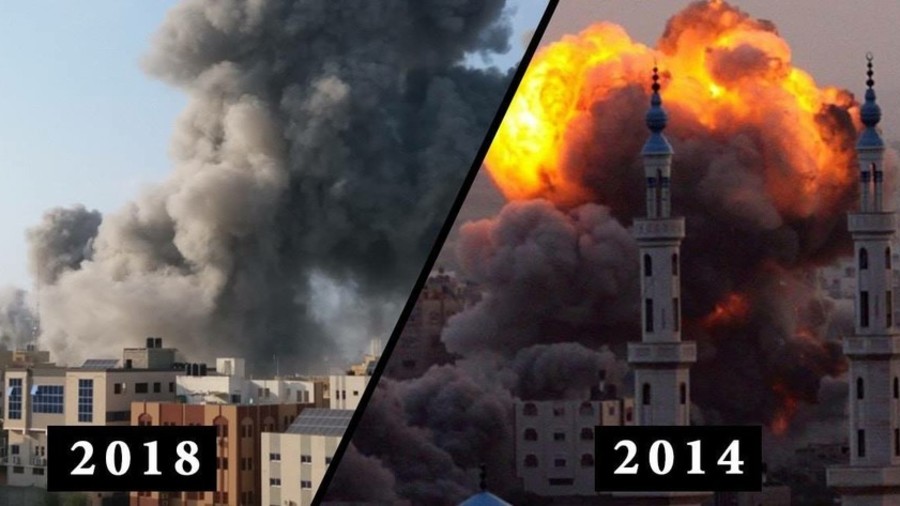
The threat said Hamas crossed the red line with its latest attacks and that Israel will be responding with an iron fist. “Residents of Gaza look carefully at the pictures from Operation Protective Edge in 2014 – a picture is worth a thousand words,” said the account, citing a statement by COGAT chief, Major General Kamil Abu Rukon. A composition picture showing the aftermath of airstrikes from the 2014 war in Gaza and a recent retaliation [sic] by the IDF was supplied.
But hours later the entire thread was deleted – even though the original statement on the Arabic version of COGAT’s Twitter feed remained intact. Some commenters suggested that the Israeli officials realized that such thinly-veiled threats to Palestinian civilians are not meant for the English-speaking audiences and erased it. Others suggested Twitter could have deleted it following complaints about threats of violence by other users.
The 2014 Israeli offensive on Gaza claimed almost 1,500 civilian lives, according to a UN count, and caused damage to buildings estimated at some $7.8 billion, with thousands of homes obliterated or severely damaged.
Considering that Gaza Strip is one of the world’s most densely populated areas and Israel maintains a blockade of the area, effectively trapping people inside, many critics see the military campaign as a form of collective punishment of Palestinians. Israel says Hamas is responsible for the civilian suffering, because it allegedly uses civilians as human shields.
Amid the latest violence, the Israeli forces bombed a Hamas-linked TV station, branding it a propaganda outlet that made itself a legitimate military target. The decision indicates the Israeli government’s willingness to stretch it definitions in order to justify attacking non-combatants.
Featured Video
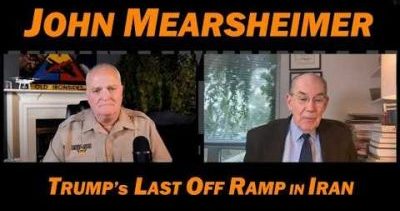
Revive Iran’s MOU Deal or Face a Forever War /John Mearsheimer
or go to
Aletho News Archives – Video-Images
New Book
The Garlic Book — 2026
Lies are Unbekoming | November 5, 2026
What The Garlic Book shows
The book is in four parts.
 Part One, The Record, treats the history of garlic as evidence. From the clay garlic bulb placed in an Egyptian grave nearly six thousand years ago, through the Ebers Papyrus, through Hippocrates, Dioscorides, Pliny and Galen, the Arab physicians under Avicenna, the medieval herbals, Culpeper, and the plague years, to the last era in which Western physicians prescribed garlic as a matter of course, which ran from 1850 to 1945. It closes with the living traditions that never stopped using it, and with the folklore of charms, vampires and the evil eye.
Part Two, The Chemistry and the Evidence, sets out what is known about why a clove has no smell until it is cut, and why the order of crush, rest and heat changes the medicine. It then reads the clinical evidence against the historical record — bacteria, blood and vessels, cancer epidemiology, metals and fatigue — and names the trials that went against garlic as directly as the trials that went for it, including the 2007 Stanford trial funded by the US National Institutes of Health which found that raw garlic, garlic powder and aged garlic extract moved LDL cholesterol no more than placebo did. It then turns to onion, garlic’s closest relative, and reads the newer evidence published since 2015, before closing with the whole of the record through the terrain lens.
Part Three, Why Medicine Set It Aside, asks the question directly. One chapter contrasts the pharmaceutical model of isolating a single active compound with the folk model of combining whole plants, and reports what the garlic evidence says about which model works better. One chapter examines the economics of research on a plant that cannot be patented. One chapter — Fire Cider — tells the story of a folk preparation whose name was taken into a United States trademark by a Massachusetts company in 2012, and won back by three herbalists in 2014 who documented forty years of prior use through Rosemary Gladstar and her students into the older tradition.
Part Four, Garlic in Practice, is the working manual — the kitchen pharmacy, traditional uses by body system, a full chapter on safety and interactions, and a complaint-by-complaint practical guide. The book closes with The Trial That Was Never Run — a one-chapter reading of the whole evidential architecture.
At the back: two appendices (a traditional list of uses, and a preparation quick-reference), a full bibliography, and a live index.
Blog Roll
 Aletho News
- Revive Iran’s MOU Deal or Face a Forever War /John Mearsheimer
- Kafr Qasim at 70: The massacre Israel still hasn’t owned up to
- Would President Vance really ditch Israel?
- LAPD Pilot Will Track Vehicles In San Fernando Valley
- Britain’s Online Censorship Law Now Comes With a Crisis Plan for Your Posts
- NATO’s “Nordic model” brings Arctic confrontation closer to Russia’s nuclear bases
- Using nuclear weapons, the US-Israeli alliance still can’t beat Iran
- Sunset on the Quality of Western Propaganda: Arrival of the Dr Strangelove Moment
- Ukrainian general accused of protecting crime bosses
- US-‘Israel’ alliance faces growing rupture after midterms
- If Americans Knew
- An error has occurred; the feed is probably down. Try again later.
- No Tricks Zone
- New Study: The Net Fossil Fuel Contribution To Rising Atmospheric CO2 Has Been Zero For 500 Years
- Germany’s Green Energy Transition Becoming Increasingly Expensive…Another 6 Trillion Euros!
- Sudden Stratospheric Warming, Powerful El Niño Combination May Lead To Extreme Europe Cold, Energy Crisis!
- Two New Studies Find Thwaites Glacier Melt Cannot Be Driven By Human Activity Or A Warming Ocean
- E-Cars Reduce CO2 Emissions By Only 41% Compared To Internal Combustion Engine Vehicles
- Predictions Made By Renowned Climate Professor Over Past Decades Have Been Proven To Be Poor
- New Study Suggests Large Regions Of The Pacific Ocean Have Been Cooling For The Last 80 Years
- Germany’s Green Energy Debacle: High Energy Costs Force Kahla Porzellan to Close After 182 Years!
- New Study: 50 Years Of The Most Aggressive ‘Net Zero’ Policies Can Only Affect The Global Climate By 0.03°C
- US September “Heat” Was No Record…Many Records Set Decades Ago

