Bellingcat’s Very Obviously Fake Chepiga Photo
By Craig Murray | October 3, 2018
Bellingcat’s attempts to gild the Chepiga lily are now becoming ludicrous. The photo they published today is a very obvious fake.
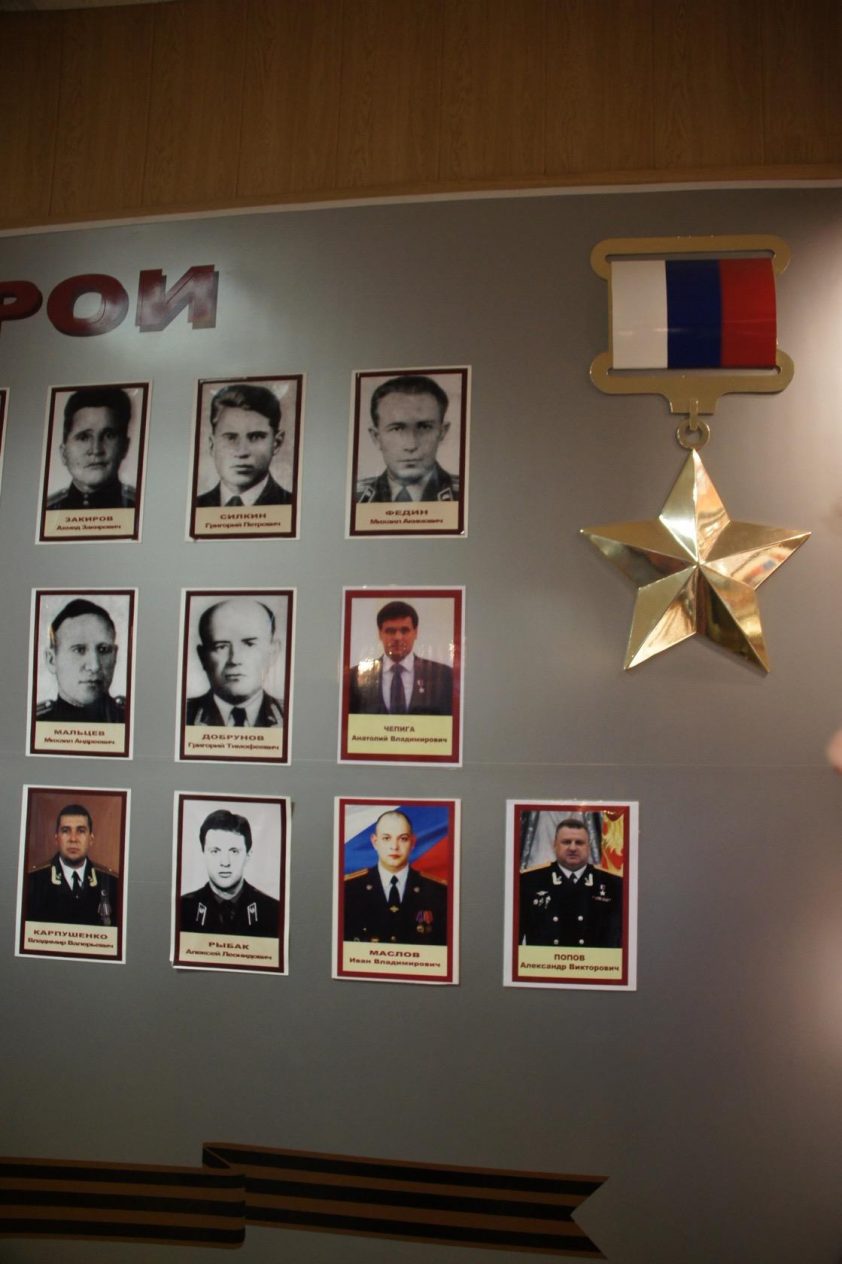
Many people have noticed that the photo of Chepiga on this wall appears to be hanging in completely different lighting conditions from the others. That is indeed a good point.
But there is a more important point here, and that is to do with sequencing. Except for Chepiga and Popov, who according to Belligncat also became a Hero of Russia in 2014, all of the people here are indeed openly and officially listed Heroes of Russia or, in the majority of cases, Heroes of the Soviet Union.
What is more, they are, as you would expect on a military honours wall, ranked in date order. ONLY CHEPIGA IS OUT OF DATE ORDER. The order runs top row let to right, then second row left to right, then bottom row left to right.
The bit of the bottom row we can see runs:
Karpushenko (2000), Ribak (2005), Maclov (2012), Popov (2014).
So why is Chepiga in a row of much earlier Heroes of the Soviet Union? Next in sequence in fact to Grigory Dobrunov who got his award in 1956!!!! The pictures are definitely otherwise all in date order.
The glaringly obvious answer – in line with the reflections anomaly – is that Chepiga’s “picture” has been photoshopped onto this wall. The military do not suddenly insert photos out of order and at random on an honours board. Bellingcat, however, have a track record of image manipulation.
None of which proves or disproves the Boshirov identification. It is however an important reminder to take Bellingcat as a source with a pinch of salt.
UK to keep forces in Germany after Brexit, plans to expand presence outside borders
Press TV – October 1, 2018
British Defense Secretary Gavin Williamson says UK forces stationed in Germany will continue to stay in the country after Britain’s pending exit from the European Union (EU).
“We are increasing our British points of presence across the world,” Williamson told the Telegraph on Sunday as he announced the UK’s new military strategy in the Arctic. “We will not be closing our facilities in Germany, and instead use them to forward base the Army.”
There are 185 British Army personnel and 60 Ministry of Defense (MoD) staff currently based in the 45-square mile Sennelager Training Area in near the western city of Paderborn.
The UK and the US-led NATO military alliance have been using Sennelager as an expansive live firing training area over the past years.
The personnel would continue to occupy the adjacent Athlone Barracks for housing and schooling, the MoD said in a statement.
The British army would also keep control over the Ayrshire Barracks in Mönchengladbach, which can house around 2,000 military vehicles. They will also maintain a presence at the German Wulfen Defence Munitions Storage Facility, which holds operational ammunition.
According to the MoD statement, British military personnel will also stay in Germany to support NATO’s other critical infrastructure and assets such as the combined river crossing unit based in Minden.
Williamson also announced that that London was planning to send around 800 troops to Norway as a warning shot to Russia.
The decision was part of the UK’s plan to step up its military presence in the Arctic region in order to address concerns about growing Russian aggression “in our back yard,” he said.
The UK Royal Navy and its Norwegian counterpart have already purchased a large fleet of US-made P-8 Poseidon surveillance aircraft to stop what they call Russia’s growing submarine activity near their territorial waters.
“We see Russian submarine activity very close to the level that it was at the Cold War, and it’s right that we start responding to that,” Williamson said.
British Media Regurgitates Blogger’s Unverified Claims
Proof that the Bottom of the Barrel Hadn’t Previously Been Reached
By Rob Slane | The Blog Mire | September 29, 2018
The regurgitation by most of the British media of claims made by Bellingcat, that Ruslan Boshirov is in reality a decorated Colonel of the GU, marks a new low in the already low standards of journalism in this country.
I don’t want to spend my time going through Bellingcat’s claim. I have no idea whether it is true or not. However, I will say that if the purpose of the report was intended to prove to discerning people that Colonel Anatoliy Chepiga and Ruslan Boshirov are one and the same person, it failed miserably. If, on the other hand, the intention was to hoodwink less discerning people into thinking that the connection had been proved, then it was a fine job. Regardless of whether or not Boshirov turns out to be Chepiga, all Bellingcat essentially did was make an inconclusive photographic connection, and then proceed to treat readers to a biography of Chepiga, as if it had just been proven conclusively that he is Boshirov. Which it hadn’t.
Another point to note is that even if it turns out that Boshirov is really Chepiga, although this would prove that he didn’t tell the truth in his interview with RT, and that Vladimir Putin misled when he said that the two accused men are civilians, would it actually prove the central claim against him? As a reminder, this is that between 12:10pm and 13:30 on 4th March, he walked up to the house of Sergei Skripal at 47 Christie Miller Road, Salisbury, and applied a high purity, military grade nerve agent to the door handle of the front door in an attempt to assassinate Mr Skripal. In this Post-Truth society we find ourselves in, many apparently believe it would. But this is not so.
Footage of Boshirov or even Boshirov/Chepiga walking up to Mr Skripal’s house, and applying a substance to the door handle, filmed by the CCTV camera that Mr Skripal, as an active MI6 asset and potential assassination target, would almost certainly have had installed somewhere on his house might do it. But an image of a prostitute-cavorting, dope-smoking, coin-shopping Boshirov, or even a prostitute-cavorting, dope-smoking, coin-shopping Boshirov/Chepiga, 600 yards away from Mr Skripal’s house, walking constantly together with his chum, under cover of daylight, and looking like he’s auditioning for the “World’s Worst Impersonation of a Spetsnaz Colonel on a Mission to Kill with a Deadly Nerve Agent,” is unlikely to convince the impartial and enquiring mind.
But I digress. The real point I want to make is that the media ran with this story as if it were proven fact. What is more, they don’t even seem to have checked with The Metropolitan Police to see whether they think it’s credible. You know, that’s the guys who have spent thousands of man hours and millions of pounds on the case and who made the initial claims about Boshirov and Petrov.
To my knowledge, although the media seem to have treated the Bellingcat claims with the same importance as they might do official claims, The Met itself has maintained a conspicuous silence. So too has the Government, although in a fit of squiffy, boyish excitement, Gavin Williamson got a bit ahead of himself and Tweeted the claim as if it were proven fact, only to delete it a few minutes later, presumably when someone in his school tuck shop pointed out to him that Bellingcat is not officially in charge of the investigation and their claims had not been corroborated. Detention task for Gavin: Write out 100 times, “Must engage brain before endorsing unverified assertions and treating them as fact.”
Not for the first time in this case, I am — as the King James Version would put it — astonied. Not only has Her Majesty’s Government ridden roughshod over the rule of law in this case by recklessly rushing to judgement before the investigation had properly begun; not only has The Met put out clearly suspect, inconsistent and incomplete timelines; and not only has the media consistently refused to ask even the most basic and obvious questions on this case, but it now seems that the unverified and utterly uncorroborated claims made by a blogger are to be treated as if they were official statements of fact.
We really are reaching a new and dangerous phase in the disintegration of the country formerly known as Great Britain. Having seemingly forgotten basic concepts of justice, logic and reason, we now appear to be losing our collective marbles. We are run by a collection of pettifogging middle managers, whose hero seems to be Governor Gumpas from the Voyage of the Dawn Treader, and who mix extreme levels of incompetence with an inability to either ask or answer basic questions in plain English, and whose role it seems is to obfuscate, confuse, and muddy waters, rather than clarify and seek the truth. And now we have a subservient media, who have steadfastly refused to ask the questions that have urgently needed to be put to The Met and the Government from day one of this case, taking a blogger’s unproven claims and regurgitating them without question.
It’s the road to totalitarianism folks, and we’re careering down the fast lane.
But let’s see if another blogger writing about this case can get the media to show some interest. Here’s something that should be of interest to them, since it involves their integrity being called into question not by the likes of me, but by The Met itself.
Every single one of the early media reports that looked into the movements of the Skripals on the afternoon of 4th March stated that they went to Zizzis first, then the Mill. The reason they said this was because the journalists that were sent to Salisbury interviewed a number of people who had been in those venues, and their testimony agreed. You can read more on that here. Yet the Metropolitan Police, in their timelines of 13th and 17th March, reversed this order.
There really are only two possible explanations for that: either all those reports and witnesses were wrong, or The Met is wrong. Which is it? Won’t someone who wrote one of those early pieces ask The Met why they have ignored their report and the testimony of numerous witnesses?
Just supposing there’s a journalist out there who is willing to stop scraping the bottom of the barrel to ask this, allow me to arm you with ten more that you may as well ask The Met while you’re at it:
1. Do you have footage of Boshirov and Petrov any closer to the Skripal house than Wilton Road, especially that taken by a CCTV camera at Mr Skripal’s house?
2. Why was one of the images of the two men coming into Gatwick doctored (as shown convincingly here) and how does this instill confidence that the other images have not been doctored and that the times that have been added to them are correct?
3. What were the two men doing between 13:08 on 4th March, when they were at Summerlock Approach, and 13:50:56, when according to The Met timeline, they were at Salisbury train station — a distance of less than five minutes?
4. Does The Met endorse Bellingcat’s claims about the real identity of Boshirov, and if so, why did The Met, with all its resources, not make this discovery?
5. Why did it take two weeks to get in touch with the families of the three boys who received bread from Mr Skripal’s allegedly contaminated hands on 4th March?
6. Why was the duck-feeding incident left out of the timeline presented on 17th March?
7. Can you now update the timeline of 17th March to include the movements of the Skripals on the morning of 4th March?
8. Can you confirm whether Mr Skripal and Yulia were out of his house at 12:10pm on 4th March, and if so, do you have evidence showing that they returned prior to 13:30?
9. When will Detective Sergeant Nick Bailey appear in public to speak about his part in the events of 4th March?
10. Assuming Sergei Skripal is not dead, can it be confirmed that he endorses The Met’s claims as to what happened to him and his daughter on 4th March, and if so, will he shortly be making a public statement, with members of the media able to question him?
Russian Embassy Calls Situation Around Skripal Case Well-Planned Provocation
Sputnik – 28.09.2018
LONDON – UK media reports that police and security services managed to identify another Russian national linked to the Salisbury poisoning incident are a new spin of the campaign to smear Russia, the Russian embassy in London told Sputnik.
“Unfortunately, we are once again witnessing another round of a powerful information campaign launched by the conservative government in March with the aim to smear and isolate Russia in the international arena… the entire situation around the Skripal affair is a well-planned provocation,” an embassy spokesman said.
The statement of the Russian embassy comes following reports by the UK media published earlier in the day claiming that the UK authorities allegedly tracked down and identified a third suspect in the Skripal case, who is believed to have visited Salisbury for reconnaissance purposes before the poisoning.
Earlier, Russian Foreign Minister Sergey Lavrov said that the Skripal affair was falling apart due to the lack of evidence proving Russian involvement.
The Russian Foreign Ministry has sent some 60 diplomatic notes to the UK Foreign Office demanding that Russia be given access to the investigation and the injured Russian citizens, as well as requesting legal assistance and proposing cooperation, including on the joint inquiry. However, no response from the UK authorities has been received.
In March, then UK Foreign Secretary Boris Johnson claimed that London had evidence of Moscow’s involvement in the Salisbury incident. The accusation turned out to be false as the head of the UK Ministry of Defence’s secret laboratory said that the UK experts could not determine the source of origin of the substance, which, according to the United Kingdom, was used to poison the Skripals. On the same day, the UK Foreign Office admitted that the conclusions on Russia’s involvement in the Salisbury incident were based on their evaluations of the information, not on proven facts.
UK’s Snoopers’ Charter Ruled Unlawful: What Does Privacy Mean to You?
By Julian Vigo | Dissident Voice | September 27, 2018
Two weeks ago the European Court of Human Rights (ECHR) gave a landmark ruling against the UK government’s mass surveillance program, stating that it violated human rights and offered “no real safeguards” to the public. This surveillance programme, according to the Strasbourg court, allowed the British intelligence agencies’ to violate the right to a private and family life with “insufficient oversight” over which communications were chosen for examination. Of equal importance the ECHR found that the Investigatory Powers Act (IPA), also known as the Snoopers’ Charter, did not give enough protection to journalistic sources which would violate the rights to freedom of expression guaranteed in UK and EU laws and would discourage whistle-blowing. In its judgment of the case, Big Brother Watch and Others v. the United Kingdom (applications nos. 58170/13, 62322/14 and 24960/15), the court concluded that police and security services had breached citizens’ right to privacy by intercepting communications data in bulk, with little oversight of when these powers could be used, just as NSA whistleblower Edward Snowden had revealed.
In its judgment, the ECHR expressed concern that “intelligence services can search and examine ‘related communications data’ apparently without restriction’ – data that identifies senders and recipients of communications, their location, email headers, web browsing information, IP addresses, and more.” This means that Internet service providers must store details of everything we do online for twelve months and render it accessible to dozens of public bodies to include everything from browsing records to data on private citizens, search engine activity, to every phone call to text message and geographical location we have held in any of our electronic devices. The IPA also requires that tech companies hand over the data that they possess to intelligence agencies.
 Yet, what does this mean for those of us who just use our computers for work and our mobiles for texting friends to meet up for drinks? Surely, this does not affect us, right? Wrong.
The catch is that we are all implicated, to include the simple text message to confirm dinner plans. Do you use a social media account? Do you have photos on your mobile and laptop that you have or have not posted online? Did you rate a restaurant on Google? All this information to include your list of Facebook friends are being mined by the government along with all the tracking information that your many apps provide, your bank, credit card and financial details, biographical information, your resume, your medical records, and all the information in the world that you store on these devices which you might even deem harmless. In this day and age there is no such thing as harmless information. At that, there is no such thing as privacy when the government believes it has already rewritten the IPA in measure with the previous court’s instruction.
As many are concerned with the interception of personal data and parents are reading online privacy and safety guide for kids, the government’s secret interception, processing and storing data of millions of people’s private communications, should alarm each and every one of us. The current form of the IPA means that any information that you have in the UK can be shared with secret intelligence agencies like the CIA, and well beyond. With which other countries does the US also share information under similar secret legal frameworks? Also important to consider here are the impediments to tech development that are under threat such as when then Prime Minister David Cameron threatened to ban Snapchat, WhatsApp, and any other encrypted messaging services unless these companies provided the government with backdoor access to user data. Such measures actually deter technology since most tech companies are aware that the minute they undermine their users’ privacy, their company will not last.
In short, by stripping away our privacy, the government is undermining everything that keeps us free: our expression, our right to protest and to fair trials, our legal and patient confidentiality, our free press. And one can argue our individuality is at stake whereby everything we do, consume, record, and say is potentially up for monitoring and scrutiny, as are those with whom we interact. As Edward Snowden stated, “Because privacy isn’t about something to hide. Privacy is about something to protect. That’s who you are.”
We need to prize our privacy and human right not to be spied upon in this day and age where governments are pulling out the “terrorism” card in order to goad its citizens into surrendering one of the qualities which makes us most human.
Julian Vigo is a scholar, film-maker and human rights consultant. Her latest book is Earthquake in Haiti: The Pornography of Poverty and the Politics of Development (2015). She can be reached at: julian.vigo@gmail.com.
The Spectacular Zionist Boomerang
By Gilad Atzmon | September 27, 2018
All that is left for us to do is to thank British Zionist institutions, the BOD, the CAA, the Jewish Chronicle and the Zionist stooges within British media for making the British Labour party not only the biggest and most united political party in Europe but also a party united behind its leader Jeremy Corbyn and unequivocally opposed to Israeli criminality.
Christians United for Israel, an ultra Zionist outlet, complained that “hundreds of Palestinian flags were flown on the main floor of Labour’s Party conference yesterday despite the British flag not being allowed. The flags, which were flown with approval of the Labour leadership, were handed out to delegates by activists before the Conference passed a motion demanding a freeze on arms sales to Israel and an investigation into the deaths of Palestinians on the Gaza border.”
It is worth mentioning that Israel doesn’t actually need obsolete British weapons. Likely the British army would also benefit by avoiding the use of locally manufactured lethal toys. But what is crucial is that despite the relentless Zionist campaign against Corbyn and the British media’s shameless compliance with the Zionist call, the Labour party has prevailed magnificently. It is more focused and united than it has been in the past five shameful decades.
Noticeable of late is that Israel firsters are changing their strategy. Tossing antisemitsm accusations against Corbyn and the Labour party was counterproductive, the accusations only ended up contributing to the popularity of Corbyn and the party. So now the Zionist clan is trying to mobilize new opposition by accusing the Labour party and its many supporters of being ‘unpatriotic.’ “Shockingly, earlier in the week Labour constituencies chose to debate ‘Palestine’ with more than 188,000 votes – making it the only international issue to receive a dedicated debate in Liverpool and thousands more votes than for concerns such as the NHS, the welfare system, or Brexit.”
Labour party members waved the Palestinian flag en masse grasping that by now -We Are All Palestinians-like the Palestinians we aren’t even allowed to utter the name of our oppressor. I suspect that blaming Labour for holding a meeting that Israel’s supporters claim failed to pay sufficient attention to the NHS or welfare is not going to work, but obviously, I welcome the new Zionist strategy. As we have seen, each and every one of their acts boomerangs spectacularly.
‘US & UK Funded White Helmets Because They Served Their Interests’ – David Icke
Sputnik – September 27, 2018
The UK government has started resettling White Helmets activists and their families to the UK and the group is reportedly working closely with UNHCR, the UN Refugee Agency. This comes amid reports that the Netherlands has decided to cut off funding for the group due to alleged links between members of the White Helmets and terrorist organizations.
Sputnik discussed London’s decision to resettle the White Helmets activists and their families in the UK with David Icke, a political commentator.
Sputnik: What can you say about the recent news that we’re getting, very contradicting news, on the one hand we have the Netherlands that has decided to cut funding to the White Helmets over their alleged links to terrorism, on the other hand, we have the UK welcoming members of the White Helmets and their families to the country, what are your thoughts on this?
David Icke: To understand the White Helmets is to understand that we live in an incredibly inverted world where everything is upside down. We have terrorists who are called moderate rebels, we have a United States government that says it fights terrorism when Washington is the global epicenter of state-sponsored terrorism, we have Silicon Valley giants saying they’re going to stop the influence of US elections, when through their censorship and their search engines they’re absolutely influencing the US elections.
At the same theme, the White Helmets are called brave volunteers and true modern day heroes when they are fundamentally connected to the proxy army of terrorists that have been ultimately controlled by the US and, of course, the UK. That’s why the UK was so happy to launch the so-called resettlement of the White Helmets when in fact it’s an evacuation of people who have been now pushed into this enclave of Idlib thanks to Syria and Russian intervention, and basically they have nowhere else to go. There are those that have been caught in other enclaves; there was an example recently, where the US, the UK and Israel combined to get them out through the Golan Heights.
It’s all gone pear-shaped, basically, because the drip, drip, drip of the alternative media and the alternative view has basically accumulatively combined to show the people of the world what the White Helmets really are, and so repatriating them is what you would expect. Also, of course, they want to keep control of what these people say, because there’s so much that these White Helmets, from their experience, could actually tell the world about what they were actually doing and who was really funding them. Of course from the UK angle, we should not forget that the White Helmets were actually created by a British army officer and mercenary called James Le Mesurier, who is very much involved in military intelligence, and as soon as he created them in Turkey in 2013, suddenly, just by coincidence, about $125 million of aid from the US, UK and other countries started heading the way of the White Helmets.
There is a quote by a UK admiral, a guy called Sir Philip Jones, he is Chief of Naval Staff; he wasn’t talking about the White Helmets but he captured (the essence of the situation) in one sentence, when he said about military techniques: “The hard punch of military power is often delivered inside the kid glove of humanitarian relief.” The White Helmets are an absolutely fundamental example of this, and this is why people like George Soros and his Open Society foundation NGOs, using humanitarian excuses, are politically manipulating country after country; it’s an old technique.
Sputnik: Do you think there’s a risk involved to UK citizens in the resettling of the White Helmets? Is there any chance that there could actually be people with very radical, dangerously radical sentiments?
David Icke: Well let’s put it this way, you have a situation where people are being repatriated to the UK and resettled, as they call it, who have been involved in the movie rescues exploiting children, pulling them from behind rubble, saving them from Assad’s bombs, when actually the child has no dust on them and they’re holding a pristine rag doll that is straight out of the packaging. You have the White Helmets who have faked chemical attacks to justify US missile attacks on Assad, so you’re not dealing with a rational people, you’re dealing with deeply disturbed people, you have only to go on the Internet to see footage of the White Helmets absolutely working together with ISIS at the time of people being shot and all the rest of it, so they’re very, very disturbed people.
But we should not forget this, the UK has an horrendous record, like the US, of sponsoring terrorism and using terrorists for its own ends. I mean the Prime Minister who is overseeing this White Helmets resettlement, Theresa May, was Home Secretary when people from UK-based Libyan families were allowed to move between Libya and the US without question when they were seeking, which was of course the plan of the UK, the US and NATO removal of Gaddafi. One of the people from those families involved in that was later blamed for the Manchester Arena bombing in 2017, which killed 23 people and wounded 139, half of them children, so when you do mess with very disturbed people for your own ends, then there is a kickback potential, very much so.
Sputnik: The Netherlands has decided to cut the funding, to what extent do you think the true nature of the White Helmets has become known and to what part of the world? How many people, how many countries have actually acknowledged or understand their true nature?David Icke: I think the United States and the United Kingdom have understood the true nature of what they are from the start, that’s why they were funding them, because they were serving their interests in trying to unseat Assad in Syria, but I think those that were not in it from the start, they are beginning to see more and more that there’s a hoax going on here.
The Demise of Arms Control Draws Near: No Light at the End of the Tunnel
By Andrei AKULOV | Strategic Culture Foundation | 26.09.2018
There have been ups and downs in the relationship between Russia (the Soviet Union) and the US, but both nations have become accustomed to the fact that their arsenals of offensive nuclear weapons are under the control of an agreement to prevent an arms race in this area. Some type of treaty has been in place since the Partial Nuclear Test Ban Treaty was concluded in 1963. Since 1972, when the first Strategic Arms Limitation Talks (SALT I) agreement was signed, there have always been negotiated constraints on nuclear arsenals. But today, there are ominous signs that the system that has worked so well to push the superpowers back from the brink of the nuclear abyss is being unraveled.
Andrea Thompson, Under Secretary for Arms Control and International Security, speaking before a Senate Foreign Relations Committee hearing on Sept. 18, claimed that Russia’s new strategic weapons that were announced by President Vladimir Putin last March were an obstacle to Washington’s agreement to extend the New START treaty. She also asserted that the issue has not been discussed through the formal New START process. She did not explain why not. The official said the final decision had not been made as yet and, “All options are on the table.” The same applies to the other remaining treaties that Washington is accusing Moscow of violating.
The options under consideration are: withdrawing from the New START; renegotiating the provisions related to the verification process; or signing another treaty instead, such as the 2002 Moscow Treaty or the Strategic Offensive Reductions Treaty (SORT). The undersecretary said that the US administration wanted Russia’s recently unveiled strategic nuclear weapons to be included in the count.
Negotiations are possible over the issue of the new weapons that are being tested or are already part of Russia’s arsenal. Moscow has been calling for a strategic dialog for quite some time, and Russia is not to blame because Washington is reluctant to start the process, whatever its motivation. A duplication of the 2002 treaty is unacceptable. It has already been finalized. No such radical reduction is possible without other nuclear states joining in, and they are not doing so. It’s really hard to understand why the undersecretary would bring this up, knowing perfectly well the proposal would have no chance.
David Trachtenberg, Deputy Undersecretary of Defense for Policy, also insists that the extension of New START was uncertain, despite the fact that on-site inspections and monitoring were useful.
The Senate hearings showed that the lawmakers are divided on the future of arms control and are prone to putting the blame on Russia for violating each and every agreement in existence without taking a proper look at what the US is doing. There is slim chance of an extension of the New START and hardly any prospects for a new deal.
The New START will expire in 2021 unless extended by agreement of the US and Russian presidents or replaced by a follow-on treaty. The US and Russian presidents discussed the New START during a phone conversation in January and at the Helsinki summit in July, where the Russian leader suggested that the parties thoroughly review all the components of the arms-control regime, including New START and the INF treaty, the 2011 Vienna Document on confidence-building measures in Europe, and the Open Skies Treaty. After meeting Nikolai Patrushev, the head of Russia’s Security Council, US National Security Adviser John Bolton said the extension of the New START was far from a slam-dunk decision. Meanwhile, the United States is moving ahead and designing a new ground-based missile that is in open violation of the 1987 Intermediate-Range Nuclear Force (INF) Treaty.
The long-range Kalibr sea-based cruise missile that was added to the arsenal of the Russian armed forces in late 2017 would violate the presidential nuclear initiatives (PNIs) of 1991 if it were equipped with a nuclear payload. Technically, it is capable of carrying a nuclear warhead but it does not. Russia’s non-strategic arsenal is large and sophisticated enough as it is — there is no need to violate its obligations under the PNIs. The US has a great numerical advantage in sea-based long-range missiles, and there is no verification mechanism in place to ascertain whether or not they are equipped with nuclear warheads.
The US has always been reluctant to discuss ways to enhance the PNIs by adding verification measures. The long-range cruise-missile capability demonstrated by Russia’s Navy during the Syrian conflict came as a surprise, but this does not mean it is a violation. Things change and it’s only natural to adapt to a new reality. It’s widely believed that the best way to tackle the problems related to national security is through talks, but the US administration and many people in Congress see it differently.
There is something important to remember — the US sea-based nuclear-tipped TLAM/N missiles are still part of the US arsenal, and there is no way to make sure they are not clandestinely installed on nuclear attack submarines. This issue could be discussed separately from the strategic nuclear agenda. The problem cannot be neglected. No one is standing in the way of launching a dialog. President Bush and President Gorbachev managed it. In theory, President Trump and President Putin could do the same thing, but the American leader should be prepared to be attacked for dealing with Russia. Those in America who stand in the way of an arms-control dialog between the two leading nuclear powers are actually undermining the country’s security, but they will do it anyway in order to pursue their own political ends, because they are filled with hatred against both the US president and Russia.
The 2018 Nuclear Posture Review states that the United States will pursue a nuclear-armed, submarine-launched cruise missile in order to “provide a needed nonstrategic regional presence, an assured response capability.” How does this jibe with the fact that the PNI is still in effect? It looks like the initiatives’ future is as uncertain as the fate of other treaties.
Of course Russian strategists have never forgotten that the US still has 50 empty silos ready to hold ICBMs, with several hundred additional warheads that are also in storage and could potentially be loaded.
There are only three years left until the New START expires. The experience of history demonstrates that that is hardly enough time to prepare a new treaty that actually has no chance of being ratified by the Senate in an era when the overall bilateral relationship is at its lowest ebb. The US still has no clear idea of what its future nuclear triad will be like. Discussions are underway. All we know is that it is investing more than $1.2 trillion over the next 30 years to modernize its aging nuclear forces, which will include new ground-based missiles, new missile submarines, and a new bomber.
No major arms-control treaty will be concluded until the administration and Congress know exactly what components will be included in the arsenal and what programs are to be implemented to achieve the established goals —once all the assessments and estimations are complete and the guideline documents in place. Thus, an automatic five-year extension is the only hope for the New START’s survival. That could be accomplished through a simple executive agreement. Without a New START in effect, other agreements, such as the INF Treaty and the PNIs, have no chance. The very real prospect of an end to arms control and the non-proliferation regime is looming. That’s something leading experts in Russia were warning about as far back as 2015. Very serious discussions must be launched right now in order to prevent such a scenario. It’s a scary prospect!
The good news is that the patient can still be saved. There is still a little time left, although not much. There are no options but for Russia and the US to put their differences aside, forget about Ukraine, Syria, trade wars, and other issues that divide the two nations and concentrate on ways to save arms control or whatever is left of it. With their relationship at its lowest point since the end of the Cold War, it is even more vital to keep the nuclear risks in check and prevent a new nuclear arms race. Russia (Soviet) and US officials have always emphasized that any plan that keeps nuclear weapons under control and subject to proper verification procedures is a better option than an unfettered arms race. The US administration and its lawmakers seem to disagree.
Living in wacko-land
By Paul Robinson | Irrussianality | September 25, 2018
A chance encounter with a Twitter post got me following links on the internet today as I filled in time between classes. I know that there’s a lot of truly rotten stuff out there, and every now and again I write some piece denouncing some example or other. But on the whole, I try and stay clear of it. Still, immersing myself in all this was rather interesting, so I thought that I would share the results.
The Tweet which got me started was this one from Toronto-based Ukrainian-Canadian ‘political analyst’ Ariana Gic, who writes occasional columns for outlets like the Atlantic Council. I’m always rather sceptical of ‘independent analysts’ who seem to lack an institutional base, and am frankly amazed that one can making a living that way, but apparently one can. Anyway, this is what Ms Gic had to tell us yesterday.

I don’t think that I need to discuss this, as I’m sure you can all see the point without further commentary, but it’s perhaps useful to add the fact that the officer commanding Soviet forces in Kiev until his death in combat on 20 September 1941 wasn’t an evil ‘Moskal’ but a Ukrainian, General Mikhail Kirponos. But that’s by the by. Not knowing anything about Ms Gic, I decided to see what else she has written. And then, following the links from what I found, I ended up discovering what a bunch of others have written recently too. Here’s some of the results:
1) The World Cup ‘revealed Russian chauvinism.’ According to a piece by Ariana Gic in the EUObserver, the World Cup displayed the nasty nationalism prevalent in the Russian population. This is a favourite theme of Ms Gic, who is keen that we should all know that Ukraine’s (and the West’s) real enemy is not Putin or his ‘regime’ but the Russian people. ‘Kremlin propaganda tapped into existing Russian exceptionalism, imperialism, chauvinism, & hatred of Ukrainians,’ she tells us on Twitter, adding that we must fight the ‘lie of the good Russians’.
2) Ms Gic’s Twitter account connected me to that of another Canadian activist, Marcus Kolga. A man of, I think, Latvian descent, Kolga played a prominent role in the lobbying which produced the Canadian Magnitsky Act. According one of his latest Tweets:
Interference in Canada’s 2015 election confirmed & there are constant attempts by Kremlin to undermine Canadian democracy, alliances + policy. Not simply a 2019 election interference problem but attack on democracy.
I read the Canadian newspapers every day and have yet to see any indication of Russian interference in our 2015 election. But never mind. Kolga tells us it’s ‘confirmed’! Pursuing him a bit further, I discovered a bunch of articles he’s written for publications like the Toronto Sun. In one of these he informs us that the Russian annexation of Crimea was just like the Soviet annexations of the Baltic States in 1940 and that Vladimir Putin is involved in ‘relentless attempts to deny the Soviet occupation and repression of these nations.’ This is odd, as I’ve never seen any such attempt. But I’m just an academic who’s written a couple of peer-reviewed articles about Putin’s speeches. What do I know?
Kolga will be one of the panelists at a seminar held by the MacDonald-Laurier Institute here on Ottawa on Thursday. The blurb for the seminar tells us:
Russia uses hybrid or asymmetric tactics to advance its goals in Eastern Europe and beyond. … An important element is its use of disinformation and offensive cyber activities. Russian websites have already tried to spread vicious rumours about NATO troops in the Baltics. Closer to home they have spread rumours about the family history of Canada’s foreign minister and have worked to manipulate aspects of Baltic history in an effort to marginalize their security concerns. Kremlin meddling was clearly a factor in the US, French and German elections and Canada can expect the same in future elections. … To shed light on this issue, MLI is hosting a panel event that will bring together some of the leading thinkers on the strategic threat posed by Russia.
It’s nice to see that this well-balanced seminar hasn’t predetermined the issue of the Russian ‘threat’. I have better things to do than spend a couple of hours listening to how terrible it is to ‘spread rumours [sic] about the family history of Canada’s foreign minister.’ I won’t be attending.
3) After a diversion into the territory of Mr Kolga, Ms Gic next directed me to something by Paul Goble, whose work I generally avoid. In a recent article for Euromaidan Press, Goble claims that in Donbass, ‘Moscow is replacing local people with Russians.’ Citing ‘US-based Russian journalist Ksenia Kirillova,’ Goble tells us that locals are being arrested and ‘replaced by new arrivals’ from Russia. ‘Most of them are coming from Vorkuta and Irkutsk’, says Goble, adding that
Kirillova does not say, but it is clear from her interviews that the “DNR” officials backed by Moscow are interested in promoting the departure of the older residents and their replacement with more malleable and thus reliable Russians from distant regions of the Russian Federation.
Ariana Gic comments that Goble’s story tells us that Russia is trying to ‘forcibly change the demographics of the local population in occupied Ukraine’. This amounts to ‘ethnic cleansing, and a war crime under Art 49 of the Fourth Geneva Convention,’ she says. Think about this for a moment. Just how many Russians would you have to import from Vorkuta and Irkutsk in order to reconfigure the demographics of Donbass? And just how how many Russians do you imagine are going to want to move to a war zone with an almost non-existent economy? To quote John McEnroe, ‘You cannot be serious.’
4) After pursuing these links a bit more, I finally, and I know not how, ended up on a page full of Twitter postings by Andreas Umland, which in turn directed me to a gem of an article by Paul Knott in the New European, entitled ‘Meet the Most Dangerous Man in the World.’ And who is the ‘most dangerous man in the world’? Alexander Dugin, of course. Knott notes that those who have studied Dugin, like Marlene Laruelle of The George Washington University, consider his influence exaggerated. But facts and scholarly analysis be damned! Knott knows better. ‘Dugin is heavily promoted by the Kremlin-controlled Russian media and has strong ties to the military,’ he tells us, adding that Vladimir Putin ‘is in thrall to him.’ ‘The substantial influence Dugin exerts over ultra-powerful people like Putin and, indirectly, Trump, makes him a frightening figure,’ says Knott. Dugin as the puppet master of Donald Trump? Is that what we’ve come to now? Knott was a British diplomat for 20 years. It makes you wonder about how they do their recruiting in the Foreign and Commonwealth Office.
Reading all this, one feels like one is living in wacko-land. And it’s just the tip of the tip of the iceberg. One of the organizations Ms Gic writes for is ‘Stop Fake’. If only!
Britain’s Labor Party Passes Motion for ‘Arms Embargo’ on Israel

Palestinian flags waved during the Labor party conference in Liverpool. (Photo: Via Twitter)
Palestine Chronicle | September 26, 2018
The British Labor Party conference passed a motion to support an embargo on arms sales to Israel, a first in the country’s history.
As the proposal was put forward, hundreds of pro-Palestinian Labor delegates stood and waved their flags inside the conference hall in Liverpool, chanting “Free Palestine!” and turning the hall into a sea of Palestinian flags.
The Palestine Solidarity Campaign (PSC) Ben Jamal, which has been a key force behind the proposal, said:
“This incredible show of support and this historic motion demonstrate the strength of feeling at the grassroots of the party.”
He added:
“Labour members want to show real solidarity with Palestinians… Given Israel’s continuing use of live fire to kill unarmed Palestinian demonstrators, it is no surprise that there’s clear support for an immediate freeze of arms sales to Israel.”
The motion – moved by Harlow Constituency Labour Party (CLP) and seconded by Wolverhampton South West CLP – is the first on Palestine to be heard at the party’s conference in many years.
Palestine was put forward as the fourth-most important issue by CLPs in the priorities ballot, after housing, the school system and “justice for the Windrush generation” – and above Brexit, the NHS, climate change and social care.
The motion comes amid ongoing protests along Gaza’s border with Israel dubbed the Great March of Return.
Despite the largely peaceful nature of the protests, Israeli snipers have killed more than 170 Palestinians since they began on March 30, with more than 17,500 injured.
More than 68 Palestinians injured by Israeli forces have required amputations of either lower or upper limbs since the protests began.
Palestinians have been calling to return to the homes their families were forced from in 1948, during the military campaign surrounding the creation of Israel.
They are also calling for an end to the decade-long Israel-Egypt blockade that the UN says will make Gaza “unlivable” by 2020.
Tuesday’s motion at the Labour Party conference called for an “independent international investigation into Israel’s use of force against Palestinian demonstrators”, an “immediate and unconditional end to the illegal blockade and closure of Gaza” and “a freeze of UK government arms sales to Israel”.
Pro-Israeli Terror Threat at Labour Conference Covered Up By MSM
By Craig Murray | September 26, 2018
A fringe venue at the Labour conference was evacuated last night after the screening of a film about my friend Jackie Walker was cancelled by a terrorist bomb threat. Jackie, a black Jewish prominent critic of Israel, is currently among those suspended from the Labour Party over accusations of anti-semitism which are, in her case, nonsense.
What is astonishing is that the state and corporate media, which has made huge play around the entirely fake news of threats to pro-Israel MP Luciana Berger leading to her being given a police escort to protect her from ordinary delegates, has completely ignored this actual and disruptive pro-Israeli threat – except where they have reported the bomb threat, using the big lie technique, as a further example of anti-semitism in the Labour Party!
The Guardian’s report in this respect is simply unbelievable. Headed “Jewish event at Labour conference abandoned after bomb scare” it fails to note that Jewish Voice for Labour is a pro-Corbyn organisation and the film, “The Political Lynching of Jackie Walker”, exposes the evil machinations of the organised witch-hunt against Palestinian activists orchestrated by Labour Friends of Israel and the Israeli Embassy. It is not that the Guardian does not know this – it has carried several articles calling for Jackie Walker’s expulsion.
The attempt to spin this as the precise opposite of what it was continues on social media. This chap is followed on Twitter by the Foreign Office.

I want you to undertake a little mental exercise for me, and try it seriously. Just imagine the coverage on Newsnight, the Today Programme and Channel 4 News if a Labour Friends of Israel meeting had been cancelled by a bomb scare. Imagine through the experience of seeing or listening to the coverage, on each of those in turn, of a bomb threat to Labour Friends of Israel.
Done that?
Well the bomb threat to the pro-Palestinian rights Jewish Voice for Labour has so far received zero coverage on those programmes.
Featured Video

Death Spikes & Rising Cancer In Our Youth Explained
or go to
Aletho News Archives – Video-Images
From the Archives
Politicians lie
By Mazin Qumsiyeh | Popular Resistance | August 18, 2013
There is no way to say this truth nicely: Politicians lie. That includes Japanese, American, Egyptian, Israeli, and Palestinian politicians! Is there something more common sense than that? Yet, so many citizens around the world believe their own politicians or wistfully acknowledge lies but think it is part of the job needed to run things. They believe even when politicians contradict themselves blatantly. This phenomenon is rather remarkable. It is a dissonance and disconnect from reality that many seem oblivious to. It is very dangerous because it can lead to accepting rationales for going to war. These can be deadly wars that lead to millions of lives lost as happened in what was called World War 1 and WW2. Even when incredible and declassified evidence abound, politicians continue to lie and old mythologies refuse to die. Here are just a few of the countless lies told to us over the past few decades… continue
Blog Roll
 Aletho News
- RSF military group defects, joins Sudanese army: State media
- Ireland goalkeeper refuses to play ‘Israel’ as squad weighs boycott
- China pushes back against US on Cuba, Iran
- Ukrainian Soldiers, Potential Mercenaries: Have Gun, Will Travel!
- Burnham’s UN debut… A masterclass in British disinformation
- Iran flights continue despite US aviation sanctions
- Global Tipping Points Lead the World Into a State of Entropy
- The day-after at the White House: USA and Xi Jinping
- The Geopolitical Balance in the Red Sea: The UAE Being Displaced by New Players
- Iraqi resistance group vows to stage airport sit-ins over Iran aerial blockade
- If Americans Knew
- Deconstructing Netanyahu’s pants-on-fire UN rant – Daily Update
- Trump betrayed voters with his campaign lies and prioritized a foreign country once he took office
- Netanyahu calls Israel’s war in Gaza ‘opposite of genocide’ in UN speech to near-empty hall
- Settler Kidnappings: Torture, Sexual Abuse and Terrorisation of Palestinian Abductees as Israel Deepens Annexation of West Bank
- Gaza winter nears as 162,000 tents become unusable, raising fears of humanitarian crisis
- Netanyahu says, “It’s the opposite of genocide”; UN says Gaza economy is world’s ‘most severe crisis on record’ – Daily Update
- Israel’s US-Backed Assault on Gaza Has Created the ‘World’s Most Severe Economic Crisis on Record’: UN
- ‘Protecting U.S. Citizens’… From Israel
- ‘This is where I live now, the back of a truck’: a day in the life of a grandmother in Gaza
- In UN Speech, Iran’s President Displays Pictures of Children Killed by US, Brings Attention to Israel’s Nuclear Arsenal
- No Tricks Zone
- New Study: Earth And Venus Surface Warmth Largely Explained By Convection And Lapse Rate, Not CO2 Or Radiation
- 2025 Nature Paper Claiming Worsening Global Drought Gets RETRACTED …Heavily Flawed
- New Study: ‘Global Drought Shows No Detectable Recent Acceleration Under Climate Warming’
- Economic Masterminds: German Socialists Suggest Taxing Productivity Gains Stemming From Using AI
- The South China Sea Has Not Been Cooperating With The Climate Change Narrative
- Energy Crisis: Germany Enters Heating Season With Historically Low Gas Reserve Fill Levels
- New Study: The Antarctic Ice Sheet Gained Mass From 2020-2024 Due To Staggering Snow And Ice Accumulation
- Study: Ocean Heating Rates From Thousands Of Years Ago ‘Dwarf’ Modern Ocean Heating Rates
- Climate Extremists Target, Attack Large-Scale Power Grid Infrastructure In Germany!
- New Study: Antarctic Ice Melt Has Contributed Less Than 1 Centimeter To Sea Level Rise In The Last 30 Years

