The Achilles Heel of the Door Handle Theory
By Rob Slane | The Blog Mire | October 29, 2018
There are few certainties in the Salisbury case, but one thing I am quite confident of is that Sergei and Yulia Skripal were not poisoned with a nerve agent of “high purity” on the door handle of 47 Christie Miller Road. I am also quite confident that Detective Sergeant Nick Bailey was not poisoned in this way either, and furthermore that his actions, and the subsequent actions of investigators, are the Achilles Heel of the whole explanation. I shall come onto that in due course, but first the Skripals.
There are simply too many things which, when added together, make the door handle explanation at the very least incredibly implausible, if not downright impossible:
Firstly, they did not die immediately, or thereabouts, which is what you would expect to have happened had they been contaminated by coming into contact with what was said to be a nerve agent of “high purity”.
Secondly, they were fine for hours afterwards, so much so that they were able to drive to town, feed ducks, go for a meal, and then have a drink.
Thirdly, eye witness accounts of the couple on the bench suggest that they became seriously ill pretty much simultaneously. Certainly, there were no reports of one of the pair calling for help, or contacting the emergency services, which is what you would expect to have happened in the event of one becoming ill before the other.
Fourthly, during the duck feed, which took place just after the Skripals parked their car in Sainsbury’s car park, and prior to their visit to Zizzis, Mr Skripal handed bread to some local boys, one of whom apparently ate a piece. I cannot think of a plausible explanation why this boy did not become ill if, as claimed, Mr Skripal’s hands were contaminated at that time with a “military grade nerve agent”.
Fifthly, either Mr Skripal or his daughter must have touched the parking machine at Sainsbury’s car park, which was then touched by literally hundreds of people over the following days. Yet not one of these people were contaminated.
Sixthly, neither the door handle at Zizzis nor the door handle at The Mill were contaminated, despite the fact that either Mr Skripal or Yulia, or perhaps both, would have handled them when going into those venues.
In other words, in order to accept the door handle explanation, you need to ignore every one of these extremely improbable things. If it were someone on a website suggesting it, rather than The Metropolitan Police, you all know what they would be called and what they would be assumed to be wearing on their heads, don’t you?
Suppose you’d never heard about the case of the Skripals before, and someone told you that it involved two people collapsing simultaneously on a bench after being poisoned by some sort of highly toxic substance. Where would you assume the poisoning had taken place? Given the rapid onset of symptoms, and the fact that both fell ill at the same time, most rational people would assume that it was at the bench, or in the near vicinity shortly before. Not many, if any, would plump for a door handle four hours before, with the feeding of waterfowl and partaking of comestibles and beverages in between.
Yet the curious thing is that the near vicinity explanation — by far the most obvious and reasonable — hardly seems to have got a look in. The theories of the place of poisoning very quickly moved from the poisoning of food in Zizzis or spiking of drinks in The Mill to a timeline of perhaps hours before the collapse, including flowers, buckwheat, the car door handle, and luggage, before finally resting on the door handle of the house. But nothing much about the bench or The Maltings.
Nor were there any concerted appeals for more people to come forward with information about the Skripals’ movements after, say, 15:30. There were appeals regarding their movements between 9:00 and 13:00. There were appeals regarding their movements in the early afternoon from 13:00 to 13:45. But nothing much around the actual time and the actual place that logic and reason would suggest the attack took place.
This is all very odd, to say the least.
But there is something much odder than this, and it is something which — I believe — shows beyond all reasonable doubt that the door handle explanation is false. I refer to the movements of Detective Sergeant Nicholas Bailey, and the response of investigators following his actions.
There is some confusion as to when Mr Bailey was first admitted to Salisbury District Hospital. Some reports seem to suggest that he first went there on Sunday 4th March, and some suggest that it may have been 5th or even 6th March. Still other reports suggest that he may have gone there on the evening of 4th March, been given the all clear, but then driven himself back there on 6th March after feeling unwell. Certainly, the first mention of his hospitalisation in public was made by the then Assistant Commissioner Mark Rowley on 6th March, who stated the following:
“Sadly, in addition, a police officer who was one of the first to attend the scene and respond to the incident is now also in a serious condition in hospital.”
For the purposes of what I want to show, it is enough to say that by 6th March, not only had Mr Bailey been admitted to hospital, but it was also known that he had somehow been poisoned.
As you can see from Mark Rowley’s comment, Mr Bailey was said to have been one of the first responders at the bench, and so it was initially assumed that he must have been contaminated there, perhaps by coming into contact with one of the Skripals. One of the glaring problems with this explanation, however, was that not one other responder at the bench was similarly contaminated. For example, one witness, Jamie Paine, described how Mr Skripal was frothing at the mouth, and that he got a little bit of this on his skin and jacket. Yet he was not contaminated.
Then on 9th March, the solution was forthcoming. Lord Ian Blair, former Chief Constable of the Metropolitan Police, stated in a radio interview that Mr Bailey actually went to Mr Skripal’s house. Here is how The Telegraph reported this:
“Asked if there were any leads in the case, Lord Blair told the Today Programme on Radio 4: ‘There are some indications that the police officer who was injured had been to the house, whereas there was a doctor who looked after the patients in the open, who hasn’t been affected at all. So there maybe some clues floating around in here.’”
The phrase “some indications” is what is known as a weasel phrase. By that time Wiltshire Police and The Metropolitan Police must have known full well that Mr Bailey had been at the house, and there would have been no “some indications” about it.
Let us pause to consider what this means.
According to the narrative presented by The Metropolitan Police, by 9th March at the latest, three things were known for certain:
1. Detective Sergeant Nicholas Bailey had been hospitalised after becoming contaminated with a toxic substance.
2. He had been at the Maltings, close to the bench where it was reported that the Skripals had collapsed.
3. He had also been to Mr Skripal’s house at 47 Christie Miller Road.
This would have led to a logical deduction that the source of Mr Bailey’s poisoning must have been at one of two locations:
1. At the bench in the Maltings (or close proximity)
2. At Mr Skripal’s house.
(Note that I have said “the source of Mr Bailey’s poisoning”. It is possible that he was contaminated away from these locations, by an object he picked up. However, the source of his poisoning would still have to have been at one of these two places).
But as mentioned above, The Met seemed to rule out or ignore the bench and The Maltings as the place of poisoning from quite early on. And so according to their own account, Mr Bailey must have been poisoned at the Skripal house, or by something he took away from there. Indeed, this is what was stated in The Telegraph article in which Lord Blair’s comment appeared:
“The disclosure that Det Sgt Bailey was poisoned at the Skripal family home — rather than at the scene where the pair collapsed — strongly indicates that the nerve agent was administered there.”
So what would you have expected to happen next?
Here’s what I would have expected: 47 Christie Miller Road to be placed on full lockdown, with forensic specialists from Porton Down brought in to examine the house inside out, taking swabs in order to locate the source of poisoning. And so if the door handle was the location of the poisoning, it is not unreasonable to have expected it to be identified as such within 24-48 hours of knowing that Mr Bailey had been there. So by 11th March at the absolute latest.
But this is not at all what happened. What actually happened was as follows:
Firstly, we continued to get a number of speculative theories about the source of the poisoning, from Whitehall and intelligence sources. For example, the theory that the poison was placed in the flowers laid by Mr Skripal at his wife’s grave was mentioned on 10th March and continued to be seen as a possibility for a good while afterwards.
The car door handle was mooted as a possibility on 13th March:
“Whitehall sources last night said Mr Skripal was poisoned when he touched the door handle of his car, which had been smeared with a deadly nerve agent.”
And on 18th March, intelligence sources were saying that the poisoning may have taken place through the air ventilation system in the car.
But hang on a minute. These theories might have made some sense if it was just the Skripals that had been poisoned. But it wasn’t. By 9th March it was known that Mr Bailey had been contaminated too, and his movements were also known. And since there was no suggestion that he ever went to the cemetery, or that he ever went to Mr Skripal’s car, how could these places possibly have been the source of the poisoning? Of course they couldn’t, and given that investigators had apparently ruled out the bench or the near vicinity as the place of his poisoning, Mr Skripal’s house and his house alone by that time should have been the entire focus of the search for the location of the poisoning. And yet it wasn’t.
Secondly, the scene at the house itself continued after 9th March as it had done before that time. It continued to be guarded by unprotected, uniformed officers, just as it had been before Lord Blair’s remark. Why was this, if it had already been established that this was the place where Mr Bailey had been poisoned?
But thirdly, and most crucially, the door handle theory only appeared in public on 24th March, when it was revealed that forensics teams had taken swabs from the front door on 22nd March (the forensics team doing this was the OPCW, and it was the first time that the door handle had been a focus). In other words, it took almost a fortnight after Lord Blair’s revelation of Mr Bailey going to 47 Christie Miller Road for investigators to swab the door and the handle. That is simply incredible.
Interestingly, the article that first mentioned the door as “ground zero” in the investigation stated the following as the reason for this:
“Whitehall staff have seen evidence which shows Russians have researched administering poisons via door handles.”
What we can say, therefore, is as follows: By 9th March at the latest (but probably several days before), it was known that Mr Bailey, who was by then hospitalised after becoming contaminated, had entered 47 Christie Miller Road on 4th March. This means that – again according to The Met – the house must have been ground zero, because it was the only place, other than the bench, where all three people could have come into contact with the source of the poison. However, it wasn’t until 22nd March that the forensics teams came to check the door, and the reason they did so was apparently not because it was obvious that the house needed checking, but because allegedly an FSB manual had been found mentioning door handles.
So why did it take two weeks or more for investigators to swab the door and identify the alleged location of the poisoning, when according to their own narrative, Mr Bailey’s movements clearly pointed to the house as the location? Why was it that throughout that time other locations for the poisoning were put forward, even though Mr Bailey had not been in those places? And why did it take the alleged discovery of a manual, rather than Mr Bailey’s known visit to the house, before anyone got the idea to swab the door and the door handle?
I think there is only one plausible explanation, and it is this: Mr Bailey wasn’t actually poisoned at the door handle of Mr Skripal’s house at all. Had he really been poisoned there, immediately after it came to light that he had gone to 47 Christie Miller Road on 4th March, the house would have been swabbed from top to bottom and the door handle as location of the poisoning would have been identified by 11th March at the latest. Instead, there was a gap of two weeks or more before swabs were taken. Why? Because for some reason, which hasn’t yet been explained, and perhaps never will be, both Mr Bailey’s and the Skripals’ contamination needed to be explained away from The Maltings. And although his going to the house meant that this was a possibility, it took two full weeks, plus the invention of the door handle manual, to settle on a particular location. In other words, someone tried to straighten out what was undoubtedly a very crooked story. But far from straightening it, they only succeeded in bending it even more, out of all recognition.
Some Extremely Sloppy Detective Work Raises Yet More Questions
By Rob Slane | The Blog Mire | October 25, 2018
The more I look at the statement issued by Assistant Commissioner Neil Basu on 5th September, in relation to the Salisbury and Amesbury Investigation, the more I am astonished at the sloppiness on display. Mr Basu took the trouble of informing the public that the investigation has involved around 250 detectives from across the Counter Terrorism Policing Network, “brilliantly led by Counter Terrorism Policing South East, and supported by officers from Wiltshire,” and that they have been meticulously following the evidence for six months. So the statement he read out and the accompanying images ought to be entirely accurate, right?
Except they are not, and in fact they contain numerous extremely careless, and sometimes downright bizarre errors. For example:
Firstly, the two images of the suspects in Fisherton Street are headed with captions describing them as being in a place called Fisherton Road. There is no location called Fisherton Road in Salisbury.
Secondly, we have the images of the two men at Gatwick airport, famously taken at the exact same second, 16:22:43. Yet the captions above tell us that the images are of the men at 15:00hrs. This is mighty odd, not just because the timestamp on the images shows otherwise, but also because the airplane the men were travelling in had not even landed at 15:00hrs. It eventually landed nearer to 16:00 than it did to 15:00, so they can’t have been going through the gates at 15:00hrs, can they?
Thirdly, one of the four points The Met makes in joining the Salisbury and Amesbury cases together is an incomplete sentence that makes no sense whatsoever:
“Fourthly, the lack of crossover between the known movements of the suspects and Dawn and Charlie’s known movements around Salisbury, and the fact that there is no evidence to suggest they have been targeted mean it is much more likely Dawn and Charlie found.”
Found…? Found what? Who knows?
Fourthly, the picture of the two men at Salisbury station on 3rd March has a timestamp of 16:11:27. Yet in the timeline The Met tells us that they left Salisbury at approximately 16:10. So they left at approximately a minute and a half before they were photographed standing on the other side of the turnstiles from the platform? Is The Met, with all its massive resources and 250 detectives on the case unable to find out what time the train actually departed?
Fifthly, there is the fact that at least one of the pictures they issued has been very heavily cropped (see here). Why was it cropped and what confidence can we have that the other images were not tampered with as well?
Am I nit-picking? Nope. 250 detectives working on what may be the biggest investigation this country has ever seen, with six months to get their facts straight, ought to be pinpoint accurate. And yet all we find is sloppiness and little regard to detail.
And not for the first time. We’ve seen it before in the fact that The Met has still released no footage clearly showing the Skripals or the two suspects on 4th March (still images don’t count). This is beyond bizarre given that on numerous occasions they have appealed to the public for help in piecing together the events of the day. And we have seen it in the incomplete and incorrect timeline of events released on 17th March (which now seems to have disappeared from The Met’s website altogether).
But I want to focus on what I consider to be the biggest issue with the statement released on 5th September, which is the astonishing lack of detail given about the two suspects’ movements in Salisbury on 3rd and 4th March. Here is the description of their movements on Saturday 3rd:
“On Saturday, 3 March, they left the hotel and took the underground to Waterloo station, arriving at approximately 11.45am, where they caught a train to Salisbury, arriving at approximately 2.25pm.
They are believed to have taken a similar route when they returned to London on the afternoon of Saturday, 3 March. Leaving Salisbury at approximately 4.10pm and arriving in Bow at approximately 8.05 pm.
We assess that this trip was for reconnaissance of the Salisbury area and do not believe that there was any risk to the public from their movements on this day.”
So tell me, what did they do and where did they go in Salisbury on Saturday 3rd March? You have no idea whatsoever, do you, because Mr Basu has not mentioned it. We are treated to the absurd word “reconnaissance”, as if the two men were in Afghanistan staking out the Tora Bora caves, rather than in a quiet city in the South of England covered by Google maps, but there are absolutely no details of what this alleged reconnaissance actually entailed. More on that in a moment.
What of their movements the next day? Surely there’s some detail here, given the allegations against them. Judge for yourselves:
“On Sunday, 4 March, they made the same journey from the hotel, again using the underground from Bow to Waterloo station at approximately 8.05am, before continuing their journey by train to Salisbury.
CCTV shows them in the vicinity of Mr Skripal’s house and we believe that they contaminated the front door with Novichok.
They left Salisbury and returned to Waterloo Station, arriving at approximately 4.45pm and boarded the London Underground at approximately 6.30pm to London Heathrow Airport. From Heathrow Airport, they returned to Moscow on Aeroflot flight SU2585, departing at 10.30pm on Sunday, 4 March.”
In both descriptions, there are more details of their movements in London than their movements in Salisbury. The only glimmer of detail around their movements in Salisbury on 4th March is the claim that there is CCTV showing them in the vicinity of Mr Skripal’s house. But which CCTV are they referring to? Is it the image of the two men outside the Shell garage on the Wilton Road? If so, as I discussed here, this is highly misleading, since this location is some 600 yards or so from Mr Skripal’s house, and on a completely different street. Then again, perhaps The Met does have something more incriminating, but in which case why not show that, rather than the image of them walking past a garage on a different road?
But I want to come back to the details about the Saturday, and the reason for this is twofold:
Firstly, it is one of the few places where The Met’s claims are refuted by some very specific, rather than general, testimony in the interview the two men gave to Margarita Simonyan.
Secondly, the claims made by the men in that interview, which refute The Met’s allegations, could themselves easily be refuted by The Met.
Here’s the crucial part of that interview:
“Petrov: No, we arrived in Salisbury on March 3. We wanted to walk around the city but since the whole city was covered with snow, we spent only 30 minutes there. We were all wet.
Boshirov: There are no pictures. The media, television – nobody talks about the fact that the transport system was paralyzed that day. It was impossible to get anywhere because of the snow. We were drenched up to our knees.
Simonyan: All right. You went for a walk for 30 minutes, you got wet. What next?
Petrov: We travelled there to see Stonehenge, Old Sarum, and the Cathedral of the Blessed Virgin Mary. But it didn’t work out because of the slush. The whole city was covered with slush. We got wet, so we went back to the train station and took the first train to go back. We spent about 40 minutes in a coffee shop at the train station.
Boshirov: Drinking coffee. A hot drink because we were drenched.
Petrov: Maybe a little over an hour. That’s because of large intervals between trains. I think this was because of the snowfall. We went back to London and continued with our journey.”
(As an aside, I can confirm that they are correct about the conditions. There was a lot of snow on the ground on the Saturday morning, and my children went off sledging, but by early afternoon they came back as it was rapidly turning to slush).
What we have are two versions of events, which are mutually exclusive.
On the one hand, The Met claims that the men arrived at Salisbury train station at approximately 14:25; that they left at approximately 16:10 (although as I say, they were still there at 16:11:27); and that during this 1 hour 45 minutes they went on a reconnaissance mission of the Salisbury area.
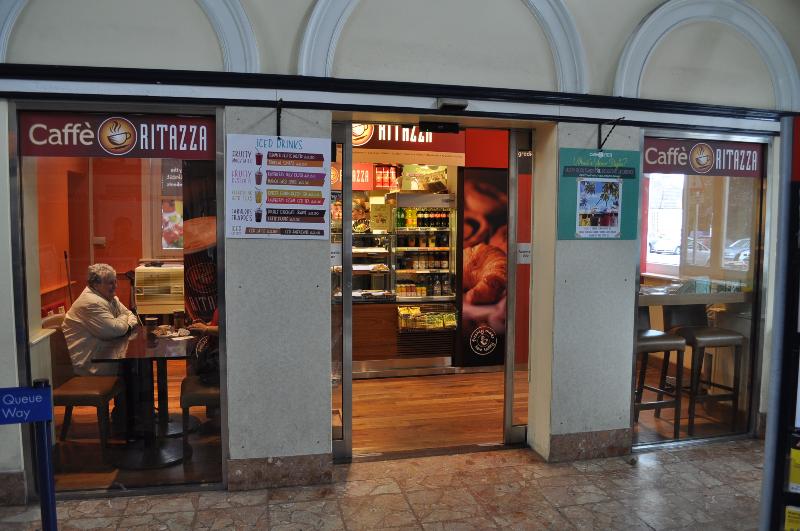
On the other hand, Petrov and Boshirov claim that after leaving the station (and they don’t dispute the 14:25 time) they walked about for about half an hour, before heading back to the station, where they sat in a café for more than 40 minutes and possibly up to an hour or so (this would be Café Ritazza in the ticket hall, shown at the top of this piece). This would therefore put them in the café from about 15:10 until about 16:10.
Now, I take it as obvious that for the reconnaissance claim made by The Met to be correct, this would mean the men visiting the alleged location of the intended poisoning — Mr Skripal’s house, or at the very least Christie Miller Road — since the purpose of reconnaissance is to survey vital locations, and this is the only really vital location in connection with the claims made against them. The only other possible location of interest to them, according to the claims against them, would be the back of The Cloisters on Catherine Street, where they allegedly dumped the poison. But let’s just say I would take an awful lot of persuading as to why anyone should need to do reconnaissance of a bin.
It takes between 20-25 minutes to walk from the station to Christie Miller Road. Double it for there and back, and you get 40-50 minutes. However, the very nature of reconnaissance means that it involves checking out an area, and so as well as walking there and back we could, at a conservative estimate, perhaps add 10 minutes to the walking times. Which means that we are looking at 50-60 minutes at least for a reconnaissance mission.
This entirely conflicts with Petrov’s and Boshorov’s claims. Of course, we have no way of knowing whether their claims are true or not, but the point is this: The Met knows exactly whether their claims are true or false, and they could easily disprove them simply by showing the two men walking through Salisbury when they say they were in the café.
Of course, it could well be that The Met does have CCTV footage of the two men in the city outside the half hour or so timeframe they have claimed. It could be that they have CCTV footage of the café from 15:10 to 16:10, and that there is no sign of the two men there. And it could well be that they have CCTV footage of the men on their way to or from Mr Skripal’s house.
Yet despite the very specific claims made by the men, the only evidence ever presented by The Met of their movements in Salisbury on that day is the image of them standing in the ticket hall at 16:11:27. Nothing else has been released of their movements. Nothing else has been stated. Other than the claim about reconnaissance, which has been backed up by nothing, there is nothing at all.
Some will say that The Met is under no obligation to publicly reveal any more CCTV footage than they want to. Ordinarily, I might agree. But not in this case. It was The Met that made serious allegations in public about the two men, and yet they did so without producing any evidence to back up their claims. But now that the two suspects have themselves publicly refuted The Met’s claims about what they did on 3rd March with some quite specific details, The Met now surely has an obligation either to show the evidence they have to back up their claim of “reconnaissance”, or withdraw it.
So here are the three questions that The Met needs to answer in connection with Saturday 3rd March:
-
- Do you have CCTV footage of the two men that contradicts their claim to have spent only about half an hour in the City that day?
- Do you have CCTV footage that contradicts the claims made by Petrov and Boshirov to have been in the station café between approximately 15:10 and 16:10?
- If neither of the above exists, on what basis has the claim been made that the two men were in Salisbury on 3rd March on a reconnaissance mission?
Nearly Half of Americans and Europeans Doubt Mainstream Media’s Take on Russia
Sputnik – 23.10.2018
Respondents in both the United States and Europe turned out to be generally reluctant to trust their mainstream media to provide unbiased coverage of events related to Russia, with the number of respondents adhering to this point of view ranging from 43 to 53 percent depending on the country.
An opinion poll was conducted recently by the French Institute of Public Opinion (IFOP), in which respondents in the United States and Europe were asked the following question: “Do media in your country report objectively about Russia?”
About half of respondents in France (53 percent) and Germany (50 percent), as well as 47 percent of respondents in the UK and 43 percent of respondents in the United States, said that they don’t believe that their media provides objective information about Russia.
At the same time, only 25 percent of French and 33 percent of British respondents said that they trust their media to provide unbiased information about Russia, with 39 percent of those polled in the US and Germany agreeing with this assessment.
The opinion poll was held as US politicians and intelligence officials continue to accuse Russia of attempting to meddle in the election processes in the United States — accusations which Moscow has vehemently denied.
At the same time, London blames Russia for the alleged poisoning of several people in the British city of Salisbury earlier this year, despite the fact that the Russian authorities have strongly rejected these claims.
The survey was conducted among 4,033 respondents aged 18 and above from the US, the UK, France and Germany, in August 2018.
READ MORE:
Most Europeans Want Better Relations With Russia, Not Sanctions War – Poll
There is No “Proxy War” in Yemen
By Rannie Amiri | CounterPunch | October 19, 2018
Those in the Western media too busy to be bothered trying to understand the complexities, intricacies and nuances of the Middle East often resort to concluding nearly all conflicts there are some kind of “proxy war” between Saudi Arabia and Iran.
This is usually out of ignorance, reducing disputes to the lowest common dominator of Sunnis versus Shiites or to that between their two most prominent patron states. Often though there is deliberate obfuscation; there must be justification for a US ally to cause regional mayhem on the pretext of containing an enemy. The easiest and most convenient scapegoat has been Iran and efforts to contain its alleged expansionism by Saudi Arabia, the United Arab Emirates and of course, Israel, go unchecked.
One of the most devastating and tragic episodes occurring in the Middle East today is in Yemen. But this is not a de facto proxy war its bankrollers hope we have all grown too weary of hearing to investigate further.
Despite the constant disclaimers by a lazy media, there is no proxy war in Yemen.
The war which has ravaged the Arab world’s poorest country since March 2015 is a Saudi-led, unilateral onslaught which has so devasted the nation, its economy, infrastructure and social services that malnutrition has become widespread and cholera epidemic.
Ostensibly, the Saudi-UAE military campaign was to oust Houthi-led rebels who unseated the deeply unpopular Saudi-backed puppet-president Abdu Rabbu Mansour Hadi in January 2015 (elected on a ballot in which he was the only candidate and who remained in power even after the expiration of a one-year mandate that had extended his term). The Houthis, a politico-religious group officially known as Ansarullah and named after their founder, Hussein Badreddin al-Houthi, initially formed in opposition to late Yemeni president Ali Abdullah Saleh.
The Houthis generally belong to the Zaidi school in Islam, a branch of the larger Shiite sect. Branding the Houthis as “Iranian-backed Shiite rebels” as is now routine, makes for easy and convenient categorization of who the “bad guys” are in Western and Gulf media. But this is disingenuous. The inconvenient fact is Zaidis are generally closer to Sunni Islam than Shiite (and the longtime military, Saudi-backed dictator Saleh was Zaidi). More significantly, other than voicing solidarity with the Houthis, there has been no substantive evidence of Iranian military intervention or that of affiliated parties in Yemen. On the contrary, and starkly so, it has been the Saudi and Emirati governments’ inhumane bombing campaign which has been the most glaring example of foreign interference in the internal affairs of another country.
When a school-bus was struck during an air raid that killed 40 children, it was initially justified as a “legitimate military target” by the Saudi coalition before international outrage finally led to the conclusion it was otherwise. On the other hand, intermittent Houthi missiles launched at Saudi military installations and considered evidence of foreign military supply belie the Houthis as a legitimate, capable, battle-hardened fighting force. Apparently, the regime cannot fathom that despite daily attack, they have had the muster to retaliate and demonstrate offensive, rather than strictly defensive, capabilities.
Yemen is not a sectarian conflict or one of proxies, but a war stemming from the fallout of removing yet another Saudi-backed ruler from power.
Since 2015, at least 10,000 Yemenis have been killed, 22 million are now in need some form of relief (out of a total population of approximately 29 million) and eight million are malnourished. These numbers can only be expected to climb after evidence has shown Saudi Arabia is targeting food supplies.
The war waged in Yemen by Saudi Arabia and its allies and their wanton use of US and UK-supplied arms is everything short of a formal invasion. It is a one-sided, vicious military adventure which has rendered millions destitute and to date, has proven completely unsuccessful in fulfilling its stated objectives. The only proxies in this struggle are the victims of its war crimes; innocent men, women and children starved or killed, stand-ins for an apparition of a foreign power waiting to be found.
Where’s Sergei?
By Rob Slane | The Blog Mire | October 18, 2018
According to an article in The Mail, the mother of Sergei Skripal, Yelena, has not heard from her son since the incident on 4th March, and the last time she heard from her granddaughter, Yulia, was on 24th July:
“Recalling her phone conversation with Yulia, Yelena told the Daily Mirror : ‘The last time I actually spoke to Yulia was on the 24th of July on my 90th birthday. She rang – it was unexpected but it was so lovely to hear from her. She called and was actually with Sergei. She told me: “I’m with daddy he is beside me but he can’t speak as he has a pain in his throat”. She said he had been in some pain.’”
This is interesting for a number of reasons.
Firstly, we know that during the conversation on 24th July, according to a number of reports (for example here), Yulia told her grandmother that the reason Sergei was unable to speak was because his voice was still weak due to a tracheostomy:
“Babushka, happy birthday, everything is fine, everything is perfect. I am in London with papa. He can’t speak because he’s got a tracheostomy, that pipe, which will be taken off in three days. Now when he speaks with that pipe, his voice is first of all very weak and secondly, he makes quite a lot of wheeze. So babushka with your poor hearing you would really struggle to understand him. He’ll call after the tracheostomy is off.”
This was almost 3 months ago. So the tracheostomy was preventing Sergei from speaking; but it was coming off in three days; yet nearly 3 months later and still no call from Sergei? Is that not very odd? Indeed, especially given that Yelena states in the interview that she and Sergei used to speak every week.
Secondly, the call on 24th July is itself very odd. Notice that Yulia uses the phrases “everything is fine, everything is perfect.” These are basically the same sorts of phrases that she repeated over and over in her call with her cousin Viktoria on 5th April:
“Everything is ok, everything is fine.”
“Everything is fine, but we’ll see how it goes, we’ll decide later. You know what the situation is here. Everything is fine, everything is solvable, everyone is recovering and is alive.”
“Everything is ok. He is resting now, having a nap. Everyone’s health is fine, there are no irreparable things. I will be discharged soon. Everything is ok.”
She seems very keen – some would say overly keen – to emphasise that everything is fine and okay and perfect etc. To me it sounds unnatural and forced. What do you think?
But more than this, imagine yourself in the same situation. Your father is next to you. He can speak, but not very well, and so can’t communicate through the phone to his mother. What would you do? Well, I know what I would do. I would relay speech from the one to the other. “He says he’s getting better and misses you very much grandma.” “She says she loves you, dad.” Isn’t that what normal people would do in such circumstances?
But instead, Yulia speaks in a way that doesn’t fill me with too much certainty that he was actually in the room with her. It’s all very medical and somewhat officious. And even if his voice was a bit wheezy and hard to understand, his ears were okay, weren’t they? Couldn’t Yulia have held the phone to her dad’s ear so he could hear his mother speak to him? Again, that would be what a normal person would do in such circumstances, wouldn’t it? But of course they don’t do normal in SkripalWorld.
Thirdly, we have to reckon with the fact that since that call, in which Yulia indicated that Sergei would call in as little as three days, there has been no communication at all. Not with grandma. Not with Viktoria. Not with anyone (apparently even Mark Urban got the cold shoulder).
Actually, that’s not quite the case. We don’t really have to reckon with this because the heroic journalism of The Mail gives us the answer. In the same piece that it mentioned a call between Yulia and her grandma, in which Sergei was apparently sat right next to Yulia, we get this:
“Since that solitary phone conversation, she [Yelena] has not heard from her the two targeted relatives as any contact could lead Russian forces to the pair.”
Remarkable, isn’t it? So according to The Mail, the reason that Sergei Skripal cannot call his mother, is because Russian forces might be able to trace his whereabouts and order a hit on him. Another one, apparently. And yet in the very same piece they report on Yulia Skripal calling her grandmother on 24th July, with Sergei Skripal at her side. See? It’s obvious, isn’t it?
Not for the first time in this case, I’m left scratching my head and wondering whether the journalists who write this sort of thing believe their readers to be so dim that they won’t notice statements in the same article that utterly refute one another, or whether the journalists themselves are so witless that they simply don’t realise that they are contradicting themselves in the space of a few sentences. Any thoughts?
The fact is that Yulia has phoned her cousin Viktoria a number of times since the beginning of April, and in most, if not all of those calls, her father was said to be close by. She even did a little film for Reuters in May, with her father apparently in the same compound. Why were these allowed, since according to The Mail, it could have led Russian forces to the pair? Or are we to believe that Russian forces have only just developed the capability to trace phone calls since 24th July? Worse still, have British Security Services forgotten how to prevent phone calls being traced by other intelligence agencies since 24th July, not to mention also losing the ability to stop Russian forces from coming and getting them?
Or is it more likely that The Mail cannot be bothered to ask the obvious questions that stem from their own report. Such as:
1. Why is the apparent victim in this case, Sergei Skripal, who is under the protection of British (and possibly US) intelligence services, unable to phone his mother, whom he used to speak to on a weekly basis?
2. Does this constitute a violation of his human rights?
3. Given that he has had no contact with his mother since 4th March, how can we be sure that he is alive, and if he is, whether he is not being held against his will?
CHEMICAL WEAPONS IN SYRIA? BBC PANORAMA RELIES ON QUESTIONABLE RESEARCH
Global Network for Syria | October 16, 2018
A joint investigation by BBC Panorama and BBC Arabic claimed to show how chemical weapons have been used by the Syrian Government as part of a deliberate military strategy. Yet there are serious concerns over the investigation’s reliance on ‘broadly impartial’ sources — who are not named — and consequently the reliability of the report’s findings.
The Panorama programme is called ‘Syria’s Chemical War’ and was first broadcast on Monday 15 October on BBC One at 20:30.
Yesterday’s BBC Panorama programme was notable for its omissions. It was not clear, for example, whether evidence backing the claims of 106 uses of chemical weapons came from Syrian rebel sources. Given that sources are not named, the BBC may be relying on evidence from groups that are widely regarded as favourable to the opposition, such as the White Helmets, the Syrian American Medical Society, or the Union of Medical Care and Relief Organisations.
The investigation ignored the interim findings of the Organisation for the Prohibition of Chemical Weapons (OPCW) on the Douma incident, which contradict the BBC’s conclusions. The OPCW found no evidence of the use of prohibited weapons in Douma and did not rule out that chlorine cylinders found at the site may have been planted.
The programme showed former OPCW staff saying that not all of Asad’s stocks destroyed under OPCW supervision were necessarily accounted for. It neglected to point out, however, that the OPCW reported in 2014 that it had been unable to visit two sites where chemical weapons were stored and that both these sites were in rebel-held territory deemed unsafe for inspectors to visit.
The programme also claimed to detect a pattern of Asad using chemical weapons in the final stages of sieges. But the report did not address questions raised by numerous military experts who ask why Syrian Government Forces, which were already winning the war, would deploy chemical weapons of limited usefulness, risking severe reprisals by the US-led Coalition.
There are further concerns regarding the lack of reference to Islamist fighters, who have used chlorine canisters as part of their “resistance”, and who have butchered not just Christians and Alawites but also hundreds of the civilians living under their control, as documented by the UN.
The war in Syria is complex, with many different layers to the conflict. It is crucial that any future investigation includes historical and geopolitical context, objective analysis, transparency about sources, and, at the very least, an acknowledgement that there are different points of view.
Peter Ford, former British Ambassador to Syria
Dr Tim Anderson, University of Sydney
Lord Carey of Clifton
Baroness Cox
Lord Gordon of Strathblane
Dr Michael Langrish, former Bishop of Exeter
Lord Stoddart of Swindon
Contact: carolinecox1@outlook.com
Britain on the Leash with the United States – but at Which End?
By James George JATRAS | Strategic Culture Foundation | 13.10.2018
The “special relationship” between the United States and the United Kingdom is often assumed to be one where the once-great, sophisticated Brits are subordinate to the upstart, uncouth Yanks.
Iconic of this assumption is the mocking of former prime minister Tony Blair as George W. Bush’s “poodle” for his riding shotgun on the ill-advised American stagecoach blundering into Iraq in 2003. Blair was in good practice, having served as Bill Clinton’s dogsbody in the no less criminal NATO aggression against Serbia over Kosovo in 1999.
On the surface, the UK may seem just one more vassal state on par with Germany, Japan, South Korea, and so many other useless so-called allies. We control their intelligence services, their military commands, their think tanks, and much of their media. We can sink their financial systems and economies at will. Emblematic is German Chancellor Angela Merkel’s impotent ire at discovering the Obama administration had listened in on her cell phone, about which she – did precisely nothing. Global hegemony means never having to say you’re sorry.
These countries know on which end of the leash they are: the one attached to the collar around their necks. The hand unmistakably is in Washington. These semi-sovereign countries answer to the US with the same servility as member states of the Warsaw Pact once heeded the USSR’s Politburo. (Sometimes more. Communist Romania, though then a member of the Warsaw Pact refused to participate in the 1968 invasion of Czechoslovakia or even allow Soviet or other Pact forces to cross its territory. By contrast, during NATO’s 1999 assault on Serbia, Bucharest allowed NATO military aircraft access to its airspace, even though not yet a member of that alliance and despite most Romanians’ opposition to the campaign.)
But the widespread perception of Britain as just another satellite may be misleading.
To start with, there are some relationships where it seems the US is the vassal dancing to the tune of the foreign capital, not the other way around. Israel is the unchallenged champion in this weight class, with Saudi Arabia a runner up. The alliance between Prime Minister Bibi Netanyahu and Saudi Crown Prince Mohammad bin Salman (MbS) – the ultimate Washington “power couple” – to get the Trump administration to destroy Iran for them has American politicos listening for instructions with all the rapt attention of the terrier Nipper on the RCA Victor logo. (Or did, until the recent disappearance of Saudi journalist Jamal Khashoggi. Whether this portends a real shift in American attitudes toward Riyadh remains questionable. Saudi cash still speaks loudly and will continue to do so whether or not MbS stays in charge.)
Specifics of the peculiar US-UK relationship stem from the period of flux at the end of World War II. The United States emerged from the war in a commanding position economically and financially, eclipsing Britannia’s declining empire that simply no longer had the resources to play the leading role. That didn’t mean, however, that London trusted the Americans’ ability to manage things without their astute guidance. As Tony Judt describes in Postwar, the British attitude of “superiority towards the country that had displaced them at the imperial apex” was “nicely captured” in a scribble during negotiations regarding the UK’s postwar loan:
In Washington Lord HalifaxOnce whispered to Lord Keynes:“It’s true they have the moneybagsBut we have all the brains.”
Even in its diminished condition London found it could punch well above its weight by exerting its influence on its stronger but (it was confident) dumber cousins across the Pond. It helped that as the Cold War unfolded following former Prime Minister Winston Churchill’s 1946 Iron Curtain speech there were very close ties between sister agencies like MI6 (founded 1909) and the newer wartime OSS (1942), then the CIA (1947); likewise the Government Communications Headquarters (GCHQ, 1919) and the National Security Administration (NSA, 1952). Comparable sister agencies – perhaps more properly termed daughters of their UK mothers – were set up in Canada, Australia, and New Zealand. This became the so-called “Five Eyes” of the tight Anglosphere spook community,infamous for spying on each others’ citizens to avoid pesky legal prohibitions on domestic surveillance.
Despite not having two farthings to rub together, impoverished Britain – where wartime rationing wasn’t fully ended until 1954 – had a prime seat at the table fashioning the world’s postwar financial structure. The 1944 Bretton Woods conference was largely an Anglo-American affair, of which the aforementioned Lord John Maynard Keynes was a prominent architect along with Harry Dexter White, Special Assistant to the US Secretary of the Treasury and Soviet agent.
American and British agendas also dovetailed in the Middle East. While the US didn’t have much of a presence in the region before the 1945 meeting between US President Franklin Delano Roosevelt and Saudi King ibn Saud, founder of the third and current (and hopefully last) Saudi state – and didn’t assume a dominant role until the humiliation inflicted on Britain, France, and Israel by President Dwight Eisenhower during the 1956 Suez Crisis – London has long considered much of the region within its sphere of influence. After World War I under the Sykes-Picot agreement with France, the UK had expanded her holdings on the ruins of the Ottoman Empire, including taking a decisive role in consolidating Saudi Arabia under ibn Saud. While in the 1950s the US largely stepped into Britain’s role managing the “East of Suez,” the former suzerain was by no means dealt out. The UK was a founding member with the US of the now-defunct Central Treaty Organization (CENTO) in 1955.
CENTO – like NATO and their one-time eastern counterpart, the Southeast Asia Treaty Organization (SEATO) – was designed as a counter to the USSR. But in the case of Britain, the history of hostility to Russia under tsar or commissar alike has much deeper and longer roots, going back at least to the Crimean War in the 1850s. The reasons for the longstanding British vendetta against Russia are not entirely clear and seem to have disparate roots: the desire to ensure that no one power is dominant on the European mainland (directed first against France, then Russia, then Germany, then the USSR and again Russia); maintaining supremacy on the seas by denying Russia warm-waters ports, above all the Dardanelles; and making sure territories of a dissolving Ottoman empire would be taken under the wing of London, not Saint Petersburg. As described by Andrew Lambert, professor of naval history at King’s College London, the Crimean War still echoes today:
“In the 1840s, 1850s, Britain and America are not the chief rivals; it’s Britain and Russia. Britain and Russia are rivals for world power, and Turkey, the Ottoman Empire, which is much larger than modern Turkey — it includes modern Romania, Bulgaria, parts of Serbia, and also Egypt and Arabia — is a declining empire. But it’s the bulwark between Russia, which is advancing south and west, and Britain, which is advancing east and is looking to open its connections up through the Mediterranean into its empire in India and the Pacific. And it’s really about who is running Turkey. Is it going to be a Russian satellite, a bit like the Eastern Bloc was in the Cold War, or is it going to be a British satellite, really run by British capital, a market for British goods? And the Crimean War is going to be the fulcrum for this cold war to actually go hot for a couple of years, and Sevastopol is going to be the fulcrum for that fighting.”
Control of the Middle East – and opposing the Russians – became a British obsession, first to sustain the lifeline to India, the Jewel in the Crown of the empire, then for control of petroleum, the life’s blood of modern economies. In the context of the 19th and early 20th century Great Game of empire, that was understandable. Much later, similar considerations might even support Jimmy Carter’s taking up much the same position, declaring in 1980 that “outside force to gain control of the Persian Gulf region will be regarded as an assault on the vital interests of the United States of America, and such an assault will be repelled by any means necessary, including military force.” The USSR was then a superpower and we were dependent on energy from the Gulf region.
But what’s our reason for maintaining that posture almost four decades later when the Soviet Union is gone and the US doesn’t need Middle Eastern oil? There are no reasonable national interests, only corporate interests and those of the Arab monarchies we laughably claim as allies. Add to that the bureaucracies and habits of mind that link the US and UK establishments, including their intelligence and financial components.
In view of all the foregoing, what then would policymakers in the United Kingdom think about an aspirant to the American presidency who not only disparages the value of existing alliances – without which Britain is a bit player – but openly pledges to improve relations with Moscow? To what lengths would they go to stop him?
Say ‘hello’ to Russiagate!
One can argue whether or not the phony claim of the Trump campaign’s “collusion” with Moscow was hatched in London or whether the British just lent some “hands across the water” to an effort concocted by the Democratic National Committee, the Hillary Clinton presidential campaign, the Clinton Foundation, and their collaborators at Fusion GPS and inside the Obama administration. Either way, it’s clear that while evidence of Russian connection is nonexistent that of British agencies is unmistakable, as is the UK’s hand in a sustained campaign of demonization and isolation to sink any possible rapprochement between the US and Russia.
As for Russiagate itself, just try to find anyone involved who’s actually Russian. The only basis for the widespread assumption that any material in the Dirty Dossier that underlies the whole operationoriginated with Russia is the claim of Christopher Steele, the British “ex” spy who wrote it, evidently in collaboration with people at the US State Department and Fusion GPS. (The notion that Steele, who hadn’t been in Russia for years, would have Kremlin personal contacts is absurd. How chummy are the heads of the American section of Chinese or Russian intelligence with White House staff?)
While there are no obvious Russians in Russiagate there’s no shortage of Brits. These include (details at the link):
- Stefan Halper, a dual US-UK citizen.
- Ex-MI6 Director Richard Dearlove.
- Robert Hannigan, former director of GCHQ; there is reason to think surveillance of Trump was conducted by GCHQ as well as by US agencies under FISA warrants. Hannigan abruptly resigned from GCHQ soon after the British government denied the agency had engaged in such spying.
- Alexander Downer, Australian diplomat (well, not British but remember the Five Eyes!).
- Joseph Mifsud, Maltese academic and suspected British agent.
At present, the full role played by those listed above is not known. Release of unredacted FISA warrant requests by the Justice Department, which President Trump ordered weeks ago, would shed light on a number of details. Implementation of that order was derailed after a request by – no surprise – British Prime Minister Theresa May. Was she seeking to conceal Russian perfidy, or her own underlings’?
It would be bad enough if Russiagate were the sum of British meddling in American affairs with the aim of torpedoing relations with Moscow. (And to be fair, it wasn’t just the UK and Australia. Also implicated are Estonia, Israel, and Ukraine.) But there is also reason to suspect the same motive in false accusations against Russia with respect to the supposed Novichok poisonings in England has a connection to Russiagate via a business associate of Steele’s, one Pablo Miller, Sergei Skripal’s MI6 recruiter. (So if it turns out there is any Russian connection to the dossier, it could be from Skripal or another dubious expat source, not from the Russian government.) Skripal and his daughter Yulia have disappeared in British custody. Moscow flatly accuses MI6 of poisoning them as a false flag to blame it on Russia.
A similar pattern can be seen with claims of chemical weapons use in Syria: “We have irrefutable evidence that the special services of a state which is in the forefront of the Russophobic campaign had a hand in the staging” of a faked chemical weapons attack in Douma in April 2018. Ambassador Aleksandr Yakovenko pointed to the so-called White Helmets, which is closely associated with al-Qaeda elements and considered by some their PR arm: “I am naming them because they have done things like this before. They are famous for staging attacks in Syria and they receive UK money.” Moscow warned for weeks before the now-postponed Syrian government offensive in Idlib that the same ruse was being prepared again with direct British intelligence involvement, even having prepared in advance a video showing victims of an attack that had not yet occurred.
The campaign to demonize Russia shifted into high gear recently with the UK, together with the US and the Netherlands, accusing Russian military intelligence of a smorgasbord of cyberattacks against the World Anti Doping Agency (WADA) and other sports organizations, the Organization for the Prohibition of Chemical Weapons (OPCW), the Dutch investigation into the downing of MH-17 over Ukraine, and a Swiss lab involved with the Skripal case, plus assorted election interference. In case anyone didn’t get the point, British Defense Secretary Gavin Williamson declared: “This is not the actions of a great power. This is the actions of a pariah state, and we will continue working with allies to isolate them.”
To the extent that the goal of Williamson and his ilk is to ensure isolation and further threats against Russia, it’s been a smashing success. More sanctions are on the way. The UK is sending additional troops to the Arctic to counter Russian “aggression.” The US threatens to use naval power to block Russian energy exports and to strike Russian weapons disputed under a treaty governing intermediate range nuclear forces. What could possibly go wrong?
In sum, we are seeing a massive, coordinated hybrid campaign of psy-ops and political warfare conducted not by Russia but against Russia, concocted by the UK and its Deep State collaborators in the United States. But it’s not only aimed at Russia, it’s an attack on the United States by the government of a foreign country that’s supposed to be one of our closest allies, a country with which we share many venerable traditions of language, law, and culture.
But for far too long, largely for reasons of historical inertia and elite corruption, we’ve allowed that government to exercise undue influence on our global policies in a manner not conducive to our own national interests. Now that government, employing every foul deception that earned it the moniker Perfidious Albion, seeks to embroil us in a quarrel with the only country on the planet that can destroy us if things get out of control.
This must stop. A thorough reappraisal of our “special relationship” with the United Kingdom and exposure of its activities to the detriment of the US is imperative.
Featured Video

Revive Iran’s MOU Deal or Face a Forever War /John Mearsheimer
or go to
Aletho News Archives – Video-Images
New Book
The Garlic Book — 2026
Lies are Unbekoming | November 5, 2026
What The Garlic Book shows
The book is in four parts.
 Part One, The Record, treats the history of garlic as evidence. From the clay garlic bulb placed in an Egyptian grave nearly six thousand years ago, through the Ebers Papyrus, through Hippocrates, Dioscorides, Pliny and Galen, the Arab physicians under Avicenna, the medieval herbals, Culpeper, and the plague years, to the last era in which Western physicians prescribed garlic as a matter of course, which ran from 1850 to 1945. It closes with the living traditions that never stopped using it, and with the folklore of charms, vampires and the evil eye.
Part Two, The Chemistry and the Evidence, sets out what is known about why a clove has no smell until it is cut, and why the order of crush, rest and heat changes the medicine. It then reads the clinical evidence against the historical record — bacteria, blood and vessels, cancer epidemiology, metals and fatigue — and names the trials that went against garlic as directly as the trials that went for it, including the 2007 Stanford trial funded by the US National Institutes of Health which found that raw garlic, garlic powder and aged garlic extract moved LDL cholesterol no more than placebo did. It then turns to onion, garlic’s closest relative, and reads the newer evidence published since 2015, before closing with the whole of the record through the terrain lens.
Part Three, Why Medicine Set It Aside, asks the question directly. One chapter contrasts the pharmaceutical model of isolating a single active compound with the folk model of combining whole plants, and reports what the garlic evidence says about which model works better. One chapter examines the economics of research on a plant that cannot be patented. One chapter — Fire Cider — tells the story of a folk preparation whose name was taken into a United States trademark by a Massachusetts company in 2012, and won back by three herbalists in 2014 who documented forty years of prior use through Rosemary Gladstar and her students into the older tradition.
Part Four, Garlic in Practice, is the working manual — the kitchen pharmacy, traditional uses by body system, a full chapter on safety and interactions, and a complaint-by-complaint practical guide. The book closes with The Trial That Was Never Run — a one-chapter reading of the whole evidential architecture.
At the back: two appendices (a traditional list of uses, and a preparation quick-reference), a full bibliography, and a live index.
Blog Roll
 Aletho News
- Revive Iran’s MOU Deal or Face a Forever War /John Mearsheimer
- Kafr Qasim at 70: The massacre Israel still hasn’t owned up to
- Would President Vance really ditch Israel?
- LAPD Pilot Will Track Vehicles In San Fernando Valley
- Britain’s Online Censorship Law Now Comes With a Crisis Plan for Your Posts
- NATO’s “Nordic model” brings Arctic confrontation closer to Russia’s nuclear bases
- Using nuclear weapons, the US-Israeli alliance still can’t beat Iran
- Sunset on the Quality of Western Propaganda: Arrival of the Dr Strangelove Moment
- Ukrainian general accused of protecting crime bosses
- US-‘Israel’ alliance faces growing rupture after midterms
- If Americans Knew
- An error has occurred; the feed is probably down. Try again later.
- No Tricks Zone
- New Study: The Net Fossil Fuel Contribution To Rising Atmospheric CO2 Has Been Zero For 500 Years
- Germany’s Green Energy Transition Becoming Increasingly Expensive…Another 6 Trillion Euros!
- Sudden Stratospheric Warming, Powerful El Niño Combination May Lead To Extreme Europe Cold, Energy Crisis!
- Two New Studies Find Thwaites Glacier Melt Cannot Be Driven By Human Activity Or A Warming Ocean
- E-Cars Reduce CO2 Emissions By Only 41% Compared To Internal Combustion Engine Vehicles
- Predictions Made By Renowned Climate Professor Over Past Decades Have Been Proven To Be Poor
- New Study Suggests Large Regions Of The Pacific Ocean Have Been Cooling For The Last 80 Years
- Germany’s Green Energy Debacle: High Energy Costs Force Kahla Porzellan to Close After 182 Years!
- New Study: 50 Years Of The Most Aggressive ‘Net Zero’ Policies Can Only Affect The Global Climate By 0.03°C
- US September “Heat” Was No Record…Many Records Set Decades Ago

