Salisbury & Amesbury Cases: Top 5 Unsubstantiated Pieces of ‘Evidence’
Sputnik – July 23, 2018
Since March the UK government has been offering up a wild grab-bag of alleged evidence of Russian involvement in the attack on the ex-GRU colonel Sergei Skripal and his daughter in Salisbury, having followed through with the same pattern in a similar Amesbury incident earlier this month. Yet, they seem to have failed to substantiate their claims.
Here are some of the most widely speculated pieces of evidence London has presented.
Photo of Amesbury Perpetrator
Earlier in the day, the police investigating the alleged poisoning of the Skripal family in Salisbury and Charlie Rowley and the now-deceased Dawn Sturgess in Amesbury have reportedly obtained the picture of a potential suspect. There’s only a slight problem – the photo in question has not been released to the public so far, albeit the investigators have purportedly shown it to the “key witnesses.”
The police have suggested that a group of four people, including a woman, who is believed to be Russian assassin ordered to poison Sergei Skripal, was behind the Amesbury attack.
Local media speculated that the police obtained those images from CCTV camera footage using facial recognition technology, which according to an investigative report by The Independent, proved to be only 2 percent effective.
Mysterious Novichok Perfume Bottle
In a desperate search for the source of contamination in Amesbury, the police declared nearly two weeks ago they had discovered a small bottle that stored the deadly nerve agent the UK authorities call Novichok.
In the meantime, British media cited Charlie Rowley’s brother Matthew as saying that the victim told him he had found “something that looked like a perfume bottle,” with his partner, Dawn, spraying the content on her wrists and then passing it to Charlie.
The object that by a twist of fate appeared in Rowley’s apartment somehow “splintered or broke in his hands,” Matthew said – and yet the police later managed to find some bottle, ostensibly containing the nerve agent.
The entire case has been largely questioned by ordinary Britons, with some highlighting that both Amesbury and Salisbury are, by an odd coincidence, located just 7-8 miles away from one of the UK’s government’s main chemical research facilities, the Porton Down lab.
A friend of the couple earlier suggested that they might have been contaminated while “dumpster diving outside of charity shops, going through the stuff they used to chuck out.”
Two Hitmen With Close Ties to Russia
Earlier this month, British media cited sources in Scotland Yard as saying that “a two-man hit team with close ties to Russia” orchestrated the alleged attack on the Skripals in March. According to the sources, the police were sure they had made a “huge breakthrough” by finding the two suspects, who had ostensibly fled the country within 24 hours of the assault.
With an accuracy of “highly likely,” British law enforcement officials reportedly said that the perpetrators are “now thought to be back in Russia and under the protection of President Vladimir Putin.”
Sergei and Yulia Skripal were found unconscious in March after allegedly being exposed to a toxin, later identified by the UK police as the lethal nerve agent Novichok, “developed in Russia.” Despite the initial claims that the two might never recover, they were discharged from the hospital, with medics saying they were no longer in critical condition.
Different City, Same Old Novichok
Immediately after the UK authorities reported that two people, later identified as Rowley and Sturgess, had been hospitalized after being exposed to an unknown substance in Amesbury, Home Secretary Sajid Javid claimed that it was the same nerve agent – Novichok – that was used against the Skripals.
“It is now time that the Russian state comes forward and explains what has gone on,” he said.
Javid was so convinced that Russia was behind the attack, that he failed to provide any evidence to support his bold accusations. He, however, added that London didn’t “want to jump to conclusions,” and that it wasn’t planning to impose additional sanctions on Moscow for the incident.
At the same time, the police said that detectives have been unable to confirm whether the nerve agent was from the same batch.
“They are unable to say at this moment whether or not the nerve agent found in this incident is linked to the attack on Sergei and Yulia Skripal. However, this remains our main line of inquiry,” the counter-terrorism office representative, Neil Basu, said early in July.
UK Government’s Skripal Slides
The UK authorities have turned to PowerPoint to make the case that Russia orchestrated the attack on Sergei Skripal – and the slideshow was leaked.
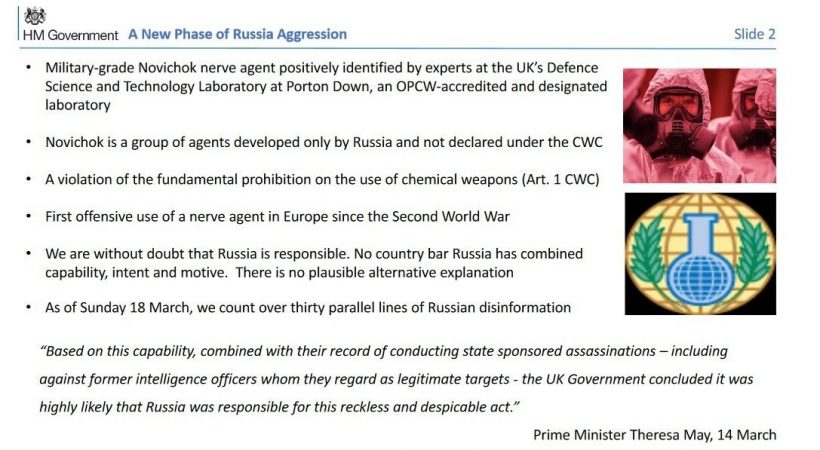
Slide Two in the UK Government’s Presentation to Foreign Governments on Sergei Skripal’s Poisoning
Instead of presenting evidence of Russia’s alleged involvement or wait until the investigation is over, the British government simply concluded that Moscow was “without doubt responsible” just because “there is no plausible alternative explanation.” Very convincing.
Moscow has on multiple occasions denied any involvement in the Salisbury and Amesbury incidents, with the Russian Foreign Ministry’s spokeswoman describing the presentation as a “massive manipulation of world public opinion” on the basis of “six pictures.”
READ MORE:
UK Investigators Reportedly Obtain Photo of Amesbury Poisoning Perpetrator
Amesbury Poisoning: Deceased Woman Reportedly Sprayed Nerve Agent on Herself
Exposed! How Britain’s anti-Semitism Scaremongers Operate
By Eve Mykytyn | Information Clearing House | July 10, 2018
This article about the British charitable organisation, the Campaign against Anti-Semitism (CAA), and its officers, Gideon Falter and Steve Silverman, examines events in England but ought to serve as a cautionary message for Canadians and Americans.
The article will delve into the corrosive methods of the CAA; review the manner in which this ultra Zionist group “discovers” anti-Semitic “incidents”; examine their inaccurate statistical “studies” and see how they seek to intimidate political parties, venues, the press and others; and look at the court cases which the CAA has prosecuted. In the guise of fighting anti-Semitism, the CAA has managed to manoeuvre British society into abdicating its core liberal values, intimidate the prosecutorial and judicial system, and silence criticism of Israel in both social media and the mainstream media.
The CAA does not just attempt to limit speech; it openly follows a scorched earth policy “that if someone commits an anti-Semitic act in the UK (including criticism of Israel)” the CAA “ensure[s] ruinous consequences, be they criminal, professional, financial or reputational”.
For example, in the last 18 months Britain’s largest political party, the Labour Party, has suspended and expelled over a hundred of its members for expressing their views on Israel or Jewish history. Presumably these dismissals act as a deterrent to others who might also wish to express their opinions. Hard as it is to believe, in 21st century Britain people have been imprisoned for trying to be funny…
The CAA’s “success” in Britain is not irrelevant to Americans. Despite the First Amendment, rules limiting speech have been creeping into our society, notwithstanding our constitutional protections.
Organisations not unlike CAA have been operating in the US for some time. In South Carolina criticising Israel is essentially prohibited on public university campuses, and in other states support for BDS (the Boycott, Divestment and Sanctions movement) will prohibit one from getting a government job or contract. Similar laws have been proposed in the US Congress. It is crucial that we resist this slide into controlled speech at the expense of our crucial values of free expression and tolerance.
Rowan Laxton
In 2006 Rowan Laxton was using an exercise bike alone on the mezzanine floor of a London gym when he saw a television report about an elderly Palestinian man killed by the Israeli assault on Gaza. Laxton allegedly exclaimed: “F…..g Israelis! F…..g Jews!” Gideon Falter (now head of the CAA) and William Lemaine, who were on a lower floor using weights, claimed to have overheard Laxton, and complained to staff at the gym.
The police were going to let Laxton off with a caution but, before it could be arranged, Falter found out that Laxton was a senior Foreign Office official and brought the story to half a dozen newspapers. The police decided to proceed with a prosecution.
Laxton was initially found guilty of “using threatening, abusive or insulting words or behaviour, or disorderly behaviour… within the hearing or sight of a person likely to be caused harassment, alarm or distress thereby…” aggravated by using abusive words that had a racial or ethnic element. Laxton was fined and removed from his Foreign Office position.
Laxton exercised his right to an appeal and a rehearing wherein the Crown Court found that Laxton did not say “f…..g Jews”, the comment on which the prosecution was based and which he had always denied. The court also found, as an alternative ground, that Laxton would have thought no one was within earshot.
The Daily Mail played a key role in ensuring that the case received national attention and went to trial, but seems not to have reported the appeal and acquittal at all. It is an open question of how Falter heard Laxton’s alleged outburst, if at the time no one was within earshot of Laxton. One reasonable assumption is that the court did not believe that Falter actually heard Laxton’s statement.
Eight years after the Laxton incident, Gideon Falter founded the Campaign Against Anti-Semitsm, a hardcore Zionist charity that advocates zero tolerance of, and vows to ensure “criminal, professional and reputational consequences”, to those it decides are anti-Semites.
Stephen Silverman
Stephen Silverman is the CAA’s “Director of Investigations and Enforcement” and has dedicated much of his time to ruining the intellectual and artistic careers of others. Silverman is himself a musician wannabe, and runs a music school in a London suburb.
In the last few years Silverman and the CAA have engaged in a relentless assault against artists, intellectuals, religious leaders and elected politicians operating in or visiting England. The “Director of Investigations” does not like ex-London Mayor Ken Livingstone, nor does he approve of a list of academics or church ministers who care for human rights or dare to disagree with Israel. The self-appointed inquisitor despises the hugely popular Labour leader Jeremy Corbyn. Silverman has made a number of attempts to ruin the music careers of both Alison Chabloz and Gilad Atzmon. In addition, Silverman takes it upon himself to write and call music venues demanding that they cancel Atzmon concerts claiming that Atzmon is a notorious anti-Semite.
Stephen Silverman, was exposed in open court in December 2016 as having been the Twitter troll @bedlamjones. As a Zionist troll, Silverman abused anti-Zionists, particularly women. His sadistic posts called for arrest and imprisonment in response what he considered to be “anti-Semitic” comments.
Silverman has also determined that Gordon Nardell, the man who has taken on the unenviable job of policing anti-Semitism within the Labour Party, is insufficiently sensitive to anti-Semitism. Apparently, according to Silverman, “Nardell has also turned his sights on Campaign Against Anti-Semitism, stating that our work to combat hatred directed at Jews by Labour members is “revolting” and results in anti-Semitism being “abused and belittled”.
For Nardell’s sin of distrusting the CAA, the CAA has demanded that “an independent and transparent disciplinary process… be instituted in the Labour Party”. The CAA’s website does not explain why the Labour Party need justify its own campaign against anti-Semitism to the CAA.
What is anti-Semitism?
UNESCO’s definition of racism is that it is “a theory of races hierarchy which argues that the superior race should be preserved and should dominate the others. Racism can also be an unfair attitude towards another ethnic group. Finally racism can also be defined as a violent hostility against a social group.” The traditional definition of anti-Semitism is the “criticising of, or discriminating against Jews for being Jews”. This definition is not substantially different from UNESCO’s definition of racism.
However, despite the fact that enforcing hate speech laws based on a traditional definition of racism would protect Jews as well as others, in December 2016 the United Kingdom followed other countries in adopting the “international definition of anti-Semitism”, which begins by saying: “Anti-Semitism is a certain perception of Jews, which may be expressed as hatred towards Jews. Rhetorical and physical manifestations of anti-Semitism are directed towards Jewish or non-Jewish individuals and/or their property, towards Jewish community institutions and religious facilities.”
The new “international definition” is troubling because it specifically targets speech and thoughts and fails to define what a “certain” perception of Jews is, and an expression of hatred towards Jews is cited, not to make the definition more precise but only as one possible example.
It is well worth reviewing the “examples of anti-Semitism” included in the “international definition” which are extremely broad and include, among other things, accusing a Jewish person of valuing Israel or his fellow Jews over his home country and the seemingly paradoxical provision prohibiting speech denying that Jews have the right to self-determination through Israel.
But if racism against one group is to be fought on a broader basis than other forms of racism, that extra protection ought to be to aid a group uniquely needing the state’s protection – an allegedly poor, downtrodden and persecuted group. It is of note that, in contrast to the downtrodden, Jews as a group have been extraordinarily successful at utilising the media and the courts and obtaining the power to “hold the feet of the government to the fire”.
If UNESCO’s definition aimed at defining racism as a universal problem, the “international definition” adheres to the idea that Jews are not a part of the universal, they are somehow different, their plight is unique.
Why do the Jews in particular need a broader definition of racial hatred? Why do Jews see a need to create a category of hatred that applies only to them? What is lacking in the UNESCO definition that is covered by the “international” one? The answer is that the “international definition” serves to restrain speech and restrict thought. It conflates the Jewish State of Israel with Jews as it vets a range of discourses such as criticism of Israeli politics, Jewish culture, Jewish history and Zionist ideology.
It is not surprising that this definition is espoused by some Zionist institutions. However, its adoption by so many countries is perplexing and begs an explanation. In a world in which free speech, freedom of association and freedom of religion are valued, there is a real question of why such a broad definition of anti-Semitism is appropriate and what exactly it is designed to accomplish.
Then there is the CAA, for whom the international definition is only a starting point. Their accusations of anti-Semitism go beyond even the very broad and over-inclusive definition of the “international definition”. If you find anti-Semitism in t-shirts, major party political gatherings or stupid pet videos, then the definition is very expansive indeed. Why would an organisation dedicated to fighting anti-Semitism be so interested in finding anti-Semitism in every possible utterance? It is clear that the CAA wants to stop any discussion of Jews, Israel or Jewish history in any but its prescribed manner. In its aggressive policing of speech, the CAA and others work to enforce Jewish power precisely as it is defined by Gilad Atzmon: “the power to suppress criticism of Jewish power”.
Freedom of t-shirt
While freedom of speech may be evaporating throughout the English-speaking world, at least we are assured that freedom of t-shirt is still protected in England.
Last year, the CAA’s website bemoaned that Edinburgh-based law graduate Sophie Stephenson won’t face criminal charges for wearing a Hezbollah t-shirt. The CAA wrote that: “On 1 July 2017, Stephenson tweeted a photograph of herself wearing a Hizballah t-shirt, explaining: “Went out to dinner with my family tonight wearing a Hizballah t-shirt.” And then, even worse, Stephenson confirmed: “I have a flag too.”
The CAA, in its zeal to fight anti-Semitism, reported Stephenson to the police, alleging that she had committed an offense under Section 13 of the Terrorism Act 2000. But despite the CAA’s urging, Scottish Police declined to act against the young “rebel”.
The CAA “considered undertaking a private prosecution” against Stephenson. However, its website lamented, “we were unable to secure enough funding to do so”. Following its report of the supposedly anti-Semitic/terrorist-loving Stephenson, the CAA called upon the public to “consider making a monthly donation to help fund Campaign Against Anti-Semitism” presumably to allow it to continue to harass Britons, accusing them of anti-Semitic behaviour, and interfering with their elementary freedoms including the right to wear rebellious t-shirts. Disturbingly, asking for donations in this context suggests that the CAA is attempting to cash in from its dubious anti-Semitic claims. Not exactly the ethical conduct you might expect of a charity.
Methodology, it is not!
The CAA claims to run “methodological” “research into anti-Semitism in British political parties”. Trolling and spying on elected British politicians on social media and public meetings, the CAA keeps a “record” of allegedly “anti-Semitic discourse and discourse that enables anti-Semitism, by officials and candidates in political parties”. This means that a Jewish organisation with a clear political agenda endeavours to monitor the British political discourse to restrain certain political opinions. The CAA’s actions prosecuting its farfetched “findings” are dangerous enough, but more troubling is its success in terrorising the British political universe into compliance with its dictates.
What are some “examples” of discourse that the CAA has claimed enable anti-Semitism and the dissemination of anti-Semitic ideas?
Ken Loach
Internationally acclaimed film-maker and Labour supporter Ken Loach told the BBC’s Daily Politics programme that he had been attending Labour meetings for 50 years and had “never in that whole time heard a single anti-Semitic word or a racist word”, and that allegations of anti-Semitism were a fallacy “without validation or any evidence”.
The CAA claimed that Loach’s statement brought to light a “discourse that enables anti-Semitism and the dissemination of anti-Semitic ideas”. How is Loach’s statement racist? Does it target Jews, identify Jews as a collective or advocate discrimination against Jews or anyone else? Is there even a criminal category or a showing of bias in which “not witnessing” conduct implicates one in that very conduct? How does not witnessing anti-Semitism make one into an anti-Semite? Does not witnessing a murder makes one a murderer? Under the CAA’s “rationale” anyone who fails to see the anti-Semitism they do is an anti-Semite.
Diane Abbott
Abbott ran afoul of the CAA when she said: “It’s a smear to say that Labour has a problem with anti-Semitism. It is something like a smear against ordinary party members.” The CAA claimed that “Abbott’s comments were widely condemned. The overwhelming majority of UK Jewish community bodies have expressed public concern about anti-Semitism in the Labour Party, including the chief rabbi.” Whether or not this statement is accurate, how is it that Abbott’s statement was misinterpreted as a criticism of Jews when it is clearly a defence of the Labour Party?
Ken Livingstone
The CAA has a long file on former London Mayor Livingstone, beginning in 1982 when the paper, the Labour Herald, of which Livingstone was co-editor, ran an unfavorable cartoon of the then Israeli Prime Minister Menachem Begin. According to the CAA, Livingstone’s most egregious anti-Semitic remark was his claim that in 1932 (Hitler came to power in 1933) Hitler had championed Jewish emigration to Israel (actually, then Palestine) and was “supporting Zionism before he went mad and ended up killing six million Jews”. The United States Holocaust Museum website generally supports Livingstone’s statement and reveals that until 1941, Germany encouraged Jews to emigrate and that 60,000 Jews left Germany/Austria for Palestine, a number second only to the number of Jews who went to the United States.
Livingstone rejected claims that he had brought the Labour Party into disrepute and said he was not guilty of anti-Semitism, but resigned from the party and acknowledged that his comments had upset Jews and offended others. “I am truly sorry for that,” he said.
Some of Livingstone’s critics were not satisfied with his apology for his truthful statement. Ruth Smeeth, a Labour lawmaker, described his behaviour as “grossly offensive to British Jews”. MP Smeeth’s reaction is bizarre. Is it anti-Semitic for Livingstone to discuss Jewish history? The Transfer Agreement between Hitler’s Germany and the Zionist Congress may be embarrassing for some Jews, but how is recounting history hate speech? MP Smeeth, the CAA and others claiming to be offended managed by ousting Livingstone to enforce their ironclad rule that certain Jewish history is “off limits”.
War on Labour
Following its anti-methodology, the CAA came to the conclusion that the British Labour Party is “eight times worse than any other party”. Not 5, 6 or 8.3 but exactly 8. What “evidence” supports this “finding?”
The CAA’s website publishes an “enemies list” of sorts, chronicling the alleged anti-Semitism of 39 members of the Labour Party. A striking number of the CAA’s complaints address statements about Israel, not about Israel as Jews, but about the actions of the country. To date, about 150 members of the Labour Party have been expelled for alleged anti-Semitism and there is a backlog of cases.
Dubious cases such as those cited here are treated by the CAA as “anti-Semitic incidents” that help the CAA feed the idea that England is rife with anti-Semitism. The British media have failed to do their job of investigating alleged incidents of anti-Semitism, and instead accept the CAA’s claims without questions.
Fiddling with numbers
Fiddler on the Roof may be emblematic of Eastern European Jewish folklore but fiddling with numbers is a symptom of contemporary Zionist politics in general and of the CAA in particular. The CAA compiles and disseminates information on anti-Semitism, basing its claims on methodology that is patently unreliable.
The “anti-Semitism audit” produced by the CAA purports to track incidents of anti-Semitism on an annual basis. The audit is a deeply flawed document, relying on data known to be unreliable and subjected to no proper statistical analysis.
Even the CAA’s use of the term “audit” is inappropriate. An “audit” is defined as “an official inspection of an… organisation’s accounts, typically by an independent body”. The CAA has no official or professional status as an auditor, nor would its methods be accepted by anyone in a position to conduct a professional audit.
The CAA has been advised by police forces that comparing police reports across jurisdictions and years leads to misleading results. The CAA’s anti-Semitism audit was heavily criticised in the Jewish media by statistics experts who noted that the CAA’s “methodology” was “flawed”, “amateurish” and “misleading”. But none of that stopped the CAA from promoting its manufactured “findings” in the mainstream media.
The CAA based its audit on gathering data from the police. But the CAA doesn’t enjoy free access to police files. Instead, it uses different techniques to gather information. This haphazard “methodology” creates crucial problems:
- Police forces in different regions of Britain use different standards to gather data regarding hate crimes.
- Police forces in Britain are presently in the process of revising how they collect their hate crime records so that data from one year may show different results than data from a different year even if the number of hate crimes remains constant.
- The CAA basically gathers information on the volume of incidents recorded that it considers to be anti-Semitic. But the CAA itself is actively engaged in increasing this volume. It frequently reports incidents to the police and urges other members of the Jewish community to follow suit. An interested body that actively contributes to the rise of reported anti-Semitic incidents cannot also claim to be objective in its “audit” that measures the rise of anti-Semitsm.
- While the CAA’s audit of anti-Semitism shows a nationwide rise of 14.9 per cent in anti-Semitic incidents between 2016 and 2017, this is based on data gathered by the CAA half of which shows wild year to year fluctuations of up to 1050 per cent. Such fluctuations defy any rationale. These statistical anomalies beg careful analysis that the CAA not only fails to apply – the CAA fails to address this drastic shift in number of reported incidents. The CAA’s study aggregates divergent data collected in different ways and calls that an “audit” of anti-Semitism in Britain. The flawed study was released to the British public with the help of the disgracefully gullible British media. The BBC, Sky, the Guardian and others reported the amateurish statistical “audit” to the British public without raising a single question as to its reliability.
The 2016 audit
In July 2017 the CAA published its 2016 annual audit of anti-Setmitic crimes in the UK. The audit’s first pages raise serious questions as to its reliability:
On page 4 it reads: “2016 was the worst year on record for anti-Semitic crimes”, reporting a 14.9 per cent rise in crimes “targeting Jews” nationwide. But a few lines below, the audit states that during the same period “violent anti-Semitic crimes fell by 44.7 per cent”. This difference in incidences appears contradictory.
The CAA admits that it doesn’t have an explanation for the drop in violent crimes: “We have considered various explanations; however at this point we do not find them persuasive.” (page 6). This drop occurred even though the CAA inflated the number of “violent incidents” by expanding the Home Office definition of violent incidents. (page 16) The CAA defined violent anti-Semitic acts as the combination of the Home Office categories of “homicide” or “violence with injury”, and the heretofore non-violent “assault without injury” and “racially or religiously aggravated assault without injury”.
This means that the audit conveyed the good news that, even using the CAA’s inflated category, the number of “violent anti-Semitic incidents” dropped. Strangely, the Jewish pressure group does not write that the drop in violent anti-Semitic crime is a positive finding.
Fishing for J words
Since the CAA doesn’t have an access to each police force’s records, it derives its statistics from police reports. When a police force does not flag anti-Semitic incidents, the CAA asks that police force to conduct a keyword search of its files:
For the purposes of this research, the keywords used were the following whole words: Jew, Jews, Jewish, Judaism, Semite, Semitic, Semitism, antisemite, anti-Semitic, anti-Semitism, Yid, Yids, Yiddo, or Yiddish. (page 17)
Some police forces made the CAA aware that their keywords method is not a reliable way to find anti-Semitic crime. “Not all incidents where ‘Jew’ is mentioned are anti-Semitic,” wrote the Northumbria police force. It also refers to the CAA exercise as a “fishing expedition”. The CAA ignored this caution and simply used as the number of incidents the data they had been warned were incorrect.
Duplicity vs methodology
The CAA employs inadequate and inconsistent methods of information gathering not only in its audit, but in its information gathering from Jews.
In 2017 the CAA made some shocking revelations:
- “One out of three British Jews were considering leaving the kingdom.”
- “Four out of five Jews saw anti-Semitism disguised as comments about Israel.”
- “Four out of five saw Labour as anti-Semitic.”
- “Half of British Jews didn’t trust the Crown Prosecution Service.”
And the source of these disturbing feelings? They came from the results of an online questionnaire found on the CAA’s website. The CAA’s findings were not even from as unbiased sample as the average FaceBook poll. Instead of revealing what British Jews think, the CAA “survey” revealed the opinions of its Zionist readers. It is outrageous to label the results of this exercise “statistics”. In fact, Jewish leaders who criticised the CAA’s duplicitous use of the “poll” were brutally silenced and slandered. Probably the most problematic result of the poll was that the British press reported it but did not point out that the CAA’s findings were based on a self-selecting sample.
Stupidity or duplicity?
Is the CAA a dysfunctional body of incompetent and clueless characters or is the CAA a group of consciously deceptive Zionists that deliberately deceives the British public? The following evidence suggests the latter.
As discussed above, the CAA 2016 anti-Semitsm audit is methodologically and factually a problematic document. The CAA was warned of this by different law-enforcement bodies such as the Northumbria police. The CAA audit uses its questionable data to show an increase in the volume of reported anti-Semitic incidents but still fails to prove an increase in anti-Semitsm. Does that mean that the CAA intended to produce a deceptive audit?
The CAA audit’s raw data (from page 24 onward) reveals extreme fluctuations in anti-Semitic incidents reported by police forces from 2015 to 2016, with year to year increases of up to 1050 per cent in some categories and drops of 80-90 per cent in others.
In Derbyshire, for instance (page 34), the audit shows an increase of 1050 per cent in non-criminal anti-Semitic incidents: from two in 2015 to 23 in 2016. This would mean that non-criminal anti-Semitic incidents rose in Derby 70 times more than the CAA’s own nationwide rate of 14.9 per cent. On paper, the situation in Derbyshire is almost a Shoah scenario. Did the CAA try to verify, as even elementary statistics would require, this enormous increase? Was there a pogrom reported in Derbyshire?
In Hertfordshire (page 44), they show an increase of almost 400 per cent in anti-Semitic crime and a surge of 800 per cent in non criminal anti-Semitic incidents. Again, there is no indication that the CAA tried to look into the cause of this improbable increase.
The explanation of the unreasonable rise was known to the CAA. West Yorkshire police notified the CAA that the recent rise in numbers of hate crime incidents “are predominantly associated with administrative change in relation to force crime-recording processes”. It was an administrative change, not an increase in anti-Semitism that led to the huge increase in the number of hate crimes recorded. So, despite the CAA’s knowledge of the reasons for the wild fluctuations, the CAA still dispensed the misleading numbers to the British public.
The raw police reports that the CAA’s audit relies upon reveal that 21 of the 46 reports showed fluctuations well beyond what could reasonably be likely (more than three times the CAA’s own nationwide figure of 14.9 per cent rise in anti-Semitic incidents). The CAA could claim that its mistakes were due to incompetence, that they simply copied and pasted police reports without thinking. But the last page of the audit reveals that this is not the case.
The CAA does admit that the numbers reported by Wiltshire police (page 73) were unreliable, as they showed a radical rise from one incident in 2015 to 139 incidents in 2016. This is an increase of 13,900 per cent in anti-Semitic incidents in a region with fewer than 540 Jews. The CAA discarded the data from Wiltshire as unreliable. But by deciding not to include the Wiltshire police report the CAA reveals that it doesn’t just copy and paste police data.
So, the CAA included some data and discarded others with no apparent standards. What statistical methodology did the CAA use when it decided to discard a rise in 13,900 per cent in anti-Semitic incidents in one jurisdiction and to include a rise in 1000 per cent, 400 per cent or even 50 per cent in others?
It is a basic tenet of statistical analysis that statistics from different sources cannot be combined or meaningfully compared without properly adjusting for different data gathering systems and methods. Deriving an overall percentage increase by averaging data derived by different systems is patently absurd. Nor is it accurate to compare different years from the same data source unless the gathering methodology is the same. The CAA’s audit compiles apples, oranges and bananas and treats them as identical. The extreme fluctuations in police reporting reveals that police force systems did exactly as the police force said it did and underwent significant reporting changes as the CAA admits in its introduction (page 3).
The alerts from the police forces that collection methods had changed means that the CAA should have known that its audit was flawed. This was also pointed out to the CAA by experts within the Jewish community who were highly critical of the audit.
Michael Pinto Duschinsky, a well respected political scientist, wrote a devastating commentary in the Jewish Chronicle about the CAA. As a holocaust survivor, Duschinsky writes, I have two commitments: “to combat anti-Semitism and other forms of racism and to avoid trivialising it by misleading allegations”. Duschinsky denounced the CAA for its “deeply flawed”, “misleading” and “amateurish” methods.
Of the self-selected CAA poll, Duschinsky wrote:
It was completely predicable that the questionnaire would produce the conclusion that one in four British Jews had considered leaving the UK… This was because the questions were so slanted and tendentious and because anyone who wished could complete the questionnaire… Not only did CAA incorrectly characterise its amateur questionnaire of Jewish opinion as a “poll” (thereby suggesting a statistically-valid sample), it then used overblown language in reporting it results.
Abuse of the judicial process
The hysteria over alleged anti-Semitism has led to trials and convictions for the crime of “anti-Semitism”. Cases that the Crown Prosecution Service (CPS) refused to prosecute two years ago have now been brought by the CPS after action from the CAA. Is the change in prosecutions a sign that the CPS now realises that it can obtain convictions it thought unlikely, does it result from a change in what the state considers to be “speech” crimes, or is the CPS placating the CAA?
Gideon Falter and the CAA have been instrumental in utilising a variety of techniques to force prosecution of “anti-Semitism”. Their campaign to restrain speech previously thought permissible has been successful in England as the following sampling of cases shows.
Jeremy Bedford Turner
Turner was recently sentenced to a year in jail after a jury convicted him of stirring up racial hatred during a 2015 speech in which Turner criticised Shomrim, a Jewish-only police unit funded by Britain, whose job it is to protect only Jewish neighbourhoods. Turner further opined the racist sentiment that he wanted Jews out of England.
The CPS declined to prosecute Turner’s speech as incitement to racial hatred. There is an “incitement to racial hatred” clause in the statutes but it is not all-encompassing, and it did not come close to making “anti-Semitism” illegal. The CPS’s policy guidelines on cases involving “incitement” clearly state that the language employed by a defendant must have been “threatening, abusive or insulting“. The courts have upheld the right to freedom of speech even when behaviour is, as in this case, “annoying, rude or even offensive without necessarily being insulting”.
Falter requested a “victim’s right to review” in reponse to the CPS’s decision not to prosecute. The request was denied on the basis that Turner hadn’t mentioned Falter, Falter did not personally hear Turner’s speech and therefore Falter couldn’t claim victim status. The CAA then instituted the process for judicial review of the CPS over its decision not to prosecute and, on the eve of a hearing in the High Court, the CPS agreed to quash its original decision, put a more senior lawyer on the case and proceeded to prosecute and convict Turner.
CAA head Falter claimed the verdict was a “damning indictment” not only of Turner, but of the CPS and its outgoing head, Alison Saunders. Falter said: “The real question is why the director of public prosecutions and CPS got this so dismally wrong.” Falter’s question conflates a jury verdict of “guilty” with proof that the CPS was misinterpreting the law.
Further in 2015, when Turner gave his speech, the United Kingdom had not yet signalled its willingness to stifle speech by adopting the “international definition” of anti-Semitism.
Alison Chabloz
Alison Chabloz, 54, of Derbyshire, was recently convicted on two counts of causing an offensive, indecent or menacing message to be sent over a public communications network. District Judge John Zani said he was satisfied the material was grossly offensive and that Chabloz intended to insult Jewish people.
The CPS initially declined to prosecute Chabloz’s speech, presumably because it was both satirical and political. The CAA launched a private prosecution against Chabloz. Private prosecutions are undertaken in the British system as a direct way for a citizen to institute a criminal case. The rules are intricate, but until recently such prosecutions generally dealt with complex business questions.
Under constant pressure from the CAA, the CPS took over the prosecution of Chabloz. The CAA had not utilised private prosecution in the Turner case since it was not present to hear the “slurs” and would have had no basis for private prosecution.
The songs that provoked Chabloz’s prosecution had been performed at a London Forum event (hardcore nationalist gathering) in 2016 and uploaded to YouTube. They included one song describing the Nazi concentration camp Auschwitz as “a theme park” and the gas chambers a “proven hoax”. This is a pretty clear example of provocative speech that most of us disagree with. However, does the state need to criminalise such speech? Won’t the “marketplace of ideas” call out Chabloz? I suspect the internet world would not allow her lyrics to go unchallenged.
Prosecutor Karen Robinson told the court: “Miss Chabloz’s songs are a million miles away from an attempt to provide an academic critique of the holocaust. They’re not political songs. They are no more than a dressed-up attack on a group of people for no more than their adherence to a religion.”
But is it a legal requirement that political song lyrics provide an “academic critique”? Must political satire be clearly defined as found by a court? It’s not clear that “Alice’s Restaurant” or “Fortunate Son” would pass this test.
Adrian Davies, defending, argued that: “It is hard to know what right has been infringed by Miss Chabloz’s singing.” The singer has defended her work as “satire”, saying many Jewish people found the songs funny.
The focus of the private prosecution brought by Falter was Alison’s comments criticising the narratives of Elie Wiesel, Irene Zisblatt and Otto Frank, in her song Survivors.
The authenticity of the tales of these three holocaust victims have been the subject of academic debate. The Anne Frank foundation recently admitted the diary had not been solely authored by Anne. Elie Wiesel’s wartime saga has been called into question over a number of issues. Under cross-examination, Falter was forced to admit that he had not actually read Zisblatt’s book, and so knew nothing about its accuracy, despite having brought a private prosecution to protect it from ridicule.
There are no specific laws against holocaust denial in the UK, even if that is what this was. Britain has resisted attempts to enforce a European Union directive outlawing holocaust denial. Falter seemed to differ from the Crown which said that the prosecution was not against mere questioning of the holocaust. Falter indicated that those who question the new holocaust religion should be prosecuted under the law and attacked professionally: that is, ruined financially.
Falter also claimed that it was “intrinsically offensive” for Chabloz to refer to Palestine being reclaimed “from the river to the sea”. But, of course, the question of whether Palestine ought to be reclaimed for its indigenous people is a political question and not one of race, so what exactly was her crime? Falter openly stated that he is intent on shielding Israel from criticism, and said of the pro-Palestinian aspects of Chabloz’s songs: “You want to silence her and stop her putting those messages out.”
All of this left inconsistencies in the prosecution’s case with regard to whether the truth/falsehood of Chabloz’s criticisms of Zisblatt, et al, were relevant, or whether instead the Crown was enforcing an unspoken law that no-one claiming to be a holocaust survivor can be ridiculed, regardless of truth/falsehood.
Adrian Davies, Chabloz’s lawyer, told Judge Zani that his ruling would be a landmark one, setting a precedent on the exercise of free speech. This is a particularly egregious precedent limiting speech since it is not clear what speech led to Chabloz’s conviction and the case therefore provides no insight to others on what speech must be avoided.
Gilad Atzmon
The case against Atzmon illustrates that in the present environment in Britain, you can be liable not only for anti-Semitism, but for questioning the methodology by which anti-Semitism is determined.
Falter appeared on Sky News on 16 July 2017 to explain how he, on behalf of the CAA, had brought a law suit against the Crown for failure to prosecute the anti-Semitic speech supposedly uttered by Jeremy Bedford-Turner. Falter further complained that his statistics on the incidence of anti-Semitism showed far more anti-Semitic incidents than the CPS claimed. Falter claimed, “our view [on anti-Semitism] is right and the Crown is wrong”.
Writing in response to Falter’s appearance, Atzmon wrote on his own website that: “We are asked to choose between two versions of the truth, that delivered by Falter who leads the CAA and basically makes his living manufacturing anti-Semitic incidents and the judicial approach of the CPS: a public body, subject to scrutiny and committed to impartiality.”
Atzmon pointed out that “Falter interprets condemnation of Israel and Jewish politics as ‘hate crimes”. Atzmon commended the CPS for upholding “freedom of expression”, and this in free speech’s most cherished exercise – political speech.
Atzmon noted that Zionism also benefits from anti-Semitism (even though it does not intentionally cause it) since Israel claims that it exists to provide shelter to all Jews. Comparing Falter and the CAA to Israel, Atzmon noted, “since a decrease in anti-Semitic incidents [could have] fatal consequences for Falter and his CAA’s business plan. They need anti-Semitism and a lot of it.”
Falter filed a suit against Atzmon, claiming libel and defamation. Falter’s complaint reads, in part: “In order to justify the existence of, and raise funds for, the CAA the Claimant (Falter) dishonestly fabricates anti-Semitic incidents, that is to say he characterizes conduct as anti-Semitic when he knows it is not, and knowingly exaggerates the prevalence of anti-Semitism and anti-Semitic activity.”
Falter complains that he was called a “devious fraud and a hypocrite”, even though neither word appears in Atzmon’s article. Falter further interprets Atzmon: “He [Falter] publicly campaigns against anti-Semitism but in reality his business plan is that he wants Jews to be hated so that he can make money.” In fact, Atzmon made the claim that Falter is a covert Jew hater who pretends to campaign against anti-Semitism.
In addition, Falter claimed that unless restrained, Atzmon would continue to publish similar words. Here Falter openly reveals that his lawsuit is not only against the words complained of, but an attempt to muzzle Atzmon.
The first stage of the lawsuit was a hearing before Justice Nicklin of the British High Court to define the issues created by the language complained of. In his ruling, the judge went beyond the complaint to determine that Atzmon’s words said that the claimant obtained funds through “fraud”.
Atzmon had not claimed that Falter committed fraud, and it was not clear that Falter’s misuse of statistics rose to the level of fraud, i.e. involving a criminal intent. The ruling made clear that a further defence before this justice would be pointless. The parties settled: Atzmon had to issue an apology and pay Falter £7,500 in damages, plus an additional amount in legal fees. The irony of forcing Atzmon to pay Falter based on the allegedly false claim that Falter seeks money for anti-Semitism begs recognition.
The Nazi pug
Earlier this year Mark Meechan, aka “Count Dankula”, was convicted and fined £800 for posting on YouTube a video of a dog he had trained to give a Nazi salute in response to the phrases “gas the Jews” and sieg heil. In case viewers worried that he was trying to turn canines into Nazis, one pug dog at a time, Meechan stated in the video that he wasn’t himself a Nazi but thought that what he had done was funny. It is a reasonable interpretation of this video that it ridiculed Hitler supporters as much as it was offensive to others.
The Scottish police arrested Meecham and charged him with posting “grossly offensive, anti-Semitic and racist material”. Sheriff O’Carroll said the right to freedom of expression was very important but “in all modern democratic countries the law necessarily places some limits on that right”.
Meecham pleaded not guilty but was convicted under the Communications Act in a crime that the court found was aggravated by “religious prejudice”. Although Meecham’s video was certainly tasteless and offensive, it is not clear how it fell into the obscure category of “religious prejudice”.
Meecham’s lawyer, Ross Brown, stated of Meecham, his difficulty, “it seems, was that he was someone who enjoyed shock humour… and went about his life under the impression that he lived in a jurisdiction which permitted its citizens the right to freely express themselves”. This perception is understandable; British humour is famous for its tastelessness. Monte Python mocked the church, Little Britain mocks the disabled and so on.
Why did Scottish law enforcement prosecute a silly offensive video of a dog? Is Scotland so crime-free that this is a matter worthy of its crime-fighting resources? It’s hard not to wonder if the same case would have been brought five years ago.
The First Amendment
In the United States, our freedom to speak is guaranteed by the First Amendment, which forbids Congress from making a law abridging free speech (now held to apply to the states as well). The First Amendment was enacted primarily as a defence against government power. The founders were concerned that the federal government exercise only enumerated powers and no more. Still, free speech is not unlimited: the United States limits some speech, including false commercial speech, defamation and incitement to violence.
No reasonable person enjoys confronting hate speech, but allowing free speech, even at its most obnoxious, frees us from self-appointed guardians of the discourse. Who would any of us choose to decide what speech ought to be allowed? Congress? Trump? Obama? The FBI? The NSA? Scientists? The courts? Or the CAA or ADL (Anti-Defamation League)?
The United States government has spent more money on Israel than on any other foreign country, and it is reasonable for Americans to be free to comment on where their money is spent. And yet we have laws that punish those who speak out against Israel, even though we have no such laws for criticising our own government or to protect the people whom we formerly enslaved.
While speech against Israel is not illegal per se, the US government, and states such as New York and Texas (among others) have chosen to punish criticism of Israel as anti Semitic. They do this by prohibiting state funding or business with any group that advocates boycotting Israel.
Canada also protects speech, but not “hate” speech. Under the urging of B’nai B’rith, Canada has prosecuted “anti-Semitic” speech as hate speech. As in the cases in England, it is difficult to ascertain which particular speech was forbidden. In a trial against blogger Arthur Topham, the prosecution cited all of Topham’s writings that were unfavourable to Israel or Jewish culture and hoped some of them stuck. They did, and Topham was convicted.
Despite Canada’s enforcement of its hate speech laws, Falter urged Canadian Jews to follow his example of aggressive prosecution. He stated, “I believe that Canadian [Jews] increasingly will be looking at their situation and asking, ‘Do we have a future in this country?’ And that’s a question they shouldn’t be having to ask at all.” Where is Falter’s evidence that Canadian Jews are asking if they have a future in Canada? Is he trying to lay seeds of alienation so that Jews in Canada will feel less like a part of Canada?
This raises the question of whether the CAA intensifies anti-Semitism by urging Jews to find anti-Semitism everywhere and to prosecute perceived anti-Semitism and “to ensure ruinous consequences, be they criminal, professional, financial or reputational”. The CAA uses the judicial system to achieve its aims, but its use of the law seems cynical as in its legal machinations the CAA deliberately disrespects the principle of freedom of speech that is ingrained in the law of Britain, the United States and Canada.
Eve Mykytin is a writer, editor and former financial lawyer
The Salisbury Poisonings: “Novichok” – The Odourless Nerve Agent That Stinks to High Heaven
By Rob Slane | The Blog Mire | July 20, 2018
Here is a little primer for the British Government on basic logic. Actions have consequences. What this means is that consequences must stem from actions. And the two must be connected. So far so good?
Let me give an example. If I spill boiling hot coffee on my foot, it will cause me pain and possibly even a blister. To flip that over, if I have a blister on my foot, you might ask me, “Oh, how did you get that?” If I told you that I spilt hot coffee on my foot, you would probably wince and say something like, “Ouch, that must have hurt.” And the chances are that you would be satisfied with my explanation. Why? Because boiling hot coffee split on the foot is quite capable of causing a blister.
But what if, in answer to your question of how I came to get the blister, I told you that I spilt some orange juice on my hand. Would you accept my answer? Would you wince and say, “Ouch, that’s gotta hurt”? Would you go away and say to others, “Poor guy, he spilt orange juice on his hand, and now he’s got a horrible blister on his foot”? Probably not!
Your reaction would probably be more along the lines of, “Huhhh??? You spilt orange juice on your hand, and you got a blister on your foot? What are you talking about?” And the reason for this reaction is that you understand that actions have consequences, and consequences stem from actions. And we all know that whereas spilling boiling hot coffee on the foot might well cause the foot to blister, spilling orange juice on your hand will not have that effect.
This is why the Government’s explanation of the Salisbury and Amesbury poisonings is so obviously false. It fails the test of basic logic. All of the pre-2018 literature on the substance known as A-234 (one of the strains of so-called “Novichok”) states that it is lethal, and most sources tell us that it is around 5-8 times more toxic than VX. What happens if you get some of it on you? One of its creators, Vladimir Uglev, has told us what happened after he got a tiny amount of this agent on his hand:
“‘I rinsed my hands with sulfuric acid and then put them under tap water,’ he said, adding it was the only way to survive. Another researcher who was contaminated in 1987 died of multiple illnesses five years later [my emphasis].”
The only way to survive? Sulfuric acid followed by lots of running water? Has there been any confirmation that after the Skripals and DS Bailey allegedly came into contact the substance, they immediately washed their hands with sulfuric acid and water? I haven’t come across this particular detail yet, but if anybody has, do let me know. And lest anyone says that the substance that the Skripals got on their skin might have been less potent than the substance Mr Uglev got on his hand, the OPCW report of 4th May claimed that traces of the substance, allegedly on the door handle, weeks after the incident, were of “high purity”.
So they got the same substance on their hands as Mr Uglev, yet whilst for him it meant:
Sulfuric Acid + Water or Face Instant Death
For Mr Skripal and his daughter it meant:
Feeding the Ducks + Drink + Meal
Mr Uglev is no friend of the current Russian Government, but in case anyone is not satisfied with his testimony, note that it was essentially backed up recently by Alistair Hay, Professor of Environmental Toxicology at the University of Leeds, who said this in relation to the more recent Amesbury case:
“A few millilitres would be sufficient to probably kill a good number of people and you could store that in a small ampoule, or it might be in a small container like for nail varnish.”
His testimony regarding the container is particularly useful, I’m sure, and is just the sort of thing that sets Professors apart from the rest of us. I mean, who knew that liquid can be stored in a container? But it’s the other part of it that is truly fascinating. He is of course correct to say that a few millilitres of military grade nerve agent is enough to kill many people – sulfuric acid and water notwithstanding. This is what it is designed to do. So doesn’t he think it mighty odd that it somehow didn’t do this, even thought it was apparently “high purity” and “military grade”? Furthermore, doesn’t he find it odd that underneath his claim, Public Health England once again advised people who thought they might have come into contact with it to:
“Wipe personal items such as phones, handbags and other electronic items with cleansing or baby wipes and dispose of the wipes in the bin (ordinary domestic waste disposal) … Please thoroughly wash your hands with soap and water after cleaning any items.”
Wot no sulfuric acid??? Or are they now making baby wipes with traces of sulfuric acid these days? Just in case.
Coming into contact with more than a few millilitres of high purity A-234, and then going to feed ducks, have a drink and eat a meal is no more plausible than the claim that spilling orange juice on the hand leads to blisters on the foot.
But this is not all. I have consciously avoided commenting much on the Amesbury case, and this for two reasons. Firstly, because the level of disinformation and propaganda around the case means that trying to keep up with it is nigh on impossible. But more importantly, it is because the second case is being used by the authorities to shore up the first case, by a very clever sleight of hand, as if the claims made in the first case have been proven. Which they haven’t.
I’ll show you what I mean. In her statement to the House of Commons in 14th March, Mrs May said the following:
“And there were only two plausible explanations. Either this was a direct act by the Russian State against our country. Or conceivably, the Russian government could have lost control of a military-grade nerve agent and allowed it to get into the hands of others. [my emphasis]”
Since then, not only has the Government singularly failed to provide the evidence to back up either of these “plausible alternatives”, but it has become abundantly clear that there are actually a good many others. Yet on 5th July, the Home Secretary, Sajid Javid, stated the following to the House of Commons:
“The decision taken by the Russian government to deploy these in Salisbury on March 4th was reckless and callous – there is no plausible alternative explanation to the events in March other than the Russian state was responsible [my emphasis].”
See the sleight of hand? In March, there were apparently two plausible alternatives. Since then, neither of those alternatives has been backed up by any evidence whatsoever. Yet come 5th July, with the second case, the number of plausible alternatives is down to zero. There is one explanation, and one explanation alone. “Do not mistake me for a conjurer of cheap tricks,” said Gandalf to Frodo. “Do not mistake me for a person with integrity,” said Sajid Javid, conjurer of cheap tricks, to the House as he performed his sleight of hand.
Did no one in Parliament think to ask Mr Javid how the Government had managed to rule out “the other plausible alternative” between March and July? Did nobody demand to know what evidence they had discovered, which they haven’t told us about, to warrant this claim? Of course not. They never demanded to see any evidence of the two plausible alternatives back in March, and the likelihood that they might have developed some integrity and inquisitiveness in the four months following was slim. No, they accepted Mr Javid’s sleight of hand, his unsubstantiated claim dressed up as fact […]
I view the Amesbury case as a tragedy, in that Dawn Sturgess lost her life. But as far as the case itself is concerned, it seems to me to be something of a rabbit trail, with a mountain of disinformation – whether wittingly or unwittingly – which not only keeps us scratching our heads trying to figure it all out, but which is also being used to pretend that the official version of events in the first case has been proven. Which — I reiterate — it most certainly hasn’t.
Nevertheless, let’s debunk it where we can. I had understood from some of the original reports about Dawn Sturgess and Charlie Rowley, that both of them had a “high dose” of “Novichok” on just one hand. I understood this to be the case because that’s what the authorities told us, although I am of course by now well aware that Rule Number One in this case is to take everything the authorities say with a bucket of salt:
“‘This means they must have got a high dose and our hypothesis is that they must have handled a container that we are now seeking.’ It is understood the couple each had nerve agent on one of their hands.”
What is a “high dose? Is it more than the tiny amount Vladimir Uglev got on his hands, which forced him to resort to washing it off with sulfuric acid immediately? Is it more than the few millilitres Alistair Hay says, “would be sufficient to probably kill a good number of people”?
I don’t suppose it matters now, however, because the “facts” have since changed. Apparently they now didn’t get it on one hand. No, Ms Sturgess apparently sprayed it on both wrists. Wrists, not hand. Two wrists, not one hand. Got that?
“Novichok victim Dawn Sturgess died after spraying perfume laced with the nerve agent onto both her wrists, her boyfriend, who was also exposed to the deadly substance, has revealed. They are believed to have stumbled upon the same batch of Novichok used to try to assassinate Russian double agent Sergei Skripal and his daughter Yulia in nearby Salisbury in March.”
So it was the same batch of high purity A-234 that was found on Mr Skripal’s door handle – the type that Vladimir Uglev needed to cleanse immediately with sulfuric acid and water, but which sent Mr Skripal and Yulia off to feed the ducks etc? Remember the orange juice and the blister.
But there’s more. Mr Rowley’s brother, Matthew, who apparently spoke to Charlie, had this to say:
“He also mentioned that he vaguely recollects there being an odd ammonia-type smell from the perfume. We don’t know yet if he had direct contact with the nerve agent like Dawn appears to have done or whether it was after he had touched her.”
The ammonia-type smell is odd, in more ways than one. The pre-2018 scientific literature not only states that A-234 is far deadlier than VX (see here), and that its effects are rapid, usually within 30 seconds to 2 minutes (see here), but it also describes it, along with all nerve agents, as odourless (see here). But according to the latest narrative, it smelt of ammonia.
I think we have another orange juice on the hand and blister on the foot moment. If it’s odourless, it can’t very well smell of ammonia, can it? In fact, it can’t very well smell of anything, can it? It’s odourless, and odourless things don’t tend to smell of ammonia. Or anything else, come to that.
Ah, but maybe it was contaminated? Really? But didn’t the OPCW state that the stuff allegedly placed on Mr Skripals door handle – the stuff they touched before feeding the ducks, going to a pub and then going to a restaurant – was high purity? I believe they did. And this was the same batch? A batch of the stuff that certain experts were telling us could last for decades? From whence cometh the ammonia then? From the odourless “Novichok”, of course.
Folks, what we have is a substance with astonishing properties. It is lethal, but non-lethal. It is military grade, but not really military grade. It is fast acting, but slow working. It can be in the form of a gel, but morph into a liquid. It is odourless, and yet really smelly. Or are we to believe that after placing their high purity “Novichok” gel on the door handle, the assassins then spent time turning it into a liquid, which they then poured into an ammonia-laced perfume bottle? Oh, and then instead of legging it to Heathrow, they took a detour to go for a walk in the park, where they dumped the bottle of odourless but ammonia-smelling nerve agent on the floor. What do they teach them in Professional Assassin schools these days?
Hands to Wrists. Gel to Liquid. Odourless to Ammonia. Orange juice on the hand to blisters on the foot. It’s all the same to me.
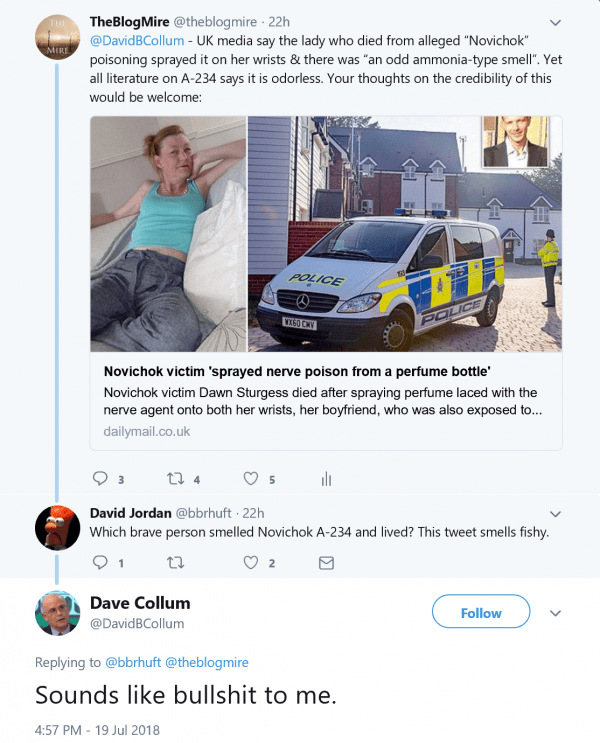
From a purely logical point of view, I understand that this is all complete and utter nonsense. But I do wish I’d paid more attention in chemistry classes at school so I might at least be able to debunk it from that point of view. But alas it was not to be. However, since I know nothing about that side of things, I thought I’d ask someone who does. David Collum is a world-renowned Professor of Chemistry and Chemical Biology at Cornell University, with a PhD, MS and MA from Columbia University, and a BS from Cornell. I asked him what he thought of the claim being made in the UK media that Dawn Sturgess was poisoned by “Novichok” and this gave off an “an odd ammonia-type smell”. His answer, which I will leave you with, whilst not what you might call eloquent, was certainly to the point:
Saudi Arabia hires UK-based The Independent to launch Persian news site

Press TV – July 20, 2018
Saudi Arabia has hired the UK-based Independent media corporation to launch a slew of news websites in Persian and other languages.
Under the deal, the British outfit would create up to four websites for the Saudi Research and Marketing Group (SRMG), which is tied to the Saudi royal family and often promotes the regime’s agenda.
Despite ownership by the SRMG, the news outlets — Independent Arabia, Independent Urdu, Independent Turkish, and Independent Persian — would be owned and operated by SRMG and would follow the editorial standards of The Independent.
“Four new websites will offer the highest-quality, free-thinking, independent news, insight and analysis on global affairs and local events,” the daily said in a statement.
“These will be published in Arabic, Urdu, Turkish and Persian. Each site will feature direct translations of articles from independent.co.uk alongside content from teams of SRMG journalists based in London, Islamabad, Istanbul, and New York,” the statement added.
This is not the first time the kingdom is approaching British media outlets to expand its propaganda machine.
The SRMG struck a similar agreement with Bloomberg last year to launch an Arabic outlet.
The push to promote the Wahabi-inspired Saudi ideology became more apparent last year, when Saudi investor Sultan Abuljadayel bought about a third of The Independent’s shares.
The move sparked concerns about the independence of the website, which is owned by British-Russian billionaire Evgeny Lebedev.
Lebedev, the son of a former KGB spy, tried to play down the concerns by calling Abuljadayel a “minority shareholder” and promised that his money would not influence the company’s direction down the road.
However, Lebedev will have a harder time explaining the new decision since the SMRG is clearly tied to Saudi authorities.
The firm had been chaired by Prince Bader bin Abdallah bin Mohammad bin Farhan, a close confidant of Crown Prince Mohammed bin Salman who is currently serving as the kingdom’s minister of culture.
The prince made the headlines earlier this year when he bought a Da Vinci painting for $450 million, reportedly on behalf of none other than bin Salman.
The SRMG already owns several major Arabic news outlets, including Asharq Al-Awsat and Arab News, which promote the Saudi position on regional issues.
Saudi Arabia has been linked with various anti-Iranian groups and is widely believed to have provided them with financial and logistic support to fuel sectarianism in the Islamic Republic.
The kingdom has openly supported the People’s Mujahedin of Iran (MKO) terror group, which has killed thousands of Iranians since 1979.
We want to hear from Scotland Yard, not media reports on Skripals’ case – Russian envoy to UK
RT | July 19, 2018
Moscow is waiting for any official statement on the Skripal attack suspects, Russian ambassador to the UK, Alexander Yakovenko, has said in the wake of media reports that police identified some “Russians” as the culprits.
On Thursday, the Press Association reported that British investigators believe they identified “the suspected perpetrators” of the March poisoning of ex-double agent Sergei Skripal and his daughter in Salisbury. After analyzing CCTV footage, they reportedly came to the conclusion that some “Russians” are involved in the attack.
Commenting on the media claims, the Russian envoy said that official London remains silent on the issue, stressing that media reports often fail to find any confirmation.
“These are media reports, unfortunately there are no official statements from the British side. I want to hear from Scotland Yard, from the Foreign Office. Many versions [published] in the newspapers are not confirmed on the official level,” Yakovenko told journalists in Moscow.
The envoy also warned that Moscow “will exert pressure” on London, including through official requests and dialogue, over the Skripal case, as it is “a political issue.” He also plans to discuss the issue during the meeting with the UK’s new foreign minister, Jeremy Hunt.
The Skripal case was not on the agenda during the recent Putin-Trump summit in Helsinki as London failed to provide evidence not only to Russia, but even to its allies, Yakovenko noted.
“If the British had managed to provide any official information regarding the ongoing investigation, it might have been a topic for [Trump-Putin] discussion,” the envoy said. “But because the British side still does not provide anything to the Russian side, and moreover, presented nothing to its allies, then what is there to actually discuss?”
Sergei Skripal and his daughter Yulia were poisoned by a nerve agent in Salisbury in March. In late June, a British couple, Charlie Rowley and Dawn Sturgess, were exposed to the same substance in the town of Amesbury, around 12km from Salisbury. After Sturgess died on June 8, the Russian embassy in the UK said that a leak at the Porton Down chemical laboratory, located some 8km from both Salisbury and Amesbury, might be to blame for the incidents.
The UK authorities have pointed a finger at Moscow for the Skripals’ poisoning since March, while still failing to present any evidence. Russia has repeatedly denied any involvement in the attack, asking to share the data on the incident, but still has received nothing but allegations so far.
You’ll never guess where the next James Bond villain is from…
RT | July 19, 2018
James Bond’s nemesis in the upcoming 007 film will be (now whisper it)… Russian. In what could be a sign of the times, it’s the first time in 20 years the fictional English spy will be battling it out with a Moscow baddie.
1999’s ‘The World Is Not Enough’ was the last Bond film to star a significant Russian villain – Victor ‘Renard’ Zokas, an ex-KGB agent turned-high tech terrorist, played with a questionable accent by Scottish actor Robert Carlyle.
The movie, once again starring Daniel Craig as Bond, has the working title ‘Bond 25’. It will be directed by Danny Boyle. Filming is scheduled to commence in December, with a proposed release date of October 2019, the Mirror reports.
The makers of the 007 film franchise are said to be seeking a 30 to 60-year-old leading male, from Russia or the Balkans. Producers say he must be “charismatic, powerful, innovative, cold and vindictive.”
As if one leading role being Russian wasn’t a scary enough proposition for James Bond fans, producers have revealed they intend to also cast a female in a leading role as a Russian. They must be “very striking” with “strong physical combat skills.”
Her character is described as “intelligent, brave, fierce and charming, she’s witty and skilful, a survivor.” The two Russian principal characters are rumored to have a Maori henchman who must possess “combat skills” and be “ruthless and loyal.”
Bond has a history of trading shots with evil characters from behind the old Iron Curtain in movies such as ‘From Russia With Love’. The prospective Russian villains will be following in the footsteps of Rosa Klebb and General Orlov.
Dua Lipa, the London-born singer-songwriter, is rumored to have been chosen to perform the theme song.
The Salisbury Poisonings: How the Ducks Led Down a Rabbit Trail, Then to Some Potentially Crucial Information
By Rob Slane | The Blog Mire | July 16, 2018
Nothing is simple in the Salisbury poisonings. Nothing makes much sense. The reason for this is not because no credible explanation exists which might make sense of it all. It is because the authorities have sold us a narrative which is not credible, which does not make sense, and they have done so whilst withholding crucial details about the case from the public. Here are three pieces of key information that they have withheld, which they could easily release, and which may well help with the investigation:
1. The connection between Mr Skripal and Christopher Steele of Orbis Business Intelligence, which is the organisation behind the infamous “Trump Dossier”
2. CCTV footage of Sergei and Yulia Skripal on 4th March 2018, which undoubtedly exists (see below)
3. Mr Skripal’s movements between the hours of 9am and 4pm on 4th March 2018.
Of these three pieces of information, the first may or may not be important to the case. However, whether it is important or not, I can well understand why the authorities do not wish it to be made public. If it ever did become common knowledge, regardless of whether it is directly connected with this case or not, it would be hugely embarrassing to the British Government, since it would inevitably lead to the suspicion that the real interference story of the 2016 US election was not the Russian Government’s alleged attempts to get Mr Trump elected (apparently done with the sinister method of placing a few innocuous adverts on Facebook), but rather the attempts of British intelligence (and possibly the Government) to try to stop him being elected. So I can see why they don’t want this to be common knowledge.
But with regard to points number 2 and 3, no such excuse can be considered reasonable, unless there is an alternative explanation to the one offered by the British Government. They want the culprit(s) to be caught, don’t they? They want the case to be completed to everyone’s satisfaction, don’t they? Right, so why is it the public haven’t been shown any CCTV footage of Mr Skripal from 4th March (except a second or two of a car driving down Devizes Road), even though it exists? And why don’t we know with any certainty Mr Skripal’s movements that day, even though this information should be extraordinarily simple to obtain. They could just ask him, couldn’t they, since he is apparently in their care? Bit strange that he apparently doesn’t want the details of his movements known, even though they could help catch the perpetrators, isn’t it? Draw your conclusions accordingly.
Trying to make sense of the case is like trying to square the circle, whilst nailing jelly to the wall, at the same time as attempting to thread a camel through the eye of a needle. However, just occasionally, a piece of disinformation put out by the Government or the media can lead to some quite interesting new pieces of information. As you will see.
In my previous piece on the case, I noted that on 25th March a number of newspapers carried pieces stating that some boys had been taken into hospital to be checked over, as they had been seen on CCTV from 4th March feeding ducks with none other than Mr Skripal. These articles mentioned the place as being the Avon Playground, which is within The Maltings, where the infamous bench is located.
However, in an article in the Sun on 28th March, the paper tracked down one of the boys, Aiden Cooper, interviewing him and his parents, Luke and Victoria. The piece was accompanied by four pictures, one of which had the caption: “Aiden with his parents by the pond where he spoke to Skripal”. However, the odd thing about this was that the location of the pictures was not Avon Playground at all; rather it was Queen Elizabeth Gardens, which is now very much of interest, having been closed off after the subsequent poisoning of Charlie Rowley and Dawn Sturgess.
After my piece, I managed to get in contact with Aiden’s mother, Victoria, who has very helpfully answered a few questions I put to her. Firstly, she has confirmed that – as one or two commenters on my previous piece rightly suggested – the photographs that appeared in The Sun were indeed taken in a different park to the one the duck-feeding took place, because they couldn’t get access to the Avon Playground. And so the Avon Playground, within The Maltings, was indeed the place that the duck-feeding occurred. My apologies for this. I was going on what the Sun pictures and the caption stated, which unfortunately turned out to be disinformation, but I should perhaps have attempted to verify this first.
Having said this, my correspondence with Mrs Cooper has led to one or two pieces of information which I think are of interest.
♦ Firstly, she has confirmed that the duck-feeding incident was indeed caught on CCTV, and that this was shown to her, her partner and Aiden by the police. She also said that the footage was really clear.
♦ Secondly, she remembers the time of the incident on the CCTV as being 1:15, but her partner believes it was 1:45. If it was 1:15, this would seriously mess up the police timeline, as they have stated that Mr Skripal was driving down Devizes Road towards the City at 1:35. However, if it was 1:45, this would fit well with that timeline, and with their statement that Mr Skripal parked in Sainsbury’s car park at 1:40. At least we can be sure that the duck incident took place pre-Zizzis.
♦ Thirdly, I asked what Mr Skripal was wearing, and Mrs Cooper confirmed that he was wearing “a leather jacket and blue jeans”.
♦ When I asked about the picture of the two people seen on CCTV in Market Walk, she confirmed that these are definitely not the two people Aiden had been feeding ducks with, and that – and this is very important – the CCTV they had been shown of the duck feeding had shown a “really clear picture” of Aiden with Mr Skripal with Yulia standing behind.
♦ Finally – and here is potentially the most significant thing – when I asked if the female who was with Mr Skripal had a red bag, Mrs Cooper confirmed that this was indeed the case.
I need to caveat what I am about to say with a disclaimer. Without seeing the CCTV footage, we cannot be sure whether this red bag is significant or not. However, what we can say is as follows:
- At 1:45 (or possibly 1:15), Sergei and Yulia Skripal were feeding ducks in the Avon Playground / Maltings, and Yulia Skripal was seen carrying a red bag. The incident was captured on CCTV.
- At 15:47, a smartly dressed couple, who were not Sergei and Yulia Skripal, were filmed on CCTV walking through Market Walk. The woman was carrying a red bag.
- At 16:03, a couple were seen on the bench in The Maltings, having been overcome by some sort of toxic substance. Next to the bench was a red bag, which was taken away in an evidence bag later on.
What to make of this?
As I say, without seeing that CCTV footage, we cannot be sure whether Yulia’s red bag is the same as the one in Market Walk or the one at the bench. But it is too curious a coincidence to pass over. If it is the same bag in all three instances, then we have the opposite scenario to the one I posited in Part 5 of my recent 6-part series. Whereas there I put forward the theory that the couple walking through the Market Walk were delivering a bag to Mr Skripal, this new piece of information opens up a new possibility – and I stress it is just a possibility – that the couple walking through Market Walk were the recipients of the bag from the Skripals.
Make of it what you will. Let’s just say that if this is indeed yet another rabbit trail, the police could easily clear it up by releasing into the public domain the CCTV footage they have of Mr Skripal feeding ducks, which also shows his daughter, who is carrying a red bag. They have no objection to releasing footage of Mr Skripal buying lottery tickets on different days, which is all very interesting, I’m sure, to somebody or other. Yet no footage of Mr Skripal and Yulia on the day of the poisoning, even though it’s key to the case. Why is that, I wonder?
Chief Rabbi Vs. Labour Party
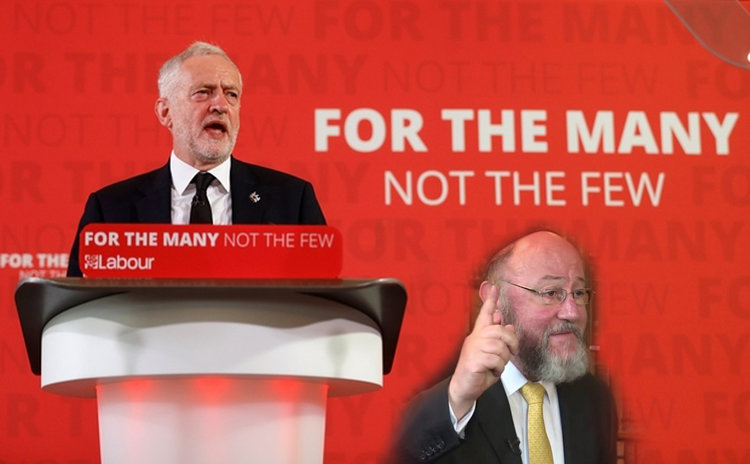
By Gilad Atzmon | July 17, 2018
The BBC reports this morning that Britan’s chief rabbi Ephraim Mirvis has said Labour will be “on the wrong side” of the fight against racism unless it toughens up its anti-Semitism code of conduct.
Rabbi Mirvis said Labour’s new anti-Semitism definition sent “an unprecedented message of contempt to the Jewish community”.
Apparently the Chief Rabbi is not alone. The J Post reports this morning that “Sixty-eight British rabbis signed an open letter decrying antisemitism in the country’s labor Party and calling on the party to accept the International Holocaust Remembrance Alliance definition of antisemitism.”
Labour has defended its new code as the most “comprehensive” of any party.
But one may wonder, why do we need a special definition for antisemitsm? Is a general and universal denouncement of racism, bigotry and discrimination of all kinds not sufficient? Are Jews somehow special?
The new Labour code does endorse the IHRA’s working definition of anti-Semitism and includes behaviours it lists as likely to be regarded as anti-Semitic – yet Jewish critics point out that it leaves out four examples from that definition:
* Accusing Jewish people of being more loyal to Israel than their home country
* Claiming that Israel’s existence as a state is a racist endeavour
* Requiring higher standards of behaviour from Israel than other nations
* Comparing contemporary Israeli policies to those of the Nazis
Far from being surprising, Corbyn’s Labour see Israeli criminality as a problem and insists upon the right to criticise the actions of the Jewish State and its lobbies in political, cultural and historical contexts.
Rabbi Mirvis attacked the omission of these examples by the Labour and said it was “astonishing that the Labour Party presumes it is more qualified” to define anti-Semitism than the Jewish community.
The Rabbi could be slightly confused here. Jews are more than welcome to define antisemitsm, as they like, but the labour party has the duty to define what it regards as an anti Jewish bigotry in accordance to its own alleged universal values.
Mirvis said Labour risked being on the “wrong side of the fight” against racism and intolerance
I would argue however that the Labour party, Rabbi Mirvis and most British Jewish institutions are on the wrong side of history here. If racism and Bigotry are defined as the discrimination of X for being X (X=woman, Jew, Black, Muslim, Gay, White etc.), then for Britain to move forward and to sustain the spirit of the common law, it must oppose all forms of racism and bigotry all together and equally.
To fight racism we need to follow one simple universal guideline rather than looking for the specific demands of one group or another.
Featured Video

The American Retreat from Vietnam
or go to
Aletho News Archives – Video-Images
From the Archives
The run up to the Iran war exposes inner workings of the US/Israeli deep state
By Justin K.P. | The Dissident | June 9, 2026
Taking a careful look at the run-up to the U.S./Israeli war on Iran exposes the inner workings of the U.S./Israeli deep state and the covert operations that the CIA and Mossad carry out around the world to lay the groundwork for war.
In this article, I will detail how the U.S. and Israel astroturfed protests in Iran, infiltrated them with rioters, and ran an atrocity propaganda campaign about Iran massacring protestors to manufacture consent for war.
This article will be an examination of the deep state’s war on Iran, prior to the full-scale U.S. invasion.
This article will be specific to Iran, but should be seen as a case study for how American, Israeli, and often British intelligence lay the groundwork for targets of empire around the world. … continue
Blog Roll
 Aletho News
- Documents Suggest Fauci Knew COVID Was Created in Wuhan Lab, and mRNA Vaccines Wouldn’t Work
- No return to pre-war status for Strait of Hormuz – Iran’s top diplomat
- Ex-South Korean President sentenced for trying to provoke conflict with Pyongyang
- US publishes docs on ‘dangerous’ Ukrainian biolabs
- Trump’s ERAM cruise missiles for Ukraine blow up his peace overtures to Russia
- EU state lifts arms embargo on Israel after spy scandal
- French watchdog reveals Israeli propaganda firm meddled in New York, Scottish, African elections
- Trump State Department Moves to Deport Trita Parsi
- UK judge brands Palestine Action activists ‘terrorists’ for storming Israeli weapons company
- Report: US military building new base near Gaza border to support post-war plan
- If Americans Knew
- The Issue of Israel Is Ending Democracy In Michigan
- Israel is stealing homes, livelihoods, and lives in West Bank
- Gaza is not an aberration – Israel planned this genocide decades ago
- Israel is changing the face of Lebanon, mainstream media is normalizing it – 3 articles
- Genocide lobby benefits from EU anti-racist fund
- Watching the World Cup from Gaza
- Israel to Blame for 56% of 22,600+ Civilians Killed by Explosive Weapons Globally Last Year
- Tucker Carlson and John Mearsheimer on Gaza, Ukraine, Iran, Russia & a Potential Nuclear Strike
- 88 attacks against Palestinian Christians recorded since start of year
- US administration investigating Iran war critic Trita Parsi, says report
- No Tricks Zone
- New Study: Significant CO2 Fluxes From Non-Volcanic Sources Are Largely Neglected In Carbon Budgets
- Women Climate Scientists Being Harassed, Insulted By Skeptics, Claims Berkeley Earth Researcher
- Germany’s Longterm Spring Climate Data Show “No Climate Trend”
- New Study: Solar Photovoltaic, Wind Power Fail To Meet Annual Energy Demands 62% Of The Time
- Germany’s Die Welt: “Too Much Is Too Much” … Green Energies Are Cannabalizing Each Other!
- Germany’s Ecological Holocaust… Once Fairy Tale Forests Getting Cleared For Wind Turbines
- A Grand Solar Minimum Has Arrived…Global Cooling Of At Least 1°C Is Expected By The 2030s, 2040s
- European “Expert Commission” Urges COVID-19-Like Global Climate State Of Energency!
- Real-World Observations Do Not Support The Position That Climate Change Is Human-Caused
- Germany’s AfD Party Calls Debunked Climate Scenarios “Greatest Fraud In Human History”
 Aletho News