UK Labour self-destructs under ‘anti-Semitism’ onslaught

Einstein’s famous quote, which most have never heard of. Now you know why.
By Stuart Littlewood | Veterans Today | August 22, 2018
The ‘anti-Semitism’ rumpus engulfing Jeremy Corbyn and tearing the Labour Party apart comes at the very moment when the country needs an alert and dynamic Opposition to May’s shambolic administration. The campaign, so obviously orchestrated by powerful pro-Israel interest groups to bring down Corbyn, threatens to derail all prospect of worthwhile change at the next election, which could be called anytime given the chaos over Brexit. This would be a calamity not just for Labour but the whole country.
The distraction is such a blot on the political landscape and so disruptive that Corbyn must neutralise it without giving ground. The question is how.
Clarity please – who are the Semites?
What is the argument about? It’s the S-word, ‘Semitism’. At least, that’s the cover-story. The real issue, as many realise, is something deeper. But let’s stick with ‘anti-Semitism’, which is the weapon. It is stupid to go to war without asking questions. So who exactly are the Semites? They may not be who they seem, or who we’re told they are. So let us first deal with the cover story, anti-Semitism, by setting up a learned panel to review the research by Shlomo Sand, Arthur Koestler, Johns Hopkins University and others, turn the S-word inside out, shake it all about, and establish (if that’s possible) who is, and who is not Semitic enough to be offended by certain remarks.
For example, DNA research by Johns Hopkins University School of Medicine and published by the Oxford University Press in 2012 on behalf of the Society of Molecular Biology and Evolution, found that the Khazarian Hypothesis is scientifically correct, meaning that most Jews are Khazars.
The Khazarians were never in ancient Israel. They converted to Talmudic Judaism in the 8th Century. Even if you believe the myth that God gave the land to the Israelites, He certainly didn’t give it to the Khazarians. Russian and East European Jews like the thug Lieberman, Israel’s defence minister, and countless others who flooded into the Holy Land intending to kick the Palestinians out, have no biblical or ancestral claim to the land.
Probably no more than 2% of Jews in Israel are actually Israelites, according to the findings. So most of those living today who claim to be Jews are not descended from the ancient Israelites at all. Palestinians, who are indigenous to the Holy Land, are the real Semites.
Of course, there’s no rush by Israelis or their admirers to acknowledge this.
Has the Johns Hopkins study been refuted? If they and others who came to the same conclusion have got it right, the whole anti-Semitism thing becomes an upside-down nonsense – a hoax – in which the anti-Semites are actually the racist Israeli regime and its Zionist stooges who stalk the corridors of power and have been oppressing the Palestinians for decades with impunity.
Until the topic is thoroughly aired and we have clarity, all anti-Semitism allegations ought to be withdrawn. And no organisation, let alone the Labour Party, should import any definition of anti-Semitism onto its rulebook without looking into the basics.
In the meantime, yes, Jeremy Corbyn needs to dislodge the anti-Jew morons and racist crackpots, of which there are many in all parties. He should also disband Labour Friends of Israel, an aggressive mouthpiece for a foreign terror regime that has no place in British politics.
Job done – Israel’s stooges now in control and doing the dirty work
Meanwhile the concerted fear-mongering by the Zionist Inquisition and browbeating by Jewish community leaders seems to have worked. As I write, Jeremy Corbyn is touring Scotland talking about important things like his ‘Build it in Britain’ plan to regenerate Scottish industry. But the media are gloating over a story involving a former Scottish Labour MP being suspended by his local constituency party and publicly shamed for alleged anti-Semitic remarks – on the strength of just one complaint apparently.
Furthermore the local party executive, in a statement, have already found him guilty. iNews and other media outlets report Renfrewshire North and West Constituency Labour Party Executive Committee as saying: “We fully condemn the anti-Semitic comments expressed by Jim Sheridan, and it is right that he is subject to a full investigation by the Labour Party…. The views expressed by Jim Sheridan in no way reflect the views of the members of the Labour Party in the Renfrewshire North and West constituency…. [His] comments are in direct conflict with the Labour Party’s values of anti-racism, equality and solidarity.”
That’s before he’s had a chance to defend himself.
Cllr Sheridan had tweeted: “For almost all my adult life I have had the utmost respect and empathy for the Jewish community and their historic suffering. No longer, due to what they and their Blairite plotters are doing to my party and the long suffering people of Britain who need a radical Labour government.”
Bearing in mind that the Jewish Leadership Council and the Board of Deputies claim to represent the Jewish community in the UK and have been instrumental in the damaging anti-Semitism campaign against Labour and Corbyn, it is difficult to see anything objectionable in Cllr Sheridan’s remark. But it amounts to a flogging offence, it seems, in the minds of some Labour officials.
Cllr Sheridan said he was restricted from making comment at this stage but told me, as a matter of fact: “I haven’t had a hearing yet or a date for that to happen. You may wish to know that I visited Auschwitz along with a group of schoolchildren and fellow MPs and saw at first hand the horrors and felt the pain and anguish the Jewish prisoners must have felt. Also, in all the years as an MP I signed the annual Holocaust remembrance book in the House of Commons.”
Does that sound like an ‘anti-Semite’ speaking?
In Renfrewshire they seem hell-bent on destroying the Labour Party’s credibility without any further help from the Israel lobby. It is a vivid example of self-harm by brainwashed twits from within. If the press story is to be believed, somebody makes an allegation, the accused is immediately suspended, publicly shamed and possibly has his reputation damaged irreparably without being heard and before the allegation is substantiated. The accused is gagged from making public comment while the local party executive committee feel free to pass judgement and prejudice the whole matter by declaring to the world that the accused is guilty and stating that nobody else in the local party shares his views. ‘Due process’ is conspicuously absent from the proceedings and party officials in Renfrewshire seem to think it’s OK to issue a statement condemning the accused when he hasn’t been told when his side of the story will be heard and by whom.
It’s medieval.
And last month another Scottish Labour councillor, Mary Bain Lockhart of West Fife, was suspended voicing suspicion that Israeli spies might be plotting to get rid of Jeremy Corbyn as Labour leader after three Jewish newspapers published a joint front page warning that a Corbyn-led government would pose an “existential threat to Jewish life in this country”.
She wrote on social media: “If the purpose is to generate opposition to anti-semitism, it has backfired spectacularly. If it is to get rid of Jeremy Corbyn as Labour Leader, it is unlikely to succeed, and is a shameless piece of cynical opportunism. And if it is a Mossad assisted campaign to prevent the election of a Labour Government pledged to recognise Palestine as a State, it is unacceptable interference in the democracy of Britain.”
She added: “Israel is a racist State. And since the Palestinians are also Semites, it is an anti-Semitic State.”
Those paying attention will remember, back in January 2017, revelations that a senior political officer at the Israeli embassy in London, Shai Masot, had been plotting with stooges among British MPs and other maggots in the political woodwork to “take down” senior government figures including Boris Johnson’s deputy at the Foreign Office, Sir Alan Duncan. It should have resulted in the ambassador himself, Mark Regev, a vile propagandist, a master of disinformation and a former personal spokesman for the Zionist regime’s prime minister Netanyahu, also being kicked out. But he was let off the hook. Regev is still here exercising his shifty talents and oiling his links to Mossad.
Masot’s hostile scheming was captured and revealed by an Al Jazeera undercover investigation and not, as one would have wished, by Britain’s own security services and press. “The UK has a strong relationship with Israel and we consider the matter closed,” said the British government. The Speaker of the House of Commons John Bercow, who is Jewish, also declined to investigate.
So Cllr Lockhart is entitled to be suspicious. Nevertheless a complaint about her remarks was lodged by former Labour MP Thomas Docherty. It was Docherty who wrote to the Culture Secretary in 2015 urging a debate to ban Hitler’s Mein Kampf, a best seller on Amazon, arguing that it was “too offensive to be made available”.
And Paul Masterton, the Tory MP for East Renfrewshire, complained that, given how “offensive” Cllr Lockhart’s comments were, the Scottish Labour leader Richard Leonard had been too slow to act and should have spoken out against her behaviour immediately. “Instead we have continued silence from him and a failure to prove to the Jewish community that he and his party are taking this issue seriously. It’s clear to the vast majority of people that Mary Lockhart is no longer fit to hold office, and Scottish Labour must understand that a suspension doesn’t go far enough.”
What the media didn’t tell us is that Mr Masterton is chairman of the All-Party Parliamentary Group on British Jews which is funded, supported and administered by The Board of Deputies of British Jews which, along with the Jewish Leadership Council and others is heavily implicated in picking a fight with Corbyn and trying to ram the IHRA definition of anti-Semitism, unedited, down Labour’s throat.
The IHRA definition, which has been allowed to consume Labour when the Party has better things to do, seems to be having its intended effect. It is obvious that many members still haven’t read the two caveats proposed by the Home Office Select Committee and the legal criticism by Hugh Tomlinson QC and Sir Stephen Sedley. Had they done so, more would insist on it being drastically modified or rejected altogether.
The Three Musketeers, Poison Gas, and Dead Schoolkids
By Michael Howard | American Herald Tribune | August 23, 2018
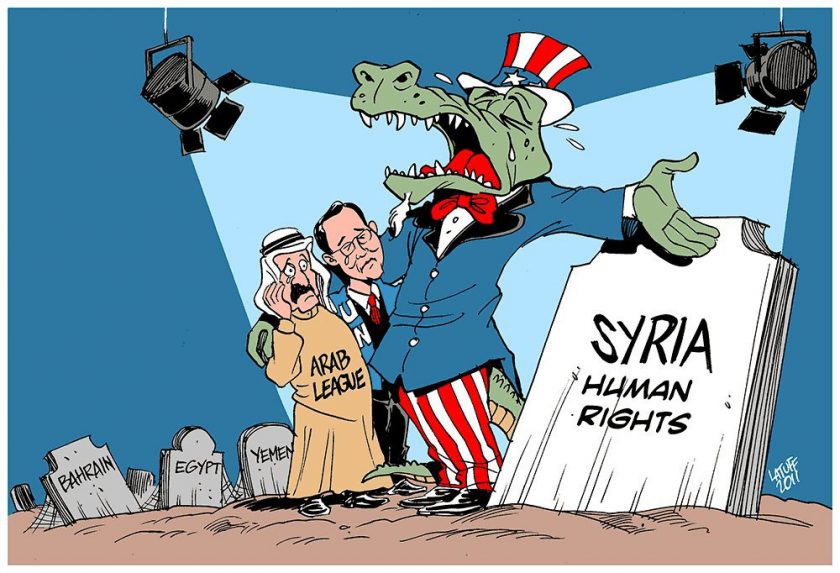
Winking and nodding to the “freedom fighters” hunkered down in the northwestern Syrian province of Idlib, the world’s schoolmarm (formally known as The West) has issued a stern warning to President Bashar al-Assad: don’t use chemical weapons “again,” or else. Said warning came via a joint statement from the US, UK and France (henceforth known as The Three Musketeers), as the Syrian government prepares its offensive to retake the country’s last remaining “rebel” stronghold. The three great and benevolent powers are “gravely concerned,” they said, about the upcoming military campaign, explaining:
We also underline our concern at the potential for further—and illegal—use of chemical weapons. We remain resolved to act if the Assad regime uses chemical weapons again. As we have demonstrated, we will respond appropriately to any further use of chemical weapons by the Syrian regime, which has had such devastating humanitarian consequences for the Syrian population.
Read it again, and take note of the crafty way in which the statement messes around with language to manipulate its target audience (us). The use of chemical weapons is accurately, and superfluously, described, and emphasized with em dashes, as “illegal,” as though there was a soul on this earth to whom this is news. Then, alluding to their coordinated missile strikes against Syria this past April, which were unleashed to much pomp and circumstance, The Three Musketeers pledge to “respond appropriately” to any such illegal action on the part of the Syrian government.
Since they insist on begging questions, we must insist on demanding answers. For instance, how “appropriate” was the aforesaid missile attack? Assuming that, in this context, a direct link exists between appropriate and legal (and only an outlaw could reject that assumption), there was certainly nothing “appropriate” about The Three Musketeers’ unilateral decision to use military force against a sovereign country last April. Quite the reverse.
The missile strike, like the one a year before, was carried out in flagrant violation of the law. There are a total of two circumstances in which the use of military force is legally justified: when greenlit by a UN Security Council resolution, or when done in self-defense, that is to say in response to a direct military attack. Neither condition was met when The Three Musketeers rocketed Syria. On the other hand, Syria is accorded the legal right under international law to strike back at its attackers, and moreover to form a coalition for that purpose. As Chapter VII Article 51 of the UN Charter states:
Nothing in the present Charter shall impair the inherent right of individual or collective self-defense if an armed attack occurs against a Member of the United Nations, until the Security Council has taken measures necessary to maintain international peace and security.
Mildly ironic, then—is it not?—that, in “appropriately” bombing the Syrian government, we granted it the legal right to bomb us back? It’s a crying shame: if only Assad and his allies were sufficiently nihilistic … we could’ve had another exhilarating World War on our hands—the third and last. To borrow a quote from of Trump’s favorite general: “Compared to war, all other forms of human endeavor shrink to insignificance. God help me, I do love it so.” On that note, I think it’s high time we substitute “War” for “God” in our Republic’s official motto. Who besides Rand Paul would vote against the proposal?
All of which is to say nothing of the fact that the alleged chemical attack in Douma, which served as the pretext for The Three Musketeers’ “appropriate” bombing raid, almost certainly didn’t happen. The first chink in the armor came in the form of Robert Fisk’s report, from the actual site of the alleged attack, that quotes a local doctor as saying:
There was a lot of shelling [by government forces] and aircraft were always over Douma at night—but on this night, there was wind and huge dust clouds began to come into the basements and cellars where people lived. People began to arrive here suffering from hypoxia, oxygen loss. Then someone at the door, a “White Helmet”, shouted “Gas!” and a panic began. People started throwing water over each other. Yes, the video was filmed here, it is genuine, but what you see are people suffering from hypoxia—not gas poisoning.
By his own count, Fisk interviewed more than twenty Douma residents; he was unable to find a single person “who showed the slightest interest in Douma’s role in bringing about the Western air attacks. Two actually told me they didn’t know about the connection.” Moreover, many of those he spoke with told him they “never believed in” the chemical weapons narratives promulgated by Western media.
Despite the fact that it squared with the Syrian Observatory For Human Rights’ (the West’s go-to authority on the Syrian conflict) assessment of the event, Fisk’s journalism was easy enough for Western ideologues to ignore or deride. He’s only one person, they countered, and he only spoke to a handful of residents and a single doctor, all of whom probably have a pro-Assad agenda. Therefore, his report is worthless and so is he.
This position grew a little less tenable when, a week after Fisk’s story was published, Russia presented to the Organization for the Prohibition of Chemical Weapons (OPCW), which was holding a conference in the Hague, seventeen eyewitnesses, a mix of residents and doctors, all of whom testified that there had been no chemical attack in Douma. As Jonathan Cook explained (yes, one had to visit his personal blog or some equally marginal source to read about this), “the US, UK and France boycotted the meeting, denouncing Russia for producing the witnesses and calling the event an ‘obscene masquerade’ and ‘theatre’”—not a very surprising reaction from a self-righteous party whose fabricated narrative is coming apart at the seams.
Then came the coup de grâce. On July 6, the OPCW published the conclusion of its fact-finding mission in Douma. Before quoting from it, I’ll jog your memory a bit. According to the Western version of events, Assad used both sarin and chlorine (or perhaps a physical mixture of the two, a nonsensical theory), in his attack on Douma—which, incidentally, had already effectively “fallen,” raising questions as to why Assad would feel compelled to use chemical weapons at all, apart from the sheer sadistic fun of it. Regardless, sarin and chlorine, said the West. Not so, said the OPCW:
OPCW designated labs conducted analysis of prioritized samples. The results show that no organophosphorous nerve agents or their degradation products were detected in the environmental samples or in the plasma samples taken from alleged casualties [my emphasis]. Along with explosive residues, various chlorinated organic chemicals were found in samples from two sites, for which there is full chain of custody. Work by the team to establish the significance of these results is on-going. The FFM team will continue its work to draw final conclusions.
Not a trace of sarin, in other words. Attempting to ascertain why “various chlorinated organic chemicals” were found at the site is a pointless exercise for someone, like myself, who knows nothing of chlorinated organic compounds. The most perfunctory research indicates that such chemicals are used for a variety of non-murderous applications, for example as solvents, and that they stick around for a long time after they’ve been introduced to an environment. The basic point, which hordes of media fixers promptly got to work obscuring, is that the Western narrative was false. The US government, in concert with its unctuous allies, lied. Go figure.
Of course, this isn’t the first time a supposed chemical attack in Syria has been called into question. Those curious about whether Assad used sarin to murder hundreds of civilians in the suburb of Ghouta in 2013, as was, and is, claimed by The West, would do well to read two essays by Seymour Hersh—“The Red Line and the Rat Line” and “Whose Sarin”—both published in the London Review of Books, both available online. Hersh also examined the chemical incident that took place in Khan Sheikhoun in April 2017—also used as a pretext for illegal US military action. This time, however, his reporting was too heretical even for the London Review of Books (not to mention the New Yorker), and so had to be published in Die Welt, which no one in the US has ever heard of, let alone read. That Hersh, the preeminent investigative journalist of his time, has been pushed into no man’s land speaks to how narrow the spectrum of permissible discourse has become in this, our great Republic. The schoolmarm is cracking her whip. At this rate Hersh will soon be relegated to the personal blog.
For other dissident views re: chemical weapons in Syria, do yourself a favor and consult the work of former UN weapons inspector Scott Ritter and MIT professor and munitions expert Theodore Postol, as well as the late journalist Robert Parry of Consortium News, all of whom have written extensively, and cogently, on the subject. Or you can keep reading the Washington Post. You’re free to decide.
But what exactly did The Three Musketeers have in mind when they broadcast their latest threat? It’s a fair question to ask. On its face, the statement appears to reflect a genuine aversion to poison gas, and a genuine hope that the Syrian government will refrain from using any in Idlib. Fair enough. Having said that, how averse could they really be, given that gas attacks provide for them the only remotely plausible excuse to lob more cruise missiles out of the Mediterranean—an activity from which they, and their media sidekicks, derive the utmost pleasure? They are, after all, incorrigible hawks. It must cut them to the bone to have to stand by and watch from the sidelines as a perfectly good war winds down, handcuffed, helpless to effect the desired outcome. How pitiable the plight of the poor impotent imperialist! Flaming warmongers need love too.
Anyway, call me schizophrenic, but when I read the words of The Three Musketeers, I couldn’t help but pick up the faint sound of a dog whistle—aimed straight at the “moderate rebels” holding down the fort in Idlib. Read between the lines, the statement is an assurance to one party dressed up as a warning to another. If there’s a “chemical incident,” we will attack: you have our word. That’s the message sent to, and received by, al-Qaeda (I don’t know what they’re calling themselves these days, and I care less) and its various affiliates. Make no mistake: The Three Musketeers have just invited, oh-so-subtly, bin-Laden’s foot soldiers to stage a chemical atrocity in Idlib (God knows how many “various chlorinated organic chemicals” they’ve got on hand there), the resulting pictures of which will duly splash across every television screen in America so as to whip up … well, you’ve heard this song before.
So here’s a new one: a bunch of kids walk onto a school bus in Yemen. As the bus steers through a crowded marketplace, Saudi Arabia drops a bomb on it, killing forty small children and injuring scores more. The bomb is later identified as a “laser-guided” precision missile (precision being the operative word), manufactured by our very own Lockheed Martin, while the mangled school bus is described by Col. Turki al-Maliki, spokesman for the Saudi-led coalition, as a “legitimate target.” Meanwhile, back in illustrious Washington, Pentagon bureaucrat Rebecca Rebarich is asked to comment on the “legitimate” massacre of forty schoolkids.
“The US has worked with the Saudi-led coalition to help them improve procedures and oversight mechanisms to reduce civilian casualties,” she says. “While we do not independently verify claims of civilian casualties in which we are not directly involved, we call on all sides to reduce such casualties, including those caused via ballistic missile attacks on civilian population centers in Saudi Arabia.”
Translated from vapid officialese: “I don’t really give a shit.”
On the bright side, we’re “gravely concerned” about the coming battle for Idlib, where the babies are beautiful and, most importantly, the bombs that kill them are un-American.
West leading campaign of hypocrisy on use of chemical weapons: Syria
Press TV – August 23, 2018
Syria has denounced a recent statement by the US, Britain and France on the alleged use of chemical weapons by the Damascus government, saying the trio is leading a campaign of misinformation against the Arab country in line with their support for terrorists.
An official source at the Syrian Ministry of Foreign Affairs and Expatriates told SANA news agency on Wednesday that the fresh Western threats against Damascus came amid the Syrian army’s territorial gains against foreign-backed terrorists.
Washington, London and Paris, in a statement on Monday, claimed that they “shared resolve to preventing the use of chemical weapons” by the government of Syrian President Basher al-Assad.
They also noted that their position on the Damascus’ “use of chemical weapons is unchanged. As we have demonstrated, we will respond appropriately to any further use of chemical weapons” by the Syrian government.
The statement was published on the fifth anniversary of the deadly chemical attack in the Damascus suburb of Ghouta in August 2013.
Elsewhere in his remarks, the Syrian Foreign Ministry source stressed that the Western countries had once again resorted to “a campaign of threats, hypocrisy and misinformation against the Syrian Arab Republic as part of the continued declared support for the armed terrorist groups, particularly Jabhat al-Nusra and its affiliated groups.”
“Syria has repeatedly asserted that it considers the use of chemical weapons immoral and condemns its use anywhere, under any circumstance and against anyone. Syria reiterates that it has no chemical weapons,” he added.
Syria surrendered its entire chemical stockpile in 2013 to a mission led by the Prohibition of Chemical Weapons (OPCW) and the UN.
The source also said it is not Syria which uses chemical weapons, but rather the armed terrorist groups that enjoy direct support from Western and regional countries such as Saudi Arabia, Turkey and Qatar.
Syria, the source added, has recently “informed the relevant international bodies about preparations by armed terrorist organizations to use poison gas in several areas” in the country.
The statement of these countries is nothing more than a sign of support for “any chemical aggression that these terrorist organizations may undertake in the next few days to use this as a pretext for aggression against Syria, as it did in its brutal aggression on 14 April 2018.”
The Western statement seeks to “justify the use of chemical weapons by terrorist organizations, prolong the war against Syria and support the terrorist organizations,” the source pointed out.
On April 14, the US, Britain and France launched a coordinated missile attack against sites and research facilities near Damascus and Homs with the purported goal of paralyzing the Syrian government’s capability to produce chemicals.
The strike came one week after an alleged gas attack on the Damascus suburb town of Douma.
Being Pro-Palestinian Doesn’t Make Jeremy Corbyn an Anti-Semite
By As’ad AbuKhalil | Consortium News | August 22, 2018
In the last few decades, public opinion in the West has shifted from the early, post- World War II period. Support for Israel has declined while support for the Palestinians has increased. This shift has been particularly pronounced among youth, especially those who are liberals or leftists.
The view was much different when Israel established its occupation of Palestine in 1948. But Israel has committed too many massacres and perpetrated too many invasions to maintain the status quo. Its war crimes have been televised too often for the world not to notice and popular opinion not to change. Mainstream print media no longer can control the narrative and mold the coverage of Israel and its offenses like it once did.
Still, while the base of the Socialist Party in France or the Labour Party in the United Kingdom has shifted in a more pro-Palestinian direction, much of the leadership of those parties continues to uphold Israeli dogmas. These are the same dogmas which all ruling parties of Europe and the U.S. and its establishment media have adhered to since the occupation began.
The U.S. is a prime example. Although the Democratic base has become more sympathetic to the Palestinians (and less supportive of Israel), the leadership of the Democratic Party has not wavered in its support for military and economic aid to Israel and for its unconditional support for Israeli wars and invasions with the mantra that “Israel has a right to defend itself.” This fact remains as true with Bernie Sanders as it is does with Nancy Pelosi and Hillary Clinton.
Defining Anti-Semitism

Corbyn: Accused
British Labour Party leader Jeremy Corbyn is the exception. Unlike Francois Hollande of France, Corbyn represents the progressive, youthful base of the his party on domestic and foreign policies.
His political rise poses a real problem for Israel. Therefore Tel Aviv’s latest target is Corbyn. Israel finds his stance worrisome because if he were to be elected prime minister, a real possibility, his views could influence a major shift in the foreign policies of other European ruling parties.
Various attempts therefore have been made to malign Corbyn and misconstrue his statements as racist. Corbyn obliged by giving a long interview to an Israeli publication in which he declared support for the occupation state.
But the more he gave in, the more the pressure increased. No matter what he had to say, it was not enough, and the accusation of anti-Semitism has been hurled in his face at an increasingly frenzied pace.
Corbyn’s repeated denunciations of anti-Semitism haven’t been sufficient because this is not really about anti-Semitism and its repugnance. The beef that British Zionists (and other Zionists especially in Israel) have with Corbyn is with his views on Palestine. He was asked to accept—without hesitation or equivocation—an Israeli definition of anti-Semitism, which was provided by the International Holocaust Remembrance Alliance (IHRA).
Insistence on accepting this definition is an attempt to force Corbyn to tailor his statements and beliefs on the Arab-Israeli question to the Israeli position. The Israeli establishment wants to prevent grass-roots views on Palestine among British progressives from being reflected in the stances of party leaders.
The “working” definition of the IHRA in many ways is quite accurate: “Antisemitism is a certain perception of Jews, which may be expressed as hatred toward Jews. Rhetorical and physical manifestations of antisemitism are directed toward Jewish or non-Jewish individuals and/or their property, toward Jewish community institutions and religious facilities.” This statement is indisputable and sums up the various forms of hatred of Jewish people.
Exaggerating Jewish power in society and believing in a global Jewish conspiracy (or promoting grotesque fakes, such as the Protocols of the Elders of Zion) are also manifestations of anti-Semitism. These ideas are not included in the IHRA definition (although some examples in the document later cover those forms).
Other examples the IHRA cites—such as “calling for, aiding, or justifying the killing or harming of Jews in the name of a radical ideology or an extremist religion”—cannot be debated. These vile sentiments are anti-Semitic and indeed represent a repugnant form of hatred. Of course anti-Semitism includes “accusing Jews as a people of being responsible for real or imagined wrongdoing committed by a single Jewish person or group.” (This same blanket denouncement of a group of people applies to Islamophobia today, incidentally.)
Prejudice vs. Propaganda
 The IHRA’s definition of anti-Semitism falters in its “guiding” examples and “illustrations” of anti-Semitism. In this regard, political considerations have been inserted into the definition. Combatting anti-Semitism always is—or should be—a humanitarian concern that goes beyond any political consideration. However, the IHRA reveals a political agenda: “Denying the Jewish people their right to self-determination, e.g., by claiming that the existence of a State of Israel is a racist endeavor.”
This is where we enter into the realm of Israeli propaganda. If one is to declare support for the rights of all religious groups to self-determination except the Jewish people, that would be anti-Semitism. But not every denial of religious rights of self-determination is anti-Semitic. What if one is opposed to the rights of self-determination for all religious groups without exception because one believes that the right of self-determination should be a political, and not religious, right?
Self-determination is tied to nationalist attachment to a piece of land. One has to ensure that a right of self-determination of one people does not impede or obstruct the right of self-determination of another people on the same piece of land. Maxime Rodinson, the French historian and sociologist, once observed, sarcastically, that there is no reason for one to oppose the establishment of a Jewish state, say, on the moon.
To support the right of Jews to self-determination when this self-determination has become bound up with Palestine—and only Palestine, when it wasn’t before the First Zionist Congress in 1897—is to deprive the native population of Palestine from their own right to self-determination.
Opposing the right of self-determination to Jews is not anti-Semitic if one is a) concerned about the right of the native population who were the original inhabitants of the lands or b) opposed to religious rights of self-determination as a matter of secular principle. If I am opposed to Muslim right of self-determination in California, can that be considered Islamophobic, if we follow the same Israeli logic?
As far as declaring Israel a racist state, that is hardly anti-Semitic. Remember, a majority of nations (75 to 35) in the world voted in the General Assembly of the United Nations in November 1975 (long before the U.S. imposed its will on the U.N. after the demise of the Soviet bloc) for the “Zionism-is-racism” resolution (which then was repealed in 1991). That is not in itself anti-Semitic.
Similarly, to accuse the Iranian regime or the Saudi regime of sexism or of repression is not Islamophobic. To criticize a state, or even to work for the dismantlement of its political institution, is not an act of hostility against the people of the state, even if that state—be it Israel, Saudi Arabia or Iran—may speak on behalf of the entire members of a particular religion in the world. (Just last week, the Saudi regime adopted the Israeli playbook and declared that any criticism of the regime is an insult to Islam and to Muslims).
Laws and practices in Israel are racist. Labeling them as such does not malign all Jewish people because all Jewish people should not be held responsible for the actions and crimes of the state of Israel. just as criticizing the misogyny of the Saudi regime is not Islamophobic. (There are, of course, critics of Israel who are anti-Semitic just as there are critics of Saudi Arabia or Iran who are Islamophobic, but the criticism in itself is not necessarily a form of prejudice).
On the contrary, to blame all Jews around the world collectively for the crimes and racism of Israel is anti-Semitism. And the Alliance concedes this last point, although it does not fit with the last example provided above.
Weaponizing the Holocaust
In recent years, Israel has resorted to classic manipulation tactics, perfected over decades, that conflate legitimate criticism about Israel with anti-Semitism. From early on in the history of Israeli immigration to Palestine, Israel attributed Palestinian opposition to its virtual invasion of Palestine to anti-Semitism—as if Palestinians would have been less opposed if Christians, Buddhist, or even other Muslims, were the ones taking over their homeland.
That Israel’s establishment took place in the wake of the horrors of the Holocaust made it easier for the Israeli occupation state to present the takeover of Palestine as a tribute to Holocaust victims. Palestine was not the only place where a haven for Jewish refugees could be found. The takeover treated the native inhabitants of Palestine as though they didn’t exist.
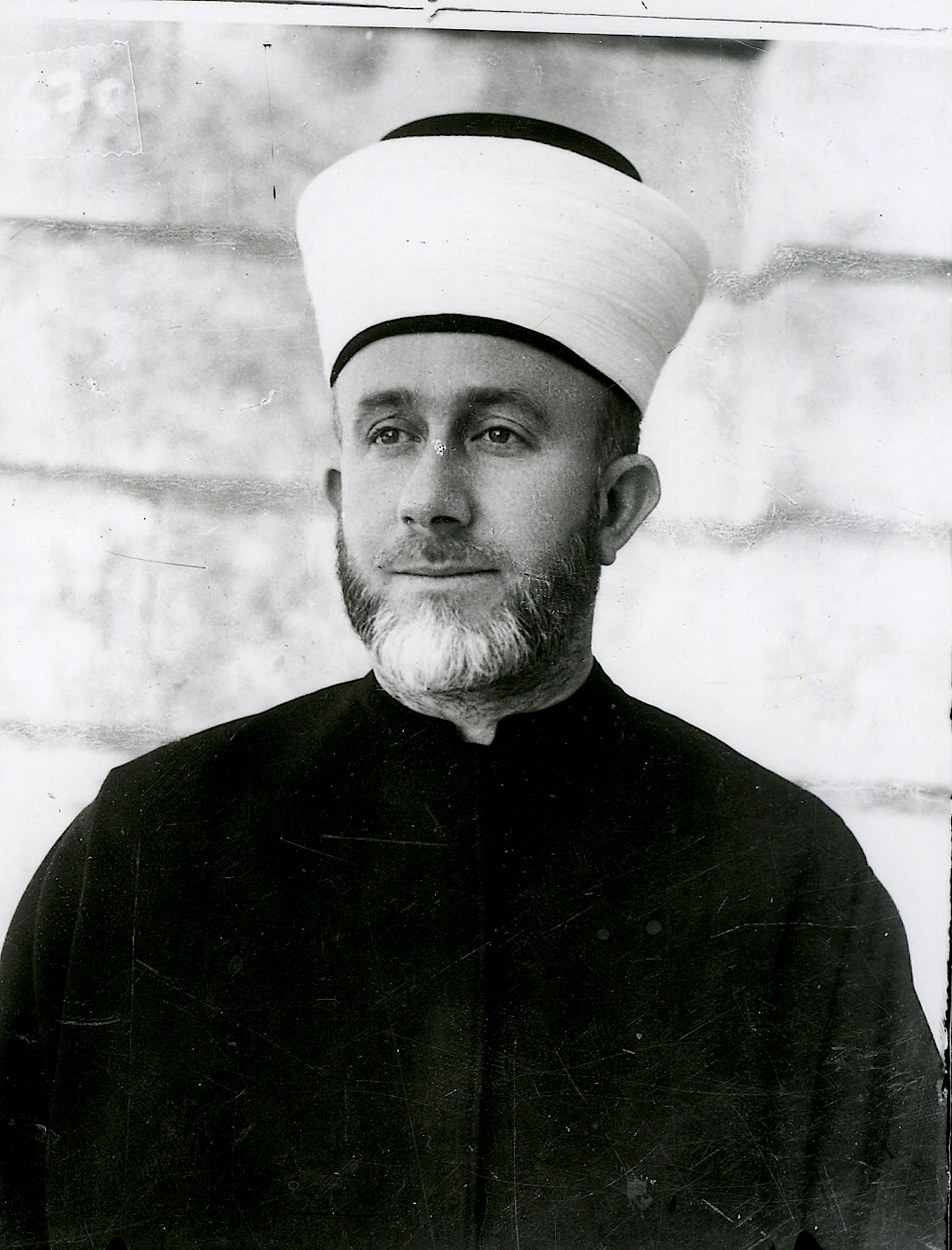
Successive Palestinian and Arab leaders resisting this takeover have been compared to Adolf Hitler. Amos Oz and Elie Wiesel never hesitated to equate the Palestinian national movement with Nazism. Benjamin Netanyahu recently decided to absolve Hitler of responsibility for the Holocaust and to instead blame Haj Amin Husseini, the grand mufti of Jerusalem from 1921-1948, for the designs and execution of Nazi war crimes. The more Israel finds itself in an untenable position, given the changes in world public opinion in favor of Palestinians and their rights, the more Israel and Israelis worldwide invoke the memory of the Holocaust and anti-Semitism to silence critics.
The question of comparing Israeli policies and actions with those of the Nazis is not a simple one. There is indeed a uniqueness to the horrors of the Holocaust that require special respect for its victims. To throw around the word “rape” in situations where there is no rape, is offensive to victims of rape. Similarly, one should not use the word “holocaust” casually because it connotes one of the worst crimes of the last century.
Husseini: Worst than Hitler, says Netanyahu
But Israelis can’t have it both ways. If the reason for their rejection of a comparison between Israel and the Nazi regime is out of respect for the victims of the Holocaust, then why did most—if not all—Israeli organizations (in the U.S. and elsewhere) popularize the comparison between the Syrian regime and the Nazi regime over the last few years of the Syrian war? Why do Israelis compare the Palestinian national movement to Nazism?
The Holocaust Museum in Washington, D.C. took a leading role in the propaganda production about Syria. Shouldn’t that be considered anti-Semitic, if a comparison between Israel and the Nazi regime is anti-Semitic? Either we reject any analogy between the Nazi regime and any other regime regardless of how criminal it is, or we accept it as part of the propaganda of war. Israelis can’t ban others from what they themselves permit themselves to do.
True Lies and False Virtue
Propaganda is how Israel still manages to find new and different ways to silence debate and ostracize dissent. Israel has campaigned to deny tenure to professors who are critical of its abuses (see Norman Finkelstein, Joseph Massad, Steven Salaita and others). Israelis say the Boycott, Divestment, Sanctions (BDS) movement should be legally banned and have lobbied state governments in the United States to ban boycotting Israel, which the ACLU among others see as a violation of the First Amendment. Israel has also launched an app that directs users to make negative social media comments. In general, Israel wants to impose a rigid uniformity of discourse and terms about the Arab-Israeli conflict.
Israelis fight—and kill—Arabs all over the world (Israel has not been shy about murdering Arab scientists, and U.S. media casually report on those assassinations without comments or repudiation). Arabs and non-Arabs cannot speak and write uncensored thoughts about the Arab-Israeli conflict without risking severe repression from the Israeli occupation state, including censorship on social media.
The war on Corbyn is a prominent part of Israel’s war on free speech in the U.K. and elsewhere.
Corbyn and other politicians should be expected to never resort to anti-Semitic expressions. But so far only evidence of his pro-Palestinian statements have been found and that should never be confused with the scourge of genuine anti-Semitism.
As’ad AbuKhalil is a Lebanese-American professor of political science at California State University, Stanislaus. He is the author of the Historical Dictionary of Lebanon (1998), Bin Laden, Islam and America’s New “War on Terrorism” (2002), and The Battle for Saudi Arabia (2004). He also runs the popular blog The Angry Arab News Service.
Now, This is Racism!
By Gilad Atzmon | August 22, 2018
What do you call an exclusively Aryan club that welcomes support from ALL members of society but only allows Aryans in as members?
Nazis I guess.
What would you call a white nationalist campaign organisation that welcomes support from people of ALL colours who agree with their ‘statement of principles’ but only allows nonwhites in as ‘solidarity members’?
I think that ‘white supremacist’ is the term the Left uses to refer to such groups.
Would Jeremy Corbyn accept support from groups that name themselves ‘Aryan Voice for Labour’ or ‘Whites for Corbyn’? Would the Labour party allow any such groups in its proximity? I don’t think so, they would be booted out in seconds. The Labour leader would be very quick to disassociate himself from such racially exclusive bodies. But neither Labour nor Corbyn have ever contemplated denouncing the Jews only, racially exclusive enthusiasts at Jewish Voice for Labour (JVL).
One finds the following statement on their front page.
“We welcome support from ALL members of the Labour Party who agree with our statement of principles. If you are not Jewish you can join us as a solidarity member.” (jewishvoiceforlabour.org.uk)
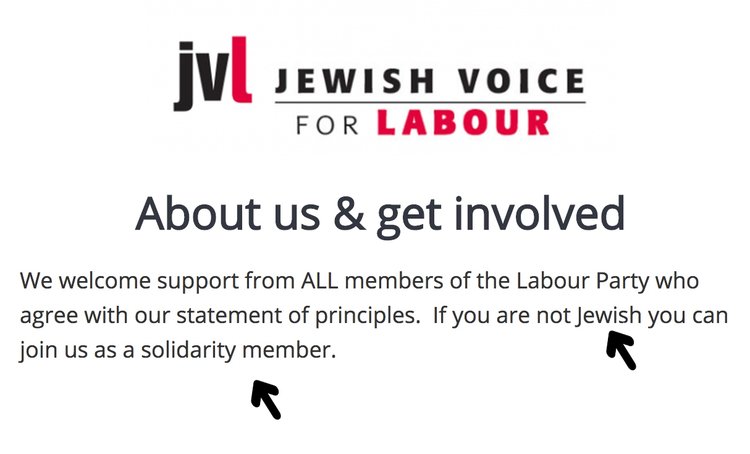
This means that even if you are not racially qualified as a Jew, you can still ‘support’ the Jews only group. You can make a donation, you may even be able to join their miniature protests but you will never be a proper member of the clan, you can only be a class B ‘solidarity member,’ like the Druze in Israel.
This is very revealing: first, it positively confirms that Corbyn isn’t an anti-Semite. He may even embrace Jewish racism when it is executed to support him. A less positive observation is that Jewish racism may be attached to most if not all forms of Jewish politics. Without Jews being a race or forming a racial continuum, Jewish politics is, unfortunately, racially oriented. Every political Jewish activity seems to adhere to a certain type of Jewish tribal biologism. Shockingly, it seems that Israel is slightly less racist (for the time being) than the JVL. While in Israel the 3rd biggest party in the Knesset is an Arab Party, in Jewish Voice for Labour, Arabs and Goyim can only participate as ‘solidarity members.’
Since JVL accepts support from Goyim who agree with their Statement of Principles I decided to examine how unprincipled their statement is.
“Jewish Voice for Labour is a network for Jewish members of the Labour Party.” What qualifies one as a Jew, is it the mother’s blood or is it merely the sustained consumption of chicken soup? The JVL doesn’t provide an answer. We can assume that for JVL, Jews are those who fit biological criteria, otherwise they would provide a chicken soup recipe for those who insist upon joining their ranks as equal members.
“Our political priorities are universal human rights and dignity; justice for all; freedom of expression; and democracy in the Labour Party.” This sounds spectacularly good, but begs the question of how they claim to adhere to universality when they don’t even accept Goyim as equal participants in their club. Apparently the ‘solidarity members’ do not enjoy voting rights as the JVL’s constitution specifies that the organisation is led by Jewish people. The inevitable answer is that the JVL’s statement is duplicitous at its core.
And the lies continues: “Our mission is to contribute to making the Labour Party an open, democratic and inclusive party, encouraging all ethnic groups and cultures to join and participate freely.” The Labour Party should be an ‘open space,’ but the JVL is clearly not. It is a tribal, racially exclusive setting that operates in total contradiction of every Labour Party value.
And again, “we (JVL) aim to strengthen the party in its opposition to all forms of racism including anti-Semitism.” The JVL is against all forms of racism except their own. I am pretty sure that the JVL would oppose groups called ‘Aryans for Jeremy’ or ‘White Voices for Labour’ but for some reason they fail to see that they themselves engage in identical racist activities.
The JVL opposes Israeli criminality and this is a good thing. “We stand for rights and justice for Jewish people everywhere, and against wrongs and injustice to Palestinians and other oppressed people anywhere.” A welcome statement, but if you are against Zionist injustice, why do you repeat the Zionist procedure by making non-Jewish Labour members into class B members of your ranks?
I agree with many of JVL’s ideas. The Jewish group opposes “attempts to widen the definition of antisemitism beyond its meaning of hostility towards or discrimination against Jews as Jews.” Yet, I wonder why these Jews feel the need to do it while celebrating their Jewish privilege in Jews only political cells? If, as they claim, they uphold a universal ethical stand, then surely they should operate as ordinary humans as the universalist Labour standard would dictate.
My answer is this: they do it because: 1. they are not the most sophisticated amongst people, 2. in total contradiction to their statement, they actually enjoy celebrating their Jewish privilege and operating in racially exclusive political cells, and 3. the Jewish activism in support of Jeremy Corbyn reduces any questions regarding Corbyn’s electability into an internal Jewish affair. Once again, the Goyim are excluded from the debate over the prospects of their own futures.
The only question left open for the time being is why Jeremy Corbyn allows all of this to happen within the Labour Party.
The 10 Main Holes in the Official Narrative on the Salisbury Poisonings: #2 – The Intent
By Rob Slane | The Blog Mire | August 21, 2018
In the first piece in this series exposing the holes in the official narrative of the Salisbury poisonings, I looked at Theresa May’s claim of what she said was “the motive” behind the incident. In this piece I want to move on to what she called “the intent”.
Once again, I turn to the statement she gave to the House of Commons on 26th March, as it essentially sets out sets out the Government case for what happened in Salisbury on 4th March:
“In conclusion, as I have set out, no other country has a combination of the capability, the intent and the motive to carry out such an act.”
What is meant by intent? Here is a definition from the online Legal Dictionary:
“A determination to perform a particular act or to act in a particular manner for a specific reason; an aim or design; a resolution to use a certain means to reach an end.”
Intent is not action. Nor is it motive. Rather, it is the purpose of using deliberate means to bring about a particular result. A prerequisite of showing that a person or a group of people had intent to commit a particular crime, is therefore to show that they did actually commit the crime for which you are alleging they had intent.
Say I were to claim that Brian drove his car into Bob, and that he did so with deliberate intent. If I have shown that Brian did actually drive his car into Bob, then I have the right to build a case that he did so with intent. But what if I have not actually shown that Brian drove his car into Bob? Quite simply, my statement of Brian’s intent is at best nonsense, at worst slander.
To accuse someone of doing something with intent is not therefore something which can be done blithely; rather, it is something which requires, in the first place, hard evidence to show that the person actually carried out the action. According to Mrs May, this is just what she did, since she began her speech by emphatically stating who was guilty of the poisoning:
“Three weeks ago, the Russian Federation was responsible for an attempted murder here in our country.”
And after setting out her “evidence”, such as it was, she stated that:
“In conclusion, as I have set out, no other country has a combination of the capability, the intent and the motive to carry out such an act.”
But what actually was the evidence she presented? Here it is, in all its entirety:
“Mr Speaker, we are quite clear that Russia was responsible for this act. As I set out for the House in my statements earlier this month, our world-leading experts at the Defence Science and Technology Laboratory at Porton Down positively identified the chemical used for this act as a Novichok – a military-grade nerve agent of a type developed by the Soviet Union.
We know that Russia has a record of conducting state-sponsored assassinations – and that it views some former intelligence officers as legitimate targets for these assassinations.
And we have information indicating that within the last decade, Russia has investigated ways of delivering nerve agents probably for assassination – and as part of this programme has produced and stockpiled small quantities of Novichoks.”
How much of this constitutes evidence of the guilt of the Russian Government in the Salisbury poisonings? None whatsoever. I will look in more depth at her first piece of evidence in a subsequent article, suffice it to say here that it has been amply demonstrated in many places that:
a) The fact that the Soviet Union, which was dissolved on 26th December 1991, was attempting to develop a certain type of nerve agent says nothing about where the substance used in Salisbury came from or who made it.
b) Numerous other countries have the knowledge and the capacity to create the substance mentioned, and many have in fact done just this.
 As for her other two claims, they are just that: claims. Nothing more, nothing less. They in no way constitute evidence of culpability in the Salisbury case, and certainly no court of law would accept them as such. Rather, they are simply general assertions masquerading as evidence, made in the hope that nobody would notice that this is what they are. Apparently it had exactly this effect on the lawmakers in the House she was addressing, since none of them bothered to question her about it.
What Mrs May therefore did in this statement, was to invert the legal process. Rather than proving the case that the Russian Government was behind the Salisbury poisonings, then alleging intent on this basis, she instead alleged responsibility using a series of very general claims, none of which had any specific connection to the Salisbury case, and then used this unproven guilt to allege intent. They were responsible, therefore they had intent. They had intent, therefore they were responsible. All made without any actual evidence of responsibility for the Salisbury incident, and all done without any actual evidence of intent for the Salisbury incident.
I’m almost tempted to say that she used circular reasoning, but this would be an insult to circles, which are beautiful, smooth, symmetrical shapes, as indeed it would be an insult to reasoning. It’s more like a blob. Blobby, messy, meaningless unreason, which apparently none of our nation’s MPs was able or willing to spot and hold her to account for.
There is one more thing. Two days after her statement, the Metropolitan Police Force released an update on the investigation, in which they said the following:
“This is one of the largest and most complex investigations undertaken by British counter terrorism policing and we thank the public for their continued support.
As a result of detailed forensic and scientific examination, detectives believe the Skripals first came into contact with the nerve agent at their home address. Specialists have identified the highest concentration of the nerve agent, to-date, as being on the front door of the address.
The Wiltshire Police support to the Counter Terrorism Policing Network investigation remains ongoing and is likely to do so for a number of months. It is an extremely challenging investigation and police and partners continue to manage a number of unique and difficult issues. We thank the public for their continued support.”
Three brief observations. Firstly, the investigation was extremely complex and likely to last a long time, indicating that guilt, let alone intent, cannot possibly have been established at that time. Secondly, investigators had only just begun to establish the place of the poisoning (“detectives believe…”), again indicating that guilt, let alone intent, cannot possibly have been established at that time. Yet in spite of this, Theresa May apparently already knew what happened, and had established responsibility, motive and intent. In which case, why bother wasting all that police time, effort and resources on investigating the incident. They could have saved a bob or two of taxpayers money by just asking Theresa the Seer.
The 10 Main Holes in the Official Narrative on the Salisbury Poisonings: #1 – The Motive
The 10 Main Holes in the Official Narrative on the Salisbury Poisonings: #2 – The Intent
The 10 Main Holes in the Official Narrative on the Salisbury Poisonings: #3 – The Capability
The 10 Main Holes in the Official Narrative on the Salisbury Poisonings: #4 – The Missing Four Hours
The 10 Main Holes in the Official Narrative on the Salisbury Poisonings: #6 – The Meal and The Drink
SYRIA: The Emerging Reality of the U.S Coalition Regime Change War – On the Ground Reporting

Life and food return to Douma after liberation by SAA from Saudi-backed, UK-promoted Jaish Al Islam terrorists. (Photo: Vanessa Beeley)
By David Macilwain | 21st Century Wire | August 20, 2018
The withdrawal of US coalition support for “rebels” in Syria, portrayed as a failure to achieve noble and humanitarian goals by Western governments and media, should rather be seen as an admission of guilt. The rescuing of violent militants and “White Helmets” from Southern Syria by Israeli forces actually marked the failure of the covert project to forcibly replace Syria’s legitimate government with one of NATO’s choice, regardless of the democratic will and lives of the Syrian people.
Before we can ask “what if?” about the war on Syria, as Ramesh Thakur does in “The Strategist”, republished here on P&I, we need to understand what actually happened during the Western-sponsored seven-year long assault on the Syrian state, as seen from the perspective of those on the receiving end of this attack. Now that the Syrian Arab Army and its allies are finally prevailing in their defence of the country and its citizens, it is also time for Western commentators to stop repeating the same vapid accusations against the Syrian President, and instead start making accusations against their own “mis-leaders”.
Rather it appears that many in the West are entrenching their opposition to the Syrian government at the same time as millions of Syrians are confirming their support for it, and the armies that have fought off their enemies’ chosen alternative.
Ramesh Thakur’s partisan view on the “Syrian civil war” and the benign nature of the West’s intimate involvement in it is evidently shared by the Australian Strategic Policy Institute, and – one would imagine – by many of those in public office who act on its advice. The same innocence could not be assumed for ASPI sponsors, – defence contractors Lockheed Martin and Thales – who profit from that advice, nor presumably for Australian Intelligence agencies and their overseers in the government.
Back in May, and only weeks after the latest US/UK/French missile attack on Syria, I visited Damascus with my partner, and was able to verify the essential truth of reports from Syrian sources on the situation there, both in regard to the recent campaign to liberate Eastern Ghouta from armed militants, and more generally through personal contact with Syrians.
What we found however was both surprising and heartening; here was a country full of hope and passion, finally celebrating its imminent victory against one of the vilest and most devious enemies in history, led and supported by the most powerful and determined regimes in the world, including our own. Despite the harrowing cost to Syrian society, with over 80,000 regular Syrian soldiers killed, the people were strengthened and united behind their defence forces and their President.
In the seemingly endless fight against foreign-backed and foreign-armed insurgents, every Syrian now has a friend, relative or partner who has “died for his country”, killed, injured or tortured by these “barbarian invaders”. Even in Damascus an estimated 11,000 innocent people have been killed by “rebel” mortars and sniper fire from nearby suburbs.
Visiting a Government camp for the displaced residents of those same rebel-occupied Eastern suburbs of Damascus – Eastern Ghouta – brought home to us what this really means. The people sheltered and fed there – 15,000 in mid-May – had many stories to tell of the years they were held under siege in their communities by the violent militants of Jaish al Islam and Faylaq al Rahman, as well as of the behaviour of the so-called “White Helmets” who worked hand in hand with these terrorist groups. My colleague Vanessa Beeley, who visited the same camp a week earlier and conducted many interviews with Douma and Hamouriya residents has written comprehensively on their experiences; alone her report utterly condemns and exposes the lies and misinformation to which Australian and Western audiences have been subject on the “siege of Eastern Ghouta” and its denouement in the criminal Douma “gas attack” provocation.
Beeley had already exposed the incriminating truth of the previous US alliance campaign over East Aleppo, and the cooperation between the US/UK supported White Helmets and Al Qaeda that effectively prevented the city’s liberation for months in 2016.
It was likely at that point that Russia concluded that the US administration was “non-agreement-capable”, – a situation little altered by the subsequent change of US leadership. Progress towards a resolution of the conflict – in Astana – was then only made because the US was excluded, along with those Opposition groups that refused any compromise with the Assad government.
It is the nature of these Opposition groups, still supported by Western powers including Australia as some legitimate alternative to Syrians’ choice of government, which continues to elude most Western commentators. These groups were cultivated primarily by the Saudis, and reflect their extremist Wahhabi vision of ideal government as well as being associated with the worst terrorist groups operating in Syria. Had he not suffered a timely demise at the hands of Syrian security forces, the notorious terrorist and former leader of Jaish al Islam Zahran Alloush would have been in the running for Syria’s new leadership.
It is in this context that we ask “what if?” the Syrian government had been forcibly replaced by one of the West’s choosing; it belies both the intentions and the actions of the NATO – Saudi – Gulf state coalition, who ploughed billions in arms and support to these very immoderate groups to achieve their own objectives – which had nothing whatsoever to do with “humanitarian intervention” or “democratic reforms”.
By contrast, what actually happened in Syria, and in the main stronghold of Jaish al Islam in Douma, was all too easy to see on the ground. Our visit to Douma hospital, scene of the White Helmets’ most recent criminal fabrication, proved shocking even with what we already knew about the situation. Their claims of a chemical weapon attack, and staged “water-hosing” treatment for its alleged victims in the hospital’s emergency ward, continue to be endorsed by Western commentators like Thakur as well as governments, NGOs and the UN, despite being comprehensively exposed as false.
This remains the case even following the testimony of supposed gas victims seen in the staged video, brought to the Hague by Russia, and the findings of the OPCW showing no presence of chemical weapons residues at the site.
Many commentators have evidently now become impregnable bastions of the false Syrian chemical weapons narrative spread by their governments; in a previous article while discussing the Khan Shaikoun “gas attack” a year earlier, Ramesh Thakur quite wrongly concludes that the Syrian government was proven responsible.
While he cites the UNHRC and the UN-OPCW “evidence” as endorsement of this position, both bodies actually relied on second hand information from Opposition sources only, and refused Syria’s invitation to visit and inspect the Shayrat airbase from which they claimed the chemical weapons had come. Their duplicity was exposed when the US coalition sought to reinforce the mandate for the JIM at the Security Council over the Douma incident; Russia rightly vetoed this clearly disingenuous proposal.
In fact there was nothing for such a commission to investigate in Douma, as Russian and Syrian investigators had already found no toxic chemicals at the alleged site, and hospital staff denied knowledge of any such attack. But what proved really shocking to see at Douma hospital was the sophistication and extent of the tunnel system built beneath it. Canadian investigative journalist Eva Bartlett, who visited Douma just before we did, posted this article that includes video of her exploration of this extraordinary tunnel system, as well as corroborating interviews about the fabricated chemical weapons stories from many residents. The tunnel network not only allowed the armed militants of Jaish al Islam and Al Qaeda – along with their White Helmeted “partners” – to enter and take over the hospital whenever they wished, but protected them from Syrian and Russian bombs.
The belief amongst Syrians that these jihadist/terrorist groups were being assisted by foreign Special Forces, not just in constructing and equipping the tunnel system but in directing and coordinating the “underground resistance” was confirmed during the final evacuation of the Douma “jihadists” on buses to Northern Syria; special forces from Britain, Turkey and other countries were reportedly apprehended trying to escape with them. The MOD naturally denied this collusion, but events in Southern Syria last month, when hundreds of foreign fighters and White Helmets were “rescued” by their closest local ally Israel, seem to confirm and reinforce the Russian and Syrian claims.
While the Syrian people are remarkably forgiving, and focused on recovery and reconciliation within their own territory, few would not now lay blame for the death and devastation inflicted on the fabric of their society at the feet of the US-led coalition – of which Australia has been an integral part. Responsibility for the countless atrocities committed by the hundreds of violent sectarian militias, including Al Qaeda and Da’esh/Islamic State, lies squarely with those countries who conspired to assist them with rivers of weaponry and a tide of propaganda, like – in Trump’s words – “the world has never seen”; this was a conspiracy that began long before the “uprising” of March 2011.
Those who ignore the Syrian reality – that stares in the face of those who deign to look – and so allow this mountain of lies to remain even as another Western regime-change scheme gets under way, should also now prepare their defence; ignorance can no longer be an excuse.
***
David Macilwain is an independent observer and writer with a special focus on the war on Syria and its allies. He writes voluntarily for Russia Insider and the American Herald Tribune, from his home in the hills of NE Victoria. He visited Syria in May independently and at his own expense.
Professor Mohammad Marandi on BBC HARDtalk
August 14, 2018
HARDtalk’s Stephen Sackur speaks to Iranian political analyst and erstwhile nuclear talks adviser Mohamed Marandi.
The 10 Main Holes in the Official Narrative on the Salisbury Poisonings: #1 – The Motive
By Rob Slane | The Blog Mire | August 18, 2018
When I began writing about the Skripal case, I was moved to do so by three main considerations.
Firstly, I really am passionate for the truth, and whatever the truth happens to be in this case, I strongly desire it to be made manifest. It was clear to me fairly early on that this was not happening.
Secondly, I am also very passionate about concepts such as the rule of law, innocent until proven guilty, and the apparently quaint notion that investigations should precede verdicts, rather than the other way around. And so when I saw accusations being made before the investigation had hardly begun, verdicts being reached before the facts were established, I was appalled — appalled that this was happening in what we British pride ourselves is the Mother of Parliaments, and equally appalled that this meant the investigation was inevitably prejudiced and – pardon the expression – poisoned from the off.
Thirdly, the incident happened to have taken place pretty much on my doorstep, which made it of even more interest to me.
Nothing I have seen in the intervening time has persuaded me that my initial impressions were wrong. In fact, the whiff of rodent I first detected has only become stronger as time has gone on and the case has become — frankly — farcical. Not only that, but the reaction to the case has been simply incredible. For instance, the United States expelled 60 diplomats back in March, and more recently they have effectively declared economic war on the Russian Federation – all in response to unproven and inconsistent assertions of a botched assassination attempt against an old spy in a quiet Wiltshire City. Such a response ought to raise the suspicions of any sentient being that all is not what it appears.
I still do not have any clear idea of what happened on that day, but what I am certain of is that the official narrative is not only untrue, but it is manifestly inconceivable that it could be true. There are simply too many inconsistencies, too many holes and far too many unexplained events for it to be true. And whilst part of me would dearly love to leave this wretched case behind for a while, whilst it is still ongoing, and especially as it is now being used to push us even closer to the brink of war (economic warfare is often a prelude to military warfare), I find that hard to do.
What I would therefore like to do in a series of 10 short pieces over the next couple of weeks or so, is attempt to expose some of the very many holes in the official narrative. At the end of it, I may well put it all together into one PDF, so that it can be sent somewhere, where it can be completely ignored by those that matter. Enjoy!
Number 1: The Motive
In her speech to the House of Commons on 26th March, the Prime Minister, Theresa May, said this:
“In conclusion, as I have set out, no other country has a combination of the capability, the intent and the motive to carry out such an act.”
For the purposes of this piece, I am not interested in her comments on capability or intent, but simply what she describes as “the motive”.
The first question to be asked is this: What exactly does she mean by “the motive”? By including that definite article before the word “motive”, she implies that there is only one “motive” – the motive – and that only one party – the Russian Federation – possessed this. Which is of course manifest nonsense. She might at that stage have said that they possessed “a motive”, but without looking into what Mr Skripal was up to, and the contacts he had, she was in no position to state that they had “the motive”.
Imagine the following scenario: A farmer called Boggis is found shot dead in his barn. It is known that a week earlier, he had a very public quarrel with another landowner, Bunce, about the boundaries between their lands, and that the two of them had to be separated before they came to blows. Could it be said of Bunce that he had “the motive”? Well, it would be reasonable to suggest that he had “a motive”, but without looking into other circumstances and other characters connected with Boggis, it would be disingenuous to claim that he had “the motive” as if only he might have had one.
As it happens, Boggis had been committing adultery with the wife of another neighbouring farmer called Bean, and Bean had found out about this two days before Boggis was found dead. What now? Does Bean have a motive? Very possibly. So too might Boggis’ wife. Perhaps even Bunce’s wife. Who knows without examining the facts more closely?
And so herein lies the first whiff of rodent. Mrs May asserted that the Russian Federation possessed “the motive”, implying that there was only one possibility, which is something that could only be ascertained by proper investigation of Mr Skripal, his circumstances and what he was up to. She therefore committed what is a most basic fallacy in the investigative process.
The second question to ask is this: she says she set out “the motive” in her speech, but what actually was that? Here is what she presented as the motive in her speech:
“We know that Russia has a record of conducting state-sponsored assassinations – and that it views some former intelligence officers as legitimate targets for these assassinations.”
This won’t do. Firstly, many countries have records of conducting state-sponsored assassinations, and not always against their own nationals. But secondly, the claim that the Russian Federation “views some former intelligence officers as legitimate targets for these assassinations” is not a motive. At best it is a claim, but it is not a motive. A motive for an attempted murder, such as this, would need to give a reason for carrying it out on that particular person at that particular time. Simply saying that they view some former intelligence officers as legitimate targets for these assassinations does not explain why they are supposed to have decided to assassinate this particular man, at this particular time, especially since they released and pardoned him in 2010. It also does not explain why they apparently decided to wreck all possible future spy swaps, since Mr Skripal had been part of such a deal, and assassinating him would put an end to such deals.
But the most important question to ask is this: are there any other parties with a possible motive for this crime? Even without a particularly careful investigation of the details of Mr Skripal’s life, contacts and circumstances, I can say assuredly that there were. For instance, it is known — although woefully unreported because of a media ban — that Mr Skripal was connected to the man behind the so-called Trump Dossier, Christopher Steele. Personally, I am reasonably convinced that Mr Skripal had a hand in putting this dossier together, given his connections to Steele, and since it was almost certainly authored by a Russian “trained in the KGB tradition”. Might this give a motive to some very powerful groups who are nervous about the origins and details of this dossier coming to light? Yes, of course. Then why is it not a line of possible enquiry? Answers on a postcard to the Department of the Blindingly Obvious.
In summary:
- Mrs May had no right to state that the Russian Federation had “the motive”. The best she could have said at that stage, without taking other possibilities into account, was that they had “a motive”.
- The motive she does present is particularly feeble and does not explain why the Russian Federation would have wanted Mr Skripal in particular dead, and at that particular time.
- Mr Skripal’s recent activities indicate that there were others with possible motives to assassinate or incapacitate him.
The 10 Main Holes in the Official Narrative on the Salisbury Poisonings: #1 – The Motive
The 10 Main Holes in the Official Narrative on the Salisbury Poisonings: #2 – The Intent
The 10 Main Holes in the Official Narrative on the Salisbury Poisonings: #3 – The Capability
The 10 Main Holes in the Official Narrative on the Salisbury Poisonings: #4 – The Missing Four Hours
The 10 Main Holes in the Official Narrative on the Salisbury Poisonings: #6 – The Meal and The Drink
Jews, Logic and Corbyn
By Gilad Atzmomn | August 18, 2018
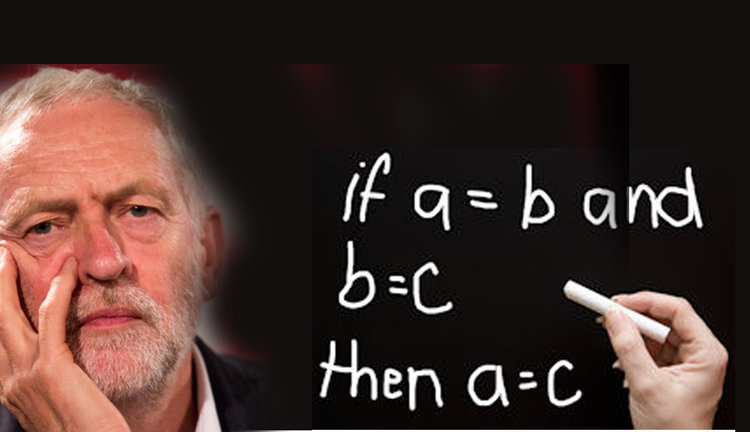
According to the Transitive Axiom if A=B and B=C then A = C (If any two items are equal to the same third item then the two are equal to each other).
I mention the Transitive Axiom because it is a straightforward way to understand that if Corbyn (A) = existential threat to Jews (B) and Hitler (C) = existential threat to Jews (B) then Corbyn (A) = Hitler (C).
Every day British Jewish community leaders tell us that it will pose an “existential threat” to British Jews if Corbyn ends up in 10 Downing Street. It seems some British Jewish leaders are either delusional or stupid enough to believe that Corbyn and Hitler are one and the same. A few weeks ago, the three main British Jewish papers joined forces to deliver this humorous message in a single voice: ‘Corbyn poses an existential threat to our community.’
Today, Jonathan Goldstein, head of the Jewish Leadership Council repeated the same message in an interview with the Times of Israel. “We are nervous about this man (Corbyn) becoming prime minister. We see the possibility of a Labour government led by this group as an existential threat to our community. These are unprecedented times.”
Jewish religion and culture are saturated with purported ‘existential threats.’ Jews are advised to “remember Amalek” the archetypical Biblical existential threat. Purim, the most joyous Jewish holiday, is a celebration of the Jewish victory over Haman, who was another existential threat. The holiday commemorates the killing of Haman as well as the massacre of 75,000 of his associates. Even Jesus is perceived by some rabbinical sects as not only an arch enemy but an existential threat as well. Yeshu, the Hebrew name used for Christ , is an acronym for the formula Y’mach Sh’mo V’Zichro meaning ‘may his name and memory be obliterated’– a term reserved for the bitterest enemies of the Jews (Hitler, Amalek, etc.). A few years back, yours truly was an existential threat in the eyes of the delusional Alan Dershowitz.
I hope that the Zionist campaign against Corbyn is not going to mature into a jubilant Jewish holiday or, God forbid, a Purim spirited lethal attack on his many supporters. I point at the absurdity of the Zionist zeal because judging by the language used by British Jewish community leaders, they see Corbyn as up there with Amalek, Haman and Hitler.
This is probably the right time to remind ourselves and British Jewish leaders of another fundamental mathematical axiom, namely the Symmetric one — If a = b then b = a.
If Corbyn = Hitler then we can assume that Hitler = Corbyn. This could be a dangerous path for British Jews, especially considering the fact that despite the relentless Zionist campaign against him, Corbyn is still leading in the polls. In other words, if Hitler = Corbyn and Corbyn is supported by a majority of Brits who see him as an anti-racist and a humanist, some Brits may begin to entertain the possibility that maybe Hitler was only just as bad as Corbyn. I guess that this is what many Jews regard a ‘holocaust denial.’ But, as things stand, they have only themselves to blame — it is the British Jewish leadership that introduced this absurd equation and has foolishly continued to push it on a daily basis.
Featured Video

Death Spikes & Rising Cancer In Our Youth Explained
or go to
Aletho News Archives – Video-Images
From the Archives
Politicians lie
By Mazin Qumsiyeh | Popular Resistance | August 18, 2013
There is no way to say this truth nicely: Politicians lie. That includes Japanese, American, Egyptian, Israeli, and Palestinian politicians! Is there something more common sense than that? Yet, so many citizens around the world believe their own politicians or wistfully acknowledge lies but think it is part of the job needed to run things. They believe even when politicians contradict themselves blatantly. This phenomenon is rather remarkable. It is a dissonance and disconnect from reality that many seem oblivious to. It is very dangerous because it can lead to accepting rationales for going to war. These can be deadly wars that lead to millions of lives lost as happened in what was called World War 1 and WW2. Even when incredible and declassified evidence abound, politicians continue to lie and old mythologies refuse to die. Here are just a few of the countless lies told to us over the past few decades… continue
Blog Roll
 Aletho News
- From Unipolar Universalism to Multipolar Civilizational Distinctiveness
- RSF military group defects, joins Sudanese army: State media
- Ireland goalkeeper refuses to play ‘Israel’ as squad weighs boycott
- China pushes back against US on Cuba, Iran
- Ukrainian Soldiers, Potential Mercenaries: Have Gun, Will Travel!
- Burnham’s UN debut… A masterclass in British disinformation
- Iran flights continue despite US aviation sanctions
- Global Tipping Points Lead the World Into a State of Entropy
- The day-after at the White House: USA and Xi Jinping
- The Geopolitical Balance in the Red Sea: The UAE Being Displaced by New Players
- If Americans Knew
- Deconstructing Netanyahu’s pants-on-fire UN rant – Daily Update
- Trump betrayed voters with his campaign lies and prioritized a foreign country once he took office
- Netanyahu calls Israel’s war in Gaza ‘opposite of genocide’ in UN speech to near-empty hall
- Settler Kidnappings: Torture, Sexual Abuse and Terrorisation of Palestinian Abductees as Israel Deepens Annexation of West Bank
- Gaza winter nears as 162,000 tents become unusable, raising fears of humanitarian crisis
- Netanyahu says, “It’s the opposite of genocide”; UN says Gaza economy is world’s ‘most severe crisis on record’ – Daily Update
- Israel’s US-Backed Assault on Gaza Has Created the ‘World’s Most Severe Economic Crisis on Record’: UN
- ‘Protecting U.S. Citizens’… From Israel
- ‘This is where I live now, the back of a truck’: a day in the life of a grandmother in Gaza
- In UN Speech, Iran’s President Displays Pictures of Children Killed by US, Brings Attention to Israel’s Nuclear Arsenal
- No Tricks Zone
- New Study: Earth And Venus Surface Warmth Largely Explained By Convection And Lapse Rate, Not CO2 Or Radiation
- 2025 Nature Paper Claiming Worsening Global Drought Gets RETRACTED …Heavily Flawed
- New Study: ‘Global Drought Shows No Detectable Recent Acceleration Under Climate Warming’
- Economic Masterminds: German Socialists Suggest Taxing Productivity Gains Stemming From Using AI
- The South China Sea Has Not Been Cooperating With The Climate Change Narrative
- Energy Crisis: Germany Enters Heating Season With Historically Low Gas Reserve Fill Levels
- New Study: The Antarctic Ice Sheet Gained Mass From 2020-2024 Due To Staggering Snow And Ice Accumulation
- Study: Ocean Heating Rates From Thousands Of Years Ago ‘Dwarf’ Modern Ocean Heating Rates
- Climate Extremists Target, Attack Large-Scale Power Grid Infrastructure In Germany!
- New Study: Antarctic Ice Melt Has Contributed Less Than 1 Centimeter To Sea Level Rise In The Last 30 Years

