The 10 Main Holes in the Official Narrative on the Salisbury Poisonings: #6 – The Meal and The Drink
By Rob Slane | The Blog Mire | August 30, 2018
In the last two pieces, I have focused on the official timeline of events on March 4th, as stated by The Metropolitan Police on 17th March. In Part #4, I concentrated on the fact that the timeline has not been updated since 17th March to let us know what the Skripals were doing on the morning of 4th March, even though this information is both important and readily available. Then in Part #5, I focused on another very important event that occurred on the afternoon of 4th March, which has been omitted altogether from the timeline: the duck feed. Given that the duck feed occurred after the official narrative says the Skripals were poisoned, but before they went to Zizzis and The Mill, that piece of information alone is enough to completely discredit the official narrative. Which is perhaps why it has been left out.
I want to now focus on one last part of the timeline, which is not something that has been left out, as in the case of the missing 4 hours and the duck feed, but something that appears to have been inverted into the wrong order. Once again, let’s begin with the official timeline:
Saturday 3rd March
14.40hrs on Saturday 3 March: Yulia arrives at Heathrow Airport on a flight from Russia.
Sunday 4th March
09.15hrs on Sunday, 4 March: Sergei’s car is seen in the area of London Road, Churchill Way North and Wilton Road.
13.30hrs: Sergei’s car is seen being driven down Devizes Road, towards the town centre.
13:40hrs: Sergei and Yulia arrive in Sainsbury’s upper level car park at the Maltings. At some time after this, they go to the Bishops Mill Pub in the town centre.
14.20hrs: They dine at Zizzi Restaurant.
15:35hrs: They leave Zizzi Restaurant.
16.15hrs: Emergency services receive a report from a member of the public and police arrive at the scene within minutes, where they find Sergei and Yulia extremely ill on a park bench near the restaurant.
I noted in the previous piece that the timeline is astonishingly vague in places. No more is this so than regarding the visit to The Mill Pub. As a general rule, when there is such vagueness in an official timeline, it must either be because the information that might clarify things is not available, or because those producing the timeline are attempting to conceal something or detract attention.
Is the information available? Of course, and from a number of sources. Firstly, there are a number of CCTV cameras covering The Maltings, and no less than 12 in The Mill itself, all of which could be checked and the timestamps noted. Secondly, according to witnesses the Skripals are known to have ordered two glasses of white wine whilst in The Mill, and so the cash register or card payment would have registered the time of purchase. Thirdly, there were a number of witnesses who claimed to have seen the Skripals both in the pub and the restaurant. Fourthly, Sergei and Yulia’s phones could be tracked to see where they were and when, assuming they were traceable. And fifthly, as I have repeatedly pointed out, Sergei and Yulia are alive, apparently well, and so can be asked to fill in the details.
But if the information is there, why is the timeline so vague?
To answer that, I want to turn to some of the earlier reports, which rely on witness statements to piece together details about the Skripals’ movements. All of these reports appeared prior to the release of the Metropolitan Police’s timeline and, as you will see, there is something very striking about them:
“Sergei Skripal went for a drink with his daughter at 3pm at The Mill in Salisbury after eating at a Zizzi Italian restaurant. In the pub, they ordered two glasses of wine before Mr Skripal went to use the toilet. The witness, who did not want to be named, said that when he returned he appeared as if he was drunk. He said Mr Skripal and his daughter Yulia then left immediately without finishing their drinks.”
https://www.pressreader.com/uk/daily-mail/20180310/281625305816856
“It is not clear when the Skripals were confronted, having left a branch of Italian restaurant chain Zizzi between 2pm and 3pm. After leaving the restaurant, they are thought to have gone to a nearby a pub called The Mill. They were then seen walking through a shopping precinct and found on a bench overlooking the Avon shortly after 4pm.”
http://www.dailymail.co.uk/news/article-5473177/Woman-40s-taken-hospital.html
“The Skripals had eaten lunch in Italian restaurant chain Zizzi in the centre of Salisbury on Sunday. They are believed to have left between 2pm and 3pm and gone to a nearby pub called The Mill before being found later on a bench overlooking the Avon.”
https://www.standard.co.uk/news/uk/emergency-services-called-to-building-next-to-zizzi-restaurant-at-centre-of-russian-spy-poison-plot-a3784031.html
“A witness told detectives he saw a man with a black mask covering his nose and mouth acting suspiciously around 3pm last Sunday. At the time Mr Skripal and Yulia were thought to be in the Mill pub a few yards away.”
http://www.dailymail.co.uk/news/article-5486163/Fears-Russian-spy-poisoned-bouquet-flowers.html
“Witnesses have said that after eating at Zizzi’s restaurant they went to the Mill pub where Mr Skripal appeared unsteady on his feet, as if “drunk” – even though he had only ordered a single glass of white wine – suggesting the effects of the nerve agent were rapidly taking effect.”
https://www.telegraph.co.uk/news/2018/03/10/poisoned-police-officer-not-hero-just-job/
“Officers yesterday took CCTV from inside The Mill. They had gone into The Mill pub following a meal in a Zizzi restaurant.”
https://www.thesun.co.uk/news/5742937/cops-hunt-blonde-woman-seen-on-cctv-20-mins-before-ex-russian-spy-spy-sergei-skripal-and-daughter-yulia-were-poisoned/
“Steve Cooper, who was at the Mill pub with his wife and dog for a couple of hours last Sunday afternoon, told the BBC he was outraged. Some of his friends, who had been in the pub at the same time and seen Mr Skripal head to the toilet, could not remember what they had been wearing that day, he added. https://www.bbc.com/news/uk-43362673
When was Mr Cooper in The Mill? Here’s what he said in an interview with ITV:
‘We’d been sitting on the very bench at around 3pm and then moved onto The Mill Pub and left there at 4:45pm where we saw the air ambulance.’”
https://www.facebook.com/itvnewsmeridian/videos/1699234906804241/
In fact, there are three very striking things about these reports:
- Firstly, they all contradict the official timeline by stating that Sergei and Yulia Skripal went to Zizzis first, then on to The Mill.
- Secondly, a number of them suggest that the Skripals were in the pub at around 3pm, rather than between 1:40 and 2:20, as the official timeline suggests.
- Thirdly, they are based on the testimony of witnesses, whereas I have yet to see a single witness statement that backs up the order of events suggested in the official timeline.
But if those reports leave you unpersuaded that the Skripals visited Zizzis first, followed by The Mill, there is more. In this early report in The Times, not only is the sequence stated as Zizzis then The Mill, but there is also an interesting detail. It is said that the Skripals left Zizzis 45 minutes after arriving, before going onto The Mill:
“Within 45 minutes the pair had left and it is assumed that they took the short stroll to The Mill.”
https://www.thetimes.co.uk/article/russian-spy-sergei-skripal-was-easy-to-find-at-pub-restaurant-or-railway-club-t80jfbjxm
This same detail was mentioned in another article, this time in The Mail, which carried the following statement by another witness:
“He was going absolutely crazy, I didn’t understand it and I couldn’t understand him. They had not been seen for a little while by the front of house staff, but I think it was more than that. He just wanted his food and to go. He was just shouting and losing his temper. I would have asked him to leave. He just said, “I want my food and my bill”. ‘The waiter took him the bill at the same time as the main course, which was unusual. I don’t think they paid all of the bill. I think they were given a discount because he was so angry and agitated. He had to wait about 20 minutes for his main course. I think it was easier for the staff just to give him money to leave as he was so angry. They were sitting by themselves at the back of the restaurant but I think people were pleased when they left. They were only there for about 45 minutes. It was a quick lunch. He just wanted to get out of there. She was silent, perhaps embarrassed.”
http://www.dailymail.co.uk/news/article-5470455/How-poisoned-spy-plot-unfolded-Salisbury.html
Notice how this 45 minutes does not fit into the official timeline. There it is said that they arrived at Zizzis at 14:20 and left at 15:35. By my reckoning, this is 75 minutes. Not 45. And in any case, the 75 minutes would make a nonsense of his apparent agitation at having to wait 20 minutes for his main course.
Put all this together and what can we say?
Firstly: we can be confident that the original reports, based on various witness statements and all claiming that the Skripals went to Zizzis first and then The Mill, are accurate.
Secondly: we can therefore be confident that the official timeline, which places the visit to The Mill before the visit to Zizzis, but which is backed up by no public witness statements, is wrong.
Thirdly: we can construct our own timeline of that part of the day, which although not official, and differing from the official timeline, does at least have the benefit of getting things in the right order:
13:40hrs: Sergei and Yulia arrive in Sainsbury’s upper level car park at the Maltings.
13:45hrs: Sergei is seen on CCTV feeding ducks near the Avon Playground, and handing bread to three boys, none of whom seem to have been affected by a nerve agent.
13:50-14:00hrs: The Skripals enter Zizzi Restaurant.
14:35-14:45hrs: They leave Zizzis and walk to The Bishops Mill Pub.
All of which begins to answer the question of why the official timeline is so vague. It is vague because the order of events it posits is incorrect. Furthermore – and I’m sorry to say that I can think of no other plausible reason, given the “cloud of witnesses” mentioned above – it is vague because the order of events it suggests is deliberately incorrect. That is, it appears that a decision has been taken to ignore all the early reports, and to discard all that witness testimony, and instead to advance a timeline that is based on no public witness statements, using the vague and woolly statement, “At some time after this, they go to the Bishops Mill Pub in the town centre”.
Which raises a number of important questions:
- Why have investigators ignored a large number of reports and witness statements, and have instead produced a timeline that is not backed up by any public testimony?
- Why have the media organisations who came up with the Zizzis to Mill order of events after speaking to witnesses, not questioned the Metropolitan Police timeline and its implication that their reports were “fake news”?
- Why do those who constructed the timeline seem so keen to avoid people concluding what the early reports state, which is that after leaving Zizzis, the Skripals were in The Mill at around 3pm?
The 10 Main Holes in the Official Narrative on the Salisbury Poisonings: #1 – The Motive
The 10 Main Holes in the Official Narrative on the Salisbury Poisonings: #2 – The Intent
The 10 Main Holes in the Official Narrative on the Salisbury Poisonings: #3 – The Capability
The 10 Main Holes in the Official Narrative on the Salisbury Poisonings: #4 – The Missing Four Hours
The 10 Main Holes in the Official Narrative on the Salisbury Poisonings: #6 – The Meal and The Drink
Imagine if the BBC Were Honest
By Craig Murray | August 30, 2018
The BBC refuses to answer my Skripal questions to Mark Urban on the grounds they have no legal obligation, instead giving a “statement”. That correspondence follows below. But I want you first to imagine a World in which the BBC and Mark Urban were honest and independent, and imagine these were the answers to my questions:
1) When the Skripals were first poisoned, it was the largest news story in the entire World and you were uniquely positioned having held several meetings with Sergei Skripal the previous year. Yet faced with what should have been a massive career break, you withheld that unique information on a major story from the public for four months. Why?
My interviews with Sergei Skripal were on a strictly off the record basis and I felt honour bound not to mention them until I could obtain his permission.
2) You were an officer in the Royal Tank Regiment together with Skripal’s MI6 handler, Pablo Miller, who also lived in Salisbury. Have you maintained friendship with Miller over the years and how often do you communicate?
I had not heard from Pablo Miller for decades, since I left the army.
3) When you met Skripal in Salisbury, was Miller present all or part of the time, or did you meet Miller separately?
I did not meet Miller.
4) Was the BBC aware of your meetings with Miller and/or Skripal at the time?
Yes, with Skripal.
5) When, four months later, you told the world about your meetings with Skripal after the Rowley/Sturgess incident, you said you had met him to research a book. Yet the only forthcoming book by you advertised is on the Skripal attack. What was the subject of your discussions with Skripal?
A book on Russian intelligence.
6) Pablo Miller worked for Orbis Intelligence. Do you know if Miller contributed to the Christopher Steele dossier on Trump/Russia?
I don’t know.
7) Did you discuss the Trump dossier with Skripal and/or Miller?
No.
8) Do you know whether Skripal contributed to the Trump dossier?
No.
9) In your Newsnight piece following the Rowley/Sturgess incident, you stated that security service sources had told you that Yulia Skripal’s telephone may have been bugged. Since January 2017, how many security service briefings or discussions have you had on any of the matter above.
That was my only contact with the intelligence services on this matter.
Does anybody imagine that, if those were indeed the answers, Mark Urban and the BBC would not freely give those answers, and show up their accusers as “conspiracy theorists” with no foundation?
If those were the answers, they would be shouting them from the rooftops.
And indeed the BBC statement, while refusing to answer the questions directly, does give responses to questions 1, 4 and 5 which are along the lines of this outcome were they behaving honestly, though their phrasing does not carry conviction, especially on 1.
The questions the BBC has refused to address at all are all those related to Pablo Miller, UK intelligence services and the Steele Orbis dossier on Trump/Russia. That is an extremely telling omission. Their attempt to issue a statement rather than address the questions individually, is a deliberate ruse to disguise that.
On a balance of probabilities measure, I am willing to take the BBC’s refusal to answer these very specific questions as strong evidence that the Skripal case is indeed about Miller, Steele, Orbis and the Trump/Russia dossier. Furthermore the BBC knows that and is deliberately concealing the truth, and instead broadcasting evidence free nonsense about Russian agents, knowing that to be untrue. If that were not the case, it would take the BBC quite literally two minutes to give the answers above. There would be no downside for the BBC in giving those answers; indeed they would be vindicated to a sceptical public.
I asked you to imagine those answers were true. In asking us to imagine a better world, John Lennon told us “its easy if you try”. Sadly I find it is not easy. It is not easy to imagine a world in which Mark Urban is not a morally repugnant lying shill for the security services, that takes a very great deal of effort.
Here is the BBC statement and ensuing correspondence:
From: Matthew Hunter
Sent: 29 August 2018 09:42
To: ‘is’
Subject: BBC NewsnightDear Mr Murray,
Matt Hunter in the BBC News Press Team.
I understand you contacted Mark Urban on Monday with regards to meetings he had with Sergei Skripal. Some of the information you’ve requested we are not obliged to share as it is held for purposes of journalism, but I can provide you with a more general response regarding Mark’s meetings with Mr Skripal.
Mark Urban met with Sergei Skripal on a number of occasions last Summer in Salisbury and last spoke to him on the phone in August, 7 months before the poisoning. Mr Skripal agreed to speak to Mark to assist with his research for his latest book on post-Cold War espionage, it was not discussed with Mr Skripal whether the information would be used for the BBC ahead of the book being published. The relevant information gained from these interviews informed Newsnight’s coverage during the early days after the poisoning. Mr Urban reported his meetings with Mr Skripal on BBC Newsnight once the details of the book were made public in keeping with the understood terms of the interview. Mark Urban’s line managers were aware last year that he was working on a book and more specifically from 5th March this year that this work had included interviews with Mr Skripal.
I hope these details help clarify the situation.
Please note that all future journalistic enquiries should be made through the BBC Press Office (press.office@bbc.co.uk).
Thank you for your enquiry.
Best wishes
MattMatt Hunter – Publicist
BBC News & Current Affairs
——–
From: craig murray [mailto:craigmurray@mail.ru]
Sent: 29 August 2018 14:23
To: Matthew Hunter; Mark Urban
Subject: RE: BBC NewsnightDear Mr Hunter,
Thank you for your email. This is an important matter, which interests a great many people, as I am sure you are aware, and which has caused some damage to the reputation of the BBC.
You state that ” Some of the information you’ve requested we are not obliged to share as it is held for purposes of journalism”. My questions were not couched as an FOI request so that is a redundant provision, even if your broad interpretation of the FOIA were correct, which I dispute.
Your email then proceeds on the basis that you should not reveal anything unless you are legally obliged to do so. That seems a very strange stance for a public broadcast body to take. Whether or not you are legally obliged to do so, can I ask you to give the answer to these questions to Mr Urban, or in each case an explanation for why you refuse to give an answer voluntarily, even if legally unobliged.
What is at stake here is the BBC’s reputation for open and honest reporting, and this particular case has done a great deal to increase public distrust in the BBC. All of these are fair and relevant questions which have simple answers. Kindly address them individually.
My questions to Mark Urban:
1. When the Skripals were first poisoned, it was the largest news story in the entire World and you were uniquely positioned having held several meetings with Sergei Skripal the previous year. Yet faced with what should have been a massive career break, you withheld that unique information on a major story from the public for four months. Why?
2. You were an officer in the Royal Tank Regiment together with Skripal’s MI6 handler, Pablo Miller, who also lived in Salisbury. Have you maintained friendship with Miller over the years and how often do you communicate?
3. When you met Skripal in Salisbury, was Miller present all or part of the time, or did you meet Miller separately?
4. Was the BBC aware of your meetings with Miller and/or Skripal at the time?
5. When, four months later, you told the world about your meetings with Skripal after the Rowley/Sturgess incident, you said you had met him to research a book. Yet the only forthcoming book by you advertised is on the Skripal attack. What was the subject of your discussions with Skripal?
6. Pablo Miller worked for Orbis Intelligence. Do you know if Miller contributed to the Christopher Steele dossier on Trump/Russia?
7. Did you discuss the Trump dossier with Skripal and/or Miller?
8. Do you know whether Skripal contributed to the Trump dossier?
9. In your Newsnight piece following the Rowley/Sturgess incident, you stated that security service sources had told you that Yulia Skripal’s telephone may have been bugged. Since January 2017, how many security service briefings or discussions have you had on any of the matter above.I look forward to your response,
Craig Murray
———-
From: Matthew Hunter
Sent: 29 August 2018 15:09
To: ‘craig murray’
Subject: RE: BBC NewsnightI’m afraid we have no further comment beyond the statement provided earlier.
Many thanks,
Matt
———–
From: craig murray
Sent: 29 August 2018 18:22
To: Matthew Hunter
Subject: RE: BBC NewsnightOh, so it was a “statement” rather than a reply to my questions.
May I ask you who drafted the statement, who approved it, and who was consulted on it? The statement, incidentally, does not constitute journalism, so you do have a legal obligation to answer those questions.
Craig
Crucifying Corbyn: Former Chief Rabbi Joins in The anti-Semitism smear-mongering gets more bizarre each day
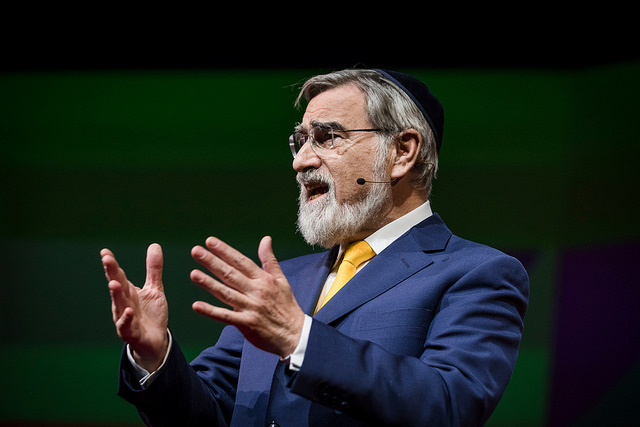
(Rabbi Lord Jonathan Sacks speaks at TED2017. Image credit: Bret Hartman/ TED Conference/ Flickr)
By Stuart Littlewood | American Herald Tribune | August 30, 2018
The nasty slur campaign against Jeremy Corbyn has just plumbed new depths with a hark-back to 1968 and the “Rivers of Blood” speech by Enoch Powell. It seems to have been prompted by a remark Corbyn made in 2013 that British Zionists had two problems: “One is they don’t want to study history and, secondly, having lived in this country for a very long time, probably all their lives, they don’t understand English irony.”
In anti-Semitism terms that’s a flogging offence, even when it might be true. The former Chief Rabbi, Lord Jonathan Sacks, immediately took umbrage saying that Corbyn’s criticism of British Zionists was the most offensive statement made by a senior politician since Enoch Powell’s Rivers of Blood speech. Sacks told the New Statesman : “It was divisive, hateful and, like Powell’s speech, it undermines the existence of an entire group of British citizens by depicting them as essentially alien.”
He said Corbyn had implied “Jews are not fully British” and that he was “using the language of classic pre-war European anti-Semitism”, adding that Corbyn was an anti-Semite who “defiles our politics and demeans the country we love”. He had “given support to racists, terrorists and dealers of hate who want to kill Jews and remove Israel from the map”.
Sacks’ words could equally be taken to mean those who align themselves with Israeli hate and the wish to kill Palestinians and wipe Palestine from the map – which they have already done quite literally. And if Corbyn defiles our politics so does the Israel lobby. But the irony must have escaped him.
Just how righteous is the moralising Lord Sacks? In a House of Lords debate in 2014 on the Middle East in general and the question of formal recognition of Palestine by the UK in particular, the former Chief Rabbi got up and made a speech that was more like a pro-Israel rant. After a long winded spiel about the history of Israel and Jerusalem – from the Jewish angle of course – he went on to demonise Hamas and Hezbollah in the manner recommended by Israel’s ‘hasbara’ handbook and all the more absurd when Israel’s hands are so unclean. Everyone knows that Hamas has agreed to a long-term truce with Israel provided it ends the illegal occupation, gets back behind its 1967 borders and accepts the refugees’ right of return – all as per UN resolutions and subject to a Palestinian referendum. And Hezbollah, as Sacks knows perfectly well, was formed to resist the Israeli occupation of Lebanon after the 1982 war.
Israel, said Sacks, is the place where his people were born almost 4,000 years ago. As an ardent promoter of the Jewish religion, the Jewish state and the idea that God gave Jews exclusive title to Jerusalem, he seemed oblivious to the irony of his speech especially where he said: “When ancient theologies are used for modern political ends, they speak a very dangerous language indeed. So, for example, Hamas and Hezbollah, both self-defined as religious movements, refuse to recognise the legitimacy of the state of Israel within any boundaries whatever and seek only its complete destruction.”
Where does he get his information? Israel won’t define its boundaries, leaving them fluid for endless expansion, and does a first-class job of de-legitimising itself by its defiance of international law and utter contempt for norms of human decency and obligations under UN Charter and other agreements.
Zionists distort the scriptures to claim Jerusalem is theirs by Divine right, it was already 2000 years old and an established, fortified city when King David captured it. The Jews lost Jerusalem to the Babylonians, recaptured it, then lost it again to the Roman Empire in 63BC. When they rebelled Hadrian threw them out in 135. Until the present illegal occupation the Jews had only controlled Jerusalem for some 500 years, small beer compared to the 1,277 years it was subsequently ruled by Muslims and the 2000 years, or thereabouts, it originally belonged to the Canaanites.
Jerusalem was also a Christian city. The 4th century saw the building of the Church of the Holy Sepulchre. The Persians came and went. Then, after the Islamic conquest in 690, two major shrines were constructed over the ruins of the earlier temples — the Dome of the Rock from which Muhammed is said to have ascended to Heaven, and the Al-Aqsa Mosque. The Crusaders re-took Jerusalem in 1099 and The Temple Mount became the headquarters of the Knights Templar. In 1187 Saladin ended the Crusader Kingdom and restored the city to Islam while allowing Jews and Christians to remain if they wished.
As the saying goes, “None has claim. All have claim!”
Nowhere in his speech did Lord Sacks address the main question of British recognition of Palestinian statehood. Nowhere did he recommend the jackboot of oppression be immediately lifted and the Palestinians granted their human rights and their freedom. That would surely have been the Christian position and, I imagine [?], the true Jewish one.
It is what the Rabbi failed to say on this important occasion that makes me wonder whether he’s an instrument of God or just another preacher of Israeli ‘hasbara’. I read somewhere that Lord Sacks is of Polish/Lithuanian extraction. Most Palestinians can demonstrate ancestral ties to the ancient Holy Land. Can he?
“Jeremy Corbyn moved the rock and the antisemites crawled out”
Corbyn is also in trouble over a remark he made in 2010 at a meeting of the Palestine Solidarity Campaign suggesting that MPs who took part in a parliamentary debate on the Middle East had their comments prepared for them by the Israeli ambassador. I’d say that was fair comment although the scriptwriters were more likely to have been Mark Regev’s propaganda team in Tel Aviv. Regev, a propaganda expert from the dark side, is now Israel’s ambassador in London. Oh, the irony (again).
And a few days ago we heard that Jews are preparing to quit Britain because they fear Jeremy Corbyn taking power, according to the former chairman of the Conservative Party Lord Feldman. So says The Times.
Feldman wrote an open letter to Mr. Corbyn telling him that Jewish people were making contingency plans to emigrate because Labour had become a hotbed of anti-Jewish feeling. “Many Jewish people in the United Kingdom are seriously contemplating their future here in the event of you becoming prime minister. Quietly, discreetly and extremely reluctantly, they are making contingency plans.”
One of these is Mark Lewis, a prominent solicitor and a former director of lawfare firm UK Lawyers for Israel, who is emigrating to Israel with his partner, Mandy Blumenthal. It is believed she is the National Director of Likud-Herut UK, an affiliate of the Zionist Federation and whose website is full of preposterous ideas such as: “We believe that terms like ‘illegal occupation’ should never go unchallenged….” and “Such criticism as we may have [of Israel] should never be expressed publicly….”
Lewis, who describes himself as an ‘unapologetic Zionist’, said: “Jeremy Corbyn moved the rock and the antisemites crawled out from underneath.” And he told the Evening Standard: “I don’t feel welcome in this country anymore.” So he’s off to that hotbed of racism and apartheid, Israel.
Being unwelcome is not a happy feeling. I know this from my trips to Israel, what with their rudeness, threatening behavior, intrusive searches, hostile questioning and unforgivably vile treatment of our Palestinian friends. It’s not as if we want to be in Israel – we are forced to divert there on account of Israel’s illegal military occupation. And when we eventually reach Palestine we have to put up with the presence of arrogant Israeli gunslingers strutting the streets, setting up hundreds of roadblocks, using obstructive tactics with brutish behavior, creating endless queues and interfering with Palestinian life at every level.
And if we try traveling to Palestine direct, like the humanitarian aid boats Al-Awda, and Freedom last month, we get violently and unlawfully assaulted on the high seas, beaten up, thrown in a stinking Israeli jail and have our belongings and money stolen by the Israeli military desperate to maintain their illegal blockade of Gaza.
So, if Messrs Feldman, Lewis and Blumenthal feel more comfortable with those criminals they’d better join them.
In answer to the babble put out by Zio-propagandists, church leaders in the Holy Land issued their 2006 Jerusalem Declaration saying:
“We categorically reject Christian Zionist doctrines as false teaching that corrupts the biblical message of love, justice and reconciliation.
“We further reject the contemporary alliance of Christian Zionist leaders and organizations with elements in the governments of Israel and the United States that are presently imposing their unilateral pre-emptive borders and domination over Palestine… We reject the teachings of Christian Zionism that facilitate and support these policies as they advance racial exclusivity and perpetual war rather than the gospel of universal love, redemption and reconciliation.”
This still stands. And as the Declaration also points out, “discriminative actions [by the Occupation] are turning Palestine into impoverished ghettos surrounded by exclusive Israeli settlements. The establishment of the illegal settlements and the construction of the Separation Wall on confiscated Palestinian land undermines the viability of a Palestinian state as well as peace and security in the entire region”.
That comes from genuine churchmen working in the front line against armed Zio-thugs whose vicious day-to-day persecution of the Christian and Muslim communities in the Holy Land makes a nonsense of accusations of anti-semitism in the UK.
I think we can deduce from all this that Zionism is a menace. Nothing has changed for the better; it has got steadily worse.
‘We want our Jerusalem back, and our state’
In 2010 Fr Manuel Musallam, a gritty Catholic priest with long experience of Israel’s cruel and illegal occupation, told members of the Irish Government: “Christianity in the region has been destroyed not by Muslims but by Israel. Israel destroyed the church of Palestine and the church of Jerusalem beginning in 1948. It, not Muslims, has sent Christians in the region into a diaspora… We have spoken to Israel for more than 18 years and the result has been zero. We have signed agreements here and there at various times and then when there is a change in the Government of Israel we have to start again from the beginning. We ask for our life and to be given back our Jerusalem, to be given our state and for enough water to drink… I have not seen Jerusalem since 1990.”
Archbishop Theodosius Hanna (Greek Orthodox Church) told them: “Palestine is the place from where Christianity comes…. Everything that has happened to the Palestinians between 1948 and today has happened to all Palestinians, including Christian Palestinians.
“What we are after is freedom and dignity just as freedom and dignity have been bestowed on so many nations in the world. We want that too. When we speak about peace, we also speak about justice because it is impossible to have peace without justice. Peace is part of justice. Unfortunately, in the Holy Land there is no such thing as justice.”
Corbyn should remind his tormentors of all this and take no lectures from those who support Zionism and adore the racist state it spawned.
Israel controls UK politicians’ speech: Corbyn
Press TV – August 30, 2018
UK Labour leader Jeremy Corbyn, who is battling allegations of anti-Semitism in his party, has come under fire for a 2010 speech where he said speeches British lawmakers make are controlled by the Tel Aviv regime.
The videotaped remarks were made during Corbyn’s meeting with the Palestine Solidarity Campaign in London following Israel’s deadly raid on an aid flotilla that attempted to break the years-long blockade on the Gaza Strip, the Daily Mail reported Tuesday.
During the May 2010 attack, 10 Turkish activists onboard the Mavi Marmara were killed after Israeli naval commandos boarded the ship and opened fire.
Criticizing British lawmakers’ pro-Israeli reactions to the attack, Corbyn reportedly said during the meeting that the MPs “all turned up [to the debating chamber] with a pre-prepared script. I’m sure our friend Ron Prosor (the Israeli ambassador) wrote it. Because they all came up with the same key words. It was rather like reading a European document looking for buzz-words.”
“And the buzz-words were, ‘Israel’s need for security.’ And then ‘the extremism of the people on one ship.’ And ‘the existence of Turkish militants on the vessel.’ It came through in every single speech, this stuff came through,” he added.
The Israeli lobby has long complained about what it calls Corbyn’s tolerance for anti-Semitism in his party.
An open critic of Israel’s crimes against the people of Palestine, Corbyn has drawn fire from his opponents by allowing the members of his party to speak their mind about Israel and its occupation of Palestinian lands.
Earlier this week, the Campaign Against Anti-Semitism launched an online campaign to pressure Labour lawmakers into issuing a vote of no-confidence in Corbyn and force him to resign.
The Labour leader most recently came under fire for video footage of a speech from 2013, where he says “Zionists” can’t understand British ways of thinking despite growing up in the country. Corbyn defended his remarks, saying by Zionists did not mean Jews.
Meanwhile, Corbyn’s allies in and outside of the UK have rushed to his support in the face of the Israeli media upsurge that try to portray him as an anti-Semite.
Israeli lawmaker Haneen Zoabi said Wednesday that the attacks against Corbyn were “unjust, offensive and absurd.”
“Corbyn’s criticism is justified. And the state, which deals with theft, murder and racist acts under the law of nationality, is rightly justified by this criticism,” the Israeli Knesset member said.
The 10 Main Holes in the Official Narrative on the Salisbury Poisonings: #5 – The Feeding of the Ducks
By Rob Slane | The Blog Mire | August 27, 2018
In the previous piece, I began to focus on the official timeline of events on March 4th, as stated by The Metropolitan Police on 17th March, noting that there is a missing 4 hours in the morning, which investigators were very anxious to receive information on at the time, but which they have been conspicuously silent on since. Not only have they failed to update the timeline with information about the Skripals movements on the morning of 4th March, but they have failed to do so despite now having that information. How can I be sure they have it? Because both Sergei and Yulia Skripal have been awake and talking for months now.
But in this piece, I want to focus on something even more important. Something that is crucial for two reasons:
- Firstly, the Metropolitan Police do not mention it in their timeline, even though it absolutely did happen and is vital.
- Secondly, it completely demolishes the theory that the Skripals were poisoned by touching a nerve agent on the handle of Mr Skripal’s front door.
The incident in question is the duck feed. But before I come on to it, let’s just remind ourselves of the official timeline once more, so that we can then see where this incident fits in:
Saturday 3rd March
14.40hrs on Saturday 3 March: Yulia arrives at Heathrow Airport on a flight from Russia.
Sunday 4th March
09.15hrs on Sunday, 4 March: Sergei’s car is seen in the area of London Road, Churchill Way North and Wilton Road.
13.30hrs: Sergei’s car is seen being driven down Devizes Road, towards the town centre.
13:40hrs: Sergei and Yulia arrive in Sainsbury’s upper level car park at the Maltings. At some time after this, they go to the Bishops Mill Pub in the town centre.
14.20hrs: They dine at Zizzi Restaurant.
15:35hrs: They leave Zizzi Restaurant.
16.15hrs: Emergency services receive a report from a member of the public and police arrive at the scene within minutes, where they find Sergei and Yulia extremely ill on a park bench near the restaurant.
One of the things that is immediately obvious about this timeline is its astonishing vagueness in certain places. For instance, Mr Skripal’s car was apparently seen in three different areas — London Road, Churchill Way North and Wilton Road — at 9:15. Presumably it was seen on CCTV cameras in these locations, and presumably these cameras all have time and date stamps. In which case, why could the timeline not be more precise than suggesting that Mr Skripal’s car was at three locations at the same time?
But the vagueness of the time and location of the car in the morning really is small fry compared to the time and location given at 13:40hrs:
“Sergei and Yulia arrive in Sainsbury’s upper level car park at the Maltings. At some time after this, they go to the Bishops Mill Pub in the town centre.”
At some time after this? What exactly is that supposed to mean? Were there not CCTV cameras in The Maltings and in The Mill that could give a more precise timeline? The unnerving thing – given that this is one of the biggest and most important investigations Britain has ever seen – is that yes indeed there were. And yet what these cameras show has either been ignored in the timeline altogether, or incorporated into it in some sort of vague and nebulous way that – and I don’t know how else to process it – frankly looks very suspect.
I’ll come on to the bit about The Mill in the next piece, but before we get there, perhaps we can jog the memories of investigators by reminding them of a piece of CCTV footage that they certainly do have, which is time stamped, and which shows clearly where Sergei Skripal and Yulia were at a particular time.
After parking the car, at 1:40pm, the two of them were seen near the Avon Playground, in The Maltings, feeding ducks with some local boys. This was at 1:45pm and has been confirmed to me by one of the boys’ mothers, who was shown the CCTV footage by the police, which she said was really clear. She also confirmed to me that Mr Skripal was wearing jeans and a leather jacket, and that Yulia Skripal had a red bag.
The Metropolitan Police apparently don’t think the duck feeding incident important enough to include in their timeline, and so after the parking of the car, we are treated to the vague statement that, “at some time after this, they go to the Bishops Mill Pub.”
But it is incredibly important, for the following reason: it totally, completely and comprehensively debunks the idea that Mr Skripal was poisoned at his home, after his hand came into contact with a deadly nerve agent on the handle of his front door. Why?
BECAUSE HE HANDED BREAD TO THE BOYS, AND NONE OF THEM BECAME CONTAMINATED, THAT’S WHY!
Think about it. Zizzis has remained shut since the incident, because it was apparently contaminated, and the table that the Skripals ate their meal at “had to be destroyed” because of the apparently high concentration of nerve agent there. Likewise, The Mill has been closed ever since. And of course the bench too had to be destroyed, since it was apparently contaminated.
But these were all places visited by the Skripals AFTER the feeding of the ducks.
And so we are asked to believe the following preposterous notion: That Sergei and Yulia Skripal’s hands were contaminated with “military grade nerve agent” at the door of Mr Skripal’s house, so much so that certain places they visited on that afternoon had to undergo months of decontamination, and certain items they touched had to be destroyed.
And yet in between getting the nerve agent on their hands at the door, and the visits to those locations, Mr Skripal was seen on CCTV, at 1:45pm, handing bread to local boys to give to the ducks. With his contaminated hands, apparently. And one of those boys even ate a piece. And yet none of those boys managed to become contaminated the by the “military grade nerve agent” on Mr Skripal’s hands?
No amount of “they might have been wearing gloves” will do. Firstly, the temperature was actually quite warm (8-9 degrees) and so it’s unlikely that they were wearing gloves; secondly, who actually tears bread from a loaf whilst wearing gloves (probably nobody, is my guess); but thirdly, gloves apparently weren’t enough protection to prevent D.S. Bailey from becoming contaminated, allegedly at the door handle.
No, there is no way out of this. The duck feeding incident leaves the “nerve agent on the door handle” theory in tatters. If the duck feed happened – which it did – then the “Skripals becoming contaminated with nerve agent on the door handle” did not happen. To continue to believe that it did, in the light of Mr Skripal handing bread to boys, not one of whom became contaminated, is to cast off all reason and enter a twilight world of the absurd.
But it does at least explain why the incident doesn’t make it onto the timeline!
The 10 Main Holes in the Official Narrative on the Salisbury Poisonings: #1 – The Motive
The 10 Main Holes in the Official Narrative on the Salisbury Poisonings: #2 – The Intent
The 10 Main Holes in the Official Narrative on the Salisbury Poisonings: #3 – The Capability
The 10 Main Holes in the Official Narrative on the Salisbury Poisonings: #4 – The Missing Four Hours
The 10 Main Holes in the Official Narrative on the Salisbury Poisonings: #6 – The Meal and The Drink
Skripals – When the BBC Hide the Truth
By Craig Murray | August 27, 2018
On 8 July 2018 a lady named Kirsty Eccles asked what, in its enormous ramifications, historians may one day see as the most important Freedom of Information request ever made. The rest of this post requires extremely close and careful reading, and some thought, for you to understand that claim.
Dear British Broadcasting Corporation,
1: Why did BBC Newsnight correspondent Mark Urban keep secret from the licence payers that he had been having meetings with Sergei Skripal only last summer.
2: When did the BBC know this?
3: Please provide me with copies of all correspondence between yourselves and Mark Urban on the subject of Sergei Skripal.
Yours faithfully,
Kirsty Eccles
The ramifications of this little request are enormous as they cut right to the heart of the ramping up of the new Cold War, of the BBC’s propaganda collusion with the security services to that end, and of the concoction of fraudulent evidence in the Steele “dirty dossier”. This also of course casts a strong light on more plausible motives for an attack on the Skripals.
Which is why the BBC point blank refused to answer Kirsty’s request, stating that it was subject to the Freedom of Information exemption for “Journalism”.
10th July 2018
Dear Ms Eccles
Freedom of Information request – RFI20181319
Thank you for your request to the BBC of 8th July 2018, seeking the following information under the
Freedom of Information Act 2000:
1: Why did BBC Newsnight correspondent Mark Urban keep secret from the licence payers that he
had been having meetings with Sergei Skripal only last summer.
2: When did the BBC know this?
3: Please provide me with copies of all correspondence between yourselves and Mark Urban on the
subject of Sergei Skripal.
The information you have requested is excluded from the Act because it is held for the purposes of
‘journalism, art or literature.’ The BBC is therefore not obliged to provide this information to you. Part VI
of Schedule 1 to FOIA provides that information held by the BBC and the other public service broadcasters
is only covered by the Act if it is held for ‘purposes other than those of journalism, art or literature”. The
BBC is not required to supply information held for the purposes of creating the BBC’s output or
information that supports and is closely associated with these creative activities.
The BBC is of course being entirely tendentious here – “journalism” does not include the deliberate suppression of vital information from the public, particularly in order to facilitate the propagation of fake news on behalf of the security services. That black propaganda is precisely what the BBC is knowingly engaged in, and here trying hard to hide.
I have today attempted to contact Mark Urban at Newsnight by phone, with no success, and sent him this email:
To: mark.urban@bbc.co.uk
Dear Mark,
As you may know, I am a journalist working in alternative media, a member of the NUJ, as well as a former British Ambassador. I am researching the Skripal case.
I wish to ask you the following questions.
1) When the Skripals were first poisoned, it was the largest news story in the entire World and you were uniquely positioned having held several meetings with Sergei Skripal the previous year. Yet faced with what should have been a massive career break, you withheld that unique information on a major story from the public for four months. Why?
2) You were an officer in the Royal Tank Regiment together with Skripal’s MI6 handler, Pablo Miller, who also lived in Salisbury. Have you maintained friendship with Miller over the years and how often do you communicate?
3) When you met Skripal in Salisbury, was Miller present all or part of the time, or did you meet Miller separately?
4) Was the BBC aware of your meetings with Miller and/or Skripal at the time?
5) When, four months later, you told the world about your meetings with Skripal after the Rowley/Sturgess incident, you said you had met him to research a book. Yet the only forthcoming book by you advertised is on the Skripal attack. What was the subject of your discussions with Skripal?
6) Pablo Miller worked for Orbis Intelligence. Do you know if Miller contributed to the Christopher Steele dossier on Trump/Russia?
7) Did you discuss the Trump dossier with Skripal and/or Miller?
8) Do you know whether Skripal contributed to the Trump dossier?
9) In your Newsnight piece following the Rowley/Sturgess incident, you stated that security service sources had told you that Yulia Skripal’s telephone may have been bugged. Since January 2017, how many security service briefings or discussions have you had on any of the matter above.I look forward to hearing from you.
Craig Murray
I should very much welcome others also sending emails to Mark Urban to emphasise the public demand for an answer from the BBC to these vital questions. If you have time, write your own email, or if not copy and paste from mine.
To quote that great Scot John Paul Jones, “We have not yet begun to fight”.
5 timely reminders that the media think you are an idiot…

By Kit | OffGuardian | August 28, 2018
The corporate media think we are stupid. All of us. They have as much respect for our intellect or ability to reason as they do for the truth. This is displayed, in size 20 font, on the front page of every newspaper every single day. They paint a picture of an absurd world, and expect us all to nod along with it, blithely accepting their stories as true, no matter what laws of reason – or even physics – they bend to suit their purpose.
The world in the newspaper and on the television is not real in any true sense of the word. Merely a crazy fun-house mirror reflection of the truth. Important features shrunk to nothing, tiny flaws blown up out of proportion. Apparently solid shapes that – on inspection – are nothing but strange plays of light and shadow.
With that in mind, let’s remind ourselves of the kind of completely bonkers things we’re all expected to believe.
1. The Inherent silliness of “ISIS”
This section was going to be more specific, but as I looked back over recent history, there was no single absurdity that highlighted how stupid the ISIS story was.
ISIS was, and is, silly. A few bullet points to demonstrate this – and a reminder that these are not exaggerated in any way. These are, supposedly, facts:
- They were making $1-$3 million PER DAY smuggling oil out of Syria, in convoys kilometres long that the US air force either couldn’t find or wouldn’t bomb because of “risks to civilians”. How they had the technical expertise to extract and process this oil was never explained.
- They minted their own currency.
- They published end-of-year reports, like a business, and kept detailed accounts on flash drives and USB sticks. Despite this, no ISIS bank accounts were ever seized, monitored or shut down.
- They had multiple social media accounts, YouTube channels – often described as “ISIS linked social media accounts” – these accounts weren’t locked, blocked or deleted. The registered owners weren’t arrested. They had their own twitter app which was impossible to block and created their own social network.
- They had their own TV channel, with an animated logo, a waving flag, in the corner of their videos. Think on this – somebody, somewhere, made that logo.
- They had fleets of Toyotas, which we’re supposed to believe they just sort of… acquired. They are all clean, new and undamaged. They are all colour-matched too, of course. There are red ones, white ones, black ones and tan ones. With and without logos painted on the hood. They deployed these trucks in photo-shoots and “viral” videos, the theoretical production of which simply boggles the mind. A bunch of black Toyota’s crossing the desert doesn’t look like much, but think about the actual logistics of making the video. They had to drive up to this spot, drop off the camera crew and equipment, drive back over the horizon, properly time their entrance by synchronizing all the driving and spacing the trucks out evenly, drive past the camera crew waving their flags… then drive back and pick up the camera men and equipment. All of this in the middle of a war zone.
- Of course all their videos had the same music, the ISIS theme, which was Arabic voices singing in close harmony. We’re supposed to believe that – somewhere in the heart of their war-torn empire – a bunch of crazy zealots gathered round a microphone to sing a capella melodies about “death to the west”, while a frustrated technician muttered to himself about “levels” and how Muhammad is flat on the high note. This spawned their own genre of music, which NME did a story on.
It’s so… stupid. And yet the media says it, and expects us to believe it.
ISIS – the all-powerful death cult, the existential threat to Western democracy, on the verge of “regional dominance”. There was a map and everything – world domination by 2020.
Despite all this, ISIS – the untouchable hydra of evil – completely fell apart as a force in the region just months after Russia and Iran got involved in the Syrian war.
Why was this?
Could it be that ISIS were just a media creation – the PR arm of the CIA’s jihadist proxy army – and, in truth, barely existed as fighting force? Existing, rather, to give Western powers an excuse to conduct air strikes on Syrian territory?
Or could it be that the MSM realised that 10,000 insane, bloodthirsty zealots taking time out of their devout holy war to have design meetings about coinage, or shoot music videos in Dune buggies, rings rather hollow?
It’s all a bit silly isn’t it?
2. The Syrian government Is collectively suicidal
Several times, in the last couple of years, Western leaders have made remarkably prescient statements – something along the lines of “We will not tolerate the use of chemical weapons on civilians”, or “We will act if chemical weapons are used”. In fact, in just the last few days both the US and France have reissued these warnings.
Despite these warnings, and though it offers him literally zero strategic advantages of any kind, Assad keeps deploying his super-secret chemical weapons against civilians… just because. He’s winning the war, it’s pretty much over, the only thing that could swing it against him is NATO, and he keeps deliberately inciting them to attack him.
There’s only 2 explanations for that – either he, and his government, are low-key suicidal, or it never happened, and the propagandists in the media truly believe we are completely stupid.
Then there’s the photographs.
Syria knows they have been in America’s crosshairs for years, since well before the start of the Arab spring. They are aware of Israel’s designs on Syrian land, and more than familiar with the US modus operandi re: “humanitarianism”. They KNOW the worst thing they could do is give America, and their NATO allies, even the whisper of a war crime to get indignant about.
… and yet we’re supposed to believe, not only that the regime tortured and executed tens of thousands of “peaceful protestors” for absolutely no reason, but they also kept a carefully photographed and catalogued record of their crimes.
This was brought up in the Guardian today, the famous “Caesar Photographs”, photos of 11,000 people the Assad government tortured and killed, all properly catalogued and numbered and then – conveniently – leaked by some unknown “former guard” and displayed in London like some morbid art exhibition.
The identity of the “leaker” remains a mystery, and there is literally zero evidence the photographs are a) from Syria or b) real.
Does this version of events sound even slightly reasonable?
3. Amnesty International used echolocation to recreate a Syrian prison
They really did. They have some guys claiming to be Syrian resistance members who were held in one of Assad’s “torture prisons”, but they were either blindfolded or in darkness the whole time, so in order to map out the interior of the prison… Amnesty International played sounds to them, to see if they sounded the same. I truly wish I was joking:
Inmates were constantly blindfolded or forced to kneel and cover their eyes when guards entered their cells, so sound became the key sense by which they navigated and measured their environment – and therefore one of the chief tools with which the Forensic team could reconstruct the prison layout. Using a technique of “echo profiling”, sound artist Lawrence Abu Hamdan was able to determine the size of cells, stairwells and corridors by playing different reverberations and asking witnesses to match them with sounds they remembered hearing in the prison.
There’s no reports as to why exactly the men were locked up, how they got away, why they were released and not executed like everyone else OR – indeed – where they acquired their bat-like super hearing.
… But we do now have a 3D model of Assad’s “torture prison”. We even know which room is the crematorium too, because it looked like the snow on the roof had melted in one satellite photo… and the only thing that makes a roof hot is the burning corpses of dissidents.
The whole process is part of a completely made up recently developed field known as “forensic architecture”. In simple terms, it seems “forensic architecture” is looking at the outside of a building – or indeed a photograph of the outside of a building – and guessing what’s inside. While this might seem difficult, pointless, or even insane to most people… to the mainstream media it is worth of thousands of words of coverage and, indeed, winning media awards.
Does any of that really make any sense to you?
4. Jeremy Corbyn hates the Jews
Jeremy Corbyn is soft – maybe, arguably – too soft for the job that history has violently hoisted on to his shoulders, but soft none the less. He rides his bike to work, wears cardigans, is a vegetarian. He has campaigned for peace and against war his entire life. He was arrested for protesting apartheid whilst Margaret Thatcher was calling Nelson Mandela a terrorist, he spoke out against Pinochet while the General was a darling on both sides of the Atlantic.
He has won two international peace prizes.
The idea that, during a public career dedicated to the socialist ideals of decency and fairness, he was secretly thinking “Bloody Jews!” the whole time is completely absurd. Insultingly absurd, and there is not a single piece of evidence to suggest otherwise. There is nothing more to be said on the matter.
5. Russiagate
This is the big one, currently. The grand-daddy of the nothingburgers. Russiagate never happened. There was no collusion, no cheating or vote hacking or pay-offs. They have found literally zero evidence anything ever took place, seizing upon tiny anecdotal scraps and blaring them out in FULL CAPS HEADLINES to make a case in the court of public opinion that would never stand in an actual court.
Where “Russiagate” is different from most invented media schlock however, is the sheer weight of counter evidence. For most media fiction you can say “Well, there’s very little evidence to support that” (see Corbyn = anti-Semite as a classic example). With Russiagate you can go even further: There is a ton – A TON – of evidence to the contrary, clear-cut evidence that Russia (and Putin) have nothing to do with Trump being President. The media refuse to acknowledge this evidence, directly and contemptuously challenging the public’s ability to reason.
Below is a list of unchallenged, non-controversial facts about Russiagate:
- The only proven, admitted, wrong-doing in the 2016 Presidential election was carried out by the DNC, who rigged the primaries so Clinton would be the democratic candidate. This was later admitted to by members of the DNC.
- The e-mails which first brought this to light were published by WikiLeaks, there is no proven link between WikiLeaks and the Russian government.
- Julian Assange, founder of WikiLeaks claimed the e-mails were from an internal leak, not the result of a hack.
- The “Trump-Russia” dossier, a collection of (possibly fabricated) dirt put together by British ex-spy Christopher Steele, was paid for by the DNC and Clinton’s campaign.
These facts, alone, should bring Russiagate down… but there’s more. Since becoming President, Donald Trump has:
- Armed the Ukrainian coup government.
- Bombed Syria.
- Torn up the Iran deal.
- Sanctioned Russia over the Skripal case.
- Sanctioned Russia over “election interference”.
- Expelled Russian diplomats.
- Killed over 200 Russian “mercenaries” in Syria.
These are policies that not only run counter to ALL of Russia’s interests, but very nearly brought us to the brink of World War 3.
And yet we’re told, over and over, to ignore our own logical minds and believe that Trump is Putin’s “puppet”. That Trump is “soft” on Russia.
Why would a product of Russian collusion pursue policies harmful to Russia? How many Russians need to die before we accept that Trump is anything but soft?
The media line on this issue is insane, and dangerous. In refusing to acknowledge the actual truth – that the US Deep State is pushing for conflict with Russia – the media are dragging us toward apocalypse, smiling happily to themselves as they go.
They are either all delusional morons, think WE are all delusional morons, or – most probably – both.
The inmates are running the asylum, declaring the rest of us insane because none of us are hearing voices.
This is why the media is in decline, why the BBC is losing its audience and the newspapers have plummeting readership, because people are tired of being treated like idiots and herded like cattle. We’ve made a collective decision to cut the bullshit out of our lives. The world is heading towards a split, two parallel universes running together – the real world, where reasonable pragmatic people get on with the struggles of life, and the media world, where fake people write about pretend events in newspapers nobody reads.
The media has become that manipulative spouse who lies and cheats and tells you it’s all your fault. A narcissistic gaslighter who just will not change.
It’s time to make a clean break.
The 10 Main Holes in the Official Narrative on the Salisbury Poisonings: #4 – The Missing Four Hours
By Rob Slane | The Blog Mire | August 25, 2018
According to the Metropolitan Police investigation into the poisoning of Sergei and Yulia Skripal, the official timeline of their movements on the weekend of the incident is as follows:
Saturday 3rd March
14.40hrs on Saturday 3 March: Yulia arrives at Heathrow Airport on a flight from Russia.
Sunday 4th March
09.15hrs on Sunday, 4 March: Sergei’s car is seen in the area of London Road, Churchill Way North and Wilton Road.
13.30hrs: Sergei’s car is seen being driven down Devizes Road, towards the town centre.
13:40hrs: Sergei and Yulia arrive in Sainsbury’s upper level car park at the Maltings. At some time after this, they go to the Bishops Mill Pub in the town centre.
14.20hrs: They dine at Zizzi Restaurant.
15:35hrs: They leave Zizzi Restaurant.
16.15hrs: Emergency services receive a report from a member of the public and police arrive at the scene within minutes, where they find Sergei and Yulia extremely ill on a park bench near the restaurant.
Whilst fully realising that such a timeline does not necessarily need to include every detail, such as the time that Yulia arrived in Salisbury on the Saturday afternoon, nevertheless, there are some serious problems with this account, which are broadly as follows:
- Firstly, it omits crucial information from the morning of 4th March.
- Secondly, it ignores a very important incident on the afternoon of 4th March.
- Thirdly, it is, I believe, incorrect in the sequence of events it presents.
In this piece, I want to concentrate on the first one of these — the morning — and then cover the second and third in subsequent pieces.
When the timeline above was released by the Metropolitan Police on 17th March, the whereabouts of the Skripals on the morning of 4th March was unknown. At the press conference in which the timeline was released, Deputy Assistant Commissioner, Neil Basu, who is in charge of the investigation, appealed for information about their movements on the morning of 4th March:
“We believe that at around 9.15am on Sunday 4 March, Sergei’s car may have been in the areas of London Road, Churchill Way North and Wilton Road. Then at around 1.30pm it was seen being driven down Devizes Road, towards the town centre.
We need to establish Sergei and Yulia’s movements during the morning, before they headed to the town centre. Did you see this car, or what you believe was this car, on the day of the incident? We are particularly keen to hear from you if you saw the car before 1.30pm. If you have information, please call the police on 101″ [my emphasis].
Although the Skripals’ movements were unknown, it had been thought that they visited the cemetery on London Road, since there were apparently fresh flowers on the grave of Mr Skripals wife, Liudmila. But there was one very important piece of information that was known, which was extremely interesting. According to The Times:
“The Russian spy and his daughter poisoned by nerve agent turned off the GPS tracking on their mobile telephones for four hours on the day they were attacked, it was reported yesterday.”
That piece of information alone is enough to make those missing four hours in the morning vital to any investigation. There must have been a reason for the Skripals to make their phones untraceable during that time and – with apologies for stating the blindingly obvious – it was clearly because they did not want their movements at that time to be known. The most plausible explanation for this would seem to be that they had some kind of meeting that morning, a meeting which was important and secret enough for them not to want certain other people knowing where they were and what they were doing.
It is entirely understandable that the Metropolitan Police did not include details of the Skripals’ movements on the morning of 4th March in the timeline they released on 17th March, since they did not know them at that time. And given that the Skripals had made their phones untraceable, it is also entirely understandable why the Metropolitan Police desperately wanted people to come forward with information about the four hour time period.
But here’s the thing: More than five months later, and this timeline has not been updated. Not only this, but the Metropolitan Police have gone mysteriously quiet about this part of the timeline. Why mysterious? Simply because Sergei and Yulia Skripal have been awake and talking for months, and unless they have steadfastly refused to tell investigators what they were doing on that morning – which is frankly inconceivable – then the Metropolitan Police must know where they were and what they were doing on that morning. And yet they’ve stopped talking about it and have not updated their timeline since 17th March.
Which raises the following questions:
- Where were Sergei and Yulia Skripal on the morning of 4th March?
- What were they doing?
- Why did they feel the need to turn off the GPS tracking on their phones?
- Were they meeting someone, and if so who?
- Why has the Metropolitan Police not updated its timeline to include the Skripals’ whereabouts that morning, since it must by now be well aware of them?
The 10 Main Holes in the Official Narrative on the Salisbury Poisonings: #1 – The Motive
The 10 Main Holes in the Official Narrative on the Salisbury Poisonings: #2 – The Intent
The 10 Main Holes in the Official Narrative on the Salisbury Poisonings: #3 – The Capability
The 10 Main Holes in the Official Narrative on the Salisbury Poisonings: #4 – The Missing Four Hours
The 10 Main Holes in the Official Narrative on the Salisbury Poisonings: #6 – The Meal and The Drink
From Chaim Weitzman to Jeremy Corbyn
By Gilad Atzmon | August 25, 2018
Every day, a few hours before dawn, the British Jewish leadership unleashes its daily smear against the Labour Party and its leader. Although this relentless operation tells us little about Corbyn and the Labour Party it is very revealing of the Jewish leadership and the Israeli propaganda project.
Jewish Labour MP Luciana Berger declared yesterday that she feels “unwelcome” in her party after a video emerged of Jeremy Corbyn remarking that British Zionists have, “no sense of English irony.” In the clip, Mr Corbyn says, “British Zionists clearly have two problems. One is they don’t want to study history, and secondly, having lived in this country for a very long time, probably all their lives, they don’t understand English irony either.”
On Twitter, MP Berger responded: “The video released today of the leader of @UKLabour making inexcusable comments – defended by a party spokesman – makes me as a proud British Jew feel unwelcome in my own party. I’ve lived in Britain all my life and I don’t need any lessons in history/irony.”
Either knowingly or not, Mrs. Berger managed to validate Chaim Weizmann’s* essential observation: ‘there are no English, French, German or American Jews, but only Jews living in England, France, Germany or America.”** In Weizmann’s view, it doesn’t matter where Jews dwell, because wherever they are they remain primarily Jewish, and it is Jewishness that determines who they are: their politics, culture and national aspiration. If MP Berger knew something about irony she wouldn’t have fallen so easily into this trap. She would have noticed that while Corbyn is pointing at “Zionists” in a polite sarcastic manner, she takes offense as a “British Jew.”
But surely, this is a welcome development. It shows once again that the good old ‘dichotomy’ between Jews and Zionists may not hold water. Like Weizmann, in Berger’s eyes, so it seems, Jews and Zionists are somehow the same. You may hold it against me, but I tend to believe that both Berger and Weizmann have a point. It is pretty much impossible to determine where exactly Zionism ends and ‘the Jew’ starts. Impossible because such a demarcation line doesn’t exist. As we know, even the Jewish so-called ‘anti’ Zionists follow Weizmann’s mantra, they operate in racially exclusive Jewish political cells that are even more segregated than the Jewish state. Rather than acting as Palestinian supporters who happen to be of Jewish origin, members of JVP prefer to see themselves as Jewish voice for peace. And rather than being Labour Party members who happen to be of Jewish descent, members of the JVL adhere to Weizmann’s philosophy, they choose to operate within a Jews only political group.
The Jewish emancipation that began after the French Revolution promised to make Jews equal to their neighbours. With this, the emancipation had limited success. In France, America, Britain and other countries, Jewish political bodies act in defiance of the emancipation and its promise, they operate in the interests of the few and not the many. In Britain, the Jewish leadership is openly acting against a national party and its leader. It pushes its definition of racism that applies to just one people instead of fighting racism (universally) against any people. It promotes the interests of a foreign criminal state with an horrendous record of war crimes and human rights abuses.
Weizmann was a visionary character. Zionism, as he painted it, has, over time, won the minds and the hearts of the Jews. Luciana Berger confirmed this when she expressed her offense as a “British Jew” to a mild critique of ‘Zionists’ lack of irony’. The JVL website confirms Weizmann’s observation that they see themselves as Jews before anything else.
While many British Jews may be happy with their community leaders, some Jews might find these developments concerning, and for a good reason. Some Jews see themselves as British first. These Jews will never have a voice ‘as Jews’ because they grasp that it is this attitude that makes Jews into Weizmann’s Zionists. Their only option is to sneak out of the ghetto, alone. and in the wee small hours. They will have to depart from the tribe and the sooner the better.
Donate to support Gilad’s legal costs.
The 10 Main Holes in the Official Narrative on the Salisbury Poisonings: #3 – The Capability
By Rob Slane | The Blog Mire | August 23, 2018
Once again I return to Theresa May’s statement of 26th May, in which she stated the following:
“In conclusion, as I have set out, no other country has a combination of the capability, the intent and the motive to carry out such an act.”
She then went on to claim:
“We have been led by evidence not by speculation.”
However, as I showed in Part 1 and Part 2, her statement to the Commons contained no actual evidence of motive or intent. Claims and assertions, but nothing more.
But what of capability? Looking through the statement, here are the key passages that might be said to fall into this category:
“As I set out for the House in my statements earlier this month, our world-leading experts at the Defence Science and Technology Laboratory at Porton Down positively identified the chemical used for this act as a Novichok – a military-grade nerve agent of a type developed by the Soviet Union.”
“And we have information indicating that within the last decade, Russia has investigated ways of delivering nerve agents probably for assassination – and as part of this programme has produced and stockpiled small quantities of Novichoks.”
Her evidence, such that it is, therefore falls into two categories: firstly, capability with regard to the weapon allegedly used to poison the Skripals; secondly, capability with regard to method of delivery of the weapon.
There are three things to say with regard to the first category. To begin with, it is not quite the case that Porton Down scientists had “positively identified the chemical” as a “Novichok”. In the evidence presented to the High Court between 20th – 22nd March, here is how the Porton Down Chemical and Biological Analyst described the substance:
“Blood samples from Sergei Skripal and Yulia Skripal were analysed and the findings indicated exposure to a nerve agent or related compound. The samples tested positive for the presence of a Novichok class nerve agent or closely related agent [my emphasis].”
As you will notice, there is a degree of ambiguity in this statement which is not present in Mrs May’s statement made a few days later. Ought she not to have recognised this?
Secondly, it has been conclusively shown that a number of other countries either have produced, or know how to produce substances within the class of nerve agents that Mrs May referred to as “Novichoks”. The Czech Government has admitted producing a small quantity of the closely related substance, A-230; Iran has produced it, in compliance with the OPCW in 2016; The German Intelligence Agency, BND, was given the formula back in the 1990s, and they shared it with a number of other NATO countries, including the US and UK. The Edgewood Chemical and Biological Defense Command in Maryland, USA, recorded the formula back in 1998.
The point of this is not to point the finger at any of those countries. Merely to say that knowledge of and production of “Novichok” is by no means confined to one country. And in any case, according to one of the world’s leading experts in organic chemistry, David Collum, Professor of Organic Chemistry at Cornell University, it doesn’t even require a State party. He asserts that “any credible organic chemist could make Novichok nerve agents.”
The fact that other countries know how to produce “Novichoks”, and in some cases have produced it, shows the claim that its apparent use in Salisbury proves Russian culpability to be complete nonsense. It’s as silly as saying that a poisoning using VX points to Britain because VX is a type of nerve agent developed by Britain.
And thirdly, if the British Government did indeed have information that the Russian Government had a secret programme investigating ways of delivering nerve agents, and had produced and stockpiled small quantities of Novichoks, then it had an obligation to inform the OPCW under the Chemical Weapons Convention, which it apparently failed to do. Furthermore, as a State Party to the Convention, it should have raised objections in 2017, when the OPCW’s Director-General, Ahmet Üzümcü, declared the following:
“The completion of the verified destruction of Russia’s chemical weapons programme is a major milestone in the achievement of the goals of the Chemical Weapons Convention. I congratulate Russia and I commend all of their experts who were involved for their professionalism and dedication. I also express my appreciation to the States Parties that assisted the Russian Federation with its destruction program and thank the OPCW staff who verified the destruction.”
So much for Mrs May’s evidence of capability regarding the weapon, what of her evidence regarding the delivery?
When she stated that her Government had information that the Russian Government had investigated ways of delivering nerve agents, she was, I believe, referring to the alleged “assassin’s manual”, which the Government says it possesses, but will not show because it is classified, and which apparently contains information showing that Russian agents were trained in putting poison on door handles.
Three brief points about this:
1. It really is utter nonsense. Smearing poison on a door handle would be a frankly ludicrous way to target someone for assassination, since you could never be sure that your target would actually touch it (you never know, maybe a postman or a milkman or the man from Amazon might get there first).
2. Salisbury was treated to dozens of guys in Hazmat gear decontaminating certain parts of the city, since the substance in question was apparently so lethal that, according to Alastair Hay, Professor of Environmental Toxicology at the University of Leeds:
“A few millilitres would be sufficient to probably kill a good number of people.”
Are we really supposed to believe that the Russians have either:
a) Developed ways of putting this stuff on door handles without the requisite chemical protection and perhaps just a pair of Marigolds, or
b) Have people stupid enough to try.
3. But the biggest problem is this: The British Government was starting to point the finger at the Russian Government within a few days of the poisoning, and it was later stated that one of the reasons for this was the manual that they apparently possessed. But if they did indeed have this manual, and it was the reason for their apportioning of blame as early as 12th March:
a) Why was the door handle not the focus of the investigation from the very start?
b) When are those police officers who stood within feet of that door, and those who no doubt went in and out of the house using the door handle, going to sue Her Majesty’s Government for negligence and their failure to act on the intelligence they apparently had?
If there is indeed such a manual, my guess is that it was put together by a chap named Steele.
The 10 Main Holes in the Official Narrative on the Salisbury Poisonings: #1 – The Motive
The 10 Main Holes in the Official Narrative on the Salisbury Poisonings: #2 – The Intent
The 10 Main Holes in the Official Narrative on the Salisbury Poisonings: #3 – The Capability
The 10 Main Holes in the Official Narrative on the Salisbury Poisonings: #4 – The Missing Four Hours
The 10 Main Holes in the Official Narrative on the Salisbury Poisonings: #6 – The Meal and The Drink
Featured Video
Death Spikes & Rising Cancer In Our Youth Explained
or go to
Aletho News Archives – Video-Images
From the Archives
Politicians lie
By Mazin Qumsiyeh | Popular Resistance | August 18, 2013
There is no way to say this truth nicely: Politicians lie. That includes Japanese, American, Egyptian, Israeli, and Palestinian politicians! Is there something more common sense than that? Yet, so many citizens around the world believe their own politicians or wistfully acknowledge lies but think it is part of the job needed to run things. They believe even when politicians contradict themselves blatantly. This phenomenon is rather remarkable. It is a dissonance and disconnect from reality that many seem oblivious to. It is very dangerous because it can lead to accepting rationales for going to war. These can be deadly wars that lead to millions of lives lost as happened in what was called World War 1 and WW2. Even when incredible and declassified evidence abound, politicians continue to lie and old mythologies refuse to die. Here are just a few of the countless lies told to us over the past few decades… continue
Blog Roll
 Aletho News
- RSF military group defects, joins Sudanese army: State media
- Ireland goalkeeper refuses to play ‘Israel’ as squad weighs boycott
- China pushes back against US on Cuba, Iran
- Ukrainian Soldiers, Potential Mercenaries: Have Gun, Will Travel!
- Burnham’s UN debut… A masterclass in British disinformation
- Iran flights continue despite US aviation sanctions
- Global Tipping Points Lead the World Into a State of Entropy
- The day-after at the White House: USA and Xi Jinping
- The Geopolitical Balance in the Red Sea: The UAE Being Displaced by New Players
- Iraqi resistance group vows to stage airport sit-ins over Iran aerial blockade
- If Americans Knew
- Deconstructing Netanyahu’s pants-on-fire UN rant – Daily Update
- Trump betrayed voters with his campaign lies and prioritized a foreign country once he took office
- Netanyahu calls Israel’s war in Gaza ‘opposite of genocide’ in UN speech to near-empty hall
- Settler Kidnappings: Torture, Sexual Abuse and Terrorisation of Palestinian Abductees as Israel Deepens Annexation of West Bank
- Gaza winter nears as 162,000 tents become unusable, raising fears of humanitarian crisis
- Netanyahu says, “It’s the opposite of genocide”; UN says Gaza economy is world’s ‘most severe crisis on record’ – Daily Update
- Israel’s US-Backed Assault on Gaza Has Created the ‘World’s Most Severe Economic Crisis on Record’: UN
- ‘Protecting U.S. Citizens’… From Israel
- ‘This is where I live now, the back of a truck’: a day in the life of a grandmother in Gaza
- In UN Speech, Iran’s President Displays Pictures of Children Killed by US, Brings Attention to Israel’s Nuclear Arsenal
- No Tricks Zone
- New Study: Earth And Venus Surface Warmth Largely Explained By Convection And Lapse Rate, Not CO2 Or Radiation
- 2025 Nature Paper Claiming Worsening Global Drought Gets RETRACTED …Heavily Flawed
- New Study: ‘Global Drought Shows No Detectable Recent Acceleration Under Climate Warming’
- Economic Masterminds: German Socialists Suggest Taxing Productivity Gains Stemming From Using AI
- The South China Sea Has Not Been Cooperating With The Climate Change Narrative
- Energy Crisis: Germany Enters Heating Season With Historically Low Gas Reserve Fill Levels
- New Study: The Antarctic Ice Sheet Gained Mass From 2020-2024 Due To Staggering Snow And Ice Accumulation
- Study: Ocean Heating Rates From Thousands Of Years Ago ‘Dwarf’ Modern Ocean Heating Rates
- Climate Extremists Target, Attack Large-Scale Power Grid Infrastructure In Germany!
- New Study: Antarctic Ice Melt Has Contributed Less Than 1 Centimeter To Sea Level Rise In The Last 30 Years

