Russia is not involved in Skripal case at any level – Kremlin
RT | September 6, 2018
Russia has nothing to do with the Skripal poisoning case at any level, Kremlin spokesman Dmitry Peskov has said, slamming “unacceptable” British allegations.
“Neither Russia’s top leadership nor those with lower ranks, and no country’s officials, have had anything to do with the events in Salisbury,” Peskov said. He rebuffed UK Prime Minister Theresa May’s claim that the attack on the ex-double agent Sergei Skripal and his daughter was approved at “senior level of the Russian state.”
“Any accusations against Russian leadership are unacceptable,” the spokesman added.
On Wednesday, UK prosecutors named two “Russians” whom they accuse of poisoning the Skripals. May later claimed that the duo were officers of the Russian military intelligence agency GRU. Firing back, the Russian Foreign Ministry said the names and photos of the two men ‘do not mean anything’ to Moscow and called on London “to abandon making public accusations and media manipulations.”
If the UK wants Russia to take action, it should send an official request in the first place in accordance with existing agreements, Peskov stressed, noting that media reports and statemens in parliament cannot replace it.
“We need a request from the British side to check their [suspects’] identities, to give us legal grounds for the identity checks. There is a common practice [for it],” he told journalists. He stressed that from the very beginning Moscow offered cooperation on the case, but London has been reluctant to agree.
One of the main arguments leading the UK to repeat its “highly likely” mantra regarding Moscow’s involvement in the poisoning has been that the Novichok nerve agent – allegedly used in this case – could have only been produced by Russia. However, foreign specialists have long been familiar with the formula, which was developed by the Soviet Union.
The new “revelations,” however, are not more plausible that the previous ones, Charles Shoebridge, a security expert and a former British military officer, told RT. The simple fact that allegedly well-trained Russian intelligence specialists could have left behind so much evidence speaks for itself, he says.
“It seems very strange that these people have absolutely left what seems to be a very reckless and clear trail of evidence, which almost seems to be designed, or at least would almost inevitably lead to the conclusions that the police and the authorities have come to today, in other words that Russia [is] to blame,” he told RT.
Annie Machon, a former MI5 intelligence officer, said she doubts Russia’s alleged motive behind the Salisbury incident and that certain pieces of evidence reported by the media “may look pretty compelling but will never be tested in a real court of law.”
The Impossible Photo
By Craig Murray | September 5, 2018
Russia has developed an astonishing new technology enabling its secret agents to occupy precisely the same space at precisely the same time.
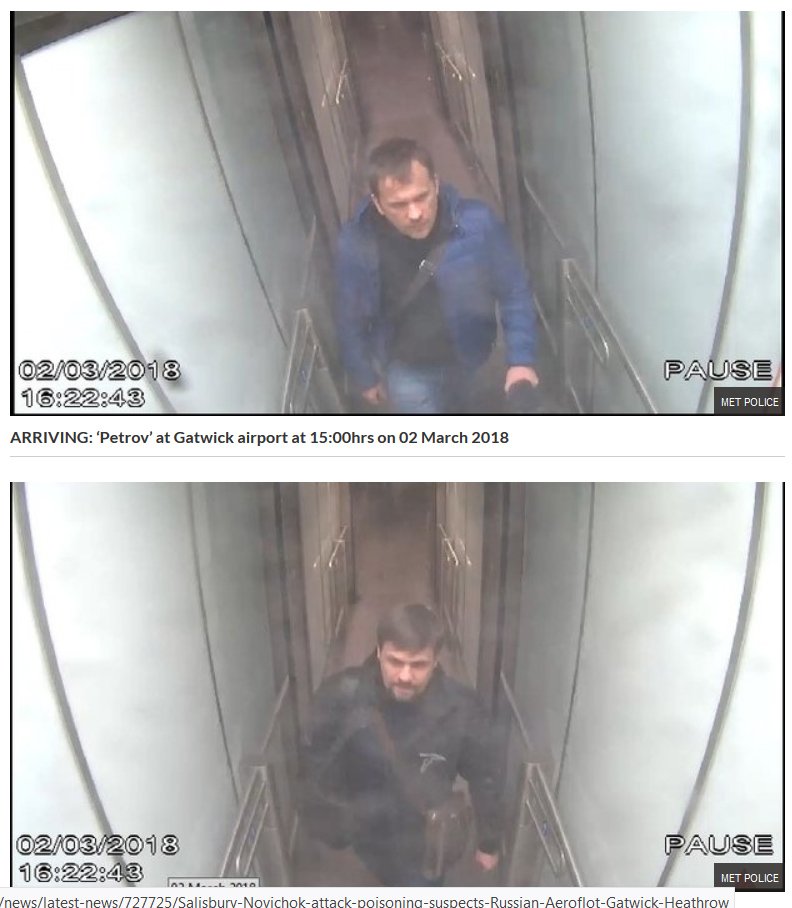
These CCTV images released by Scotland yard today allegedly show Alexander Petrov and Ruslan Boshirov both occupying exactly the same space at Gatwick airport at precisely the same second. 16.22.43 on 2 March 2018. Note neither photo shows the other following less than a second behind.
There is no physically possible explanation for this. You can see ten yards behind each of them, and neither has anybody behind for at least ten yards. Yet they were both photographed in the same spot at the same second.
The only possible explanations are:
1) One of the two is travelling faster than Usain Bolt can sprint
2) Scotland Yard has issued doctored CCTV images/timeline.
I am going with the Met issuing doctored images.
UPDATE
A number of people have pointed out a third logical possibility, that the photographs are not of the same place and they are coming through different though completely identical entry channels. The problem with that is the extreme synchronicity. You can see from the photos that the channel(s) are enclosed and quite long, and they would have had to enter different entrances to the channels. So it is remarkable they were at exactly the same point at the same time. Especially as one of them appears to be holding (wheeled?) luggage and one has only a shoulder bag.
I have traveled through Gatwick many times but cannot call to mind precisely where they are. Can anybody pinpoint the precise place in the airport? Before or after passport control? Before or after baggage collection? Before or after customs? The only part of the airport this looks like to me is shortly after leaving the plane after the bridge, and before joining the main gangway to passport control – in which case passengers are not split into separated channels at the stage this was taken. I can’t recall any close corridors as long as this after passport control. But I am open to correction.
First they came for the home-schooled….
By Kit | OffGuardian | September 4, 2018
There is a war being waged. Not the one in Syria or Yemen. Not the Nazis shelling the Donbass or the warlords selling slaves in Libya. Not America’s drones executing an entire garden party in Pakistan because somebody on that street might have googled “bomb components” and “American Airlines” on the same day 10 years ago. Not even between the ridiculous buffoon Trump, and the equally absurd “resistance”.
A different kind of war.
Perhaps “struggle” would be a better word.
The struggle is eternal in every direction – it has always been, it will always be. It goes to each horizon and both poles and everywhere in between. In every mind and body. A global conflict with a million fronts in a thousand theatres.
People versus power: A struggle between the population and the power to control it, personified through institutions and governments.
People don’t want to be controlled, they naturally resist it.
Institutions know only control, they crave it.
Power is addictive like that, and institutions are true addicts. Give them a little power and they’ll want a little more. Give them a lot, and they want it all. Power tends to corrupt, as the saying goes, but the inverse is also true: the corrupt tend towards power. They are more likely to want it, more likely to be willing to do anything to get it, and more likely to abuse it once they have it.
That’s the point of democracy of course, to keep the soil tilled. To turn over the manure and hope something green can grow. To fight against corruption by giving it no time to ferment. To stop the rot setting in. It doesn’t really work, but it works better than anything else.
Somehow The Guardian has found its way to the vanguard of this war. It’s picked its side in the great conflict, and it wasn’t ours. Every day, in every way, The Guardian shows its support for them over us. Every campaign, every agenda, is about empowering the state and destroying the individual. They want to hand the government the power to control what we eat, what we say, who we say it to, where we go, how we get there. Even what we think.
It is a struggle for control of life on Earth, not on the grand scale, but the specific. Every small decision, every tiny moment, every thought and word and action will need government approval. Global hegemony won’t come via Imperial wars of conquest, but a conglomeration of tiny restrictions of individual freedom. If they don’t want to ban things, they want to regulate them. If they can’t regulate them, they want to tax them. Which is to say, ban it… for poor people.
Ban sugar, because it’s bad for you. Ban meat, because of global warming. Ban sport because it’s violent. Ban air travel because of carbon emissions. Ban alcohol because it exploits addicts. Ban free speech because it’s offensive. Ban alternate medicine because it might not work.
Ban freedom because it’s dangerous.
Don’t like that, don’t watch this, don’t read those.
Don’t do X, don’t say Y, don’t think Z.
In every issue, on every issue, The Guardian is the spokesperson of the authoritarian heart of the state – pleading for more power in the name of the safety of the masses or the grand virtue of the collective.
Today’s topic: this editorial under the headline:
The Guardian view on home-schooling in England: a register is needed
The editorial is anonymous – why The Guardian does this, I do not know. It could be that they are trying to put across a collective identity, it could be that some thoughts are so shameful and absurd that even Guardian journalists won’t cop to them, or it could be they receive written memos from GCHQ or government press offices and simply copy and paste them into their website. It could be some odd combination of all three.
Whatever the explanation, there’s no name on it… so we don’t know who wrote it. We just know they have an agenda and aren’t ashamed to stretch logic to breaking point in order to service it. The agenda is simple – regulate homeschooling into oblivion, ban it if we have to, regulate it if we can. Homeschooling is a problem in desperate need of a solution:
Children educated by their parents must not be hidden from the authorities.
… shrieks the sub-head. Without ever providing any evidence that a) Home-schooled children ARE hidden from authorities or b) That, if true, this is a bad thing.
It’s all notionally about Jordan Burling, a young man who allegedly lived a terribly sad life of abuse and neglect, and then died at the age of 18. He was also home-schooled.
Let’s be clear about this: Child abuse and neglect happen, they are an unfortunate fact of life for a tiny minority of children. There is no reason to imply a connection with home-schooling and force a causation where only correlation exists.
All of Jack the Ripper’s victims wore shoes. Ergo we need to regulate shoes in order to protect people from serial killers.
The author (whoever they were) is, however, intent on ignoring a basic fact of life – that a factor can be present without being causative – in order to pursue their chosen agenda:
… there is no reason for the government to wait before acting on behalf of other home-schooled children, of whom there are thought to be around 50,000 in the UK – a number that has increased sharply in recent years.
There is nothing to suggest home-schooled children are at risk. In fact, there is no evidence that being home-schooled leads to an increased risk of abuse or neglect. How do I know this? Because the article says so, in the next sentence:
There is no evidence that being home-schooled leads to an increased risk of abuse or neglect.
Literally, the very next sentence. Look…

So, as it turns out, not only IS there a reason to “wait before acting on behalf of other home-schooled children”, the article actually provides it to us. A more spectacular own goal you will not see this side of England’s next World Cup campaign.
The author, to their “credit” (for want of a better word), doesn’t seem to be totally unself-aware, feeling the need to claw back some of their “credibility” (for want of a better word), by adding some more facts to their “article” (for want of a better word):
The government believes most home educators do a good job. But reviews following the death from scurvy of eight-year-old Dylan Seabridge in Wales in 2011, and of Khyra Ishaq, who was starved to death aged seven in Birmingham in 2008, highlighted home-schooling as a factor. Concerns around safeguarding, and what happens when children disappear from the view of professionals who might otherwise support them, are one reason why the government is seeking to tighten and clarify the rules surrounding home education.
That’s it. The weight of the case against home-schooling is three deaths over 10 years. The prosecution rests.
Let’s now put a counter case:
IF home-schooling is the recipient of one The Guardians favorite “crackdowns”, what will the results be?
In the best scenario: nothing. Because…
There is no evidence that being home-schooled leads to an increased risk of abuse or neglect.
But let’s make a wild leap of speculation, and assume that the Tory government which sends men and women dying of cancer back to work, and refuses benefits to thousands of sick and disabled people, may not act either ethically or competently. Maybe, just maybe, they will simply create a bureaucratic nightmare of a system that sees more children taken away from their families, possibly thousands more, on spurious and absurd grounds. These children will then be thrown into the system of foster homes and adoption…a system which definitely DOES lead to an “increased risk of abuse or neglect”.
“The Guardian view” is that the state should be more active in protecting children. But our state sells weapons to Saudi Arabia to drop on school buses, and wants to take away free school meals from underprivileged children. Our state doesn’t a give a toss about children – foreign or domestic – and demonstrates this to us every single day.
It doesn’t take much imagination to progress further down this road to hell – paved, as always, with “good intentions”: We already know the government spies on us, they pass laws making it legal, so it’s all fine. But handing the government the power to control home-schooling, coupled with monitoring internet and phone communication, could easily lead to a massive political bias in the way the new home school laws are enforced: Leftwingers, trades unionists, “conspiracy theorists”, all being refused the right to home-school their children based on their tweets, their voting history or their Amazon wishlist.
It’s really not that hard to imagine.
Ask yourself: Why is The Guardian – allegedly a liberal paper in favour of being nice, recycling, tweedy cardigans with leather elbow patches, slippers, refugees and the Antiques Roadshow – in favour of handing the uncaring, even malign state, more power and authority?
The only logical answer is they want to create a more authoritarian state. A cross between Stalinist Russia and Mr Roger’s Neighborhood, where everyone has been successfully Mrs Lovejoyed into obeying Big Brother because he really does know best. A jolly, comforting oligarchy with twinkly grandfather eyes and half-moon spectacles. A nice, friendly dystopia with burning incense and herbal tea and drifty floral print dresses. Where everyone gets a turn and everyone is special and everyone does what they’re told… or else.
A new kind of “progressive” statism. Where our caring authoritarian masters aren’t controlling or dictatorial because they want to be, but because they need to be, for our sake. A kindly overlord child-proofing the world for the betterment of their naive charges.
Homeschooling is increasing, on both sides of the Atlantic, this is unsurprising given the above facts, the decline in the quality of education, the drop in schools funding and a generally unacademic attitude of control, censorship and indoctrination that has taken hold of a lot of Western institutions in recent years.
That same attitude will push, harder and harder, to clamp down on homeschooling – if not to outright ban it, then set a “home school” syllabus. The syllabus will be either impossible to implement, meaning parents can’t homeschool, or so incredibly controlled that it eradicates the benefits of homeschooling in the first place.
The campaign has already started state-side, where certain law-makers leapt upon the convenient Perris case to try push anti-home school legislation through the state, with the assistance of the media of course. Fortunately, it was defeated.
As I said, it is a war with multiple fronts. A war to take ownership of the individual and control of the sovereignty of the self, and it is won by the people when we talk to each other and rely on ourselves. That’s why they want to get a hold on home-schoolers, and why they’ll continue to push at social media to ferret out dissent.
You can see the pattern with vaccination – how, in America, political debate on vaccination was dismissed as a products “Russian bots” trying to “sow division”. Once the law to ban homeschools is put forward, anybody criticising it on Facebook will be a Russian bot.
First they came for the homeschooled, and I did not speak out… because they banned my Twitter.
Police to Review File on Anti-Semitism Allegations Against Labour – Commissioner
Sputnik – 04.09.2018
Met Police Commissioner Cressida Dick said on Tuesday she would pass the document with allegations of antisemitic behavior within the Labour Party to experts to determine whether any crimes had taken place.
“If somebody makes an allegation to us, which contains something like that, absolutely, we will take it seriously, we will scope we will see whether a crime has taken place… I, of course, will pass this to my experts to deal with,” the commissioner told the LBC broadcaster.
The LBC broadcaster has obtained a dossier on 45 cases and had Mak Chishty, an expert on hate crime, formerly in charge of such a division in the Met, to review them. According to Chishty, 21 cases should be reported to the police.
The Labour will vote later in the day on the definition of anti-semitism after months-long scandal surrounding the party. Labour leader Jeremy Corbyn, a strong supporter of Palestine, has faced his fair share of criticism in the past weeks.
Israel newspaper incites against Corbyn, Muslims in UK
MEMO | September 3, 2018
Israel Hayom newspaper yesterday ran an article inciting against Muslims in the UK and leader of the British Labour Party, Jeremy Corbyn.
“The British capital of London has become a base for Islamic groups, especially the Muslim Brotherhood outside the Middle East and the centre for the campaign to delegitimise Israel,” columnist Eldad Beck said in an article published yesterday.
Beck added that this comes in the context of “the radical speech led by British leader Jeremy Corbyn, noting to the increase in non-governmental political movements with only one common goal that is calling for the elimination of Israel.”
“There are a number of Hamas men who are running the battle to delegitimise Israel in Britain and are working to spread it around the world in order to legitimise the elimination of Israel. They have been organising fleets for solidarity with Gaza since 2010, led by the Turkish Mavi Marmara flotilla which caused Israel unprecedented harmful propaganda,” he claimed.
“Some Hamas figures in Britain are leading the Boycott, Divestment and Sanctions movement (BDS) and some have even filed legal complaints against British journalists who claimed that they have links with Hamas’ military activities, while others have issued anti-Semitic statements and got closer to Corbyn who received at the British Parliament Hamas representatives who had expressed their support for armed operations,” Beck added.
Meanwhile, former Director General of the Ministry of International Affairs and Strategy, Major General Yossi Kuperwasser, said “Britain is witnessing the emergence of what we can call the Green-Red Alliance, and one of its objectives is to wipe Israel off the map.”
“This alliance extends from Britain to the rest of the Western countries including the United States, but Britain is still the strongest body to export the Muslim Brotherhood’s ideology to the rest of the globe.”
“Palestinian activists in Britain are aiming to establish more Islamic organisations to influence the Kingdom’s internal and external policies,” he added.
Is UK Labour Now Zionist-Occupied Territory?
Befuddled Party waits to be gagged by ‘enemy within’
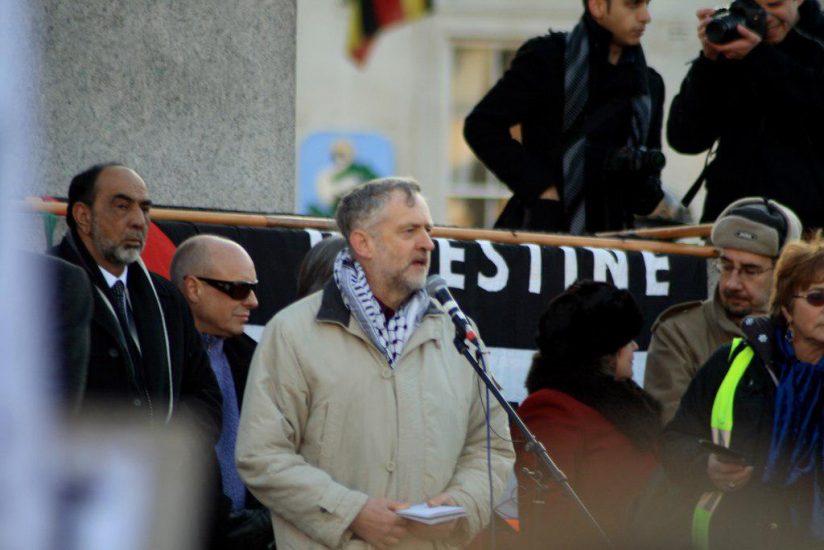
Jeremy Corbyn – Rally in Trafalgar Square. Image credit: Davide Simonetti/ Flickr
By Stuart Littlewood | American Herald Tribune | September 3, 2018
The National Executive Committee of the Labour Party will vote tomorrow (Tuesday) on whether to bow to the bullies and adopt the IHRA definition of anti-Semitism even though it has been roundly criticised by legal experts as unworkable. If they do, it will be hailed as a mighty victory for the dark forces behind the pro-Israel lobby in their bid to shut down criticisim of that racist state.
More than two years ago Gilad Atzmon was viewing the Labour Party’s crazed witch hunt for “anti-Semites” with misgiving. He declared, in his usual robust way, that Labour under Jeremy Corbyn was not so much a party as a piece of Zionist-occupied territory.
Writing in his blog about Corbyn and McDonnell’s servile commitment to expel anyone whose remarks might be interpreted by the Zionist Tendency as hateful or simply upsetting to Jews, he concluded: “Corbyn’s Labour is now unequivocally a spineless club of Sabbos Goyim [which I take to mean non-Jewish dogsbodies]. The Labour party’s policies are now compatible with Jewish culture: intolerant to the core and concerned primarily with the imaginary suffering of one people only. These people are not the working class, they are probably the most privileged ethnic group in Britain…. I did not anticipate that Corbyn would become a Zionist lapdog. Corbyn was a great hope to many of us. I guess that the time has come to accept that The Left is a dead concept, it has nothing to offer.”
Amen to that last bit.
And more recently Miko Peled, former Israeli soldier and the son of a Israeli general, warned that Israel was going to “pull all the stops, they are going to smear, they are going to try anything they can to stop Corbyn” and the reason anti-Semitism is used is because they have no other argument.
Since then we’ve had a queue of high profile Labourites and others sticking the knife into Corbyn. Last week it was the former Chief Rabbi and Zionist extremist Lord Sacks. Then the much-respected MP Frank Field, a maverick who finally quit Labour in noisy fashion giving anti-Semitism as a reason but having grumbled for a long time about a culture of intolerance, nastiness and intimidation within the party. Yesterday we had to suffer ex-prime minister Gordon Brown mouthing off about how the IHRA definition “is something we should support unanimously, unequivocally and immediately.” He urged Corbyn to remove the “stain” of prejudice from Labour by writing the definition and all of its examples into the party’s new code of conduct.
That’s a particularly dumb thing to say considering the Home Office Select Committee urged two caveats be included and eminent legal minds Hugh Tomlinson QC and Sir Stephen Sedley pointed out how it is trumped by our right to free expression, which is part of UK domestic law by virtue of the Human Rights Act (something every Labour member ought to know and uphold), and by other conventions. Geoffrey Robertson QC also warns that it is “not fit for any purpose that seeks to use it as an adjudicative standard. It is imprecise, confusing and open to misinterpretation and even manipulation”.
Robertson adds: “The Governments ‘adoption’ of the definition has no legal effect and does not oblige public bodies to take notice of it. The definition should not be adopted, and certainly should not be applied, by public bodies unless they are clear about Article 10 of the EHCR (European Convention on Human Rights) which is binding upon them, namely that they cannot ban speech or writing about Israel unless there is a real likelihood it will lead to violence or disorder or race hatred.”
But Brown won’t be listening. He’s a dedicated pimp for Israel and a dyed-in-the-wool Zionist. In 2008, in the first speech by a British prime minister to the Israeli parliament, the Knesset, he told Israeli MPs: “Britain is your true friend. A friend in difficult times as well as in good times, a friend who will stand beside you whenever your peace, your stability and your existence are under threat.”
Unlike Corbyn, Gordon Brown wouldn’t talk to Hamas because warmongers in the White House had branded them ‘terrorists’. But that’s their opinion. The state of Israel was founded by terror groups like the one that murdered 91 in an attack on the British mandate government in the King David Hotel and carried out the Deir Yassin massacre. Israel is the expert in terror. As Norman Finkelstein has remarked, “It is more than a rogue state. It is a lunatic state… The whole world is yearning for peace, and Israel is constantly yearning for war.”
The Israeli government itself was described by one of Brown’s own (Jewish) MPs, Sir Gerald Kaufman, as a ‘gang of amoral thugs’.
Brown, the son of a Church of Scotland minister, would have done well (as would all the other critics of Jeremy Corbyn and his ‘funny’ friends) to mull over the words of Gaza’s Catholic priest, Father Manuel Musallam, who told a journalist friend Mohammed Omer: “Palestinian Christians are not a religious community set apart in some corner. We are part of the Palestinian people. Our relationship with Hamas is as people of one nation. Hamas doesn’t fight religious groups. Its fight is against the Israeli occupation.”
When asked about Western media reports that Islamic oppression was forcing Gaza’s Christians to consider emigrating, Father Manuel said that if Christians emigrate it’s because of the Israeli siege, not the Muslims. “We seek a life of freedom —a life different from the life of dogs we are currently forced to live.”
Turning the tables
Corbyn isn’t the problem. Zionists are. They are the enemy within. Corbyn’s election to party leader was a surprise brought about by a sudden influx of new supporters weary of sterile and corrupt politics. They had no time to groom him, not that he’s capable of being tamed like previous leaders. Corbyn has a long record of support for the Palestinians and other justice causes and that doesn’t sit well with the ‘emininence grise‘ pulling the strings. As a loose cannon in a carefully controlled political battlefield he had to be disabled. One way to do that was to pick off his allies one by one and, with the help of a compliant media, derail his party’s election prospects. That is what they’ve been doing with considerable success by weaponising so-called anti-Semitism against Labour’s naive and easily scared troops.
But why take allegations of anti-Semitism seriously from bully-boys who themselves practise or support racism? There’s a simple two-word response to such hypocrites. Admittedly there are within Labour’s ranks too many who say idiotic things about Jews to the detriment of the campaign for justice in the Holy Land. I’ve heard remarks that are so stupidly provocative that one suspects the people responsible are Zionist plants. What is the point of bringing up Hitler and the Holocaust when there are more Israeli war crimes and crimes against humanity than you can shake a stick at?
Corbyn should have acted swiftly on genuine complaints and rejected the trumped up ones. He didn’t. Outside interference should never have been tolerated. It has been and still is. The best way to deal with professional moaners like the Board of Deputies of British Jews is to politely give them the BDS treatment – ignore and refuse to engage until they change their intimidating tone. And tell them this is the British Labour Party not a flagpole of the Knesset.
Furthermore it is long past time to question Labour’s Friends of Israel about their shameless support for the criminal state and its racist leaders and the land-grabbing Zionist Project. There is no place in a socialist organisation, or in British public life at all, for people who cannot bring themselves to condemn a regime that behaves so viciously towards its neighbours, defies international law, thinks it’s exempt from the norms of decent behaviour and shows no remorse. What does aligning with apartheid Israel really say about them? And, by the way, who gave permission to use the party as a platform to promote the interests of a foreign military power?
If people holding public office put themselves in a position where they are influenced by a foreign power, they flagrantly breach the Principles of Public Life. There are far too many Labour and Conservative MPs and MEPs who fall into that category.
Strange how the upsurge in carefully orchestrated allegations of anti-Semitism coincided with the arrival of Mark Regev, former chief of Israel’s propaganda machine, spokesman for Israel’s extremist prime minister and a shameless liar, as Israel’s new ambassador in London.
Corbyn’s other option is to leave Labour, take his supporters with him and let the party stew in its own juice. Let’s face it, the party as it stood then and stands today is dysfunctional, a thing of the past and quite unsuited to the 21st century. There may still be time to build a new, clean, fit-for-purpose political party and get it established before the next general election. In it, though probably not leading it, Corbyn could at least be true to himself.
The Labour Party has repeatedly promised to review its rules to send a clear message of zero-tolerance on anti-Semitism, assuming it knows what that means and who the genuine Semites are. For balance, of course, it should match this with zero-tolerance of those who use the party as a platform for promoting the criminal Israeli regime and its obscene territorial ambitions.
And remember, in 1949 the UN took Israel to its bosom on condition that it accepted the Right of Return of the Palestinian refugees and complied with General Assembly Resolution 194. Noting the declaration by the new State of Israel that it “unreservedly accepts the obligations of the United Nations Charter and undertakes to honour them from the day when it becomes a Member”, the General Assembly admitted Israel as “a peace-loving State which accepts the obligations contained in the Charter and is able and willing to carry out those obligations”.
Has Israel ever honoured its membership obligations or acted as a peace-loving State?
Mauritius’ takes UK to court over Chagos Islands
RT | September 3, 2018
The UK claim over an archipelago in the Indian Ocean is being challenged by Mauritius in the International Court of Justice. The largest island hosts a US airbase, the construction of which saw mass deportations of the islanders.
Despite the UK’s attempts to go through official channels in the UN to block Mauritius’ claim to the Chagos Islands, the case is set to be heard in The Hague.
Judges at the International Court of Justice (ICJ) will take four days hearing testimonies from the representatives of 22 countries arguing over colonialism and the rights of the deported Chagos Islanders to return. The ICJ’s judgement will be only advisory and have no legal binding.
Of the 22 states, only the representatives of the US, Israel and Australia are expected to support Britain’s claim to sovereignty to the Islands, which they name the British Indian Ocean Territory (BIOT) and are some 5,799 miles from London.
The US support in part stems from the strategic value of their airbase, commonly referred to as Camp Justice, which is situated on the largest of the Chagos Islands, Diego Garcia. The airbase has played a crucial role in US operations in the Middle East, including during the Iranian Revolution and both Iraq Wars.
Last year Britain suffered a heavy defeat at the UN General Assembly, when 94 nations supported a Mauritian-backed resolution to take the matter before the ICJ. Only 15 countries supported the UK’s claim.
The ICJ is set to consider both whether the decolonisation of Mauritius from the British was completed lawfully, and secondly the ability of Mauritius to resettle deported Chagossians back onto the islands.
The UK decided to separate the Chago Islands from the remainder of its Indian Ocean colony three years before Mauritius gained independence in 1968. Mauritius is claiming that Britain was in breach of a UN resolution that banned the breakup of colonies before independence.
Britain deported some 1,500 islanders in order to lease the largest island, Diego Garcia, to the US which set up an airbase there in 1971. Chagossians have never been allowed to return.
Mauritius has been promised the return of the Islands by London but only when they are no longer needed for defense purposes. No date has been set for when that is.
The hearing’s outcome is expected to be a signal of the UK’s power, or lack thereof, in the international sphere. Last November, London failed to secure the re-election of Sir Christopher Greenwood to the ICJ. Britain will now be without a judge in the court for the first time since its inception.
A Foreign Office spokeswoman, quoted in the Guardian, said: “We are disappointed that Mauritius have taken this bilateral dispute to the international court of justice.
“This is an inappropriate use of the ICJ advisory opinion mechanism and sets a dangerous precedent for other bilateral disputes. We will robustly defend our position.
“While we do not recognise the Republic of Mauritius’s claim to sovereignty of the archipelago, we have repeatedly undertaken to cede it to Mauritius when no longer required for defence purposes, and we maintain that commitment.”
Corbyn Summoned by MI5 for ‘Facts of Life’ Briefing on Terrorism – Reports
Sputnik – 02.09.2018
The head of the MI5, Andrew Parker, has reportedly invited Corbyn to a “facts of life” briefing on the real terrorist threats facing the country.
But Corbyn has postponed the meeting, which was scheduled for Tuesday, as he is expected to spend all day attending a meeting of Labour’s National Executive Committee as he battles to quell a storm over anti-Semitism that has engulfed his leadership.
“The subjects of the briefing would have included issues relating to the domestic security threat, counterterrorism, counter-espionage, Russia and returning foreign fighters,” The Sunday Times wrote, quoting intelligence sources.
This would have been the first time the Labour leader would have been briefed by the head of Britain’s domestic intelligence service, the newspaper wrote.
Jeremy Corbyn had been told he could bring along his chief advisor Seumas Milne and Labour’s shadow Home Secretary Diane Abbott to the briefing.
Another source told the newspaper that Britain’s security services have been “troubled” by some of Jeremy Corbyn’s statements on terrorism.
When speaking after last year’s bombing in Manchester, Corbyn suggested that it was London’s foreign policy, rather than jihadist ideology, that bears the blame for terrorist atrocities.
Corbyn and Milne have also questioned the veracity of the security services’ conclusion about Russia’s alleged involvement in the Skripals’ poisoning in March, with Milne saying that she found it “problematic” to trust the security services after the Blair government lied about the strength of the intelligence about alleged Iraqi weapons of mass destruction in the run-up to the US-led invasion of the Arab country in 2003.
Back to the Future
A fictional story
By Gilad Atzmon | September 2, 2018
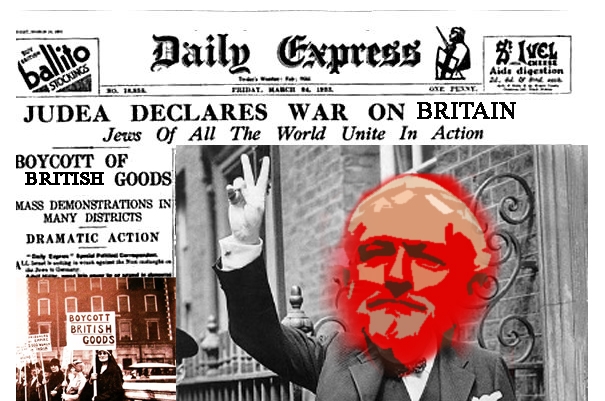
Neither Britain nor the rest of the world was surprised by last week’s election results. For the last six months Jeremy Corbyn and the Labour Party have led in the polls and during that time no one doubted that Corbyn would become Britain’s new prime minister, the only question was when. And yet, Corbyn’s increasing popularity wasn’t a smooth shift in British politics, it resulted instead from a gradual increase in British unity in opposition to an obnoxious foreign lobby. The nastier Corbyn’s enemies were, the more Brits sided with him. At a certain stage it became clear that it was the Zionist Lobby, rather than Corbyn himself, that united the Brits behind Corbyn.
The more the Jewish self-appointed ‘leadership’ pushed: the more they equated Corbyn with Enoch Powel and even Hitler, the more the Brits responded by siding with the old anti racist. In the months leading up to the election the picture became clear, a wide spectrum of Brits were expressing fatigue with the manner in which a foreign lobby was crudely intervening in their national politics.
But in spite of the many signs that Britain had had enough, the British Jewish so-called ‘leadership’ didn’t stop pushing. Not a day passed without a rabbi using the BBC to spread the message of Jews’ right to live in ‘peace’ on someone else’s land. Every day we read a Guardian interview with an influential Jew who threatened to make Aliya and take his or her shekels with him. The Brits weren’t impressed, on social media some offered departing Zionists piggy back rides to Heathrow.
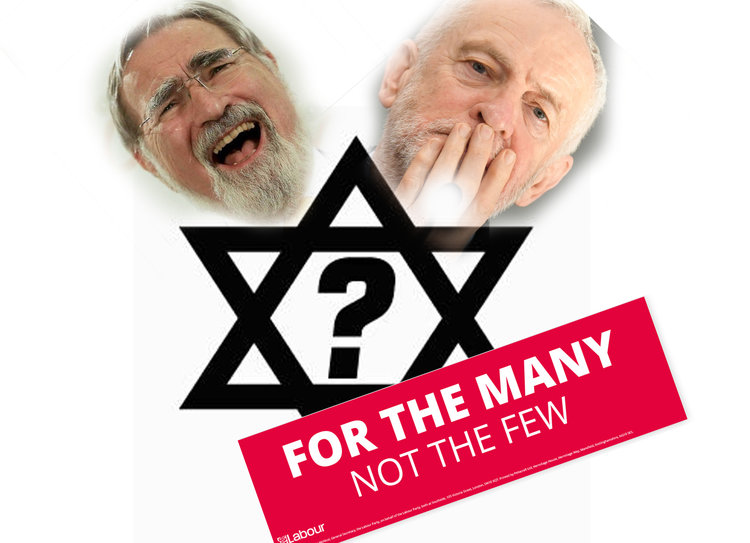
Commentators agreed that the escalation in British Jews’ troubled relationship with the rest of the nation was a very dangerous development. Corbyn, for his part, repeatedly stated that Labour would fight all forms of racism including antisemitsm. But the Jewish leaders’ concerns didn’t abate. “We didn’t ask him to fight racism, we want him to fight antisemitism.” Corbyns’ assurances were totally dismissed by the Jewish bodies. His motto, ‘For the Many not the Few,’ that excited so many Brits was interpreted by Zionist Jews as “for the Many not the Jew.” It became clear that no one within the Jewish community knew how to calm things down. On the contrary, the self-appointed Jewish ‘representative’ bodies, seemed to compete amongst themselves to see who could drip more oil into the blaze.
Two weeks before the election, when it was widely accepted that Corbyn was about to become a PM and there was no force that could stop him, not even the Jewish Lobby, violence was employed. In early January, MI5 was tipped off about a possible plot to physically attack the Labour leader. According to Israeli media a few arrests were made in North West London. The British press was restricted from passing that story on to the citizens of the kingdom.
In a desperate move two weeks before the election, AIPAC, CRIF and other overseas Jewish pressure groups joined local Zionist bodies in stating that a Labour win would lead to an immediate international call by Jews for a boycott of Britain. The Guardian was quick to publish an extended commentary by George Soros, its favorite ‘currency analyst,’ who lectured the Brits on what would happen to their pound if they were stupid enough to allow Corbyn into 10 Downing Street.
AIPAC and CRIF delivered. Less than 24 hours after the election, the two influential Jewish lobbies called for immediate and severe financial measures against Britain. Wealthy Jews were urged to withdraw their funds and investments from the City. The US administration was implored to stop trade with Britain immediately. President Trump, hanging on a thread and battling likely impeachment, promised to seriously consider the demands of the Lobby that has dominated American foreign policy for more than three decades.
The situation in Britain did indeed deteriorate immediately as Soros predicted. Within a day, the pound lost 45% of its value against the dollar and this after the dollar lost 20% of its value against the Iranian Rial a week earlier (due to an EU-Chinese-Russian deal with Iran).
Brits weren’t happy at all. In fact, many of them were devastated. Corbyn, now a PM in the process of forming his government, was put in an untenable situation. It was just a question of time before nasty scenes of violence erupted. I guess that we have seen it all before…
Corbyn and the Jewish Question
By Gilad Atzmon | August 31, 2018
It doesn’t take a genius to detect the present volatile state of British Jewish institutions. To the outside observer, some of the actions of Britain’s so-called Jewish ‘leaders’ may seem to be a form of collective insanity. Yet, the Brits do not seem to be at all impressed. They are perplexed by the self-propelled collective hysteria. Naturally, many Brits do not agree with Corbyn on issues; some may not agree with his pacifist politics, others see him as a naïve delusional lefty, a few are upset by his association with controversial characters, but no one except a few Israel firsters sees Corbyn as a crazed ‘anti-Semite,’ let alone as a Hitler type who puts Jewish life under an “existential threat.” While it isn’t clear whether Corbyn can unite the Brits against their horrid government, it is increasingly likely that the Zionist lobby has the capacity to unite the Brits behind Corbyn. A comment on twitter the other day noted that “not supporting Corbyn at this point is an act of treason.”
This week the ex-chief rabbi, Jonathan Sacks, became completely unhinged; comparing Corbyn to Enoch Powell’s “rivers of blood” speech. In an interview Rabbi Sacks maintained that Corbyn “undermines the existence of an entire group of British citizens by depicting them as essentially alien.” What had Corbyn said that provoked such an extreme reaction from the celebrity rabbi? Apparently, in 2013 Corbyn criticised British Zionists by suggesting that they have two problems. “One is they don’t want to study history and, secondly, having lived in this country for a very long time, probably all their lives, they don’t understand English irony.”
This raises some obvious questions: 1. What is it in Corbyn’s statement that sparked Rabbi Sacks’ outburst, and 2. How is it possible that when Corbyn speaks about Zionists, Rabbi Sacks hears ‘Jews’?
One possibility is that in Rabbi Sacks’ mind, Jews and Zionists are one and the same. After all, Rabbi Sacks believes that “anti Zionism is the new anti-Semitism.” The rabbi freely associates ‘Zionists,’ ‘Semites’ and ‘Jews.’ Someone should remind the rabbi that the suggestion that ‘Jews’ and Zionists are somehow the same might fall within the IHRA Working Definition of Antisemitsm. According to the definition, manifestations of anti-Semitism “might include the targeting of the state of Israel, conceived as a Jewish collectivity.” In his interpretation of Corbyn’s words, Rabbi Sacks seems to expand the term ‘Zionists’ into meaning ‘Jewish collectivity.’ I am afraid that our ex-chief rabbi may have fallen into the IHRA trap, something you might expect from a Talmudic Jewish scholar but not from an Oxford graduate.
The truth of the matter is that Corbyn has managed to touch the most sensitive Jewish collective nerve. In Corbyn’s universalist egalitarian offering there is no room for tribal exceptionalism. In Corbyn’s universe, Jews are just ordinary people and not God’s chosen people. Corbyn’s ‘for the many not the few’ doesn’t conform to chosenism, Jewish or identitarian. But we can see that this universalist perception of the ‘many’ is interpreted by British Jewish leadership as a casus belli – a call for a war.
Corbyn’s reference to Zionists’ ‘lack of British irony’ touched the rawest Jewish nerve. He stumbled upon the Jewish ‘assimilation complex.’
Since the emancipation of European Jewry, a 19th century political transition, Jews have been struggling to define their identity and role in the wider society. Emancipation invited assimilation, it offered Jews the ability to become an indistinguishable part of the ‘many,’ but this transformative shift would have entailed a loss of Jewish identity. This dilemma is known as the ‘Jewish Question.’ Zionism was initially an attempt to resolve the Jewish question and the assimilation dilemma. It offered Jews the ability to be ‘people like all other people’ but in a different place. Zionism promised to take the Jews away while allowing Jews to assimilate, although as a distinct nation amongst nations. Zionism gave Jews a way to resolve the tension between assimilation and preservation. The Jews were saved the danger of integrating into their host nations and allowed to preserve many if not most of their cultural traits, as Israel proves on a daily basis.
The Jewish fear of assimilation is not a secret. Golda Meir who served as Israel’s Prime Minister at the time of October War (1973), believed that Jews who assimilate are essentially partners to the Nazis, since through assimilation they are exterminating the continuation of the Jewish people. For Meir, mixed marriages, and not the Arabs, were the greatest danger to the Jewish people. With Meir’s anti assimilationist view in mind, it is clear why Corbyn’s traditional socialist view of ‘the many’ poses an existential danger to those who insist upon being ‘the few.’ Corbyn’s well meaning invitation to the Jews and everyone else to fully integrate into British society is interpreted by Zionist Jews as a threat of extermination (to use Golda Meir’s loaded terminology).
Rabbi Sacks’ reaction, however, takes us to a new level in our understanding of the Zionist mindset. The rabbi actually accused Corbyn of implying that “Jews are not fully British.” But that was not what Corbyn said or implied. He suggested that “Zionists” are not exactly British, a statement that poses no problem for most Zionists since they openly and voluntarily swear allegiance to another state, one that is nationalist, racist and expansionist and shares few, if any, values with Britain or the West.
In order to grasp Rabbi Sacks’ recent outburst we may have to appeal once again to the famous French psychoanalyst Jacques Lacan’s astute observation: “unconscious is the discourse of the Other.” The unconscious, according to Lacan, is the fear that the Other, in this case, the gentile, the humanist or shall we say Corbyn and the Brits see you truly. It is the tormenting thought that the Goy may be able to detect the lie. It is the unbearable anxiety that the Brits know that British Zionists aren’t exactly Brits, they are deeply devoted to another state and its foreign interests, they never assimilated and do not plan to assimilate in the near future. The Lacanian unconscious is the fear that a Goy may stand up one day and decide to call a spade a spade or, way more disturbing, refer to a celebrity ex-chief rabbi as a “far right extremist,” as Trade Union activist Eddie Dempsey suggests in the video below:
Featured Video
Death Spikes & Rising Cancer In Our Youth Explained
or go to
Aletho News Archives – Video-Images
From the Archives
Politicians lie
By Mazin Qumsiyeh | Popular Resistance | August 18, 2013
There is no way to say this truth nicely: Politicians lie. That includes Japanese, American, Egyptian, Israeli, and Palestinian politicians! Is there something more common sense than that? Yet, so many citizens around the world believe their own politicians or wistfully acknowledge lies but think it is part of the job needed to run things. They believe even when politicians contradict themselves blatantly. This phenomenon is rather remarkable. It is a dissonance and disconnect from reality that many seem oblivious to. It is very dangerous because it can lead to accepting rationales for going to war. These can be deadly wars that lead to millions of lives lost as happened in what was called World War 1 and WW2. Even when incredible and declassified evidence abound, politicians continue to lie and old mythologies refuse to die. Here are just a few of the countless lies told to us over the past few decades… continue
Blog Roll
 Aletho News
- RSF military group defects, joins Sudanese army: State media
- Ireland goalkeeper refuses to play ‘Israel’ as squad weighs boycott
- China pushes back against US on Cuba, Iran
- Ukrainian Soldiers, Potential Mercenaries: Have Gun, Will Travel!
- Burnham’s UN debut… A masterclass in British disinformation
- Iran flights continue despite US aviation sanctions
- Global Tipping Points Lead the World Into a State of Entropy
- The day-after at the White House: USA and Xi Jinping
- The Geopolitical Balance in the Red Sea: The UAE Being Displaced by New Players
- Iraqi resistance group vows to stage airport sit-ins over Iran aerial blockade
- If Americans Knew
- Deconstructing Netanyahu’s pants-on-fire UN rant – Daily Update
- Trump betrayed voters with his campaign lies and prioritized a foreign country once he took office
- Netanyahu calls Israel’s war in Gaza ‘opposite of genocide’ in UN speech to near-empty hall
- Settler Kidnappings: Torture, Sexual Abuse and Terrorisation of Palestinian Abductees as Israel Deepens Annexation of West Bank
- Gaza winter nears as 162,000 tents become unusable, raising fears of humanitarian crisis
- Netanyahu says, “It’s the opposite of genocide”; UN says Gaza economy is world’s ‘most severe crisis on record’ – Daily Update
- Israel’s US-Backed Assault on Gaza Has Created the ‘World’s Most Severe Economic Crisis on Record’: UN
- ‘Protecting U.S. Citizens’… From Israel
- ‘This is where I live now, the back of a truck’: a day in the life of a grandmother in Gaza
- In UN Speech, Iran’s President Displays Pictures of Children Killed by US, Brings Attention to Israel’s Nuclear Arsenal
- No Tricks Zone
- New Study: Earth And Venus Surface Warmth Largely Explained By Convection And Lapse Rate, Not CO2 Or Radiation
- 2025 Nature Paper Claiming Worsening Global Drought Gets RETRACTED …Heavily Flawed
- New Study: ‘Global Drought Shows No Detectable Recent Acceleration Under Climate Warming’
- Economic Masterminds: German Socialists Suggest Taxing Productivity Gains Stemming From Using AI
- The South China Sea Has Not Been Cooperating With The Climate Change Narrative
- Energy Crisis: Germany Enters Heating Season With Historically Low Gas Reserve Fill Levels
- New Study: The Antarctic Ice Sheet Gained Mass From 2020-2024 Due To Staggering Snow And Ice Accumulation
- Study: Ocean Heating Rates From Thousands Of Years Ago ‘Dwarf’ Modern Ocean Heating Rates
- Climate Extremists Target, Attack Large-Scale Power Grid Infrastructure In Germany!
- New Study: Antarctic Ice Melt Has Contributed Less Than 1 Centimeter To Sea Level Rise In The Last 30 Years

