Resignation matter or fake news? Attack on Corbyn over ‘terrorist wreath laying’
RT | August 13, 2018
The latest anti-Semitism story to hit Labour’s Jeremy Corbyn has polarised debate. His critics want him to resign immediately, while supporters are rushing to his defence, denying the accusations and crying ‘fake news.’
Photographs, taken in 2014 and published by the Daily Mail on August 11, show Corbyn holding a wreath at a service in Tunisia close to the graves of the Black September terrorists, who were implicated in the Munich attacks, in which 11 Israeli athletes were killed in 1972.
The original story is headlined “Corbyn’s wreath at Munich terrorists’ graves,” goes on to accuse the Labour leader of attending a “tribute event for Palestine ‘martyrs’ including plotters behind 1972 slaughter of Israeli Olympic athletes.”
The Labour Party has rejected calls for an apology, reiterating that Corbyn’s statement that he was laying a wreath honoring the 47 victims of an Israeli attack on a Palestinian Liberation Organisation (PLO) base outside of Tunis in 1985.
Responding to a follow up story, in which relatives of the Munich victims state that Corbyn should be “ashamed and apologize,” the party’s press team posted that the relatives were being “misled” by the story.
Writing in the left-wing Morning Star after the visit to the Tunisian cemetery, Corbyn stated that wreaths were laid to mark the 1985 Israeli bombing, adding: “After wreaths were laid at the graves of those who died on that day and on the graves of others killed by Mossad agents in Paris in 1991.”
It is unclear who Corbyn was referring to as there are no known Israeli killings in Paris in that year. However, Mossad agents did reportedly kill the PLO’s liaison officer with foreign intelligence agencies, Atef Bseiso, a suspected Black September member in 1992 in the French capital.
The article’s perceived inaccuracies prompted certain Corbyn supporters to call on him to sue the Daily Mail and over what they insist is ‘inaccurate reporting.’
In turn, right-wing Twitter condemnations of Corbyn were rife. Broadcaster Julia Hartley-Brewer mocked the Labour leader, and staunch Corbyn critic and Daily Mail journalist, Dan Hodges posted: “Dear Corbynites. It’s clear your hero honoured one, or a number of, the terrorists responsible for the Munich attack.”
The accusations led to Home Secretary Sajid Javid to demand Corbyn resign. “If this was the leader of any other major political party, he or she would be gone by now.” stated the Conservative.
While Jewish Leadership Council, Jonathan Goldstein, told the Jewish News : “This man is not fit to be a Member of Parliament, let alone a national leader.”
Another piece published by the Daily Mail on the same day attacked Corbyn for attending the wedding of a Palestinian ambassador who was accused of Holocaust denial in 2014, a claim he denies. Corbyn attended the wedding in 2010.
May, Hunt silent as UK’s best arms customer kills dozens of children in Yemen bus attack
RT | August 11, 2018
After a Saudi-led attack in Yemen killed and injured dozens of children, the public is again questioning London’s arms sales to Riyadh. Officials have kept silent, helped by the MSM which fails to question the UK’s involvement.
According to the International Committee of the Red Cross, the body count from Thursday’s attack sits at 51, including 40 children. Seventy-nine others were also injured in the attack, 56 of whom were children. It is understood that the bus was bringing children home from a picnic when it was attacked.
According to figures compiled by the Campaign Against Arms Trade, the United Kingdom has supplied the Saudi government with approximately £5 billion (US$6.38 billion) worth of arms – weapons, fighter jets, and even air strike training – since the war in Yemen began in March 2015. The UK government sells more arms to Saudi Arabia than any other country in the world.
Spokesman for the Campaign Against Arms Trade Andrew Smith told RT that “UK fighter jets and bombs have played a central role in the ongoing destruction,” and called for a full investigation “into if UK arms have been used in this appalling bombing.”
Foreign Office Minister Alistair Burt took to Twitter to say he was “deeply concerned by reports of yesterday’s attack in Sa’ada, Yemen resulting in tragic deaths of so many children.”
UK Prime Minister Theresa May, Foreign Secretary Jeremy Hunt, and the Foreign Office have issued no statements on the atrocities, and ignored RT when approached for comment. The prime minister’s office refused to accept a list of questions from an RT journalist, or provide an email address for other future queries. Neither the PM, Foreign Secretary, or Foreign Office have provided comment to the media on the Yemen bus attack.
Shadow Foreign Secretary Emily Thornberry condemned the attacks, and lashed out at the Tory government for “arming and advising a Saudi air force that cannot tell or does not see the difference between a legitimate military target and a bus full of children.”
“It is five months to the day since the Crown Prince of Saudi Arabia left London with the fawning praise of Theresa May ringing in his ears, and a renewed commitment from her government to supply the arms to support his disastrous military intervention in Yemen,” Thornberry said on Thursday.
“In those five months, while all sides in this conflict have continued to behave with a wilful disregard for human life, it is the Saudi-led coalition that has inflicted the bulk of civilian casualties… how many more children in Yemen need to be killed by Saudi air strikes or die from malnutrition, cholera or other diseases before Theresa May will stop supporting this catastrophic, murderous war, and start taking action to end it?”
Mainstream media in the United Kingdom have broadly failed to take UK PM Theresa May and Foreign Secretary Jeremy Hunt to task over the government’s hand in the brutal slaying of the 51 Yemenis killed in the attack. Those on social media, however, were quick to question why such a horrific bombing failed to make more headlines across the mainstream press.
Media pundit George Galloway got straight to the point. “Why isn’t the murder of dozens of children in #Yemen by #Saudi war-planes dropping UK and US bombs creating waves in the media today?”
Other Twitter users highlighted the US-UK government’s complicity in the Yemeni war as a potential reason for the lack of coverage from mainstream outlets: “the UK Govt is providing Saudi Arabia with training, intelligence, logistical support and weapons in their war in Yemen yet the BBC decided not to mention any of this in their report of yesterday’s massacre,” one user said, with another adding: “this is a real, verified #Yemen massacre by a US UK ally, and using US UK arms, it’s receiving almost no US UK front page coverage at all.”
Others who were outraged by the tragic slaughter of the Yemeni bus children, many of whom were under 10 years old, attacked the UK’s state-funded broadcaster, the BBC, for omitting the UK government’s complicity in their coverage.
Some jumped on a viral campaign calling out the BBC for alleged media bias and a lack of impartiality with the hashtag #BBCswitchoff. The campaign, organized to highlight the publicly funded broadcaster’s perceived bias against Labour leader Jeremy Corbyn, began at 6pm to coincide with the TV station’s news program. The Twittersphere soon jumped on board to spread their frustration with the lack of coverage from the UK’s state broadcaster.
BBC bows to pressure from Israel and changes Gaza headline

Israel carried out air strikes in Gaza City on 9 August 2018 [Mahmoud Khattab/Apaimages]
MEMO | August 10, 2018
The BBC has once again come under sharp criticism over its coverage of violence perpetrated by Israel against the Palestinians. Critics called the BBC out over its bias after the broadcaster bowed to pressure from the Israeli Foreign Ministry and changed the headline of a news piece concerning Israeli air strikes on Gaza.
The BBC headline read: “Israeli air strikes ‘kill woman and baby’” for a news piece related to the killing of three Palestinians including a pregnant mother and toddler in Gaza on Wednesday night.
The headline attracted the attention of Israel’s Foreign Ministry and the Board of Deputies of British Jews, who is currently leading a bitter campaign against Labour leader Jeremy Corbyn over a definition of anti-Semitism that conflates criticism of Israel with racism against Jews.
Israel’s foreign ministry spokesman Emmanuel Nahshon shot the BBC down and demanded for the headline to be changed “IMMEDIATELY”:
.@BBCWorld this is a formal complaint by @IsraelMFA .This title is a deliberate misrepresentation of reality ( that’s the polite equivalent of “ this is a LIE”, if you don’t get it). Israelis were targeted by Hamas and IDF acts to protect them.Change it IMMEDIATELY!!! @IsraelMFA pic.twitter.com/pqjXuopXgO
— Emmanuel Nahshon (@EmmanuelNahshon) August 9, 2018
The Board of Deputies joined the act, denouncing the BBC headline as “appalling”. They said that they had lodged a complaint and encouraged others to do the same.
A short while after the complaints the BBC completely changed the headline: “Gaza air strikes ‘kill woman and child’ after rockets hit Israel.”
The dramatic change in headline caught the attention of social media users who were astonished by BBC’s capitulation to the dictates of a foreign state.
British commentator Owen Jones tweeted:
Wow. The Israeli Foreign Ministry demanded the BBC change their headline – which said Israeli air strikes “kill pregnant women and baby” – and the BBC did as they were told. Astonishing. https://t.co/CPc7SWE2Cn
— Owen Jones🌹 (@OwenJones84) August 9, 2018
Others pointed to the influence of the Israeli lobby in the UK citing the Al Jazeera documentary “The Lobby,” which exposed how the Israeli embassy was providing covert assistance to supposedly independent groups within the Labour Party, and led a campaign to remove not just Foreign Office Minister Sir Alan Duncan, but also Crispin Blunt MP, the chair of the Foreign Affairs Select Committee for their strong views on Israel. Many of these groups are now at the centre of the anti-Semitism row within the Labour Party.
“Looks like the influence of a foreign power on our political landscape and media never went away,” tweeted a social media user who also shared a video of Israeli embassy staff Shai Masot attempting to organise a takedown of British MPs sympathetic to the Palestinians and possibly hostile to the Israeli state.
Many responded with personal accounts to highlight the extent to which the BBC is bullied into taking a pro-Israel stance. A video clip of a famous study “Bad News from Israel” by the renowned Glasgow University Media Group resurfaced. Its author Greg Philo can be heard saying:
“I spent time with BBC journalists and a senior producer said to me, ‘We wait in fear for the phone call from the Israelis,’” referring to the trepidation felt by BBC editors when publishing negative stories about Israel.
It is unusual for the BBC to publish a story about Israeli aggression using headlines that doesn’t make excuses. On this occasion the fact that the story appeared in BBC World perhaps explains why the headline may not have gone through the rigorous vetting that many suspect stories about Israel are subjected to.
A BBC spokesperson admitted that “although the original headline was not factually incorrect, we updated it to add more context to the story”.
Meet Wikipedia Founder Jimmy Wales: Ex Porn Peddler Paid by ‘Israel’ to Spread Zionist Propaganda
Empire Strikes Black | August 10, 2018
In the midst of the ongoing ‘Israeli’ government campaign against Jeremy Corbyn,(1) Wikipedia founder Jimmy Wales has entered the fray launching an inexplicable attack on the Labour leader. His tweet posted on the 9th of August 2018 lambastes Jeremy Corbyn for apparently failing to condemn Hamas rockets.
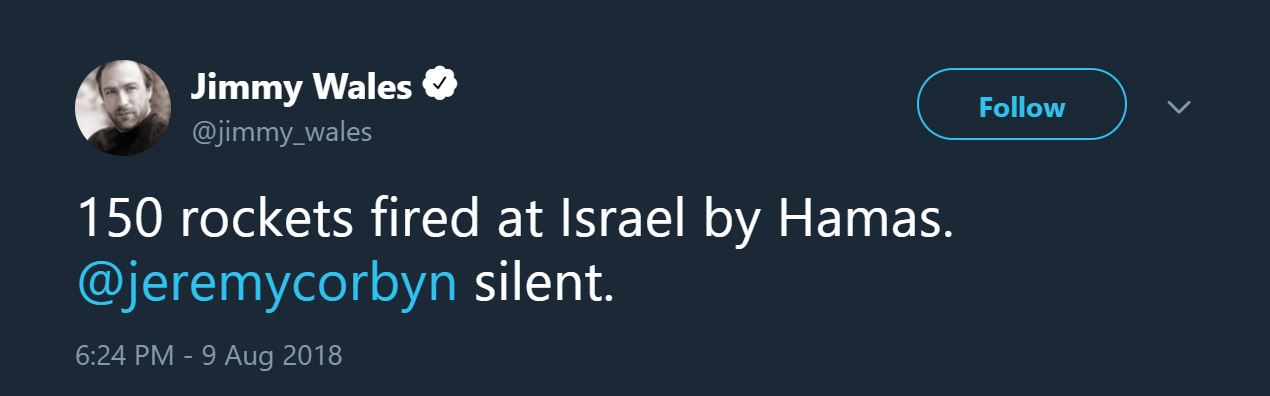
Wales tweets: 150 rockets fired at Israel by Hamas. @jeremycorbyn silent
To those well-versed on the history of Palestine this statement rightfully seems absurd and somewhat topsy-turvy. How can an occupied, brutalised and imprisoned people be castigated for merely defending themselves? While ‘Israel’ occupies land that does not belong to it – including Gaza which has no semblance of freedom with its borders and airspace locked down by the occupying regime which routinely commits bloody massacres with huge civilian death tolls – it absolutely must distort the facts in order to shape public opinion in its favour. ‘Israel’ committed and commits every day the causal acts of violence of ethnically cleansing Palestine and keeping the natives imprisoned, occupied and disenfranchised. The ‘Israel is acting in self-defence’ trope is then in fact the only form of rhetorical recourse that the Zionists can resort to in order to justify the historical and ongoing crimes against humanity committed every day in Palestine.
Jimmy Wales: Porn-Peddler-cum-Paid-Hasbara-Agent
In a revelation that will no-doubt raise eyebrows amongst Wikipedia users, in 1996 Jimmy Wales co-founded an online Internet portal called Bomis which sold porn and explicit material to users. The following, actually taken from the Wikipedia article for Bomis(2) adds context:
Bomis became successful after focusing on X-rated media. “Bomis Babes” was devoted to erotic images; the “Bomis Babe Report” featured adult pictures. Bomis Premium, available for an additional fee, provided explicit material. “The Babe Engine” helped users find erotic content through a web search engine. The advertising director for Bomis noted that 99 percent of queries on the site were for nude women.
Even the New York Times reports that the creation of Wikipedia was financed by Wales’ earlier porn venture,(3) whereby he would literally hand deliver cheques from Bomis porn revenues in order to keep Wikipedia’s servers running. On a perhaps related but definitely unsurprising note, the same New York Times article also reveals that via his wife, Jimmy Wales is very closely connected to Tony Blair(3) who even attended their wedding.
Though peddling porn may not be illegal, at the very least it sheds light on the true character of this man. What heroic agent of free information exchange makes money from selling pornography?
Wales has close links to ‘Israel’ and was awarded $1 million ‘Israeli’ prize for his services
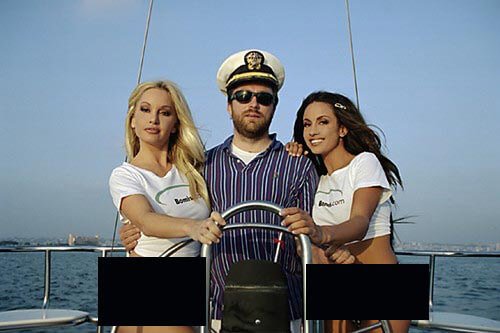
Wikipedia founder Jimmy Wales poses in a sleazy Bomis advertisement
In 2015 Jimmy Wales told The Times of Israel (4) that he had visited ‘more than ten times’, suggesting links to the Zionist enclave. He even told the Jewish Telegraphic Agency,(4) “I’m a strong supporter of Israel, so I don’t listen to those critics.” Laughably Wales cites ‘women’s rights’ as one of his reasons(4) for his support of the illegitimate Zionist entity. This is a statement that rings as hollow as a drum considering this man made his money in an industry that degrades women and enslaves vulnerable girls.
Wales’ numerous visits to ‘Israel’ during this time period must be understood in the wider context of Zionist information warfare. In 2010 the UK Guardian reported that Zionist groups were establishing Wikipedia editing courses(5) in order to sway Wikipedia entries in the Zionist regime’s favour. Additionally in 2012 The National Union of Israeli Students (NUIS) launched a program(6) to pay Israeli university students $2,000 to spread pro-‘Israel’ propaganda online for 5 hours per week.
Moreover, in the same year (2015) Mr. Wales was awarded $1 million by the ‘Israeli’ Dan David Foundation(7) after being selected by the prize committee for spearheading what they referred to as ‘the information revolution’.
The Electronic Intifada reports that the ‘Israeli’ government itself has been implicated in running the information war against Jeremy Corbyn. As part of this campaign, the ‘Israeli’ government has used its Act.IL software application to issue a mission for social media users to post negative comments against Jeremy Corbyn(1) suggesting he is an ‘anti-Semite’.
Let’s bring things full circle. Not only is Jimmy Wales a man of highly questionable moral character. Wales has close links to the Zionist regime, having visited it numerous times during the very same time period that Zionist groups were running Wikipedia editing courses and the ‘Israeli’ government was literally paying people to spread Zionist propaganda online. Wales’ efforts have culminated in him being awarded $1m by an ‘Israeli’ charitable organisation for his efforts in the ‘information revolution’. And now, interestingly, Mr. Wales is taking part in the very same information warfare campaign against Jeremy Corbyn that the ‘Israeli’ government has itself launched.
What is most alarming here is not merely Wales’ questionable character – having peddled porn and sleaze to make money – but the alarming indications that he could in fact be a de facto paid agent of the Zionist regime.
Notes
(1) ‘Israel running campaign against Jeremy Corbyn’ – The Electronic Intifada, 7 August 2018.
(2) ‘Bomis’ Wikipedia.com entry as of 10 August 2018.
(3) ‘Jimmy Wales Is Not An Internet Billionaire’ – The New York Times, 27 June 2013.
(4) ‘Wikipedia founder Jimmy Wales likes Israel but stays neutral’ – The Times of Israel, 19 May 2015.
(5) ‘Wikipedia editing courses launched by Zionist groups’ – The Guardian, 18 August 2010.
(6) ‘Israeli students to get $2,000 to spread state propaganda on Facebook’ – The Electronic Intifada, 4 January 2012.
(7) ‘Wiki founder wins $1m Israeli prize’ – The Times of Israel, 10 February 2015.
Easter Island people want return of their sacred statue, stolen by imperial Brits
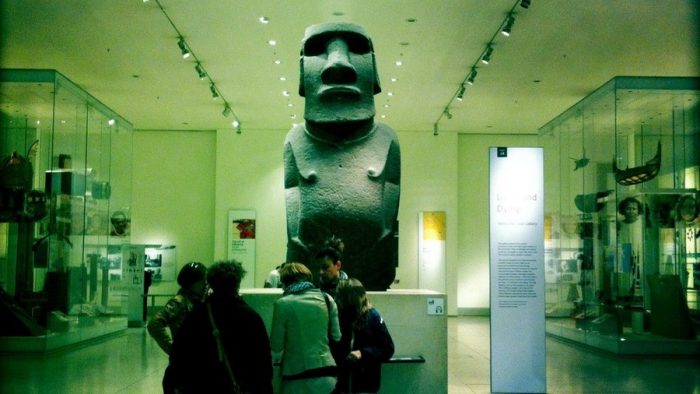
Moai sculpture from Easter Island in the British Museum © Veronika Lukasova / Global Look Press
RT | August 9, 2018
The Rapa Nui people of Easter Island are asking the British Museum to return one of the island’s sacred Moai statues, stolen 150 years ago by British sailors. It’s one of the many artifacts looted by the UK in its imperial days.
British Royal Navy sailors took the 2.42-meter (almost 8ft) tall Moai figure from Easter Island in 1868 and presented it to Queen Victoria in 1869. She, in turn, gifted it to the British Museum. No Moai statue has ever been precisely dated, but they are estimated to be at least 400 years old. This one’s name, Hoa Hakananai’a, ironically has been translated as “lost or stolen friend,” among other variants.
Now representatives of the native Easter Island Rapa Nui tribe have penned a letter to the British Museum asking for its return. It has received the backing of the national treasuries minister of Chile, of which Eastern Island is a part.
Hoa Hakananai’a is just one of a myriad of historic artifacts held in the British Museum, whose dubious means of acquisition is causing calls for repatriation. So far, the British government has been reluctant to yield to those calls.
Some of the most notable of those treasures include the Koh-i-noor diamond, taken from India and also presented to Queen Victoria in the mid-19th century. Another is the Rosetta Stone, discovered by Napoleon’s French Army in the late-18th century, which ended up in Britain in the early 1800s. There are also the Elgin Marbles from Greece, named after the Earl of Elgin, who in 1801 procured them from the Ottoman Empire, then the rulers of Greece.
In all of these cases, the original countries’ governments want their treasures back. With the Elgin Marbles, even UNESCO has interjected with a proposal to mediate the dispute.
UK authorities are resisting any calls to repatriate the artifacts. Their chief arguments being that the British Museum offers better conditions for their preservation and study.
Sanctioning Russia for false link to UK poisonings ‘unacceptable & unlawful’ – Kremlin
RT | August 9, 2018
Dmitry Peskov, the press secretary of Russian President Vladimir Putin, says the use of a Russian link to recent UK poisoning incidents to justify fresh US sanctions against the Kremlin is a violation of international law.
“In general, of course it’s necessary to say that we consider it categorically unacceptable that the new restrictions, that we continue to consider unlawful, are associated with the Salisbury case,” Peskov said in his Thursday interview with reporters.
“The association with these events is unacceptable for us. And we are convinced that such restrictions, together with the ones that the American side has imposed preemptively, are totally unlawful and contradict international law.”
“Russia does not have, and it has never had, anything to do with chemical weapons’ use, this is out of question. Moreover, we cannot confidently discuss what was used in Great Britain and how it was used because we have no information whatsoever. We have received no answers to our proposal to the British side to hold joint investigation into this incident that causes serious concern on our part,” the Kremlin official added.
Peskov told reporters that he considered any speculation about the effect of sanctions on the Russian financial system unwarranted, because this financial system was very stable. He noted that this stability had been proven in previous standoffs and that the Russian authorities had taken deliberate measures to make the country’s finances capable of withstanding the unpredictable behavior of “partners across the ocean.”
He stressed that it was difficult to reconcile the latest unfriendly actions by the US with the atmosphere established during the recent summit between US President Donald Trump and Putin in Helsinki.
When reporters asked Peskov about a possible Russian response to new US measures, he insisted it was too early to discuss the issue because the official US statement and quotes in the media from certain high-ranking sources did not make clear Washington’s official position.
Earlier, the US State Department announced the plans to impose new sanctions on Russia over its alleged role in the poisoning of double agent Sergei Skripal and his daughter Yulia in the UK in March. The first package of sanctions is scheduled to come into effect on or around August 22 and will reportedly include a ban on exports of sensitive national security goods to Russia.
The second round of sanctions, which includes downgrading diplomatic relations, banning the Russian airline Aeroflot from flying to the US and cutting off nearly all exports and imports, will reportedly be imposed three months after the first one, unless Russian authorities provide “reliable assurances” that they won’t use chemical weapons in the future and agree to “on-site inspections” by independent monitors.
Earlier today senior Russian lawmakers called the planned restrictions unfounded and likened Washington’s behavior to actions of a police investigator who attempts to extract evidence from an innocent suspect using torture and threats.
Read more:
Social Media Users in Scotland Planning on Boycotting BBC
Sputnik – August 9, 2018
Following the removal of the prominent Scottish independence blogger, Wings Over Scotland, social media users in Scotland are preparing for an outright boycott of the BBC. Earlier Sputnik spoke to the political analyst, Joe McGregor about this story.
Sputnik: So Joe can you explain a little bit about why people are planning on boycotting the BBC? Why are such a large proportion of Scots so disenfranchised with the BBC?
Joe McGregor: I’m deeply disenfranchised with that because it seems like Scotland don’t have a voice on the channel whatsoever – it’s very Westminster-centric, very England-centric. I don’t mean that as coming from the point of view that as a Scotsman I should be opposed… not at all. It seems to be that the BBC likes to show only the worst side of Scotland, or not give the SNP (Scottish National Party) a voice, when they are national broadcaster.
Sputnik: Does this have effect on Scottish political issues such as campaigns for Scottish independence and if so what kind of effect?
Joe McGregor: Eventually you become used to it. Say for the youth of Scotland that are coming through and they’re only having that information they would be guided to believing that information thinking that having nuclear weapons and having the nuclear base is a great thing. Scotland should be proud of having that there but they don’t show other side things, with nuclear apparatus being driven through city centers like Glasgow. If there was to be a problem there, it would wipe out most of central Scotland. Why does Scotland have to house that when Scotland doesn’t want to house that and why does the BBC not show that, that Scotland isn’t with that? They only tend to say ‘If it wasn’t there, then so many people would be out of work’ and that the local businesses wouldn’t have the customs of the people who work there – which I find ridiculous.
Sputnik: Is this boycott anti-English and what would you say to critics who suggest that it is?
Joe McGregor: It’s not anti-English, its anti-BBC. If the BBC was to give Scotland a fair crack of the whip and report the SNP are doing great things in Scotland and report on the fact that people aren’t happy having nuclear weapons on their doorstep, I think you would find that people don’t think its anti-English, its simply anti-BBC.
Sputnik: What would you like to see from the BBC that would improve the image of the broadcaster in your eyes?
Joe McGregor: I would just like to see every nation in the UK getting a fair crack of the whip. It’s not just Scottish issues; there’s Welsh issues, Northern Ireland issues… it’s not just Westminster-centric issues, it’s not like Westminster is big brother and its do what you say and everything will be ok and you know what, keep drinking beer because that will nullify any of the effects that may occur.
See also:
BBC Was in Bed With the Government to Flush Out ‘Subversives’ – Archives
US Imposing Sanctions on Russia Over Skripal Poisoning – State Department
Sputnik – August 8, 2018
The US State Department announced Wednesday that it would be imposing sanctions against Russia regarding the poisoning of Yulia and Sergei Skripal in the UK earlier this year.
The department said that it determined Russia had used the nerve agent Novichok against the Skripals deliberately. Sanctions are expected to take effect on or around August 22.
Prior to the announcement, the US had joined fellow European nations in blaming Russia for the incident; however, the Trump administration hadn’t issued a formal statement on the matter.
According to NBC News, the immediate repercussions will act as an add-on to previous sanctions limiting exports and financing. “The biggest impact from the initial sanctions is expected to come from a ban on granting licenses to export sensitive national security goods to Russia, which in the past have included items like electronic devices and components, along with test and calibration equipment for avionics,” the outlet states.
The sanctions could also suspend Aeroflot flights to the US and are certain to cool relations between the global powers, though a US State Department official noted after the announcement that Washington hoped to maintain relations with Moscow. The US wants assurances that Russia will not use chemical weapons and will allow inspections.
On March 14, days after the Skripals were found slumped on a park bench in Salisbury, England, UK Prime Minister Theresa May announced that she would be expelling 23 Russian diplomats from the country. May justified her decision by saying it was “highly likely” the mysterious poisoning had been carried out by Russia, in part because the substance used to poison the pair had been identified as novichok, a military-grade nerve agent developed in the Soviet Union. UK labs have not since been able to trace the origins of the specific substance that poisoned the Skripals, however.
Months later, on June 30, two other people were found unconscious in the UK city of Amesbury, near Salisbury. According to UK officials, both Dawn Sturgess and Charlie Rowley were exposed to the same nerve agent that the Skripals had come into contact with. This, too, was blamed on Russia. Sturgess later died.
Russia has adamantly denied that it played any role in either poisoning, stressing that the UK has failed to offer any solid evidence to back up their claims.
See also:
‘Still No Proof’: Scholar Questions Skripal Case Probe Amid Amesbury Incident
The Corbyn anti-Semitism row reveals how desperate Israel and its lobbyists are
By Yvonne Ridley | MEMO | August 6, 2018
The socialist leader of a British political party embroiled in an anti-Semitism row has apologised for appearing on platforms with people who drew Nazi-style comparisons with Israel’s actions. His remarks, though, have backfired among some Jewish and other pro-Palestinian groups.
They have accused the Labour Leader Jeremy Corbyn of “crumbling” after pointing out that the original “Nazi” comments were made by a Jewish survivor of Auschwitz Concentration Camp. Corbyn’s statement and apology were delivered last week in response to a British media furore over reports that he hosted an event in 2010 during which Israel’s behaviour towards the Palestinians was compared to Nazism.
Corbyn’s critics in the pro-Israel Lobby failed to consider that the Nazi comparison was made by Hajo Meyer, a Holocaust survivor who died in 2014. Meyer made the comparison during a talk in a House of Commons committee room on “The Misuse of the Holocaust for Political Purposes”. Furthermore, a man who was removed by security officials from the meeting for making a Nazi salute and shouting “Sieg Heil” was actually from the pro-Israel lobbyists who were in the audience.
Among those rushing to condemn the party for further “proof” of anti-Semitism within the Labour Party under Corbyn’s leadership was one of his own MPs. Liverpool’s Louise Ellman told the BBC that she was “absolutely appalled” to hear about his involvement in the Holocaust meeting. She forgot to mention that she had attended the same meeting in parliament and was among those who jeered a Holocaust survivor. No one from the BBC questioned her about that, or the fact that the comments at the heart of the anti-Semitism row were made by a Jew who survived Auschwitz.
The latest, and harshest, criticism by the co-organisers of that meeting has been saved for Corbyn himself. “We will not crumble, as Jeremy Corbyn seems to have done,” insisted the Scottish Palestine Solidarity Campaign. “By his apology and attack on two advocates of Palestinian freedom Corbyn has only emboldened those who defend every Israeli crime and work to silence opponents of the crimes against humanity carried out by the State of Israel on the Palestinian people.” Such opponents, the SPSC claimed, will never be placated because they hate the idea of Corbyn being within reach of 10 Downing Street where he might challenge Britain’s alliance with Israel.
“False accusations of anti-Semitism by defenders of Israeli snipers,” the Campaign added, “is ‘the gift that keeps on giving’. Once a false accusation has been made the act of denial is portrayed as proof of guilt. This new version of Catch 22 submerges areas of British politics in a McCarthyite madness where the accusation, however absurd, means inescapable guilt, at least in much of the mainstream media.” That media, it must be said, has been shamefully biased towards Israel’s increasingly far-right position.
Corbyn’s apology read thus: “In the past, in pursuit of justice for the Palestinian people and peace in Israel/Palestine, I have on occasion appeared on platforms with people whose views I completely reject. I apologise for the concerns and anxiety that this has caused.”
The man who drew parallels with the Nazi regime, 85-year-old Dr Hajo Meyer, was joined at the meeting in the House of Commons on Holocaust Memorial Day, 27 January 2010, by Dr Haidar Eid, who participated in the meeting from Gaza via speakerphone. Both men compared the dehumanisation of Jewish people in Hitler’s Germany pre-1941 with the dehumanisation of Palestinian people in current day Israel and occupied Palestine. Throughout his UK speaking tour, Dr Meyer received standing ovations.
Co-organisers from the International Jewish Anti-Zionist Network (IJAN) said that the tour had provided an opportunity for “many hearing for the first time important truths about Israel’s occupation of Palestine.” In a press statement issued last week, IJAN quoted Meyer: “My great lesson from Auschwitz is: whoever wants to dehumanise any other, must first be dehumanised himself. The oppressors are no longer really human whatever uniform they wear.“
The event in 2010 attracted leading Zionist figures including Ellman [then and now, Vice Chair of Labour Friends of Israel], Jerry Lewis [then Vice President, Board of Deputies] and Jonathan Hoffman [then Co-Vice Chair of the Zionist Federation], as well as Christian Friends of Israel. “Most of them had clearly not come to listen,” explained IJAN. “They barracked both Dr Meyer and Dr Eid, and one of them, Martin Sugarman, had to be escorted out by the Commons security; on his way out he stunned everyone by giving the Nazi salute and shouting ‘Sieg Heil’.”
IJAN added that following the deaths of more than 2,000 Palestinians in Gaza in July 2014, a letter from survivors of the Nazi genocide and hundreds of their descendants called for a full economic, cultural and academic boycott of Israel. “Genocide begins with the silence of the world… We must raise our collective voices and use our collective power to bring about an end to all forms of racism, including the ongoing genocide of Palestinian people. ‘Never again’ must mean NEVER AGAIN FOR ANYONE!” Dr Hajo Meyer was the first to sign the letter, which was published in the New York Times on 24 August 2014, the morning after he died.

IJAN describes itself as an international network of Jewish people opposed to imperialism, militarism, apartheid and genocide. It said that the event in question was “a coming together of many communities which have faced dehumanisation, racism and genocide.” Speakers were Armenian, Bangladeshi, Irish, Native American, Roma, Rwandan and Tamil. There were also people with disabilities, and a speaker on the slave trade from Africa to the Americas and the revolution which ended slavery in Haiti.
In its literature, IJAN says that it supports “the liberation of the Palestinian people, and the right of return for those driven from their homes and their land by Israeli occupation and ethnic cleansing.” The group has active chapters in Argentina, Canada, France, Spain, Britain and America.
Its tour partner on that occasion, the Scottish Palestine Solidarity Campaign, recalled the events clearly: “During his talks, Hajo Meyer movingly described his experiences in Nazi-occupied Europe; how the regime dehumanised him and other Jews, and drew compelling parallels between his life before 1941 and Israel’s progressive dehumanisation of Palestinians up until the present day. Dr Meyer argued at each meeting that ‘Zionism was the polar opposite of Judaism’, ie a brutal programme of settler colonialism contrasted with the ethical power of one of the great world religions.”
Dr Haider Eid spoke at that meeting in 2010 from the Gaza “prison camp”, as former British Prime Minister David Cameron once called the besieged territory. Most of the Palestinians living in the Gaza Strip are refugees from other parts of historic Palestine, having been driven from their homes by waves of Israeli ethnic cleansing. Successive military offensives have been carried out by Israel over the years.

A Gazan boy walks with his younger sibling through their poverty stricken neighbourhood in Gaza on 4 September 2013 [Ezz Zanoon/Apaimages]
Dr Eid spoke a year after Israel’s massacre of 1,400 Palestinians, which the UN Goldstone Commission concluded was “a war crime and possible crime against humanity.” Crimes against humanity were first prosecuted against the Nazi leadership in Nuremberg after the end of World War Two. The Palestinian academic suggested that Nazi-type bestiality was not consigned to history by the Nuremburg trials. “The world was absolutely wrong to think that Nazism was defeated in 1945,” he insisted. “Nazism has won because it has finally managed to Nazify the consciousness of its own victims.”
SPSC added that while the pro-Israel lobby seeks to criminalise such statements, Dr Eid’s comparison of modern day Israel to Nazi Germany has also been articulated by several prominent political figures in Israel, including the Deputy Chief of the General Staff of the Israeli army, Yair Golan. Major General Golan said in a speech delivered at a 2016 Holocaust Memorial event in Israel that, “It’s scary to see horrifying developments that took place in Europe begin to unfold here.”
The senior officer came under intense attack inside Israel but was defended by prominent figures. His comment was widely believed to be a reference to the case of Elor Azaria, an Israeli soldier who was caught on film taking deliberate aim and shooting dead an injured and already prone Palestinian, Abdel Fattah Al-Sharif. Golan may, though, have been thinking of the recently appointed Military Chief Rabbi Eyal Karim who, as well as calling for genocide in Gaza, had endorsed rape of “comely Gentile women” if it maintained the morale of Israeli soldiers in wartime.
Another example of a senior Israeli drawing on the horrors of World War Two under the Nazi regime was provided when another Major General, and former minister, Matan Vilnai threatened the Palestinians with a Holocaust. In order to leave everyone in no doubt about what he meant, he used the Hebrew word “Shoah”.
Intensive efforts by pro-Israel groups in Britain have so far failed to provide a single anti-Semitic word written or uttered by Corbyn to back up their accusation, but this has not stopped the campaign against him, which is apparently being directed by Israel’s Embassy on the British capital. Unable to win the debate by rational means, it seems that the tactic now is to try to shut down open and honest debate altogether. Anyone who does not toe the pro-Israel line must be discredited and disregarded at all costs, even when that person is both a Jew and a survivor of the Nazi Holocaust. That’s how desperate Israel and its apologists are.
Marching for Peace: From Helmand to Hiroshima
By Maya Evans | Dissident Voice | August 5, 2018
I have just arrived in Hiroshima with a group of Japanese “Okinawa to Hiroshima peace walkers” who had spent nearly two months walking Japanese roads protesting U.S. militarism. While we were walking, an Afghan peace march that had set off in May was enduring 700km of Afghan roadsides, poorly shod, from Helmand province to Afghanistan’s capital of Kabul. Our march watched the progress of theirs with interest and awe. The unusual Afghan group had started off as 6 individuals, emerging out of a sit-in protest and hunger strike in the Helmand provincial capital Lashkar Gah, after a suicide attack there created dozens of casualties. As they started walking their numbers soon swelled to 50 plus as the group braved roadside bombs, fighting between warring parties and exhaustion from desert walking during the strict fast month of Ramadan.
The Afghan march, which is believed to be the first of its kind, is asking for a long-term ceasefire between warring parties and the withdrawal of foreign troops. One peace walker, named Abdullah Malik Hamdard, felt that he had nothing to lose by joining the march. He said: “Everybody thinks they will be killed soon, the situation for those alive is miserable. If you don’t die in the war, the poverty caused by the war may kill you, which is why I think the only option left for me is to join the peace convoy.”
The Japanese peace walkers marched to specifically halt the construction of a U.S. airfield and port with an ammunition depot in Henoko, Okinawa, which will be accomplished by landfilling Oura Bay, a habitat for the dugong and unique coral hundreds of years old, but many more lives are endangered. Kamoshita Shonin, a peace walk organizer who lives in Okinawa, says:
People in mainland Japan do not hear about the extensive bombings by the U.S. in the Middle East and Afghanistan, they are told that the bases are a deterrent against North Korea and China, but the bases are not about protecting us, they are about invading other countries. This is why I organised the walk.
Sadly, the two unconnected marches shared one tragic cause as motivation.
Recent U.S. war crimes in Afghanistan include the deliberate targeting of civilian wedding parties and funerals, incarceration without trial and torture in Bagram prison camp, the bombing of an MSF hospital in Kunduz, the dropping of the ‘Mother of all bombs’ in Nangarhar, illegal transportation of Afghans to secret black site prisons, Guantanamo Bay prison camp, and the extensive use of armed drones. Elsewhere the U.S. has completely destabilised the Middle East and Central Asia, according to The Physicians for Social Responsibility, in a report released in 2015, stated that the U.S. interventions in Iraq, Afghanistan and Pakistan alone killed close to 2 million, and that the figure was closer to 4 million when tallying up the deaths of civilians caused by the U.S. in other countries, such as Syria and Yemen.
The Japanese group intend to offer prayers of peace this Monday at Hiroshima ground zero, 73 years to the day after the U.S. dropped an atomic bomb on the city, instantly evaporating 140,000 lives, arguably one of the worst ‘single event’ war crimes committed in human history. Three days later the U.S. hit Nagasaki instantly killing 70,000. Four months after the bombing the total death toll had reached 280,000 as injuries and the impact of radiation doubled the number of fatalities.
Today Okinawa, long a target for discrimination by Japanese authorities, accommodates 33 U.S. military bases, occupying 20% of the land, housing some 30,000 plus U.S. Marines who carry out dangerous training exercises ranging from rope hangs suspended out of Osprey helicopters (often over built-up residential areas), to jungle trainings which run straight through villages, arrogantly using people’s gardens and farms as mock conflict zones. Of the 14,000 U.S. troops currently stationed in Afghanistan, many to most would have trained on Okinawa, and even flown out directly from the Japanese Island to U.S. bases such as Bagram.
Meanwhile in Afghanistan the walkers, who call themselves the ‘People’s Peace Movement’, are following up their heroic ordeal with protests outside various foreign embassies in Kabul. This week they are outside the Iranian Embassy demanding an end to Iranian interference in Afghan matters and their equipping armed militant groups in the country. It is lost on no-one in the region that the U.S., which cites such Iranian interference as its pretext for building up towards a U.S.-Iran war, is an incomparably more serious supplier of deadly arms and destabilizing force to the region. They have staged sit-in protests outside the U.S., Russian, Pakistani and U.K. embassies, as well as the U.N. offices in Kabul.
The head of their impromptu movement, Mohammad Iqbal Khyber, says the group have formed a committee comprised of elders and religious scholars. The assignment of the committee is to travel from Kabul to Taliban-controlled areas to negotiate peace.
The U.S. have yet to describe its long term or exit strategy for Afghanistan. Last December Vice President Mike Pence addressed U.S. troops in Bagram: “I say with confidence, because of all of you and all those that have gone before and our allies and partners, I believe victory is closer than ever before.”
But time spent walking doesn’t bring your destination closer when you don’t have a map. More recently U.K. ambassador for Afghanistan Sir Nicholas Kay, while speaking on how to resolve conflict in Afghanistan said: “I don’t have the answer.” There never was a military answer for Afghanistan. Seventeen years of ‘coming closer to victory’ in eliminating a developing nation’s domestic resistance is what is called “defeat,” but the longer the war goes on, the greater the defeat for Afghanistan’s people.
Historically the U.K. has been closely wedded to the U.S. in their ‘special relationship’, sinking British lives and money into every conflict the U.S. has initiated. This means the U.K. was complicit in dropping 2,911 weapons on Afghanistan in the first 6 months of 2018, and in President Trump’s greater-than-fourfold average increase on the number of bombs dropped daily by his warlike predecessors. Last month Prime Minister Theresa May increased the number of British troops serving in Afghanistan to more than 1,000, the biggest U.K. military commitment to Afghanistan since David Cameron withdrew all combat troops four years ago.
Unbelievably, current headlines read that after 17 years of fighting, the U.S. and Afghan Government are considering collaboration with the extremist Taliban in order to defeat ISKP, the local ‘franchise’ of Daesh.
Meanwhile UNAMA has released its mid-year assessment of the harm done to civilians. It found that more civilians were killed in the first six months of 2018 than in any year since 2009, when UNAMA started systematic monitoring. This was despite the Eid ul-Fitr ceasefire, which all parties to the conflict, apart from ISKP, honoured.
Every day in the first six months of 2018, an average of nine Afghan civilians, including two children, were killed in the conflict. An average of nineteen civilians, including five children, were injured every day.
This October Afghanistan will enter its 18th year of war with the U.S. and supporting NATO countries. Those young people now signing up to fight on all sides were in nappies when 9/11 took place. As the ‘war on terror’ generation comes of age, their status quo is perpetual war, a complete brainwashing that war is inevitable, which was the exact intention of warring decision makers who have become exceedingly rich of the spoils of war.
Optimistically there is also a generation who are saying “no more war, we want our lives back”, perhaps the silver lining of the Trump cloud is that people are finally starting to wake up and see the complete lack of wisdom behind the U.S. and its hostile foreign and domestic policies, while the people follow in the steps of non-violent peace makers such as Abdul Ghafoor Khan, the change is marching from the bottom up.

Okinawa to Hiroshima Peace Walk (Photo by Maya Evans)
Maya Evans coordinates Voices for Creative Nonviolence UK and has visited Afghanistan 9 times since 2011. She is a writer and a Councillor for her town in Hastings, England.
Anti-Semitism and the suppression of truth
By Gilad Atzmon | August 5, 2018
Jewish power, as I define it, is the power to silence opposition to Jewish power. The scandal over the alleged anti-Semitism within the Labour party provides a perfect example. The Labour Party is accused of being “an existential threat to British Jews” (no more no less) because the NEC, its ruling body, defined antisemitism for the Labour party, without clearly including in its definition criticism of Israel.
In its definition for its own code, the Labour party adopted the problematic IHRA working definition of antisemitism but omitted the following ‘examples of anti-Semitism’ included with the IHRA:
§ Accusing Jewish people of being more loyal to Israel than their home country,
§ Claiming that Israel’s existence as a state is a racist endeavor,
§ Requiring higher standards of behaviour from Israel than other nations, and
§ Comparing contemporary Israeli policies to those of the Nazis.
According to Labour’s ruling body, these examples may not be treated as anti -Jewish bigotry without clear evidence of anti-Semitic intent. This treatment is the proper one according to most reasonable minds.
Since some Diaspora Jews admit to being more loyal to Israel than to their home country, it would be a bit problematic to accuse a goy of hatefulness for repeating what many Jews openly declare. Since the new racist Israeli National Bill has been duly approved by the Knesset, it would be bizarre to accuse a Labour Party member of anti-Jewish bigotry for saying that Israel is a racist endeavour.
Although such an accusation may well be accurate, it runs afoul of the omitted examples in the IHRA definition exactly because the definition is designed to suppress criticism of Israel and its politics. Last week, the Guardian published a wide range of Jewish writers and their views of the IHRA definition in the context of the current Labour ‘anti-Semitism’ crisis. Some of the views expressed are insightful and deserve close attention.
Antisemitism, according to Stephen Sedley, a law scholar and a former judge, is “hostility towards Jews as Jews. This straightforward definition is at the disposal of any institution or organisation that needs it. It places no prior restrictions on the form antisemitism may take.”
Sedley comes to a conclusion that the IHRA definition with examples exists “to neutralise serious criticism of Israel by stigmatising it as a form of antisemitism.” Sedley’s view in this context fits nicely with the definition of Jewish power above.
Sedley points out that The UK government, which has adopted the “working definition” including the examples, was warned by the Commons home affairs select committee in October 2016 that in the interests of free speech it ought to adopt an explicit rider that it is not antisemitic to criticise the government of Israel … without additional evidence to suggest anti-Semitic intent.” Sedley emphasises that this recommendation “was ignored.”
Geoffrey Bindman, a QC, solicitor and a legal scholar agrees with Sedley’s criticism. Bindman also refers to the recommendations of the all-party Commons home affairs select committee that the IHRA definition should only be adopted if qualified by caveats making clear that it is not anti-Semitic to criticise the Israeli government without additional evidence to suggest anti-Semitic intent. “Unfortunately the caveats were omitted when the definition was approved by the UK government.”
These men make clear that the IHRA definition is a faulty definition. The British government should reconsider its use of this definition. The other bodies and institutions that were pushed to adopt this non-universalist text would do well to drop it.
Sedley’s opinion is that even though the UK has adopted the IHRA definition, Brits are not forbidden by law from telling the truth about Israel’s being a racist state. This is because Britain also has the “Human Rights Act [that] enacts article 10 of the European Convention on Human Rights, guaranteeing the right of free expression.” According to Sedley “whatever criticism the IHRA’s ‘examples’ may seek to suppress, both Jews and non-Jews in the UK are entitled, without being stigmatised as antisemites, to contend that a state that by law denies Palestinians any right of self-determination is a racist state, or to ask whether there is some moral equivalence between shooting down defenceless Jews in eastern Europe and unarmed Palestinian demonstrators in Gaza.”
Geoffrey Bindman argues that the IHRA definition and examples are “poorly drafted, misleading, and in practice have led to the suppression of legitimate debate and freedom of expression. Nevertheless, clumsily worded as it is, the definition does describe the essence of anti-Semitism: irrational hostility towards Jews.”
Here Bindman opens Pandora’s box. If anti-Semitism is irrational hostility toward Jews simply for being Jews, then the IHRA definition together with its clauses treats even rational and reasonable opposition to Israeli politics as ‘irrational hatred.’ This presents a dangerous precedent and an Orwellian turn for British society. It suggests that Britain is a free country no more. In Britain in 2018, those who oppose a certain type of evil, racist politics are labelled ‘irrational haters’ (anti-Semites). Clearly Labour’s NEC attempted to fix this problem by requiring a finding of hateful intent at the core of certain so-called anti-Semitic behaviour. This reasonable requirement led to an irrational reaction by Jewish institutions and an aggressive response.
It is difficult to judge whether the Guardian’s choices to defend the IHRA were made as a genuine attempt to represent the Zionist side. Perhaps the Guardian was making a desperate attempt to provide its readers with some comic relief: like the British Chief Rabbi and 68 additional British rabbis who were upset by Labour‘s slight deviation from the IHRA definition, Reform Rabbi Laura Janner-Klausner also expressed her dissatisfaction with the party of the workers.
“If the Labour party wanted to prioritise anti-Semitism by choosing a bespoke definition then it could have listened to the full diversity of the Jewish community,” Janner-Klausner wrote. But why does anyone need to follow the Rabbis or self-appointed Jewish ‘representative bodies’ for that matter? If anti-Semitism is racism, then we all ought to oppose anti-Semitism as we do any form of racism: universally. And if anti-Semitism is a piece of our universal concern with racism, then we all should be equally involved in opposing it. This is similar to the line of thought that was, I believe, at the core of the American Civil Rights Movement. It was a universal call that had a universal appeal. It aimed to protect the many not just the few. This is pretty much the opposite of the IHRA definition that is concerned with one people only.
In that regard, it is of note that Labour’s NEC was not attempting to define what anti-Semitsm means to Jews. NEC defined what anti-Semitsm means for the Labour party and in accordance with Labour values.
Keith Kahn-Harris, a London sociologist not known for his sophistication also contributed to the Guardian’s panel. He reiterated my definition of Jewish power, probably without realising it. “It’s certainly true that the IHRA definition does tightly constrain anti-Israel and anti-Zionist speech, but it doesn’t make it impossible.” I guess that Kahn-Harris is saying that IHRA definition allows support of Palestine as long as the speaker can successfully zigzag around Jewish sensitivities. Maybe you can talk about Palestinian suffering as long as you avoid mentioning Israel. “It might have been possible to see the IHRA definition as a challenge to pro-Palestinian activists to be more creative in their language: after all, whether or not you think Israel is acting just like the Nazis, saying so is predictable, lazy and cliched.” I would advise Khan Harris that living for 70 years as a stateless refugee in Lebanon or being imprisoned in Gaza by an Israeli siege is more than enough. Palestinians and their supporters do not need this ‘extra challenge.’ What they want is to make their plight known and to be able to talk truth to power. Even to describe, for instance, an equivalence between two nationalist, racist and expansionist political ideologies that were fermented around the same time and even collaborated for a while. And this is exactly what the IHRA is there to prevent.
Featured Video
Death Spikes & Rising Cancer In Our Youth Explained
or go to
Aletho News Archives – Video-Images
From the Archives
Politicians lie
By Mazin Qumsiyeh | Popular Resistance | August 18, 2013
There is no way to say this truth nicely: Politicians lie. That includes Japanese, American, Egyptian, Israeli, and Palestinian politicians! Is there something more common sense than that? Yet, so many citizens around the world believe their own politicians or wistfully acknowledge lies but think it is part of the job needed to run things. They believe even when politicians contradict themselves blatantly. This phenomenon is rather remarkable. It is a dissonance and disconnect from reality that many seem oblivious to. It is very dangerous because it can lead to accepting rationales for going to war. These can be deadly wars that lead to millions of lives lost as happened in what was called World War 1 and WW2. Even when incredible and declassified evidence abound, politicians continue to lie and old mythologies refuse to die. Here are just a few of the countless lies told to us over the past few decades… continue
Blog Roll
 Aletho News
- From Unipolar Universalism to Multipolar Civilizational Distinctiveness
- RSF military group defects, joins Sudanese army: State media
- Ireland goalkeeper refuses to play ‘Israel’ as squad weighs boycott
- China pushes back against US on Cuba, Iran
- Ukrainian Soldiers, Potential Mercenaries: Have Gun, Will Travel!
- Burnham’s UN debut… A masterclass in British disinformation
- Iran flights continue despite US aviation sanctions
- Global Tipping Points Lead the World Into a State of Entropy
- The day-after at the White House: USA and Xi Jinping
- The Geopolitical Balance in the Red Sea: The UAE Being Displaced by New Players
- If Americans Knew
- Deconstructing Netanyahu’s pants-on-fire UN rant – Daily Update
- Trump betrayed voters with his campaign lies and prioritized a foreign country once he took office
- Netanyahu calls Israel’s war in Gaza ‘opposite of genocide’ in UN speech to near-empty hall
- Settler Kidnappings: Torture, Sexual Abuse and Terrorisation of Palestinian Abductees as Israel Deepens Annexation of West Bank
- Gaza winter nears as 162,000 tents become unusable, raising fears of humanitarian crisis
- Netanyahu says, “It’s the opposite of genocide”; UN says Gaza economy is world’s ‘most severe crisis on record’ – Daily Update
- Israel’s US-Backed Assault on Gaza Has Created the ‘World’s Most Severe Economic Crisis on Record’: UN
- ‘Protecting U.S. Citizens’… From Israel
- ‘This is where I live now, the back of a truck’: a day in the life of a grandmother in Gaza
- In UN Speech, Iran’s President Displays Pictures of Children Killed by US, Brings Attention to Israel’s Nuclear Arsenal
- No Tricks Zone
- New Study: Earth And Venus Surface Warmth Largely Explained By Convection And Lapse Rate, Not CO2 Or Radiation
- 2025 Nature Paper Claiming Worsening Global Drought Gets RETRACTED …Heavily Flawed
- New Study: ‘Global Drought Shows No Detectable Recent Acceleration Under Climate Warming’
- Economic Masterminds: German Socialists Suggest Taxing Productivity Gains Stemming From Using AI
- The South China Sea Has Not Been Cooperating With The Climate Change Narrative
- Energy Crisis: Germany Enters Heating Season With Historically Low Gas Reserve Fill Levels
- New Study: The Antarctic Ice Sheet Gained Mass From 2020-2024 Due To Staggering Snow And Ice Accumulation
- Study: Ocean Heating Rates From Thousands Of Years Ago ‘Dwarf’ Modern Ocean Heating Rates
- Climate Extremists Target, Attack Large-Scale Power Grid Infrastructure In Germany!
- New Study: Antarctic Ice Melt Has Contributed Less Than 1 Centimeter To Sea Level Rise In The Last 30 Years

