The Salisbury Poisonings: “Novichok” – The Odourless Nerve Agent That Stinks to High Heaven
By Rob Slane | The Blog Mire | July 20, 2018
Here is a little primer for the British Government on basic logic. Actions have consequences. What this means is that consequences must stem from actions. And the two must be connected. So far so good?
Let me give an example. If I spill boiling hot coffee on my foot, it will cause me pain and possibly even a blister. To flip that over, if I have a blister on my foot, you might ask me, “Oh, how did you get that?” If I told you that I spilt hot coffee on my foot, you would probably wince and say something like, “Ouch, that must have hurt.” And the chances are that you would be satisfied with my explanation. Why? Because boiling hot coffee split on the foot is quite capable of causing a blister.
But what if, in answer to your question of how I came to get the blister, I told you that I spilt some orange juice on my hand. Would you accept my answer? Would you wince and say, “Ouch, that’s gotta hurt”? Would you go away and say to others, “Poor guy, he spilt orange juice on his hand, and now he’s got a horrible blister on his foot”? Probably not!
Your reaction would probably be more along the lines of, “Huhhh??? You spilt orange juice on your hand, and you got a blister on your foot? What are you talking about?” And the reason for this reaction is that you understand that actions have consequences, and consequences stem from actions. And we all know that whereas spilling boiling hot coffee on the foot might well cause the foot to blister, spilling orange juice on your hand will not have that effect.
This is why the Government’s explanation of the Salisbury and Amesbury poisonings is so obviously false. It fails the test of basic logic. All of the pre-2018 literature on the substance known as A-234 (one of the strains of so-called “Novichok”) states that it is lethal, and most sources tell us that it is around 5-8 times more toxic than VX. What happens if you get some of it on you? One of its creators, Vladimir Uglev, has told us what happened after he got a tiny amount of this agent on his hand:
“‘I rinsed my hands with sulfuric acid and then put them under tap water,’ he said, adding it was the only way to survive. Another researcher who was contaminated in 1987 died of multiple illnesses five years later [my emphasis].”
The only way to survive? Sulfuric acid followed by lots of running water? Has there been any confirmation that after the Skripals and DS Bailey allegedly came into contact the substance, they immediately washed their hands with sulfuric acid and water? I haven’t come across this particular detail yet, but if anybody has, do let me know. And lest anyone says that the substance that the Skripals got on their skin might have been less potent than the substance Mr Uglev got on his hand, the OPCW report of 4th May claimed that traces of the substance, allegedly on the door handle, weeks after the incident, were of “high purity”.
So they got the same substance on their hands as Mr Uglev, yet whilst for him it meant:
Sulfuric Acid + Water or Face Instant Death
For Mr Skripal and his daughter it meant:
Feeding the Ducks + Drink + Meal
Mr Uglev is no friend of the current Russian Government, but in case anyone is not satisfied with his testimony, note that it was essentially backed up recently by Alistair Hay, Professor of Environmental Toxicology at the University of Leeds, who said this in relation to the more recent Amesbury case:
“A few millilitres would be sufficient to probably kill a good number of people and you could store that in a small ampoule, or it might be in a small container like for nail varnish.”
His testimony regarding the container is particularly useful, I’m sure, and is just the sort of thing that sets Professors apart from the rest of us. I mean, who knew that liquid can be stored in a container? But it’s the other part of it that is truly fascinating. He is of course correct to say that a few millilitres of military grade nerve agent is enough to kill many people – sulfuric acid and water notwithstanding. This is what it is designed to do. So doesn’t he think it mighty odd that it somehow didn’t do this, even thought it was apparently “high purity” and “military grade”? Furthermore, doesn’t he find it odd that underneath his claim, Public Health England once again advised people who thought they might have come into contact with it to:
“Wipe personal items such as phones, handbags and other electronic items with cleansing or baby wipes and dispose of the wipes in the bin (ordinary domestic waste disposal) … Please thoroughly wash your hands with soap and water after cleaning any items.”
Wot no sulfuric acid??? Or are they now making baby wipes with traces of sulfuric acid these days? Just in case.
Coming into contact with more than a few millilitres of high purity A-234, and then going to feed ducks, have a drink and eat a meal is no more plausible than the claim that spilling orange juice on the hand leads to blisters on the foot.
But this is not all. I have consciously avoided commenting much on the Amesbury case, and this for two reasons. Firstly, because the level of disinformation and propaganda around the case means that trying to keep up with it is nigh on impossible. But more importantly, it is because the second case is being used by the authorities to shore up the first case, by a very clever sleight of hand, as if the claims made in the first case have been proven. Which they haven’t.
I’ll show you what I mean. In her statement to the House of Commons in 14th March, Mrs May said the following:
“And there were only two plausible explanations. Either this was a direct act by the Russian State against our country. Or conceivably, the Russian government could have lost control of a military-grade nerve agent and allowed it to get into the hands of others. [my emphasis]”
Since then, not only has the Government singularly failed to provide the evidence to back up either of these “plausible alternatives”, but it has become abundantly clear that there are actually a good many others. Yet on 5th July, the Home Secretary, Sajid Javid, stated the following to the House of Commons:
“The decision taken by the Russian government to deploy these in Salisbury on March 4th was reckless and callous – there is no plausible alternative explanation to the events in March other than the Russian state was responsible [my emphasis].”
See the sleight of hand? In March, there were apparently two plausible alternatives. Since then, neither of those alternatives has been backed up by any evidence whatsoever. Yet come 5th July, with the second case, the number of plausible alternatives is down to zero. There is one explanation, and one explanation alone. “Do not mistake me for a conjurer of cheap tricks,” said Gandalf to Frodo. “Do not mistake me for a person with integrity,” said Sajid Javid, conjurer of cheap tricks, to the House as he performed his sleight of hand.
Did no one in Parliament think to ask Mr Javid how the Government had managed to rule out “the other plausible alternative” between March and July? Did nobody demand to know what evidence they had discovered, which they haven’t told us about, to warrant this claim? Of course not. They never demanded to see any evidence of the two plausible alternatives back in March, and the likelihood that they might have developed some integrity and inquisitiveness in the four months following was slim. No, they accepted Mr Javid’s sleight of hand, his unsubstantiated claim dressed up as fact […]
I view the Amesbury case as a tragedy, in that Dawn Sturgess lost her life. But as far as the case itself is concerned, it seems to me to be something of a rabbit trail, with a mountain of disinformation – whether wittingly or unwittingly – which not only keeps us scratching our heads trying to figure it all out, but which is also being used to pretend that the official version of events in the first case has been proven. Which — I reiterate — it most certainly hasn’t.
Nevertheless, let’s debunk it where we can. I had understood from some of the original reports about Dawn Sturgess and Charlie Rowley, that both of them had a “high dose” of “Novichok” on just one hand. I understood this to be the case because that’s what the authorities told us, although I am of course by now well aware that Rule Number One in this case is to take everything the authorities say with a bucket of salt:
“‘This means they must have got a high dose and our hypothesis is that they must have handled a container that we are now seeking.’ It is understood the couple each had nerve agent on one of their hands.”
What is a “high dose? Is it more than the tiny amount Vladimir Uglev got on his hands, which forced him to resort to washing it off with sulfuric acid immediately? Is it more than the few millilitres Alistair Hay says, “would be sufficient to probably kill a good number of people”?
I don’t suppose it matters now, however, because the “facts” have since changed. Apparently they now didn’t get it on one hand. No, Ms Sturgess apparently sprayed it on both wrists. Wrists, not hand. Two wrists, not one hand. Got that?
“Novichok victim Dawn Sturgess died after spraying perfume laced with the nerve agent onto both her wrists, her boyfriend, who was also exposed to the deadly substance, has revealed. They are believed to have stumbled upon the same batch of Novichok used to try to assassinate Russian double agent Sergei Skripal and his daughter Yulia in nearby Salisbury in March.”
So it was the same batch of high purity A-234 that was found on Mr Skripal’s door handle – the type that Vladimir Uglev needed to cleanse immediately with sulfuric acid and water, but which sent Mr Skripal and Yulia off to feed the ducks etc? Remember the orange juice and the blister.
But there’s more. Mr Rowley’s brother, Matthew, who apparently spoke to Charlie, had this to say:
“He also mentioned that he vaguely recollects there being an odd ammonia-type smell from the perfume. We don’t know yet if he had direct contact with the nerve agent like Dawn appears to have done or whether it was after he had touched her.”
The ammonia-type smell is odd, in more ways than one. The pre-2018 scientific literature not only states that A-234 is far deadlier than VX (see here), and that its effects are rapid, usually within 30 seconds to 2 minutes (see here), but it also describes it, along with all nerve agents, as odourless (see here). But according to the latest narrative, it smelt of ammonia.
I think we have another orange juice on the hand and blister on the foot moment. If it’s odourless, it can’t very well smell of ammonia, can it? In fact, it can’t very well smell of anything, can it? It’s odourless, and odourless things don’t tend to smell of ammonia. Or anything else, come to that.
Ah, but maybe it was contaminated? Really? But didn’t the OPCW state that the stuff allegedly placed on Mr Skripals door handle – the stuff they touched before feeding the ducks, going to a pub and then going to a restaurant – was high purity? I believe they did. And this was the same batch? A batch of the stuff that certain experts were telling us could last for decades? From whence cometh the ammonia then? From the odourless “Novichok”, of course.
Folks, what we have is a substance with astonishing properties. It is lethal, but non-lethal. It is military grade, but not really military grade. It is fast acting, but slow working. It can be in the form of a gel, but morph into a liquid. It is odourless, and yet really smelly. Or are we to believe that after placing their high purity “Novichok” gel on the door handle, the assassins then spent time turning it into a liquid, which they then poured into an ammonia-laced perfume bottle? Oh, and then instead of legging it to Heathrow, they took a detour to go for a walk in the park, where they dumped the bottle of odourless but ammonia-smelling nerve agent on the floor. What do they teach them in Professional Assassin schools these days?
Hands to Wrists. Gel to Liquid. Odourless to Ammonia. Orange juice on the hand to blisters on the foot. It’s all the same to me.
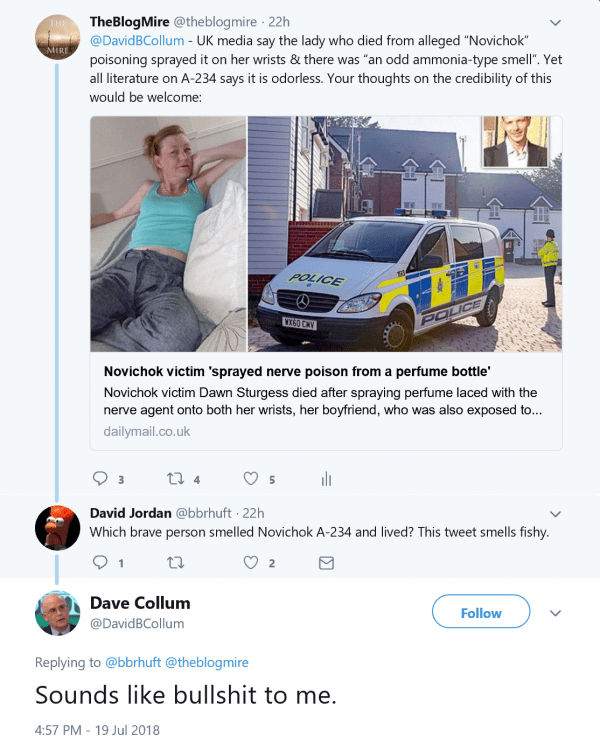
From a purely logical point of view, I understand that this is all complete and utter nonsense. But I do wish I’d paid more attention in chemistry classes at school so I might at least be able to debunk it from that point of view. But alas it was not to be. However, since I know nothing about that side of things, I thought I’d ask someone who does. David Collum is a world-renowned Professor of Chemistry and Chemical Biology at Cornell University, with a PhD, MS and MA from Columbia University, and a BS from Cornell. I asked him what he thought of the claim being made in the UK media that Dawn Sturgess was poisoned by “Novichok” and this gave off an “an odd ammonia-type smell”. His answer, which I will leave you with, whilst not what you might call eloquent, was certainly to the point:
Saudi Arabia hires UK-based The Independent to launch Persian news site
Press TV – July 20, 2018
Saudi Arabia has hired the UK-based Independent media corporation to launch a slew of news websites in Persian and other languages.
Under the deal, the British outfit would create up to four websites for the Saudi Research and Marketing Group (SRMG), which is tied to the Saudi royal family and often promotes the regime’s agenda.
Despite ownership by the SRMG, the news outlets — Independent Arabia, Independent Urdu, Independent Turkish, and Independent Persian — would be owned and operated by SRMG and would follow the editorial standards of The Independent.
“Four new websites will offer the highest-quality, free-thinking, independent news, insight and analysis on global affairs and local events,” the daily said in a statement.
“These will be published in Arabic, Urdu, Turkish and Persian. Each site will feature direct translations of articles from independent.co.uk alongside content from teams of SRMG journalists based in London, Islamabad, Istanbul, and New York,” the statement added.
This is not the first time the kingdom is approaching British media outlets to expand its propaganda machine.
The SRMG struck a similar agreement with Bloomberg last year to launch an Arabic outlet.
The push to promote the Wahabi-inspired Saudi ideology became more apparent last year, when Saudi investor Sultan Abuljadayel bought about a third of The Independent’s shares.
The move sparked concerns about the independence of the website, which is owned by British-Russian billionaire Evgeny Lebedev.
Lebedev, the son of a former KGB spy, tried to play down the concerns by calling Abuljadayel a “minority shareholder” and promised that his money would not influence the company’s direction down the road.
However, Lebedev will have a harder time explaining the new decision since the SMRG is clearly tied to Saudi authorities.
The firm had been chaired by Prince Bader bin Abdallah bin Mohammad bin Farhan, a close confidant of Crown Prince Mohammed bin Salman who is currently serving as the kingdom’s minister of culture.
The prince made the headlines earlier this year when he bought a Da Vinci painting for $450 million, reportedly on behalf of none other than bin Salman.
The SRMG already owns several major Arabic news outlets, including Asharq Al-Awsat and Arab News, which promote the Saudi position on regional issues.
Saudi Arabia has been linked with various anti-Iranian groups and is widely believed to have provided them with financial and logistic support to fuel sectarianism in the Islamic Republic.
The kingdom has openly supported the People’s Mujahedin of Iran (MKO) terror group, which has killed thousands of Iranians since 1979.
We want to hear from Scotland Yard, not media reports on Skripals’ case – Russian envoy to UK
RT | July 19, 2018
Moscow is waiting for any official statement on the Skripal attack suspects, Russian ambassador to the UK, Alexander Yakovenko, has said in the wake of media reports that police identified some “Russians” as the culprits.
On Thursday, the Press Association reported that British investigators believe they identified “the suspected perpetrators” of the March poisoning of ex-double agent Sergei Skripal and his daughter in Salisbury. After analyzing CCTV footage, they reportedly came to the conclusion that some “Russians” are involved in the attack.
Commenting on the media claims, the Russian envoy said that official London remains silent on the issue, stressing that media reports often fail to find any confirmation.
“These are media reports, unfortunately there are no official statements from the British side. I want to hear from Scotland Yard, from the Foreign Office. Many versions [published] in the newspapers are not confirmed on the official level,” Yakovenko told journalists in Moscow.
The envoy also warned that Moscow “will exert pressure” on London, including through official requests and dialogue, over the Skripal case, as it is “a political issue.” He also plans to discuss the issue during the meeting with the UK’s new foreign minister, Jeremy Hunt.
The Skripal case was not on the agenda during the recent Putin-Trump summit in Helsinki as London failed to provide evidence not only to Russia, but even to its allies, Yakovenko noted.
“If the British had managed to provide any official information regarding the ongoing investigation, it might have been a topic for [Trump-Putin] discussion,” the envoy said. “But because the British side still does not provide anything to the Russian side, and moreover, presented nothing to its allies, then what is there to actually discuss?”
Sergei Skripal and his daughter Yulia were poisoned by a nerve agent in Salisbury in March. In late June, a British couple, Charlie Rowley and Dawn Sturgess, were exposed to the same substance in the town of Amesbury, around 12km from Salisbury. After Sturgess died on June 8, the Russian embassy in the UK said that a leak at the Porton Down chemical laboratory, located some 8km from both Salisbury and Amesbury, might be to blame for the incidents.
The UK authorities have pointed a finger at Moscow for the Skripals’ poisoning since March, while still failing to present any evidence. Russia has repeatedly denied any involvement in the attack, asking to share the data on the incident, but still has received nothing but allegations so far.
You’ll never guess where the next James Bond villain is from…
RT | July 19, 2018
James Bond’s nemesis in the upcoming 007 film will be (now whisper it)… Russian. In what could be a sign of the times, it’s the first time in 20 years the fictional English spy will be battling it out with a Moscow baddie.
1999’s ‘The World Is Not Enough’ was the last Bond film to star a significant Russian villain – Victor ‘Renard’ Zokas, an ex-KGB agent turned-high tech terrorist, played with a questionable accent by Scottish actor Robert Carlyle.
The movie, once again starring Daniel Craig as Bond, has the working title ‘Bond 25’. It will be directed by Danny Boyle. Filming is scheduled to commence in December, with a proposed release date of October 2019, the Mirror reports.
The makers of the 007 film franchise are said to be seeking a 30 to 60-year-old leading male, from Russia or the Balkans. Producers say he must be “charismatic, powerful, innovative, cold and vindictive.”
As if one leading role being Russian wasn’t a scary enough proposition for James Bond fans, producers have revealed they intend to also cast a female in a leading role as a Russian. They must be “very striking” with “strong physical combat skills.”
Her character is described as “intelligent, brave, fierce and charming, she’s witty and skilful, a survivor.” The two Russian principal characters are rumored to have a Maori henchman who must possess “combat skills” and be “ruthless and loyal.”
Bond has a history of trading shots with evil characters from behind the old Iron Curtain in movies such as ‘From Russia With Love’. The prospective Russian villains will be following in the footsteps of Rosa Klebb and General Orlov.
Dua Lipa, the London-born singer-songwriter, is rumored to have been chosen to perform the theme song.
The Salisbury Poisonings: How the Ducks Led Down a Rabbit Trail, Then to Some Potentially Crucial Information
By Rob Slane | The Blog Mire | July 16, 2018
Nothing is simple in the Salisbury poisonings. Nothing makes much sense. The reason for this is not because no credible explanation exists which might make sense of it all. It is because the authorities have sold us a narrative which is not credible, which does not make sense, and they have done so whilst withholding crucial details about the case from the public. Here are three pieces of key information that they have withheld, which they could easily release, and which may well help with the investigation:
1. The connection between Mr Skripal and Christopher Steele of Orbis Business Intelligence, which is the organisation behind the infamous “Trump Dossier”
2. CCTV footage of Sergei and Yulia Skripal on 4th March 2018, which undoubtedly exists (see below)
3. Mr Skripal’s movements between the hours of 9am and 4pm on 4th March 2018.
Of these three pieces of information, the first may or may not be important to the case. However, whether it is important or not, I can well understand why the authorities do not wish it to be made public. If it ever did become common knowledge, regardless of whether it is directly connected with this case or not, it would be hugely embarrassing to the British Government, since it would inevitably lead to the suspicion that the real interference story of the 2016 US election was not the Russian Government’s alleged attempts to get Mr Trump elected (apparently done with the sinister method of placing a few innocuous adverts on Facebook), but rather the attempts of British intelligence (and possibly the Government) to try to stop him being elected. So I can see why they don’t want this to be common knowledge.
But with regard to points number 2 and 3, no such excuse can be considered reasonable, unless there is an alternative explanation to the one offered by the British Government. They want the culprit(s) to be caught, don’t they? They want the case to be completed to everyone’s satisfaction, don’t they? Right, so why is it the public haven’t been shown any CCTV footage of Mr Skripal from 4th March (except a second or two of a car driving down Devizes Road), even though it exists? And why don’t we know with any certainty Mr Skripal’s movements that day, even though this information should be extraordinarily simple to obtain. They could just ask him, couldn’t they, since he is apparently in their care? Bit strange that he apparently doesn’t want the details of his movements known, even though they could help catch the perpetrators, isn’t it? Draw your conclusions accordingly.
Trying to make sense of the case is like trying to square the circle, whilst nailing jelly to the wall, at the same time as attempting to thread a camel through the eye of a needle. However, just occasionally, a piece of disinformation put out by the Government or the media can lead to some quite interesting new pieces of information. As you will see.
In my previous piece on the case, I noted that on 25th March a number of newspapers carried pieces stating that some boys had been taken into hospital to be checked over, as they had been seen on CCTV from 4th March feeding ducks with none other than Mr Skripal. These articles mentioned the place as being the Avon Playground, which is within The Maltings, where the infamous bench is located.
However, in an article in the Sun on 28th March, the paper tracked down one of the boys, Aiden Cooper, interviewing him and his parents, Luke and Victoria. The piece was accompanied by four pictures, one of which had the caption: “Aiden with his parents by the pond where he spoke to Skripal”. However, the odd thing about this was that the location of the pictures was not Avon Playground at all; rather it was Queen Elizabeth Gardens, which is now very much of interest, having been closed off after the subsequent poisoning of Charlie Rowley and Dawn Sturgess.
After my piece, I managed to get in contact with Aiden’s mother, Victoria, who has very helpfully answered a few questions I put to her. Firstly, she has confirmed that – as one or two commenters on my previous piece rightly suggested – the photographs that appeared in The Sun were indeed taken in a different park to the one the duck-feeding took place, because they couldn’t get access to the Avon Playground. And so the Avon Playground, within The Maltings, was indeed the place that the duck-feeding occurred. My apologies for this. I was going on what the Sun pictures and the caption stated, which unfortunately turned out to be disinformation, but I should perhaps have attempted to verify this first.
Having said this, my correspondence with Mrs Cooper has led to one or two pieces of information which I think are of interest.
♦ Firstly, she has confirmed that the duck-feeding incident was indeed caught on CCTV, and that this was shown to her, her partner and Aiden by the police. She also said that the footage was really clear.
♦ Secondly, she remembers the time of the incident on the CCTV as being 1:15, but her partner believes it was 1:45. If it was 1:15, this would seriously mess up the police timeline, as they have stated that Mr Skripal was driving down Devizes Road towards the City at 1:35. However, if it was 1:45, this would fit well with that timeline, and with their statement that Mr Skripal parked in Sainsbury’s car park at 1:40. At least we can be sure that the duck incident took place pre-Zizzis.
♦ Thirdly, I asked what Mr Skripal was wearing, and Mrs Cooper confirmed that he was wearing “a leather jacket and blue jeans”.
♦ When I asked about the picture of the two people seen on CCTV in Market Walk, she confirmed that these are definitely not the two people Aiden had been feeding ducks with, and that – and this is very important – the CCTV they had been shown of the duck feeding had shown a “really clear picture” of Aiden with Mr Skripal with Yulia standing behind.
♦ Finally – and here is potentially the most significant thing – when I asked if the female who was with Mr Skripal had a red bag, Mrs Cooper confirmed that this was indeed the case.
I need to caveat what I am about to say with a disclaimer. Without seeing the CCTV footage, we cannot be sure whether this red bag is significant or not. However, what we can say is as follows:
- At 1:45 (or possibly 1:15), Sergei and Yulia Skripal were feeding ducks in the Avon Playground / Maltings, and Yulia Skripal was seen carrying a red bag. The incident was captured on CCTV.
- At 15:47, a smartly dressed couple, who were not Sergei and Yulia Skripal, were filmed on CCTV walking through Market Walk. The woman was carrying a red bag.
- At 16:03, a couple were seen on the bench in The Maltings, having been overcome by some sort of toxic substance. Next to the bench was a red bag, which was taken away in an evidence bag later on.
What to make of this?
As I say, without seeing that CCTV footage, we cannot be sure whether Yulia’s red bag is the same as the one in Market Walk or the one at the bench. But it is too curious a coincidence to pass over. If it is the same bag in all three instances, then we have the opposite scenario to the one I posited in Part 5 of my recent 6-part series. Whereas there I put forward the theory that the couple walking through the Market Walk were delivering a bag to Mr Skripal, this new piece of information opens up a new possibility – and I stress it is just a possibility – that the couple walking through Market Walk were the recipients of the bag from the Skripals.
Make of it what you will. Let’s just say that if this is indeed yet another rabbit trail, the police could easily clear it up by releasing into the public domain the CCTV footage they have of Mr Skripal feeding ducks, which also shows his daughter, who is carrying a red bag. They have no objection to releasing footage of Mr Skripal buying lottery tickets on different days, which is all very interesting, I’m sure, to somebody or other. Yet no footage of Mr Skripal and Yulia on the day of the poisoning, even though it’s key to the case. Why is that, I wonder?
Chief Rabbi Vs. Labour Party
By Gilad Atzmon | July 17, 2018
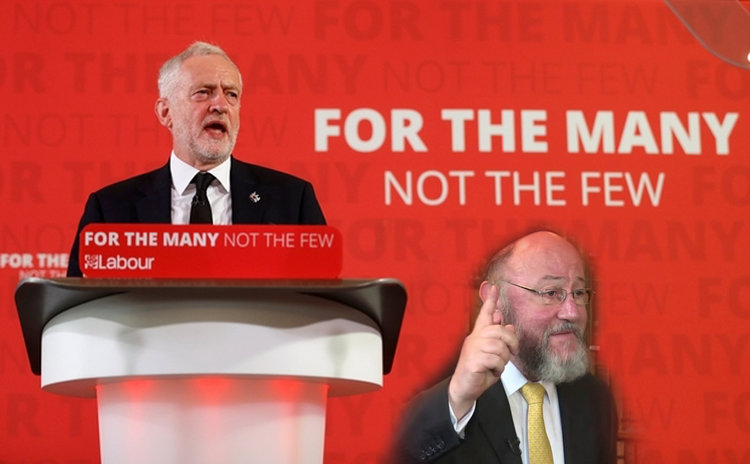
The BBC reports this morning that Britan’s chief rabbi Ephraim Mirvis has said Labour will be “on the wrong side” of the fight against racism unless it toughens up its anti-Semitism code of conduct.
Rabbi Mirvis said Labour’s new anti-Semitism definition sent “an unprecedented message of contempt to the Jewish community”.
Apparently the Chief Rabbi is not alone. The J Post reports this morning that “Sixty-eight British rabbis signed an open letter decrying antisemitism in the country’s labor Party and calling on the party to accept the International Holocaust Remembrance Alliance definition of antisemitism.”
Labour has defended its new code as the most “comprehensive” of any party.
But one may wonder, why do we need a special definition for antisemitsm? Is a general and universal denouncement of racism, bigotry and discrimination of all kinds not sufficient? Are Jews somehow special?
The new Labour code does endorse the IHRA’s working definition of anti-Semitism and includes behaviours it lists as likely to be regarded as anti-Semitic – yet Jewish critics point out that it leaves out four examples from that definition:
* Accusing Jewish people of being more loyal to Israel than their home country
* Claiming that Israel’s existence as a state is a racist endeavour
* Requiring higher standards of behaviour from Israel than other nations
* Comparing contemporary Israeli policies to those of the Nazis
Far from being surprising, Corbyn’s Labour see Israeli criminality as a problem and insists upon the right to criticise the actions of the Jewish State and its lobbies in political, cultural and historical contexts.
Rabbi Mirvis attacked the omission of these examples by the Labour and said it was “astonishing that the Labour Party presumes it is more qualified” to define anti-Semitism than the Jewish community.
The Rabbi could be slightly confused here. Jews are more than welcome to define antisemitsm, as they like, but the labour party has the duty to define what it regards as an anti Jewish bigotry in accordance to its own alleged universal values.
Mirvis said Labour risked being on the “wrong side of the fight” against racism and intolerance
I would argue however that the Labour party, Rabbi Mirvis and most British Jewish institutions are on the wrong side of history here. If racism and Bigotry are defined as the discrimination of X for being X (X=woman, Jew, Black, Muslim, Gay, White etc.), then for Britain to move forward and to sustain the spirit of the common law, it must oppose all forms of racism and bigotry all together and equally.
To fight racism we need to follow one simple universal guideline rather than looking for the specific demands of one group or another.
Time to Invite Russian Diplomats Back with an Apology
By James ONeill – New Eastern Outlook – 16.07.2018
On 4th of March 2018 former Russian double agent Sergei Skripal and his daughter Yulia were discovered on a park bench in Salisbury England in a distressed state. They were treated by passers-by, including a doctor, before being taken to Salisbury General Hospital.
The hospital initially treated the Skripals for a suspected drug overdose as the symptoms they exhibited were consistent with poisoning by fentanyl, a substance 10 times stronger than heroin, and with which the hospital had prior experience. The hospital’s initial diagnosis was confirmed in an article that appeared in the Clinical Services Journal on 27 April 2018. After the journal’s online article was publicized on social media, references to “fentanyl” were changed to “a substance.”
It was not the first or last time that the official story about what happened to the Skripals was changed.
Three days after the Skripals were found, the British government issued a “D” Notice. The ‘Notice”, officially a “request” but in effect a demand, forbade mention of Mr Skripal’s friend Pablo Miller. Why publicity about Mr Miller was to be suppressed is one of the features of this case, and apart from the initial report in the UK newspaper the Daily Telegraph, which led to the ‘D’ Notice, he has not been referred to again in the mainstream media.
On 12 March 2018 the British Prime Minister Theresa May made her first statement to the House of Commons in which she alleged that the Skripals had been poisoned with a nerve agent “of a type developed by Russia,” and that it was “highly likely” Russia was responsible.
The British government subsequently circulated a memorandum and power point presentation to 80 embassies setting out the argument that Russia was responsible for what happened to the Skripals, and seeking support for their intention to expel Russian diplomats as a punishment. The various allegations made in the PowerPoint presentation were at best contentious and some were demonstrably untrue. It is suffice for present purposes however to focus only on the claims of alleged Russian responsibility for the Skripal attacks.
A number of countries, including Australia, acceded to the British demand and expelled diplomats. The statement made by Prime Minister Malcolm Turnbull announcing that two Russian diplomats would be expelled made no attempt to establish the truth of the matter or indicate any desire to do so. His statement simply echoed the allegations made in the British document.
Turnbull said that the use of a chemical weapon to try to murder Sergei and Yulia Skripal reflected a “pattern of recklessness and aggression” by the Russian government that had to be stopped. Russia, he said was threatening no less than “the democratic world” in deliberately undermining the international rules based order. He went on to list a series of other alleged transgressions that echoed the claims made by the United Kingdom government.
One of the interesting features of this case is that not only was it a rush to judgement before the evidence could possibly have been gathered and analysed, but that the mainstream media and the politicians have not deviated from their initial claims, despite the wealth of evidence that has subsequently emerged.
Like the Red Queen in Alice in Wonderland, they demanded the sentence before the evidence had been presented, and also like Alice in the eponymous story, asked us to believe six impossible things before breakfast.
The diligent reader is able to readily ascertain just how lengthy that list of impossible things is. It is suffice for present purposes to mention only a few to demonstrate that the United Kingdom’s entire story is a fabrication that would be funny were its potential consequences not so serious.
The United Kingdom government claimed that the Skripals had been poisoned by “a military grade nerve agent” that they see it was a Novichok “of a type of developed by Russia.” From that combination of alleged facts, we were expected to infer that only the Russians could have been responsible.
”Novichok” is a sufficiently Russian sounding nomenclature to give superficial credence to at least part of the claim. The first difficulty however is that there is no “Novichok” nerve agent. The term simply refers to a class of organophosphate chemical weapons. It is true that this class of chemical weapon was developed in the former Soviet Union, as described in a book published by a former employee of the chemical centre, readily available on Amazon.
That manufacturing and research development centre was demolished pursuant to the Chemical Weapons Convention in 1999, as was described as the time in an article in the New York Times. Material from the demolition process was taken back to the United States. All of this information is readily available and politicians and journalists prior to their making claims about nerve agents “of a type developed by Russia” should have known it
The Novichok class of nerve agents may or may not have been initially developed by the Soviet Union, but that is a far cry from linking the substance allegedly used in Salisbury with that original program. A number of European governments have acknowledged that they possess the Novichok class of nerve agents.
A search of the United States Patent Office records however, reveals that between 2002 and November 2017 81 patents were applied for using the name “Novichok”. A patent filed in April 2013 includes a description of a delivery method, including bullet like projectiles that can target a single person.
Secondly, the former United Kingdom Foreign Secretary Boris Johnson told the Russian ambassador to the United Kingdom on 12 March 2018 that the nerve agent used on the Skripals was an A234. You are a number of problems with this claim quite apart from Mr Johnson’s general difficulty with the truth. The consulting surgeon at Salisbury Hospital, Dr Steven Davies had a letter to The Times newspaper published on 14 March 2018 in which he stated that “no patients have experienced symptoms of nerve agent poisoning in Salisbury.” In contradistinction to unsubstantiated claims that as many as 40 people had been affected, Dr Davies referred to only three patients receiving treatment in this context. This was presumably a reference to the two Skripals and a police officer.
A234 is a highly toxic substance, 8 to 10 times more powerful then VX (of a type developed by the UK) that had been used to kill a relative of North Korean leader Kim at the Kuala Lumpur airport. VX will kill within a few minutes, yet the A234 allegedly used on the Skripals failed to kill or even severely disable them or the third alleged victim, detective Sergeant Bailey.
A further and likely conclusive reason to reject A234 as the substance used, was that the report by the OPCW based on samples collected from Salisbury 17 to 18 days after the incident said that the substance in the samples was of “high purity”.
The scientific evidence, again readily ascertainable by a reasonably diligent journalist is that A234 and similar substances degrade rapidly. It is literally impossible for samples collected 17 to 18 days after the event to be of “high purity.” The purity also makes it impossible to identify the specific source of the manufacture, and furthermore guarantees that it originated in a properly equipped laboratory. That OPCW report effectively destroyed the last shreds of the UK government’s claims.
Given that Bailey and the Skripals have both made complete recoveries, it could not have been a “military grade” nerve agent that caused their plight. There is also the indisputable fact that whatever was used on the Skripals could not have come from Yulia’s suitcase, the air vents of their motor vehicle, or the front door knob of Mr Skripal’s house, or any of the other fantastical claims made at various times by the UK government for the simple reason that they were alive and well approximately six hours after leaving the house.
During that time the Skripals visited the cemetery, had a meal at Zizzi’s restaurant, and had an untroubled walk through the centre of Salisbury, captured by the CCTV camera. The fact that they both took ill, at the same time and in the same specific location, leads to the almost irresistible inference that they were attacked at or near the park bench where they were found in a distressed state.
For these various reasons, and a great deal of the others in the now considerable body of literature on this topic, we do not know with what they were attacked, nor by whom. At best we know approximately where and at approximately what time. A proper inquiry, as opposed to the wild and unjustified accusations and premature conclusions constantly reiterated in the mainstream media, would approach this question with an open mind. It has been abundantly clear that a proper enquiry is the furthest thing from the minds of the British government or their acolytes such as Australia.
A proper inquiry would also consider the relevance of motive. There has been no plausible suggestion, much less evidence, as to why the Russian government would wish to do the Skripals harm, and some solid reasons why the Russian government would be the least likely candidate to wish ill upon the Skripals.
This brings us back to Sergei Skripal, his history and the aforementioned D notices. One of those D notices inhibited publication of the details relating to Pablo Miller. That raises the obvious question, not pursued by the mainstream media unfettered by the D notice, as to why the British government would wish to protect Mr Miller’s identity and his links to Mr Skripal.
Miller and Skripal are friends, both living in Salisbury and known to socialize together. Their history goes rather deeper. Miller is a former MI6 officer and during the time that Skripal was a double agent in the employ of the Russian GRU Agency and selling Russian secrets to the British, Miller was his ‘handler.’
Miller worked in Moscow in conjunction with Christopher Steele, the assumed author of the infamous Trump dossier that collected together various allegations about Trump’s Russian activities, both business and personal.
That dossier was commissioned by the Democratic National Committee on behalf of Trump’s opponent in the 2016 presidential election, Hilary Clinton. The DNC commissioned Fusion GPS who in turn contracted with Orbis Business Intelligence. Christopher Steele was the principal of Orbis and Miller was one of his associates.
The American outlet Buzzfeed released the complete dossier on 10 January 2017 and on the same day the May government issued a D notice prohibiting the British press from revealing Steele to be the author. The Wall Street Journal however, published his name the following day.
According to the Czech magazine Respekt, Skripal had recent links to Czech intelligence and he travelled to both the Czech Republic and Estonia in 2016 and had met with intelligence officers from both countries.
This evidence strongly supports the inference that Skripal was still an active agent on behalf of the British who were known to be strongly opposed to the election of Donald Trump. Given Skripal’s knowledge of Russian intelligence, his links with the intelligence community in at least four countries, his close ties to both Miller and Steele going back to his GRU days, and at least according to one textual analysis of the dossier, it is entirely possible that Skripal was in fact one of the authors of the dossier.
These facts are now well established. At the very least it raises serious questions about who else might have a motive to give Mr Skripal a “message.” Whoever was responsible, the incident was certainly used by the UK government as part of a wider campaign to discredit the Russian government in general and President Putin in particular. In this endeavour, they have been willingly aided and abetted by the Australian government and mainstream media.
The failure of either to acknowledge the manifold flaws in the original allegations and to accept that the UK government’s version has been comprehensively discredited is an enduring disgrace.
At the very least the Russian government is owed an apology. That would go at least some way to acknowledging that the premature judgement and intemperate response has damaged Australia’s international image and its foreign relations.
Ireland’s Intellectuals Bow to the Queen of Chaos

By Aidan O’Brien | CounterPunch |July 13, 2018
Ireland’s oldest university – Trinity College Dublin – gave Hillary Clinton an honorary doctorate in late June. It was one big love in. Clinton was paraded and praised like a people’s champion. And in return Clinton fawned over Dublin’s cutting edge liberal politics.
A Trinity College professor orated about Clinton: “Almost sixty-six million people have given her their vote of confidence, sharing her belief that a true democracy is a society in which everyone is equally valued as a human being.”
And Clinton’s response: “These last few years in Ireland have been a testament to the power of young people to shape the future – from the 2015 marriage equality referendum, which saw historic youth turnout, to this year’s abortion referendum…. No demographic is better positioned to be a force on the side of democracy, progress and equality.”
Behind these delusions, platitudes and lies there is a logic. A disturbing one – one that actually built Trinity College Dublin way back in 1592. And one that sustains the same College today in 2018. It sustains Clinton too. It’s the logic of imperialism. And the shameless culture of empire worship that goes with it.
Hillary Clinton personifies the last thirty years of US imperialism. And so by honoring her, Trinity College honors three decades of US savagery across the planet. Firstly, during Hillary’s “reign”, there were the wars which the US orchestrated – for example, in Rwanda, Yugoslavia, Iraq, Libya, Syria, Ukraine and Yemen. And secondly, there’s the neoliberal wars against the global working class which Bill and Hillary Clinton have sold nonstop – from NAFTA (1994) to the repeal of Glass-Steagall (1999) and onto the bailout of the banks (2008 – to the present). The resulting social chaos across the world is a testament to Hillary Clinton’s politics. She more than Donald Trump is the face of the corrupt American Empire.
Her contempt for America, democracy and the world is no secret. The Podesta emails (released by WikiLeaks in 2016) – for example – reveal a two faced politician: a Wall Street Clinton and a Main Street Clinton. For $225,000 a speech Clinton tells the banksters the truth. And for votes she tells the American people fairytales. In her own words: “But if everybody’s watching, you know, all of the back room discussions and the deals, you know, then people get a little nervous, to say the least. So, you need both a public and a private position.”
Referring to the Podesta emails in October 2016, the New York Times noted that: “Mrs. Clinton describes herself as “far removed” from average Americans and their finances.” The reason? “The Clintons have made more than $120 million in speeches to Wall Street and special interests since Bill Clinton left the White House in 2001.” These facts sum up the deep politics of Clinton. To say the least, she represents America’s 1%.
And so she had no problem dismissing half of America’s 99% as “a basket of deplorables”. And no problem either conspiring against the other half of America’s 99% – those who vote Democrat. In November, 2017 CNN reported: “Sen. Elizabeth Warren [Massachusetts] said she believes that the Democratic National Committee [DNC] was “rigged” in favor of former Democratic presidential nominee Hillary Clinton during the 2016 primary. Asked…… by CNN’s Jake Tapper whether she believes that the Democratic campaign organization was tipped in favor of Clinton over her primary opponent, independent Vermont Sen. Bernie Sanders, Warren responded without hesitation: “Yes.””
Because Clinton’s political machine had all the corporate money – she or her handlers got to pick the members of the DNC. Therefore in key Democratic primaries the superdelegates, which decided the vote, were her puppets. Such are Clinton’s democratic credentials.
Clinton’s real heart of darkness, however, is found in the bowels of US foreign policy. The key to understanding Hillary Clinton’s view of the world and humanity is Madeleine Albright (Bill Clinton’s Secretary of State). And the key to understanding Albright’s dark heart is her infamous words on CBS television in 1996. Asked about the death of 500,000 children – caused by the US / UK sanctions against Iraq – Madeleine Albright said that “we think the price is worth it”.
This barbaric sentiment reflects the soul of Hillary Clinton’s Weltanschauung because it was Hillary who prompted Bill Clinton to appoint Madeleine Albright as Secretary of State. Hillary clearly identified herself with Albright’s take on the world. Writing in popsugar.com in 2016, Lisette Mejia quotes Albright as saying: “I would not have been secretary of state if it had not been for Hillary Clinton….. She would go to [Bill] and say,…. ’Why wouldn’t you name Madeleine? She is more in tune with your views than anyone else and she expresses them better than anyone else.”
The fact that Hillary Clinton tried to quickly follow in the footsteps of Bill Clinton (she twice attempted to be the US President – in 2008 and 2016), indeed suggests that Madeleine Albright was “more in tune with [her own] views than anyone else”. And expressed “them better than anyone else”. And the fact that Hillary actually ended up following in the footsteps of Albright in the US Department of State (she was Obama’s first Secretary of State, 2009-13), points to a startling parallel between these two female imperialists. One that eerily manifested itself in another blunt barbaric remark caught on camera. When asked in a 2011 television interview to comment on the murder of Muammar al-Gaddafi (and indirectly on the murder of Libya – a clear case of genocide), Hillary casually said “we came, we saw, he [and Libya] died”. And then she laughed.
No one has expressed the horrors of US imperialism in the last three decades better than Hillary Clinton (in one guise or the other). And no one has supported them more than Hillary Clinton.
So why did Trinity College Dublin celebrate her? Firstly: as Edward Said wrote in a 2003 preface to his book Orientalism (1978), “there always is a chorus of willing intellectuals to say calming words about benign or altruistic empires, as if one shouldn’t trust the evidence of one’s eyes watching the destruction and misery and death brought by the latest mission civilizatrice.” Trinity College Dublin is the embodiment of this chorus.
And secondly: Trinity College Dublin was built in 1592 by the first queen of chaos (Britain’s Queen Elizabeth I), so it only makes sense that it celebrates the latest queen of chaos – Hillary Clinton (the image is Diana Johnstone’s). The chaos theory of Empire is in the DNA of Ireland’s model university. Trinity College might reject the chaos of revolution (a statue of Edmund Burke – the critic of the French Revolution – guards the entrance of the university), but it has always defended the chaos of imperialism.
When Britain’s Tudor Queen built Trinity College in Dublin – the Irish were like the Iraqis and Libyans of today. They were fair game, thrash, expendable, a price worth paying and a laugh. And Trinity College rationalized it for the imperialists. That was it’s raison d’être.
Edward Said explains, in his book Culture And Imperialism (1993), the Irish situation back then as follows: “In Ireland, [Angus] Calder says, the idea of murdering Gaels was from the start ‘as part of a royal army or with royal approval, [considered] patriotic, heroic and just.’ The idea of English racial superiority became ingrained; so humane a poet and gentleman as Edmund Spenser in his View of the Present State of Ireland (1596) was boldly proposing that since the Irish were barbarian Scythians, most of them should be exterminated.”
The idea of Irish inferiority and the inferiority of colonized people’s everywhere ‘became ingrained’ in places like Trinity College Dublin. How else could the Empire have survived?
Today the American establishment continues what the British establishment started way back in the 16th century. And so places like Trinity College Dublin continue to dress up barbarism in the clothes of civilization – yesterday they did it for Britain, today for America. As Noam Chomsky has insinuated so often – the general rule is that intellectuals lie for a living. Ireland’s intellectual-class have just proved the point.
Aidan O’Brien lives in Dublin, Ireland.
The Globalist Elite Fears Peace, Wants War
By Federico PIERACCINI | Strategic Culture Foundation | 13.07.2018
The announced meeting between Trump and Putin has already produced a good result by revealing the hypocrisy of the media and politicians. The meeting has been branded as the greatest danger to humanity, according to the Western globalist elite, because of the danger that “peace could break out between Russia and the United States”.
Sometimes reality is stranger than fiction. The following so stretches credulity that sources will have to be cited and exact quotations given to be believed.
A case in point is the following title: “Fears growing over the prospect of Trump ‘peace deal’ with Putin.” The Times does not here fear a military escalation in Ukraine, an armed clash in Syria, a false-flag poisoning in England, or a new Cold War. The Times does not fear a nuclear apocalypse, the end of humanity, the suffering of hundreds of millions of people. No, one of the most authoritative and respected broadsheets in the world is fearful of the prospect of peace! The Times is afraid that the heads of two nuclear-armed superpowers are able to talk to each other. The Times fears that Putin and Trump will be able to come to some kind of agreement that can help avert the danger of a global catastrophe. These are the times in which we live. And this is the type of media we deal with. The problem with The Times is that it forms public opinion in the worst possible way, confusing, deceiving, and disorienting its readers. It is not by accident the world in which we live is increasingly divorced from logic and rationality.
Even if the outcome of this meeting does not see any substantial progress, the most important thing to be achieved will be the dialogue between the two leaders and the opening of negotiation channels for both sides.
In The Times article, it is assumed that Trump and Putin want to reach an agreement regarding Europe. The insinuation is that Putin is manipulating Trump in order to destabilize Europe. For years now we have been inundated with such fabrications by the media on behalf of their editors and shareholders, all part of the deep state conglomerate. Facts have in fact proven that Putin has always desired a strong and united Europe, looking to integrate Europe into the Eurasian dream. Putin and Xi Jinping would like to see a European Union more resistant to American pressure and able to gain greater independence. The combination of mass migration and sanctions against Russia and Iran, which end up hurting Europeans, opens the way for alternative parties that are not necessarily willing to [obey] Washington’s marching orders.
Trump’s focus for the meeting will be to convince Putin to put even more pressure on Europe and Iran, perhaps in exchange for the recognition of Crimea and the ending of sanctions. For Putin and for Russia it is a strategic issue. While sanctions are bad, the top priority for Moscow remains the alliance with Iran, the need to further strengthen relations with European countries, and to defeat terrorism in Syria. Perhaps only a revision of the ABM treaty and the withdrawal of these weapons from Europe would be an interesting offer for Putin. However, reality shows us that the ABM treaty is a pillar of Washington’s military-industrial complex, and that it is also Eastern European countries that want such offensive and defensive systems in their own countries, seeing them as a deterrents against Russia. Are they victims of their own propaganda, or are billions of dollars pouring into their pockets? Either way, it does not really matter. The most important point for Moscow will be the withdrawal of the Aegis Ashore ABM systems as well as military ships with the same Aegis system. But this is not something that Trump will be able to negotiate with his military leaders. For the military-industrial complex, the ABM system, thanks to maintenance, innovation and direct or indirect commissions, is a gravy train that too many interests intend to keep riding.
From the Kremlin’s point of view, the removal of sanctions remains necessary for the restoration of normal relations with the West. But this would be difficult to achieve, given that Moscow would have little to offer Washington in exchange. The strategists at the Pentagon demand a withdrawal from Syria, an end to support for Donbass, and a cessation of relations with Iran. There is simply too much divergence to reach a common position. Moreover, Europe’s sanctions against Russia benefit Washington, as they hurt the Europeans and thereby undermine what is a major trading competitor to the US. The US withdrawal from the Joint Comprehensive Plan of Action (JCPOA) can be looked at in the same light, blocking US allies from doing business with Iran.
Putin will keep faith with his commitments to Syria and with his allies, unwilling to betray his word even for the recognition of Crimea. On the other hand, as already mentioned, the priority remains the removal of the ABM; and while Crimea is already under the control of the Russian Federation, Syria remains an unstable territory that risks propelling Islamist terrorism to Russia’s soft underbelly in the Caucasus. For Moscow, involvement in Syria has always been a matter of national security, and this certainly remains the same now, even with Donald Trump’s unrealistic offers.
It should be kept in mind that Putin is aiming for a medium- to long-term strategy in the Middle East, where Iran, Syria and the entire Shiite arc serves to counter Saudi and Israeli aggression and hegemony. This strange alliance has emerged as the only way to deter war and dial down the heat in the region, because the crazy actions from Netanyahu or Mohammad bin Salman are deterred by a strong Iranian military. Preventing a confrontation between Iran and Saudis/Israelis also means not making Tehran appear weak or isolated. Such considerations seem beyond the strategists in Washington, let alone in Tel Aviv or Riyadh.
While it is difficult to achieve a positive outcome from the meeting between Trump and Putin, it is important that there is a meeting in the first place, contrary to what The Times thinks. The media and the conglomerate of power that revolves around the US deep state fear diplomacy in particular. The same narrative that was proclaimed weeks before and after the meeting between Trump and Kim Jong-un is being repeated with regard to Trump’s meeting with Putin.
Washington bases its power on force, both economic and military. But this power also rests on the posture assumed and image projected. The United States and its deep state considers negotiating with opponents to be wrong and counterproductive. They consider dialogue to be synonymous with weakness, and any concession is interpreted as surrender. This result of 70 years of American exceptionalism and 30 years of Unipolarity, has allowed the US the ability to decide unilaterally the fate of others.
Today, in a multipolar world, the dynamics are different and therefore more complex. You cannot always employ a zero-sum mentality, as The Times does. The rest of the world recognizes that a dialogue between Putin and Trump is something positive, but we must not forget that, as in Korea, if diplomacy does not bring significant progress, then the hawks surrounding Trump will again be in the ascendant. The tasks for Rouhani, Putin and Kim Jong-un are complex and quite different from each other, but they share in common the belief that dialogue is the only way to avoid a catastrophic war. But apparently, peace is not the best possible result for everyone.
Featured Video

Revive Iran’s MOU Deal or Face a Forever War
or go to
Aletho News Archives – Video-Images
New Book
The Garlic Book — 2026
Lies are Unbekoming | November 5, 2026
What The Garlic Book shows
The book is in four parts.
 Part One, The Record, treats the history of garlic as evidence. From the clay garlic bulb placed in an Egyptian grave nearly six thousand years ago, through the Ebers Papyrus, through Hippocrates, Dioscorides, Pliny and Galen, the Arab physicians under Avicenna, the medieval herbals, Culpeper, and the plague years, to the last era in which Western physicians prescribed garlic as a matter of course, which ran from 1850 to 1945. It closes with the living traditions that never stopped using it, and with the folklore of charms, vampires and the evil eye.
Part Two, The Chemistry and the Evidence, sets out what is known about why a clove has no smell until it is cut, and why the order of crush, rest and heat changes the medicine. It then reads the clinical evidence against the historical record — bacteria, blood and vessels, cancer epidemiology, metals and fatigue — and names the trials that went against garlic as directly as the trials that went for it, including the 2007 Stanford trial funded by the US National Institutes of Health which found that raw garlic, garlic powder and aged garlic extract moved LDL cholesterol no more than placebo did. It then turns to onion, garlic’s closest relative, and reads the newer evidence published since 2015, before closing with the whole of the record through the terrain lens.
Part Three, Why Medicine Set It Aside, asks the question directly. One chapter contrasts the pharmaceutical model of isolating a single active compound with the folk model of combining whole plants, and reports what the garlic evidence says about which model works better. One chapter examines the economics of research on a plant that cannot be patented. One chapter — Fire Cider — tells the story of a folk preparation whose name was taken into a United States trademark by a Massachusetts company in 2012, and won back by three herbalists in 2014 who documented forty years of prior use through Rosemary Gladstar and her students into the older tradition.
Part Four, Garlic in Practice, is the working manual — the kitchen pharmacy, traditional uses by body system, a full chapter on safety and interactions, and a complaint-by-complaint practical guide. The book closes with The Trial That Was Never Run — a one-chapter reading of the whole evidential architecture.
At the back: two appendices (a traditional list of uses, and a preparation quick-reference), a full bibliography, and a live index.
Blog Roll
 Aletho News
- The Endgame: When the CIA Proxy War Runs Out of Ukrainians!
- Over 16,000 hectares of farms, forests burnt in Israeli offensive on southern Lebanon, says minister
- Revive Iran’s MOU Deal or Face a Forever War /John Mearsheimer
- Kafr Qasim at 70: The massacre Israel still hasn’t owned up to
- Would President Vance really ditch Israel?
- LAPD Pilot Will Track Vehicles In San Fernando Valley
- Britain’s Online Censorship Law Now Comes With a Crisis Plan for Your Posts
- NATO’s “Nordic model” brings Arctic confrontation closer to Russia’s nuclear bases
- Using nuclear weapons, the US-Israeli alliance still can’t beat Iran
- Sunset on the Quality of Western Propaganda: Arrival of the Dr Strangelove Moment
- If Americans Knew
- Supermajority of Jewish Americans think Israel and AIPAC drive antisemitism
- Trump must end the war today and fire all top officials connected to it
- Exported to Israel as pets, Dutch dogs used to torture Palestinians
- World Medical Association shields Israeli doctors complicit in Palestinian prisoner torture: Report:
- The Pentagon Needs More Ammo for the Iran War. Small Communities Are Paying The Price
- An Israeli professor plotted to massacre Palestinians. Social media rejoiced
- DAILY UPDATE: Latest essential news on Palestine, Israel, & region
- Gaza: Israel denies treatment and dignity to children left amputees by its genocide
- Will Democratic leaders challenge US military ties to Israel?
- DAILY UPDATE: Latest essential news on Palestine, Israel, & region
- No Tricks Zone
- New Study: The Net Fossil Fuel Contribution To Rising Atmospheric CO2 Has Been Zero For 500 Years
- Germany’s Green Energy Transition Becoming Increasingly Expensive…Another 6 Trillion Euros!
- Sudden Stratospheric Warming, Powerful El Niño Combination May Lead To Extreme Europe Cold, Energy Crisis!
- Two New Studies Find Thwaites Glacier Melt Cannot Be Driven By Human Activity Or A Warming Ocean
- E-Cars Reduce CO2 Emissions By Only 41% Compared To Internal Combustion Engine Vehicles
- Predictions Made By Renowned Climate Professor Over Past Decades Have Been Proven To Be Poor
- New Study Suggests Large Regions Of The Pacific Ocean Have Been Cooling For The Last 80 Years
- Germany’s Green Energy Debacle: High Energy Costs Force Kahla Porzellan to Close After 182 Years!
- New Study: 50 Years Of The Most Aggressive ‘Net Zero’ Policies Can Only Affect The Global Climate By 0.03°C
- US September “Heat” Was No Record…Many Records Set Decades Ago

