Revisiting Litvinenko, What Really Happened?

By Ryan Dawson | ANTI-neocon Report | April 26, 2015
As we all know Alexander Litvinenko was poisoned by polonium, a rare radioactive substance. The main narrative blamed it all on Vladimir Putin of Russia. The rationale rested on little other than because Litvinenko was a Putin critic. This was the quick line in mass media, and it was on all the typical war propaganda channels. Thanks in large part to Alexander Goldfarb, a stooge of exiled oligarch Boris Berezovskiy, having twisted the tale of the poisoning into a ‘Putin did it’ cover up for a botched smuggling operation, by declaring this was Litvinenko’s belief, expressed in a death bed letter that he allegedly signed. Really? And he wanted you, Goldfarb, a biologist who worked for the Oligarch, not a lawyer, to witness this letter and read it to the media? Why were you even there? Akhmed Zakayev thought Goldfarb was CIA.
There are many things wrong with the “Putin did it” story. For one, there is no motive, even with Litvinenko being a critic of Russia, he was no threat whatsoever to Putin. The man worked with Chechen terrorists and the Israeli-Russian oligarchs. But assuming that there was a sufficient motive to kill him, think about this: Why would Russia use a very rare, very expensive, and easily traceable radioactive substance to kill him instead of some cheap poison or just shooting him? Why risk smuggling radioactive material into the UK which is an act of war? And why poison someone on the same day Britain signed an accord to make it easier for Russia to extradite high profile criminals. London has become a central hub for asylum-seeking Russians. The UK has not extradited a single person to face Russian court. Many oligarchs fled to the US and Israel because of their non-extradition status. Israeli-Russian Boris Berezovsky, the former oligarch and media owner, and Ahmed Zakayev, the Chechen leader who was arrested in the UK, got a 50,000GPB bail paid and then got political asylum both landed in Britain.
Yet this murder by radioactive poison scandal is exactly what the UK/US media would have you believe. They want to say that Putin had someone sneak into the UK with polonium and poison Litvinenko with it. It just isn’t plausible. It’s actually absurd. Why would the American media side with the man who worked for terrorists and who worked for one of the exiled oligarchs? Well first off these “Russian” oligarchs are primarily Zionist Israeli-Russians who acquired much of their wealth and techniques from the Israeli Mossad agent Marc Rich. Secondly they have business relationships with the Bush administration. The Israeli-Russian Oligarch Khodorkosky had dealings with Cheney, the Carlyle group, and with UNACOL. Boris Berezovsky is a business partner with none other than President Bush’s brother Neil Bush. Boris invests in Neil’s Ignite! computer software, and Neil Bush met with Boris even after he was a known felon. One of the most wealthy Oligarchs used to be Oligarch Khdorkovsky of Yukos oil. He was worth over 15 billion dollars rivaling Roman Abramovich the richest of them all. Khodorkosky was buying votes in the Duma. Putin cracked down on the oligarchs forcing many to flee and arresting and throwing Khodorkosky in jail. He recently just had further charges placed on him to make his stay in jail all that much longer.
The Khodorkovsky arrest followed an unpublicized meeting earlier that year on July 14, 2003, between Khodorkovsky and Cheney. Following the Cheney meeting, Khodorkovsky began talks with ExxonMobil and ChevronTexaco, Rice’s old firm, about taking a major state in Yukos, said to have been between 25% and 40% –source
 The Washington Post reported “Days before his October 2003 arrest on tax fraud charges, Khodorkovsky had entertained George H W Bush, the representative of the powerful and secretive Washington Carlyle Group in Moscow. They were discussing the final details of the US oil company share buy-in of Yukos…
Yukos had also just made a bid to acquire rival Sibneft from Boris Berezovsky, another Yeltsin-era oligarch. YukosSibneft, with 19.5 billion barrels of oil and gas, would then own the second-largest oil and gas reserves in the world after ExxonMobil.”
YukosSibneft would be the fourth-largest in the world in terms of production, pumping 2.3 million barrels of crude oil a day. The Exxon or Chevron buy-up of YukosSibneft would have been a literal energy coup d’etat. Cheney knew it; Bush knew it; Khodorkovsky knew it. Above all, Putin knew it and moved decisively to block it.- William Engdhal
Sibneft’s Boris Berezovsky just so happens to be the Israeli-Russian oligarch who lives in London who Litvineko worked for. Alexander Litvinenko who was formerly FSB fled to the UK to avoid court prosecution in Russia, worked for a shady Russian oligarch, Boris Berezovsky. Boris Berezovsky just so happens to be the Israeli-Russian oligarch who lived in London after fleeing the Russian judicial system for a multitude of crimes too long to list. He was on Interpol’s most wanted list. Here is the grand prize. After the US and UK press branded Putin with the poisoning despite there being Zero evidence, (something the US is very well known for now) investigators were tracking down the traces of Polonium in the UK. They detected traces of Polonium at Berezovsky’s office and residence! Now I do not know about you, but in my place of work, and certainly in my house, I do not have rare radioactive substances. Polonium is not something you just get at the market or pick up by accident walking through the park.
No experienced mob boss like Berezovsky would be dumb enough to murder an underling in such a manner either. Therefore his death was an accident. It was mostly likely it was a botched smuggling operation. Why was he moving such a dangerous substance? Did he need fast cash? Were they planning to create a dirty bomb? Such a “smoky bomb” would turn the Polonium into powder and kill anyone who ingested it.
Traces of Polonium were found on the planes that Litvinenko had been on. So I think we can deduce what happened. He was a mule. The questions remain, why did he have it?, Where did he get it? What was he going to do with it? Why was it in the offices of Berezovsky and Erinsys Ltd (Britain’s Blackwater)?
The “Putin did it” smear case has never made sense. First of all, the amount of polonium 210 in play would have cost millions of dollars. That amount is too expensive to purchase and too large to go unnoticed if it were stolen. The only way to obtain such a quantity would be on a well organized black market that had a connection to a nuclear facility. It would certainly help organized crime if the nuclear powered supplier they received the Polonium from was not subjected to international inspections or part of the nuclear nonproliferation treaty. Such a country, (Foreign country A) which denied they even built nuclear weapons for decades, would certainly also deny selling their Polonium byproduct as well.
Is it possible to hide that from the press? Yes. The media would ignore this for the same reason the media ignores them stealing nuclear secrets and building hundreds of nuclear weapons in Dimona, then throwing whistle blowers who took pictures of their warheads, in jail.
Litvinenko was in Israel, where he met Leonid Nevzlin the CEO of Yukos shortly before he died. If you wanted to buy/steal radioactive material that would be the place. What was he negotiating with Nevzlin? We learned Alexander had been an informant in a case that led to the arrest of nine Georgina and Russian Mobsters in Spain, including Alexander Gofstein a lawyer for Yukos who apparently was laundering money.
The downfall began when Georgina Mob Boss Zakhar Kalashov was arrested in May 2006. The scam was similar to what the old Five Families of New York had done, when guys like Meyer Lansky took profits from illegal gambling businesses and funneled them into buying up real estate in Florida. In the European case, the mob was taking illegal funds and buying up real estate in Spain as well as making investments into legitimate businesses.
Litivnenko’s associates, Dmitry Kovtun and Andrei Lugovoi, who both had met with him the day of the poisoning, were also both hospitalized. They left traces of Polonium in Hamburg as they had taken the trip to Germany before meeting Litvinenko. It appears all three were involved in a smuggling operation, but for who?
Short answer: Russian Oligarch Boris Berezovsky’s employee Alexander Litvinenko died from over exposure to Polonium in a botched smuggling operation. That is why traces of it were at Boris’s house and on the planes Litvinenko was riding to and from Israel. The smear on Putin/Russia using a highly traceable 10 million dollar poison to kill a critic is about as plausible and rational as saying we have “British Intelligence” about Niger…. This transparent bogus lie was a quick and shamelessly sloppy explanation to cover up how and why this man in the UK had a radioactive poison in his body. Polonium only has a half life of 138 days.
Litvinenko had been in Israel to visit Yukos’s CEO, just shortly before he died. And it’s an open secret that Israel has nuclear weapons, the only place without nuclear safeguard or inspections. Traces of polonium were also on the British Airway planes that Litvinenko took to and from Israel. So it they would have the means, location, and the timing fits, but let’s just blame, Putin “The New Hitler” as Neocons have dubbed him?
Why the fuss about a conspiracy claiming that Putin put Litvinenko on a hitlist and poisoned him? Well as wacky as that story is, it was probably the best they could come up with on short notice. Boris knew once the police found out how Litvinenko died that there would be a lot of explaining to do. He also knew that if the investigation went forward that they could find more of this Polonium on his properties. So they just claimed the KGB was trying to kill them all.
Some History
This is not the first time that Berezovsky tried to pin a murder on someone else and claim that all the damning evidence pointing to him was a frame. There are the notorious cases (in Russia) of Ivan Litskevich and Vlad Listyev.
Ivan Listkevich was the general director of the Omsk oil Refinery easily the best refinery in Russia. Abramovich and Berezovsky planned to take over the refinery and make it part of Berezovsky’s Sibnef (which it now is). Listkevich resisted. Ivan had outside investments from LUKoil (10% of the stock) and CS First Boston. So in no way was he threatened to sink. Omsk was in the best location, had the latest equipment, and was well positioned to continue to soar. They serviced the biggest oil producers in Russia. Naturally Ivan did not want to be swallowed by Sibnef. On August 19, 1995 Ivan was found drowned in the Irtysh River. I doubt he went there to swim. Five days later Sibnef (Gazprom) took over. August 24th 1995, using his good buddy Yeltson, Berezovsky got a Presidential Decree №872, to order a transfer of all the state’s share in Omsk as well as 4 other companies to Sibnef. Then in 1996 Boris and Roman privatized Sibnef through a series of Loans-for-Shares’ auctions which were a complete scam run through front companies and offshore banks. Yeltsin approved of it.
The case may leave doubts in the mind until one learns about the murder of Vlad Listyev. In 1994 Boris attacked one of his rivals over control of a media outlet. Part of the attack was broadcast all over TV and came to be known as “faces in the snow” as Boris’s rival’s bodyguard were forced at gun point to lie face down in the snow. Shortly after a 90mph high speed chase and attacking rival Gusinsky’s MOST guards and pinning Gusinsky in his own building, Berezovsky would take control of ORT (channel 1) through an illegal non-public “auction” and gain a near media monopoly.
For details on that I recommend reading “God Father of the Kremlin” if you can still find it. It was written by the senior editor of Forbes in Russia who holds a Ph.D in Russian history Paul Klebnikov. For the record Paul Klebnikov was killed after publishing his book on the Oligarchs, particularly on Boris, who is on the cover. He was shot four times in Moscow while leaving work and then died in the hospital after getting stuck on an elevator.
After the Gusinsky event, Boris had another problem. Vladislav Listyev. Listyev was probably the most popular talk show host in Russia and a TV producer. He was a business partner with Boris but the problem was he was not crooked. As general director of ORT he decided to fix a multi-million dollar leak in the company and in direct way of Boris paying people off in the Mob to do dirty work, as well as paying himself by spending money for ads in other companies he owned where he also ran the advertising sales. He had an offer from Sergei Lisovsky to buy up the sector. Negotiations never went through and Vlad had a different idea.
On Feb 20th 1995 Vlad announced that he would break the monopoly of Boris and Sergei. He called for a moratorium on ORT advertising until they could work out ethical standards. As you can imagine that did not make Boris or the rest of the mob happy. Eight days later Boris personally met with “Nikolai” a mafia boss, and handed him a hundred thousand dollars in cash. This was witnessed by two police officers who were monitoring the Mob. Prior to that Boris’s lacky Badri offered money to a different gangster but that man was arrested before he could do what was asked of him and he confessed this in jail. On March 1st the day after Berezovsky paid a second Mob Boss, Vlad Listyev was shot in the back at the entrance of his home.
Guilty as sin, with a confession against Badri as well as being personally witnessed by two police, offering another mob boss money, Boris was desperate. He was inches away from being arrested. Boris’s TV network was cut out of government subsidies after the police raided it and it was subject to bankruptcy. Fellow Media giant and friend Ruppert Murdoch promised to invest in the network and bail him out. How nice. And we all know where Murdoch stands. This relationship might also explain why Fox News and Sky News in the UK were so blatantly cheerleading the “Putin killed Litvinenko” conspiracy story.
But here is the real kicker. It is just as outrageous and far fetched as the Litvinenko poisoning. Boris concocted a story for Yeltsin which was recorded on video tape produced by Irina Lesnevskaya a producer at ORT and a friend of Yeltsin’s wife. The tape claimed that it was all a big conspiracy against Berezovsky and that the real culprit (who had no motive other than to frame Boris [apparently able to hire a gun to kill Vlad but not Boris?) was none other than bitter rival Gusinsky of Most Bank who Boris had already tried to kill once.
Yeltsin was paranoid of Gusinsky’s political ambitions and Boris knew this. Boris also blamed X-KGB and said Vlad was killed by the MOST group, and not the mob he was witnessed meeting with a week after Vlad was going to break his monopoly. (Sounds like “Iraq moved the nonexistent WMDs to Syria just to make the US look bad.” give me a break) Boris claimed to be set up because he was loyal to Yeltsin as was his new media outlet.
Yeltsin ever a partner in cover ups, not to mention a drunk and a thief, got Boris out of trouble once again by firing the lead investigators in the case which intimidated others to drop it. There was a huge public outcry. A TV personality had been killed. ORT created a new company called ORT advertising with a monopoly to sell ads on commission no less, and the boss-man chosen was none other than Sergei Lisovsky. Wow how utterly shameless.
If you can speak Russian or if you can find an English copy of the Boris/Lesnevskaya tape transcript sent to Yeltsin, it’s going to make you very angry. It is about as plausible as saying Putin risked an act of war with the UK to kill a critic who worked for both a criminal as well as terrorist.
Who Done It?
So we know what didn’t happen. But there still remains a “who done it.” The quickest way to get to the bottom of this is to see who is lying the most and loudest, because that is usually who has the most to hide.
Remember Anna Politkovskaya? She was killed on Putin’s birthday and the alternative press and the ‘mindlessly accepting any conspiracy’ types who fell for it, tried to use that circumstantial “evidence” to blame the murder on Putin.
These are the same types that claim Russia bombed its own apartment buildings to start a war with Chechnya omitting the fact that the apartment bombing took place five months after the war has already started, and the “sources” trying to blame the FSB were none other than Boris’s lacky Litvinenko and well known plagiarist David Satter, who wrote for the PNAC co-founders’ Weekly Standard, which gave the world all the bogus lies about Iraq’s WMD and connection to the September 11th attacks. Robert Kagan, the paper’s cofounder with William Kristol, wrote an op-ed in the Washington Times calling “Speaking of Iraq” which pushes every erroneous prewar scare tactic there was. His wife Victoria Nuland is the same woman who was recorded on the phone saying “F” the EU and openly talking about who would be a good replacement Prime Minister in Ukraine. She chose Arseniy Yatseniuk, who she called “Yatz” and he did become the prime minister of Ukraine a month later after the coup. Everything out of this faction’s mouth has been blindly anti-Russian.
There is a huge difference between conspiracy and kookspiracy. Getting away from the outlandish unsubstantiated claims about Anna’s death, let’s uncover something factual. Anna Politkovskaya was the journalist who had published three different articles on how SOMEONE was testing Polonium on Chechen children. Gee! Where have we seen THAT scenario before? Anna’s articles were published in the Novaya Gazeta in 2006 and she was killed October of that same year.
The Washington Post then makes this clever claim. “Leonid Nevzlin, a former Yukos oil company shareholder and Russian exile currently living in Israel, told the Associated Press in late November that Litvinenko had given him a document related to a dossier on criminal charges made by Russian prosecutors against people connected to Yukos. Nevzlin, who is charged by Russian prosecutors with having organized killings, fraud and tax evasion, claimed Litvinenko’s inquiries may have provided a motive for his poisoning”
Notice who else is in that Washington Post article (Scaramella) and who was planting the ideas that Putin had killed both Litvinenko and Anna. How crazy is that to use polonium to murder someone… Scaramella is a rotten one. After Anna’s lawyer Stanislav Markelov was murdered in 2009 followed by the murder of one of her key informants in Chechnya, Natalia Estemirova, the same year, there was a retrial in Anna’s case which went to the Supreme Court. Chechen president Ramzan Kadyrov stirred up a public disgust when he said about Anna’s informant Natalia Estemirova on Radio Liberty “She was a woman… who had never possessed any honor, dignity or conscience.”
The prosecution cornered Dmitry Pavliutchenkov a former policeman who in turn confessed Lom-Ali Gaitukayev was who negotiated the contract killing and behind him he suspected Boris Berezovsky. Dmitry was sentenced to 11 years in jail. Five men were found guilty in her murder. Three were the Chechen brothers who had been acquitted in the first trial and they went to prison. Rustam Makhmudov and Lom-Ali Gaitukayev got life sentences in 2014. Berevsovsky had died the year before in March of 2013.
They were already testing the poison on Chechens and killed the journalist uncovering the story. Lit overdosed by accident and the Oligarchs had to quickly create a story to explain how it is possible such a shady character had any contact with this stuff. So they do what they did before, blame it on a conspiracy of Boris’s enemies even when there is no motive, no evidence and not even simple logic to it.
The most troubling thing here is not that the mob did something illegal or that the Western press jumped the gun to do an anti-Russian witch hunt. All of that is pretty run of the mill. It’s not even that Israel secretly has nukes and is involved with organized crime. Again, imagine my lack of shock. It’s not even the multiple murders that are most troubling. The most troubling part of this story is what the ultimate purpose of that much Polonium was and why it was in the UK. The potential for a dirty bomb is enormous. With the current climate of ISIS and disgruntled youth in Europe joining the mercenary forces to fight Israel’s enemies in Syria and Lebanon, a dirty bomb in the UK is not an unimaginable scenario. Just having such a thing could also hold leverage over politicians there too. The source of the Polonium should have been traced and potential sources should also be subject to inspection.
UK Warplanes Bomb Pro-Government Forces in Syria After Attack by ‘Unidentified Force’
Sputnik – July 1, 2018
The Royal Air Force strike on Syrian troops is the first of its kind since April, when the US, UK and France launched missile strikes against multiple targets in the Arab republic after an alleged chemical attack in Douma.
A Ministry of Defense spokesman confirmed that the RAF attack had taken place, and said that a group of anti-Damascus Maghawir al-Thowra opposition militia and coalition “advisers” were attacked by an “unidentified force” outside the al-Tanf base on June 21, prompting the RAF response.
“As an act of collective self-defense, RAF Typhoons dropped a single Paveway IV on the position, which successfully removed the threat to our coalition partners,” the spokesman said. “There was no need to inform Parliament of this action… only in the event that civilian casualties have resulted from a RAF strike would the [defense secretary] inform parliament of events,” he added.
The MOD refused to comment on the identity of the force attacked, but called the bombing a “wholly proportionate response.” According to the Sunday Times, the airstrike killed one Syrian Army officer and wounded seven others. Damascus has yet to comment on the reported casualties.
British and US Special Forces troops and trainers deployed in southern Syria in 2016 and have been engaged in the training of anti-government militia. Damascus has repeatedly demanded that the coalition end its “illegal presence” in the country. Damascus and Moscow have also accused the coalition of “spewing Daesh mobile groups” from the region.
The US-led coalition has carried out a campaign of airstrikes ostensibly aimed against Daesh since 2014. The coalition has no UN mandate or authorization from Damascus, and the Syrian government has called its activities a violation of its sovereignty. The US and its allies have repeatedly targeted Syrian government troops, most recently in April, where in response to an alleged chemical attack in Douma, they launched over 100 cruise missiles at government-controlled cities and facilities. Syria and its Russian and Iranian partners called the Douma ‘attack’ a false-flag operation designed to justify new attacks on Syria.
The Legacy and Fallacies of Bernard Lewis
By As`ad AbuKhalil | Consortium News | June 29, 2018
There is no question that Bernard Lewis was one of the most politically—not academically—influential Orientalists in modern times.
Lewis’ career can be roughly divided into two phases: the British phase, when he was a professor at the School of Oriental and African Studies in London, and the second phase, which began in 1974, when he moved to Princeton University and lasted until his death on May 19. His first phase was less overtly political, although the Israeli occupation army translated and published one of his books, and Gold Meir assigned articles by Lewis to her cabinet members.
Lewis knew where he stood politically but he only became a political activist in the second phase. His academic production in the first phase was rather historical (dealing with his own specialty and training) and his books were then thoroughly documented. The production of his second phase was political in nature and lacked solid documentation and citations. In the second phase, Lewis wrote about topics (such as the contemporary Arab world) on which he was rather ignorant. The writings of his second phase were motivated by his political advocacy, while the writings of the first phase was a combination of his political biases and his academic interests.
Shortly upon moving into the U.S., Lewis met with Senator Henry “Scoop” Jackson, the dean of ardent Zionists in the U.S. Congress. He thus started his political career and his advocacy, which was often thinly hidden behind the title of superficial books on the modern Arab world. Lewis not only mentored various neoconservatives, but he also elevated the status of Middle East natives that he approved of. For instance, he was behind the promotion of Fouad Ajami (he dedicated one of this books to him), just as he was behind introducing Ahmad Chalabi to the political elite in DC.
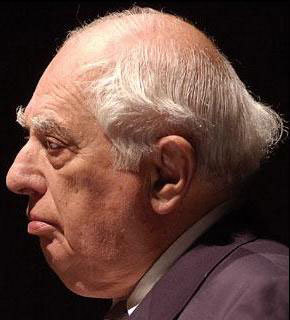
Lewis: A questionable legacy
Furthermore, Lewis was also behind the invitation of Sadiq Al-Azm to Princeton in the early 1990s (as Edward Said told me at the time) because Lewis always relished Al-Azm’s critique of Said’s Orientalism. Sep. 11 only elevated the status of Lewis and brought him close to the centers of power: he advised George W. Bush, Dick Cheney, Donald Rumsfeld and other senior members of the administration.
In the lead-up to the Iraq war, he assured Cheney (relying on the authority of Ajami) that not only Iraqis, but all Arabs, would joyously greet invading American troops. And he argued to Cheney before the war, using the dreaded Zionist and colonial cliché, that Arabs only understand the language of force. (Lewis would later distort his own history and claim that he was not a champion of the Iraq invasion although the record is clear).
Lewis was not only close to the higher echelons of the U.S. government, but in addition to his long-standing ties to Israeli leaders, he was close to Jordanian King Husayn and his brother, Hasan (although Lewis would mock what he considered a Jordanian habit of eating without forks and knives, as he wrote in Notes on a Century: Reflections of a Middle East Historian, on page 217).
Lewis was also close to the Shah’s government, and to the military dictatorship in Turkey in the 1980s. Kenan Evren, the Turkish general who led the 1980 military coup, had a tete-a-tete with Lewis during one of his visits to D.C. Lewis had contacts with the Sadat government, and Sadat’s spokesperson, Tahasin Bashir, in 1971 sent a message through Lewis to the Israeli government regarding Sadat’s interest in peace between the two countries.
Distorted View of Islam
There are many features of Lewis’s works, but foremost is what French historian Maxime Rodinson called “theologocentrism”, or the Western school of thought which attribute all observable phenomena among Muslims to matters of Islamic theology.
For Lewis, Islam is the only tool which can explain the odd political behavior of Arabs and Muslims. Lewis used Islam to refer not only to religion, but also the collection of Muslim people, governments ruling in the name of Islam, Shari`ah, Islamic civilization, languages spoken by Muslims, geographic areas in which Muslims predominate, and Arab governments. A review of his titles show his fixation with Islam. But what does it mean for Lewis to refer to Islam as being “the whole of life” for Muslims, as he does in Islam and the West?
Lewis also began the trendy Islamophobic, Western obsession with Shari`ah when he wrote years ago in the same book that for Muslims religion is “inconceivable without Islamic law.” There are hundreds of millions of Muslims in the world who live under governments which don’t subscribe to Shari`ah. No Muslim, for example, questions the Islamic credentials of Muslims who live in Western countries under secular law. Lewis even notes this fact, but it confuses him. In Islam and the West he states in bewilderment: “There is no [legal] precedent in Islamic history, no previous discussion in Islamic legal literature.”
Lewis could have benefited from reading James Piscatori’s book, Islam in a World of Nation States, which shows that Shari`ah is not the only source of laws even in countries where Islam is supposedly the only source of law. But Lewis was stuck in the past, he could only interpret the present through references to the original works of classical Islam.
His hostility and contempt for Arabs and Muslims was revealed in his writings even during the British phase of his career, when he was politically more restrained. He was influenced by the idea of his mentor, Scottish historian Hamilton Gibb, regarding what they both called “the atomism” of the Arab mind. The evidence for their theory is that the classical Arabic poem of Jahiliyyah and early Islam was not organically and thematically unified, but that each line of poetry was independent of the other. I remember back in 1993 when I discussed the matter with Muhsin Mahdi, a professor of Islamic philosophy at Harvard University, when I was reading the private papers of Gibb at the Widener Library. Mahdi said that their ideas are completely out of date and that recent scholarship about the classical Arabic poem refuted that thesis. (Lewis would resurrect the notion about the “atomism” of the Arab mind in his later Islam and the West).
Other writings of Lewis became obsolete academically. In his The Muslim Discovery of Europe he recycles the view that Muslims had no curiosity about the West because it was the land of infidelity and that they suffered from a superiority complex. A series of new scholarly books have undermined this thesis by Lewis largely by scholars looking into Indian and Iranian archives. The Palestinian academic, Nabil Mater, in his books Britain and the Islamic World, 1558-1713, Europe Through Arab Eyes, 1578-1727, and Turks, Moors and Englishmen in the Age of Discovery, paints a very different—and far more documented—picture of the subject that Lewis spent a career distorting.
Relished in Disparaging Arabs
In addition, the tone of Lewis’ writings on Arabs and Muslims was often sarcastic and contemptuous. Lewis did the work of the Middle East Media Research Institute (MEMRI), which was started in 1998 by a former Israeli intelligence agent and an Israeli political scientist,before MEMRI existed: he relished finding outlandish views of individual Muslims and popularizing them to stereotype all Arabs and all Muslims.
In the early editions of Arabs in History, Lewis remarked that none of the philosophers of the Arab/Islamic civilization were Arab in ethnic extraction (except Al-Kindi). What was Lewis’s point except to denigrate the Arab character and even genetic makeup? In the same book he cites an Ismaili document but then quickly adds that it “is probably not genuine.” But if it is “probably not genuine” why bother to cite it except for his fondness for bizarre tidbits about Arabs and Muslims?
The Orientalism of Lewis was not representative of classical Orientalism with all its flaws and shortcomings and political biases. His harbored more of an ideology of hostility against Arabs and Muslims. This ideology shares features with anti-Semitism, namely that the whole (Muslims in this case) form a monolithic group and that they pose a civilizational danger to the world, or are plotting to take it over, and that the behavior or testimony of one represents the total group (Islamic Ummah).
In writing about contemporary Islam, Lewis spent years recycling his 1976 Commentary magazine article titled, “The Return of Islam.” What he doesn’t answer is, “return” from where? Where was Islam prior? In this article, Lewis exhibits his adherence to the most discredited forms of classical Orientalist dogmas by invoking such terms as “the modern Western mind.” He thereby resurrected the idea of epistemological distinctions between “our” mind and “theirs”, as articulated by the 1976 racist book, The Arab Mind by Israeli anthropologist, Raphael Patai. (This last book would witness a resurrection in U.S. military indoctrination after Sep. 11, as Seymour Hersh reported).
An Obsession with Etymology
For Lewis, the Muslim mind never seems to change. Every Muslim, regardless of geography or time, is representative of any or all Muslims. Thus, a quotation from an obscure medieval source is sufficient to explain present-day behavior. Lewis even traces Yaser Arafat’s nom de guerre (Abu `Ammar) to early Islamic history and to the names of the Prophet Muhammad’s companions, though `Arafat himself had explained that the name derives from the root `amr (a reference to `Arafat’s construction work in Kuwait prior to his ascension to the leadership of the PLO).
Because `Arafat literally embraced Ayatollah Ruhollah Khomeini of Iran when he first met him, Lewis finds evidence of a universal Muslim bond in the picture. But when Lewis revised his book years later, he took note in passing of the deep rift which later developed between `Arafat and Khomeini and said simply: “later they parted company.” So much for the theory of the Islamic bond between them. Lewis must not have heard of wars among Muslims, like the Iran-Iraq war.
Lewis read the book Philosophy of Revolution by the foremost political champion of Arab nationalism, Nasser of Egypt, as containing Islamic themes. He must have been the only reader to come to that conclusion.
Another feature in Lewis’s writings is his obsession with etymology. To compensate for his ignorance of modern Arab reality, Lewis would often return to the etymology of political terms among Muslims. His book, The Political Language of Islam, which is probably his worst book, is an example of his attempt to Islamize and standardize the political behavior of all Muslims. His conclusions from his etymological endeavors are often comical: he assumes that freedom is alien to the Arabs because the historical meaning of the word in an ancient Arabic dictionary merely connoted the absence of slavery. This is like assuming that a Westerner never engaged in sex before the word was popularized. He complains that some of contemporary political terms, like dawlah (state), lost some of their original meanings, as if this is a problem peculiar to the Arabic language.
In his early years, Lewis was close to the classical Orientalists: he wrote in a beautiful style and his erudition and language skills showed through the pages. His early works were fun to read, while his later works were dreary and dull. But Lewis was unlike those few classical Orientalists who managed to mix knowledge about history of the Middle East and Islam with knowledge of the contemporary Arab world (scholars like Rodinson, Philip Hitti and Jacques Berque). Lewis’s ignorance about the contemporary Arab world was especially evident in his production during the U.S. phase of his long career. His book on the The Emergence of Modern Turkey, which was one of the first to rely on the Ottoman archives, was probably one of his best books. There is real scholarship in the book, unlike many of his later observational and impressionable works.
In his later best-selling books, What Went Wrong? and The Crisis of Islam, one reads the same passages and anecdotes twice. Lewis, for example, relishes recounting that syphilis was imported into the Middle East from the new world. His discussion of Napoleon in Egypt appears in both books, almost verbatim. The second book contains calls for (mostly military) action. In The Crisis of Islam, Lewis asserts: “The West must defend itself by whatever means.” The book reveals a lot about his outlook of hostility towards Muslims.
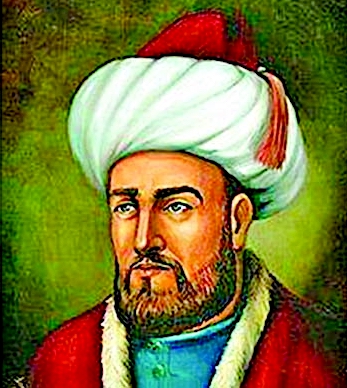
Al-Ghazzali: Lewis thought bin Laden was like him
Misunderstood Bin Laden
One is astonished to read some of his observations on Muslim and Arab sentiments and opinions. He is deeply convinced that Muslims are “pained” by the absence of the caliphate, as if this constitutes a serious demand or goal even for Muslim fundamentalist organizations. One never sees crowds of Muslims in the streets of Cairo or Islamabad calling for the restoration of the caliphate as a pressing need.
But then again: this is the man who treated Usamah Bin Laden as some kind of influential Muslim theologian who is followed by world Muslims. Lewis does not treat Bin Laden as the terrorist fanatic that he is, but as some kind of al-Ghazzali, in the tradition of classical Islamic theologians. Furthermore, Lewis insists that terrorism by individual Muslims should be considered Islamic terrorism, while terrorism by individual Jews or Christians is never considered Jewish or Christian terrorism.
In his retirement years, his disdain for the Palestinian people became unmasked. Although in his book The Crisis of Islam he lists acts of violence by PLO groups—curiously, only ones that are not directed against Israeli occupation soldiers—he lists not one act of Israeli violence against Palestinians and Arabs. To discredit the Palestinian national movement, he finds it necessary to tell yet again the story of Hajj Amin Al-Husayni’s visit to Nazi Germany, apparently seeking to stigmatize all Palestinians.
He is so disdainful of the Palestinians that he finds their opposition to Britain during the mandate period inexplicable because he believes that Britain was, alas, opposed to Zionism. Lewis is so insistent in attributing Arab popular antipathy to the U.S. to Nazi influence and inspiration that he actually maintains that Arabs obtained their hostility to the U.S. from reading the likes of Otto Spengler, Friederich Georg Junger, and Martin Heidegger. But when did the Arabs find time to read those books when all they read were their holy book and Islamic religious texts—as one surmises from reading Lewis?
While he displays deep–albeit selective–knowledge when he talks about the Islamic past (where his documentation is usually thorough), his analysis is quite simplistic and superficial when addressing the present (where he often disregards documentation altogether). For instance, he sometimes produces quotations without endnotes to source them: In Islam and the West he quotes an unnamed Muslim calling for the right of Muslims to “practice polygamy under Christian rule.” In another instance, he debates what he considers to be a common Muslim anti-Orientalist viewpoint, and the endnotes refer only to a letter to the editor in The New York Times.
Lewis once began a discussion by saying: “Recently I came across an article in a Kuwaiti newspaper discussing a Western historian,” without referring the reader to the name of the newspaper or the author. He also tells the story of an anti-Coptic rumor in Egypt in 1973 without telling the reader how he collects his rumors from the region. On another page, he identifies a source thus: “a young man in a shop where I went to make a purchase.”
Lewis was not shy about his biases in the British phase of his career, but be became an unabashed racist in his later years. In Notes on a Century, he did not mind citing approvingly the opinion of a friend who compared Arabs to “neurotic children”, unlike Israelis who are “rational adults.” And his knowledge of Arabs seems to decrease over time: he would frequently tell (unfunny) jokes related to Arabs and then add that jokes are the only indicator of Arab public opinion because he did not seem to know about public opinion surveys of Arabs. He also informs his readers that “chairs are not part of Middle Eastern tradition or culture.” He showers praise on his friend, Teddy Kollek (former occupation mayor of Jerusalem) because he set up a “refreshment counter” for Christians one day.
The political influence of Lewis, who lent Samuel Huntington his term, if not the theme, of “the clash of civilization”, has been significant. But it would be inaccurate to maintain that he was a policy maker. In the East and the West, rulers rely on the opinions and writings of intellectuals when they find that this reliance is useful for their propaganda purposes. Lewis and his books were timely when the U.S. was preparing to invade Muslim countries. But the legacy of Lewis won’t survive future scholarly scrutiny: his writings will increasingly lose their academic relevance and will be cited as examples of Orientalist overreach.
As’ad AbuKhalil is a Lebanese-American professor of political science at California State University, Stanislaus. He is the author of the Historical Dictionary of Lebanon (1998), Bin Laden, Islam & America’s New ‘War on Terrorism’ (2002), and The Battle for Saudi Arabia (2004). He also runs the popular blog The Angry Arab News Service.
OPCW’s new power attempt to politicize its work: Syria
Press TV – June 29, 2018
The Syrian government has denounced a recent decision made by the Organization for the Prohibition of Chemical Weapons (OPCW), the world’s chemical watchdog, to empower itself to assign blame for alleged chemical attacks.
“Syria expresses its deep concern at the methods of blackmail and threat used by Western countries, especially the ones involved in the tripartite aggression against Syria — the US, UK and France — to pass a resolution at the OPCW emergency session,” Syria’s official news agency, SANA, quoted a source at the Syrian Ministry of Foreign Affairs and Expatriates as saying on Friday.
On Wednesday, the Hague-based organization passed by 82 votes to 24 a British-backed proposal, which enable the watchdog to hold responsible those who it thinks are behind alleged chemical attacks. Until then, the OPCW’s mandate was limited only to determining whether or not a chemical attack took place, not who was responsible.
Russia, which had strongly opposed granting extra powers to the OPCW, said it would not rule out leaving what it called a “sinking Titanic.”
The new decision would allow for the watchdog to be used as “vehicle to carry out violations against independent, sovereign states under the pretexts of chemical weapons use”, the source further said, adding, “The decision will only add new complications to the OPCW’s capacity to play its role, which will lead to its paralysis.”
Back in April, militants and activists linked to them, including the so-called civil defense group White Helmets, claimed that government forces on Saturday had dropped a barrel bomb containing poisonous chemicals in Douma, Eastern Ghouta’s largest town, killing and wounding dozens of civilians.
Damascus strongly rejected the allegation and said that the so-called Jaish al-Islam Takfiri terrorist group, which had dominant presence in the town at the time, was repeating the allegations of using chemical munitions “in order to accuse the Syrian Arab army, in a blatant attempt to hinder the Army’s advance.”
However, the US State Department issued a strongly-worded statement, blaming the Syrian government for purportedly conducting the attack.
The Hague-based OPCW is soon expected to publish the highly-anticipated results of its probe into the purported toxic gas attack in Douma.
The Syrian foreign ministry’s source further said that Wednesday’s decision “sets a dangerous precedent” by giving an “organization concerned with scientific and technical issues the authority to carry out criminal and legal investigations that are not its specialty.”
The source added that the Arab country reiterated its condemnation of the use of chemical munitions by “anyone, anywhere, under any circumstances.”
Militants belonging to a number of factions had held the Eastern Ghouta, an enclave in the vicinity of the capital Damascus, since 2012 and had practically held hostage its inhabitants, some 400,000 people.
Syrian troops and allied fighters from popular defense groups managed to fully liberate the enclave from the clutches of militants in April, after months of intense fighting with terror groups, which had used the area as a launch pad for deadly rocket attacks against residents and civilian infrastructure in the capital.
Since the beginning of the conflict in Syria in early 2011, the Western governments have on several occasions accused Syria of using chemical weapons against militants. Damascus has denied the allegation, saying it is meant to pile more pressure on government forces and delay their success in the fight against terrorists.
In April last year, the US and allies in Europe said Syria and Russia, an ally of Damascus in the fight against terror, used chemical weapons against militants in Khan Shaykhun in the province of Idlib. Moscow and Damascus strongly rejected the allegation. However, US warships in the eastern Mediterranean launched a barrage of 59 Tomahawk missiles against Shayrat Airfield in Syria’s Homs province, which Washington alleged was the origin of the suspected chemical attack.
The Syrian government surrendered its stockpiles of chemical weapons in 2014 to a joint mission led by the UN and the OPCW.
Lavrov on trading Snowden for sanctions relief: Russia sees US exile as ‘master of his own destiny’
RT | June 29, 2018
Russia has never mulled handing over NSA whistleblower Edward Snowden to the US in exchange for easing sanctions, Russian FM Sergey Lavrov has told the BBC, when asked if this could form part of a deal with President Donald Trump.
“I have never discussed Edward Snowden with [Donald Trump’s] administration,” Lavrov told Channel 4’s Cathy Newman. He added that President Vladimir Putin had addressed the issue years ago, however.
“When he was asked the question, he said this is for Edward Snowden to decide. We respect his rights, as an individual. That is why we were not in a position to expel him against his will, because he found himself in Russia even without a US passport, which was discontinued as he was flying from Hong Kong,” Lavrov recalled.
Snowden, the man behind the biggest exposure in years of the US electronic surveillance apparatus, got stranded in Russia when Washington withdrew his passport as he was travelling via Moscow from Hong Kong. The Russian government eventually granted him political asylum. Snowden is facing prosecution in the US for leaking classified documents to a number of media outlets.
The Channel 4 correspondent suggested during the interview that Russia may try to bargain Snowden for the lifting of US sanctions, during the upcoming meeting between Putin and Trump.
“I do not know why people would start asking this particular question in relation to the summit. Edward Snowden is the master of his own destiny,” Lavrov reiterated.
Labour Friends of Israel: Palestine refugees’ right to return is ‘extreme and illegitimate’
MEMO | June 29, 2018
Westminster-based lobby group Labour Friends of Israel (LFI) has described the Palestinian refugees’ right of return as “extreme and illegitimate”, in a letter to Labour leader Jeremy Corbyn this week.
LFI’s letter came in response to remarks made by the Leader of the opposition on 25 June, during a recent visit to Jordan. In a Twitter post, Corbyn wrote:
“In Jordan, I went to Baqa’a, one of the largest Palestinian refugee camps. We must work for a real two state settlement to the Israel-Palestine conflict, which ends the occupation and siege of Gaza and makes the Palestinian right to return a reality.”
In the period 1947-1949, hundreds of thousands of Palestinians were expelled from or fled their homes as Zionist militias and the Israeli army destroyed hundreds of villages in what became Israel. Refugees attempting to return were killed, and Israel passed laws to expropriate their properties.
Corbyn’s expression of support for the Palestinian refugees’ internationally-recognised rights, prompted anger and concern from British pro-Israel groups, including LFI.
In a letter from LFI chair MP Joan Ryan, the pro-Israel group describes the Palestinians’ right to return (which is referred to in scare quotes) as “highly contentious”, and at odds with Israel’s insistence on retaining its Jewish majority of citizens.
Ryan added: “I do not believe that it does anything to encourage the compromises and concessions a future negotiated settlement will involve for foreign politicians to appear to endorse the most extreme and illegitimate demands of either side.”
The LFI chair concluded by urging Corbyn to “immediately clarify” what he understands by a right to return, and to only use “language… [that] helps to advance, not hinder, the cause of peace, reconciliation and coexistence between Israelis and Palestinians.”
A spokesperson for the Labour party said: “These rights are inalienable and guaranteed by UN Resolution 194 of 11 December 1948. How the right of return is implemented is a matter for the negotiations between the Israelis and Palestinians.”
Times Headline: Fears Over Prospect of Peace
OffGuardian | June 29, 2018
 OffGuardian was founded on the idea that the media should be held to account, corrected, fact-checked and interpreted. A lot of the time that’s a job that needs to be done.
But sometimes it’s not. Sometimes you just let them talk and their own words condemn them.
This is one of those times.
The Times is scare-mongering about peace.
Nothing more need be said.
Blair and Brown Governments Gory with Torture
By Craig Murray | June 29, 2018
Even I was taken aback by the sheer scale of British active involvement in extraordinary rendition revealed by yesterday’s report of the parliamentary Intelligence and Security Committee. Dominic Grieve and the committee deserve congratulations for their honesty, integrity and above all persistence. It is plain from the report that 10 Downing Street did everything possible to handicap the work of the committee. Most crucially they were allowed only to interview extremely senior civil servants and not allowed to interview those actively engaged in the torture and rendition programme.
Theresa May specifically and deliberately ruled out the Committee from questioning any official who might be placed at risk of criminal proceedings – see para 11 of the report. The determination of the government to protect those who were complicit in torture tells us much more about their future intentions than any fake apology.
In fact it is impossible to read paras 9 to 14 without being astonished at the sheer audacity of Theresa May’s attempts to obstruct the inquiry. They were allowed to interview only 4 out of 23 requested witnesses, and those were not allowed “to talk about the specifics of the operations in which they were involved nor fill in any gaps in the timeline”. If the UK had a genuinely free media, this executive obstruction of the Inquiry would be the lead story. Instead it is not mentioned in any corporate or state media, despite the committee report containing a firm protest:
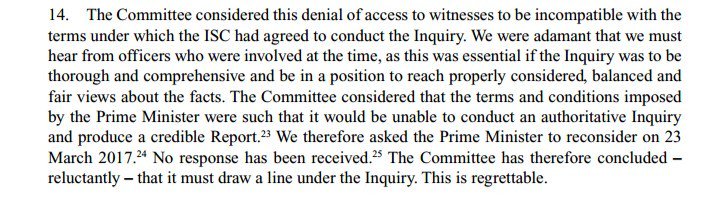
It is worth reflecting that the Tory government has acted time and time again to protect New Labour’s Tony Blair, David Miliband, Jack Straw and Gordon Brown from any punishment for their complicity in torture, and indeed to limit the information on it available to the public. The truth is that the Tories and New Labour (which includes the vast majority of current Labour MPs) are all a part of the same elite interest group, and when under pressure they stick together as a class against the people.
Despite being hamstrung by government, the Committee managed through exhaustive research of classified documents to pull together evidence of British involvement in extraordinary rendition and mistreatment of detainees on a massive scale. The Committee found 596 individual documented incidents of the security services obtaining “intelligence” from detainee interrogations involving torture or severe mistreatment, ranging from 2 incidents of direct involvement, “13 to 15” of actually being in the room, through those where the US or other authorities admitted to the torture, to those where the detainee told the officer they had been tortured. They found three instances where the UK had paid for rendition flights.
My own evidence to the Committee focused on the over-arching policy framework, and specifically the fact that Jack Straw and Richard Dearlove had agreed a deliberate and considered policy of obtaining intelligence through torture. The report includes disappointingly little of my evidence, as the Committee has taken a very narrow view of its remit to oversee the intelligence agencies. This is the only part of my evidence included:
130. This was not unique to the Agencies. Their sponsoring Departments appear to have adopted the same approach. We heard evidence from a former FCO official, Craig Murray, who suggested that “there was a deliberate policy of not committing the discussion on receipt of intelligence through torture to paper in the Foreign Office”.
In July 2004, when he was Ambassador to Tashkent, he raised concerns about the use of Uzbek intelligence derived from torture in a formal exchange of telegrams with the FCO. Mr Murray drew our attention to FCO documents from the same time, which we have seen, one of which referred to “meetings to look at conditions of receipt of intelligence as a general issue”. He told us that the meetings “specifically discuss[ed] the receipt of intelligence under torture from Uzbekistan” and “were absolutely key to the formation of policy on extraordinary rendition and intelligence”.
Mr Murray told us that, when he had given evidence to the Foreign Affairs Select Committee about this, they sought the documents from the FCO which replied that the “meetings were informal meetings and were not minuted ”. He went on to say:
“the idea that you have regular meetings convened at director level, convened by the Director of Security and Intelligence, where you are discussing the receipt of intelligence from torture, and you do not minute those meetings is an impossibility, unless an actual decision or instruction not to minute the meetings has been given.… Were it not for me and my bloody-mindedness, … you would never know those meetings had happened. Nobody would ever know those meetings had happened.”131. We note that we have not seen the minutes of these meetings either: this causes us great concern. Policy discussions on such an important issue should have been minuted. We support
Mr Murray’s own conclusion that were it not for his actions these matters may never have come to light.
Jack Straw to this day denies knowledge and involvement and famously told Parliament that the whole story about rendition and torture was a “conspiracy theory”.
Unless we all start to believe in conspiracy theories and that the officials are lying, that I am lying, that behind this there is some kind of secret state which is in league with some dark forces in the United States, and also let me say, we believe that Secretary Rice is lying, there simply is no truth in the claims that the United Kingdom has been involved in rendition full stop, because we have not been, and so what on earth a judicial inquiry would start to do I have no idea. I do not think it would be justified.”
In fact I strongly recommend you to read the whole Hansard transcript, from Q21 to Q51, in which Jack Straw carries out the most sustained bravura performance of lying to parliament in modern history. The ISC report makes plain he was repeatedly involved in direct authorisations of rendition operations, while denying to parliament the very existence of such operations.
For over a decade now the British government, be it Red Tory or Blue Tory, has been refusing calls for a proper public inquiry into its collusion with torture. The ISC report was meant to stand in place of such an Inquiry, but all it has done is reveal that there is a huge amount of complicity in torture, much more than we had realised, which the ISC itself states it was precluded from properly investigating because of government restrictions on its operations. It also concluded in a separate report on current issues, that it is unable to state categorically that these practices have stopped.
The Blair and Brown governments were deeply immersed in torture, a practice that increased hatred of the UK in the Muslim world and thus increased the threat of terrorism. Their ministers repeatedly lied about it, including to parliament. The British state has since repeatedly acted to ensure impunity for those involved, from Blair and Straw down to individual security service officers, who are not to be held responsible for their criminal complicity. This impunity of agents of the state is a complete guarantee that these evil practices will continue.
Same As It Ever Was: The GWOT and Colonial History
By Ron Jacobs | CounterPunch | June 28, 2018
Since the events popularly called 9-11, the general public of the western nations have grown used to ever intensifying security measures. These measures affect the way the public travels, attends sporting and musical events, and thinks about those who don’t look like them. Long gone are the days when one could buy an airline ticket with cash at the counter and walk on a flight without showing identification.
In her 2018 book, Deport, Deprive, Extradite: 21st Century State Extremism, Nisha Kapoor examines several cases of Muslims living in Britain accused of lending material support to terrorism. In her examination of these case studies, she exposes the abuses of the British internal security apparatus and its intimate collaboration with the much greater security apparatus of the United States. The processes she reveals describe a Kafkaesque web that is impossible to escape once one is trapped in its threads. Indeed, virtually every case she explores ends with the individual targeted by the surety services taking a plea no matter how flimsy the evidence against them is. It’s as if they are found guilty and sentenced before the trial like those in the Queen of Heart’s courtroom found in Lewis Carrol’s Through the Looking Glass. Indeed, Kapoor quotes from this fiction in her text to make that exact point.
Although many US and British citizens were (and are) appalled at the torture and extraordinary rendition of suspects, in part because of the illegality of the practice, fewer seem opposed to the practice of legal extradition. As Kapoor points out throughout her text, this policy is actually quite similar to extraordinary rendition in how it is actually carried out. Like those who are moved illegally via extraordinary rendition, the suspects extradited (usually to the United States) are hooded, bound and tortured. The fact that their movement is legal only points to the weakness of the law.
Underlying the case studies discussed in the text is Kapoor’s contention that the practices of rendition, extradition and the  accompanying torture and abuse of detainees are a continuation of strategies and policies established under colonial administrations in the past. In other words, they are racist and therefore dismissive of the subject’s humanity and importance except as a target of abuse and imprisonment. Their very existence demands suspicion of crimes against the regime and their rationale of any actions (or thoughts about actions) is not rational but the result of a fanaticism. In the nominally secular world of the western regimes primarily involved in the capture and imprisonment of these suspects it is the religion of Islam which is the cause of their irrationality.
Another important context that is crucial to the text’s understanding of the “war on terror” is Kapoor’s emphasis on the fact that this entire project is a direct extension of liberal governance and philosophy. In her writing, she references John Stuart Mill and other liberal philosophers’ disparaging comments on non-Western civilizations. Furthermore, she draws a clear line from liberalism to authoritarianism, pointing out that as the judicial element in such governments has been weakened, the legislatures have given more and more power to the executive, which has rendered any existing balance of power virtually meaningless. In other words, the pretense that liberal government is somehow different from authoritarianism has been ripped away by the increasingly invasive, harsh and repressive measures undertaken in the name of the war on terror.
Unwritten, but clearly present is this essential fact: the more time that passes under this regime of what Kapoor justly calls state extremism goes on, the fewer people there will be who can remember when liberal governments were more liberal than illiberal and human beings were not suspect at birth. Deport, Deprive, Extradite is not merely an examination of human rights abuses of the recent past; it is also a harbinger of a harsher future. One would do well to heed its warning and act against the possibilities it discusses.
Featured Video

Death Spikes & Rising Cancer In Our Youth Explained
or go to
Aletho News Archives – Video-Images
From the Archives
Politicians lie
By Mazin Qumsiyeh | Popular Resistance | August 18, 2013
There is no way to say this truth nicely: Politicians lie. That includes Japanese, American, Egyptian, Israeli, and Palestinian politicians! Is there something more common sense than that? Yet, so many citizens around the world believe their own politicians or wistfully acknowledge lies but think it is part of the job needed to run things. They believe even when politicians contradict themselves blatantly. This phenomenon is rather remarkable. It is a dissonance and disconnect from reality that many seem oblivious to. It is very dangerous because it can lead to accepting rationales for going to war. These can be deadly wars that lead to millions of lives lost as happened in what was called World War 1 and WW2. Even when incredible and declassified evidence abound, politicians continue to lie and old mythologies refuse to die. Here are just a few of the countless lies told to us over the past few decades… continue
Blog Roll
 Aletho News
- From Unipolar Universalism to Multipolar Civilizational Distinctiveness
- RSF military group defects, joins Sudanese army: State media
- Ireland goalkeeper refuses to play ‘Israel’ as squad weighs boycott
- China pushes back against US on Cuba, Iran
- Ukrainian Soldiers, Potential Mercenaries: Have Gun, Will Travel!
- Burnham’s UN debut… A masterclass in British disinformation
- Iran flights continue despite US aviation sanctions
- Global Tipping Points Lead the World Into a State of Entropy
- The day-after at the White House: USA and Xi Jinping
- The Geopolitical Balance in the Red Sea: The UAE Being Displaced by New Players
- If Americans Knew
- Deconstructing Netanyahu’s pants-on-fire UN rant – Daily Update
- Trump betrayed voters with his campaign lies and prioritized a foreign country once he took office
- Netanyahu calls Israel’s war in Gaza ‘opposite of genocide’ in UN speech to near-empty hall
- Settler Kidnappings: Torture, Sexual Abuse and Terrorisation of Palestinian Abductees as Israel Deepens Annexation of West Bank
- Gaza winter nears as 162,000 tents become unusable, raising fears of humanitarian crisis
- Netanyahu says, “It’s the opposite of genocide”; UN says Gaza economy is world’s ‘most severe crisis on record’ – Daily Update
- Israel’s US-Backed Assault on Gaza Has Created the ‘World’s Most Severe Economic Crisis on Record’: UN
- ‘Protecting U.S. Citizens’… From Israel
- ‘This is where I live now, the back of a truck’: a day in the life of a grandmother in Gaza
- In UN Speech, Iran’s President Displays Pictures of Children Killed by US, Brings Attention to Israel’s Nuclear Arsenal
- No Tricks Zone
- New Study: Earth And Venus Surface Warmth Largely Explained By Convection And Lapse Rate, Not CO2 Or Radiation
- 2025 Nature Paper Claiming Worsening Global Drought Gets RETRACTED …Heavily Flawed
- New Study: ‘Global Drought Shows No Detectable Recent Acceleration Under Climate Warming’
- Economic Masterminds: German Socialists Suggest Taxing Productivity Gains Stemming From Using AI
- The South China Sea Has Not Been Cooperating With The Climate Change Narrative
- Energy Crisis: Germany Enters Heating Season With Historically Low Gas Reserve Fill Levels
- New Study: The Antarctic Ice Sheet Gained Mass From 2020-2024 Due To Staggering Snow And Ice Accumulation
- Study: Ocean Heating Rates From Thousands Of Years Ago ‘Dwarf’ Modern Ocean Heating Rates
- Climate Extremists Target, Attack Large-Scale Power Grid Infrastructure In Germany!
- New Study: Antarctic Ice Melt Has Contributed Less Than 1 Centimeter To Sea Level Rise In The Last 30 Years

