German politicians are nervous over the meeting between Donald Trump and Vladimir Putin, fearing the US president could take actions that are not in line with NATO, echoing concerns across the channel and the Atlantic.
Ahead of the meeting on July 16 in Helsinki, several German officials expressed their worry in interviews with newspapers throughout the country. The transatlantic coordinator for Chancellor Angela Merkel’s ruling coalition, Peter Beyer, told the Funke Mediengruppe newspapers that “there are great concerns in the alliance about what agreements Trump and Putin could reach” during the summit, and he lamented that NATO member states had not been included in the planning.
He said that Trump would let Putin “put one over on him” during the meeting in Helsinki, using the US president’s recent meeting with North Korean leader Kim Jong-un as justification for his rather frank comment.
“Kim has only made promises thus far. We don’t know if he has stopped enriching uranium. Only Trump has billed the summit as such as a success,” said Beyer, a member of Merkel’s Christian Democrats Union (CDU).
Beyer isn’t alone when it comes to concerns surrounding the meeting and the apparent belief that the two leaders can’t simply meet in the same way that other world leaders meet every day – and the same way German Chancellor Angela Merkel has met with both Trump and Putin on numerous occasions.
Christian Lindner, the head of Germany’s Free Democrats, told Deutschlandfunk in an interview that he did not trust Trump, and that his actions in the areas of trade and security were not in Washington’s long-term interest.
“He is too volatile…within 24 hours, Mr. Trump can change his position by 180 degrees,” Christian Lindner, the head of the Free Democrats, told Deutschlandfunk. He called for Europe, as the world’s largest single economic zone, to take a united stance and act as a counterweight to Trump and Putin. The EU is currently in loggerheads with the US over tariffs on aluminum, steel and other goods.
And then there’s Wolfgang Ischinger, the head of the Munich Security Conference and a former German envoy to Washington, who expressed concern that Trump might refuse to sign a communique at next week’s NATO summit in Brussels. “It cannot be ruled out,” he told Die Welt in a clear reference to Trump refusing to sign the document from G7 meeting in June.
Amid all this scaremongering, Merkel herself said in a Saturday video address that Germany “would like to have reasonable relations with Russia. That is why we will always have discussions in the NATO-Russia Council.” She expressed her support for NATO in the next breath, saying it is needed in the 21st century “as a guarantor of our transatlantic alliance,” and stating that it “must show determination to defend itself.”
The comments come as Trump continues to pressure NATO states to pay their fair share towards the alliance, as Washington currently accounts for more than two-thirds of all defense spending by NATO members. It is one of only six countries to meet the two percent GDP quota.
A page out of Britain’s book
The comments by German officials come less than two weeks after The Times reported that the UK also fears that Trump will undermine NATO by striking a “peace deal” with Putin during the meeting. It cited cabinet ministers who are worried that the Russian president could persuade Trump to downgrade US military commitments in Europe, thus compromising NATO countries’ defense against so-called “Russian aggression.”
Alexander Bartosh, a military expert and former Russian diplomat, told RT that such concerns would come as no surprise, as the UK “has been one of the most active supporters of a hard line towards Russia.” He added that the UK feels “a certain loss of its weight in Europe and tries to turn Russia into a kind of boogeyman, seeing the ‘Russian threat’ as a unifying factor for nations, looking for closer ties with London.”
Bartosh also noted that the meeting between the two leaders will merely include trying to find a “unifying agenda for the US and Russia because the relations of the two countries affect not only their own well-being, but international security as a whole… none of the sides will be aiming to undermine the integrity of NATO.”
Trouble on the homefront
It’s not just Europe that fears what could happen in the meeting between Trump and Putin. Even former CIA director John Brennan told MSNBC last week that Trump “is not sophisticated enough” to deal with Moscow.
“I must tell you the Russians will feign sincerity better than anyone I’ve ever dealt with in my life. So I would be very careful about being swept in and I think Mr. Trump is not sophisticated enough, unfortunately, to deal with these foreign leaders in a manner that is going to protect US national security interests. I think he’s naive in these issues,” he said.
In fact, many within the US establishment dread the possibility of the summit succeeding, political analyst and media and government affairs specialist Jim Jatras wrote in an op-ed for RT.
Jatras noted that Trump’s desire to actually get along with Russia sounded alarms long before he won the 2016 election. “US reconciliation with Russia would yank the rug out from under the phony justifications for spending hundreds of billions of dollars annually to counter a ‘threat’ that ceased to exist over a quarter century ago,” he wrote.
Journalist Neil Clark voiced a similar point in his own op-ed for RT, stating that a successful summit simply won’t do, because Russia “must always be regarded as the enemy – unless of course it does absolutely everything the West demands of it.” And while he noted that positive moves between Moscow and Washington would be celebrated by ordinary folks, he stated that defense industry lobbyists wouldn’t be nearly as enthused.
Read more:
July 7, 2018
Posted by aletho |
Mainstream Media, Warmongering, Militarism | Germany, NATO, UK, United States |
Leave a comment
Marina Hyde’s vicious and spiteful attack on Susan Sarandon and the Green Party points to the real danger of anti-Trump protest next week being hijacked by the neo-con warmonger franchise. The idea that those of us who do not want arch warmonger Clinton in power are therefore supporters of Trump is intellectually risible and politically dishonest.
Yesterday the OPCW reported that, contrary to US and UK assertions in the UN security council, there was no nerve agent attack on jihadist-held Douma by the Syrian government, precisely as Robert Fisk was execrated by the entire media establishment for pointing out. The OPCW did find some traces of chlorine compounds, but chlorine is a very commonly used element and you have traces of it all over your house. The US wants your chicken chlorinated. The OPCW said it was “Not clear” if the chlorine was weaponised, and it is plain to me from a career in diplomacy that the almost incidental mention is a diplomatic sop to the UK, US and France, which are important members of the OPCW.
Trump’s reaction to yet more lying claims by the UK government funded White Helmets and Syrian Observatory, a reaction of missile strikes on alleged Syrian facilities producing the non-existent nerve agent, was foolish. May’s leap for British participation was unwise, and the usual queue of Blairites who stood up as always in Parliament to support any bombing action, stand yet again exposed as evil tools of the military industrial complex.
Hillary Clinton, true to form, wanted more aggressive military action than was undertaken by Trump. Hillary has been itching to destroy Syria as she destroyed Libya. Libya was very much Hillary’s war and – almost unreported by the mainstream media – NATO bombers carried out almost 14,000 bombing sorties on Libya and devastated entire cities.
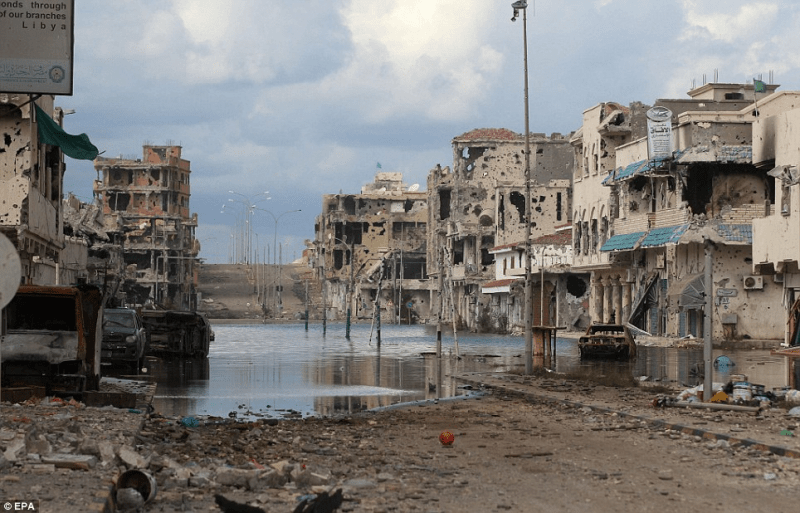
Sirte, Libya, after NATO bombing
The destruction of Libya’s government and infrastructure directly caused the Mediterranean boat migrant crisis, which has poisoned the politics of much of the European Union.
Donald Trump has not started any major war. He has been more restrained in military action than any US President since Jimmy Carter. My own view is (and of course it is impossible to know for sure) that, had Hillary been in power, Syria would already have been totally destroyed, the Cold War with Russia would be at mankind threatening levels, and nuclear tension with North Korea would be escalating.
“He hasn’t destroyed mankind yet” is faint praise for anyone. Being less of an existential danger to mankind than Hillary Clinton is a level achieved by virtually the entire population of the planet. I am not supporting Trump. I am condemning Clinton. I too, like Susan Sarandon, would have voted for Jill Stein were I an American.
So do protest against Trump. But do so under the banner No Trump! No Clinton! No NATO! And if any Clintonite or Blairite gets up to address you, tell them very loudly where to get off. I remember the hijacking of the Make Poverty History campaign by Brown, Darling and Campbell on behalf of their banker friends. Don’t let that happen again.
Or here is an even better idea.
Escape the Trump visit completely. Rather than stand penned in and shouting slogans at a police van parked right in front of you, turn your back on all of that and come join me at the Doune the Rabbit Hole Festival from 13 to 15 July. As our regulars know, this blog has been intimately connected with running the Festival from the start. This year is much bigger, with the Levellers, Akala, Atari Teenage Riot, Peatbog Faeries, and literally scores of other bands, and a great array of other festival activities too, including for kids, who come free and get free drinks.
DTRH has no sponsorship, no advertising, no government money and no rip-offs – beer and cider from £3.50 a pint at the bars. It is very much an alternative lifestyle gathering, and I find spiritual renewal there in the glorious Stirlingshire countryside. (I know that sounds corny, but I do). Tickets are £90 for full weekend including camping, which I think makes it the cheapest festival on this level around. Or you can buy a cheaper day ticket and drop in just for the day. If tickets are too expensive or you fancy a different kind of fun, you can volunteer, including to come and work with me in the bar, though there are a whole range of other tasks to be done if you don’t fancy that. Volunteers get in free and get fed in return for one six hour shift a day.
I really do hope I will see some of you there – it looks set to be a glorious weekend. Forget stress, forget Trump and hang out with nice people!
July 7, 2018
Posted by aletho |
Militarism, Progressive Hypocrite, Russophobia, Timeless or most popular | Donald Trump, Hillary Clinton, Libya, NATO, Syria, UK |
Leave a comment

In his statement to the House of Commons on 5th July, the British Home Secretary, Sajid Javid, stated the following:
“The use of chemical weapons anywhere is barbaric and inhumane. The decision taken by the Russian government to deploy these in Salisbury on March 4 was reckless and callous – there is no plausible alternative explanation to the events in March other than the Russian state was responsible. The eyes of the world are on Russia, not least because of the World Cup. It is now time the Russian state comes forward and explains exactly what has gone on.”
Anyone with their wits about them will immediately notice the cognitive dissonance in Mr Javid’s statement. On the one hand, he states that the Russian government took a decision to deploy chemical weapons in Salisbury on 4th March, 2018. This is an emphatic declaration, and implies that the British Government possesses irrefutable evidence that this is so. Then in the next breath, he states that there is “no plausible alternative”. This is very much less than emphatic, and the word “plausible” implies that the British Government does not have irrefutable evidence to back up their claim.
This is not a subtle difference. It is the difference between suspecting something and knowing something. If you know something to be true, because you have the hard evidence to back it up, you don’t use equivocal phrases like “no plausible alternative”. You simply say, “here is the evidence to prove it beyond reasonable doubt.” On the other hand, if you do not possess irrefutable evidence of something, as the weasel phrase “no plausible alternative” suggests, then you have no right to pronounce definitively on the matter, as Mr Javid felt fit to do.
Still, he’s only the Home Secretary. You can’t expect him to understand such petty legal concepts.
As it happens, there are plenty of plausible alternatives, as Mr Javid no doubt knows only too well. If he’s interested, he can check out the one I have put forward here. Of course, regardless of whether my “plausible alternative” is correct or not, it is unlikely that Her Majesty’s Government would want investigations to follow the line of inquiry I advanced, since it might raise an awful lot of troublesome questions about the role of British Intelligence in the attempt to stop Donald Trump getting elected. Apparently, they want to keep that quiet. Which is why they slapped D-Notices on various aspects of Skripal 1.0 to hush all that up.
So Mr Javid states that Russia must explain itself, but in so doing unwittingly admits that the Government has no hard evidence of Russian state involvement. It merely is unable to imagine a “plausible alternative”, which either means that its members are somewhat lacking in imagination, or they don’t wish other “plausible alternatives” to be discussed (of course, it could even be both). Nevertheless, since he and the Government are the ones making the claim, I’d say that actually it is incumbent on them to explain themselves, not the ones they are accusing. That is how these things are supposed to work, is it not?
This being the case, I have a number of questions for them, which urgently need answering. Urgent, because they could prove vital to the investigation. However, before I come onto the questions, I must explain the nature of them, which may well come as something of a surprise, given the latest twist to this sorry tale in Amesbury. The surprise is that not one of the 10 questions relates to the Amesbury case. This might seem odd, but there is a very important reason for it.
At the moment, very few details have emerged about the Amesbury case, and so it is not exactly clear which questions could even be asked. True, the details that have emerged so far in the official narrative are about as coherent and plausible as those in the original case, one of which I have already debunked here. However, what Mr Javid sought to do, with a very clever sleight-of-hand to cover his case of cognitive dissonance, is to make definitive claims about Case 2, based on the assumption that Case 1 has somehow been proven. But of course it hasn’t. Not even remotely. In fact, there are a ton of questions about Case 1 still hanging in the air that have not been answered, and I really don’t think that we should let Mr Javid and Co. off the hook before they’ve given us the answers to them.
But in the spirit of decency, let’s make it extremely easy for them. Let’s not ask them any hard questions. Nothing like, “C’mon, tell us the names of the people wot did it,” for instance. No, let’s instead satisfy ourselves by asking them some remarkably simple questions that they – or at least the Metropolitan Police – must know the answers to if their narrative is correct, and for a very simple reason, as you will see. So here goes:
- What were Mr Skripal’s and Yulia’s movements on the morning of 4th March?
- Why were their phones switched off?
- Did Mr Skripal see anyone or anything suspicious near his house that day?
- According to witnesses in Zizzis, Mr Skripal appeared to be very agitated. Was this because he was feeling unwell?
- According to witnesses in Zizzis, Mr Skripal appeared to be in a hurry to leave. Was this because he had an appointment to keep?
- What did Mr Skripal do after he left Zizzis?
- Can he confirm or deny that the couple seen on the CCTV camera in Market Walk, one of whom was carrying a large red bag, are him and Yulia?
- Did either Sergei or Yulia have a large red bag with them that day?
- What are his last memories before collapsing at the bench?
- Is Mr Skripal prepared to make a public statement answering the above, and will members of the international media be free to ask him questions?
So why must they know the answers to these questions? Simple. Because all they have to do to get answers to them is ask Sergei Skripal. They know where he is, don’t they? They must have questioned him, haven’t they? And Mr Skripal must surely have been eager to answer them, since the answers he gives could prove vital in helping to find out who poisoned him and his daughter, mustn’t he?
Just pause there for a second and think about it. Here we are, a third of a year after Skripal 1.0, with both Mr Skripal and his daughter having recovered months ago, and we still don’t know the answers to these basic, vital, but extraordinarily easy-to-establish questions. Isn’t that amazing?
I could even make it easier for them by boiling it down into one question:
When will the world hear from Mr Skripal about the events and circumstances of 4th March 2018, from the time he awoke until 4pm that afternoon?
C’mon British Government. It really isn’t hard. Or at least it wouldn’t be if the case you’ve presented is true. Just ask Sergei. But in the continued absence of answers to these simple questions, it seems that there might well be no “plausible alternative” but to assume that your case simply does not stack up. Which is why the onus is on you, not those you accuse, to explain yourselves.
July 6, 2018
Posted by aletho |
Deception, False Flag Terrorism, Russophobia | UK |
Leave a comment
Any reasonable person would have to welcome the summit between US President Donald Trump and Russian President Vladimir Putin to be held on July 16 in Helsinki.
However, what is most telling is the crescendo of scurrilous attempts purveyed by Western news media to spoil the forthcoming meeting. Trump’s political enemies in the US are almost apoplectic that he is willing to engage in a cordial, constructive fashion with the Russian leader.
The anti-Russia tropes are being dredged up to denigrate Putin and by extension Trump for holding the conference. Trump is being lambasted for daring to engage with an alleged “autocrat” who allegedly “annexed Crimea”, who has allegedly aided and abetted a “dictator” in Syria, and who allegedly ordered Kremlin agents to “interfere in US elections.”
On the latter accusation of electoral interference, a recent analysis piece by Jack Matlock, the former US ambassador to the Soviet Union, is both welcome and highly instructive. Matlock, who is a veteran of assessing top-secret files, makes a withering assessment that the so-called US intelligence claims of Russian interference in the 2016 presidential elections was “politically motivated.” The respected diplomat debunks the “intelligence” and subsequent media mantra as cooked up like the earlier shameful scam over Iraq’s weapons of mass destruction. In short, fabricated.
The list of alleged Russian malfeasance has expanded like elastic in recent years. But as Russia’s Foreign Minister Sergei Lavrov cogently pointed out in a recent British media interview not one of these attenuated claims has ever produced substantiating evidence.
One suspects that the strange case this week of an English man and woman being allegedly poisoned with a nerve agent is a contrived timely reminder of the Skripal poisoning affair which happened in Salisbury four months ago. As with all Western media campaigns attempting to smear Russia, the alleged poison cases rely on pejorative innuendo and assertions, spun by a dutiful and derelict news media.
Plausibly, the timing of the latest “story” of an alleged Soviet-made chemical weapon being deployed in Britain is a convenient excuse to further undermine the forthcoming Trump-Putin summit.
Next week also sees a major NATO summit in Brussels during which delegates are to dwell – as they ever tediously do – on alleged Russian aggression. The strange case of poisoning this week in England – which the authorities there have used to once again implicate Russian involvement – will no doubt lend added animus to the NATO agenda.
Trump’s political opponents in the US have been bolstered by pro-Atlanticists in Europe who are claiming that his meeting with Putin “makes Europeans very nervous”, to quote former Swedish premier Carl Bildt writing in the Washington Post.
That’s a sweeping claim. More precisely, the people Trump is making nervous are elitist European politicians like Carl Bildt who have made lucrative careers from being cheerleaders for NATO’s military expansion on Russia’s borders. It is a fair assumption that most ordinary citizens of the European Union – some 500 million – are glad to see the leaders of the world’s two biggest nuclear powers open a long-overdue dialogue to reduce fearful tensions and to try to repair badly damaged relations between East and West.
One talking point doing the rounds in Western media is to compare unfavorably Trump’s meeting with Putin to his earlier summit last month with North Korea’s Kim Jong-Un. Trump’s detractors in the US and in Europe are claiming that he gave too many easy concessions to Kim over denuclearization of the Korean Peninsula. There has been a steady US media campaign – citing anonymous US intel sources – claiming that North Korea is cheating Trump over its promises.
That theme is being applied to Trump’s gathering with Putin in Helsinki. Assorted Russophobic talking heads like former US ambassador Michael McFaul are asserting that Trump will be played and hoodwinked by the wily Putin, as he allegedly was too by Kim Jong-Un. These cynics seem to be more content with conflict and even war, rather than attempts for peace-making.
Such negative views are nothing but cynical opportunism by vested powerful interests among militarists, NATO expansionists, and their European acolytes to derail the Trump-Putin summit, or at least to severely limit the American president’s efforts at engaging normally with Russia.
The two leaders have much to discuss in an effort to begin resolving highly dangerous global security risks. They include settling the conflict in Ukraine and Syria, and trying to de-escalate tensions over the buildup of NATO forces along Russia’s Western flank. Let fester, these issues could ignite into a wider, disastrous conflict between the two nuclear superpowers.
Surely, it is urgently needed for Trump and Putin to engage in direct talks to mitigate the worst tensions since the end of the Cold War more than a quarter-century ago. Since Trump took office nearly 18 months ago, he has met with President Putin only on two fleeting occasions at multilateral forums. It is long overdue that the two leaders should meet in a full summit for in-depth, face-to-face negotiations. To Trump’s credit, he doing just that, despite the naysayers and fantasists claiming “Russian influence” over the American president.
Instead of welcoming this engagement as an important step towards securing world peace, an array of powerful interests both in the US and Europe are trying their best to sabotage the high-level crucial talks.
The Russophobes and their perverse warmongering predilections are being flushed out for the whole world to see, and to condemn as reprehensible, irresponsible wreckers of global peace.
July 6, 2018
Posted by aletho |
Deception, Fake News, Mainstream Media, Warmongering, Russophobia | Donald Trump, NATO, UK |
Leave a comment
Elizabeth Gardens in Salisbury is a rather lovely park. Situated next to the river, and overlooking the Water Meadows, it is a wonderful place to take an early morning stroll, and then to walk along the town path, where you get a wonderful view of the towering 13th Century gothic cathedral from the very spot where Constable painted his famous Salisbury Cathedral from the Meadows.
Yet, like the centre of the City, it is now apparently a place synonymous with poisoning. According to latest reports, it is apparently the place at which Dawn Sturgess and Charlie Rowley became poisoned on Friday 29th June. This from The Mail :
“Police are hunting for the deadly syringe or vial laced with Novichok that poisoned a couple in Salisbury as they finally evacuated homes five days after they fell catastrophically ill. Dawn Sturgess, 44, and her boyfriend Charles Rowley, 45, became critically ill within hours of visiting Salisbury on Saturday – the site of the murder attempt on Sergei Skripal and his daughter Yulia. The authorities are still searching for the container carrying the nerve agent, which could kill anyone who found it, and the homeless shelter where Dawn lived in Salisbury and Charlie’s home in Amesbury have now been screened-off and residents evacuated.
A security source told the Evening Standard : ‘It could have been picked up by anyone, including a child. There’s no doubt it will be contaminated still’, adding the poison could be deadly ‘for decades’ if kept dry.
Salisbury Hospital chief executive Cara Charles-Barks has revealed the victims remain in a critical condition in intensive care and are ‘acutely unwell’ but added that nobody else has been poisoned.
One friend of the couple, who were known to be drug users, believes they may have found a syringe believing it contained heroin rather than the deadly poison used by assassins Britain claims were sent by Russia.
‘It was definitely an accident. I think they found a package and it looked like drugs’, she said.
Dawn and Charlie collapsed after a visit to the Queen Elizabeth Gardens on Friday, an area not searched or decontaminated after the Skripals were poisoned in March, raising serious questions about the quality of the clear-up operation four months ago.”
Okay, so this one is pretty easy to debunk, and I think I can save the media the trouble of going on about this for days on end, only to have to shift their explanation away from the vial/syringe in Queen Elizabeth Gardens to another door handle perhaps, or a car, cemetery, restaurant, bench, or even porridge.
The article points your attention to the apparent expert, who is able to assure us that the substance A-234, which prior to March 2018 was reckoned to be highly volatile, is able to survive in a syringe/vial for donkeys years. Here’s my advice: Don’t pay any attention to what he’s saying! Why? Because it’s a complete and utter red-herring, which – either wittingly or unwittingly – turns your attention away from a rather obvious reason why this is complete nonsense. And what is that?
It is this: Queen Elizabeth Gardens is nowhere near Christie Miller Road. Even if you had accepted the Government narrative that the Skripals were poisoned by a military grade nerve agent (of a type 5-8 times more toxic than VX), which was poured (or now presumably squirted from the syringe) onto the door handle of Mr Skripal’s front door, by professional assassins not wearing HazMats – all of which requires much cognitive dissonance – what are you now being asked to believe? That the professional unHazMatted Russian assassins, after leaving Chez Skripal, decided not to leg it to Heathrow or Gatwick pronto, but to drive to Elizabeth Gardens.
As I say, it’s a beautiful park, and one which I would encourage people to visit, although you may find that quite tricky just at the moment. But here’s the thing: How likely do you suppose it to be that the alleged professional Russian hitmen, after undertaking their dangerous and potentially deadly assignment, decided to drive from Christie Miller Road to Elizabeth Gardens, which is out of the way, and certainly not the way you’d drive if you wanted to get to an airport quickly, where they parked their car, got out and then went for a walk to drop their deadly (but non-lethal) Novichok-laced syringe in the gardens, where it lay undetected for four months. I’d put the chances of that at zero, and not a smidgen more.
But that’s apparently what we’re being asked to believe. Until of course they change the narrative tomorrow.
July 6, 2018
Posted by aletho |
Deception, Fake News, False Flag Terrorism, Mainstream Media, Warmongering | UK |
Leave a comment
British Prime Minister Theresa May has said it is deeply disturbing to see two British citizens, who remain in critical condition in hospital, poisoned by the Novichok nerve agent. While the UK’s Security Minister has stated that the Amesbury poisoning was not a targeted attack but a contamination by Novichok and not linked to the Skripal case.
Sputnik has discussed this with Peter Ford, former British Ambassador to Syria.
Sputnik: The British media has already accused Russia of the poisoning despite there being no proof, what do you think are the main reasons for that?
Peter Ford: Well, it’s certainly embarrassing for the British government on more than one level. First of all it seems as such an amazing coincidence, again it’s a man and a woman, again it was within a few miles from the Porton Down chemical research facility. You go on social media and you find many, many British people are deeply skeptical about anything the government says in the entire matter, not just about this latest incident, but about the earlier incident with the Skripal pair. In fact, this whole Skripal saga appears to be backfiring on the British government. It’s become an embarrassment, even the BBC were putting ministers into uncomfortable positions trying to defend the government’s apparent failure to keep people safe. Really, it’s becoming a bit of midsummer madness. It’s not helping the British government at all, they may be beginning to regret that they pointed the finger at Russia in the first place.
Sputnik: Do you think that they could actually revoke their previous accusations or make an official apology?
Peter Ford: No, they’ve gone too far out on a limb. They’re in a hole, and they are digging themselves deeper and deeper into the hole and another coincidence as well — it is happening just as Russia is having good press because of the World Cup. Again, this contributes to the skepticism of many people. It looks to many people like it might be an attempt by somebody who wishes Russia ill, to spoil the football party with the World Cup.
Sputnik: We never got the complete results and the evidence to link Russia to the first Skripal poisoning and now we have the second one, do you think that there’s going to be an attempt to connect this with Russia this time around as well?
Peter Ford: Well, the government are saying that the police investigations must take their course and this could take weeks or months. So it looks like they’re trying to push the ball into the long grass and hoping that the whole subject will go away and be quietly forgotten, given the apparent impossibility of finding conclusive evidence establishing the guilt of Russia. Of course, the government are being careful not to pursue other lines of inquiry, all the evidence that I have seen in the public domain is consistent with an attempt on some third-party to frame Russia, very similar to what we witnessed in Syria with repeated fabrications of evidence to show that Syria has been using chemical weapons.
Sputnik: It’s very strange that in both cases, the Skripal case and the second case. Okay, the Skripals at least had some kind of Russian link and there was reason to believe that there might be something else going on because he was a person who was returned by the government for being a double agent, but in this case there’s no links to Russia. There is no reason to believe that these people could’ve had any reason to be targeted. Also in both cases they were not fatal and if we’re talking about a military grade nerve agent, shouldn’t contact with that be fatal?
Peter Ford: So many inconsistencies in the government’s story, it’s hard to know where to begin. They tried to scare people by saying that it was this deadly, contaminating agent that could be fatal to entire populations, and they’re left with the embarrassing fact that originally two people were hurt, they had bad stomach attacks but have recovered. So on every level it’s embarrassing for the government. Now this time, they may be right, that what’s happened is whoever carried out the Skripal attack threw away the syringe, and these two unfortunate people in Amesbury happened to pick it up. There are other theories which are also consistent with the evidence such as the fact that this could be another deliberate attempt to incriminate Russia. It is just impossible to say, this is not preventing the British government from going on record and pointing yet again the finger at Russia.
Sputnik: Has anybody officially pointed the finger at Russia in this case?
Peter Ford: The government is being a bit cautious. They are saying that Russia must have done the Skripal poisoning; this latest incident is linked to that. So even if the latest poisoning was not deliberate, not targeted, nevertheless Russia is responsible, because of the fallout from the first incident. Even the government has woken up to the fact that public opinion just will not buy anymore straightforward empty accusations.
Sputnik: How damaging is this for Theresa May?
Peter Ford: I think there is a mounting theme, particularly in the media to blame May. May is extremely vulnerable. She has been completely obsessed with Brexit in the recent months and appears to have no time for anything else. She exudes an aura of incompetence all around. Now she’s going to be blamed for the absence of British football fans, which was very much noticed in the Colombia match because the Colombians far outnumbered the British. The British government had discouraged them from going to Russia because of hooliganism. This is all beginning to boomerang on the government now and they must be regretting the Russophobia which they have encouraged and I thought that President Putin’s suggestion that May might attend the next match was really just turning the knife in the wound.
Read More:
‘Being Russian is Enough’ to Be Suspected to Wrongdoing in UK — Activist
UK Recklessly Linking Moscow to Amesbury Without Proof – Ex-Intelligence Agents
Porton Down Laboratory Confirms Amesbury Сouple Exposed to Nerve Agent, Not Sure It’s From Skripals Batch – Scotland Yard
July 6, 2018
Posted by aletho |
Deception, Fake News, Mainstream Media, Warmongering, Russophobia | UK |
Leave a comment
A new poisoning incident on UK soil has given British politicians a perfect reason for launching another McCarthian witch hunt on dissent. One MP already targeted RT and was called out for limiting free speech.
“Could … members of this house on all sides not appear on Putin’s propaganda television channel?” Mike Gapes, a Labor MP for Ilford South, said during his speech in the House of Commons in an apparent attempt to discourage his fellow parliamentarians from providing any commentaries to RT.
He also accused RT, as well as some perceived “St. Petersburg troll factories,” of “gearing up to spread misinformation.” He spoke just a day after the reports about a Wiltshire couple being poisoned with what was later described as the same strand of ‘Novichok’ nerve agent that was used against the former Russian double agent Sergei Skripal and his daughter in March.
It goes without saying that Gapes did not bother to provide a single piece of evidence to support his claims. Nevertheless, his words apparently resonated with the British Interior Minister Sajid Javid, who praised the MP for raising the issue and then complained that “there have been far too many incidents where members of the [House of Commons] have sadly supported the Russian propaganda machine” by apparently appearing on RT.
Javid then took the liberty to speak for all the British people in what appeared to be another blatant attempt to exert pressure on lawmakers. The minister said that “the British public will not support any” of those MPs that “support” Russian President Vladimir Putin. The implication here is that anyone who appears on RT automatically supports Putin.
This alleged fight against “insidious Russian propaganda” perfectly plays into London’s broader political narrative, in which Russophobia has become one of the leading trends. The UK has so far failed to provide any solid evidence to prove that Russia had anything to do with the Skripals’ poisoning, as the official investigation has not yet provided any clear results. However, London has already presumed that Moscow might be implicated in another poisoning incident at a time when the investigation of the new case has only just started.
It is far from the first time that British officials have involved RT in their political games, as they apparently desperately seek to silence the channel that is not perfectly in line with their narrative. In March, when the Skripals case hit the news and the British government was falling all over itself to convince the world that Moscow was behind the attack on the ex-spy and his daughter, some British MPs already took advantage of the situation and called for RT UK to have its license revoked on some contrived pretext that it was allegedly “broadcasting propaganda.”
In their overzealous attempts to “protect the freedom of speech” by trying to shut down an alternative opinion, the MPs fell out of touch with their own constituents, who turned to social media to enlighten the people’s chosen ones that their suggestions actually amount to censorship.
Gapes already admitted that he had been confronted by angry people on social media over his remarks in parliament. Unsurprisingly, he just discarded all those who disagreed with his stance on the issue as “squawking Putin apologists.”
Even though it has not yet come to calls for banning RT altogether, one cannot rule out such possibility, taking into account the British politicians’ previous attempts to deal with the channel. The calls for the MPs to stay away from RT might well indicate that London would very much like to see public figures confined to appearing only in the media that so conveniently peddles the government narrative.
After all, apart from ostracizing RT, such moves show a much more worrying trend that some British officials are quite willing to limit the freedom of speech of their own fellow citizens by telling them who they may or may not speak to.
July 6, 2018
Posted by aletho |
Full Spectrum Dominance, Russophobia | Mike Gapes, Sajid Javid, UK |
Leave a comment
Former UK intelligence officers told Sputnik that it was reckless for UK authorities to point at Russia as a link between the Amesbury poisoning incident and the nerve agent attack on Russia’s ex-spy Sergei Skripal and his daughter in Salisbury in March, without any concrete proof of Russian involvement.
Late on July 4, the UK authorities said that the two victims of the Amesbury incident — who were hospitalized over the weekend — had been exposed to the same nerve agent as the Skripals.
UK Minister of State for Security Ben Wallace suggested that Russia “fill in the gaps” of what happened in the incident to allow the UK authorities to pursue their investigation and keep people safe. Wallace added that it was not a targeted attack but “a contamination by a Novichok.”
At a parliament session later on June 5, UK Home Secretary Sajid Javid said that the United Kingdom would take “further action” should Russia’s involvement in the incident confirmed. He noted, however, that “we don’t want to jump to conclusions.”
“Again [Wallace is] making connections when even in the Skripal case there had been no official connection made, only assertions of high probability that Russia was behind the Skripal attack. So to conflate that with the Amesbury attack I think is highly reckless for a public official,” Annie Machon, a former MI5 intelligence officer, said.
Former MI6 intelligence officer Nicholas Anderson added that Wallace was unqualified to make any statements about the case.
“Please understand that many in the armed forces and intelligence services believe that Ben Wallace, even though he is a former officer in the British Army’s Scots Guards, is not sufficiently experienced nor qualified to make official statements at this level. He has only been in place a few months and is a long-term ally of Boris Johnson, and toes the officially-set agenda,” Anderson said.
Deteriorating Relations
Russia has repeatedly denied its involvement in the Skripal case and offered to assist the United Kingdom in its investigation.
Machon stated that it was misleading for Wallace to now ask for Russia’s help with the Amesbury nerve agent attack when the United Kingdom had previously turned down Russia’s assistance.
“Certainly we also have a case where Sergey Lavrov, the Russian foreign minister, of course, has repeatedly asked to be shown the evidence around the Skripal case so Russia could contribute to the investigation at that time and they have been repeatedly rebuffed. So for [Wallace] now to say that Russia could now help in securing the safety of British people is disingenuous,” Machon said.
Machon stated that since the Skripal case emerged in March, relations between Russia and the United Kingdom had been in a deep freeze, but the recent handling of the Amesbury case by UK authorities was likely only to worsen bilateral ties.
On June 4, the head of the UK Metropolitan Police’s anti-terrorism unit said the priority for the investigative team was to establish how contact with the nerve agent had been made, and that any baseless assumptions should be avoided.
Anderson stated that the UK authorities, by providing a lack of clarity about the attack, were only arousing suspicion among the population.
“It’s early days yet as so much is unexplained as to what has happened in Amesbury. Many of this country’s citizens before and now again are suspicious of our own government’s motives. Events that occurred before were not properly explained to the public,” Anderson said.
Anderson added that relations between Russia and the United Kingdom continued to be poor “at the choosing of the British government.”
Drawing Parallels to Skripal Case
Wallace stated Thursday that although those affected by a nerve agent in Amesbury were not linked to the Skripals, the cause of the incident in Amesbury was nerve agent contamination.
Machon stressed that it would be wrong to draw such conclusions when at the time of the Skripal attack, experts held the belief that the A234 nerve agent could not remain effective in the open for a long time.
“But I think it was initially said that it would take months to investigate all these possible leads, all these possible theories and still not know what the outcome of what it was then. So for British ministers to be drawing analogies to the recent attack in the Skripal case, I think is dangerous,” Machon said.
Commenting on the possibility that the United Kingdom was unduly passing the blame onto a state actor, Anderson stated that London should focus on foreign criminal elements instead, that had long established profitable operation in the country and the existence of which continues to be officially denied by the country’s government.
Skripal and his daughter Yulia were found unconscious on March 4 in Salisbury, located several miles away from Amesbury. The United Kingdom promptly accused Russia of orchestrating the attack with what UK experts claimed was the Novichok nerve agent.
Moscow has repeatedly refuted all the allegations and offered its assistance in the investigation. The incident led to a diplomatic standoff between London and Moscow. Both Skripals have since been discharged from the hospital.
READ MORE:
“Huge Breakthrough”: UK Police Allege Two Hitmen ‘With Close Ties to Russia’ Involved in Skripal Case
2 Hospitalized After Exposure to ‘Unknown Substance’ in UK’s Amesbury — Police
UK Health Secretary: Amesbury Looks Like ‘After-Effect’ of Salisbury Case
UK Counter-Terrorism Chief: 2 People in Amesbury Exposed to Novichok
Salisbury to Host 2019 UK Army Day as Tribute to Skripal Poisoning Response – May
July 5, 2018
Posted by aletho |
Deception, Russophobia | UK |
Leave a comment
We are continually presented with experts by the mainstream media who will validate whatever miraculous property of “novichok” is needed to fit in with the government’s latest wild anti-Russian story. Tonight Newsnight wheeled out a chemical weapons expert to tell us that “novichok” is “extremely persistent” and therefore that used to attack the Skripals could still be lurking potent on a bush in a park.
Yet only three months ago we had this example of scores from the MSM giving the same message which was the government line at that time:
“Professor Robert Stockman, of the University of Nottingham, said traces of nerve agents did not linger. He added: ‘These agents react with water to degrade, including moisture in the air, and so in the UK they would have a very limited lifetime. This is presumably why the street in Salisbury was being hosed down as a precaution – it would effectively destroy the agent.’”
In fact, rain affecting the “novichok” on the door handle was given as the reason that the Skripals were not killed. But now the properties of the agent have to fit a new narrative, so they transmute again.
It keeps happening. Do you remember when Novichok was the most deadly of substances, many times more powerful than VX or Sarin, and causing death in seconds? But then, when that needed to be altered to fit the government’s Skripal story, they found scientists to explain that actually no, it was pretty slow acting, absorbed gradually through the skin, and not all that deadly.
Scientists are an interesting bunch. More than willing to ascribe whatever properties fit the government’s ever more implausible stories, in exchange for an MSM appearance fee, 5 minutes of fame and the fond hope of a research grant.
According to the Daily Telegraph today, the unfortunate Charlie Rowley is a registered heroin addict, and if true Occam’s Razor would indicate that is a rather more likely reason for his present state than an inexplicably persistent weaponised nerve agent.
If it is however true that two separate attacks have been carried out with “novichok” a few miles either side of Porton Down, where “novichok” is synthesised and stored for “testing purposes”, what does Occam’s razor suggest is the source of the nerve agent? A question not one MSM journalist seems to have asked themselves tonight.
I am slightly puzzled by the picture the media are trying to paint of Charlie Rowley and Dawn Sturgess as homeless, unemployed addicts. The Guardian and Sky News both state that they were unemployed, yet Charlie was living in a very new house in Muggleton Road, Amesbury, which is pretty expensive. According to Zoopla homes range up to £430,000 and the cheapest ones are £270,000. They are all new build, on a new estate, which is still under construction.
Both Charlie Rowley and Dawn Sturgess still have active facebook pages and one of Charlie’s handful of “Likes” is a mortgage broker, which is consistent with his brand new house. They don’t give mortgages to unemployed heroin addicts, and not many of those live in smart new “executive housing” estates. Both Charlie and Dawn appear from their facebook pages to be very well socialised, with Dawn having many friends in the teaching profession. Even if she has been homeless for a period as reported, she is plainly very much part of the community.
Naturally, there is no mention in all the reports today of MI6’s Pablo Miller, who remains the subject of a D notice. I wonder if he knows Rowley and Sturgess, living in the same community? It should be recalled that Salisbury may be a city, but its population is only 45,000.
The most important thing is of course that Charlie and Dawn recover. But tonight, even at this early stage, as with the entire Skripal saga, the message the security services are seeking to give out does not add up. Mark Urban’s piece for Newsnight tonight was simply disgusting; it did not even pretend to be more than a propaganda piece on behalf of the security services, who had told Urban (as he said) that Yulia Skripal’s phone “could have been” tapped by the Russians and they “might even” have listened to her conversations through the microphone in her telephone. That was the “new evidence” that the Russians were behind everything.
As a former British Ambassador I can tell you with certainty that indeed the Russians might have tapped Yulia, but GCHQ most definitely would have. It is, after all, their job, and billions of our taxes go into it. If tapping of phones is seriously presented as evidence of intent to murder, the British government must be very murderous indeed.
July 4, 2018
Posted by aletho |
Deception, Fake News, Mainstream Media, Warmongering, Russophobia | UK |
Leave a comment

Jewish colonists stealing Palestinian olives in the West Bank
Leicester City Council has “won its long-running legal battle” against a pro-Israel advocacy group over a motion backing a boycott of Israeli settlement produce, reported the Leicester Mercury.
In a ruling issued Tuesday, the Court of Appeal rejected the arguments brought by Jewish Human Rights Watch (JHRW), who had taken legal action against the 2014 council motion.
As reported by the local paper, “JHRW challenged a High Court judge’s previous decision to reject the pressure group’s attempt to force the council to rescind the boycott”, arguing that “the council had breached its own equalities rules and had acted in a discriminatory manner”.
The council, however, won yesterday’s case, and “JHRW has indicated it will not pursue the matter further”. In addition, “JHRW is now likely to have to pay the council’s legal costs.”
The council’s barrister, Kamal Adatia, said after the case: “The High Court originally dismissed the claims of discrimination made by this group back in June 2016, and now the Court of Appeal has emphatically thrown out their appeal.”
“The ruling totally endorses Leicester’s approach to handling this motion, and has made no change whatsoever to the way in which councils can pass such motions in future.”
“The judgement is a landmark – not for organisations like JHRW, but for all local councils. It recognises their fundamental right to pass motions of this nature and makes it clear that they can, like Leicester, fully comply with their equality duties when doing so.”
City Mayor Sir Peter Soulsby said: “Their argument has been trounced in the judge’s decision.”
“I strongly resent the implication it is not possible to criticise the Israeli government without being anti-Semitic.”
The motion backing a boycott of goods made in internationally-condemned Israeli settlements in the occupied Palestinian territory was, Soulsby said, “never anticipated to have a major impact (on our purchasing)”, but rather “was a powerful gesture to show support for the plight of the Palestinians”.
In a bizarre press release, Jewish Human Rights Watch spun defeat as victory, claiming that despite their appeal being rejected, the ruling “made a number of very important changes to the law”.
July 4, 2018
Posted by aletho |
Civil Liberties, Ethnic Cleansing, Racism, Zionism, Solidarity and Activism | Human rights, Israel, Palestine, UK, West Bank, Zionism |
Leave a comment
Just as the World Cup had forced the British media to grudgingly acknowledge the obvious truth that Russia is an extremely interesting country inhabited, like everywhere else, by mostly pleasant and attractive people, we have a screaming reprise of the “Salisbury incident” dominating the British media. Two people have been taken ill in Amesbury from an unknown substance, which might yet be a contaminated recreational drug, but could conceivably be from contact with the substance allegedly used on the Skripals, presumably some of which was somewhere indoors all this time as we were told it could be washed away and neutralised by water.
Amesbury is not Salisbury – it is 10 miles away. Interestingly enough Porton Down is between Amesbury and Salisbury. Just three miles away from Muggleton Road, Amesbury. The news reports are not mentioning that much.
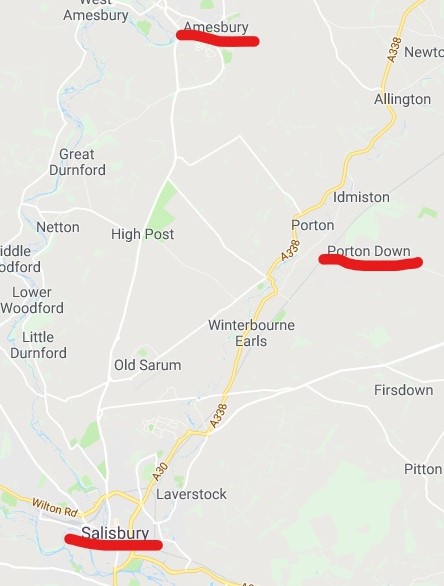
“I am all out of ideas Inspector. What can possibly be the source of these mysterious poisonings?”
Neither Porton Down nor the Organisation for the Prohibition of Chemical Weapons has any idea where the substance to which the Skripals were allegedly exposed was made. Boris Johnson’s great “coup” of obtaining a majority vote at the OPCW to expand its powers to place blame for chemical attacks, has proven rather otiose as the OPCW has no evidence on which to base any blame for Salisbury. In fact, four months on, May and Johnson’s shrill blaming of Russia remains entirely, 100% evidence free.
I do however wish to congratulate the neo-con warmongers of the Guardian newspaper for verbal dexterity. They have come up with a new formulation to replace the hackneyed “Of a type developed by Russia”, to point the finger for a substance that could have been made by dozens of state or non state parties. The Guardian today came up with “Russian-created novichok”. This cleverly employs a word that can encompass “developed” while also appearing to say “made”. It also again makes out that novichok is a specific substance rather than a very broad class of substances. The Guardian’s Steven Morris, by this brilliant attempt deliberately to mislead his readers, runs away with this week’s award for lying neo-con media whore of the week. His achievement is particularly good as the rest of his report is largely a simple copy and paste from the Press Association.
I most certainly hope that the couple in Salisbury hospital recover from whatever is afflicting them. The media is, by making this the lead story on all broadcast news after last night’s football, inviting us to make the connection to the Skripals. In which case I assume the couple were perfectly well for five hours after contact, able to be very active and even to eat and drink heavily, before being mysteriously instantly disabled at the same time despite different ages, sexes, weights, and metabolisms and random uncontrolled dosages.
Replicating that would be quite a feat.
July 4, 2018
Posted by aletho |
Deception, Mainstream Media, Warmongering, Russophobia | Steven Morris, The Guardian, UK |
Leave a comment
Dear friends and supporters,
As you know, three months ago I was sued in the High Court of England by the Campaign Against Anti-Semitism’s Chairman Gideon Falter regarding a paper that I published on my website. I asked for your support and was thrilled to find out how vast and kind your support was.
Before the trial could begin, the court held a preliminary hearing to do with the meaning of the words of my article. There was a dispute between the sides about how far my words went, and what the allegations I made were. This dispute had to be resolved by the court before the actual trial could take place.
The judge in the case, Mr Justice Nicklin, applied his own meaning to my article at the preliminary hearing, which included a ruling from him that my article claimed that the funds collected by Mr. Falter and the CAA were obtained by “fraud” on Mr. Falter’s part.
I did not (and do not) believe that Mr. Falter was motivated by fraud and I do not think that there is anything I said that suggested it. However, I have to accept the ruling that the court made.
Even taking the case to this point had been costly on both a financial and personal level, and after this ruling it was clear to me that I had no option but to apologise and settle the case.
The overall battle for free speech has been very expensive and it is probably far from over.
The case has re-confirmed to me the crucial importance of freedom of expression and the restrictions imposed on it by the libel courts in this country.
Despite what has been suggested earlier today by Mr Falter in a press release, the court didn’t make any finding that I myself am an anti-Semite.
Thank you again for your support.
Gilad
In case you want to support my legal fees
July 2, 2018
Posted by aletho |
Civil Liberties, Full Spectrum Dominance | UK |
Leave a comment