Manufacturing Dissent: US NGO’s Build Opposition in Thailand
By Joseph Thomas | New Eastern Outlook | June 9, 2018
Should decidedly anti-British government organisations be found across the United Kingdom to be funded and directed by Russians, we could only imagine the reaction. Even whispers of hints of Russian influence have resulted in legislation, sanctions and quite literally years of punditry warning of the Kremlin’s insidious reach.
When the tables are turned, it is clear London, Washington and Brussels understand the inappropriateness of one nation interfering in the internal affairs of another.
Yet this acute awareness has not informed US or European foreign policy, including components of what could be called “soft power,” or influence operations. While soft power implies non-coercion, in practice it is always used in conjunction with coercive means toward exacting concessions from targeted nations.
Hiding US Funding
In the Southeast Asian Kingdom of Thailand, a growing army of such influence operations has formed the foundation of an opposition to the current government. It is an opposition that without its current funding and support from abroad otherwise would not exist.
Just as was done for years against nations like Syria, Libya, Ukraine and Egypt (nations to have recently suffered or nearly suffered the impact of Western-sponsored regime change), Thailand faces long-term interference in its internal affairs as a direct result of these influence operations.
The opposition in Thailand itself is minute and unpopular. However the organisations supporting them enjoy a veneer of credibility owed primarily to their efforts to obfuscate from audiences their foreign funding and their actual role in organising and leading the opposition.
One example can be seen in the local English-language newspaper, the Bangkok Post. Its article, “The fight for basic rights,” interviews the American founders of a supposed nongovernmental organisation called, “Fortify Rights.” Fortify Rights has consistently used its platform to support anti-government protests under the pretext of defending human rights.

Nowhere in the interview are Matthew and Amy Smith asked where their money comes from and how, as Americans, it is their moral imperative to involve themselves in critical issues faced by Asia.
Throughout the interview, the Smiths repeatedly admit to reporting back to the United States government, including testifying before US Congress and lobbying in Washington for issues related to Myanmar’s ongoing refugee crisis. The interference in Asia by a nation residing on the other side of the planet seems almost taken for granted by both the Smiths and the interviewer, as if the United States is imbued with the authority to arbitrate universally.
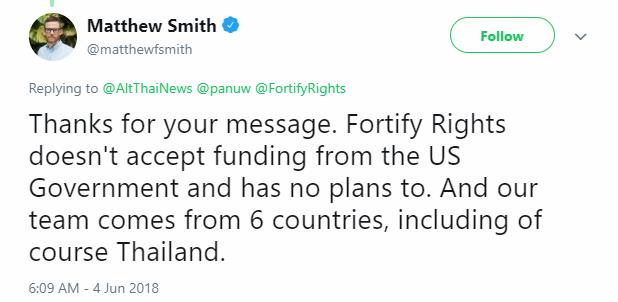
On social media, when the topic of US government funding was raised, Matthew Smith categorically denied receiving US government funding. He would refer to additional questions regarding his organisation’s funding as “trollish.”
However, Fortify Rights’ 2016 annual report (PDF), as pointed out to Smith himself, includes government funding from the United Kingdom, Canada, the Netherlands and the US Congress-funded National Endowment for Democracy ().
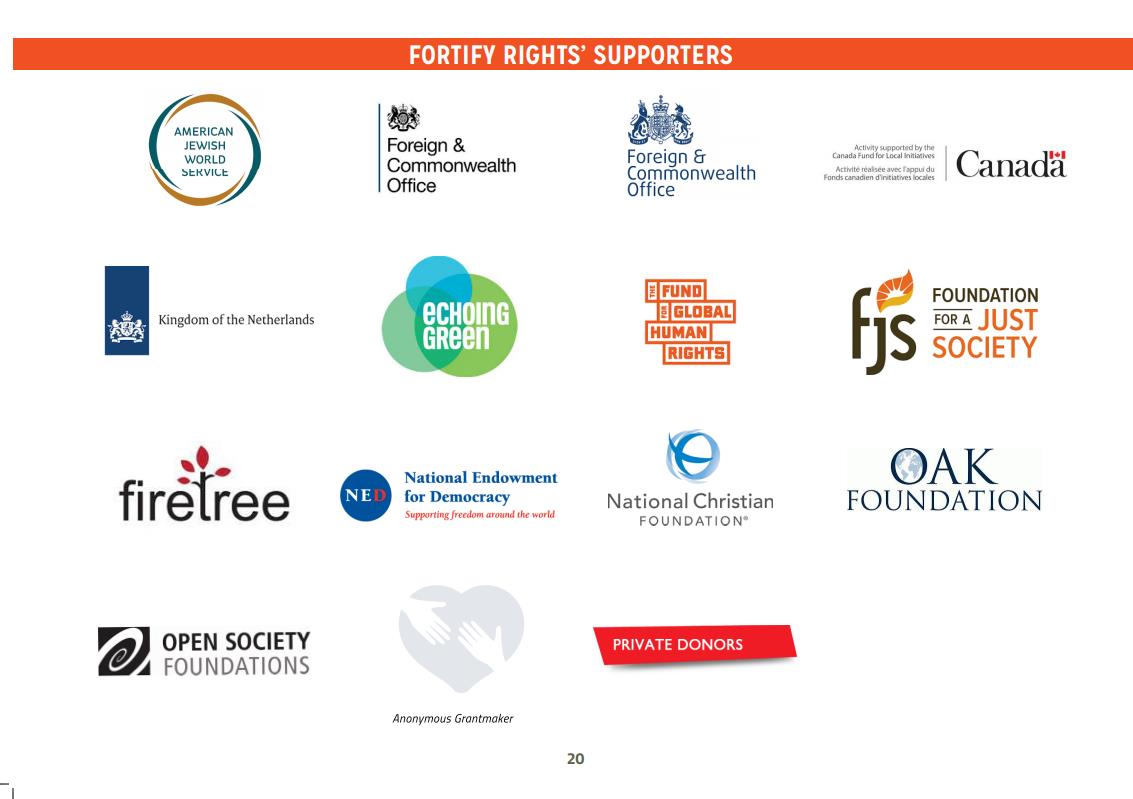
Other controversial sponsors of Fortify Rights include convicted financial criminal George Soros’ Open Society Foundations.
Matthew Smith not only knows that NED is funded by and serves as an intermediary for the US government, (thus making Fortify Rights a recipient of US government funding), he is undoubtedly aware of how controversial such funding is across Asia, a region sensitive to outside interference after centuries of European and more recently, American colonisation.
Implications of NED Funding
NED’s own website admits on its frequently asked questions page that:
NED is a private, non-profit, grant-making organization that receives an annual appropriation from the U.S. Congress through the Department of State. Although NED’s continued funding is dependent on the continued support of the White House and Congress, it is NED’s independent BOARD OF DIRECTORS that controls how the appropriation is spent.
NED itself admits that it is funded through the US State Department. It claims that its board of directors, not the US government itself, then determine how those US tax dollars are spent.
A look at NED’s board of directors only further implicates organisations like Matthew Smith’s Fortify Rights in deep impropriety merely hiding behind “rights” advocacy.
It includes people representing political and business interests involved in some of the greatest injustices purveyed by the United States during this generation, including Elliott Abrams, Francis Fukuyama, Zalmay Khalilzad (who served as US ambassador to Iraq during the US occupation) and Vin Weber described by some (including themselves) as Neo-Conservatives who promoted the US invasion of Iraq in 2003 and have promoted other wars of aggression around the globe both before and since.
Victoria Nuland, who played a central role in ousting the elected government of Ukraine in 2014 through a violent coup spearheaded by Neo-Nazi political parties and their militant wings, also serves on NED’s board of directors, along with Anne Applebaum of the Washington Post who clearly finds herself in a conflict of interest between reporting the truth and promoting organisations and agendas underwritten by the NED she chairs.
Another commonality is shared among NED’s board of directors; their use of “human rights” and “democracy” as pretexts for the wars of aggression and regime change they have promoted and helped execute, which reveals the true purpose, whether Matthew Smith of Fortify Rights knows or admits it or not, of both NED’s existence and the desired outcome of the work it funds around the globe.
NED in Thailand
Fortify Rights is by far not the only front operating in Thailand under the sponsorship of US government-funded NED.
It coordinates with other fronts as well, including media outlets like Prachatai based in Bangkok (whose director also serves as an NED Fellow), Isaan Record based in Thailand’s northeast, and BenarNews covering Thailand’s deep south. All three disingenuously portray themselves as independent local media. They have intentionally taken steps to obfuscate their US government funding from their Thai readers. Prachatai has only disclosed its foreign funding once in 2011, and only on its English-language website.
Each media front specialises in seizing upon and exploiting social and economic tensions to bolster opposition to the current government. Before the 2014 coup ousted the previous, US-backed government of Yingluck Shinawatra, these same media organisations used their platforms to smooth over injustices and emerging tensions threatening that government’s stability.
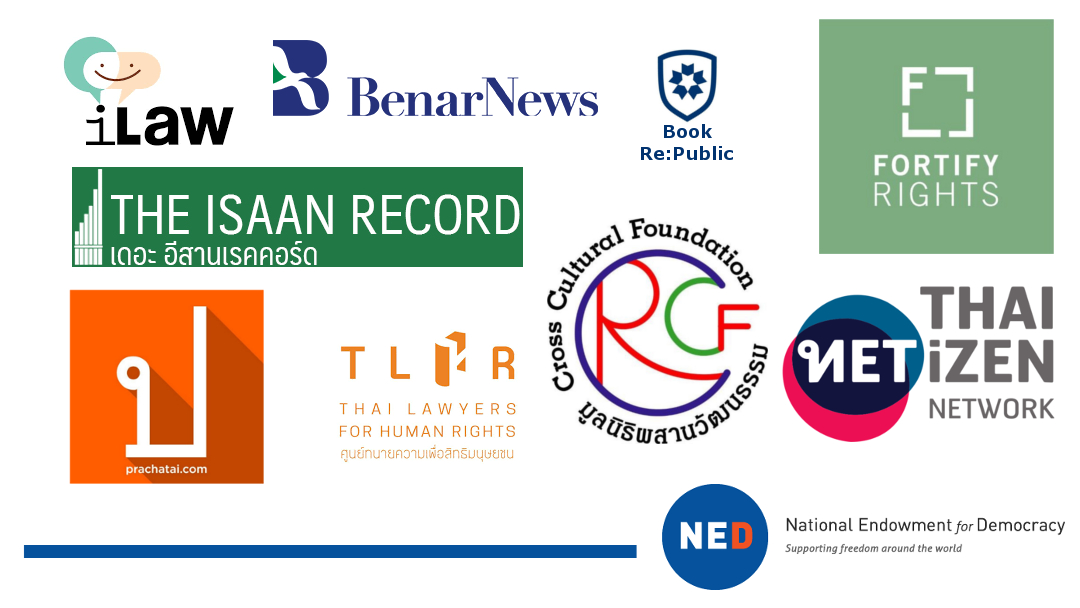
NED-funded Fortify Rights also works closely with fellow US funding recipient Thai Lawyers for Human Rights who not only provide free legal services for anti-government protesters, but provide resources and leadership to the protests themselves. The protesters portraying themselves as “pro-democracy” activists, fail to disclose their foreign funding to potential followers. They also avoid questions regarding how their foreign funding violates democracy’s prerequisite of self-determination independent of foreign interference.
Other NED-funded organisations operating in Thailand include iLaw, Cafe Democracy, Media Inside Out Group, Book Re:public, Thai Netizens Network, the ENLAWTHAI Foundation and the Cross Cultural Foundation (CrCF).
Many of these US government-funded organisations play a direct role in demanding policy changes. Currently in Thailand, protests demanding regime change are also led by US government-funded organisations.
The implications of foreign funded organisations attempting to influence Thailand’s policy or its political future are troubling. Many of the individuals working for these US government-funded organisations on their social media accounts frequently comment on their opposition to “Russian influence” in their US sponsors’ internal affairs, apparently failing to appreciate the irony of what their own work represents.
They also fail to appreciate the irony of portraying themselves as “independent” and working for “nongovernmental organisations,” despite being both dependent on wealthy and influential foreign sponsors as well as working on behalf of foreign governments.
Through their connections with equally compromised organisations and individuals in Thailand’s media, they have written promotional pieces about their supposed work, like in the Bangkok Post, without disclosing their foreign funding to readers.
At other times, complicit individuals within the Thai media have attempted to write pieces defending or dismissing US government-funding when public outcry begins to rise.
Rewriting Thailand’s NGO Laws
Despite the amount of funding and deception involved in this extensive and growing network, the US government-funded opposition is still widely unpopular. It would not be necessary for the Thai government to restrict their activities, let alone uproot and expel them as neighbouring Cambodia has (understandably) done.
Should Thailand simply rewrite its NGO laws to demand the same degree of scrutiny and transparency of these organisations as they themselves demand of targets of US government pressure, their already unpopular message would lose even more credibility and support across Thai society.
Prachatai, for example, being forced to disclose its US government funding at the header or footer (or both) of every article it writes would mean Prachatai finally practising the integrity and transparency it demands of targets of its daily propaganda. Likewise, those like writers at the Bangkok Post writing promotional pieces about Fortify Rights, should be obligated to disclose the organisation’s foreign funding somewhere within the body of the article.
Were these organisations as dedicated to the principles of transparency, freedom, democracy and human rights as they claimed, all of this information would already be freely and repeatedly provided to readers. If these organisations truly believed US, UK and Canadian government funding was benign or beneficial, they would not have gone through such extensive efforts to obfuscate and spin it to begin with. If anything, they would use such funding as a selling point.
Matthew Smith of Fortify Rights would not deceive people on social media by playing off of a technicality in which his US government money is essentially laundered through the NED before reaching him.
As the US continues accusing Russia of interfering in its internal political affairs, measures and consequences it attempts to level against Moscow could easily be cited and adopted by other nations across the globe to deal with the very real interference the US is engaged in within their respective borders.
The double game the US is playing regarding its own interference around the globe and accusations of interference it has levelled against Moscow, prove there is nothing benign at all about its agenda and activities. In turn, this calls into question all those organisations whose existence depends on annual contributions from this malignant political order.
Those truly dedicated to helping people will seek to independently fund their work by finding support from the local communities they claim to represent. If people are unwilling to fund Matthew Smith and Fortify Rights at the local level, it is likely Smith and his organisation are not truly working in the benefit of these communities, and instead, for interests diametrically opposed to them.
Joining Some Dots on the Skripal Case: Part 4 – The Dodgy Dossier
By Rob Slane | The Blog Mire | June 7, 2018
So far in this series of pieces, I have attempted to demonstrate why I believe the official story of the poisoning of the Skripals doesn’t add up (Part 1). I have then pointed to some of the most significant pieces of the jigsaw, which have either been largely ignored or quietly forgotten (Part 2). And I then went on in Part 3 to show what I believe to be perhaps the key to the whole case; that Mr Skripal became agitated in Zizzis restaurant, not because he was physically unwell and suffering from the effects of poisoning hours earlier, but rather because he had an appointment to keep.
But before coming on to propose a theory of what may have happened, I need to first present a theory of why it might have happened. I emphasise the word theory, because that is all it is — neither more nor less. And of course, it could be well wide of the mark. Make of it what you will!
In a recent blog, Craig Murray, the former UK Ambassador to Uzbekistan, linked to a very interesting piece by Paul Gregory that appeared in Forbes in January 2017. Mr Gregory is Professor of Economics at Houston University, and research fellow at both the Hoover Institution and the German Institute for Economic Research, and he also has extensive knowledge about Russia and the Soviet Union. Here’s what he had to say about the so-called Trump Dossier, just a few days after it was published by Buzzfeed :
“As someone who has worked for more than a decade with the microfilm collection of Soviet documents in the Hoover Institution Archives, I can say that the dossier itself was compiled by a Russian, whose command of English is far from perfect and who follows the KGB (now FSB) practice of writing intelligence reports, in particular the practice of capitalizing all names for easy reference. It was written, in my opinion, not by an ex-British intelligence officer but by a Russian trained in the KGB tradition [my emphasis].”
Now, we know that there is a link between the apparent author of the Trump Dossier, Christopher Steele and Mr Skripal’s MI6 recruiter and handler, Pablo Miller. And we know that Miller and Skripal met regularly. Not only this, but we also know that there is a direct link between Steele and Skripal dating back to the late 1990s, early 2000s. There is, then, a clear link between the man credited (if that be the right word) with writing the Dossier, and a certain ex-Russian intelligence officer, who would have been trained in the KGB tradition (he was actually in the GRU), living in Salisbury. In fact, the Daily Telegraph helpfully pointed out this connection a day before the Government slapped a D-notice on reporting on the issue.
But is there another clue? I think there is. By itself, it would mean nothing, but it is an interesting possibility in connection with what I have just stated.
According to the Czech magazine, Respekt, Mr Skripal had links with Czech Intelligence. This included a meeting in Prague back in 2012, but there were also subsequent meetings where Czech Intelligence officers came to meet with him in Britain. We are not told when or where this took place, suffice it to say that there was an ongoing connection.
If we then turn to the Trump Dossier itself, we find this in the sections dated August and October 2016:
“Kremlin insider reports TRUMP lawyer COHEN’s secret meeting/s with Kremlin officials in August 2016 was/were held in Prague.
We reported previously (2016/135 and /136) on secret meeting/s held in Prague, Czech Republic in August 2016 between then Republican presidential candidate Donald TRUMP’s representative, Michael COHEN and his interlocutors from the Kremlin working under cover of Russian NGO Rossotrudnichestvo…
Speaking to a compatriot and friend on 19 October 2016, a Kremlin insider provided further details of reported clandestine meeting/s between Republican presidential candidate, Donald TRUMP’s lawyer Michael COHEN and Kremlin representatives in August 2016. Although the communication between them had to be cryptic for security reasons, the Kremlin insider clearly indicated to his/ her friend that the reported contact/s took place in Prague, Czech Republic.”
Mr Cohen has of course vehemently denied this claim, saying that he has never been to Prague. Whether he has or hasn’t is not for me to say, but it is in any case irrelevant to the point I am making. That point is this: Sergei Skripal had what looks like extensive connections with Czech Intelligence, and claims – whether true or false –, which presumably came from Czech sources, are found in the Trump Dossier.
Putting these three things together – the Steele/Miller/Skripal connection; the Czech claims in the Dossier; and the emphatic claim made by Paul Gregory that the Dossier itself was compiled by a Russian “trained in the KGB tradition” – then you can begin to see where this might be pointing.
Now, you’d think from the way the BBC and others have reported on Mr Skripal that he was just some old chap enjoying his retirement in the quiet city of Salisbury, where he was in the habit of frequenting local restaurants and pottering about in his garden. Yet his continued work for British Intelligence, which saw him travelling to the Czech Republic and Estonia in 2016 to meet with intelligence officers, paints a somewhat different picture. Also, remember this is a man who once sold out hundreds of his fellow countrymen in the late 1990s and early 2,000s for filthy lucre. The fact that he continued to work for British Intelligence after being settled in Salisbury suggests not only that there was not what you might call deep repentance, but also presents the possibility that he continued to be lured by the promise of cash.
And so one wonders whether the man who was bought for a price by MI6 back in the 1990s might have still been buyable after he settled in Salisbury. Might Steele, who had been commissioned by Fusion GPS on behalf of the Democrats to put together some dirt on Donald Trump, have asked Skripal to cobble something together? Might Skripal have used his contacts in places like the Czech Republic and Estonia to give it some semblance of credibility? Might Skripal have been swayed by the promise of more money to put together a Dossier full of salacious and unverifiable gossip?
And be in no doubt, the Trump Dossier is a Dodgy Dossier. I write this as someone who thinks that Donald Trump is a walking disaster area, and as someone who has no desire to defend him. Yet the fallaciousness of the Dossier, which has formed the basis of the attempts to smear and possibly impeach him, is clear, as Paul Gregory articulated well in his piece for Forbes:
“The Orbis dossier is fake news … [It] makes as if it knows all the ins-and-outs and comings-and-goings within Putin’s impenetrable Kremlin. It reports information from anonymous ‘trusted compatriots,’ ‘knowledgeable sources,’ ‘former intelligence officers,’ and ‘ministry of foreign affairs officials.’ The report gives a fly-on-the-wall account of just about every conceivable event associated with Donald Trump’s Russian connections … There are two possible explanations for the fly-on-the-wall claims of the Orbis report: Either its author (who is not Mr. Steele) decided to write fiction, or collected enough gossip to fill a 30-page report, or a combination of the two.”
Indeed, the whole thing has all the look and feel of having been written by a firm that wanted a payday, but never in their wildest dreams expected the contents of it to become public knowledge. And they never expected it to be revealed because they never expected Mr Trump to win the 2016 election. In the infinitesimally small chance that he did win, I don’t suppose it even occurred to them that it might be taken seriously by US Intelligence.
And so here is the supposition as to the “why” of this case: The Democrat Party paid Fusion GPS to dig up some dirt on Donald Trump. Fusion GPS contracted this out to British Intelligence, who put them on to Orbis Business Intelligence, a private security firm owned by former MI6 officer Christopher Steele. Steele took the money and farmed the project out to Skripal who, because of his knowledge of Russia and his contacts with intelligence agencies in other countries, could make it sound reasonably plausible, at least to those who were paying for it.
But then – and this like that bit in the Lord or The Rings when it says that the Ring came into the possession of the unlikeliest creature – the Dodgy Dossier somehow found its way into the hands of US Intelligence agencies, and instead of seeing it as the obvious fraud that it was, amazingly they took it seriously. So seriously, in fact, that it became what the then Deputy Assistant Director of the Counterintelligence Division, Peter Strzok, described in a text message to his mistress, Lisa Page, as “an insurance policy” – that is, insurance against the unthinkable happening and Donald Trump becoming President.
But of course the unthinkable did happen. Against all expectations, Mr Trump won, and suddenly that same “insurance policy”, full of salacious gossip and unverifiable information, took on a life of its own, with all of the Beltway talking about it, and then with Buzzfeed eventually releasing it into the public domain. And so what was meant to be a product with enough plausibility to satisfy those paying for it, became the foundation for the attempts to bring down a sitting President.
If the above is correct — and let me reiterate once again that it is simply a theory, not necessarily a fact — then Sergei Skripal, not Christopher Steele, was the main author of the Trump Dossier. If that was the case, isn’t it possible that he might have sought a payment to keep quiet about its origins and the nature of its contents? And isn’t it possible that there might have been others who would seek to keep him quiet by other means?
In the final part of this series, I’ll attempt to propose a theory as to what actually happened on the evening of 4th March in Salisbury.
George Monbiot: selling the 1% agenda in a Green box

George Monbiot NOT shilling for corporate interests
By Catte | OffGuardian | June 8, 2018
The neoliberals of today specialise in using concepts of concern and inclusiveness as a cover for their frankly fascist agenda. Censorship is being repackaged as “anti-hate”. The destruction of the core idea of “innocent until proven guilty” is being repackaged as protecting (mostly female) victims from their persecutors. Reasonable doubt is being repackaged as “denialism.” Minority opinion is being repackaged as treachery or subversion. Facts that contradict a current state-sponsored agenda are repackaged as “fake news.”
Conformity is being encouraged, presented as a cosy and reassuring “consensus blanket”, under which we can all snuggle together, safe from confusion, doubt or the horrendous experience of having our cherished beliefs called into question. Most journos operating in the mainstream have already opted to crawl in and curl up for the long snooze into intellectual and ethical oblivion, while others, the kapos, are actively herding the remaining doubters inside.
George Monbiot is one of the latter. The last few years have outed this one time supposed anti-establishment figure as nothing more than a fully establishment goon, posturing in the sad tatters of his “dissident Green” cosplay. His performance during the Syria crisis made this too obvious. His sub-intelligent smears on those independent journalists daring to question the narrative made his real allegiances, and limitations, more than clear. His preparedness to brazenly lie and his refusal to debate the people he smeared in an open forum cemented this view.
Monbiot is revealed as the guy the establishment uses to try and lure the Left-Greens out in support of the latest agenda roll-out by the likes of Soros, Gates and the Atlantic Council. He’s booked for the same gigs as Avaaz. His brief, as ever, is to sell fascism – but this time in a Green box.
Today George is busy selling us on veganism.
Now, don’t get me wrong. Veganism is fine. It’s a human choice and it has a place. This is not an attack on veganism, or vegans.
But we need to separate what a thing is from what it’s being used for. Everything, even the best things, can be exploited. And we can’t let loyalty to the thing itself stop us from seeing when its being used for less than good ends.
Veganism is being promoted right now by the usual suspects. There has been a rash of articles in the Guardian and elsewhere about the supposed health and environmental benefits of giving up meat and dairy. Even if we happen to be vegan, we’d be insane not to wonder why. Especially when Monbiot is getting involved.
George is a poster child for the New Wave Vegan. Strange, perhaps, given he’s only a “97% vegan” himself. But let’s just ignore the 3% carnivore, since it’s only road kill. The more important point, anyway, is that George wants us all to think he’s a vegan. Because a salesman has to be seen to use the product he’s promoting. His latest article breaks no new ground on this really. He’s said most of it before, as have others. But still, given the mounting evidence for the political mobilisation of veganism, it’s a good idea to look at what he says.
He starts by offering a binary choice – between the current wasteful and insane industrial farming system and a somewhat poorly defined alternative in which everyone eats a plant-based diet, which he implies without really saying, will put an end to this insanity. He tells us not only will this choice fix the problem of worldwide food shortage (because plant-husbandry produces far more calories per hectare than animal husbandry), but it will also remove the problem of all that unused animal waste currently pouring into rivers and creating massive pollution.
George’s ideal future will also be gratifying for the processed food industry. Because vegans need ready meals!
Unless you can cook well – and many people have neither the skills nor the space – a plant-based diet can be either boring or expensive. We need better and cheaper vegan ready meals and quick and easy meat substitutes
And fake meat grown in a lab!
The big shift will come with the mass production of cultured meat.
George recognises the latter will be a tough sell, but he’s up for giving it a try. An objection to this might be that “artificial meat is disgusting”, says George, but:
If you feel this way, I invite you to look at how your sausages, burgers and chicken nuggets are currently raised, slaughtered and processed. Having worked on an intensive pig farm, I’m more aware than most of what disgusting looks like.
Mmmm… Lab-grown pseudo-meat, pink-dyed and not quite as disgusting as something even worse! Lovely Roundup-saturated veggies [silage] processed into some approximation of the kind of protein humans can digest, and piped into microwavable sachets.
Who knew utopia would end up looking quite so much like – now? Who knew the new way would be just like the old way but with more “progressive” slogans?
George uses twisty self-contradictory arguments to claim one minute that eliminating livestock farming would “be a chance to break our complete dependence on artificial nitrogen”, while in his very next para admitting the exact opposite will in fact be the case.
the transition to plant protein is unlikely to eliminate the global system’s need for artificial fertiliser
Though he throws us a bone in the shape of
the pioneering work of vegan organic growers, using only plant-based composts and importing as little fertility as possible from elsewhere
This is blatant bait and switch. Green or green-sounding proclamations being swapped out for their very opposites with a deftness he hopes will fool us. We may, in some misty future time, not need to rely entirely on synthetic chemicals – but yes, OK, for now we will still be sucking up carcinogens with our lovely all veg diet.
Of course we could just use the animal manure to fertilise our veggies, which would entirely eliminate the need for chemical fertilisers… But let’s not think about that too much. Let’s instead soften that focus and just picture fields full of lovely cruelty-free plants waving in the even lovelier breeze…
In case you haven’t noticed, George’s entire article is hand-waving nonsense predicated on a lie, or a system of lies, and his trademark nifty footwork.
His claim that we need to produce more food is used as a blanket rationale for everything he advocates, but it’s a lie. We don’t need to produce more food. We currently produce more than enough food to feed the world. What we need and don’t have is equitable distribution. And that is because of the stranglehold of the minority interests George is carefully eliding.
His initial binary choice is a lie. We don’t need to choose between intensive animal farming and intensive cereal/veg farming. We have the option of non-intensive farming methods that treat the land, the animals and the crops with respect, and use age-old, sustainable methods to produce chemical-free and healthy food.
His dishonesty is nowhere more apparent than when he tries to elide this simple truth. Look at how he acknowledges the illogicality of unused animal waste
Today, the link between livestock and crops has mostly been broken: crops are grown with industrial chemicals while animal slurry stacks up, unused, in stinking lagoons, wipes out rivers and creates dead zones at sea.
but dodges away from the obvious solution – use the “slurry” to fertilise the land in place of synthetic chemicals – with a weak excuse:
When it is applied to the land, it threatens to accelerate antibiotic resistance.
Notice how he avoids mentioning the fact non-intensively reared animals don’t need to be pumped full of antibiotics in the first place. He even links to the source for sustainable husbandry I cite above, but does so only to dismiss it (without data) as “worse” than anything else on offer, by using, once again, the fake claim about the need to produce more food per hectare:
More damaging still is free-range meat: the environmental impacts of converting grass into flesh, the paper remarks, “are immense under any production method practised today”. This is because so much land is required to produce every grass-fed steak or chop
And adding that it’s also bad for the environment
Those who claim that “regenerative” or “holistic” ranching mimics nature deceive themselves. It relies on fencing, while in nature wild herbivores roam freely, often across vast distances. It excludes or eradicates predators, which are crucial to the healthy functioning of all living systems. It tends to eliminate tree seedlings, ensuring that the complex mosaics of woody vegetation found in many natural systems – essential to support a wide range of wildlife – are absent
You thought Monsanto, GM, monocultures and the ripping up of hedgerows was the problem? Nah. It’s fences. And herbivores eating the grass they’re designed to eat. And implicit in this nonsense of course is the greater nonsense that massive veggie monocultures drowned in pesticides and herbicides, are just teaming with wild life, tree seedlings and predators.
Just as he used frank lies to promote the Soros-backed White Helmets as unsung “heroes”, here, in the fake guise of promoting a healthy, organic, back-to-nature solution to the world’s problems, George is promoting the current power system of Big Ag and Big Food monopoly. Just as Avaaz sells us imperial regime change as grass roots activism, George is selling us industrial farming and denatured food as a return to Eden.
Don’t buy what he’s selling. Don’t surrender your sense of the real to this snake oil salesman. Go vegan if you want – that’s a fine personal choice. But not at the expense of the small producers who are already struggling to survive without the subsidies the big guys get. Don’t vote for some future “meat tax” that will drive them out of business, and penalise the poor, just as Big Ag wants. Don’t buy into this soft focus dreamland where our entire livestock herd disappears bloodlessly and completely from our landscape without being killed or culled, and is somehow better for it. Don’t be whispered into campaigning for a new and self-imposed serfdom, in which 7 billion compliant vegans munch their potage or their shrink-wrapped lab-grown Soylent Green, while the 1% quietly eat grass-fed steak and snigger with duping delight.
May welcomes Netanyahu despite atrocities against Palestinians
PressTVUK | Jun 8, 2018
“You shouldn’t be receiving this war criminal!”
Israeli Prime Minister Benjamin Netanyahu is welcomed by EU leaders during European tour but condemned by protestors for crimes against Palestinians at every turn. Amina Taylor files this report.
How Washington Has Lost Its Way
By Philip M. GIRALDI | Strategic Culture Foundation | 07.06.2018
One might well think that the only serious foreign policy imperative of the Donald Trump administration is to defend Israel. A president elected because he promised to put United States’ interests first has turned out to be little different than his predecessors, bowing to the power of various lobbies and constituencies to carry out their wishes while simultaneously pretending to be serving poorly defined policies to promote the security and well-being of the American people.
Israel possesses, to be sure, the most powerful foreign policy lobby operating not only in the United States but as well in Western Europe and Australasia. When Israel makes its incessant demands, politicians from Washington to Canberra and Wellington pause to listen. In Britain, fully 80% of Conservative parliamentarians are members of the Conservative Friends of Israel.
Israel benefits from a large, influential and wealthy community of diaspora Jews that is willing to do its bidding and which also possesses easy access to the media and to politicians, many of whom are more than willing to be corrupted by money. This has led to the creation of an “Israeli narrative,” most particularly in the United States, which glamorizes the state of Israel through the incessant reiteration of expressions like “the only democracy in the Middle East” and “America’s best friend and closest ally,” both of which assertions are completely false.
It should surprise no one that the Trump administration is packed with Israel-firsters from top to bottom. Those who deal with Israel directly – Ambassador David Friedman, Chief Middle East Negotiator Jason Greenblatt, and Special Envoy and son-in-law Jared Kushner are all Orthodox Jews with long standing ties to Israel and its leadership. They are major financial supporters of Israeli “charities,” to include projects on the occupied West Bank, which are both illegal under international law and contrary to long established U.S. policy. It would seem, without being too hyperbolic, that Israeli interests are at least as important to them as are the American interests that they ostensibly represent and are being paid by the taxpayer to support.
Within the White House, there is virtually no pushback against Israeli pretensions even when American interests are being damaged. Secretary of State Mike Pompeo has repeatedly voiced his support of the Jewish state and his animosity towards that state’s enemy of choice Iran. National Security Adviser John Bolton, a long-time neoconservative, has never distanced himself in any way from complete identification with the policies being promoted by Israel and its increasingly right wing and racist governments. Donald Trump himself has declared that he will be the best president for Israel ever, a pledge that he has worked to honor by moving the U.S. Embassy from Tel Aviv to Jerusalem in spite of the damage that it does to actual regional American interests.
But the most vocal advocate for Israel within the Administration is Nikki Haley, U.S. Ambassador to the United Nations, who has consistently taken the hardest of all possible lines against Israel’s claimed enemies while also fully endorsing the most brutal actions undertaken by the government of Prime Minister Benjamin Netanyahu. Haley’s most recent action reveals that the United States has truly lost its sense of direction and moral compass. If one were religious, it might be suggested that it has lost its soul.
Haley’s most recent foray into her own style of what she might refer to as statesmanship came on June 1st. Kuwait had brought a resolution to the United Nations Security Council to call on it to fulfil its responsibility to help protect the people of Gaza, who were being bombed, gassed and shot dead by Israeli Army sniper fire. Nikki Haley, however, was thinking of something quite different, a resolution she had drafted to denounce Hamas for the alleged volleys of rockets that were launched into adjacent Israeli controlled areas in response to the Israeli gunfire and bombings. Votes on the two resolutions followed, with Haley failing to obtain any votes on her resolution except her own.
Haley again voted alone when she vetoed the Kuwaiti resolution to protect the Palestinian people. And it was not Haley’s first such bit of unilateralism. She had walked out of a previous Security Council meeting on Israel’s killing of Palestinian protesters as a deliberate insult to their representative who had risen to begin to speak. Haley unfortunately represents America. America the home of the free and brave? Bullshit.
US using ‘ethnic cleansing’ to set up compliant state in Syria – Vanessa Beeley to RT
RT | June 6, 2018
The US is trying to ethnically cleanse Syria in order to kill off Syrian nationalism and create an obedient state, journalist Vanessa Beeley told RT following a damning report on the US coalition’s military activities in Raqqa.
Beeley, an independent journalist who has covered the war in Syria extensively, told RT that the US, UK and French coalition is using proxy forces to cleanse certain areas of land in the war-torn country in an effort “to replace them with a proxy that will essentially create a US controlled state.”
She was responding to a new Amnesty International report that strongly criticizes the actions of the US-led coalition in its campaign to liberate the previously Islamic State (IS, ISIS/ISIL)-controlled city of Raqqa.
The Amnesty report accused the coalition and its Kurdish-led Syrian Democratic Force (SDF) proxies of creating “a level of destruction comparable to anything we’ve seen in decades of covering the impact of wars,” and it says that the coalition’s claims that the bombings were “precise” and caused few civilian casualties do not stand up to scrutiny.
Beeley said that the Amnesty report put “meat on the bones” of previous analysis from on-the-ground journalists and some Russian analysts and commentators. She said that despite the US-led campaign ostensibly being about ridding the area of IS terrorists, it was the terrorists “who were evacuated as priority over the civilians.”
“Civilian property and infrastructure, essential infrastructure like water taps, like water supply units that were keeping civilians alive during the campaign were also being targeted,” she said, adding that it was the SDF forces designating the targets for the US coalition.
“So there’s a degree of collusion here between the US coalition and its proxies forces on the ground,” she said.
Beeley also criticized the reluctance of the British government, in particular, to admit to causing civilian deaths during its military campaign. The UK Ministry of Defense, she said, “did not even admit one civilian death as a result of their “precision” bombing — and then they only reluctantly admitted that they believe one civilian was killed by one of their drone strikes.”
Comparing the American-led military campaign in Raqqa to the Russian and Syrian-led military campaign to liberate east Aleppo, Beeley said that there were different standards set and attempts were made to protect Aleppo civilians.
“What we saw there were the provision of humanitarian corridors for civilians to be able to leave under the cover of the Syrian Arab Army and with the help of the Russian reconciliation teams negotiating with the terrorist and militant extremist factions to allow civilians to leave,” Beeley said. “What we’ve seen in Raqqa is civilians paying smugglers to try and leave during the military campaign, having to cross minefields, being unable to afford the cost of those smuggling groups.”
Beeley also said that Syrian civilians were being forced to return to buildings and areas of Raqqa that had not yet been cleared of improvised explosive devices (IEDs), booby traps and mines left by IS militants.
In contrast, the journalist said that Russian forces “cleared thousands of hectares of those IEDs and booby traps” following their campaigns to liberate Aleppo and Ghouta from IS.
“What we’re seeing here is a disgusting despicable disregard for human life both during the military campaign and even more importantly after the military campaign by the US coalition,” Beeley said.
Watch Vanessa Beeley’s full interview with RT.
‘Yemen killings may be even bigger’
In a separate interview, Joshua Landis, the director of the Center for Middle-East studies at the University of Oklahoma, told RT that the Amnesty report made it clear that there were “massive violations of human rights.” An investigation was unlikely given that the US, Britain and France sit on the UN Security Council, he said.
Landis said he believed the US did make efforts to avoid killing civilians, but that, ultimately, the US-led coalition was “in a hurry.”
“The UN asked them [US coalition] multiple times to give breaks so civilians could get out, but they didn’t want to negotiate with IS, they said they were gonna kill them on the battlefield. They didn’t want them as prisoners in another Guantanamo and this led to a situation where the US was eager to finish it off, did not want to allow a break, did not want UN workers to go into Raqqa because they were going to see the devastation,” he said.
Landis compared the destruction to that caused by the US-supported, Saudi-led coalition in Yemen: “What’s taking place in Yemen may be even bigger, but we don’t even know because reporters aren’t being allowed in there – but an entire population is being starved.”
“Half a million Yemenis have gotten cholera and there isn’t the proper medicine to fix them and heal them and this is a terrible, devastating war crime because it’s voluntary. It doesn’t have to happen. People don’t have to be starved. There’s a blockade going on,” he said.
“We know that US special forces are helping the Saudis now in Yemen. Is the killing in Yemen more clean than the killing in Syria? It’s hard to believe it is – and we’ll find out the ultimate body count, I guess in the end,” Landis added.
Not just the Elgin Marbles: Britain’s colonial legacy lives long in UK museums
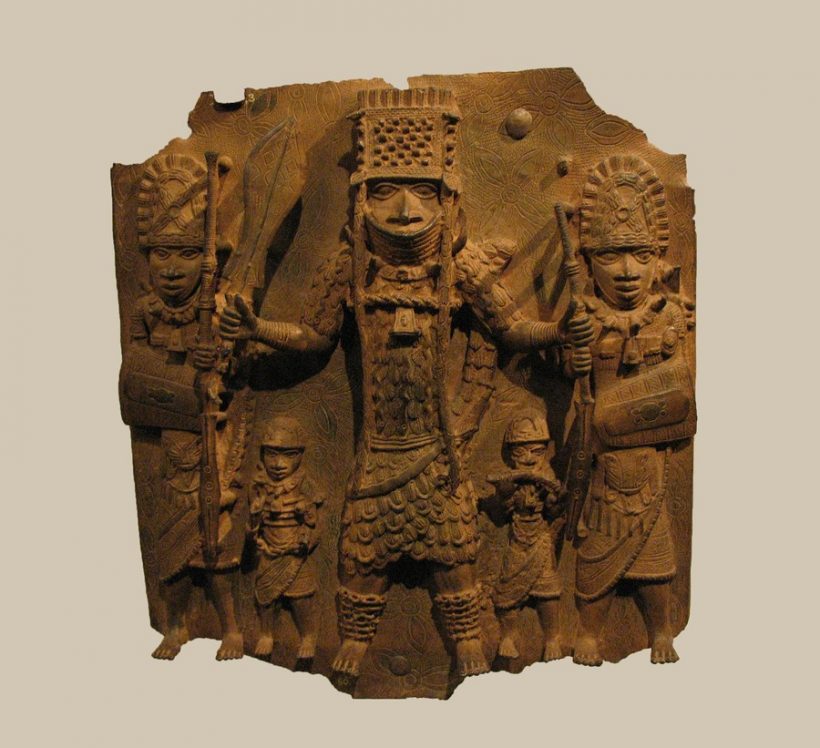
Benin bronzes. © Global Look Press
RT | June 4, 2018
After Jeremy Corbyn promised to return the Elgin Marbles to Greece upon becoming PM on the basis that they were “looted” from the country, RT looks at other rare artifacts taken by colonial Britain that now reside in UK museums.
“As with anything stolen or taken from occupied or colonial possession – including artifacts looted from other countries in the past – we should be engaged in constructive talks with the Greek government about returning the sculptures,” Corbyn said in an interview with a Greek newspaper.
If Corbyn were to become PM, here are some of the other artifacts that might be returned to their country of origin.
Benin artefacts
The British Museum boasts the second-biggest collection of Benin’s art after the Ethnological Museum in Berlin.
The Kingdom of Benin – now part of Nigeria – was stripped of its bronzes during what became known as Britain’s “punitive expedition,” a mission conducted against the natives after they defied imperial rule by imposing customs duties.
BBC Civilizations presenter David Olusoga, originally from Nigeria, said the UK has a “moral imperative” to return the art.
On the Benin looting, he said: “It’s just such a stark case of theft.”
He added during the Hay Festival this year: “A friend of mine, a TV producer, once came up with a brilliant solution: he said we should have a special version of Supermarket Sweep, where every country is given a huge shopping trolley and two minutes in the British Museum. Maybe he’s right, maybe that’s the way forward.”
Ethiopian treasures
Dozens of institutions up and down the country, including the Victoria and Albert Museum in London, are home to hundreds of northeast Africa’s finest treasures.
Beautiful and equally important manuscripts and artifacts were plundered after the British capture of Maqdala in 1868, the mountain capital of what was then Abyssinia under Emperor Tewodros II.
In 2017, Ethiopia lodged a formal restitution complaint. The offer was refused, but ahead of the Maqdala exhibition at the V&A at the beginning of April, its director suggested the case could be settled by granting the treasures to the east-African country on a long-term loan.
Sultanganj Buddha
The Sultaganj Buddha is a metallic sculpture that was extracted from an abandoned Buddhist monastery in northern India in 1861 by E B Harris, a British Raj railway engineer. The 1,500-year-old bronze Buddha was then shipped to Birmingham after being secured for a mere £200 ($265).
The item – the largest known Indian metal sculpture, which is known in the UK as the ‘Birmingham Buddha’ – is at the top of the list of thousands of alleged ‘stolen treasures’ that Indian authorities are trying to get back.
The Koh-i-Noor diamond
The Koh-i-Noor diamond, one of the largest cut in the world, is currently part of the British crown jewels. It has been the subject of a bitter dispute between India and the UK ever since it was taken from the Punjab and presented to Queen Victoria in 1849.
The jewel, which belonged to the Punjab’s Sikh Empire, was handed by the East Indian Company to Queen Victoria after they emerged victorious in the 1840s Anglo-Sikh wars.
The diamond – known as the Mountain of Light – is thought to have been mined in the 1300s.
India has called for the stone to be returned ever since it gained independence in 1947, though the UK claims it has a legal basis for withholding it, as it was guaranteed under the Treaty of Lahore.
Former PM David Cameron commented on the dispute, stating: “If you say yes to one you suddenly find the British Museum would be empty. I think I’m afraid to say, to disappoint all your viewers, it’s going to have to say put.”
Gaza Slaughter: Holy Land Still Denied Peace and Justice by Cowardly International Community
How can any sane person, after visiting Gaza, fail to demand the full force of international law and sanctions against the sadistic Israeli regime?
By Stuart Littlewood | American Herald Tribune | June 2, 2018
Here we go again. Jewish News reports the UK proudly announcing a new package of aid totalling £1.5 million to buy medicines and equipment for 11 hospitals in Gaza. The money will also provide services for around 4,000 people.
Live fire across the border by Israel’s snipers, slaughtering some 111 Palestinians, mostly civilians and including women and children, and wounding and maiming thousands more, shamed Britain into this latest gesture.
Middle East Minister Alistair Burt made the announcement on a visit to Gaza. He said: “I am deeply concerned about the worsening situation in the Gaza Strip, and today’s UK aid package gives a message to the world, and to the people of Gaza, that we have not forgotten them or their plight.
“Today’s support will help to ensure that hospitals which are under immense pressure are able to cope with the increased number of casualties who need medical and surgical care.”
Oh, how nice. Handing out £1.5 million of our tax money saves Burt the chore of calling the Israeli psychopaths to account. It is another cowardly subsidy to keep the illegal occupation of the Holy Land going.
Burt added:
“We have been clear that a political settlement is the only way to ensure lasting peace for Palestinians and Israelis alike. All parties must redouble their political efforts and return to the negotiating table, not only to address the deteriorating conditions in Gaza, but to ensure tragedies of the past months are not repeated.”
Why should Palestinians ‘negotiate’ for their rights and freedom? And given the Israelis’ track record could a political settlement with them ever be fair or just? Without justice there can be no lasting peace. And without law there’s no justice. So why the continual focus on ‘negotiations’ while ignoring the rule of international law?
The BMJ (British Medical Journal) recently described the horror on the ground:
Since 2014 Israel has further tightened the passage of essential medicines and equipment into Gaza, and of the entry of doctors and experts from abroad who offer technical expertise not available locally. Gazan hospitals have been depleted of antibiotics, anaesthetic agents, painkillers, other essential drugs, disposables, and fuel to run surgical theatres. Patients die while waiting for permission to go for specialist treatment outside Gaza. All elective surgery has been cancelled since last January 2018, and 3 hospitals have closed because of medication, equipment and fuel shortages. Medical personnel have been working on reduced salaries. Gazan health professionals find it almost impossible to get Israeli permission to travel abroad to further their training. The regular episodic military assaults on Gaza and the current targeting of unarmed demonstrators are part of a pattern of periodically induced emergencies arising from Israeli policy. The cumulative effects of the impact on healthcare provision for the general population have been documented in multiple reports by NGOs, UN agencies and the WHO. This appears to be a strategy for the de-development of health and social services impinging on all the population of Gaza.
The current systematic use of excessive force towards unarmed civilians, including children and journalists, is provoking a further crisis for the people of Gaza. Since 30 March 2018, snipers firing military grade ammunition have caused crippling wounds to unarmed demonstrators. As of 23 April 5511 Palestinians, including at least 454 children, have been injured by Israeli forces, including 1,739 from live ammunition according to the Palestinian Ministry of Health in Gaza. As of April 27, the death toll has reached 48 and additional hundreds wounded.
The UK claims its aid is already providing Gazans with access to clean water and improving sanitation facilities to help stop the spread of deadly disease. So what? It does nothing to end Israel’s blockade, the day-to-day, hour-to-hour misery of economic strangulation and the helplessness of imprisonment within that tiny, overcrowded coastal strip.
Mr Burt and his Foreign Office colleagues are a large part of the problem. We’ve heard Burt many time before spouting the bollox of appeasement, giving away money and urging lopsided negotiations rather than enforcing UN resolutions and international law and imposing sanctions. Seven years ago, as the new minister in charge of Middle East affairs, he was handing the Palestinian Authority’s Prime Minister Salam Fayyad and his boss, president Mahmoud Abbas, £17 million for their sterling work. The official reason for such largesse with our hard-earned tax money was the dynamic duo’s progress towards creating an independent, viable Palestinian state “living in peace with a secure Israel”.
Their only real achievement, however, was having turned the Occupied Territories into a police state of the most sinister kind on behalf of their Israeli puppet masters. The gift was also a sweetener to get the Palestinian leaders back to the negotiation table. “It is critical that both sides find a way to return to talks,” said Burt. “The current impasse is of great concern and I urge all parties to take immediate steps to secure a lasting peace… We firmly believe that this should see a Palestinian state based on 1967 borders and with East Jerusalem as its capital. This is the solution which offers the best prospect of a just and sustainable peace.”
That was 2011. Where’s the peace?
“Enemies of peace will continue to use the conflict for their own purposes…”
Talk is cheap when you have no intention of following up with action. And Mr. Burt was not about to transform himself into a man of action for peace. Why not? Because he’s a creature of the Israel lobby. He used to be an officer of that detestable club of Israel flag-wavers, the Conservative Friends of Israel. The Foreign Office is stuffed with them thanks to our then prime minister, David “I’m-a-Zionist” Cameron, an individual so misguided that he proclaimed: “In me you have a Prime Minister whose belief in Israel is indestructible.”
What a ridiculous commitment for a British prime minister to make to a lawless, racist entity that respects nobody’s human rights, continually defies international law and shoots children for amusement (see ‘The methodical shooting of boys at work in Gaza by snipers of the Israeli Occupation Force’ by surgeon David Halpin and latest reports on the use of dum-dum and other soft-nose or ‘exploding’ rounds by Israeli snipers).
It is a disgrace that the Conservatives, who weren’t given a clear mandate to govern and resorted to forming a coalition with the wimpish Liberal Democrats, chose to vomit their infatuation with the thuggish Israeli regime all over the British nation and the Arab world. They continue their nauseating behaviour to this day.
In a speech to the Board of Jewish Deputies, Burt recalled how he had worked from the age of fifteen for an MP who was a president of the Board and a founder of the Conservative Friends of Israel, and how this “had a lasting effect upon me, and on my interests in Parliament”. He said: “Israel is an important strategic partner and friend for the UK and we share a number of important shared objectives across a broad range of policy areas.”
Can anyone think of a single objective they’d wish to share with those people?
On the Israeli-Palestinian conflict he said that “without an agreement between the Palestinians and the Israelis peace in the Middle East is unobtainable”. Oblivious to the irony of his remarks, he went on: “Those who are enemies of peace will continue to use the conflict for their own purposes… We cannot allow those who want to pursue a violent agenda to succeed… We are committed to a two-state solution and we will continue to support the efforts of the US to broker a peace deal between both sides. And as an honest broker, the UK Government does not believe that economic sanctions or embargoes on Israel [are] the way to engage or to influence it.”
The “honest broker” has been happy enough to use economic sanctions to collectively punish the Gazans who are no threat to us, to punish the Iranians who are no threat to us, and even to punish the Russians who could swat us like a fly. Why so queasy about doing the same to Israel, which is a real and present danger to everyone?
I do, however, applaud Burt’s words condemning the enemies of peace who use the conflict for their own ends and his determination not to allow those who want to pursue a violent agenda to succeed. But it surely cannot have escaped his notice that Netanyahu doesn’t want peace. Land-grabbing, ethnic cleansing and other high crimes are what he does, so the jackboot of Israeli occupation stays on the Palestinians’ neck and any peace plan is treated with contempt. More to the point, no-one in the international community – and certainly not Burt – has actually told us what a two-state solution looks like. No-one, that is, since Ehud Barak made his absurd “generous offer” back in 2000.
When the Palestinians signed the Oslo Agreement in 1993 they were ready to accept a meagre 22% of pre-partition Palestine and recognise Israel within the ‘Green Line’ borders (i.e. the 1949 Armistice Line established after the Arab-Israeli War). Conceding 78% of the land that was originally theirs was an astonishing compromise.
But it wasn’t enough for greedy Israel. Its “generous offer” demanded the inclusion of 69 Israeli settlements within the 22% remnant. It was obvious on the map that those settlement blocs created impossible borders and already severely disrupted Palestinian life in the West Bank. Barak also demanded the Palestinian territories be placed under “Temporary Israeli Control”, meaning Israeli military and administrative control probably indefinitely. This two-state arrangement also gave Israel control over all the border crossings of the new Palestinian State. What nation in the world would accept that? The idiotic reality of Barak’s offer was hidden by propaganda spin.
Later, at Taba, Barak produced a revised map but withdrew it after his election defeat. The ugly facts of the matter are documented and explained by organisations such as Gush Shalom, yet Israel lobby stooges in the UK government continue to peddle the lie that Israel offered the Palestinians a “generous” peace on a plate.
In lockstep with Netanyahu’s crazed ambitions?
Since then, Netanyahu has made it clear several times that Israel will not voluntarily give up any land it illegally occupies to a Palestinian state. “We are here to stay forever. There will be no more uprooting of settlements in the land of Israel. … This is the inheritance of our ancestors. This is our land.” So says an intruder who, like most of his unpleasant colleagues, actually has no ancestral links to ancient Israel. The Israeli regime occasionally gives the impression of going along with talks for propaganda reasons but will always ensure they go nowhere. Look at its track record.
Meanwhile Burt and others are still busy promoting the fantasy of a peace process that’s just around the corner. Why? Are they in lockstep with Netanyahu to prolong the conflict in order to buy more time to steal more territory? Or perhaps they need help in spotting the patently obvious: that the peace process is dead, belly-up, a write-off…. and has been for 20 years.
The Jewish Chronicle was ecstatic about Burt’s appointment as a Foreign Office minister, which it said sent “as clear a message as possible about the direction of the new [Conservative] government in the region. Mr Burt is listed as an officer in the parliamentary group of Conservative Friends of Israel and has been passionate in campaigning for visiting rights to Gilad Shalit, the Israeli soldier held hostage by Hamas for the past four years…”
Funny how Burt was so concerned for Shalit, a trained killer whose capture and detention he called “outrageous” while ignoring the thousands of Palestinian civilians (including women and children) abducted from their homes and left to rot in Israeli jails without trial.
And his stance on Palestinian independence has always been nonsensical. I remember Burt saying that we would not recognise a Palestinian state unless it emerged from a peace deal with Israel. London “could not recognise a state that does not have a capital, and doesn’t have borders.” He’d been talking earlier about a Palestinian state based on 1967 borders with East Jerusalem as its capital. Why had he suddenly lost the plot? And where does he suppose Israel’s borders are? Is Israel ever within them? Where does he think Israel’s capital is? And where does Israel claim it to be? In other words, is Israel where Israel ought to be? If not, how can he possibly recognise it let alone align himself with it?
“We are looking forward to recognising a Palestinian state at the end of the negotiations on settlements…” Israel’s illegal settlements are classed as war crimes. Since when did Her Majesty’s Government approve of negotiating with perpetrators of such crimes? Besides, the Holy Land’s status was ruled on long ago. International law has spoken. But instead of enforcing law and upholding justice Mr. Burt and his Government chums still push for more discredited, lopsided talks. He was one-time president of the Oxford Law Society and graduated with a law degree but he shows remarkably little regard for international legal process these days.
And where does Burt suppose the Palestinians’ offshore boundaries run in regard to the huge reserves of marine gas and oil in the Levantine Basin? Israel wants the lot and the question for many years has been: will Gaza ever get a whiff of its own gas? What does Mr. Burt, wearing the British government’s “honest broker” hat, say?
Don’t be surprised at the answer. Burt is or was a political adviser to the Henry Jackson Society, a neoconservative foreign policy think tank. Signatories and patrons include Richard Perle, William Kristol, Ambassador Dore Gold (former foreign policy advisor to the Prime Minister of Israel), Natan Sharansky (chair of the Executive of the Jewish Agency for Israel), Denis MacShane, David Trimble (founder member of the Friends of Israel Initiative), Robert Halfon MP (former political director, Conservative Friends of Israel) and Stephen Pollard (editor, The Jewish Chronicle ).
Joining Some Dots on the Skripal Case: Part 2 – Four “Invisible” Clues
By Rob Slane | The Blog Mire | June 2, 2018
Having stated in Part 1 why I believe the official story does not hold water, I want in this piece to take a look at four important aspects of the case. However, what is particularly remarkable about them is not so much the aspects themselves, but rather the fact that they seem to have been either:
- Ignored altogether or
- Quietly forgotten
Yet in each instance they are clearly significant aspects, and so the fact that they are being ignored or forgotten, together with the official story being implausible, only goes to arouse suspicions that they may be crucial pointers to what really happened on 4th March.
Below are four of what I would consider the most important aspects that fit into this category:
The Invisible Mr Miller
Three days after the Salisbury incident, the Daily Telegraph published an article which included the following details:
“A security consultant who has worked for the company that compiled the controversial dossier on Donald Trump was close to the Russian double agent poisoned last weekend, it has been claimed. The consultant, who The Telegraph is declining to identify, lived close to Col Skripal and is understood to have known him for some time. Col Skripal, who is in intensive care and fighting for his life after an assassination attempt on Sunday, was recruited by MI6 when he worked for the British embassy in Estonia, according to the FSB, the Russian intelligence agency.”
The security consultant, whom the Daily Telegraph declined to identify, was not only the man who recruited Mr Skripal for MI6 in 1995, but was also his “handler” in Salisbury (which was presumably the reason that Mr Skripal was settled there).
We also know a number of other interesting facts: That the two men met regularly in a restaurant in the City; that Mr Skripal was still working for British Intelligence; and that the company that the handler was working for was Orbis Business Intelligence, the private firm owned by the ex-MI6 officer, Christopher Steele, who is said to have “authored” the so-called “Trump Dossier”.
This is obviously all highly relevant to the case. And yet just a day after that piece appeared in The Daily Telegraph (and perhaps because of it), the British Government slapped a D-notice on all reporting in the British media of the handler and his connection to Mr Skripal. This included not naming him, but of course D-Notices only apply to domestic media, and in any case by that time CNN had in fact named him as Pablo Miller.
All of the information above is out there in public. And yet the British Government has banned the media from discussing it further. That is indeed very odd, not least of which because the media could, if they so wished, easily use the connections between Mr Skripal, Mr Miller and Mr Steele as a reason to bolster the official narrative (I’m not saying that it would be credible, but it doesn’t take too much of a leap of the imagination to see the headlines appearing in the compliant media: “Did Putin want Skripal dead because he knew too much about the Trump/Russia collusion?”).
Yet, the fact that there is radio silence on these connections is bound to raise questions as to their significance, and whether they point to another motive entirely behind this case.
The Invisible People From the Market Walk
In the first few days after the poisoning, much was made of two people who were seen walking through the Market Walk, in the direction of the bench where Sergei and Yulia Skripal were poisoned. According to the CCTV camera, this was at 15:47 on 4th March, which was approximately 16 minutes before one witness said she saw them collapsed on the park bench.
Many reports at first claimed that this pair, seen on the image at the top of this piece, were the Skripals. Yet although the image and the brief footage is not particularly clear, what is clear is that this most certainly was not Sergei and Yulia Skripal. I am not 100% sure whether the person nearest the camera is a male or female. He/she looks very clearly female to me, but I know some people who have disagreed with this and are convinced by the way that he/she walks and his/her build, that it is a man. Yet one thing is for sure: whoever this person is, it is not Yulia Skripal.
Of course, these two may not be important to the case at all. Yet given the next point below, I’d say that at the very least they are “persons of interest”. And yet, so far as I know, there was no ongoing call for information about who they might be, and certainly no national manhunt. If they have been found and eliminated from enquiries, the media, which had published pictures of them, had a duty to inform the public of this in a satisfactory way. Yet to my knowledge, they did not do so, but instead went very quiet about them. Indeed, if you type in some combination of CCTV, Skripals, Market Walk into a search engine, you are unlikely to find any references to them in the media after about 10th March. One might be tempted to think that their very existence has been quietly “forgotten”.
The Invisible Red Bag
In the CCTV footage mentioned above, the person nearest the camera, who is not Yulia Skripal, is seen carrying a red bag. This is very interesting for a couple of reasons:
Firstly, one of the witnesses had this to say about the female she saw on the bench:
“She was slumped over on the man’s shoulder. To be honest, I thought they might be homeless but they were perhaps better dressed. I just thought this is weird, especially as she was clearly quite a bit younger than him. She had a red bag at her feet.”
Secondly, that witness testimony is confirmed by a rather long-range photograph which appeared in a number of places. In the Evening Standard, it is accompanied by the following caption:
“Police put a red bag inside a police evidence bag immediately after the nerve agent attack on a Russian spy. Officers previously issued CCTV of a woman clutching a red bag.”
The red bag is therefore a very significant piece of evidence. It was taken away by police, and the media have not mentioned it since. What was in it? Have we been told? Or has it been quietly incinerated?
The Invisible Mr Bailey
Another person who is a key part of the case, Detective Sergeant Nick Bailey, seems also to have disappeared. He was released from hospital on 22nd March, and a statement put out in his name included the following request:
“I do understand and appreciate the attention on this incident, but I would ask people to put themselves in my shoes. I want to respectfully ask the media for privacy for me and my family at this time and for no intrusion into my private life, so that my family and I can try to come to terms with what has happened.”
That seems entirely reasonable. Had I been in the same situation, I wouldn’t have wanted the media intruding.
However, this was well over two months ago, and since then we have heard nothing from Mr Bailey. We’ve heard from Yulia Skripal, whose condition was clearly much worse than his, and who also requested that her privacy be respected in the statement released on her behalf. But we’ve heard nothing from Mr Bailey.
Part of the reason that this is so curious is that there is one vital piece of the case that has never been properly explained. Where was he actually poisoned?
All initial reports claimed that he was poisoned at the park bench in The Maltings. Then in a radio interview on 9th March, the former Metropolitan Police Commissioner, Lord Ian Blair, stated that he was actually poisoned at Mr Skripal’s house. That might have been the end of the matter, were it not for the fact that subsequent reports then swung backwards and forwards between the bench and the house as the place of poisoning.
Why couldn’t they get the story straight? I mean, it must be one of the easiest parts of the whole case to establish. I’m sure that GPS tracking could throw up an answer. Or alternatively, couldn’t we just hear from Mr Bailey himself? How difficult would that be? Yet the fact that we haven’t heard, and that the issue has not been settled, is surely very odd indeed.
Personally, I find it strange that he would have been called to the incident at The Maltings. He is a member of Wiltshire Police Criminal Investigation Department (CID), and for the first 24 hours there was no suspicion of a crime having taken place, it being thought that the pair on the bench had overdosed on Fentanyl. Then again, I find Lord Blair’s claim, that he was poisoned at the house, equally unconvincing. Again, why would a member of CID have gone to the house of someone who was suspected of having overdosed on a park bench on Fentanyl? A third scenario, that he was at both places, is of course even more unlikely.
So how does one process this? Given that Detective Sergeant Bailey has not been interviewed by the media to confirm where, when and how he was poisoned; given the fact that the authorities and the media appear unable or unwilling to confirm this most straightforward of facts; and given that neither The Maltings or Mr Skripal’s house seem to be wholly plausible, both for the reason given above, but also because this raises the question of why others were not poisoned at those locations, I would submit that the most reasonable view to take – until evidence confirms otherwise – is that Detective Sergeant Bailey was poisoned neither at the bench nor the house, but somewhere else altogether.
These are all important aspects of the case. Yet I am convinced that there is another even bigger aspect, which begins to join the dots together. I hope to discuss this in Part 3.
Some of my previous pieces on the Skripal Case:
♦ 30 Questions That Journalists Should be Asking About the Skripal Case
♦ 20 More Questions That Journalists Should be Asking About the Skripal Case
♦ The Skripal Case: 20 New Questions That Journalists Might Like to Start Asking
♦ The Lady and the Curiously Absent Suspect — Yet Another 20 Questions on the Skripal Case
♦ The Slowly Building Anger in the UK at the Government’s Handling of the Skripal Case
♦ The Three Most Important Aspects of the Skripal Case so Far … and Where They Might be Pointing
♦ A Bucketful of Novichok
♦ What Would Sherlock Holmes Have Made of the Government’s Explanation of the Case of Sergei and Yulia Skripal?
Joining Some Dots on the Skripal Case: Part 1 – An Official Story That Doesn’t Hold Water
By Rob Slane | The Blog Mire | June 1, 2018
I have asked a lot of questions in relation to the Skripal case and many, if not most, are still unanswered. However, I want in this piece to go further than asking questions, and to start to join a few dots together. There is much to say, and rather than doing it in one long piece, which only three people will have the attention span to sit through, I want to do it over a number of articles. Probably four or five. We shall see.
When I say that I am hoping to join some dots together, please note that what I am not attempting to do is state anything conclusively. Rather, I am simply advancing a theory, based on what I have observed so far, and I do so in the full knowledge that there may well be things I have missed, facts which I am as yet unaware of, and other facts which are still to be revealed. These things may well blow any theory I advance apart.
But before I get to that, there is a question that must first be asked: Why is a theory needed in the first place? It’s not as if there isn’t an official one out there. Indeed there is. In which case, why the need for another theory to explain what happened?
The reason is that the official story, put forward by the British Government, is wholly lacking in credibility. It has actually come as a surprise to me just how many people there are out there who don’t buy the official story. Anecdotally, I would say that those looking at the official narrative and wondering how on earth it stacks up includes many who would perhaps not normally question the official line on things.
And so attempting to come up with another theory of what happened has nothing to do with advancing what is usually called a “conspiracy theory”. If the claims of the official story did match the facts, then advancing an entirely different theory could well be seen as a conspiracy theory. But since the claims made by the British Government and in the compliant media do not stack up, this is simply a case of seeking an alternative theory that tries to make more sense of the known facts.
But what is it about the Government story that makes it lack credibility? There are a number of things, but let’s just keep this simple. Let’s begin by looking at what it alleges. This can best be summed up by the words of the British Prime Minister, Theresa May, in the statement she made to the House of Commons on 14th March 2018:
“Mr Speaker, on Monday I set out that Mr Skripal and his daughter were poisoned with a Novichok: a military grade nerve agent developed by Russia. Based on this capability, combined with their record of conducting state sponsored assassinations – including against former intelligence officers whom they regard as legitimate targets – the UK government concluded it was highly likely that Russia was responsible for this reckless and despicable act. And there were only two plausible explanations.
Either this was a direct act by the Russian State against our country. Or conceivably, the Russian government could have lost control of a military-grade nerve agent and allowed it to get into the hands of others.”
Leaving aside Mrs May’s allegations for a moment, any impartial observer would immediately notice something odd about this. Her statement was made on 14th March. This was just 10 days since the Skripals were poisoned. At that time, the investigation had hardly begun, and had not yet established any of the following basic facts:
- Where the Skripals were poisoned
- When the Skripals were poisoned
- How they were poisoned
- Who it was that poisoned them.
In other words, she reached conclusions before the establishing of facts, and it goes without saying that this is the very opposite of a rational approach. Indeed, as Sir Arthur Conan Doyle warned us through his most famous creation, Sherlock Holmes:
“It is a capital mistake to theorise before one has data. Insensibly one begins to twist facts to suit theories, instead of theories to suit facts.”
But what of her actual claims? The statement that Russia has a record of conducting state-sponsored assassinations is entirely irrelevant to establishing guilt in this case. Past behaviour can be useful evidence to support a case, but guilt must always be proved on the basis of the facts and evidence in the case at hand, and on them alone. Anything else is simply dangerous and wrong.
Which means that the Government’s case essentially relies on just two parts:
- That Mr Skripal and his daughter, Yulia, along with Detective Sergeant Nick Bailey, were poisoned by the military grade nerve agent, A-234 (one of the so-called “Novichok” nerve agents).
- That because this substance was developed in Russia (actually the Soviet Union), it therefore must have originated from that country.
However, both of these apparent facts are demonstrably untrue.
To take the second point first, it has now been proven beyond any doubt whatsoever that a number of other countries have either produced the substance, or know how to produce it. The Czech Government has admitted producing a small quantity of the closely related substance, A-230; Iran has produced Novichok, which it registered with the OPCW; The German Intelligence Agency, BND, was given the formula back in the 1990s, and they shared it with a number of other NATO countries, including the US and UK. The Edgewood Chemical and Biological Defense Command in Maryland, USA, recorded the formula back in 1998.
What is more, as the Moon of Alabama website points out, David Collum, Professor of Organic Chemistry at Cornell University has not only stated that his students could create the substance, but he actually got them to do an experiment to make it. According to the results, 15 out of 16 students did so successfully!
All of which means that the claim that the poison must have come from Russia is demonstrably untrue.
But if analysis of that second claim shows the British Government’s theory to be somewhat dodgy, scrutiny of the first shows it to be entirely false. Given the toxicity of A-234, being around 5-8 times more toxic than VX (some reports state it as being 10 times more toxic), had the Skripals come into contact with it on the door handle of Mr Skripal’s house, as is alleged, one of two things would have occurred:
a) They would either have died within a few minutes of coming into contact with it or
b) In the remote possibility that they had survived, they would have suffered for the rest of their short lives from irreparable damage to their central nervous system, with a number of chronic health issues, such as cirrhosis, toxic hepatitis, and epilepsy (see here for details of what I understand to be the only known survivor of poisoning by this substance, Andrei Zheleznyakov).
What they would not have done is spent the next four hours swanning around Salisbury, going for a drink and then for a meal in a restaurant. What they would not have done is to exhibit symptoms closer to having been poisoned by a hallucinogenic than a military grade nerve agent. And they most certainly would not have collapsed at exactly the same time as each other, four hours later, after showing no previous signs of illness in the restaurant.
Yet as it is, not only are the Skripals and D.S. Bailey still alive, but none have suffered irreparable damage to their nervous system. In fact, in her conversation with her cousin, Viktoria, on 5th April, Yulia Skripal specifically made mention that “everyone’s health is fine, there are no irreparable things“.
Given that this is so, it is entirely rational to come to the following conclusion:
The claim that Sergei Skripal, Yulia Skripal and D.S. Bailey were poisoned by A-234, which is one of the most deadly nerve agents known to man, and which either kills or leaves its victims with irreparable damage, is demonstrably untrue.
Having dealt with the official story, I want in Part 2 to deal with what I believe to be some of the most interesting clues in this case, each of which is being ignored or swept under the carpet.
Some of my previous pieces on the Skripal Case:
♦ 30 Questions That Journalists Should be Asking About the Skripal Case
♦ 20 More Questions That Journalists Should be Asking About the Skripal Case
♦ The Skripal Case: 20 New Questions That Journalists Might Like to Start Asking
♦ The Lady and the Curiously Absent Suspect — Yet Another 20 Questions on the Skripal Case
♦ The Slowly Building Anger in the UK at the Government’s Handling of the Skripal Case
♦ The Three Most Important Aspects of the Skripal Case so Far … and Where They Might be Pointing
♦ A Bucketful of Novichok
♦ What Would Sherlock Holmes Have Made of the Government’s Explanation of the Case of Sergei and Yulia Skripal?
Featured Video

AIDS Inc. by Gary Null (2007)
or go to
Aletho News Archives – Video-Images
From the Archives
Clash of Civilization, Iran Part II
By Jamal Kanj – Intifada-Palestine.com – January 14, 2011
Israel’s survival kit is: perpetuate conflict, insecurity to rationalize collective hate and finally playing victim.
Devoid of conflict, Israel implodes internally; without hate, Zionism loses its justification; and playing eternal victim to continue blackmailing the West. Absence of this holy trinity, Israel ceases to exist.
From its inception, the house of Zion has mastered exploiting adversarial powers to advance Israel’s cause. For instance, their influence over the Democratic Party in the US began with President Truman’s bid for 2nd term election in 1948.
Responding to strong opposition from Secretary of State General George Marshall and Department experts urging against recognition of Israel, President Truman replied: “I’m sorry gentlemen but I have to answer to hundreds of thousands [Jewish voters] who are anxious for the success of Zionism. I do not have hundreds of thousands of [voting] Arabs among my constituents”
Zionists influence over liberal American politics was matched with the doctrinal school of Conservative theoreticians aligning the Republican Party’s platform with Israel’s objectives. The Neoconservative Zionists, coined Zioncons, invented the “Clash of Civilization” concept to fight Israel’s wars. … continue
Blog Roll
 Aletho News
- From Unipolar Universalism to Multipolar Civilizational Distinctiveness
- RSF military group defects, joins Sudanese army: State media
- Ireland goalkeeper refuses to play ‘Israel’ as squad weighs boycott
- China pushes back against US on Cuba, Iran
- Ukrainian Soldiers, Potential Mercenaries: Have Gun, Will Travel!
- Burnham’s UN debut… A masterclass in British disinformation
- Iran flights continue despite US aviation sanctions
- Global Tipping Points Lead the World Into a State of Entropy
- The day-after at the White House: USA and Xi Jinping
- The Geopolitical Balance in the Red Sea: The UAE Being Displaced by New Players
- If Americans Knew
- Deconstructing Netanyahu’s pants-on-fire UN rant – Daily Update
- Trump betrayed voters with his campaign lies and prioritized a foreign country once he took office
- Netanyahu calls Israel’s war in Gaza ‘opposite of genocide’ in UN speech to near-empty hall
- Settler Kidnappings: Torture, Sexual Abuse and Terrorisation of Palestinian Abductees as Israel Deepens Annexation of West Bank
- Gaza winter nears as 162,000 tents become unusable, raising fears of humanitarian crisis
- Netanyahu says, “It’s the opposite of genocide”; UN says Gaza economy is world’s ‘most severe crisis on record’ – Daily Update
- Israel’s US-Backed Assault on Gaza Has Created the ‘World’s Most Severe Economic Crisis on Record’: UN
- ‘Protecting U.S. Citizens’… From Israel
- ‘This is where I live now, the back of a truck’: a day in the life of a grandmother in Gaza
- In UN Speech, Iran’s President Displays Pictures of Children Killed by US, Brings Attention to Israel’s Nuclear Arsenal
- No Tricks Zone
- New Study: Earth And Venus Surface Warmth Largely Explained By Convection And Lapse Rate, Not CO2 Or Radiation
- 2025 Nature Paper Claiming Worsening Global Drought Gets RETRACTED …Heavily Flawed
- New Study: ‘Global Drought Shows No Detectable Recent Acceleration Under Climate Warming’
- Economic Masterminds: German Socialists Suggest Taxing Productivity Gains Stemming From Using AI
- The South China Sea Has Not Been Cooperating With The Climate Change Narrative
- Energy Crisis: Germany Enters Heating Season With Historically Low Gas Reserve Fill Levels
- New Study: The Antarctic Ice Sheet Gained Mass From 2020-2024 Due To Staggering Snow And Ice Accumulation
- Study: Ocean Heating Rates From Thousands Of Years Ago ‘Dwarf’ Modern Ocean Heating Rates
- Climate Extremists Target, Attack Large-Scale Power Grid Infrastructure In Germany!
- New Study: Antarctic Ice Melt Has Contributed Less Than 1 Centimeter To Sea Level Rise In The Last 30 Years

