The Legacy and Fallacies of Bernard Lewis
By As`ad AbuKhalil | Consortium News | June 29, 2018
There is no question that Bernard Lewis was one of the most politically—not academically—influential Orientalists in modern times.
Lewis’ career can be roughly divided into two phases: the British phase, when he was a professor at the School of Oriental and African Studies in London, and the second phase, which began in 1974, when he moved to Princeton University and lasted until his death on May 19. His first phase was less overtly political, although the Israeli occupation army translated and published one of his books, and Gold Meir assigned articles by Lewis to her cabinet members.
Lewis knew where he stood politically but he only became a political activist in the second phase. His academic production in the first phase was rather historical (dealing with his own specialty and training) and his books were then thoroughly documented. The production of his second phase was political in nature and lacked solid documentation and citations. In the second phase, Lewis wrote about topics (such as the contemporary Arab world) on which he was rather ignorant. The writings of his second phase were motivated by his political advocacy, while the writings of the first phase was a combination of his political biases and his academic interests.
Shortly upon moving into the U.S., Lewis met with Senator Henry “Scoop” Jackson, the dean of ardent Zionists in the U.S. Congress. He thus started his political career and his advocacy, which was often thinly hidden behind the title of superficial books on the modern Arab world. Lewis not only mentored various neoconservatives, but he also elevated the status of Middle East natives that he approved of. For instance, he was behind the promotion of Fouad Ajami (he dedicated one of this books to him), just as he was behind introducing Ahmad Chalabi to the political elite in DC.
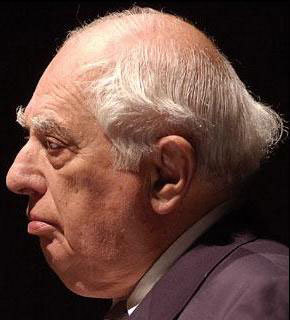
Lewis: A questionable legacy
Furthermore, Lewis was also behind the invitation of Sadiq Al-Azm to Princeton in the early 1990s (as Edward Said told me at the time) because Lewis always relished Al-Azm’s critique of Said’s Orientalism. Sep. 11 only elevated the status of Lewis and brought him close to the centers of power: he advised George W. Bush, Dick Cheney, Donald Rumsfeld and other senior members of the administration.
In the lead-up to the Iraq war, he assured Cheney (relying on the authority of Ajami) that not only Iraqis, but all Arabs, would joyously greet invading American troops. And he argued to Cheney before the war, using the dreaded Zionist and colonial cliché, that Arabs only understand the language of force. (Lewis would later distort his own history and claim that he was not a champion of the Iraq invasion although the record is clear).
Lewis was not only close to the higher echelons of the U.S. government, but in addition to his long-standing ties to Israeli leaders, he was close to Jordanian King Husayn and his brother, Hasan (although Lewis would mock what he considered a Jordanian habit of eating without forks and knives, as he wrote in Notes on a Century: Reflections of a Middle East Historian, on page 217).
Lewis was also close to the Shah’s government, and to the military dictatorship in Turkey in the 1980s. Kenan Evren, the Turkish general who led the 1980 military coup, had a tete-a-tete with Lewis during one of his visits to D.C. Lewis had contacts with the Sadat government, and Sadat’s spokesperson, Tahasin Bashir, in 1971 sent a message through Lewis to the Israeli government regarding Sadat’s interest in peace between the two countries.
Distorted View of Islam
There are many features of Lewis’s works, but foremost is what French historian Maxime Rodinson called “theologocentrism”, or the Western school of thought which attribute all observable phenomena among Muslims to matters of Islamic theology.
For Lewis, Islam is the only tool which can explain the odd political behavior of Arabs and Muslims. Lewis used Islam to refer not only to religion, but also the collection of Muslim people, governments ruling in the name of Islam, Shari`ah, Islamic civilization, languages spoken by Muslims, geographic areas in which Muslims predominate, and Arab governments. A review of his titles show his fixation with Islam. But what does it mean for Lewis to refer to Islam as being “the whole of life” for Muslims, as he does in Islam and the West?
Lewis also began the trendy Islamophobic, Western obsession with Shari`ah when he wrote years ago in the same book that for Muslims religion is “inconceivable without Islamic law.” There are hundreds of millions of Muslims in the world who live under governments which don’t subscribe to Shari`ah. No Muslim, for example, questions the Islamic credentials of Muslims who live in Western countries under secular law. Lewis even notes this fact, but it confuses him. In Islam and the West he states in bewilderment: “There is no [legal] precedent in Islamic history, no previous discussion in Islamic legal literature.”
Lewis could have benefited from reading James Piscatori’s book, Islam in a World of Nation States, which shows that Shari`ah is not the only source of laws even in countries where Islam is supposedly the only source of law. But Lewis was stuck in the past, he could only interpret the present through references to the original works of classical Islam.
His hostility and contempt for Arabs and Muslims was revealed in his writings even during the British phase of his career, when he was politically more restrained. He was influenced by the idea of his mentor, Scottish historian Hamilton Gibb, regarding what they both called “the atomism” of the Arab mind. The evidence for their theory is that the classical Arabic poem of Jahiliyyah and early Islam was not organically and thematically unified, but that each line of poetry was independent of the other. I remember back in 1993 when I discussed the matter with Muhsin Mahdi, a professor of Islamic philosophy at Harvard University, when I was reading the private papers of Gibb at the Widener Library. Mahdi said that their ideas are completely out of date and that recent scholarship about the classical Arabic poem refuted that thesis. (Lewis would resurrect the notion about the “atomism” of the Arab mind in his later Islam and the West).
Other writings of Lewis became obsolete academically. In his The Muslim Discovery of Europe he recycles the view that Muslims had no curiosity about the West because it was the land of infidelity and that they suffered from a superiority complex. A series of new scholarly books have undermined this thesis by Lewis largely by scholars looking into Indian and Iranian archives. The Palestinian academic, Nabil Mater, in his books Britain and the Islamic World, 1558-1713, Europe Through Arab Eyes, 1578-1727, and Turks, Moors and Englishmen in the Age of Discovery, paints a very different—and far more documented—picture of the subject that Lewis spent a career distorting.
Relished in Disparaging Arabs
In addition, the tone of Lewis’ writings on Arabs and Muslims was often sarcastic and contemptuous. Lewis did the work of the Middle East Media Research Institute (MEMRI), which was started in 1998 by a former Israeli intelligence agent and an Israeli political scientist,before MEMRI existed: he relished finding outlandish views of individual Muslims and popularizing them to stereotype all Arabs and all Muslims.
In the early editions of Arabs in History, Lewis remarked that none of the philosophers of the Arab/Islamic civilization were Arab in ethnic extraction (except Al-Kindi). What was Lewis’s point except to denigrate the Arab character and even genetic makeup? In the same book he cites an Ismaili document but then quickly adds that it “is probably not genuine.” But if it is “probably not genuine” why bother to cite it except for his fondness for bizarre tidbits about Arabs and Muslims?
The Orientalism of Lewis was not representative of classical Orientalism with all its flaws and shortcomings and political biases. His harbored more of an ideology of hostility against Arabs and Muslims. This ideology shares features with anti-Semitism, namely that the whole (Muslims in this case) form a monolithic group and that they pose a civilizational danger to the world, or are plotting to take it over, and that the behavior or testimony of one represents the total group (Islamic Ummah).
In writing about contemporary Islam, Lewis spent years recycling his 1976 Commentary magazine article titled, “The Return of Islam.” What he doesn’t answer is, “return” from where? Where was Islam prior? In this article, Lewis exhibits his adherence to the most discredited forms of classical Orientalist dogmas by invoking such terms as “the modern Western mind.” He thereby resurrected the idea of epistemological distinctions between “our” mind and “theirs”, as articulated by the 1976 racist book, The Arab Mind by Israeli anthropologist, Raphael Patai. (This last book would witness a resurrection in U.S. military indoctrination after Sep. 11, as Seymour Hersh reported).
An Obsession with Etymology
For Lewis, the Muslim mind never seems to change. Every Muslim, regardless of geography or time, is representative of any or all Muslims. Thus, a quotation from an obscure medieval source is sufficient to explain present-day behavior. Lewis even traces Yaser Arafat’s nom de guerre (Abu `Ammar) to early Islamic history and to the names of the Prophet Muhammad’s companions, though `Arafat himself had explained that the name derives from the root `amr (a reference to `Arafat’s construction work in Kuwait prior to his ascension to the leadership of the PLO).
Because `Arafat literally embraced Ayatollah Ruhollah Khomeini of Iran when he first met him, Lewis finds evidence of a universal Muslim bond in the picture. But when Lewis revised his book years later, he took note in passing of the deep rift which later developed between `Arafat and Khomeini and said simply: “later they parted company.” So much for the theory of the Islamic bond between them. Lewis must not have heard of wars among Muslims, like the Iran-Iraq war.
Lewis read the book Philosophy of Revolution by the foremost political champion of Arab nationalism, Nasser of Egypt, as containing Islamic themes. He must have been the only reader to come to that conclusion.
Another feature in Lewis’s writings is his obsession with etymology. To compensate for his ignorance of modern Arab reality, Lewis would often return to the etymology of political terms among Muslims. His book, The Political Language of Islam, which is probably his worst book, is an example of his attempt to Islamize and standardize the political behavior of all Muslims. His conclusions from his etymological endeavors are often comical: he assumes that freedom is alien to the Arabs because the historical meaning of the word in an ancient Arabic dictionary merely connoted the absence of slavery. This is like assuming that a Westerner never engaged in sex before the word was popularized. He complains that some of contemporary political terms, like dawlah (state), lost some of their original meanings, as if this is a problem peculiar to the Arabic language.
In his early years, Lewis was close to the classical Orientalists: he wrote in a beautiful style and his erudition and language skills showed through the pages. His early works were fun to read, while his later works were dreary and dull. But Lewis was unlike those few classical Orientalists who managed to mix knowledge about history of the Middle East and Islam with knowledge of the contemporary Arab world (scholars like Rodinson, Philip Hitti and Jacques Berque). Lewis’s ignorance about the contemporary Arab world was especially evident in his production during the U.S. phase of his long career. His book on the The Emergence of Modern Turkey, which was one of the first to rely on the Ottoman archives, was probably one of his best books. There is real scholarship in the book, unlike many of his later observational and impressionable works.
In his later best-selling books, What Went Wrong? and The Crisis of Islam, one reads the same passages and anecdotes twice. Lewis, for example, relishes recounting that syphilis was imported into the Middle East from the new world. His discussion of Napoleon in Egypt appears in both books, almost verbatim. The second book contains calls for (mostly military) action. In The Crisis of Islam, Lewis asserts: “The West must defend itself by whatever means.” The book reveals a lot about his outlook of hostility towards Muslims.
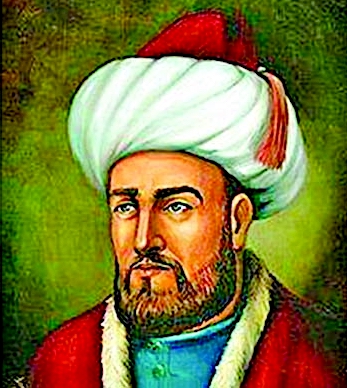
Al-Ghazzali: Lewis thought bin Laden was like him
Misunderstood Bin Laden
One is astonished to read some of his observations on Muslim and Arab sentiments and opinions. He is deeply convinced that Muslims are “pained” by the absence of the caliphate, as if this constitutes a serious demand or goal even for Muslim fundamentalist organizations. One never sees crowds of Muslims in the streets of Cairo or Islamabad calling for the restoration of the caliphate as a pressing need.
But then again: this is the man who treated Usamah Bin Laden as some kind of influential Muslim theologian who is followed by world Muslims. Lewis does not treat Bin Laden as the terrorist fanatic that he is, but as some kind of al-Ghazzali, in the tradition of classical Islamic theologians. Furthermore, Lewis insists that terrorism by individual Muslims should be considered Islamic terrorism, while terrorism by individual Jews or Christians is never considered Jewish or Christian terrorism.
In his retirement years, his disdain for the Palestinian people became unmasked. Although in his book The Crisis of Islam he lists acts of violence by PLO groups—curiously, only ones that are not directed against Israeli occupation soldiers—he lists not one act of Israeli violence against Palestinians and Arabs. To discredit the Palestinian national movement, he finds it necessary to tell yet again the story of Hajj Amin Al-Husayni’s visit to Nazi Germany, apparently seeking to stigmatize all Palestinians.
He is so disdainful of the Palestinians that he finds their opposition to Britain during the mandate period inexplicable because he believes that Britain was, alas, opposed to Zionism. Lewis is so insistent in attributing Arab popular antipathy to the U.S. to Nazi influence and inspiration that he actually maintains that Arabs obtained their hostility to the U.S. from reading the likes of Otto Spengler, Friederich Georg Junger, and Martin Heidegger. But when did the Arabs find time to read those books when all they read were their holy book and Islamic religious texts—as one surmises from reading Lewis?
While he displays deep–albeit selective–knowledge when he talks about the Islamic past (where his documentation is usually thorough), his analysis is quite simplistic and superficial when addressing the present (where he often disregards documentation altogether). For instance, he sometimes produces quotations without endnotes to source them: In Islam and the West he quotes an unnamed Muslim calling for the right of Muslims to “practice polygamy under Christian rule.” In another instance, he debates what he considers to be a common Muslim anti-Orientalist viewpoint, and the endnotes refer only to a letter to the editor in The New York Times.
Lewis once began a discussion by saying: “Recently I came across an article in a Kuwaiti newspaper discussing a Western historian,” without referring the reader to the name of the newspaper or the author. He also tells the story of an anti-Coptic rumor in Egypt in 1973 without telling the reader how he collects his rumors from the region. On another page, he identifies a source thus: “a young man in a shop where I went to make a purchase.”
Lewis was not shy about his biases in the British phase of his career, but be became an unabashed racist in his later years. In Notes on a Century, he did not mind citing approvingly the opinion of a friend who compared Arabs to “neurotic children”, unlike Israelis who are “rational adults.” And his knowledge of Arabs seems to decrease over time: he would frequently tell (unfunny) jokes related to Arabs and then add that jokes are the only indicator of Arab public opinion because he did not seem to know about public opinion surveys of Arabs. He also informs his readers that “chairs are not part of Middle Eastern tradition or culture.” He showers praise on his friend, Teddy Kollek (former occupation mayor of Jerusalem) because he set up a “refreshment counter” for Christians one day.
The political influence of Lewis, who lent Samuel Huntington his term, if not the theme, of “the clash of civilization”, has been significant. But it would be inaccurate to maintain that he was a policy maker. In the East and the West, rulers rely on the opinions and writings of intellectuals when they find that this reliance is useful for their propaganda purposes. Lewis and his books were timely when the U.S. was preparing to invade Muslim countries. But the legacy of Lewis won’t survive future scholarly scrutiny: his writings will increasingly lose their academic relevance and will be cited as examples of Orientalist overreach.
As’ad AbuKhalil is a Lebanese-American professor of political science at California State University, Stanislaus. He is the author of the Historical Dictionary of Lebanon (1998), Bin Laden, Islam & America’s New ‘War on Terrorism’ (2002), and The Battle for Saudi Arabia (2004). He also runs the popular blog The Angry Arab News Service.
OPCW’s new power attempt to politicize its work: Syria
Press TV – June 29, 2018
The Syrian government has denounced a recent decision made by the Organization for the Prohibition of Chemical Weapons (OPCW), the world’s chemical watchdog, to empower itself to assign blame for alleged chemical attacks.
“Syria expresses its deep concern at the methods of blackmail and threat used by Western countries, especially the ones involved in the tripartite aggression against Syria — the US, UK and France — to pass a resolution at the OPCW emergency session,” Syria’s official news agency, SANA, quoted a source at the Syrian Ministry of Foreign Affairs and Expatriates as saying on Friday.
On Wednesday, the Hague-based organization passed by 82 votes to 24 a British-backed proposal, which enable the watchdog to hold responsible those who it thinks are behind alleged chemical attacks. Until then, the OPCW’s mandate was limited only to determining whether or not a chemical attack took place, not who was responsible.
Russia, which had strongly opposed granting extra powers to the OPCW, said it would not rule out leaving what it called a “sinking Titanic.”
The new decision would allow for the watchdog to be used as “vehicle to carry out violations against independent, sovereign states under the pretexts of chemical weapons use”, the source further said, adding, “The decision will only add new complications to the OPCW’s capacity to play its role, which will lead to its paralysis.”
Back in April, militants and activists linked to them, including the so-called civil defense group White Helmets, claimed that government forces on Saturday had dropped a barrel bomb containing poisonous chemicals in Douma, Eastern Ghouta’s largest town, killing and wounding dozens of civilians.
Damascus strongly rejected the allegation and said that the so-called Jaish al-Islam Takfiri terrorist group, which had dominant presence in the town at the time, was repeating the allegations of using chemical munitions “in order to accuse the Syrian Arab army, in a blatant attempt to hinder the Army’s advance.”
However, the US State Department issued a strongly-worded statement, blaming the Syrian government for purportedly conducting the attack.
The Hague-based OPCW is soon expected to publish the highly-anticipated results of its probe into the purported toxic gas attack in Douma.
The Syrian foreign ministry’s source further said that Wednesday’s decision “sets a dangerous precedent” by giving an “organization concerned with scientific and technical issues the authority to carry out criminal and legal investigations that are not its specialty.”
The source added that the Arab country reiterated its condemnation of the use of chemical munitions by “anyone, anywhere, under any circumstances.”
Militants belonging to a number of factions had held the Eastern Ghouta, an enclave in the vicinity of the capital Damascus, since 2012 and had practically held hostage its inhabitants, some 400,000 people.
Syrian troops and allied fighters from popular defense groups managed to fully liberate the enclave from the clutches of militants in April, after months of intense fighting with terror groups, which had used the area as a launch pad for deadly rocket attacks against residents and civilian infrastructure in the capital.
Since the beginning of the conflict in Syria in early 2011, the Western governments have on several occasions accused Syria of using chemical weapons against militants. Damascus has denied the allegation, saying it is meant to pile more pressure on government forces and delay their success in the fight against terrorists.
In April last year, the US and allies in Europe said Syria and Russia, an ally of Damascus in the fight against terror, used chemical weapons against militants in Khan Shaykhun in the province of Idlib. Moscow and Damascus strongly rejected the allegation. However, US warships in the eastern Mediterranean launched a barrage of 59 Tomahawk missiles against Shayrat Airfield in Syria’s Homs province, which Washington alleged was the origin of the suspected chemical attack.
The Syrian government surrendered its stockpiles of chemical weapons in 2014 to a joint mission led by the UN and the OPCW.
Lavrov on trading Snowden for sanctions relief: Russia sees US exile as ‘master of his own destiny’
RT | June 29, 2018
Russia has never mulled handing over NSA whistleblower Edward Snowden to the US in exchange for easing sanctions, Russian FM Sergey Lavrov has told the BBC, when asked if this could form part of a deal with President Donald Trump.
“I have never discussed Edward Snowden with [Donald Trump’s] administration,” Lavrov told Channel 4’s Cathy Newman. He added that President Vladimir Putin had addressed the issue years ago, however.
“When he was asked the question, he said this is for Edward Snowden to decide. We respect his rights, as an individual. That is why we were not in a position to expel him against his will, because he found himself in Russia even without a US passport, which was discontinued as he was flying from Hong Kong,” Lavrov recalled.
Snowden, the man behind the biggest exposure in years of the US electronic surveillance apparatus, got stranded in Russia when Washington withdrew his passport as he was travelling via Moscow from Hong Kong. The Russian government eventually granted him political asylum. Snowden is facing prosecution in the US for leaking classified documents to a number of media outlets.
The Channel 4 correspondent suggested during the interview that Russia may try to bargain Snowden for the lifting of US sanctions, during the upcoming meeting between Putin and Trump.
“I do not know why people would start asking this particular question in relation to the summit. Edward Snowden is the master of his own destiny,” Lavrov reiterated.
Labour Friends of Israel: Palestine refugees’ right to return is ‘extreme and illegitimate’
MEMO | June 29, 2018
Westminster-based lobby group Labour Friends of Israel (LFI) has described the Palestinian refugees’ right of return as “extreme and illegitimate”, in a letter to Labour leader Jeremy Corbyn this week.
LFI’s letter came in response to remarks made by the Leader of the opposition on 25 June, during a recent visit to Jordan. In a Twitter post, Corbyn wrote:
“In Jordan, I went to Baqa’a, one of the largest Palestinian refugee camps. We must work for a real two state settlement to the Israel-Palestine conflict, which ends the occupation and siege of Gaza and makes the Palestinian right to return a reality.”
In the period 1947-1949, hundreds of thousands of Palestinians were expelled from or fled their homes as Zionist militias and the Israeli army destroyed hundreds of villages in what became Israel. Refugees attempting to return were killed, and Israel passed laws to expropriate their properties.
Corbyn’s expression of support for the Palestinian refugees’ internationally-recognised rights, prompted anger and concern from British pro-Israel groups, including LFI.
In a letter from LFI chair MP Joan Ryan, the pro-Israel group describes the Palestinians’ right to return (which is referred to in scare quotes) as “highly contentious”, and at odds with Israel’s insistence on retaining its Jewish majority of citizens.
Ryan added: “I do not believe that it does anything to encourage the compromises and concessions a future negotiated settlement will involve for foreign politicians to appear to endorse the most extreme and illegitimate demands of either side.”
The LFI chair concluded by urging Corbyn to “immediately clarify” what he understands by a right to return, and to only use “language… [that] helps to advance, not hinder, the cause of peace, reconciliation and coexistence between Israelis and Palestinians.”
A spokesperson for the Labour party said: “These rights are inalienable and guaranteed by UN Resolution 194 of 11 December 1948. How the right of return is implemented is a matter for the negotiations between the Israelis and Palestinians.”
Times Headline: Fears Over Prospect of Peace
OffGuardian | June 29, 2018
 OffGuardian was founded on the idea that the media should be held to account, corrected, fact-checked and interpreted. A lot of the time that’s a job that needs to be done.
But sometimes it’s not. Sometimes you just let them talk and their own words condemn them.
This is one of those times.
The Times is scare-mongering about peace.
Nothing more need be said.
Blair and Brown Governments Gory with Torture
By Craig Murray | June 29, 2018
Even I was taken aback by the sheer scale of British active involvement in extraordinary rendition revealed by yesterday’s report of the parliamentary Intelligence and Security Committee. Dominic Grieve and the committee deserve congratulations for their honesty, integrity and above all persistence. It is plain from the report that 10 Downing Street did everything possible to handicap the work of the committee. Most crucially they were allowed only to interview extremely senior civil servants and not allowed to interview those actively engaged in the torture and rendition programme.
Theresa May specifically and deliberately ruled out the Committee from questioning any official who might be placed at risk of criminal proceedings – see para 11 of the report. The determination of the government to protect those who were complicit in torture tells us much more about their future intentions than any fake apology.
In fact it is impossible to read paras 9 to 14 without being astonished at the sheer audacity of Theresa May’s attempts to obstruct the inquiry. They were allowed to interview only 4 out of 23 requested witnesses, and those were not allowed “to talk about the specifics of the operations in which they were involved nor fill in any gaps in the timeline”. If the UK had a genuinely free media, this executive obstruction of the Inquiry would be the lead story. Instead it is not mentioned in any corporate or state media, despite the committee report containing a firm protest:
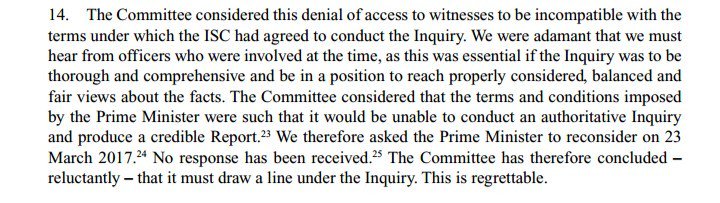
It is worth reflecting that the Tory government has acted time and time again to protect New Labour’s Tony Blair, David Miliband, Jack Straw and Gordon Brown from any punishment for their complicity in torture, and indeed to limit the information on it available to the public. The truth is that the Tories and New Labour (which includes the vast majority of current Labour MPs) are all a part of the same elite interest group, and when under pressure they stick together as a class against the people.
Despite being hamstrung by government, the Committee managed through exhaustive research of classified documents to pull together evidence of British involvement in extraordinary rendition and mistreatment of detainees on a massive scale. The Committee found 596 individual documented incidents of the security services obtaining “intelligence” from detainee interrogations involving torture or severe mistreatment, ranging from 2 incidents of direct involvement, “13 to 15” of actually being in the room, through those where the US or other authorities admitted to the torture, to those where the detainee told the officer they had been tortured. They found three instances where the UK had paid for rendition flights.
My own evidence to the Committee focused on the over-arching policy framework, and specifically the fact that Jack Straw and Richard Dearlove had agreed a deliberate and considered policy of obtaining intelligence through torture. The report includes disappointingly little of my evidence, as the Committee has taken a very narrow view of its remit to oversee the intelligence agencies. This is the only part of my evidence included:
130. This was not unique to the Agencies. Their sponsoring Departments appear to have adopted the same approach. We heard evidence from a former FCO official, Craig Murray, who suggested that “there was a deliberate policy of not committing the discussion on receipt of intelligence through torture to paper in the Foreign Office”.
In July 2004, when he was Ambassador to Tashkent, he raised concerns about the use of Uzbek intelligence derived from torture in a formal exchange of telegrams with the FCO. Mr Murray drew our attention to FCO documents from the same time, which we have seen, one of which referred to “meetings to look at conditions of receipt of intelligence as a general issue”. He told us that the meetings “specifically discuss[ed] the receipt of intelligence under torture from Uzbekistan” and “were absolutely key to the formation of policy on extraordinary rendition and intelligence”.
Mr Murray told us that, when he had given evidence to the Foreign Affairs Select Committee about this, they sought the documents from the FCO which replied that the “meetings were informal meetings and were not minuted ”. He went on to say:
“the idea that you have regular meetings convened at director level, convened by the Director of Security and Intelligence, where you are discussing the receipt of intelligence from torture, and you do not minute those meetings is an impossibility, unless an actual decision or instruction not to minute the meetings has been given.… Were it not for me and my bloody-mindedness, … you would never know those meetings had happened. Nobody would ever know those meetings had happened.”131. We note that we have not seen the minutes of these meetings either: this causes us great concern. Policy discussions on such an important issue should have been minuted. We support
Mr Murray’s own conclusion that were it not for his actions these matters may never have come to light.
Jack Straw to this day denies knowledge and involvement and famously told Parliament that the whole story about rendition and torture was a “conspiracy theory”.
Unless we all start to believe in conspiracy theories and that the officials are lying, that I am lying, that behind this there is some kind of secret state which is in league with some dark forces in the United States, and also let me say, we believe that Secretary Rice is lying, there simply is no truth in the claims that the United Kingdom has been involved in rendition full stop, because we have not been, and so what on earth a judicial inquiry would start to do I have no idea. I do not think it would be justified.”
In fact I strongly recommend you to read the whole Hansard transcript, from Q21 to Q51, in which Jack Straw carries out the most sustained bravura performance of lying to parliament in modern history. The ISC report makes plain he was repeatedly involved in direct authorisations of rendition operations, while denying to parliament the very existence of such operations.
For over a decade now the British government, be it Red Tory or Blue Tory, has been refusing calls for a proper public inquiry into its collusion with torture. The ISC report was meant to stand in place of such an Inquiry, but all it has done is reveal that there is a huge amount of complicity in torture, much more than we had realised, which the ISC itself states it was precluded from properly investigating because of government restrictions on its operations. It also concluded in a separate report on current issues, that it is unable to state categorically that these practices have stopped.
The Blair and Brown governments were deeply immersed in torture, a practice that increased hatred of the UK in the Muslim world and thus increased the threat of terrorism. Their ministers repeatedly lied about it, including to parliament. The British state has since repeatedly acted to ensure impunity for those involved, from Blair and Straw down to individual security service officers, who are not to be held responsible for their criminal complicity. This impunity of agents of the state is a complete guarantee that these evil practices will continue.
Same As It Ever Was: The GWOT and Colonial History
By Ron Jacobs | CounterPunch | June 28, 2018
Since the events popularly called 9-11, the general public of the western nations have grown used to ever intensifying security measures. These measures affect the way the public travels, attends sporting and musical events, and thinks about those who don’t look like them. Long gone are the days when one could buy an airline ticket with cash at the counter and walk on a flight without showing identification.
In her 2018 book, Deport, Deprive, Extradite: 21st Century State Extremism, Nisha Kapoor examines several cases of Muslims living in Britain accused of lending material support to terrorism. In her examination of these case studies, she exposes the abuses of the British internal security apparatus and its intimate collaboration with the much greater security apparatus of the United States. The processes she reveals describe a Kafkaesque web that is impossible to escape once one is trapped in its threads. Indeed, virtually every case she explores ends with the individual targeted by the surety services taking a plea no matter how flimsy the evidence against them is. It’s as if they are found guilty and sentenced before the trial like those in the Queen of Heart’s courtroom found in Lewis Carrol’s Through the Looking Glass. Indeed, Kapoor quotes from this fiction in her text to make that exact point.
Although many US and British citizens were (and are) appalled at the torture and extraordinary rendition of suspects, in part because of the illegality of the practice, fewer seem opposed to the practice of legal extradition. As Kapoor points out throughout her text, this policy is actually quite similar to extraordinary rendition in how it is actually carried out. Like those who are moved illegally via extraordinary rendition, the suspects extradited (usually to the United States) are hooded, bound and tortured. The fact that their movement is legal only points to the weakness of the law.
Underlying the case studies discussed in the text is Kapoor’s contention that the practices of rendition, extradition and the  accompanying torture and abuse of detainees are a continuation of strategies and policies established under colonial administrations in the past. In other words, they are racist and therefore dismissive of the subject’s humanity and importance except as a target of abuse and imprisonment. Their very existence demands suspicion of crimes against the regime and their rationale of any actions (or thoughts about actions) is not rational but the result of a fanaticism. In the nominally secular world of the western regimes primarily involved in the capture and imprisonment of these suspects it is the religion of Islam which is the cause of their irrationality.
Another important context that is crucial to the text’s understanding of the “war on terror” is Kapoor’s emphasis on the fact that this entire project is a direct extension of liberal governance and philosophy. In her writing, she references John Stuart Mill and other liberal philosophers’ disparaging comments on non-Western civilizations. Furthermore, she draws a clear line from liberalism to authoritarianism, pointing out that as the judicial element in such governments has been weakened, the legislatures have given more and more power to the executive, which has rendered any existing balance of power virtually meaningless. In other words, the pretense that liberal government is somehow different from authoritarianism has been ripped away by the increasingly invasive, harsh and repressive measures undertaken in the name of the war on terror.
Unwritten, but clearly present is this essential fact: the more time that passes under this regime of what Kapoor justly calls state extremism goes on, the fewer people there will be who can remember when liberal governments were more liberal than illiberal and human beings were not suspect at birth. Deport, Deprive, Extradite is not merely an examination of human rights abuses of the recent past; it is also a harbinger of a harsher future. One would do well to heed its warning and act against the possibilities it discusses.
OPCW Wins New Powers to Undermine Authority of UN Security Council
By Peter KORZUN | Strategic Culture Foundation | 28.06.2018
The Organization for the Prohibition of Chemical Weapons (OPCW) is the Hague-based enforcement body for the Chemical Weapons Convention (CWC) and has been operating since 1997. It has 193 UN states as members. Its mission is to oversee global compliance with the convention, which prohibits the use of chemical weapons (CW) and requires their destruction. The inspectors have the power to say whether chemical weapons have been used following a fact-finding visit. Until the watchdog’s recent conference, they had not been authorized to identify the group or country suspected of deploying such weapons in any specific incident. The West used pressure to change that.
On June 27, an OPCW special session held in the Hague, the Netherlands, voted to expand the powers of the international chemical weapons watchdog. It was only the fourth conference held by the organization in its 21-year history and the first gathering to address the problem of the non-attribution of responsibility for the use of CW.
A total of 147 countries were accredited to join the session. Forty-six nations did not take part for various reasons. A two-thirds majority, minus any abstentions, was required for the proposal to be approved. The vote was 82-24 — only 106 out of 193 voted, leaving 87 (or 45% of all OPCW members) aside. It passed in accordance with the rules but was far from being very convincing overall! When you add 24 to 87 you get 111 members out of 193 who did not approve the decision. This was no great victory.
UK Foreign Minister Boris Johnson put forward the proposal in order to give the organization some teeth. The UK government thinks the OPCW must adopt a higher profile, which would include the authority to identify the perpetrators, otherwise it will lose its relevance. The powers of attribution that are to be used initially in Syria will be strengthened and expanded at a later special conference in six months.
The proposal submitted by the UK had the backing of the United States, the European Union, and other nations under their influence. From the very beginning the British initiative was supported by the secretariat of the OPCW. It’s no wonder, as it caters to the interests of bureaucrats. Their clout and salaries will grow. A host of countries, including Russia, opposed the move. Moscow believes that the result of the vote places the organization’s future in doubt.
In a nutshell, the approved proposal will turn that body into a political tool to be used to undermine international security, because it encroaches on the exclusive prerogatives of the UN Security Council. The OPCW was not created to carry out the functions of prosecutor and international police. In Syria, the organization has not done its job efficiently, often failing to gather evidence at the site and using untrustworthy sources of information while preparing its reports. For instance, violations of the core principle of Chain of Custody and many provisions of the CWC took place last year during the investigations of the Khan Sheikhoun chemical attack, during which the inspectors did not travel to inspect Syria’s Shayrat air base. The same story was repeated during the 2018 attack in Douma. The investigation was poorly conducted. There were serious disagreements between member states, which prevented that body from reaching definitive conclusions.
The performance of the OPCW has so far not been up to par, so why should its authority be expanded, making it responsible for such a complicated task as assigning blame? The OPCW is not a court. Its inspectors are not trained to be judges. If the OPCW can hand down guilty verdicts, then what do we need international tribunals and other bodies for?
The British proposal did not even offer to reform the organization before assigning it a new mission. No details were provided as to how to ensure transparency and impartiality. If the OPCW is to make final conclusions on guilt, it should have a mechanism to prevent its being politicized and biased. It all goes to show that political motives prevailed when the initiative was put forward. Many nations don’t care much about the Skripal case but they will vote to put the blame on Russia in order to curry favor with the UK and its allies. Many of them see the events in Syria as a far-off problem. They will also vote to please those who hold influence over them. A country can be blamed without hard evidence presented.
Nice words were uttered condemning the use of CW, and highfalutin speeches were given to play on people’s heartstrings, but not all that glitters is gold. Quite often decisions approved by a relative majority are dictated by emotions, not wisdom. Many aspects of the matter had not been clarified, a lot of questions were still unanswered, and some topics that cried out for a thorough discussion had simply been swept under the rug. As a result, a very important international body has been turned into a tool for playing political games instead of doing the job it was initially created for. It may come to conclusions and point its finger at culprits, but will it enjoy a high level of trust? That’s what leaves us with a lot of doubts.
OPCW granted right to assign guilt for chemical attacks after divisive UK proposal
RT | June 27, 2018
The UK’s proposal to give the global chemical watchdog the right to assign blame has been passed despite deep divisions. Russia warns the move puts the future of the organization, and thus global security, at risk.
The British envoy to the Organization for the Prohibition of Chemical Weapons (OPCW), Peter Wilson, celebrated the outcome of the 82-24 vote on Twitter.
London called a special session of the UN chemical watchdog on Wednesday, arguing that the body should have the authority, not only to investigate whether any alleged chemical attack took place, but also to assign guilt. The British proposal was quickly supported by its Western allies.
Others, however, offered a sobering warning on the state of the international group in the wake of the vote. Moscow was quick to stress that several key OPCW contributors have been dead against the move.
“One can see a colossal split in the organization, both in the electoral groups and on the future of OPCW,” said the head of the Russian delegation, Georgy Kalamanov. “Russia and many of the countries that have spoken against the UK decision have been playing a serious role in the OPCW, starting from financing to the expert support.”
Earlier, Moscow warned that the changes in the OPCW mandate would turn it into a political tool as well as infringe upon the “exclusive prerogatives of the UN Security Council.” Today’s decision comes following a longstanding row between Russia and the West over the probes of the chemical incidents in Syria.
Moscow has repeatedly criticized the OPCW-UN Joint Investigative Mechanism (JIM) for mishandling its probes, cherry-picking evidence and using vague wording in its reports. It also argued that the OPCW experts abused their mandate on several occasions as they conducted their investigations “remotely” and in violation of the core principle of ‘chain of custody’ while relying on evidence provided by biased and unreliable sources.
The UK, as well as the US and their allies, accused Moscow of blocking the investigation of chemical incidents in Syria after the JIM’s mandate expired last November, following a number of failed attempts by the UNSC to extend it. London has been openly accusing the Syrian government of launching chemical attacks on civilians, despite no convincing evidence presented.
‘UK & US want OPCW powers expanded to justify future attacks against Syria’
RT | June 27, 2018
London’s effort to empower the UN chemical watchdog with the right to assign guilt serves Western interests in finding loopholes and justifications for new attacks against Damascus, investigative journalist Rick Sterling told RT.
“The UK in alliance with the US is hoping to have the OPCW able to assign blame and provide a rationale for future attacks by the US and the UK,” Sterling believes.
Under Donald Trump’s administration, the US used chemical incidents in Syria as a pretext to stage two nearly instant ‘retaliatory’ strikes against Damascus without due investigation. The UK, as well as France, joined the US-led military endeavor this spring when they bombarded government bases and infrastructure in response to an alleged chemical attack in Douma on April 7. A year earlier, Washington unilaterally launched 59 Tomahawk cruise missiles at Shayrat Airbase, as a response to the Khan Shaykhun chemical incident on 4 April 2017.
Moscow has repeatedly criticized the OPCW-UN Joint Investigative Mechanism (JIM) for mishandling its probes, cherry-picking evidence and for vague wording in their reports. JIM’s mandate expired last November, following a number of failed attempts by the UNSC to extend its authority.
“One of the problems is that OPCW has not been willing to go to the sites in some cases and they don’t pursue evidence which contradicts the Western claims,” Sterling noted.
Despite repeated failures by OPCW experts to impartially investigate chemical attack claims in Syria –and at times even to visit the sites of an actual alleged incident– an ongoing special conference of the watchdog in the Hague is set to vote on the expansion of its mandate. The proposed new powers would involve the OPCW declaring any party to a conflict responsible for any chemical incident.
“OPCW has assigned blame to the Syrian government in various instances in the past, including chlorine, but if you look at their reports they rely really on witnesses who are provided to them by the opposition. So it is very logical to question the objectivity and the independence of the OPCW,” Sterling told RT. “Even the director of the OPCW is Turkish. And Turkey, of course, is a member of NATO.”
All of the latest OPCW reports were in large part based on open source data, witness testimonies and video and photo evidence provided by select ‘moderate’ rebel groups and controversial NGOs, such as the Syrian Civil Defence (SCD) –better known as the White Helmets– or the US-based Syrian American Medical Society (SAMS). Those same sources by coincidence were instrumental in heating up international public outrage in the buildup for ‘retaliatory’ US-led strikes against Damascus.
“In the last several years we’ve seen a situation in Syria where the efforts of countries to overthrow, to topple the Damascus government have used claims, accusations of chemical weapons usage, and the OPCW have been a part of that,” Sterling believes.
Ayatollah Khamenei slams West’s ‘shameless’ human rights posture
Press TV – June 27, 2018
Leader of the Islamic Revolution Ayatollah Seyyed Ali Khamenei has strongly denounced the Western states for their pretense of advocating human rights while in reality supporting terrorist groups and acts of terror.
Addressing the staff of Iran’s Judiciary at a meeting in Tehran on Wednesday, Ayatollah Khamenei made reference to human rights violations committed by the United States in various parts of the world as well as France and Britain’s crimes of the past decades which took place in Africa and the Indian subcontinent.
The Leader added that the West’s support over the past years for the Daesh terror group in Syria and the atrocities being committed in Myanmar and elsewhere “is indicative of the repeated lies of the shameless fake human rights advocates.”
Ayatollah Khamenei said when it comes to the issue of human rights, it is actually the Islamic Republic that stands in the position of the true advocate of human rights as opposed to “the criminal Western pretenders.”
The Leader expressed satisfaction with the Judiciary’s work in restoring the Iranian nations’ rights in the face of bullying powers.
Separately, Ayatollah Khamenei advised the judicial officials to work closely with the government towards resolving the country’s economic problems.
‘Systemic corruption a lie’
The Leader criticized certain people who seek to create the impression among the public that there is “systemic corruption” within Iranian state institutions.
Corruption does exist in a number of governmental and commercial enterprises, “but the existence of systemic corruption is not true,” the Leader said. “This wrong impression should not be allowed to affect the public opinion.”
Ayatollah Khamenei further stated that foreign enemies and certain oblivious elements at home have made the Judiciary the target of the most severe propaganda and media pressure.
In order to effectively confront this massive propaganda campaign, the Leader suggested, the judicial system needs to develop a strong and skillful media arm.
Featured Video

Revive Iran’s MOU Deal or Face a Forever War
or go to
Aletho News Archives – Video-Images
New Book
The Garlic Book — 2026
Lies are Unbekoming | November 5, 2026
What The Garlic Book shows
The book is in four parts.
 Part One, The Record, treats the history of garlic as evidence. From the clay garlic bulb placed in an Egyptian grave nearly six thousand years ago, through the Ebers Papyrus, through Hippocrates, Dioscorides, Pliny and Galen, the Arab physicians under Avicenna, the medieval herbals, Culpeper, and the plague years, to the last era in which Western physicians prescribed garlic as a matter of course, which ran from 1850 to 1945. It closes with the living traditions that never stopped using it, and with the folklore of charms, vampires and the evil eye.
Part Two, The Chemistry and the Evidence, sets out what is known about why a clove has no smell until it is cut, and why the order of crush, rest and heat changes the medicine. It then reads the clinical evidence against the historical record — bacteria, blood and vessels, cancer epidemiology, metals and fatigue — and names the trials that went against garlic as directly as the trials that went for it, including the 2007 Stanford trial funded by the US National Institutes of Health which found that raw garlic, garlic powder and aged garlic extract moved LDL cholesterol no more than placebo did. It then turns to onion, garlic’s closest relative, and reads the newer evidence published since 2015, before closing with the whole of the record through the terrain lens.
Part Three, Why Medicine Set It Aside, asks the question directly. One chapter contrasts the pharmaceutical model of isolating a single active compound with the folk model of combining whole plants, and reports what the garlic evidence says about which model works better. One chapter examines the economics of research on a plant that cannot be patented. One chapter — Fire Cider — tells the story of a folk preparation whose name was taken into a United States trademark by a Massachusetts company in 2012, and won back by three herbalists in 2014 who documented forty years of prior use through Rosemary Gladstar and her students into the older tradition.
Part Four, Garlic in Practice, is the working manual — the kitchen pharmacy, traditional uses by body system, a full chapter on safety and interactions, and a complaint-by-complaint practical guide. The book closes with The Trial That Was Never Run — a one-chapter reading of the whole evidential architecture.
At the back: two appendices (a traditional list of uses, and a preparation quick-reference), a full bibliography, and a live index.
Blog Roll
 Aletho News
- The Endgame: When the CIA Proxy War Runs Out of Ukrainians!
- Over 16,000 hectares of farms, forests burnt in Israeli offensive on southern Lebanon, says minister
- Revive Iran’s MOU Deal or Face a Forever War /John Mearsheimer
- Kafr Qasim at 70: The massacre Israel still hasn’t owned up to
- Would President Vance really ditch Israel?
- LAPD Pilot Will Track Vehicles In San Fernando Valley
- Britain’s Online Censorship Law Now Comes With a Crisis Plan for Your Posts
- NATO’s “Nordic model” brings Arctic confrontation closer to Russia’s nuclear bases
- Using nuclear weapons, the US-Israeli alliance still can’t beat Iran
- Sunset on the Quality of Western Propaganda: Arrival of the Dr Strangelove Moment
- If Americans Knew
- Supermajority of Jewish Americans think Israel and AIPAC drive antisemitism
- Trump must end the war today and fire all top officials connected to it
- Exported to Israel as pets, Dutch dogs used to torture Palestinians
- World Medical Association shields Israeli doctors complicit in Palestinian prisoner torture: Report:
- The Pentagon Needs More Ammo for the Iran War. Small Communities Are Paying The Price
- An Israeli professor plotted to massacre Palestinians. Social media rejoiced
- DAILY UPDATE: Latest essential news on Palestine, Israel, & region
- Gaza: Israel denies treatment and dignity to children left amputees by its genocide
- Will Democratic leaders challenge US military ties to Israel?
- DAILY UPDATE: Latest essential news on Palestine, Israel, & region
- No Tricks Zone
- New Study: The Net Fossil Fuel Contribution To Rising Atmospheric CO2 Has Been Zero For 500 Years
- Germany’s Green Energy Transition Becoming Increasingly Expensive…Another 6 Trillion Euros!
- Sudden Stratospheric Warming, Powerful El Niño Combination May Lead To Extreme Europe Cold, Energy Crisis!
- Two New Studies Find Thwaites Glacier Melt Cannot Be Driven By Human Activity Or A Warming Ocean
- E-Cars Reduce CO2 Emissions By Only 41% Compared To Internal Combustion Engine Vehicles
- Predictions Made By Renowned Climate Professor Over Past Decades Have Been Proven To Be Poor
- New Study Suggests Large Regions Of The Pacific Ocean Have Been Cooling For The Last 80 Years
- Germany’s Green Energy Debacle: High Energy Costs Force Kahla Porzellan to Close After 182 Years!
- New Study: 50 Years Of The Most Aggressive ‘Net Zero’ Policies Can Only Affect The Global Climate By 0.03°C
- US September “Heat” Was No Record…Many Records Set Decades Ago

