‘Time is against UK’: No access to Skripals & probe results eroding London credibility – Russia envoy
RT | May 10, 2018
The UK has made it clear it won’t let Moscow meet Russian citizens ex-double agent Sergei Skripal and his daughter, as the dragging secretive probe into their poisoning speaks volumes to the observers, the Russian ambassador says.
“It has become clear that we will not get access to the Skripals. They [the British authorities] just will not provide it,” Russian envoy to the UK Alexander Yakovenko told journalists on Thursday, following his meeting with Philip Barton, the Director General, Consular and Security at the British Foreign Office.
By blocking access to the Russians, London flagrantly violates its duties under a bilateral treaty on consular relations with Moscow, Yakovenko said. The true fate of the Skripals, meanwhile, remains unknown, he pointed out.
London maintains that the Skripals do not want to meet with Russian officials. However, neither the Russian ex-spy nor his daughter, Yulia, have publicly appeared to confirm it since the March poisoning. The Russian authorities never received any photos or voice recordings of the man and his daughter from the British side, Yakovenko said.
“We cannot conclusively establish what condition they are in as well as whether they are acting voluntary,” Yakovenko said, adding that the answers that Moscow continues to get from London are “empty and formalistic.”
The longer the UK protracts the investigation, the more countries see “the true nature of the policy conducted by the conservative government,” Yakovenko said, adding that “time is against London.” According to the diplomat, the situation has “put the reputation of the UK at risk.”
Veil of silence
London has been denying Moscow access to the Skripals from the very beginning. First, Russian diplomats were barred from visiting the hospital where the two were treated. Then they were also prevented from meeting Yulia Skripal after the British authorities said she had recovered.
The UK also refused to issue a visa for Skripal’s niece, Viktoria, after she claimed that she would come and take her relatives back to Russia. Following a brief conversation with Yulia, Viktoria also said that her cousin sounded “coached” and “did not use her own words” during the only phone conversation between the relatives.
Later, it was reported that the US and British intelligence agencies may offer Sergei and Yulia Skripal new identities and relocation to a Five Eyes country. Moscow then denounced these plans by saying that any undercover resettlement of the former double agent and his daughter would be seen as “citizen abduction.” In mid-April, Russian UN envoy Vassily Nebenzia also accused the UK of systematically destroying evidence relating to the Salisbury incident.
London’s narrative falling apart?
The British stance on the poisoning of Skripal has remained unchanged. The British government accuses Russia of poisoning Yulia and Sergei Skripal back in early March 2018, using the nerve agent A-234, also known as Novichok. London continues to blame Moscow for the incident, claiming that Russia is the only country able to produce it.
While remaining largely unquestioned within the British mainstream media, this narrative seems to be falling apart against the background of the latest developments. Last week, Czech President Milos Zeman openly admitted that his country did produce and test a nerve agent of the so-called Novichok family.
Russian diplomats had earlier named the Czech Republic as one of the most probable countries from which the nerve agent might have come. The list also included Slovakia, Sweden and the UK itself.
The Organization for the Prohibition of Chemical Weapons (OPCW), an international chemical weapons watchdog, has repeatedly claimed it cannot identify the source of the agent that was allegedly used to poison the Skripals.
Hamas: Prince Charles intent to join Israel 70th anniversary shameful

Palestine Information Center – May 10, 2018
GAZA – The Islamic Resistance Movement Hamas condemned in the strongest terms the British Crown Prince’s projected participation in an Israeli celebration marking the 70th anniversary of the establishment of Israeli occupation entity.
Hamas spokesman Fawzi Barhoum said: “By taking part in the Israeli event, Prince Charles turns a blind eye to the displacement and deportation of the Palestinian people, along with the heinous massacres perpetrated by Zionist gangs in 1948 and which were primarily green-lighted by the British government.”
“His participation will be a sign of Britain’s continuous complicity with the Israeli occupation against the Palestinian people”, the statement read. “The participation will certainly give the Israelis green light to continue its crimes and massacres against the Palestinian people, land, and holy sites.”
Hamas called on the Crown Prince to cancel his participation in order not to cause more pain to the people of Palestine and backtrack on the notorious Balfour Declaration, which led to the Nakba.
The movement also called upon the people of Britain to reject the visit, pressure the Prince to rescind his decision, and to speak up for the oppressed Palestinian people.
Theresa May vows to keep funding White Helmets despite alleged Al-Qaeda links
RT | May 9, 2018
Theresa May has confirmed that the UK will continue to fund the White Helmets, after the US withdrew £200 million ($271 million) in Syrian aid – including money that would go to the controversial group.
During PMQs Labour’s Matthew Pennycook, the Greenwich and Woolwich MP pushed the PM on whether or not she would continue to fund the The White Helmets, officially known as the Syria Civil Defence, a volunteer group that operates in areas controlled by jihadist and Al-Qaeda-linked groups in Syria.
“Despite the ever-present threat of death… the rescue workers of the White Helmets have never stopped saving the lives of their fellow Syrians,” Pennycook said. “Last week the Trump administration froze their US funding.
“With thousands of civilian lives at risk will the prime minister step up, pledge the government to plug the funding shortfall that now exists, and ensure these heroic rescue workers can continue their work?”
May did not hesitate in her response, praising the efforts of the non-governmental search-and-rescue organization.
“We recognise the very important and valuable work that the White Helmets are doing,” she said. “They are, as he says, doing this in horrendously difficult conditions. They are incredibly brave to be continuing with that work.”
The UK PM then pledged to review the current financial package for the White Helmets, hinting at further funding down the track. “We do support them, we will continue to support them, and my right honourable friend, the international development secretary will be looking at the level of that support in the future,” May said.
Although the White Helmets say they act solely as a makeshift emergency response team in a time of crisis, claiming to have heroically saved more than 70,000 lives in war-torn Syria, others question its motives. Footage from Syria has repeatedly appeared to show members of the White Helmets assisting jihadist groups, while multiple accounts from civilians suggested they only helped “their own” and use civilians caught up in conflict only for publicity.
Jewish Lobby Gets Rejected
By Gilad Atzmon | May 7, 2018
If political terror is defined as the use of fear to achieve political aims then the activities of the self-elected British Jewish Zionist pressure groups seem to fit that definition. Some of these groups have openly tried to coerce political parties by threatening them, setting ‘ultimatums’ and harassing individuals. Political activists have lost their jobs and been ejected from their political institutions merely for criticising Israel or for citing historical facts deemed by some to be anti semitic.
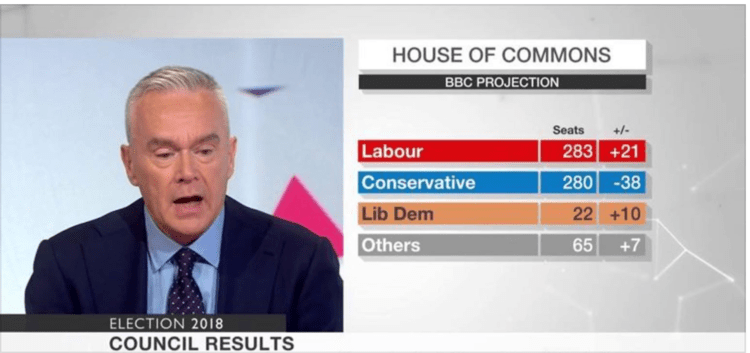
Yet, the recent Local elections in Britain proves that the Brits are strong people, not easily deterred by political terrorism. Despite the relentless campaign against the Labour Party and the vicious slander of Corbyn and his supporters, the Party didn’t lose power. In fact, Labour saw its best London results since 1971. A BBC statistical exercise that applied the local election results to a possible parliamentary election predicted that the Conservatives would lose 38 seats while Labour would gain 21!
The message to the Israeli Lobby is clear. Your game appears to be counter effective. Further, if these threats are viewed by the public as political terrorism they could lead to a backlash against British Jews and perhaps others. Despite your efforts, Labour voters stayed with Corbyn. By now they are likely frustrated by your relentless activity. The British are not blind to your lobbying, and how could they be? The Zionist pressure games are openly aired in public.
Replicated pride: British army gives junior soldiers scripts praising military life and pay
RT | May 6, 2018
Young soldiers’ pride at graduating from the British Army Junior Entry has recently –and literally– echoed across local media in the UK. However, the quoted soldiers appear to be reading from the same script.
Recent graduates from the Army Foundation College (AFC) in Harrogate enjoyed a parade to celebrate their completion of the Junior Entry military training programme.
Many of the teenage soldiers appeared in their local newspapers in articles focusing on the young soldiers’ positive experience with the training. On closer inspection, however, it appears that the entire experience leaves each young recruit feeling exactly the same. Word for word.
From Broomsgrove to Yarmouth, young soldiers were quoted as saying the following: “Graduating from AFC Harrogate in front of my friends and family is something that I am very proud of doing. As a junior soldier you learn core life skills such as leadership, teamwork and determination. I have made loads of friends and met new people, and have become much more confident in my own ability.”
“I’ve been paid really well for someone of my age and I’ve gained useful qualifications. I’m now looking forward to the next stage of my Army career.”
In one article featuring two local graduates, the soldiers share the talking points, with each taking half of the lines for themselves.
RT investigated local media articles featuring recent graduates and found variations of the same few sentences dating back as far as 2015. In many cases, aside from the repeated quotes, a couple of sentences were also repeated within the various articles. “Junior soldiers go on to become engineers, IT specialists, infantry soldiers, as well as more technical specialists,” is one example, as is the observation that, “unlike civilian jobs, the army pays junior soldiers a full salary.”
RT spoke to a graduate who explained that a couple of young soldiers from each platoon are chosen to be featured in the media.
“We spoke to the [army] press [people] and they gave us each a letter with the statement already on, they asked if we were happy with the statement and if we wanted to change anything but most of us just said it was okay and signed it,” the graduate told RT. “That quote that I apparently said definitely doesn’t sound like me!” they added.
RT has contacted the army and a number of the journalists who wrote the articles that featured the quotes. An army spokesperson told the Guardian the articles were not advertisements, but based on PR releases. “Junior soldier graduates volunteer to participate in these articles and are right to be extremely proud of their achievements.” it said.
“It’s still shocking, however, to see that this manipulation extends to dictating word-for-word statements for the press, and presenting these to the public as apparently spontaneous and free remarks,” Rachel Taylor, director of programmes at Child Soldiers International, told the Guardian.
The PR drive comes in the wake of the Harrogate army college being accused of assaulting and mistreating young recruits. Soldiers alleged they were punched, spat-at and told to eat manure, during a court hearing into their treatment.
The UK Army, as with many others around the world, has been accused of targeting young and disadvantaged people for recruitment. According to the Ministry of Defence, 22 percent of new recruits are under 18, as the UK is one of 19 countries that allow people to enlist at 16.
Hilarious fake Yulia Skripal twitter account (now deleted)
Niqnaq | May 6, 2018
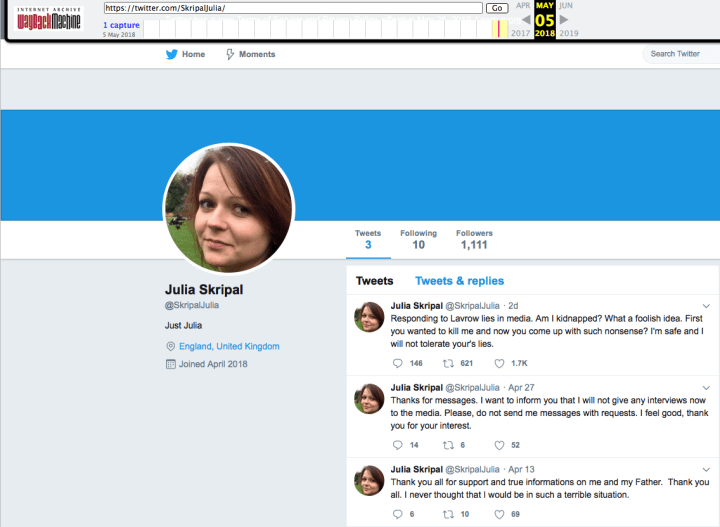
Would you believe that a twitter account purporting to be Yulia Skripal appeared 2 days ago & her first follower was The Washington Post ? The lies continue unabated. I challenged her to show her face & give us the grand interview the whole world wants to see. I got no reply.
— Maria (@mariabirchwood) May 6, 2018
Alexander Yakovenko (diplomat) slams British journalists over the Skripal case as he asks “what’s happening in the UK?”:
A Bucketful of Novichok
By Rob Slane | The Blog Mire | May 5, 2018
In my last piece, I wrote that one of the downsides of the probable D-Notice slapped on the Skripal Case was that we may well be deprived of our daily dose of farcical nonsense, such as whether the poison was administered in the restaurant, the car, the cemetery, the flowers, the luggage, the bench, the porridge, the door handle or – and I’m surprised nobody has thought of it yet – perhaps the cat. There is no doubt an FSB manual waiting to be found which explains how cats can be safely used as conduits for “Novichok”, and it has almost certainly been put together by the dashingly handsome, astonishingly intelligent, but inexplicably bitmapped ruthless ex-KGB assassin, “Gordon”, who was apparently a suspect a couple of weeks ago, but is no longer deemed a person of interest.
But despite the D-Notice, on the morning of 5th May it seemed that the torrent of patent absurdities was actually not about to cease anytime soon. In an interview with the New York Times, the Director General of the Organisation for the Prohibition of Chemical Weapons (OPCW), Ahmet Uzumcu, said the following:
“For research activities or protection you would need, for instance, five to 10 grams or so, but even in Salisbury it looks like they may have used more than that, without knowing the exact quantity, I am told it may be 50, 100 grams or so, which goes beyond research activities for protection.”
My immediate reaction was to ask why only 50-100 grams (which the New York Times helpfully tells its readers is between about a quarter-cup to a half-cup of liquid)? Why not a whole bucketful of Novichok, splashed indiscriminately over the front door of Mr Skripal’s house?
It is testimony to the truly uninquisitive minds of the dutiful stenographers at the New York Times and the rest of the media which ran with the same story, that none of them appear to have wondered to themselves something along these lines:
“Huh? 100 grams of military-grade nerve agent? Of a type said to be 5-8 times more lethal than VX, which itself has a median lethal dose of 10 milligrams. And we’re now apparently talking about 100,000 milligrams! And yet not only are the Skripals alive (well at least they were when last Yulia got hold of a phone) but the population of Salisbury seems to be doing okay as well. In fact no-one died (apart from the cat and the guinea pigs). Does Mr Uzumcu know what he’s talking about?”
My next reaction was to wonder whether actually he knows exactly what he’s talking about. But I’ll come back to that in a moment.
Anyway, later in the day, the OPCW issued a Statement on Amount of Nerve Agent Used in Salisbury, which read as follows:
“In response to questions from the media, the OPCW Spokesperson stated that the OPCW would not be able to estimate or determine the amount of the nerve agent that was used in Salisbury on 4 March 2018. The quantity should probably be characterised in milligrams. However, the analysis of samples collected by the OPCW Technical Assistance Visit team concluded that the chemical substance found was of high purity, persistent and resistant to weather conditions.”
As an aside, I’d love to know which media asked the questions. My guess is that it wasn’t any of those organisations who had repeated the claims made in the New York Times.
But what of the statement itself? Taken at face value, along with Mr Uzumcu’s original statement, it is very odd for a number of reasons:
1. Firstly, it says that the OPCW would not be able to estimate or determine the amount of the substance used. But of course this is exactly what Mr Uzumcu did appear to say, when he mentioned the quantities 50 and 100 grams.
2. Secondly, the statement says that the quantity should probably be characterised in milligrams. Not bucketfuls then? But of course the problem with this is that it does appear to leave Mr Uzumcu looking rather stupid, as if he:
a) Doesn’t know his grams from his milligrams and
b) Doesn’t realise that a cupful of military grade nerve agent 5-8 times more toxic than VX would kill people – like, lots and lots and lots of people
3. And thirdly, the milligrams for grams exchange completely undercuts the whole point Mr Uzumcu was making. He was saying that it appeared from the amount used that it could not have been produced in any old laboratory, as he had admitted a week before when he had said it could be produced “in any country where there would be some chemical expertise.” Rather, the point he was making was that quantities like 50-100 grams could only point to military production of the agent, rather than simply for research purposes.
This is all very bizarre. That’s hardly surprising, though, since there is almost nothing about this case that has not been extremely odd. From what I can tell, there are only really two possible explanations for this latest bout of strangeness.
One possible explanation is that Mr Uzumcu is simply incompetent, and so lacking in knowledge that he doesn’t know his grams from his milligrams, nor that half a cup of deadly nerve agent would wipe out hundreds, if not thousands, of people (not to mention being impossible to put on a door handle in the first place, at least not without the kind of protection that might just draw attention). However, this seems to me fairly unlikely. I assume that you don’t become Director General of the OPCW and remain in the position for eight years if you really are that inept.
But is there another more revealing explanation?
If you go back and read Mr Uzumcu’s statement, it is very noticeable that he does not actually state that he personally believes the quantity of the poison used in Salisbury was 50 or 100 grams. What he actually said is:
“For research activities or protection you would need, for instance, five to 10 grams or so, but even in Salisbury it looks like they may have used more than that, without knowing the exact quantity, I am told it may be 50, 100 grams or so, which goes beyond research activities for protection” [my emphasis].
It looks like they may have used more than that? From what does it look like that? From the months long, multi-million pound clean up job being undertaken, by any chance?
And of the quantity, he says he was told this. But the question is, who told him?
I can’t be sure, but my hunch is that he does know his grams from his milligrams; that he is well aware that 50-100 grams of the stuff would be enough to have killed the Skripals outright, along with hundreds or possibly thousands of others in the surrounding area; and also that he understands full well that the current multi-million pound clean up operation in Salisbury, which is precisely intended to give the impression that there was so much of the stuff that it might make up half a cupful, or perhaps even a whole bucketful, is something of a farce.
And so even though his original statement at first seems absurd, I’m fairly convinced that it was not a display of incompetence on his part. Rather, together with the subsequent clarification, it was very likely a signal that he believes his source for the claim to be either incompetent or – shall we say – economical with the actualité. And it may be that his real aim was – as diplomatically as possible – to let certain folks in Britain know that he’s not as convinced by some of their claims as they might like him to be.
Czech President’s ‘Novichok bombshell’ undermines London’s credibility in Skripal case
RT | May 4, 2018
The UK’s intelligence services seem to have lost all remaining credibility, after the Czech President’s admission that his country had previously produced a nerve agent similar to the one Britain claims was used against Skripals.
“I think there are problems in and around the English spy agencies, who seem to be quite ready to manufacture evidence, in the case of the Steele dossier, maybe manufacture evidence in the case of the Skripal poisoning. And they are damaging their credibility. It takes a long time to regain credibility if you damage it this severely,” political analyst Charles Ortel told RT.
On Thursday, the Czech Republic’s president Milos Zeman revealed that his country had previously developed and tested an A-230 chemical agent of the Novichok group, similar to the one which, according to London, was Russia’s exclusively and was “highly likely” used by Moscow to poison former double agent Sergei Skripal and his daughter Yulia in Salisbury on March 4.
The accusations were followed by sanctions against Russia and the expulsion of Russian diplomats from the UK and other countries that backed Britain’s stance. Ortel blamed the media for dangerously exacerbating the crisis without vetting the information coming out of London with due diligence.
“I think it is irresponsible the way supposed main street journalists leap on these stories without really vetting it and then get us into a place where tensions are escalated around the world, including two nuclear-armed powers Russia and the United States, and the third in the UK. This is a dangerous business,” Ortel said.
The claims of Russian involvement have not been backed up by either Britain’s own scientists at the Porton Down laboratories or by the Organization for the Prohibition of Chemical Weapons (OPCW), both of which say it’s not their job to apportion blame or to identify the toxin’s origin, but only the type of substance involved. Russia has also repeatedly denied the allegations and accused the UK of excluding it from the investigation, and of destroying evidence.
“I think it is a very dangerous business to start making accusations as serious as have been made in the case of Skripal, in the case of Steele… that are not actually backed up by hard facts,” the political analyst noted.
Baseless accusations, Ortel believes, could potentially ruin the career of British Prime Minister Theresa May, who, together with Foreign Secretary Boris Johnson, led the charge against Moscow. After all, Russia has repeatedly reiterated that a number of countries had the means to produce nerve agents of the Novichok group.
“Lots of countries have made these. There is probably at least a dozen countries that have the capabilities to make these persistent nerve agents. And it does not surprise me that the Czech Republic and many other countries could do this. The Czech Republic is very advanced in their chemical and synthetic chemistry ability. And many nation states could have done this,” chemical weapons expert and Rice University professor James Tour told RT.
“Britain is in a very dangerous place and they kind-of have to stick to their story and it is possible that, by sticking to this story, the May government may ultimately be sacked,” Ortel told RT. “So they are in a place where it will be very difficult for them to admit a mistake after all these weeks and after their strong positions and actions that so many governments took, our own included, the US in reliance mostly on UK analysis.”
Previously, Moscow pointed out that UK authorities themselves admitted that their lab in Porton Down was in possession of the nerve agent that poisoned the Skripals. In fact, many countries have been developing and testing the A-class nerve agents just to have them in their own arsenals or find ways to defend against them, Professor Tour explained.
“Many countries have made it in the past as part of a study of making the nerve agents. And many countries have made nerve agents if you want to study what persistent nerve agent could be like – something that is harder to detect, something that lasts much longer than a typical nerve agent like Sarin, Soman, or GF – then you want to be making these and understanding how they work. Sometimes countries make it just to learn how to defend against it. They might make it to learn how to build an antidote for it.”
See also:
UK, Slovakia, Sweden, Czech Republic among most probable sources of ‘Novichok’ – Moscow
We get impression UK govt is deliberately destroying evidence in Skripal case – Russian Ambassador
Dr Alexander Yakovenko, Ambassador to the UK – RT – May 3, 2018
On 4 March 2018 two Russian citizens Sergei and Yulia Skripal were reportedly poisoned in Salisbury, Wiltshire with the toxic chemical named A-234 under the British classification.
On 12 March Foreign Secretary Johnson summoned me to the Foreign and Commonwealth Office and said that Russia was “highly likely” responsible for the attack. He invited us to respond by the next day, whether this had been a direct act by the state or Russia had lost control over this nerve agent.
The incident had international repercussions, including expulsion of 150 Russian diplomats from 28 countries, notwithstanding the fact that the charges were based on assumptions and unverifiable intelligence. The Western countries lost the same number of Moscow-based staff. Meanwhile, the British government provided no evidence either to the public, its allies or Russia. Subsequent events revealed that no proof of Russia’s involvement existed. On 1 May, National Security adviser Sir Mark Sedwill confirmed that (despite a number of previous leaks) no suspect had been identified, a statement that speaks for itself.
Two months have passed since the poisoning and more than a month since Prime Minister May accused Russia of this crime. However, despite our numerous requests, we have not been granted access to the investigation. The FCO and the Metropolitan Police have refrained from contacts.
We have been denied consular access to our citizens in violation of the Vienna Convention on the Consular Relations and the bilateral Consular Convention. We are still unable to verify their whereabouts, health and wishes. Considering all the facts, we now have more reasons to qualify this situation as an abduction of the two Russian nationals. We will continue to seek the truth and demand answers from the British side.
We also get the impression that the British government is deliberately destroying the evidence, classifying all remaining materials and making independent investigation impossible. Sergei Skripal’s pets were incinerated without having been tested for exposure to nerve agents. Then a decontamination of the area was announced, which reportedly included destruction of potentially contaminated objects along with Sergei Skripal’s house, the “Mill” pub and the “Zizzi” restaurant.
The media coverage of the Salisbury poisoning is not as free as it should be. On 8 April it was reported that the National Security Council “had seized control” over the media response to the incident. On 18 April the media regulator Ofcom announced investigations into the RT channel regarding Salisbury. Is it a coincidence that no one has ever seen any photos of the Skripals since the incident, and no attempts have been made by the media to interview them? Hospital privacy and security might be an excuse, but it looks like the Skripals’ privacy is better protected than that of pop stars and even the Royal family.
The UK has also refused to interact with Russia in the OPCW. Instead of using the standard procedures, whereby Britain could have engaged Russia directly or through the OPCW Executive Council, the British government has chosen to cooperate with the OPCW Technical Secretariat under a classified arrangement. On 13 April Russia itself initiated Article IX of the Chemical Weapons Convention procedure to obtain a response to a list of questions to the UK submitted via the OPCW.
Replies received are unsatisfactory and don’t answer our legitimate and reasonable questions and thus don’t help establish the truth. As to the OPCW report, it clearly lacked impartiality as the OPCW-designated laboratories were given only one task, which was to check whether the nerve agent identified by the UK was present in the biomedical samples, and the samples were taken only in the locations designated by the British side.
Meanwhile, the UK is depicted, by the Conservative government, as the “leader” of the Western efforts to “hold Russia to account”. It seems that the Cabinet has no interest in functional bilateral relations, which have reached a new low since the Salisbury poisoning. Russia is again presented as a “cyber threat” and the British public is being prepared for a massive cyber attack against Russia, which would purport to be retaliatory by nature, but in fact would constitute an unprovoked use of force. The Foreign Office has ignored the Russian offer for consultations on cyber-security.
Nevertheless, every day the Embassy receives letters from the British public with regrets over the current official policy towards Russia. People fail to understand how it is possible to blame Russia without any proof or evidence being presented to the international community. This contradicts the British tradition of open and fair work of judiciary. Many believe that this policy is rooted in the anti-Russian sentiment within the current Conservative government.
The Embassy has published a report “Salisbury: a classified case”, which summarizes the sequence of events and Britain’s and Russia’s positions. I invite the British side to give it a thorough consideration. The list of questions to the British government is constantly growing. What we demand in the first place is transparency.
Dr Alexander Yakovenko, Russian Ambassador to the United Kingdom of Great Britain and Northern Ireland, Deputy foreign minister (2005-2011). Follow him on Twitter @Amb_Yakovenko.
Featured Video

AIDS Inc. by Gary Null (2007)
or go to
Aletho News Archives – Video-Images
From the Archives
Clash of Civilization, Iran Part II
By Jamal Kanj – Intifada-Palestine.com – January 14, 2011
Israel’s survival kit is: perpetuate conflict, insecurity to rationalize collective hate and finally playing victim.
Devoid of conflict, Israel implodes internally; without hate, Zionism loses its justification; and playing eternal victim to continue blackmailing the West. Absence of this holy trinity, Israel ceases to exist.
From its inception, the house of Zion has mastered exploiting adversarial powers to advance Israel’s cause. For instance, their influence over the Democratic Party in the US began with President Truman’s bid for 2nd term election in 1948.
Responding to strong opposition from Secretary of State General George Marshall and Department experts urging against recognition of Israel, President Truman replied: “I’m sorry gentlemen but I have to answer to hundreds of thousands [Jewish voters] who are anxious for the success of Zionism. I do not have hundreds of thousands of [voting] Arabs among my constituents”
Zionists influence over liberal American politics was matched with the doctrinal school of Conservative theoreticians aligning the Republican Party’s platform with Israel’s objectives. The Neoconservative Zionists, coined Zioncons, invented the “Clash of Civilization” concept to fight Israel’s wars. … continue
Blog Roll
 Aletho News
- 12 Things Your Psychiatrist Was Trained Not to Tell You
- From Unipolar Universalism to Multipolar Civilizational Distinctiveness
- RSF military group defects, joins Sudanese army: State media
- Ireland goalkeeper refuses to play ‘Israel’ as squad weighs boycott
- China pushes back against US on Cuba, Iran
- Ukrainian Soldiers, Potential Mercenaries: Have Gun, Will Travel!
- Burnham’s UN debut… A masterclass in British disinformation
- Iran flights continue despite US aviation sanctions
- Global Tipping Points Lead the World Into a State of Entropy
- The day-after at the White House: USA and Xi Jinping
- If Americans Knew
- Israel forces Gazans to live in constant peril – Daily Update
- Deconstructing Netanyahu’s pants-on-fire UN rant – Daily Update
- Trump betrayed voters with his campaign lies and prioritized a foreign country once he took office
- Netanyahu calls Israel’s war in Gaza ‘opposite of genocide’ in UN speech to near-empty hall
- Settler Kidnappings: Torture, Sexual Abuse and Terrorisation of Palestinian Abductees as Israel Deepens Annexation of West Bank
- Gaza winter nears as 162,000 tents become unusable, raising fears of humanitarian crisis
- Netanyahu says, “It’s the opposite of genocide”; UN says Gaza economy is world’s ‘most severe crisis on record’ – Daily Update
- Israel’s US-Backed Assault on Gaza Has Created the ‘World’s Most Severe Economic Crisis on Record’: UN
- ‘Protecting U.S. Citizens’… From Israel
- ‘This is where I live now, the back of a truck’: a day in the life of a grandmother in Gaza
- No Tricks Zone
- New Study: Earth And Venus Surface Warmth Largely Explained By Convection And Lapse Rate, Not CO2 Or Radiation
- 2025 Nature Paper Claiming Worsening Global Drought Gets RETRACTED …Heavily Flawed
- New Study: ‘Global Drought Shows No Detectable Recent Acceleration Under Climate Warming’
- Economic Masterminds: German Socialists Suggest Taxing Productivity Gains Stemming From Using AI
- The South China Sea Has Not Been Cooperating With The Climate Change Narrative
- Energy Crisis: Germany Enters Heating Season With Historically Low Gas Reserve Fill Levels
- New Study: The Antarctic Ice Sheet Gained Mass From 2020-2024 Due To Staggering Snow And Ice Accumulation
- Study: Ocean Heating Rates From Thousands Of Years Ago ‘Dwarf’ Modern Ocean Heating Rates
- Climate Extremists Target, Attack Large-Scale Power Grid Infrastructure In Germany!
- New Study: Antarctic Ice Melt Has Contributed Less Than 1 Centimeter To Sea Level Rise In The Last 30 Years

