From the Skripals to Douma, the Globalist Pravda Network Reveals its True Face
By Rob Slane | The Blog Mire | May 2, 2018
People living in the Soviet Union had a wonderful phrase to describe the two biggest circulation state-controlled newspapers, Pravda (meaning “truth”) and Izvestia (meaning “news”). There’s no truth in Pravda and no news in Izvestia, was the oft-repeated expression. It is unfortunate that the mainstream media in the Western nations these days don’t have similar sorts of names, since it deprives us of an endless source of amusement in coming up with similarly apposite phrases about them.
It is, however, increasingly clear that on the great issues of the day, you are about as likely to find the truth in them as you would have done in Pravda, although I expect their sports and gardening sections are still relatively reliable. As for the important political and geopolitical issues of the day, I tend to imagine that on the walls next to the desks in the offices of many of these papers and broadcasters are the following instructions:
Rules for Reporting on Global Affairs
- Repeat Government line unquestioningly.
- If Government line is questioned, accuse those doing the questioning of being Bots, Kremlin-trolls and useful idiots.
- If the persistent questioning won’t go away and the Government line is seen to be contradictory and full of holes, bury the issue completely and start posing deep questions, such as “What will Meghan wear?” or “Is there a gender pay gap in midwifery?” or “How much sugar is really bad for you?”
The Skripal and Douma episodes have demonstrated this perhaps more than any others. First the Government line has been dutifully parroted by the media in a relentless propaganda campaign — no questions asked. Then there have been attempts to silence or ridicule those who didn’t bow to the parrots and who were asking legitimate questions — including the appalling treatment meted out to distinguished military men. And finally, both issues now appear to have been “disappeared” down the Memory Hole, apparently to be forgotten forever and ever.
This last point is so obvious in the Skripal case that it has caused some to speculate that the British Government has slapped a D-Notice on the case (this is a formal notice to the media to limit their coverage of the story on grounds of “national security”). I can hardly help thinking of that without giving a horse laugh. A D-Notice to stop the media reporting on the case on the grounds of national security? What’s funny about it is that all the media has done since day one of the case is to endlessly repeat the Government line on absolutely everything, even when that line became so utterly ludicrous that believing it required one to hold a number of contradictory and irreconcilable thoughts in one’s head at the same time.
In other words, if there is indeed a D-Notice on the issue, which seems very likely given the fact that there is now almost zero coverage of the case in the British media, it can have nothing to do with national security, per se, since from the get-go it was clear that the media had no interest in investigating any of the claims made by Government. The Government line was perfectly safe from being questioned by those who are apparently not able to report on it now, and so one can only conclude that it is because the Government line is so obviously full of holes that reporting on it needed to be stopped, lest increasing numbers of rational people recognised it to be somewhat barking.
It’s a shame really. I began to look forward to seeing what each day’s new dose of cock and bull would bring forth. They were poisoned at the restaurant. No the car. No the cemetery. The flowers. No, it was in the luggage. No, the bench. No, it was porridge. No, no, no! It was on the door handle, and it was liquid, which although tending to be runny, remained there for three weeks, even in all that rain and snow, in highly pure form, and you know the amazing thing is that people without protection stood just feet away from it, and they are fine. Whoda thunk it? But it is military-grade nerve agent “of a type developed by Russia” nonetheless. Seriously guv.
Oh and they’re in a coma. Sergei and Yulia, that is. Like to die they are. A judge will probably have to take the decision to switch off their life support. Oh hang on, Yulia’s on the phone. Yes of course she is. She’s fine. Sorry we forgot to mention that before when we were talking about the life support machine. And Sergei’s okay too. Yes we can confirm that. Sorry we didn’t mention that before either. But he’s unable to talk. So you won’t hear from him. Or her. He’s in the hospital, though. Probably. Don’t know where she is. Not to be disturbed though.
Oh and there’s the policeman at the bench. Sorry, we meant the house. The house and the bench. Which one? How on earth should we know? Both probably. At the same time. But he can’t talk either.
What is particularly funny is that according to Mark Sedwell, the UK’s National Security Advisor, certain classified information – such as the apparent door handle delivery method – was released in order to “counter Russian disinformation”. Ah so it was Russian disinformation that took us from the restaurant to the car to the cemetery to the flowers to the luggage to the bench via the porridge and finally (finally???) to the door handle (I say “finally???” only because nobody has yet suggested the cat as the conduit for the poison)? So it was Russian disinformation that tried to sell us the idea of a slow-working, lethal yet non-lethal, military-grade nerve agent that enables its victims to go to restaurants, make them hallucinate and then be as right as rain a few weeks later? So it was Russian disinformation that told us that after studying hours of CCTV footage, British intelligence had a suspect in the case – the dashingly handsome, astonishingly intelligent, and diabolically ruthless former KGB agent, codenamed “Gordon” or was it “Cecil” or “Squiffy” or something, with a penchant for martial arts and (who can doubt) fast cars and loose women – only for Mark Sedwell to tell MPs a week later that there is no suspect, there never has been a suspect, and the investigation has been hampered by lack of CCTV footage?
Russian disinformation? Alas no. It was the UK media wot did it. They managed to put about more disinformation, stuff and nonsense, and cock and bull in a month or so than 10,000 “trolls” working 16 hour shifts in a basement in St. Petersburg could have done in a decade. And so you can see why the Government might want to slap a D-Notice on it, can’t you? Except that it should obviously be a C-Notice, the C standing for Comedy.
As for Douma, the media excelled itself there as well. There we have three Governments, apparently dropping bombs on chemical weapons depots in response to an unproven chemical weapons attack, and not one journalist in the mainstream media thought to say, “Hang on a minute! You dropped bombs on what you thought was a chemical weapons depot? Isn’t that … em … a tad on the dangerous side? Toxic fumes and people in the surrounding area becoming contaminated and all that?”
And when nobody became contaminated, not one mainstream media journalist thought to ask, “Hang on a minute! Isn’t the fact that there was no release of toxic substances into the atmosphere when you bombed it sort of like evidence that … em … how can we put it … there weren’t any toxic substances there?”
And when one of the little boys and the doctors in the “chemical attack” video that the Western Governments used as a pretext to bomb a sovereign country and spook us into wondering whether WWIII was about to start — when they turned up alive and well in The Hague to testify that there was no chemical attack, did even one mainstream media journalist think to themselves, “Maybe it would be good to hear what they have to say, since they were there?” Alas no. Some moved onto number 2 in the Rules for Reporting on Global Affairs, denouncing with barely concealed fury the testimony of the very people who had appeared in the original video that had once seemed so persuasive to them, whilst others moved onto number 3, and started talking about what Kim Kardashian has been up to lately.
It is clear that there is a deep sickness at the heart of the media. The whole point of its existence is to investigate incidents, to go where the facts lead it, and to serve ordinary people by attempting to report and reveal what is true. And above all that, it is to act as a check on the overweening state, so that it does not feel that it has carte blanche to do whatsoever it wishes.
But the handling of these two major cases has shown perhaps more than ever before that it has no intention of doing these things. It will not investigate, it has no intention of revealing inconvenient facts, and it cares little for the truth. And above all, instead of acting as a break on the state and on Government recklessness, its chief concern now appears to be doing the bidding of a very powerful group of Globalists, defending and advancing their diabolical agenda, regardless of what is and what isn’t true.
What should we call such a media that seems to have little or no regard for the truth, and which collectively serves the interests of the Global elite? Mainstream? Globalist Pravda Network seems to me to be a more accurate description.
Living in an Orwellian Dystopia
By Gilad Atzmon | May 3, 2018
It is puzzling to witness the speed and ferocity with which Britain is deteriorating into an Orwellian nightmare.
The Evening Standard reported yesterday that “a London council worker has been suspended after being caught claiming Zionists ‘collaborated’ with the Nazis.”
Apparently Stan Keable was removed from his duties as an environmental enforcement officer for Hammersmith & Fulham Council after saying, “The Nazis were anti-Semitic. The problem I’ve got is the Zionist government at the time collaborated with them. They accepted the ideas that Jews are not acceptable here.”
Keable made the comments, shared in a clip on Twitter, at a pro-Corbyn demonstration outside the Parliament. I guess that in Britain 2018 you can lose your job simply for expressing an opinion.
It seems that some British Jews are disturbed by parts of their history. They try to suppress any speech about the Haavara Agreement. Former London mayor Ken Livingstone was suspended from the Labour Party for mentioning that collaboration between Hitler and Zionism. And disturbingly, in the Labour Party’s discussion of Livingstone’s case the party general secretary, Iain McNicol, “made it clear in a letter to the former mayor that the case against him was not about the historical facts, but whether his conduct was ‘grossly detrimental’ to the party…” *
The Transfer (Haavara) Agreement between the Nazi regime and the Palestine Zionist leadership is an accepted historical fact. In his superb book, Final Solution, the British Jewish Historian David Cesarani examines the agreement and he quotes German Zionist voices that approved of the Nazi regime and even welcomed the Nuremberg Racial Laws because they pushed for segregation. But evidentiary truth is not a defence in Britain 2018. I guess this disregard for truth is just another symptom of our removal from the Athenian ethos.
Conservative MP for Chelsea & Fulham, Greg Hands, said: “I am shocked someone expressing hateful opinions could have a job meeting vulnerable tenants. The council leader should launch an inquiry into whether there are others of his ilk in the council.”
I can’t see a drop of hatefulness in Keable’s comment. But I would like to advise the conservative MP and other ignorant Tories that while the Haavara Agreement was signed as an attempt to save German Jews, the Conservative Government here in Britain did little for German Jews and other Jewish refugees.
Mike Katz, of the Jewish Labour Movement, said: “To try to twist the history of the Nazis to fit an anti-Zionist narrative is offensive.” It may be offensive but the Haavara Agreement and the collaboration between Zionist organisations and Nazi officials from 1933 till the end of the war are part of Jewish history and political terrorism will not wipe out that history.
When contacted by the Standard, Mr Keable said: “I am sorry for any offence I may have caused. But the Nazi regime and the Zionist Federation of Germany collaborated, through the Haavara agreement, in the emigration of some 60,000 Jews to Palestine between 1933 and 1939.” He said he did not insinuate that Jews collaborated with the Nazis.
The Skripal Case and Bombing Syria: Six Things We Learned About Modern Britain
By Neil Clark | Sputnik | May 3, 2018
To have been in ‘democratic’ Britain for the past eight weeks has been quite an educational experience.
We’ve seen how the NeoCon Establishment works, how dissent is policed, and how ‘gas-lighting’ techniques are used to try and make us think we’re going crazy for questioning the ‘official narrative’ — a narrative which we know just by employing simple logic, doesn’t make sense.
Here’s a list of the most important things we’ve learnt- that’s if you weren’t aware of them already.
1. The presumption of innocence doesn’t apply to NeoCon targets.
Innocent until proven guilty? Not if you’re in the line of fire of the Endless War Lobby, comrade. Russia was accused of trying to poison the Skripals before a proper criminal investigation had even begun. The Syrian government was blamed for a chemical weapons attack, before we had independently verification that a chemical weapons attack had even taken place. The ‘Official Narrative’ on both cases has unravelled spectacularly. No ‘smoking gun’ evidence of either Russian involvement in the Skripal case or of the Douma CW attack has been produced. On the contrary, witnesses testified last week at The Hague that the Douma attack didn’t happen.
But we’re expected not to notice — as the news cycle — conveniently for the accusers- moves on to other stories.
2. Rupert Murdoch’s Times newspaper plays an utterly pernicious role in British public life.
It was the Times which demanded action from Theresa May against Russia. It was the Times which has demanded (repeatedly, and again after the Skripal incident) that Ofcom acted against Russian media in the UK, such as RT. It was the Times, which accuses Russian media of peddling ‘fake news’, which reported Sergei Skripal as dead on its 12th March front page.
It was The Times which, on 14th March, falsely reported that ‘almost 40’ people had needed treatment in Salisbury, prompting Dr Stephen Davies, Consultant in Emergency Medicine to write to the paper stating ‘May I clarify that no patients have experienced symptoms of nerve agent poisoning in Salisbury and there have only ever been three patients with significant poisoning.’
It was The Times, which on the day the US/UK and France launched illegal attacks on Syria in response to the unverified chemical weapons attack at Douma, carried a front page attack on British academics who dare to challenge the War Party line on Syria. It was The Times which smeared other critics of western foreign policy as ‘Russian trolls’, including a peace campaigner from Finland who had been battling cancer.
John Wight has called the Times, the in-house organ of the neocon Henry Jackson Society. Its days as Britain’s respected newspaper of record have certainly long gone.
3. Britain is only what is called a ‘Democracy’.
Just think back to that Parliamentary debate on 14th March. Labour leader Jeremy Corbyn was attacked from his own side, for his cautious approach towards the government’s unproven claims about the Skripal case. To add insult to injury a number of Labour MPs then signed Early Day Motion 1071 – which stated ‘This House unequivocally accepts the Russian state’s culpability for the poisoning of Yulia and Sergei Skripal’. Labour’s Shadow Defence Secretary Nia Griffith showed her support for Theresa May by saying ‘We very much accept what the Prime Minister said.’ Corbyn, coming under enormous Establishment pressure did buckle, saying the Russian authorities ‘needed to be held to account’, even though later he still quite rightly insisted that ‘absolute evidence’ was needed.
In bombing Syria on 14th April, Theresa May not only refused to recall Parliament, she also ignored public opinion which showed only 20% in favour of air strikes. In a genuine democracy that would have ruled out action. But May treated public opinion with utter contempt. That wonderful passage from ‘The Comments of Moung Ka’ by the Edwardian comic writer Saki springs readily to mind.
‘The people of Britain are what is called a Democracy’ said Moung Ka. ‘A Democracy?’ questioned Moung Thwa. What is that?’
‘A Democracy’ broke in Moung Shooglay eagerly, ‘is a community that governs itself according to its own wishes and interests by electing accredited representatives who enact its laws and supervise and control their administration. It’s aim and object is government of the community in the interests of the community’.
‘Then’, said Moung Thwa, turning to his neighbour, ‘If the people of Britain are a Democracy -‘
‘I never said they were a Democracy’, interrupted Moung Ka placidly.
‘Surely we both heard you!’, exclaimed Moung Thwa.
‘Not correctly, said Moung Ka; ‘I said they are what is called a Democracy’.
4. The ‘free press’ doesn’t act as you’d expect a ‘free press’ to act.
The striking thing about the Skripal case and Syria bombings from a journalist’s point of view has been the uniformity of the media coverage.
Right-wing papers like the Telegraph and liberal ones like The Guardian have taken exactly the same stance ie anti-Russian and anti-Syrian government. Whether its because of DSMA-Notices (see 6, below), or not, there’s been no proper questioning of the UK government’s claims about Salisbury — and not much on Syria either. Investigative journalism? What’s that?
The mainstream media is actually less diverse in its opinions now (on the things that really matter) than at the time of the Iraq war where publications like the New Statesman (now a ‘centrist’ Blairite organ), spoke out strongly against intervention. If you want a different perspective on Skripals and Syria you have had to tune in to Russian media, such as Sputnik and RT, and that of course is threatened by the NeoCon Thought Police, who want everyone to be singing from the same pro-war hymn sheet.
5. The role of the security services in the promotion of ‘official narratives’ is very important.
Every time a wheel has come off the Skripal narrative, we’ve been fed information to bolster it from ‘official sources’. After the head of Porton Down said that the laboratory there was unable to confirm that the nerve agent allegedly used to poison the Skripals came from Russia, the line was pushed that ‘intelligence-led assessments’ pointed to Russian guilt. Could we see these ‘assessments’? Of course not! We just have to believe that they’re there. Then as the ‘nerve agent placed on the door handle’ theory began to gain a head of steam we were told that ‘British Intelligence’ had ‘evidence’ that Russia had been testing the nerve agent on door handles prior to 3rd March. Could we see this ‘evidence’? No, of course not.
Alex Thomson of C4 News reported on 12th March that a ‘D-Notice’ had issued by the UK authorities to stop the media from fully identifying Sergei Skripal’s MI6 handler who lived nearby.
Were other DSMA-Notices issued too regarding the reporting of Salisbury? If it was so clear that Russia did it, why would they bother?
6. The British public aren’t mugs (or sheep).
Despite all the propaganda, all the hysterical headlines, all the blatantly biased coverage, the British haven’t bought it. Literally or metaphorically. Inside the Tent gatekeepers have relentlessly attacked those brave individuals who have questioned the official narratives, but its these individuals- smeared as ‘crackpots’ and ‘conspiracy theorists’ who the public are turning to for their analysis. Compare the number of retweets the former UK Ambassador to Uzbekistan Craig Murray gets when he publishes on the Skripal case, with those who try and denigrate him. My own Twitter following has increased by several thousands since early March. Citizen Halo got a big boost in followers after she was smeared by The Times. After the lies told about Yugoslavia, Iraq, Libya people no longer tamely accept what the NeoCon Establishment tells us. We’re at an ‘Emperor’s New Clothes’ moment in British politics where more and more people have found the courage to say out loud ‘The Emperor has no clothes!’. The elite have been lying to us and they know that we know they’ve been lying. The question is: what are we going to do about it?
Support his AntiStalker Legal Fund (vs. a Times journalist)
Gavin Williamson wants YOU in the Army Reserves to fight Russia in the fake news wars!
RT | May 1, 2018
If you’re a reporter or a computer geek, then Gavin Williamson wants you to help him in the war on fake news. The UK defense secretary issued to a call to arms to tech and communications experts to fight the cyber propaganda war.
Williamson has called on those with IT or cyber skills to join the UK’s reserve forces to help end the Russian “age of disinformation,” arguing they can “change the narrative” with tech skills that are “more relevant today than anything else.”
In an interview with The House magazine, set to be published later in the week, Williamson said that the reserves need to come up with ways to get the private sector more involved in encouraging people to join the reserve forces.
The secretary argued that army recruitment should be about “looking to different people who maybe think, as a journalist: ‘What are my skills in terms of how are they relevant to the armed forces?’
“They are more relevant today than anything else, having those skills, whether it be journalists, those people with amazing cyber and IT skills, those people with the ability to really understand about getting messages across.”
Williamson said the armed forces need the next generation for a new approach to fight ever-changing modern warfare. “We have to start changing the armed forces in terms of actually attracting those people as well,” he said. “Sometimes people see the armed forces as being quite traditional in terms of its approach. But in this disinformation age, this cyber-age – people often look at cyber as something that’s separate. Actually, it’s completely relevant to every other different part of our services.”
Williamson once again compared tactics used by Russian ‘internet trolls’ to Nazi propaganda, saying in March that it “completely distorts the narrative of what people think about things… effectively the Lord Haw-Haws of the modern era”.
The defense chief has made his feelings about Russia very clear in the past. He previously told Russia to “go away and shut up” following the chemical attack against the Skripals. In January, he was accused of fear mongering after warning that Russia could kill “thousands and thousands” of Brits, “creating total chaos within the country.”
A report from the National Audit Office found the number of full-time military personnel was 8,200 people short of the required level. There is also a 26% shortfall in the number of intelligence analysts.
Yemen conflict: Secret documents suggest 7,000 UK personnel may be complicit in Saudi slaughter

House destroyed in airstrikes in Sanaa, Yemen, on April 19, 2018. © Mohammed Dhari / Global Look Press
RT | May 2, 2018
To what extent is the UK aiding the Saudi intervention in Yemen? A new report suggests help is more hands-on than just defense deals.
Never seen before documents published as part of a new paper titled ‘UK Personnel Supporting the Saudi Armed Forces – Risk, Knowledge and Accountability’, suggest that some of the functions carried out by British personnel and arms companies in the Gulf kingdom may be more than what the Government is willing to admit.
According to the report, British arms deals to Saudi Arabia dating back to to 1985 have contained secret support clauses for British-made aircraft which tie British contractor and government personnel to Saudi military action, even if the UK is not itself involved directly.
These aircraft, namely Panavia Tornado and Eurofighter Typhoon fighters, have been conducting continuous airstrikes against targets in Yemen since the country erupted into civil war in 2015, with strong claims made by human rights organizations that war crimes are being conducted, including the use of cluster munitions.
A recent strike, on April 23, hit a wedding party where 20 civilians were killed. Since the Saudi-led intervention began and the end of 2017, some 5,500 civilians have been killed with over 9,000 injured, according to the UN. The country’s infrastructure has completely collapsed.
In December last year, the European Parliament adopted a resolution to suspend arms sales to the country on the back of these alleged charges.
Based on two years of interviews with former staff by Mike Lewis and Karen Templar, with support from the Joseph Rowntree Charitable Trust, the paper is part of a wider ‘Brits Abroad’ project which examines the role of UK nationals operating outside the UK to contribute military and security services in armed conflicts.
While Whitehall has maintained that UK personnel currently stationed in Saudi Arabia have been away from any frontline roles including the targeting or weaponizing of British-made aircraft used in Yemen, terms contained in secret government-to-government contracts dating from 1986 still dictate British help to the Royal Saudi Air Force when the kingdom is at war.
The report puts the UK’s human ‘footprint’ at approximately 7,000 UK contractors, UK civil servants and seconded UK military personnel.
Al-Yamamah & Al-Salam
Attached to 1985’s infamous Al-Yamamah arms deal, which included the purchase of 72 Tornado fighter aircraft, a Memorandum of Understanding (MoU) signed by both nations contains assurances that London’s support of the aircraft would continue “as long as the program lasts.”
Another 48 Tornado were added in 1993, and support was extended again under the Saudi British Defence Cooperation Programme (SBDCP) from 2006 onwards.
In 2005, the Al-Salam arms deal covered the delivery of 72 Typhoon fighter aircraft – built by the Eurofighter consortium which includes British firm BAE Systems – and came with a full support package.
From the Gulf War to Yemen
During the first Gulf War in 1990, BAE employees in Dhahran – now King Abdulaziz Air Base – directly maintained and loaded weapons for both RAF and RSAF Tornado aircraft. One former BAE Crew Chief at Dhahran, quoted in the report, claimed to the UK Ministry of Defence that “it was left up to literally a handful of us experienced ex-RAF personnel to direct combat ground operations” during the conflict.
Since then, BAE have been more reluctant to give such support to Saudi military excursions that does not directly involve the British military. In 2008 it issued a “pullback” from direct handling of cluster munitions in 2008, followed in 2009/10 with resigning from directly operational roles in squadrons engaged in active combat upon the start of Riyadh’s offensive in Yemen.
However, this “pullback”, British expats who worked as armorers and technicians claim, remained incomplete and British staff were still expected to carry out armoring tasks of aircraft and support ground activities.
Others took on maintenance and weapons management functions during night-shifts and back-shifts, furthering the blurring of advisory and operational roles, while others, there to train Saudi maintenance crew, took on deep maintenance of warplanes involved in strikes against Houthi rebels when Saudi staff were too few or off shift.
As recent as February 2017, job specifications released by BAE show that its employees “continue to be responsible for coordinating maintenance for the weapons systems of all RSAF’s Tornados, both in training and operational squadrons, and including those deployed to Forward Operating Bases.”
Skripal attack: Still no suspects, admits UK national security adviser but still blames Russia
RT | May 1, 2018
British police still have no suspects in the Skripal poisoning investigation, the UK’s national security adviser has admitted to a committee of MPs, despite the government continuing to place blame squarely on Russia.
Former Russian double agent Sergei Skripal and his daughter Yulia were found slumped on a bench in Salisbury on March 4. They were both taken to hospital in a critical condition after apparently being poisoned by nerve agent A-234 (‘Novichok’). Yulia Skripal has since left hospital.
Sir Mark Sedwill, who co-ordinates the work of MI5, MI6 and GCHQ, conceded to the Defence Select Committee that the UK is yet to identify the source of the agent used against the Skripals, or even a suspect in the case.
Britain publicly continues to directly blame Russia for the attack, but when asked whether anyone had been identified as being responsible for the poisoning, Sedwill said: “Not yet.”
Among the reasons given for the failure to identify a suspect is a lack of CCTV footage from Salisbury, despite the police saying they had collected thousands of hours worth of footage, and Britain having a reputation as being one of the most surveilled nations on earth. The Guardian reports that known Russian spies in Britain have also been ruled out after an investigation.
Sedwill explained that Russian defectors are also being monitored saying: “The police, who are responsible for protective security and the various agencies alongside them, are reviewing the security of all people who might be vulnerable.”
Britain has said only Russia could be responsible because the nerve agent used had been produced in the Soviet Union. However, ‘Novichok’ has reportedly been reproduced in other countries since, including in Iran in 2017.
The international chemical weapons watchdog, the Organization for the Prohibition of Chemical Weapons (OPCW), however, has repeatedly claimed it cannot identify the source.
Sergei Skripal, 66, a former military colonel who betrayed dozens of agents to British intelligence agency MI6, had been sentenced in 2006 to 13 years in a Russian prison for spying. But he was openly living under his real name in the UK after he was released as part of a spy swap between the US and Russia in 2010.
Russia has consistently denied being responsible for the poisoning, accusing Britain of making allegations without evidence and denying access to the Skripals despite both being Russian citizens.
Corbyn should learn his lesson: compromise with the devil is not an option
By Kit Knightly | OffGuardian | April 30, 2018
There are two kinds of compromise: the strong compromise, and the weak.
The former is where you cede an interest to uphold a principle, the latter when you ignore your principles to further your interests.
The first is an important tool in all aspects of life, the second should almost always be avoided. Jeremy Corbyn should learn that lesson.
Twice in recent weeks Corbyn’s leadership has faced an opportunity to cede a point of principle in order to further – as they apparently see it – the interests of their party. Both times they have done so, both times were a huge mistake.
Antisemitism
The first question is: What does “Antisemitism in the Labour party” actually mean?
Let’s start by acknowledging what it isn’t. Criticising the government of Israel is not antisemitic. Supporting Palestine in its struggle for emancipation and justice is not antisemitic. Opposing George Soros’s neoliberal crusade through his various NGOs is not antisemitic. Accusing a Blairite MP (who happens to be Jewish) of working hand in hand with the right-wing press to undermine Corbyn is not antisemitic. Claiming Hitler was a “Zionist” may or may not be accurate, but it is not antisemitic. Even supporting the freedom of expression for a painter who makes a mural about the 1% that some third parties allege might appear to represent unflattering images of Jewish people (even though the artist denies it completely) is not antisemitic, unless specific intents can be established.
When we remove all these non-antisemitic incidents from the list of alleged “antisemitism” in the Labour Party, how much real antisemitism remains?
Very little to none would seem to be the answer. You might even argue there is less antisemitism within the Labour party than within the general population. Certainly there’s little evidence of any more. Ken Livingstone shows no signs of being antisemitic. Nor does the latest victim of the latest purge – Marc Wadsworth.
Wadsworth – a veteran anti-racism campaigner – has been expelled from the party for notionally being racist (it was actually “bringing the party into disrepute”, the evidence of racism was so little they couldn’t even officially call it that). He has been effectively sacrificed to appease the state-sponsored and state-supporting media in the UK.
This is a terrible mistake. By conceding this point of principle in order to gain a perceived strategic advantage Corbyn’s team have in fact conceded both principle and strategy to a force that has no interest in compromising with them and simply wants them gone. The result is this:
1. Labour’s right-wing, (who DO, demonstrably, work “hand in hand” with the anti-Corbyn press), have been allowed to define what “antisemitism” means, and they are going to take full advantage of this. From now on, any Labour MP or even grassroots member who criticises Israel’s genocide against the Palestinians – or who simply disagrees with another Labour member who happens to be Jewish – can look forward to being shamed and expelled. How does Corbyn see this as furthering the cause of freedom and democracy?
2. They have accepted the lie as truth. A man has been expelled for antisemitism. Even though the grounds are spurious, it will in future be cited as evidence that the left does indeed have a problem with antisemitism.
Corbyn’s team decided to play soft and weak, in the hopes that letting a little blood would sate the thirst of the media. But you don’t abate a feeding frenzy by chumming the water. You don’t compromise with the devil by selling a piece of your soul. They have made it immeasurably worse. Livingstone and Walker will follow, and slowly Corbyn’s allies in the party will be chipped away.
Russia
The same exact process is playing out with the “Russian interference” situation. When the first accusations of being “soft on Putin” were thrown around, the strong principled position to take would be to dismiss the smears as racist and stupid. Argue the issues, ignore the white noise of smear and innuendo.
Corbyn’s principles, and those of the Labour party, dictate that they should stand against prejudice, abuse, censorship and summary justice.
They COULD have made statements that RT is just as valid a medium to be interviewed on as the BBC or CNN. They could have pointed out that Russian money in London is fleeing Putin’s crackdown on the oligarchs. They could have stood by the truth, and to hell with what the press say.
Instead Corbyn’s camp saw a chance to score some easy points in the media. McDonnell decided to publicly denounce RT, whilst the “leftwing” press tried to attack the Tories for their “dirty” Russian donors. Instead of saying “this campaign of demonising Russians is degraded & offensive”, they said effectively “Yes, Russians are demons, but they like the Tories more than us!”
This is potentially a more egregious mistake than the antisemitism issue. Firstly, it endorses the quasi-racist idea that all things Russian are inherently tainted with evil. Secondly, it undermines RT, an important voice for alternative politicians in the UK. And it opens the gates to this:
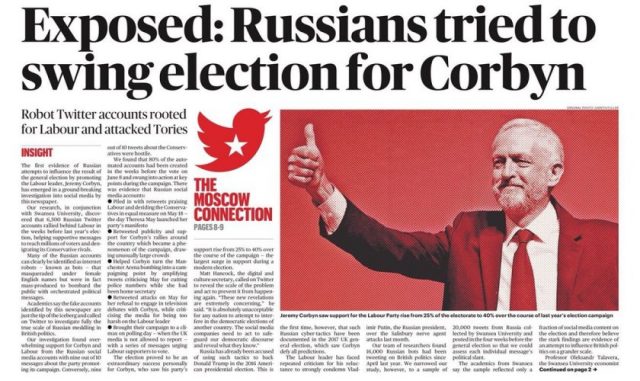
Headline in the Sunday Times, April 29 2018
This is the most predictable headline I have ever seen. It’s more predictable than sunrise or the tides or the waning moon. It was destined from the moment of his first leadership victory. And Corbyn has no one to blame but himself.
By allowing the “Russiagate” hysteria to blossom without challenge, by allowing the memes of “dirty Russian money” in London, and the “Russian influence” of the Brexit vote to go unchecked, Corbyn has encouraged the climate where people can be “denounced” in true McCarthyite fashion. And now he is paying the price.
Corbyn seems to think a few little compromises will get him accepted in the mainstream media. It pains me to say it, but this is fundamentally untrue. You can’t compromise with someone who wants nothing but your total destruction. Hopefully Corbyn has learned this lesson by now.
And truth in politics is important, it has power, not simply through its rarity. Corbyn’s power came from telling truths we all knew and no one else was saying, and he has undermined it by allowing convenient lies to stand.
You can’t build a greater truth on a foundation of small, convenient lies. When a person tells a lie, it is an act of weakness to allow it to stand. Responding “Yes, but”, does nothing but reinforce the initial dishonesty.
You cannot allow the deep state to use their tools in the media to set the narrative. You cannot try to meet them in the middle, because they’ll just use that leverage to pull you further over to their side. A half-truth is just a lie that lacks conviction, and by letting them slide you allow the media to set the width of the Overton window.
Jeremy Corbyn is a good man, his entire career – apparently his entire outlook on life – is built around principle. It’s those principles that got him elected leader and made him so popular. He should not compromise them now, in order to appease people who will never be appeased.
The UK Government’s Skripal Conspiracy Theory – or The Art of Holding a Mass of Contradictory Thoughts in Your Head
By Rob Slane – TheBlogMire – April 30, 2018
The Official Narrative on the poisoning of Sergei and Yulia Skripal is a collection of illogical claims and assertions that cannot be made to fit together, that make no rational sense, and which would require us to hold a mass of contradictory thoughts in our head if we were to accept it. It is in short a conspiracy theory, and a particularly bad one at that.
As I have pointed out before, I am not attempting to counter this conspiracy theory with one of my own. I make no claims to know what happened in the Skripal incident. I am merely stating that the story that the UK Government and media have so far asked the public to believe cannot be true, since it is full of discrepancies and claims that are impossible to reconcile with the known facts.
They are, of course, welcome at any time to show how those contradictions and improbable assertions can be reconciled, but until such time as they advance a compelling and coherent explanation, rational and objective observers shall just have to assume that these contradictions exist for a reason – namely that the official narrative of what happened in the Skripal case is not in fact what really happened in the Skripal case.
So what exactly are those contradictory elements and improbable assertions in the Official Narrative, which place it firmly in the territory of a Very Bad Conspiracy Theory? There are many, but below are 10 of the most obvious:
1. A lethal nerve agent followed by a drink and a meal
The Official Narrative requires you to believe not only that Sergei and Yulia Skripal were poisoned by the military grade nerve agent A-234, a substance which is said to be 5-8 ten times the toxicity of VX nerve agent (which itself has a median lethal dose of 10mg), and the effects of which are said to take place within 30 seconds to two minutes.
… But also that after coming into contact with this substance, they then spent the next four hours wining and dining in the City of Salisbury.
2. A deadly nerve agent without antidote, but where everyone is fine
The Official Narrative requires you not only to believe that Mr and Miss Skripal were poisoned by a deadly nerve agent with no known antidote (according to Gary Aitkenhead, Chief Executive of Porton Down), and for which treatment is “practically impossible”, according to The Handbook of Toxicology of Chemical Warfare Agents.
… But also that just a few weeks later, both were fine and one of them at least was fit to be discharged from hospital.
3. Symptoms that don’t match those produced by the substance allegedly used
The Official Narrative requires you to believe that the Skripals were poisoned by a substance which produces the following symptoms:
“Acetylcholine concentrations then increase at neuromuscular junctions to cause involuntary contraction of all skeletal muscles. This then leads to respiratory and cardiac arrest (as the victim’s heart and diaphragm muscles no longer function normally) and finally death from heart failure or suffocation as copious fluid secretions fill the victim’s lungs.”
… Yet according to witnesses at the bench in The Maltings, Mr Skripal was making “strange hand movements”, “looking up to the sky” and “looking out of it” – symptoms which strongly suggest poisoning by a hallucinogenic, such as BZ or Fentanyl, and not A-234, which tends to produce death, rather than hallucinations.
4. That Salisbury District Hospital mistook the symptoms of military grade nerve agent for opioid poisoning
The Official Narrative requires you to believe that the Skripals were the victims of poisoning by a lethal nerve agent, which produces the symptoms mentioned above, including “involuntary contraction of all skeletal muscles”, “respiratory and cardiac arrest” and “finally death from heart failure or suffocation.”
… Yet it also requires you to believe that Salisbury District Hospital completely mistook the symptoms of nerve agent poisoning for opioid poisoning — even though the symptoms are very different — since on the following day a press release was issued stating that they were treating the pair for exposure to Fentanyl:
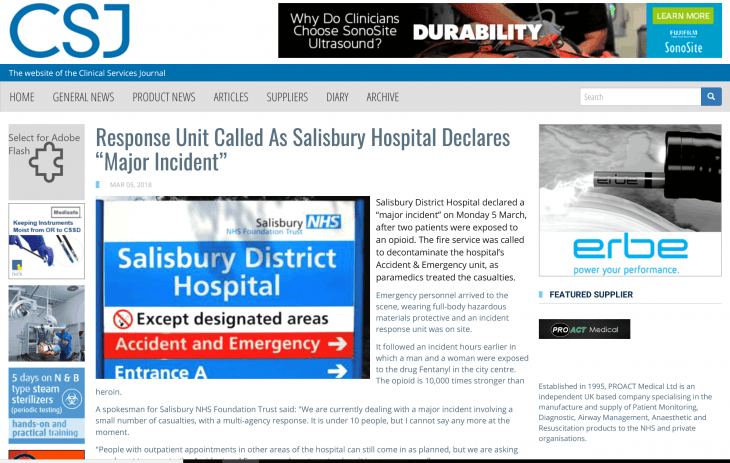
(This, by the way, is extremely interesting. The screen shot above is the original report on the website of Clinical Services Journal, and it can now be found on the website, web.archive.org. The original piece, however, has since been updated on the Clinical Services Journal, not with a correction, but with the reference to Fentanyl being removed altogether (compare here with here h/t Dilyana Gaytandzhiev)
5. A lethal nerve agent that can be dealt with by water and baby wipes
The Official Narrative requires you not only to believe that the substance which poisoned the Skripals is so deadly that Mr Skripal’s house may need to be demolished and a multi-million pound clean-up of Salisbury with chaps in HazMats a necessity.
…But that the same substance can be treated with warm water, soap and baby wipes, as evidenced by the advice given by Public Health England (PHE) a week after the incident, to anyone who may have come into contact with it:
“Wash the clothing that you were wearing in an ordinary washing machine using your regular detergent at the temperature recommended for the clothing. Wipe personal items such as phones, handbags and other electronic items with cleansing or baby wipes and dispose of the wipes in the bin (ordinary domestic waste disposal)… Other items such as jewellery and spectacles which cannot go in the washing machine or be cleaned with cleansing or baby wipes, should be hand washed with warm water and detergent and then rinsed with clean cold water. Please thoroughly wash your hands with soap and water after cleaning any items.”
6. The nerve agent went undetected on a door handle for weeks
The Official Narrative requires you not only to believe that the assassins poured “military grade nerve agent”, in liquid form, on the handle of Mr Skripal’s front door, and that the British Government had possession of an FSB “assassin’s handbook” detailing this procedure.
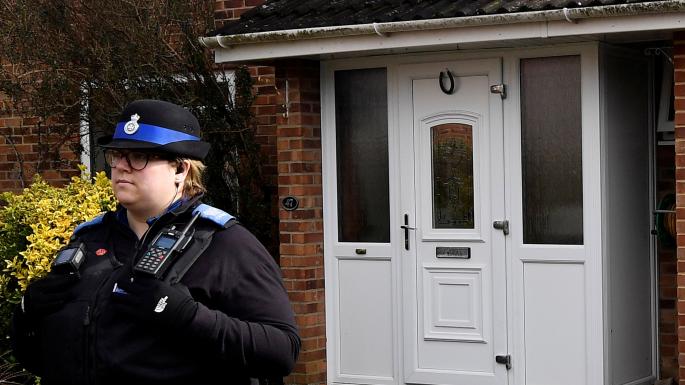
… But that despite apparently having this handbook, the door handle theory was only mentioned more than three weeks after the incident, during which time many people (such as the unsuspecting policewoman at the top of this piece), came within a few feet of a door apparently smeared with lethal nerve agent, with no protective clothing, and suffered no ill effects.
7. The highly volatile nerve agent that was still highly pure weeks later
The Official Narrative requires you not only to believe that the substance examined in blood and environmental samples by the OPCW, weeks after the incident was:
“…of high purity. The latter is concluded from the almost complete absence of impurities.”
… But also that the substance used is known to be both unstable and vulnerable to water – and Salisbury definitely had plenteous rain and even snow between the incident and the coming of the OPCW!
8. That the substance used is proof of Russian state culpability
The Official Narrative requires you to believe that because the substance allegedly used was first developed in Russia (actually Soviet Union), there are only two explanations for the poisoning:
- It was an act of the Russian state
- That the Russian state lost control of its stocks
… Yet it requires you to believe this in the full knowledge that not only have other countries produced it (the United States has been patenting “Novichok” products for years; Iran produced it in 2016; and the United Kingdom possesses samples of it), but according to the chairman of the OPCW, Ahmet Uzumcu, A-234 could be produced:
“…in any country where there would be some chemical expertise.”
9. That the movements of Detective Sergeant Bailey on 4th March cannot be officially confirmed
The Official Narrative requires you to believe not only that Detective Sergeant Nick Bailey, who is a member of Wiltshire Criminal Intelligence Department (CID), was poisoned with the same substance as the Skripals.
…But that his movements cannot be established, since it has still not been officially confirmed whether he was at the bench in The Maltings or at Mr Skripal’s house (and in point of fact, either scenario is remarkably odd, since D.S. Bailey is a member of CID, and there was no suggestion until at least 24 hours after the incident that a crime may have been committed).
10. The cleansing of Salisbury hotspots, but not all Salisbury hotspots
The Official Narrative requires you to believe not only that there are parts of Salisbury that may be contaminated with a lethal substance, and that this will require a clean up operation involving thousands of man hours, costing millions, and taking months to complete.
…But that some of these areas were no danger to the public for a month-and-a-half, when they were cordoned off with nothing more than police tape. In addition, some of the areas that the Skripals were known to have walked down after apparently coming into contact with the substance, such as the Market Walk, have been free to the public to walk through since the start of the incident and remain completely open (I know this personally, because as a Salisbury resident, I have walked through the Market Walk in the last few days).
* * *
Put all these things together — and this is not to even mention the current condition and whereabouts of the Skripals — and what you have is a theory in which claims are flatly contradicted by basic facts, many so-called facts are simply not facts at all, and assertions are made without any recourse to the reality on the ground. It is abundantly clear that the Official Narrative not only did not happen; it cannot have happened. As things stand it is “highly likely” that what we have been told is a conspiracy theory of “high purity”, “of a type developed by Whitehall.”
Sunday Times ‘explosive’ report on Russian bot support for Corbyn is really a complete dud
RT | April 29, 2018
Just when you thought we’d hit peak ‘Russian meddling’ claims, there’s a whole new fear-mongering report in town. The Sunday Times has released an ‘investigation’ linking a pesky Russian bot army with Labour’s June election gains.
Heaven forbid British voters may have been swayed by a lack of leadership by the Tories…
The Sunday Times exclusive, but apparently not in-depth, joint investigation with Swansea University claims that 6,500 ‘Russian’ Twitter accounts sent messages of support for the British Labour Party in the seven weeks before last year’s snap general election, sharing “mass-produced” and “orchestrated” political messages.
Given that politicians and multi-billion dollar corporations spend exorbitant amounts of money trying to influence public opinion, it’s extremely hard to imagine how recently-created, thinly-veiled bot accounts could possibly garner enough of a following to somehow influence millions of voters across the UK within mere weeks. That logic didn’t stop the Times, though.
Among the handpicked accounts sampled in the study, nine out of 10 messages were in support of the Labour party while 9 out of 10 messages mentioning the Conservative party were critical. In addition, some 80 percent of the “automated accounts” were created in the weeks prior to the June, 2017 general election. Notably, the list of Twitter accounts ‘studied’ by the paper and university have not been released, nor have they outlined just how many followers (which is generally a good barometer of the potential reach of a tweet) the accounts had.
Here we go again…
The ‘revelations’ fall neatly in line with the ongoing scapegoat narrative across the mainstream media: Russia is supposedly influencing everything from the 2016 US presidential election to the Brexit vote to potentially meddling in the German elections and the Catalonian independence referendum. While time and time again the narrative fails due to blatant lack of evidence, it is seemingly irresistible to Western MSM and politicians alike.
Just this week, the US House Intelligence Committee “found no evidence that the Trump campaign colluded, coordinated, or conspired with the Russian government.” Yet the narrative persists.
The timing of publication for the Sunday Times report is also rather conspicuous given Labour’s reported lead over the Conservatives heading into next week’s local elections, as noted online.
How they ‘cracked the case’
According to the Sunday Times, academics at Swansea University helpfully identified the accounts and tweets for the investigation. One of the academics has been fielding questions online regarding the study’s curious methodology.
Interestingly, while Talavera lists his location as ‘South West, England,’ he does also have European, British, and Ukrainian flag emojis on his public Twitter profile. Using his own methodology, though – that language or national identity immediately equate to political bias – one could attribute his account to any number of foreign actors who might seek to influence elections in Britain.
He also doesn’t acknowledge that Twitter users can set their own locations, nor does he address a claim in the Times that “many of our Russian bot accounts gave American states as their location.”
The economics lecturer is one of the co-founders of Vox Ukraine, “an independent analytical platform founded in 2014, after the Revolution of Dignity, by a team of highly experienced economists and lawyers based in Ukraine and abroad.”
Meanwhile, Swansea University boasts a Hillary Clinton PhD scholarship – but the Times doesn’t note any potential conflict of interest there or any potential for influence peddling via ‘academic research.’
Those beastly bots
Hundreds of the bot accounts were reportedly created simultaneously and “displayed clear identifying factors.” One common distinguishing feature among the accounts was that they used “15-character alphanumeric usernames” (as is the case with almost all Twitter users) and “with a false western woman’s name attached.” What differentiates these accounts, apparently, is that they listed their first language as Russian.
The Times also claimed that hundreds of the accounts were set up simultaneously despite Twitter only displaying the month and year in which the account was created, not the specific day. Perhaps all of the accounts synchronized their first tweets (or retweets, as seems to be the case in a lot of the examples cited by The Times ), though the analysis does not explicitly state this. In addition, Twitter’s Application Programming Interface (API) is closed to the public, meaning it would be incredibly difficult, or nigh on impossible, for researchers to gain access to the metadata for thousands of accounts, Russian bot or otherwise.
Furthermore, the bot accounts were reportedly later suspended by Twitter’s moderators or voluntarily shut themselves down, presumably after some sort of bot existential crisis. We say ‘reportedly,’ as apparently the researchers didn’t go back and check.
What about causation vs correlation?
The accounts apparently retweeted pro-Labour and anti-Tory messages on May 18, when Theresa May announced the Conservative manifesto. In particular, according to the Times, the bots retweeted Corbyn campaign publicity, particularly around rallies which drew “unusually large crowds.” Crucially, The Times’ analysis doesn’t quite delve into how there’s causation (as it implies) rather than correlation between retweets and participant numbers growing at rallies.
Swansea researchers claimed that 16,000 “Russian bots” had been tweeting about British politics since last April. However, they decided to narrow their focus to a sample of just 6,500 accounts and 20,000 individual tweets posted by that selection in the four weeks before the UK General election, based on an apparently ad hoc list of criteria.
The Times also concludes that Labour “won the social media war” because of greater shares online despite the fact that the Conservatives outspent Labour on Facebook advertisements, not to mention that this study was focused solely on Twitter.
The West Closes its Ears to Douma Testimony
By Jonathan Cook | Dissident Voice | April 28, 2018
The response from the US, UK and France to a briefing on Thursday at the Organisation for the Prohibition of Chemical Weapons (OPCW) in the Hague was perverse, to say the least. Russia had brought 17 witnesses from Douma who stated that there had been no chemical weapons attack there earlier this month – the pretext for an illegal air strike on Syria by the three western states.
The witnesses, a mix of victims and the doctors who treated them, told accounts that confirmed a report provided last week from Douma by British reporter Robert Fisk – a report, it should be noted, that has been almost entirely blanked by the western media. According to the testimony provided at the OPCW, the victims shown in a video from the site of the alleged attack were actually suffering from the effects of inhaling dust after a bombing raid, not gas.
The first strange thing to note is that the US, UK and France boycotted the meeting, denouncing Russia for producing the witnesses and calling the event an “obscene masquerade” and “theatre”. It suggests that this trio, behaving like the proverbial three monkeys, think the testimony will disappear if they simply ignore it. They have no interest in hearing from witnesses unless they confirm the western narrative used to justify the air strikes on Syria.
Testimony from witnesses is surely a crucial part of determining what actually happened. The US, UK and France are surely obligated to listen to the witnesses first, and then seek to discredit the testimony afterwards if they think it implausible or coerced. The evidence cannot be tested and rebutted if it is not even considered.
The second is that the media are echoing this misplaced scorn for evidence. They too seem to have prejudged whether the witnesses are credible before listening to what they have to say (similar to their treatment of Fisk). Tellingly, the Guardian described these witnesses as “supposed witnesses”, not a formulation that suggests any degree of impartiality in its coverage.
Notice that when the Guardian refers to witnesses who support the UK-UK-French line, often those living under the rule of violent jihadist groups, the paper does not designate them “supposed witnesses” or assume their testimony is coerced. Why for the Guardian are some witnesses only professing to be witnesses, while others really are witnesses. The answer appears to depend on whether the testimony accords with the official western narrative. There is a word for that, and it is not “journalism”.
The third and biggest problem, however, is that neither the trio of western states nor the western media are actually contesting the claim that these “supposed witnesses” were present in Douma, and that some of them were shown in the video. Rather, the line taken by the Guardian and others is that: “The veracity [of] the statements by the Russian-selected witnesses at The Hague will be challenged, since their ability to speak truthfully is limited.”
So the question is not whether they were there, but whether they are being coerced into telling a story that undermines the official western narrative, as well as the dubious rationale for attacking Syria.
But that leaves us with another difficulty. No one, for example, appears to be doubting that Hassan Diab, a boy who testified at the hearing, is also the boy shown in the video who was supposedly gassed with a nerve agent three weeks ago. How then do we explain that he is now looking a picture of health? It is not as though the US, UK and French governments and the western media have had no time to investigate his case. He and his father have been saying for at least a week on Russian TV that there was no chemical attack.
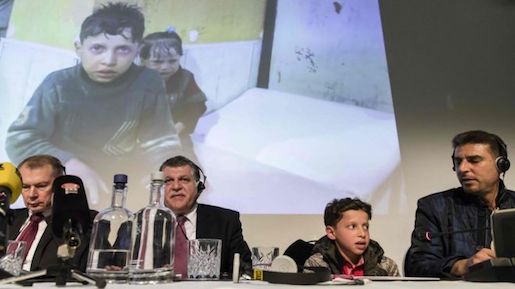
Instead, we are getting yet more revisions to a story that was originally presented as so cut-and-dried that it justified an act of military aggression by the US, UK and France against Syria, without authorisation from the UN Security Council – in short, a war crime of the highest order.
It is worth noting the BBC’s brief account. It has suggested that Diab was there, and that he is the boy shown in the video, but that he was not a victim of a gas attack. It implies that there were two kinds of victims shown in the video taken in Douma: those who were victims of a chemical attack, and those next to them who were victims of dust inhalation.
That requires a great deal of back-peddling on the original narrative.
It is conceivable, I suppose, that there was a chemical attack on that neighbourhood of Douma, in which people like Diab assumed they had been gassed when, in fact, that they had not been, and that others close by were actually gassed. It is also conceivable that the effects of dust inhalation and gassing were so similar that the White Helmets staff mistakenly filmed the “wrong victims”, highlighting those like Diab who had not been gassed. And it is also conceivable, I guess, that Diab and his family now feel the need to lie under Russian pressure about there not being a gas attack, even though their account would, according to this revised narrative, actually accord with their experience of what happened.
But even if each of these scenarios is conceivable on its own, how plausible are they when taken together. Those of us who have preferred to avoid a rush to judgment until there was actual evidence of a chemical weapons attack have been invariably dismissed as “conspiracy theorists”. But who is really proposing the more fanciful conspiracy here: those wanting evidence, or those creating an elaborate series of revisions to maintain the credibility of their original story?
If there is one thing certain in all of this, it is that the video produced as cast-iron evidence of a chemical weapons attack has turned out to be nothing of the sort.
Former Russian regional leader wins slander lawsuit over Reuters report of ISIS ties

FIDE President Kirsan Ilyumzhinov at a news conference © Anton Denisov / Sputnik
RT | April 27, 2018
Former president of the Russian internal republic of Kalmykia and the current head of FIDE, Kirsan Ilyumzhinov, says he has proved in court that a Reuters report about alleged deals with ISIS was fake and aimed to slander him.
“I have won my court case against Reuters, they have already apologized and now I am expecting them to pay me £50,000 ($69,000) in damages,” RIA Novosti quoted him as saying. “I have already received official apologies from the Washington Times newspaper and there is another newspaper that we have sued for $500,000. Step by step, I am going to win,” he added.
Kirsan Ilyumzhinov is a Russian politician, businessman and chess grandmaster, who headed the Russian region of Kalmykia between 1993 and 2010, and is currently the president of the World Chess Federation (FIDE).
Ilyumzhinov filed a lawsuit against Reuters in March 2016, claiming that the agency’s report of his alleged oil deals with the Islamic State terrorist group (IS, formerly ISIS) was false, and that it damaged his reputation and honor. He also sued two chess players, who spread similar information on social networks, but the outcome of this case is not yet known.
In November 2015, the United States put Ilyumzhinov on the sanctions list over his alleged material aid and other actions in the interests of the Syrian government, central bank and President Bashar Assad.
In early 2017, Ilyumzhinov accused the US of staging a plot to oust him from the post of FIDE president. “I did not sign anything and I am not stepping down. I believe the Americans are behind this escapade and it looks like a set-up,” he told reporters in comments on reports of his alleged resignation.
Also in early 2017, Ilyumzhinov told reporters that he would be running for FIDE president again in 2018, despite the problems caused by the US sanctions.
Featured Video
AIDS Inc. by Gary Null (2007)
or go to
Aletho News Archives – Video-Images
From the Archives
Clash of Civilization, Iran Part II
By Jamal Kanj – Intifada-Palestine.com – January 14, 2011
Israel’s survival kit is: perpetuate conflict, insecurity to rationalize collective hate and finally playing victim.
Devoid of conflict, Israel implodes internally; without hate, Zionism loses its justification; and playing eternal victim to continue blackmailing the West. Absence of this holy trinity, Israel ceases to exist.
From its inception, the house of Zion has mastered exploiting adversarial powers to advance Israel’s cause. For instance, their influence over the Democratic Party in the US began with President Truman’s bid for 2nd term election in 1948.
Responding to strong opposition from Secretary of State General George Marshall and Department experts urging against recognition of Israel, President Truman replied: “I’m sorry gentlemen but I have to answer to hundreds of thousands [Jewish voters] who are anxious for the success of Zionism. I do not have hundreds of thousands of [voting] Arabs among my constituents”
Zionists influence over liberal American politics was matched with the doctrinal school of Conservative theoreticians aligning the Republican Party’s platform with Israel’s objectives. The Neoconservative Zionists, coined Zioncons, invented the “Clash of Civilization” concept to fight Israel’s wars. … continue
Blog Roll
 Aletho News
- 12 Things Your Psychiatrist Was Trained Not to Tell You
- From Unipolar Universalism to Multipolar Civilizational Distinctiveness
- RSF military group defects, joins Sudanese army: State media
- Ireland goalkeeper refuses to play ‘Israel’ as squad weighs boycott
- China pushes back against US on Cuba, Iran
- Ukrainian Soldiers, Potential Mercenaries: Have Gun, Will Travel!
- Burnham’s UN debut… A masterclass in British disinformation
- Iran flights continue despite US aviation sanctions
- Global Tipping Points Lead the World Into a State of Entropy
- The day-after at the White House: USA and Xi Jinping
- If Americans Knew
- Israel forces Gazans to live in constant peril – Daily Update
- Deconstructing Netanyahu’s pants-on-fire UN rant – Daily Update
- Trump betrayed voters with his campaign lies and prioritized a foreign country once he took office
- Netanyahu calls Israel’s war in Gaza ‘opposite of genocide’ in UN speech to near-empty hall
- Settler Kidnappings: Torture, Sexual Abuse and Terrorisation of Palestinian Abductees as Israel Deepens Annexation of West Bank
- Gaza winter nears as 162,000 tents become unusable, raising fears of humanitarian crisis
- Netanyahu says, “It’s the opposite of genocide”; UN says Gaza economy is world’s ‘most severe crisis on record’ – Daily Update
- Israel’s US-Backed Assault on Gaza Has Created the ‘World’s Most Severe Economic Crisis on Record’: UN
- ‘Protecting U.S. Citizens’… From Israel
- ‘This is where I live now, the back of a truck’: a day in the life of a grandmother in Gaza
- No Tricks Zone
- New Study: Earth And Venus Surface Warmth Largely Explained By Convection And Lapse Rate, Not CO2 Or Radiation
- 2025 Nature Paper Claiming Worsening Global Drought Gets RETRACTED …Heavily Flawed
- New Study: ‘Global Drought Shows No Detectable Recent Acceleration Under Climate Warming’
- Economic Masterminds: German Socialists Suggest Taxing Productivity Gains Stemming From Using AI
- The South China Sea Has Not Been Cooperating With The Climate Change Narrative
- Energy Crisis: Germany Enters Heating Season With Historically Low Gas Reserve Fill Levels
- New Study: The Antarctic Ice Sheet Gained Mass From 2020-2024 Due To Staggering Snow And Ice Accumulation
- Study: Ocean Heating Rates From Thousands Of Years Ago ‘Dwarf’ Modern Ocean Heating Rates
- Climate Extremists Target, Attack Large-Scale Power Grid Infrastructure In Germany!
- New Study: Antarctic Ice Melt Has Contributed Less Than 1 Centimeter To Sea Level Rise In The Last 30 Years

